Phys 110 Chapter 19 Temperature LECTURE OUTLINE 19.1 Temperature and the Zeroth Law of Thermodynamics 19.2 Thermometers and the Celsius Temperature Scale 19.3 The Constant-Volume Gas Thermometer and the Absolute Temperature Scale 2 Two
"Phys 110 Chapter 19 Temperature LECTURE OUTLINE" is the property of its rightful owner. Permission is granted to
download and print the materials on this website for personal, non-commercial use only, and to display it
on your personal computer provided you do not modify the materials and that you retain all copyright
notices contained in the materials. By downloading content from our website, you accept the terms of this
agreement.
Presentation Transcript
01
Phys 110 Chapter 19 Temperature<br>
02
LECTURE OUTLINE 19.1 Temperature and the Zeroth Law of Thermodynamics
19.2 Thermometers and the Celsius Temperature Scale
19.3 The Constant-Volume Gas Thermometer and the Absolute Temperature Scale 2<br>
03
Two objects are in thermal equilibrium with each other if they do not exchange energy when in thermal contact.
The zeroth law of thermodynamics (the law of equilibrium): states that if objects A and B are separately in thermal equilibrium with a third object C, then objects A and B are in thermal equilibrium with each other.
Two objects in thermal equilibrium with each other are at the same temperature. Conversely, if two objects have different temperatures, then they are not in thermal equilibrium with each other. 19.1 Temperature and the Zeroth Law of Thermodynamics<br>
04
. Thermometers are devices that are used to measure the temperature of a system.
All thermometers are based on the principle that some physical property of a system changes as the system’s temperature changes.
Some physical properties that change with temperature are:
(1) the volume of a liquid
(2) the dimensions of a solid
(3) the pressure of a gas at constant volume
(4) the volume of a gas at constant pressure
(5) the electric resistance of a conductor
(6) the color of an object.
A temperature scale can be established on the basis of any one of these physical properties. 19.2 Thermometers and the Celsius Temperature Scale<br>
05
Temperature is the property that determines whether an object is in thermal equilibrium with other objects. Two objects in thermal equilibrium with each other are at the same temperature.
0°C is called the ice point of water.
100°C is the steam point of water.
The length of the liquid column of thermometer between the two points is divided into 100 equal segments to create the Celsius scale. Thus, each segment denotes a change in temperature of one Celsius degree.<br>
06
19.3 The Constant-Volume Gas Thermometer and the Absolute Temperature Scale An ideal gas is described by the equation of state:
PV=nRT
where n equals the number of moles of the gas, V is its volume, R is the universal gas constant (8.314 J/mol.K), and T is the absolute temperature.<br>
07
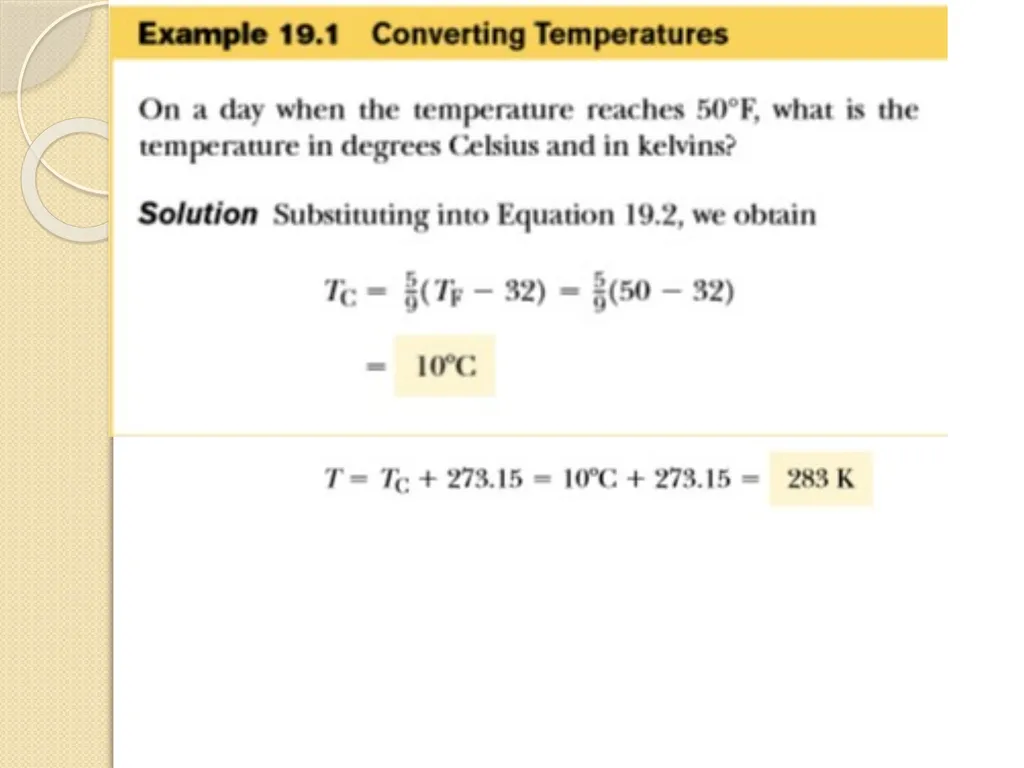
The Celsius, Fahrenheit, and Kelvin Temperature Scales The conversion between Celsius and Kelvin temperatures is:
The relationship between the Celsius and Fahrenheit temperature scales is:
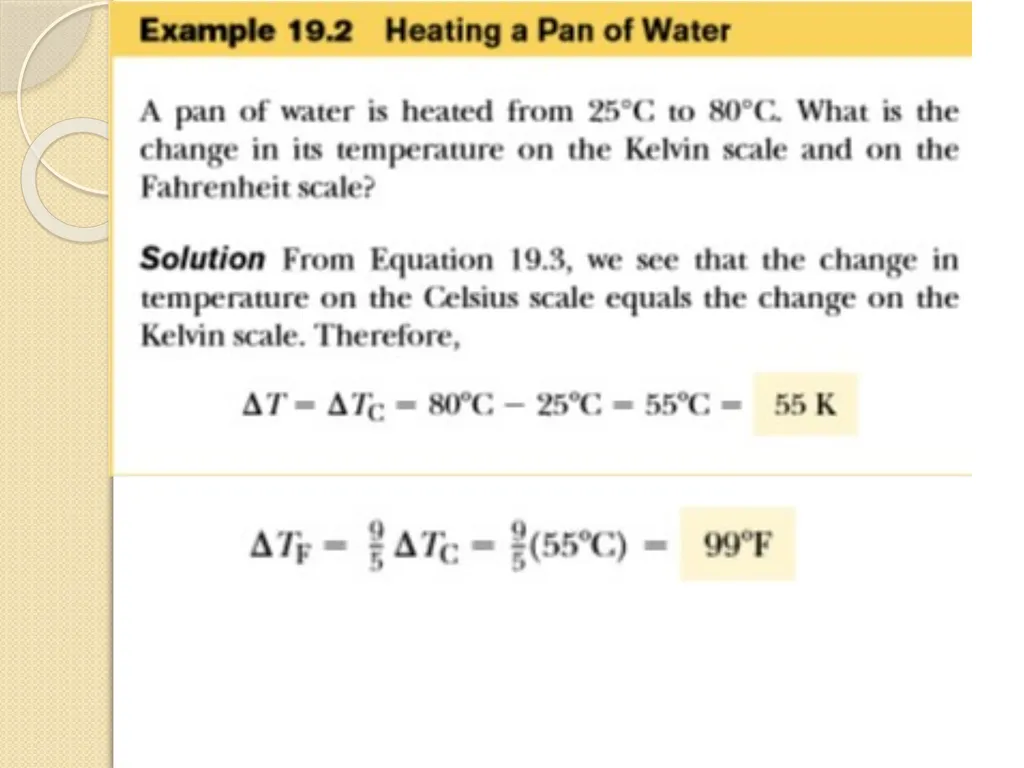
We can use the two Equations above to find a relationship between changes in temperature on the Celsius, Kelvin, and Fahrenheit scales:<br>
08
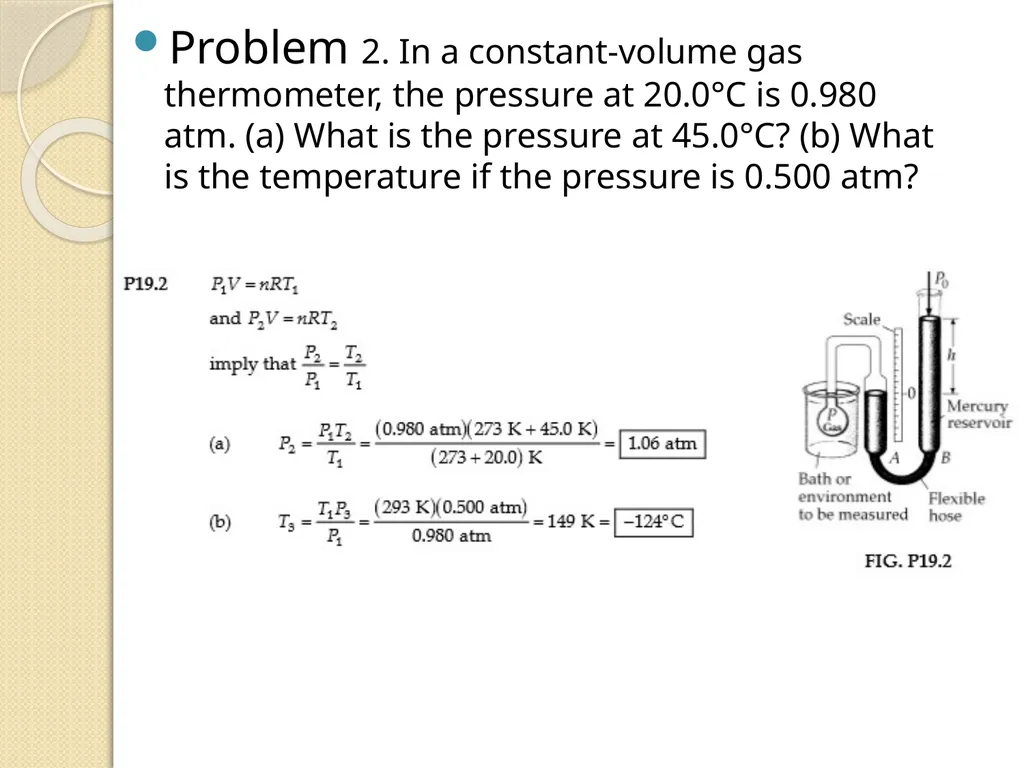
Problem 2. In a constant-volume gas thermometer, the pressure at 20.0°C is 0.980 atm. (a) What is the pressure at 45.0°C? (b) What is the temperature if the pressure is 0.500 atm?<br>
09
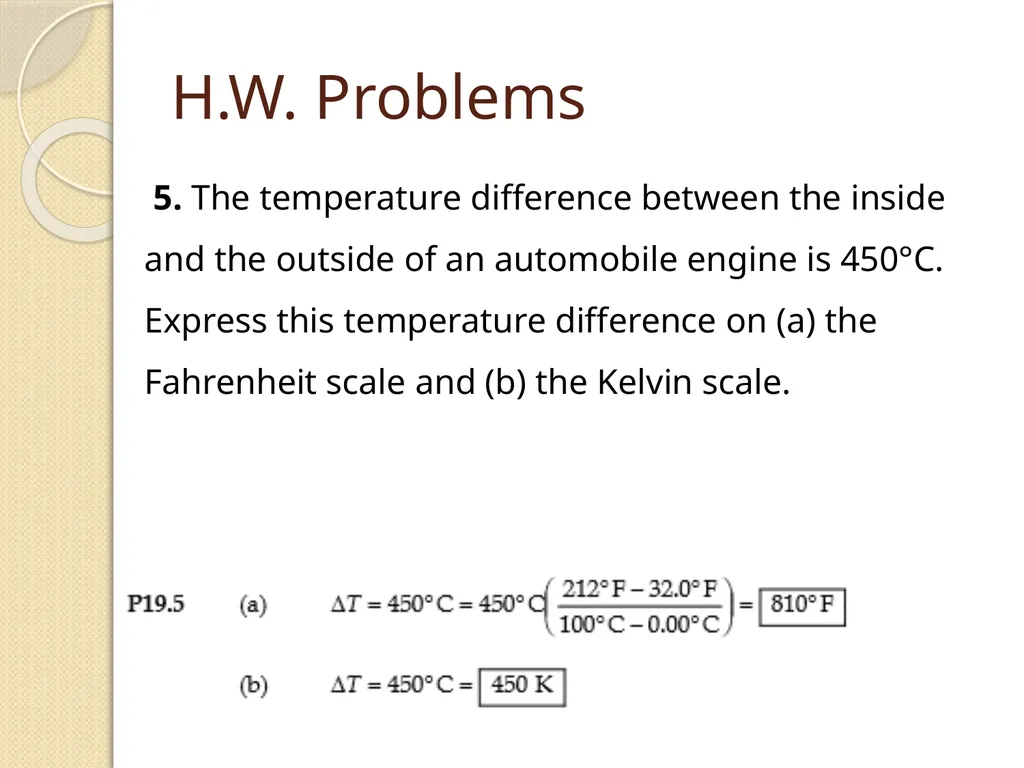
5. The temperature difference between the inside and the outside of an automobile engine is 450°C. Express this temperature difference on (a) the Fahrenheit scale and (b) the Kelvin scale. H.W. Problems<br>
10
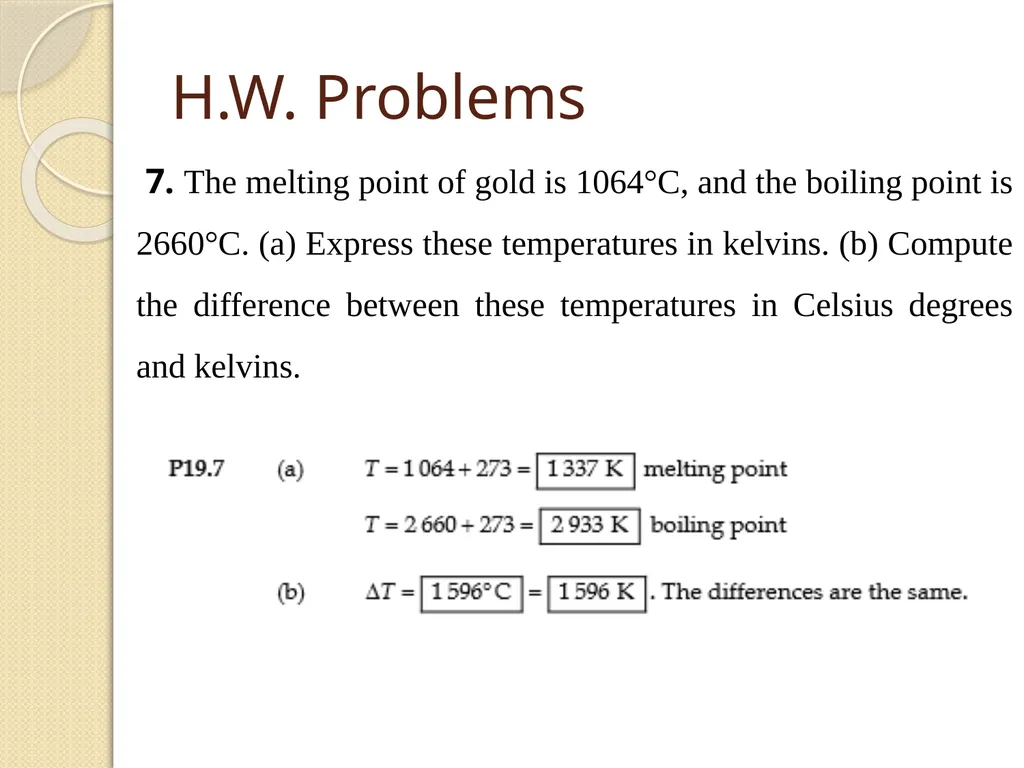
H.W. Problems 7. The melting point of gold is 1064°C, and the boiling point is 2660°C. (a) Express these temperatures in kelvins. (b) Compute the difference between these temperatures in Celsius degrees and kelvins.<br>