04
. Heat is defined as the transfer of energy across the boundary of a system due to a temperature difference between the system and its surroundings.
We use the symbol Q for the amount of energy transferred by this process.
The calorie is the amount of energy necessary to raise the temperature of 1 g of water from 14.5°C to 15.5°C. The mechanical equivalent of heat is 1 cal = 4.186 J.<br>
05
20.2 Specific Heat and Calorimetry<br>
06
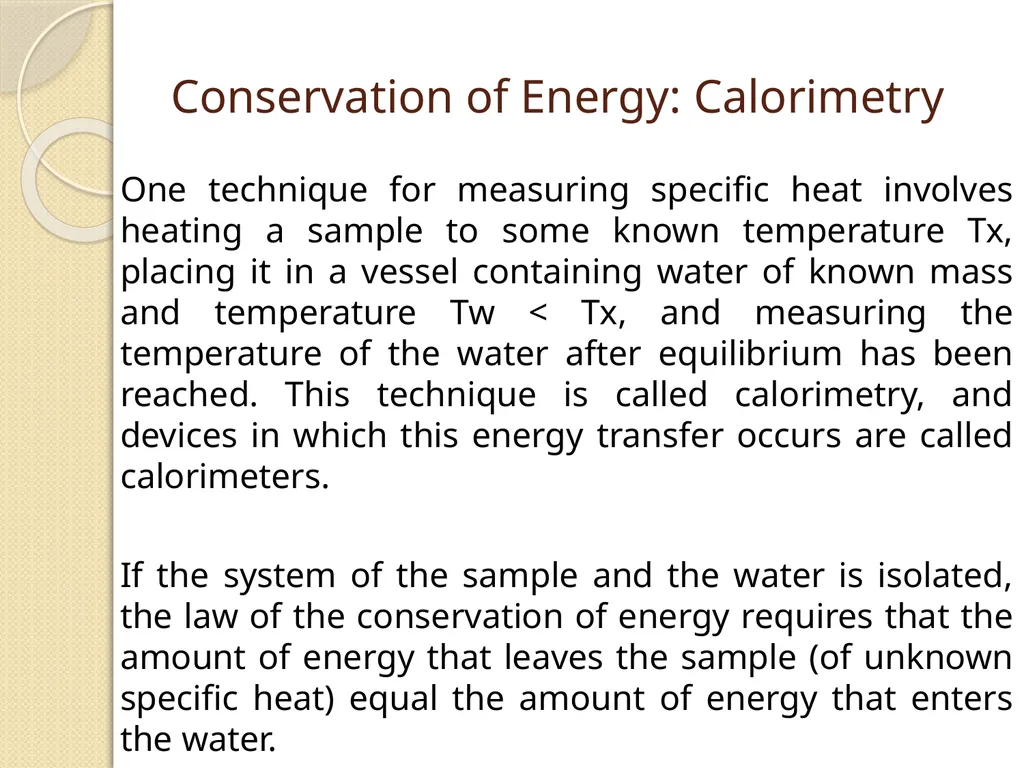
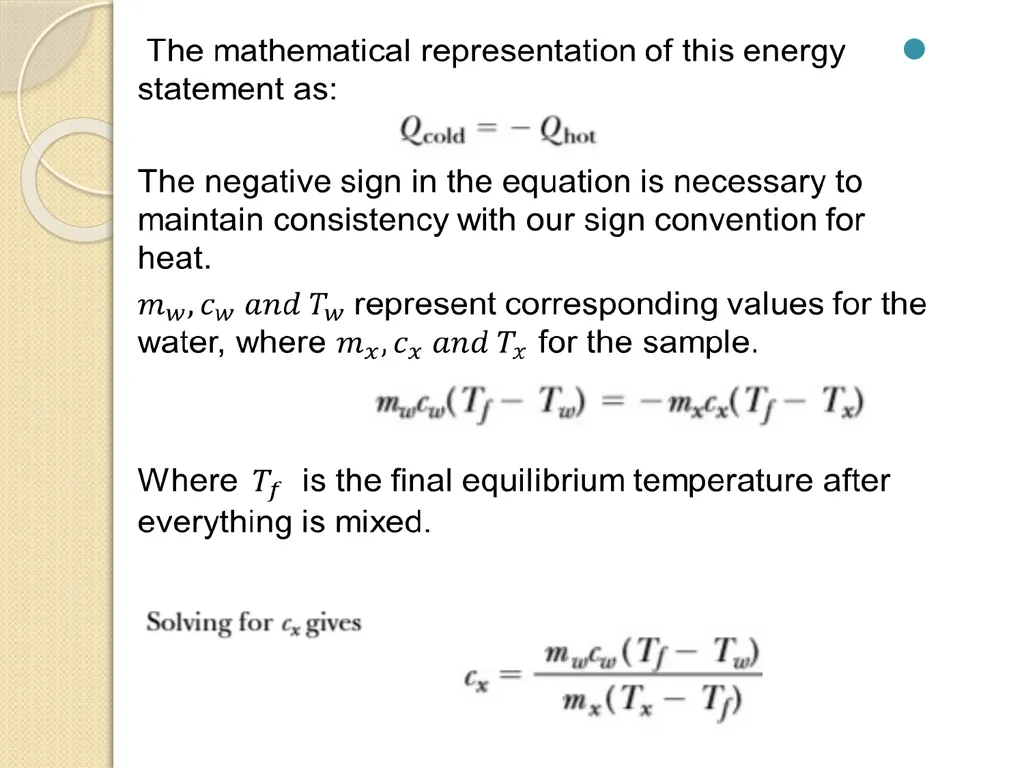
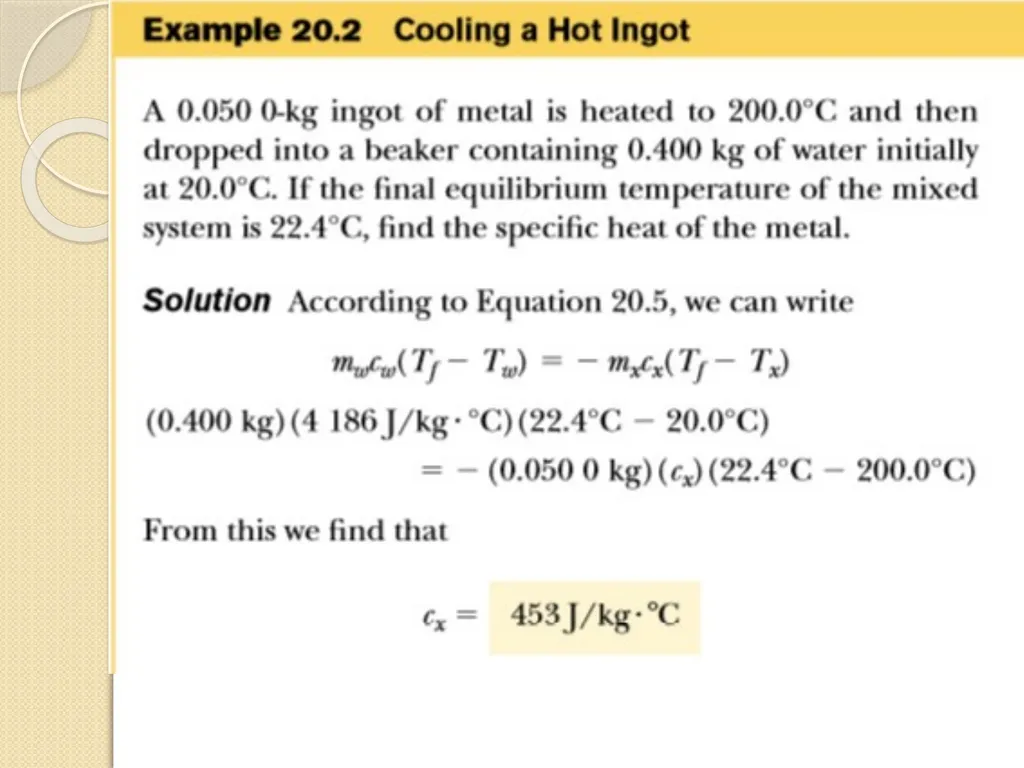
Conservation of Energy: Calorimetry One technique for measuring specific heat involves heating a sample to some known temperature Tx, placing it in a vessel containing water of known mass and temperature Tw < Tx, and measuring the temperature of the water after equilibrium has been reached. This technique is called calorimetry, and devices in which this energy transfer occurs are called calorimeters.
If the system of the sample and the water is isolated, the law of the conservation of energy requires that the amount of energy that leaves the sample (of unknown specific heat) equal the amount of energy that enters the water.<br>
07
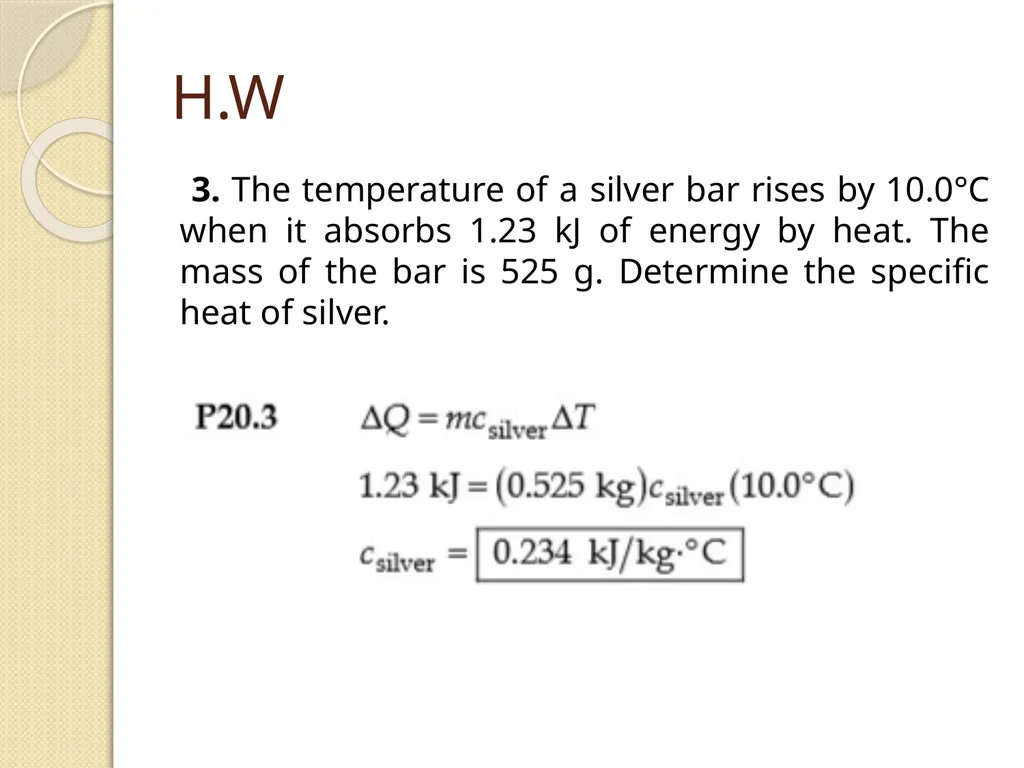
H.W 3. The temperature of a silver bar rises by 10.0°C when it absorbs 1.23 kJ of energy by heat. The mass of the bar is 525 g. Determine the specific heat of silver.<br>
08
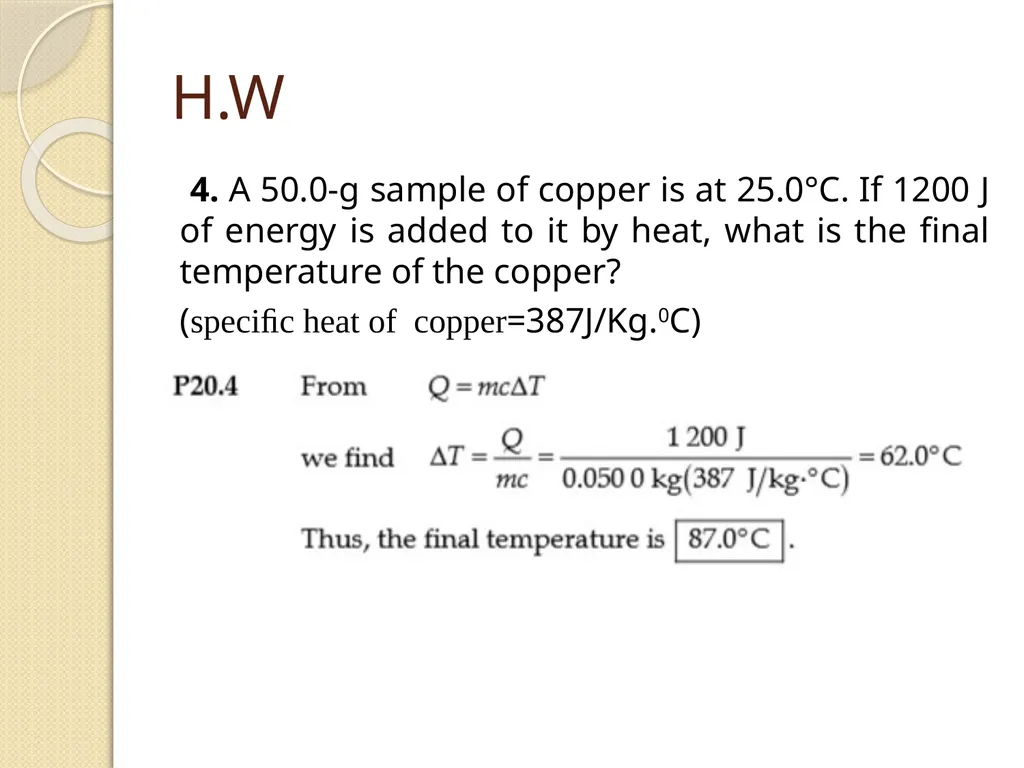
H.W 4. A 50.0-g sample of copper is at 25.0°C. If 1200 J of energy is added to it by heat, what is the final temperature of the copper?
(specific heat of copper=387J/Kg.0C)<br>
09
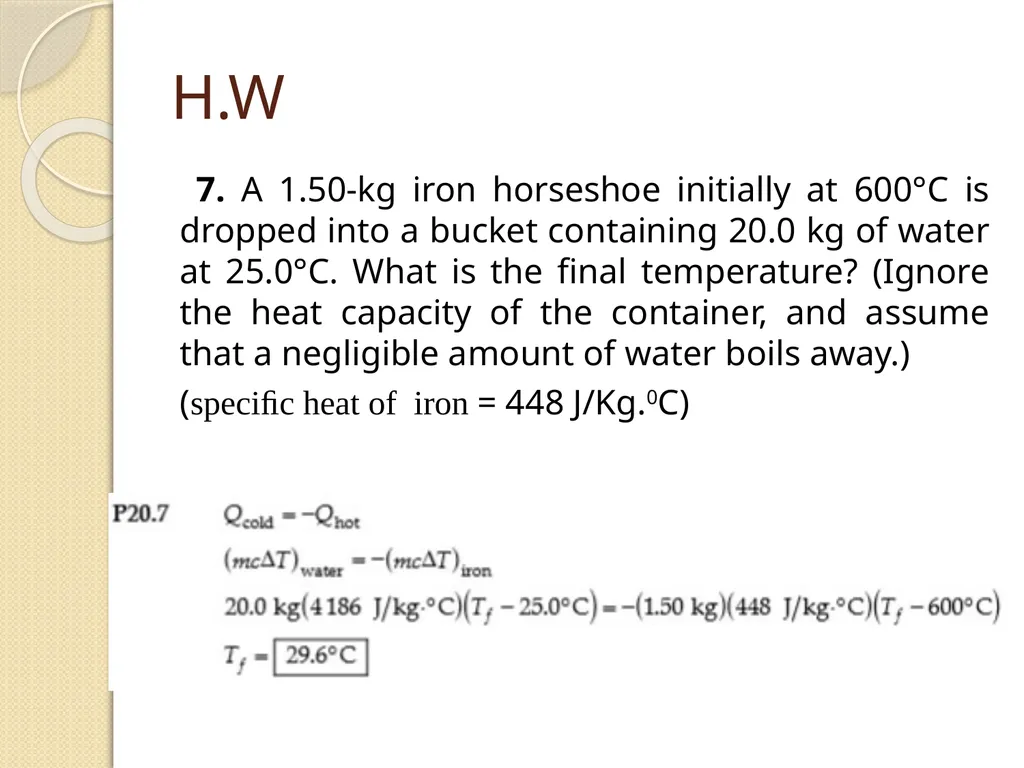
H.W 7. A 1.50-kg iron horseshoe initially at 600°C is dropped into a bucket containing 20.0 kg of water at 25.0°C. What is the final temperature? (Ignore the heat capacity of the container, and assume that a negligible amount of water boils away.)
(specific heat of iron = 448 J/Kg.0C)<br>
10
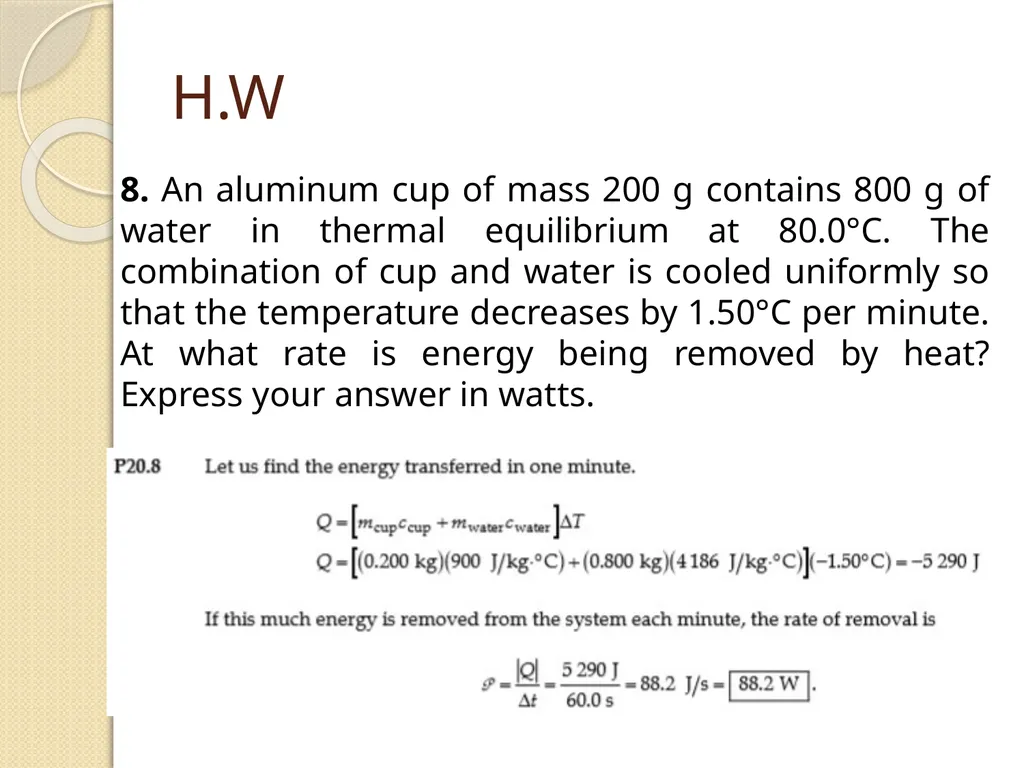
H.W 8. An aluminum cup of mass 200 g contains 800 g of water in thermal equilibrium at 80.0°C. The combination of cup and water is cooled uniformly so that the temperature decreases by 1.50°C per minute. At what rate is energy being removed by heat? Express your answer in watts.<br>
12
20.5 The First Law of Thermodynamics Suppose that a system undergoes a change from an initial state to a final state. During this change, energy transfer by heat Q to the system occurs, and work W is done on the system.
The quantity Q +W is determined completely by the initial
and final states of the system, and we call this quantity the change in the internal energy of the system.<br>
13
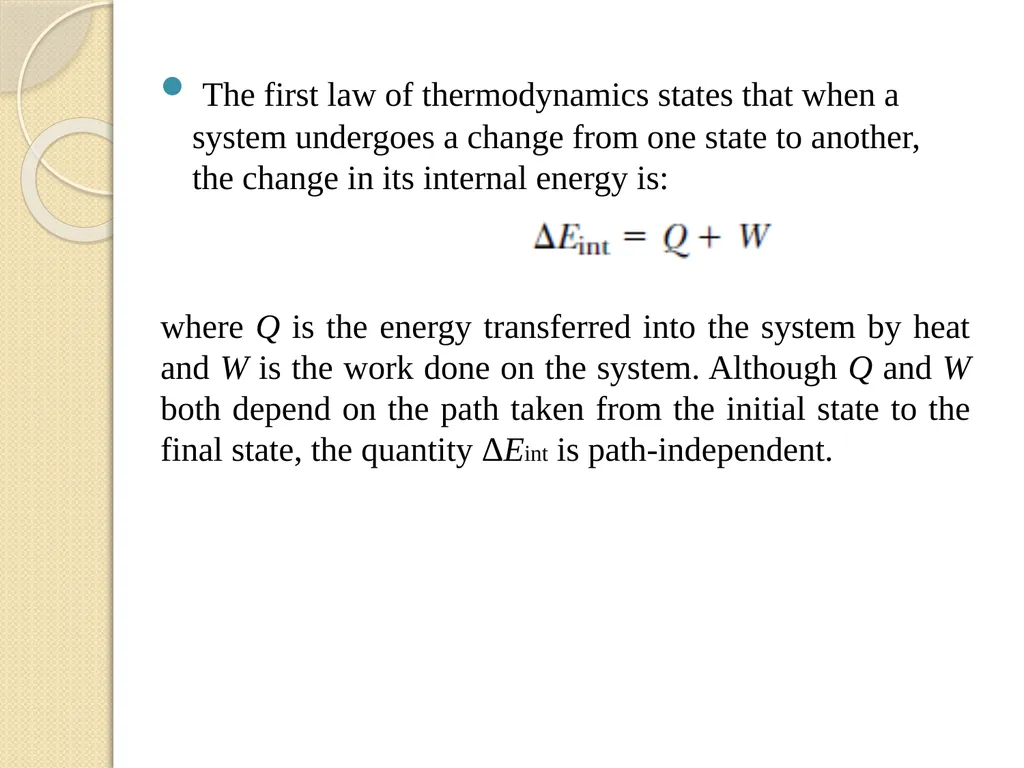
The first law of thermodynamics states that when a system undergoes a change from one state to another, the change in its internal energy is:
where Q is the energy transferred into the system by heat and W is the work done on the system. Although Q and W both depend on the path taken from the initial state to the final state, the quantity ΔEint is path-independent.<br>
14
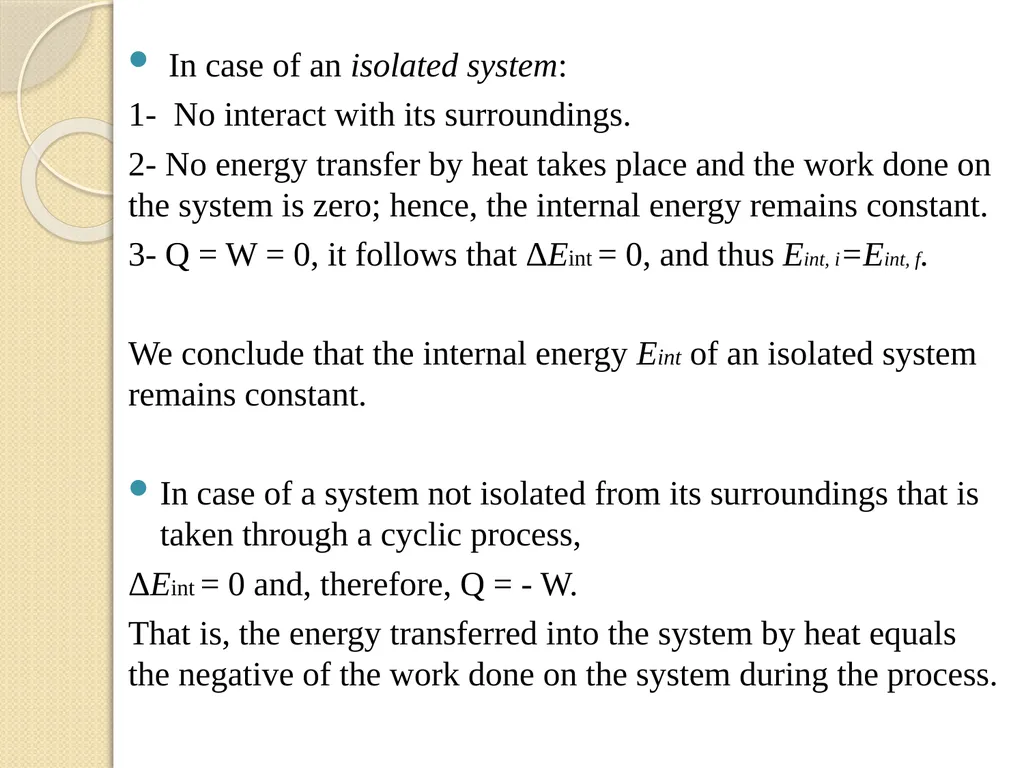
In case of an isolated system:
1- No interact with its surroundings.
2- No energy transfer by heat takes place and the work done on the system is zero; hence, the internal energy remains constant.
3- Q = W = 0, it follows that ΔEint = 0, and thus Eint, i=Eint, f.
We conclude that the internal energy Eint of an isolated system remains constant.
In case of a system not isolated from its surroundings that is taken through a cyclic process,
ΔEint = 0 and, therefore, Q = - W.
That is, the energy transferred into the system by heat equals the negative of the work done on the system during the process.<br>
15
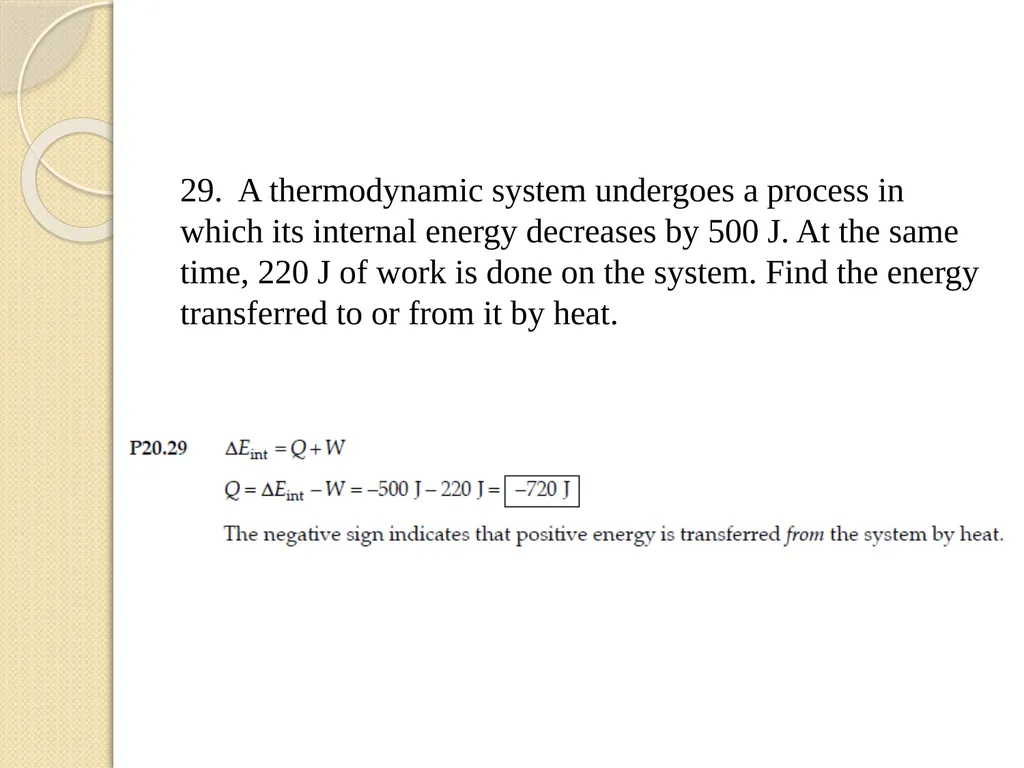
29. A thermodynamic system undergoes a process in which its internal energy decreases by 500 J. At the same time, 220 J of work is done on the system. Find the energy transferred to or from it by heat.<br>
16
30. A gas is taken through the cyclic process described in Figure below. (a) Find the net energy transferred to the system by heat during one complete cycle.
(b) What If? If the cycle is reversed—that is, the process follows the path ACBA—what is the net energy input per cycle by heat?<br>
17
20.7 Energy Transfer Mechanisms Energy may be transferred by work, which we addressed in Chapter 7, and by:
conduction,
convection, or
radiation.<br>
18
Conduction
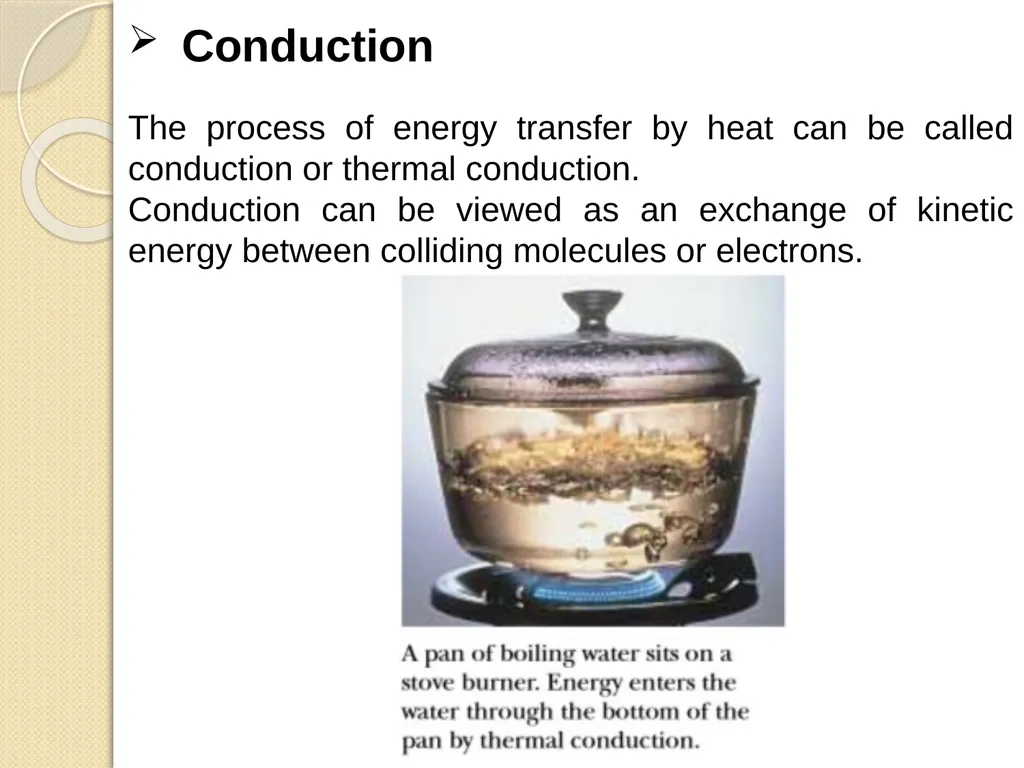
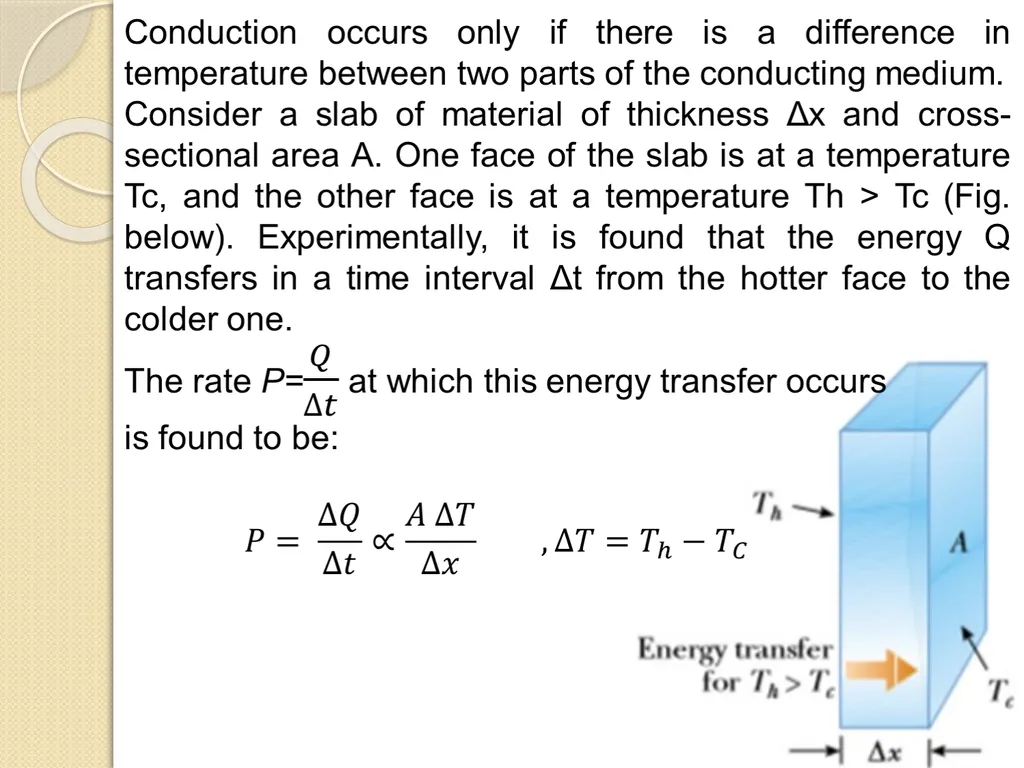
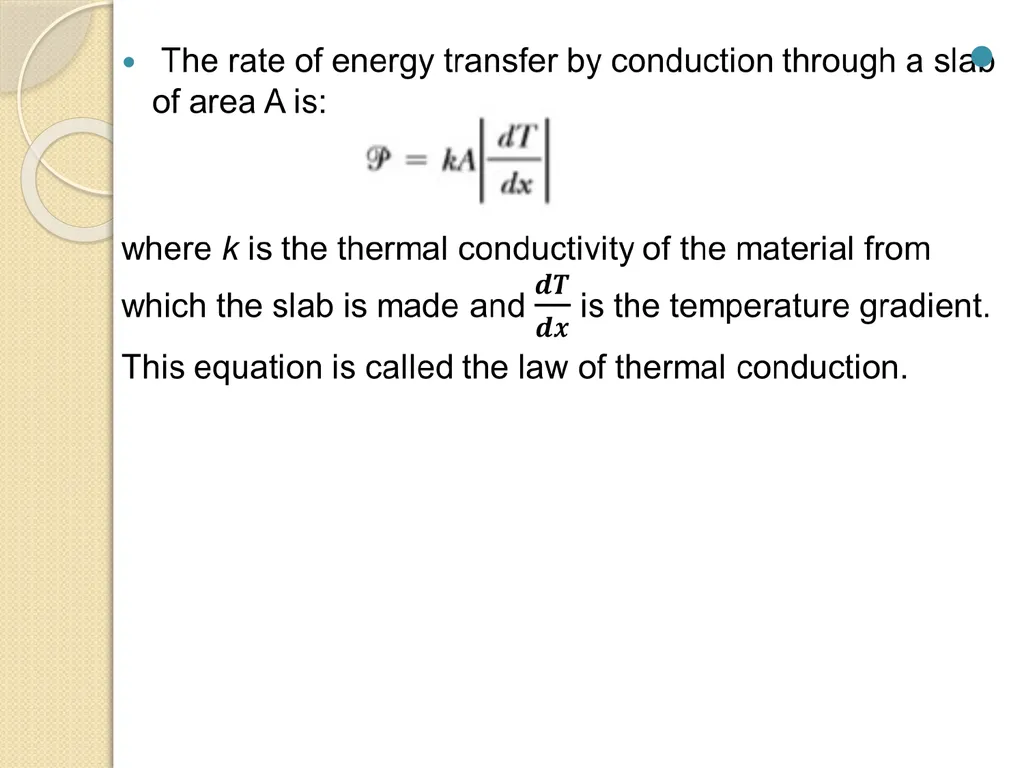
The process of energy transfer by heat can be called conduction or thermal conduction.
Conduction can be viewed as an exchange of kinetic energy between colliding molecules or electrons.<br>
19
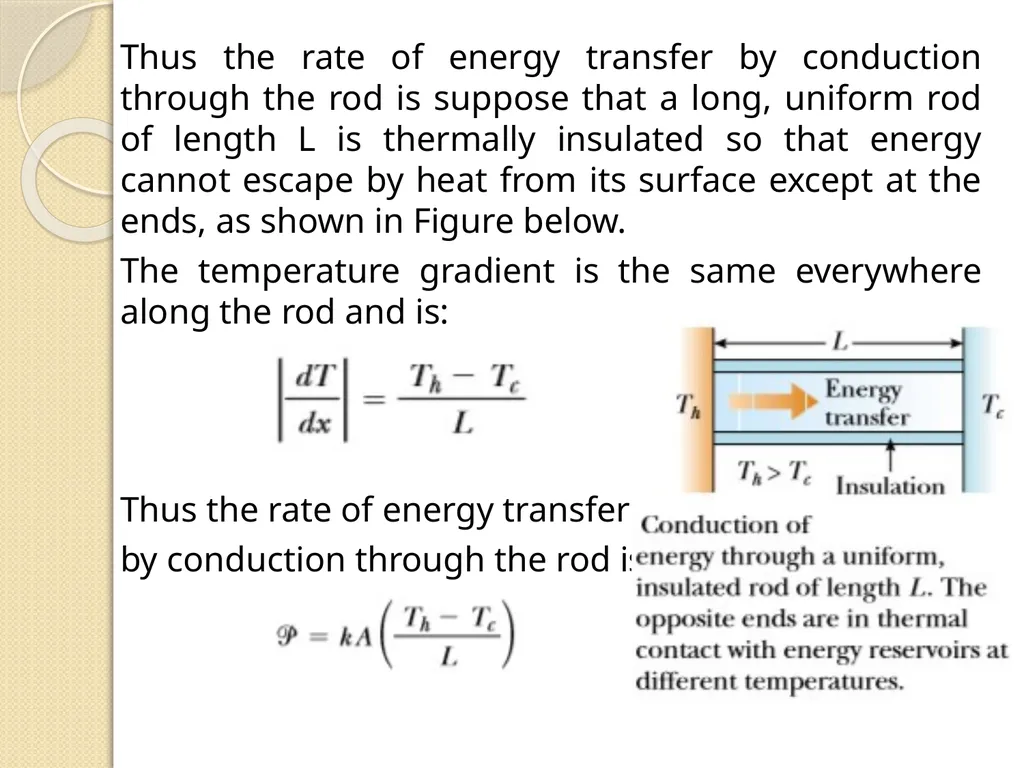
Thus the rate of energy transfer by conduction through the rod is suppose that a long, uniform rod of length L is thermally insulated so that energy cannot escape by heat from its surface except at the ends, as shown in Figure below.
The temperature gradient is the same everywhere along the rod and is:
Thus the rate of energy transfer
by conduction through the rod is:<br>
20
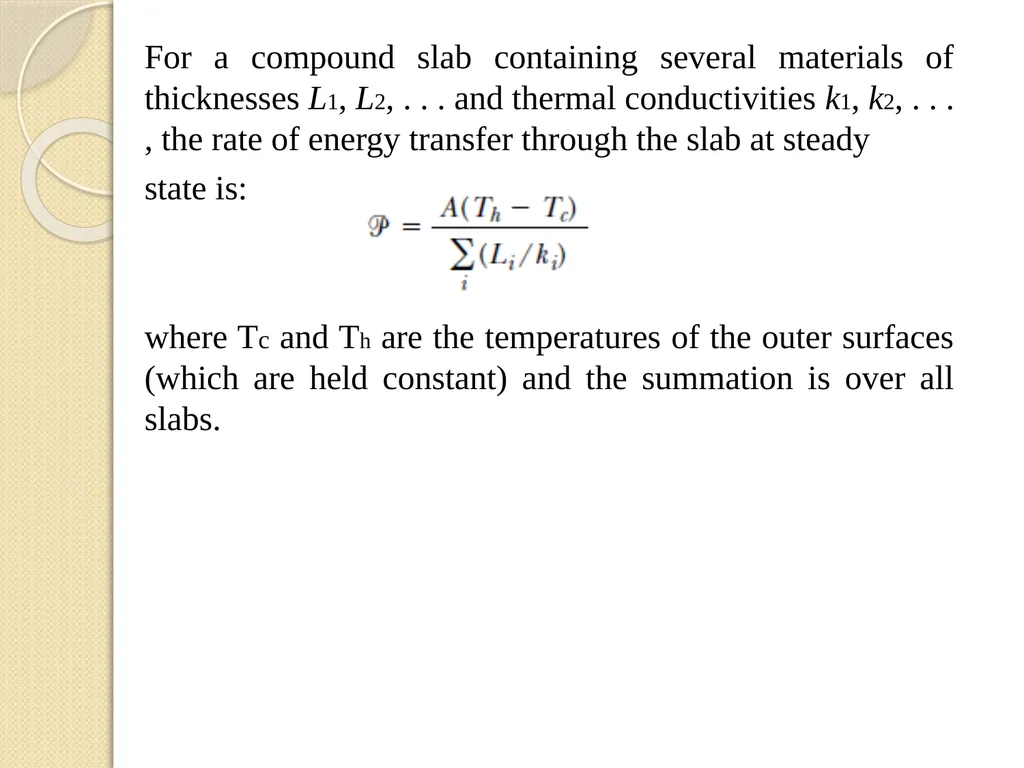
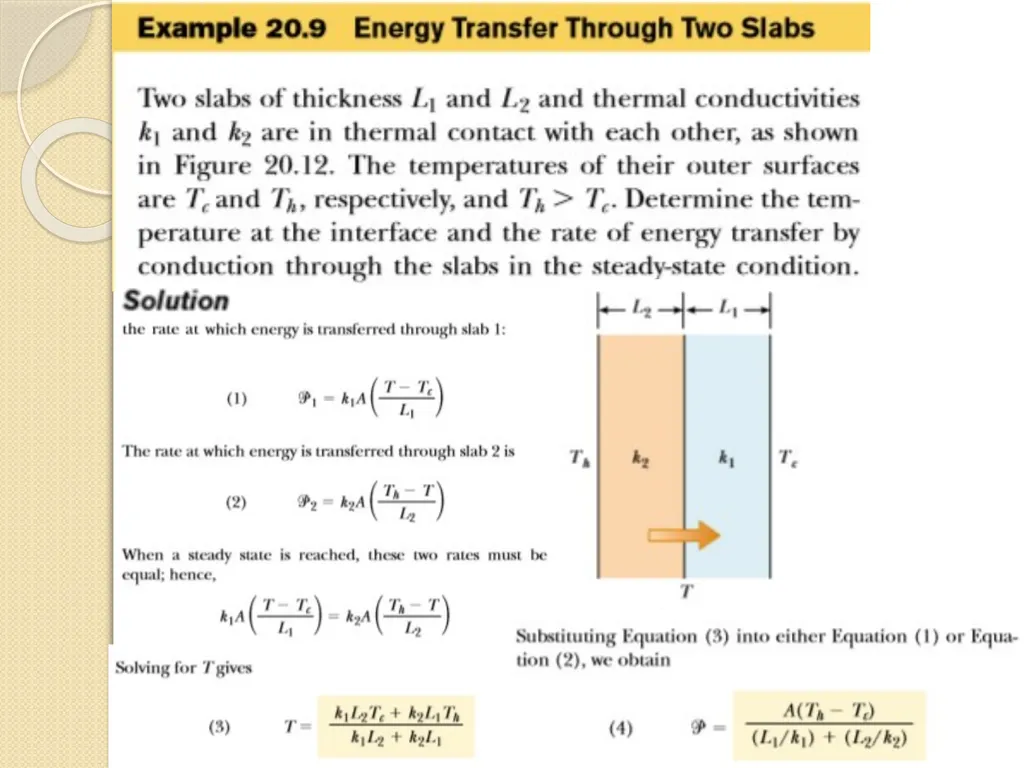
For a compound slab containing several materials of thicknesses L1, L2, . . . and thermal conductivities k1, k2, . . . , the rate of energy transfer through the slab at steady
state is:
where Tc and Th are the temperatures of the outer surfaces (which are held constant) and the summation is over all slabs.<br>
21
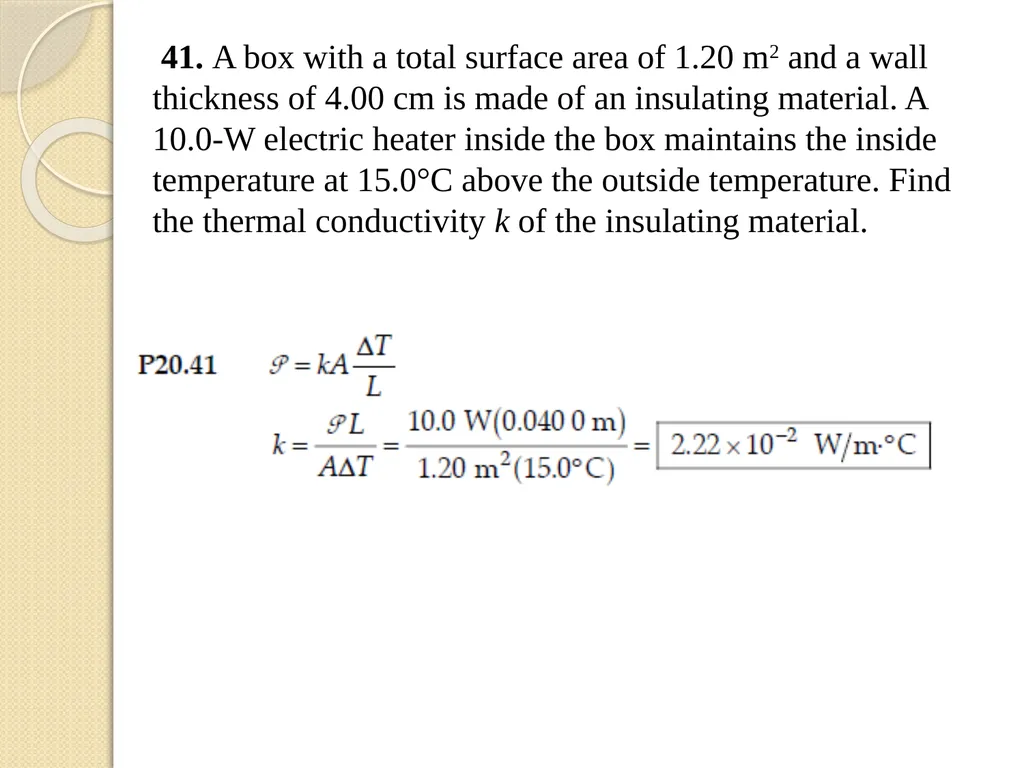
41. A box with a total surface area of 1.20 m2 and a wall thickness of 4.00 cm is made of an insulating material. A 10.0-W electric heater inside the box maintains the inside temperature at 15.0°C above the outside temperature. Find the thermal conductivity k of the insulating material.<br>
22
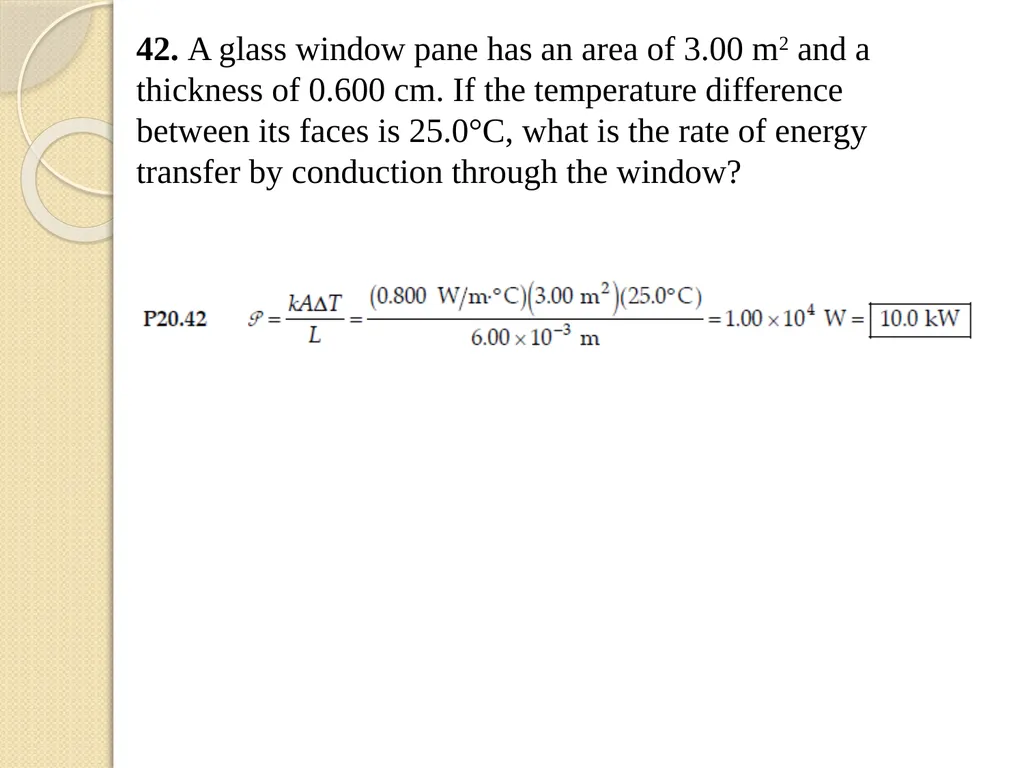
42. A glass window pane has an area of 3.00 m2 and a thickness of 0.600 cm. If the temperature difference between its faces is 25.0°C, what is the rate of energy transfer by conduction through the window?<br>
23
A bar of gold is in thermal contact with a bar of silver of
the same length and area (Fig. P20.43). One end of the
compound bar is maintained at 80.0°C while the opposite
end is at 30.0°C. When the energy transfer reaches steady
state, what is the temperature at the junction?
(kAu=314 W/m.0C , kAg=427 W/m.0C)<br>
24
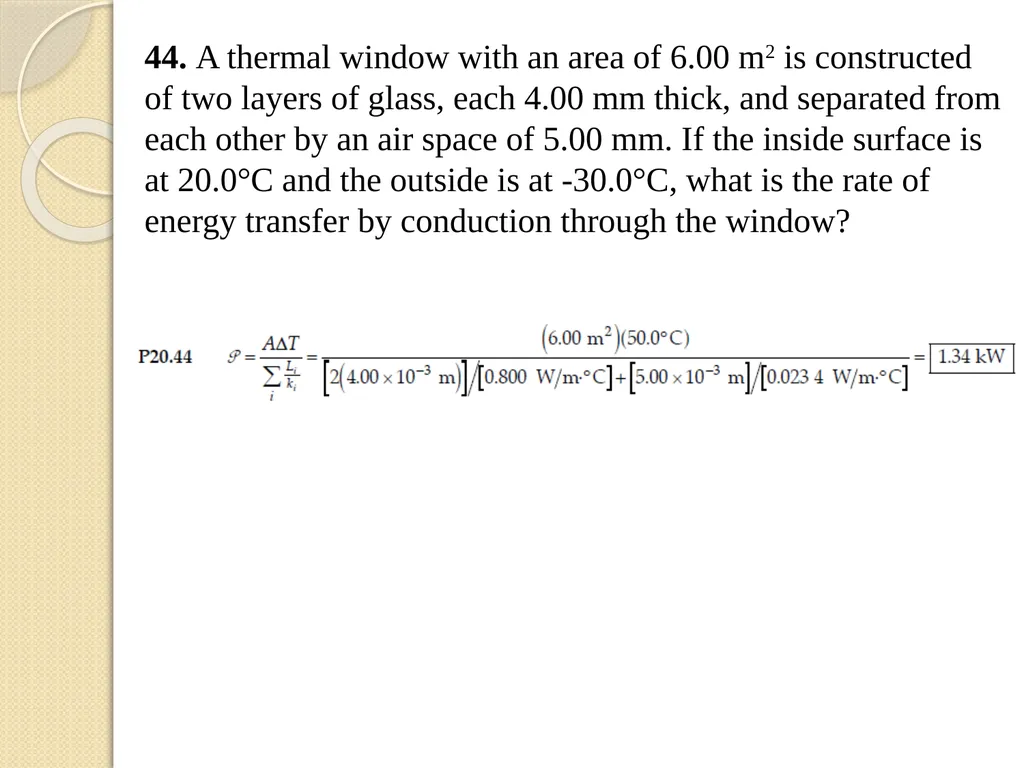
44. A thermal window with an area of 6.00 m2 is constructed of two layers of glass, each 4.00 mm thick, and separated from each other by an air space of 5.00 mm. If the inside surface is at 20.0°C and the outside is at -30.0°C, what is the rate of energy transfer by conduction through the window?<br>
25
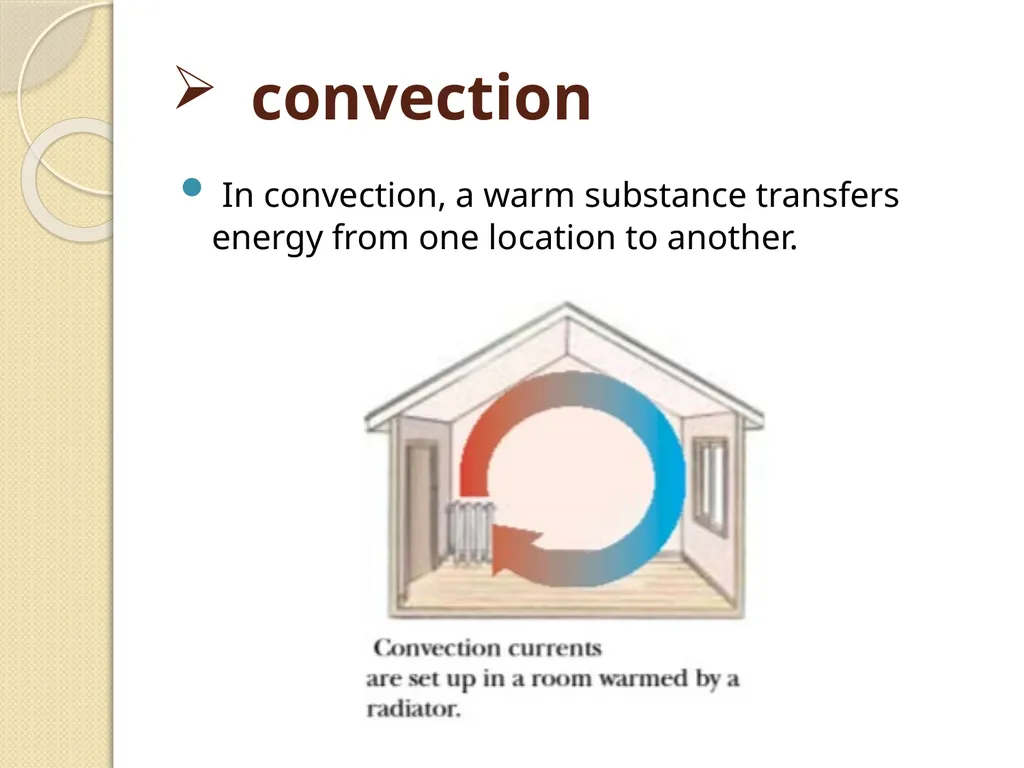
convection In convection, a warm substance transfers energy from one location to another.<br>
26
Radiation All objects radiate energy continuously in the form of electromagnetic waves produced by thermal vibrations of the molecules.
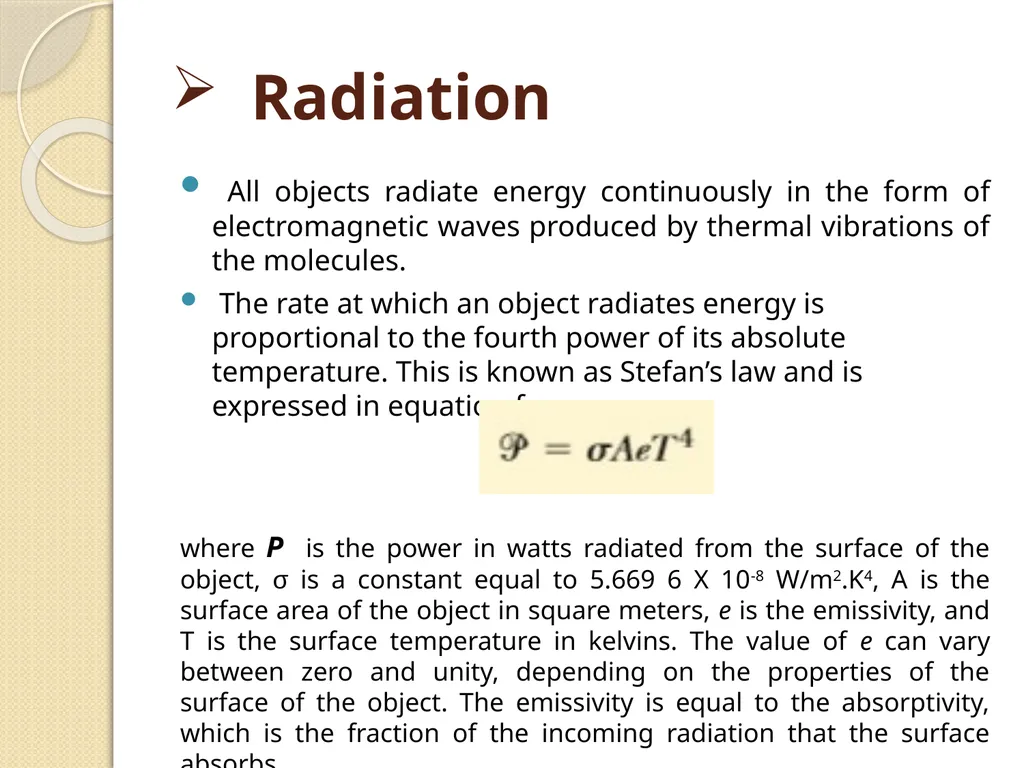
The rate at which an object radiates energy is proportional to the fourth power of its absolute temperature. This is known as Stefan’s law and is expressed in equation form as:
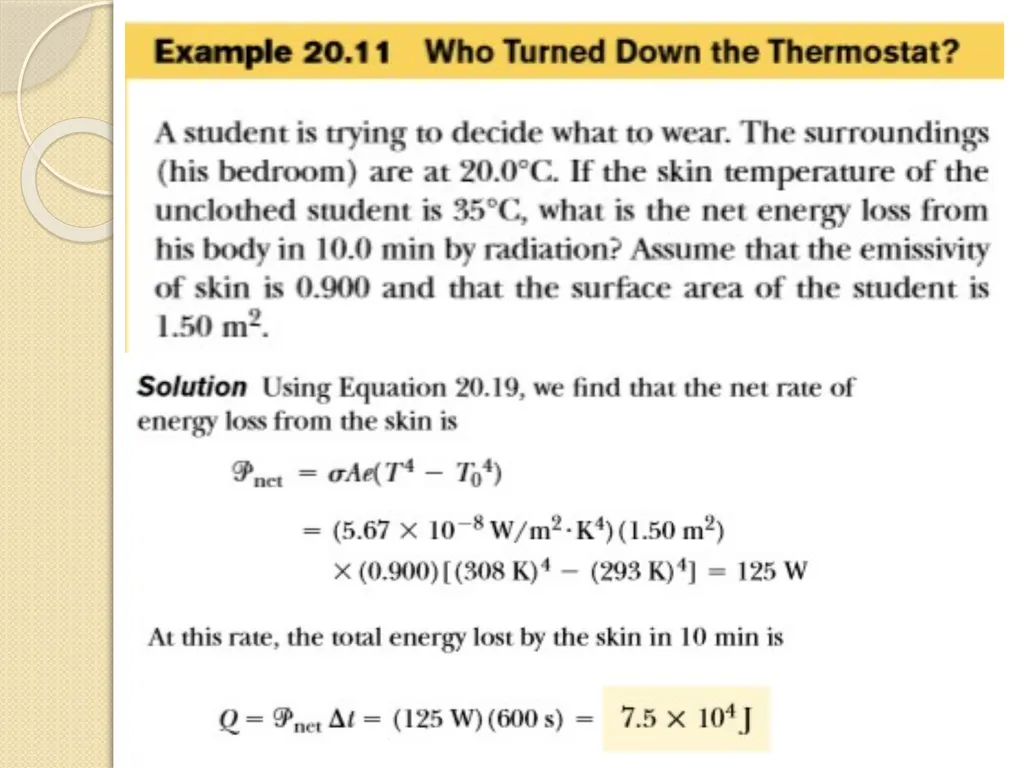
where P is the power in watts radiated from the surface of the object, σ is a constant equal to 5.669 6 X 10⁻⁸ W/m2.K4, A is the surface area of the object in square meters, e is the emissivity, and T is the surface temperature in kelvins. The value of e can vary between zero and unity, depending on the properties of the surface of the object. The emissivity is equal to the absorptivity, which is the fraction of the incoming radiation that the surface absorbs.<br>
27
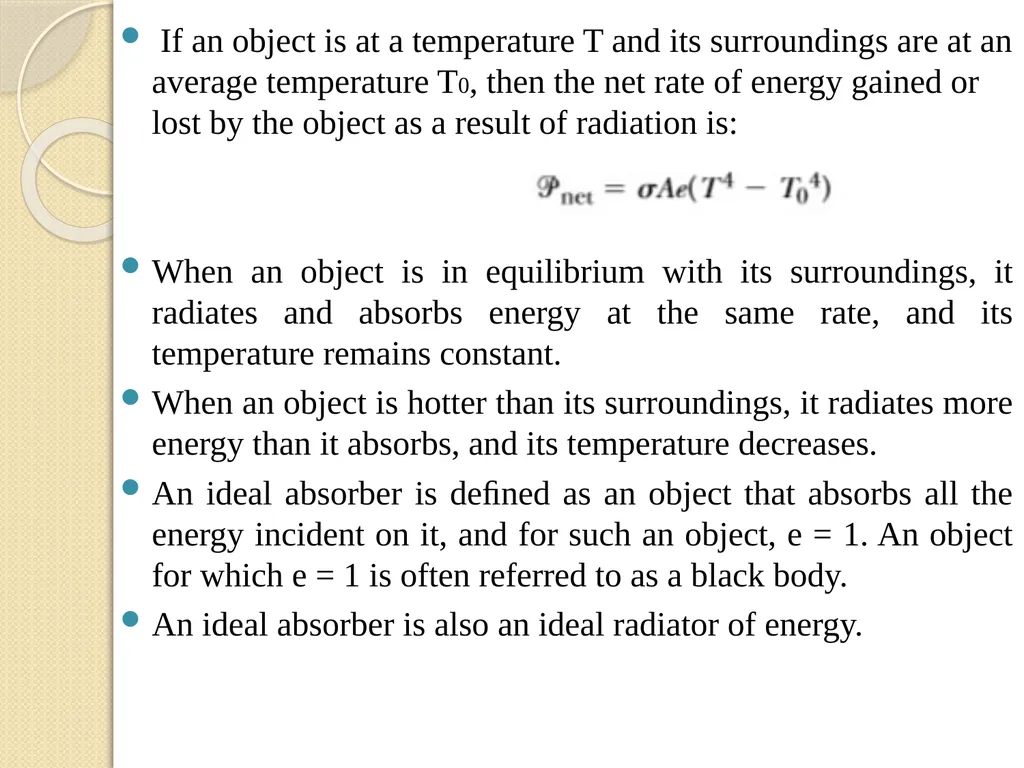
If an object is at a temperature T and its surroundings are at an average temperature T0, then the net rate of energy gained or lost by the object as a result of radiation is:
When an object is in equilibrium with its surroundings, it radiates and absorbs energy at the same rate, and its temperature remains constant.
When an object is hotter than its surroundings, it radiates more energy than it absorbs, and its temperature decreases.
An ideal absorber is defined as an object that absorbs all the energy incident on it, and for such an object, e = 1. An object for which e = 1 is often referred to as a black body.
An ideal absorber is also an ideal radiator of energy.<br>
28
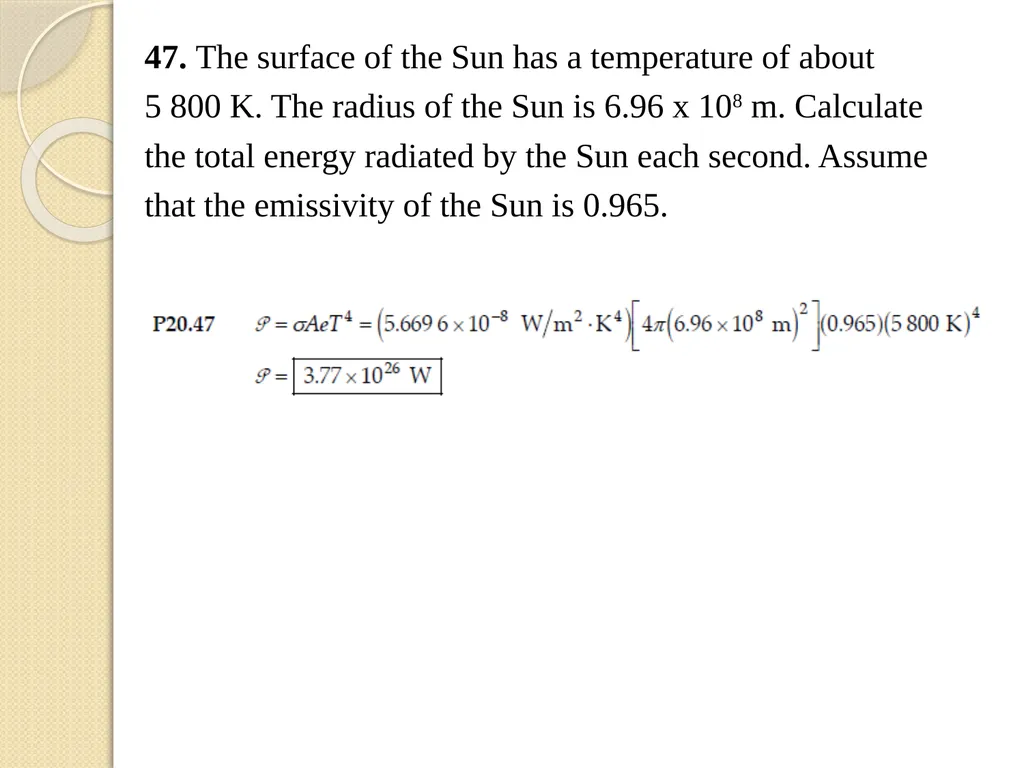
47. The surface of the Sun has a temperature of about
5 800 K. The radius of the Sun is 6.96 x 10⁸ m. Calculate
the total energy radiated by the Sun each second. Assume
that the emissivity of the Sun is 0.965.<br>
29
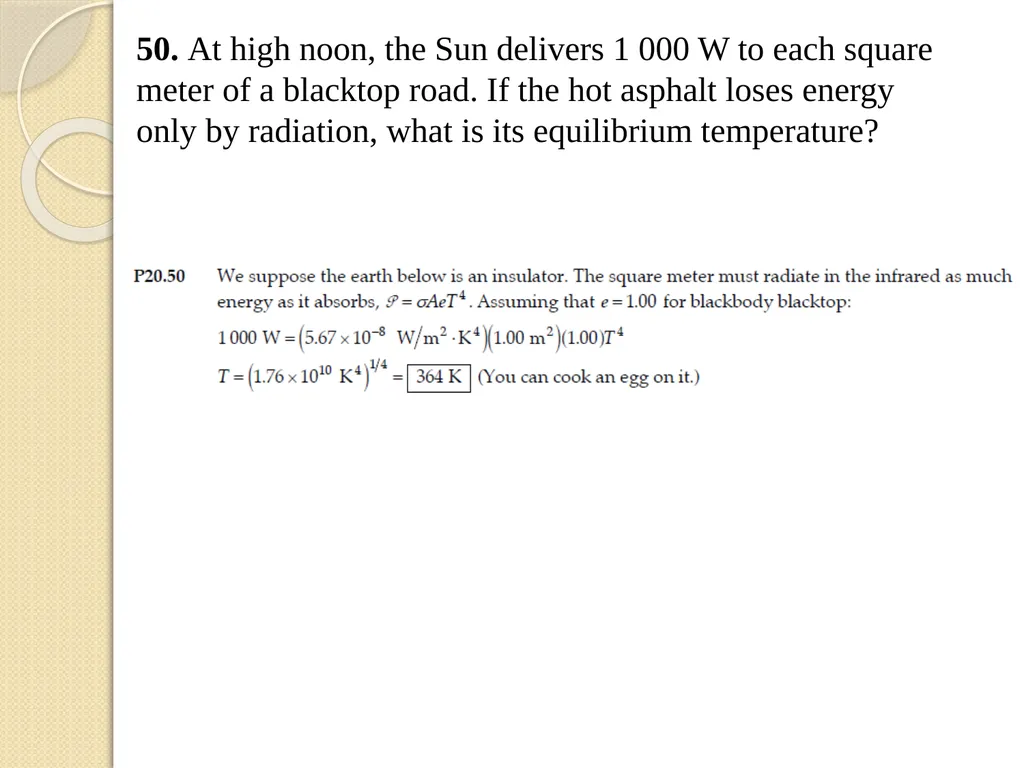
50. At high noon, the Sun delivers 1 000 W to each square meter of a blacktop road. If the hot asphalt loses energy only by radiation, what is its equilibrium temperature?<br>