Physical Education Physical education is structured, supervised, content-based physical activity part of the curriculum that takes place at school and during the school day. Your logo 2 Categories of Physical Education According to the
"Physical Education Physical education is" is the property of its rightful owner. Permission is granted to
download and print the materials on this website for personal, non-commercial use only, and to display it
on your personal computer provided you do not modify the materials and that you retain all copyright
notices contained in the materials. By downloading content from our website, you accept the terms of this
agreement.
Presentation Transcript
01
Physical Education Physical education is structured, supervised, content-based physical activity part of the curriculum that takes place at school and during the school day. Your logo<br>
02
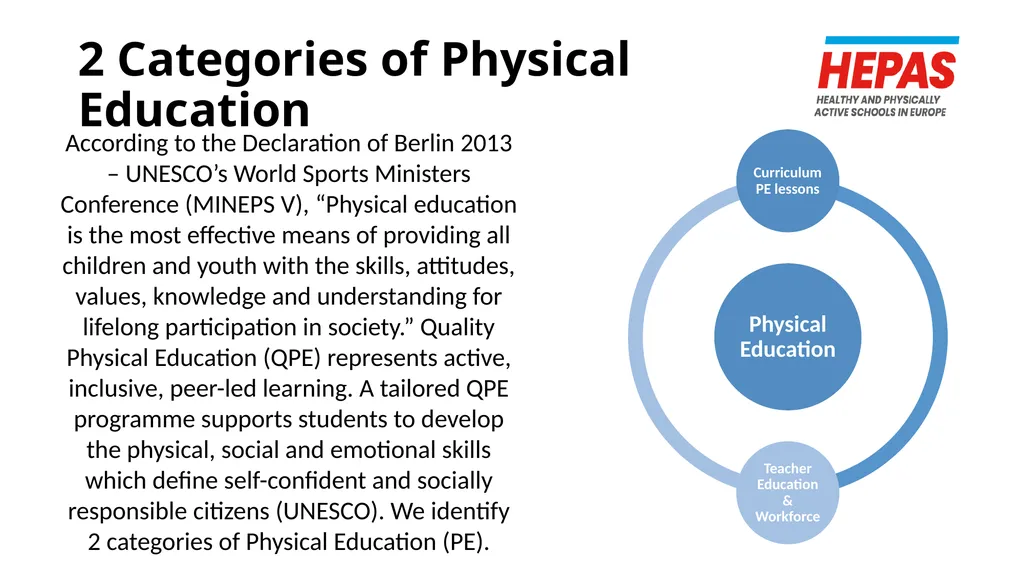
2 Categories of Physical Education According to the Declaration of Berlin 2013 – UNESCO’s World Sports Ministers Conference (MINEPS V), “Physical education is the most effective means of providing all children and youth with the skills, attitudes, values, knowledge and understanding for lifelong participation in society.” Quality Physical Education (QPE) represents active, inclusive, peer-led learning. A tailored QPE programme supports students to develop the physical, social and emotional skills which define self-confident and socially responsible citizens (UNESCO). We identify 2 categories of Physical Education (PE).<br>
03
2 Categories of Physical Education<br>
04
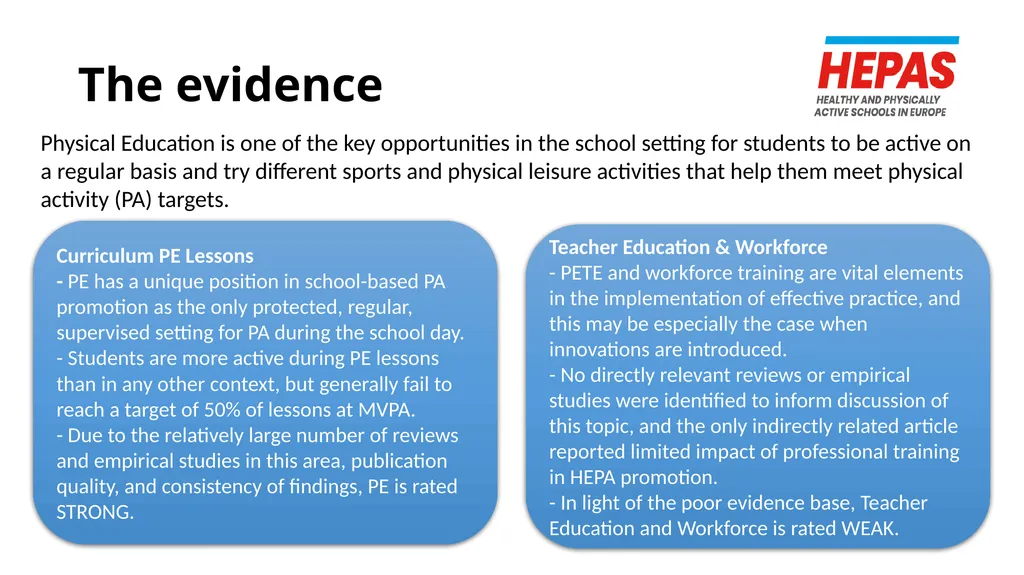
The evidence Physical Education is one of the key opportunities in the school setting for students to be active on a regular basis and try different sports and physical leisure activities that help them meet physical activity (PA) targets. Curriculum PE Lessons - PE has a unique position in school-based PA promotion as the only protected, regular, supervised setting for PA during the school day.
- Students are more active during PE lessons than in any other context, but generally fail to reach a target of 50% of lessons at MVPA.
- Due to the relatively large number of reviews and empirical studies in this area, publication quality, and consistency of findings, PE is rated STRONG. Teacher Education & Workforce
- PETE and workforce training are vital elements in the implementation of effective practice, and this may be especially the case when innovations are introduced.
- No directly relevant reviews or empirical studies were identified to inform discussion of this topic, and the only indirectly related article reported limited impact of professional training in HEPA promotion.
- In light of the poor evidence base, Teacher Education and Workforce is rated WEAK.<br>
05
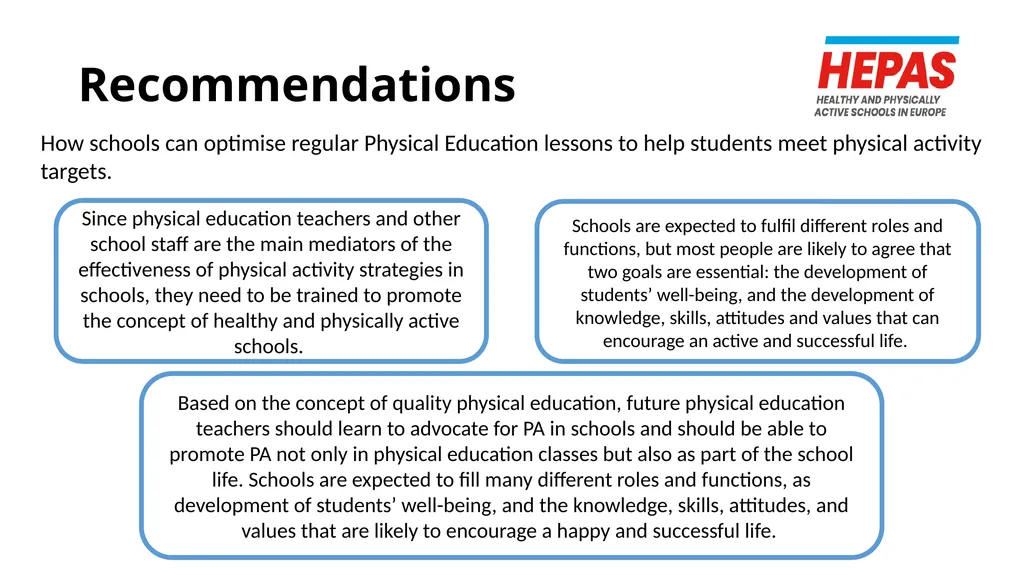
Recommendations Since physical education teachers and other school staff are the main mediators of the effectiveness of physical activity strategies in schools, they need to be trained to promote the concept of healthy and physically active schools. Schools are expected to fulfil different roles and functions, but most people are likely to agree that two goals are essential: the development of students’ well-being, and the development of knowledge, skills, attitudes and values that can encourage an active and successful life. Based on the concept of quality physical education, future physical education teachers should learn to advocate for PA in schools and should be able to promote PA not only in physical education classes but also as part of the school life. Schools are expected to fill many different roles and functions, as development of students’ well-being, and the knowledge, skills, attitudes, and values that are likely to encourage a happy and successful life. How schools can optimise regular Physical Education lessons to help students meet physical activity targets.<br>
06
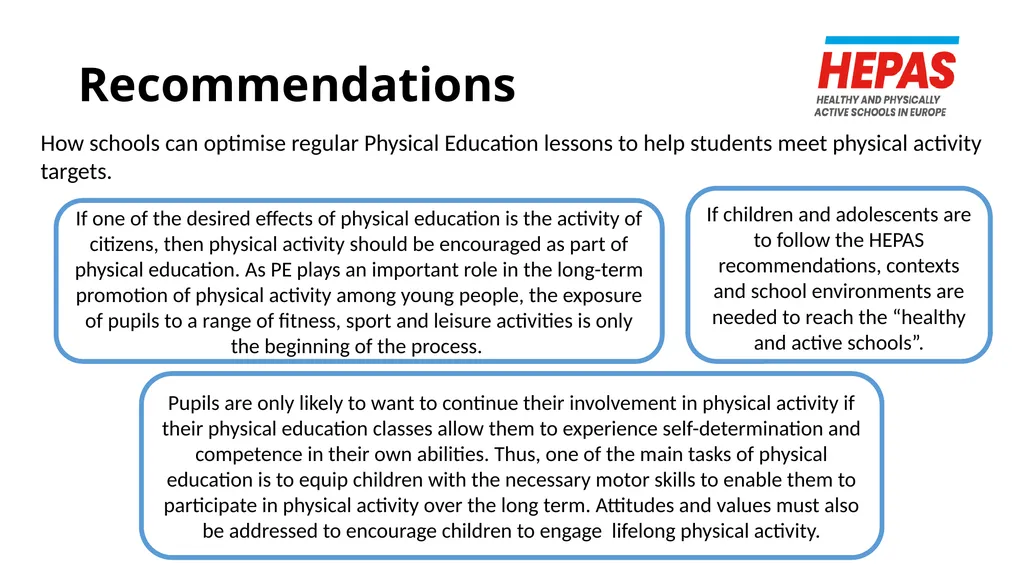
Recommendations If one of the desired effects of physical education is the activity of citizens, then physical activity should be encouraged as part of physical education. As PE plays an important role in the long-term promotion of physical activity among young people, the exposure of pupils to a range of fitness, sport and leisure activities is only the beginning of the process. If children and adolescents are to follow the HEPAS recommendations, contexts and school environments are needed to reach the “healthy and active schools”. Pupils are only likely to want to continue their involvement in physical activity if their physical education classes allow them to experience self-determination and competence in their own abilities. Thus, one of the main tasks of physical education is to equip children with the necessary motor skills to enable them to participate in physical activity over the long term. Attitudes and values must also be addressed to encourage children to engage lifelong physical activity. How schools can optimise regular Physical Education lessons to help students meet physical activity targets.<br>