
Physical Therapy for Children With Cerebral Palsy
YM
Published · 69 slides · 0 views

1 / 1

Description
Physical Therapy for Children With Cerebral Palsy Course: Neurological Rehabilitation (PTA 235) Unit: Pediatrics Term: Spring 2014 Instructor: Delane Frutiger Clark, PT Class Goal The goal of this lecture is to provide PTA students with a
Related Topics
Share
Embed code
Download this presentation From Below
"Physical Therapy for Children With Cerebral Palsy" is the property of its rightful owner. Permission is granted to download and print the materials on this website for personal, non-commercial use only, and to display it on your personal computer provided you do not modify the materials and that you retain all copyright notices contained in the materials. By downloading content from our website, you accept the terms of this agreement.
Presentation Transcript
01
Physical Therapy for Children With
Cerebral Palsy Course: Neurological Rehabilitation (PTA 235)
Unit: Pediatrics
Term: Spring 2014
Instructor: Delane Frutiger Clark, PT<br>
Unit: Pediatrics
Term: Spring 2014
Instructor: Delane Frutiger Clark, PT<br>
02
Class Goal The goal of this lecture is to provide PTA students with a foundation to develop knowledge and skill in providing physical therapy services to children with CP in today’s practice environment.<br>
03
Class Objectives Describe the etiology, pathophysiology, classification, and clinical presentation of CP.
Use the ICF framework to identify impairments, activity limitations, and participation restrictions.
Describe common tests and measures used to examine and evaluate children with CP.
Describe evidence-based interventions for CP.
Perform pre-determined therapeutic activities with a child who has CP.<br>
Use the ICF framework to identify impairments, activity limitations, and participation restrictions.
Describe common tests and measures used to examine and evaluate children with CP.
Describe evidence-based interventions for CP.
Perform pre-determined therapeutic activities with a child who has CP.<br>
04
Class Objectives Communicate effectively with children who have CP and their families.
Based on a lab experience with a child who has CP describe the child’s clinical presentation and identify interventions that could could improve the child’s impairments, activity limitations and participation restrictions.
Describe secondary conditions affecting individuals with CP and the importance of health and wellness across the lifespan<br>
Based on a lab experience with a child who has CP describe the child’s clinical presentation and identify interventions that could could improve the child’s impairments, activity limitations and participation restrictions.
Describe secondary conditions affecting individuals with CP and the importance of health and wellness across the lifespan<br>
05
Cerebral Palsy “A group of permanent disorders of the development of movement and posture, causing activity limitation, that are attributed to non-progressive disturbances that occurred in the developing fetal or infant brain. The motor disorders of cerebral palsy are often accompanied by disturbances of sensation, perception, cognition, communication, and behavior, by epilepsy, and by secondary musculoskeletal problems”.
Rosenbaum, P., Paneth, N., Leviton, A., Goldstein, M., Bax, M. A Report: The Definition and Classification of Cerebral Palsy April 2006. Developmental Medicine & Child Neurology. February 2007: 49: Supplement 109: 8-14.<br>
Rosenbaum, P., Paneth, N., Leviton, A., Goldstein, M., Bax, M. A Report: The Definition and Classification of Cerebral Palsy April 2006. Developmental Medicine & Child Neurology. February 2007: 49: Supplement 109: 8-14.<br>
06
Cerebral Palsy Most common motor disability in childhood.
Most common condition treated in pediatric PT.
Prevalence = 3.3 per 1,000 8-year-olds in US.
No longer a condition just treated in childhood.
Age-related changes affect physical and psychosocial function.
PTs and PTAs – Important role in promoting health and wellness across the lifespan of individuals with CP.<br>
Most common condition treated in pediatric PT.
Prevalence = 3.3 per 1,000 8-year-olds in US.
No longer a condition just treated in childhood.
Age-related changes affect physical and psychosocial function.
PTs and PTAs – Important role in promoting health and wellness across the lifespan of individuals with CP.<br>
07
Etiology Multifactorial
Prenatal – Before birth (70-80%)
Perinatal – During or around time of birth (10%)
Postnatal – After birth
Source: www.uptodate.com<br>
Prenatal – Before birth (70-80%)
Perinatal – During or around time of birth (10%)
Postnatal – After birth
Source: www.uptodate.com<br>
08
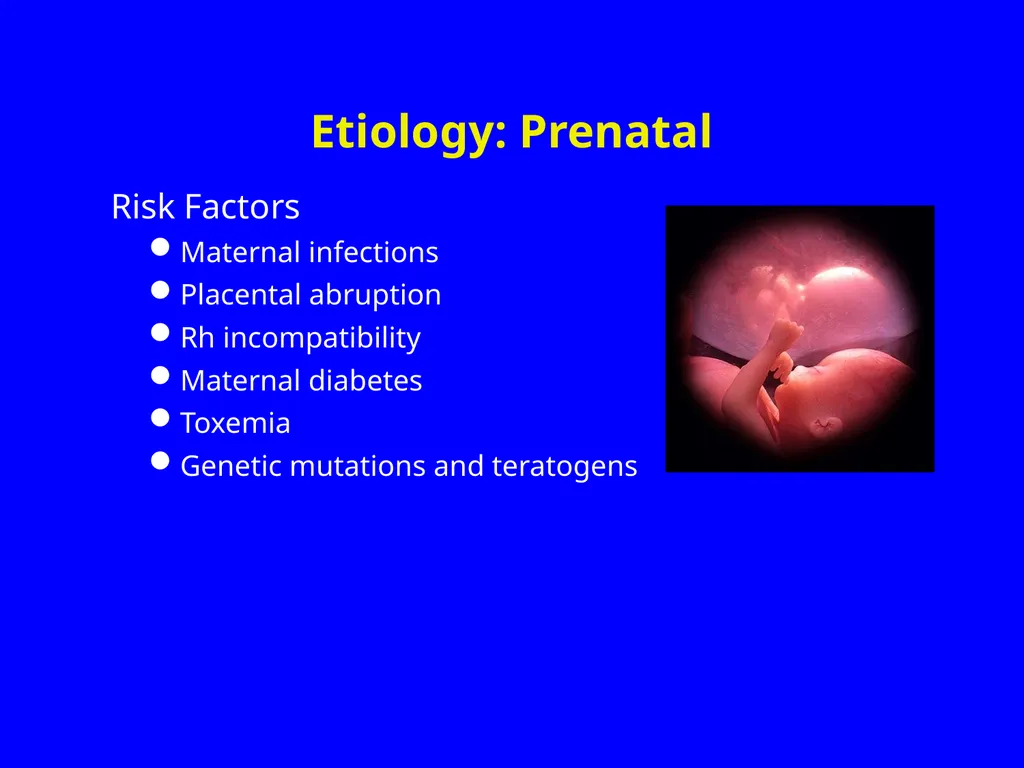
Etiology: Prenatal Risk Factors
Maternal infections
Placental abruption
Rh incompatibility
Maternal diabetes
Toxemia
Genetic mutations and teratogens<br>
Maternal infections
Placental abruption
Rh incompatibility
Maternal diabetes
Toxemia
Genetic mutations and teratogens<br>
09
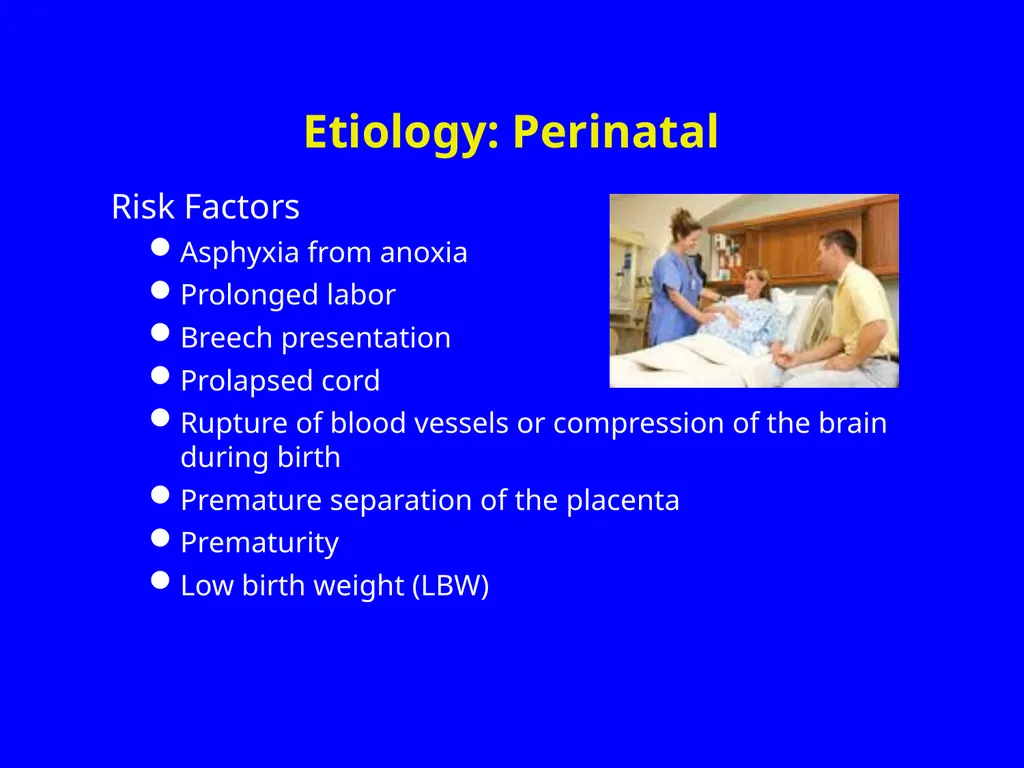
Etiology: Perinatal Risk Factors
Asphyxia from anoxia
Prolonged labor
Breech presentation
Prolapsed cord
Rupture of blood vessels or compression of the brain during birth
Premature separation of the placenta
Prematurity
Low birth weight (LBW)<br>
Asphyxia from anoxia
Prolonged labor
Breech presentation
Prolapsed cord
Rupture of blood vessels or compression of the brain during birth
Premature separation of the placenta
Prematurity
Low birth weight (LBW)<br>
10
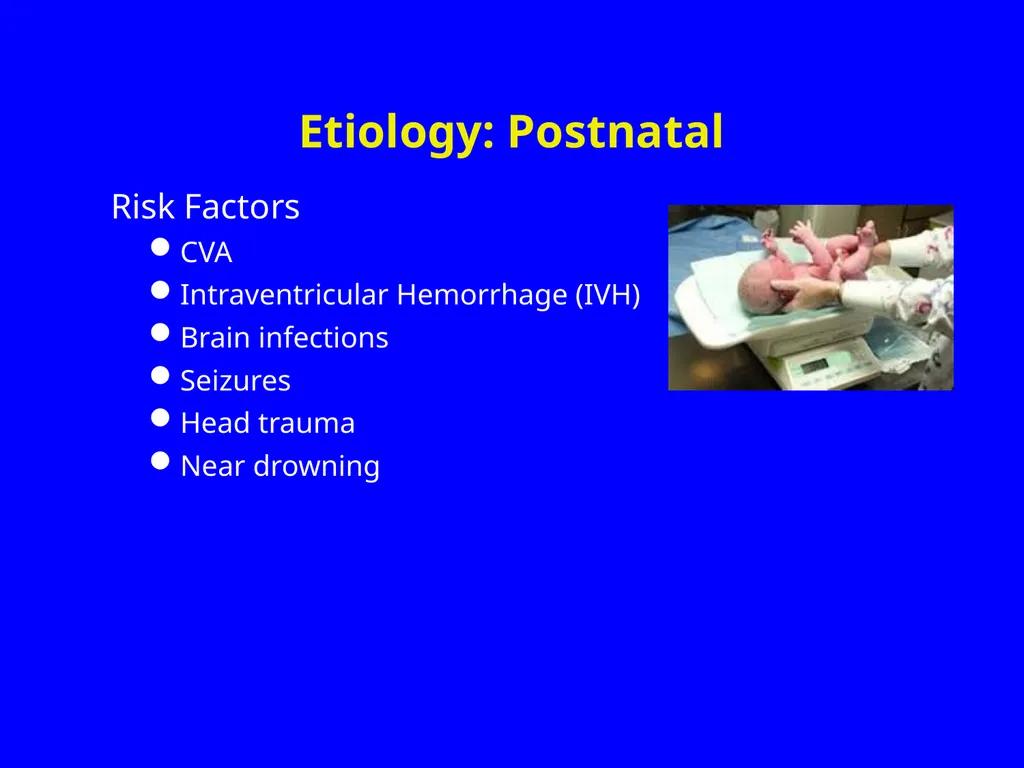
Etiology: Postnatal Risk Factors
CVA
Intraventricular Hemorrhage (IVH)
Brain infections
Seizures
Head trauma
Near drowning<br>
CVA
Intraventricular Hemorrhage (IVH)
Brain infections
Seizures
Head trauma
Near drowning<br>
11
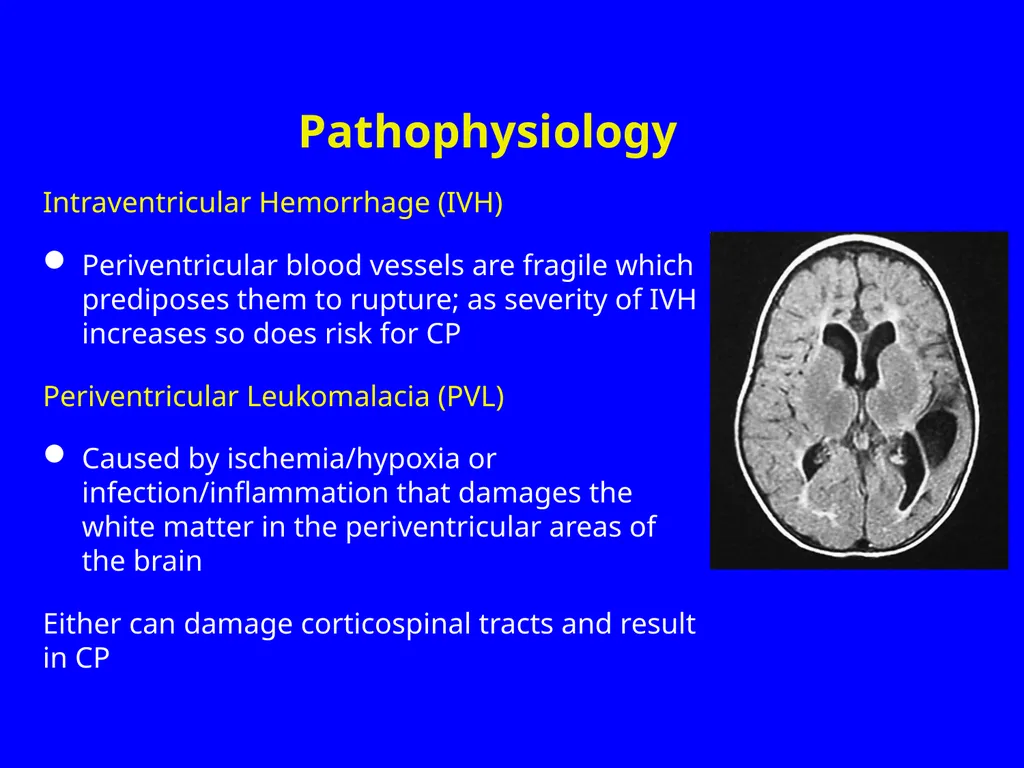
Pathophysiology Intraventricular Hemorrhage (IVH)
Periventricular blood vessels are fragile which prediposes them to rupture; as severity of IVH increases so does risk for CP
Periventricular Leukomalacia (PVL)
Caused by ischemia/hypoxia or infection/inflammation that damages the white matter in the periventricular areas of the brain
Either can damage corticospinal tracts and result in CP<br>
Periventricular blood vessels are fragile which prediposes them to rupture; as severity of IVH increases so does risk for CP
Periventricular Leukomalacia (PVL)
Caused by ischemia/hypoxia or infection/inflammation that damages the white matter in the periventricular areas of the brain
Either can damage corticospinal tracts and result in CP<br>
12
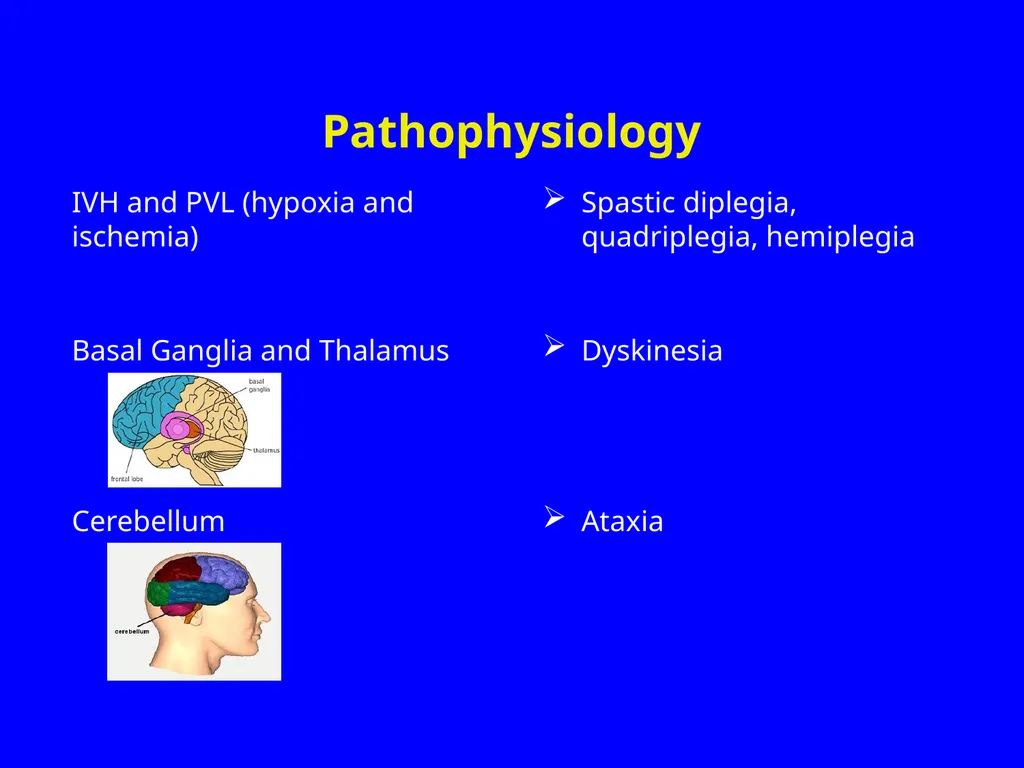
Pathophysiology IVH and PVL (hypoxia and ischemia)
Basal Ganglia and Thalamus
Cerebellum Spastic diplegia, quadriplegia, hemiplegia
Dyskinesia
Ataxia<br>
Basal Ganglia and Thalamus
Cerebellum Spastic diplegia, quadriplegia, hemiplegia
Dyskinesia
Ataxia<br>
13
Diagnosis May not be diagnosed right away
Usually diagnosed in the 1st or 2nd year (CDC)
Involves: Monitoring, Screening, Evaluation
Based on history and clinical presentation
Brain imaging is a useful diagnostic tool<br>
Usually diagnosed in the 1st or 2nd year (CDC)
Involves: Monitoring, Screening, Evaluation
Based on history and clinical presentation
Brain imaging is a useful diagnostic tool<br>
14
Clinical Presentation IVH and PVL resulting in corticospinal lesions cause:
Spasticity
Weakness
Basal ganglia or cerebellar lesions cause:
Problems with modulating and refining movement<br>
Spasticity
Weakness
Basal ganglia or cerebellar lesions cause:
Problems with modulating and refining movement<br>
15
Classification of CP Distribution – Hemiplegia, Diplegia, Quadriplegia
Motor Impairment - Spastic, Dyskinetic, Ataxic
Function – Gross Motor Function Classification System (GMFCS)<br>
Motor Impairment - Spastic, Dyskinetic, Ataxic
Function – Gross Motor Function Classification System (GMFCS)<br>
16
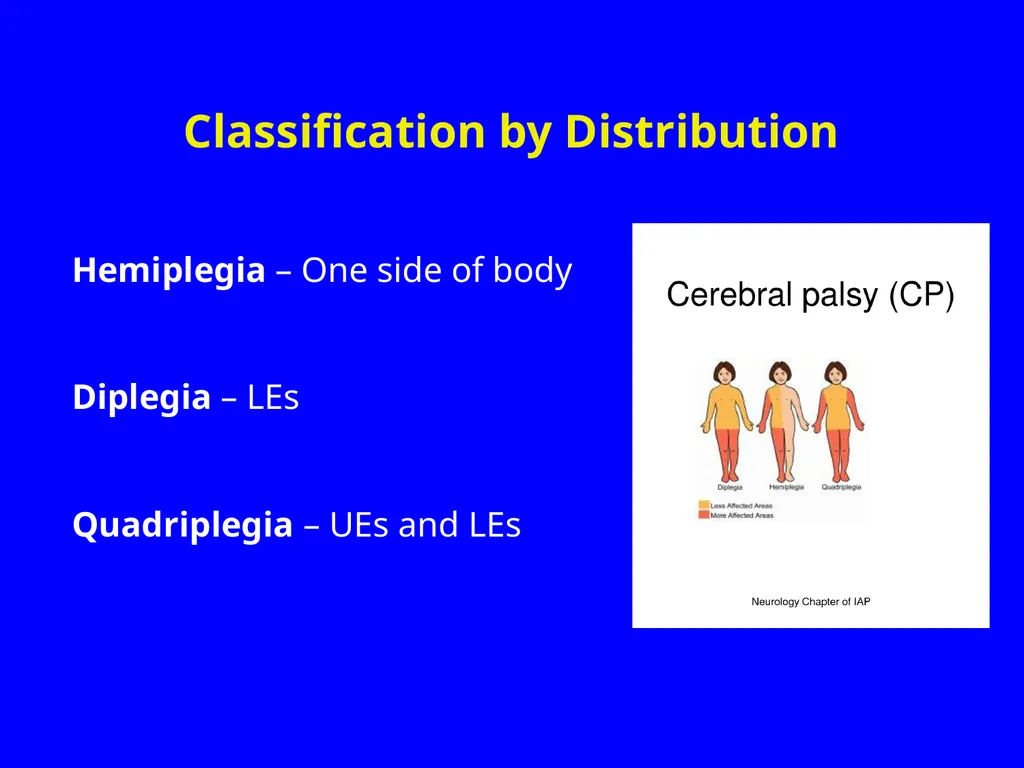
Classification by Distribution Hemiplegia – One side of body
Diplegia – LEs
Quadriplegia – UEs and LEs<br>
Diplegia – LEs
Quadriplegia – UEs and LEs<br>
17
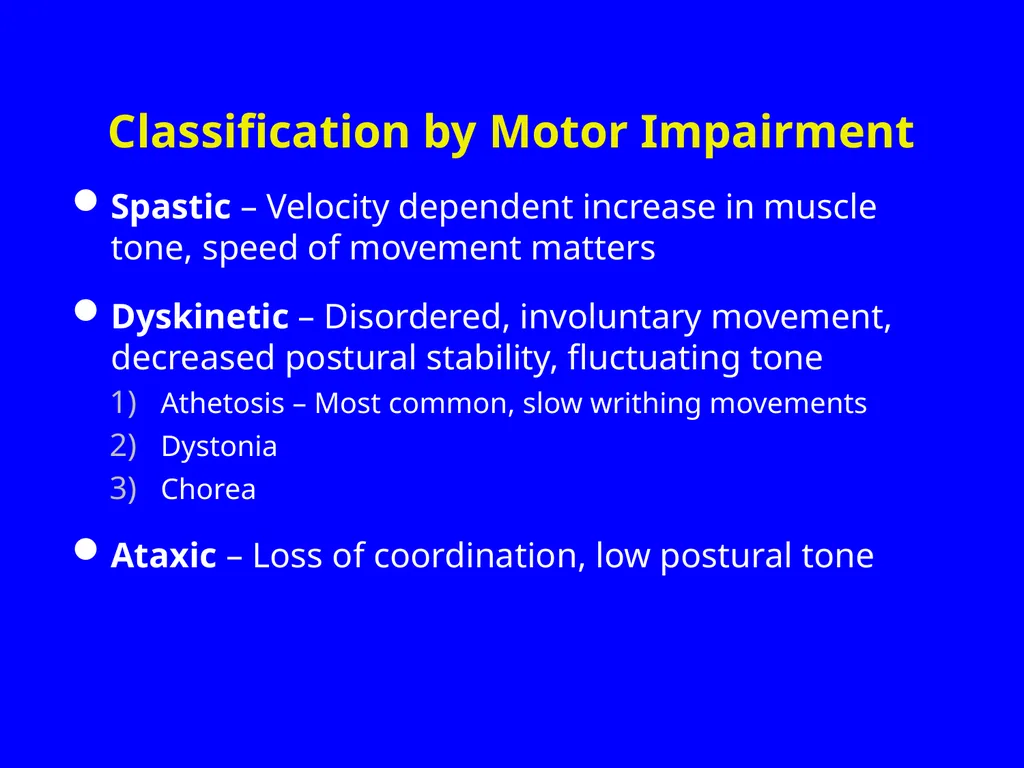
Classification by Motor Impairment Spastic – Velocity dependent increase in muscle tone, speed of movement matters
Dyskinetic – Disordered, involuntary movement, decreased postural stability, fluctuating tone
Athetosis – Most common, slow writhing movements
Dystonia
Chorea
Ataxic – Loss of coordination, low postural tone<br>
Dyskinetic – Disordered, involuntary movement, decreased postural stability, fluctuating tone
Athetosis – Most common, slow writhing movements
Dystonia
Chorea
Ataxic – Loss of coordination, low postural tone<br>
18
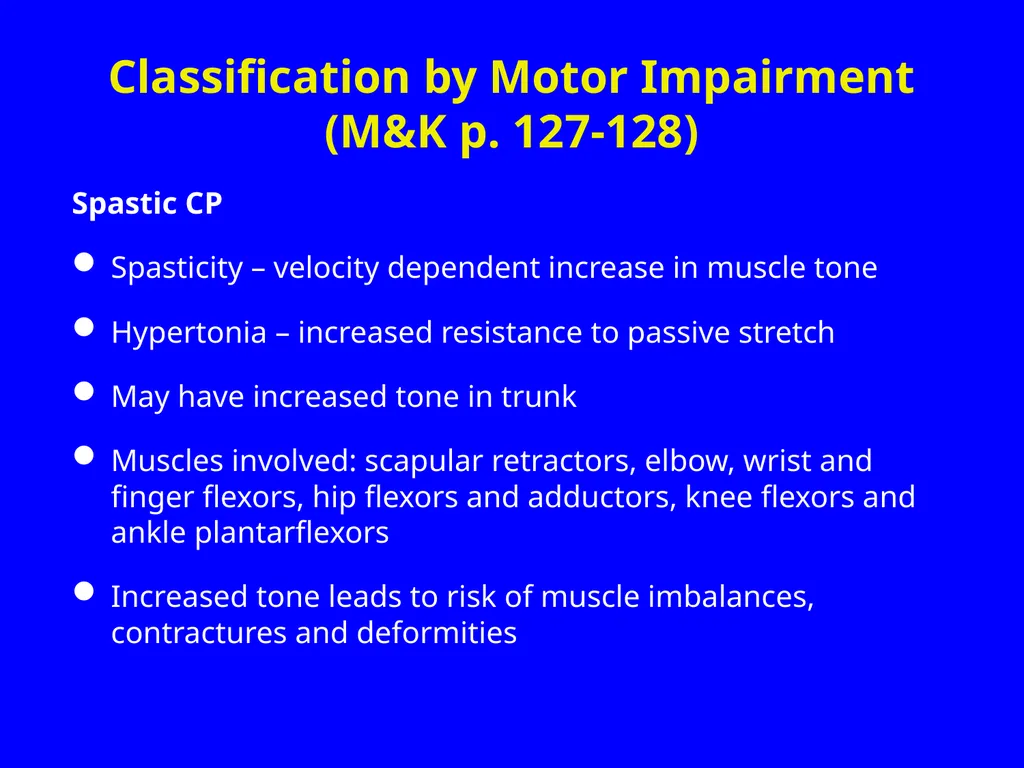
Classification by Motor Impairment (M&K p. 127-128) Spastic CP
Spasticity – velocity dependent increase in muscle tone
Hypertonia – increased resistance to passive stretch
May have increased tone in trunk
Muscles involved: scapular retractors, elbow, wrist and finger flexors, hip flexors and adductors, knee flexors and ankle plantarflexors
Increased tone leads to risk of muscle imbalances, contractures and deformities<br>
Spasticity – velocity dependent increase in muscle tone
Hypertonia – increased resistance to passive stretch
May have increased tone in trunk
Muscles involved: scapular retractors, elbow, wrist and finger flexors, hip flexors and adductors, knee flexors and ankle plantarflexors
Increased tone leads to risk of muscle imbalances, contractures and deformities<br>
19
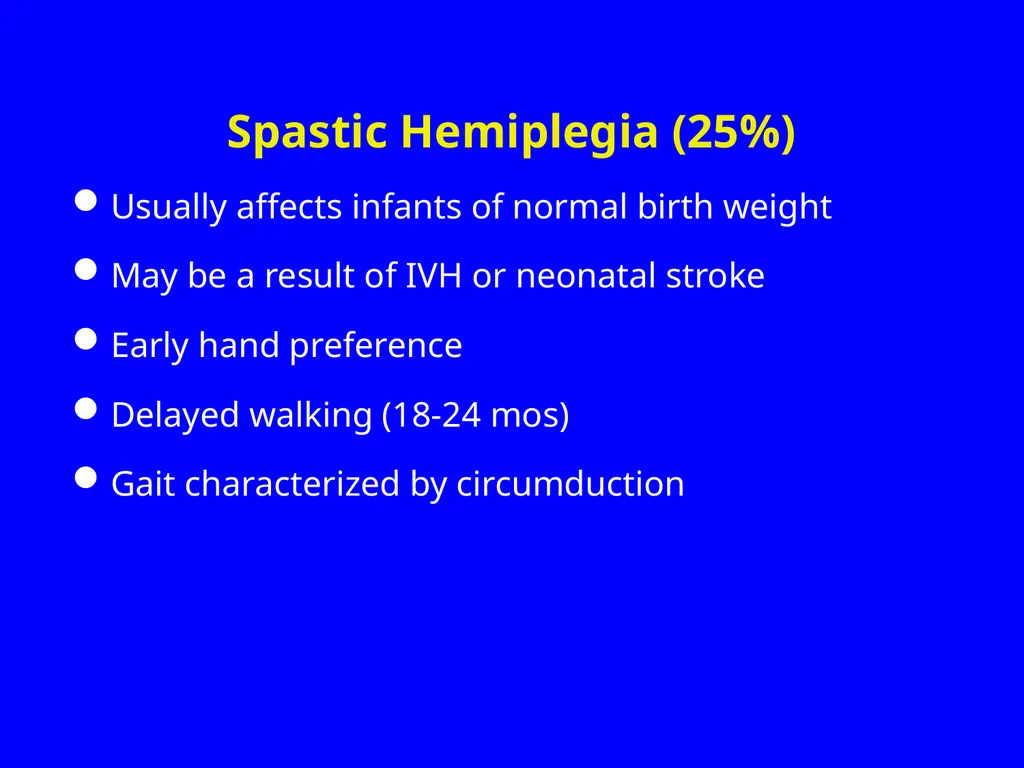
Spastic Hemiplegia (25%) Usually affects infants of normal birth weight
May be a result of IVH or neonatal stroke
Early hand preference
Delayed walking (18-24 mos)
Gait characterized by circumduction<br>
May be a result of IVH or neonatal stroke
Early hand preference
Delayed walking (18-24 mos)
Gait characterized by circumduction<br>
20
TED Talk: In Our Baby’s Illness,
A Life Lesson http://www.ted.com/talks/roberto_d_angelo_francesca_fedeli_in_our_baby_s_illness_a_life_lesson<br>
21
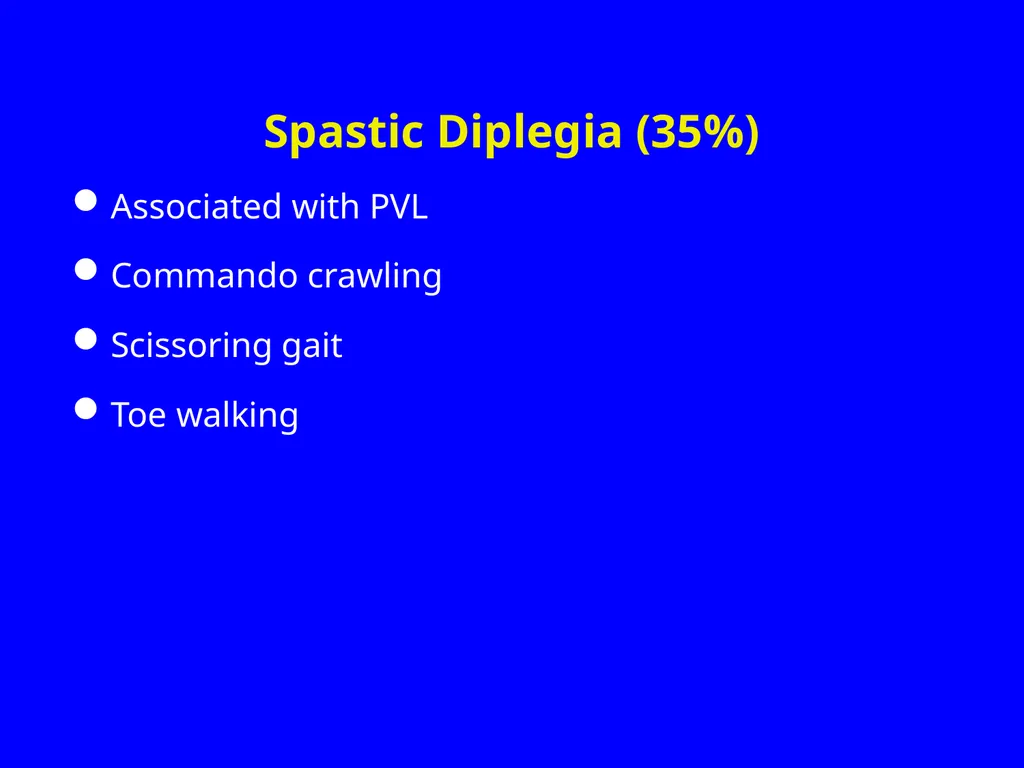
Spastic Diplegia (35%) Associated with PVL
Commando crawling
Scissoring gait
Toe walking<br>
Commando crawling
Scissoring gait
Toe walking<br>
22
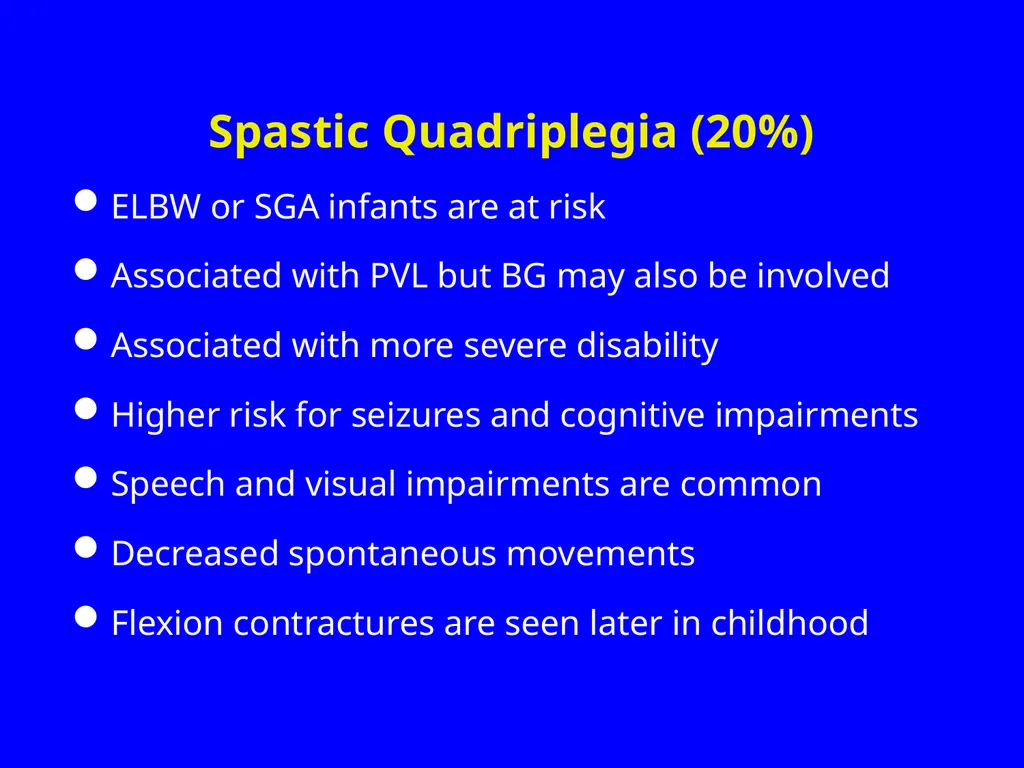
Spastic Quadriplegia (20%) ELBW or SGA infants are at risk
Associated with PVL but BG may also be involved
Associated with more severe disability
Higher risk for seizures and cognitive impairments
Speech and visual impairments are common
Decreased spontaneous movements
Flexion contractures are seen later in childhood<br>
Associated with PVL but BG may also be involved
Associated with more severe disability
Higher risk for seizures and cognitive impairments
Speech and visual impairments are common
Decreased spontaneous movements
Flexion contractures are seen later in childhood<br>
23
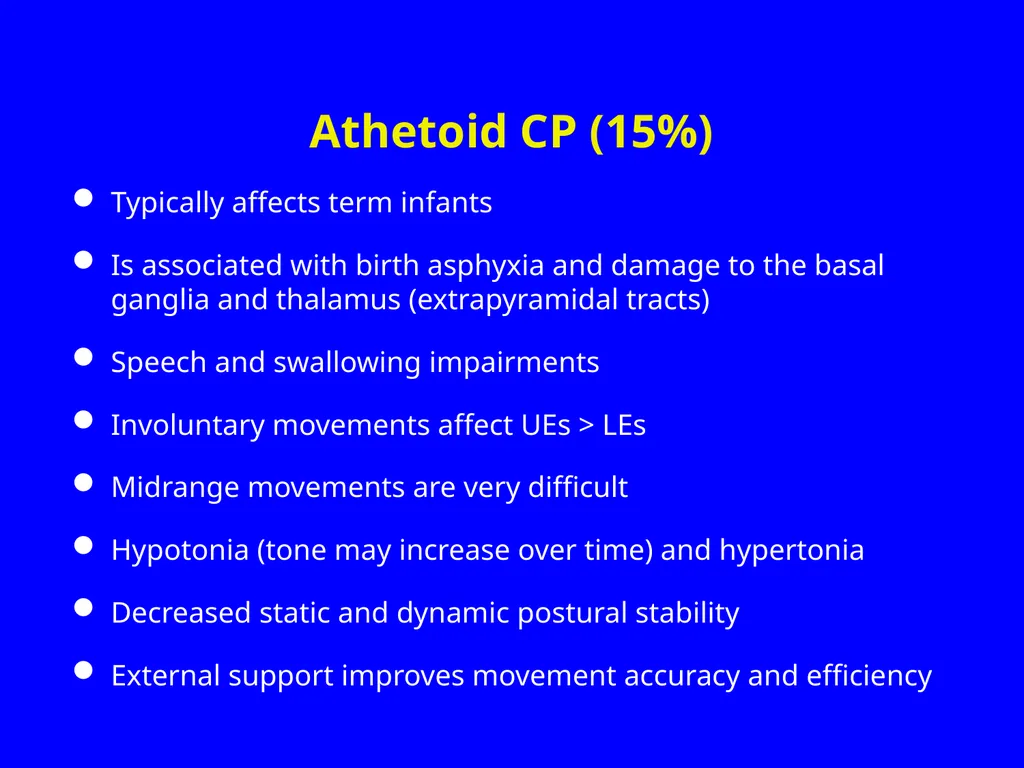
Athetoid CP (15%) Typically affects term infants
Is associated with birth asphyxia and damage to the basal ganglia and thalamus (extrapyramidal tracts)
Speech and swallowing impairments
Involuntary movements affect UEs > LEs
Midrange movements are very difficult
Hypotonia (tone may increase over time) and hypertonia
Decreased static and dynamic postural stability
External support improves movement accuracy and efficiency<br>
Is associated with birth asphyxia and damage to the basal ganglia and thalamus (extrapyramidal tracts)
Speech and swallowing impairments
Involuntary movements affect UEs > LEs
Midrange movements are very difficult
Hypotonia (tone may increase over time) and hypertonia
Decreased static and dynamic postural stability
External support improves movement accuracy and efficiency<br>
24
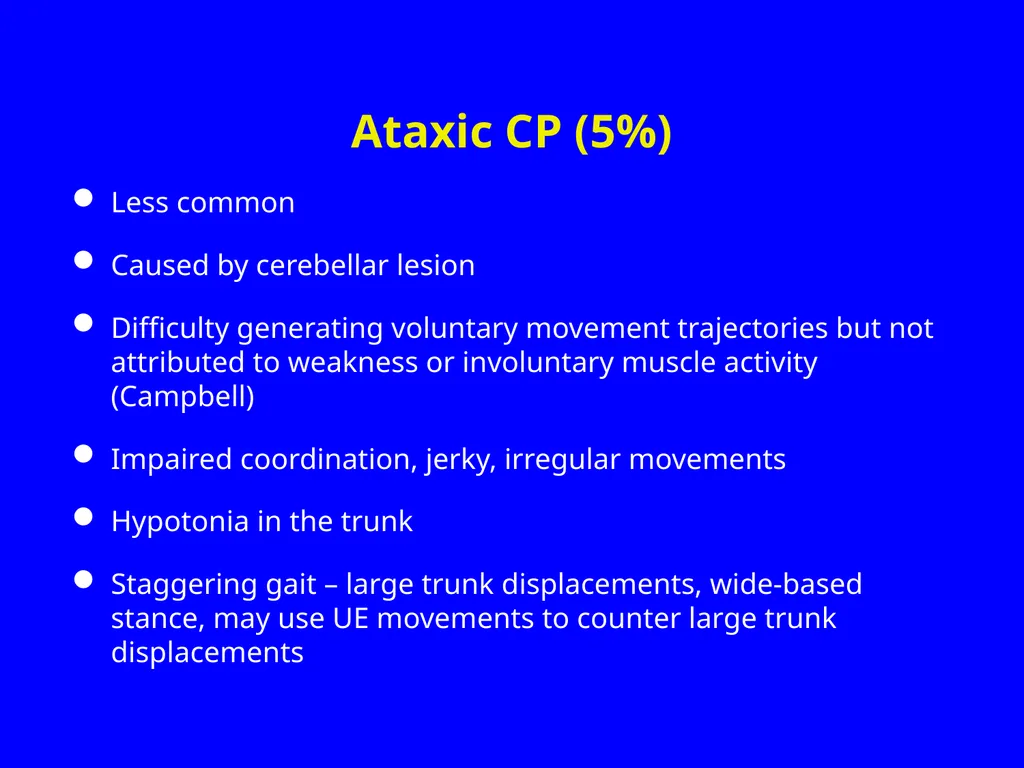
Ataxic CP (5%) Less common
Caused by cerebellar lesion
Difficulty generating voluntary movement trajectories but not attributed to weakness or involuntary muscle activity (Campbell)
Impaired coordination, jerky, irregular movements
Hypotonia in the trunk
Staggering gait – large trunk displacements, wide-based stance, may use UE movements to counter large trunk displacements<br>
Caused by cerebellar lesion
Difficulty generating voluntary movement trajectories but not attributed to weakness or involuntary muscle activity (Campbell)
Impaired coordination, jerky, irregular movements
Hypotonia in the trunk
Staggering gait – large trunk displacements, wide-based stance, may use UE movements to counter large trunk displacements<br>
25
Video Clips Child with hemiplegic CP
http://www.youtube.com/watch?v=loqtJe1GH3E
Child with spastic diplegic CP
http://www.youtube.com/watch?v=ZBfzStukRmc
Child with spastic quadripegic CP
http://www.youtube.com/watch?v=6ePz-rdsqko
Child with athetoid CP
http://www.youtube.com/watch?v=F5MxbMfu5Bg
Child with ataxic CP
http://www.youtube.com/watch?v=gcFRm3AGU1g<br>
http://www.youtube.com/watch?v=loqtJe1GH3E
Child with spastic diplegic CP
http://www.youtube.com/watch?v=ZBfzStukRmc
Child with spastic quadripegic CP
http://www.youtube.com/watch?v=6ePz-rdsqko
Child with athetoid CP
http://www.youtube.com/watch?v=F5MxbMfu5Bg
Child with ataxic CP
http://www.youtube.com/watch?v=gcFRm3AGU1g<br>
26
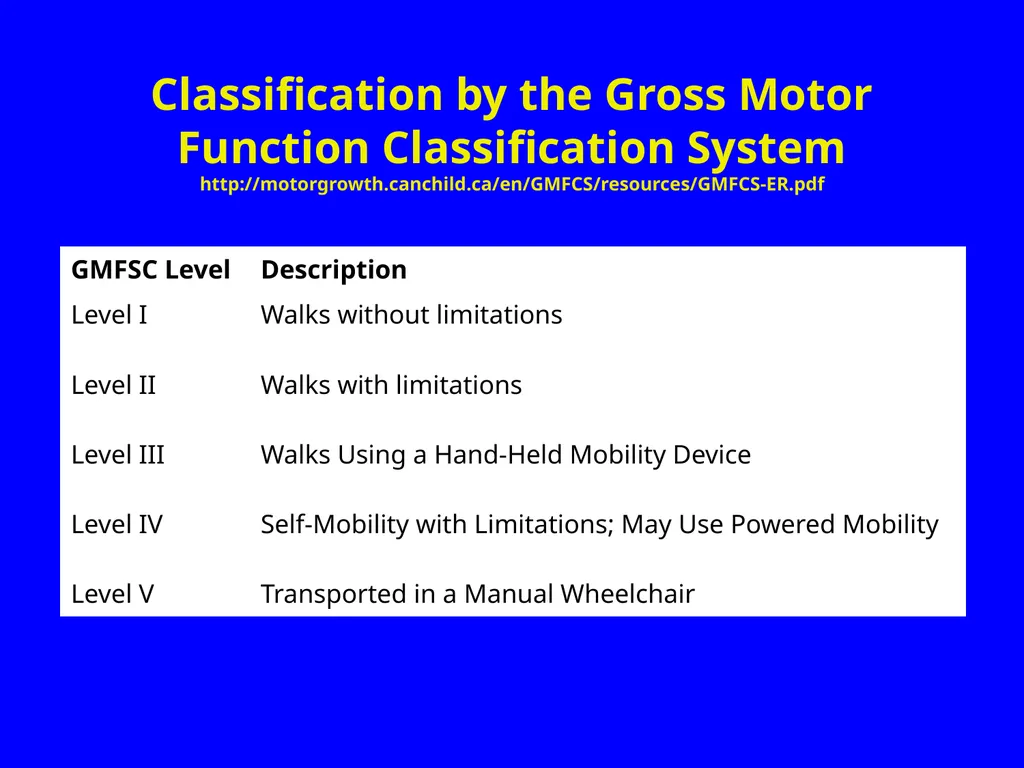
Classification by the Gross Motor Function Classification System
http://motorgrowth.canchild.ca/en/GMFCS/resources/GMFCS-ER.pdf<br>
27
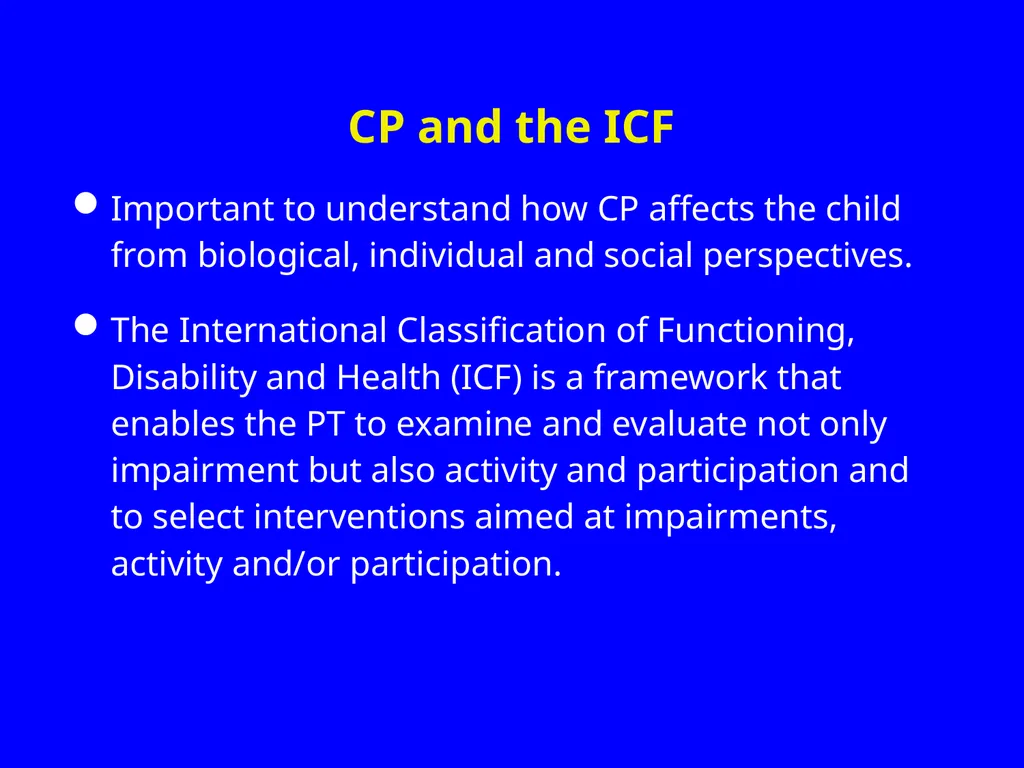
CP and the ICF Important to understand how CP affects the child from biological, individual and social perspectives.
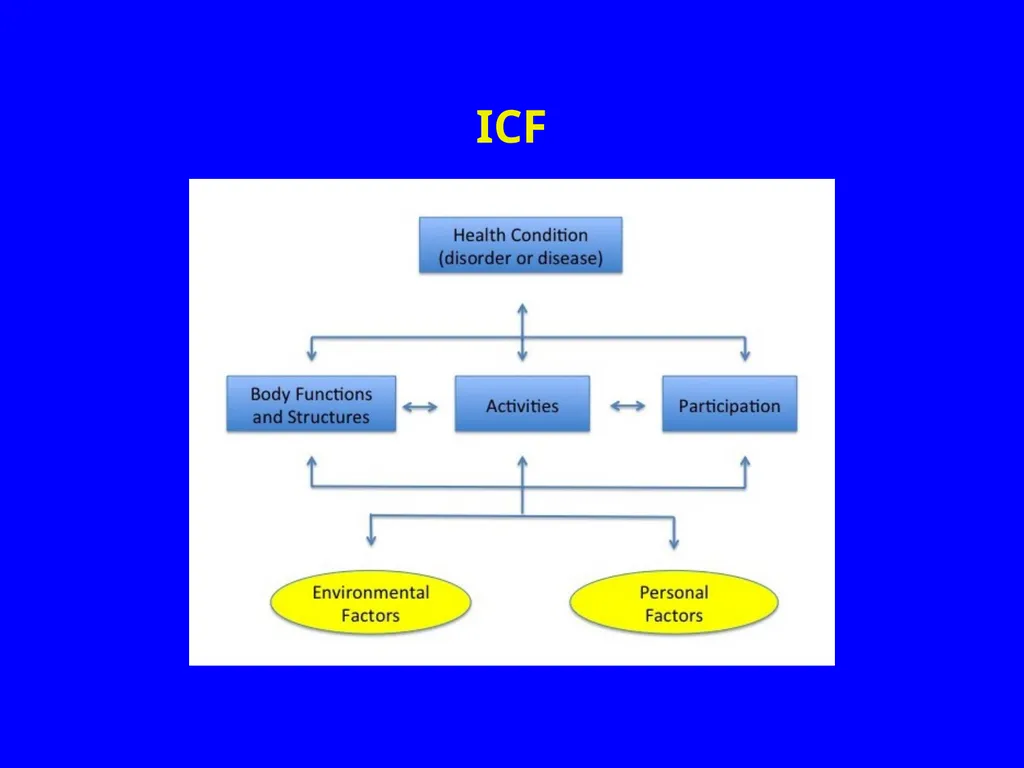
The International Classification of Functioning, Disability and Health (ICF) is a framework that enables the PT to examine and evaluate not only impairment but also activity and participation and to select interventions aimed at impairments, activity and/or participation.<br>
The International Classification of Functioning, Disability and Health (ICF) is a framework that enables the PT to examine and evaluate not only impairment but also activity and participation and to select interventions aimed at impairments, activity and/or participation.<br>
28
ICF<br>
29
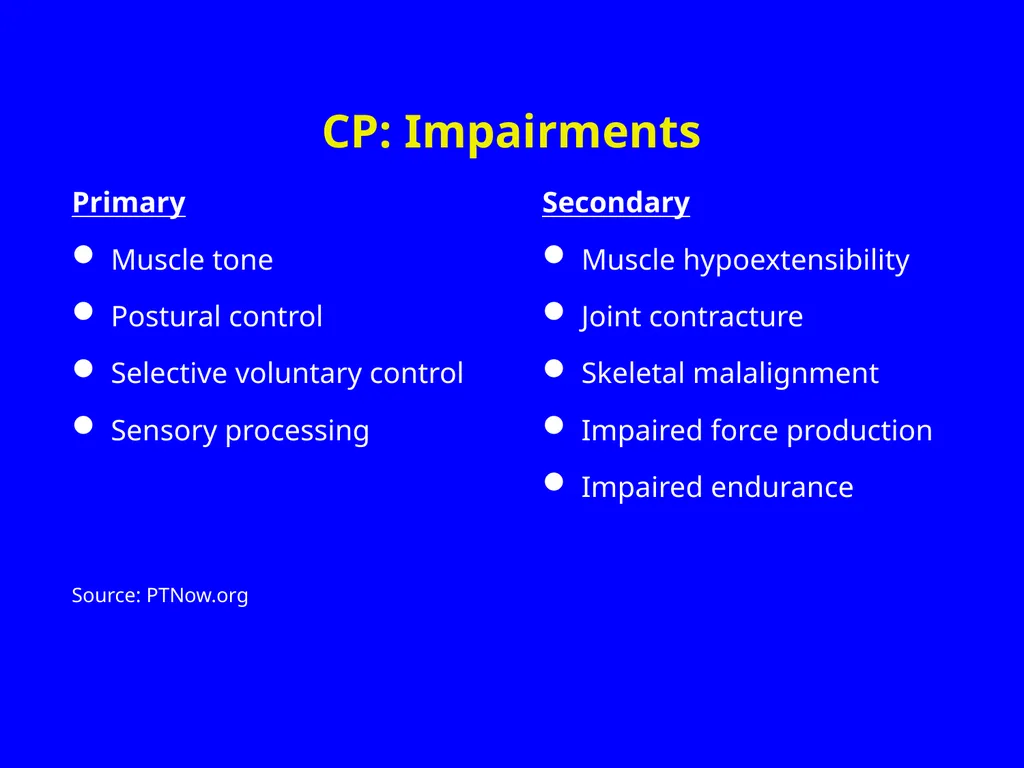
CP: Impairments Primary
Muscle tone
Postural control
Selective voluntary control
Sensory processing
Source: PTNow.org Secondary
Muscle hypoextensibility
Joint contracture
Skeletal malalignment
Impaired force production
Impaired endurance<br>
Muscle tone
Postural control
Selective voluntary control
Sensory processing
Source: PTNow.org Secondary
Muscle hypoextensibility
Joint contracture
Skeletal malalignment
Impaired force production
Impaired endurance<br>
30
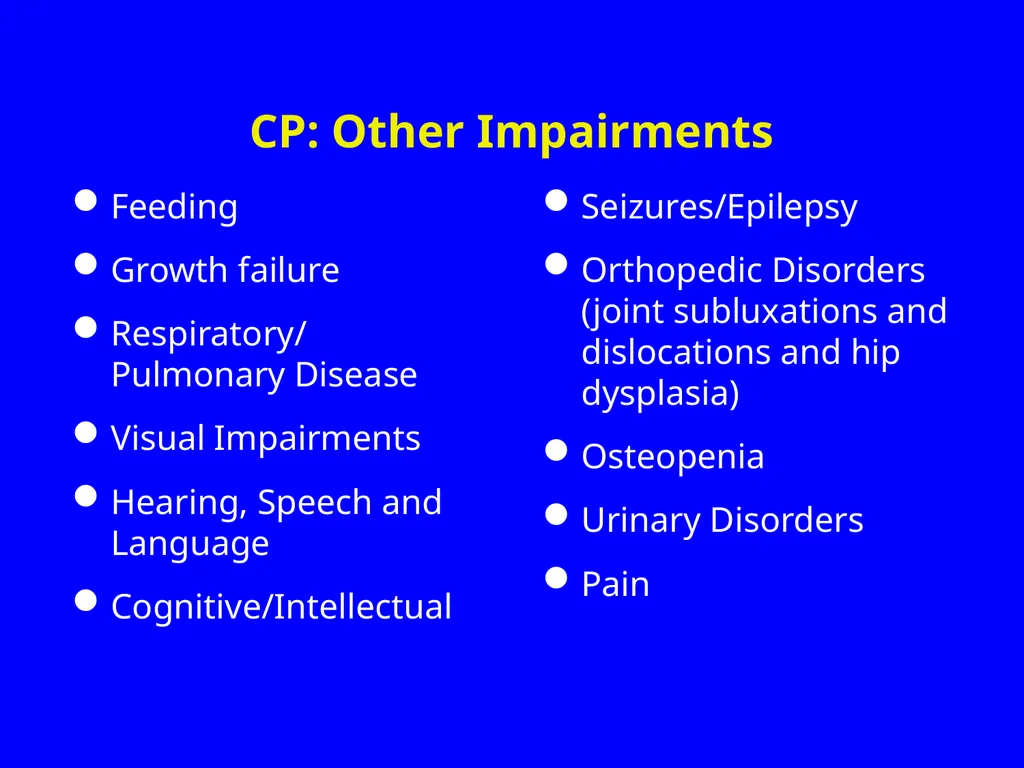
CP: Other Impairments Feeding
Growth failure
Respiratory/Pulmonary Disease
Visual Impairments
Hearing, Speech and Language
Cognitive/Intellectual Seizures/Epilepsy
Orthopedic Disorders (joint subluxations and dislocations and hip dysplasia)
Osteopenia
Urinary Disorders
Pain<br>
Growth failure
Respiratory/Pulmonary Disease
Visual Impairments
Hearing, Speech and Language
Cognitive/Intellectual Seizures/Epilepsy
Orthopedic Disorders (joint subluxations and dislocations and hip dysplasia)
Osteopenia
Urinary Disorders
Pain<br>
31
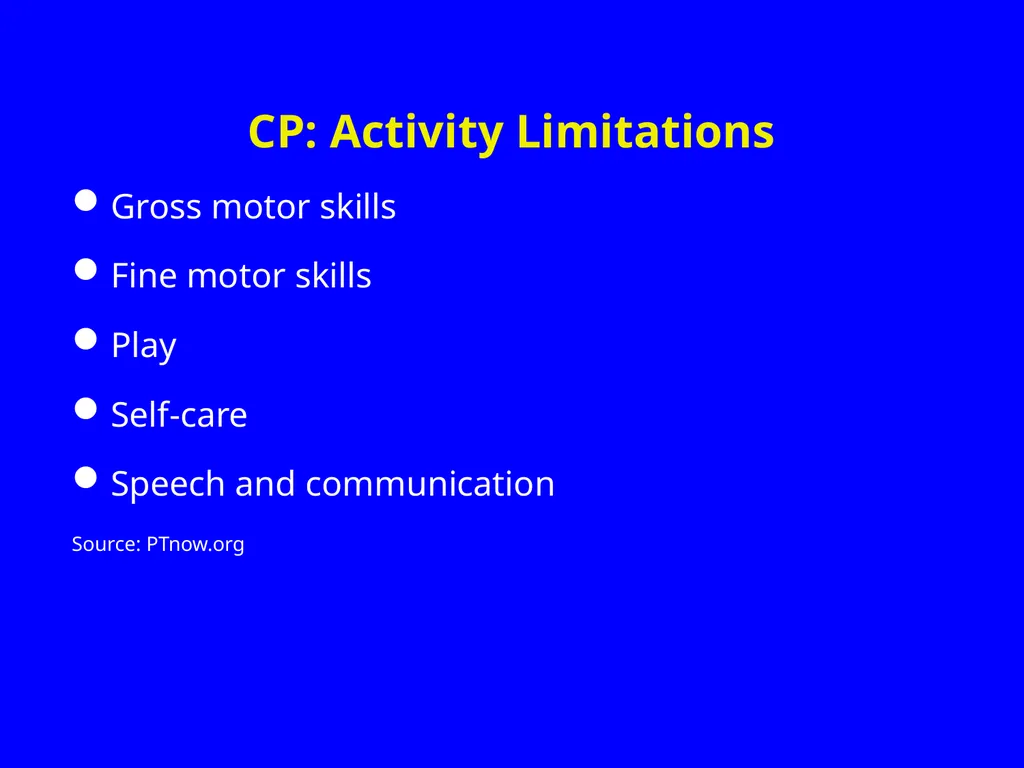
CP: Activity Limitations Gross motor skills
Fine motor skills
Play
Self-care
Speech and communication
Source: PTnow.org<br>
Fine motor skills
Play
Self-care
Speech and communication
Source: PTnow.org<br>
32
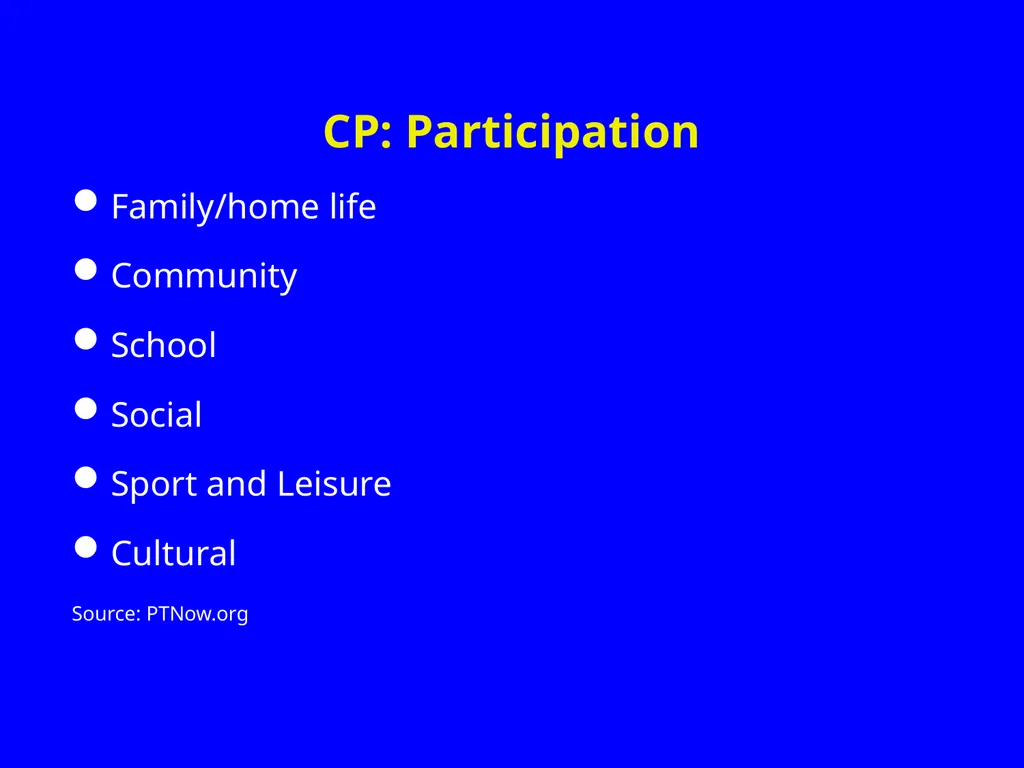
CP: Participation Family/home life
Community
School
Social
Sport and Leisure
Cultural
Source: PTNow.org<br>
Community
School
Social
Sport and Leisure
Cultural
Source: PTNow.org<br>
33
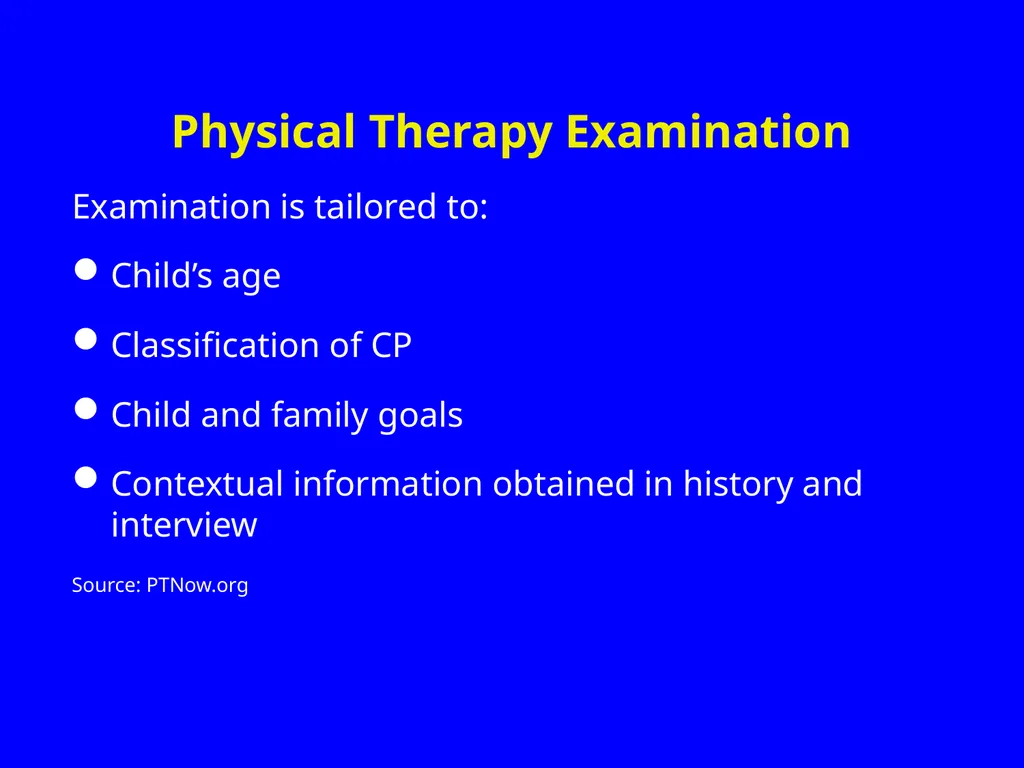
Physical Therapy Examination Examination is tailored to:
Child’s age
Classification of CP
Child and family goals
Contextual information obtained in history and interview
Source: PTNow.org<br>
Child’s age
Classification of CP
Child and family goals
Contextual information obtained in history and interview
Source: PTNow.org<br>
34
APTA Guide to Practice: Practice Patterns
for CP Pattern 5B: Impaired Neuromotor Development
Pattern 5C: Impaired Motor Function and Sensory Integrity Associated With Nonprogressive Disorders of the Central Nervous System - Congenital Origin or Acquired in Infancy or Childhood
http://guidetoptpractice.apta.org/<br>
Pattern 5C: Impaired Motor Function and Sensory Integrity Associated With Nonprogressive Disorders of the Central Nervous System - Congenital Origin or Acquired in Infancy or Childhood
http://guidetoptpractice.apta.org/<br>
35
Physical Therapy Examination History/Interview - Medical and Social
Musculoskeletal: Posture/Alignment, ROM, Strength
Neuromuscular: Muscle Tone, Spasticity (Modified Ashworth Scale and Tardieu Scale), Balance (Pediatric Balance Scale), Selective Control, Coordination, Motor Planning, Pain, Reflexes (primitive, righting, equilibrium reactions)
Cardiovascular/Pulmonary: Vital signs, Endurance (6- Minute Walk Test, Early Activity Scale for Endurance)<br>
Musculoskeletal: Posture/Alignment, ROM, Strength
Neuromuscular: Muscle Tone, Spasticity (Modified Ashworth Scale and Tardieu Scale), Balance (Pediatric Balance Scale), Selective Control, Coordination, Motor Planning, Pain, Reflexes (primitive, righting, equilibrium reactions)
Cardiovascular/Pulmonary: Vital signs, Endurance (6- Minute Walk Test, Early Activity Scale for Endurance)<br>
36
Physical Therapy Examination Gross Motor Skills [Gross Motor Function Measure, (GMFM)] and other mobility skills
ADL/Self Care
Adaptive Equipment
Participation [Pediatric Evaluation of Disability Inventory (PEDI)]<br>
ADL/Self Care
Adaptive Equipment
Participation [Pediatric Evaluation of Disability Inventory (PEDI)]<br>
37
Common Tests and Measures Impairments: Goniometry (ROM), MMT (strength), Modified Ashworth Scale or MAS (spasticity)
Activity: GMFM, Peabody Developmental Motor Scales 2nd Editiion (PDMS-2), PEDI
Participation: PEDI<br>
Activity: GMFM, Peabody Developmental Motor Scales 2nd Editiion (PDMS-2), PEDI
Participation: PEDI<br>
38
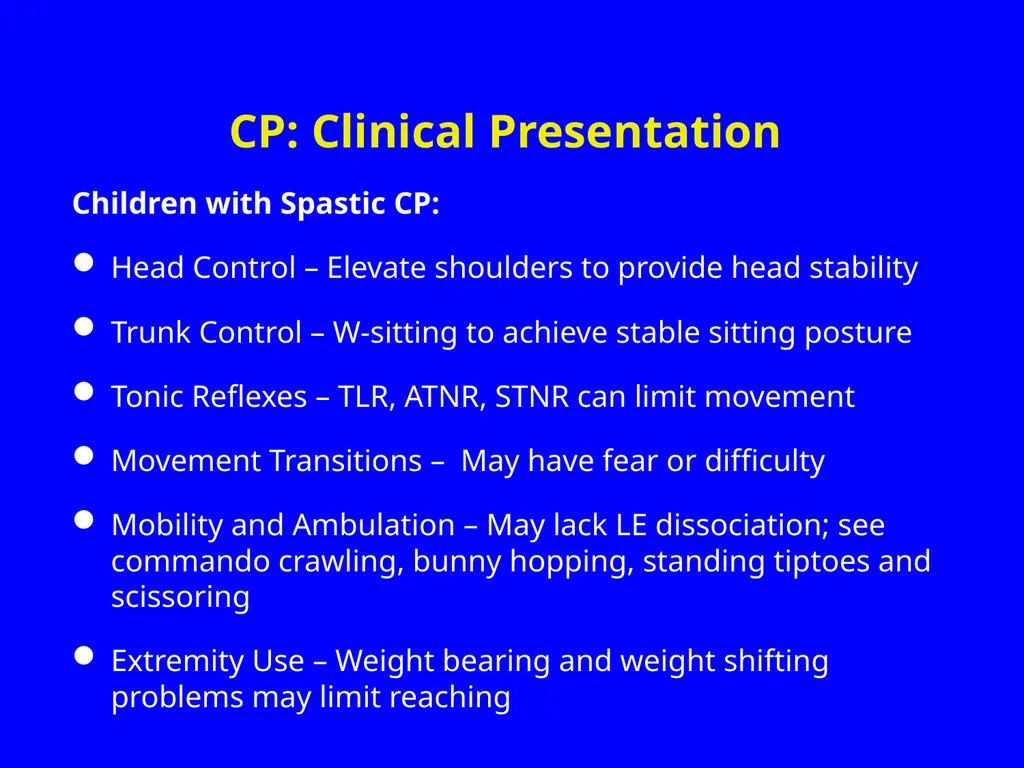
CP: Clinical Presentation Children with Spastic CP:
Head Control – Elevate shoulders to provide head stability
Trunk Control – W-sitting to achieve stable sitting posture
Tonic Reflexes – TLR, ATNR, STNR can limit movement
Movement Transitions – May have fear or difficulty
Mobility and Ambulation – May lack LE dissociation; see commando crawling, bunny hopping, standing tiptoes and scissoring
Extremity Use – Weight bearing and weight shifting problems may limit reaching<br>
Head Control – Elevate shoulders to provide head stability
Trunk Control – W-sitting to achieve stable sitting posture
Tonic Reflexes – TLR, ATNR, STNR can limit movement
Movement Transitions – May have fear or difficulty
Mobility and Ambulation – May lack LE dissociation; see commando crawling, bunny hopping, standing tiptoes and scissoring
Extremity Use – Weight bearing and weight shifting problems may limit reaching<br>
39
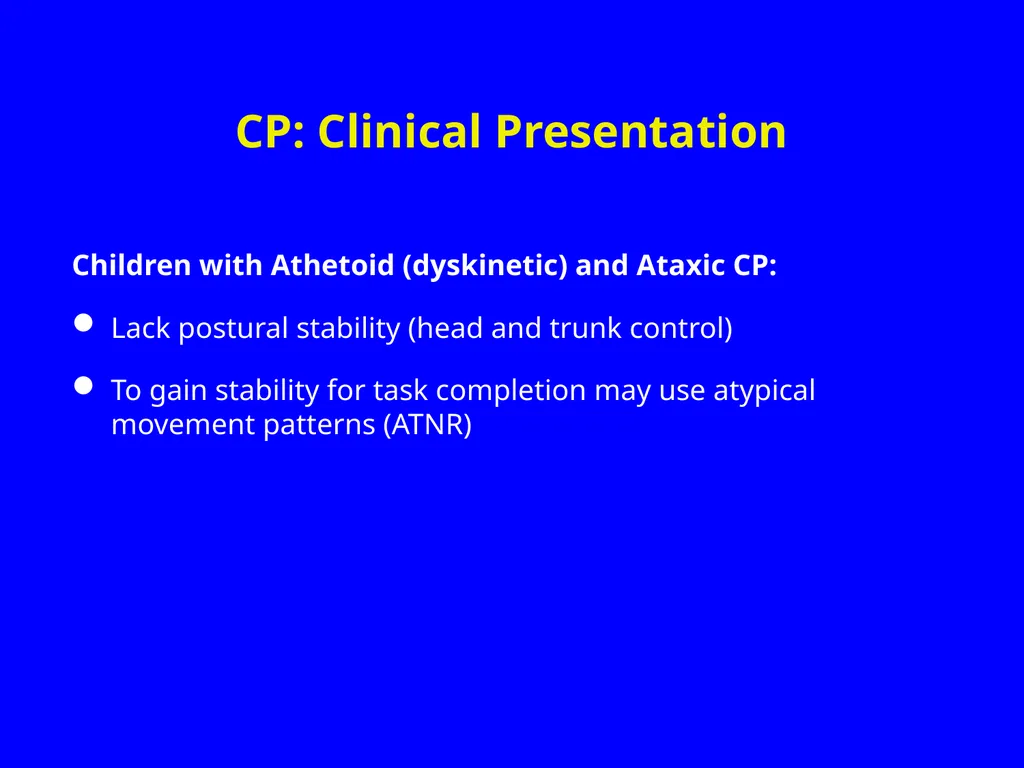
CP: Clinical Presentation Children with Athetoid (dyskinetic) and Ataxic CP:
Lack postural stability (head and trunk control)
To gain stability for task completion may use atypical movement patterns (ATNR)<br>
Lack postural stability (head and trunk control)
To gain stability for task completion may use atypical movement patterns (ATNR)<br>
40
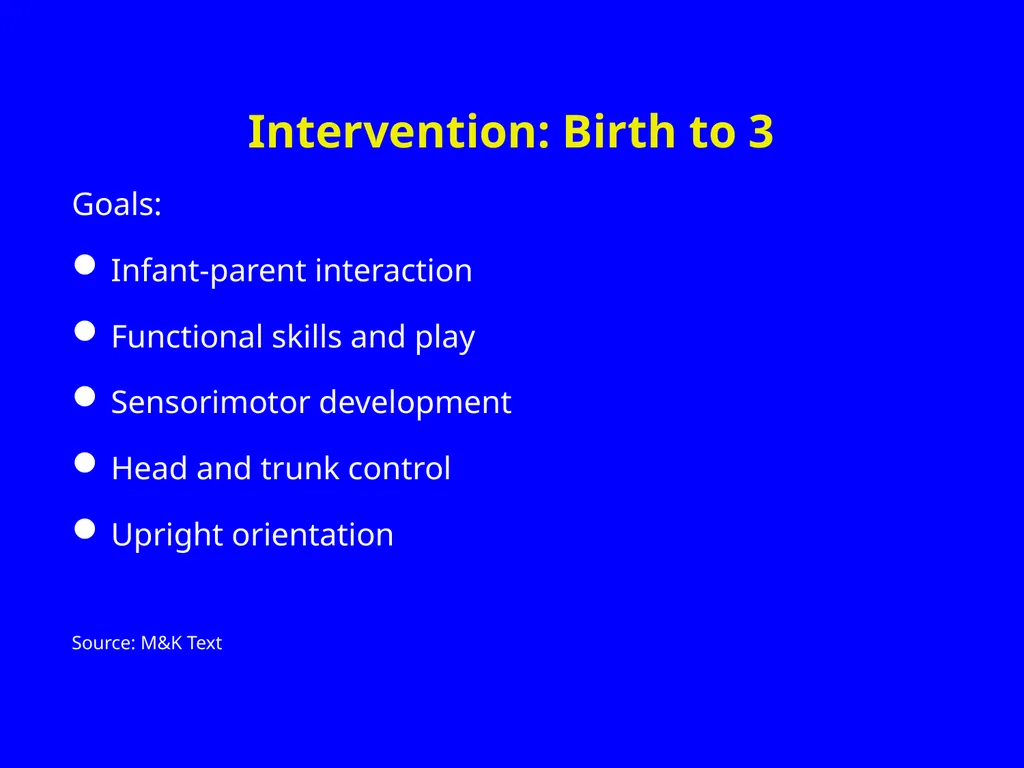
Intervention: Birth to 3 Goals:
Infant-parent interaction
Functional skills and play
Sensorimotor development
Head and trunk control
Upright orientation
Source: M&K Text<br>
Infant-parent interaction
Functional skills and play
Sensorimotor development
Head and trunk control
Upright orientation
Source: M&K Text<br>
41
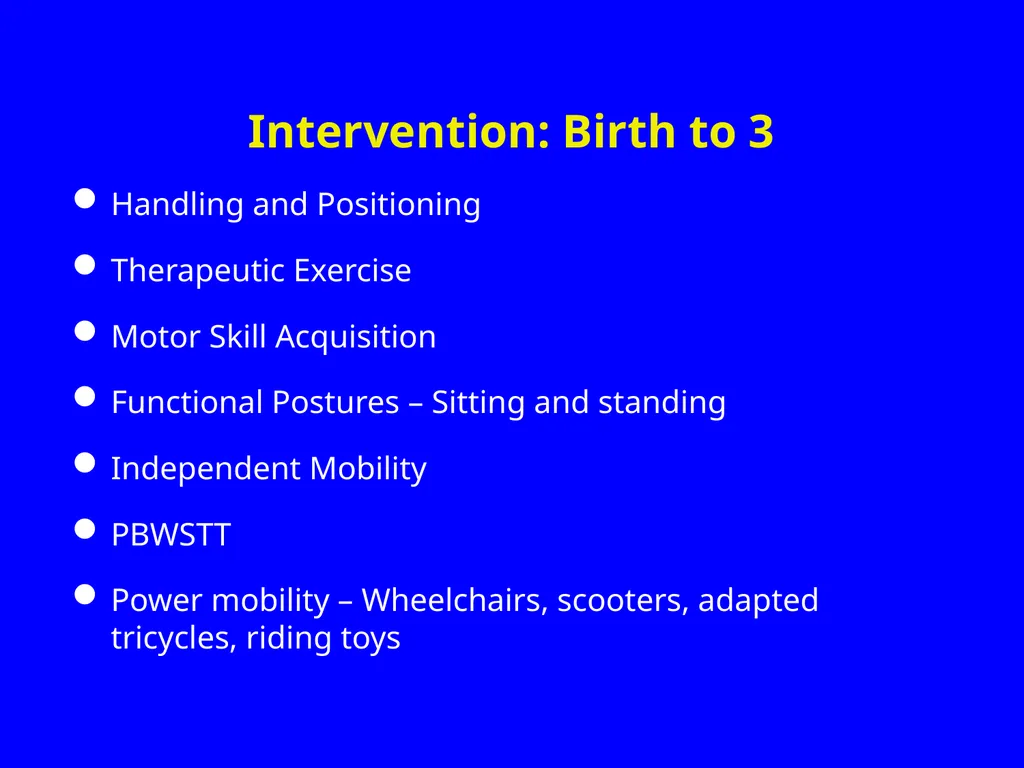
Intervention: Birth to 3 Handling and Positioning
Therapeutic Exercise
Motor Skill Acquisition
Functional Postures – Sitting and standing
Independent Mobility
PBWSTT
Power mobility – Wheelchairs, scooters, adapted tricycles, riding toys<br>
Therapeutic Exercise
Motor Skill Acquisition
Functional Postures – Sitting and standing
Independent Mobility
PBWSTT
Power mobility – Wheelchairs, scooters, adapted tricycles, riding toys<br>
42
Intervention: Preschool Years Goals:
Independent Mobility
Functional Movement
ADLs
Social Interaction<br>
Independent Mobility
Functional Movement
ADLs
Social Interaction<br>
43
Intervention: Preschool Years Independent Mobility – If they don’t have it, may now need assistive devices (orthoses, walker, w/c)
Gait – May be functional or therapeutic
Orthoses – AFOs are most common (non-hinged, hinged and ground reaction), SMOs for medial-lateral ankle stability
Assistive Devices – If not walkers, an alternative form of mobility
Power Mobility – For children with greater severity; important factors are accessibility and independence<br>
Gait – May be functional or therapeutic
Orthoses – AFOs are most common (non-hinged, hinged and ground reaction), SMOs for medial-lateral ankle stability
Assistive Devices – If not walkers, an alternative form of mobility
Power Mobility – For children with greater severity; important factors are accessibility and independence<br>
44
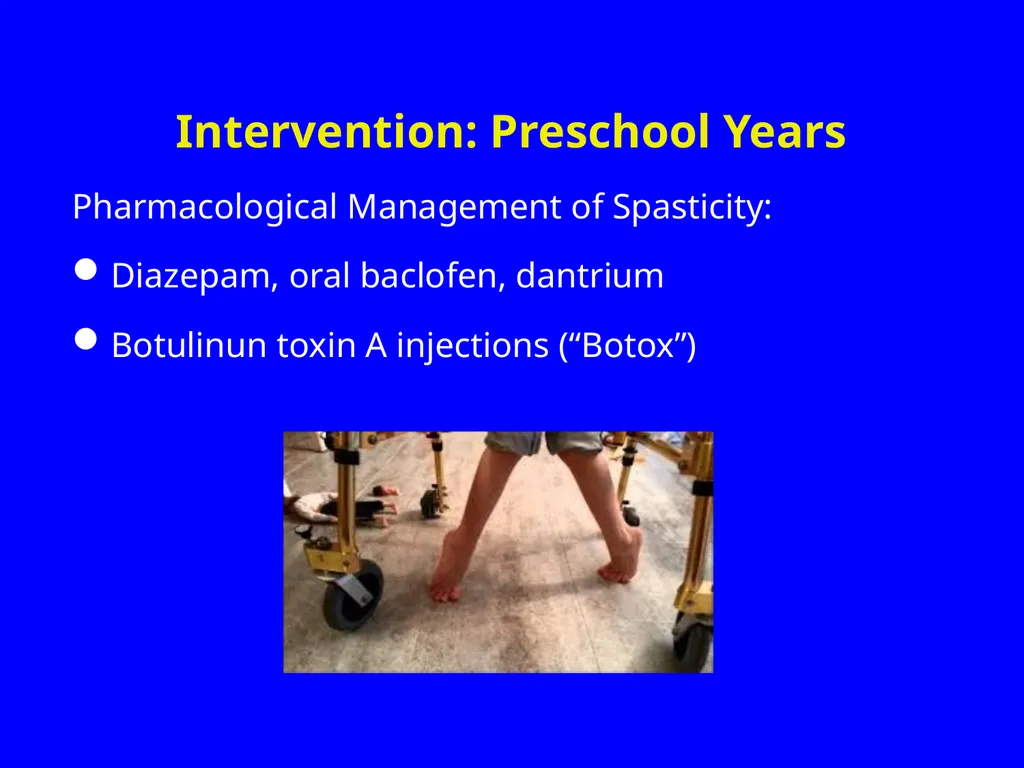
Intervention: Preschool Years Pharmacological Management of Spasticity:
Diazepam, oral baclofen, dantrium
Botulinun toxin A injections (“Botox”)<br>
Diazepam, oral baclofen, dantrium
Botulinun toxin A injections (“Botox”)<br>
45
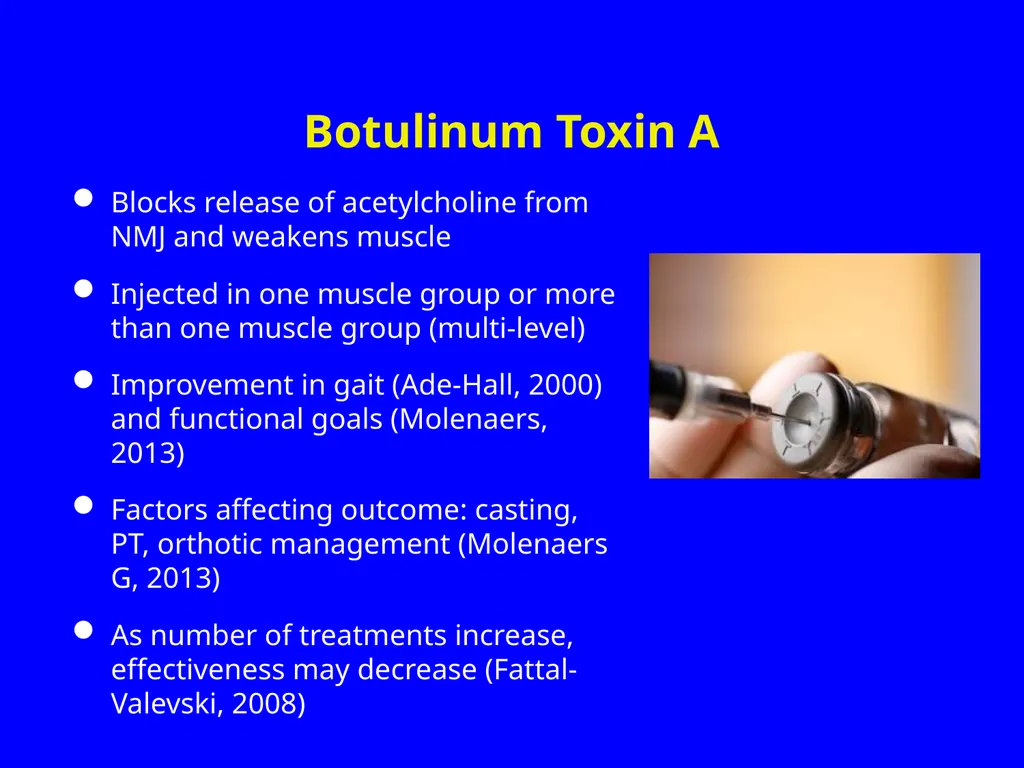
Botulinum Toxin A Blocks release of acetylcholine from NMJ and weakens muscle
Injected in one muscle group or more than one muscle group (multi-level)
Improvement in gait (Ade-Hall, 2000) and functional goals (Molenaers, 2013)
Factors affecting outcome: casting, PT, orthotic management (Molenaers G, 2013)
As number of treatments increase, effectiveness may decrease (Fattal-Valevski, 2008)<br>
Injected in one muscle group or more than one muscle group (multi-level)
Improvement in gait (Ade-Hall, 2000) and functional goals (Molenaers, 2013)
Factors affecting outcome: casting, PT, orthotic management (Molenaers G, 2013)
As number of treatments increase, effectiveness may decrease (Fattal-Valevski, 2008)<br>
46
Intervention: Preschool Years Surgical Management
Spasticity
Selective Dorsal Rhizotomy - selectively cut afferent sensory nerve roots, reducing the sensory input into the spinal reflex arc and reducing muscle tone.
Intrathecal Baclofen (ITB)
Muscle shortening, joint contracture, and skeletal malalignment
Muscle or tendon releases
Tendon transfers
Osteotomies<br>
Spasticity
Selective Dorsal Rhizotomy - selectively cut afferent sensory nerve roots, reducing the sensory input into the spinal reflex arc and reducing muscle tone.
Intrathecal Baclofen (ITB)
Muscle shortening, joint contracture, and skeletal malalignment
Muscle or tendon releases
Tendon transfers
Osteotomies<br>
47
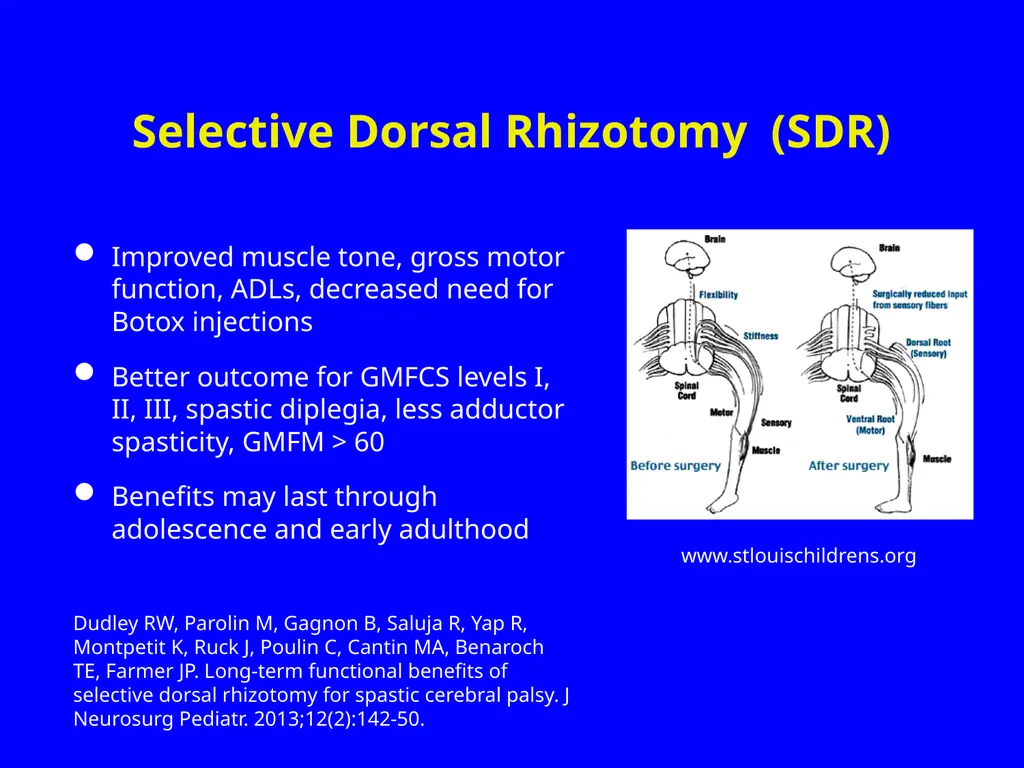
Selective Dorsal Rhizotomy (SDR) Improved muscle tone, gross motor function, ADLs, decreased need for Botox injections
Better outcome for GMFCS levels I, II, III, spastic diplegia, less adductor spasticity, GMFM > 60
Benefits may last through adolescence and early adulthood
Dudley RW, Parolin M, Gagnon B, Saluja R, Yap R, Montpetit K, Ruck J, Poulin C, Cantin MA, Benaroch TE, Farmer JP. Long-term functional benefits of selective dorsal rhizotomy for spastic cerebral palsy. J Neurosurg Pediatr. 2013;12(2):142-50. www.stlouischildrens.org<br>
Better outcome for GMFCS levels I, II, III, spastic diplegia, less adductor spasticity, GMFM > 60
Benefits may last through adolescence and early adulthood
Dudley RW, Parolin M, Gagnon B, Saluja R, Yap R, Montpetit K, Ruck J, Poulin C, Cantin MA, Benaroch TE, Farmer JP. Long-term functional benefits of selective dorsal rhizotomy for spastic cerebral palsy. J Neurosurg Pediatr. 2013;12(2):142-50. www.stlouischildrens.org<br>
48
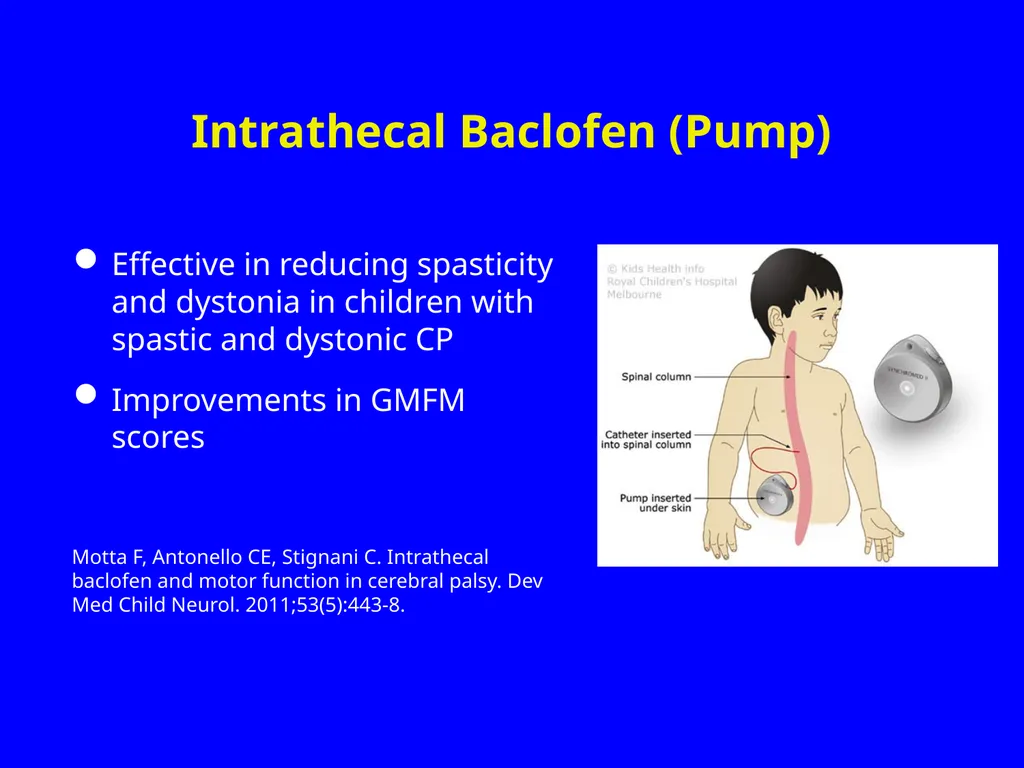
Intrathecal Baclofen (Pump) Effective in reducing spasticity and dystonia in children with spastic and dystonic CP
Improvements in GMFM scores
Motta F, Antonello CE, Stignani C. Intrathecal baclofen and motor function in cerebral palsy. Dev Med Child Neurol. 2011;53(5):443-8.<br>
Improvements in GMFM scores
Motta F, Antonello CE, Stignani C. Intrathecal baclofen and motor function in cerebral palsy. Dev Med Child Neurol. 2011;53(5):443-8.<br>
49
Intervention: Preschool Years Functional Movement
ADLS
Peer Interaction<br>
ADLS
Peer Interaction<br>
50
Intervention: School Age and Adolescence Goals
Safeguard previous gains
Self-responsibility and motivation
Independent mobility
Independent ADLs Fitness and self-image
Community integration
Vocational plan
Social interaction<br>
Safeguard previous gains
Self-responsibility and motivation
Independent mobility
Independent ADLs Fitness and self-image
Community integration
Vocational plan
Social interaction<br>
51
Intervention: School Age and Adolescence Physiologic changes – Growth/body mass changes
Strength
Fitness
Community Integration<br>
Strength
Fitness
Community Integration<br>
52
Intervention: Adulthood Goals
Independent mobility and ADLs
Healthy lifestyles
Participation
Independent living
Vocation<br>
Independent mobility and ADLs
Healthy lifestyles
Participation
Independent living
Vocation<br>
53
Assistive Devices and Technology Positioning devices – Standers may have positive effect on BMD, spasticity, ROM (Glickman LB, 2010).
Assistive mobility devices (walkers, gait trainers, crutches, w/c’s)
Augmentative communication
ADLs (bath/shower chairs, toilet chairs)
Orthoses<br>
Assistive mobility devices (walkers, gait trainers, crutches, w/c’s)
Augmentative communication
ADLs (bath/shower chairs, toilet chairs)
Orthoses<br>
54
The Evidence Impairment Focused Interventions
Endurance Training – May improve aerobic fitness but effect on activity less clear (Butler JM, 2010)
Strength Training – Improved muscle strength and gait; 40-50 minutes 3x/week (Park EY, 2014)<br>
Endurance Training – May improve aerobic fitness but effect on activity less clear (Butler JM, 2010)
Strength Training – Improved muscle strength and gait; 40-50 minutes 3x/week (Park EY, 2014)<br>
55
The Evidence Impairment Focused Interventions
Stretching – Passive DF stretch may have immediate effects but long-lasting effects unknown (Theis N, 2013); Casting plus Botox injections (vs Botox alone) resulted in increased ankle DF ROM in children with equinus foot (Lee SJ, 2011)
Balance – 8wk balance plus strength training program resulted in improvements in balance and strength (Auld ML, 2014); Wii-based balance training effective in improving balance in ambulatory children with CP (Tarakci D, 2013)<br>
Stretching – Passive DF stretch may have immediate effects but long-lasting effects unknown (Theis N, 2013); Casting plus Botox injections (vs Botox alone) resulted in increased ankle DF ROM in children with equinus foot (Lee SJ, 2011)
Balance – 8wk balance plus strength training program resulted in improvements in balance and strength (Auld ML, 2014); Wii-based balance training effective in improving balance in ambulatory children with CP (Tarakci D, 2013)<br>
56
The Evidence Activity Focused Interventions
PBWSTT – In children with moderate to severe CP, increased gait speed and trend toward increased gait endurance (Dodd KJ ,2007). May be no more effective than over ground gait training for increasing function. (Willoughby KL, 2010)
Electrical Stimulation – May improve impairments and activity limitations related to gait (Cauraugh JH, 2010)<br>
PBWSTT – In children with moderate to severe CP, increased gait speed and trend toward increased gait endurance (Dodd KJ ,2007). May be no more effective than over ground gait training for increasing function. (Willoughby KL, 2010)
Electrical Stimulation – May improve impairments and activity limitations related to gait (Cauraugh JH, 2010)<br>
57
Partial Body Weight Supported Treadmill Training http://www.youtube.com/watch?v=k3TMEGT8Aq0<br>
58
The Evidence Activity Focused Interventions
AFOs – May improve gait efficiency (Morris, 2011); may improve gait kinetics and kinematics, and functional mobility (Figueiredo EM, 2008)
Functional Activities Training – Task-oriented strength training has positive effect on functional mobility (Salem Y, 2009)<br>
AFOs – May improve gait efficiency (Morris, 2011); may improve gait kinetics and kinematics, and functional mobility (Figueiredo EM, 2008)
Functional Activities Training – Task-oriented strength training has positive effect on functional mobility (Salem Y, 2009)<br>
59
The Evidence Activity Focused Interventions
Constraint Induced Movement Therapy (CIMT)
Developmental disregard – child tends to not use limb which leads to further impairment ( tone, motor control, ROM, strength, skeletal maturation)
Based on 2 principles: constraint of noninvolved limb and massed practice of involved limb
High intensity training
Potential to improve UE motor function in the involved limb
Optimal dosage has not been established
Modified program more feasible and still result in positive outcome
Hoare B. Constraint-induced movement therapy in the treatment of the upper limb in children with hemiplegic cerebral palsy. Cochrane Database Of Systematic Reviews [serial online]. November 12, 2008;(1)Available from: Cochrane Database of Systematic Reviews, Ipswich, MA. Accessed March 14, 2014<br>
Constraint Induced Movement Therapy (CIMT)
Developmental disregard – child tends to not use limb which leads to further impairment ( tone, motor control, ROM, strength, skeletal maturation)
Based on 2 principles: constraint of noninvolved limb and massed practice of involved limb
High intensity training
Potential to improve UE motor function in the involved limb
Optimal dosage has not been established
Modified program more feasible and still result in positive outcome
Hoare B. Constraint-induced movement therapy in the treatment of the upper limb in children with hemiplegic cerebral palsy. Cochrane Database Of Systematic Reviews [serial online]. November 12, 2008;(1)Available from: Cochrane Database of Systematic Reviews, Ipswich, MA. Accessed March 14, 2014<br>
60
CIMT http://www.youtube.com/watch?v=IG3VCIsAXPI<br>
61
Children with CP and Participation Involvement in a life situation
Person-Environment Interaction
Home, school, community, social relationships
Mental and physical health benefits
May improve QOL<br>
Person-Environment Interaction
Home, school, community, social relationships
Mental and physical health benefits
May improve QOL<br>
62
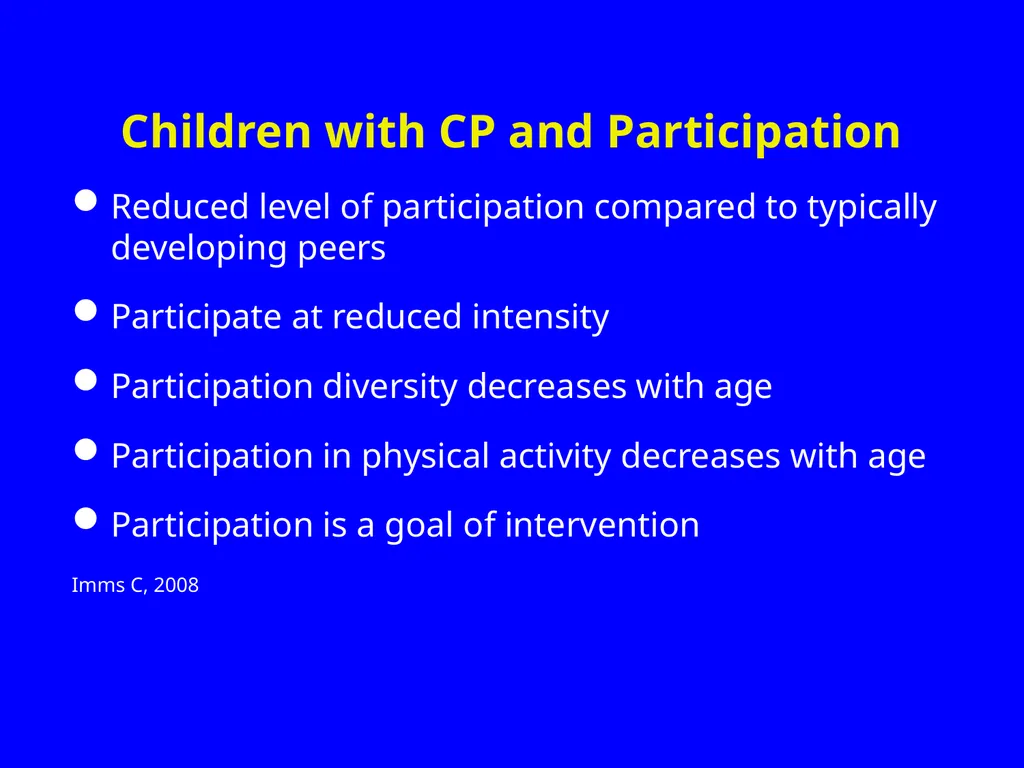
Children with CP and Participation Reduced level of participation compared to typically developing peers
Participate at reduced intensity
Participation diversity decreases with age
Participation in physical activity decreases with age
Participation is a goal of intervention
Imms C, 2008<br>
Participate at reduced intensity
Participation diversity decreases with age
Participation in physical activity decreases with age
Participation is a goal of intervention
Imms C, 2008<br>
63
Secondary Conditions, Prevention
and Fitness Discussion of article by
Fowler EG, Kolobe THA, Damiano DL, Thorpe DE, Morgan DW, Brunstrom JE, Coster WJ, Henderson RC, Pitetti KH, Rimmer JH, Rose J, Stevenson RD. Promotion of Physical Fitness and Prevention of Secondary Conditions for Children With Cerebral Palsy: Section on Pediatrics Research Summit Proceedings. Physical Therapy. 2007; 87:1495-1510.<br>
Fowler EG, Kolobe THA, Damiano DL, Thorpe DE, Morgan DW, Brunstrom JE, Coster WJ, Henderson RC, Pitetti KH, Rimmer JH, Rose J, Stevenson RD. Promotion of Physical Fitness and Prevention of Secondary Conditions for Children With Cerebral Palsy: Section on Pediatrics Research Summit Proceedings. Physical Therapy. 2007; 87:1495-1510.<br>
64
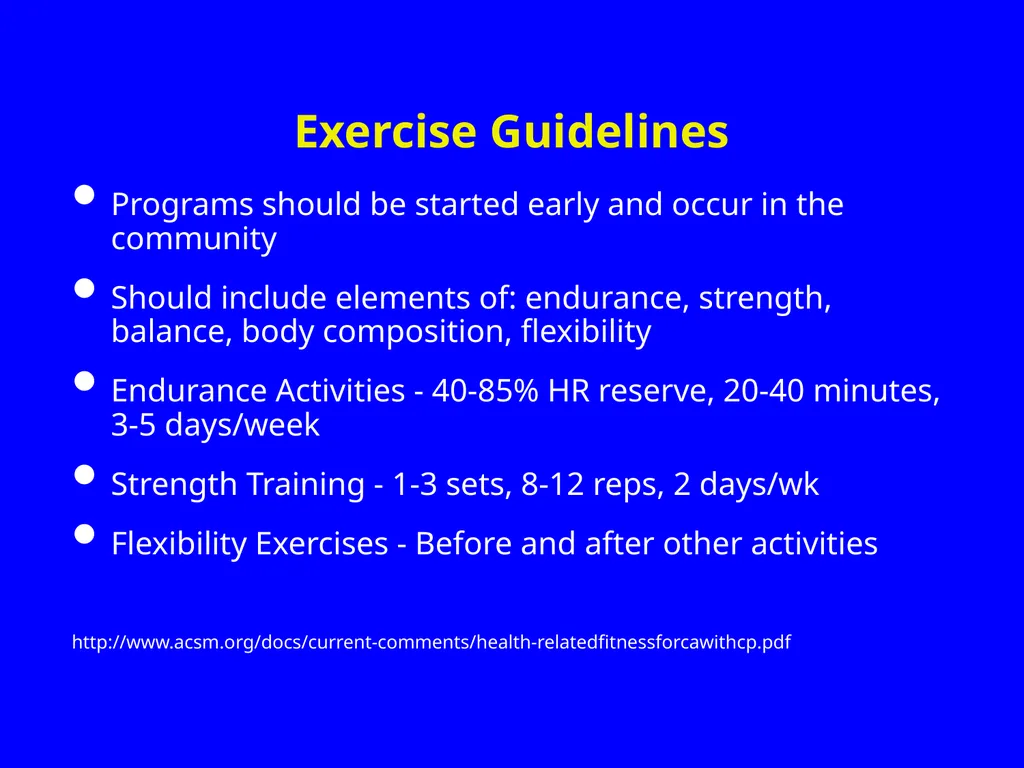
Exercise Guidelines Programs should be started early and occur in the community
Should include elements of: endurance, strength, balance, body composition, flexibility
Endurance Activities - 40-85% HR reserve, 20-40 minutes, 3-5 days/week
Strength Training - 1-3 sets, 8-12 reps, 2 days/wk
Flexibility Exercises - Before and after other activities
http://www.acsm.org/docs/current-comments/health-relatedfitnessforcawithcp.pdf<br>
Should include elements of: endurance, strength, balance, body composition, flexibility
Endurance Activities - 40-85% HR reserve, 20-40 minutes, 3-5 days/week
Strength Training - 1-3 sets, 8-12 reps, 2 days/wk
Flexibility Exercises - Before and after other activities
http://www.acsm.org/docs/current-comments/health-relatedfitnessforcawithcp.pdf<br>
65
Resources for Physical Activity and Fitness American College of Sports Medicinehttp://www.acsm.org/docs/current-comments/health-relatedfitnessforcawithcp.pdf
KidsHealth. http://kidshealth.org/kid/health_problems/brain/cerebral_palsy.html
National Center on Health, Physical Activity, and Disability. http://www.ncpad.org
United Cerebral Palsy. http://ucp.org/resources/health-and-wellness/<br>
KidsHealth. http://kidshealth.org/kid/health_problems/brain/cerebral_palsy.html
National Center on Health, Physical Activity, and Disability. http://www.ncpad.org
United Cerebral Palsy. http://ucp.org/resources/health-and-wellness/<br>
66
Closing Discussion: The Perspective of an Individual with CP Does this influence the way you practice?
Article - Jones GC. Aging with cerebral palsy and other disabilities: personal reflections and recommendations. Developmental Medicine & Child Neurology. 2009; 51(4): 12-15.
http://onlinelibrary.wiley.com/doi/10.1111/j.1469-8749.2009.03427.x/pdf<br>
Article - Jones GC. Aging with cerebral palsy and other disabilities: personal reflections and recommendations. Developmental Medicine & Child Neurology. 2009; 51(4): 12-15.
http://onlinelibrary.wiley.com/doi/10.1111/j.1469-8749.2009.03427.x/pdf<br>
67
Small Group Activity: Applying the ICF Framework and Interventions Using your case study (Jan or Ian), identify the following and suggest treatment ideas/activities targeted at the child’s PT goals:
Impairments of body function and structure
Activity limitations
Participation restrictions
Contextual factors (personal or environmental) you would consider when providing intervention.<br>
Impairments of body function and structure
Activity limitations
Participation restrictions
Contextual factors (personal or environmental) you would consider when providing intervention.<br>
68
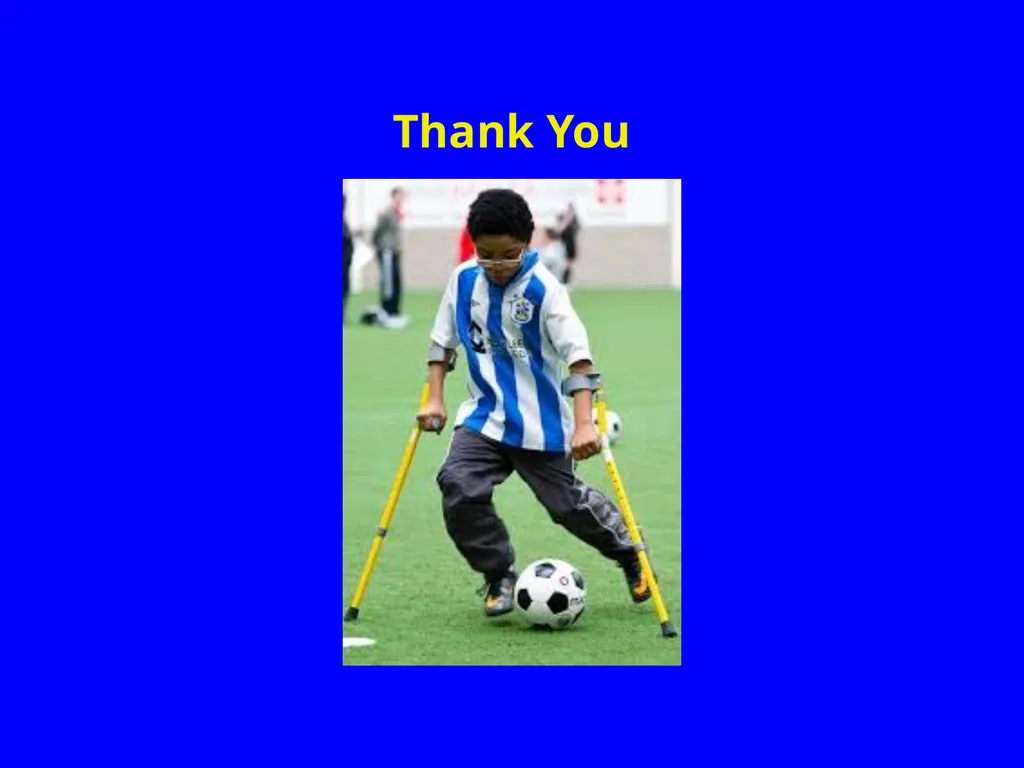
Thank You<br>
69
Next: Lab Discussion of small group activities from lecture
Clinic observations of children with CP
3 yo male with spastic quadriplegic CP
2.5 yo female with spastic hemiplegic CP
Positioning, handling, activities for children with CP
Clinic visit write-ups (forms available on Moodle)<br>
Clinic observations of children with CP
3 yo male with spastic quadriplegic CP
2.5 yo female with spastic hemiplegic CP
Positioning, handling, activities for children with CP
Clinic visit write-ups (forms available on Moodle)<br>