
PHYSICO –CHEMICAL CHANGES DURING PREPARATION AND
NS
Published · 15 slides · 0 views

1 / 1


Description
PHYSICO CHEMICAL CHANGES DURING PREPARATION AND STORAGE OF CONCENTRATED MILK By Manish Kumar Condensed and Evaporated Milk Condensed Milk Condensed milk is the product obtained by evaporating a part of the water of whole milk, or fully or
Related Topics
Share
Embed code
Download this presentation From Below
"PHYSICO –CHEMICAL CHANGES DURING PREPARATION AND" is the property of its rightful owner. Permission is granted to download and print the materials on this website for personal, non-commercial use only, and to display it on your personal computer provided you do not modify the materials and that you retain all copyright notices contained in the materials. By downloading content from our website, you accept the terms of this agreement.
Presentation Transcript
01
PHYSICO –CHEMICAL CHANGES DURING PREPARATION AND STORAGE OF CONCENTRATED MILK By Manish Kumar<br>
02
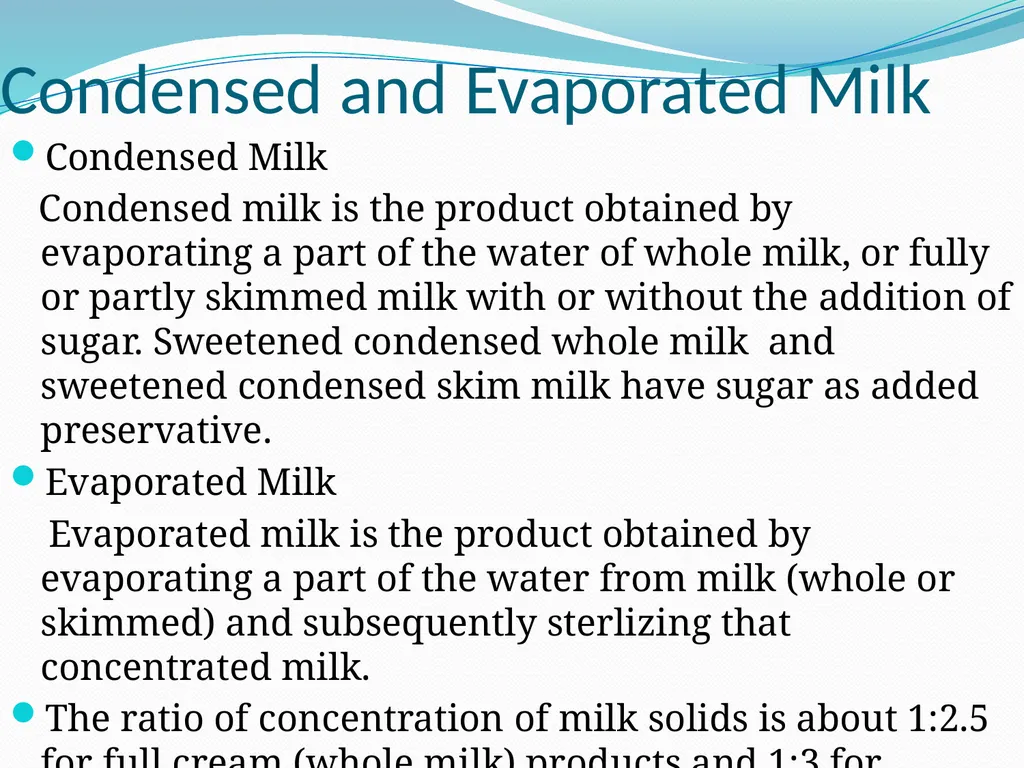
Condensed and Evaporated Milk Condensed Milk
Condensed milk is the product obtained by evaporating a part of the water of whole milk, or fully or partly skimmed milk with or without the addition of sugar. Sweetened condensed whole milk and sweetened condensed skim milk have sugar as added preservative.
Evaporated Milk
Evaporated milk is the product obtained by evaporating a part of the water from milk (whole or skimmed) and subsequently sterlizing that concentrated milk.
The ratio of concentration of milk solids is about 1:2.5 for full cream (whole milk) products and 1:3 for sweetened condensed skim milk.<br>
Condensed milk is the product obtained by evaporating a part of the water of whole milk, or fully or partly skimmed milk with or without the addition of sugar. Sweetened condensed whole milk and sweetened condensed skim milk have sugar as added preservative.
Evaporated Milk
Evaporated milk is the product obtained by evaporating a part of the water from milk (whole or skimmed) and subsequently sterlizing that concentrated milk.
The ratio of concentration of milk solids is about 1:2.5 for full cream (whole milk) products and 1:3 for sweetened condensed skim milk.<br>
03
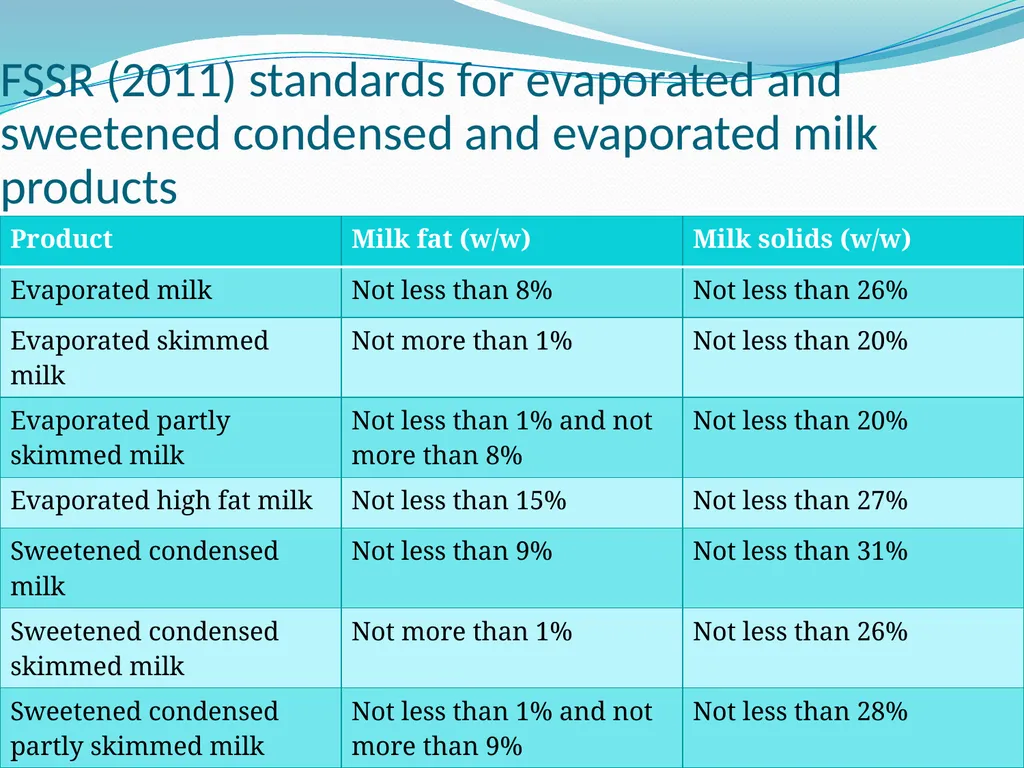
FSSR (2011) standards for evaporated and sweetened condensed and evaporated milk products<br>
04
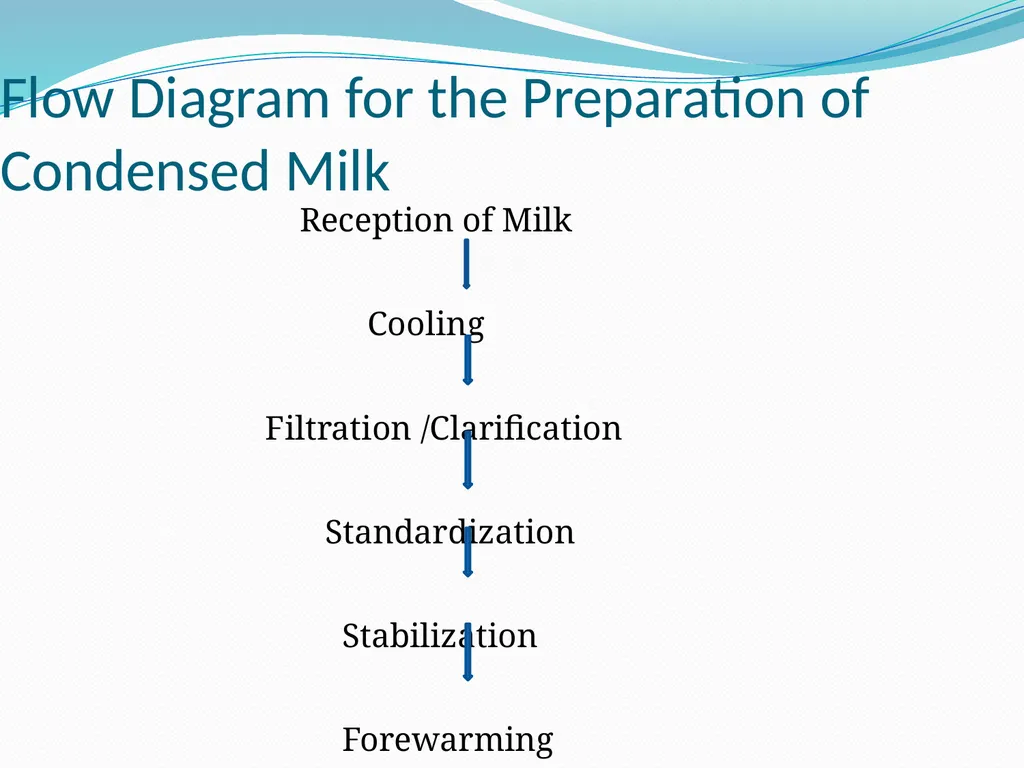
Flow Diagram for the Preparation of Condensed Milk Reception of Milk
Cooling
Filtration /Clarification
Standardization
Stabilization
Forewarming<br>
Cooling
Filtration /Clarification
Standardization
Stabilization
Forewarming<br>
05
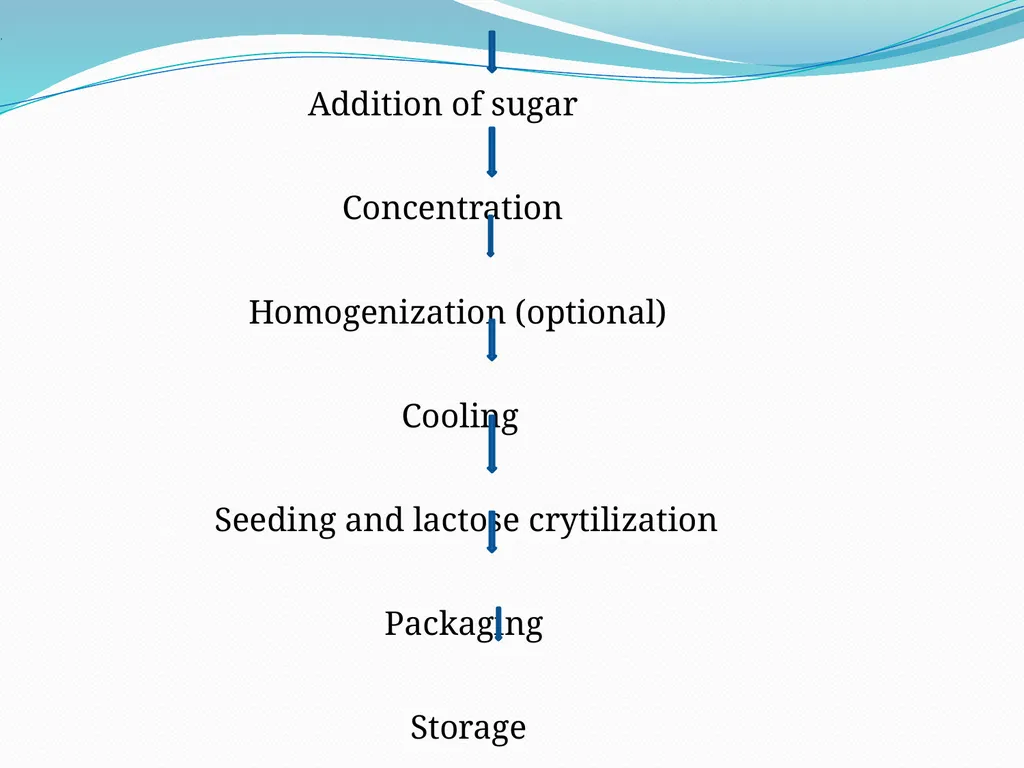
. Addition of sugar
Concentration
Homogenization (optional)
Cooling
Seeding and lactose crytilization
Packaging
Storage<br>
Concentration
Homogenization (optional)
Cooling
Seeding and lactose crytilization
Packaging
Storage<br>
06
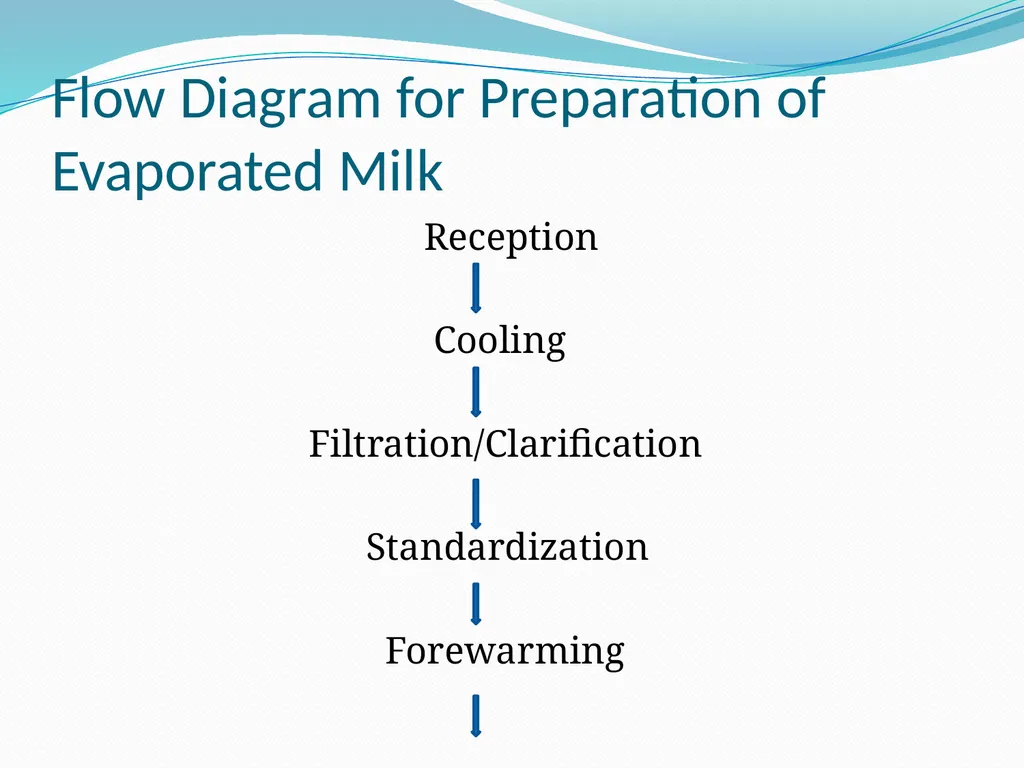
Flow Diagram for Preparation of Evaporated Milk Reception
Cooling
Filtration/Clarification
Standardization
Forewarming<br>
Cooling
Filtration/Clarification
Standardization
Forewarming<br>
07
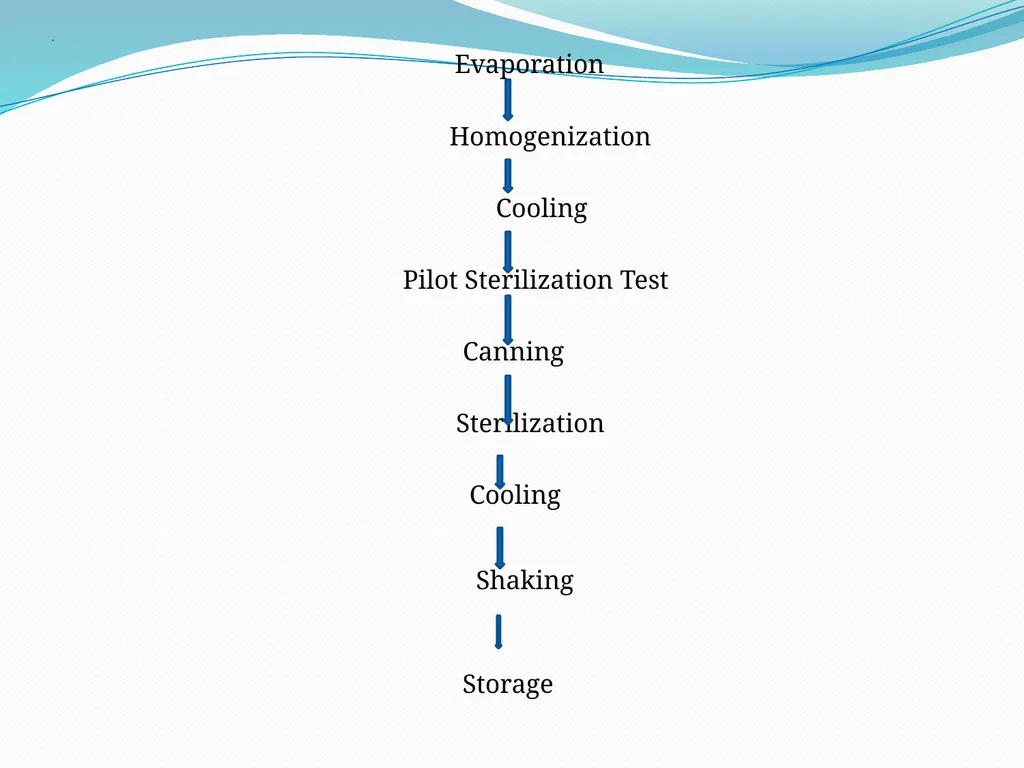
. Evaporation
Homogenization
Cooling
Pilot Sterilization Test
Canning
Sterilization
Cooling
Shaking
Storage<br>
Homogenization
Cooling
Pilot Sterilization Test
Canning
Sterilization
Cooling
Shaking
Storage<br>
08
Physico-Chemical changes during Preparation During the manufacture of condensed milk certain physical changes such as development of brown colour, changes in viscosity are noticed besides increase in density/specific gravity. One of the important chemical changes noticed is decrease in pH. These changes occurring in the physico-chemical properties in condensed milk due to various processing conditions have profound effect on the final quality and self-life and storage stability of the product. Some of these physico-chemical properties are discussed below:
i) Density/Specific Gravity: Removal of water in the manufacture of condensed milk increases the total solids<br>
i) Density/Specific Gravity: Removal of water in the manufacture of condensed milk increases the total solids<br>
09
. content. Because of the total solids concentration the density/sp. gr. of condensed milk increases. The sp. gr. of concentrated milk is product. Baume’ hydrometers are widely used for sp. gr. measurements.
ii) Freezing Point: Freezing point of milk is quite constant, however it is always lower than that of water and varies with composition of milk. Removal of water as well as addition of soluble substances, such as sugar, has direct effect on the freezing point of condensed milk.
iii) Viscosity: Viscosity of condensed milk varies greatly according to the composition, processing conditions and storage period. Increase in concentration increases the viscosity. Homogenization and low temperature storage of concentrated milk is highly important for successful marketing of the product. Too high or low viscosity is not desirable in the product. Low viscosity tends to leave objectionable sugar sediment in condensed milk and fat separation in evaporated milk. Too high viscosity causes gel<br>
ii) Freezing Point: Freezing point of milk is quite constant, however it is always lower than that of water and varies with composition of milk. Removal of water as well as addition of soluble substances, such as sugar, has direct effect on the freezing point of condensed milk.
iii) Viscosity: Viscosity of condensed milk varies greatly according to the composition, processing conditions and storage period. Increase in concentration increases the viscosity. Homogenization and low temperature storage of concentrated milk is highly important for successful marketing of the product. Too high or low viscosity is not desirable in the product. Low viscosity tends to leave objectionable sugar sediment in condensed milk and fat separation in evaporated milk. Too high viscosity causes gel<br>
10
. formation and mineral deposits in evaporated milk.
iv) Colour and Flavour: Objectionable brown colour is sometimes found in condensed milks. Exposure to high heat during manufacture and storage of condensed milk tends to darken their colour and develope a ‘cooked’ flavour. Various factors contributing to the brown discolouration and cooked flavour production, are heat treatment, total soils concentration, pH condition, addition of compounds like sugar stabilizers, storage temperature and time of storage.
v) Changes in pH: A decrease in pH as compared to milk can be expected in condensed milks during manufacture because of the processing steps such as preheating, concentration and sterilization. Decrease in pH has definite effect on the stability of concentrated milk towards heat sterilization.<br>
iv) Colour and Flavour: Objectionable brown colour is sometimes found in condensed milks. Exposure to high heat during manufacture and storage of condensed milk tends to darken their colour and develope a ‘cooked’ flavour. Various factors contributing to the brown discolouration and cooked flavour production, are heat treatment, total soils concentration, pH condition, addition of compounds like sugar stabilizers, storage temperature and time of storage.
v) Changes in pH: A decrease in pH as compared to milk can be expected in condensed milks during manufacture because of the processing steps such as preheating, concentration and sterilization. Decrease in pH has definite effect on the stability of concentrated milk towards heat sterilization.<br>
11
Sweetened Condensed Milk Age Thickening
The main change in sweetened condensed milk during storage is presumably age thickening and, finally, gelation. Sweetened condensed milk is far more concentrated than evaporated milk. However, it does not thicken markedly faster with age. It is usually assumed that added sucrose inhibits age thickening. Sucrose increases the Ca²⁺ activity. A difference with evaporated milk is that an initial decrease in viscosity before age thickening is not observed. The viscosity in sweetened condensed milk increases almost linearly with time. The following main factors affect age thickening in sweetened condensed milk:
1.) The variation in the type of milk and season occurs among batches of milk.
2.) Higher preheating treatment yields higher initial viscosity, and gel can form earlier. Hence, UHT heating is now generally applied.
3.) The addition of sugar at later in evaporating process results in lesser age thickening.
4.) Higher concentration factor gives more age thickening.<br>
The main change in sweetened condensed milk during storage is presumably age thickening and, finally, gelation. Sweetened condensed milk is far more concentrated than evaporated milk. However, it does not thicken markedly faster with age. It is usually assumed that added sucrose inhibits age thickening. Sucrose increases the Ca²⁺ activity. A difference with evaporated milk is that an initial decrease in viscosity before age thickening is not observed. The viscosity in sweetened condensed milk increases almost linearly with time. The following main factors affect age thickening in sweetened condensed milk:
1.) The variation in the type of milk and season occurs among batches of milk.
2.) Higher preheating treatment yields higher initial viscosity, and gel can form earlier. Hence, UHT heating is now generally applied.
3.) The addition of sugar at later in evaporating process results in lesser age thickening.
4.) Higher concentration factor gives more age thickening.<br>
12
. 5. )The influence of added salts varies widely and depends on the stage at which it is added. Salts are added up to 0.2%. Adding a small amount of sodium tetrapolyphosphate (e.g.0.03%)mostly delays age thickening considerably, where as adding more may have the opposite effect.
6.)Age thickening considerably increases with storage temperature.
Maillard Browning
Ongoing Maillard reactions are inevitable. Brown discoloration is stronger as the storage temperature is higher, the milk is evaporated to a higher concentration, and more intense heating is applied. Additional Millard reactions occur if the added sugar contains invert sugar.
Oxidative Changes<br>
6.)Age thickening considerably increases with storage temperature.
Maillard Browning
Ongoing Maillard reactions are inevitable. Brown discoloration is stronger as the storage temperature is higher, the milk is evaporated to a higher concentration, and more intense heating is applied. Additional Millard reactions occur if the added sugar contains invert sugar.
Oxidative Changes<br>
13
. These changes can be prevented by keeping head space oxygen to a minimum.
Lactose Crystallization
Sweetened condensed milk contains around 38 to 45 g lactose per 100 g water. The solubility of lactose at room temperature is about 20 g per 100 g water, but in sweetened condensed milk the solubility is about half as much due to the presence of sucrose. It implies that 75% of the lactose tends to crystallize, meaning about 8 g per 100 g sweetens condensed milk. Due to the high viscosity, nucleation will be slow and only a few nuclei would be formed per unit volume of milk, leading to large crystals.
Without special measures, the product will obtain a relatively high quantity of large crystals. These crystals settle and are<br>
Lactose Crystallization
Sweetened condensed milk contains around 38 to 45 g lactose per 100 g water. The solubility of lactose at room temperature is about 20 g per 100 g water, but in sweetened condensed milk the solubility is about half as much due to the presence of sucrose. It implies that 75% of the lactose tends to crystallize, meaning about 8 g per 100 g sweetens condensed milk. Due to the high viscosity, nucleation will be slow and only a few nuclei would be formed per unit volume of milk, leading to large crystals.
Without special measures, the product will obtain a relatively high quantity of large crystals. These crystals settle and are<br>
14
. responsible for a sandy mouth feel. Although the crystals may not be so large as to be felt singly in mouth, they can be large enough to cause a non-smooth impression. To avoid this, they should be smaller than about 8 μ m in length. Preventing crystallization is not possible and, accordingly, a large number of crystals should be obtained. Satisfactory results can be reached by using seed lactose. Adding 0.03% seed lactose represents 0.004 times the amount of lactose to be crystallized. The final size of the crystals in the product should not exceed 8 μ m. Consequently, the lactose would contain enough seed crystals (one per crystal to be formed) if its crystal size does not exceed about (0.004 x 8³)1/3 , i.e., 1.25 μ m. Such tiny crystals can be made by intensive grinding of α-lactose hydrate.<br>
15
. . Thank You<br>