
PHYSICS B.Sc Part I Dr. Rajesh Kumar Neogy




Description: PHYSICS B.Sc Part I Dr. Rajesh Kumar Neogy Assistant Professor Dept. Of Physics M. L Arya College kasba Laws of Thermodynamics Thermodynamics Thermodynamics is the study of the effects of work, heat, and energy on a system
Related Topics
Download Presentation
"PHYSICS B.Sc Part I Dr. Rajesh Kumar Neogy" is the property of its rightful owner. Permission is granted to download and print the materials on this website for personal, non-commercial use only, and to display it on your personal computer provided you do not modify the materials and that you retain all copyright notices contained in the materials. By downloading content from our website, you accept the terms of this agreement.
Presentation Transcript
slide1. PHYSICS B.Sc Part I Dr. Rajesh Kumar Neogy
Assistant Professor
Dept. Of Physics
M. L Arya College kasba<br>
slide2. Laws of Thermodynamics Thermodynamics
• Thermodynamics is the study of the effects of work, heat, and energy on a system
• Thermodynamics is only concerned with macroscopic (large-scale) changes and observations<br>
slide3. Getting Started • All of thermodynamics can be expressed in terms of four quantities (i) Temperature (T) (ii) Internal Energy (U) (iii) Entropy (S) (iv) Heat (Q) • We will take up and discuss all these quantities as we progress through the lesson<br>
slide4. Introduction According to British scientist C. P. Snow, the three laws of thermodynamics can be (humorously) summarized as 1. You can’t win 2. You can’t even break even 3. You can’t get out of the game<br>
slide5. 1.0 You can’t win (1st law) • The first law of thermodynamics is an extension of the law of conservation of energy • The change in internal energy of a system is equal to the heat added to the system minus the work done by the system ΔU = Q - W<br>
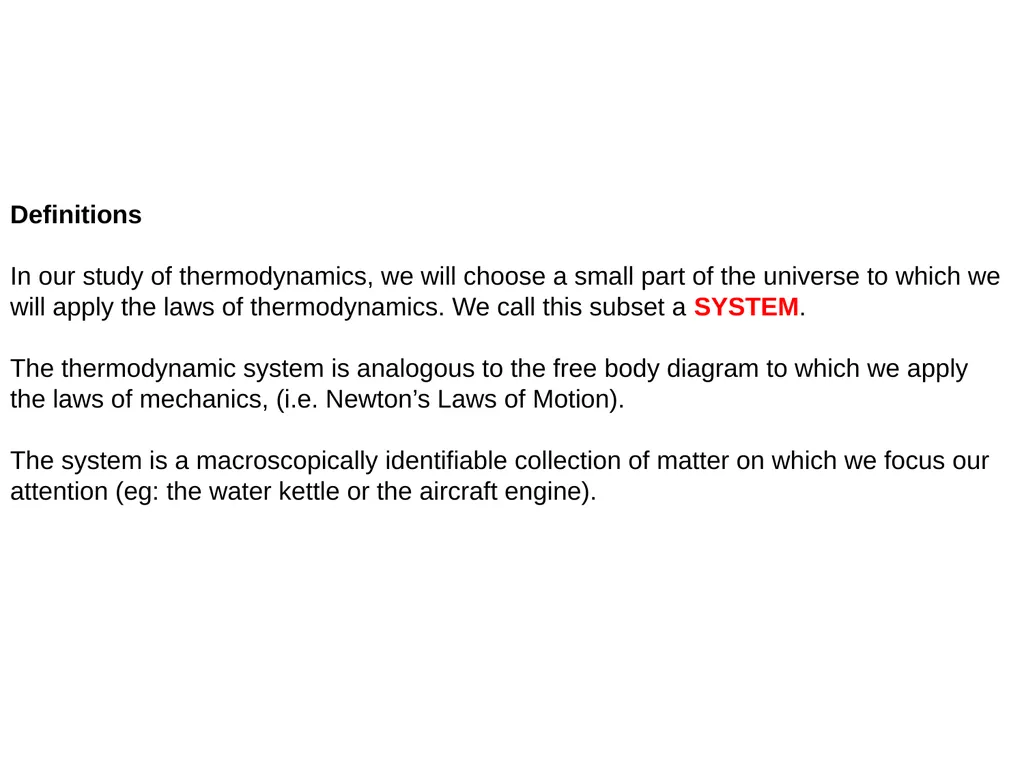
slide6. Definitions
In our study of thermodynamics, we will choose a small part of the universe to which we will apply the laws of thermodynamics. We call this subset a SYSTEM.
The thermodynamic system is analogous to the free body diagram to which we apply the laws of mechanics, (i.e. Newton’s Laws of Motion).
The system is a macroscopically identifiable collection of matter on which we focus our attention (eg: the water kettle or the aircraft engine).<br>
slide7. The rest of the universe outside the system close enough to the system to have some perceptible effect on the system is called the surroundings.
The surfaces which separates the system from the surroundings are called the boundaries as shown in fig below (eg: walls of the kettle, the housing of the engine). Closed system - in which no mass is permitted to cross the system boundary i.e. we would always consider a system of constant mass. We do permit heat and work to enter or leave but not mass. Open system- in which we permit mass to cross the system boundary in either direction (from the system to surroundings or vice versa). In analysing open systems, we typically look at a specified region of space, and observe what happens at the boundaries of that region. Isolated System - in which there is no interaction between system and the surroundings. It is of fixed mass and energy, and hence there is no mass and energy transfer across the system boundary.<br>
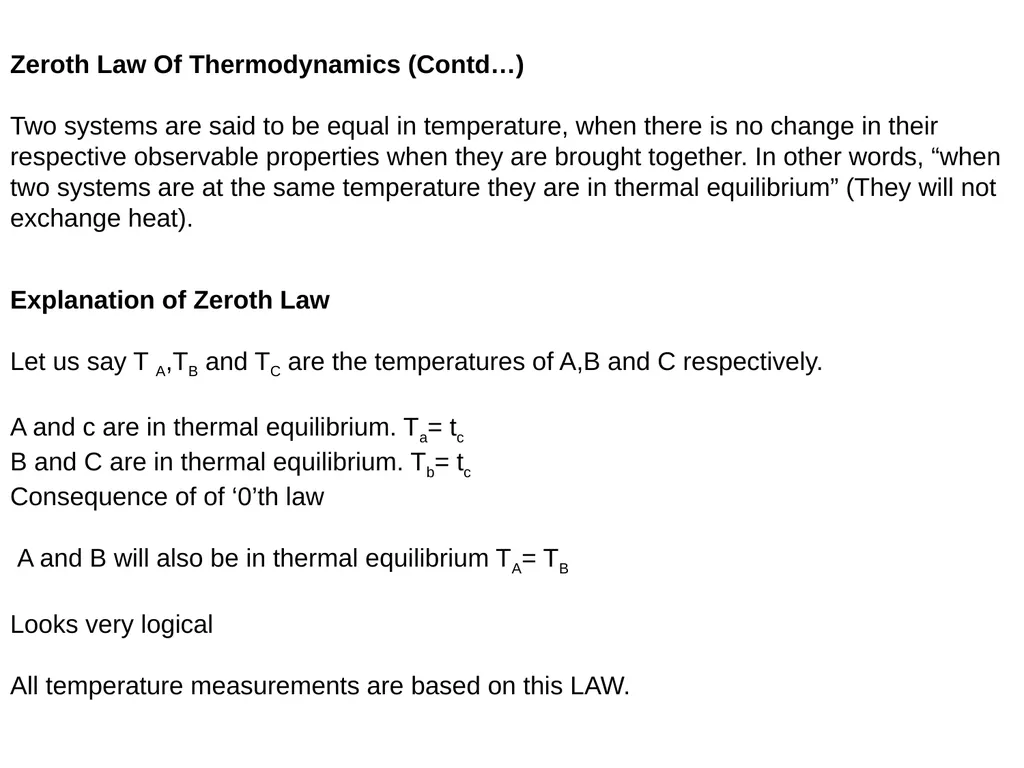
slide8. Zeroth Law Of Thermodynamics (Contd…)
Two systems are said to be equal in temperature, when there is no change in their respective observable properties when they are brought together. In other words, “when two systems are at the same temperature they are in thermal equilibrium” (They will not exchange heat). Explanation of Zeroth Law
Let us say T A,TB and TC are the temperatures of A,B and C respectively.
A and c are in thermal equilibrium. Ta= tc
B and C are in thermal equilibrium. Tb= tc
Consequence of of ‘0’th law
A and B will also be in thermal equilibrium TA= TB
Looks very logical
All temperature measurements are based on this LAW.<br>
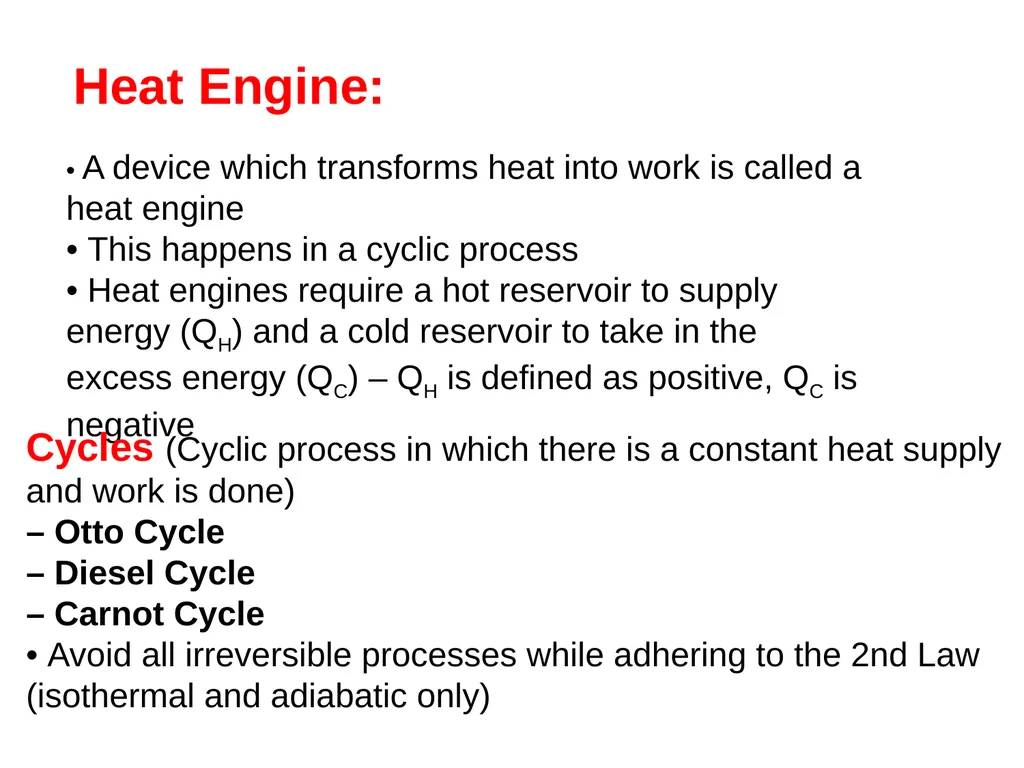
slide14. Heat Engine:
• A device which transforms heat into work is called a heat engine
• This happens in a cyclic process
• Heat engines require a hot reservoir to supply energy (QH) and a cold reservoir to take in the excess energy (QC) – QH is defined as positive, QC is negative Cycles (Cyclic process in which there is a constant heat supply and work is done)
– Otto Cycle
– Diesel Cycle
– Carnot Cycle
• Avoid all irreversible processes while adhering to the 2nd Law (isothermal and adiabatic only)<br>
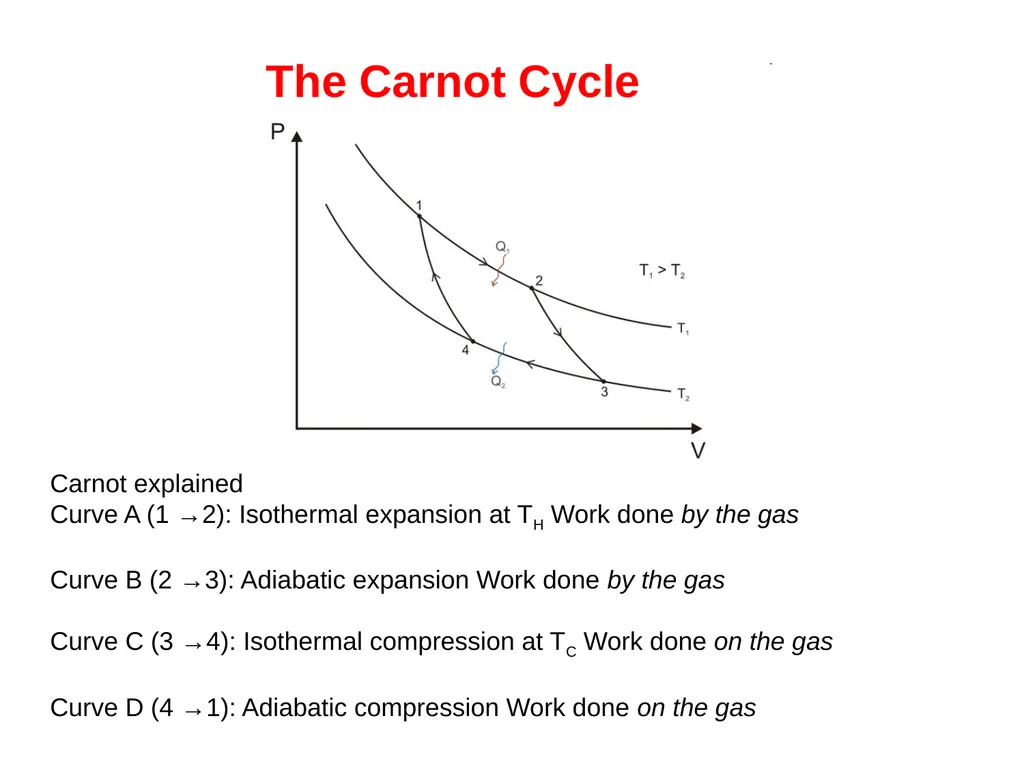
slide15. The Carnot Cycle Carnot explained
Curve A (1 →2): Isothermal expansion at TH Work done by the gas
Curve B (2 →3): Adiabatic expansion Work done by the gas
Curve C (3 →4): Isothermal compression at TC Work done on the gas
Curve D (4 →1): Adiabatic compression Work done on the gas<br>
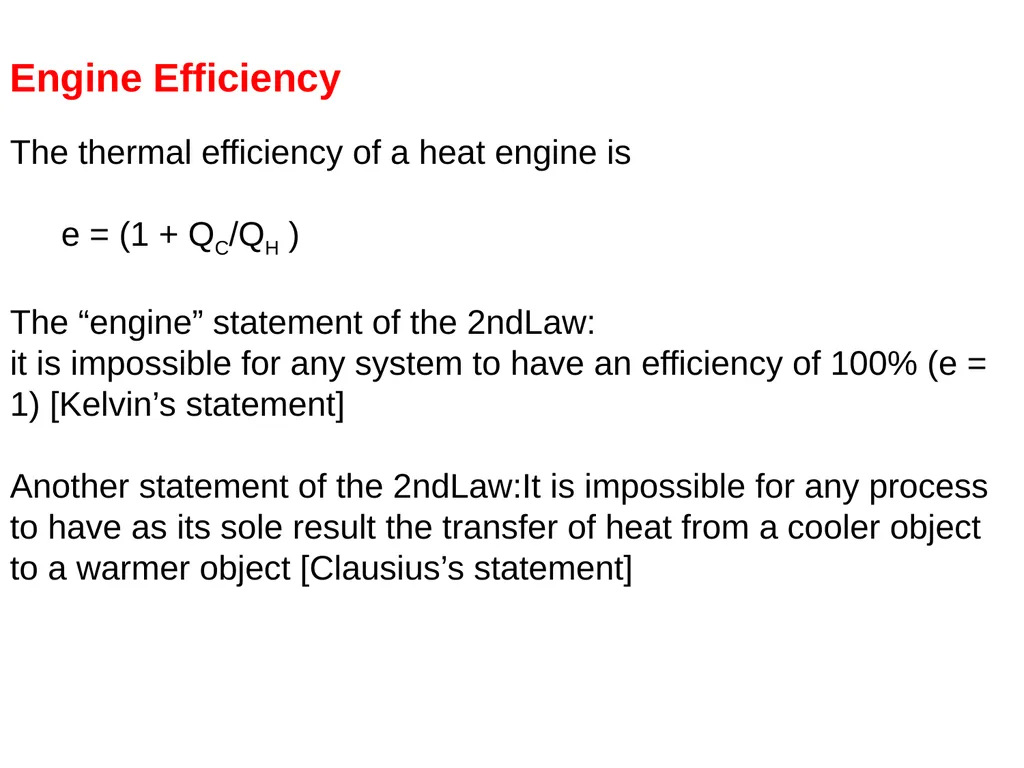
slide16. Engine Efficiency
The thermal efficiency of a heat engine is
e = (1 + QC/QH )
The “engine” statement of the 2ndLaw:
it is impossible for any system to have an efficiency of 100% (e = 1) [Kelvin’s statement]
Another statement of the 2ndLaw:It is impossible for any process to have as its sole result the transfer of heat from a cooler object to a warmer object [Clausius’s statement]<br>
slide17. Practical Uses
Automobile engines, refrigerators, and air conditioners all work on the principles laid out by the 2nd Law of Thermodynamics.
Ever wonder why you can’t cool your kitchen in the hot summer by leaving the refrigerator door open? Feel the air coming off the back -you heat the air outside to cool the air inside
See, you can’t break even!<br>
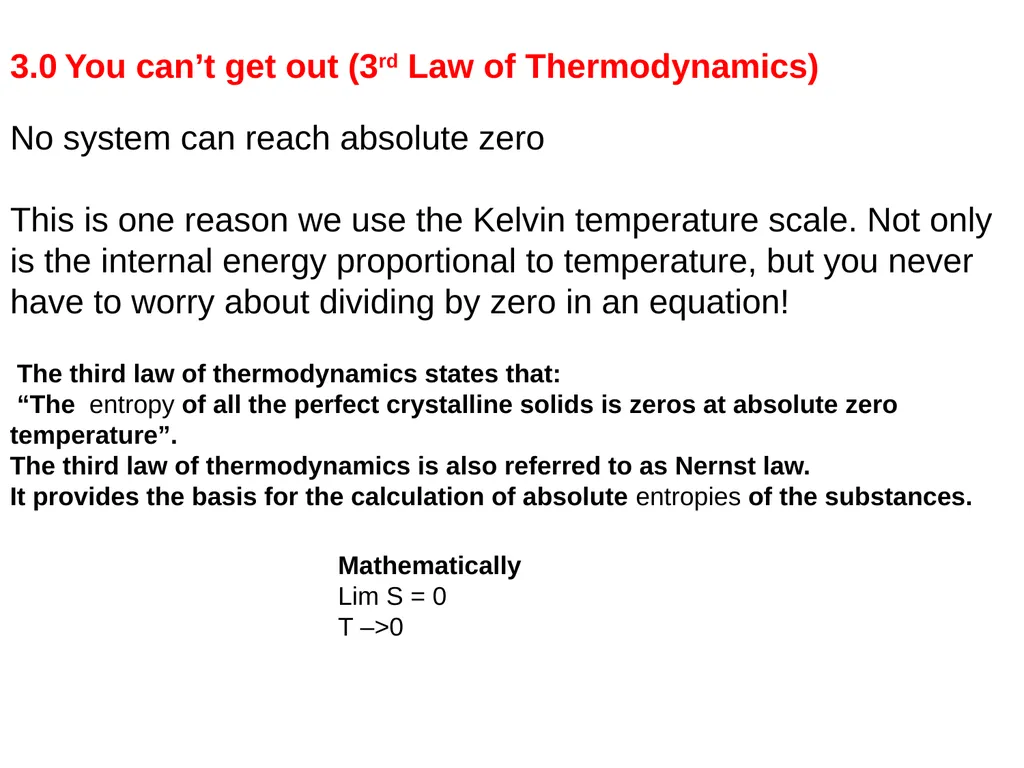
slide18. 3.0 You can’t get out (3rd Law of Thermodynamics)
No system can reach absolute zero
This is one reason we use the Kelvin temperature scale. Not only is the internal energy proportional to temperature, but you never have to worry about dividing by zero in an equation! The third law of thermodynamics states that:
“The entropy of all the perfect crystalline solids is zeros at absolute zero temperature”.
The third law of thermodynamics is also referred to as Nernst law.
It provides the basis for the calculation of absolute entropies of the substances. Mathematically
Lim S = 0
T –>0<br>
slide19. 3.1 Implications of 3rd Law
MIT researchers achieved 450 picokelvin in 2003 (less than ½ of one billionth!)
Molecules near these temperatures have been called the fifth
state of matter: Bose-Einstein Condensates
Awesome things like super-fluidity and super-conductivity happen at these temperatures
Exciting frontier of research<br>
slide20. Importance of third law of thermodynamics is given below:
1) It helps in calculating the thermodynamic properties.
2) It is helpful in measuring chemical affinity. Because of this it isknown as Nernst theorem.
3) It explains the behavior of solids at very low temperature.
4) It helps in analyzing chemical and phase equilibrium.Third law of thermodynamics
The third law of thermodynamics is sometimes stated as follows:
The entropy of a perfect crystal at absolute zero is exactly equal to zero. At zero kelvin the system must be in a state with the minimum possible energy
, and this statement of the third law holds true if the perfect crystal has only one minimum energy state .
Entropy is related to the number of possible microstates, and with only one microstate available at zero kelvin, the entropy is exactly zero.<br>
slide21. A more general form of the third law applies to systems such as glasses thatmay have
We know that entropy is the rate of change of disorder occurring in a system. Walther Nernst introduced the concept of entropy in the third law of thermodynamics which states that:
For a perfect crystal at the absolute zero temperature, the entropy would be exactly equal tozero. When only one minimum energy state is possessed by a perfect crystal the law would hold true.If we consider systems such as glasses which are not perfect crystal then a generalized form of 3rd law would be When the temperature approaches zero, the randomness or entropy of a system would approach a constant value. The Constant value of entropy is called Residual Entropy and it should be noted that it is not necessarily zero.<br>
Assistant Professor
Dept. Of Physics
M. L Arya College kasba<br>
slide2. Laws of Thermodynamics Thermodynamics
• Thermodynamics is the study of the effects of work, heat, and energy on a system
• Thermodynamics is only concerned with macroscopic (large-scale) changes and observations<br>
slide3. Getting Started • All of thermodynamics can be expressed in terms of four quantities (i) Temperature (T) (ii) Internal Energy (U) (iii) Entropy (S) (iv) Heat (Q) • We will take up and discuss all these quantities as we progress through the lesson<br>
slide4. Introduction According to British scientist C. P. Snow, the three laws of thermodynamics can be (humorously) summarized as 1. You can’t win 2. You can’t even break even 3. You can’t get out of the game<br>
slide5. 1.0 You can’t win (1st law) • The first law of thermodynamics is an extension of the law of conservation of energy • The change in internal energy of a system is equal to the heat added to the system minus the work done by the system ΔU = Q - W<br>
slide6. Definitions
In our study of thermodynamics, we will choose a small part of the universe to which we will apply the laws of thermodynamics. We call this subset a SYSTEM.
The thermodynamic system is analogous to the free body diagram to which we apply the laws of mechanics, (i.e. Newton’s Laws of Motion).
The system is a macroscopically identifiable collection of matter on which we focus our attention (eg: the water kettle or the aircraft engine).<br>
slide7. The rest of the universe outside the system close enough to the system to have some perceptible effect on the system is called the surroundings.
The surfaces which separates the system from the surroundings are called the boundaries as shown in fig below (eg: walls of the kettle, the housing of the engine). Closed system - in which no mass is permitted to cross the system boundary i.e. we would always consider a system of constant mass. We do permit heat and work to enter or leave but not mass. Open system- in which we permit mass to cross the system boundary in either direction (from the system to surroundings or vice versa). In analysing open systems, we typically look at a specified region of space, and observe what happens at the boundaries of that region. Isolated System - in which there is no interaction between system and the surroundings. It is of fixed mass and energy, and hence there is no mass and energy transfer across the system boundary.<br>
slide8. Zeroth Law Of Thermodynamics (Contd…)
Two systems are said to be equal in temperature, when there is no change in their respective observable properties when they are brought together. In other words, “when two systems are at the same temperature they are in thermal equilibrium” (They will not exchange heat). Explanation of Zeroth Law
Let us say T A,TB and TC are the temperatures of A,B and C respectively.
A and c are in thermal equilibrium. Ta= tc
B and C are in thermal equilibrium. Tb= tc
Consequence of of ‘0’th law
A and B will also be in thermal equilibrium TA= TB
Looks very logical
All temperature measurements are based on this LAW.<br>
slide14. Heat Engine:
• A device which transforms heat into work is called a heat engine
• This happens in a cyclic process
• Heat engines require a hot reservoir to supply energy (QH) and a cold reservoir to take in the excess energy (QC) – QH is defined as positive, QC is negative Cycles (Cyclic process in which there is a constant heat supply and work is done)
– Otto Cycle
– Diesel Cycle
– Carnot Cycle
• Avoid all irreversible processes while adhering to the 2nd Law (isothermal and adiabatic only)<br>
slide15. The Carnot Cycle Carnot explained
Curve A (1 →2): Isothermal expansion at TH Work done by the gas
Curve B (2 →3): Adiabatic expansion Work done by the gas
Curve C (3 →4): Isothermal compression at TC Work done on the gas
Curve D (4 →1): Adiabatic compression Work done on the gas<br>
slide16. Engine Efficiency
The thermal efficiency of a heat engine is
e = (1 + QC/QH )
The “engine” statement of the 2ndLaw:
it is impossible for any system to have an efficiency of 100% (e = 1) [Kelvin’s statement]
Another statement of the 2ndLaw:It is impossible for any process to have as its sole result the transfer of heat from a cooler object to a warmer object [Clausius’s statement]<br>
slide17. Practical Uses
Automobile engines, refrigerators, and air conditioners all work on the principles laid out by the 2nd Law of Thermodynamics.
Ever wonder why you can’t cool your kitchen in the hot summer by leaving the refrigerator door open? Feel the air coming off the back -you heat the air outside to cool the air inside
See, you can’t break even!<br>
slide18. 3.0 You can’t get out (3rd Law of Thermodynamics)
No system can reach absolute zero
This is one reason we use the Kelvin temperature scale. Not only is the internal energy proportional to temperature, but you never have to worry about dividing by zero in an equation! The third law of thermodynamics states that:
“The entropy of all the perfect crystalline solids is zeros at absolute zero temperature”.
The third law of thermodynamics is also referred to as Nernst law.
It provides the basis for the calculation of absolute entropies of the substances. Mathematically
Lim S = 0
T –>0<br>
slide19. 3.1 Implications of 3rd Law
MIT researchers achieved 450 picokelvin in 2003 (less than ½ of one billionth!)
Molecules near these temperatures have been called the fifth
state of matter: Bose-Einstein Condensates
Awesome things like super-fluidity and super-conductivity happen at these temperatures
Exciting frontier of research<br>
slide20. Importance of third law of thermodynamics is given below:
1) It helps in calculating the thermodynamic properties.
2) It is helpful in measuring chemical affinity. Because of this it isknown as Nernst theorem.
3) It explains the behavior of solids at very low temperature.
4) It helps in analyzing chemical and phase equilibrium.Third law of thermodynamics
The third law of thermodynamics is sometimes stated as follows:
The entropy of a perfect crystal at absolute zero is exactly equal to zero. At zero kelvin the system must be in a state with the minimum possible energy
, and this statement of the third law holds true if the perfect crystal has only one minimum energy state .
Entropy is related to the number of possible microstates, and with only one microstate available at zero kelvin, the entropy is exactly zero.<br>
slide21. A more general form of the third law applies to systems such as glasses thatmay have
We know that entropy is the rate of change of disorder occurring in a system. Walther Nernst introduced the concept of entropy in the third law of thermodynamics which states that:
For a perfect crystal at the absolute zero temperature, the entropy would be exactly equal tozero. When only one minimum energy state is possessed by a perfect crystal the law would hold true.If we consider systems such as glasses which are not perfect crystal then a generalized form of 3rd law would be When the temperature approaches zero, the randomness or entropy of a system would approach a constant value. The Constant value of entropy is called Residual Entropy and it should be noted that it is not necessarily zero.<br>