
Physiology Physiology is the study of processes






Description: Physiology Physiology is the study of processes and functions in living organisms. It is a broad field that encompasses many disciplines and has strong roots in physics, chemistry, and mathematics .The scope of physiology ranges from the
Related Topics
Download Presentation
"Physiology Physiology is the study of processes" is the property of its rightful owner. Permission is granted to download and print the materials on this website for personal, non-commercial use only, and to display it on your personal computer provided you do not modify the materials and that you retain all copyright notices contained in the materials. By downloading content from our website, you accept the terms of this agreement.
Presentation Transcript
slide1. Physiology<br>
slide2. Physiology is the study of processes and functions in living organisms. It is a broad field that encompasses many disciplines and has strong roots in physics, chemistry, and mathematics .The scope of physiology ranges from the activities or functions of individual molecules and cells to the interaction of our bodies with the external world.<br>
slide3. The Basis of Physiological Regulation
Our bodies are made up of incredibly complex and delicate materials, and we are constantly subjected to all kinds of disturbances, yet we keep going for a lifetime. It is clear that conditions and processes in the body must be closely controlled and regulated, i.e., kept at appropriate values.<br>
slide4. The Basis of Physiological Regulation Extracellular Fluid “Internal Environment”
About 60 percent of the adult human body is fluid, mainly a water solution of ions and other substances. Although most of this fluid is inside the cells and is called intracellular fluid, about one third is in the spaces outside the cells and is called extracellular fluid. This extracellular fluid is in constant motion throughout the body. It is transported rapidly in the circulating blood and then mixed between the blood and the tissue fluids by diffusion through the capillary walls.<br>
slide5. In the extracellular fluid are the ions and nutrients needed by the cells to maintain cell life. Thus, all cells live in essentially the same environment the extracellular fluid. For this reason, the extracellular fluid is also called the internal environment of the body.<br>
slide6. For optimal cell, tissue, and organ function in animals, several conditions in the internal environment must be maintained within narrow limits. These include but are not limited to (1) oxygen and carbon dioxide tensions,
(2) concentrations of glucose and other metabolites,
(3) osmotic pressure,
(4) concentrations of hydrogen, potassium, calcium, and magnesium ions, and
(5) temperature.<br>
slide7. Differences between Extracellular and Intracellular fluids. The extracellular fluid contains large amounts of sodium, chloride, and bicarbonate ions plus nutrients for the cells, such as oxygen, glucose, fatty acids, and amino acids. It also contains carbon dioxide that is being transported from the cells to the lungs to be excreted, plus other cellular waste products that are being transported to the kidneys for excretion.<br>
slide8. . The intracellular fluid differs significantly from the extracellular fluid; specifically, it contains large amounts of potassium, magnesium, and phosphate ions instead of the sodium and chloride ions found in the extracellular fluid. Extracellular fluid is transported through all parts of the body in two stages. The first stage is movement of blood through the body in the blood vessels, and the second is movement of fluid between the blood capillaries and the intercellular spaces between the tissue cells.<br>
slide9. Body-Fluid Compartments<br>
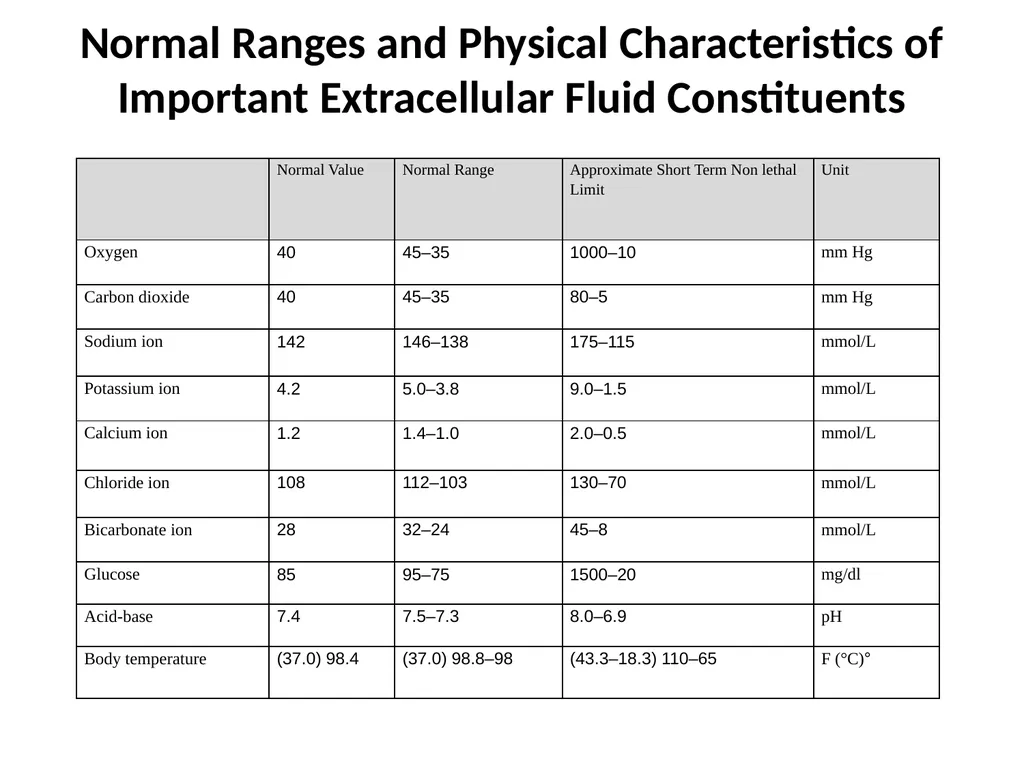
slide10. Normal Ranges and Physical Characteristics of Important Extracellular Fluid Constituents<br>
slide11. “Homeostatic” Mechanisms of the Major Functional Systems
The term homeostasis is used by physiologists to mean maintenance of nearly constant conditions in the internal environment. Essentially all organs and tissues of the body perform functions that help maintain these constant conditions. For instance, the lungs provide oxygen to the extracellular fluid to replenish the oxygen used by the cells, the kidneys maintain constant ion concentrations, and the gastrointestinal system provides nutrients.
Homeostasis in a general sense refers to stability, balance or equilibrium.<br>
slide12. “Homeostatic” Mechanisms of the Major Functional Systems
The term homeostasis is used by physiologists to mean maintenance of nearly constant conditions in the internal environment. Essentially all organs and tissues of the body perform functions that help maintain these constant conditions. For instance, the lungs provide oxygen to the extracellular fluid to replenish the oxygen used by the cells, the kidneys maintain constant ion concentrations, and the gastrointestinal system provides nutrients.
Homeostasis in a general sense refers to stability, balance or equilibrium.<br>
slide13. Homeostatic regulation involves three parts or mechanisms:
1) Receptor
2) Control center
3) Effector<br>
slide14. An organism is said to be in homeostasis when the internal environment contains:
The optimal concentration of gases
The optimal concentration of nutrients
The optimal concentration of ions and water
At the optimal temperature<br>
slide15. Characteristics of Control Systems
The aforementioned examples of homeostatic control mechanisms are only a few of the many thousands in the body, all of which have certain characteristics in common. These characteristics are explained in this lecture.
1) Negative Feedback Nature of Most Control Systems
2) Positive Feedback<br>
slide2. Physiology is the study of processes and functions in living organisms. It is a broad field that encompasses many disciplines and has strong roots in physics, chemistry, and mathematics .The scope of physiology ranges from the activities or functions of individual molecules and cells to the interaction of our bodies with the external world.<br>
slide3. The Basis of Physiological Regulation
Our bodies are made up of incredibly complex and delicate materials, and we are constantly subjected to all kinds of disturbances, yet we keep going for a lifetime. It is clear that conditions and processes in the body must be closely controlled and regulated, i.e., kept at appropriate values.<br>
slide4. The Basis of Physiological Regulation Extracellular Fluid “Internal Environment”
About 60 percent of the adult human body is fluid, mainly a water solution of ions and other substances. Although most of this fluid is inside the cells and is called intracellular fluid, about one third is in the spaces outside the cells and is called extracellular fluid. This extracellular fluid is in constant motion throughout the body. It is transported rapidly in the circulating blood and then mixed between the blood and the tissue fluids by diffusion through the capillary walls.<br>
slide5. In the extracellular fluid are the ions and nutrients needed by the cells to maintain cell life. Thus, all cells live in essentially the same environment the extracellular fluid. For this reason, the extracellular fluid is also called the internal environment of the body.<br>
slide6. For optimal cell, tissue, and organ function in animals, several conditions in the internal environment must be maintained within narrow limits. These include but are not limited to (1) oxygen and carbon dioxide tensions,
(2) concentrations of glucose and other metabolites,
(3) osmotic pressure,
(4) concentrations of hydrogen, potassium, calcium, and magnesium ions, and
(5) temperature.<br>
slide7. Differences between Extracellular and Intracellular fluids. The extracellular fluid contains large amounts of sodium, chloride, and bicarbonate ions plus nutrients for the cells, such as oxygen, glucose, fatty acids, and amino acids. It also contains carbon dioxide that is being transported from the cells to the lungs to be excreted, plus other cellular waste products that are being transported to the kidneys for excretion.<br>
slide8. . The intracellular fluid differs significantly from the extracellular fluid; specifically, it contains large amounts of potassium, magnesium, and phosphate ions instead of the sodium and chloride ions found in the extracellular fluid. Extracellular fluid is transported through all parts of the body in two stages. The first stage is movement of blood through the body in the blood vessels, and the second is movement of fluid between the blood capillaries and the intercellular spaces between the tissue cells.<br>
slide9. Body-Fluid Compartments<br>
slide10. Normal Ranges and Physical Characteristics of Important Extracellular Fluid Constituents<br>
slide11. “Homeostatic” Mechanisms of the Major Functional Systems
The term homeostasis is used by physiologists to mean maintenance of nearly constant conditions in the internal environment. Essentially all organs and tissues of the body perform functions that help maintain these constant conditions. For instance, the lungs provide oxygen to the extracellular fluid to replenish the oxygen used by the cells, the kidneys maintain constant ion concentrations, and the gastrointestinal system provides nutrients.
Homeostasis in a general sense refers to stability, balance or equilibrium.<br>
slide12. “Homeostatic” Mechanisms of the Major Functional Systems
The term homeostasis is used by physiologists to mean maintenance of nearly constant conditions in the internal environment. Essentially all organs and tissues of the body perform functions that help maintain these constant conditions. For instance, the lungs provide oxygen to the extracellular fluid to replenish the oxygen used by the cells, the kidneys maintain constant ion concentrations, and the gastrointestinal system provides nutrients.
Homeostasis in a general sense refers to stability, balance or equilibrium.<br>
slide13. Homeostatic regulation involves three parts or mechanisms:
1) Receptor
2) Control center
3) Effector<br>
slide14. An organism is said to be in homeostasis when the internal environment contains:
The optimal concentration of gases
The optimal concentration of nutrients
The optimal concentration of ions and water
At the optimal temperature<br>
slide15. Characteristics of Control Systems
The aforementioned examples of homeostatic control mechanisms are only a few of the many thousands in the body, all of which have certain characteristics in common. These characteristics are explained in this lecture.
1) Negative Feedback Nature of Most Control Systems
2) Positive Feedback<br>