
Please note: You do not need to print off this


Description: Please note: You do not need to print off this PowerPoint. It is designed to take you through your work step by step and some slide may just be for information. War photographer, by Carol Ann Duffy Context: Duffy was inspired to write this
Related Topics
Download Presentation
"Please note: You do not need to print off this" is the property of its rightful owner. Permission is granted to download and print the materials on this website for personal, non-commercial use only, and to display it on your personal computer provided you do not modify the materials and that you retain all copyright notices contained in the materials. By downloading content from our website, you accept the terms of this agreement.
Presentation Transcript
slide1. Please note:
You do not need to print off this PowerPoint. It is designed to take you through your work step by step and some slide may just be for information.<br>
slide2. War photographer, by Carol Ann Duffy<br>
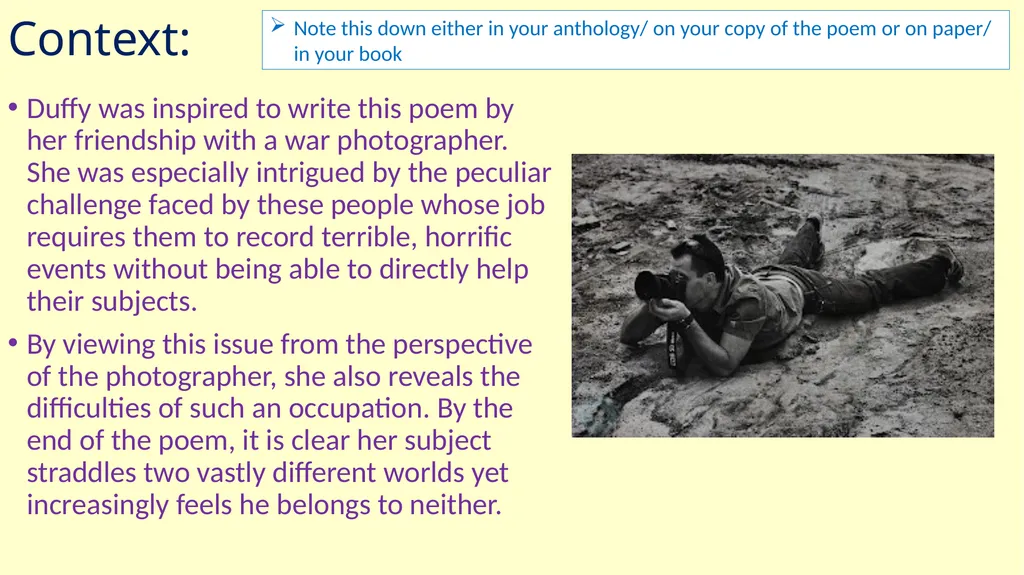
slide3. Context: Duffy was inspired to write this poem by her friendship with a war photographer. She was especially intrigued by the peculiar challenge faced by these people whose job requires them to record terrible, horrific events without being able to directly help their subjects.
By viewing this issue from the perspective of the photographer, she also reveals the difficulties of such an occupation. By the end of the poem, it is clear her subject straddles two vastly different worlds yet increasingly feels he belongs to neither. Note this down either in your anthology/ on your copy of the poem or on paper/ in your book<br>
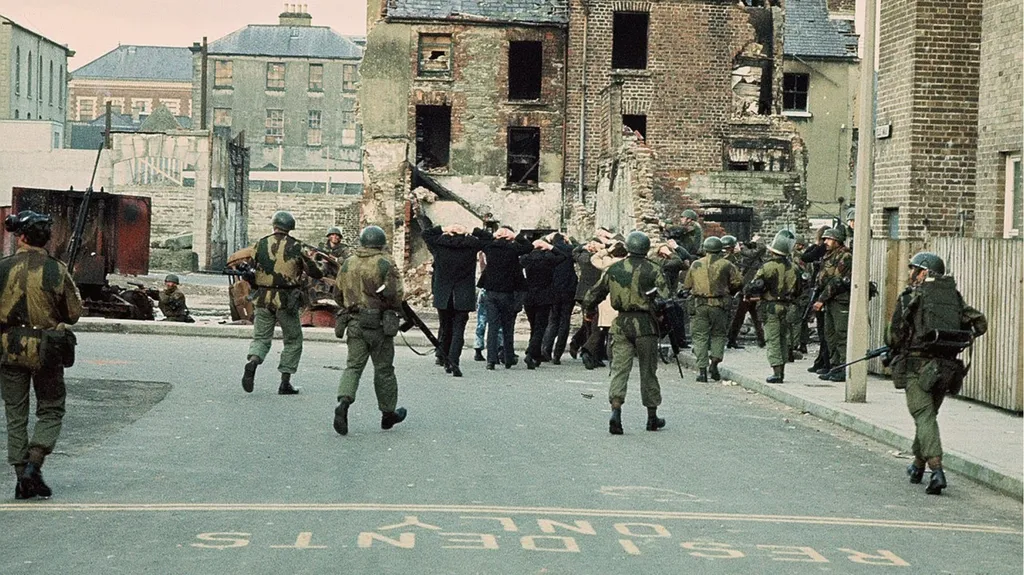
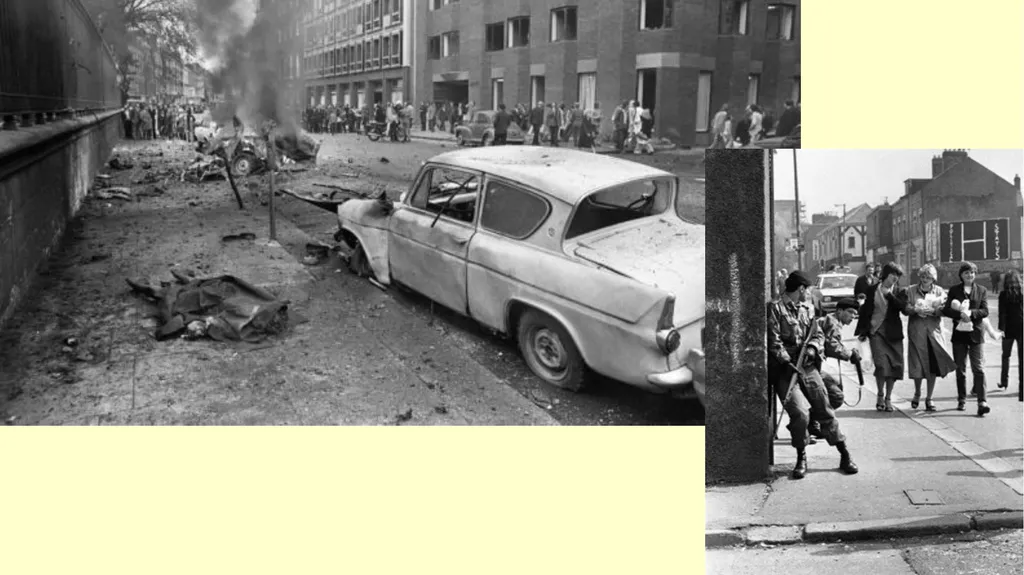
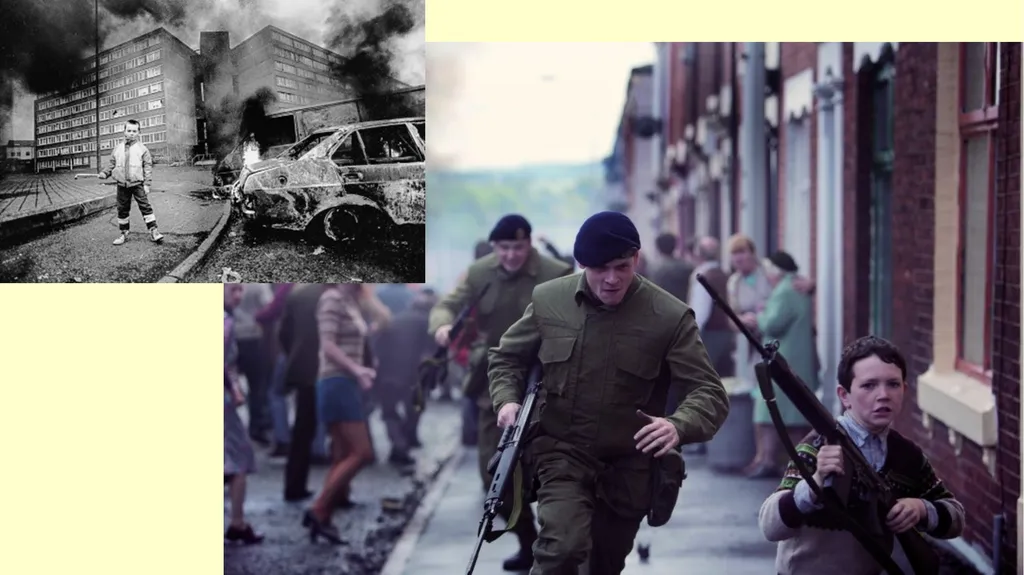
slide4. Not all conflict is far away… The Troubles The next slide contains information about a particular conflict called ‘The Troubles’ which is referenced in this poem. You don’t need to note this information down.
The slides following that contain a series of images. You need to imagine you are the photographer taking those images, then answer the questions on the slide which follows them.<br>
slide5. Belfast: The Troubles The Troubles, also called Northern Ireland conflict, was around 1968 to 1998 in Northern Ireland between the overwhelmingly Protestant unionists (loyalists), who desired the area to remain part of the United Kingdom, and the overwhelmingly Roman Catholic nationalists (republicans), who wanted Northern Ireland to become part of the republic of Ireland. The British army was also involved and their purpose was claimed to be a peacekeeping role, mostly between the nationalist Irish Republican Army (IRA), which viewed the conflict as a guerrilla war for national independence, and the unionist forces, which called the IRA’s actions terrorism. Marked by street fighting, bombings, sniper attacks, roadblocks, and internment without trial, the confrontation had the characteristics of a civil war, often labelled as “low-intensity conflict.” 3,600 people were killed and more than 30,000 more were wounded before a peaceful solution, which involved the governments of both the United Kingdom and Ireland, was effectively reached in 1998, leading to a power-sharing arrangement in the Northern Ireland Assembly at Stormont. Key terms:
Guerrilla = small independent group taking part in irregular fighting, typically against larger regular forces. Often impromptu or without authorisation.
Civil war = a war between citizens of the same country.<br>
slide9. Image task #1 How would you feel if you were stood in those scenes? Why?
Is there anything in those images that you, as the person taking those photos, would wish you could help with or be involved in?
Which image do you think would be the most shocking for people to see if they were to come across it in a newspaper?
How does it make you feel knowing this conflict was so close to your home country?<br>
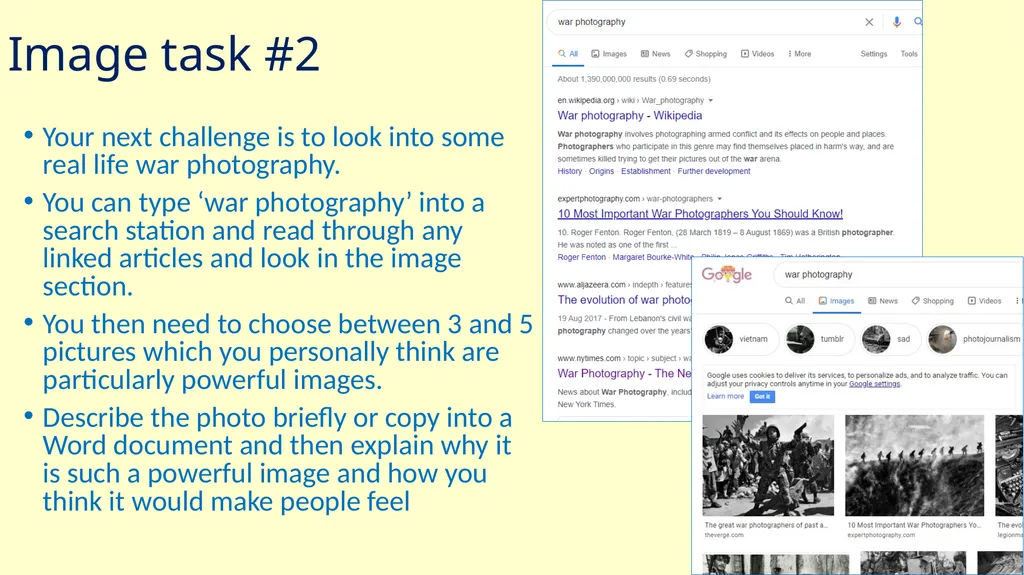
slide10. Image task #2 Your next challenge is to look into some real life war photography.
You can type ‘war photography’ into a search station and read through any linked articles and look in the image section.
You then need to choose between 3 and 5 pictures which you personally think are particularly powerful images.
Describe the photo briefly or copy into a Word document and then explain why it is such a powerful image and how you think it would make people feel<br>
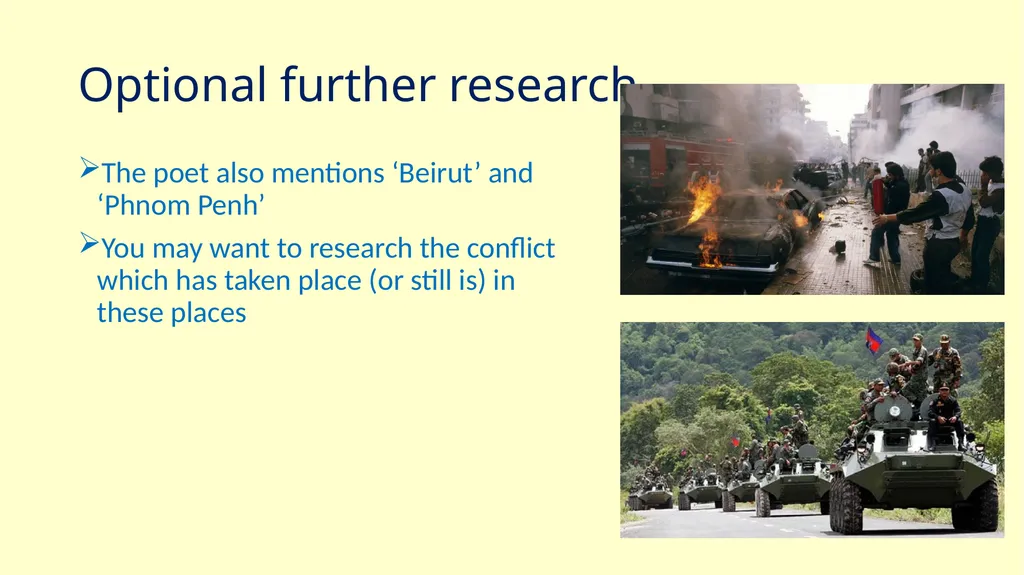
slide11. Optional further research The poet also mentions ‘Beirut’ and ‘Phnom Penh’
You may want to research the conflict which has taken place (or still is) in these places<br>
slide12. The following slides provide you with some notes to make on your copy of the poem. If you don’t have access to a printer you can copy the poem into a Word document and make notes uses text boxes.<br>
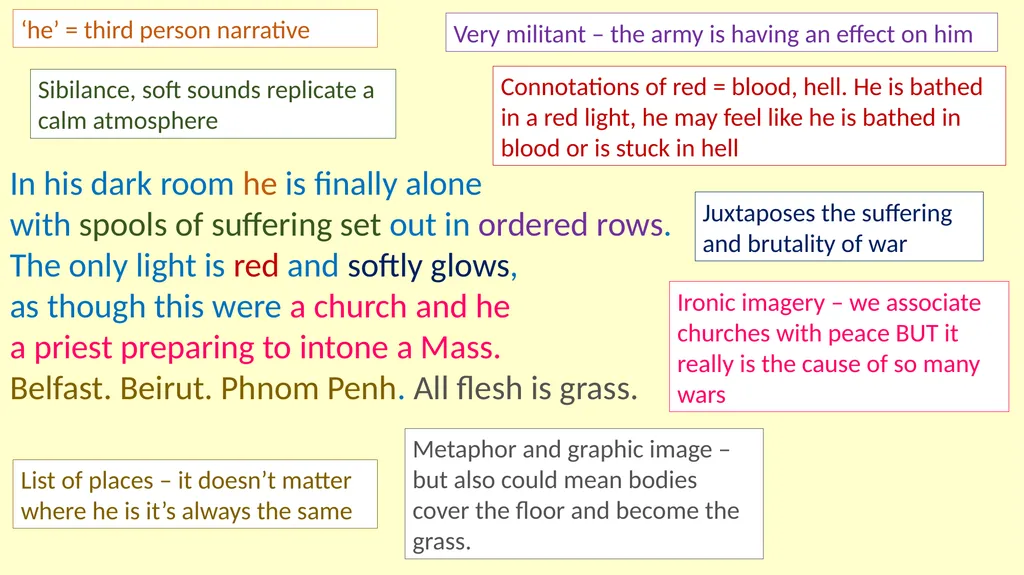
slide13. In his dark room he is finally alone
with spools of suffering set out in ordered rows.
The only light is red and softly glows,
as though this were a church and he
a priest preparing to intone a Mass.
Belfast. Beirut. Phnom Penh. All flesh is grass. ‘he’ = third person narrative Sibilance, soft sounds replicate a calm atmosphere Very militant – the army is having an effect on him Connotations of red = blood, hell. He is bathed in a red light, he may feel like he is bathed in blood or is stuck in hell Juxtaposes the suffering and brutality of war Ironic imagery – we associate churches with peace BUT it really is the cause of so many wars List of places – it doesn’t matter where he is it’s always the same Metaphor and graphic image – but also could mean bodies cover the floor and become the grass.<br>
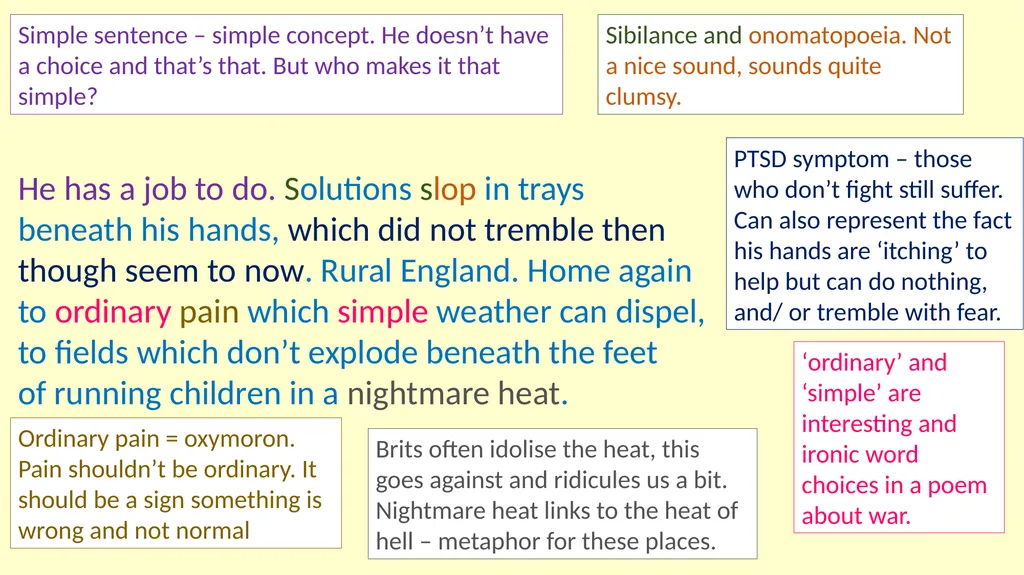
slide14. He has a job to do. Solutions slop in trays
beneath his hands, which did not tremble then
though seem to now. Rural England. Home again
to ordinary pain which simple weather can dispel,
to fields which don’t explode beneath the feet
of running children in a nightmare heat. Simple sentence – simple concept. He doesn’t have a choice and that’s that. But who makes it that simple? Sibilance and onomatopoeia. Not a nice sound, sounds quite clumsy. PTSD symptom – those who don’t fight still suffer. Can also represent the fact his hands are ‘itching’ to help but can do nothing, and/ or tremble with fear. Ordinary pain = oxymoron. Pain shouldn’t be ordinary. It should be a sign something is wrong and not normal ‘ordinary’ and ‘simple’ are interesting and ironic word choices in a poem about war. Brits often idolise the heat, this goes against and ridicules us a bit. Nightmare heat links to the heat of hell – metaphor for these places.<br>
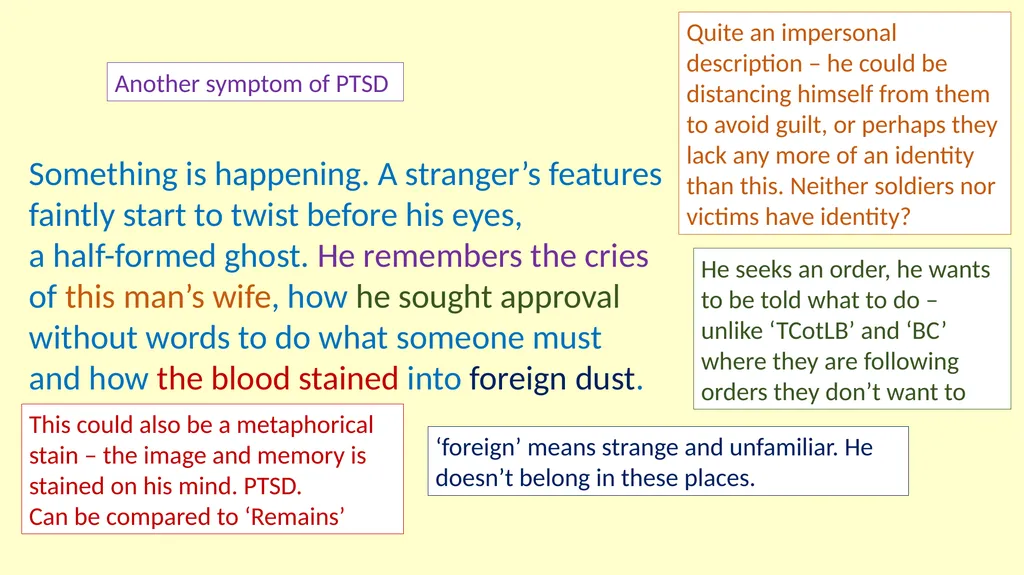
slide15. Something is happening. A stranger’s features
faintly start to twist before his eyes,
a half-formed ghost. He remembers the cries
of this man’s wife, how he sought approval
without words to do what someone must
and how the blood stained into foreign dust. Another symptom of PTSD Quite an impersonal description – he could be distancing himself from them to avoid guilt, or perhaps they lack any more of an identity than this. Neither soldiers nor victims have identity? He seeks an order, he wants to be told what to do – unlike ‘TCotLB’ and ‘BC’ where they are following orders they don’t want to This could also be a metaphorical stain – the image and memory is stained on his mind. PTSD.
Can be compared to ‘Remains’ ‘foreign’ means strange and unfamiliar. He doesn’t belong in these places.<br>
slide16. A hundred agonies in black and white
from which his editor will pick out five or six
for Sunday’s supplement. The reader’s eyeballs prick
with tears between the bath and pre-lunch beers.
From the aeroplane he stares impassively at where
he earns his living and they do not care. Metaphor – his pictures are agony. They are pictures of people in agony but they could also be agonising for him to see.
Links to ‘Remains’ – ‘the image of agony’ ‘A hundred’ pictures and just ‘five or six’ used. So little of what he sees and photographs gets used and seen – emphasising that there’s so much we don’t know and see of these places. Is it worth it? Eyeballs prick with tears is quite a graphic, aggressive way of saying they cry. Is she criticising people?
‘bath’ and ‘pre-lunch’ beers are very indulgent acts. Mocking? Focuses on this just being how he makes money. It makes it sound less meaningful. He could feel guilty for not being able to help. ‘they’ is very ambiguous. Who are ‘they’? Could be both the people reading the supplements and the people he photographs<br>
slide2. War photographer, by Carol Ann Duffy<br>
slide3. Context: Duffy was inspired to write this poem by her friendship with a war photographer. She was especially intrigued by the peculiar challenge faced by these people whose job requires them to record terrible, horrific events without being able to directly help their subjects.
By viewing this issue from the perspective of the photographer, she also reveals the difficulties of such an occupation. By the end of the poem, it is clear her subject straddles two vastly different worlds yet increasingly feels he belongs to neither. Note this down either in your anthology/ on your copy of the poem or on paper/ in your book<br>
slide4. Not all conflict is far away… The Troubles The next slide contains information about a particular conflict called ‘The Troubles’ which is referenced in this poem. You don’t need to note this information down.
The slides following that contain a series of images. You need to imagine you are the photographer taking those images, then answer the questions on the slide which follows them.<br>
slide5. Belfast: The Troubles The Troubles, also called Northern Ireland conflict, was around 1968 to 1998 in Northern Ireland between the overwhelmingly Protestant unionists (loyalists), who desired the area to remain part of the United Kingdom, and the overwhelmingly Roman Catholic nationalists (republicans), who wanted Northern Ireland to become part of the republic of Ireland. The British army was also involved and their purpose was claimed to be a peacekeeping role, mostly between the nationalist Irish Republican Army (IRA), which viewed the conflict as a guerrilla war for national independence, and the unionist forces, which called the IRA’s actions terrorism. Marked by street fighting, bombings, sniper attacks, roadblocks, and internment without trial, the confrontation had the characteristics of a civil war, often labelled as “low-intensity conflict.” 3,600 people were killed and more than 30,000 more were wounded before a peaceful solution, which involved the governments of both the United Kingdom and Ireland, was effectively reached in 1998, leading to a power-sharing arrangement in the Northern Ireland Assembly at Stormont. Key terms:
Guerrilla = small independent group taking part in irregular fighting, typically against larger regular forces. Often impromptu or without authorisation.
Civil war = a war between citizens of the same country.<br>
slide9. Image task #1 How would you feel if you were stood in those scenes? Why?
Is there anything in those images that you, as the person taking those photos, would wish you could help with or be involved in?
Which image do you think would be the most shocking for people to see if they were to come across it in a newspaper?
How does it make you feel knowing this conflict was so close to your home country?<br>
slide10. Image task #2 Your next challenge is to look into some real life war photography.
You can type ‘war photography’ into a search station and read through any linked articles and look in the image section.
You then need to choose between 3 and 5 pictures which you personally think are particularly powerful images.
Describe the photo briefly or copy into a Word document and then explain why it is such a powerful image and how you think it would make people feel<br>
slide11. Optional further research The poet also mentions ‘Beirut’ and ‘Phnom Penh’
You may want to research the conflict which has taken place (or still is) in these places<br>
slide12. The following slides provide you with some notes to make on your copy of the poem. If you don’t have access to a printer you can copy the poem into a Word document and make notes uses text boxes.<br>
slide13. In his dark room he is finally alone
with spools of suffering set out in ordered rows.
The only light is red and softly glows,
as though this were a church and he
a priest preparing to intone a Mass.
Belfast. Beirut. Phnom Penh. All flesh is grass. ‘he’ = third person narrative Sibilance, soft sounds replicate a calm atmosphere Very militant – the army is having an effect on him Connotations of red = blood, hell. He is bathed in a red light, he may feel like he is bathed in blood or is stuck in hell Juxtaposes the suffering and brutality of war Ironic imagery – we associate churches with peace BUT it really is the cause of so many wars List of places – it doesn’t matter where he is it’s always the same Metaphor and graphic image – but also could mean bodies cover the floor and become the grass.<br>
slide14. He has a job to do. Solutions slop in trays
beneath his hands, which did not tremble then
though seem to now. Rural England. Home again
to ordinary pain which simple weather can dispel,
to fields which don’t explode beneath the feet
of running children in a nightmare heat. Simple sentence – simple concept. He doesn’t have a choice and that’s that. But who makes it that simple? Sibilance and onomatopoeia. Not a nice sound, sounds quite clumsy. PTSD symptom – those who don’t fight still suffer. Can also represent the fact his hands are ‘itching’ to help but can do nothing, and/ or tremble with fear. Ordinary pain = oxymoron. Pain shouldn’t be ordinary. It should be a sign something is wrong and not normal ‘ordinary’ and ‘simple’ are interesting and ironic word choices in a poem about war. Brits often idolise the heat, this goes against and ridicules us a bit. Nightmare heat links to the heat of hell – metaphor for these places.<br>
slide15. Something is happening. A stranger’s features
faintly start to twist before his eyes,
a half-formed ghost. He remembers the cries
of this man’s wife, how he sought approval
without words to do what someone must
and how the blood stained into foreign dust. Another symptom of PTSD Quite an impersonal description – he could be distancing himself from them to avoid guilt, or perhaps they lack any more of an identity than this. Neither soldiers nor victims have identity? He seeks an order, he wants to be told what to do – unlike ‘TCotLB’ and ‘BC’ where they are following orders they don’t want to This could also be a metaphorical stain – the image and memory is stained on his mind. PTSD.
Can be compared to ‘Remains’ ‘foreign’ means strange and unfamiliar. He doesn’t belong in these places.<br>
slide16. A hundred agonies in black and white
from which his editor will pick out five or six
for Sunday’s supplement. The reader’s eyeballs prick
with tears between the bath and pre-lunch beers.
From the aeroplane he stares impassively at where
he earns his living and they do not care. Metaphor – his pictures are agony. They are pictures of people in agony but they could also be agonising for him to see.
Links to ‘Remains’ – ‘the image of agony’ ‘A hundred’ pictures and just ‘five or six’ used. So little of what he sees and photographs gets used and seen – emphasising that there’s so much we don’t know and see of these places. Is it worth it? Eyeballs prick with tears is quite a graphic, aggressive way of saying they cry. Is she criticising people?
‘bath’ and ‘pre-lunch’ beers are very indulgent acts. Mocking? Focuses on this just being how he makes money. It makes it sound less meaningful. He could feel guilty for not being able to help. ‘they’ is very ambiguous. Who are ‘they’? Could be both the people reading the supplements and the people he photographs<br>