04
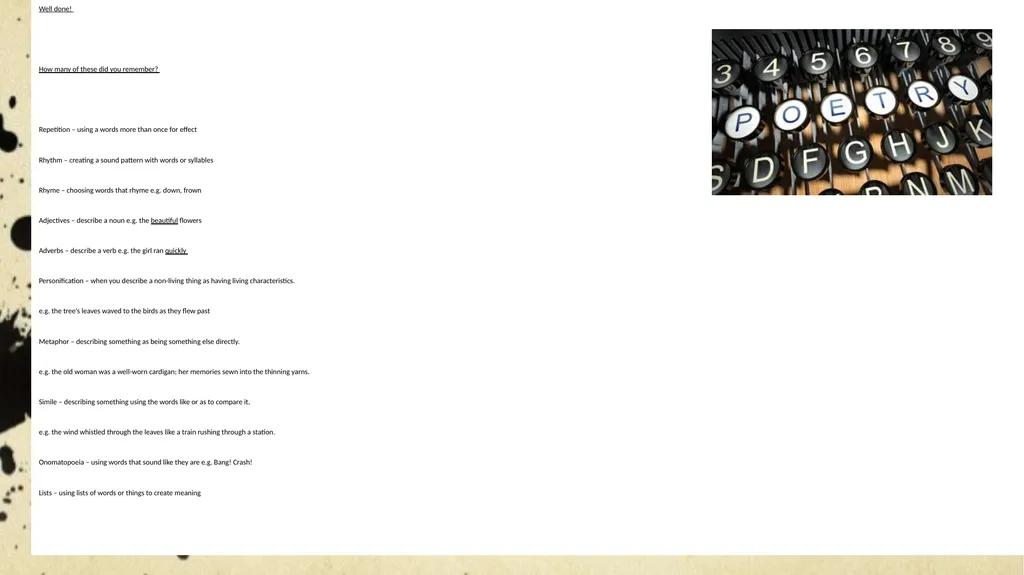
When you are writing poetry, try to use as many of these techniques as possible. They will help you vary your writing and create depth to your descriptions.
e.g. Lockdown landed like a lead weight, (alliteration)
It came without warning, no time to prepare,
Like a horrible accident or a bad dream that you don’t expect. (adjectives)
Schools closed, working from home, home school learning, (lists)
roles changed overnight and suddenly the “new normal” grew
all around us. (metaphor/personification)<br>
05
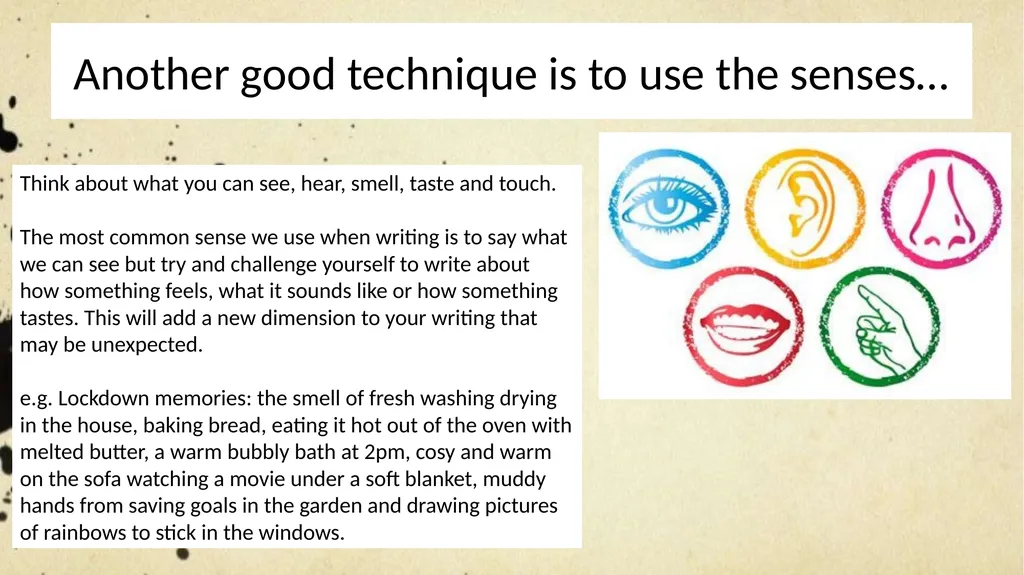
Another good technique is to use the senses… Think about what you can see, hear, smell, taste and touch.
The most common sense we use when writing is to say what we can see but try and challenge yourself to write about how something feels, what it sounds like or how something tastes. This will add a new dimension to your writing that may be unexpected.
e.g. Lockdown memories: the smell of fresh washing drying in the house, baking bread, eating it hot out of the oven with melted butter, a warm bubbly bath at 2pm, cosy and warm on the sofa watching a movie under a soft blanket, muddy hands from saving goals in the garden and drawing pictures of rainbows to stick in the windows.<br>
06
Metaphors are harder to write than similes. Have a go at playing this metaphor game to help you generate ideas. Imagine that coronavirus were a vehicle. What would it be? Try to describe it in this way.
e.g. it would be a huge black tank, rumbling over our towns and cities like a dark storm cloud.
If coronavirus were a film it would be…
If coronavirus were a person it would be…
If coronavirus were a drink it would be…
If coronavirus were a game it would be…
If coronavirus were a piece of clothing it would be…<br>
07
What type of poem should I write?! There are many different types of poem.
Before you press return have a go at writing down the different types of poem you can remember.
I’ll help you get started…
An acrostic poem – when the first letter of each line spells out a word, vertically.
Now you have a go!<br>
08
Did you think of any of these? Narrative – where the poem tells a story
Rhyming – where the words rhyme in different patterns
List – the poem is made up of a list or collection of words
Haiku – these short, Japanese poems consist of 3 lines. The first and last lines of a Haiku have 5 syllables and the middle line has 7 syllables.
Free verse – anything goes! Made up words, no rules but still a meaning behind what you’re writing.
Sonnet – this is a fourteen line poem with a fixed rhyme scheme. Often, sonnets use iambic pentameter: five sets of unstressed syllables followed by stressed syllables for a ten-syllable line. (VERY TRICKY TO WRITE!)
Limericks - have a strict rhyme scheme of AABBA, in which the first, second and fifth line rhyme, while the third and fourth lines are shorter and share a different rhyme. (Not impossible but hard to write!)
Ballad – is a story set to music, songs are poems!<br>
09
So what type of poem will you chose? It’s up to you! The possibilities are endless!
Grab your pencil and get drafting. Poetry can take time to evolve. Be patient with your ideas and enjoy just writing things down. You may need to write several edits, changing words, adding things in and taking bits out until you are happy with your final poem. Make mistakes, change your mind, rip up versions that don’t work until you find the words that make sense to you.
The theme of our poem is this period of time that we have all lived through since March. Use it to tell your stories, memories, thoughts and feelings about coronavirus, lockdown and the new normal we find ourselves in.<br>
10
WAGOLL (what a good one looks like)�Here are a couple of examples I have written to help you get started – yours will be much better! List Poem
Coronavirus
Lockdown, shut down, news updates, confusion, worry.
Planning, working from home, home schooling, long days, same days, weird days, timetables, star charts, juggling, zoom meetings, team meetings, google meet, facetime, WhatsApp, devices, chargers,
“Who has taken my charger?!”
Advice, guidance, rules, laws? Risk assessments, school plans, online learning.
Changes, deadlines, no time, all change! Re-do, re-plan, re-think.
Playing, garden time, walks, clapping on Thursdays, rainbows, baking, making,
kitchen table is our classroom,
Mum in goal, trampoline, hair braiding, slime making, reading, TV, films for the kids.
Washing, cooking, cleaning, sanitising, shopping – repeat!
Chatting, laughing, crying, ups and downs, good days, bad days, sunny days, rainy days, busy days, lonely days.
Family, friends, new routines, new normal.<br>
11
Haiku
Coronavirus Haiku
Global pandemic,
We didn’t see it coming
World turned upside down. WAGOLL (what a good one looks like)�Here are a couple of examples I have written to help you get started – yours will be much better!<br>
12
Now it’s your turn to get writing!�I can’t wait to read your poems.�Remember to submit them to�headofschool@oldcatton.norfolk.sch.uk<br>