
POLICY AND PROCEDURES HANDBOOK TEXAS A&M
LD
Published · 65 slides · 0 views

1 / 1

Description
POLICY AND PROCEDURES HANDBOOK TEXAS AM UNIVERSITY- CORPUS CHRISTI PURCHASING DEPARTMENT Revised 4252023 Welcome to Texas AM University-Corpus Christi and the Procurement and Disbursements Department, also known as, Purchasing. The
Related Topics
Share
Embed code
Download this presentation From Below
"POLICY AND PROCEDURES HANDBOOK TEXAS A&M" is the property of its rightful owner. Permission is granted to download and print the materials on this website for personal, non-commercial use only, and to display it on your personal computer provided you do not modify the materials and that you retain all copyright notices contained in the materials. By downloading content from our website, you accept the terms of this agreement.
Presentation Transcript
01
POLICY AND PROCEDURES HANDBOOK TEXAS A&M UNIVERSITY- CORPUS CHRISTI
PURCHASING DEPARTMENT Revised 4/25/2023<br>
02
Welcome to Texas A&M University-Corpus Christi and the Procurement and Disbursements Department, also known as, Purchasing. The primary function of these pages is to familiarize faculty & staff with the basic information necessary to communicate with the Procurement and Disbursements Department.
As an agency of the State of Texas we are bound by the laws of the State of Texas. We subscribe to the Code of Ethics as outlined by the National Association of Educational Buyers and the State of Texas.
The mission of the Procurement and Disbursements Department is to procure and pay for goods and services to support the University programs, services and research with courteous and dedicated assistance to all of our customers. We will support the mission of the University while maintaining the highest level of professional ethics and integrity, and promote efficient and effective use of all resources.
Communication is a key factor in the procurement process. Please feel free to call on us anytime you have questions or comments at 825-2617.
Director of Procurement and Disbursements I. Introduction 2<br>
As an agency of the State of Texas we are bound by the laws of the State of Texas. We subscribe to the Code of Ethics as outlined by the National Association of Educational Buyers and the State of Texas.
The mission of the Procurement and Disbursements Department is to procure and pay for goods and services to support the University programs, services and research with courteous and dedicated assistance to all of our customers. We will support the mission of the University while maintaining the highest level of professional ethics and integrity, and promote efficient and effective use of all resources.
Communication is a key factor in the procurement process. Please feel free to call on us anytime you have questions or comments at 825-2617.
Director of Procurement and Disbursements I. Introduction 2<br>
03
II. TAMU-CC Purchasing Handbook 3<br>
04
For more information see
Purchasing Policy & Procedures Handbook online DOLLAR GUIDELINE FOR ALL FUNDING ACCOUNTS
The following guidelines will be used when making purchases of goods and services.
A. <$5,000 Limited Purchase Orders (Delegated purchases to department)
B. $5,000.01 to $25,000 (Spot Purchase)
C. $25,000.01 to $50,000 (INFORMAL)
D. $50,000.01 > (FORMAL) Purchasing Policy & Procedure Handbook 4<br>
Purchasing Policy & Procedures Handbook online DOLLAR GUIDELINE FOR ALL FUNDING ACCOUNTS
The following guidelines will be used when making purchases of goods and services.
A. <$5,000 Limited Purchase Orders (Delegated purchases to department)
B. $5,000.01 to $25,000 (Spot Purchase)
C. $25,000.01 to $50,000 (INFORMAL)
D. $50,000.01 > (FORMAL) Purchasing Policy & Procedure Handbook 4<br>
05
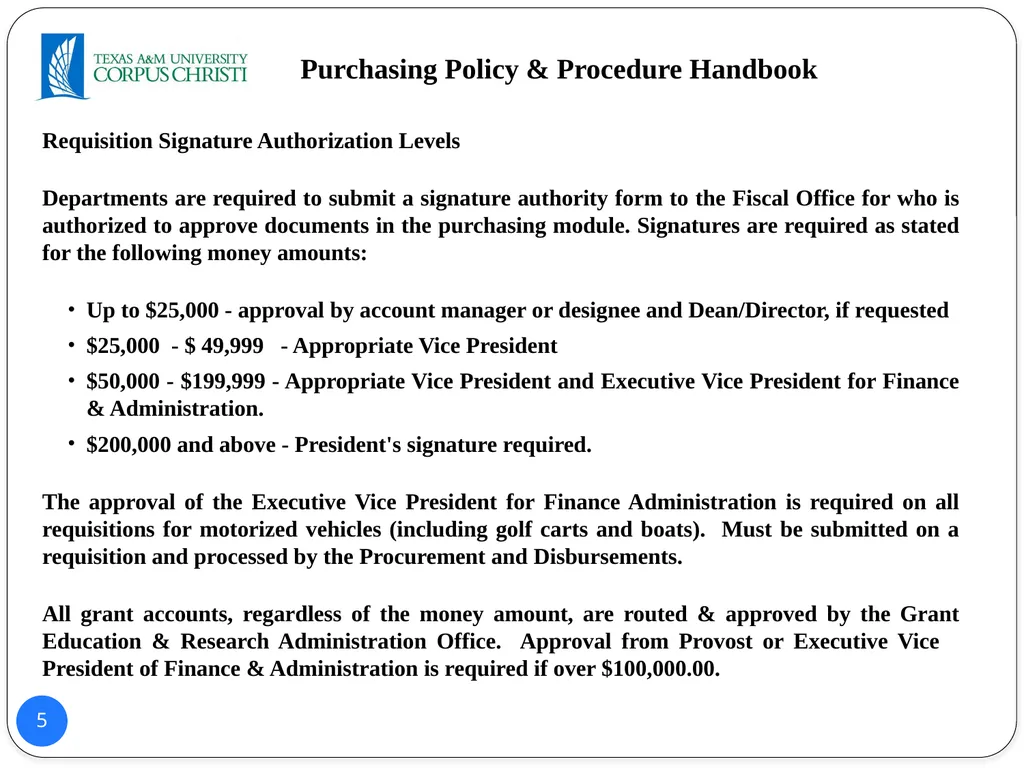
Requisition Signature Authorization Levels
Departments are required to submit a signature authority form to the Fiscal Office for who is authorized to approve documents in the purchasing module. Signatures are required as stated for the following money amounts:
Up to $25,000 - approval by account manager or designee and Dean/Director, if requested
$25,000 - $ 49,999 - Appropriate Vice President
$50,000 - $199,999 - Appropriate Vice President and Executive Vice President for Finance & Administration.
$200,000 and above - President's signature required.
The approval of the Executive Vice President for Finance Administration is required on all requisitions for motorized vehicles (including golf carts and boats). Must be submitted on a requisition and processed by the Procurement and Disbursements.
All grant accounts, regardless of the money amount, are routed & approved by the Grant Education & Research Administration Office. Approval from Provost or Executive Vice President of Finance & Administration is required if over $100,000.00. Purchasing Policy & Procedure Handbook 5<br>
Departments are required to submit a signature authority form to the Fiscal Office for who is authorized to approve documents in the purchasing module. Signatures are required as stated for the following money amounts:
Up to $25,000 - approval by account manager or designee and Dean/Director, if requested
$25,000 - $ 49,999 - Appropriate Vice President
$50,000 - $199,999 - Appropriate Vice President and Executive Vice President for Finance & Administration.
$200,000 and above - President's signature required.
The approval of the Executive Vice President for Finance Administration is required on all requisitions for motorized vehicles (including golf carts and boats). Must be submitted on a requisition and processed by the Procurement and Disbursements.
All grant accounts, regardless of the money amount, are routed & approved by the Grant Education & Research Administration Office. Approval from Provost or Executive Vice President of Finance & Administration is required if over $100,000.00. Purchasing Policy & Procedure Handbook 5<br>
06
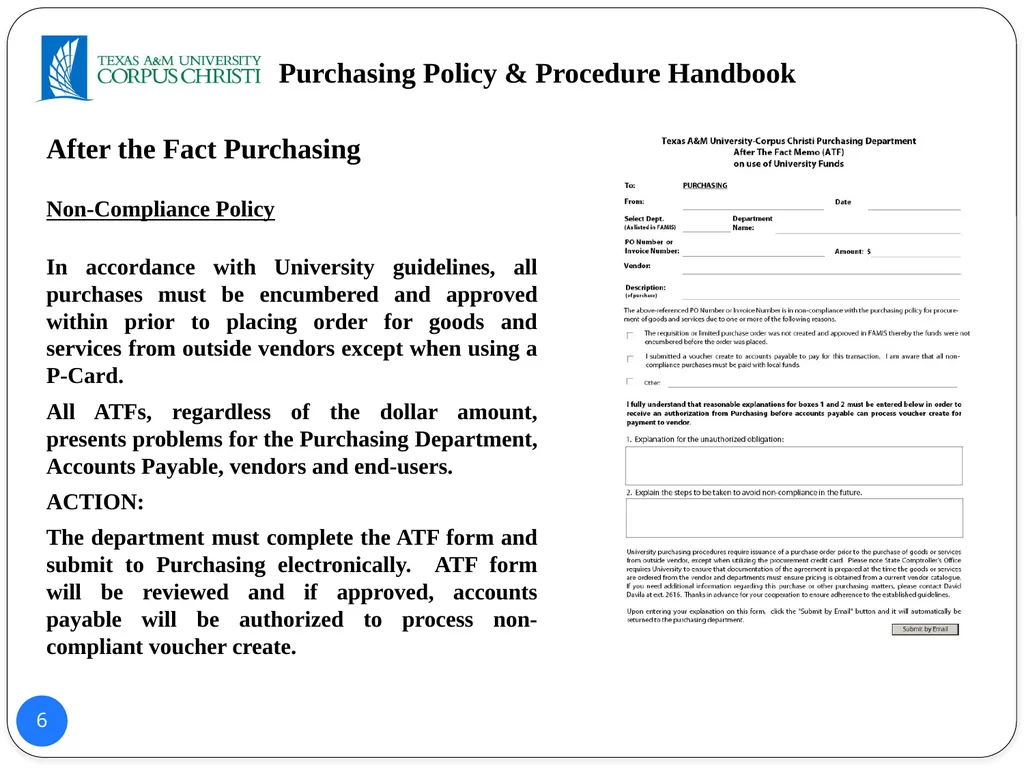
After the Fact Purchasing
Non-Compliance Policy
In accordance with University guidelines, all purchases must be encumbered and approved within prior to placing order for goods and services from outside vendors except when using a P-Card.
All ATFs, regardless of the dollar amount, presents problems for the Purchasing Department, Accounts Payable, vendors and end-users.
ACTION:
The department must complete the ATF form and submit to Purchasing electronically. ATF form will be reviewed and if approved, accounts payable will be authorized to process non-compliant voucher create. Purchasing Policy & Procedure Handbook 6<br>
Non-Compliance Policy
In accordance with University guidelines, all purchases must be encumbered and approved within prior to placing order for goods and services from outside vendors except when using a P-Card.
All ATFs, regardless of the dollar amount, presents problems for the Purchasing Department, Accounts Payable, vendors and end-users.
ACTION:
The department must complete the ATF form and submit to Purchasing electronically. ATF form will be reviewed and if approved, accounts payable will be authorized to process non-compliant voucher create. Purchasing Policy & Procedure Handbook 6<br>
07
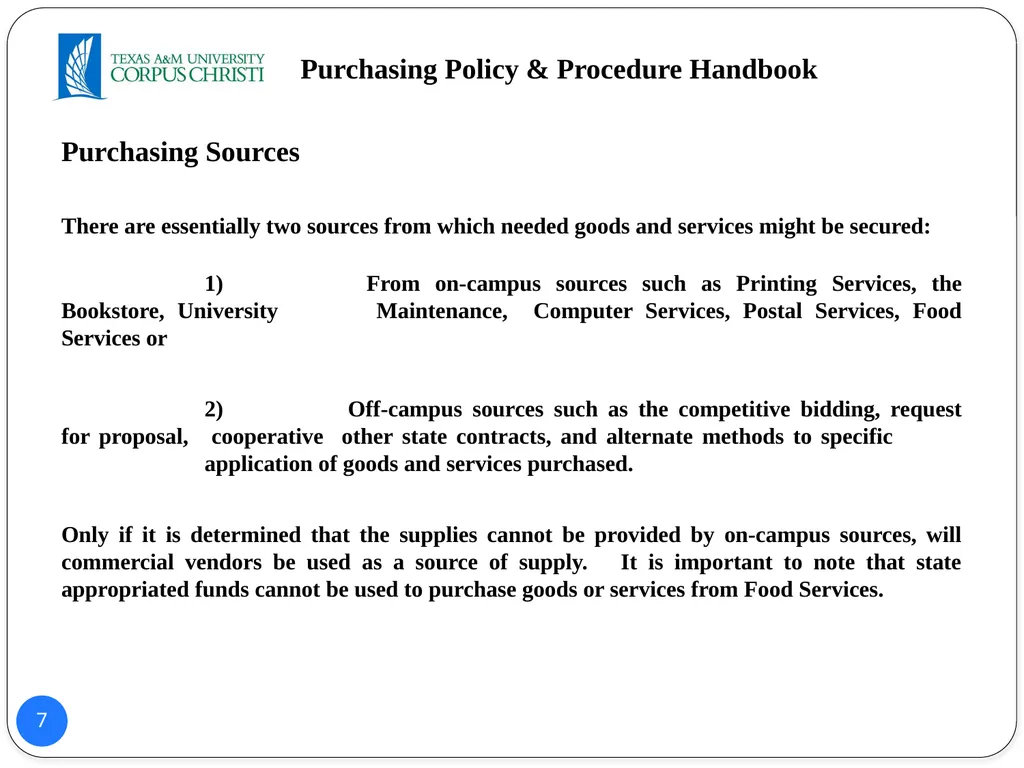
Purchasing Sources
There are essentially two sources from which needed goods and services might be secured:
1) From on-campus sources such as Printing Services, the Bookstore, University Maintenance, Computer Services, Postal Services, Food Services or
2) Off-campus sources such as the competitive bidding, request for proposal, cooperative other state contracts, and alternate methods to specific application of goods and services purchased.
Only if it is determined that the supplies cannot be provided by on-campus sources, will commercial vendors be used as a source of supply. It is important to note that state appropriated funds cannot be used to purchase goods or services from Food Services. Purchasing Policy & Procedure Handbook 7<br>
There are essentially two sources from which needed goods and services might be secured:
1) From on-campus sources such as Printing Services, the Bookstore, University Maintenance, Computer Services, Postal Services, Food Services or
2) Off-campus sources such as the competitive bidding, request for proposal, cooperative other state contracts, and alternate methods to specific application of goods and services purchased.
Only if it is determined that the supplies cannot be provided by on-campus sources, will commercial vendors be used as a source of supply. It is important to note that state appropriated funds cannot be used to purchase goods or services from Food Services. Purchasing Policy & Procedure Handbook 7<br>
08
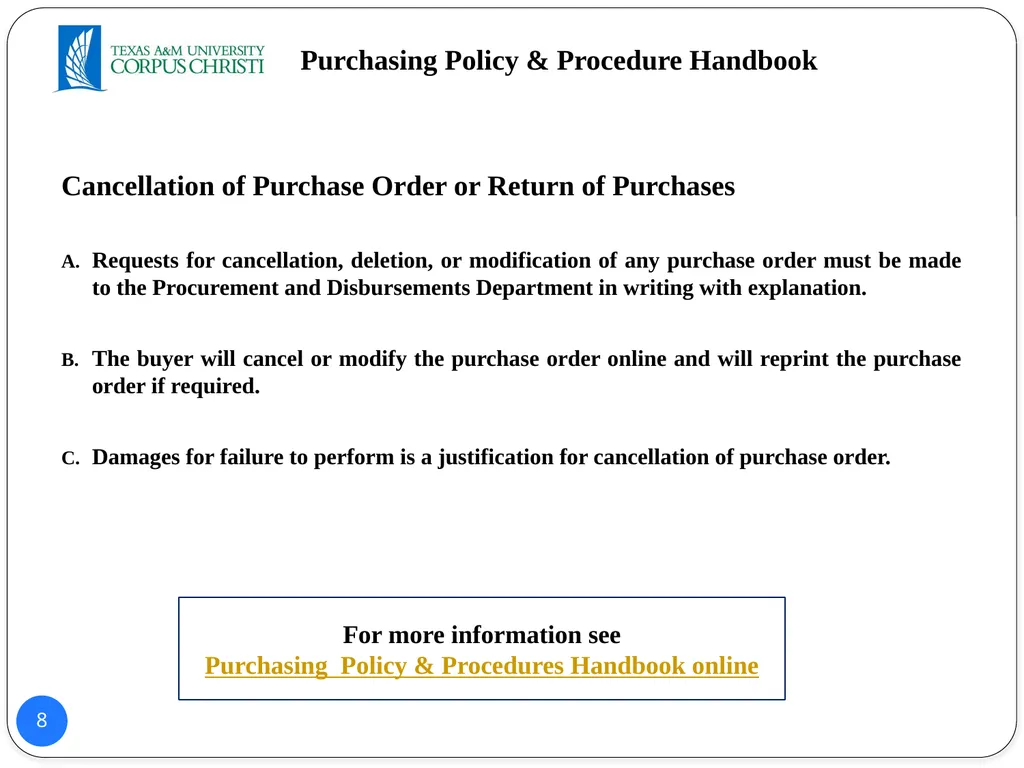
Cancellation of Purchase Order or Return of Purchases
Requests for cancellation, deletion, or modification of any purchase order must be made to the Procurement and Disbursements Department in writing with explanation.
The buyer will cancel or modify the purchase order online and will reprint the purchase order if required.
Damages for failure to perform is a justification for cancellation of purchase order. Purchasing Policy & Procedure Handbook For more information see
Purchasing Policy & Procedures Handbook online 8<br>
Requests for cancellation, deletion, or modification of any purchase order must be made to the Procurement and Disbursements Department in writing with explanation.
The buyer will cancel or modify the purchase order online and will reprint the purchase order if required.
Damages for failure to perform is a justification for cancellation of purchase order. Purchasing Policy & Procedure Handbook For more information see
Purchasing Policy & Procedures Handbook online 8<br>
09
Authority to Obligate Funds
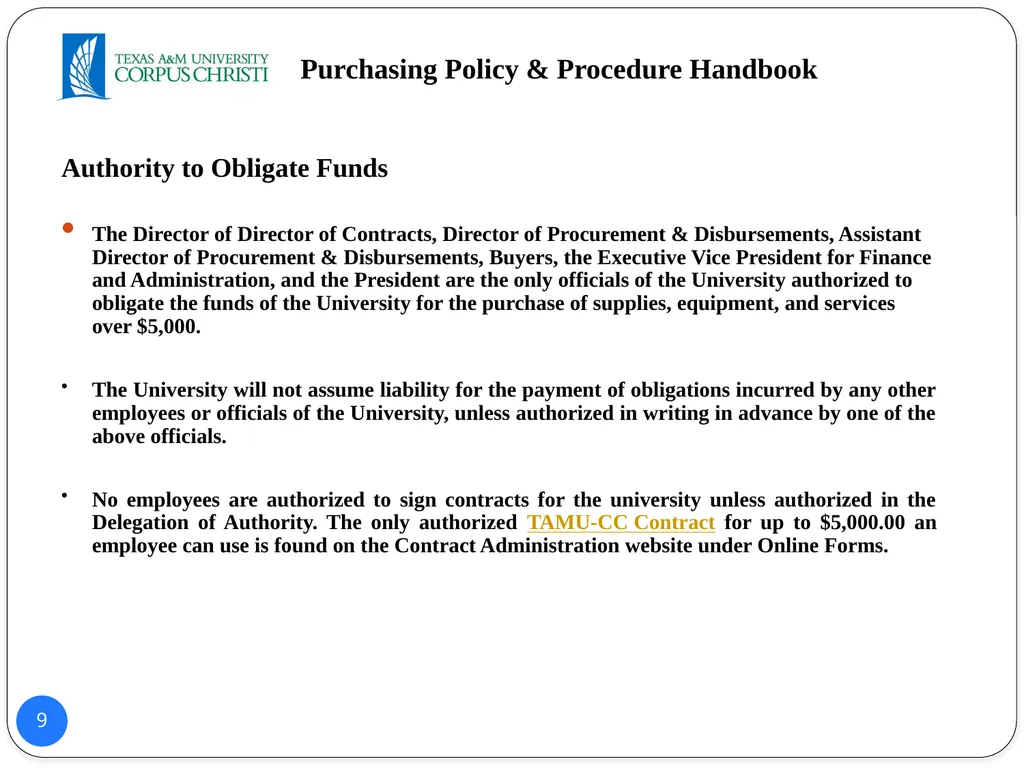
The Director of Director of Contracts, Director of Procurement & Disbursements, Assistant Director of Procurement & Disbursements, Buyers, the Executive Vice President for Finance and Administration, and the President are the only officials of the University authorized to obligate the funds of the University for the purchase of supplies, equipment, and services over $5,000.
The University will not assume liability for the payment of obligations incurred by any other employees or officials of the University, unless authorized in writing in advance by one of the above officials.
No employees are authorized to sign contracts for the university unless authorized in the Delegation of Authority. The only authorized TAMU-CC Contract for up to $5,000.00 an employee can use is found on the Contract Administration website under Online Forms. Purchasing Policy & Procedure Handbook 9<br>
The Director of Director of Contracts, Director of Procurement & Disbursements, Assistant Director of Procurement & Disbursements, Buyers, the Executive Vice President for Finance and Administration, and the President are the only officials of the University authorized to obligate the funds of the University for the purchase of supplies, equipment, and services over $5,000.
The University will not assume liability for the payment of obligations incurred by any other employees or officials of the University, unless authorized in writing in advance by one of the above officials.
No employees are authorized to sign contracts for the university unless authorized in the Delegation of Authority. The only authorized TAMU-CC Contract for up to $5,000.00 an employee can use is found on the Contract Administration website under Online Forms. Purchasing Policy & Procedure Handbook 9<br>
10
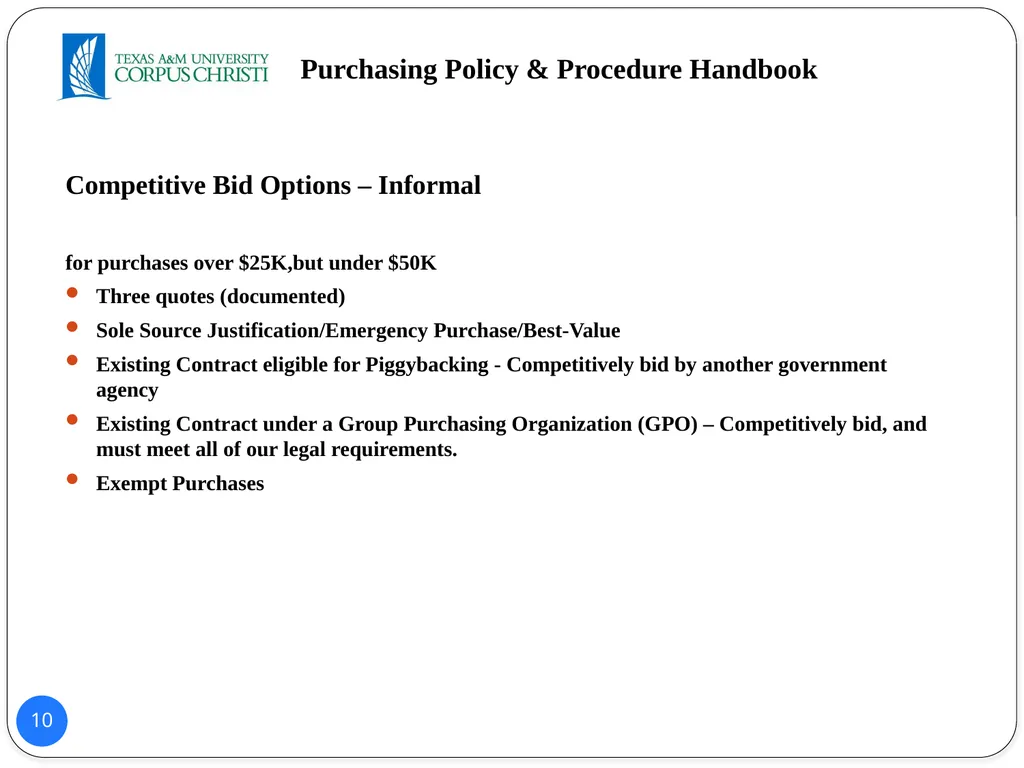
Competitive Bid Options – Informal
for purchases over $25K,but under $50K
Three quotes (documented)
Sole Source Justification/Emergency Purchase/Best-Value
Existing Contract eligible for Piggybacking - Competitively bid by another government agency
Existing Contract under a Group Purchasing Organization (GPO) – Competitively bid, and must meet all of our legal requirements.
Exempt Purchases Purchasing Policy & Procedure Handbook 10<br>
for purchases over $25K,but under $50K
Three quotes (documented)
Sole Source Justification/Emergency Purchase/Best-Value
Existing Contract eligible for Piggybacking - Competitively bid by another government agency
Existing Contract under a Group Purchasing Organization (GPO) – Competitively bid, and must meet all of our legal requirements.
Exempt Purchases Purchasing Policy & Procedure Handbook 10<br>
11
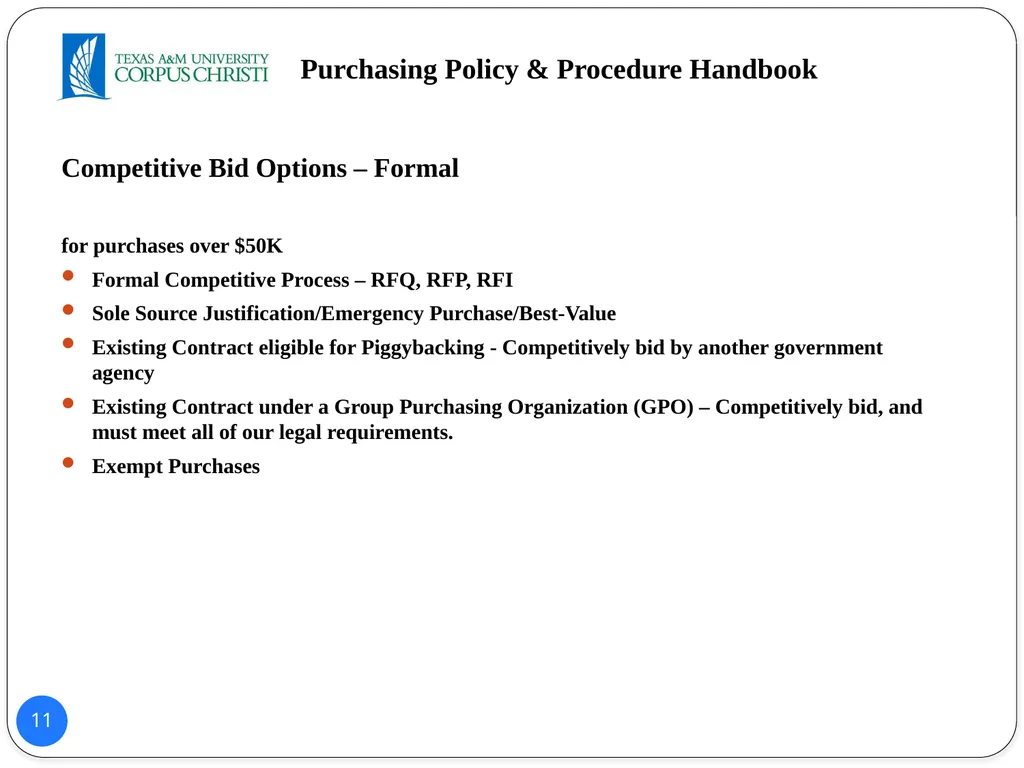
Competitive Bid Options – Formal
for purchases over $50K
Formal Competitive Process – RFQ, RFP, RFI
Sole Source Justification/Emergency Purchase/Best-Value
Existing Contract eligible for Piggybacking - Competitively bid by another government agency
Existing Contract under a Group Purchasing Organization (GPO) – Competitively bid, and must meet all of our legal requirements.
Exempt Purchases Purchasing Policy & Procedure Handbook 11<br>
for purchases over $50K
Formal Competitive Process – RFQ, RFP, RFI
Sole Source Justification/Emergency Purchase/Best-Value
Existing Contract eligible for Piggybacking - Competitively bid by another government agency
Existing Contract under a Group Purchasing Organization (GPO) – Competitively bid, and must meet all of our legal requirements.
Exempt Purchases Purchasing Policy & Procedure Handbook 11<br>
12
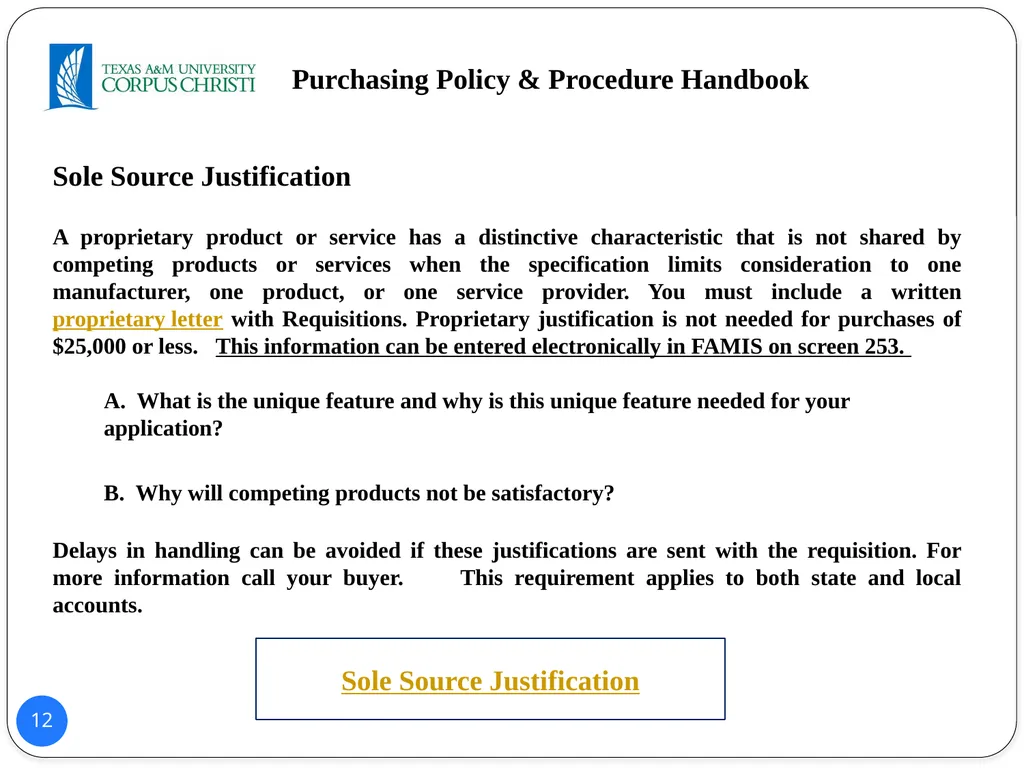
Sole Source Justification Sole Source Justification
A proprietary product or service has a distinctive characteristic that is not shared by competing products or services when the specification limits consideration to one manufacturer, one product, or one service provider. You must include a written proprietary letter with Requisitions. Proprietary justification is not needed for purchases of $25,000 or less. This information can be entered electronically in FAMIS on screen 253.
A. What is the unique feature and why is this unique feature needed for your application?
B. Why will competing products not be satisfactory?
Delays in handling can be avoided if these justifications are sent with the requisition. For more information call your buyer. This requirement applies to both state and local accounts. Purchasing Policy & Procedure Handbook 12<br>
A proprietary product or service has a distinctive characteristic that is not shared by competing products or services when the specification limits consideration to one manufacturer, one product, or one service provider. You must include a written proprietary letter with Requisitions. Proprietary justification is not needed for purchases of $25,000 or less. This information can be entered electronically in FAMIS on screen 253.
A. What is the unique feature and why is this unique feature needed for your application?
B. Why will competing products not be satisfactory?
Delays in handling can be avoided if these justifications are sent with the requisition. For more information call your buyer. This requirement applies to both state and local accounts. Purchasing Policy & Procedure Handbook 12<br>
13
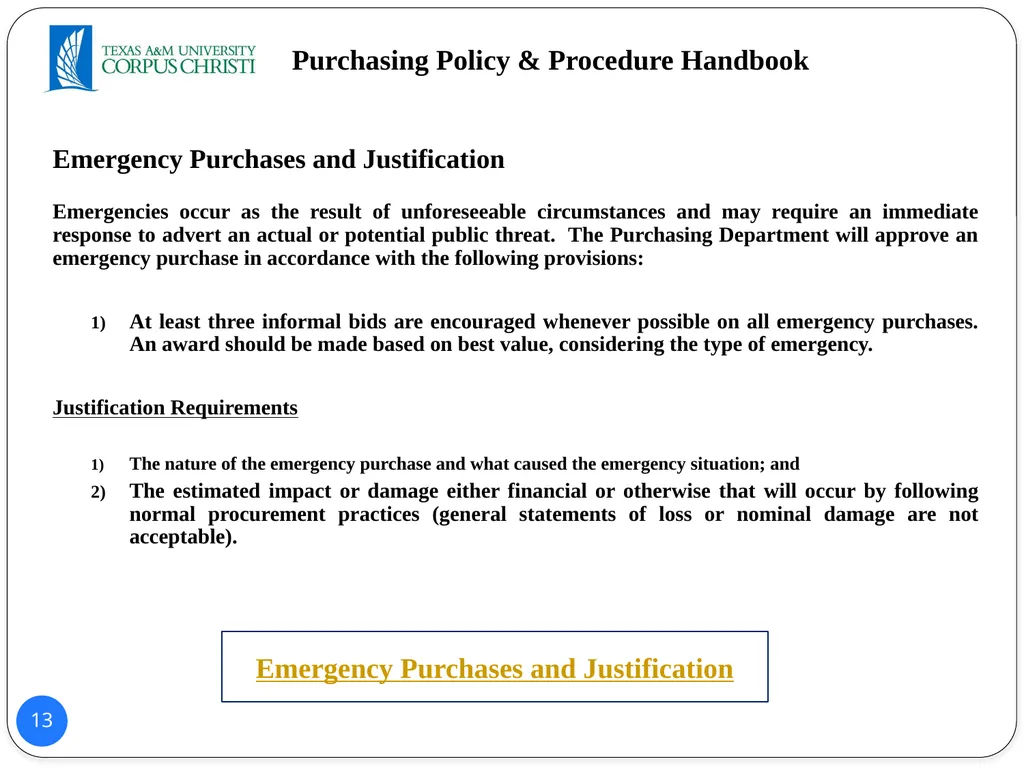
Emergency Purchases and Justification
Emergencies occur as the result of unforeseeable circumstances and may require an immediate response to advert an actual or potential public threat. The Purchasing Department will approve an emergency purchase in accordance with the following provisions:
At least three informal bids are encouraged whenever possible on all emergency purchases. An award should be made based on best value, considering the type of emergency.
Justification Requirements
The nature of the emergency purchase and what caused the emergency situation; and
The estimated impact or damage either financial or otherwise that will occur by following normal procurement practices (general statements of loss or nominal damage are not acceptable). Emergency Purchases and Justification Purchasing Policy & Procedure Handbook 13<br>
Emergencies occur as the result of unforeseeable circumstances and may require an immediate response to advert an actual or potential public threat. The Purchasing Department will approve an emergency purchase in accordance with the following provisions:
At least three informal bids are encouraged whenever possible on all emergency purchases. An award should be made based on best value, considering the type of emergency.
Justification Requirements
The nature of the emergency purchase and what caused the emergency situation; and
The estimated impact or damage either financial or otherwise that will occur by following normal procurement practices (general statements of loss or nominal damage are not acceptable). Emergency Purchases and Justification Purchasing Policy & Procedure Handbook 13<br>
14
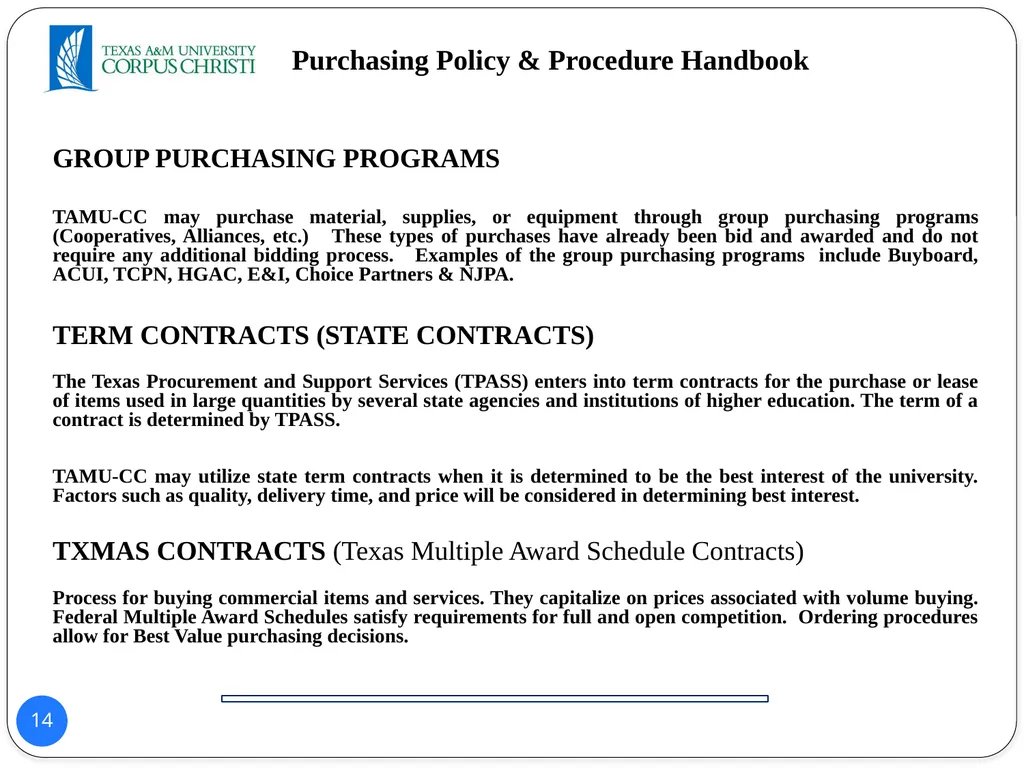
GROUP PURCHASING PROGRAMS
TAMU-CC may purchase material, supplies, or equipment through group purchasing programs (Cooperatives, Alliances, etc.) These types of purchases have already been bid and awarded and do not require any additional bidding process. Examples of the group purchasing programs include Buyboard, ACUI, TCPN, HGAC, E&I, Choice Partners & NJPA.
TERM CONTRACTS (STATE CONTRACTS)
The Texas Procurement and Support Services (TPASS) enters into term contracts for the purchase or lease of items used in large quantities by several state agencies and institutions of higher education. The term of a contract is determined by TPASS.
TAMU-CC may utilize state term contracts when it is determined to be the best interest of the university. Factors such as quality, delivery time, and price will be considered in determining best interest.
TXMAS CONTRACTS (Texas Multiple Award Schedule Contracts)
Process for buying commercial items and services. They capitalize on prices associated with volume buying. Federal Multiple Award Schedules satisfy requirements for full and open competition. Ordering procedures allow for Best Value purchasing decisions. Purchasing Policy & Procedure Handbook 14<br>
TAMU-CC may purchase material, supplies, or equipment through group purchasing programs (Cooperatives, Alliances, etc.) These types of purchases have already been bid and awarded and do not require any additional bidding process. Examples of the group purchasing programs include Buyboard, ACUI, TCPN, HGAC, E&I, Choice Partners & NJPA.
TERM CONTRACTS (STATE CONTRACTS)
The Texas Procurement and Support Services (TPASS) enters into term contracts for the purchase or lease of items used in large quantities by several state agencies and institutions of higher education. The term of a contract is determined by TPASS.
TAMU-CC may utilize state term contracts when it is determined to be the best interest of the university. Factors such as quality, delivery time, and price will be considered in determining best interest.
TXMAS CONTRACTS (Texas Multiple Award Schedule Contracts)
Process for buying commercial items and services. They capitalize on prices associated with volume buying. Federal Multiple Award Schedules satisfy requirements for full and open competition. Ordering procedures allow for Best Value purchasing decisions. Purchasing Policy & Procedure Handbook 14<br>
15
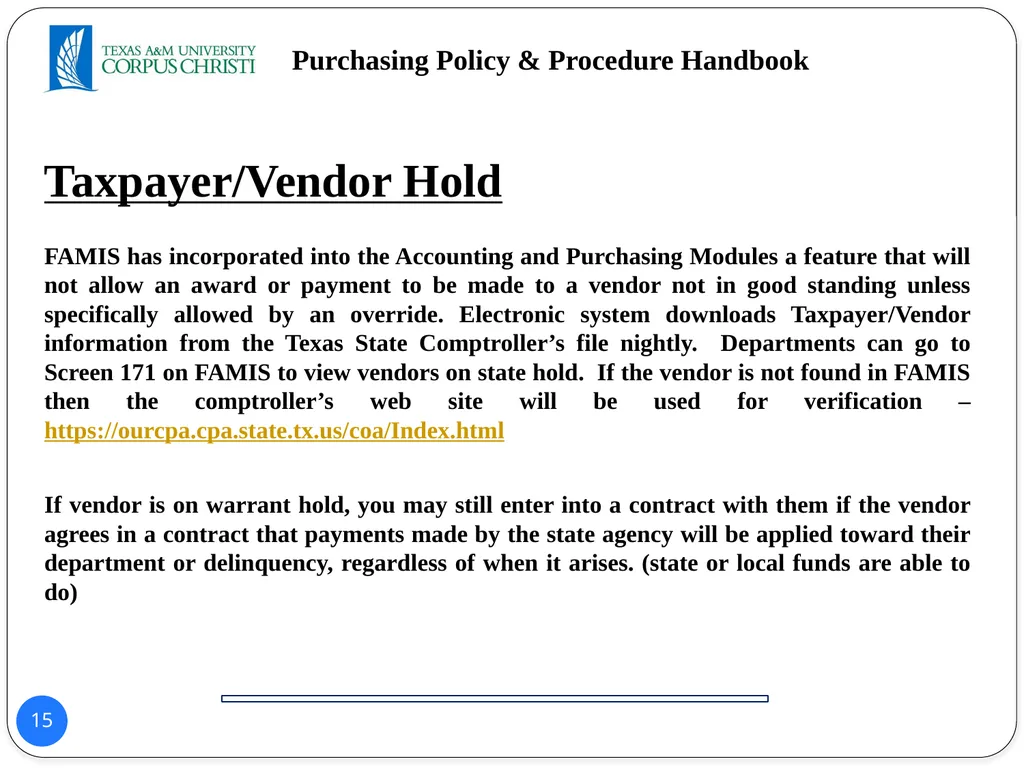
Taxpayer/Vendor Hold
FAMIS has incorporated into the Accounting and Purchasing Modules a feature that will not allow an award or payment to be made to a vendor not in good standing unless specifically allowed by an override. Electronic system downloads Taxpayer/Vendor information from the Texas State Comptroller’s file nightly. Departments can go to Screen 171 on FAMIS to view vendors on state hold. If the vendor is not found in FAMIS then the comptroller’s web site will be used for verification – https://ourcpa.cpa.state.tx.us/coa/Index.html
If vendor is on warrant hold, you may still enter into a contract with them if the vendor agrees in a contract that payments made by the state agency will be applied toward their department or delinquency, regardless of when it arises. (state or local funds are able to do) Purchasing Policy & Procedure Handbook 15<br>
FAMIS has incorporated into the Accounting and Purchasing Modules a feature that will not allow an award or payment to be made to a vendor not in good standing unless specifically allowed by an override. Electronic system downloads Taxpayer/Vendor information from the Texas State Comptroller’s file nightly. Departments can go to Screen 171 on FAMIS to view vendors on state hold. If the vendor is not found in FAMIS then the comptroller’s web site will be used for verification – https://ourcpa.cpa.state.tx.us/coa/Index.html
If vendor is on warrant hold, you may still enter into a contract with them if the vendor agrees in a contract that payments made by the state agency will be applied toward their department or delinquency, regardless of when it arises. (state or local funds are able to do) Purchasing Policy & Procedure Handbook 15<br>
16
Sales and Use Tax
As agency of the State of Texas, Texas A&M University-Corpus Christi is tax exempt. The exemption applies to all purchases on limited purchase orders, purchase orders, P-card, and Travel card. The Purchasing credit card identifies agency as being tax exempt. All cardholders should carry a Tax Exemption Certificate with their P-card.
Out-of-State Sales and Use Tax
If you are in another state and take possession of goods in that state, we are subject to pay the non-Texas sales tax. If goods are ordered from another state and shipped to Texas and that vendor does not have a Texas location, we should not pay the non-Texas sales tax.
As per eXpendit, a state agency may not voluntarily pay a tax or fee if the agency is legally exempt from paying it. Purchasing Policy & Procedure Handbook 16<br>
As agency of the State of Texas, Texas A&M University-Corpus Christi is tax exempt. The exemption applies to all purchases on limited purchase orders, purchase orders, P-card, and Travel card. The Purchasing credit card identifies agency as being tax exempt. All cardholders should carry a Tax Exemption Certificate with their P-card.
Out-of-State Sales and Use Tax
If you are in another state and take possession of goods in that state, we are subject to pay the non-Texas sales tax. If goods are ordered from another state and shipped to Texas and that vendor does not have a Texas location, we should not pay the non-Texas sales tax.
As per eXpendit, a state agency may not voluntarily pay a tax or fee if the agency is legally exempt from paying it. Purchasing Policy & Procedure Handbook 16<br>
17
Purchasing Policy & Procedure Handbook 17 Specialized Purchasing & Exempt Purchases<br>
18
DIRECT PUBLICATIONS: This delegation does not include any item which could reasonably be expected to be bid. An example of an item which may be competitively bid would be subscription services. While certain publications may only be available from the publisher, a service which manages subscriptions to various publications could be competitively bid. A list of examples of direct publications that are not expected to be bid include, but are not limited to, can be found in the handbook. All payments for direct publication, regardless of dollar amount require the following statement: "Not available through any other source.”
GIFT ACCOUNTS: Gift accounts are processed the same as local funds, unless the donor specifies a vendor or sole source.
FEDERAL FUNDS: Purchases utilizing Federal Funds must be made in accordance with provisions of grant or contract. All federal and state guidelines are followed in the procurement of goods and services. Federal funds may utilize State Contract and General Service Administration contracts. Purchasing Policy & Procedure Handbook 18<br>
GIFT ACCOUNTS: Gift accounts are processed the same as local funds, unless the donor specifies a vendor or sole source.
FEDERAL FUNDS: Purchases utilizing Federal Funds must be made in accordance with provisions of grant or contract. All federal and state guidelines are followed in the procurement of goods and services. Federal funds may utilize State Contract and General Service Administration contracts. Purchasing Policy & Procedure Handbook 18<br>
19
GRANTS
Purchases utilizing grants must be made in accordance with provisions of the grant or when using a contract. When using grant accounts approval is required if:
1. Under $50,000 Director of Contracts can sign and review without TAMU Legal review, grant's office personnel will review and approve in FAMIS.
2. Over $50,000 TAMU Legal must review (waived if using a legal approved contract form), grants office will verify that goods or services are allowed in grant and will approve in FAMIS. Director of Sponsored Programs, Research & Graduate Studies and Director of Contracts grants will sign the contract.
3. $100,000 or over will require the signature of the Executive VP of Finance and Administration. Purchasing Policy & Procedure Handbook 19<br>
Purchases utilizing grants must be made in accordance with provisions of the grant or when using a contract. When using grant accounts approval is required if:
1. Under $50,000 Director of Contracts can sign and review without TAMU Legal review, grant's office personnel will review and approve in FAMIS.
2. Over $50,000 TAMU Legal must review (waived if using a legal approved contract form), grants office will verify that goods or services are allowed in grant and will approve in FAMIS. Director of Sponsored Programs, Research & Graduate Studies and Director of Contracts grants will sign the contract.
3. $100,000 or over will require the signature of the Executive VP of Finance and Administration. Purchasing Policy & Procedure Handbook 19<br>
20
PRE-APPROVAL REQUIRED FOR EQUIPMENT/SUPPLIES/SERVICES BY FACILITIES SERVICES
Equipment/Supplies Requiring Installation/Modification of Facility
Requisitions for equipment that requires installation/modification of existing facilities is submitted to Facilities Services prior to being sent to Procurement and Disbursements. Facilities Services reviews and notifies department of any additional requirements that will be needed. These are incorporated into the requisition and then sent to Purchasing. If a Facilities Services work request to modify the facility is needed, the using department is notified.
Modification, Construction and Renovation
Modification, construction and renovation of existing building and grounds must be approved by Facilities Services. Requisitions will not be processed by the Purchasing without written approval of Facilities Services by a Facilities Modification Form. Purchasing Policy & Procedure Handbook 20<br>
Equipment/Supplies Requiring Installation/Modification of Facility
Requisitions for equipment that requires installation/modification of existing facilities is submitted to Facilities Services prior to being sent to Procurement and Disbursements. Facilities Services reviews and notifies department of any additional requirements that will be needed. These are incorporated into the requisition and then sent to Purchasing. If a Facilities Services work request to modify the facility is needed, the using department is notified.
Modification, Construction and Renovation
Modification, construction and renovation of existing building and grounds must be approved by Facilities Services. Requisitions will not be processed by the Purchasing without written approval of Facilities Services by a Facilities Modification Form. Purchasing Policy & Procedure Handbook 20<br>
21
Hand Held Radios, Security Radios
All requests are submitted to Telecommunications and Facilities Services for review prior to submitting by Procurement and Disbursement Department. Due to security and the limited frequencies available and the necessity to identify program frequencies for each radio, the Telecommunications Department reviews all radio purchases.
Portable Building
Portable Buildings must be approved prior to purchase by the Director of Facilities Services.
Security Camera system & Door Access
Purchases involving locking mechanisms, door access control components, and/or security camera systems must be submitted through the “Door Access Committee” which will eliminate multiple security related systems. Purchasing Policy & Procedure Handbook 21<br>
All requests are submitted to Telecommunications and Facilities Services for review prior to submitting by Procurement and Disbursement Department. Due to security and the limited frequencies available and the necessity to identify program frequencies for each radio, the Telecommunications Department reviews all radio purchases.
Portable Building
Portable Buildings must be approved prior to purchase by the Director of Facilities Services.
Security Camera system & Door Access
Purchases involving locking mechanisms, door access control components, and/or security camera systems must be submitted through the “Door Access Committee” which will eliminate multiple security related systems. Purchasing Policy & Procedure Handbook 21<br>
22
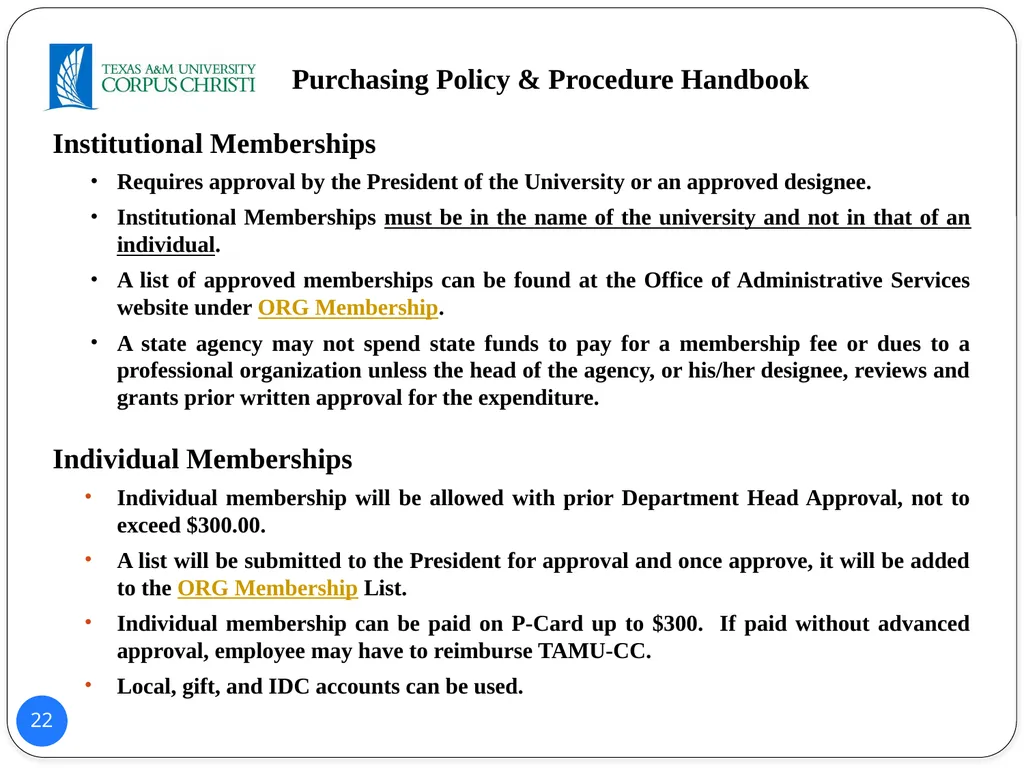
Institutional Memberships
Requires approval by the President of the University or an approved designee.
Institutional Memberships must be in the name of the university and not in that of an individual.
A list of approved memberships can be found at the Office of Administrative Services website under ORG Membership.
A state agency may not spend state funds to pay for a membership fee or dues to a professional organization unless the head of the agency, or his/her designee, reviews and grants prior written approval for the expenditure.
Individual Memberships
Individual membership will be allowed with prior Department Head Approval, not to exceed $300.00.
A list will be submitted to the President for approval and once approve, it will be added to the ORG Membership List.
Individual membership can be paid on P-Card up to $300. If paid without advanced approval, employee may have to reimburse TAMU-CC.
Local, gift, and IDC accounts can be used. Purchasing Policy & Procedure Handbook 22<br>
Requires approval by the President of the University or an approved designee.
Institutional Memberships must be in the name of the university and not in that of an individual.
A list of approved memberships can be found at the Office of Administrative Services website under ORG Membership.
A state agency may not spend state funds to pay for a membership fee or dues to a professional organization unless the head of the agency, or his/her designee, reviews and grants prior written approval for the expenditure.
Individual Memberships
Individual membership will be allowed with prior Department Head Approval, not to exceed $300.00.
A list will be submitted to the President for approval and once approve, it will be added to the ORG Membership List.
Individual membership can be paid on P-Card up to $300. If paid without advanced approval, employee may have to reimburse TAMU-CC.
Local, gift, and IDC accounts can be used. Purchasing Policy & Procedure Handbook 22<br>
23
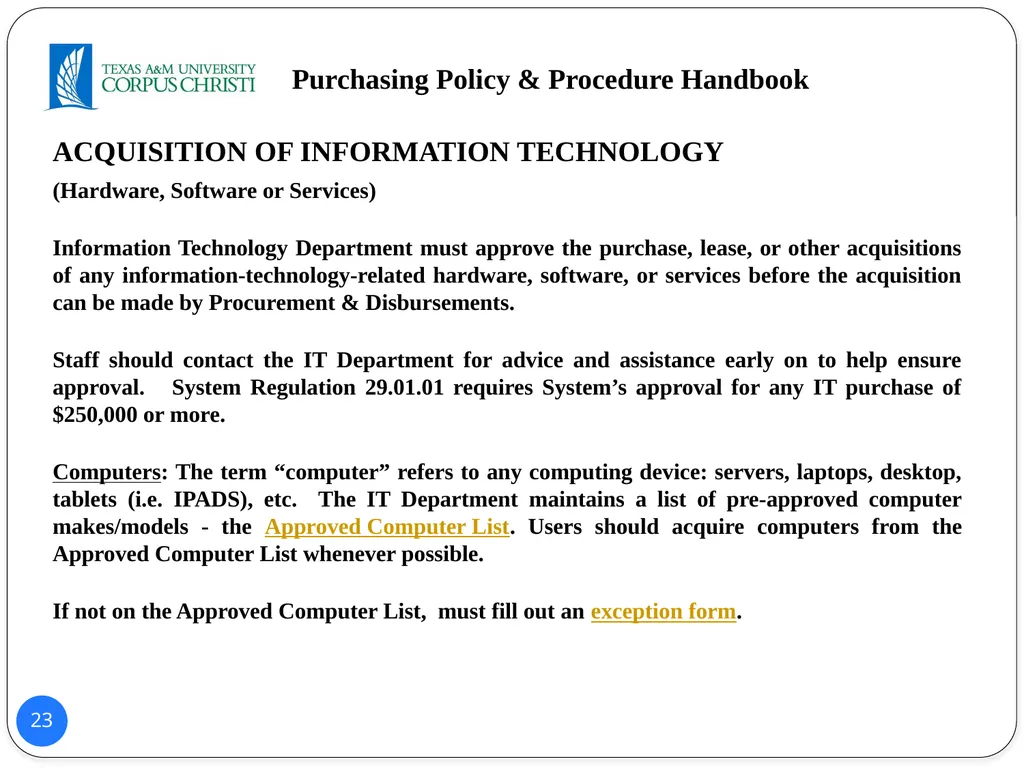
ACQUISITION OF INFORMATION TECHNOLOGY
(Hardware, Software or Services)
Information Technology Department must approve the purchase, lease, or other acquisitions of any information-technology-related hardware, software, or services before the acquisition can be made by Procurement & Disbursements.
Staff should contact the IT Department for advice and assistance early on to help ensure approval. System Regulation 29.01.01 requires System’s approval for any IT purchase of $250,000 or more.
Computers: The term “computer” refers to any computing device: servers, laptops, desktop, tablets (i.e. IPADS), etc. The IT Department maintains a list of pre-approved computer makes/models - the Approved Computer List. Users should acquire computers from the Approved Computer List whenever possible.
If not on the Approved Computer List, must fill out an exception form. Purchasing Policy & Procedure Handbook 23<br>
(Hardware, Software or Services)
Information Technology Department must approve the purchase, lease, or other acquisitions of any information-technology-related hardware, software, or services before the acquisition can be made by Procurement & Disbursements.
Staff should contact the IT Department for advice and assistance early on to help ensure approval. System Regulation 29.01.01 requires System’s approval for any IT purchase of $250,000 or more.
Computers: The term “computer” refers to any computing device: servers, laptops, desktop, tablets (i.e. IPADS), etc. The IT Department maintains a list of pre-approved computer makes/models - the Approved Computer List. Users should acquire computers from the Approved Computer List whenever possible.
If not on the Approved Computer List, must fill out an exception form. Purchasing Policy & Procedure Handbook 23<br>
24
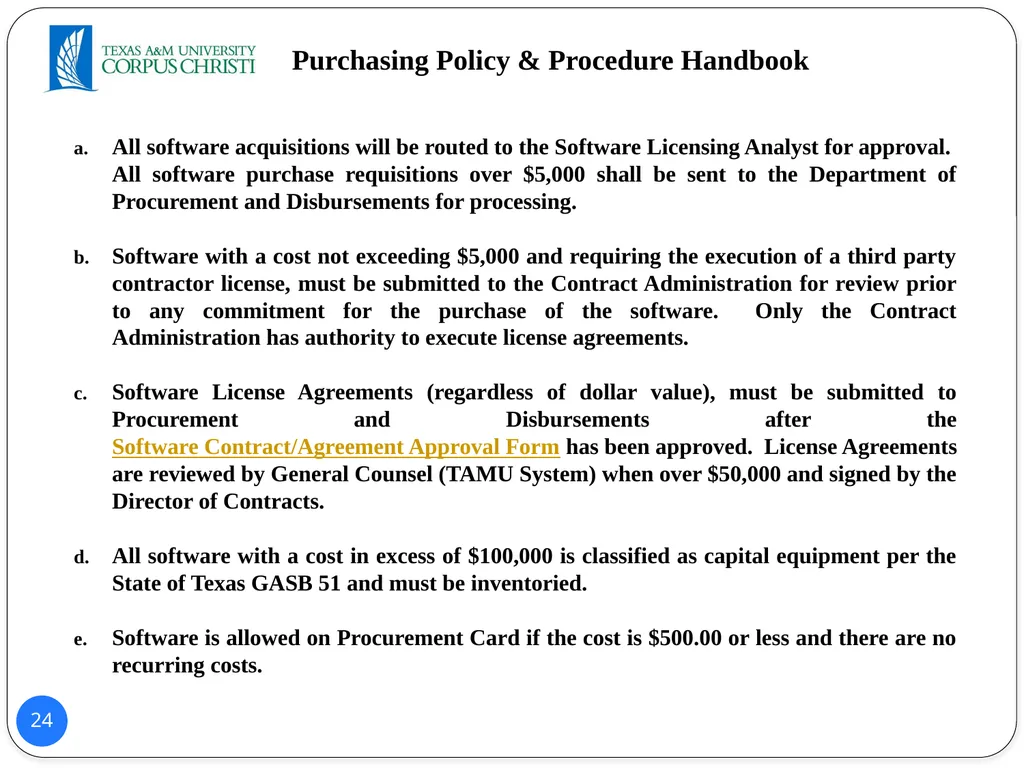
Software:
All software acquisitions will be routed to the Software Licensing Analyst for approval. All software purchase requisitions over $5,000 shall be sent to the Department of Procurement and Disbursements for processing.
Software with a cost not exceeding $5,000 and requiring the execution of a third party contractor license, must be submitted to the Contract Administration for review prior to any commitment for the purchase of the software. Only the Contract Administration has authority to execute license agreements.
Software License Agreements (regardless of dollar value), must be submitted to Procurement and Disbursements after the Software Contract/Agreement Approval Form has been approved. License Agreements are reviewed by General Counsel (TAMU System) when over $50,000 and signed by the Director of Contracts.
All software with a cost in excess of $100,000 is classified as capital equipment per the State of Texas GASB 51 and must be inventoried.
Software is allowed on Procurement Card if the cost is $500.00 or less and there are no recurring costs. Purchasing Policy & Procedure Handbook 24<br>
All software acquisitions will be routed to the Software Licensing Analyst for approval. All software purchase requisitions over $5,000 shall be sent to the Department of Procurement and Disbursements for processing.
Software with a cost not exceeding $5,000 and requiring the execution of a third party contractor license, must be submitted to the Contract Administration for review prior to any commitment for the purchase of the software. Only the Contract Administration has authority to execute license agreements.
Software License Agreements (regardless of dollar value), must be submitted to Procurement and Disbursements after the Software Contract/Agreement Approval Form has been approved. License Agreements are reviewed by General Counsel (TAMU System) when over $50,000 and signed by the Director of Contracts.
All software with a cost in excess of $100,000 is classified as capital equipment per the State of Texas GASB 51 and must be inventoried.
Software is allowed on Procurement Card if the cost is $500.00 or less and there are no recurring costs. Purchasing Policy & Procedure Handbook 24<br>
25
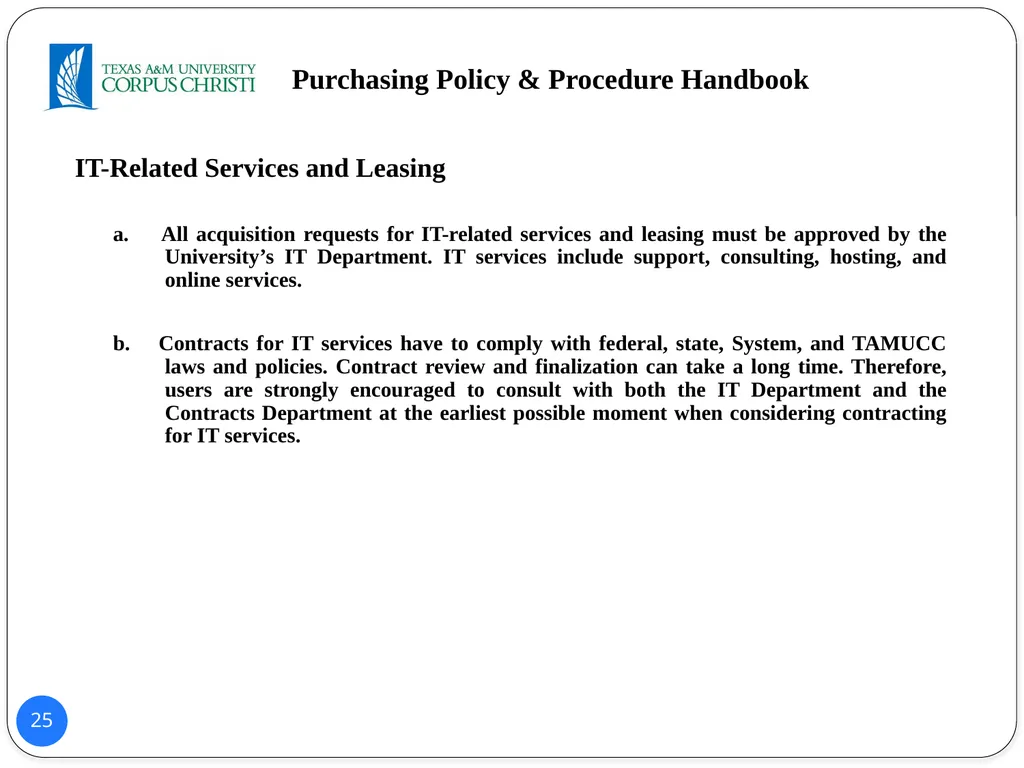
IT-Related Services and Leasing
a. All acquisition requests for IT-related services and leasing must be approved by the University’s IT Department. IT services include support, consulting, hosting, and online services.
b. Contracts for IT services have to comply with federal, state, System, and TAMUCC laws and policies. Contract review and finalization can take a long time. Therefore, users are strongly encouraged to consult with both the IT Department and the Contracts Department at the earliest possible moment when considering contracting for IT services. Purchasing Policy & Procedure Handbook 25<br>
a. All acquisition requests for IT-related services and leasing must be approved by the University’s IT Department. IT services include support, consulting, hosting, and online services.
b. Contracts for IT services have to comply with federal, state, System, and TAMUCC laws and policies. Contract review and finalization can take a long time. Therefore, users are strongly encouraged to consult with both the IT Department and the Contracts Department at the earliest possible moment when considering contracting for IT services. Purchasing Policy & Procedure Handbook 25<br>
26
FOOD PURCHASES
The use of state funds for the purchase of food is very limited. State funds cannot be used for the purchase of coffee or related items for consumption by employees or departmental visitors. State funds can, however, be used to pay for food purchases related to research or teaching. Refer to System Policy 21.01.12 – Purchase of Food and Refreshment.
Expenditures for food and/or refreshments from local funds are authorized as per the Expenditure Guidelines.
FLOWERS, FLORAL ARRANGEMENTS, AND PLANTS
May not use state funds to purchase flowers, floral arrangements, or decorative plants for a state officer or employee or for the friends or family of a state officer or employee. Local accounts may purchase flowers and plants, upon advanced approval from the account responsible with adequate documentation. Refer to Expenditure Guidelines.
Purchases from state funds are limited to vegetation, dirt, potting soil, fertilizer, seeds, and plants needed for erosion prevention, research, teaching, or agriculture. Purchasing Policy & Procedure Handbook 26<br>
The use of state funds for the purchase of food is very limited. State funds cannot be used for the purchase of coffee or related items for consumption by employees or departmental visitors. State funds can, however, be used to pay for food purchases related to research or teaching. Refer to System Policy 21.01.12 – Purchase of Food and Refreshment.
Expenditures for food and/or refreshments from local funds are authorized as per the Expenditure Guidelines.
FLOWERS, FLORAL ARRANGEMENTS, AND PLANTS
May not use state funds to purchase flowers, floral arrangements, or decorative plants for a state officer or employee or for the friends or family of a state officer or employee. Local accounts may purchase flowers and plants, upon advanced approval from the account responsible with adequate documentation. Refer to Expenditure Guidelines.
Purchases from state funds are limited to vegetation, dirt, potting soil, fertilizer, seeds, and plants needed for erosion prevention, research, teaching, or agriculture. Purchasing Policy & Procedure Handbook 26<br>
27
RENTALS OF MACHINES AND EQUIPMENT
A. Rentals
On rentals equal to or greater than $5,000.00 for the entire rental period, submit requisition to procurement department.
In the case of a long-term rental, the total anticipated rental amount will be the criteria for the type of handling. For example, if a department wanted to rent a copier from an outside vendor at $500.00 a month for only a month, a requisition through Purchasing would not be necessary unless a contract needed to be signed. On the other hand, if the anticipated rental period total exceeds $5,000.00 a requisition would be required.
B. Start Date
New lease or rental contracts, maintenance agreements, or various other term-oriented service contracts may be written to have an effective start date at any time during a fiscal year. However, the contract must be written to expire on the last day of the fiscal year within which it is effective, with renewals written to coincide with the beginning of the new fiscal year on September 1st. Contracts and agreements shall be processed, reviewed and executed by Contracts Administration. Departments do not have the authority to sign a contract. Purchasing Policy & Procedure Handbook 27<br>
A. Rentals
On rentals equal to or greater than $5,000.00 for the entire rental period, submit requisition to procurement department.
In the case of a long-term rental, the total anticipated rental amount will be the criteria for the type of handling. For example, if a department wanted to rent a copier from an outside vendor at $500.00 a month for only a month, a requisition through Purchasing would not be necessary unless a contract needed to be signed. On the other hand, if the anticipated rental period total exceeds $5,000.00 a requisition would be required.
B. Start Date
New lease or rental contracts, maintenance agreements, or various other term-oriented service contracts may be written to have an effective start date at any time during a fiscal year. However, the contract must be written to expire on the last day of the fiscal year within which it is effective, with renewals written to coincide with the beginning of the new fiscal year on September 1st. Contracts and agreements shall be processed, reviewed and executed by Contracts Administration. Departments do not have the authority to sign a contract. Purchasing Policy & Procedure Handbook 27<br>
28
PURCHASE OF USED OR DEMO EQUIPMENT
Should it become necessary for a department to secure used or demonstrator equipment or supplies due to inability to secure new equipment, or because of lack of adequate funds or used equipment will satisfy the agency’s need at a substantial savings. The following documents and data must be provided:
Properly prepared requisition fully describing equipment.
Signed bid or bids secure by agency, (min. 3) or reason why 3 bids could not be obtained.
If only one bid is available, statement as to why no competition. Letter or signed statement from bidder or bidders guaranteeing quality and condition of merchandise offered.
Letter from authorized person connected with the University giving acceptable reasons why it is necessary to purchase used merchandise and the approximate cost of same if purchased new.
Letter from an authorized, responsible person connected with the university stating that he/she has personally examined equipment or supplies, and giving his/her opinion as to condition and value. Purchasing Policy & Procedure Handbook 28<br>
Should it become necessary for a department to secure used or demonstrator equipment or supplies due to inability to secure new equipment, or because of lack of adequate funds or used equipment will satisfy the agency’s need at a substantial savings. The following documents and data must be provided:
Properly prepared requisition fully describing equipment.
Signed bid or bids secure by agency, (min. 3) or reason why 3 bids could not be obtained.
If only one bid is available, statement as to why no competition. Letter or signed statement from bidder or bidders guaranteeing quality and condition of merchandise offered.
Letter from authorized person connected with the University giving acceptable reasons why it is necessary to purchase used merchandise and the approximate cost of same if purchased new.
Letter from an authorized, responsible person connected with the university stating that he/she has personally examined equipment or supplies, and giving his/her opinion as to condition and value. Purchasing Policy & Procedure Handbook 28<br>
29
TRADE-INS
NOTE: Regardless of dollar amount, request for trade-in must be submitted to the Procurement and Disbursements Department.
A department may offer surplus or salvage property as a trade-in on new property of the same general type when such exchange is in the best interests of the state.
Equipment may be purchased with a trade-in of equipment of a similar type of equipment if the following requirements are satisfied:
Describe the age, condition, make, model, and serial number
(if applicable) of the equipment. This information must be listed on the PO;
Give a realistic estimate of the used equipment's value;
Show each trade-in allowance as an individual item on your requisition.
If not used as a trade-in, the equipment must be disposed of as surplus or salvage property. Since the department may profit more from the sale of old equipment as surplus property than as a trade-in, the estimate of the equipment's value is extremely important. Purchasing Policy & Procedure Handbook 29<br>
NOTE: Regardless of dollar amount, request for trade-in must be submitted to the Procurement and Disbursements Department.
A department may offer surplus or salvage property as a trade-in on new property of the same general type when such exchange is in the best interests of the state.
Equipment may be purchased with a trade-in of equipment of a similar type of equipment if the following requirements are satisfied:
Describe the age, condition, make, model, and serial number
(if applicable) of the equipment. This information must be listed on the PO;
Give a realistic estimate of the used equipment's value;
Show each trade-in allowance as an individual item on your requisition.
If not used as a trade-in, the equipment must be disposed of as surplus or salvage property. Since the department may profit more from the sale of old equipment as surplus property than as a trade-in, the estimate of the equipment's value is extremely important. Purchasing Policy & Procedure Handbook 29<br>
30
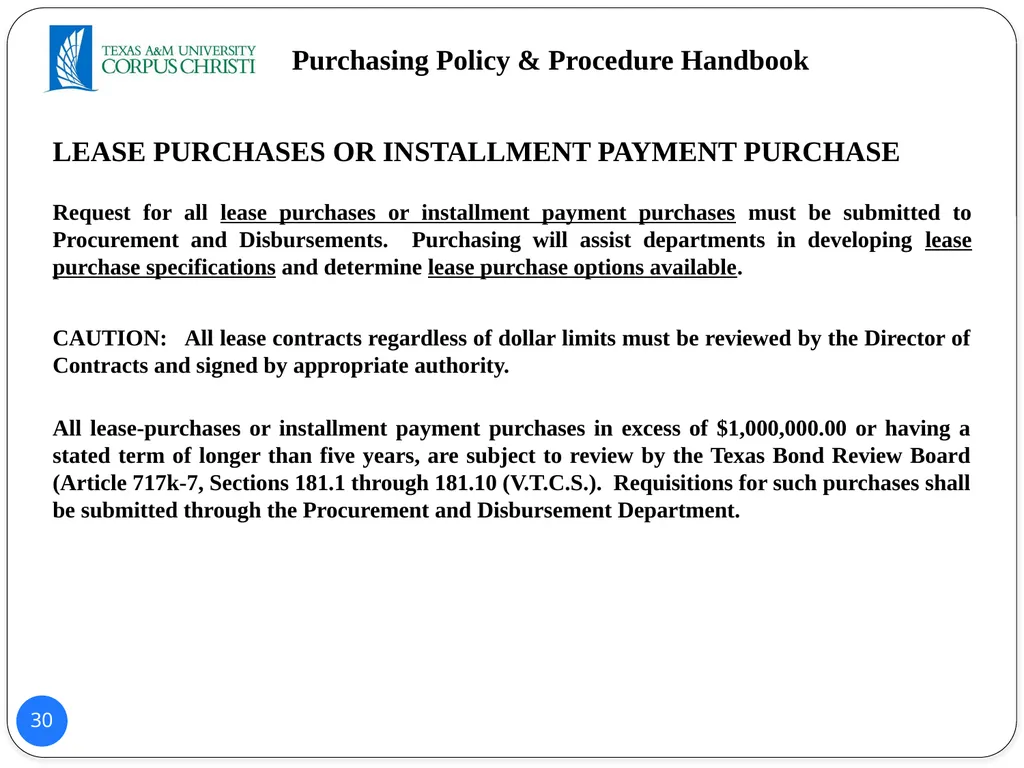
LEASE PURCHASES OR INSTALLMENT PAYMENT PURCHASE
Request for all lease purchases or installment payment purchases must be submitted to Procurement and Disbursements. Purchasing will assist departments in developing lease purchase specifications and determine lease purchase options available.
CAUTION: All lease contracts regardless of dollar limits must be reviewed by the Director of Contracts and signed by appropriate authority.
All lease-purchases or installment payment purchases in excess of $1,000,000.00 or having a stated term of longer than five years, are subject to review by the Texas Bond Review Board (Article 717k-7, Sections 181.1 through 181.10 (V.T.C.S.). Requisitions for such purchases shall be submitted through the Procurement and Disbursement Department. Purchasing Policy & Procedure Handbook 30<br>
Request for all lease purchases or installment payment purchases must be submitted to Procurement and Disbursements. Purchasing will assist departments in developing lease purchase specifications and determine lease purchase options available.
CAUTION: All lease contracts regardless of dollar limits must be reviewed by the Director of Contracts and signed by appropriate authority.
All lease-purchases or installment payment purchases in excess of $1,000,000.00 or having a stated term of longer than five years, are subject to review by the Texas Bond Review Board (Article 717k-7, Sections 181.1 through 181.10 (V.T.C.S.). Requisitions for such purchases shall be submitted through the Procurement and Disbursement Department. Purchasing Policy & Procedure Handbook 30<br>
31
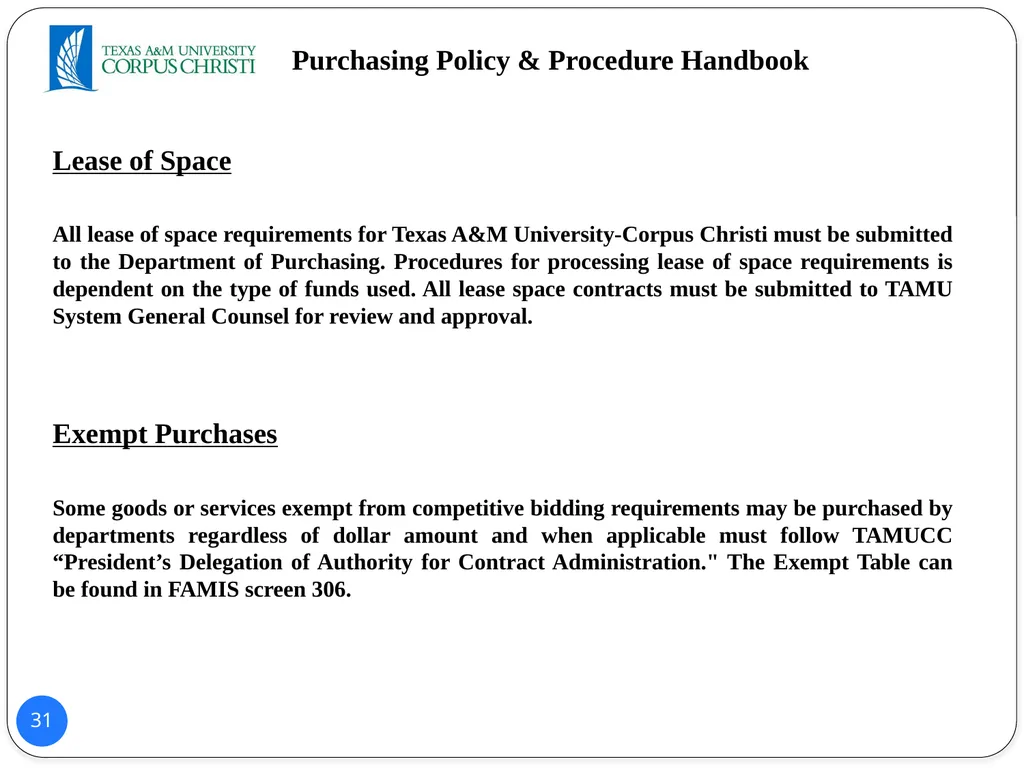
Lease of Space
All lease of space requirements for Texas A&M University-Corpus Christi must be submitted to the Department of Purchasing. Procedures for processing lease of space requirements is dependent on the type of funds used. All lease space contracts must be submitted to TAMU System General Counsel for review and approval.
Exempt Purchases
Some goods or services exempt from competitive bidding requirements may be purchased by departments regardless of dollar amount and when applicable must follow TAMUCC “President’s Delegation of Authority for Contract Administration." The Exempt Table can be found in FAMIS screen 306. Purchasing Policy & Procedure Handbook 31<br>
All lease of space requirements for Texas A&M University-Corpus Christi must be submitted to the Department of Purchasing. Procedures for processing lease of space requirements is dependent on the type of funds used. All lease space contracts must be submitted to TAMU System General Counsel for review and approval.
Exempt Purchases
Some goods or services exempt from competitive bidding requirements may be purchased by departments regardless of dollar amount and when applicable must follow TAMUCC “President’s Delegation of Authority for Contract Administration." The Exempt Table can be found in FAMIS screen 306. Purchasing Policy & Procedure Handbook 31<br>
32
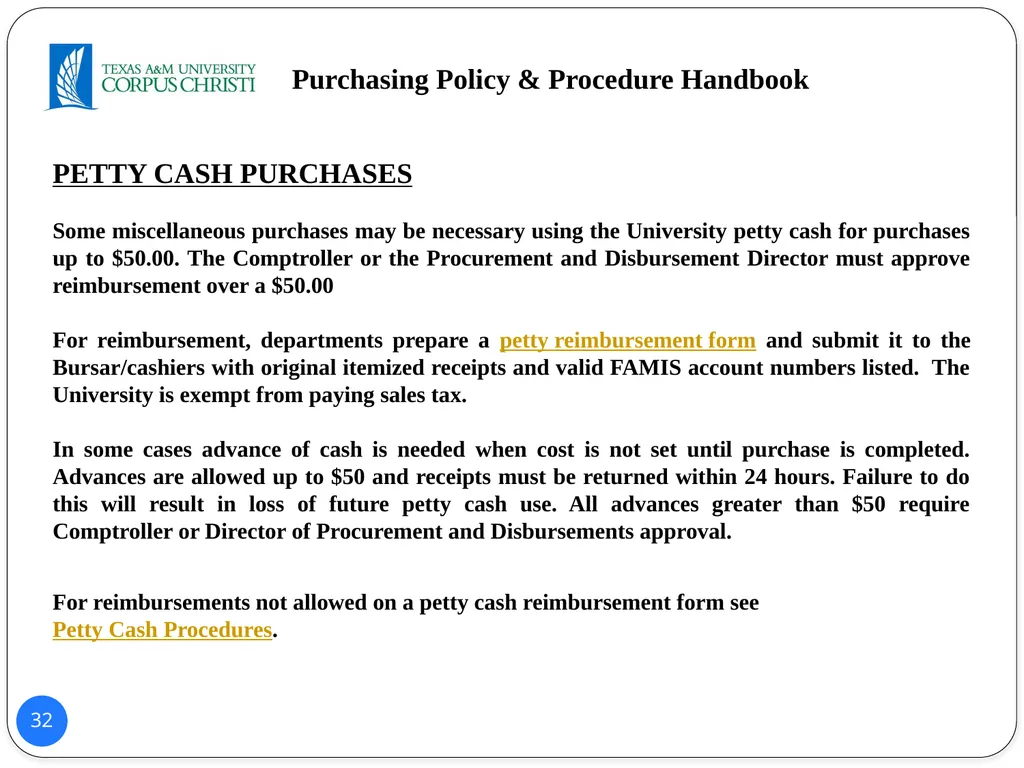
PETTY CASH PURCHASES
Some miscellaneous purchases may be necessary using the University petty cash for purchases up to $50.00. The Comptroller or the Procurement and Disbursement Director must approve reimbursement over a $50.00
For reimbursement, departments prepare a petty reimbursement form and submit it to the Bursar/cashiers with original itemized receipts and valid FAMIS account numbers listed. The University is exempt from paying sales tax.
In some cases advance of cash is needed when cost is not set until purchase is completed. Advances are allowed up to $50 and receipts must be returned within 24 hours. Failure to do this will result in loss of future petty cash use. All advances greater than $50 require Comptroller or Director of Procurement and Disbursements approval.
For reimbursements not allowed on a petty cash reimbursement form see Petty Cash Procedures. Purchasing Policy & Procedure Handbook 32<br>
Some miscellaneous purchases may be necessary using the University petty cash for purchases up to $50.00. The Comptroller or the Procurement and Disbursement Director must approve reimbursement over a $50.00
For reimbursement, departments prepare a petty reimbursement form and submit it to the Bursar/cashiers with original itemized receipts and valid FAMIS account numbers listed. The University is exempt from paying sales tax.
In some cases advance of cash is needed when cost is not set until purchase is completed. Advances are allowed up to $50 and receipts must be returned within 24 hours. Failure to do this will result in loss of future petty cash use. All advances greater than $50 require Comptroller or Director of Procurement and Disbursements approval.
For reimbursements not allowed on a petty cash reimbursement form see Petty Cash Procedures. Purchasing Policy & Procedure Handbook 32<br>
33
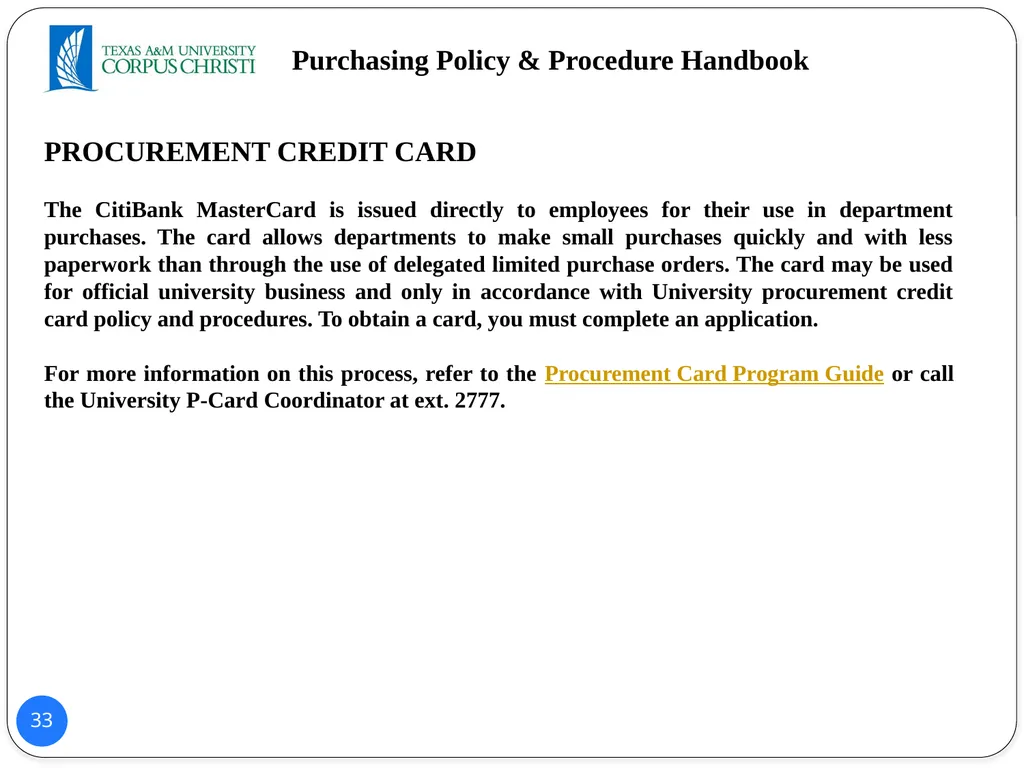
PROCUREMENT CREDIT CARD
The CitiBank MasterCard is issued directly to employees for their use in department purchases. The card allows departments to make small purchases quickly and with less paperwork than through the use of delegated limited purchase orders. The card may be used for official university business and only in accordance with University procurement credit card policy and procedures. To obtain a card, you must complete an application.
For more information on this process, refer to the Procurement Card Program Guide or call the University P-Card Coordinator at ext. 2777. Purchasing Policy & Procedure Handbook 33<br>
The CitiBank MasterCard is issued directly to employees for their use in department purchases. The card allows departments to make small purchases quickly and with less paperwork than through the use of delegated limited purchase orders. The card may be used for official university business and only in accordance with University procurement credit card policy and procedures. To obtain a card, you must complete an application.
For more information on this process, refer to the Procurement Card Program Guide or call the University P-Card Coordinator at ext. 2777. Purchasing Policy & Procedure Handbook 33<br>
34
Services Purchasing Policy & Procedure Handbook 34<br>
35
PURCHASE OF SERVICES
The furnishing of skilled or unskilled labor or professional work but does not include professional services covered by the Professional Services Procurement Act, services of an employee of a state agency, consulting services or services by a private consultant as defined by Chapter 454, Acts of the 65th Legislature, Regular Sessions, 1977, and services of public utilities. Rentals are not considered service unless operator is furnished with equipment. Rentals without an operator are handled as any other purchase of equipment.
STATE & LOCAL FUNDS
If the cost is $5,000.00 or less, bids are not required and a limited purchase order may be used. For any purchase of services which exceed $25,000.00 per year these rules require competitive bidding, or justification explaining why the service is needed and why it cannot be obtained competitively from more than one source. A bid/quote must be obtained if the cost exceeds $25,000.00 per year. Purchasing Policy & Procedure Handbook 35<br>
The furnishing of skilled or unskilled labor or professional work but does not include professional services covered by the Professional Services Procurement Act, services of an employee of a state agency, consulting services or services by a private consultant as defined by Chapter 454, Acts of the 65th Legislature, Regular Sessions, 1977, and services of public utilities. Rentals are not considered service unless operator is furnished with equipment. Rentals without an operator are handled as any other purchase of equipment.
STATE & LOCAL FUNDS
If the cost is $5,000.00 or less, bids are not required and a limited purchase order may be used. For any purchase of services which exceed $25,000.00 per year these rules require competitive bidding, or justification explaining why the service is needed and why it cannot be obtained competitively from more than one source. A bid/quote must be obtained if the cost exceeds $25,000.00 per year. Purchasing Policy & Procedure Handbook 35<br>
36
EQUIPMENT MAINTENANCE/SERVICE AGREEMENTS
Requisitions must be submitted to the Procurement and Disbursements Department for maintenance/service agreements when fund orders will exceed $5,000.00 per year
Requisitions must include the following information and attachments:
Period of time for coverage (September 1, XXXX through August 31, XXXX)
Make and/or model number of equipment
Serial number
Location of equipment.
Department contact and phone number.
Copy of vendor's proposed Maintenance Agreement if available. (Do Not Sign). Only the Purchasing Director or designee has authority to execute.
If sole source, complete the "Justification for Sole Source Purchases" form and attach to your requisition. Purchasing Policy & Procedure Handbook 36<br>
Requisitions must be submitted to the Procurement and Disbursements Department for maintenance/service agreements when fund orders will exceed $5,000.00 per year
Requisitions must include the following information and attachments:
Period of time for coverage (September 1, XXXX through August 31, XXXX)
Make and/or model number of equipment
Serial number
Location of equipment.
Department contact and phone number.
Copy of vendor's proposed Maintenance Agreement if available. (Do Not Sign). Only the Purchasing Director or designee has authority to execute.
If sole source, complete the "Justification for Sole Source Purchases" form and attach to your requisition. Purchasing Policy & Procedure Handbook 36<br>
37
PRINTING AND COPYING
Printing is a means of word processing or graphic reproduction of paper documents using a printing press and copying does not reasonably require a quick copy center or high volume duplication equipment or services. If the estimated price does not exceed $5,000.00, departments are not required to purchase the copy or print job using a competitive process. The University Print Shop is exempt from this rule and can be used without bidding.
PRINTING AND COPYING OVER $25,000.00
If the estimated price exceeds $25,000.00, job must be bid out or use the following options:
University Print Shop
Texas Department of Criminal Justice (TDCJ) Print Shops: address and phone number of the TCI print shops are listed on the CCG website: http://www.tdcj.state.tx.us/documents/M&L_Overview.pdf
TXMAS Contracts Purchasing Policy & Procedure Handbook 37<br>
Printing is a means of word processing or graphic reproduction of paper documents using a printing press and copying does not reasonably require a quick copy center or high volume duplication equipment or services. If the estimated price does not exceed $5,000.00, departments are not required to purchase the copy or print job using a competitive process. The University Print Shop is exempt from this rule and can be used without bidding.
PRINTING AND COPYING OVER $25,000.00
If the estimated price exceeds $25,000.00, job must be bid out or use the following options:
University Print Shop
Texas Department of Criminal Justice (TDCJ) Print Shops: address and phone number of the TCI print shops are listed on the CCG website: http://www.tdcj.state.tx.us/documents/M&L_Overview.pdf
TXMAS Contracts Purchasing Policy & Procedure Handbook 37<br>
38
INTERAGENCY AGREEMENTS/CONTRACTS
State agencies are authorized by the Texas Interagency Cooperation Act to enter into and perform written contracts with other agencies of the State for furnishing special or technical services. Proposals for interagency contracts will be approved by the Director of Contracts or authorized designee, prior to expenditure of funds related to the contract. Written contracts are required only when the total amount of the transaction is expected to exceed $50,000. In situations where the amount of the transaction is $50,000 or less, the agencies may use an informal letter of agreement instead of a contract. No contract or informal letter of agreement will be required for transactions totaling $5,000 or less. Must follow Prompt Payment Act.
INTRA-AGENCY (INTRA-SYSTEM) PURCHASES
An intra-agency purchase occurs when a state agency purchases from another state agency within its own system. Intra-agency purchases usually are made between agencies in a university system that has several branches or locations. Intra-agency purchases may be for any kind of good or service. Intra-agency payments are frequently deposited into a local fund or account by the receiving agency. Purchasing Policy & Procedure Handbook 38<br>
State agencies are authorized by the Texas Interagency Cooperation Act to enter into and perform written contracts with other agencies of the State for furnishing special or technical services. Proposals for interagency contracts will be approved by the Director of Contracts or authorized designee, prior to expenditure of funds related to the contract. Written contracts are required only when the total amount of the transaction is expected to exceed $50,000. In situations where the amount of the transaction is $50,000 or less, the agencies may use an informal letter of agreement instead of a contract. No contract or informal letter of agreement will be required for transactions totaling $5,000 or less. Must follow Prompt Payment Act.
INTRA-AGENCY (INTRA-SYSTEM) PURCHASES
An intra-agency purchase occurs when a state agency purchases from another state agency within its own system. Intra-agency purchases usually are made between agencies in a university system that has several branches or locations. Intra-agency purchases may be for any kind of good or service. Intra-agency payments are frequently deposited into a local fund or account by the receiving agency. Purchasing Policy & Procedure Handbook 38<br>
39
EMPLOYEE VS. INDEPENDENT CONTRACTOR DETERMINATION
An employee is an individual who performs a service for the university and is working under the direction and control of the university/agency or its employees. Direction and control can be implied to exist when the employer has the right to control both the results as well as the means and methods of the worker. (IRS Treasury Regulation 31.3121(d)-1(c)). It is unnecessary for the employer to actually direct or control the manner which the services are performed; it is sufficient if the employer has the right to do so. The Internal Revenue code provides that employment taxes are imposed on wages received by employees.
An independent contractor is an individual engaged by the university to perform a specific function or task and who is free to perform this function or task completely at the individual's own discretion with regard to means and methods. No taxes are required to be withheld or paid on compensation disbursed. (IRS Treasury Regulation 31.3401(c)-1(b)). The existence of an agreement or contract helps support the independent contractor position. This document should be fairly specific in what is to be provided and amount or lack of control the university/agency has over the individual. Purchasing Policy & Procedure Handbook 39<br>
An employee is an individual who performs a service for the university and is working under the direction and control of the university/agency or its employees. Direction and control can be implied to exist when the employer has the right to control both the results as well as the means and methods of the worker. (IRS Treasury Regulation 31.3121(d)-1(c)). It is unnecessary for the employer to actually direct or control the manner which the services are performed; it is sufficient if the employer has the right to do so. The Internal Revenue code provides that employment taxes are imposed on wages received by employees.
An independent contractor is an individual engaged by the university to perform a specific function or task and who is free to perform this function or task completely at the individual's own discretion with regard to means and methods. No taxes are required to be withheld or paid on compensation disbursed. (IRS Treasury Regulation 31.3401(c)-1(b)). The existence of an agreement or contract helps support the independent contractor position. This document should be fairly specific in what is to be provided and amount or lack of control the university/agency has over the individual. Purchasing Policy & Procedure Handbook 39<br>
40
Factors Distinguishing Employee Status from Independent Contractor Status
Specific factors that are used by the IRS in determining whether an individual is an employee or an independent contractor are listed below. This listing is commonly referred to as the "20 factors" test. These Twenty factors have been identified by the courts in indicating whether sufficient control is present to establish an employer-employee relationship under the common-law rules. The importance of each factor varies depending on the occupation, the factual context in which the services are performed, and even the interpretation of the particular IRS examiner. As expected, the IRS leans toward classifying individuals as employees. Purchasing Policy & Procedure Handbook Complete a form entitled "Twenty-Factor for Employer-Employee Relationships VS Independent Contractor." Contracts under $5,000 do not require written contracts, but must have a twenty-factor test submitted for payment and signed by the department head or delegated personnel. 40<br>
Specific factors that are used by the IRS in determining whether an individual is an employee or an independent contractor are listed below. This listing is commonly referred to as the "20 factors" test. These Twenty factors have been identified by the courts in indicating whether sufficient control is present to establish an employer-employee relationship under the common-law rules. The importance of each factor varies depending on the occupation, the factual context in which the services are performed, and even the interpretation of the particular IRS examiner. As expected, the IRS leans toward classifying individuals as employees. Purchasing Policy & Procedure Handbook Complete a form entitled "Twenty-Factor for Employer-Employee Relationships VS Independent Contractor." Contracts under $5,000 do not require written contracts, but must have a twenty-factor test submitted for payment and signed by the department head or delegated personnel. 40<br>
41
For contracts/agreements that do not involve monetary value, use the “Non-Purchase Order Contract/Agreement Approval Form.” Note this form is not required if contract is submitted on requisition or limited order.
The twenty-factor checklist form will be reviewed by the Contracts Director or Contracts Manager as to whether payment is approved as an independent contractor/consultant when over $5,000.00 and signed by the Department Head or his designee when under $5,000.00. If rejected due to checklist determination being an employee instead of an independent contractor the department will be required to submit a personal transaction record to the Human Resources to process as an employee. Purchasing Policy & Procedure Handbook 41<br>
The twenty-factor checklist form will be reviewed by the Contracts Director or Contracts Manager as to whether payment is approved as an independent contractor/consultant when over $5,000.00 and signed by the Department Head or his designee when under $5,000.00. If rejected due to checklist determination being an employee instead of an independent contractor the department will be required to submit a personal transaction record to the Human Resources to process as an employee. Purchasing Policy & Procedure Handbook 41<br>
42
USE OF PRIVATE CONSULTANTS
Consulting services is defined as the service of studying or advising a state agency under a contract that does not involve the traditional relationship of employer and employee. The term does not include service connected with the routine work necessary to the functioning of a component’s programs. The key words are studying and advising, rather than performing. A private consultant may be employed only if: (1) there is a substantial need for the consulting services; and (2) the University cannot adequately perform the consulting services with its own personnel or through a contract with another state agency. Consulting services will be procured in accordance with the best value standards in Texas Education Code, Section 51.93345
Funds may not be used, regardless of source, to enter into a consultant contract with any individual who is currently employed by an A&M System Member or who has been employed by an A&M System Member within the past 12 months, they must go through payroll. Purchasing Policy & Procedure Handbook 42<br>
Consulting services is defined as the service of studying or advising a state agency under a contract that does not involve the traditional relationship of employer and employee. The term does not include service connected with the routine work necessary to the functioning of a component’s programs. The key words are studying and advising, rather than performing. A private consultant may be employed only if: (1) there is a substantial need for the consulting services; and (2) the University cannot adequately perform the consulting services with its own personnel or through a contract with another state agency. Consulting services will be procured in accordance with the best value standards in Texas Education Code, Section 51.93345
Funds may not be used, regardless of source, to enter into a consultant contract with any individual who is currently employed by an A&M System Member or who has been employed by an A&M System Member within the past 12 months, they must go through payroll. Purchasing Policy & Procedure Handbook 42<br>
43
DEFINITION
Professional Services are those services directly related to the professional practices as defined by the Professional Services Procurement Act, (Government Code, Section 2254.002). These include services within the scope of the practices of: accounting, architecture, optometry, medicine, land surveying, and professional engineering. Services provided by professionals outside the scope of their profession, e.g. management consulting services provided by accounting firms, are not considered professional services for the purposes of this document. Purchasing Policy & Procedure Handbook 43<br>
Professional Services are those services directly related to the professional practices as defined by the Professional Services Procurement Act, (Government Code, Section 2254.002). These include services within the scope of the practices of: accounting, architecture, optometry, medicine, land surveying, and professional engineering. Services provided by professionals outside the scope of their profession, e.g. management consulting services provided by accounting firms, are not considered professional services for the purposes of this document. Purchasing Policy & Procedure Handbook 43<br>
44
Guest Speaker/Lecturer Services
For the purchase of services from a sole source provider, the department shall book a guest speaker/lecturer at the agreed upon speaker fee, travel allowance and expenses. All travel costs are to be considered part of the service and must be entered as a separate line in the purchasing module. The department must submit to Purchasing a requisition describing the services to be provided, the date of the meeting/seminar, and the travel expense allowance.
For the purchase of services that may be provided by more than one source (competitive bid), the department will submit to the purchasing department a requisition describing the service to be provided, date of meeting/seminar, and travel allowance and expenses. (Note: pianist, entertainers, performers, theaters, and one time guest speakers are exempt from the bidding process.) All travel costs are to be considered as part of the service and must be entered as a separate line item. A list of suggested sources should be included. Purchasing will obtain bids and issue the purchase order. Purchasing Policy & Procedure Handbook 44<br>
For the purchase of services from a sole source provider, the department shall book a guest speaker/lecturer at the agreed upon speaker fee, travel allowance and expenses. All travel costs are to be considered part of the service and must be entered as a separate line in the purchasing module. The department must submit to Purchasing a requisition describing the services to be provided, the date of the meeting/seminar, and the travel expense allowance.
For the purchase of services that may be provided by more than one source (competitive bid), the department will submit to the purchasing department a requisition describing the service to be provided, date of meeting/seminar, and travel allowance and expenses. (Note: pianist, entertainers, performers, theaters, and one time guest speakers are exempt from the bidding process.) All travel costs are to be considered as part of the service and must be entered as a separate line item. A list of suggested sources should be included. Purchasing will obtain bids and issue the purchase order. Purchasing Policy & Procedure Handbook 44<br>
45
Advertising/Public Relations
For the purchase of services from a sole source provider, the department is to place the ad at an agreed upon cost. All requisitions must be approved by Marketing and Communications. The department will submit to the Purchasing Department a requisition describing services to be provided, date of advertisement and copy of the ad. The department will submit a sole source justification and any documentation that indicates the agreed upon cost of the service, person contacted and all terms and conditions. Purchasing will check for compliance and process the order.
For the purchase of services that may be provided by more than one source (competitive bid), the department will submit to the purchasing department a requisition describing the service to be provided. All travel costs are to be considered as part of the service. Include list of suggested sources. Purchasing will obtain bids and issue the purchase order. Purchasing Policy & Procedure Handbook 45<br>
For the purchase of services from a sole source provider, the department is to place the ad at an agreed upon cost. All requisitions must be approved by Marketing and Communications. The department will submit to the Purchasing Department a requisition describing services to be provided, date of advertisement and copy of the ad. The department will submit a sole source justification and any documentation that indicates the agreed upon cost of the service, person contacted and all terms and conditions. Purchasing will check for compliance and process the order.
For the purchase of services that may be provided by more than one source (competitive bid), the department will submit to the purchasing department a requisition describing the service to be provided. All travel costs are to be considered as part of the service. Include list of suggested sources. Purchasing will obtain bids and issue the purchase order. Purchasing Policy & Procedure Handbook 45<br>
46
Preferences
1. Texas resident bidders.
(a.) A Texas resident bidder shall be given preference over a nonresident bidder when the cost, and quality of the goods or services are equal.
(b.) The university may award a contract to a nonresident bidder only if its bid is lower than the lowest bid submitted by a responsible Texas resident bidder
2. Texas and United States products.
(a.) Supplies, materials, or equipment produced in Texas
(b.) Agricultural products grown in Texas
3. Products of persons with mental or physical disabilities.
4. Recycled, remanufactured or environmentally sensitive products.
5. Energy efficient products
6. Rubberized asphalt paving material.
7. Recycled motor oil and lubricants. Purchasing Policy & Procedure Handbook 46<br>
1. Texas resident bidders.
(a.) A Texas resident bidder shall be given preference over a nonresident bidder when the cost, and quality of the goods or services are equal.
(b.) The university may award a contract to a nonresident bidder only if its bid is lower than the lowest bid submitted by a responsible Texas resident bidder
2. Texas and United States products.
(a.) Supplies, materials, or equipment produced in Texas
(b.) Agricultural products grown in Texas
3. Products of persons with mental or physical disabilities.
4. Recycled, remanufactured or environmentally sensitive products.
5. Energy efficient products
6. Rubberized asphalt paving material.
7. Recycled motor oil and lubricants. Purchasing Policy & Procedure Handbook 46<br>
47
Vendor Performance Checklist
Certain information regarding vendor’s character must be verified. Purchasers must check the following information prior to awarding a contract to a vendor:
Debarred Vendor List – Purchasers shall not award contracts to vendors who have been barred from participating in state contracting opportunities. You can view a list of barred vendors on TPASS’ website at:
http://www.window.state.tx.us/procurement/prog/vendor_performance/debarred/
Comptroller Tax Hold – Purchasers must check a vendor’s tax status on the Comptroller’s website at https://ourcpa.cpa.state.tx.us/coa/Index.html. If a vendor is on tax hold, you should call the vendor and ask them to resolve their account with the Comptroller of Public Accounts. You are not prohibited from issuing contracts based on a vendor’s tax status. (Only applies to procurement card purchases over $150.) Purchasing Policy & Procedure Handbook 47<br>
Certain information regarding vendor’s character must be verified. Purchasers must check the following information prior to awarding a contract to a vendor:
Debarred Vendor List – Purchasers shall not award contracts to vendors who have been barred from participating in state contracting opportunities. You can view a list of barred vendors on TPASS’ website at:
http://www.window.state.tx.us/procurement/prog/vendor_performance/debarred/
Comptroller Tax Hold – Purchasers must check a vendor’s tax status on the Comptroller’s website at https://ourcpa.cpa.state.tx.us/coa/Index.html. If a vendor is on tax hold, you should call the vendor and ask them to resolve their account with the Comptroller of Public Accounts. You are not prohibited from issuing contracts based on a vendor’s tax status. (Only applies to procurement card purchases over $150.) Purchasing Policy & Procedure Handbook 47<br>
48
Purchasing Policy & Procedure Handbook Invoicing 48<br>
49
Prompt Payment Law
The Comptroller’s office automatically computes and pay interest owed to vendors for late payments processed through the Uniform Statewide Accounting System (USAS) that are covered by the prompt payment law. The Prompt Payment Law now requires the Comptroller’s office to pay that interest automatically at the same time the principal is paid.
We have 30 days from the latest of the following three dates to pay:
The day the agency received the goods, or
The day the vendor completed performing its services for the agency, or
The day the agency received the invoice for goods and services Purchasing Policy & Procedure Handbook 49<br>
The Comptroller’s office automatically computes and pay interest owed to vendors for late payments processed through the Uniform Statewide Accounting System (USAS) that are covered by the prompt payment law. The Prompt Payment Law now requires the Comptroller’s office to pay that interest automatically at the same time the principal is paid.
We have 30 days from the latest of the following three dates to pay:
The day the agency received the goods, or
The day the vendor completed performing its services for the agency, or
The day the agency received the invoice for goods and services Purchasing Policy & Procedure Handbook 49<br>
50
Interest on overdue payment:
(1) A payment begins to accrue interest on the date the payment is overdue.
(2) An overdue payment bears interest. The interest calculation is one percentage point higher than the prime rate published in the Wall Street Journal on the first business day of July.
Early Payment Discounts
An early payment discount (also referred to as a cash discount) is a discount offered to the purchaser if the payment is made within a specified period. Commission Rule 1 TAC 113.6(a)(11) states: "Discounts will not be used in determining the low bid. All cash discounts offered will be taken if earned".
This rule extends to all types of purchasing including term contract, open market, and delegated purchases. The Texas Procurement and Support Services (TPASS) urges all agencies to pay invoices promptly and earn all discounts available. Purchasing Policy & Procedure Handbook 50<br>
(1) A payment begins to accrue interest on the date the payment is overdue.
(2) An overdue payment bears interest. The interest calculation is one percentage point higher than the prime rate published in the Wall Street Journal on the first business day of July.
Early Payment Discounts
An early payment discount (also referred to as a cash discount) is a discount offered to the purchaser if the payment is made within a specified period. Commission Rule 1 TAC 113.6(a)(11) states: "Discounts will not be used in determining the low bid. All cash discounts offered will be taken if earned".
This rule extends to all types of purchasing including term contract, open market, and delegated purchases. The Texas Procurement and Support Services (TPASS) urges all agencies to pay invoices promptly and earn all discounts available. Purchasing Policy & Procedure Handbook 50<br>
51
Excess Obligations Prohibited
The General Appropriation Bill, approved each biennium by the Texas Legislature, contains the following provision:
No department or agency specified in this Act shall incur an obligation in excess of the amounts appropriated to it for the respective objects or purposes named. As a specific exemption to this provision the TPASS may determine that a proposed installment purchase arrangement is cost effective and certify this finding in response to an agency request. Such a finding may be made for obligations incurred for the purchase or lease of automated information system equipment only if such department or agency has filed with the Department of Information Resources (DIR) a long-range automated information system plan and such plan has been approved by DIR.
In the event this provision is violated, the Comptroller shall deduct an amount or amounts equivalent to such over-obligation from the salary or other compensation due the responsible disbursing or requisitioning officer or employee, and apply the amount to the payment of the obligation. This provision is specified pursuant to Section 10, Article XVI, of the Constitution of Texas. Purchasing Policy & Procedure Handbook 51<br>
The General Appropriation Bill, approved each biennium by the Texas Legislature, contains the following provision:
No department or agency specified in this Act shall incur an obligation in excess of the amounts appropriated to it for the respective objects or purposes named. As a specific exemption to this provision the TPASS may determine that a proposed installment purchase arrangement is cost effective and certify this finding in response to an agency request. Such a finding may be made for obligations incurred for the purchase or lease of automated information system equipment only if such department or agency has filed with the Department of Information Resources (DIR) a long-range automated information system plan and such plan has been approved by DIR.
In the event this provision is violated, the Comptroller shall deduct an amount or amounts equivalent to such over-obligation from the salary or other compensation due the responsible disbursing or requisitioning officer or employee, and apply the amount to the payment of the obligation. This provision is specified pursuant to Section 10, Article XVI, of the Constitution of Texas. Purchasing Policy & Procedure Handbook 51<br>
52
Excess obligations apply to those purchases in which the purchase or service extends beyond a biennium. Any equipment lease, lease with option to buy, lease purchase, installment purchase, or any other type of purchase which incurs obligations beyond the current appropriations act is strictly prohibited by the Texas Constitution, unless the obligation is expressly contingent upon continued legislative appropriations.
Examples:
Lease with option to buy
Lease purchase
Installment purchase Purchasing Policy & Procedure Handbook 52<br>
Examples:
Lease with option to buy
Lease purchase
Installment purchase Purchasing Policy & Procedure Handbook 52<br>
53
Bond Review Board
All lease or installment purchases with a principal value of $250,000 or a term of more than five years must have prior written approval from the Bond Review Board submitted with the requisition. Excess obligation documentation procedures are still required if the purchase is not being financed through the TPFA's master lease program. Purchasing Policy & Procedure Handbook 53<br>
All lease or installment purchases with a principal value of $250,000 or a term of more than five years must have prior written approval from the Bond Review Board submitted with the requisition. Excess obligation documentation procedures are still required if the purchase is not being financed through the TPFA's master lease program. Purchasing Policy & Procedure Handbook 53<br>
54
Purchasing Policy & Procedure Handbook Central Receiving 54<br>
55
Purchasing Policy & Procedure Handbook Central Receiving is responsible for receipt and redistribution of in-bound freight and parcels to Texas A&M University-Corpus Christi. The purpose of Central Receiving Warehouse is to provide a central point of delivery for goods purchased by the University to facilitate the efficient delivery by carriers. Central Receiving personnel will inspect and deliver all freight and parcels to specified campus addresses and will usually do so within 1-3 days of arriving at the Central Receiving Warehouse.
Receiving Shipment Procedures
Guidelines for Returning Merchandise
Tracking Shipments 55<br>
Receiving Shipment Procedures
Guidelines for Returning Merchandise
Tracking Shipments 55<br>
56
Central Receiving is not responsible for damages or loss incurred during package shipment, but will assist the sender in filing a claim with the private carrier. Purchasing Policy & Procedure Handbook For more information see
Tracking Shipments 56<br>
Tracking Shipments 56<br>
57
Retention Records Storage
University records can be stored at Central Receiving.
Departments must box and label records.
Departments must box and label records.
No boxes will be accepted without proper labeling.
Records Retention label can be found on the Purchasing website, Central Receiving under forms.
Department, description of contents, point of contact and extension, retention period, and disposal date.
Each box should have a records retention label taped to it for identification purposes with a Records Storage Manifest provided to Central Receiving for recordkeeping. A duplicate copy of the manifest should be placed inside the box(es). Purchasing Policy & Procedure Handbook 57<br>
University records can be stored at Central Receiving.
Departments must box and label records.
Departments must box and label records.
No boxes will be accepted without proper labeling.
Records Retention label can be found on the Purchasing website, Central Receiving under forms.
Department, description of contents, point of contact and extension, retention period, and disposal date.
Each box should have a records retention label taped to it for identification purposes with a Records Storage Manifest provided to Central Receiving for recordkeeping. A duplicate copy of the manifest should be placed inside the box(es). Purchasing Policy & Procedure Handbook 57<br>
58
To transfer records from your department to Central Receiving:
submit a Records Storage Manifest
send an email to Central Receiving Warehouse Supervisor or Warehouse Operations Specialist with quantity, location, point of contact.
When disposal date approaches:
Central Receiving warehouse staff will notify department.
Department must complete Records Destruction Form.
Submit form to Chris Shupala, Records Administrator, for approval.
Records Destruction Form can be found on the Purchasing website, Central Receiving under forms.
When approved, send form to Warehouse Supervisor
Central Receiving warehouse staff will provide department with an estimate of shredding charges and will request an account number. Upon destruction of records, department will receive a copy of the Records Destruction Form with warehouse supervisor’s signature of completion. Purchasing Policy & Procedure Handbook 58<br>
submit a Records Storage Manifest
send an email to Central Receiving Warehouse Supervisor or Warehouse Operations Specialist with quantity, location, point of contact.
When disposal date approaches:
Central Receiving warehouse staff will notify department.
Department must complete Records Destruction Form.
Submit form to Chris Shupala, Records Administrator, for approval.
Records Destruction Form can be found on the Purchasing website, Central Receiving under forms.
When approved, send form to Warehouse Supervisor
Central Receiving warehouse staff will provide department with an estimate of shredding charges and will request an account number. Upon destruction of records, department will receive a copy of the Records Destruction Form with warehouse supervisor’s signature of completion. Purchasing Policy & Procedure Handbook 58<br>
59
Surplus and Salvage Property
Items of surplus/salvage that are not transferred between departments must be transferred to the Central Receiving Warehouse for surplus.
TAMU-CC will publicize via the Texas Higher Education Coordinating Board website all instructional material and data processing equipment designated as surplus. The posting will remain on the web site for 10 days.
Items that are not transferred to another state agency will be included in publicized Surplus Sealed Bid Sale or in The Public Surplus Group website. Central Receiving is responsible for posting legal notice, preparing bid listing and notification to high bidders. Legal notice in the local newspaper will be posted the weekend prior to the sale.
All items will be sold as is and the individual having high bid is responsible for removing items from campus. Purchasing Policy & Procedure Handbook 59<br>
Items of surplus/salvage that are not transferred between departments must be transferred to the Central Receiving Warehouse for surplus.
TAMU-CC will publicize via the Texas Higher Education Coordinating Board website all instructional material and data processing equipment designated as surplus. The posting will remain on the web site for 10 days.
Items that are not transferred to another state agency will be included in publicized Surplus Sealed Bid Sale or in The Public Surplus Group website. Central Receiving is responsible for posting legal notice, preparing bid listing and notification to high bidders. Legal notice in the local newspaper will be posted the weekend prior to the sale.
All items will be sold as is and the individual having high bid is responsible for removing items from campus. Purchasing Policy & Procedure Handbook 59<br>
60
Surplus items related to Capitalized and Controlled Property on Department Inventory will be submitted to Central Receiving.
Designation of Controlled and Non-Controlled Items
Controlled surplus items include, but not limited to, computers, fax machines, cameras, projectors, golf carts or any items that are on the Department’s inventory. Note: These items have an assigned fixed asset tag applied on them.
Non-Controlled surplus items include, but not limited to, desks, filing cabinets, chairs, printers or any items that are not on the Department’s inventory. Note: These items do not have an assigned fixed asset tag applied on them. Purchasing Policy & Procedure Handbook 60<br>
Designation of Controlled and Non-Controlled Items
Controlled surplus items include, but not limited to, computers, fax machines, cameras, projectors, golf carts or any items that are on the Department’s inventory. Note: These items have an assigned fixed asset tag applied on them.
Non-Controlled surplus items include, but not limited to, desks, filing cabinets, chairs, printers or any items that are not on the Department’s inventory. Note: These items do not have an assigned fixed asset tag applied on them. Purchasing Policy & Procedure Handbook 60<br>
61
Disposing Item of No Value
If the surplus item has no value or is in extremely poor condition, take a picture, scan it, and send to the Warehouse Supervisor.
The Warehouse Supervisor will make the determination as to how to dispose of the item.
Scanned photos of controlled and non-controlled surplus items destroyed/disposed will be kept by the Warehouse Supervisor for recordkeeping.
We cannot accept items that cannot be resold or utilized again by another department. Purchasing Policy & Procedure Handbook 61<br>
If the surplus item has no value or is in extremely poor condition, take a picture, scan it, and send to the Warehouse Supervisor.
The Warehouse Supervisor will make the determination as to how to dispose of the item.
Scanned photos of controlled and non-controlled surplus items destroyed/disposed will be kept by the Warehouse Supervisor for recordkeeping.
We cannot accept items that cannot be resold or utilized again by another department. Purchasing Policy & Procedure Handbook 61<br>
62
Disposing Item of Value
1. Accountable Property Officer for the department must process an electronic Transfer Departmental Property (TDP) in Canopy. The department to surplus transfer is created to transfer controlled and non-controlled property to Central Receiving. Accountable Property Officer must clearly mark every item listed as a surplus item.
2. The Warehouse Supervisor reserves the right to inspect surplus items, especially large requests, prior to turn-in due to space availability and daily receiving operations. Central Receiving will only accept delivery of surplus items during the following hours: Monday thru Friday: 8:30 a.m. – 9:30 a.m. or between 1:00 p.m. to 2:30 p.m.
3. Warehouse Supervisor will use the information provided on either form to process a work order with SSC Service Solutions (SSC) to transport the surplus items to Central Receiving. Purchasing Policy & Procedure Handbook 62<br>
1. Accountable Property Officer for the department must process an electronic Transfer Departmental Property (TDP) in Canopy. The department to surplus transfer is created to transfer controlled and non-controlled property to Central Receiving. Accountable Property Officer must clearly mark every item listed as a surplus item.
2. The Warehouse Supervisor reserves the right to inspect surplus items, especially large requests, prior to turn-in due to space availability and daily receiving operations. Central Receiving will only accept delivery of surplus items during the following hours: Monday thru Friday: 8:30 a.m. – 9:30 a.m. or between 1:00 p.m. to 2:30 p.m.
3. Warehouse Supervisor will use the information provided on either form to process a work order with SSC Service Solutions (SSC) to transport the surplus items to Central Receiving. Purchasing Policy & Procedure Handbook 62<br>
63
Purchasing Policy & Procedure Handbook 4. SSC will use the information on the work order to pick up the identified surplus items. SSC will deliver the surplus items to Central Receiving and unload them at the staging area located inside the Central Receiving Warehouse either at the front or back bays.
5. Deliveries will not be accepted between the hours of 10:00 a.m. and 1:00 p.m. when Central Receiving is receiving incoming daily freights from commercial truck firms (UPS, FedEx, freight carriers, etc.). Deliveries by departments not using SSC should be done before 10:00 a.m. or after 1:00 p.m.
It is highly recommended that SSC be used to transport surplus items to lessen the risk of injury and/or damages.
Surplus property is available for viewing and on first come basis. Contact Central Receiving to schedule time. Forms are available on Central Receiving website. 63<br>
5. Deliveries will not be accepted between the hours of 10:00 a.m. and 1:00 p.m. when Central Receiving is receiving incoming daily freights from commercial truck firms (UPS, FedEx, freight carriers, etc.). Deliveries by departments not using SSC should be done before 10:00 a.m. or after 1:00 p.m.
It is highly recommended that SSC be used to transport surplus items to lessen the risk of injury and/or damages.
Surplus property is available for viewing and on first come basis. Contact Central Receiving to schedule time. Forms are available on Central Receiving website. 63<br>
64
Sanitation of Computers
You are required to certify that all software and data contained on the hard disk drive of any computer (notebook, micro, mini or mainframe) has been irreversibly erased before the computer is transferred to Central Receiving for surplus to prevent the use of an “un-erased” utility to recover software or other data from a hard disk drive and to assure that neither licensed nor confidential information is inadvertently turned-over to unauthorized persons.
All hard drives need to be removed before turning in to Surplus. If you do not have anyone that is qualified, contact IT help desk at 825‐2692 to create a work order to have that done. Purchasing Policy & Procedure Handbook 64<br>
You are required to certify that all software and data contained on the hard disk drive of any computer (notebook, micro, mini or mainframe) has been irreversibly erased before the computer is transferred to Central Receiving for surplus to prevent the use of an “un-erased” utility to recover software or other data from a hard disk drive and to assure that neither licensed nor confidential information is inadvertently turned-over to unauthorized persons.
All hard drives need to be removed before turning in to Surplus. If you do not have anyone that is qualified, contact IT help desk at 825‐2692 to create a work order to have that done. Purchasing Policy & Procedure Handbook 64<br>
65
65 Thank you<br>