
policy debate introduction Getting started in



Description: policy debate introduction Getting started in policy debate; an introduction by Rich Edwards, Baylor University What Is policy debate? National, Year-Long Topic: Policy debaters debate the topic as selected by the National Federation of
Related Topics
Download Presentation
"policy debate introduction Getting started in" is the property of its rightful owner. Permission is granted to download and print the materials on this website for personal, non-commercial use only, and to display it on your personal computer provided you do not modify the materials and that you retain all copyright notices contained in the materials. By downloading content from our website, you accept the terms of this agreement.
Presentation Transcript
slide1. policy debate introduction Getting started in policy debate; an introduction by Rich Edwards, Baylor University<br>
slide2. What Is policy debate? National, Year-Long Topic: Policy debaters debate the topic as selected by the National Federation of High Schools.
2-Person Teams: You will have a debate partner; you will debate a two-person team from another school.
Affirmative or Negative?: Almost all policy debate is “switch-sides,” meaning you will be affirmative one round, but negative the next.<br>
slide3. What Do We Debate About? 2025-26 Policy Debate Resolution: “Resolved: The United States federal government should significantly increase its exploration and/or development of the Arctic.”
The Affirmative Case must present a ”plan”: Think of the resolution as a umbrella – the affirmative must present and defend a plan that falls under the resolution.
Yes or No to the Plan?: The affirmative says ”yes” to the plan; the negative says “no.”<br>
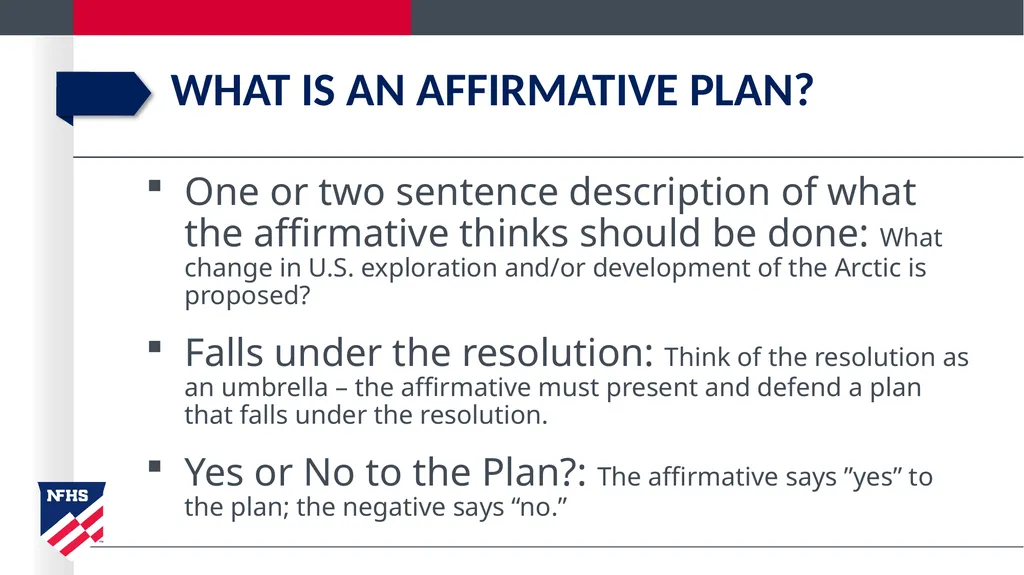
slide4. What Is an affirmative plan? One or two sentence description of what the affirmative thinks should be done: What change in U.S. exploration and/or development of the Arctic is proposed?
Falls under the resolution: Think of the resolution as an umbrella – the affirmative must present and defend a plan that falls under the resolution.
Yes or No to the Plan?: The affirmative says ”yes” to the plan; the negative says “no.”<br>
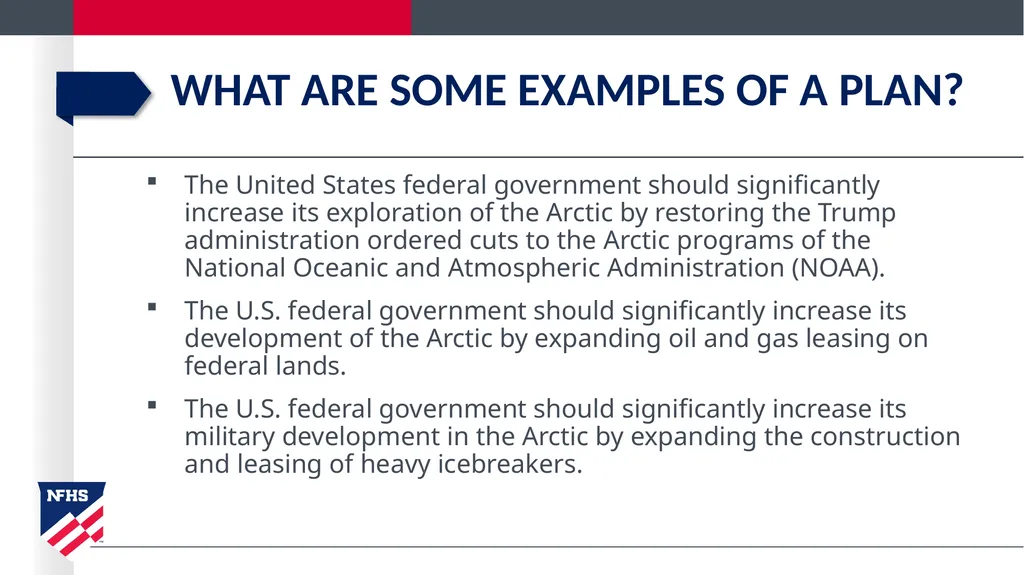
slide5. What Are some examples of a plan? The United States federal government should significantly increase its exploration of the Arctic by restoring the Trump administration ordered cuts to the Arctic programs of the National Oceanic and Atmospheric Administration (NOAA).
The U.S. federal government should significantly increase its development of the Arctic by expanding oil and gas leasing on federal lands.
The U.S. federal government should significantly increase its military development in the Arctic by expanding the construction and leasing of heavy icebreakers.<br>
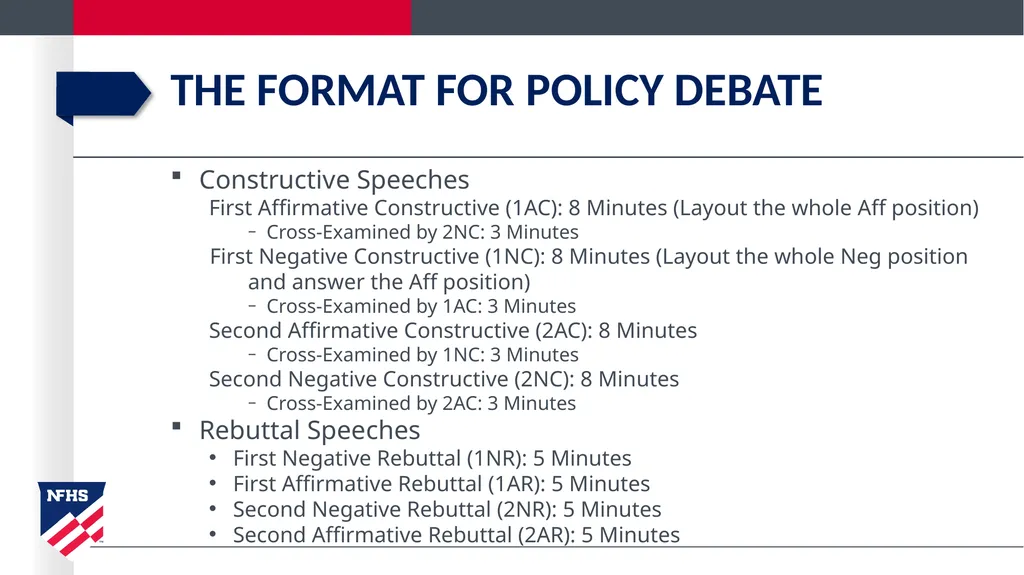
slide6. the format for policy debate Constructive Speeches
First Affirmative Constructive (1AC): 8 Minutes (Layout the whole Aff position)
Cross-Examined by 2NC: 3 Minutes
First Negative Constructive (1NC): 8 Minutes (Layout the whole Neg position and answer the Aff position)
Cross-Examined by 1AC: 3 Minutes
Second Affirmative Constructive (2AC): 8 Minutes
Cross-Examined by 1NC: 3 Minutes
Second Negative Constructive (2NC): 8 Minutes
Cross-Examined by 2AC: 3 Minutes
Rebuttal Speeches
First Negative Rebuttal (1NR): 5 Minutes
First Affirmative Rebuttal (1AR): 5 Minutes
Second Negative Rebuttal (2NR): 5 Minutes
Second Affirmative Rebuttal (2AR): 5 Minutes<br>
slide7. What Are the parts of the AFF case? Plan: This usually comes first in the speech
Harm: What is wrong now, and why is it significantly harmful? This argument must be supported with direct quotations from authoritative evidence.
Inherency: What is the defect or defect in the present system that keeps it from resolving the harm (what law, Supreme Court decision, Executive Order, prevailing attitude, etc.)? Needs direct quotations from authoritative evidence.
Solvency: Why will the plan solve the problem? This too needs to be supported by direct quotations from authoritative evidence.<br>
slide8. What Are the parts of the Neg case? Topicality: Do you wish to argue that the plan is an illegitimate example of the resolution? (optional)
Disadvantage(s): Do you wish to argue that adopting the affirmative plan would create more harm than good? (optional)
Counterplan: Do you wish to propose that there is a better way (other than the resolution) to solve the affirmative harm? Note: There must be a good reason why one shouldn’t just do both the plan and the counterplan.
Answers to the Case: Can you provide answers (supported with evidence) to the harm, inherency, and solvency arguments made by the affirmative?<br>
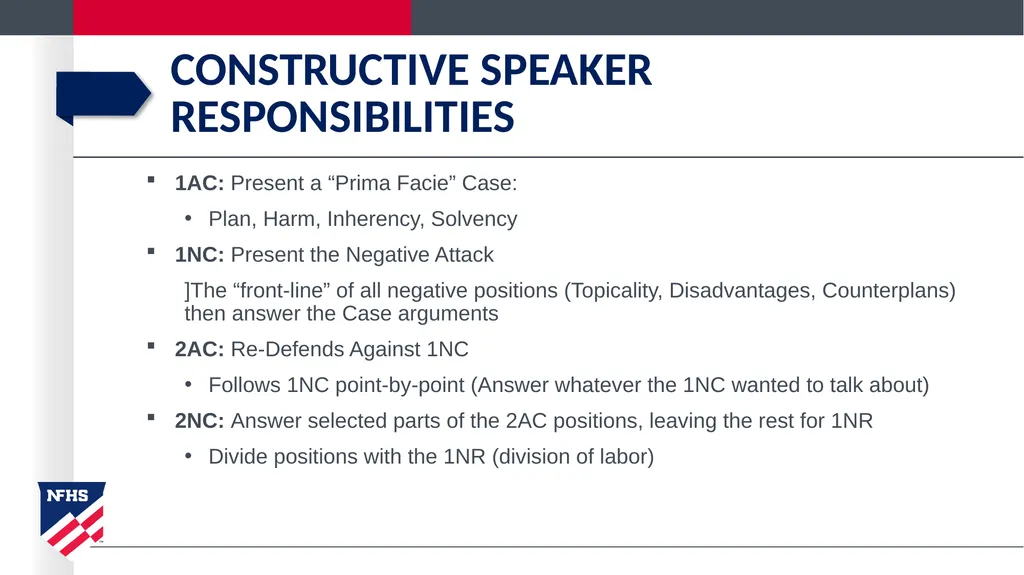
slide9. Constructive speaker responsibilities 1AC: Present a “Prima Facie” Case:
Plan, Harm, Inherency, Solvency
1NC: Present the Negative Attack
]The “front-line” of all negative positions (Topicality, Disadvantages, Counterplans) then answer the Case arguments
2AC: Re-Defends Against 1NC
Follows 1NC point-by-point (Answer whatever the 1NC wanted to talk about)
2NC: Answer selected parts of the 2AC positions, leaving the rest for 1NR
Divide positions with the 1NR (division of labor)<br>
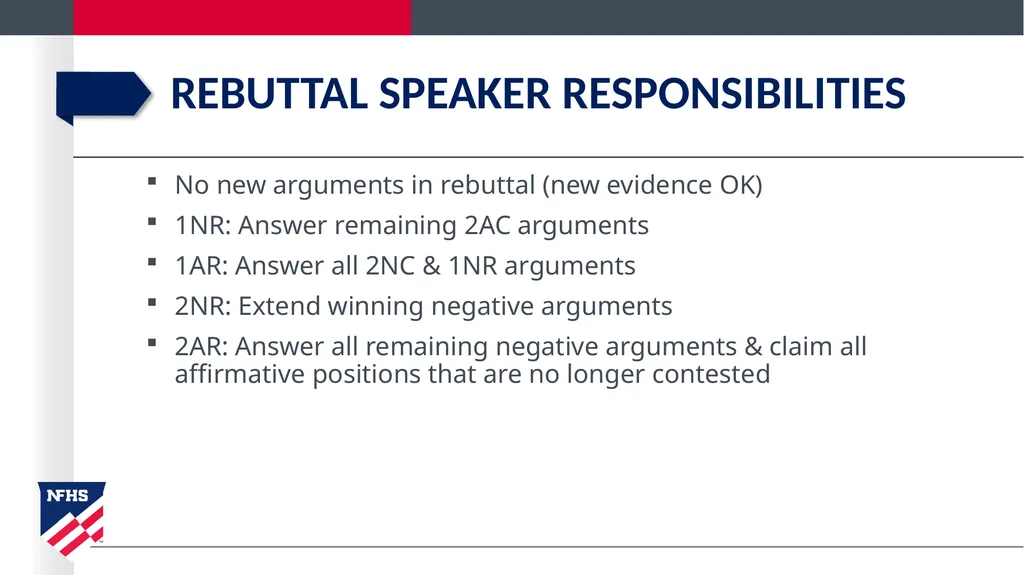
slide10. Rebuttal speaker responsibilities No new arguments in rebuttal (new evidence OK)
1NR: Answer remaining 2AC arguments
1AR: Answer all 2NC & 1NR arguments
2NR: Extend winning negative arguments
2AR: Answer all remaining negative arguments & claim all affirmative positions that are no longer contested<br>
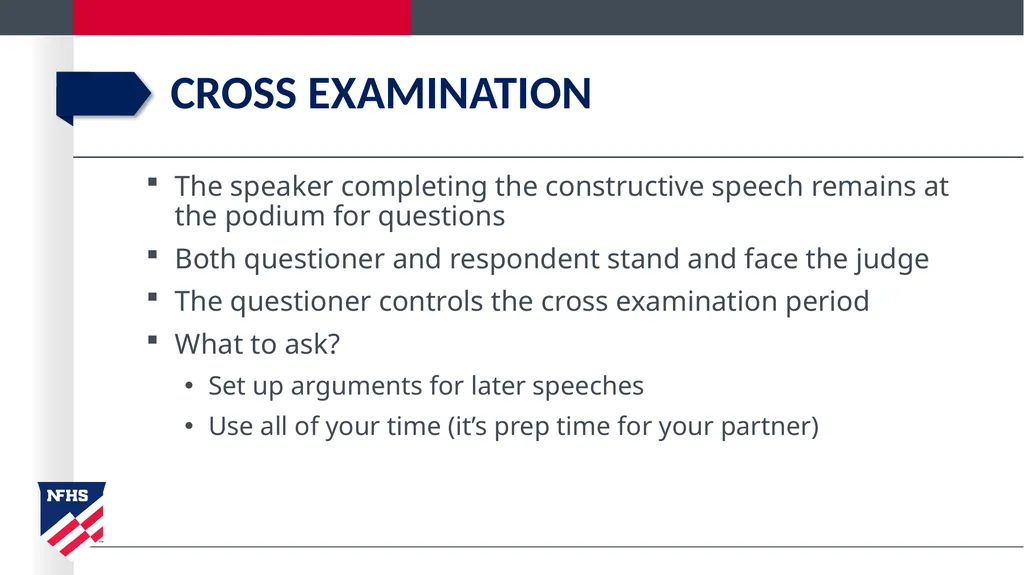
slide11. cross examination The speaker completing the constructive speech remains at the podium for questions
Both questioner and respondent stand and face the judge
The questioner controls the cross examination period
What to ask?
Set up arguments for later speeches
Use all of your time (it’s prep time for your partner)<br>
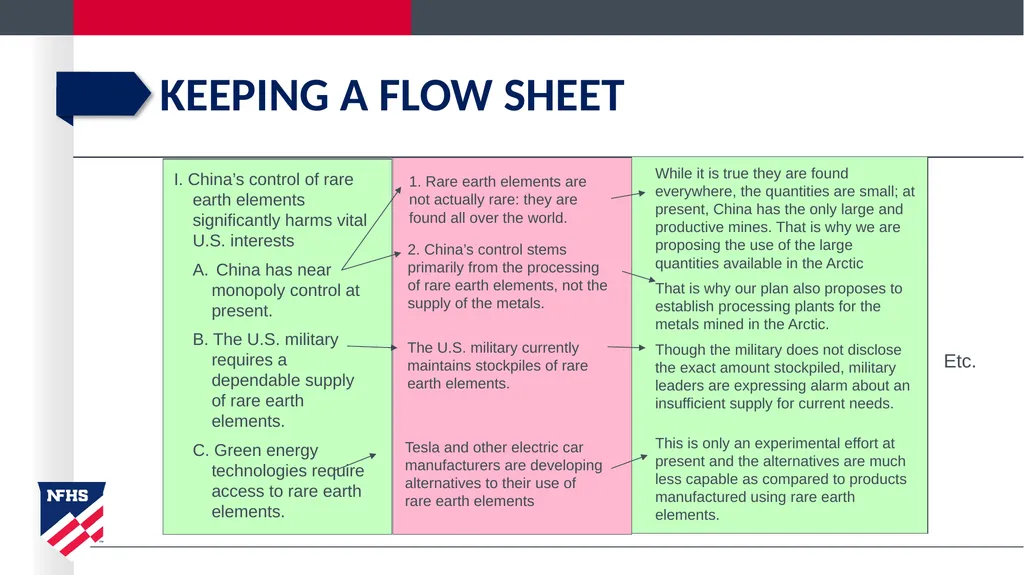
slide12. keeping a flow sheet I. China’s control of rare earth elements significantly harms vital U.S. interests
China has near monopoly control at present.
B. The U.S. military requires a dependable supply of rare earth elements.
C. Green energy technologies require access to rare earth elements. 1. Rare earth elements are not actually rare: they are found all over the world. While it is true they are found everywhere, the quantities are small; at present, China has the only large and productive mines. That is why we are proposing the use of the large quantities available in the Arctic
That is why our plan also proposes to establish processing plants for the metals mined in the Arctic.
Though the military does not disclose the exact amount stockpiled, military leaders are expressing alarm about an insufficient supply for current needs.
This is only an experimental effort at present and the alternatives are much less capable as compared to products manufactured using rare earth elements. The U.S. military currently maintains stockpiles of rare earth elements. Tesla and other electric car manufacturers are developing alternatives to their use of rare earth elements 2. China’s control stems primarily from the processing of rare earth elements, not the supply of the metals. Etc.<br>
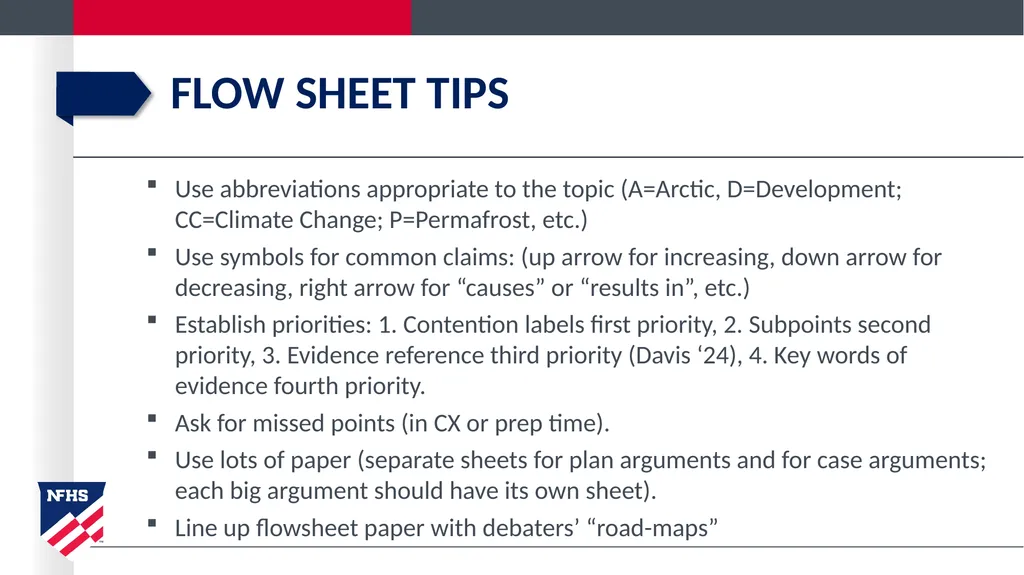
slide13. flow sheet tips Use abbreviations appropriate to the topic (A=Arctic, D=Development; CC=Climate Change; P=Permafrost, etc.)
Use symbols for common claims: (up arrow for increasing, down arrow for decreasing, right arrow for “causes” or “results in”, etc.)
Establish priorities: 1. Contention labels first priority, 2. Subpoints second priority, 3. Evidence reference third priority (Davis ‘24), 4. Key words of evidence fourth priority.
Ask for missed points (in CX or prep time).
Use lots of paper (separate sheets for plan arguments and for case arguments; each big argument should have its own sheet).
Line up flowsheet paper with debaters’ “road-maps”<br>
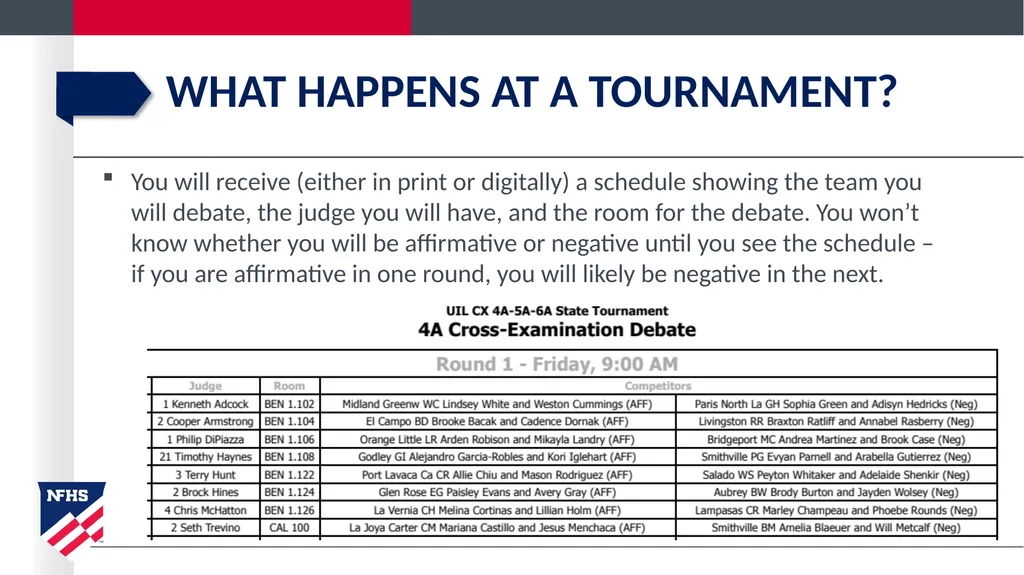
slide14. What happens at a tournament? You will receive (either in print or digitally) a schedule showing the team you will debate, the judge you will have, and the room for the debate. You won’t know whether you will be affirmative or negative until you see the schedule – if you are affirmative in one round, you will likely be negative in the next.<br>
slide15. Policy Debate Vocabulary Road Map: Debaters often pre-list for the judge the order of the arguments in the speech. Example for the 1NC: “I will have a topicality argument, two disadvantages, then the case.”
Prep Time: For most tournaments, each team is typically allowed eight minutes of prep time. This prep time can be used by the team at any point between speeches to prepare responses, strategize, or organize arguments. Teams can divide their prep time however they see fit, using it all at once or spreading it out across multiple breaks between speeches.
T: Debaters often use this short-hand way of referring to Topicality arguments.
DA or Disad: Short-hand for Disadvantage.<br>
slide16. Policy Debate Vocabulary Spread: Speaking quickly in order to fit more arguments into the limited speech time.
Drop: When a debater does not address or respond to an argument made by the opposing team.
Extend: Continuing to emphasize or elaborate on a point from earlier in the debate.
Kritik (K): A philosophical argument challenging underlying assumptions of the other team’s case; this could potentially involve a critique of the llanguage, the value systems, or the broader implications of the other team’s case rather than focusing directly on the policy proposal. Some coaches and judges advise against the use of kritik arguments.<br>
slide17. Policy Debate Vocabulary Turn: An argument that flips an opponent's point to benefit the other side (e.g., an advantage can be turned into a disadvantage).
Status Quo: Debaters use this Latin term to refer to the “present system,” or things as they now are.
Line-by-Line: Going through the flow argument by argument, responding to each point made by the other team.
Cross-Apply: Taking an argument from one part of the debate and applying it to another argument or issue.
Off-case: Arguments made by the Negative that are not directly responding to the Affirmative's case structure (e.g., topicality, disadvantages, or counterplans).<br>
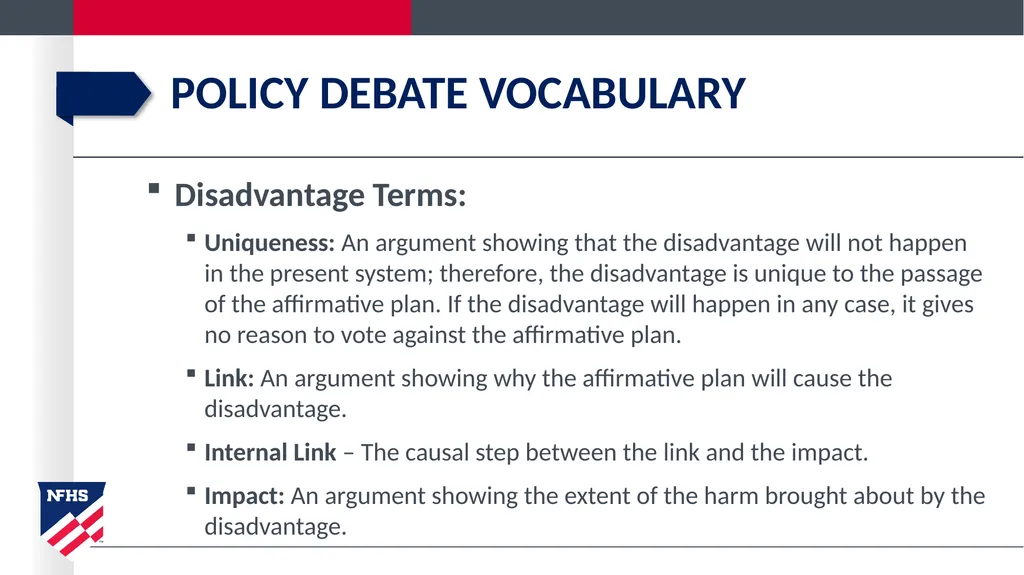
slide18. Policy Debate Vocabulary Disadvantage Terms:
Uniqueness: An argument showing that the disadvantage will not happen in the present system; therefore, the disadvantage is unique to the passage of the affirmative plan. If the disadvantage will happen in any case, it gives no reason to vote against the affirmative plan.
Link: An argument showing why the affirmative plan will cause the disadvantage.
Internal Link – The causal step between the link and the impact.
Impact: An argument showing the extent of the harm brought about by the disadvantage.<br>
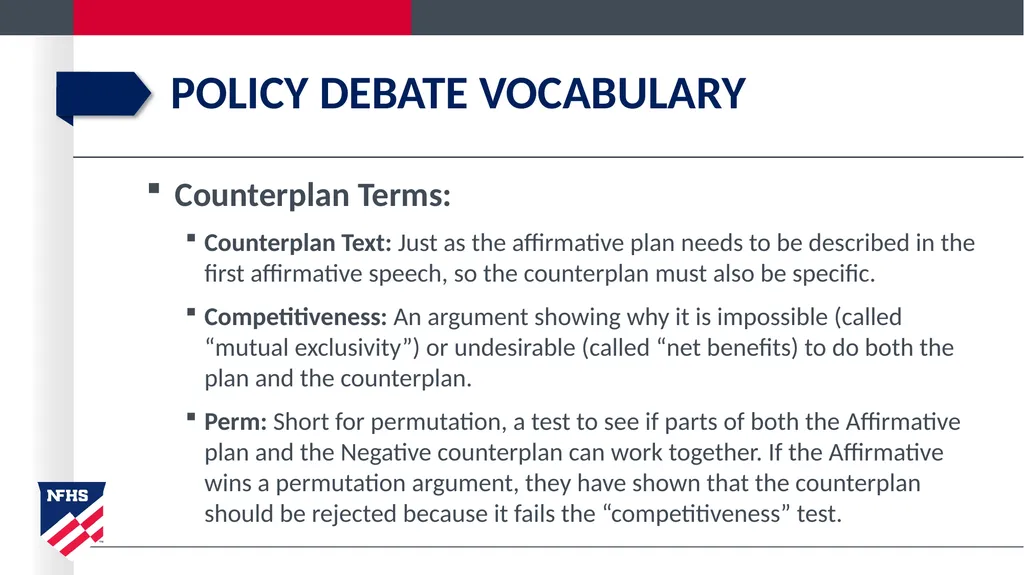
slide19. Policy Debate Vocabulary Counterplan Terms:
Counterplan Text: Just as the affirmative plan needs to be described in the first affirmative speech, so the counterplan must also be specific.
Competitiveness: An argument showing why it is impossible (called “mutual exclusivity”) or undesirable (called “net benefits) to do both the plan and the counterplan.
Perm: Short for permutation, a test to see if parts of both the Affirmative plan and the Negative counterplan can work together. If the Affirmative wins a permutation argument, they have shown that the counterplan should be rejected because it fails the “competitiveness” test.<br>
slide20. POLICY DEBATE INTRODUCTION www.nfhs.org<br>
slide2. What Is policy debate? National, Year-Long Topic: Policy debaters debate the topic as selected by the National Federation of High Schools.
2-Person Teams: You will have a debate partner; you will debate a two-person team from another school.
Affirmative or Negative?: Almost all policy debate is “switch-sides,” meaning you will be affirmative one round, but negative the next.<br>
slide3. What Do We Debate About? 2025-26 Policy Debate Resolution: “Resolved: The United States federal government should significantly increase its exploration and/or development of the Arctic.”
The Affirmative Case must present a ”plan”: Think of the resolution as a umbrella – the affirmative must present and defend a plan that falls under the resolution.
Yes or No to the Plan?: The affirmative says ”yes” to the plan; the negative says “no.”<br>
slide4. What Is an affirmative plan? One or two sentence description of what the affirmative thinks should be done: What change in U.S. exploration and/or development of the Arctic is proposed?
Falls under the resolution: Think of the resolution as an umbrella – the affirmative must present and defend a plan that falls under the resolution.
Yes or No to the Plan?: The affirmative says ”yes” to the plan; the negative says “no.”<br>
slide5. What Are some examples of a plan? The United States federal government should significantly increase its exploration of the Arctic by restoring the Trump administration ordered cuts to the Arctic programs of the National Oceanic and Atmospheric Administration (NOAA).
The U.S. federal government should significantly increase its development of the Arctic by expanding oil and gas leasing on federal lands.
The U.S. federal government should significantly increase its military development in the Arctic by expanding the construction and leasing of heavy icebreakers.<br>
slide6. the format for policy debate Constructive Speeches
First Affirmative Constructive (1AC): 8 Minutes (Layout the whole Aff position)
Cross-Examined by 2NC: 3 Minutes
First Negative Constructive (1NC): 8 Minutes (Layout the whole Neg position and answer the Aff position)
Cross-Examined by 1AC: 3 Minutes
Second Affirmative Constructive (2AC): 8 Minutes
Cross-Examined by 1NC: 3 Minutes
Second Negative Constructive (2NC): 8 Minutes
Cross-Examined by 2AC: 3 Minutes
Rebuttal Speeches
First Negative Rebuttal (1NR): 5 Minutes
First Affirmative Rebuttal (1AR): 5 Minutes
Second Negative Rebuttal (2NR): 5 Minutes
Second Affirmative Rebuttal (2AR): 5 Minutes<br>
slide7. What Are the parts of the AFF case? Plan: This usually comes first in the speech
Harm: What is wrong now, and why is it significantly harmful? This argument must be supported with direct quotations from authoritative evidence.
Inherency: What is the defect or defect in the present system that keeps it from resolving the harm (what law, Supreme Court decision, Executive Order, prevailing attitude, etc.)? Needs direct quotations from authoritative evidence.
Solvency: Why will the plan solve the problem? This too needs to be supported by direct quotations from authoritative evidence.<br>
slide8. What Are the parts of the Neg case? Topicality: Do you wish to argue that the plan is an illegitimate example of the resolution? (optional)
Disadvantage(s): Do you wish to argue that adopting the affirmative plan would create more harm than good? (optional)
Counterplan: Do you wish to propose that there is a better way (other than the resolution) to solve the affirmative harm? Note: There must be a good reason why one shouldn’t just do both the plan and the counterplan.
Answers to the Case: Can you provide answers (supported with evidence) to the harm, inherency, and solvency arguments made by the affirmative?<br>
slide9. Constructive speaker responsibilities 1AC: Present a “Prima Facie” Case:
Plan, Harm, Inherency, Solvency
1NC: Present the Negative Attack
]The “front-line” of all negative positions (Topicality, Disadvantages, Counterplans) then answer the Case arguments
2AC: Re-Defends Against 1NC
Follows 1NC point-by-point (Answer whatever the 1NC wanted to talk about)
2NC: Answer selected parts of the 2AC positions, leaving the rest for 1NR
Divide positions with the 1NR (division of labor)<br>
slide10. Rebuttal speaker responsibilities No new arguments in rebuttal (new evidence OK)
1NR: Answer remaining 2AC arguments
1AR: Answer all 2NC & 1NR arguments
2NR: Extend winning negative arguments
2AR: Answer all remaining negative arguments & claim all affirmative positions that are no longer contested<br>
slide11. cross examination The speaker completing the constructive speech remains at the podium for questions
Both questioner and respondent stand and face the judge
The questioner controls the cross examination period
What to ask?
Set up arguments for later speeches
Use all of your time (it’s prep time for your partner)<br>
slide12. keeping a flow sheet I. China’s control of rare earth elements significantly harms vital U.S. interests
China has near monopoly control at present.
B. The U.S. military requires a dependable supply of rare earth elements.
C. Green energy technologies require access to rare earth elements. 1. Rare earth elements are not actually rare: they are found all over the world. While it is true they are found everywhere, the quantities are small; at present, China has the only large and productive mines. That is why we are proposing the use of the large quantities available in the Arctic
That is why our plan also proposes to establish processing plants for the metals mined in the Arctic.
Though the military does not disclose the exact amount stockpiled, military leaders are expressing alarm about an insufficient supply for current needs.
This is only an experimental effort at present and the alternatives are much less capable as compared to products manufactured using rare earth elements. The U.S. military currently maintains stockpiles of rare earth elements. Tesla and other electric car manufacturers are developing alternatives to their use of rare earth elements 2. China’s control stems primarily from the processing of rare earth elements, not the supply of the metals. Etc.<br>
slide13. flow sheet tips Use abbreviations appropriate to the topic (A=Arctic, D=Development; CC=Climate Change; P=Permafrost, etc.)
Use symbols for common claims: (up arrow for increasing, down arrow for decreasing, right arrow for “causes” or “results in”, etc.)
Establish priorities: 1. Contention labels first priority, 2. Subpoints second priority, 3. Evidence reference third priority (Davis ‘24), 4. Key words of evidence fourth priority.
Ask for missed points (in CX or prep time).
Use lots of paper (separate sheets for plan arguments and for case arguments; each big argument should have its own sheet).
Line up flowsheet paper with debaters’ “road-maps”<br>
slide14. What happens at a tournament? You will receive (either in print or digitally) a schedule showing the team you will debate, the judge you will have, and the room for the debate. You won’t know whether you will be affirmative or negative until you see the schedule – if you are affirmative in one round, you will likely be negative in the next.<br>
slide15. Policy Debate Vocabulary Road Map: Debaters often pre-list for the judge the order of the arguments in the speech. Example for the 1NC: “I will have a topicality argument, two disadvantages, then the case.”
Prep Time: For most tournaments, each team is typically allowed eight minutes of prep time. This prep time can be used by the team at any point between speeches to prepare responses, strategize, or organize arguments. Teams can divide their prep time however they see fit, using it all at once or spreading it out across multiple breaks between speeches.
T: Debaters often use this short-hand way of referring to Topicality arguments.
DA or Disad: Short-hand for Disadvantage.<br>
slide16. Policy Debate Vocabulary Spread: Speaking quickly in order to fit more arguments into the limited speech time.
Drop: When a debater does not address or respond to an argument made by the opposing team.
Extend: Continuing to emphasize or elaborate on a point from earlier in the debate.
Kritik (K): A philosophical argument challenging underlying assumptions of the other team’s case; this could potentially involve a critique of the llanguage, the value systems, or the broader implications of the other team’s case rather than focusing directly on the policy proposal. Some coaches and judges advise against the use of kritik arguments.<br>
slide17. Policy Debate Vocabulary Turn: An argument that flips an opponent's point to benefit the other side (e.g., an advantage can be turned into a disadvantage).
Status Quo: Debaters use this Latin term to refer to the “present system,” or things as they now are.
Line-by-Line: Going through the flow argument by argument, responding to each point made by the other team.
Cross-Apply: Taking an argument from one part of the debate and applying it to another argument or issue.
Off-case: Arguments made by the Negative that are not directly responding to the Affirmative's case structure (e.g., topicality, disadvantages, or counterplans).<br>
slide18. Policy Debate Vocabulary Disadvantage Terms:
Uniqueness: An argument showing that the disadvantage will not happen in the present system; therefore, the disadvantage is unique to the passage of the affirmative plan. If the disadvantage will happen in any case, it gives no reason to vote against the affirmative plan.
Link: An argument showing why the affirmative plan will cause the disadvantage.
Internal Link – The causal step between the link and the impact.
Impact: An argument showing the extent of the harm brought about by the disadvantage.<br>
slide19. Policy Debate Vocabulary Counterplan Terms:
Counterplan Text: Just as the affirmative plan needs to be described in the first affirmative speech, so the counterplan must also be specific.
Competitiveness: An argument showing why it is impossible (called “mutual exclusivity”) or undesirable (called “net benefits) to do both the plan and the counterplan.
Perm: Short for permutation, a test to see if parts of both the Affirmative plan and the Negative counterplan can work together. If the Affirmative wins a permutation argument, they have shown that the counterplan should be rejected because it fails the “competitiveness” test.<br>
slide20. POLICY DEBATE INTRODUCTION www.nfhs.org<br>