
Politeness Principle INTRODCTION In our study of
SB
Published · 10 slides · 0 views

1 / 1
Description
Politeness Principle INTRODCTION In our study of tact in unit 4, we noted that language use often demands some form of politeness in order not to sound too pointed, uncultured or rude. This is because language as a form of cultural
Related Topics
Share
Embed code
Download this presentation From Below
"Politeness Principle INTRODCTION In our study of" is the property of its rightful owner. Permission is granted to download and print the materials on this website for personal, non-commercial use only, and to display it on your personal computer provided you do not modify the materials and that you retain all copyright notices contained in the materials. By downloading content from our website, you accept the terms of this agreement.
Presentation Transcript
01
Politeness Principle INTRODCTION
In our study of tact in unit 4, we noted that language use often demands some form of politeness in order not to sound “too pointed,” “uncultured” or “rude.” This is because language as a form of cultural expressions consists of etiquette and rules of behaviour that interactants must imbibe and practice. Politeness is therefore one type of the manifestations of etiquette or proper behaviour in communication. In this unit we shall be considering the role of politeness phenomena as an important concern of pragmatics in the role of communicating social meaning.<br>
In our study of tact in unit 4, we noted that language use often demands some form of politeness in order not to sound “too pointed,” “uncultured” or “rude.” This is because language as a form of cultural expressions consists of etiquette and rules of behaviour that interactants must imbibe and practice. Politeness is therefore one type of the manifestations of etiquette or proper behaviour in communication. In this unit we shall be considering the role of politeness phenomena as an important concern of pragmatics in the role of communicating social meaning.<br>
02
1. Politeness Politeness is not just about showing some compliments, it is rather the exercise of language choice to create a context intended to match addressee’s notion of how he or she should be addressed. Among the aspects of context that are particularly determined by language choice in the domain of politeness are the power-distance relationship of the interactants and the extent to which a speaker imposes on or requires something of their addressee. Thus being “polite” is simply a way a speaker implicates a context that matches the one assumed by the hearer (Grundy, 2000:144-5). This we do by applying some great deal of linguistic politeness as a rule for ensuring the appropriate etiquette or conduct. Look at the example below showing expressions of politeness phenomena:
(i) Could you possibly pick up that pen for me please
(ii) Peak up that pen for me
As we can see in the above examples, politeness principle does not always encourage economy of words as we observed in the case of pragmatic presupposition, rather the speaker of (i) adopts politeness strategy as long as it satisfies his intention and needs. That is not to say however that there are no situations where (ii) will be the most appropriate.<br>
03
1. Politeness Polite utterances often encode the relationship between the speaker and hearer. In the above example, (i) may be my way of asking an adult student who came to see me in my office to pick up a pen for me. But if my child were to be in my office (ii) will indeed be appropriate without his feeling upset. According to Grundy (2000), if we do not see the relationship between us and the persons who address us as they do, we may be upset by the strategies they use, since these strategies imply the kind of relationship we have with them, thus linguistic politeness is “the function of language to imply the most appropriate speaker-addressee relationship” (2000:147).
Now look at the mail below which I received from the secretary of the International Association of World Englishes, when I was initially unable to register as a member of the IAWE.
I do apologize for the inconvenience. IAWE uses PayPal as one way to accept membership dues because PayPal is inexpensive and simple to use. Other banking services we investigated in the past were too costly and might have meant a substantial increase in membership fees.
We do realize that there are some limitations with PayPal. One limitation is that it does not accept credit cards from certain countries because of a high percentage of financial fraud cases there. Nigeria is one instance of this. Macau is another. It isn't fair to you, but IAWE does not have influence on PayPal's policies.<br>
04
1. Politeness IAWE values members from Nigeria, Macau and other countries and regions that are not supported by PayPal.
For the time being, the only alternative we have is for you to send a check/cashier's check/money order in US dollars to the secretary-treasurer (me). I understand that there are fees for getting money orders and that this is far less convenient than using a credit card, and I am sorry about that.<br>
For the time being, the only alternative we have is for you to send a check/cashier's check/money order in US dollars to the secretary-treasurer (me). I understand that there are fees for getting money orders and that this is far less convenient than using a credit card, and I am sorry about that.<br>
05
2. Politeness as Face Saving Politeness as Face Saving The concept of “face” in pragmatics refers to someone’s self image. Your face therefore is your emotional and social sense of self worth that you expect someone else to recognise (Yule, 1996). If anyone says something to you that constitutes a threat to your self image, that is called face-threatening act. If someone tells you:
(iii) Leave the road! And another tells you:
(iv) Could you please, move a little bit to your right
The first person (iii) speaks to you as if s/he has some authority or social power over you. If he doesn’t really have that power, s/he is indeed threatening your face. The other person who adopts an indirect speech act (in form of a question) removes the face threatening act, thus making his request less threatening. This other person that removes your tendency to feel threatened has performed a face-saving act. This facesaving strategy constitutes politeness.<br>
06
2. Politeness as Face Saving You have both the negative face and positive face. Your negative face is your need to be independent and free of any form of imposition, while your positive face is your need to be well treated, to belong, to be a member of the group (Yule, 1996). A face-saving act that recognises another person’s negative face will be concerned about his need not to be imposed, harassed or insulted. Thus the need to use such expressions as “I’m sorry to bother you…” “I just couldn’t help asking if…” “I know you’re busy but…” etc. A face-saving act that emphasises a person’s positive face will show solidarity and be mindful of a common goal, tendency or a common weakness. For instance if someone tells you: “O’ you’re very kind.” And in response you say: “Thanks, but I’m not as kind as you are.” You are being polite by applying a positive face-saving act, implying that you are not in any way better. The appropriate language use that shows politeness varies among cultures. Many times what some cultures consider as impolite may not be impolite to some. For instance in my Igbo culture, it will be impolite for a child to say to his parent, “come on Dad,” or “don’t be silly mum.” This will indeed be viewed as face-threatening or outright insult. But this is not the case in some European cultures. Interpreting how interactants communicate is actually a matter of pragmatics – being able to interpret what is intended, rather than what is said.<br>
07
3. Models of Politeness Strategies The notion of “face” was actually that of Goffman’s, while the elaborate work on linguistic politeness was carried out by Brown and Levinson (1978/1987). They insisted that for politeness to take place, someone has recognized the other person’s “self esteem” and the need to protect it. In most of our encounters with people, Brown and Levinson argue that our face is put at risk. Asking me to take a longer process of registration because my country is branded fraudulent, or telling you to wait indefinitely outside the lecturer’s office constitute face-threatening to you and I. In some cases those who threaten us attempt to reduce the effect of such impoliteness by using some redressive language designed to compensate the threat. So they say: “I do apologize for the inconveniences” or “sorry about that” or they make a joke of our complaints. This type of politeness strategy, i.e. use of redressive expressions is targeted at compensating for face-threatening behavior. When performing face-threatening act to perform, Brown and Levinson propose three strategies, namely:
(a) Do the act on record (without attempting to hide what we’re doing)
(b) Do the act off record (in such a way to pretend to hide it)
(c) Don’t do it at all<br>
(a) Do the act on record (without attempting to hide what we’re doing)
(b) Do the act off record (in such a way to pretend to hide it)
(c) Don’t do it at all<br>
08
3. Models of Politeness Strategies In the “do the acts on record” strategy, you do it (i) baldly- without redress (ii) with positive redress (iii) with negative politeness redress. This could be with expressions such as “I’m sorry”, or make a joke or call the addressee’s pet name etc. In the “do the acts on record” strategy, you do it (i) baldly- without redress (ii) with positive redress (iii) with negative politeness redress. This could be with expressions such as “I’m sorry”, or make a joke or call the addressee’s pet name etc.
In his own model of politeness strategies, Lakoff (1973) argues that politeness principle like conversational principle operates with some maxims which are assumed to be followed by interactants in their conversations with others. As with the cooperative principles any flouting of these maxims will definitely affect meaning provided it is perceived for what it is (Cook, 1989). Lakoff therefore formulates the maxims as follows:
(a) Don’t impose
(b) Give options
(c) Make your receiver feel good<br>
09
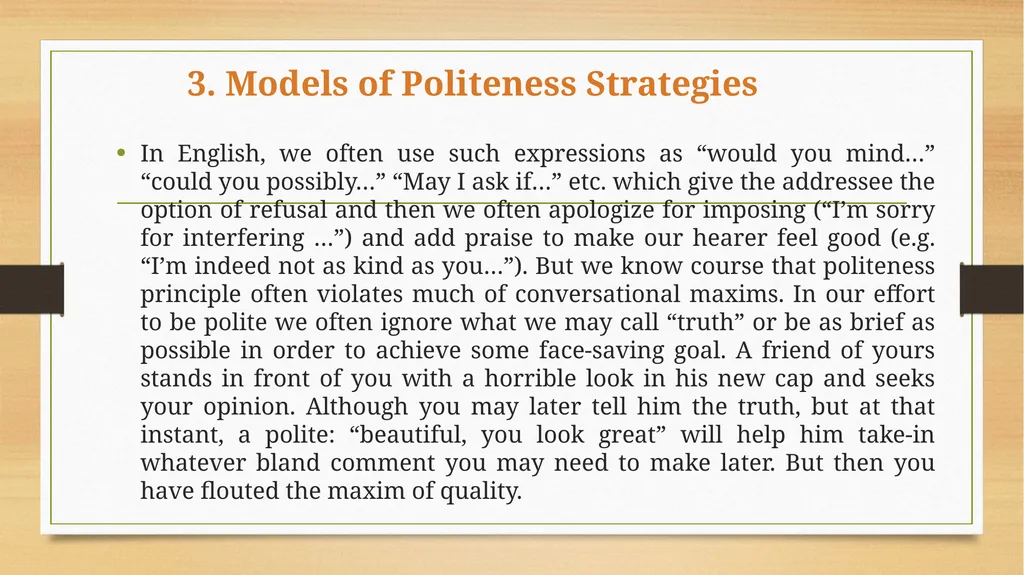
3. Models of Politeness Strategies In English, we often use such expressions as “would you mind…” “could you possibly…” “May I ask if…” etc. which give the addressee the option of refusal and then we often apologize for imposing (“I’m sorry for interfering …”) and add praise to make our hearer feel good (e.g. “I’m indeed not as kind as you…”). But we know course that politeness principle often violates much of conversational maxims. In our effort to be polite we often ignore what we may call “truth” or be as brief as possible in order to achieve some face-saving goal. A friend of yours stands in front of you with a horrible look in his new cap and seeks your opinion. Although you may later tell him the truth, but at that instant, a polite: “beautiful, you look great” will help him take-in whatever bland comment you may need to make later. But then you have flouted the maxim of quality.<br>
10
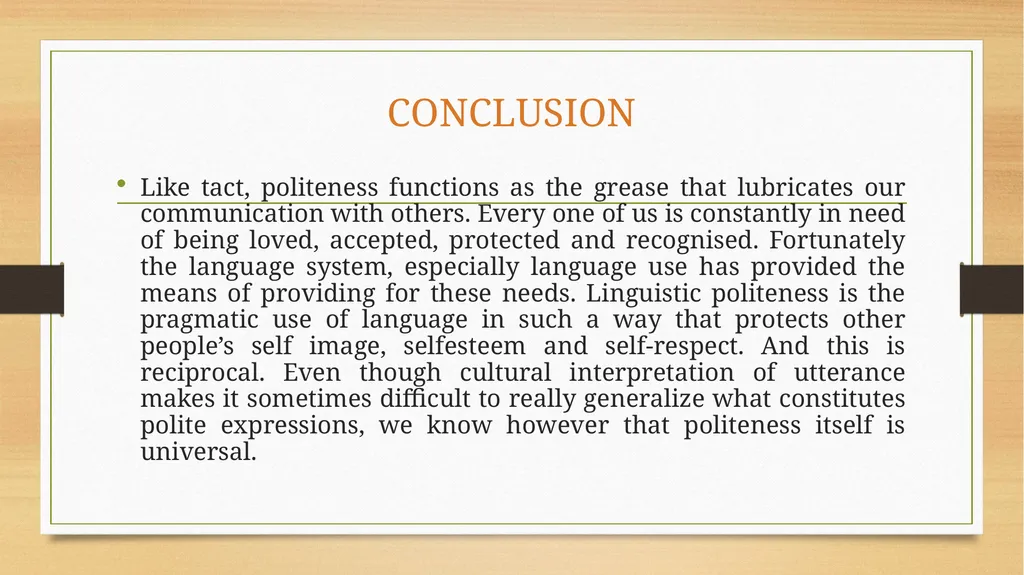
CONCLUSION Like tact, politeness functions as the grease that lubricates our communication with others. Every one of us is constantly in need of being loved, accepted, protected and recognised. Fortunately the language system, especially language use has provided the means of providing for these needs. Linguistic politeness is the pragmatic use of language in such a way that protects other people’s self image, selfesteem and self-respect. And this is reciprocal. Even though cultural interpretation of utterance makes it sometimes difficult to really generalize what constitutes polite expressions, we know however that politeness itself is universal.<br>