
POLLUTION DUE TO PLASTICS : Plastic pollution
CM
Published · 19 slides · 0 views
1 / 1

Description
POLLUTION DUE TO PLASTICS : Plastic pollution means accumulation of man-made plastic products in the environment to the point where they create problems for living organisms and their habitats. Most of the plastic materials end up on
Related Topics
Share
Embed code
Download this presentation From Below
"POLLUTION DUE TO PLASTICS : Plastic pollution" is the property of its rightful owner. Permission is granted to download and print the materials on this website for personal, non-commercial use only, and to display it on your personal computer provided you do not modify the materials and that you retain all copyright notices contained in the materials. By downloading content from our website, you accept the terms of this agreement.
Presentation Transcript
01
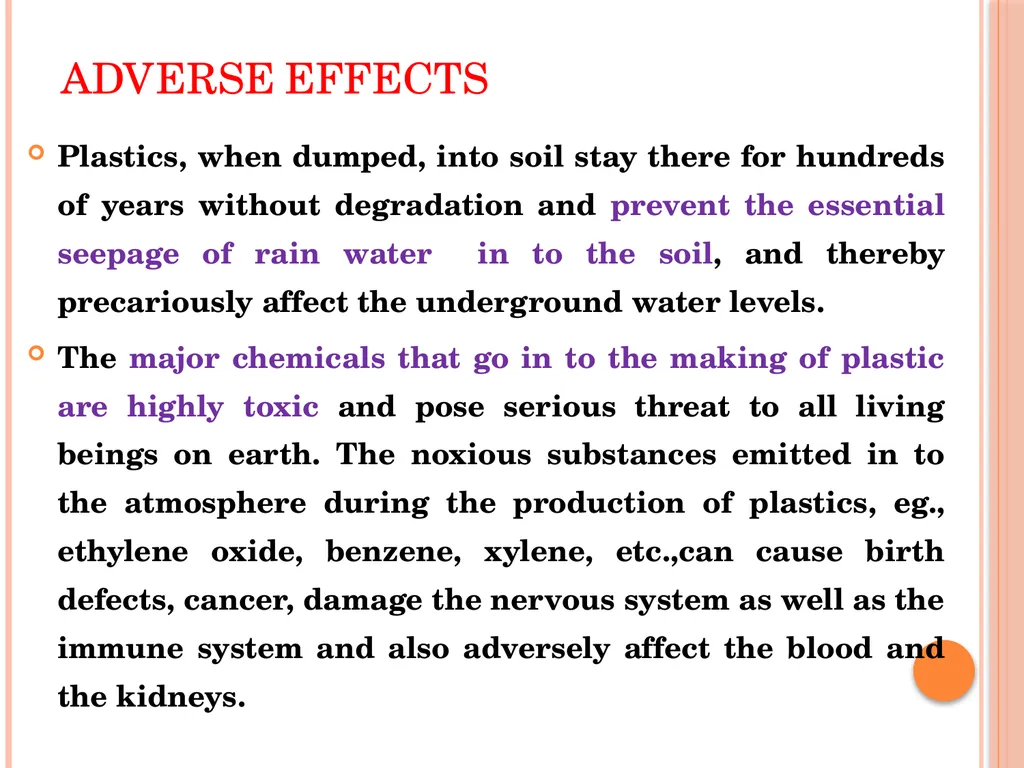
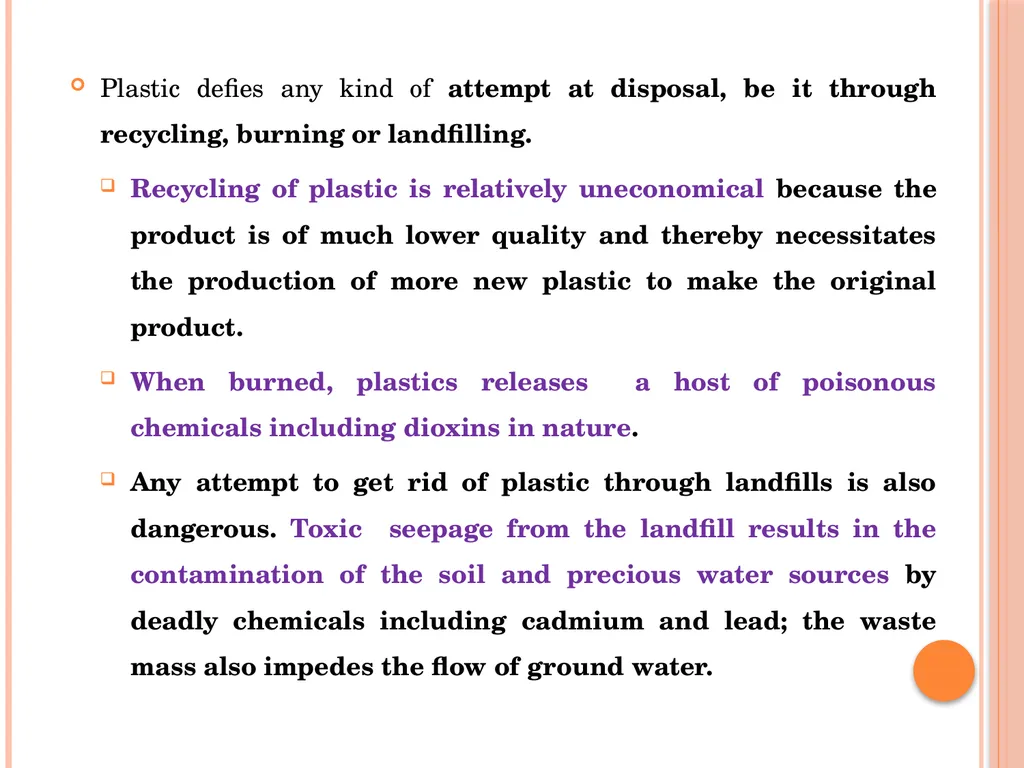
POLLUTION DUE TO PLASTICS : Plastic pollution means accumulation of man-made plastic products in the environment to the point where they create problems for living organisms and their habitats.
Most of the plastic materials end up on landfill sites where that contaminate the soil. Most synthetic plastics are persistent pollutants in the sense that they are quite resistant to the environmental degradation processes.<br>
Most of the plastic materials end up on landfill sites where that contaminate the soil. Most synthetic plastics are persistent pollutants in the sense that they are quite resistant to the environmental degradation processes.<br>
02
ADVERSE EFFECTS Plastics, when dumped, into soil stay there for hundreds of years without degradation and prevent the essential seepage of rain water in to the soil, and thereby precariously affect the underground water levels.
The major chemicals that go in to the making of plastic are highly toxic and pose serious threat to all living beings on earth. The noxious substances emitted in to the atmosphere during the production of plastics, eg., ethylene oxide, benzene, xylene, etc.,can cause birth defects, cancer, damage the nervous system as well as the immune system and also adversely affect the blood and the kidneys.<br>
The major chemicals that go in to the making of plastic are highly toxic and pose serious threat to all living beings on earth. The noxious substances emitted in to the atmosphere during the production of plastics, eg., ethylene oxide, benzene, xylene, etc.,can cause birth defects, cancer, damage the nervous system as well as the immune system and also adversely affect the blood and the kidneys.<br>
03
Plastic defies any kind of attempt at disposal, be it through recycling, burning or landfilling.
Recycling of plastic is relatively uneconomical because the product is of much lower quality and thereby necessitates the production of more new plastic to make the original product.
When burned, plastics releases a host of poisonous chemicals including dioxins in nature.
Any attempt to get rid of plastic through landfills is also dangerous. Toxic seepage from the landfill results in the contamination of the soil and precious water sources by deadly chemicals including cadmium and lead; the waste mass also impedes the flow of ground water.<br>
Recycling of plastic is relatively uneconomical because the product is of much lower quality and thereby necessitates the production of more new plastic to make the original product.
When burned, plastics releases a host of poisonous chemicals including dioxins in nature.
Any attempt to get rid of plastic through landfills is also dangerous. Toxic seepage from the landfill results in the contamination of the soil and precious water sources by deadly chemicals including cadmium and lead; the waste mass also impedes the flow of ground water.<br>
04
Plastic waste is often mistaken for food by land and marine animals, thereby endangering their life; plastic clogs their intestine and leads to slow starvation.
Plastic waste causes the clogging of drainage systems. Choked drains provide excellent breeding grounds for mosquitoes; besides they cause flooding of low-lying areas during the monsoon.<br>
Plastic waste causes the clogging of drainage systems. Choked drains provide excellent breeding grounds for mosquitoes; besides they cause flooding of low-lying areas during the monsoon.<br>
05
CONTROL MEASURES The only way to overcome the lasting danger of plastic pollution is to cut down the use of plastic.
Reusing plastic bags again and again without throwing them away is one way to bring down their production.
Plastic bags can be replaced by bags made of paper, jute, or cloth.
Resort to the use of biodegradable plastics for making the products that find routine use.<br>
Reusing plastic bags again and again without throwing them away is one way to bring down their production.
Plastic bags can be replaced by bags made of paper, jute, or cloth.
Resort to the use of biodegradable plastics for making the products that find routine use.<br>
06
An alternative to plastic utensil should be used.
Avoid using disposable plastic water bottles and use reusable water bottles.
Environmental awareness and education on conservation of environment should be given to people.
Usage of natural packaging materials like banyan leaf, bamboo utensils, etc. should be encouraged in hotels and restaurants.
All the stores and shops must avoid providing plastic carry bags to their customers and should supply cloth bags and reusable carry bags to carry grocery items and dress materials.<br>
Avoid using disposable plastic water bottles and use reusable water bottles.
Environmental awareness and education on conservation of environment should be given to people.
Usage of natural packaging materials like banyan leaf, bamboo utensils, etc. should be encouraged in hotels and restaurants.
All the stores and shops must avoid providing plastic carry bags to their customers and should supply cloth bags and reusable carry bags to carry grocery items and dress materials.<br>
07
Garbage should be properly disposed. Improper disposal and dumping of plastic wastes on roads and water resources should be avoided.
Reduce the usage of unwanted plastic products in the house, office and in the environment.
Instead of thrashing plastics bottles, the disposable water bottles can be reused as water bottle sprinkler, pen stand, magazine rack, etc.
Recycling of plastic products should be strictly followed.<br>
Reduce the usage of unwanted plastic products in the house, office and in the environment.
Instead of thrashing plastics bottles, the disposable water bottles can be reused as water bottle sprinkler, pen stand, magazine rack, etc.
Recycling of plastic products should be strictly followed.<br>
08
POLLUTION DUE TO PESTICIDES Plants on which we depend for food are under attack from insects, fungi, bacteria, viruses, rodents and other animals, and must compete with weeds for nutrients.
To kill unwanted populations living in or on their crops, farmers use pesticides.
The remnants of such pesticides used on pests may get adsorbed by the soil particles and contaminate root crops grown in that soil.
The consumption of such crops causes the pesticides remnants to enter human biological systems, affecting them adversely.<br>
To kill unwanted populations living in or on their crops, farmers use pesticides.
The remnants of such pesticides used on pests may get adsorbed by the soil particles and contaminate root crops grown in that soil.
The consumption of such crops causes the pesticides remnants to enter human biological systems, affecting them adversely.<br>
09
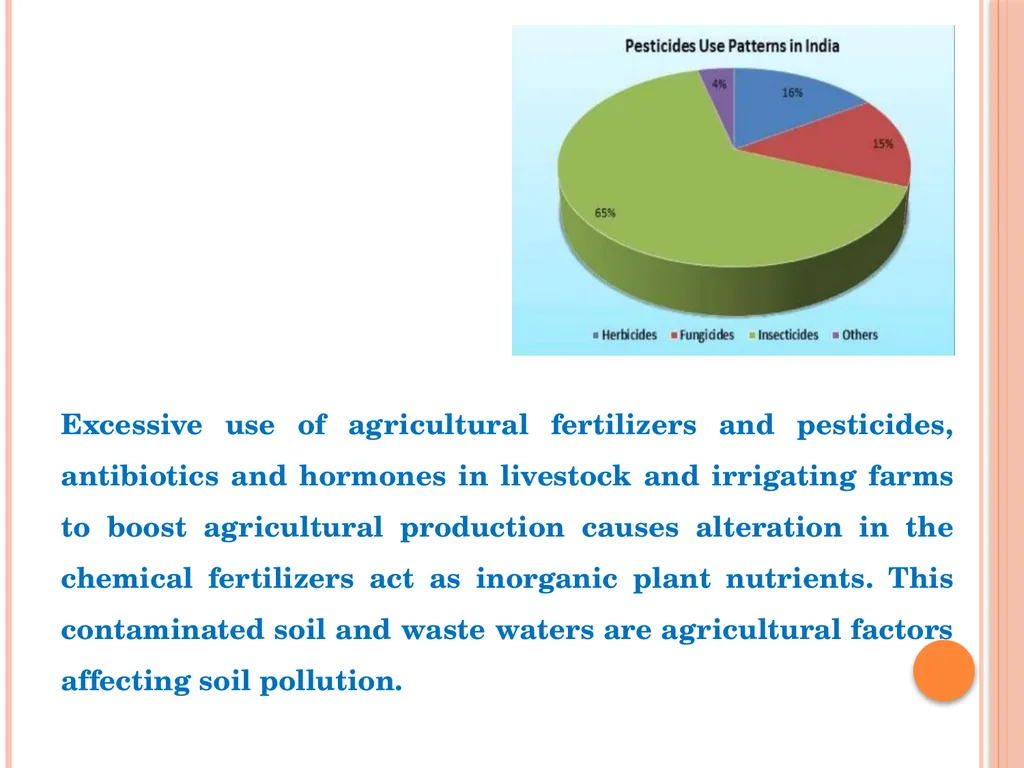
Excessive use of agricultural fertilizers and pesticides, antibiotics and hormones in livestock and irrigating farms to boost agricultural production causes alteration in the chemical fertilizers act as inorganic plant nutrients. This contaminated soil and waste waters are agricultural factors affecting soil pollution.<br>
10
ADVERSE EFFECTS Some arsenic pesticides may render the soil permanently infertile.
Pesticide residues in soil may be taken up by plants and cause phyto-toxicity. They may enter the aquatic environment and enter the food chain.
Pesticides such as endrin, dieldrin,DDT, etc. may seep through the soil and contaminate ground water and surface waters. They may eventually contaminate drinking water supplies.
Polychlorinated biphenyles(PCB) having half life periods if about 25 years in soil are among the most hazardous soil pollutants. They may accumulate in soil and plants andwhen they eventually enter the animal or human body , they may cause severe health disorders including eye damage, skin problems, nervous disorders, foetus deformities and liver or stomach cancer<br>
Pesticide residues in soil may be taken up by plants and cause phyto-toxicity. They may enter the aquatic environment and enter the food chain.
Pesticides such as endrin, dieldrin,DDT, etc. may seep through the soil and contaminate ground water and surface waters. They may eventually contaminate drinking water supplies.
Polychlorinated biphenyles(PCB) having half life periods if about 25 years in soil are among the most hazardous soil pollutants. They may accumulate in soil and plants andwhen they eventually enter the animal or human body , they may cause severe health disorders including eye damage, skin problems, nervous disorders, foetus deformities and liver or stomach cancer<br>
11
Irrigated water from pesticide contaminated soils may evaporate and spread the toxic pesticide vapours in the atmosphere.
Persistent pesticides can damage human tissues and interfere with the normal metabolic activities by disturbing enzymatic functioning
Excessive use of synthetic pesticides may lead to defoliation of forests and adverce effects on fauna and flora.
DDT can enter the food chain and accumulate in human fats and may lead to disorders such as impotency
Chlorinated pesticides and herbicides are hazardous soil pollutants which can affect the soil texture and damage the ecosystem.<br>
Persistent pesticides can damage human tissues and interfere with the normal metabolic activities by disturbing enzymatic functioning
Excessive use of synthetic pesticides may lead to defoliation of forests and adverce effects on fauna and flora.
DDT can enter the food chain and accumulate in human fats and may lead to disorders such as impotency
Chlorinated pesticides and herbicides are hazardous soil pollutants which can affect the soil texture and damage the ecosystem.<br>
12
CONTROL MEASURES Banning the use of highly toxic and resistant synthetic chemical pesticides or at least regulating/restricting their use only for special purposes under thorough monitoring.
Encouraging the use of bio-pesticides in place of toxic chemical pesticides.
Imparting informal and formal public awareness programmes to educate people at large regarding the health hazards and undesirable effects due to environmental pollution.
The most effective way to reduce risks posed by pesticides is to use non-chemical control methods to reduce or eliminate pest problems. Around the home, such measures include: removing sources of food and water (such as leaky pipes); and destroying pest shelters and breeding sites (such as litter and plant debris).
Don't use products for pests that are not indicated on the label and don't use more pesticide than directed by the label. Don't think that twice the amount will do twice the job. <br>
Encouraging the use of bio-pesticides in place of toxic chemical pesticides.
Imparting informal and formal public awareness programmes to educate people at large regarding the health hazards and undesirable effects due to environmental pollution.
The most effective way to reduce risks posed by pesticides is to use non-chemical control methods to reduce or eliminate pest problems. Around the home, such measures include: removing sources of food and water (such as leaky pipes); and destroying pest shelters and breeding sites (such as litter and plant debris).
Don't use products for pests that are not indicated on the label and don't use more pesticide than directed by the label. Don't think that twice the amount will do twice the job. <br>
13
Use protective measures when handling pesticides as directed by the label, such as wearing impermeable gloves, long pants, and long-sleeve shirts. Change clothes and wash your hands immediately after applying pesticides.
Before applying a pesticide (indoors or outdoors), remove children, toys and pets from the area and keep them away until the pesticide has dried or as recommended by the label.
Remove or cover food during indoor applications.
Don't spray outdoors on windy or rainy days. Take precautions to keep the pesticide from drifting or running off into the vegetable garden, pool or neighbor's yard.
If using a commercial applicator or lawn care service, ask for information about potential risks and safety precautions to take.
Don't buy more pesticides than you will need. If you have leftover pesticides, check with your local government to determine whether your community has a household hazardous waste collection program or other program for disposing of pesticides.<br>
Before applying a pesticide (indoors or outdoors), remove children, toys and pets from the area and keep them away until the pesticide has dried or as recommended by the label.
Remove or cover food during indoor applications.
Don't spray outdoors on windy or rainy days. Take precautions to keep the pesticide from drifting or running off into the vegetable garden, pool or neighbor's yard.
If using a commercial applicator or lawn care service, ask for information about potential risks and safety precautions to take.
Don't buy more pesticides than you will need. If you have leftover pesticides, check with your local government to determine whether your community has a household hazardous waste collection program or other program for disposing of pesticides.<br>
14
Bio-medical waste Waste generated during the diagnosis, testing, treatment, research or production of biological products for humans or animals
Sources of Bio-Medical Waste
Hospitals Labs
Research centers Animal research
Blood banks Nursing homes
Mortuaries Autopsy centers
Clinics Dental clinics
Home care Cosmetic clinics
Paramedics Funeral services
Institutions Vaccinating centers
Animal./slaughter houses<br>
Sources of Bio-Medical Waste
Hospitals Labs
Research centers Animal research
Blood banks Nursing homes
Mortuaries Autopsy centers
Clinics Dental clinics
Home care Cosmetic clinics
Paramedics Funeral services
Institutions Vaccinating centers
Animal./slaughter houses<br>
15
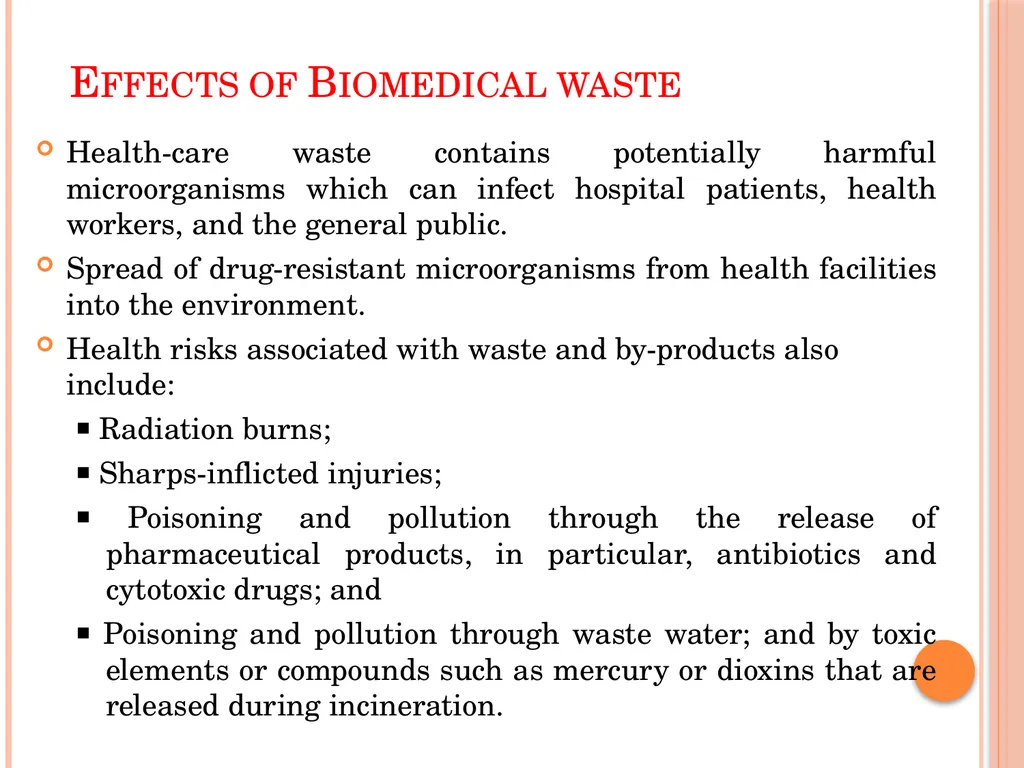
Effects of Biomedical waste Health-care waste contains potentially harmful microorganisms which can infect hospital patients, health workers, and the general public.
Spread of drug-resistant microorganisms from health facilities into the environment.
Health risks associated with waste and by-products also include:
▪ Radiation burns;
▪ Sharps-inflicted injuries;
▪ Poisoning and pollution through the release of pharmaceutical products, in particular, antibiotics and cytotoxic drugs; and
▪ Poisoning and pollution through waste water; and by toxic elements or compounds such as mercury or dioxins that are released during incineration.<br>
Spread of drug-resistant microorganisms from health facilities into the environment.
Health risks associated with waste and by-products also include:
▪ Radiation burns;
▪ Sharps-inflicted injuries;
▪ Poisoning and pollution through the release of pharmaceutical products, in particular, antibiotics and cytotoxic drugs; and
▪ Poisoning and pollution through waste water; and by toxic elements or compounds such as mercury or dioxins that are released during incineration.<br>
16
Landfills can contaminate drinking water if they are not properly constructed. Occupational risks exist at disposal facilities.
▪ Incineration of waste results in the release of pollutants into the air and of ash residue. Incinerated materials containing chlorine can generate dioxins and furans, which are human carcinogens and have been associated with a range of adverse health effects. Incineration of heavy metals or materials with high-metal content (in particular lead, mercury, and cadmium) can lead to the spread of toxic metals in the environment.<br>
▪ Incineration of waste results in the release of pollutants into the air and of ash residue. Incinerated materials containing chlorine can generate dioxins and furans, which are human carcinogens and have been associated with a range of adverse health effects. Incineration of heavy metals or materials with high-metal content (in particular lead, mercury, and cadmium) can lead to the spread of toxic metals in the environment.<br>
17
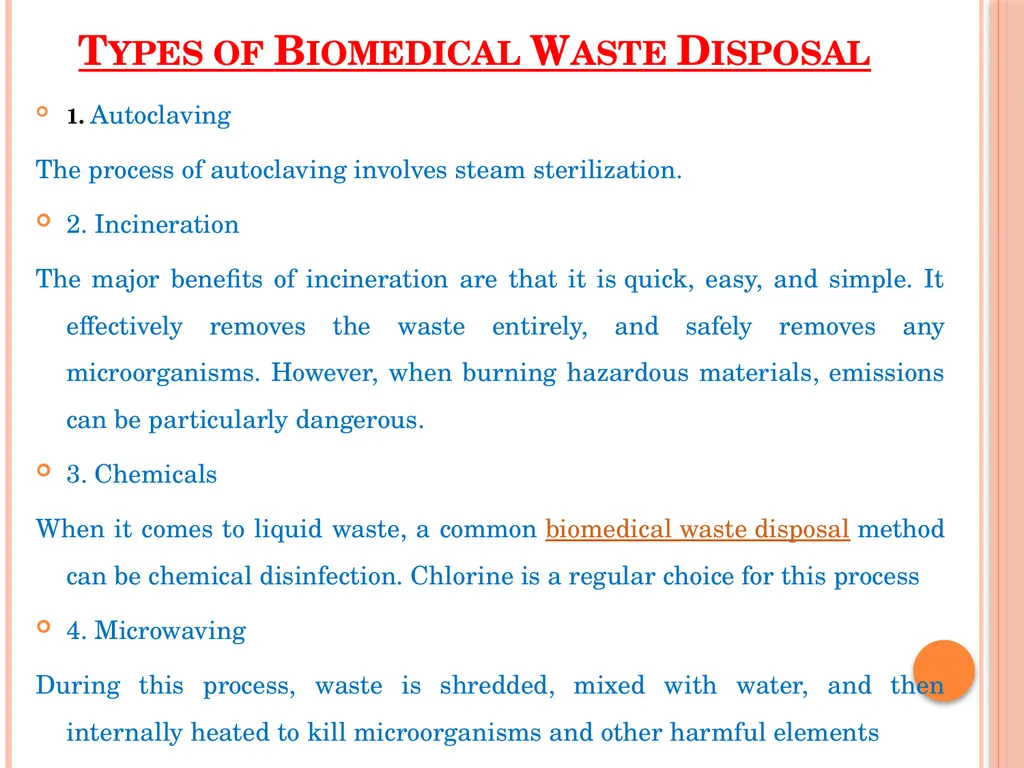
Types of Biomedical Waste Disposal 1. Autoclaving
The process of autoclaving involves steam sterilization.
2. Incineration
The major benefits of incineration are that it is quick, easy, and simple. It effectively removes the waste entirely, and safely removes any microorganisms. However, when burning hazardous materials, emissions can be particularly dangerous.
3. Chemicals
When it comes to liquid waste, a common biomedical waste disposal method can be chemical disinfection. Chlorine is a regular choice for this process
4. Microwaving
During this process, waste is shredded, mixed with water, and then internally heated to kill microorganisms and other harmful elements<br>
The process of autoclaving involves steam sterilization.
2. Incineration
The major benefits of incineration are that it is quick, easy, and simple. It effectively removes the waste entirely, and safely removes any microorganisms. However, when burning hazardous materials, emissions can be particularly dangerous.
3. Chemicals
When it comes to liquid waste, a common biomedical waste disposal method can be chemical disinfection. Chlorine is a regular choice for this process
4. Microwaving
During this process, waste is shredded, mixed with water, and then internally heated to kill microorganisms and other harmful elements<br>