Pope Valley School CA2800840 Napa County Jar Test by Guy Schott, P.E. October 10, 2018 Pope Valley School Water Characteristics October 10, 2018 Source: Burton Creek Turbidity: 6 NTU pH: 8.5 Alkalinity: 80 mgL as CaCO3 UVT: 79.5 UVA:
"Pope Valley School CA2800840 Napa County Jar Test" is the property of its rightful owner. Permission is granted to
download and print the materials on this website for personal, non-commercial use only, and to display it
on your personal computer provided you do not modify the materials and that you retain all copyright
notices contained in the materials. By downloading content from our website, you accept the terms of this
agreement.
Presentation Transcript
01
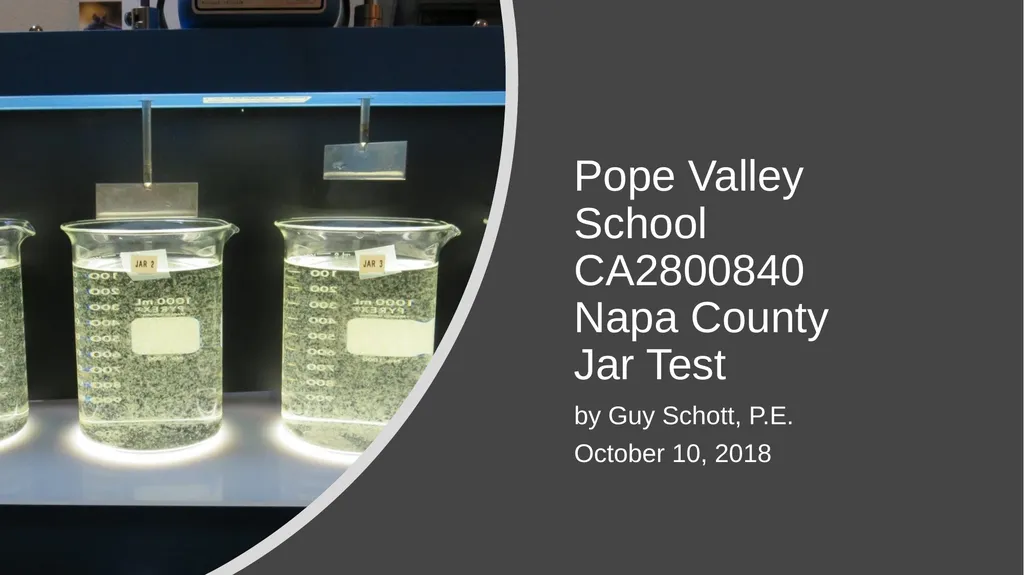
Pope Valley School CA2800840 Napa County Jar Test by Guy Schott, P.E.
October 10, 2018<br>
02
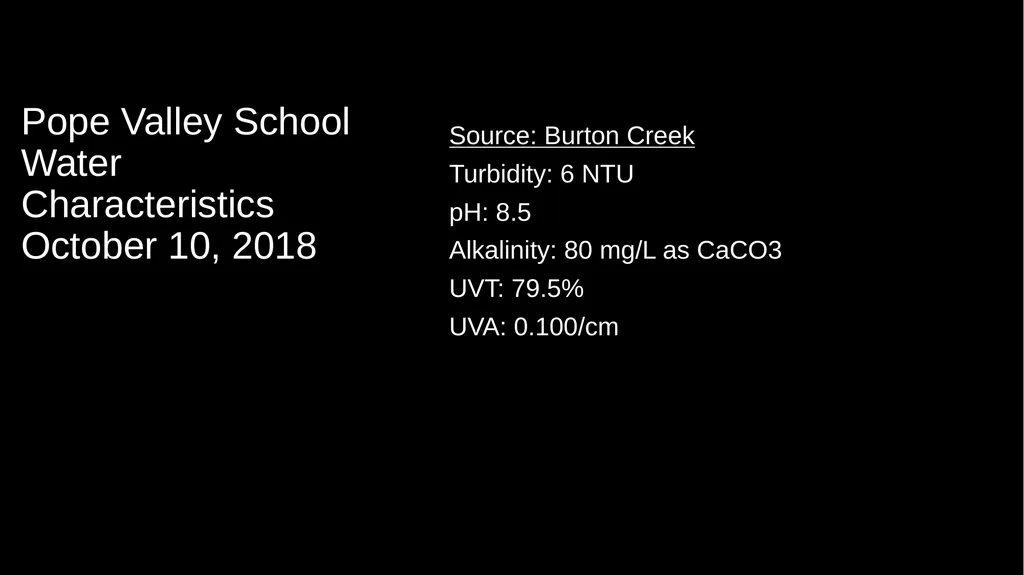
Pope Valley School Water Characteristics October 10, 2018 Source: Burton Creek
Turbidity: 6 NTU
pH: 8.5
Alkalinity: 80 mg/L as CaCO3
UVT: 79.5%
UVA: 0.100/cm<br>
03
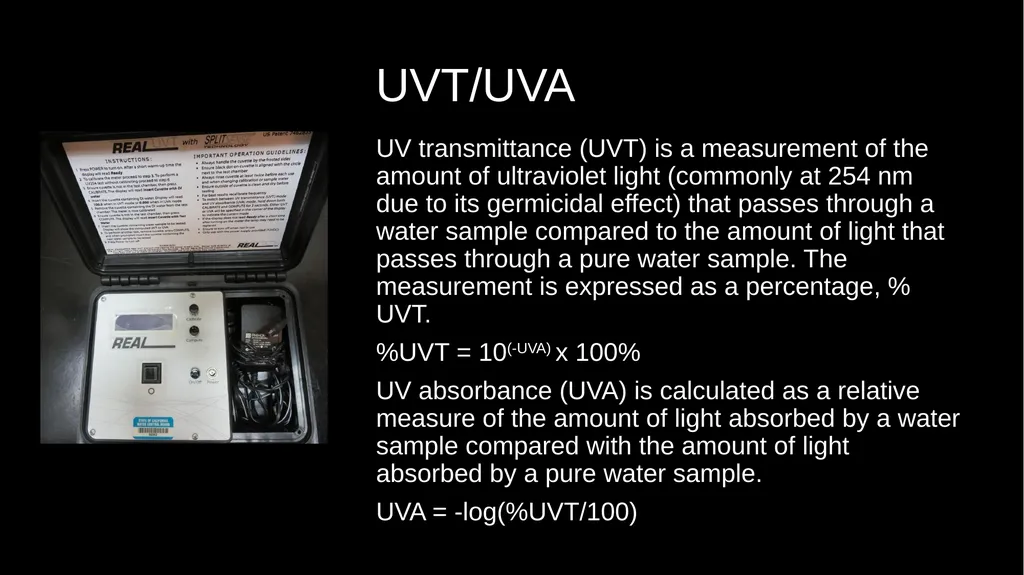
UVT/UVA UV transmittance (UVT) is a measurement of the amount of ultraviolet light (commonly at 254 nm due to its germicidal effect) that passes through a water sample compared to the amount of light that passes through a pure water sample. The measurement is expressed as a percentage, % UVT.
%UVT = 10(-UVA) x 100%
UV absorbance (UVA) is calculated as a relative measure of the amount of light absorbed by a water sample compared with the amount of light absorbed by a pure water sample.
UVA = -log(%UVT/100)<br>
04
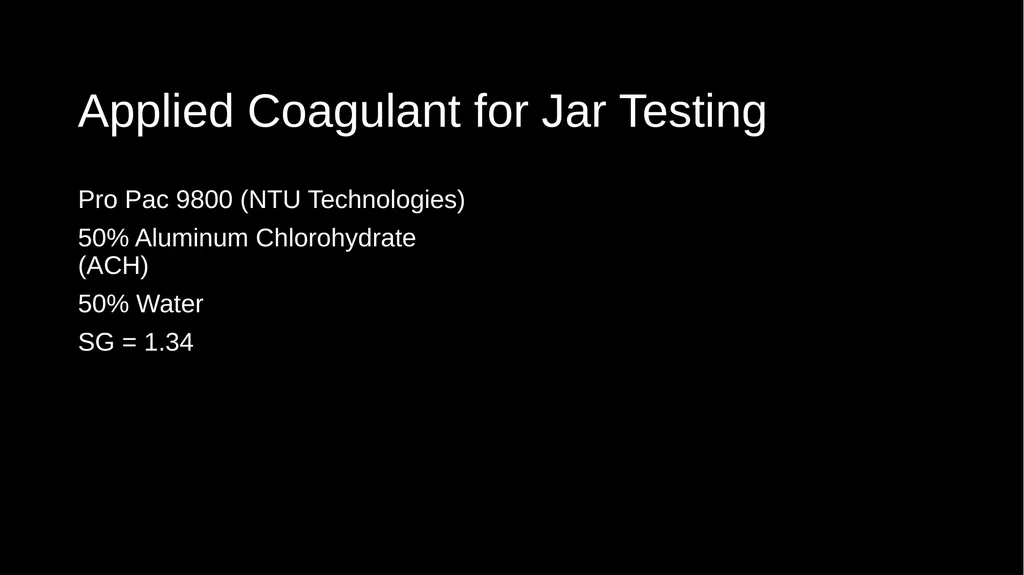
Applied Coagulant for Jar Testing Pro Pac 9800 (NTU Technologies)
50% Aluminum Chlorohydrate (ACH)
50% Water
SG = 1.34<br>
05
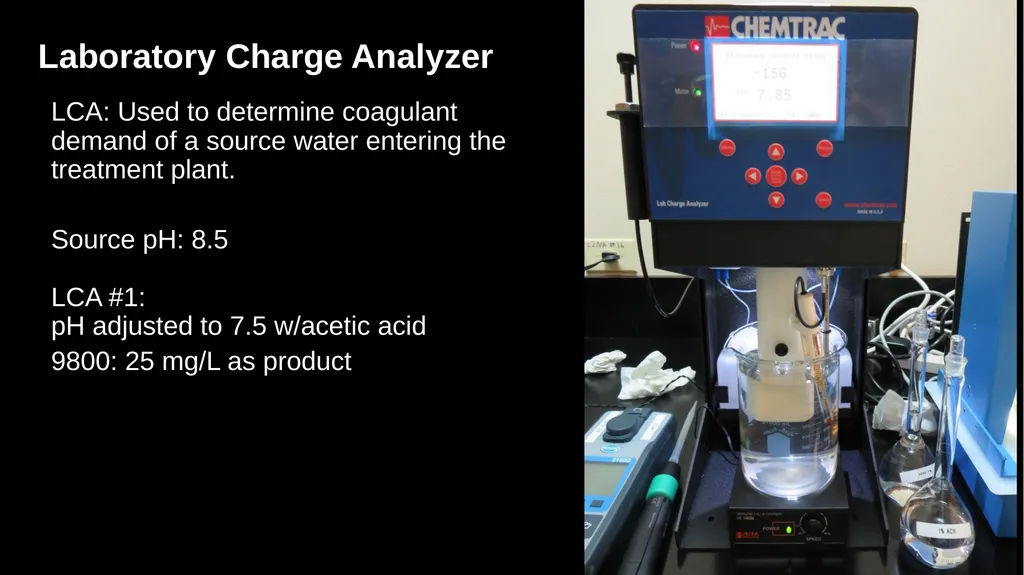
Laboratory Charge Analyzer LCA: Used to determine coagulant demand of a source water entering the treatment plant.
Source pH: 8.5
LCA #1:
pH adjusted to 7.5 w/acetic acid
9800: 25 mg/L as product<br>
06
Coagulant Information Unless stated otherwise, all coagulant doses are reported as Product (100% strength).
Preparation of coagulant stock solutions are generally 1.0 and/or 0.1 percent strength using 100 and/or 200 mL volumetric flasks.
Finnpipette F2 variable volume pipette, capacity 100-1000 micro liters is used for stock solution preparation and coagulant aid jar test dosing.
Finnpipette F2 variable volume pipette, capacity 0.5-5 mL is used for primary coagulant jar test dosing.<br>
07
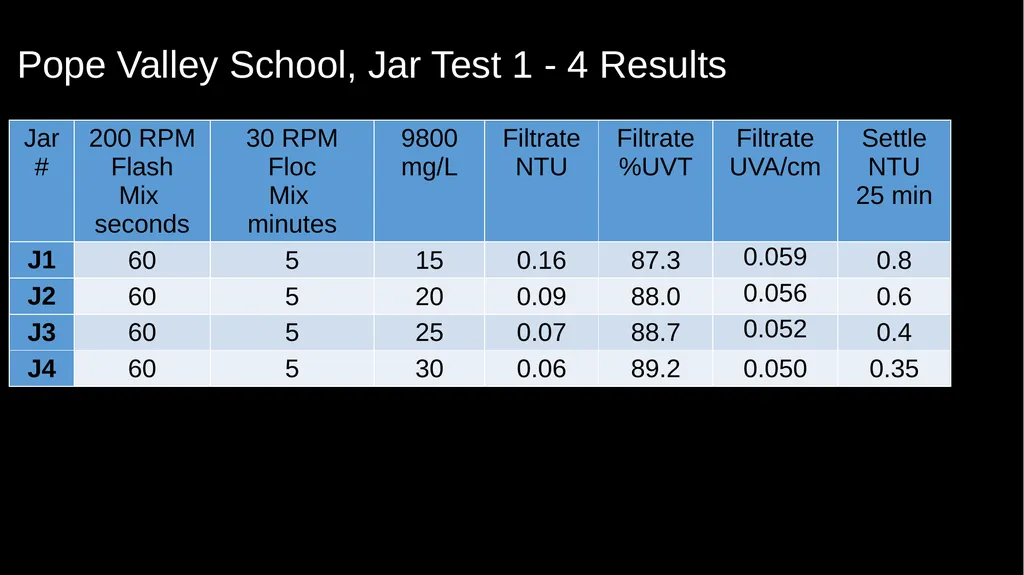
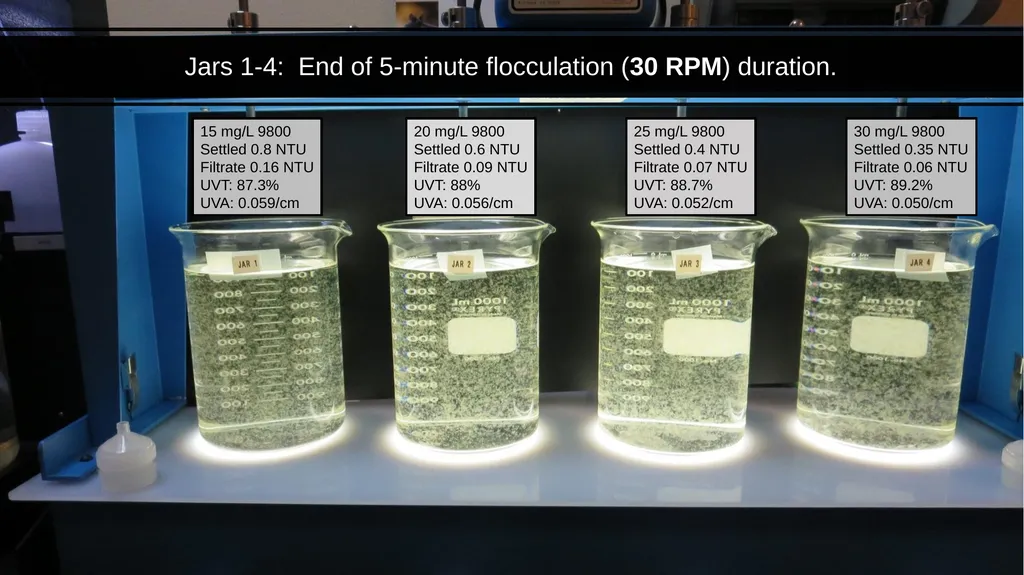
Pope Valley School, Jar Test 1 - 4 Results<br>
08
Jars 1-4 Test Flash Mix 60 Sec (200 RPM) Floc Mix 5 min (30 RPM) Applied Coagulant 9800<br>
Jars 1-4: After 25-minutes of settling, settled water turbidity is taken.<br>
11
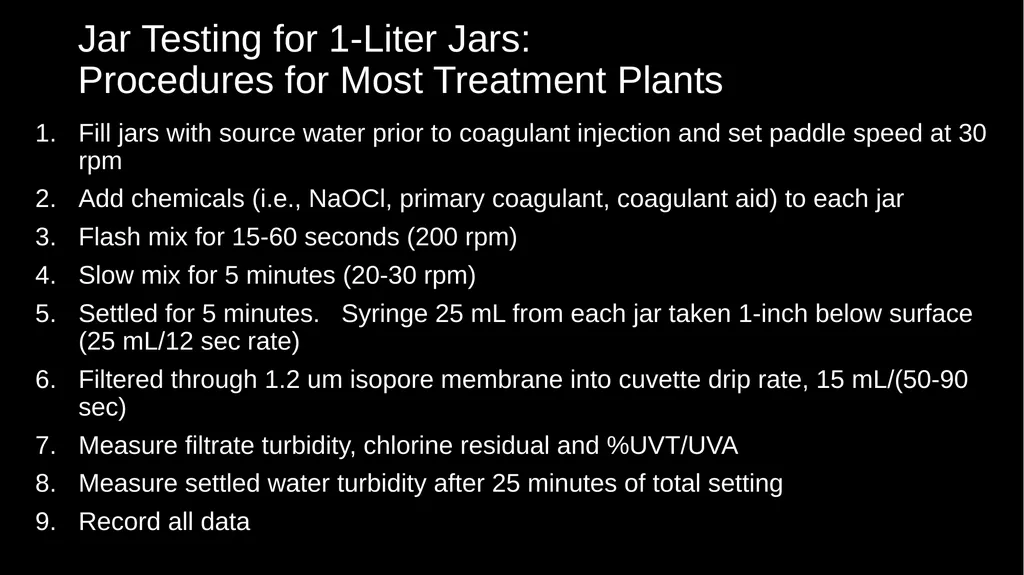
Jar Testing for 1-Liter Jars: Procedures for Most Treatment Plants Fill jars with source water prior to coagulant injection and set paddle speed at 30 rpm
Add chemicals (i.e., NaOCl, primary coagulant, coagulant aid) to each jar
Flash mix for 15-60 seconds (200 rpm)
Slow mix for 5 minutes (20-30 rpm)
Settled for 5 minutes. Syringe 25 mL from each jar taken 1-inch below surface (25 mL/12 sec rate)
Filtered through 1.2 um isopore membrane into cuvette drip rate, 15 mL/(50-90 sec)
Measure filtrate turbidity, chlorine residual and %UVT/UVA
Measure settled water turbidity after 25 minutes of total setting
Record all data<br>
12
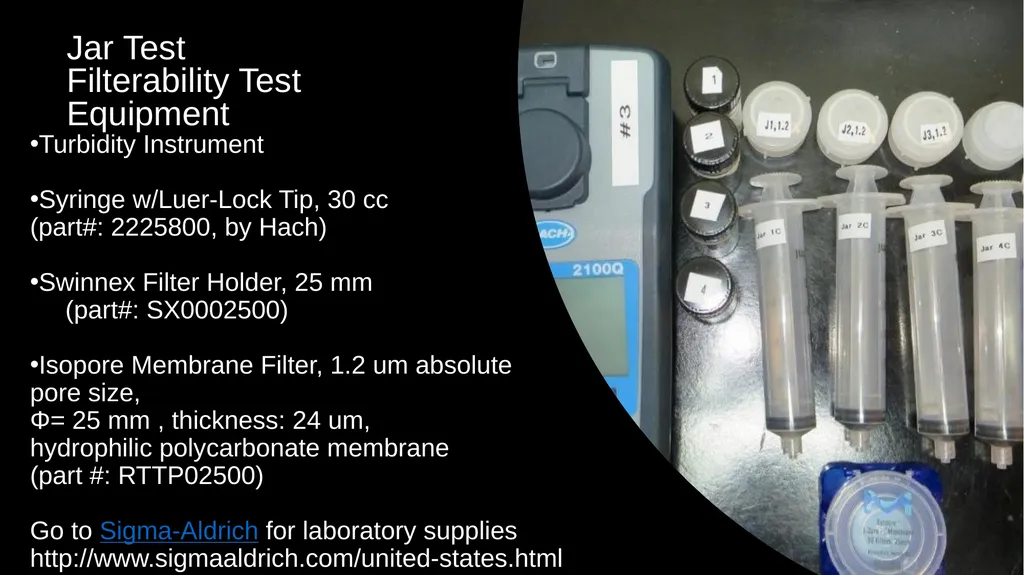
Jar Test Filterability Test Equipment Turbidity Instrument
Syringe w/Luer-Lock Tip, 30 cc
(part#: 2225800, by Hach)
Go to Sigma-Aldrich for laboratory supplies http://www.sigmaaldrich.com/united-states.html<br>
13
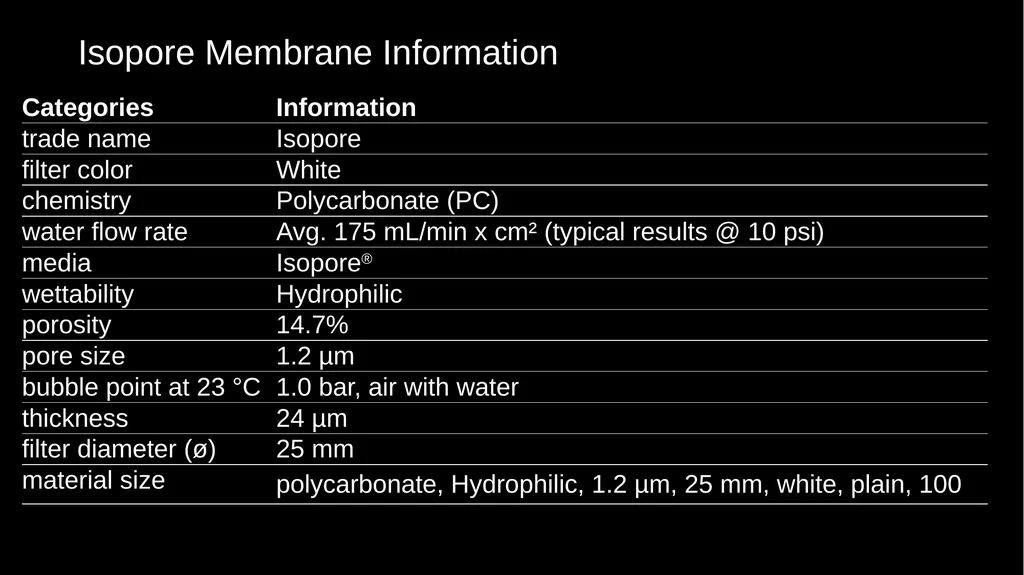
Isopore Membrane Information<br>
14
Isopore Membrane Background Information The Isopore membrane is a polycarbonate, track-etched screen filter recommended for all analyses in which the sample is viewed on the surface of the membrane. The Isopore membrane is composed of polycarbonate film, which has a smooth, glass-like surface for clearer sample observation. The unique manufacturing process of the membrane ensures a precise pore diameter and a consistent pore size for accurate separation of samples by size. Matched-weight filters are not usually required because of low, constant tar and ash weights. Features & Benefits: Membrane structure retains particles on the surface, simplifying counting and analysis<br>
15
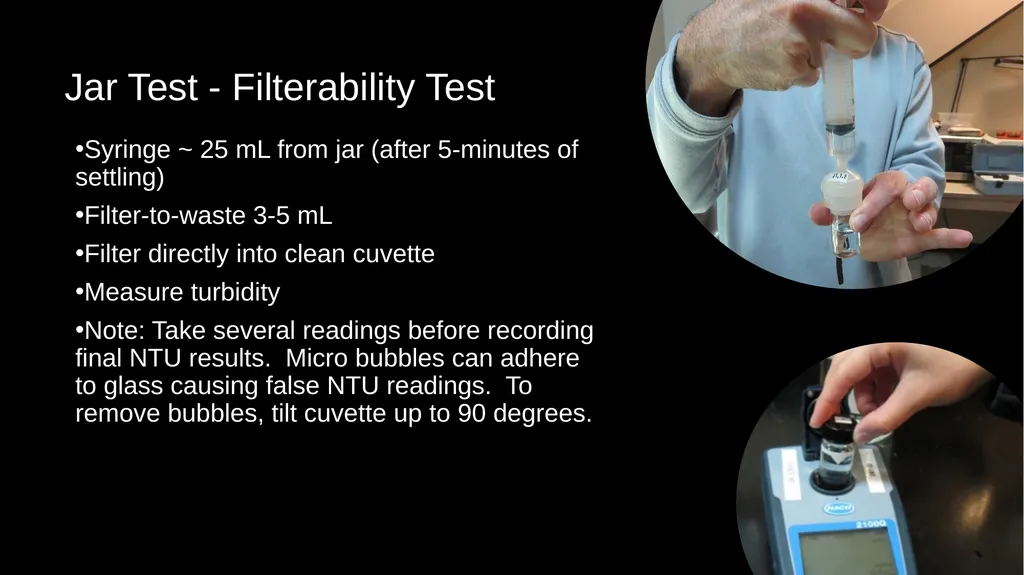
Jar Test - Filterability Test Syringe ~ 25 mL from jar (after 5-minutes of settling)
Filter-to-waste 3-5 mL
Filter directly into clean cuvette
Measure turbidity
Note: Take several readings before recording final NTU results. Micro bubbles can adhere to glass causing false NTU readings. To remove bubbles, tilt cuvette up to 90 degrees.<br>
16
Contact Guy Schott, P.E.
State Water Resources Control Board
Division of Drinking Water
Santa Rosa, CA
Go to Stock Solution/Dose calculations/Jar Test Results for tools to download
www.waterboards.ca.gov/drinking_water/programs/districts/mendocino_district.html
Email: Guy Schott - Guy.Schott@waterboards.ca.gov
Office Number: 707-576-2732<br>