Population Biology Chapter 27 Growth of Populations A population is a group of organisms belonging to the same species and living within a certain area. The number of organisms within the group is the population size. Under ideal
"Population Biology Chapter 27 Growth of" is the property of its rightful owner. Permission is granted to
download and print the materials on this website for personal, non-commercial use only, and to display it
on your personal computer provided you do not modify the materials and that you retain all copyright
notices contained in the materials. By downloading content from our website, you accept the terms of this
agreement.
Presentation Transcript
01
Population Biology Chapter 27<br>
02
Growth of Populations A population is a group of organisms belonging to the same species and living within a certain area.
The number of organisms within the group is the population size.
Under ideal conditions, unlimited food, absence of disease etc, the size of a population would increase indefinitely.<br>
03
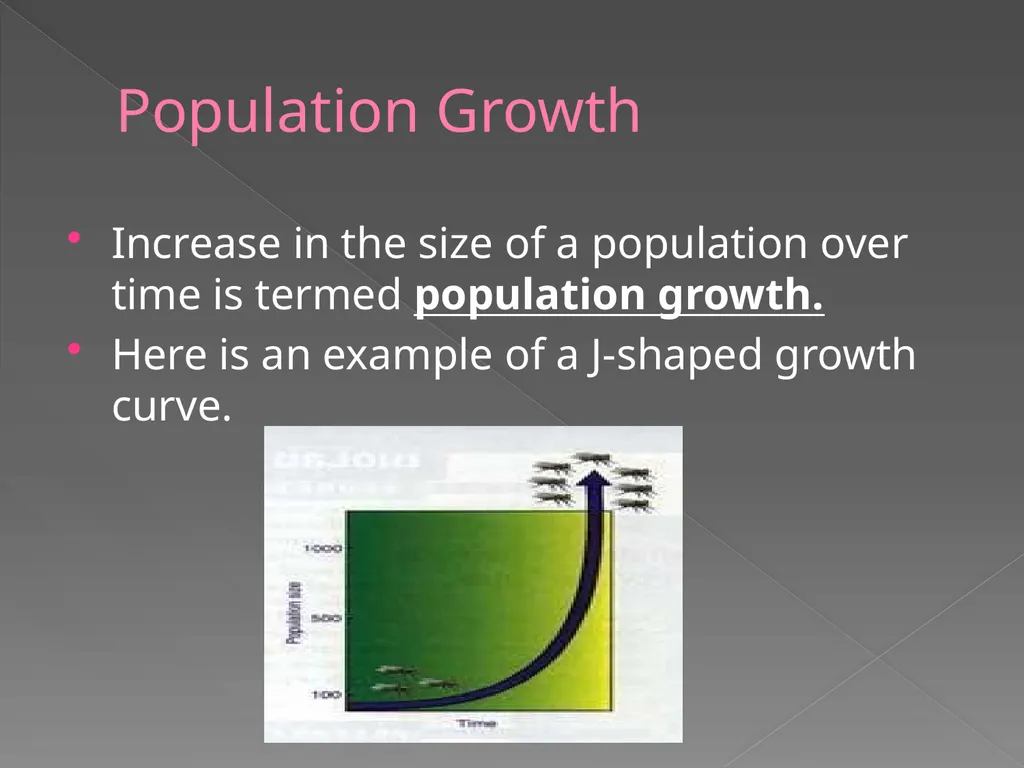
Population Growth Increase in the size of a population over time is termed population growth.
Here is an example of a J-shaped growth curve.<br>
04
Example Under ideal conditions, many species of bacteria can double their population size every 20 minutes.
In 36 hours, one bacterium could give rise to enough bacteria to cover the Earth with a layer 30 cm deep.
The highest rate of reproduction under ideal conditions is called a population’s biotic potential.<br>
05
Biotic potential Most organisms never reach their biotic potential.
Limiting factors are circumstances that keep organisms from reaching their biotic potential.
Temperature, disease, predators, habitat, and lack of food can all be considered limiting factors.<br>
06
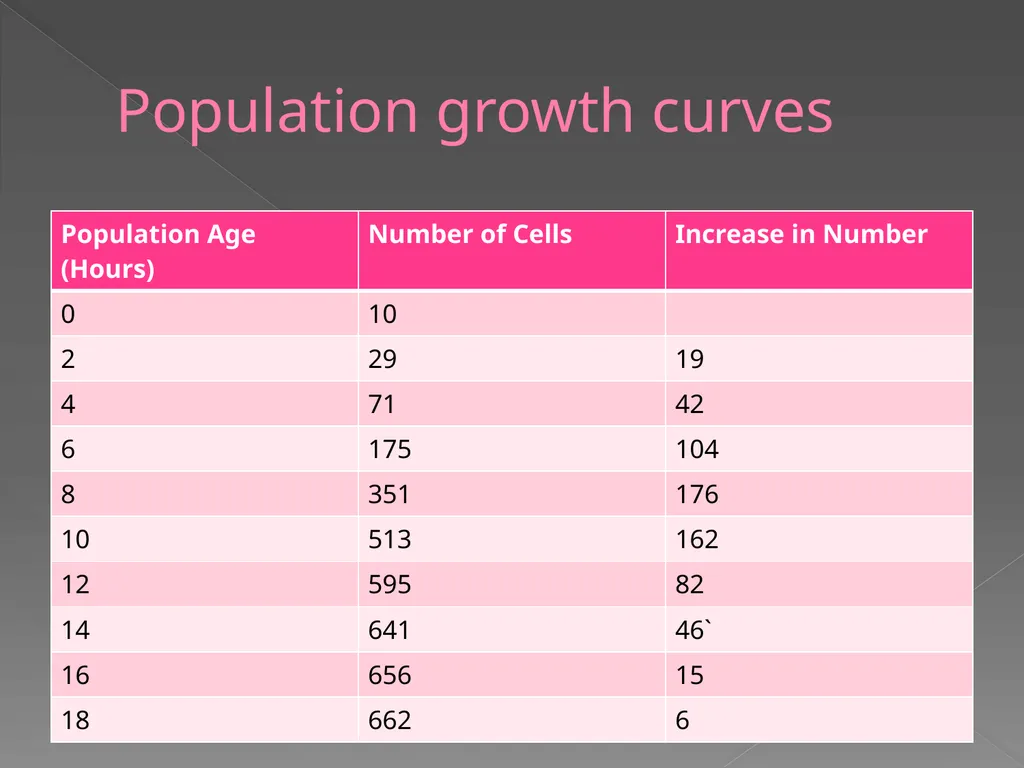
Population Growth Curves How do we know how populations grow and respond to the environment?
In a lab, growth can be studied easily because conditions can be controlled.
To study a population of yeast cells, a culture medium can be inoculated with a few yeast cells and growth can be measured.<br>
07
Population growth curves<br>
08
Population growth curves: s curve/ carrying capacity<br>
09
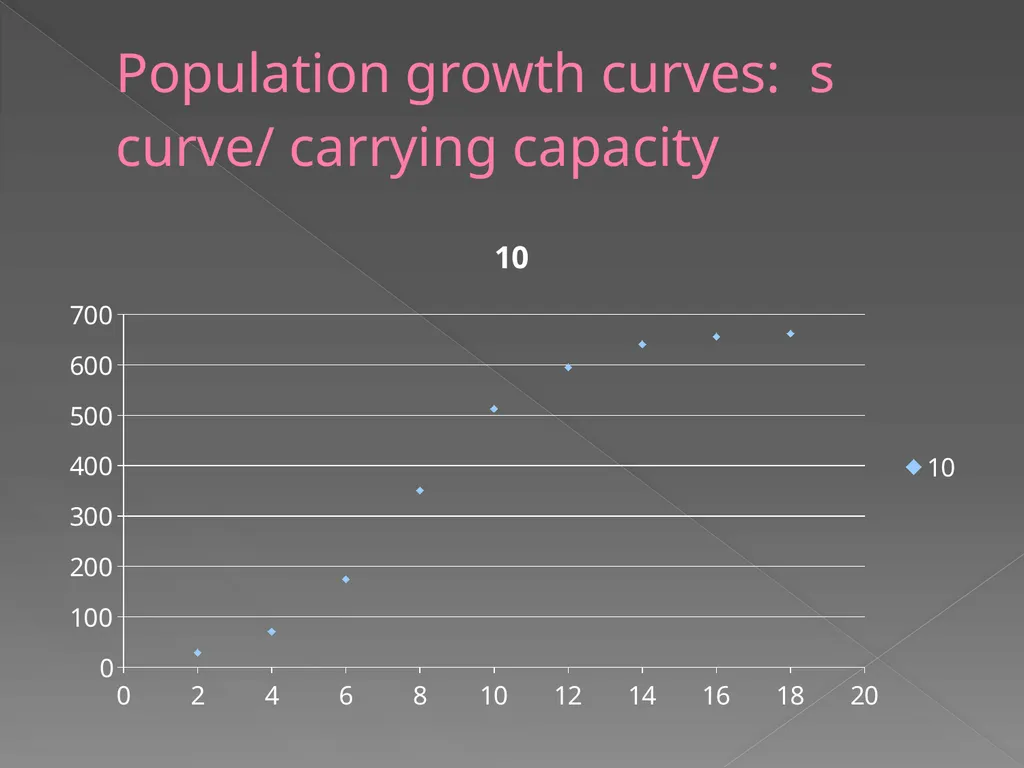
Carrying capacity When a population arrives at a point when its size is no longer increasing, it has reached its carrying capacity of the environment at that particular time.
This number is not definite or permanent.
What do you think this means?
At carrying capacity, the birth rate for a population will roughly equal the death rate, (everything else being equal.)<br>
10
Density-dependent limiting factors Limiting factors for organisms that follow an S-shaped growth curve are almost always density-dependent.
This means the influence of any limiting factor varies with the size of the population density.
Example: Frogs in a pond.<br>
11
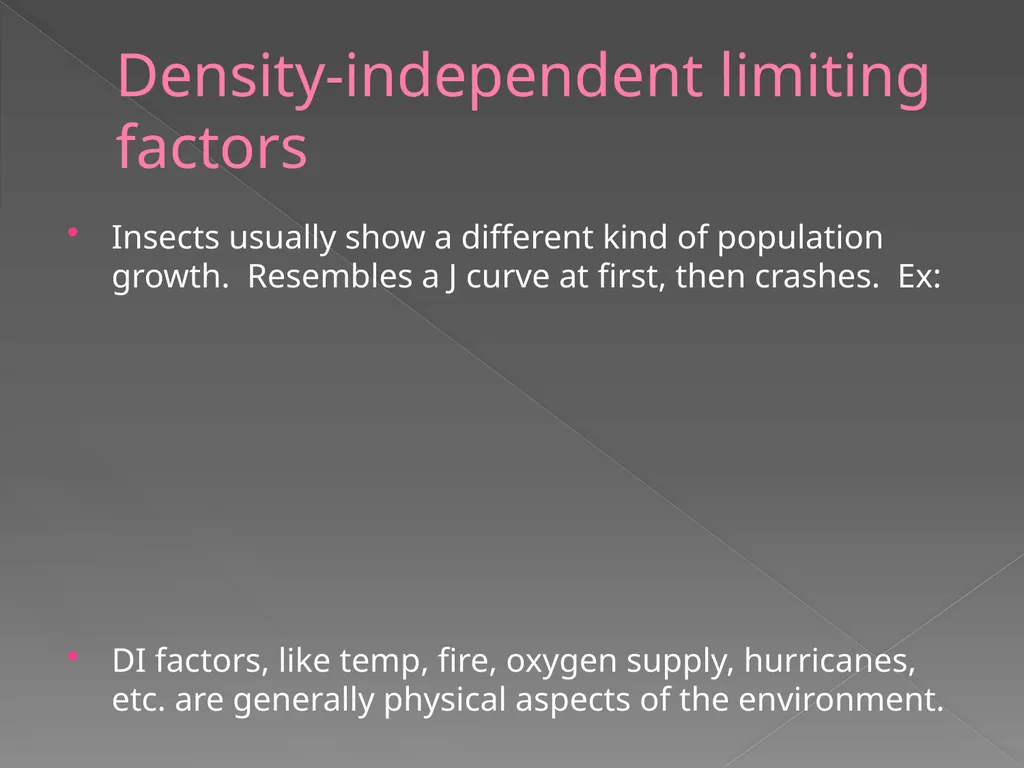
Density-independent limiting factors Insects usually show a different kind of population growth. Resembles a J curve at first, then crashes. Ex:
DI factors, like temp, fire, oxygen supply, hurricanes, etc. are generally physical aspects of the environment.<br>
12
27.1 Review Questions 1-5 page 766<br>
13
27.2 regulation of population size DD limiting factors are more often biological rather than physical.
Predation and food: Often hard to determine what effect predation has on a population.
Predation as a DD factor: we will work on an activity with this.
Is predation beneficial?<br>
14
parasitism Parasites can be limiting factors for a population.
They usually harm their host, but do not kill it.
If they killed the host, they would be without a home.
Why is parasitism a DD factor?
What about disease and populations? Are they DD as well?<br>
15
Interspecific competition When populations of different species compete for same food source.
Its DD.
When it occurs, three things may happen:
Extinction (local)
Movement – warblers and spruce trees.
Adaptation – Darwin’s finches – seeds vs. insects.
Virtual Lab involving Paramecium caudatum and Paramecium aurelia.<br>
16
Intraspecific competition Competition between members of the same species.
More severe, because all members of the same species have same requirements to survive.
Also DD: how organisms adapt
Life cycles and life spans – tadpoles and frogs; insects, dispersal of plant seeds by wind.
Dominance and social hierarchy – wolves. Increases order and decreases aggression throughout the species. If not all can mate due to poor conditions, dominant ones will and lesser ones will not.<br>
17
Inraspecific continued Role separation – ants and bees
Behavioral and physiological changes – birth and death rates can be affected by stress in populations.
Emigration – move out to a new area.
Territoriality – song birds, coyotes, fox, howler monkeys. Reduces conflict within species and can help keep populations in check.<br>
18
The human population – without limits??<br>
19
Human population Right now, it appears to be a J curve growth.
Growth rates are declining in developed countries.
Not the case in undeveloped countries.
More sanitary populations
Antibiotics
Technology has expanded the limits<br>
20
Tragedy of the commons Thomas Malthus wrote an essay on population growth.
Dealt with people’s tendency to take care of what they owned, and not take care of what they did not.<br>