
PORTFOLIO COMMITTEE PRESENTATION ON THE




Description: PORTFOLIO COMMITTEE PRESENTATION ON THE DEVELOPMENT FINANCE INSTITUTIONS DIRECTOR-GENERAL: MR T ZULU 03 MARCH 2015 1 CONFIDENTIAL OUTLINE Introduction Background Progress to date Needs Analysis Sector Challenges Rationale Case for
Related Topics
Download Presentation
"PORTFOLIO COMMITTEE PRESENTATION ON THE" is the property of its rightful owner. Permission is granted to download and print the materials on this website for personal, non-commercial use only, and to display it on your personal computer provided you do not modify the materials and that you retain all copyright notices contained in the materials. By downloading content from our website, you accept the terms of this agreement.
Presentation Transcript
slide1. PORTFOLIO COMMITTEE PRESENTATION ON THE DEVELOPMENT FINANCE INSTITUTIONS
DIRECTOR-GENERAL: MR T ZULU
03 MARCH 2015 1 CONFIDENTIAL<br>
slide2. OUTLINE Introduction
Background
Progress to date
Needs Analysis
Sector Challenges
Rationale
Case for Consolidation
Options Analysis
Practical Establishment of the DFI
Delivery Model
Human Resources Implications
Financial Implications
Implementation Plan
Project Schedule 2 CONFIDENTIAL<br>
slide3. INTRODUCTION This business case sets out the rationale for the proposed establishment and also provides the details of the institutional framework and arrangements for the Consolidated DFI
In preparing this business case cognisance has been taken of the following:
specific requirements in respect of public entity establishment as determined by National Treasury and the Department of Public Service and Administration
relevant legislative and policy guidelines - the Public Finance Management Act, Public Entities Guidelines and other legislation governing public entities 3 CONFIDENTIAL<br>
slide4. BACKGROUND The housing sector is supported by three DFIs – the National Housing Finance Corporation (NHFC), the Rural Housing Loan Fund (RHLF) and the National Urban Reconstruction and Housing Agency (NURCHA)
The DFIs were created to promote social and economic development and individual DFIs have specialised areas of operation.
National Treasury undertook a review of the mandates of South Africa’s Development Finance Institutions (DFIs) at the request of Cabinet (March 2008).
Treasury Review recommended amalgamating the housing sector DFIs into a single institution. The proposed new Consolidated DFI would have three main divisions focusing on:
Intermediary Finance
Contractors
Financing (Source: The National Treasury – Review of Development Finance Institutions – Draft Report March 2008) 4 CONFIDENTIAL<br>
slide5. BACKGROUND Following the Treasury Review, the NDoHS undertook an investigation into finance delivery mechanisms for the Human Settlements Sector.
Each of the Housing Development Finance Institutions operates in a specific niche market:
RHLF addresses the lack of end user finance in non-metropolitan areas
NURCHA focus on contractor’s/developer’s finance and support in respect of new housing development (affordable and subsidy) and infrastructure backlogs
NHFC addresses the lack of project finance for social housing, as well as affordable private sector rental and housing for sale.
The existing expertise and capacity is an important resource for the sector and needs to be preserved. 5 CONFIDENTIAL<br>
slide6. BACKGROUND The DFIs, however, operate at too small a scale to impact significantly on the need.
Accordingly it is proposed that a consolidated Human Settlements Development Finance Institution (HSDFI) should be established comprising a consolidation of the existing DFIs.
(Source: Rationale: Human Settlements Development Finance Institution – Final Draft 15 March 2012)
NDoHS has recently determined that the Investment Function of the Social Housing Regulatory Authority (SHRA) will also be transferred to the consolidated HSDFI 6 CONFIDENTIAL<br>
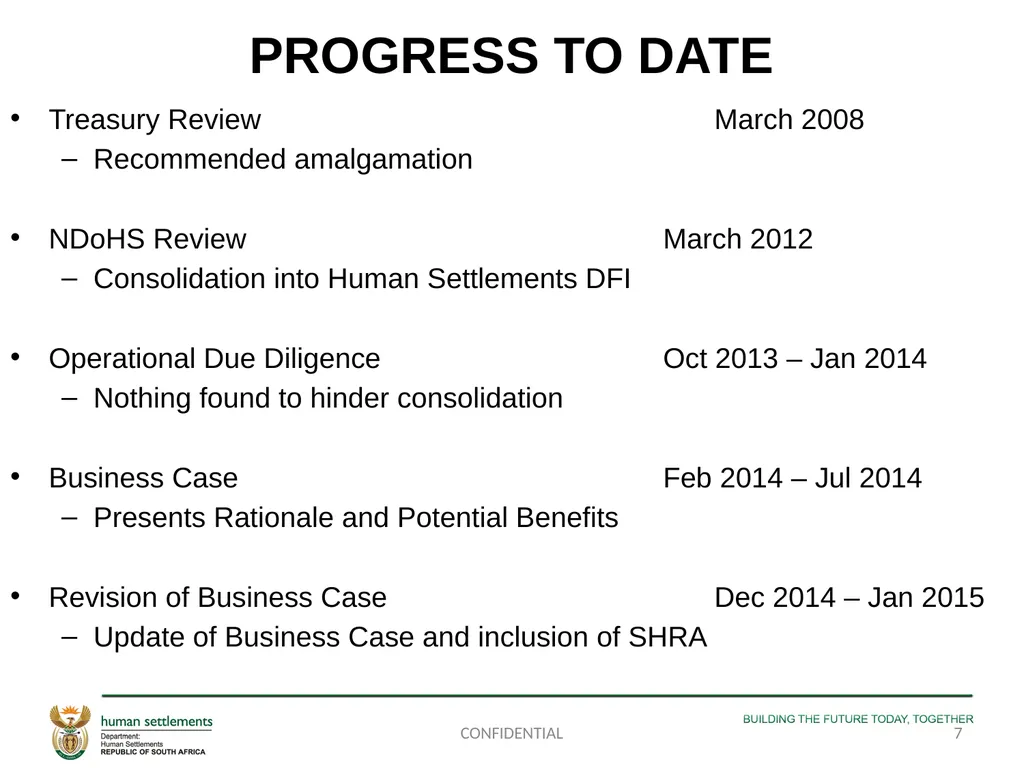
slide7. PROGRESS TO DATE Treasury Review March 2008
Recommended amalgamation
NDoHS Review March 2012
Consolidation into Human Settlements DFI
Operational Due Diligence Oct 2013 – Jan 2014
Nothing found to hinder consolidation
Business Case Feb 2014 – Jul 2014
Presents Rationale and Potential Benefits
Revision of Business Case Dec 2014 – Jan 2015
Update of Business Case and inclusion of SHRA 7 CONFIDENTIAL<br>
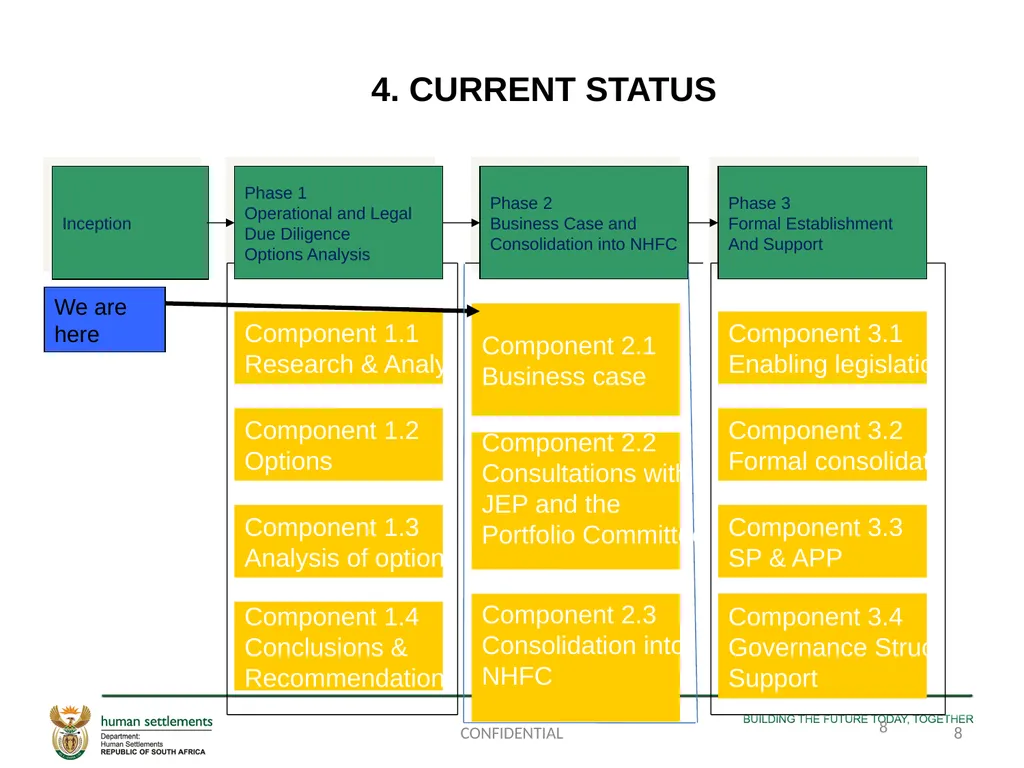
slide8. 4. CURRENT STATUS 8 Inception Phase 1
Operational and Legal
Due Diligence
Options Analysis Phase 2
Business Case and
Consolidation into NHFC Component 1.2
Options Phase 3
Formal Establishment
And Support Component 1.1
Research & Analysis Component 1.3
Analysis of options Component 1.4
Conclusions &
Recommendations Component 2.3
Consolidation into
NHFC Component 2.1
Business case Component 3.1
Enabling legislation Component 3.2
Formal consolidation Component 3.3
SP & APP Component 3.4
Governance Structure
Support We are here Component 2.2
Consultations with
JEP and the
Portfolio Committee CONFIDENTIAL 8<br>
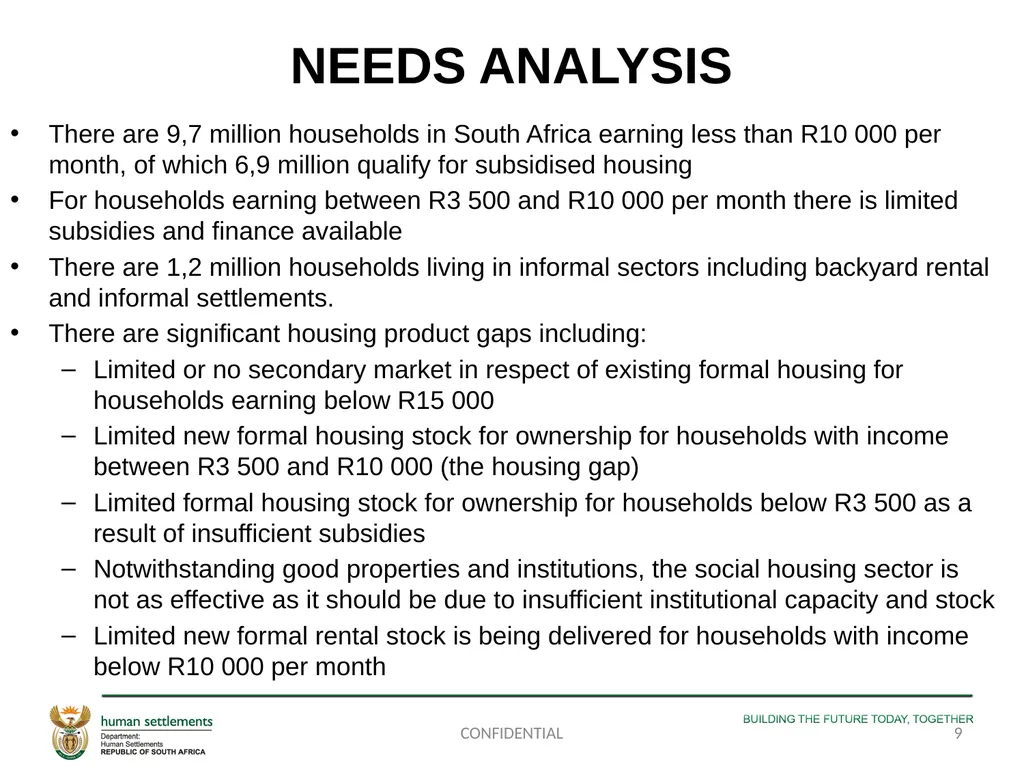
slide9. NEEDS ANALYSIS There are 9,7 million households in South Africa earning less than R10 000 per month, of which 6,9 million qualify for subsidised housing
For households earning between R3 500 and R10 000 per month there is limited subsidies and finance available
There are 1,2 million households living in informal sectors including backyard rental and informal settlements.
There are significant housing product gaps including:
Limited or no secondary market in respect of existing formal housing for households earning below R15 000
Limited new formal housing stock for ownership for households with income between R3 500 and R10 000 (the housing gap)
Limited formal housing stock for ownership for households below R3 500 as a result of insufficient subsidies
Notwithstanding good properties and institutions, the social housing sector is not as effective as it should be due to insufficient institutional capacity and stock
Limited new formal rental stock is being delivered for households with income below R10 000 per month 9 CONFIDENTIAL<br>
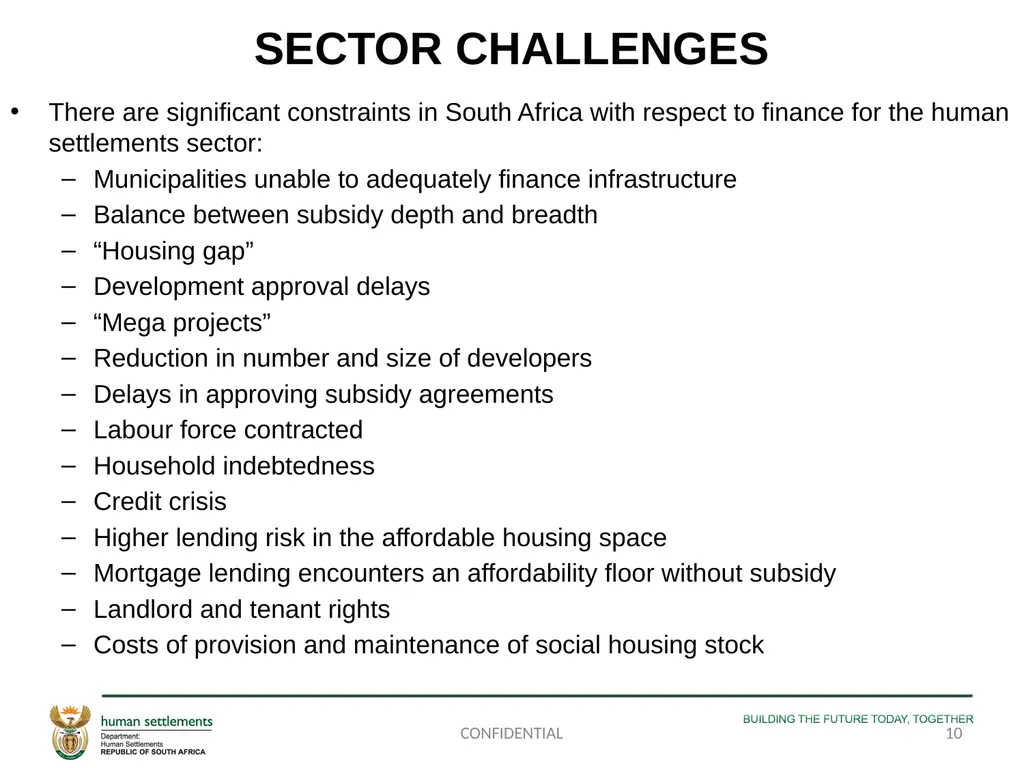
slide10. SECTOR CHALLENGES There are significant constraints in South Africa with respect to finance for the human settlements sector:
Municipalities unable to adequately finance infrastructure
Balance between subsidy depth and breadth
“Housing gap”
Development approval delays
“Mega projects”
Reduction in number and size of developers
Delays in approving subsidy agreements
Labour force contracted
Household indebtedness
Credit crisis
Higher lending risk in the affordable housing space
Mortgage lending encounters an affordability floor without subsidy
Landlord and tenant rights
Costs of provision and maintenance of social housing stock 10 CONFIDENTIAL<br>
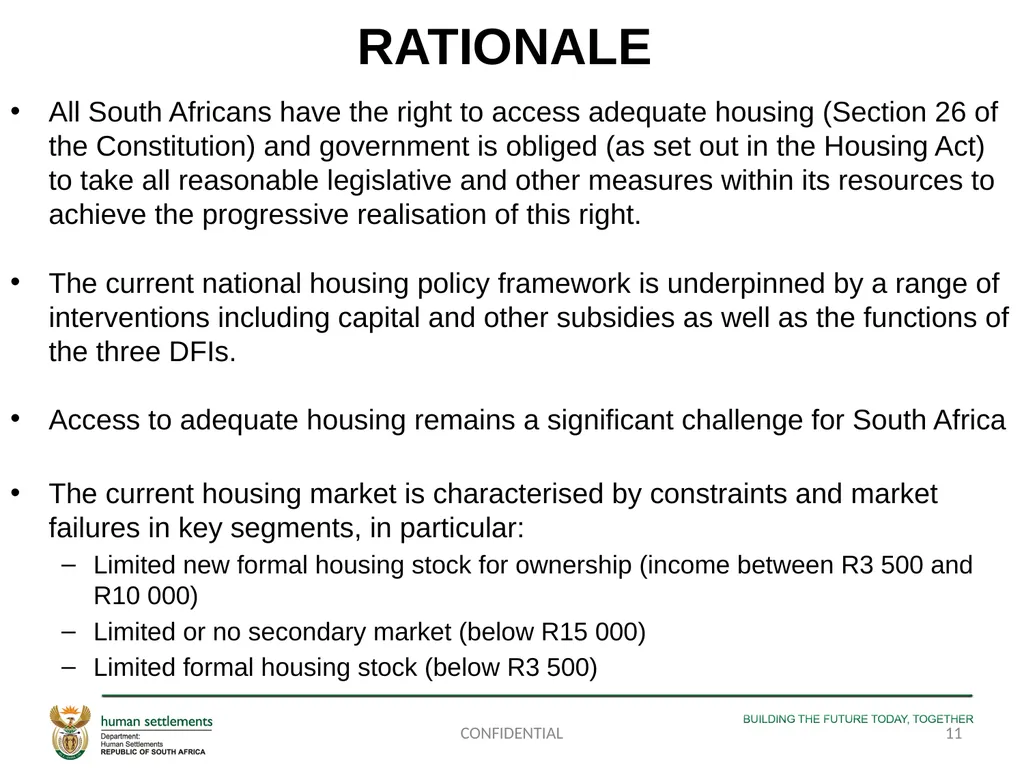
slide11. RATIONALE All South Africans have the right to access adequate housing (Section 26 of the Constitution) and government is obliged (as set out in the Housing Act) to take all reasonable legislative and other measures within its resources to achieve the progressive realisation of this right.
The current national housing policy framework is underpinned by a range of interventions including capital and other subsidies as well as the functions of the three DFIs.
Access to adequate housing remains a significant challenge for South Africa
The current housing market is characterised by constraints and market failures in key segments, in particular:
Limited new formal housing stock for ownership (income between R3 500 and R10 000)
Limited or no secondary market (below R15 000)
Limited formal housing stock (below R3 500) 11 CONFIDENTIAL<br>
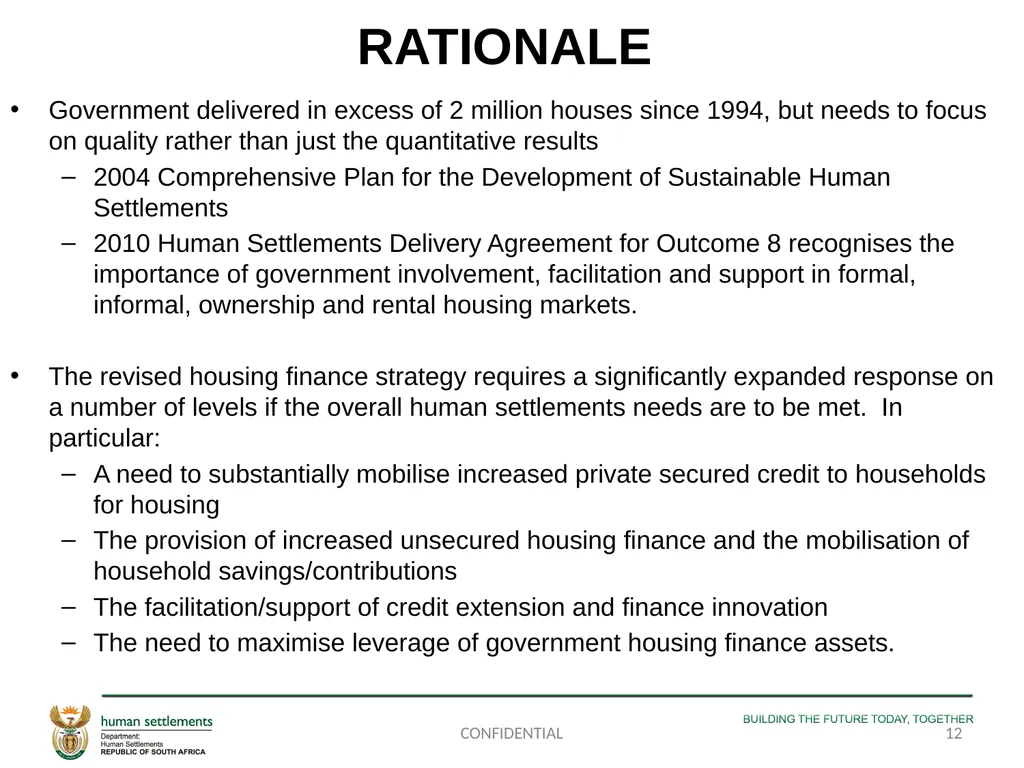
slide12. RATIONALE Government delivered in excess of 2 million houses since 1994, but needs to focus on quality rather than just the quantitative results
2004 Comprehensive Plan for the Development of Sustainable Human Settlements
2010 Human Settlements Delivery Agreement for Outcome 8 recognises the importance of government involvement, facilitation and support in formal, informal, ownership and rental housing markets.
The revised housing finance strategy requires a significantly expanded response on a number of levels if the overall human settlements needs are to be met. In particular:
A need to substantially mobilise increased private secured credit to households for housing
The provision of increased unsecured housing finance and the mobilisation of household savings/contributions
The facilitation/support of credit extension and finance innovation
The need to maximise leverage of government housing finance assets. 12 CONFIDENTIAL<br>
slide13. RATIONALE The revised housing finance strategy therefore strongly indicates the need to build on, as well as rationalise and coordinate the efforts of the existing capacity of the human settlements DFIs, as well as other related public entities and DFIs 13 CONFIDENTIAL<br>
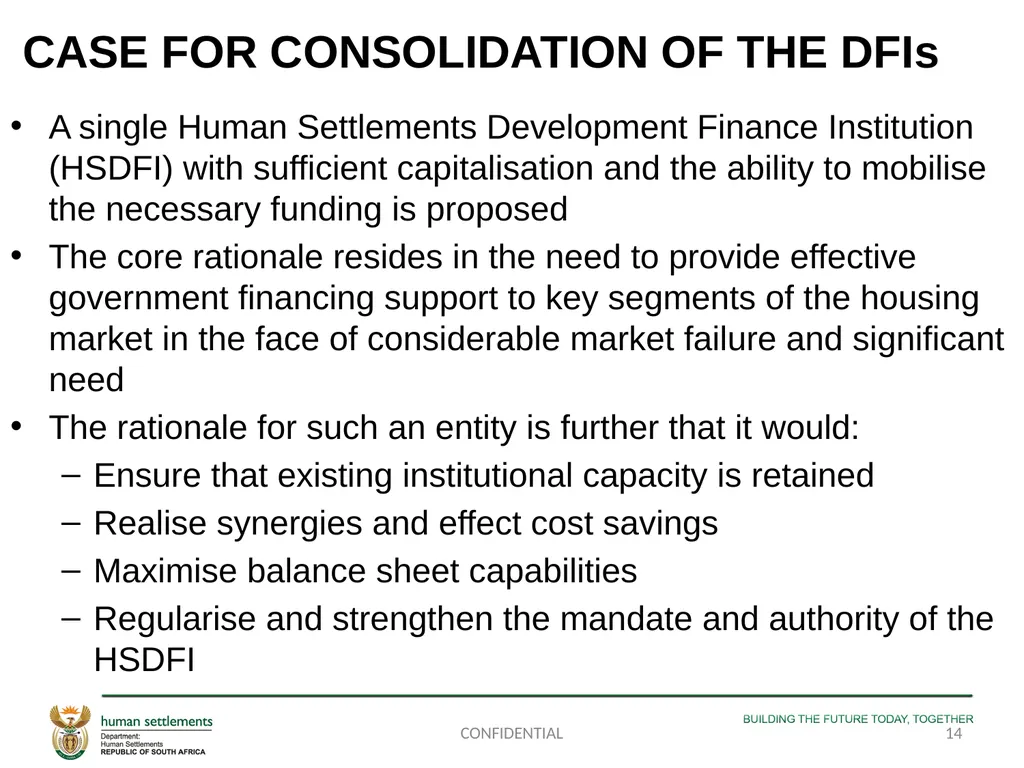
slide14. CASE FOR CONSOLIDATION OF THE DFIs A single Human Settlements Development Finance Institution (HSDFI) with sufficient capitalisation and the ability to mobilise the necessary funding is proposed
The core rationale resides in the need to provide effective government financing support to key segments of the housing market in the face of considerable market failure and significant need
The rationale for such an entity is further that it would:
Ensure that existing institutional capacity is retained
Realise synergies and effect cost savings
Maximise balance sheet capabilities
Regularise and strengthen the mandate and authority of the HSDFI 14 CONFIDENTIAL<br>
slide15. CASE FOR CONSOLIDATION OF THE DFIs NHFC, NURCHA and RHLF to be amalgamated into a single development finance entity
Result in improved policy and functional alignment, operational economies of scale, optimal financial resource allocation and an environment conducive to innovative and expanded human settlements finance provision
Consolidated DFI extended to include the investment function of the Social Housing Regulatory Authority (SHRA). Opportunity for a one-stop shop
Accredited Social Housing Institutions (accredited by SHRA) able to apply for government restructuring capital grant and additional finance to a single Institution
Result: Savings in time and effort for both the social housing institutions as well as avoiding the duplication of effort currently performed by the SHRA and NHFC
Current legislative mandate includes administering the restructuring capital grant allocated by the Medium Term Expenditure Framework (MTEF)
Includes assessing Social Housing Institutions and allocation of capital grants to projects from approved institutions
Function therefore involves a comprehensive assessment of the institution and the financial viability of individual projects 15 CONFIDENTIAL<br>
slide16. ROLE OF THE NEW DFI The role of the HSDFI is to provide effective government financing support to key segments of the housing market in the face of considerable market failure and significant need
Given the policy mandate as well as the identified needs of the sector, the core functions of the HSDFI are as follows:
Provision of unsecured finance
Provision of mortgage-backed finance
Provision of rental housing development finance
Provision of development finance for reticulation and link infrastructure
Provision of contractor and developer support
Capacity building of financial intermediaries
Promotion of innovation and new product development
SHRA Investment Function added as further core function 16 CONFIDENTIAL<br>
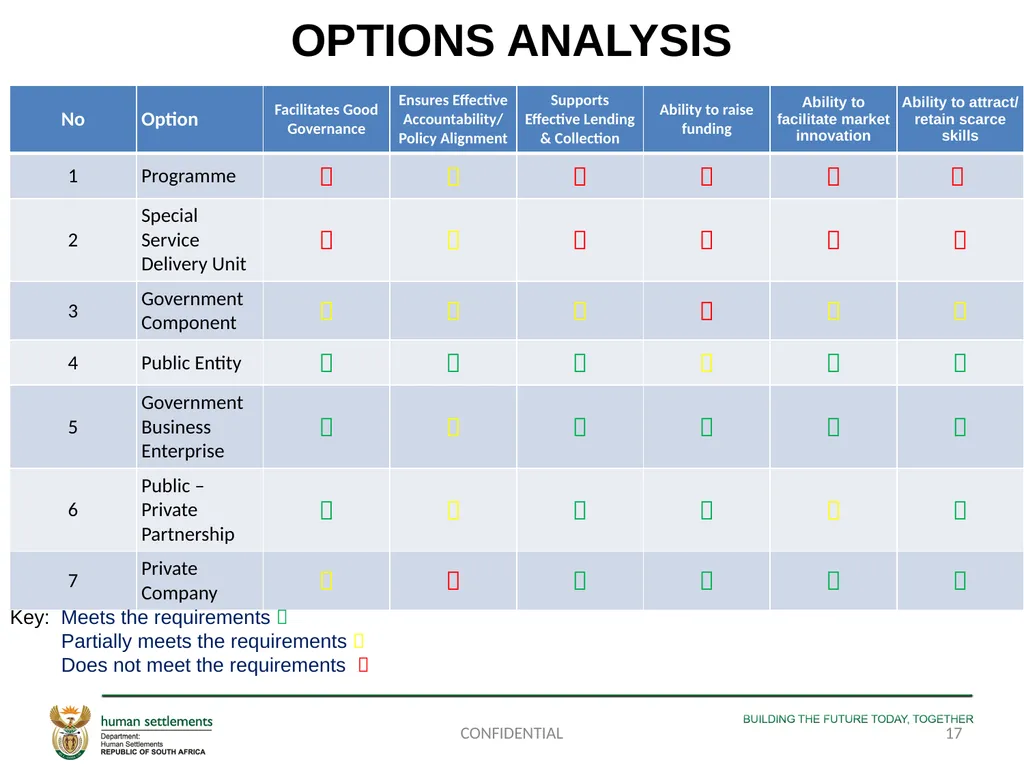
slide17. OPTIONS ANALYSIS 17 Key: Meets the requirements
Partially meets the requirements
Does not meet the requirements CONFIDENTIAL<br>
slide18. OPTIONS ANALYSIS Option 4 – Public Entity
The HSDFI will be established through enabling legislation
It is currently not possible to provide an overview of the provisions of the legislation as it has not yet been developed
The options analysis has indicated that a Government Business Enterprise (Section 3B entity) be established:
To ensure the mandate and capability to raise external funding is met
To enable the entity to invest surplus funds directly in its own activities
To ensure that the entity is tax exempt enabling greater re-investment 18 CONFIDENTIAL<br>
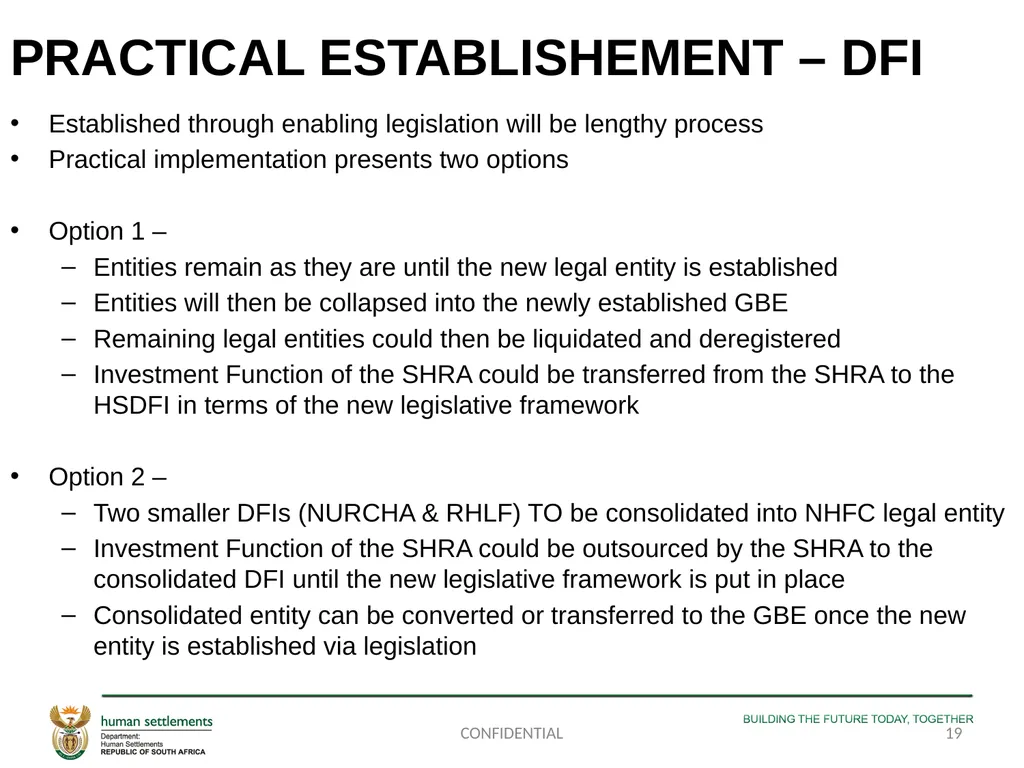
slide19. PRACTICAL ESTABLISHEMENT – DFI Established through enabling legislation will be lengthy process
Practical implementation presents two options
Option 1 –
Entities remain as they are until the new legal entity is established
Entities will then be collapsed into the newly established GBE
Remaining legal entities could then be liquidated and deregistered
Investment Function of the SHRA could be transferred from the SHRA to the HSDFI in terms of the new legislative framework
Option 2 –
Two smaller DFIs (NURCHA & RHLF) TO be consolidated into NHFC legal entity
Investment Function of the SHRA could be outsourced by the SHRA to the consolidated DFI until the new legislative framework is put in place
Consolidated entity can be converted or transferred to the GBE once the new entity is established via legislation 19 CONFIDENTIAL<br>
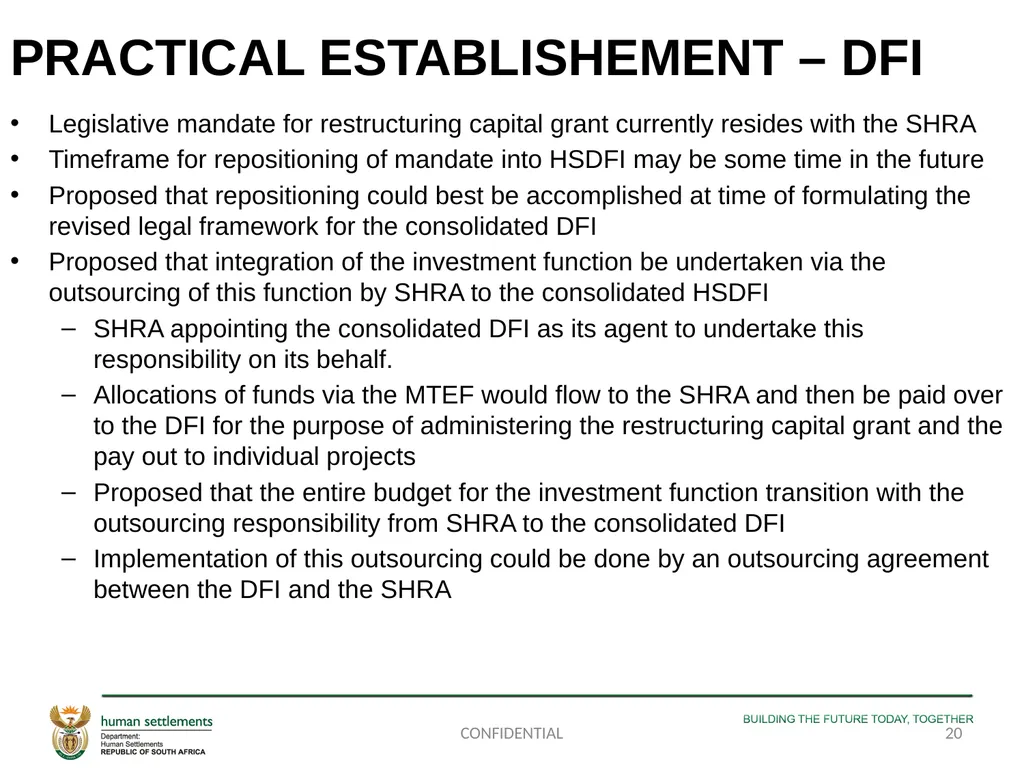
slide20. PRACTICAL ESTABLISHEMENT – DFI Legislative mandate for restructuring capital grant currently resides with the SHRA
Timeframe for repositioning of mandate into HSDFI may be some time in the future
Proposed that repositioning could best be accomplished at time of formulating the revised legal framework for the consolidated DFI
Proposed that integration of the investment function be undertaken via the outsourcing of this function by SHRA to the consolidated HSDFI
SHRA appointing the consolidated DFI as its agent to undertake this responsibility on its behalf.
Allocations of funds via the MTEF would flow to the SHRA and then be paid over to the DFI for the purpose of administering the restructuring capital grant and the pay out to individual projects
Proposed that the entire budget for the investment function transition with the outsourcing responsibility from SHRA to the consolidated DFI
Implementation of this outsourcing could be done by an outsourcing agreement between the DFI and the SHRA 20 CONFIDENTIAL<br>
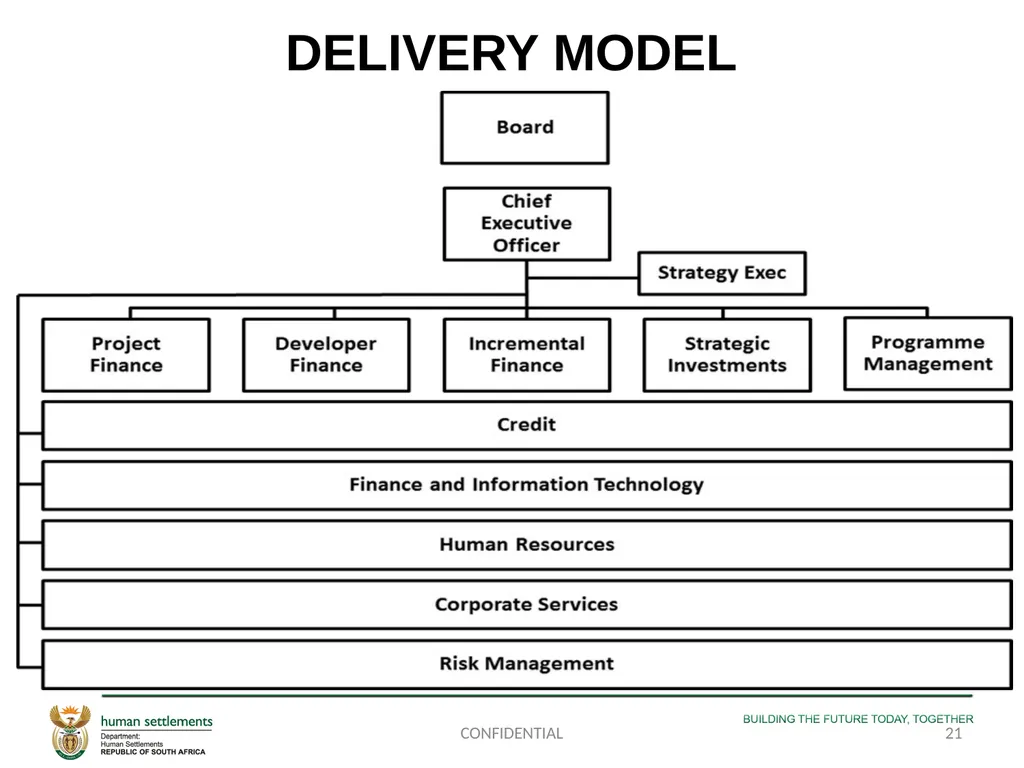
slide21. DELIVERY MODEL 21 CONFIDENTIAL<br>
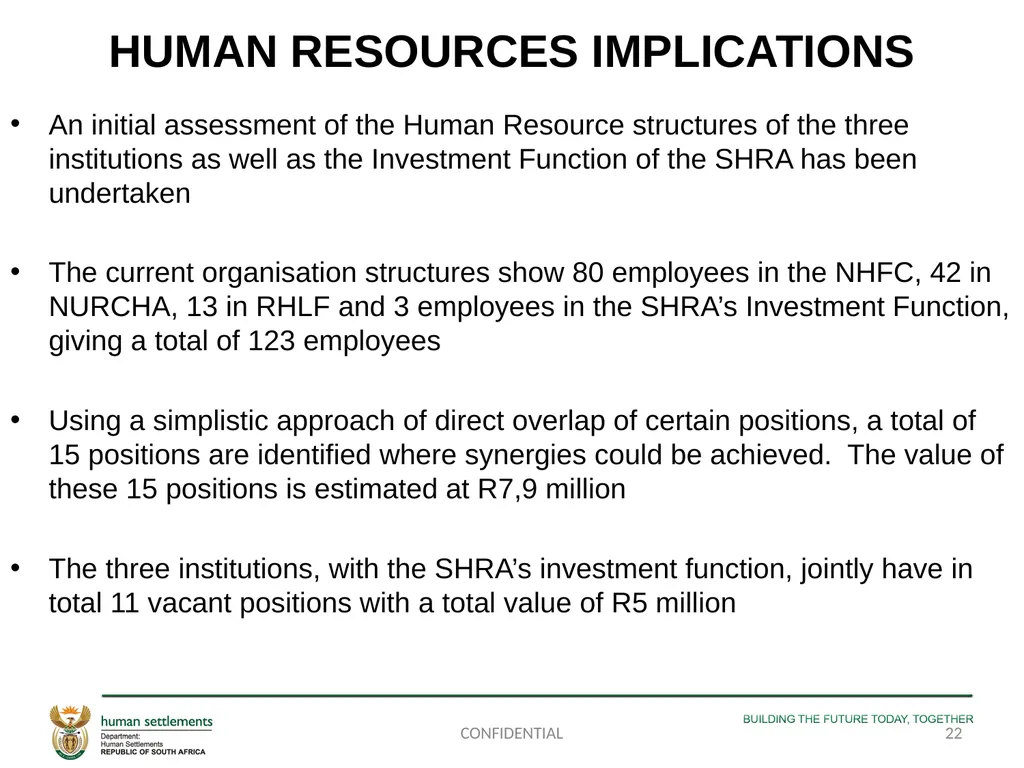
slide22. HUMAN RESOURCES IMPLICATIONS An initial assessment of the Human Resource structures of the three institutions as well as the Investment Function of the SHRA has been undertaken
The current organisation structures show 80 employees in the NHFC, 42 in NURCHA, 13 in RHLF and 3 employees in the SHRA’s Investment Function, giving a total of 123 employees
Using a simplistic approach of direct overlap of certain positions, a total of 15 positions are identified where synergies could be achieved. The value of these 15 positions is estimated at R7,9 million
The three institutions, with the SHRA’s investment function, jointly have in total 11 vacant positions with a total value of R5 million 22 CONFIDENTIAL<br>
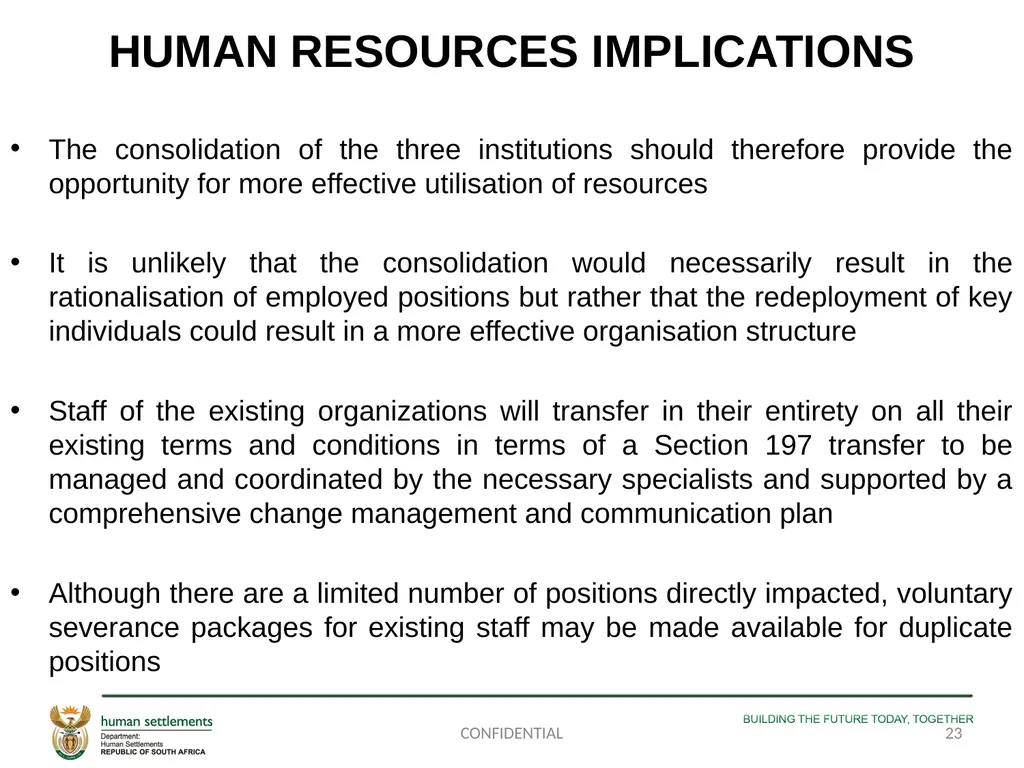
slide23. HUMAN RESOURCES IMPLICATIONS The consolidation of the three institutions should therefore provide the opportunity for more effective utilisation of resources
It is unlikely that the consolidation would necessarily result in the rationalisation of employed positions but rather that the redeployment of key individuals could result in a more effective organisation structure
Staff of the existing organizations will transfer in their entirety on all their existing terms and conditions in terms of a Section 197 transfer to be managed and coordinated by the necessary specialists and supported by a comprehensive change management and communication plan
Although there are a limited number of positions directly impacted, voluntary severance packages for existing staff may be made available for duplicate positions 23 CONFIDENTIAL<br>
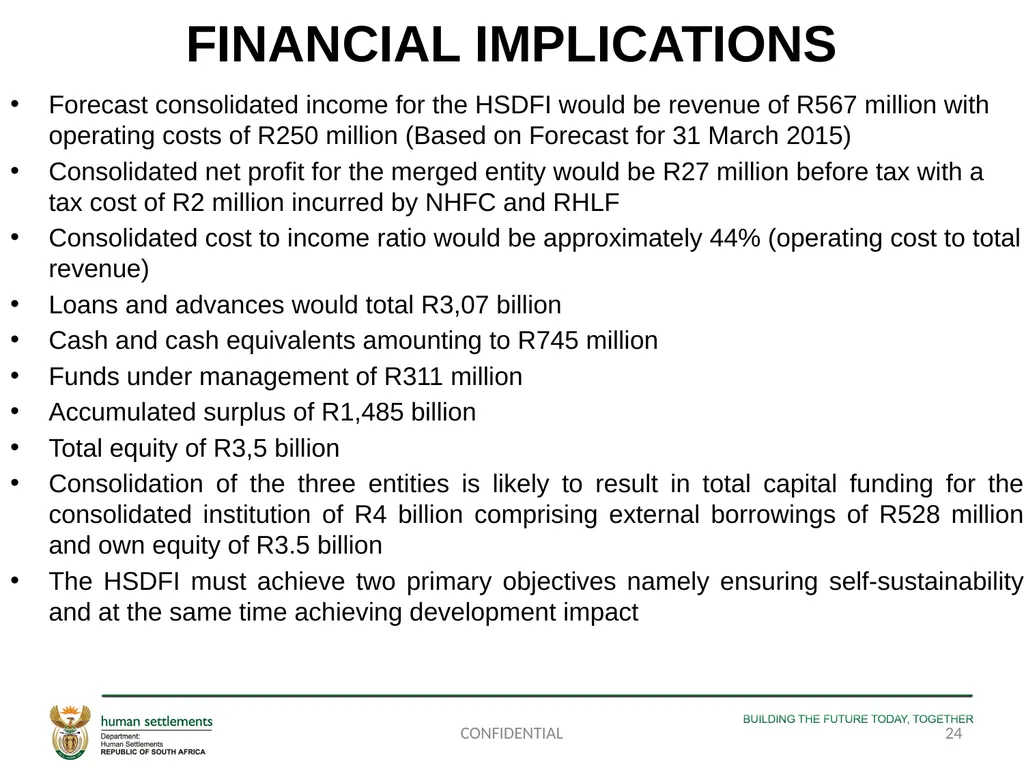
slide24. FINANCIAL IMPLICATIONS Forecast consolidated income for the HSDFI would be revenue of R567 million with operating costs of R250 million (Based on Forecast for 31 March 2015)
Consolidated net profit for the merged entity would be R27 million before tax with a tax cost of R2 million incurred by NHFC and RHLF
Consolidated cost to income ratio would be approximately 44% (operating cost to total revenue)
Loans and advances would total R3,07 billion
Cash and cash equivalents amounting to R745 million
Funds under management of R311 million
Accumulated surplus of R1,485 billion
Total equity of R3,5 billion
Consolidation of the three entities is likely to result in total capital funding for the consolidated institution of R4 billion comprising external borrowings of R528 million and own equity of R3.5 billion
The HSDFI must achieve two primary objectives namely ensuring self-sustainability and at the same time achieving development impact 24 CONFIDENTIAL<br>
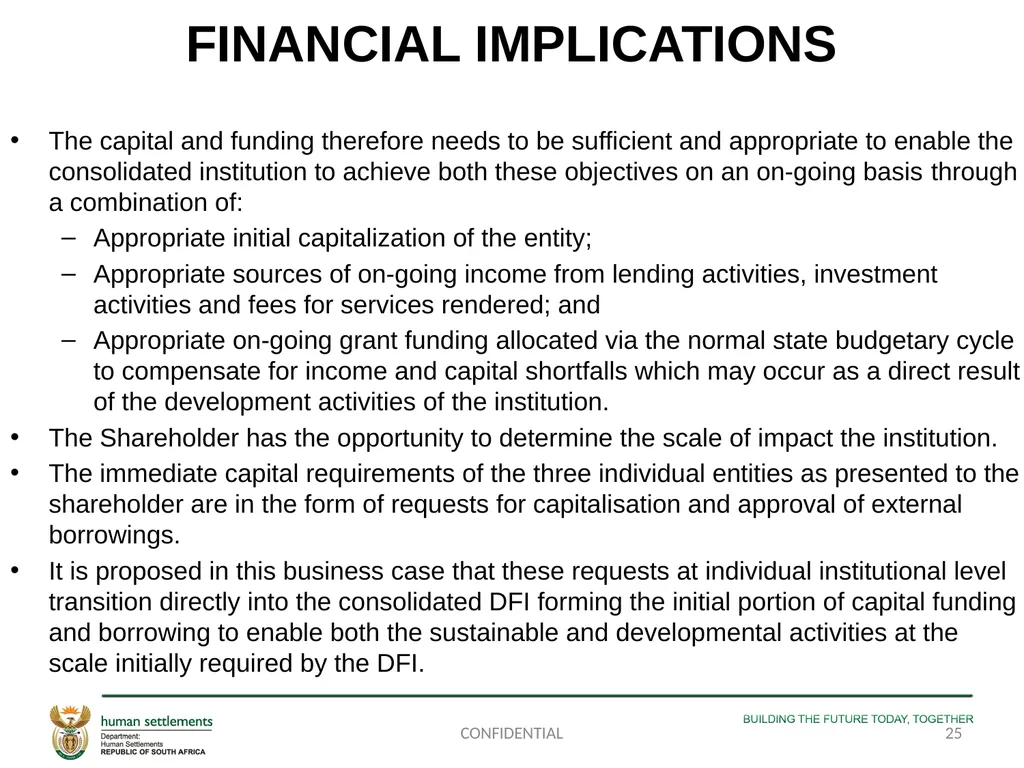
slide25. FINANCIAL IMPLICATIONS The capital and funding therefore needs to be sufficient and appropriate to enable the consolidated institution to achieve both these objectives on an on-going basis through a combination of:
Appropriate initial capitalization of the entity;
Appropriate sources of on-going income from lending activities, investment activities and fees for services rendered; and
Appropriate on-going grant funding allocated via the normal state budgetary cycle to compensate for income and capital shortfalls which may occur as a direct result of the development activities of the institution.
The Shareholder has the opportunity to determine the scale of impact the institution.
The immediate capital requirements of the three individual entities as presented to the shareholder are in the form of requests for capitalisation and approval of external borrowings.
It is proposed in this business case that these requests at individual institutional level transition directly into the consolidated DFI forming the initial portion of capital funding and borrowing to enable both the sustainable and developmental activities at the scale initially required by the DFI. 25 CONFIDENTIAL<br>
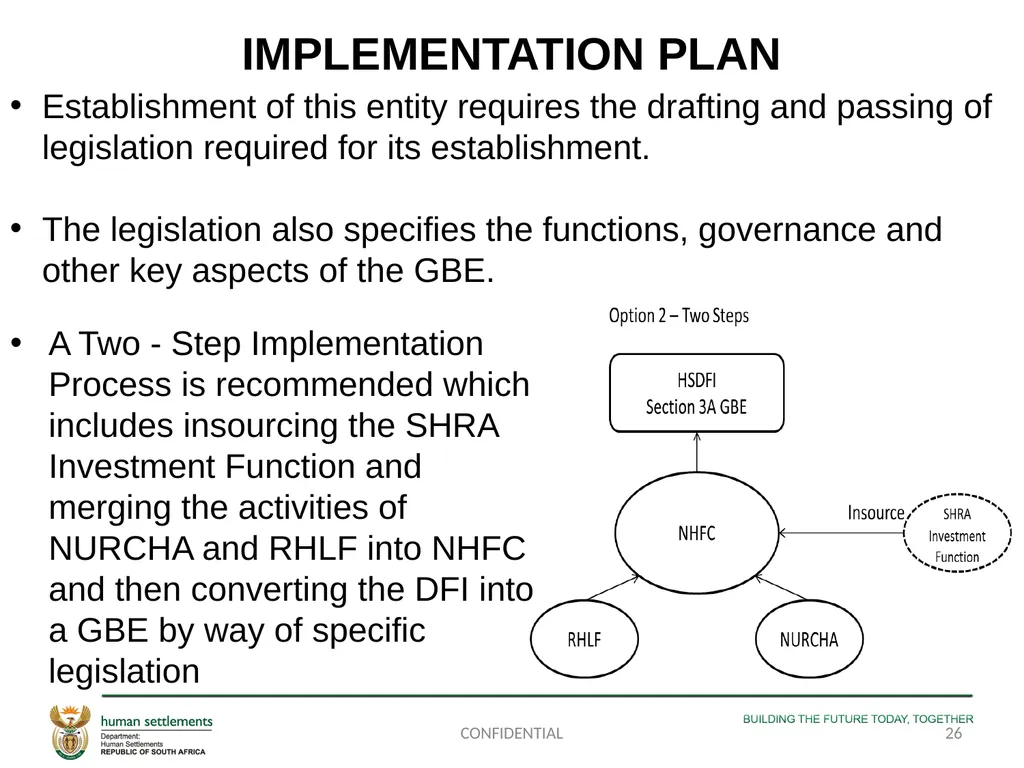
slide26. IMPLEMENTATION PLAN 26 Establishment of this entity requires the drafting and passing of legislation required for its establishment.
The legislation also specifies the functions, governance and other key aspects of the GBE. A Two - Step Implementation Process is recommended which includes insourcing the SHRA Investment Function and merging the activities of NURCHA and RHLF into NHFC and then converting the DFI into a GBE by way of specific legislation CONFIDENTIAL<br>
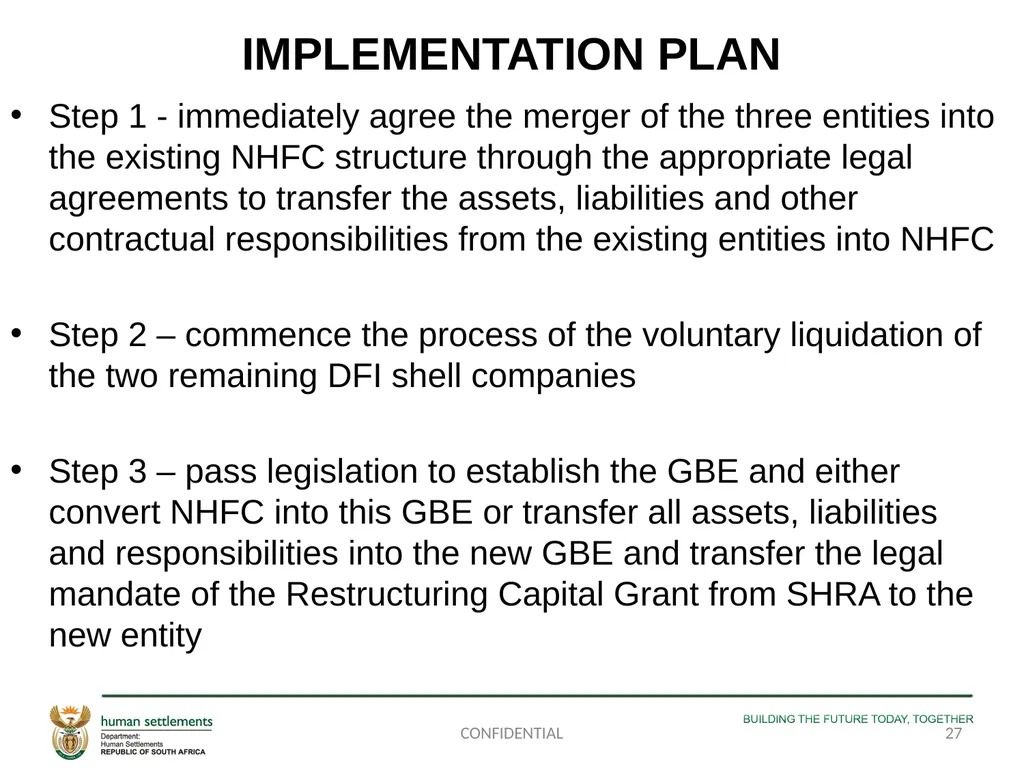
slide27. IMPLEMENTATION PLAN 27 Step 1 - immediately agree the merger of the three entities into the existing NHFC structure through the appropriate legal agreements to transfer the assets, liabilities and other contractual responsibilities from the existing entities into NHFC
Step 2 – commence the process of the voluntary liquidation of the two remaining DFI shell companies
Step 3 – pass legislation to establish the GBE and either convert NHFC into this GBE or transfer all assets, liabilities and responsibilities into the new GBE and transfer the legal mandate of the Restructuring Capital Grant from SHRA to the new entity CONFIDENTIAL<br>
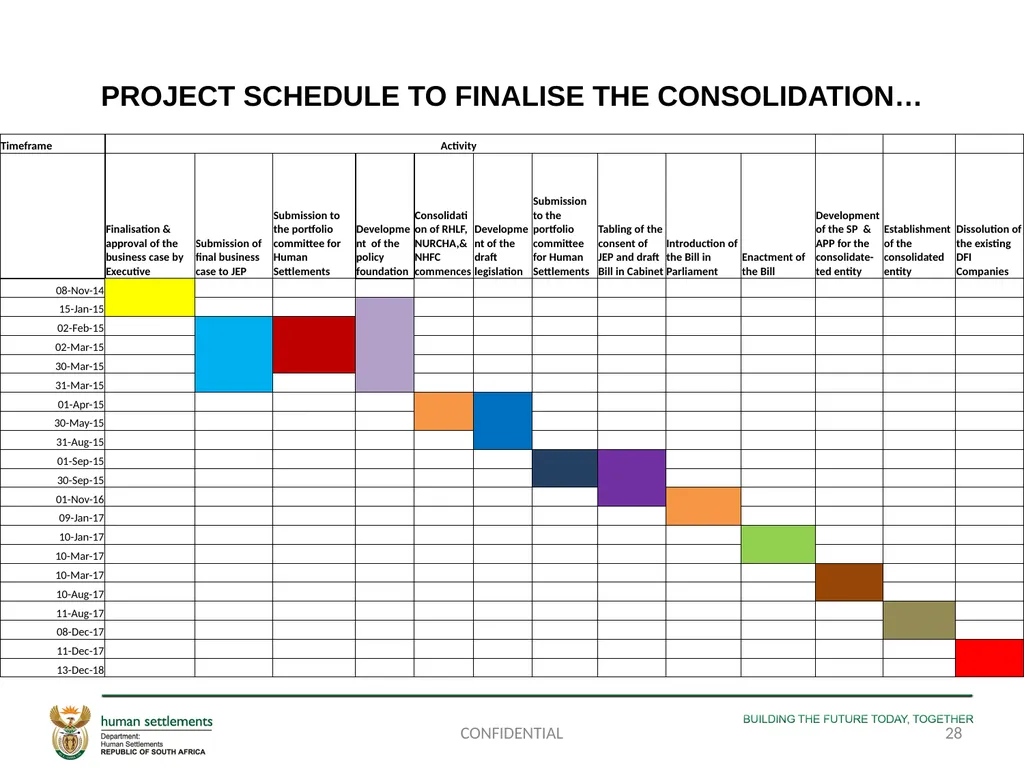
slide28. PROJECT SCHEDULE TO FINALISE THE CONSOLIDATION… CONFIDENTIAL 28<br>
slide29. THANK YOU 29 CONFIDENTIAL<br>
DIRECTOR-GENERAL: MR T ZULU
03 MARCH 2015 1 CONFIDENTIAL<br>
slide2. OUTLINE Introduction
Background
Progress to date
Needs Analysis
Sector Challenges
Rationale
Case for Consolidation
Options Analysis
Practical Establishment of the DFI
Delivery Model
Human Resources Implications
Financial Implications
Implementation Plan
Project Schedule 2 CONFIDENTIAL<br>
slide3. INTRODUCTION This business case sets out the rationale for the proposed establishment and also provides the details of the institutional framework and arrangements for the Consolidated DFI
In preparing this business case cognisance has been taken of the following:
specific requirements in respect of public entity establishment as determined by National Treasury and the Department of Public Service and Administration
relevant legislative and policy guidelines - the Public Finance Management Act, Public Entities Guidelines and other legislation governing public entities 3 CONFIDENTIAL<br>
slide4. BACKGROUND The housing sector is supported by three DFIs – the National Housing Finance Corporation (NHFC), the Rural Housing Loan Fund (RHLF) and the National Urban Reconstruction and Housing Agency (NURCHA)
The DFIs were created to promote social and economic development and individual DFIs have specialised areas of operation.
National Treasury undertook a review of the mandates of South Africa’s Development Finance Institutions (DFIs) at the request of Cabinet (March 2008).
Treasury Review recommended amalgamating the housing sector DFIs into a single institution. The proposed new Consolidated DFI would have three main divisions focusing on:
Intermediary Finance
Contractors
Financing (Source: The National Treasury – Review of Development Finance Institutions – Draft Report March 2008) 4 CONFIDENTIAL<br>
slide5. BACKGROUND Following the Treasury Review, the NDoHS undertook an investigation into finance delivery mechanisms for the Human Settlements Sector.
Each of the Housing Development Finance Institutions operates in a specific niche market:
RHLF addresses the lack of end user finance in non-metropolitan areas
NURCHA focus on contractor’s/developer’s finance and support in respect of new housing development (affordable and subsidy) and infrastructure backlogs
NHFC addresses the lack of project finance for social housing, as well as affordable private sector rental and housing for sale.
The existing expertise and capacity is an important resource for the sector and needs to be preserved. 5 CONFIDENTIAL<br>
slide6. BACKGROUND The DFIs, however, operate at too small a scale to impact significantly on the need.
Accordingly it is proposed that a consolidated Human Settlements Development Finance Institution (HSDFI) should be established comprising a consolidation of the existing DFIs.
(Source: Rationale: Human Settlements Development Finance Institution – Final Draft 15 March 2012)
NDoHS has recently determined that the Investment Function of the Social Housing Regulatory Authority (SHRA) will also be transferred to the consolidated HSDFI 6 CONFIDENTIAL<br>
slide7. PROGRESS TO DATE Treasury Review March 2008
Recommended amalgamation
NDoHS Review March 2012
Consolidation into Human Settlements DFI
Operational Due Diligence Oct 2013 – Jan 2014
Nothing found to hinder consolidation
Business Case Feb 2014 – Jul 2014
Presents Rationale and Potential Benefits
Revision of Business Case Dec 2014 – Jan 2015
Update of Business Case and inclusion of SHRA 7 CONFIDENTIAL<br>
slide8. 4. CURRENT STATUS 8 Inception Phase 1
Operational and Legal
Due Diligence
Options Analysis Phase 2
Business Case and
Consolidation into NHFC Component 1.2
Options Phase 3
Formal Establishment
And Support Component 1.1
Research & Analysis Component 1.3
Analysis of options Component 1.4
Conclusions &
Recommendations Component 2.3
Consolidation into
NHFC Component 2.1
Business case Component 3.1
Enabling legislation Component 3.2
Formal consolidation Component 3.3
SP & APP Component 3.4
Governance Structure
Support We are here Component 2.2
Consultations with
JEP and the
Portfolio Committee CONFIDENTIAL 8<br>
slide9. NEEDS ANALYSIS There are 9,7 million households in South Africa earning less than R10 000 per month, of which 6,9 million qualify for subsidised housing
For households earning between R3 500 and R10 000 per month there is limited subsidies and finance available
There are 1,2 million households living in informal sectors including backyard rental and informal settlements.
There are significant housing product gaps including:
Limited or no secondary market in respect of existing formal housing for households earning below R15 000
Limited new formal housing stock for ownership for households with income between R3 500 and R10 000 (the housing gap)
Limited formal housing stock for ownership for households below R3 500 as a result of insufficient subsidies
Notwithstanding good properties and institutions, the social housing sector is not as effective as it should be due to insufficient institutional capacity and stock
Limited new formal rental stock is being delivered for households with income below R10 000 per month 9 CONFIDENTIAL<br>
slide10. SECTOR CHALLENGES There are significant constraints in South Africa with respect to finance for the human settlements sector:
Municipalities unable to adequately finance infrastructure
Balance between subsidy depth and breadth
“Housing gap”
Development approval delays
“Mega projects”
Reduction in number and size of developers
Delays in approving subsidy agreements
Labour force contracted
Household indebtedness
Credit crisis
Higher lending risk in the affordable housing space
Mortgage lending encounters an affordability floor without subsidy
Landlord and tenant rights
Costs of provision and maintenance of social housing stock 10 CONFIDENTIAL<br>
slide11. RATIONALE All South Africans have the right to access adequate housing (Section 26 of the Constitution) and government is obliged (as set out in the Housing Act) to take all reasonable legislative and other measures within its resources to achieve the progressive realisation of this right.
The current national housing policy framework is underpinned by a range of interventions including capital and other subsidies as well as the functions of the three DFIs.
Access to adequate housing remains a significant challenge for South Africa
The current housing market is characterised by constraints and market failures in key segments, in particular:
Limited new formal housing stock for ownership (income between R3 500 and R10 000)
Limited or no secondary market (below R15 000)
Limited formal housing stock (below R3 500) 11 CONFIDENTIAL<br>
slide12. RATIONALE Government delivered in excess of 2 million houses since 1994, but needs to focus on quality rather than just the quantitative results
2004 Comprehensive Plan for the Development of Sustainable Human Settlements
2010 Human Settlements Delivery Agreement for Outcome 8 recognises the importance of government involvement, facilitation and support in formal, informal, ownership and rental housing markets.
The revised housing finance strategy requires a significantly expanded response on a number of levels if the overall human settlements needs are to be met. In particular:
A need to substantially mobilise increased private secured credit to households for housing
The provision of increased unsecured housing finance and the mobilisation of household savings/contributions
The facilitation/support of credit extension and finance innovation
The need to maximise leverage of government housing finance assets. 12 CONFIDENTIAL<br>
slide13. RATIONALE The revised housing finance strategy therefore strongly indicates the need to build on, as well as rationalise and coordinate the efforts of the existing capacity of the human settlements DFIs, as well as other related public entities and DFIs 13 CONFIDENTIAL<br>
slide14. CASE FOR CONSOLIDATION OF THE DFIs A single Human Settlements Development Finance Institution (HSDFI) with sufficient capitalisation and the ability to mobilise the necessary funding is proposed
The core rationale resides in the need to provide effective government financing support to key segments of the housing market in the face of considerable market failure and significant need
The rationale for such an entity is further that it would:
Ensure that existing institutional capacity is retained
Realise synergies and effect cost savings
Maximise balance sheet capabilities
Regularise and strengthen the mandate and authority of the HSDFI 14 CONFIDENTIAL<br>
slide15. CASE FOR CONSOLIDATION OF THE DFIs NHFC, NURCHA and RHLF to be amalgamated into a single development finance entity
Result in improved policy and functional alignment, operational economies of scale, optimal financial resource allocation and an environment conducive to innovative and expanded human settlements finance provision
Consolidated DFI extended to include the investment function of the Social Housing Regulatory Authority (SHRA). Opportunity for a one-stop shop
Accredited Social Housing Institutions (accredited by SHRA) able to apply for government restructuring capital grant and additional finance to a single Institution
Result: Savings in time and effort for both the social housing institutions as well as avoiding the duplication of effort currently performed by the SHRA and NHFC
Current legislative mandate includes administering the restructuring capital grant allocated by the Medium Term Expenditure Framework (MTEF)
Includes assessing Social Housing Institutions and allocation of capital grants to projects from approved institutions
Function therefore involves a comprehensive assessment of the institution and the financial viability of individual projects 15 CONFIDENTIAL<br>
slide16. ROLE OF THE NEW DFI The role of the HSDFI is to provide effective government financing support to key segments of the housing market in the face of considerable market failure and significant need
Given the policy mandate as well as the identified needs of the sector, the core functions of the HSDFI are as follows:
Provision of unsecured finance
Provision of mortgage-backed finance
Provision of rental housing development finance
Provision of development finance for reticulation and link infrastructure
Provision of contractor and developer support
Capacity building of financial intermediaries
Promotion of innovation and new product development
SHRA Investment Function added as further core function 16 CONFIDENTIAL<br>
slide17. OPTIONS ANALYSIS 17 Key: Meets the requirements
Partially meets the requirements
Does not meet the requirements CONFIDENTIAL<br>
slide18. OPTIONS ANALYSIS Option 4 – Public Entity
The HSDFI will be established through enabling legislation
It is currently not possible to provide an overview of the provisions of the legislation as it has not yet been developed
The options analysis has indicated that a Government Business Enterprise (Section 3B entity) be established:
To ensure the mandate and capability to raise external funding is met
To enable the entity to invest surplus funds directly in its own activities
To ensure that the entity is tax exempt enabling greater re-investment 18 CONFIDENTIAL<br>
slide19. PRACTICAL ESTABLISHEMENT – DFI Established through enabling legislation will be lengthy process
Practical implementation presents two options
Option 1 –
Entities remain as they are until the new legal entity is established
Entities will then be collapsed into the newly established GBE
Remaining legal entities could then be liquidated and deregistered
Investment Function of the SHRA could be transferred from the SHRA to the HSDFI in terms of the new legislative framework
Option 2 –
Two smaller DFIs (NURCHA & RHLF) TO be consolidated into NHFC legal entity
Investment Function of the SHRA could be outsourced by the SHRA to the consolidated DFI until the new legislative framework is put in place
Consolidated entity can be converted or transferred to the GBE once the new entity is established via legislation 19 CONFIDENTIAL<br>
slide20. PRACTICAL ESTABLISHEMENT – DFI Legislative mandate for restructuring capital grant currently resides with the SHRA
Timeframe for repositioning of mandate into HSDFI may be some time in the future
Proposed that repositioning could best be accomplished at time of formulating the revised legal framework for the consolidated DFI
Proposed that integration of the investment function be undertaken via the outsourcing of this function by SHRA to the consolidated HSDFI
SHRA appointing the consolidated DFI as its agent to undertake this responsibility on its behalf.
Allocations of funds via the MTEF would flow to the SHRA and then be paid over to the DFI for the purpose of administering the restructuring capital grant and the pay out to individual projects
Proposed that the entire budget for the investment function transition with the outsourcing responsibility from SHRA to the consolidated DFI
Implementation of this outsourcing could be done by an outsourcing agreement between the DFI and the SHRA 20 CONFIDENTIAL<br>
slide21. DELIVERY MODEL 21 CONFIDENTIAL<br>
slide22. HUMAN RESOURCES IMPLICATIONS An initial assessment of the Human Resource structures of the three institutions as well as the Investment Function of the SHRA has been undertaken
The current organisation structures show 80 employees in the NHFC, 42 in NURCHA, 13 in RHLF and 3 employees in the SHRA’s Investment Function, giving a total of 123 employees
Using a simplistic approach of direct overlap of certain positions, a total of 15 positions are identified where synergies could be achieved. The value of these 15 positions is estimated at R7,9 million
The three institutions, with the SHRA’s investment function, jointly have in total 11 vacant positions with a total value of R5 million 22 CONFIDENTIAL<br>
slide23. HUMAN RESOURCES IMPLICATIONS The consolidation of the three institutions should therefore provide the opportunity for more effective utilisation of resources
It is unlikely that the consolidation would necessarily result in the rationalisation of employed positions but rather that the redeployment of key individuals could result in a more effective organisation structure
Staff of the existing organizations will transfer in their entirety on all their existing terms and conditions in terms of a Section 197 transfer to be managed and coordinated by the necessary specialists and supported by a comprehensive change management and communication plan
Although there are a limited number of positions directly impacted, voluntary severance packages for existing staff may be made available for duplicate positions 23 CONFIDENTIAL<br>
slide24. FINANCIAL IMPLICATIONS Forecast consolidated income for the HSDFI would be revenue of R567 million with operating costs of R250 million (Based on Forecast for 31 March 2015)
Consolidated net profit for the merged entity would be R27 million before tax with a tax cost of R2 million incurred by NHFC and RHLF
Consolidated cost to income ratio would be approximately 44% (operating cost to total revenue)
Loans and advances would total R3,07 billion
Cash and cash equivalents amounting to R745 million
Funds under management of R311 million
Accumulated surplus of R1,485 billion
Total equity of R3,5 billion
Consolidation of the three entities is likely to result in total capital funding for the consolidated institution of R4 billion comprising external borrowings of R528 million and own equity of R3.5 billion
The HSDFI must achieve two primary objectives namely ensuring self-sustainability and at the same time achieving development impact 24 CONFIDENTIAL<br>
slide25. FINANCIAL IMPLICATIONS The capital and funding therefore needs to be sufficient and appropriate to enable the consolidated institution to achieve both these objectives on an on-going basis through a combination of:
Appropriate initial capitalization of the entity;
Appropriate sources of on-going income from lending activities, investment activities and fees for services rendered; and
Appropriate on-going grant funding allocated via the normal state budgetary cycle to compensate for income and capital shortfalls which may occur as a direct result of the development activities of the institution.
The Shareholder has the opportunity to determine the scale of impact the institution.
The immediate capital requirements of the three individual entities as presented to the shareholder are in the form of requests for capitalisation and approval of external borrowings.
It is proposed in this business case that these requests at individual institutional level transition directly into the consolidated DFI forming the initial portion of capital funding and borrowing to enable both the sustainable and developmental activities at the scale initially required by the DFI. 25 CONFIDENTIAL<br>
slide26. IMPLEMENTATION PLAN 26 Establishment of this entity requires the drafting and passing of legislation required for its establishment.
The legislation also specifies the functions, governance and other key aspects of the GBE. A Two - Step Implementation Process is recommended which includes insourcing the SHRA Investment Function and merging the activities of NURCHA and RHLF into NHFC and then converting the DFI into a GBE by way of specific legislation CONFIDENTIAL<br>
slide27. IMPLEMENTATION PLAN 27 Step 1 - immediately agree the merger of the three entities into the existing NHFC structure through the appropriate legal agreements to transfer the assets, liabilities and other contractual responsibilities from the existing entities into NHFC
Step 2 – commence the process of the voluntary liquidation of the two remaining DFI shell companies
Step 3 – pass legislation to establish the GBE and either convert NHFC into this GBE or transfer all assets, liabilities and responsibilities into the new GBE and transfer the legal mandate of the Restructuring Capital Grant from SHRA to the new entity CONFIDENTIAL<br>
slide28. PROJECT SCHEDULE TO FINALISE THE CONSOLIDATION… CONFIDENTIAL 28<br>
slide29. THANK YOU 29 CONFIDENTIAL<br>