Post-World War II Migration to Britain www.ourmigrationstory.org.uk Lesson Objectives To identify groups of immigrants already in Britain by 1945, and the groups who came after World War Two To identify which post-war groups were pushed
"Post-World War II Migration to Britain" is the property of its rightful owner. Permission is granted to
download and print the materials on this website for personal, non-commercial use only, and to display it
on your personal computer provided you do not modify the materials and that you retain all copyright
notices contained in the materials. By downloading content from our website, you accept the terms of this
agreement.
Presentation Transcript
01
Post-World War II Migration to Britain www.ourmigrationstory.org.uk<br>
02
Lesson Objectives To identify groups of immigrants already in Britain by 1945, and the groups who came after World War Two
To identify which post-war groups were ‘pushed’ and/or ‘pulled’ to Britain and to explain how and why
. Starter task Use the first nine migration stories 1900-2000s (http://www.ourmigrationstory.org.uk/oms/by-era/1900–2000) to complete the starter sheet identifying information about groups of immigrants already in Britain by the start of World War Two. www.ourmigrationstory.org.uk Post-World War Migration to Britain<br>
03
Push and pull factors in migration There are many reasons why people migrate (move from one area to another) but they can be broadly grouped into two types:
Push factors are things that prompt people to leave a place. In other words, there are factors ‘pushing’ them away from the place they live. Examples can include famine, disease, war or a lack of jobs.
Pull factors are things that prompt people to go to a certain place. In other words there are factors ‘pulling’ them to a certain place. Examples can include plentiful jobs, better climate or the presence of family in the new area.
Sometimes, both types of factors act on group at the same time. For example, many Pakistanis from Mirpur were pushed out of their homes because a dam was built that flooded the area; at the same time the British government gave them work permits to come to Britain because there were lots of jobs available in textile mills and factories in the Midlands and North of England.<br>
04
Focus on post-WW2 Immigration You will research groups of immigrants who came to Britain after World War Two on the Our Migration Story website.
For each group fill in the information capture sheet with as much detail as you can from reading their migration story.
Four case studies to investigate:
Pakistani immigrants: ‘Families divided: the campaign for Anwar Ditta and her children’
http://www.ourmigrationstory.org.uk/oms/families-divided-the-campaign-for-anwar-ditta-and-her-children
Caribbean immigrants:
‘London on the move: West Indian transport workers’ http://www.ourmigrationstory.org.uk/oms/london-on-the-move-west-indian-transport-workers
‘Sailing from St. Vincent: the story of Jannett V. Creese’ http://www.ourmigrationstory.org.uk/oms/sailing-to-new-shores-the-story-of-jannett-v-creese
East African Asian immigrants: ‘On the picket line: Jayaben Desai from East Africa to Grunwick’ http://www.ourmigrationstory.org.uk/oms/from-east-africa-to-grunwick-jayaben-desai
Polish immigrants: ‘Polish migration after 2004’ http://www.ourmigrationstory.org.uk/oms/polish-migration-after-2004<br>
05
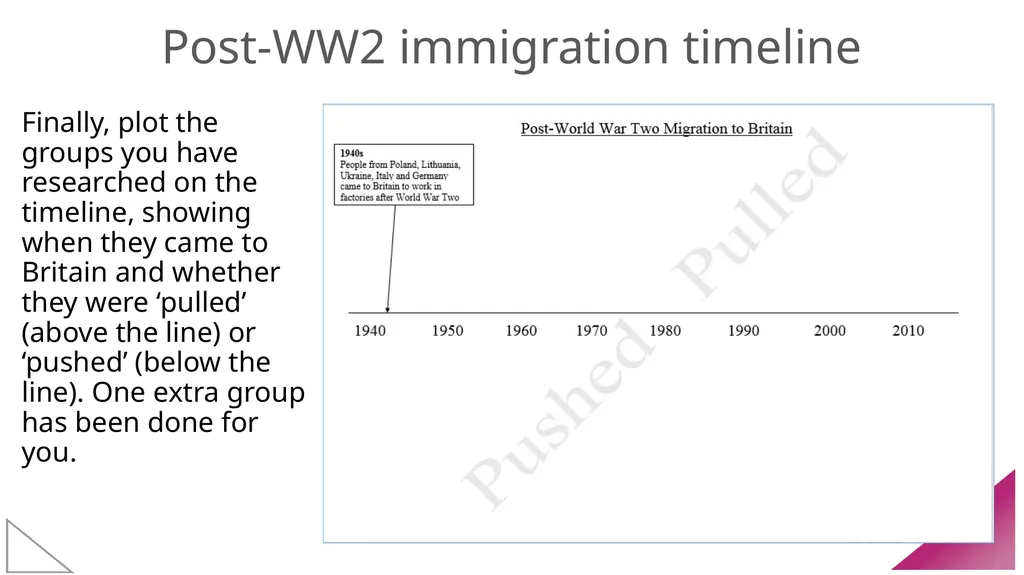
Post-WW2 immigration timeline Finally, plot the groups you have researched on the timeline, showing when they came to Britain and whether they were ‘pulled’ (above the line) or ‘pushed’ (below the line). One extra group has been done for you.<br>