
Poststructuralism, the Question of Power/Knowledge
A
Published · 31 slides · 0 views
1 / 1








Description
Poststructuralism, the Question of PowerKnowledge and the Human Subject in History: Michel Foucault Dr Claudia Stein Linguistic Turn (def.): Major philosophical development in the 20th century that focusses primarily on the analysis of
Related Topics
Share
Embed code
Download this presentation From Below
"Poststructuralism, the Question of Power/Knowledge" is the property of its rightful owner. Permission is granted to download and print the materials on this website for personal, non-commercial use only, and to display it on your personal computer provided you do not modify the materials and that you retain all copyright notices contained in the materials. By downloading content from our website, you accept the terms of this agreement.
Presentation Transcript
01
Poststructuralism, the Question of Power/Knowledge and the Human Subject in History:
Michel Foucault
Dr Claudia Stein<br>
Michel Foucault
Dr Claudia Stein<br>
02
Linguistic Turn (def.):
Major philosophical development in the 20th century that focusses primarily on the analysis of language (not only spoken language!) and the relations between language, language users and the world.
High time of ‘the linguistic turn’ is the 1950/60, particularly France, but thinkers go back to the late 19th century.<br>
Major philosophical development in the 20th century that focusses primarily on the analysis of language (not only spoken language!) and the relations between language, language users and the world.
High time of ‘the linguistic turn’ is the 1950/60, particularly France, but thinkers go back to the late 19th century.<br>
03
At stake in this problematization of language is the question of ‘reality’
Can humans ever ‘get’ at it considering that they always have to use a form of language to communicate their experiences of ‘reality’?
For historians, in particular, this raises the question whether they can ever get at the ‘experiences’ of their actors in the past? If one doubts that language is reflecting ‘reality’, what is their narrative actually re-presenting?<br>
Can humans ever ‘get’ at it considering that they always have to use a form of language to communicate their experiences of ‘reality’?
For historians, in particular, this raises the question whether they can ever get at the ‘experiences’ of their actors in the past? If one doubts that language is reflecting ‘reality’, what is their narrative actually re-presenting?<br>
04
Reality is NOT representable in any form of human culture (whether written, spoken, visual or dramatic)
Because ‘reality’ is not representable in any form, no authoritative account can exists of anything.
Nobody can make claim of possessing a ‘universal’ truth of anything. There is never a single single authority on a given subject of knowledge (this includes claims made in the natural sciences!) The answer of postwar ‘linguistic turn’ enthusiasts is clear:<br>
Because ‘reality’ is not representable in any form, no authoritative account can exists of anything.
Nobody can make claim of possessing a ‘universal’ truth of anything. There is never a single single authority on a given subject of knowledge (this includes claims made in the natural sciences!) The answer of postwar ‘linguistic turn’ enthusiasts is clear:<br>
05
Because there is no authoratiative account of anything, postmodern ‘linguistic turn’ practitioners target accounts which claim to represent such a ‘universal truths’.
Target: the hidden ‘metanarratives’ of modernity (originated in the Enlightenment) ‘Simplifying to the extreme, I define postmodern as incredulity toward metanarratives. ... The narrative function is losing its functors, its great hero, its great dangers, its great voyages, its great goal. It is being dispersed in clouds of narrative language ... Where, after the metanarratives, can legitimacy reside?’
Jean-François Lyotard, The Postmodern Condition: A Report of Knowledge (1979).<br>
Target: the hidden ‘metanarratives’ of modernity (originated in the Enlightenment) ‘Simplifying to the extreme, I define postmodern as incredulity toward metanarratives. ... The narrative function is losing its functors, its great hero, its great dangers, its great voyages, its great goal. It is being dispersed in clouds of narrative language ... Where, after the metanarratives, can legitimacy reside?’
Jean-François Lyotard, The Postmodern Condition: A Report of Knowledge (1979).<br>
06
Michel Foucault 1926-1984 A French philosopher who does ‘histories’…<br>
07
‘It (history writing) consists in uncovering ... thought and trying to change it: showing that things are not as obvious as people believe, making it so that what is taken for granted is no longer taken for granted. To practice criticism is to make harder those acts which are now too easy... [A]s soon as people begin to no longer be able to think things the way they have been thinking them, transformation becomes at the same time very urgent, very difficult and entirely possible.’
M. Foucault, ‘So, is it important to think?’ in
The Essential Foucault: Selections from Essential Works of Foucault, 1954-1984, ed. by P. Rabinow and N Rose (New York, 1994). History Writing as a Critique of the Present<br>
M. Foucault, ‘So, is it important to think?’ in
The Essential Foucault: Selections from Essential Works of Foucault, 1954-1984, ed. by P. Rabinow and N Rose (New York, 1994). History Writing as a Critique of the Present<br>
08
Foucault and Jean-Paul Sartre at a political manifestation Foucault, an ‘intellectual engage’ who takes this critique of the present serious…. Prison reform movement (e.g. Discipline and Punish)
Anti-psychiatry movement (e.g. History of Madness)<br>
Anti-psychiatry movement (e.g. History of Madness)<br>
09
A history of the human subject and ‘the self’
‘… the interaction between oneself and others and in the technologies of individual domination, the history of how an individual acts upon himself (or herself);
I am interested in the technologies of the self and a history of the subject.’ Towards the end of his life he identifies the key concern that runs through all his work as….<br>
‘… the interaction between oneself and others and in the technologies of individual domination, the history of how an individual acts upon himself (or herself);
I am interested in the technologies of the self and a history of the subject.’ Towards the end of his life he identifies the key concern that runs through all his work as….<br>
10
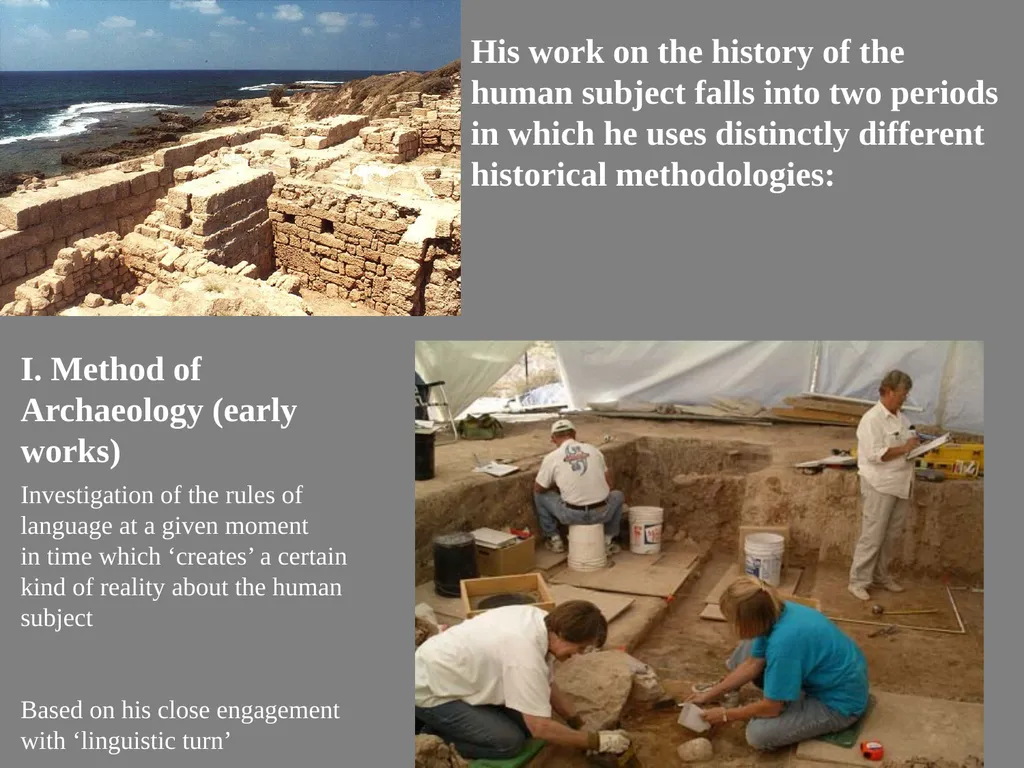
I. Method of Archaeology (early works) Investigation of the rules of
language at a given moment
in time which ‘creates’ a certain kind of reality about the human subject
Based on his close engagement with ‘linguistic turn’ His work on the history of the human subject falls into two periods in which he uses distinctly different historical methodologies:<br>
language at a given moment
in time which ‘creates’ a certain kind of reality about the human subject
Based on his close engagement with ‘linguistic turn’ His work on the history of the human subject falls into two periods in which he uses distinctly different historical methodologies:<br>
11
Method of Archaeology
Is concerned with the analysis of language as a system of the possibility of human expression; it is synchronic – at one moment in time -- and does never try to explain historical change or the origin or distribution of power.
Inspired by structuralism.
Foucault’s idea is that every mode of thinking (based on the structure of language) involves implicit rules (maybe not even consciously formulated by those following them) that materially restrict the range of possible thoughts individuals can have.
This is the case for the past as it is for the present: you can only speak what the current rules of language allows you to think!
ERGO:
The human subject is never in control of what he/she is saying<br>
Is concerned with the analysis of language as a system of the possibility of human expression; it is synchronic – at one moment in time -- and does never try to explain historical change or the origin or distribution of power.
Inspired by structuralism.
Foucault’s idea is that every mode of thinking (based on the structure of language) involves implicit rules (maybe not even consciously formulated by those following them) that materially restrict the range of possible thoughts individuals can have.
This is the case for the past as it is for the present: you can only speak what the current rules of language allows you to think!
ERGO:
The human subject is never in control of what he/she is saying<br>
12
Renaissance Episteme (1450-1650)
Classical Episteme (1650-1800)
Modern Episteme (1800-1966)
Postmodern Episteme (late1960s -?)
Where are we now? Post-Postmodern Episteme? ‘In any given culture and at any given moment there is always only one episteme that defines the conditions of possibility of all knowledge, whether expressed in theory or silently invested in a practice.’ Episteme<br>
Classical Episteme (1650-1800)
Modern Episteme (1800-1966)
Postmodern Episteme (late1960s -?)
Where are we now? Post-Postmodern Episteme? ‘In any given culture and at any given moment there is always only one episteme that defines the conditions of possibility of all knowledge, whether expressed in theory or silently invested in a practice.’ Episteme<br>
13
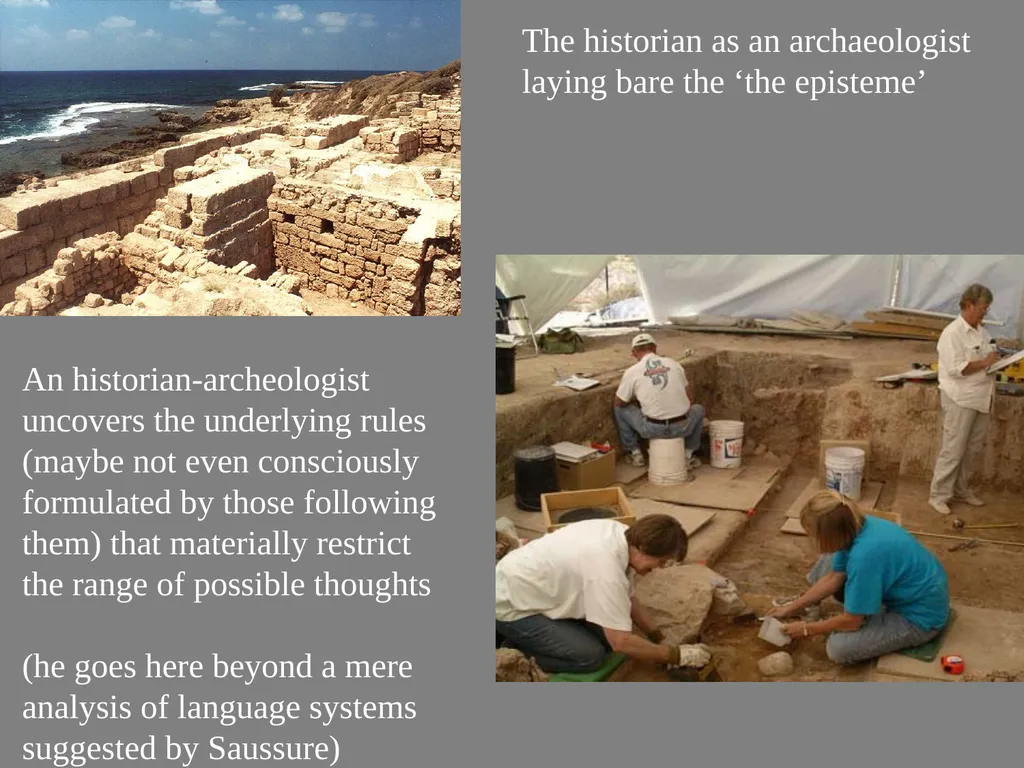
The historian as an archaeologist
laying bare the ‘the episteme’ An historian-archeologist uncovers the underlying rules (maybe not even consciously formulated by those following them) that materially restrict the range of possible thoughts
(he goes here beyond a mere analysis of language systems suggested by Saussure)<br>
laying bare the ‘the episteme’ An historian-archeologist uncovers the underlying rules (maybe not even consciously formulated by those following them) that materially restrict the range of possible thoughts
(he goes here beyond a mere analysis of language systems suggested by Saussure)<br>
14
What makes thought possible at a particular moment in time? How do people speak about it? Analysis of the rules of what is possible to say?
‘Discourse’ and ‘discourse’ analysis aims to overcome the
problems of traditional history writing which takes what is ‘said’ as a given The archaeologist-historian uses ‘discourse analysis’ to uncover
the invisible rules of language that organize what we can say and
not say at a particular moment in time<br>
‘Discourse’ and ‘discourse’ analysis aims to overcome the
problems of traditional history writing which takes what is ‘said’ as a given The archaeologist-historian uses ‘discourse analysis’ to uncover
the invisible rules of language that organize what we can say and
not say at a particular moment in time<br>
15
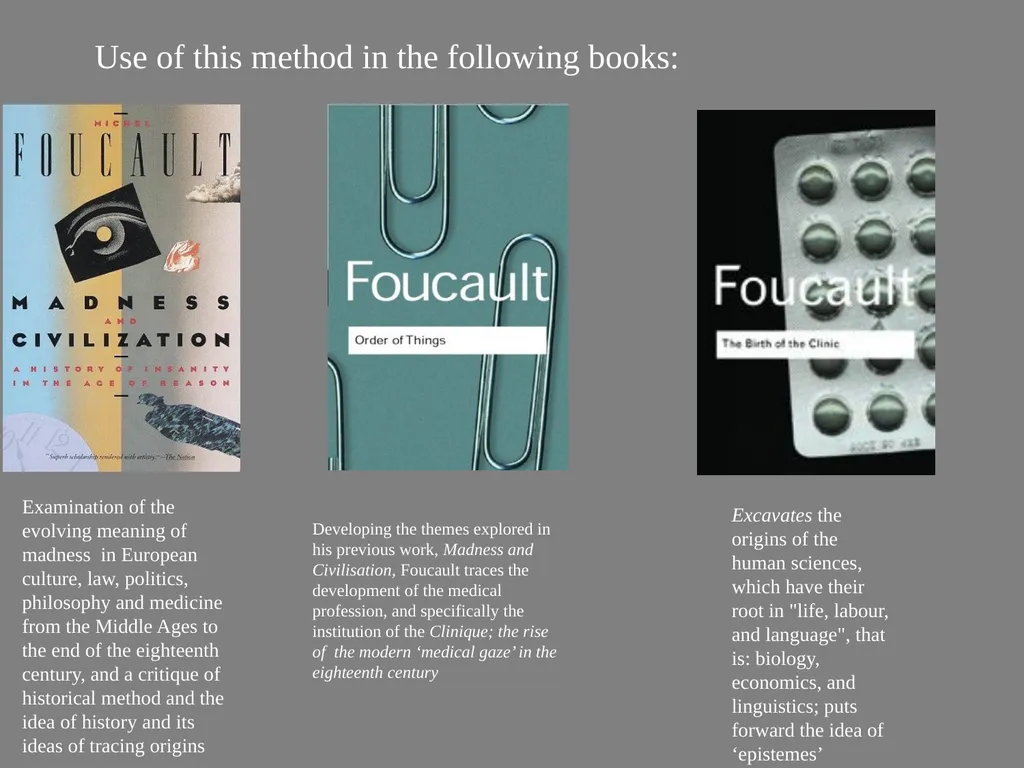
Use of this method in the following books: Examination of the evolving meaning of madness in European culture, law, politics, philosophy and medicine from the Middle Ages to the end of the eighteenth century, and a critique of historical method and the idea of history and its ideas of tracing origins Excavates the origins of the human sciences, which have their root in "life, labour, and language", that is: biology, economics, and linguistics; puts forward the idea of ‘epistemes’ Developing the themes explored in his previous work, Madness and Civilisation, Foucault traces the development of the medical profession, and specifically the institution of the Clinique; the rise of the modern ‘medical gaze’ in the eighteenth century<br>
16
His critique of traditional history writing:
Takes the human subject for grante (instead
of historically understanding its ‘making’)
Search for origins of ideas/practices (no questioning of the present ideas or practices themselves)
Focus on ‘discoveries’ and ‘break throughs’ by individuals in control of ‘reality’
Linear development of history from origins to now; history can offer ‘lessons’ from
the past<br>
Takes the human subject for grante (instead
of historically understanding its ‘making’)
Search for origins of ideas/practices (no questioning of the present ideas or practices themselves)
Focus on ‘discoveries’ and ‘break throughs’ by individuals in control of ‘reality’
Linear development of history from origins to now; history can offer ‘lessons’ from
the past<br>
17
He leaves this phase behind….
Realisation: It is not language and speech and thinking that make people ‘act’ but also everyday ‘practises’ and their engagement with the material world
And he is dissatisfied with traditional explanations for historical change in history writing at this time:
‘The traditional explanations as the spirit of the time, technology, social cultural influences struck me for the most part as being more than magical effective’.<br>
Realisation: It is not language and speech and thinking that make people ‘act’ but also everyday ‘practises’ and their engagement with the material world
And he is dissatisfied with traditional explanations for historical change in history writing at this time:
‘The traditional explanations as the spirit of the time, technology, social cultural influences struck me for the most part as being more than magical effective’.<br>
18
2. Method of Genealogy (early 1970s)
a historical causal explanation that is material, multiple, and corporeal.
It is concerned with the analysis of historical ‘emergence’ – not search for ‘origins’
it is conceptualised not as a ‘discovery’, the culmination of events, or as the end of a process of development but rather as a particular momentary manifestation of chances or as a struggle between forces of power.<br>
a historical causal explanation that is material, multiple, and corporeal.
It is concerned with the analysis of historical ‘emergence’ – not search for ‘origins’
it is conceptualised not as a ‘discovery’, the culmination of events, or as the end of a process of development but rather as a particular momentary manifestation of chances or as a struggle between forces of power.<br>
19
Geneology is a the critical ‘history of the present’
The subject matter of this kind of history is the origins of present rules, practices or institutions that claim authority over us. It starts from an investigation of the present.
What claims authority over us now? What makes us think that certain ideas, practices, institutions in the present are ‘normal’)
The aim is not to understand the past for its own sake, but to understand and evaluate the present, particularly with a view to discrediting unjustified claims of authority and power (see slide on Nietzsche)<br>
The subject matter of this kind of history is the origins of present rules, practices or institutions that claim authority over us. It starts from an investigation of the present.
What claims authority over us now? What makes us think that certain ideas, practices, institutions in the present are ‘normal’)
The aim is not to understand the past for its own sake, but to understand and evaluate the present, particularly with a view to discrediting unjustified claims of authority and power (see slide on Nietzsche)<br>
20
Genology also involves an investigation of power:
“It seems to me that power must be understood in the first instance as the multiplicity of force relations immanent in the sphere in which they operate and which constitute their own organization;
as the process which, through ceaseless struggles and confrontations, transforms, strengthens, or reverses them;
as the support which these force relations find in one another, thus forming a chain or a system, or on the contrary, the disjunctions and contradictions which isolate them from one another;
and lastly, as the strategies in which they take effect, whose general design or institutional crystallization is embodied in the state apparatus, in the formulation of the law, in the various social hegemonies” (Foucault, 1990, pp. 92-93). Aim of all power: the get the human body under control<br>
“It seems to me that power must be understood in the first instance as the multiplicity of force relations immanent in the sphere in which they operate and which constitute their own organization;
as the process which, through ceaseless struggles and confrontations, transforms, strengthens, or reverses them;
as the support which these force relations find in one another, thus forming a chain or a system, or on the contrary, the disjunctions and contradictions which isolate them from one another;
and lastly, as the strategies in which they take effect, whose general design or institutional crystallization is embodied in the state apparatus, in the formulation of the law, in the various social hegemonies” (Foucault, 1990, pp. 92-93). Aim of all power: the get the human body under control<br>
21
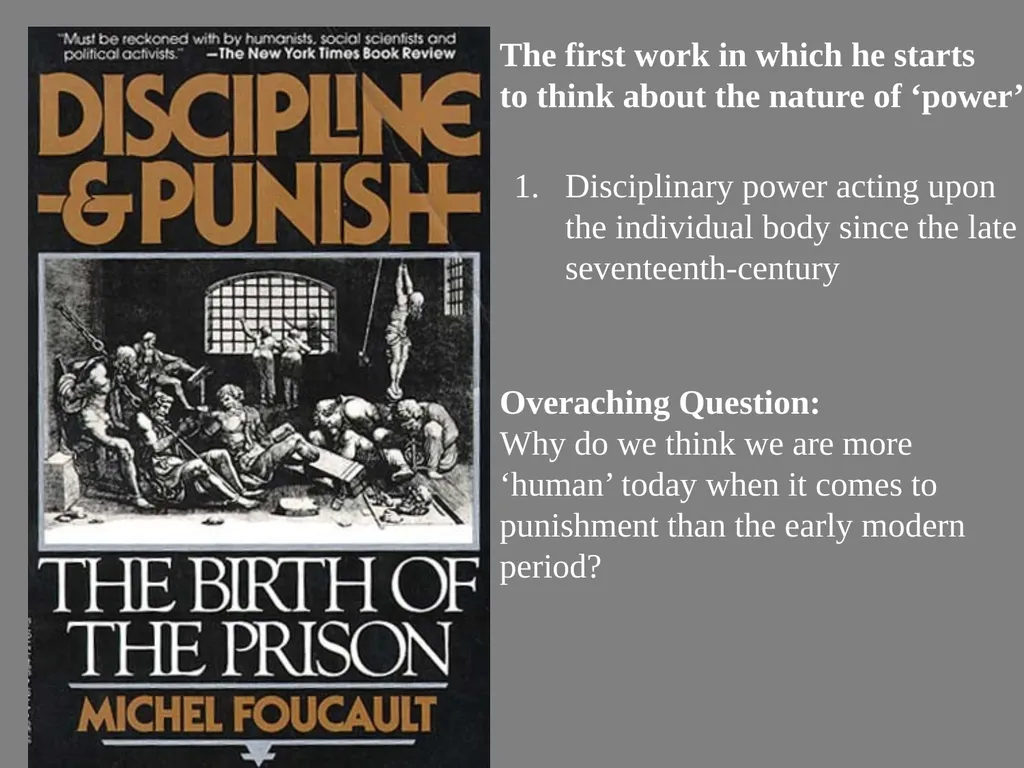
Overaching Question:
Why do we think we are more ‘human’ today when it comes to punishment than the early modern
period? Disciplinary power acting upon
the individual body since the late
seventeenth-century The first work in which he starts
to think about the nature of ‘power’<br>
Why do we think we are more ‘human’ today when it comes to punishment than the early modern
period? Disciplinary power acting upon
the individual body since the late
seventeenth-century The first work in which he starts
to think about the nature of ‘power’<br>
22
‘Discipline’ (or disciplinary power) may be defined neither with an institution nor with an apparatus; it is a type of power, a modality for its exercise, comprising a whole set of instruments, techniques, procedures, levels of applications, targets.’
Goal of discipline:
Discipline produces ‘docile’ bodies. Bodies which act without being told to act in a particular way. The do it voluntarily and even ‘like’ doing it. Observation:<br>
Goal of discipline:
Discipline produces ‘docile’ bodies. Bodies which act without being told to act in a particular way. The do it voluntarily and even ‘like’ doing it. Observation:<br>
23
Discipline and Punish investigates the different aspects of ‘discipline’:
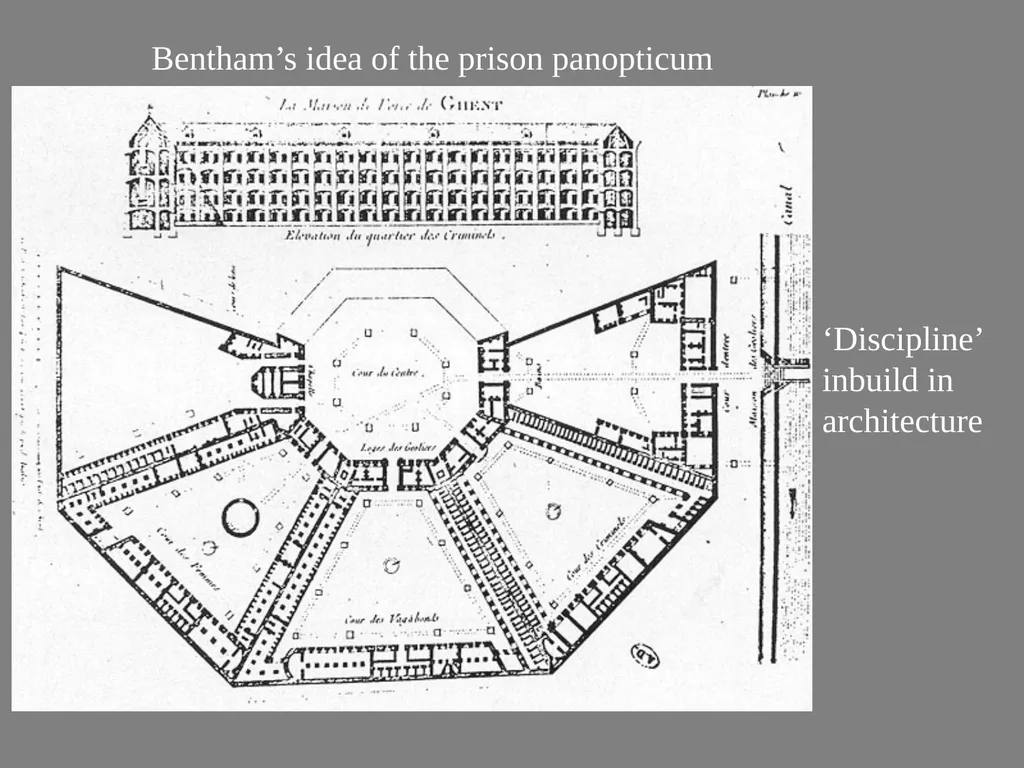
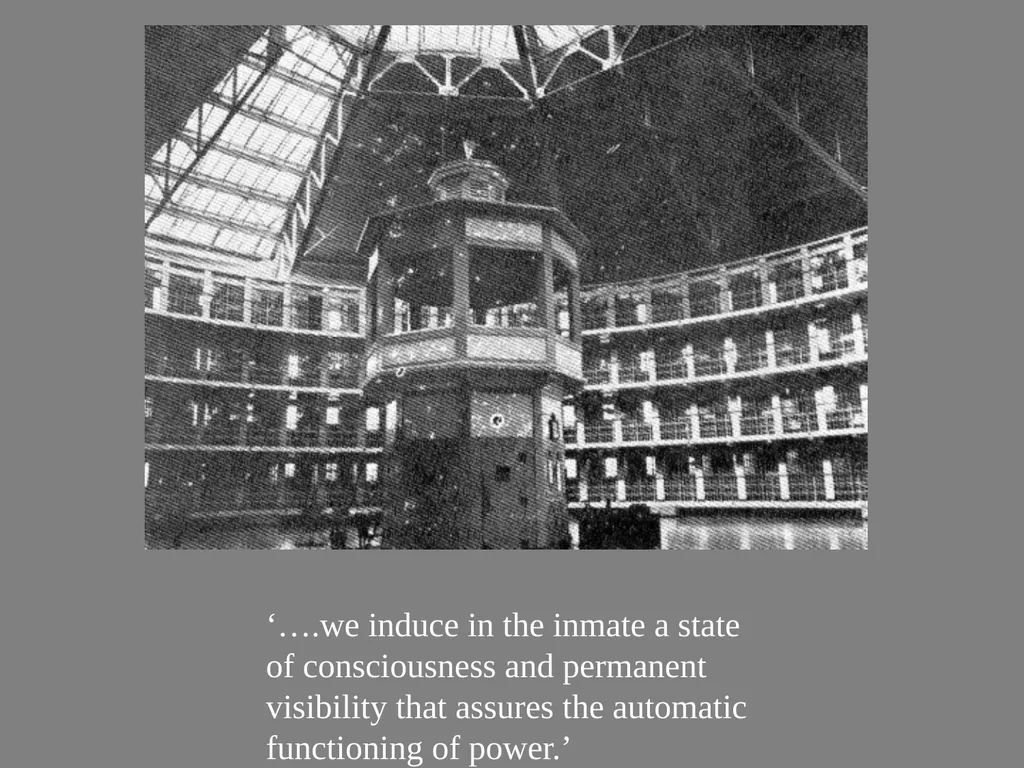
1. Hierarchical spacial observation Foucault uses ideas of Jeremy Bentham, the founder of utilitarianism to show this….<br>
1. Hierarchical spacial observation Foucault uses ideas of Jeremy Bentham, the founder of utilitarianism to show this….<br>
24
Bentham’s idea of the prison panopticum ‘Discipline’
inbuild in
architecture<br>
inbuild in
architecture<br>
25
‘….we induce in the inmate a state of consciousness and permanent visibility that assures the automatic functioning of power.’<br>
26
2. Normalising Judgement
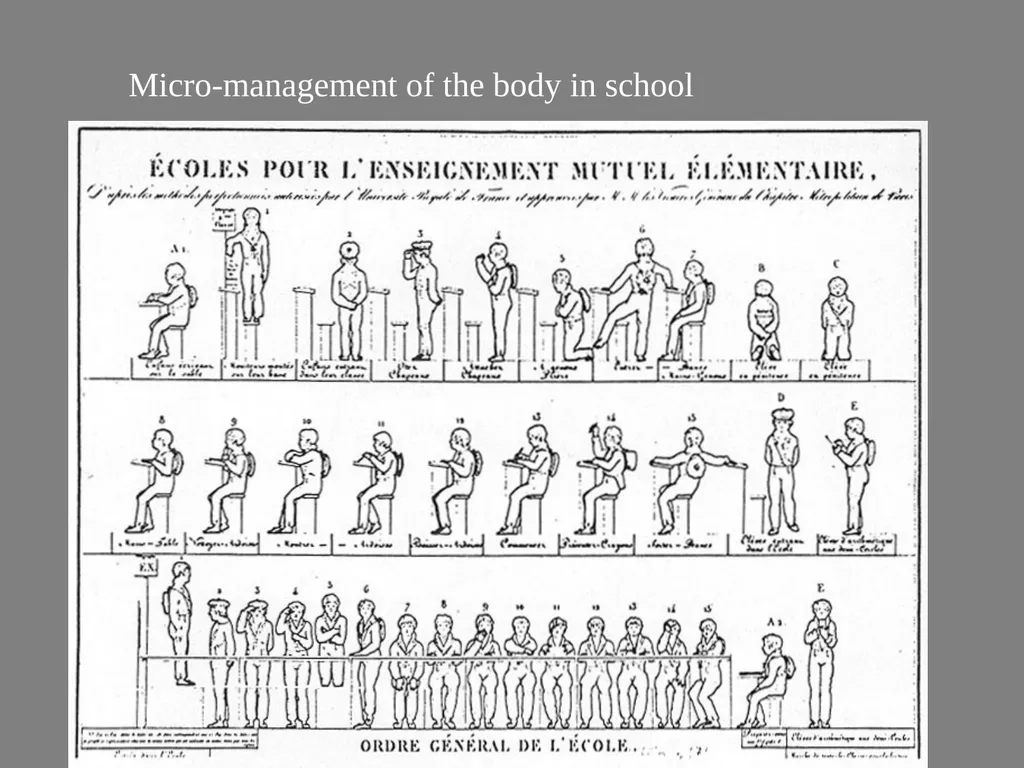
Individuals are judged not by the intrinsic rightness or wrongness of their acts but by where their actions are placed on a ranked scale that compares them to everyone else. We are subjected to a whole set of micro-normalising judgements (regarding time keeping, activities, speech, of body, of sexuality). We use ‘discipline’ to punish those who do not conform to the ‘normalizing judgement’.<br>
Individuals are judged not by the intrinsic rightness or wrongness of their acts but by where their actions are placed on a ranked scale that compares them to everyone else. We are subjected to a whole set of micro-normalising judgements (regarding time keeping, activities, speech, of body, of sexuality). We use ‘discipline’ to punish those who do not conform to the ‘normalizing judgement’.<br>
27
Micro-management of the body in school<br>
28
3. Examination
combines ‘normative judgement’ with ‘hierarchical observation’ to create a ‘normalising gaze’ through which individuals may be classified or judged.
The medical examination in a doctor’s office is a prime locus of modern power/knowledge.
There is no knowledge without power and vice-versa (medical knowledge is the most striking example)<br>
combines ‘normative judgement’ with ‘hierarchical observation’ to create a ‘normalising gaze’ through which individuals may be classified or judged.
The medical examination in a doctor’s office is a prime locus of modern power/knowledge.
There is no knowledge without power and vice-versa (medical knowledge is the most striking example)<br>
29
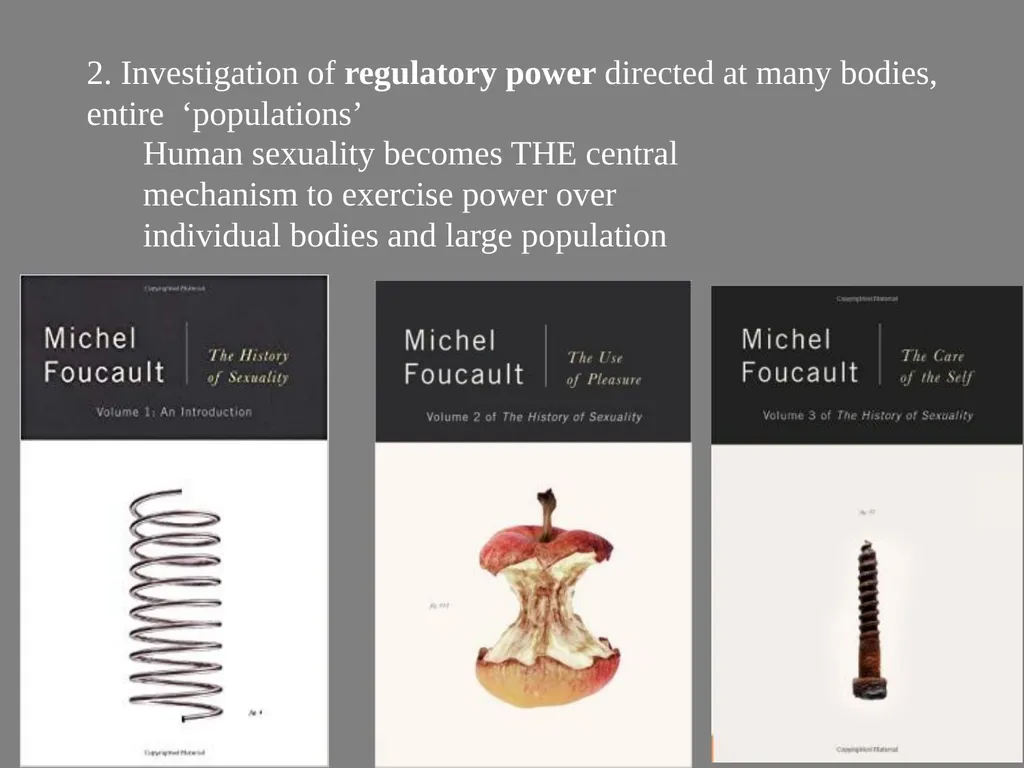
2. Investigation of regulatory power directed at many bodies, entire ‘populations’ Human sexuality becomes THE central mechanism to exercise power over individual bodies and large population<br>
30
Biopower:
‘I mean a number of phenomena that seem to me to be quite significant, namely, the set of mechanisms through which the basic biological features of the human species became the object of a political strategy, of a general strategy of power, or, in other words, how, starting from the 18th century, modern Western societies took on board the fundamental biological fact that human beings are a species. This is what I have called biopower.’<br>
‘I mean a number of phenomena that seem to me to be quite significant, namely, the set of mechanisms through which the basic biological features of the human species became the object of a political strategy, of a general strategy of power, or, in other words, how, starting from the 18th century, modern Western societies took on board the fundamental biological fact that human beings are a species. This is what I have called biopower.’<br>