
PowerPoint presentation Finishing advanced fish,

Description: PowerPoint presentation Finishing advanced fish, shellfish and crustacean dishes Unit 308: Produce and present advanced main course dishes using standardised recipes Introduction 2 It is very important to ensure that advanced fish,
Related Topics
Download Presentation
"PowerPoint presentation Finishing advanced fish," is the property of its rightful owner. Permission is granted to download and print the materials on this website for personal, non-commercial use only, and to display it on your personal computer provided you do not modify the materials and that you retain all copyright notices contained in the materials. By downloading content from our website, you accept the terms of this agreement.
Presentation Transcript
slide1. PowerPoint presentation Finishing advanced fish, shellfish and crustacean dishes Unit 308: Produce and present advanced main course dishes using standardised recipes<br>
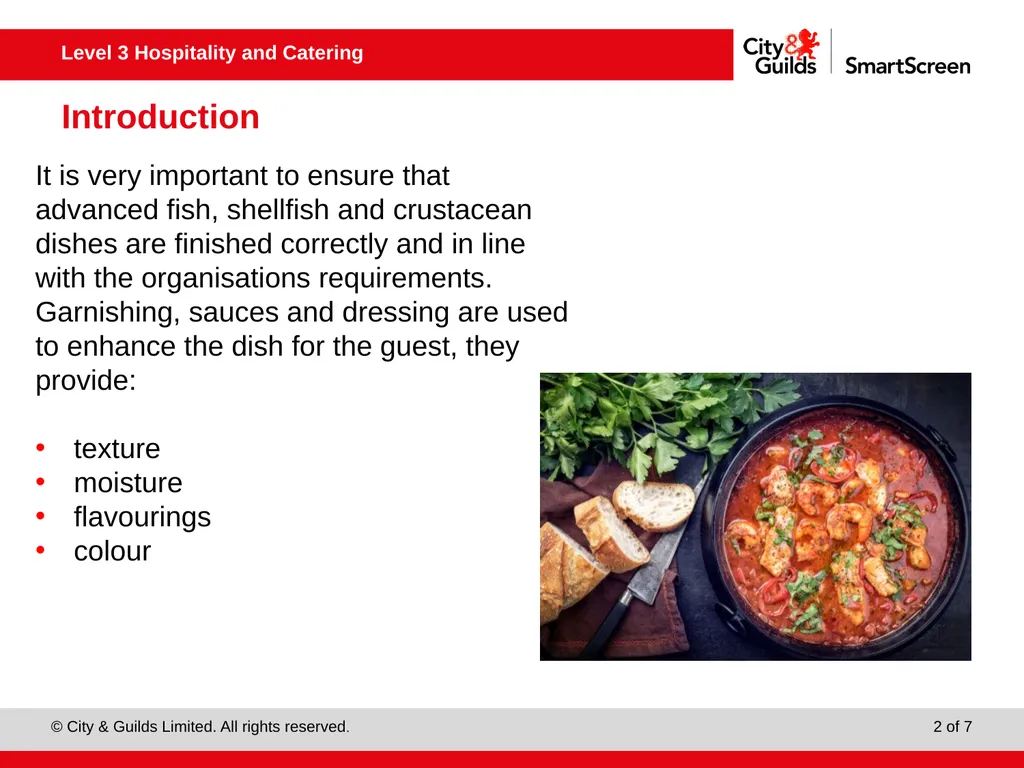
slide2. Introduction 2 It is very important to ensure that advanced fish, shellfish and crustacean dishes are finished correctly and in line with the organisations requirements. Garnishing, sauces and dressing are used to enhance the dish for the guest, they provide:
texture
moisture
flavourings
colour<br>
slide3. Finishing Garnishing – the most common garnish for seafood is lemon as the flavour works well with fish. It can be served as wedges, slices, peeled slices for meunière or lemon halves wrapped in muslin cloth. Cooked or smoked seafood is often served with fresh herbs, micro leaves, cherry tomatoes and avocado. For cooked seafood fried parsley or other herbs are very popular and grilled lime halves or slices can add subtle flavour.
Correct seasoning – very important when cooking and finishing to ensure that dish has been correctly seasoned. Fish due to the nature of their flesh contain minimal natural fats which help to improve flavour so it is important to ensure that dishes are seasoned correctly to bring out the natural flavourings of the dish.<br>
slide4. Finishing Saucing – classic sauces, like the hollandaise sauce, beurre blanc, Bercy sauce and others, can be served with fish and seafood dishes, including pan-seared sea scallops, sautéed tilapia, grilled salmon and more.
Hollandaise is a wonderfully rich, lemony and buttery sauce that goes with all kinds of poached and grilled fish dishes.
The Bercy sauce, named after a district in the east of Paris, is a finished sauce for fish and seafood dishes. It's made by reducing white wine and chopped shallots and then simmering in a basic fish velouté.
A white wine sauce is one of the most basic sauces for fish and seafood dishes.
Beurre blanc is a simple butter-based emulsified sauce that's great with fish or seafood.<br>
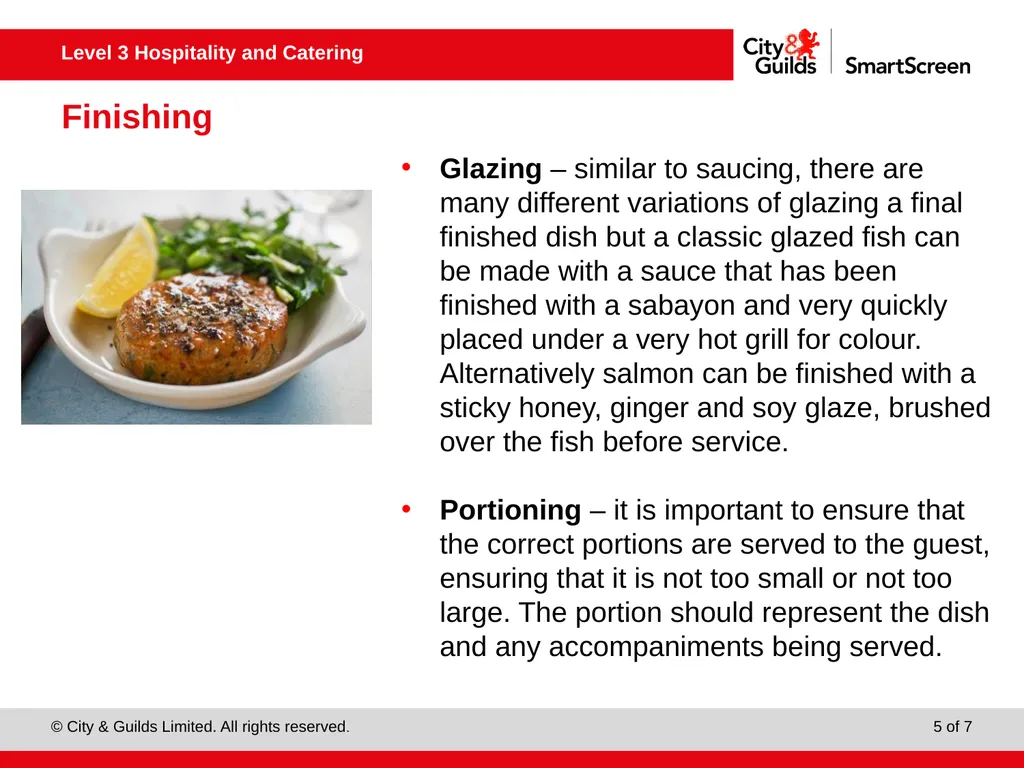
slide5. Finishing Glazing – similar to saucing, there are many different variations of glazing a final finished dish but a classic glazed fish can be made with a sauce that has been finished with a sabayon and very quickly placed under a very hot grill for colour. Alternatively salmon can be finished with a sticky honey, ginger and soy glaze, brushed over the fish before service.
Portioning – it is important to ensure that the correct portions are served to the guest, ensuring that it is not too small or not too large. The portion should represent the dish and any accompaniments being served.<br>
slide6. Finishing Temperature – the best procedure for checking doneness is to use a cooking thermometer, checking to make sure the fish has reached an internal temperature of 63ºC. To cook fish that are slightly translucent in the centre, remove the fish from the heat when they reach an internal temperature of 57ºC–60ºC. The fish will continue cooking with the retained heat if they are covered and left to stand a few minutes prior to serving.
Appearance – guests will eat with their eyes so it is important that the final served dished is correct garnished, sauced and looks appealing to the eye.<br>
slide7. Any questions?<br>
slide2. Introduction 2 It is very important to ensure that advanced fish, shellfish and crustacean dishes are finished correctly and in line with the organisations requirements. Garnishing, sauces and dressing are used to enhance the dish for the guest, they provide:
texture
moisture
flavourings
colour<br>
slide3. Finishing Garnishing – the most common garnish for seafood is lemon as the flavour works well with fish. It can be served as wedges, slices, peeled slices for meunière or lemon halves wrapped in muslin cloth. Cooked or smoked seafood is often served with fresh herbs, micro leaves, cherry tomatoes and avocado. For cooked seafood fried parsley or other herbs are very popular and grilled lime halves or slices can add subtle flavour.
Correct seasoning – very important when cooking and finishing to ensure that dish has been correctly seasoned. Fish due to the nature of their flesh contain minimal natural fats which help to improve flavour so it is important to ensure that dishes are seasoned correctly to bring out the natural flavourings of the dish.<br>
slide4. Finishing Saucing – classic sauces, like the hollandaise sauce, beurre blanc, Bercy sauce and others, can be served with fish and seafood dishes, including pan-seared sea scallops, sautéed tilapia, grilled salmon and more.
Hollandaise is a wonderfully rich, lemony and buttery sauce that goes with all kinds of poached and grilled fish dishes.
The Bercy sauce, named after a district in the east of Paris, is a finished sauce for fish and seafood dishes. It's made by reducing white wine and chopped shallots and then simmering in a basic fish velouté.
A white wine sauce is one of the most basic sauces for fish and seafood dishes.
Beurre blanc is a simple butter-based emulsified sauce that's great with fish or seafood.<br>
slide5. Finishing Glazing – similar to saucing, there are many different variations of glazing a final finished dish but a classic glazed fish can be made with a sauce that has been finished with a sabayon and very quickly placed under a very hot grill for colour. Alternatively salmon can be finished with a sticky honey, ginger and soy glaze, brushed over the fish before service.
Portioning – it is important to ensure that the correct portions are served to the guest, ensuring that it is not too small or not too large. The portion should represent the dish and any accompaniments being served.<br>
slide6. Finishing Temperature – the best procedure for checking doneness is to use a cooking thermometer, checking to make sure the fish has reached an internal temperature of 63ºC. To cook fish that are slightly translucent in the centre, remove the fish from the heat when they reach an internal temperature of 57ºC–60ºC. The fish will continue cooking with the retained heat if they are covered and left to stand a few minutes prior to serving.
Appearance – guests will eat with their eyes so it is important that the final served dished is correct garnished, sauced and looks appealing to the eye.<br>
slide7. Any questions?<br>