
PPDC Label Reform Workgroup Update PPDC Fall
AS
Published · 27 slides · 0 views
1 / 1
Description
PPDC Label Reform Workgroup Update PPDC Fall Meeting, Virtual November 13th, 2024 Agenda PPDC Label Reform Workgroup Information: Members, Diversity, Meeting Cadence and Group Collaboration Tools PPDC Label Reform Workgroup Charge Questions
Related Topics
Download this presentation From Below
"PPDC Label Reform Workgroup Update PPDC Fall" is the property of its rightful owner. Permission is granted to download and print the materials on this website for personal, non-commercial use only, and to display it on your personal computer provided you do not modify the materials and that you retain all copyright notices contained in the materials. By downloading content from our website, you accept the terms of this agreement.
Share
Embed code
Presentation Transcript
01
PPDC Label Reform Workgroup Update PPDC Fall Meeting, Virtual
November 13th, 2024<br>
November 13th, 2024<br>
02
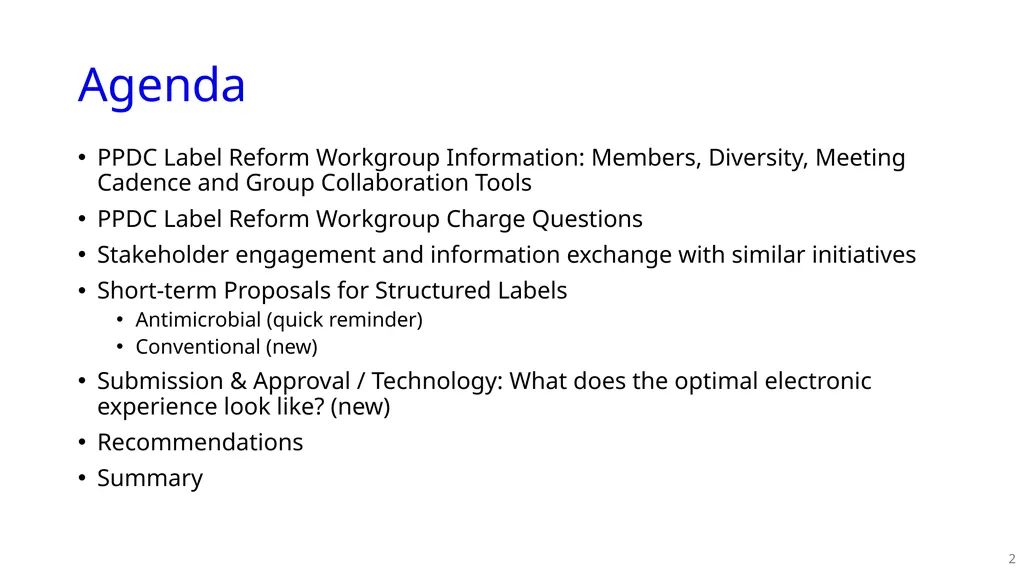
Agenda PPDC Label Reform Workgroup Information: Members, Diversity, Meeting Cadence and Group Collaboration Tools
PPDC Label Reform Workgroup Charge Questions
Stakeholder engagement and information exchange with similar initiatives
Short-term Proposals for Structured Labels
Antimicrobial (quick reminder)
Conventional (new)
Submission & Approval / Technology: What does the optimal electronic experience look like? (new)
Recommendations
Summary 2<br>
PPDC Label Reform Workgroup Charge Questions
Stakeholder engagement and information exchange with similar initiatives
Short-term Proposals for Structured Labels
Antimicrobial (quick reminder)
Conventional (new)
Submission & Approval / Technology: What does the optimal electronic experience look like? (new)
Recommendations
Summary 2<br>
03
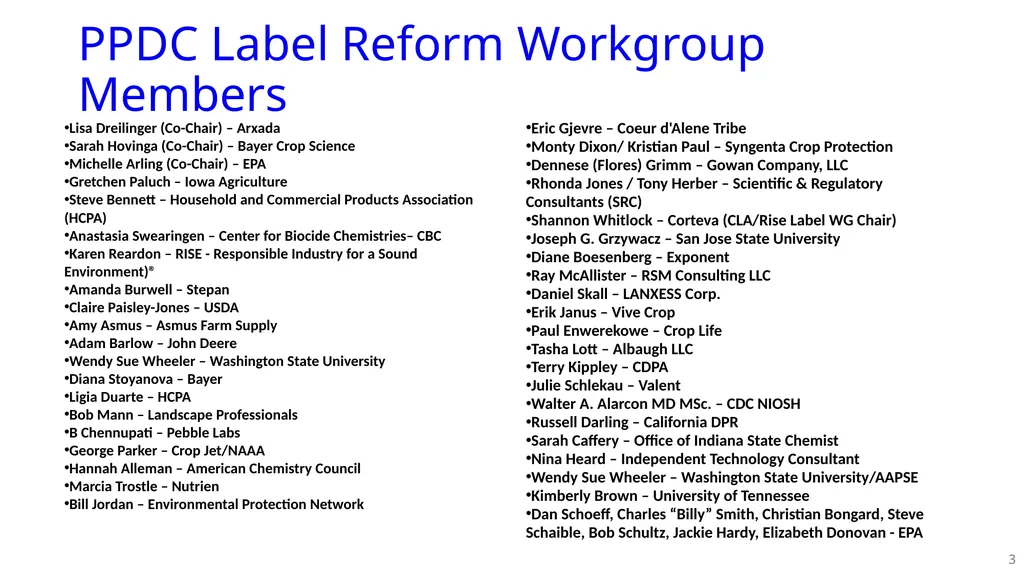
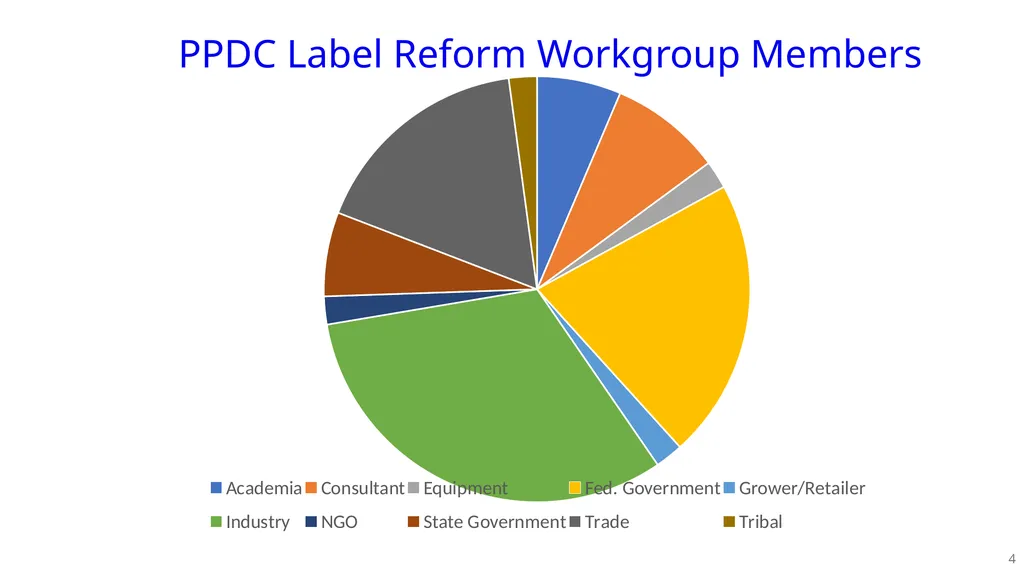
PPDC Label Reform Workgroup Members Lisa Dreilinger (Co-Chair) – Arxada
Sarah Hovinga (Co-Chair) – Bayer Crop Science
Michelle Arling (Co-Chair) – EPA
Gretchen Paluch – Iowa Agriculture
Steve Bennett – Household and Commercial Products Association (HCPA)
Anastasia Swearingen – Center for Biocide Chemistries– CBC
Karen Reardon – RISE - Responsible Industry for a Sound Environment)®
Amanda Burwell – Stepan
Claire Paisley-Jones – USDA
Amy Asmus – Asmus Farm Supply
Adam Barlow – John Deere
Wendy Sue Wheeler – Washington State University
Diana Stoyanova – Bayer
Ligia Duarte – HCPA
Bob Mann – Landscape Professionals
B Chennupati – Pebble Labs
George Parker – Crop Jet/NAAA
Hannah Alleman – American Chemistry Council
Marcia Trostle – Nutrien
Bill Jordan – Environmental Protection Network Eric Gjevre – Coeur d'Alene Tribe
Monty Dixon/ Kristian Paul – Syngenta Crop Protection
Dennese (Flores) Grimm – Gowan Company, LLC
Rhonda Jones / Tony Herber – Scientific & Regulatory Consultants (SRC)
Shannon Whitlock – Corteva (CLA/Rise Label WG Chair)
Joseph G. Grzywacz – San Jose State University
Diane Boesenberg – Exponent
Ray McAllister – RSM Consulting LLC
Daniel Skall – LANXESS Corp.
Erik Janus – Vive Crop
Paul Enwerekowe – Crop Life
Tasha Lott – Albaugh LLC
Terry Kippley – CDPA
Julie Schlekau – Valent
Walter A. Alarcon MD MSc. – CDC NIOSH
Russell Darling – California DPR
Sarah Caffery – Office of Indiana State Chemist
Nina Heard – Independent Technology Consultant
Wendy Sue Wheeler – Washington State University/AAPSE
Kimberly Brown – University of Tennessee
Dan Schoeff, Charles “Billy” Smith, Christian Bongard, Steve Schaible, Bob Schultz, Jackie Hardy, Elizabeth Donovan - EPA 3<br>
Sarah Hovinga (Co-Chair) – Bayer Crop Science
Michelle Arling (Co-Chair) – EPA
Gretchen Paluch – Iowa Agriculture
Steve Bennett – Household and Commercial Products Association (HCPA)
Anastasia Swearingen – Center for Biocide Chemistries– CBC
Karen Reardon – RISE - Responsible Industry for a Sound Environment)®
Amanda Burwell – Stepan
Claire Paisley-Jones – USDA
Amy Asmus – Asmus Farm Supply
Adam Barlow – John Deere
Wendy Sue Wheeler – Washington State University
Diana Stoyanova – Bayer
Ligia Duarte – HCPA
Bob Mann – Landscape Professionals
B Chennupati – Pebble Labs
George Parker – Crop Jet/NAAA
Hannah Alleman – American Chemistry Council
Marcia Trostle – Nutrien
Bill Jordan – Environmental Protection Network Eric Gjevre – Coeur d'Alene Tribe
Monty Dixon/ Kristian Paul – Syngenta Crop Protection
Dennese (Flores) Grimm – Gowan Company, LLC
Rhonda Jones / Tony Herber – Scientific & Regulatory Consultants (SRC)
Shannon Whitlock – Corteva (CLA/Rise Label WG Chair)
Joseph G. Grzywacz – San Jose State University
Diane Boesenberg – Exponent
Ray McAllister – RSM Consulting LLC
Daniel Skall – LANXESS Corp.
Erik Janus – Vive Crop
Paul Enwerekowe – Crop Life
Tasha Lott – Albaugh LLC
Terry Kippley – CDPA
Julie Schlekau – Valent
Walter A. Alarcon MD MSc. – CDC NIOSH
Russell Darling – California DPR
Sarah Caffery – Office of Indiana State Chemist
Nina Heard – Independent Technology Consultant
Wendy Sue Wheeler – Washington State University/AAPSE
Kimberly Brown – University of Tennessee
Dan Schoeff, Charles “Billy” Smith, Christian Bongard, Steve Schaible, Bob Schultz, Jackie Hardy, Elizabeth Donovan - EPA 3<br>
04
PPDC Label Reform Workgroup Members 4<br>
05
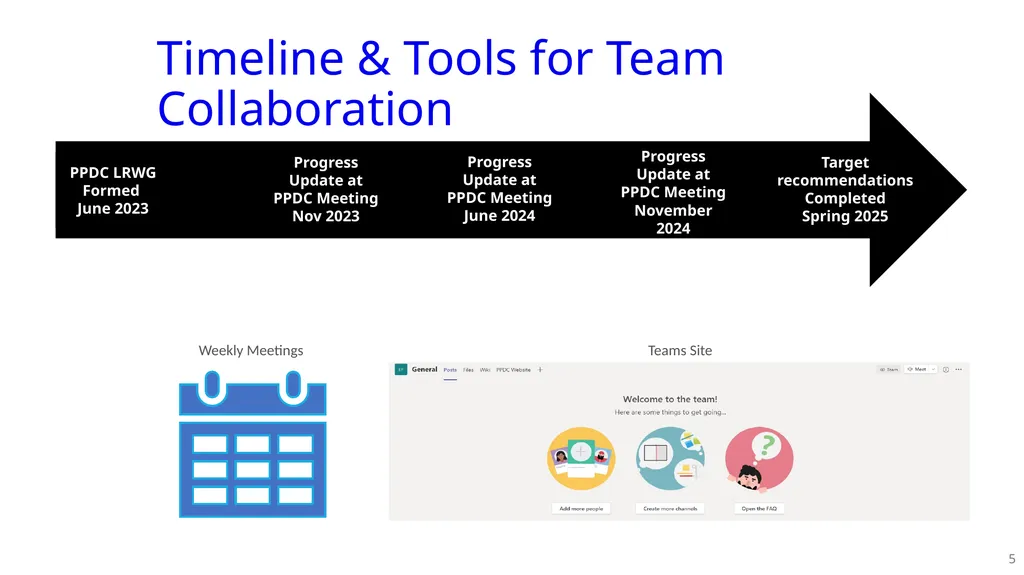
Timeline & Tools for Team Collaboration Weekly Meetings Teams Site Progress Update at PPDC Meeting
June 2024 Progress Update at PPDC Meeting
November 2024 5<br>
June 2024 Progress Update at PPDC Meeting
November 2024 5<br>
06
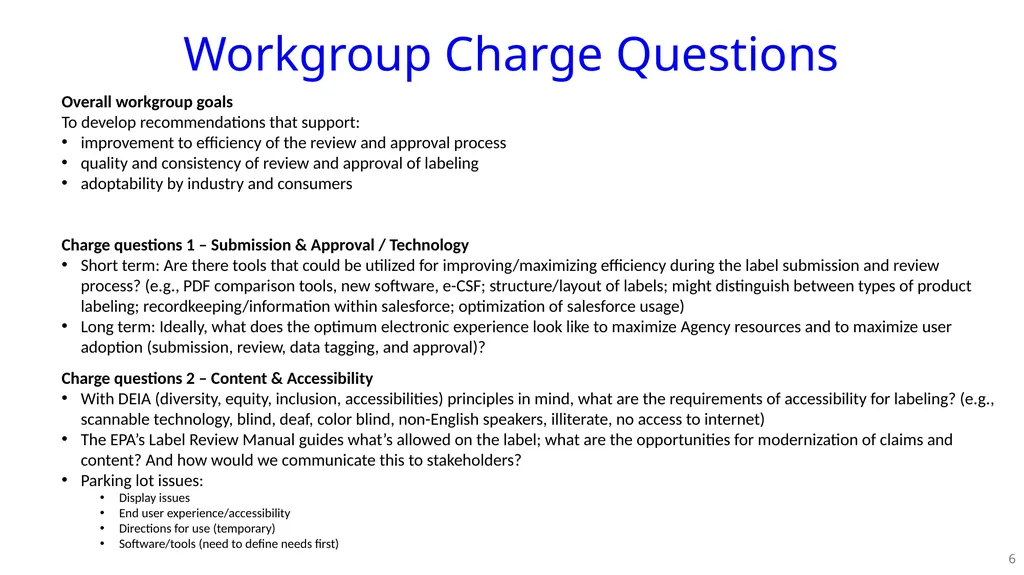
Workgroup Charge Questions Overall workgroup goals
To develop recommendations that support:
improvement to efficiency of the review and approval process
quality and consistency of review and approval of labeling
adoptability by industry and consumers
Charge questions 1 – Submission & Approval / Technology
Short term: Are there tools that could be utilized for improving/maximizing efficiency during the label submission and review process? (e.g., PDF comparison tools, new software, e-CSF; structure/layout of labels; might distinguish between types of product labeling; recordkeeping/information within salesforce; optimization of salesforce usage)
Long term: Ideally, what does the optimum electronic experience look like to maximize Agency resources and to maximize user adoption (submission, review, data tagging, and approval)?
Charge questions 2 – Content & Accessibility
With DEIA (diversity, equity, inclusion, accessibilities) principles in mind, what are the requirements of accessibility for labeling? (e.g., scannable technology, blind, deaf, color blind, non-English speakers, illiterate, no access to internet)
The EPA’s Label Review Manual guides what’s allowed on the label; what are the opportunities for modernization of claims and content? And how would we communicate this to stakeholders?
Parking lot issues:
Display issues
End user experience/accessibility
Directions for use (temporary)
Software/tools (need to define needs first) 6<br>
To develop recommendations that support:
improvement to efficiency of the review and approval process
quality and consistency of review and approval of labeling
adoptability by industry and consumers
Charge questions 1 – Submission & Approval / Technology
Short term: Are there tools that could be utilized for improving/maximizing efficiency during the label submission and review process? (e.g., PDF comparison tools, new software, e-CSF; structure/layout of labels; might distinguish between types of product labeling; recordkeeping/information within salesforce; optimization of salesforce usage)
Long term: Ideally, what does the optimum electronic experience look like to maximize Agency resources and to maximize user adoption (submission, review, data tagging, and approval)?
Charge questions 2 – Content & Accessibility
With DEIA (diversity, equity, inclusion, accessibilities) principles in mind, what are the requirements of accessibility for labeling? (e.g., scannable technology, blind, deaf, color blind, non-English speakers, illiterate, no access to internet)
The EPA’s Label Review Manual guides what’s allowed on the label; what are the opportunities for modernization of claims and content? And how would we communicate this to stakeholders?
Parking lot issues:
Display issues
End user experience/accessibility
Directions for use (temporary)
Software/tools (need to define needs first) 6<br>
07
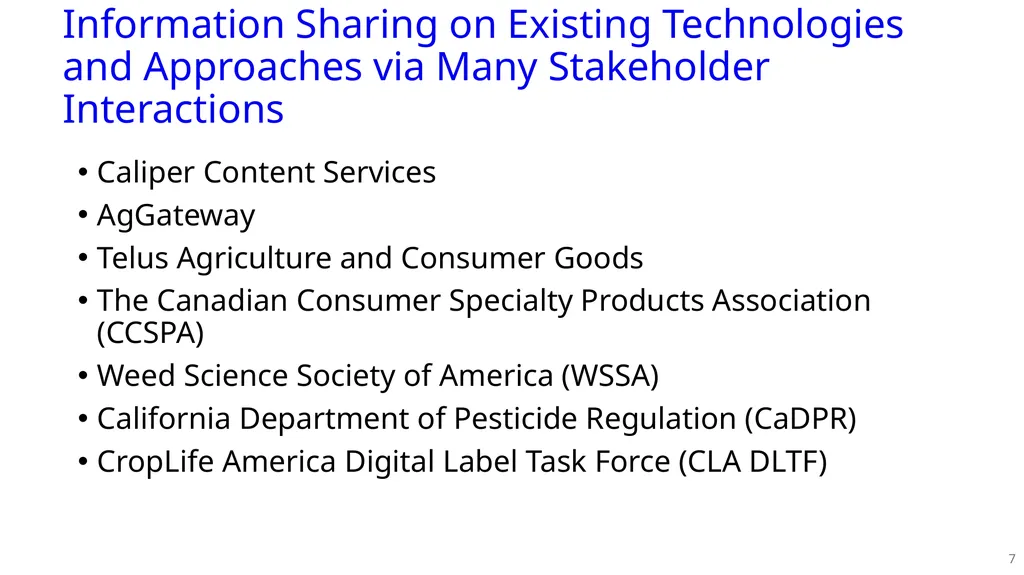
Information Sharing on Existing Technologies and Approaches via Many Stakeholder Interactions Caliper Content Services
AgGateway
Telus Agriculture and Consumer Goods
The Canadian Consumer Specialty Products Association (CCSPA)
Weed Science Society of America (WSSA)
California Department of Pesticide Regulation (CaDPR)
CropLife America Digital Label Task Force (CLA DLTF) 7<br>
AgGateway
Telus Agriculture and Consumer Goods
The Canadian Consumer Specialty Products Association (CCSPA)
Weed Science Society of America (WSSA)
California Department of Pesticide Regulation (CaDPR)
CropLife America Digital Label Task Force (CLA DLTF) 7<br>
08
Structured Labeling as a Necessary First Step Short Term – Create Voluntary Label Structure
Recommendations to US EPA on:
consistent data elements & order of data elements
where standard phrases, pick list options, and/or controlled vocabulary will begin to standardize pesticide product labels
Goal: initial step to improve label creation, review, & comprehension
Concept:
All pesticide products should share a set of common data elements according to FIFRA
This set of data elements is the starting backbone that is utilized for the structure of all pesticide products
Different types of pesticide products will differentiate in the details associated with these data elements and therefore will have different templates/modules for different pesticide types 8<br>
Recommendations to US EPA on:
consistent data elements & order of data elements
where standard phrases, pick list options, and/or controlled vocabulary will begin to standardize pesticide product labels
Goal: initial step to improve label creation, review, & comprehension
Concept:
All pesticide products should share a set of common data elements according to FIFRA
This set of data elements is the starting backbone that is utilized for the structure of all pesticide products
Different types of pesticide products will differentiate in the details associated with these data elements and therefore will have different templates/modules for different pesticide types 8<br>
09
Progress on Structured Labeling Short Term – Create Voluntary Label Structure
Progress to date of the PPDC LRWG, using Antimicrobial & Conventional product labeling as examples
Data elements identified
Source information noted for where a registrant gets guidance on the data element (Regulation [CFR citation]/Label Review Manual citation/PR Notice citation)
Identified feasibility of a pick list, standard/mandatory phrases, controlled vocabularies, and/or interoperability with other databases for data elements
Identified data elements with potential placeholders to minimize review time (e.g., QR codes and websites to be representative)
Comparison between the Antimicrobial and Conventional structures to define a minimum set of common data elements
Outstanding work for short-term voluntary label structure approach
Other pesticide type evaluations and comparison and incorporation into to minimum set of common data elements approach
Defined options for pick lists, standard/mandatory phrases, controlled vocabularies, and/or interoperability for identified data elements for all pesticide types, and where these master lists are housed/owned (governance)
Cross checking w/pesticide user groups for comprehension
Piloting of structured label submissions in order to verify efficiency gains and capture further areas for improvement 9<br>
Progress to date of the PPDC LRWG, using Antimicrobial & Conventional product labeling as examples
Data elements identified
Source information noted for where a registrant gets guidance on the data element (Regulation [CFR citation]/Label Review Manual citation/PR Notice citation)
Identified feasibility of a pick list, standard/mandatory phrases, controlled vocabularies, and/or interoperability with other databases for data elements
Identified data elements with potential placeholders to minimize review time (e.g., QR codes and websites to be representative)
Comparison between the Antimicrobial and Conventional structures to define a minimum set of common data elements
Outstanding work for short-term voluntary label structure approach
Other pesticide type evaluations and comparison and incorporation into to minimum set of common data elements approach
Defined options for pick lists, standard/mandatory phrases, controlled vocabularies, and/or interoperability for identified data elements for all pesticide types, and where these master lists are housed/owned (governance)
Cross checking w/pesticide user groups for comprehension
Piloting of structured label submissions in order to verify efficiency gains and capture further areas for improvement 9<br>
10
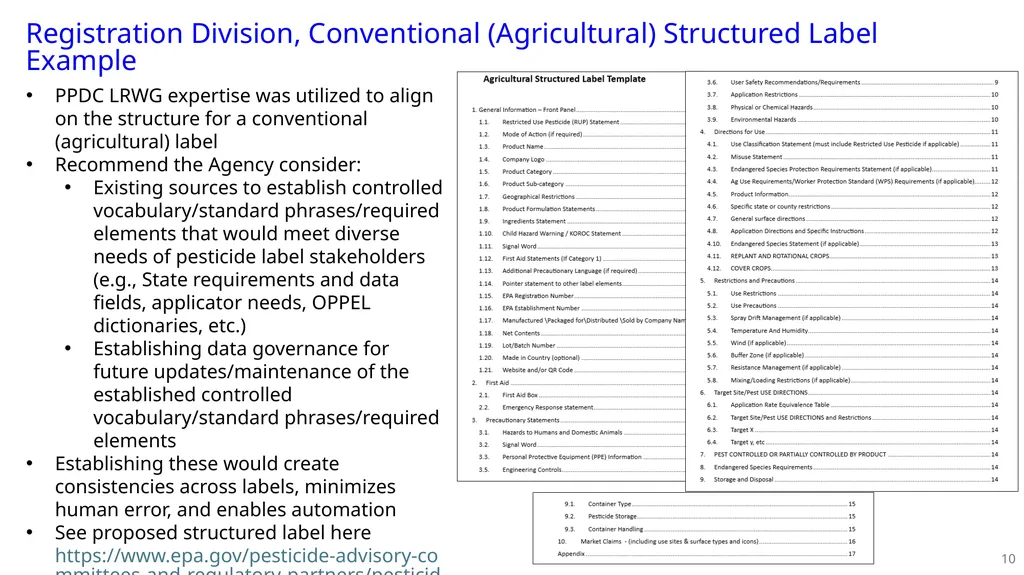
Registration Division, Conventional (Agricultural) Structured Label Example PPDC LRWG expertise was utilized to align on the structure for a conventional (agricultural) label
Recommend the Agency consider:
Existing sources to establish controlled vocabulary/standard phrases/required elements that would meet diverse needs of pesticide label stakeholders (e.g., State requirements and data fields, applicator needs, OPPEL dictionaries, etc.)
Establishing data governance for future updates/maintenance of the established controlled vocabulary/standard phrases/required elements
Establishing these would create consistencies across labels, minimizes human error, and enables automation
See proposed structured label here https://www.epa.gov/pesticide-advisory-committees-and-regulatory-partners/pesticide-program-dialogue-committee-16 10<br>
Recommend the Agency consider:
Existing sources to establish controlled vocabulary/standard phrases/required elements that would meet diverse needs of pesticide label stakeholders (e.g., State requirements and data fields, applicator needs, OPPEL dictionaries, etc.)
Establishing data governance for future updates/maintenance of the established controlled vocabulary/standard phrases/required elements
Establishing these would create consistencies across labels, minimizes human error, and enables automation
See proposed structured label here https://www.epa.gov/pesticide-advisory-committees-and-regulatory-partners/pesticide-program-dialogue-committee-16 10<br>
11
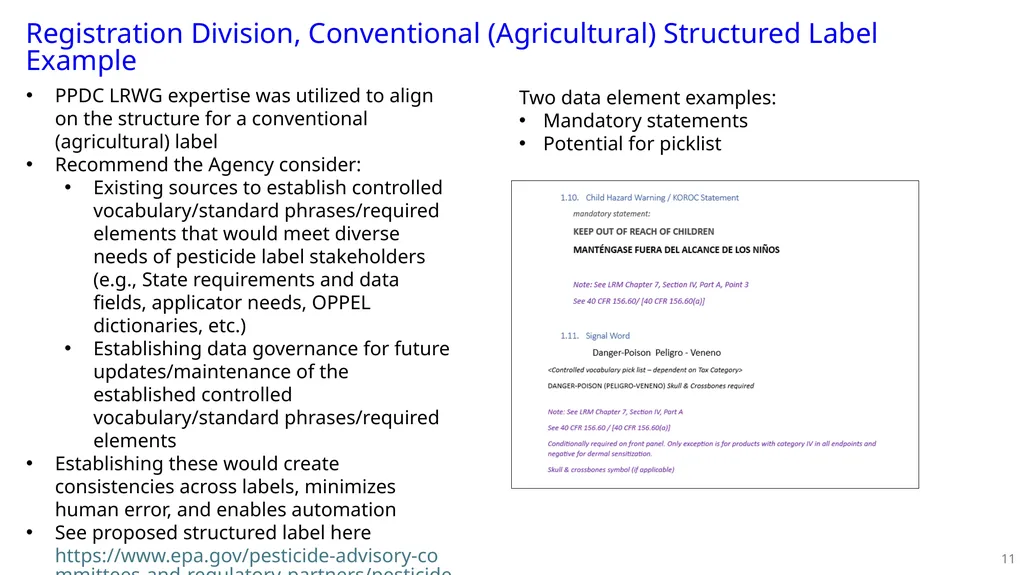
Registration Division, Conventional (Agricultural) Structured Label Example Two data element examples:
Mandatory statements
Potential for picklist PPDC LRWG expertise was utilized to align on the structure for a conventional (agricultural) label
Recommend the Agency consider:
Existing sources to establish controlled vocabulary/standard phrases/required elements that would meet diverse needs of pesticide label stakeholders (e.g., State requirements and data fields, applicator needs, OPPEL dictionaries, etc.)
Establishing data governance for future updates/maintenance of the established controlled vocabulary/standard phrases/required elements
Establishing these would create consistencies across labels, minimizes human error, and enables automation
See proposed structured label here https://www.epa.gov/pesticide-advisory-committees-and-regulatory-partners/pesticide-program-dialogue-committee-16 11<br>
Mandatory statements
Potential for picklist PPDC LRWG expertise was utilized to align on the structure for a conventional (agricultural) label
Recommend the Agency consider:
Existing sources to establish controlled vocabulary/standard phrases/required elements that would meet diverse needs of pesticide label stakeholders (e.g., State requirements and data fields, applicator needs, OPPEL dictionaries, etc.)
Establishing data governance for future updates/maintenance of the established controlled vocabulary/standard phrases/required elements
Establishing these would create consistencies across labels, minimizes human error, and enables automation
See proposed structured label here https://www.epa.gov/pesticide-advisory-committees-and-regulatory-partners/pesticide-program-dialogue-committee-16 11<br>
12
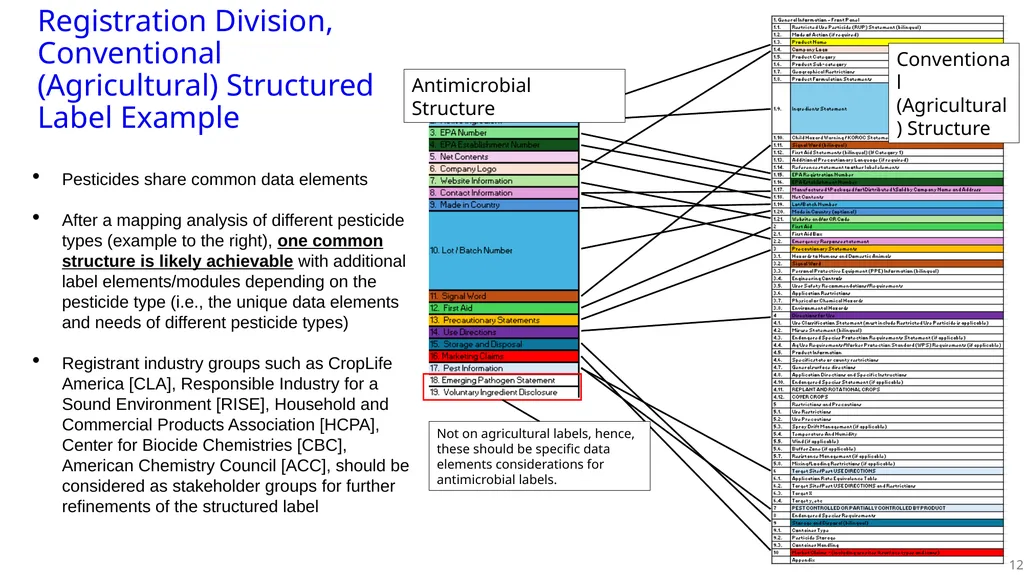
Registration Division, Conventional (Agricultural) Structured Label Example Conventional (Agricultural) Structure Not on agricultural labels, hence, these should be specific data elements considerations for antimicrobial labels. Antimicrobial Structure Pesticides share common data elements
After a mapping analysis of different pesticide types (example to the right), one common structure is likely achievable with additional label elements/modules depending on the pesticide type (i.e., the unique data elements and needs of different pesticide types)
Registrant industry groups such as CropLife America [CLA], Responsible Industry for a Sound Environment [RISE], Household and Commercial Products Association [HCPA], Center for Biocide Chemistries [CBC], American Chemistry Council [ACC], should be considered as stakeholder groups for further refinements of the structured label 12<br>
After a mapping analysis of different pesticide types (example to the right), one common structure is likely achievable with additional label elements/modules depending on the pesticide type (i.e., the unique data elements and needs of different pesticide types)
Registrant industry groups such as CropLife America [CLA], Responsible Industry for a Sound Environment [RISE], Household and Commercial Products Association [HCPA], Center for Biocide Chemistries [CBC], American Chemistry Council [ACC], should be considered as stakeholder groups for further refinements of the structured label 12<br>
13
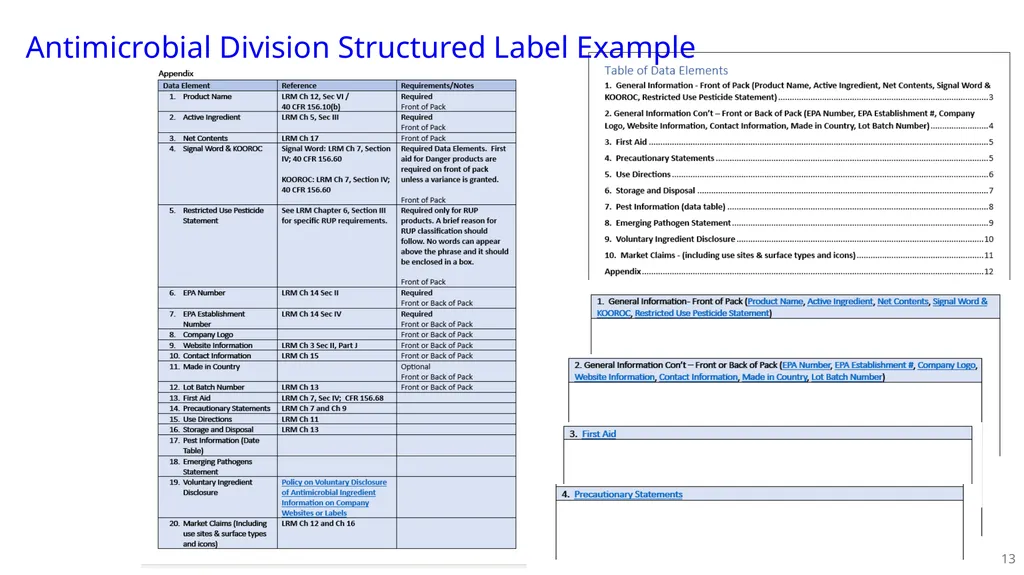
Antimicrobial Division Structured Label Example 13<br>
14
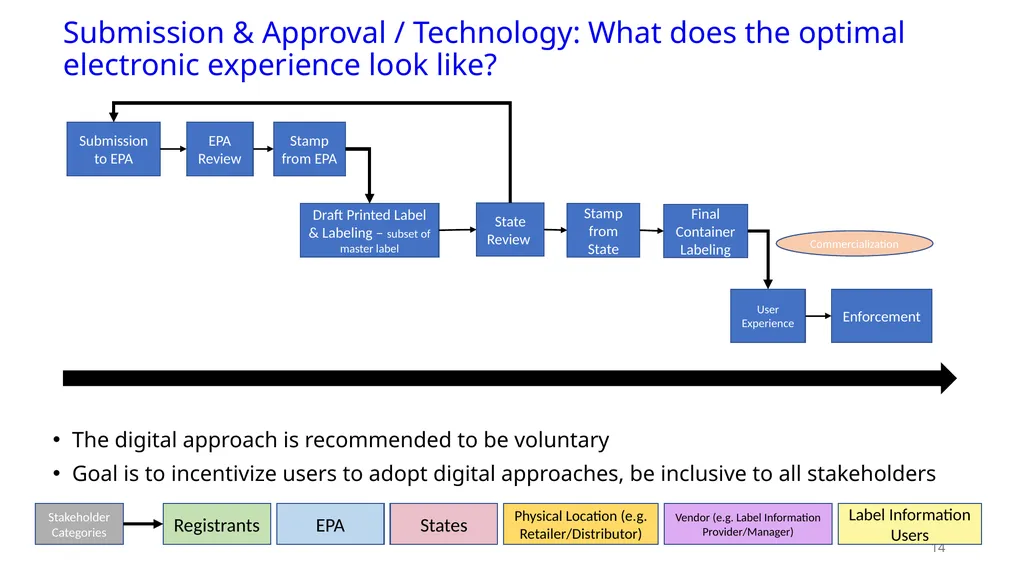
Submission & Approval / Technology: What does the optimal electronic experience look like? The digital approach is recommended to be voluntary
Goal is to incentivize users to adopt digital approaches, be inclusive to all stakeholders Submission to EPA EPA Review Stamp from EPA User Experience Draft Printed Label & Labeling – subset of master label State Review Stamp from State Final Container Labeling Enforcement Commercialization Registrants EPA States Physical Location (e.g. Retailer/Distributor) Vendor (e.g. Label Information Provider/Manager) Label Information Users Stakeholder Categories 14<br>
Goal is to incentivize users to adopt digital approaches, be inclusive to all stakeholders Submission to EPA EPA Review Stamp from EPA User Experience Draft Printed Label & Labeling – subset of master label State Review Stamp from State Final Container Labeling Enforcement Commercialization Registrants EPA States Physical Location (e.g. Retailer/Distributor) Vendor (e.g. Label Information Provider/Manager) Label Information Users Stakeholder Categories 14<br>
15
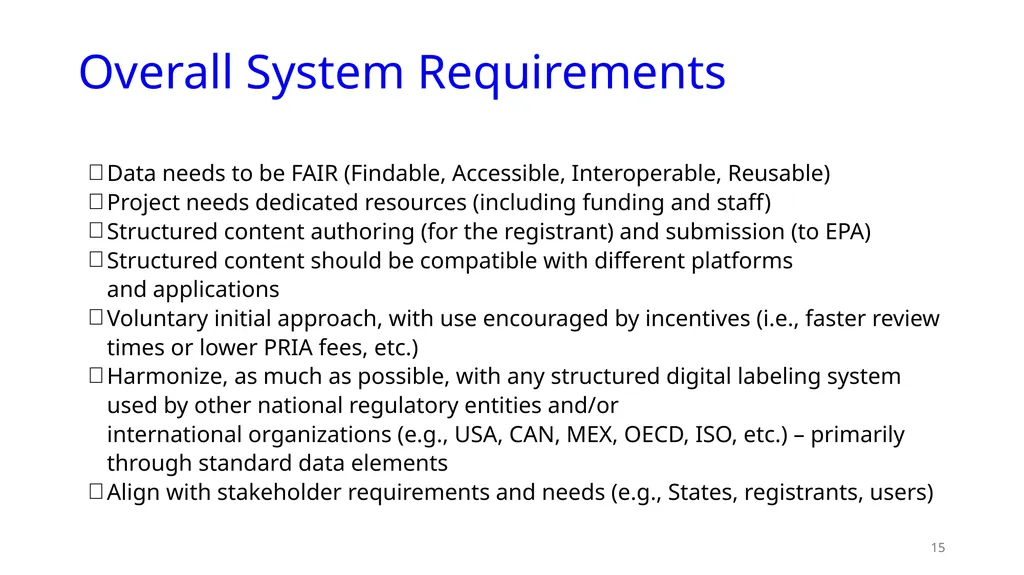
Overall System Requirements Data needs to be FAIR (Findable, Accessible, Interoperable, Reusable)
Project needs dedicated resources (including funding and staff)
Structured content authoring (for the registrant) and submission (to EPA)
Structured content should be compatible with different platforms and applications
Voluntary initial approach, with use encouraged by incentives (i.e., faster review times or lower PRIA fees, etc.)
Harmonize, as much as possible, with any structured digital labeling system used by other national regulatory entities and/or international organizations (e.g., USA, CAN, MEX, OECD, ISO, etc.) – primarily through standard data elements
Align with stakeholder requirements and needs (e.g., States, registrants, users) 15<br>
Project needs dedicated resources (including funding and staff)
Structured content authoring (for the registrant) and submission (to EPA)
Structured content should be compatible with different platforms and applications
Voluntary initial approach, with use encouraged by incentives (i.e., faster review times or lower PRIA fees, etc.)
Harmonize, as much as possible, with any structured digital labeling system used by other national regulatory entities and/or international organizations (e.g., USA, CAN, MEX, OECD, ISO, etc.) – primarily through standard data elements
Align with stakeholder requirements and needs (e.g., States, registrants, users) 15<br>
16
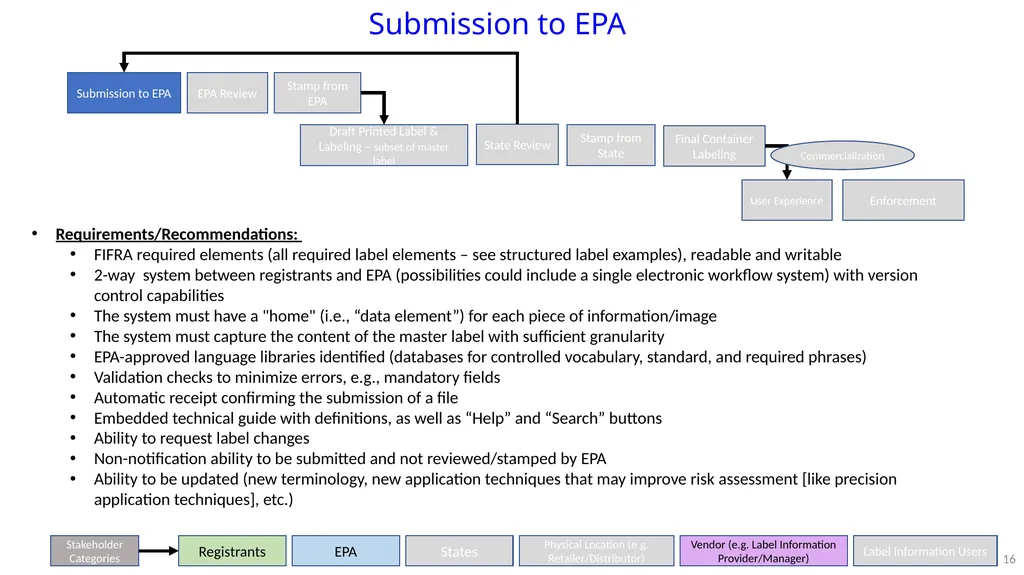
Submission to EPA EPA Review Stamp from EPA User Experience Draft Printed Label & Labeling – subset of master label State Review Stamp from State Final Container Labeling Enforcement Commercialization Submission to EPA Registrants EPA States Physical Location (e.g. Retailer/Distributor) Vendor (e.g. Label Information Provider/Manager) Label Information Users Stakeholder Categories Requirements/Recommendations:
FIFRA required elements (all required label elements – see structured label examples), readable and writable
2-way system between registrants and EPA (possibilities could include a single electronic workflow system) with version control capabilities
The system must have a "home" (i.e., “data element”) for each piece of information/image
The system must capture the content of the master label with sufficient granularity
EPA-approved language libraries identified (databases for controlled vocabulary, standard, and required phrases)
Validation checks to minimize errors, e.g., mandatory fields
Automatic receipt confirming the submission of a file
Embedded technical guide with definitions, as well as “Help” and “Search” buttons
Ability to request label changes
Non-notification ability to be submitted and not reviewed/stamped by EPA
Ability to be updated (new terminology, new application techniques that may improve risk assessment [like precision application techniques], etc.) 16<br>
FIFRA required elements (all required label elements – see structured label examples), readable and writable
2-way system between registrants and EPA (possibilities could include a single electronic workflow system) with version control capabilities
The system must have a "home" (i.e., “data element”) for each piece of information/image
The system must capture the content of the master label with sufficient granularity
EPA-approved language libraries identified (databases for controlled vocabulary, standard, and required phrases)
Validation checks to minimize errors, e.g., mandatory fields
Automatic receipt confirming the submission of a file
Embedded technical guide with definitions, as well as “Help” and “Search” buttons
Ability to request label changes
Non-notification ability to be submitted and not reviewed/stamped by EPA
Ability to be updated (new terminology, new application techniques that may improve risk assessment [like precision application techniques], etc.) 16<br>
17
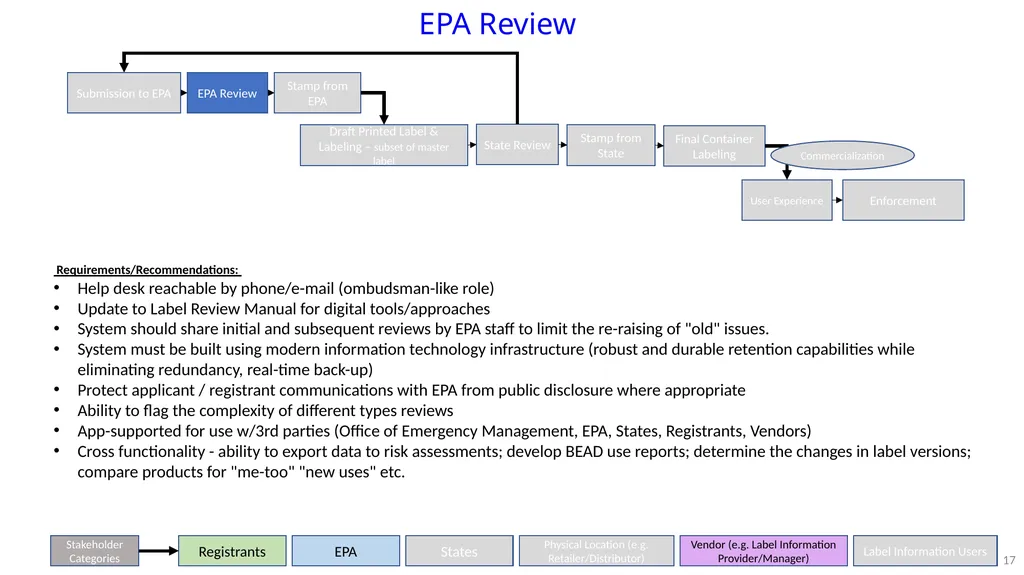
Submission to EPA EPA Review Stamp from EPA User Experience Draft Printed Label & Labeling – subset of master label State Review Stamp from State Final Container Labeling Enforcement Commercialization EPA Review Registrants EPA States Physical Location (e.g. Retailer/Distributor) Label Information Users Stakeholder Categories Requirements/Recommendations:
Help desk reachable by phone/e-mail (ombudsman-like role)
Update to Label Review Manual for digital tools/approaches
System should share initial and subsequent reviews by EPA staff to limit the re-raising of "old" issues.
System must be built using modern information technology infrastructure (robust and durable retention capabilities while eliminating redundancy, real-time back-up)
Protect applicant / registrant communications with EPA from public disclosure where appropriate
Ability to flag the complexity of different types reviews
App-supported for use w/3rd parties (Office of Emergency Management, EPA, States, Registrants, Vendors)
Cross functionality - ability to export data to risk assessments; develop BEAD use reports; determine the changes in label versions; compare products for "me-too" "new uses" etc. Vendor (e.g. Label Information Provider/Manager) 17<br>
Help desk reachable by phone/e-mail (ombudsman-like role)
Update to Label Review Manual for digital tools/approaches
System should share initial and subsequent reviews by EPA staff to limit the re-raising of "old" issues.
System must be built using modern information technology infrastructure (robust and durable retention capabilities while eliminating redundancy, real-time back-up)
Protect applicant / registrant communications with EPA from public disclosure where appropriate
Ability to flag the complexity of different types reviews
App-supported for use w/3rd parties (Office of Emergency Management, EPA, States, Registrants, Vendors)
Cross functionality - ability to export data to risk assessments; develop BEAD use reports; determine the changes in label versions; compare products for "me-too" "new uses" etc. Vendor (e.g. Label Information Provider/Manager) 17<br>
18
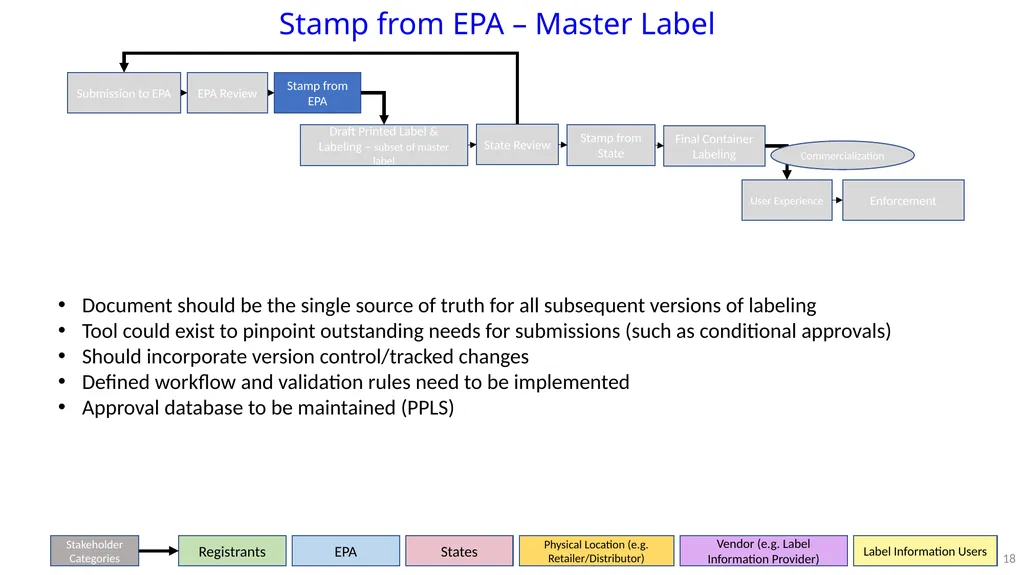
Submission to EPA EPA Review Stamp from EPA User Experience Draft Printed Label & Labeling – subset of master label State Review Stamp from State Final Container Labeling Enforcement Commercialization Stamp from EPA – Master Label Registrants EPA States Physical Location (e.g. Retailer/Distributor) Vendor (e.g. Label Information Provider) Label Information Users Stakeholder Categories Document should be the single source of truth for all subsequent versions of labeling
Tool could exist to pinpoint outstanding needs for submissions (such as conditional approvals)
Should incorporate version control/tracked changes
Defined workflow and validation rules need to be implemented
Approval database to be maintained (PPLS) 18<br>
Tool could exist to pinpoint outstanding needs for submissions (such as conditional approvals)
Should incorporate version control/tracked changes
Defined workflow and validation rules need to be implemented
Approval database to be maintained (PPLS) 18<br>
19
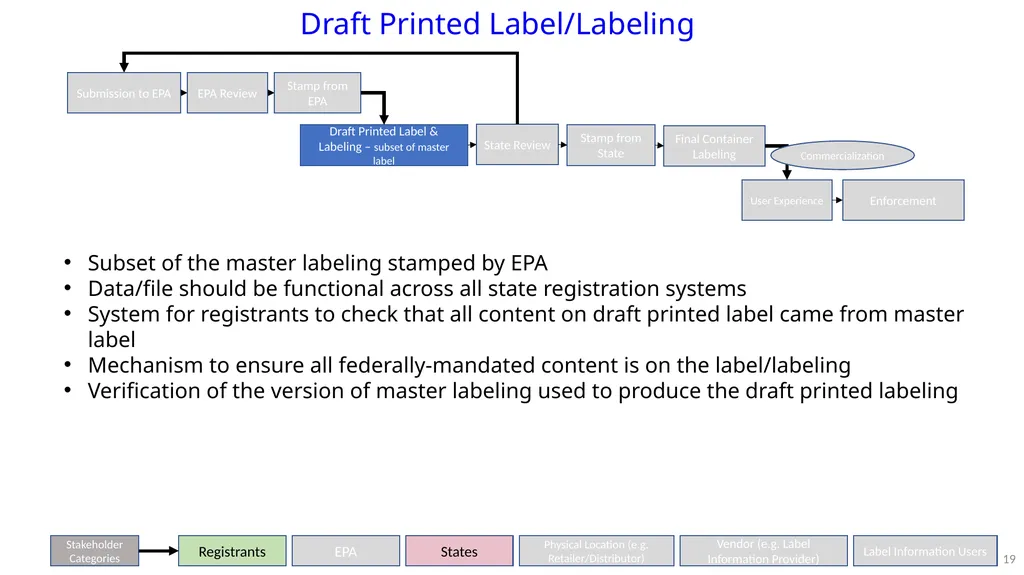
Submission to EPA EPA Review Stamp from EPA User Experience Draft Printed Label & Labeling – subset of master label State Review Stamp from State Final Container Labeling Enforcement Commercialization Draft Printed Label/Labeling Registrants EPA States Physical Location (e.g. Retailer/Distributor) Vendor (e.g. Label Information Provider) Label Information Users Stakeholder Categories Subset of the master labeling stamped by EPA
Data/file should be functional across all state registration systems
System for registrants to check that all content on draft printed label came from master label
Mechanism to ensure all federally-mandated content is on the label/labeling
Verification of the version of master labeling used to produce the draft printed labeling 19<br>
Data/file should be functional across all state registration systems
System for registrants to check that all content on draft printed label came from master label
Mechanism to ensure all federally-mandated content is on the label/labeling
Verification of the version of master labeling used to produce the draft printed labeling 19<br>
20
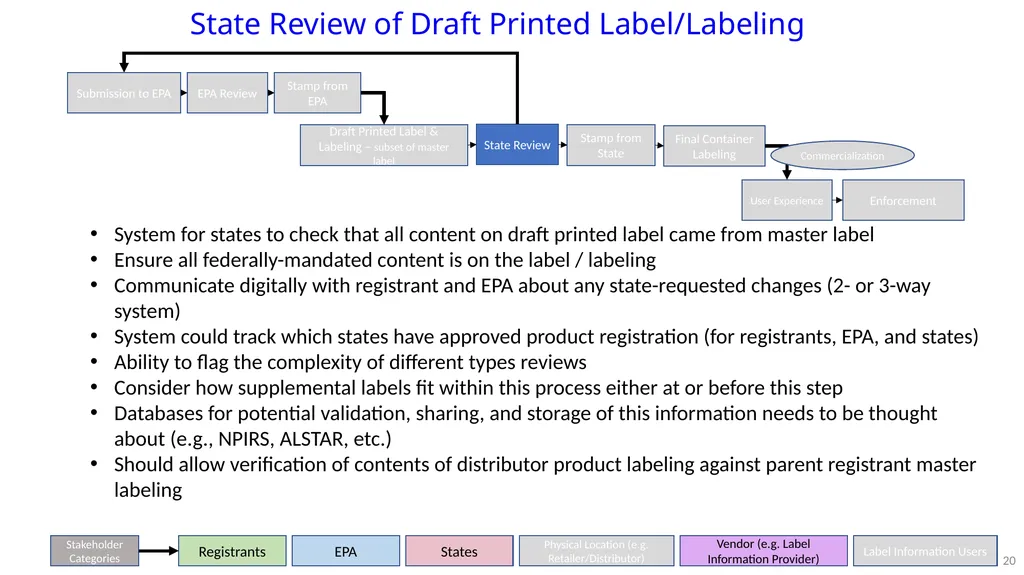
Submission to EPA EPA Review Stamp from EPA User Experience Draft Printed Label & Labeling – subset of master label State Review Stamp from State Final Container Labeling Enforcement Commercialization State Review of Draft Printed Label/Labeling Registrants EPA States Physical Location (e.g. Retailer/Distributor) Vendor (e.g. Label Information Provider) Label Information Users Stakeholder Categories System for states to check that all content on draft printed label came from master label
Ensure all federally-mandated content is on the label / labeling
Communicate digitally with registrant and EPA about any state-requested changes (2- or 3-way system)
System could track which states have approved product registration (for registrants, EPA, and states)
Ability to flag the complexity of different types reviews
Consider how supplemental labels fit within this process either at or before this step
Databases for potential validation, sharing, and storage of this information needs to be thought about (e.g., NPIRS, ALSTAR, etc.)
Should allow verification of contents of distributor product labeling against parent registrant master labeling 20<br>
Ensure all federally-mandated content is on the label / labeling
Communicate digitally with registrant and EPA about any state-requested changes (2- or 3-way system)
System could track which states have approved product registration (for registrants, EPA, and states)
Ability to flag the complexity of different types reviews
Consider how supplemental labels fit within this process either at or before this step
Databases for potential validation, sharing, and storage of this information needs to be thought about (e.g., NPIRS, ALSTAR, etc.)
Should allow verification of contents of distributor product labeling against parent registrant master labeling 20<br>
21
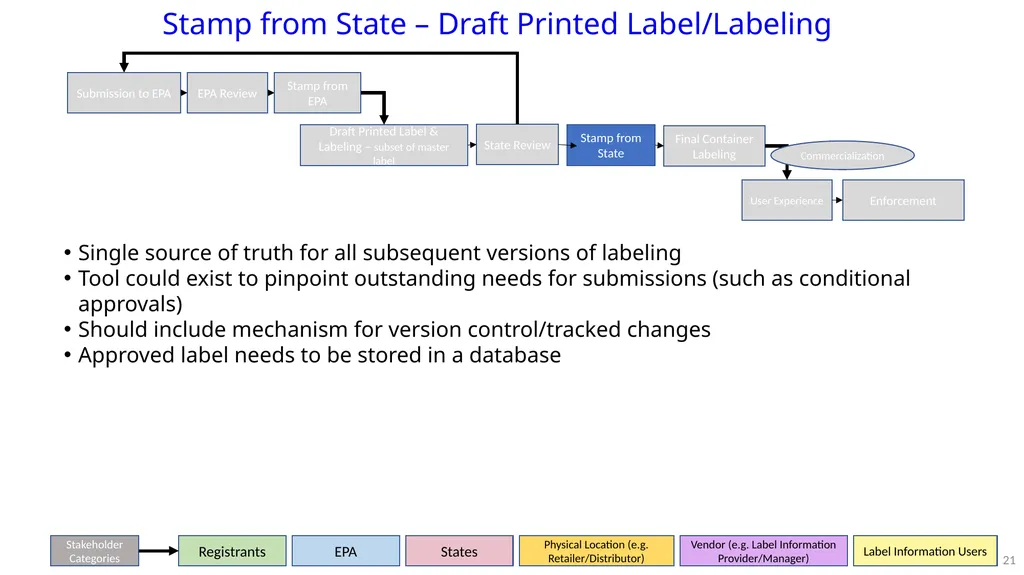
Submission to EPA EPA Review Stamp from EPA User Experience Draft Printed Label & Labeling – subset of master label State Review Stamp from State Final Container Labeling Enforcement Commercialization Stamp from State – Draft Printed Label/Labeling Registrants EPA States Physical Location (e.g. Retailer/Distributor) Vendor (e.g. Label Information Provider/Manager) Label Information Users Stakeholder Categories Single source of truth for all subsequent versions of labeling
Tool could exist to pinpoint outstanding needs for submissions (such as conditional approvals)
Should include mechanism for version control/tracked changes
Approved label needs to be stored in a database 21<br>
Tool could exist to pinpoint outstanding needs for submissions (such as conditional approvals)
Should include mechanism for version control/tracked changes
Approved label needs to be stored in a database 21<br>
22
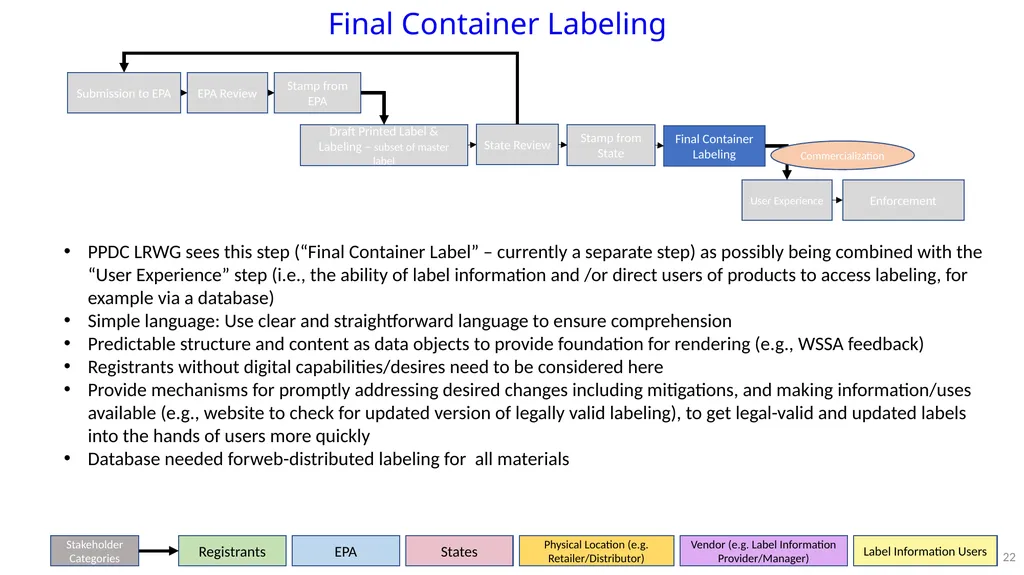
Submission to EPA EPA Review Stamp from EPA User Experience Draft Printed Label & Labeling – subset of master label State Review Stamp from State Final Container Labeling Enforcement Commercialization Final Container Labeling Registrants EPA States Physical Location (e.g. Retailer/Distributor) Vendor (e.g. Label Information Provider/Manager) Stakeholder Categories PPDC LRWG sees this step (“Final Container Label” – currently a separate step) as possibly being combined with the “User Experience” step (i.e., the ability of label information and /or direct users of products to access labeling, for example via a database)
Simple language: Use clear and straightforward language to ensure comprehension
Predictable structure and content as data objects to provide foundation for rendering (e.g., WSSA feedback)
Registrants without digital capabilities/desires need to be considered here
Provide mechanisms for promptly addressing desired changes including mitigations, and making information/uses available (e.g., website to check for updated version of legally valid labeling), to get legal-valid and updated labels into the hands of users more quickly
Database needed forweb-distributed labeling for all materials Label Information Users 22<br>
Simple language: Use clear and straightforward language to ensure comprehension
Predictable structure and content as data objects to provide foundation for rendering (e.g., WSSA feedback)
Registrants without digital capabilities/desires need to be considered here
Provide mechanisms for promptly addressing desired changes including mitigations, and making information/uses available (e.g., website to check for updated version of legally valid labeling), to get legal-valid and updated labels into the hands of users more quickly
Database needed forweb-distributed labeling for all materials Label Information Users 22<br>
23
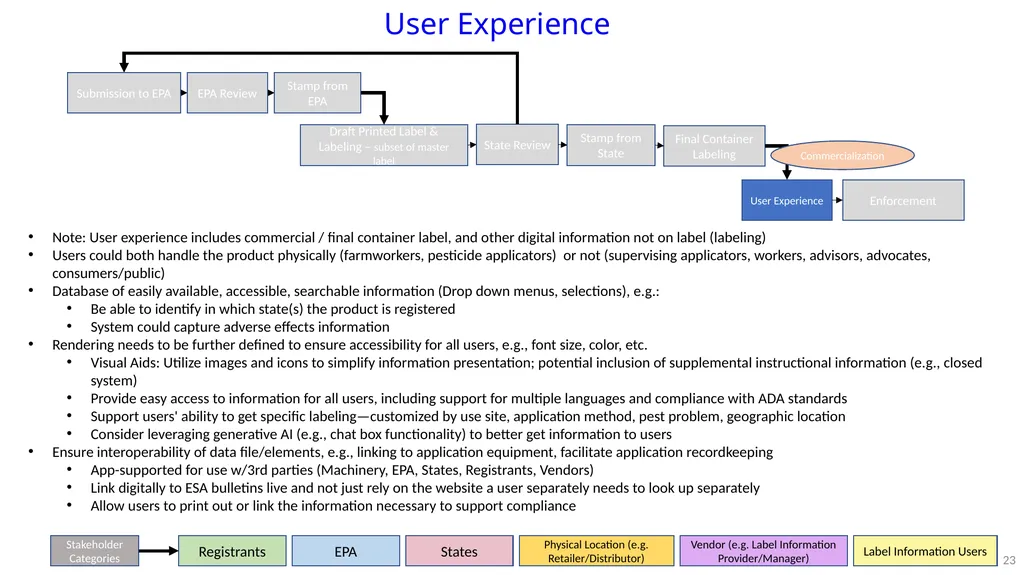
Submission to EPA EPA Review Stamp from EPA User Experience Draft Printed Label & Labeling – subset of master label State Review Stamp from State Final Container Labeling Enforcement Commercialization User Experience Registrants EPA States Physical Location (e.g. Retailer/Distributor) Vendor (e.g. Label Information Provider/Manager) Label Information Users Stakeholder Categories Note: User experience includes commercial / final container label, and other digital information not on label (labeling)
Users could both handle the product physically (farmworkers, pesticide applicators) or not (supervising applicators, workers, advisors, advocates, consumers/public)
Database of easily available, accessible, searchable information (Drop down menus, selections), e.g.:
Be able to identify in which state(s) the product is registered
System could capture adverse effects information
Rendering needs to be further defined to ensure accessibility for all users, e.g., font size, color, etc.
Visual Aids: Utilize images and icons to simplify information presentation; potential inclusion of supplemental instructional information (e.g., closed system)
Provide easy access to information for all users, including support for multiple languages and compliance with ADA standards
Support users' ability to get specific labeling—customized by use site, application method, pest problem, geographic location
Consider leveraging generative AI (e.g., chat box functionality) to better get information to users
Ensure interoperability of data file/elements, e.g., linking to application equipment, facilitate application recordkeeping
App-supported for use w/3rd parties (Machinery, EPA, States, Registrants, Vendors)
Link digitally to ESA bulletins live and not just rely on the website a user separately needs to look up separately
Allow users to print out or link the information necessary to support compliance 23<br>
Users could both handle the product physically (farmworkers, pesticide applicators) or not (supervising applicators, workers, advisors, advocates, consumers/public)
Database of easily available, accessible, searchable information (Drop down menus, selections), e.g.:
Be able to identify in which state(s) the product is registered
System could capture adverse effects information
Rendering needs to be further defined to ensure accessibility for all users, e.g., font size, color, etc.
Visual Aids: Utilize images and icons to simplify information presentation; potential inclusion of supplemental instructional information (e.g., closed system)
Provide easy access to information for all users, including support for multiple languages and compliance with ADA standards
Support users' ability to get specific labeling—customized by use site, application method, pest problem, geographic location
Consider leveraging generative AI (e.g., chat box functionality) to better get information to users
Ensure interoperability of data file/elements, e.g., linking to application equipment, facilitate application recordkeeping
App-supported for use w/3rd parties (Machinery, EPA, States, Registrants, Vendors)
Link digitally to ESA bulletins live and not just rely on the website a user separately needs to look up separately
Allow users to print out or link the information necessary to support compliance 23<br>
24
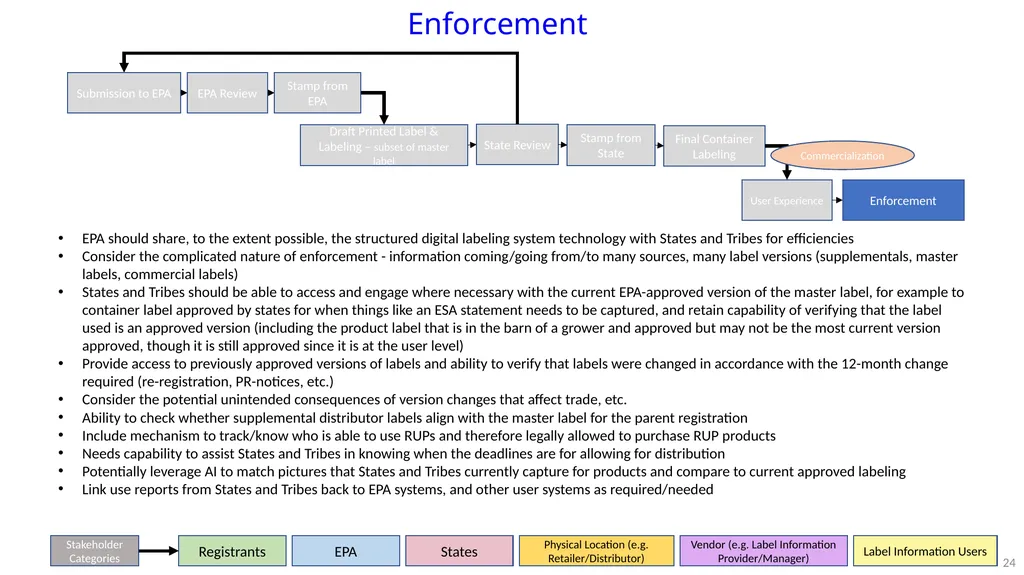
Submission to EPA EPA Review Stamp from EPA User Experience Draft Printed Label & Labeling – subset of master label State Review Stamp from State Final Container Labeling Enforcement Commercialization Enforcement Registrants EPA States Physical Location (e.g. Retailer/Distributor) Vendor (e.g. Label Information Provider/Manager) Label Information Users Stakeholder Categories EPA should share, to the extent possible, the structured digital labeling system technology with States and Tribes for efficiencies
Consider the complicated nature of enforcement - information coming/going from/to many sources, many label versions (supplementals, master labels, commercial labels)
States and Tribes should be able to access and engage where necessary with the current EPA-approved version of the master label, for example to container label approved by states for when things like an ESA statement needs to be captured, and retain capability of verifying that the label used is an approved version (including the product label that is in the barn of a grower and approved but may not be the most current version approved, though it is still approved since it is at the user level)
Provide access to previously approved versions of labels and ability to verify that labels were changed in accordance with the 12-month change required (re-registration, PR-notices, etc.)
Consider the potential unintended consequences of version changes that affect trade, etc.
Ability to check whether supplemental distributor labels align with the master label for the parent registration
Include mechanism to track/know who is able to use RUPs and therefore legally allowed to purchase RUP products
Needs capability to assist States and Tribes in knowing when the deadlines are for allowing for distribution
Potentially leverage AI to match pictures that States and Tribes currently capture for products and compare to current approved labeling
Link use reports from States and Tribes back to EPA systems, and other user systems as required/needed 24<br>
Consider the complicated nature of enforcement - information coming/going from/to many sources, many label versions (supplementals, master labels, commercial labels)
States and Tribes should be able to access and engage where necessary with the current EPA-approved version of the master label, for example to container label approved by states for when things like an ESA statement needs to be captured, and retain capability of verifying that the label used is an approved version (including the product label that is in the barn of a grower and approved but may not be the most current version approved, though it is still approved since it is at the user level)
Provide access to previously approved versions of labels and ability to verify that labels were changed in accordance with the 12-month change required (re-registration, PR-notices, etc.)
Consider the potential unintended consequences of version changes that affect trade, etc.
Ability to check whether supplemental distributor labels align with the master label for the parent registration
Include mechanism to track/know who is able to use RUPs and therefore legally allowed to purchase RUP products
Needs capability to assist States and Tribes in knowing when the deadlines are for allowing for distribution
Potentially leverage AI to match pictures that States and Tribes currently capture for products and compare to current approved labeling
Link use reports from States and Tribes back to EPA systems, and other user systems as required/needed 24<br>
25
Recommendations: Proposals for short-term voluntary label structure approach Use of this approach could result in some short-term wins for quicker submissions and review times: Regulators and registrants to consider metrics that can be used as a baseline and to then show progress as process improves
This is a voluntary approach
Not every data element is mandatory on every label (while backbone should be the same among all pesticides, different pesticide types will differ in their templates/modules)
All the “data” / “information” of the label will fit into one of these data elements
Recommend that a placeholder be allowed for Website / QR Code /Telephone Number data elements
Source information and requirements will be highlighted (e.g., location requirements)
There will be the option to add free text however, this should be limited, and standardized if possible (if not upfront, at a later date with system upgrade milestones)
The information should be understandable to all audiences (requires abbreviations to be defined and cross-checking w/a diversity of stakeholder groups)
If possible, approach should be fit-for-future use with technology advances that can reduce submission and review time (e.g., structured content authoring and review)
House in a central label guidance location that includes:
Structure of data elements for all pesticide products
Templates/Modules for different pesticides types (start with Antimicrobial and Conventional examples and add as more pesticide types are evaluated for adherence with the structure and their individual template/module needs)
Defined options for pick lists, standard/mandatory phrases, and controlled vocabularies
Validation and interoperability rules for data elements
If this guidance location is the Label Review Manual, this would need refinement, updating, and a maintenance plan to ensure user ease, to be consistent with other sources (e.g., CFR), and to remain relevant 25<br>
This is a voluntary approach
Not every data element is mandatory on every label (while backbone should be the same among all pesticides, different pesticide types will differ in their templates/modules)
All the “data” / “information” of the label will fit into one of these data elements
Recommend that a placeholder be allowed for Website / QR Code /Telephone Number data elements
Source information and requirements will be highlighted (e.g., location requirements)
There will be the option to add free text however, this should be limited, and standardized if possible (if not upfront, at a later date with system upgrade milestones)
The information should be understandable to all audiences (requires abbreviations to be defined and cross-checking w/a diversity of stakeholder groups)
If possible, approach should be fit-for-future use with technology advances that can reduce submission and review time (e.g., structured content authoring and review)
House in a central label guidance location that includes:
Structure of data elements for all pesticide products
Templates/Modules for different pesticides types (start with Antimicrobial and Conventional examples and add as more pesticide types are evaluated for adherence with the structure and their individual template/module needs)
Defined options for pick lists, standard/mandatory phrases, and controlled vocabularies
Validation and interoperability rules for data elements
If this guidance location is the Label Review Manual, this would need refinement, updating, and a maintenance plan to ensure user ease, to be consistent with other sources (e.g., CFR), and to remain relevant 25<br>
26
Longer Term – Ability for EPA to capture and communicate label elements as “Digital Data” and move from document centric to data centric label information:
Work with stakeholders to define pick lists, standard/mandatory phrases, controlled vocabularies, and/or interoperability for identified data elements for all pesticide types
Work with stakeholders for other pesticide types for comparison and incorporation into to minimum set of common data elements approach
Work with pesticide label stakeholder groups for comprehension improvement possibilities
Identify metrics to monitor benefits gained along the journey of digital labels and platforms
Pilot structured label submissions and capture further areas for improvement
Consider use document/section compare technology/approaches that is fit for the future (current tools are generally not adequate for what is needed)
Would enable EPA with automation that could support ceasing de novo reviews when previously reviewed in the last (e.g., 1 year/2 years) in most cases
Work with States to understand their needs for an electronic system
Recommend that EPA and States consider common data elements to enable interoperability of systems in Federal State, State State, and Federal/State Local Authority interfaces
End-to-end and two-way digital submission, registration, and distribution system to enable intake review, and label access by users
Define workflows of human processes, document management, system interoperability, and content/data model management Recommendations: Structured Digital Labeling is Necessary for Maximum Label Reform 26<br>
Work with stakeholders to define pick lists, standard/mandatory phrases, controlled vocabularies, and/or interoperability for identified data elements for all pesticide types
Work with stakeholders for other pesticide types for comparison and incorporation into to minimum set of common data elements approach
Work with pesticide label stakeholder groups for comprehension improvement possibilities
Identify metrics to monitor benefits gained along the journey of digital labels and platforms
Pilot structured label submissions and capture further areas for improvement
Consider use document/section compare technology/approaches that is fit for the future (current tools are generally not adequate for what is needed)
Would enable EPA with automation that could support ceasing de novo reviews when previously reviewed in the last (e.g., 1 year/2 years) in most cases
Work with States to understand their needs for an electronic system
Recommend that EPA and States consider common data elements to enable interoperability of systems in Federal State, State State, and Federal/State Local Authority interfaces
End-to-end and two-way digital submission, registration, and distribution system to enable intake review, and label access by users
Define workflows of human processes, document management, system interoperability, and content/data model management Recommendations: Structured Digital Labeling is Necessary for Maximum Label Reform 26<br>
27
Next Steps Formalize the PPDC LRWG recommendations for consideration of the PPDC in Spring 2025.
PPDC LRWG serving as an initial sounding board for EPA portal feedback during implementation phase until Spring 2025 meeting after which, we will assess needs 27<br>
PPDC LRWG serving as an initial sounding board for EPA portal feedback during implementation phase until Spring 2025 meeting after which, we will assess needs 27<br>