04
Address the cause of the wound
Manage compounding factors
Choose the appropriate dressing It’s simple!<br>
05
1. The Cause Swelling Compression
Necrotic Debride
Venous Insufficiency Decrease swelling via compression
Arterial Insufficiency Re-establish blood flow
Pressure/Diabetic Offload<br>
06
2. Compounding Factors No Smoking
Controlled Blood Sugar
Controlled Blood Pressure
Adequate Protein Intake Compliance is crucial!<br>
07
Prealbumin Indicates past 3 days level of protein
Should be >20
Normal 18-38 mg/dL Albumin Gives a longer indicator of protein
Need extra protein to heal the wound AND
Drainage from wound leaks out protein<br>
08
A1C 3 month indication of sugar level
Bacteria feeds off sugar
Leads to infection! Ankle-Brachial Index ABI should = 1.0
ABI should be triphasic<br>
09
3. Dressing Options This part is a little trickier…<br>
10
Wet-to-dry dressing Gauze with Normal Saline
Inexpensive
Great for wounds changed daily
Commonly Used For: packing abscesses or deep cavity wounds<br>
11
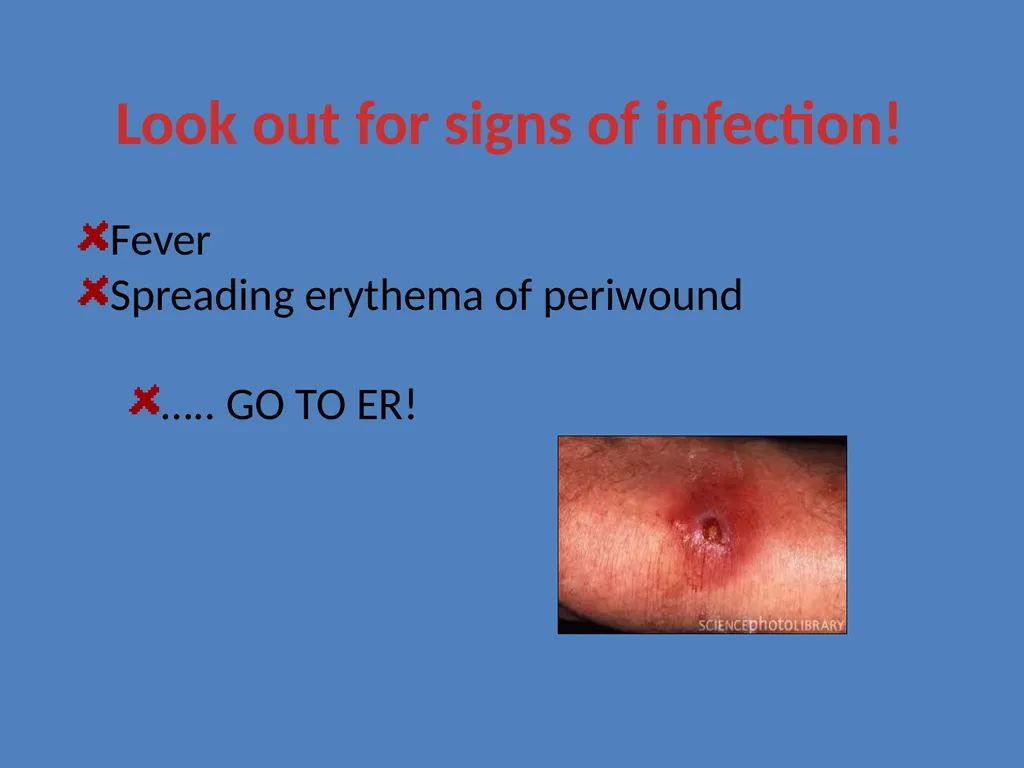
Look out for signs of infection! Fever
Spreading erythema of periwound
….. GO TO ER!<br>
12
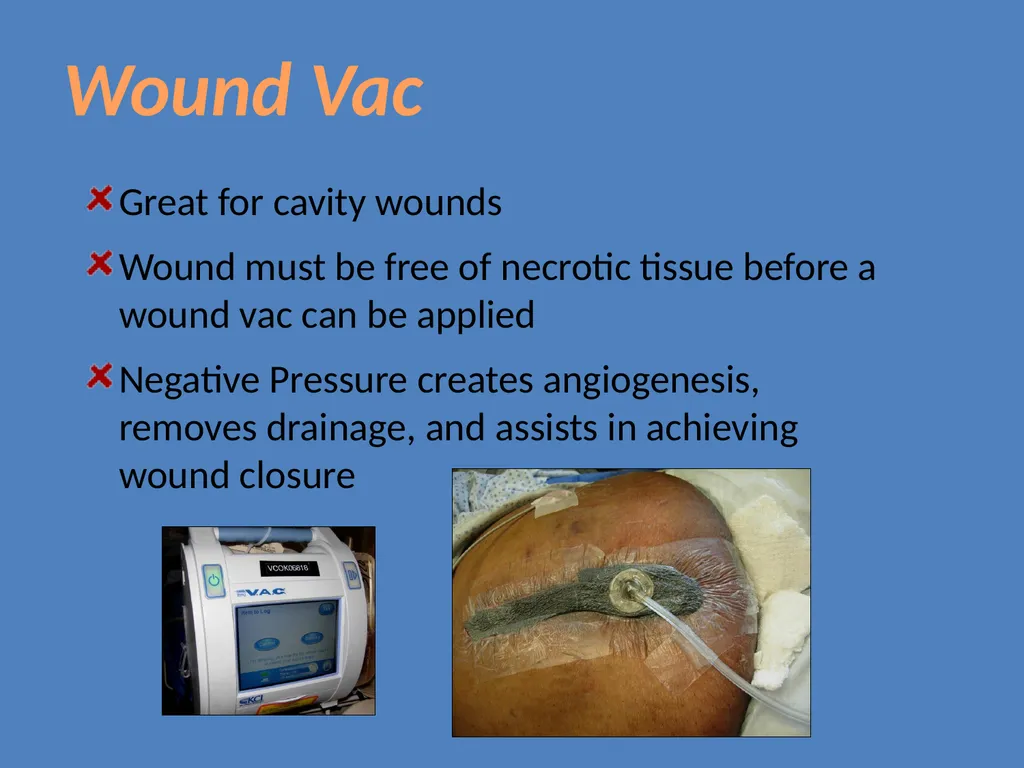
Wound Vac Great for cavity wounds
Wound must be free of necrotic tissue before a wound vac can be applied
Negative Pressure creates angiogenesis, removes drainage, and assists in achieving wound closure<br>
13
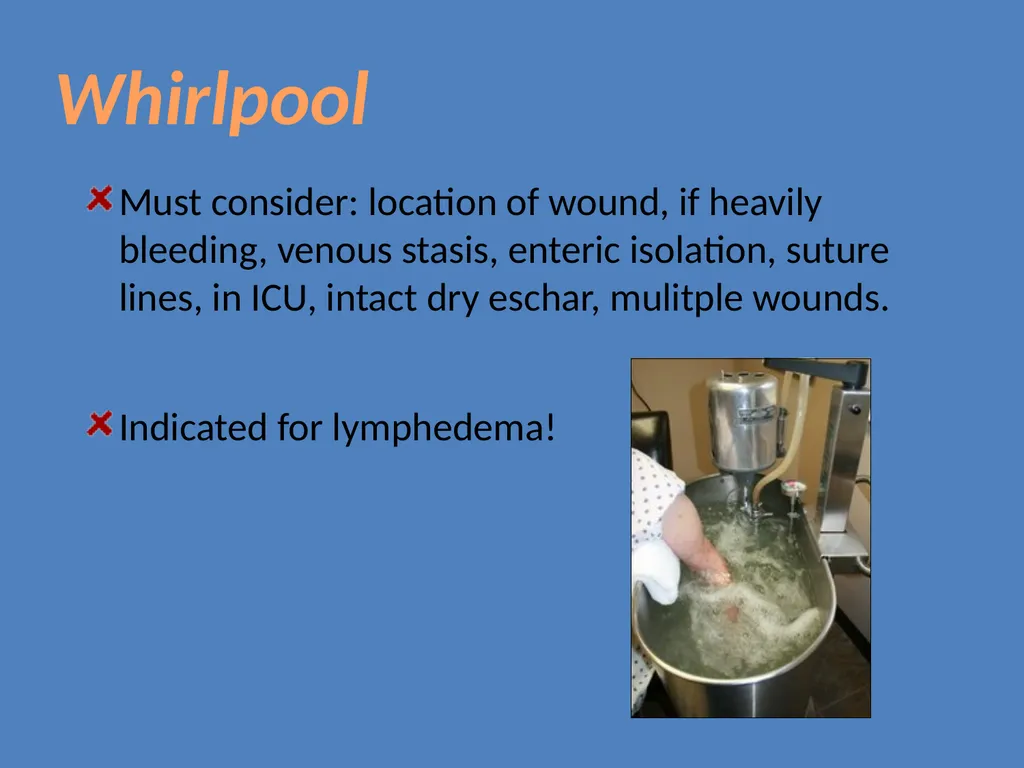
Whirlpool Must consider: location of wound, if heavily bleeding, venous stasis, enteric isolation, suture lines, in ICU, intact dry eschar, mulitple wounds.
Indicated for lymphedema!<br>
14
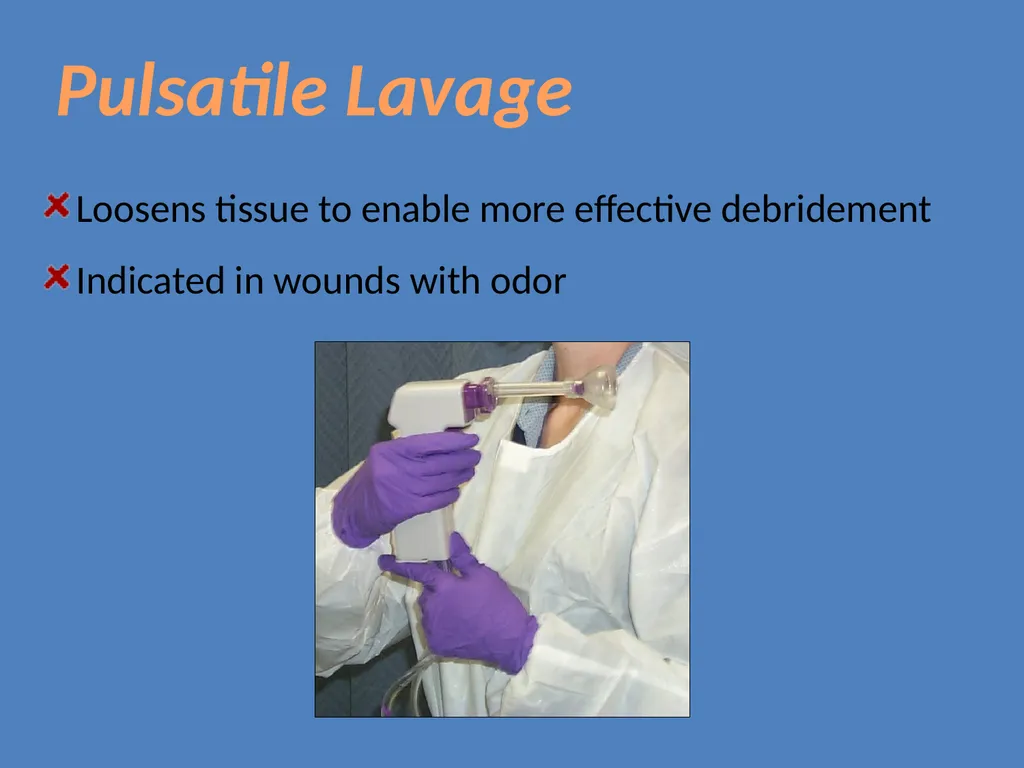
Pulsatile Lavage Loosens tissue to enable more effective debridement
Indicated in wounds with odor<br>
15
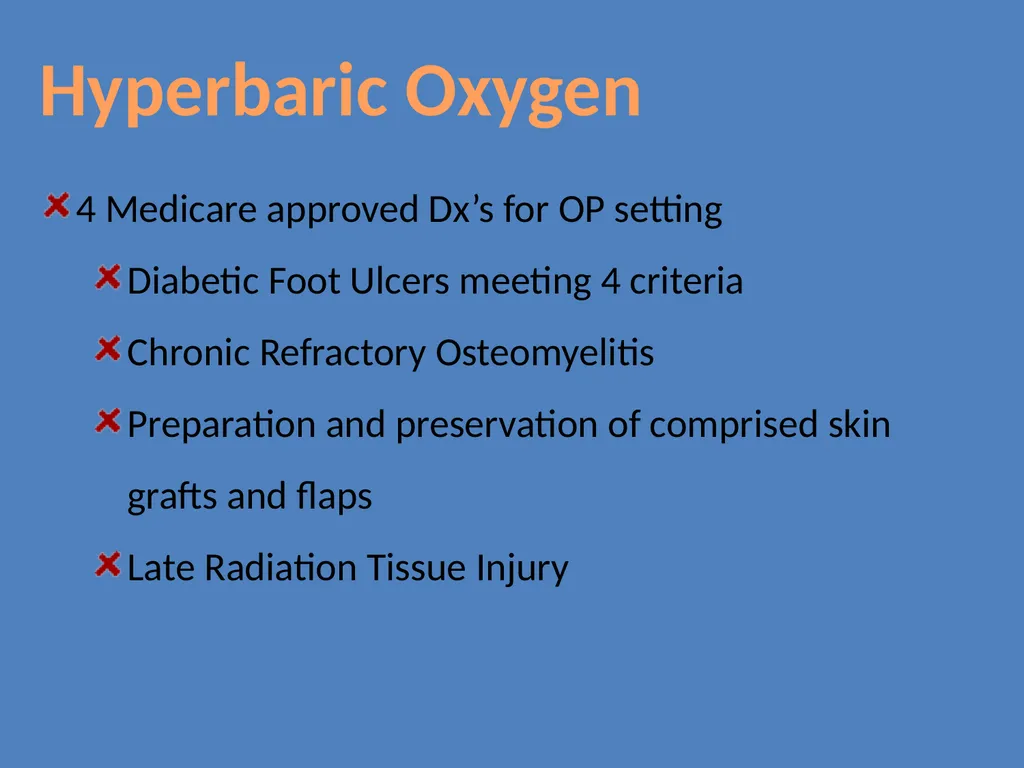
Hyperbaric Oxygen 4 Medicare approved Dx’s for OP setting
Diabetic Foot Ulcers meeting 4 criteria
Chronic Refractory Osteomyelitis
Preparation and preservation of comprised skin grafts and flaps
Late Radiation Tissue Injury<br>
16
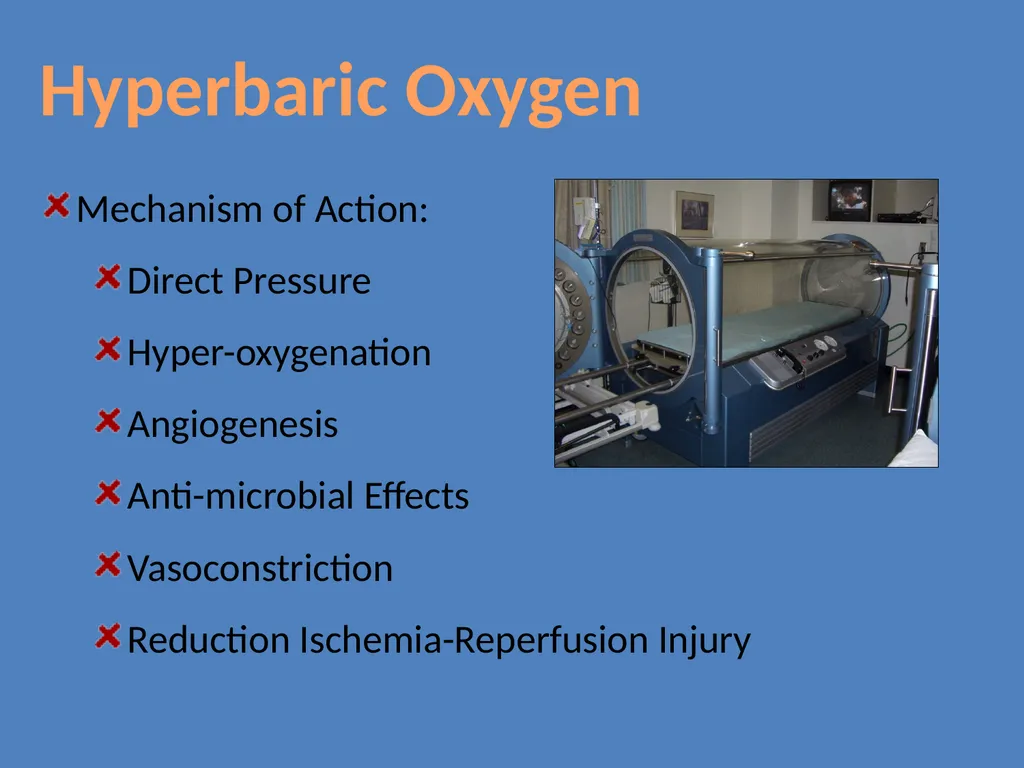
Hyperbaric Oxygen Mechanism of Action:
Direct Pressure
Hyper-oxygenation
Angiogenesis
Anti-microbial Effects
Vasoconstriction
Reduction Ischemia-Reperfusion Injury<br>
17
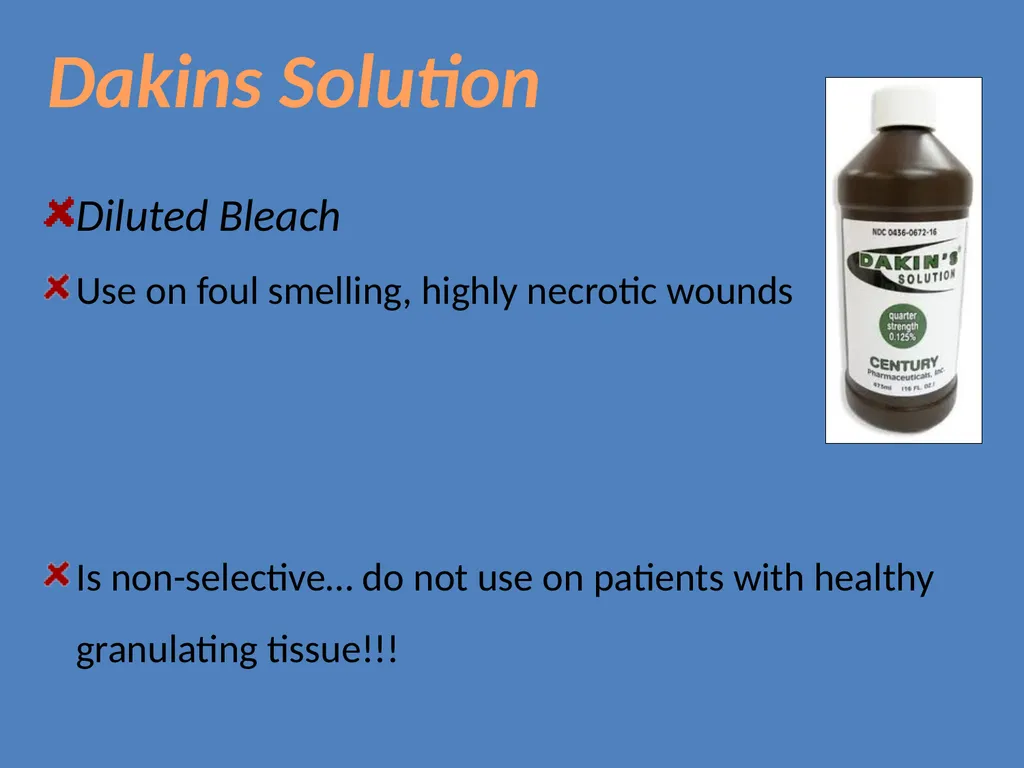
Dakins Solution Diluted Bleach
Use on foul smelling, highly necrotic wounds
Is non-selective… do not use on patients with healthy granulating tissue!!!<br>
18
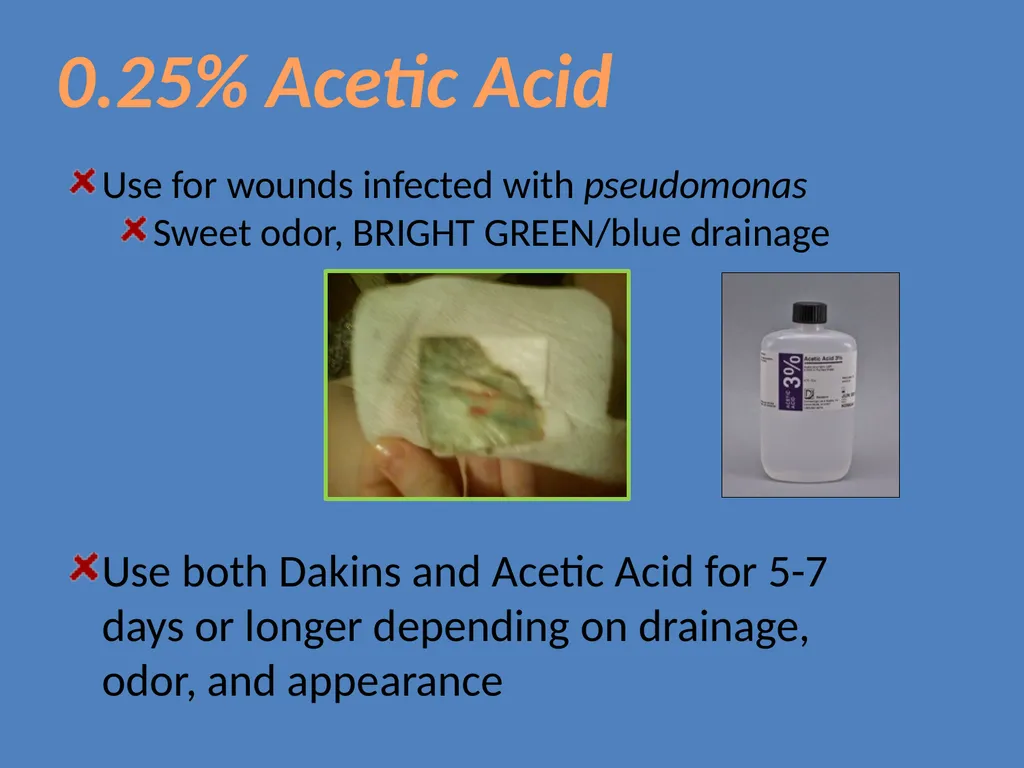
0.25% Acetic Acid Use for wounds infected with pseudomonas
Sweet odor, BRIGHT GREEN/blue drainage
Use both Dakins and Acetic Acid for 5-7 days or longer depending on drainage, odor, and appearance<br>
19
Use on 1-2 times on wounds with heavy, adherent biofilm
Is non-selective… do not use on patients with healthy granulating tissue!!! Hydrogen Peroxide<br>
20
Silver Antimicrobial
Use on green or brown necrotic wounds
Silvasorb- slight debridement
Silvadene- contains sulfar and silver, keeps wound bed moist, helps dead tissue to slough off, not a debriding agent, good for burns, removes from wound easily<br>
21
Acticoat Absorbant Silver- silver alginate, becomes a gel that absorbs drainage, cleans wound, can stay applied for 1 week to absorb drainage
Some people react to silver… if it burns, take it off!!! Silver Alginate Turns gelatinous as it soaks up drainage
Cannot use in patient’s allergic to seaweed!!!<br>
22
Acticoat _______=
Silver Impregnated ______ Acticoat Flex= silver impregnated fabric.
Stretchy, can stay in place 7 days max
Acticoat Absorbant= silver impregnated calcium alginate
Can in stay in place 7 days
Good to put under a cast<br>
23
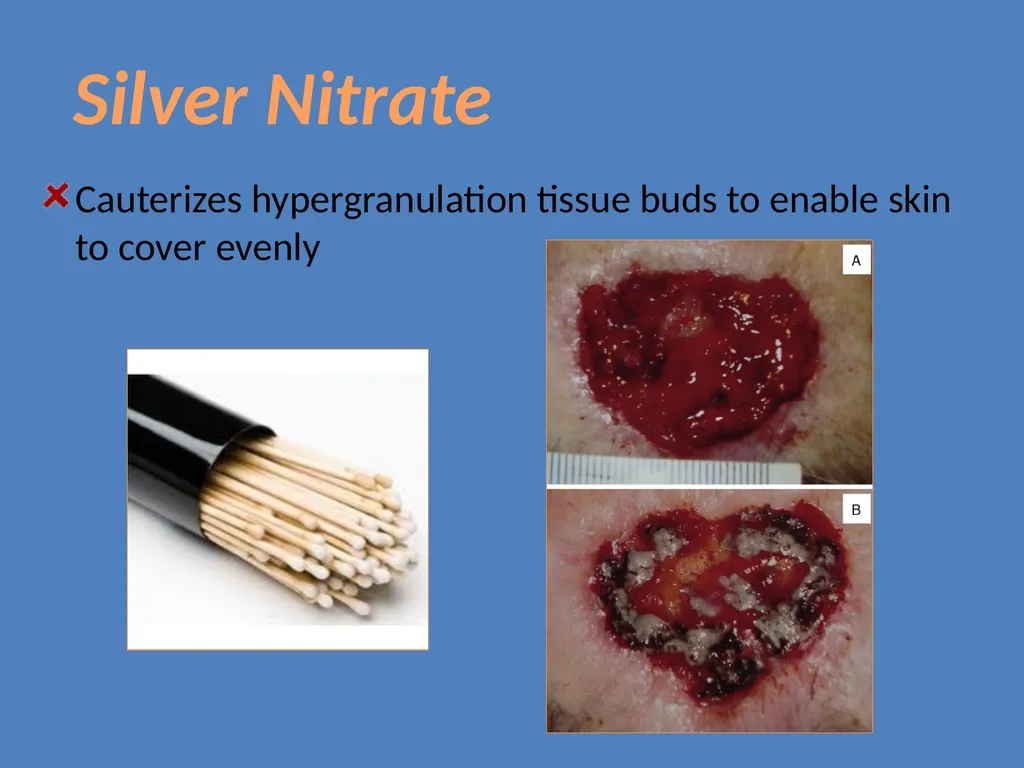
Cauterizes hypergranulation tissue buds to enable skin to cover evenly Silver Nitrate<br>
24
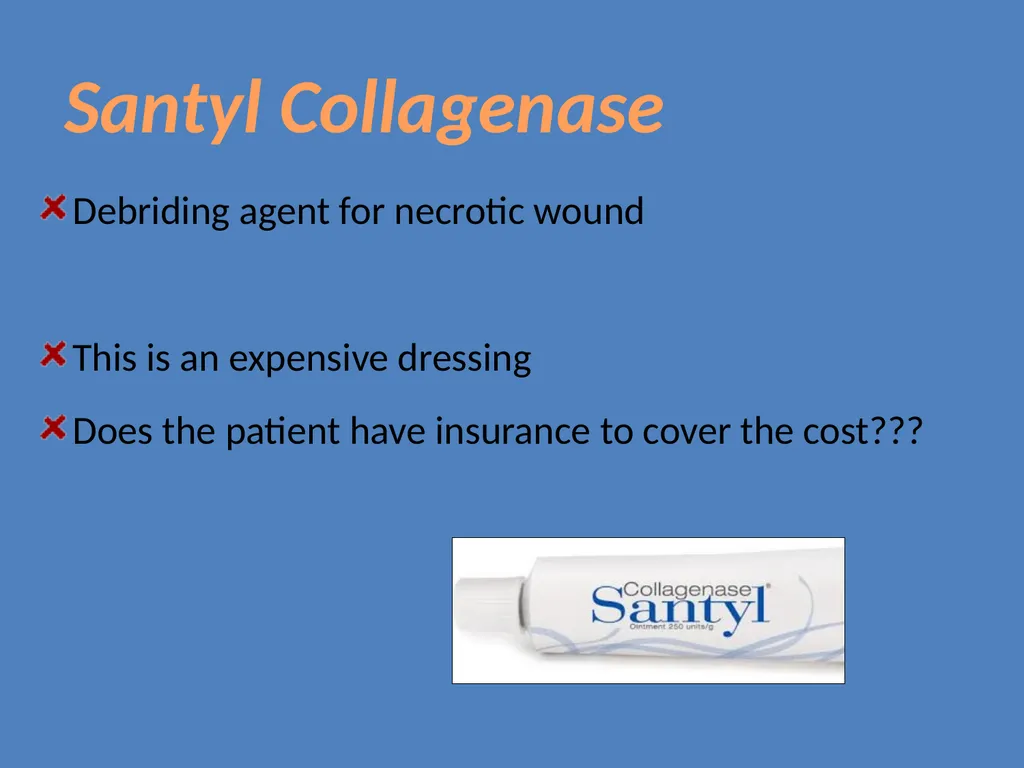
Santyl Collagenase Debriding agent for necrotic wound
This is an expensive dressing
Does the patient have insurance to cover the cost???<br>
25
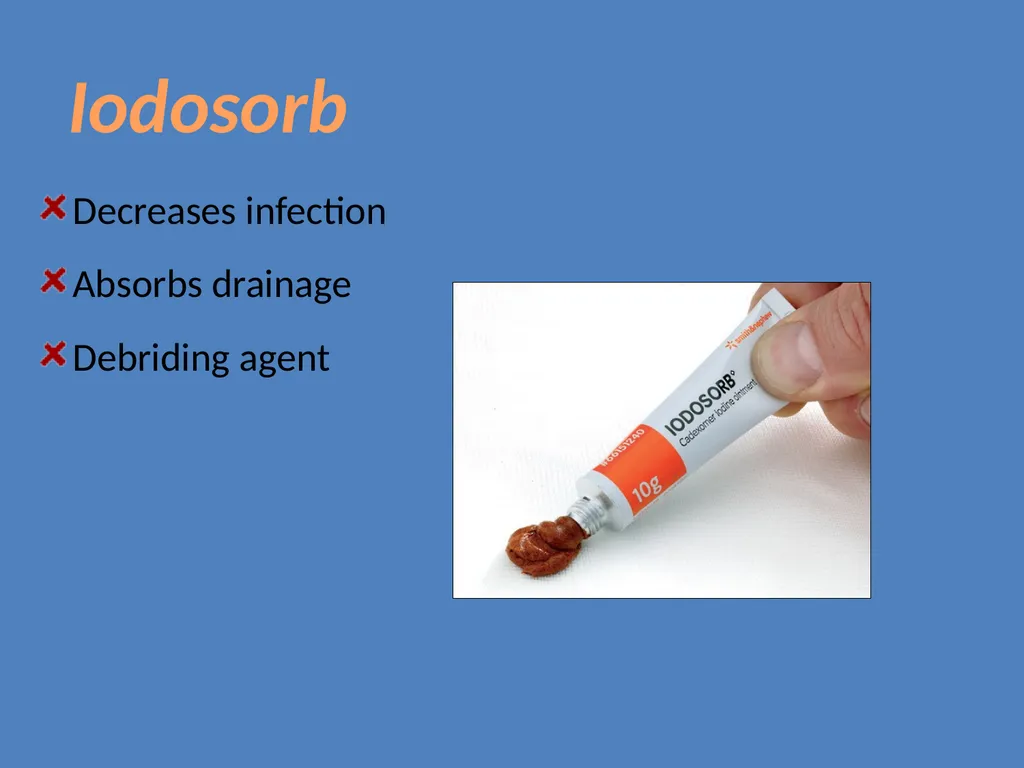
Iodosorb Decreases infection
Absorbs drainage
Debriding agent<br>
26
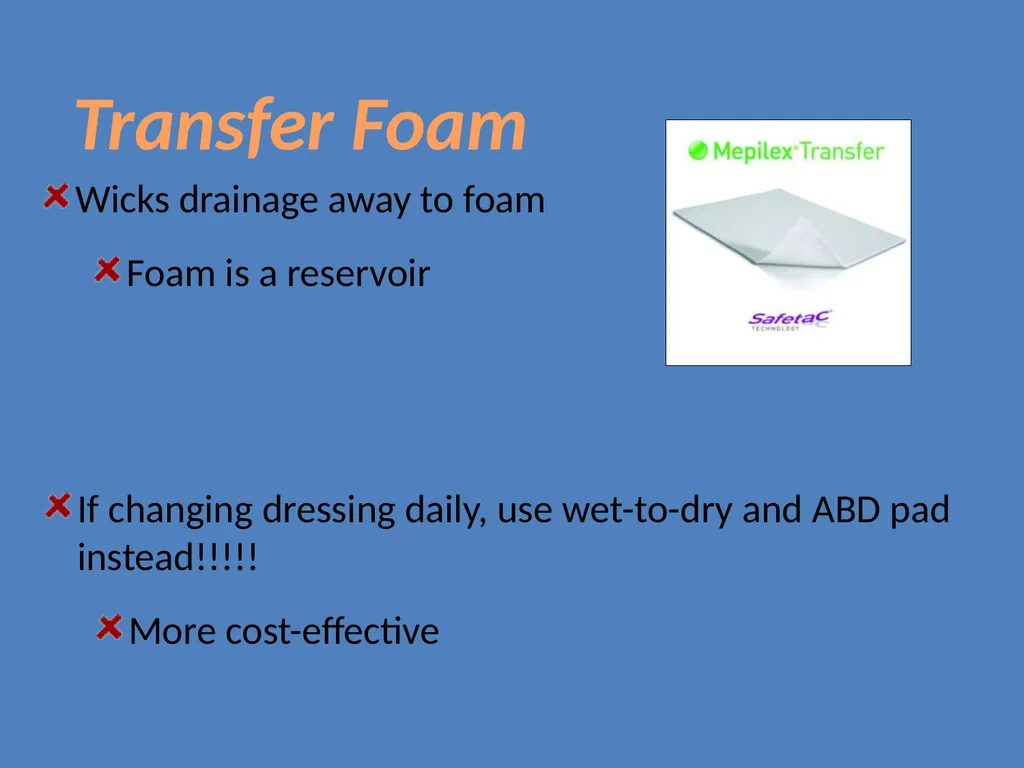
Transfer Foam Wicks drainage away to foam
Foam is a reservoir If changing dressing daily, use wet-to-dry and ABD pad instead!!!!!
More cost-effective<br>
27
Impregnated Gauze Mesalt-salt “ “
Inexpensive debriding agent
Xeroform- Iodine “ “
Does not stick to skin, great for skin tears
Toxic to healthy tissue
Adaptic- vaseline “ “<br>
28
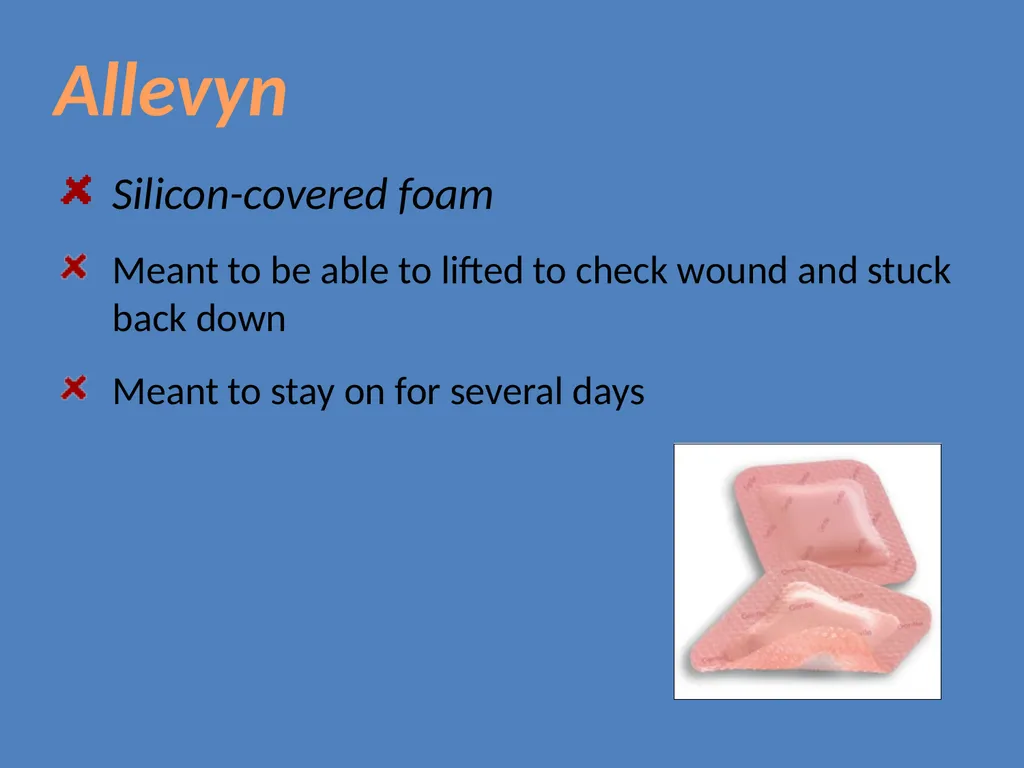
Allevyn Silicon-covered foam
Meant to be able to lifted to check wound and stuck back down
Meant to stay on for several days<br>
29
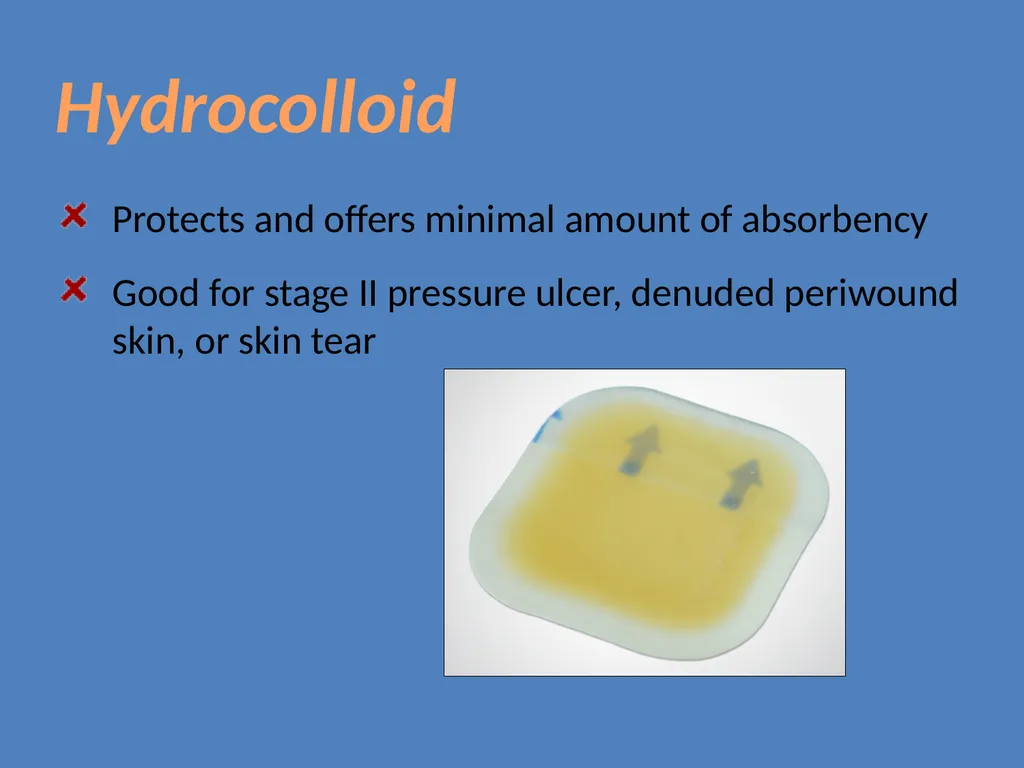
Hydrocolloid Protects and offers minimal amount of absorbency
Good for stage II pressure ulcer, denuded periwound skin, or skin tear<br>
30
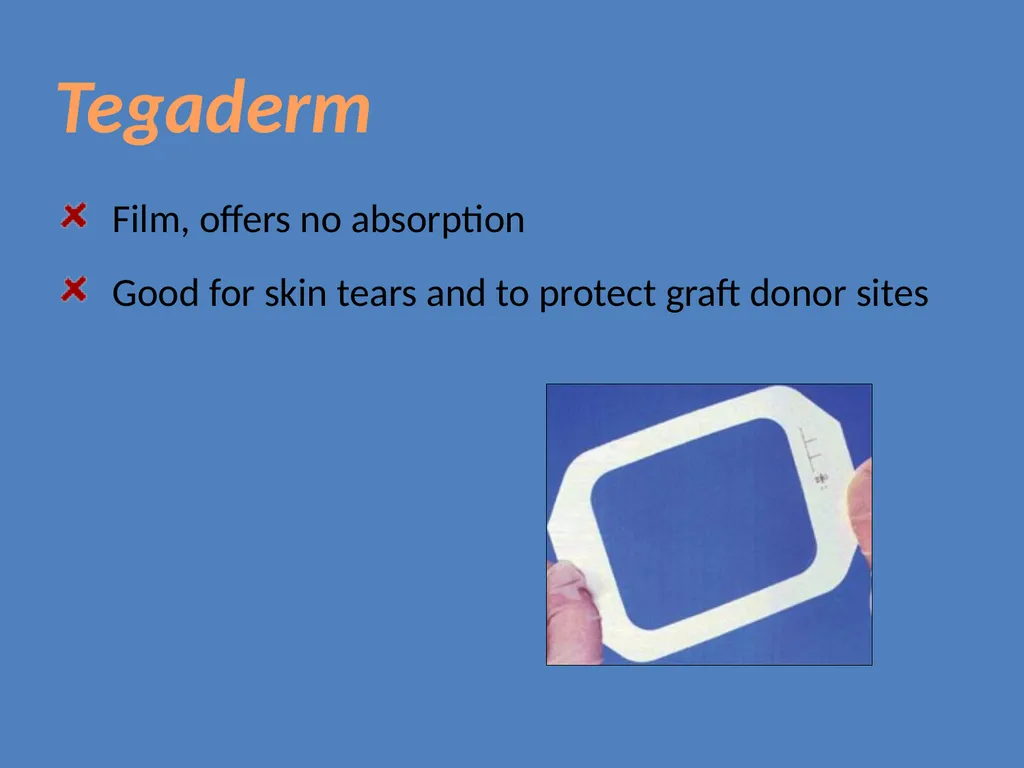
Tegaderm Film, offers no absorption
Good for skin tears and to protect graft donor sites<br>
31
Think… What is the cause of the wound?
Is the wound bed wet or dry?
Does it need cleaning/removal of necrotic tissue?
Use silver (antimicrobial) for chronic wounds with light odor/light yellow biofilm
Use debriding agent for a large amount of necrotic tissue
Use non-selective topical solution if FOUL SMELLING and MAX amount of necrotic tissue<br>
32
During an eval… History of the wound
How has the patient been treating it at home
Ask and then EDUCATE about barriers to healing
Who will do dressing changes at home<br>
33
Documentation Drainage (amount, color, and odor)
Wound bed (% amount of granulation tissue vs necrotic tissue/fibrin/slough)
Location
Measurements
Presence of tunneling/tracts/undermining (described by position as it relates to a clock, with patient in anatomical position)<br>
34
Borders
Periwound
Denuded= raw
Macerated= wet
Indurated= hard, woody
Edema (with girth measurements if needed) Documentation<br>
35
Documentation What you tissue was debrided, why, what tools you used
Ex: “debridement of scab, peeling skin, and yellow slough with forceps”
Always document how many pieces of gauze are applied
How many pieces of foam for wound vac<br>
36
Documentation When describing drainage, consider how long dressing has been on and how big the wound is/where it is
If too much drainage, need more absorptive drainage
If no drainage, need to keep wound bed moist with gel<br>
37
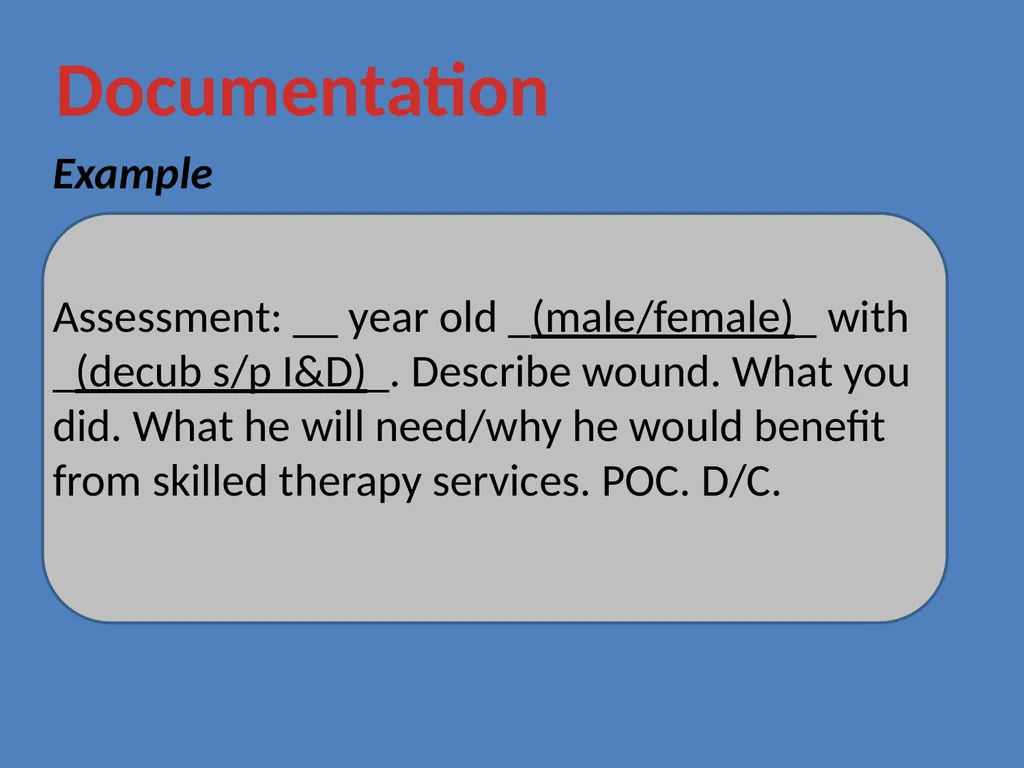
Documentation Example
Assessment: __ year old _(male/female)_ with _(decub s/p I&D)_. Describe wound. What you did. What he will need/why he would benefit from skilled therapy services. POC. D/C.<br>
38
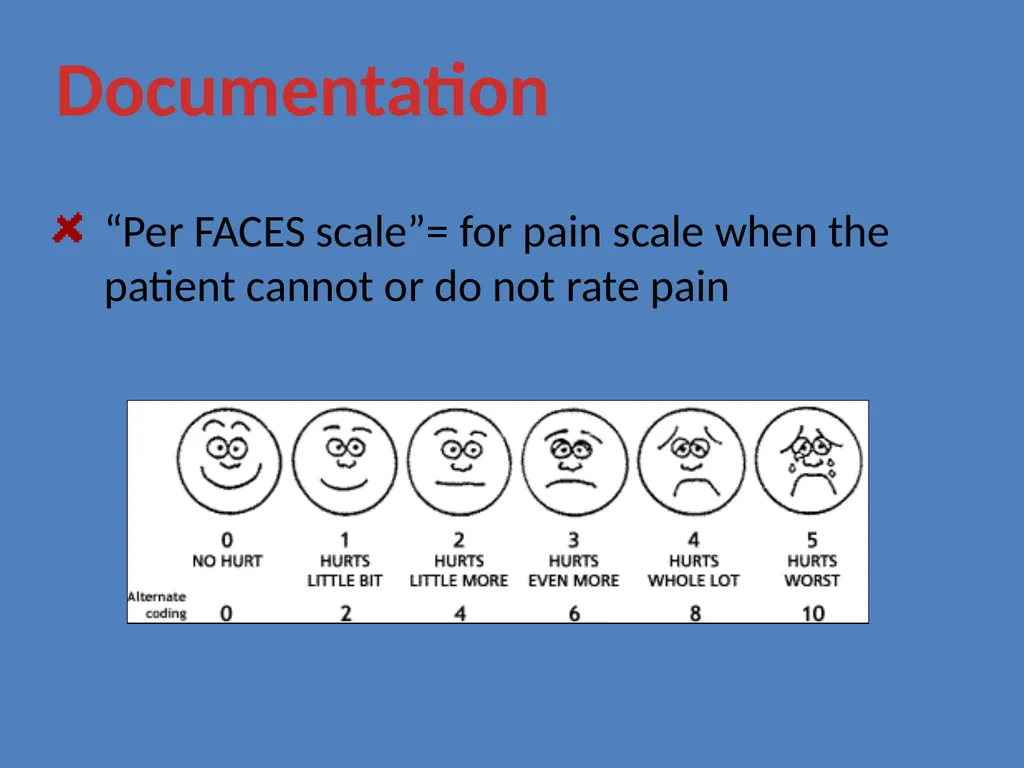
“Per FACES scale”= for pain scale when the patient cannot or do not rate pain Documentation<br>
39
Documentation Charges:
Eval
WD vac< or > 50 cm2
SD < or > 20cm2
WP, MT, SC
PT multi-layer wrap
PL kit
Supplies- from database picklist<br>
41
Total Contact Casting Use on plantar wounds, most often for Diabetic Foot Ulcers
Off-loads wounds to evenly distribute pressure<br>
42
How to Apply a Contact Cast Cotton between toes
Stockinette- cut out top of ankle crease
Pad top of foot/toes, malleoli, and anterior tibia
Roll on Webril, pad bottom of foot and Achilles
Plaster- 1st heel, 2nd toes, (2) 3 inch rolls
Blue fiberglass- (3) 4 inch rolls. Cover all plaster. Go up leg and reinforce weak parts; i.e. back of ankle and toes<br>
43
Other Off-loading Devices Forefoot off-loading shoe
Heel off-loading shoe
NWB with AD
Cam Walker boot, post-op shoe
Pelvic Pressure ulcers; limit OOB
Foot/Plantar/Toe wound; limit weight bearing<br>
44
Considerations for off-loading:
What is the goal?
Mobility or wound healing<br>
45
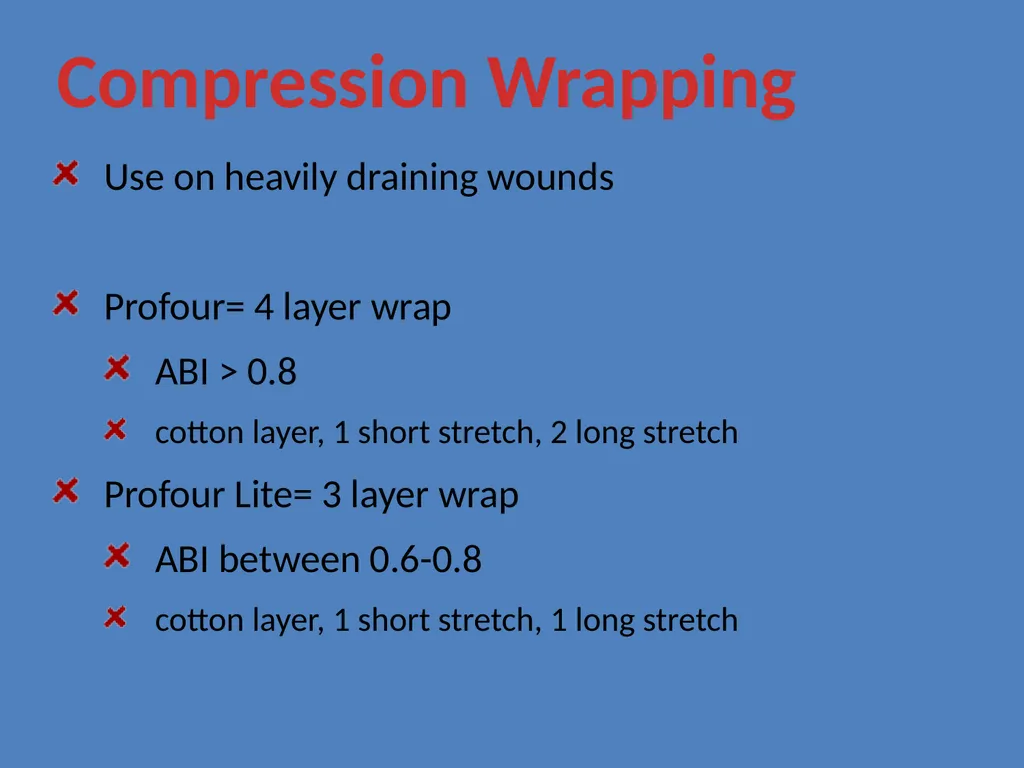
Compression Wrapping Use on heavily draining wounds
Profour= 4 layer wrap
ABI > 0.8
cotton layer, 1 short stretch, 2 long stretch
Profour Lite= 3 layer wrap
ABI between 0.6-0.8
cotton layer, 1 short stretch, 1 long stretch<br>
46
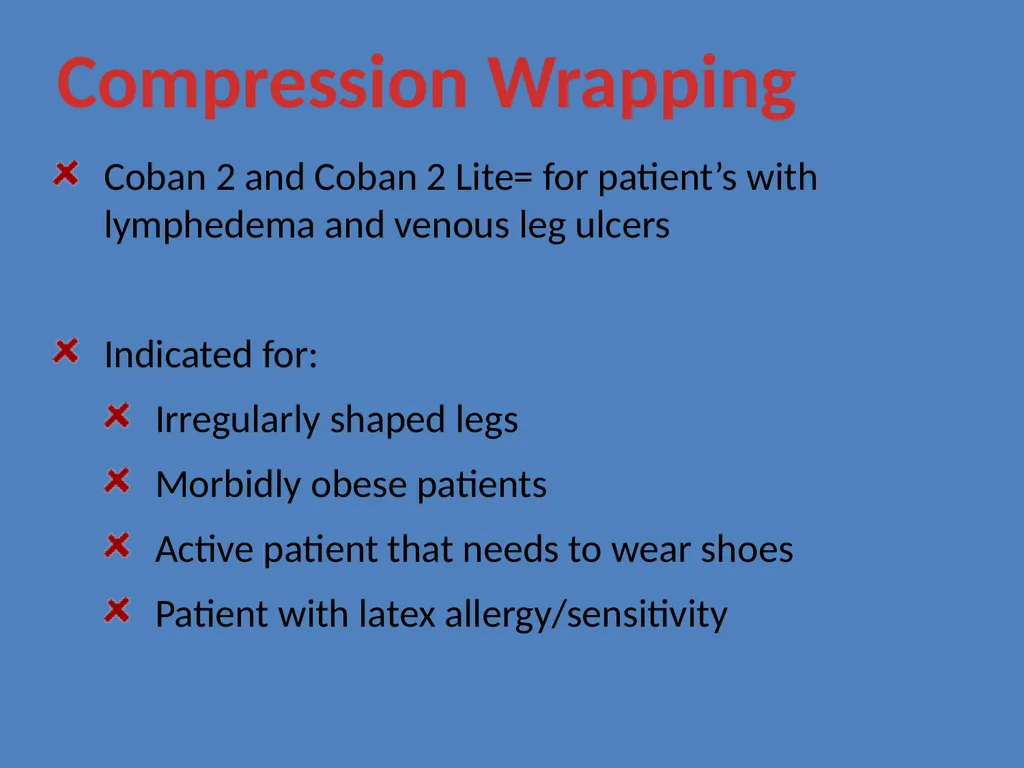
Compression Wrapping Coban 2 and Coban 2 Lite= for patient’s with lymphedema and venous leg ulcers
Indicated for:
Irregularly shaped legs
Morbidly obese patients
Active patient that needs to wear shoes
Patient with latex allergy/sensitivity<br>
47
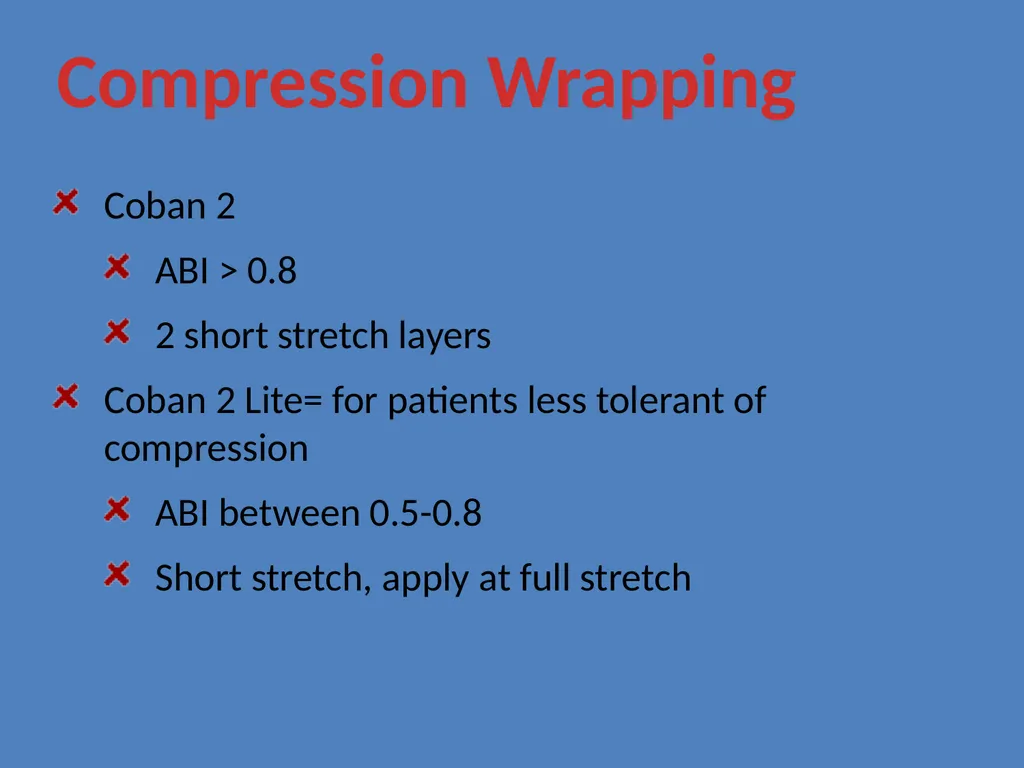
Compression Wrapping Coban 2
ABI > 0.8
2 short stretch layers
Coban 2 Lite= for patients less tolerant of compression
ABI between 0.5-0.8
Short stretch, apply at full stretch<br>
48
Kerlix and Coban
For heavily draining wounds that need frequent dressing changes
Wounds contaminated with pseudomonas needing acetic acid dressings
Patients needing mild compression, unable to tolerate other wraps Compression Wrapping<br>
49
Like all other areas of PT….
Use clinical reasoning AND
COMMON SENSE!!!!
Identify the cause and address it
Patient education for barriers to healing
Choose your dressing and treatment method<br>
50
All Information was gathered during an independent study at WakeMed Wound Care Clinic and was provided by Christina Young, PT; Cindy Wulffhaver, PTA; and Tara Marshall, PT Questions???<br>