Practitioners and parents working together to support all children Session 5 of 5 The aims of this session to understand the importance of developing effective partnerships with parents of children with SEND to be able to identify and
"Practitioners and parents working together to" is the property of its rightful owner. Permission is granted to
download and print the materials on this website for personal, non-commercial use only, and to display it
on your personal computer provided you do not modify the materials and that you retain all copyright
notices contained in the materials. By downloading content from our website, you accept the terms of this
agreement.
Presentation Transcript
01
Practitioners and parents working together to support all children
Session 5 of 5<br>
02
The aims of this session to understand the importance of developing effective partnerships with parents of children with SEND
to be able to identify and explore the key elements of good practice when working with parents
to develop increased confidence and skills in building partnerships with parents and having sensitive conversations<br>
03
Partnership with all parents in the EYFS Practice for children with SEND should start with good universal practice for all children and families.
‘Children learn and develop well in enabling environments, in which their experiences respond to their individual needs and there is a strong partnership between practitioners and parents and/or carers.’ 3<br>
04
Key person and parents The key person:
must help ensure that every child’s learning and care is tailored to meet their individual needs
must seek to engage and support parents and/or carers in guiding their child’s development at home
should also help families engage with more specialist support if appropriate<br>
05
Activity: Discussion What opportunities do you have to engage and interact with parents on a daily basis?
What other opportunities have you had to develop good relationships with the parents of your key children?
Think of one occasion that you felt that your conversation and interaction went really well. Why, and what helped?
Think of one occasion when the conversation or interaction didn’t go as well as you had hoped. Why, and what would have helped?<br>
06
SEND Code of Practice ‘All those who work with young children should be alert to emerging difficulties and respond early. In particular, parents know their children best and it is important that all practitioners listen and understand when parents express concerns about their child’s development. They should also listen to and address any concerns raised by children themselves.’ 6<br>
07
Activity: Describe what ‘partnership’ with parents means Work in pairs or small groups:
Using the sticky notes, write down up to 5 things which are important when developing partnership with parents
Each group read out their words:
Which ones are similar or the same, which are different?
Discuss how you would describe partnership with parents, as a setting 7<br>
08
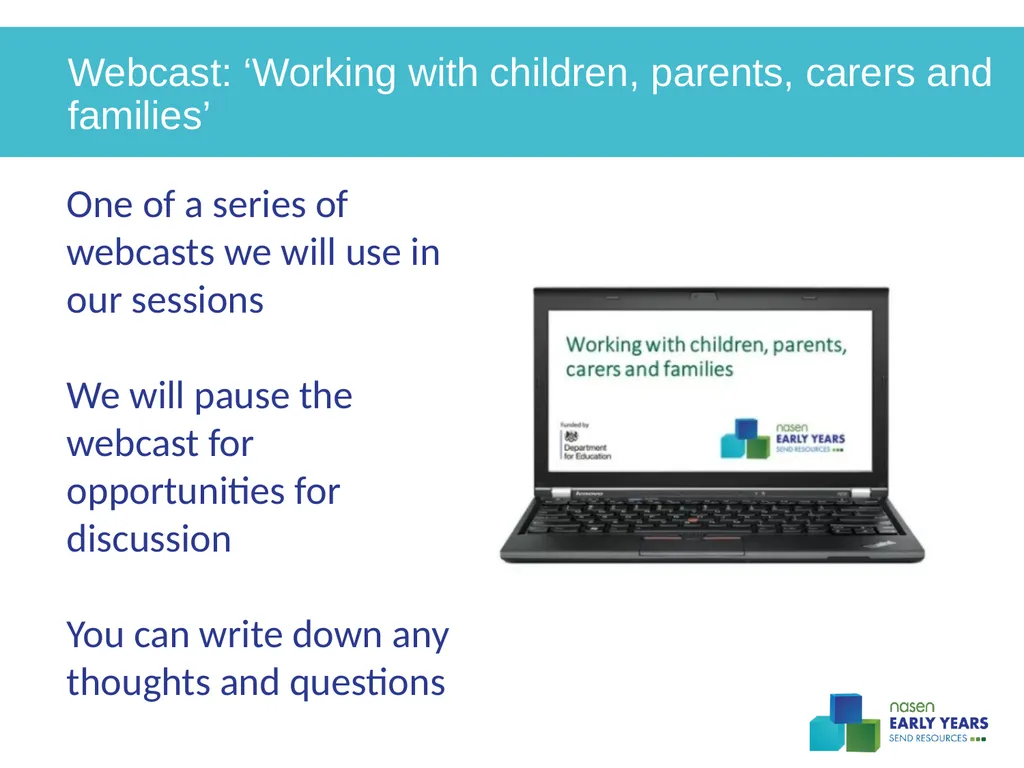
Webcast: ‘Working with children, parents, carers and families’ One of a series of webcasts we will use in our sessions
We will pause the webcast for opportunities for discussion
You can write down any thoughts and questions<br>
09
Characteristics for effective partnership Early Support, based on Family Partnership Model:
Working closely together with active participation and involvement.
Sharing power with parents leading.
Complementary expertise.
Agreeing aims and process. 9<br>
10
Characteristics of effective partnerships Negotiation
Mutual trust and respect
Openness and honesty
Clear communication<br>
11
Sensitive conversations ‘At times, parents, teachers and others may have differing expectations of how a child’s needs are best met. Sometimes these discussions can be challenging but it is in the child’s best interests for a positive dialogue between parents, teachers and others to be maintained, to work through points of difference and establish what action is to be taken.’<br>
12
Sensitive conversations Personal and professional skills needed:
Empathy
Respect and a non-judgmental attitude
Good active listening skills
Acknowledging and accepting parent’s feelings and emotions
Reflecting back what has been said
Using open questions
Body language, voice tone and facial expression
Open and honest
Professionalism and boundaries<br>
13
What next? Reflect: what have you learned from this session and what else you would like to know about
Read or Watch: ????
Do: look up the Local Offer/parent carer forum or SENDIASS and note down what you find
Discuss with colleagues what further development you would like in this area
Reflect : Use the Learning Log to record what you are thinking and identify your personal next steps in relation to inclusive practice and children with SEND<br>
14
Moving on If you wish to ‘move on’ with this topic, then split the group into groups of 3 (parent, practitioner, observer).
Each group will need the ‘using open-ended questions’ sheet and the ‘case studies’ sheet.
The observer will feed back, then they swap roles and do the same with another case study (if time).
Finish with whole group discussion.<br>