
Preface and Introduction David N. Entwistle, PsyD
DJ
Published · 26 slides · 0 views

1 / 1
Description
Preface and Introduction David N. Entwistle, PsyD These slides are designed to accompany Integrative Approaches to Psychology and Christianity, 4th ed. Material protected by copy write. Users are welcome to make changes to the presentations
Related Topics
Share
Embed code
Download this presentation From Below
"Preface and Introduction David N. Entwistle, PsyD" is the property of its rightful owner. Permission is granted to download and print the materials on this website for personal, non-commercial use only, and to display it on your personal computer provided you do not modify the materials and that you retain all copyright notices contained in the materials. By downloading content from our website, you accept the terms of this agreement.
Presentation Transcript
01
Preface
and Introduction
David N. Entwistle, PsyD
These slides are designed to accompany Integrative Approaches to Psychology and Christianity, 4th ed.
Material protected by copy write. Users are welcome to make changes to the presentations and to use them for educational purposes, provided that the original acknowledgement is maintained and any changes to the presentation clearly identified. Integrative Approaches to Psychology and Christianity – 4th ed.<br>
02
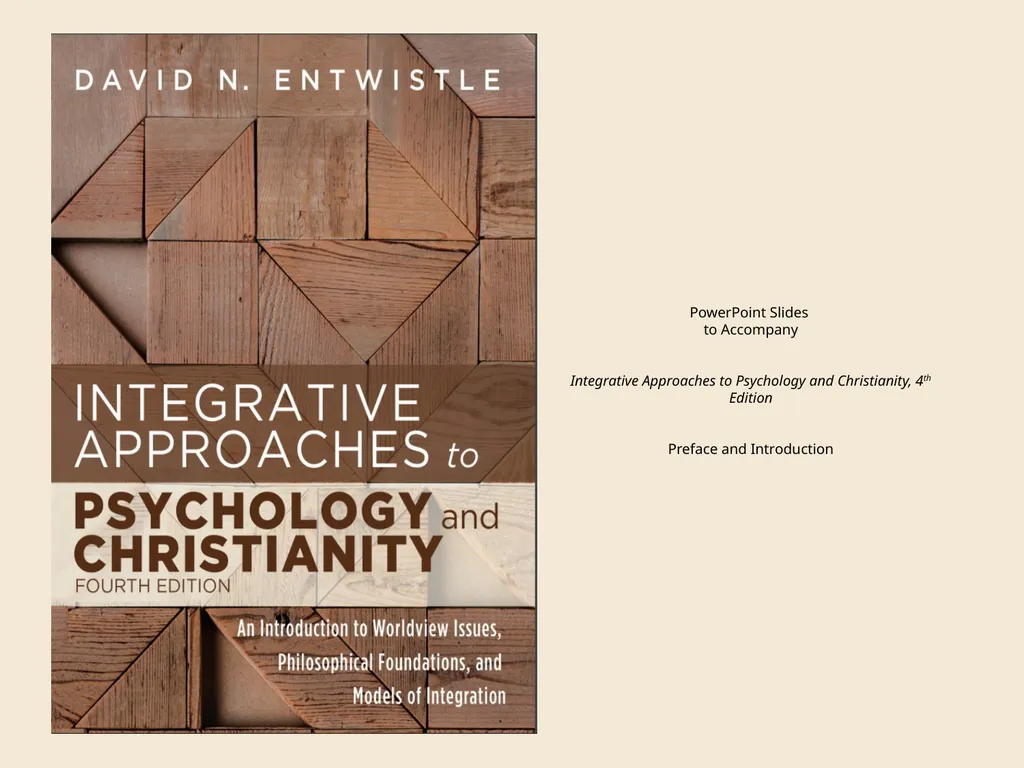
PowerPoint Slides
to Accompany
Integrative Approaches to Psychology and Christianity, 4th Edition
Preface and Introduction<br>
03
Christian Faith and Vocation The word vocation originally held the idea that God fashioned each of us to be suitable for certain tasks and that he calls us to use our abilities for God’s glory and purposes.
What does it mean to be called to be a student? Many people mistake our work for our vocation. Our vocation is the love of Jesus.
—MOTHER TERESA<br>
What does it mean to be called to be a student? Many people mistake our work for our vocation. Our vocation is the love of Jesus.
—MOTHER TERESA<br>
04
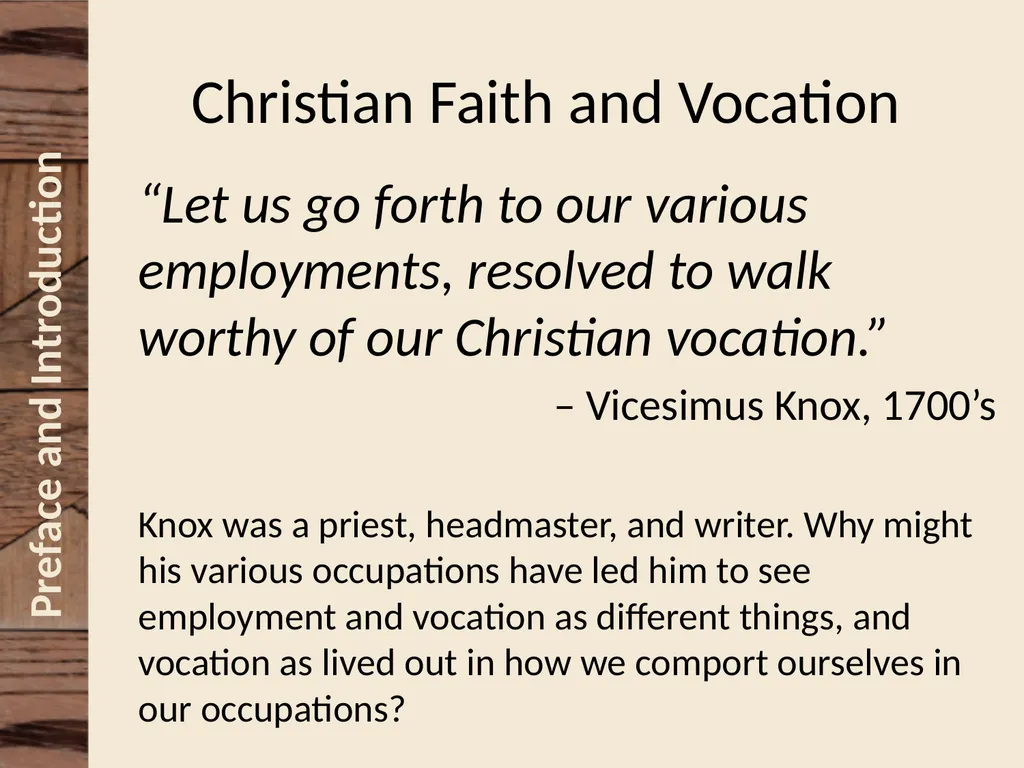
Christian Faith and Vocation “Let us go forth to our various employments, resolved to walk worthy of our Christian vocation.”
– Vicesimus Knox, 1700’s
Knox was a priest, headmaster, and writer. Why might his various occupations have led him to see employment and vocation as different things, and vocation as lived out in how we comport ourselves in our occupations?<br>
– Vicesimus Knox, 1700’s
Knox was a priest, headmaster, and writer. Why might his various occupations have led him to see employment and vocation as different things, and vocation as lived out in how we comport ourselves in our occupations?<br>
05
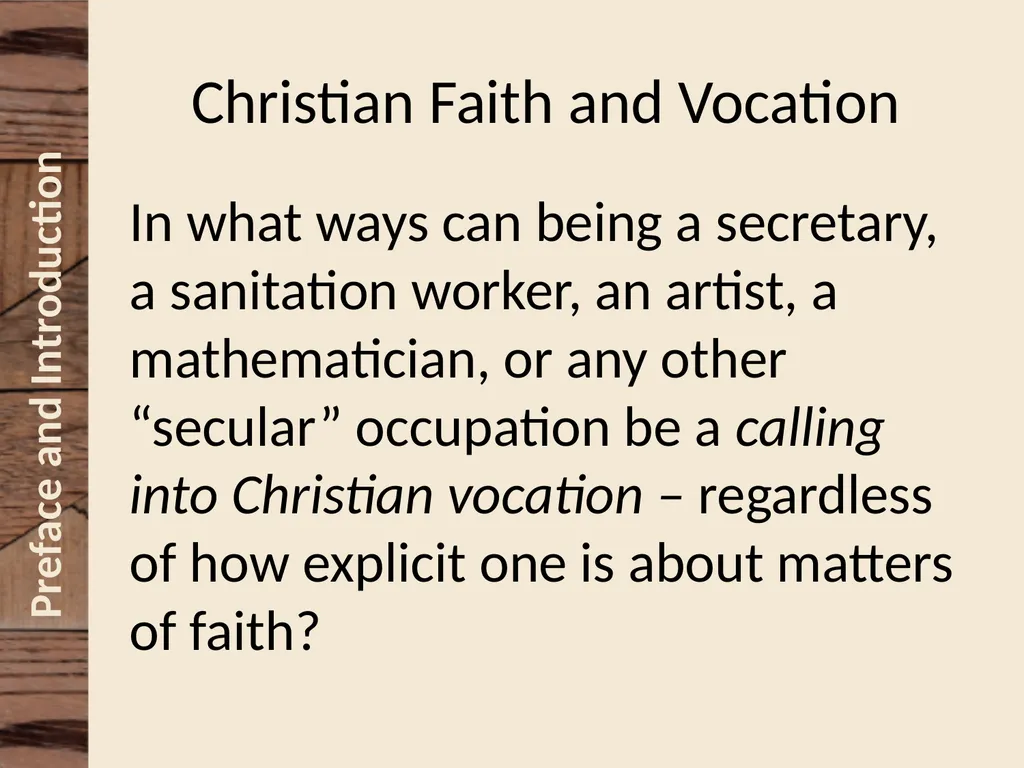
Christian Faith and Vocation In what ways can being a secretary, a sanitation worker, an artist, a mathematician, or any other “secular” occupation be a calling into Christian vocation – regardless of how explicit one is about matters of faith?<br>
06
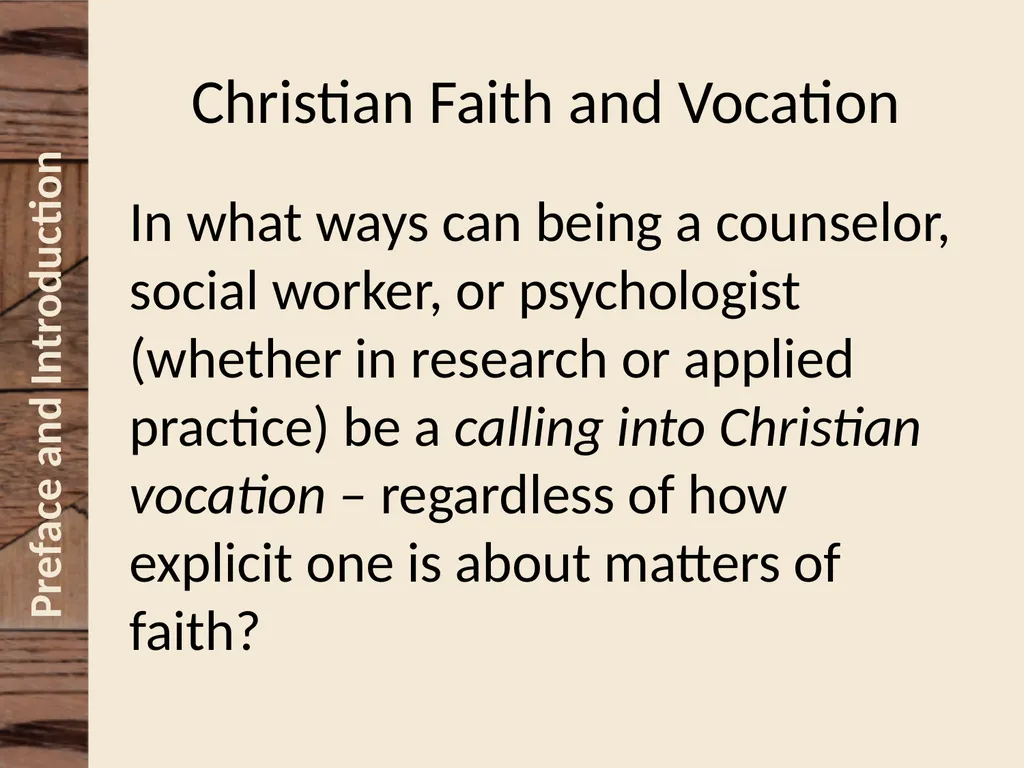
Christian Faith and Vocation In what ways can being a counselor, social worker, or psychologist (whether in research or applied practice) be a calling into Christian vocation – regardless of how explicit one is about matters of faith?<br>
07
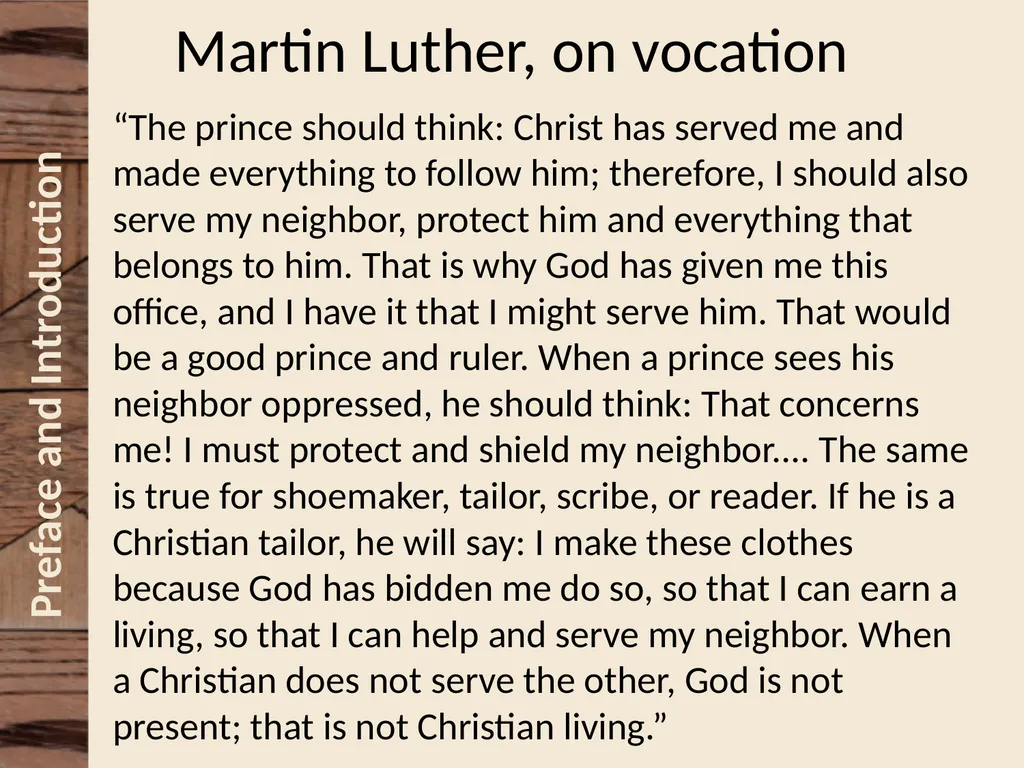
Martin Luther, on vocation “The prince should think: Christ has served me and made everything to follow him; therefore, I should also serve my neighbor, protect him and everything that belongs to him. That is why God has given me this office, and I have it that I might serve him. That would be a good prince and ruler. When a prince sees his neighbor oppressed, he should think: That concerns me! I must protect and shield my neighbor.... The same is true for shoemaker, tailor, scribe, or reader. If he is a Christian tailor, he will say: I make these clothes because God has bidden me do so, so that I can earn a living, so that I can help and serve my neighbor. When a Christian does not serve the other, God is not present; that is not Christian living.”<br>
08
The Author’s Desire to help Christians who are interested in the study or application of psychology “to walk worthy of our Christian vocation.”
The author will “frame the issue of the integration of psychology and Christianity with attention to worldview issues, philosophical underpinnings, and models of integration.”
Why? Partly because psychology is NOT just about counseling! “Psychology is a discipline with rich historical and philosophical roots. It is a broad field that studies biological, intrapsychic, and interpersonal phenomena across the life span.”<br>
09
Compartmentalization Entwistle noted ways that he experienced compartmentalization:
Distinguishing “full time Christian ministry” from “secular jobs”.
“Christian education” that never deeply explores connections between faith and disciplinary content.
To what degree have you observed such compartmentalization?<br>
Distinguishing “full time Christian ministry” from “secular jobs”.
“Christian education” that never deeply explores connections between faith and disciplinary content.
To what degree have you observed such compartmentalization?<br>
10
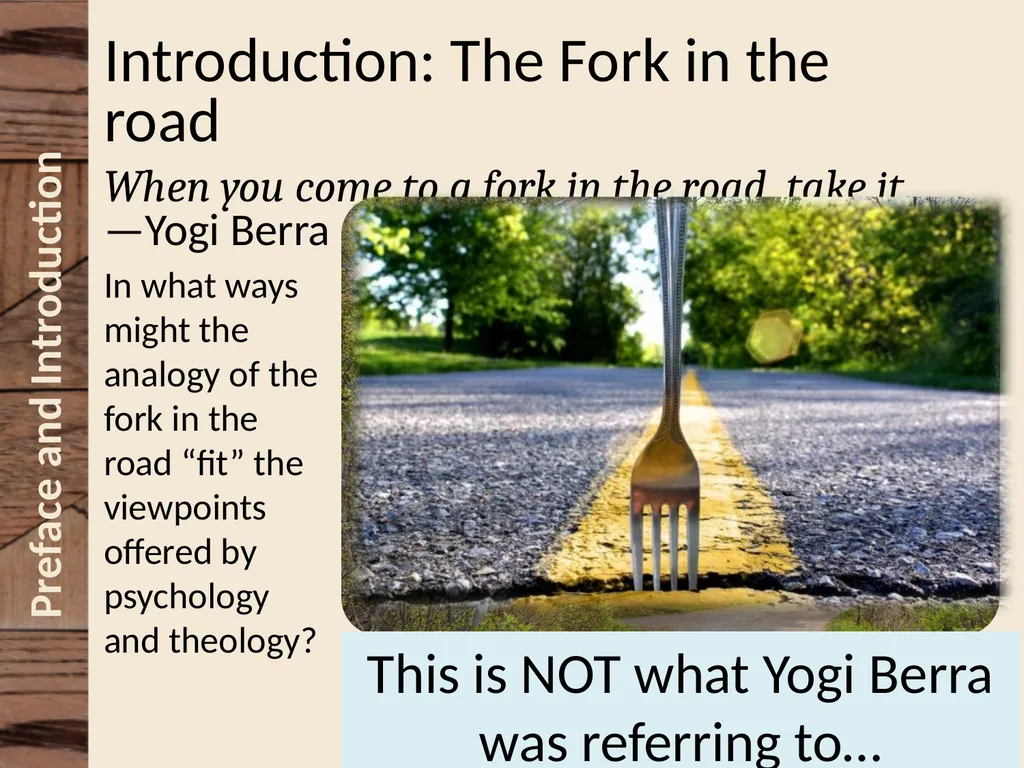
Introduction: The Fork in the road
When you come to a fork in the road, take it.
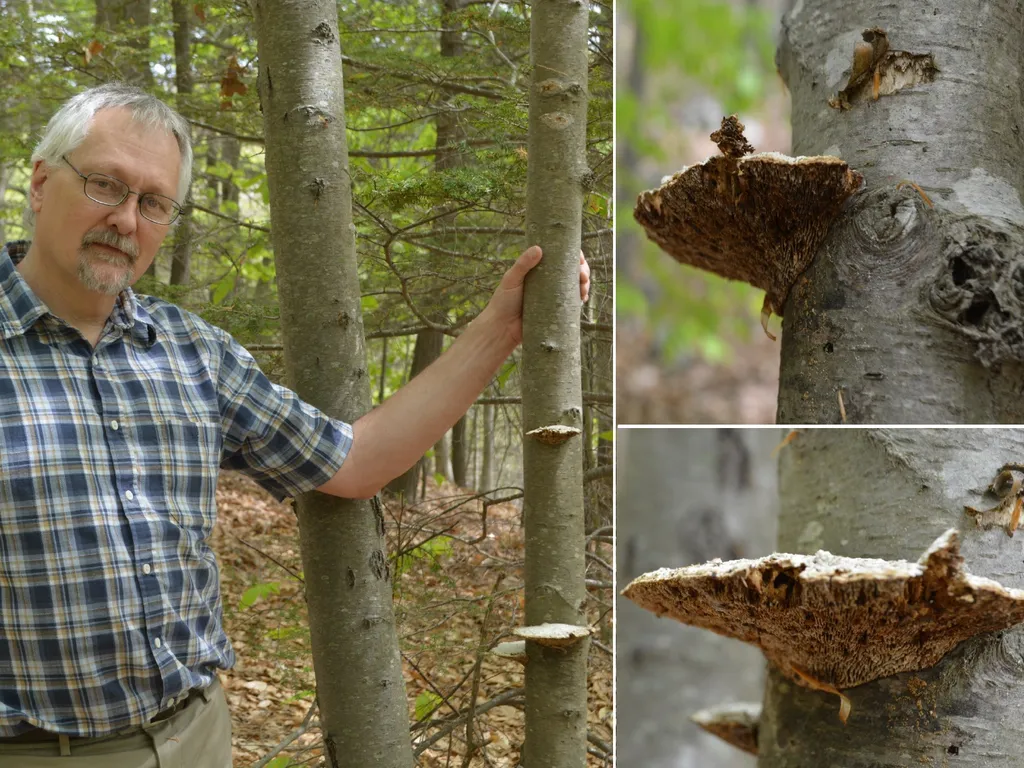
—Yogi Berra In what ways might the analogy of the fork in the road “fit” the viewpoints offered by psychology and theology? Photo credits for this and subsequent slides: Entwistle, D. N. (2015). Gordon College, Coy Pond Loop. Used by permission. This is NOT what Yogi Berra was referring to…<br>
11
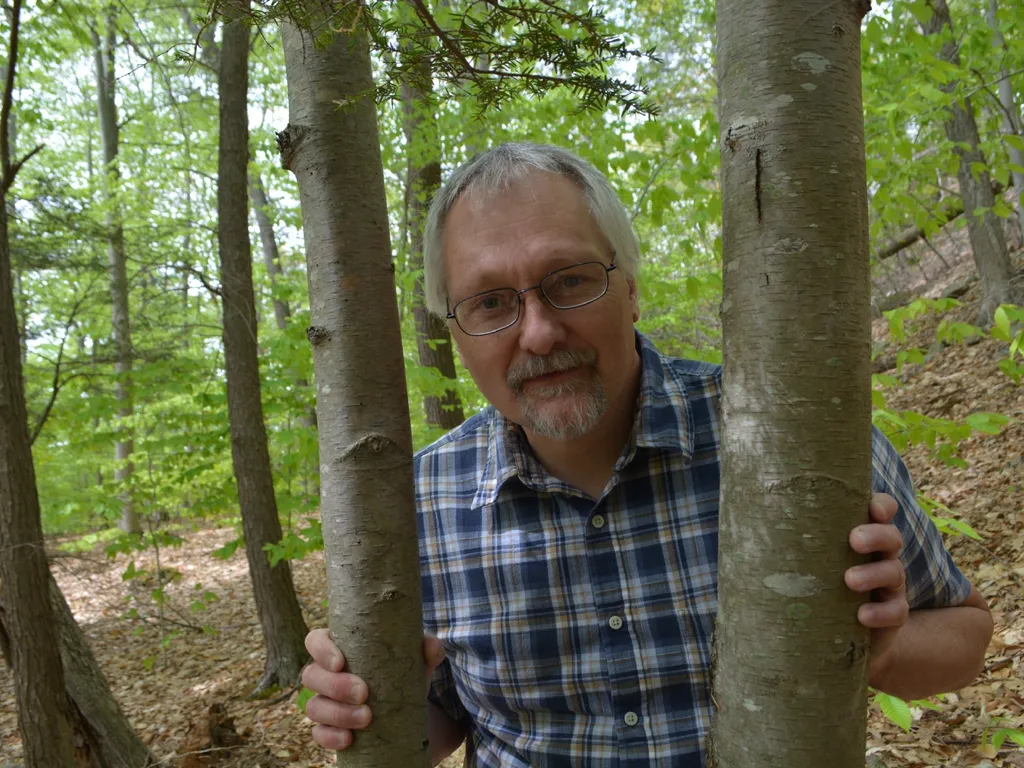
Perspectives What we see is partly dependent on our perspectives, assumptions and past experiences.
Even sharing the same vantage point, different people see different things.
Some people would hike along the trail and commune with God, while others would never recognize the hand of God in the beauty of nature.<br>
Even sharing the same vantage point, different people see different things.
Some people would hike along the trail and commune with God, while others would never recognize the hand of God in the beauty of nature.<br>
12
Premises We can gain a more complete view of human nature by drawing on both Christian theology and contemporary psychology.
BUT, our theological and psychological perspectives can easily be skewed by many things.<br>
BUT, our theological and psychological perspectives can easily be skewed by many things.<br>
13
Premises Furthermore, thinking about psychology as Christians is not primarily about bringing the academic discipline of theology into dialogue with the academic discipline or clinical practice of psychology.
Christianity is much more than theology; it is an encounter with Christ that redeems and reorients human lives and brings about “the kingdom of God,” the redemption of all of creation.<br>
Christianity is much more than theology; it is an encounter with Christ that redeems and reorients human lives and brings about “the kingdom of God,” the redemption of all of creation.<br>
14
Premises Christianity is less a system of thought than it is a commitment to follow God with heart and soul and mind that lays claim on all of life.
If this is the case, integration will orient our understanding of what it means to be human as we participate with God’s work in the world. (NOTE: This does NOT mean that integration is about proselytizing; it DOES mean that we are participating in understanding God’s world and bringing healing to brokenness).<br>
If this is the case, integration will orient our understanding of what it means to be human as we participate with God’s work in the world. (NOTE: This does NOT mean that integration is about proselytizing; it DOES mean that we are participating in understanding God’s world and bringing healing to brokenness).<br>
15
“While the integration of psychology and Christianity will entail an academic component as we consider the disciplines of psychology and Christian theology, it will also require the formation of Christian character, guided by a Christian sense of purpose, as we live out the call to be redemptive agents in the world.”<br>
16
Where do we go from here? Chapter 1 will help us look at the history of how Christians have thought about the relationship of faith and “secular” learning.
Chapter 2 will consider historical considerations about the relationship of science and Christianity.
Chapter 3 will consider some historical interactions between psychology and Christianity.<br>
Chapter 2 will consider historical considerations about the relationship of science and Christianity.
Chapter 3 will consider some historical interactions between psychology and Christianity.<br>
17
Where do we go from here? Chapter 4 will introduce the concept of how a worldview frames how we think about human beings and their place in the world and will discuss some of the contours of a Christian worldview.
Chapter 5 will help us explore virtues that are necessary for us to pursue knowledge, and four epistemic methods (authority, logic, empiricism, and hermeneutics).<br>
Chapter 5 will help us explore virtues that are necessary for us to pursue knowledge, and four epistemic methods (authority, logic, empiricism, and hermeneutics).<br>
18
Where do we go from here? Chapter 6 will engage us in metaphysics – specifically, looking at the differences between naturalism and supernaturalism.
Chapter 7 will explore philosophical anthropology, and the unique perspectives that psychology and theology shed on human nature.<br>
Chapter 7 will explore philosophical anthropology, and the unique perspectives that psychology and theology shed on human nature.<br>
19
Where do we go from here? Chapter 8 will introduce the idea that models are abstract representations of reality, and will introduce six models for relating psychology and Christianity (or religion, more broadly).
Chapter 9 will provide details about antagonistic models of disciplinary relationship: psychologists who see religion as pathological, and Christians who see psychology as a threat to godly counsel and living.<br>
Chapter 9 will provide details about antagonistic models of disciplinary relationship: psychologists who see religion as pathological, and Christians who see psychology as a threat to godly counsel and living.<br>
20
Where do we go from here? Chapter 10 examines four intermediate models that allow some positive interaction between psychology and Christianity (or religion):
Spies (who want to study or utilize the psychological benefits of religion)
Colonialists (who claim useful but isolated facets of psychology for theological benefit)
Rebuilders (who desire to create a uniquely “Christian psychology”), and
Neutral Parties (who see psychology and theology as largely useful, distinct disciplines that should be kept independent of each other.<br>
21
Where do we go from here? Chapter 11 explores the idea that psychology and Christian theology can interact in a dynamic fashion that allows us to develop a holistic view of persons.
Core Christian convictions that guide integration are discussed.
The history of integration in the Christian liberal arts tradition is reviewed.
Different types of integration are explored.<br>
Core Christian convictions that guide integration are discussed.
The history of integration in the Christian liberal arts tradition is reviewed.
Different types of integration are explored.<br>
22
Where do we go from here? Chapter 12 provides examples of what integration might look like in critiquing or developing psychological theories from a Christian perspective and discusses ethical and practice issues for integration.
Chapter 13 explores various church traditions and individuals who represent unique examples of how to go about the task of relating Christian faith and psychology.<br>
Chapter 13 explores various church traditions and individuals who represent unique examples of how to go about the task of relating Christian faith and psychology.<br>
23
A hope and a prayer Entwistle ends the Introduction citing Col. 3:17, which admonishes Christians to “give praise and thanks to God in all things.” His hope is that the book “will engage your mind and draw you closer to your Creator.”
What is your part? What do you need to do to get the most out of this book and this course?<br>
What is your part? What do you need to do to get the most out of this book and this course?<br>