
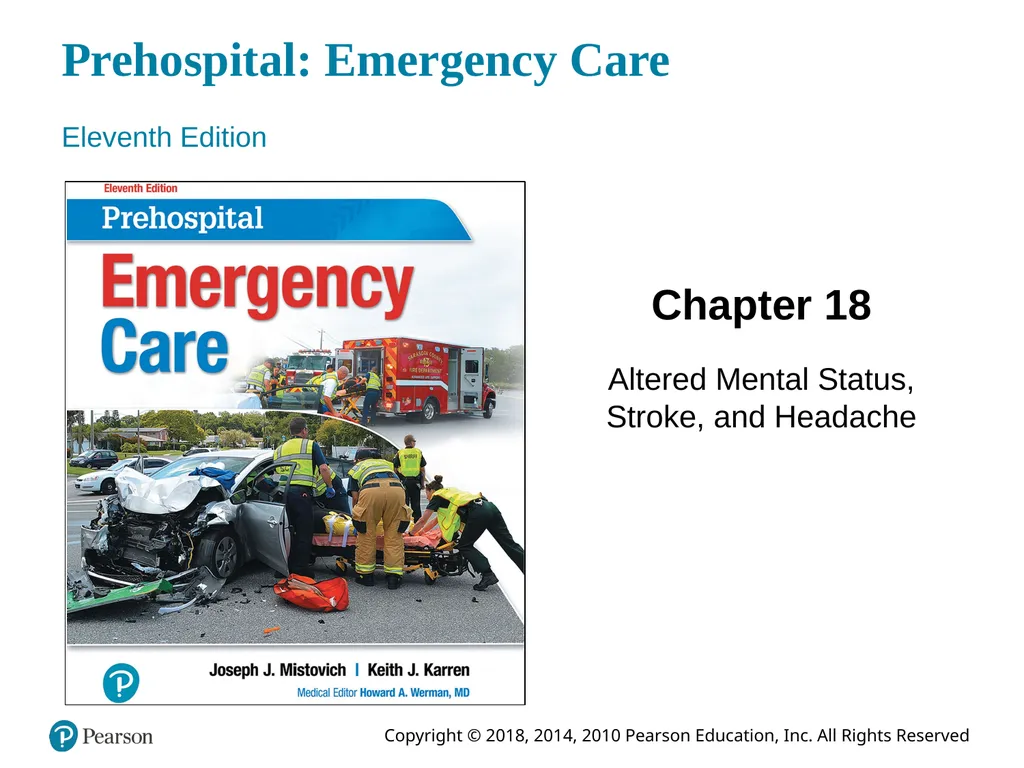
Prehospital: Emergency Care Eleventh Edition
TF
Published · 61 slides · 0 views

1 / 1
Description
Prehospital: Emergency Care Eleventh Edition Chapter 18 Altered Mental Status, Stroke, and Headache Copyright 2018, 2014, 2010 Pearson Education, Inc. All Rights Reserved Slides in this presentation contain hyperlinks. JAWS users should
Related Topics
Share
Embed code
Download this presentation From Below
"Prehospital: Emergency Care Eleventh Edition" is the property of its rightful owner. Permission is granted to download and print the materials on this website for personal, non-commercial use only, and to display it on your personal computer provided you do not modify the materials and that you retain all copyright notices contained in the materials. By downloading content from our website, you accept the terms of this agreement.
Presentation Transcript
01
Prehospital: Emergency Care Eleventh Edition Chapter 18 Altered Mental Status, Stroke, and Headache Copyright © 2018, 2014, 2010 Pearson Education, Inc. All Rights Reserved "Slides in this presentation contain hyperlinks. JAWS users should be able to get a list of links by using INSERT+F7"<br>
02
Learning Readiness E M S Education Standards, text p. 555.
Chapter Objectives, text p. 555.
Key Terms, text p. 555.
Purpose of lecture presentation versus textbook reading assignments.<br>
Chapter Objectives, text p. 555.
Key Terms, text p. 555.
Purpose of lecture presentation versus textbook reading assignments.<br>
03
Setting the Stage Overview of Lesson Topics
Altered mental status
Stroke
Headache<br>
Altered mental status
Stroke
Headache<br>
04
Case Study Introduction “Hurry, he’s back here,” Mrs. Hewlett calls to E M T s Fred Archuleta and Reese Kemp. “I think he’s having a stroke!”
The E M T s find John Hewlett, a 69-year-old male, sitting in a chair, looking anxious. Mr. Hewlett begins to speak, but his speech is slurred, and there is a noticeable droop on the right side of his face.<br>
The E M T s find John Hewlett, a 69-year-old male, sitting in a chair, looking anxious. Mr. Hewlett begins to speak, but his speech is slurred, and there is a noticeable droop on the right side of his face.<br>
05
Case Study What would make the E M T s suspect the patient might be having a stroke?
What other conditions could explain the patient’s presentation?
How should the E M T s go about determining what the problem is?<br>
What other conditions could explain the patient’s presentation?
How should the E M T s go about determining what the problem is?<br>
06
Introduction Altered mental status has many causes, and can place the patient’s airway at risk.
Early recognition of stroke is critical for proper care.
Headache should be considered a serious symptom that could be caused by an underlying condition.<br>
Early recognition of stroke is critical for proper care.
Headache should be considered a serious symptom that could be caused by an underlying condition.<br>
07
Altered Mental Status (1 of 9) Dysfunction of the reticular activating system or cerebral hemispheres interferes with consciousness.
Altered mental status (A M S) is an indication of significant illness or injury.
Causes of A M S may be structural or toxic-metabolic.<br>
Altered mental status (A M S) is an indication of significant illness or injury.
Causes of A M S may be structural or toxic-metabolic.<br>
08
Altered Mental Status (2 of 9) Other causes of A M S
Shock
Drugs that depress the C N S
Post-seizure state
Infection
Cardiac rhythm disturbance
Stroke<br>
Shock
Drugs that depress the C N S
Post-seizure state
Infection
Cardiac rhythm disturbance
Stroke<br>
09
Altered Mental Status (3 of 9) Assessment-Based Approach: A M S
Scene size-up
Causes of A M S can be medical or traumatic.
Look for the mechanism of injury or clues to the nature of the illness.
Collect the patient’s medications.
Remove the patient from a hazardous environment.<br>
Scene size-up
Causes of A M S can be medical or traumatic.
Look for the mechanism of injury or clues to the nature of the illness.
Collect the patient’s medications.
Remove the patient from a hazardous environment.<br>
10
Altered Mental Status (4 of 9) Assessment-Based Approach: A M S
Primary assessment
Stabilize the spine, if indicated.
Assess for airway patency.
Assess for breathing adequacy.
Assess the need for supplemental oxygen.<br>
Primary assessment
Stabilize the spine, if indicated.
Assess for airway patency.
Assess for breathing adequacy.
Assess the need for supplemental oxygen.<br>
11
Altered Mental Status (5 of 9) Assessment-Based Approach: A M S
Secondary assessment
Baseline vital signs
History
Physical exam
What were the signs and symptoms prior to the altered mental status<br>
Secondary assessment
Baseline vital signs
History
Physical exam
What were the signs and symptoms prior to the altered mental status<br>
12
Altered Mental Status (6 of 9) Assessment-Based Approach: A M S
Secondary assessment
Possible findings in trauma
Obvious signs of trauma
Abnormal respiratory pattern or heart rate
Unequal pupils
High or low blood pressure
Discoloration around the eyes/behind ears
Pale, cool, moist skin
Abnormal flexion or extension<br>
Secondary assessment
Possible findings in trauma
Obvious signs of trauma
Abnormal respiratory pattern or heart rate
Unequal pupils
High or low blood pressure
Discoloration around the eyes/behind ears
Pale, cool, moist skin
Abnormal flexion or extension<br>
13
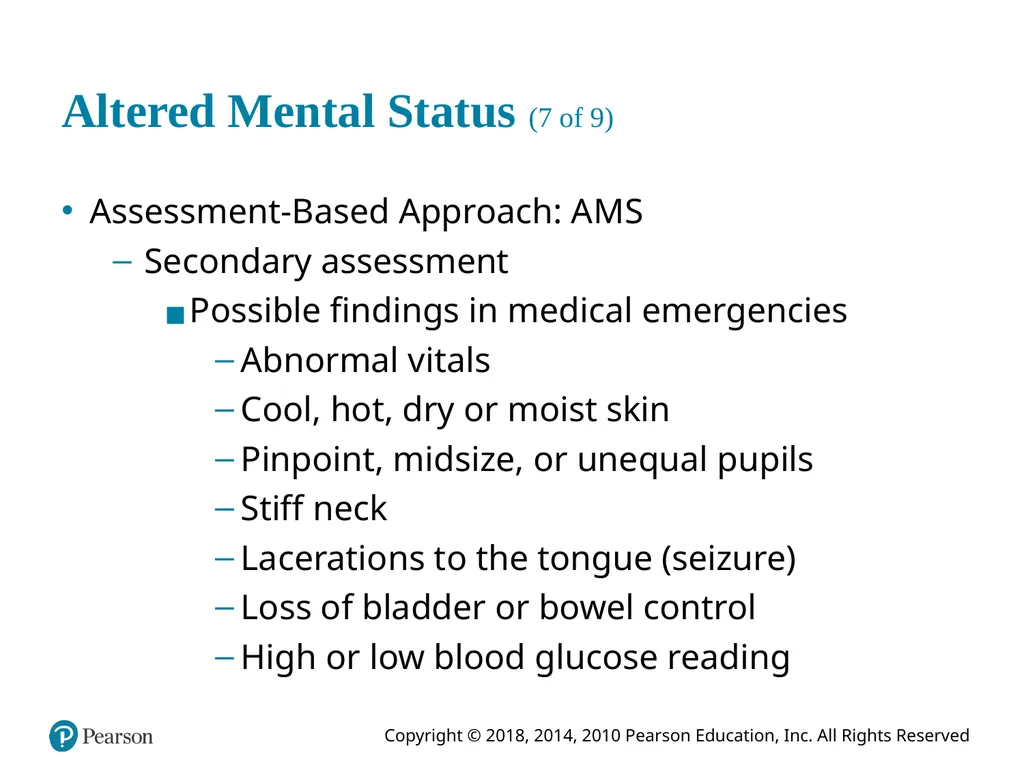
Altered Mental Status (7 of 9) Assessment-Based Approach: A M S
Secondary assessment
Possible findings in medical emergencies
Abnormal vitals
Cool, hot, dry or moist skin
Pinpoint, midsize, or unequal pupils
Stiff neck
Lacerations to the tongue (seizure)
Loss of bladder or bowel control
High or low blood glucose reading<br>
Secondary assessment
Possible findings in medical emergencies
Abnormal vitals
Cool, hot, dry or moist skin
Pinpoint, midsize, or unequal pupils
Stiff neck
Lacerations to the tongue (seizure)
Loss of bladder or bowel control
High or low blood glucose reading<br>
14
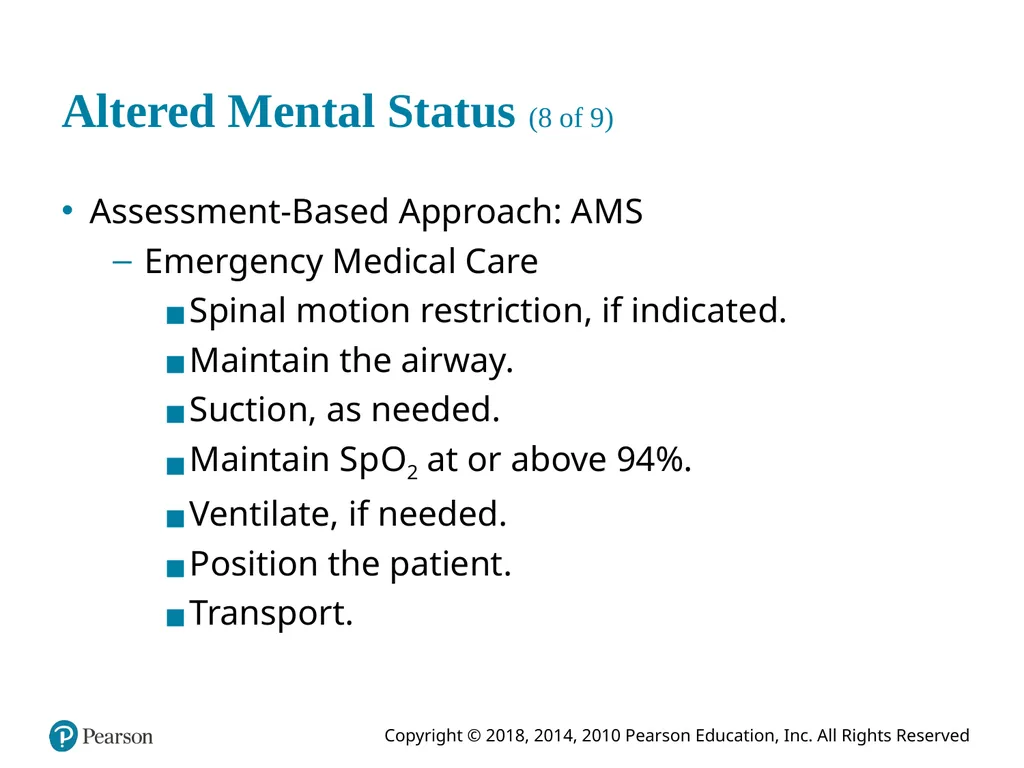
Altered Mental Status (8 of 9) Assessment-Based Approach: A M S
Emergency Medical Care
Spinal motion restriction, if indicated.
Maintain the airway.
Suction, as needed.
Maintain S p O2 at or above 94%.
Ventilate, if needed.
Position the patient.
Transport.<br>
Emergency Medical Care
Spinal motion restriction, if indicated.
Maintain the airway.
Suction, as needed.
Maintain S p O2 at or above 94%.
Ventilate, if needed.
Position the patient.
Transport.<br>
15
Altered Mental Status (9 of 9) Assessment-Based Approach: A M S
Reassessment
Reassess every five minutes.
Look for changes in mental status, airway, breathing, and circulation.
Record vital signs.<br>
Reassessment
Reassess every five minutes.
Look for changes in mental status, airway, breathing, and circulation.
Record vital signs.<br>
16
Stroke (1 of 20) Neurologic Deficit Resulting from Stroke
A deficiency in nervous system function is called a neurological deficit.
A neurological deficit is an indication of a problem affecting the central nervous system.<br>
A deficiency in nervous system function is called a neurological deficit.
A neurological deficit is an indication of a problem affecting the central nervous system.<br>
17
Stroke (2 of 20) Acute Stroke
Time is a critical factor in stroke management.
E M T s can make a significant difference through early recognition and transport.
The American Heart Association/ American Stroke Association developed the mnemonic F.A.S.T. to quickly recognize possible stroke.<br>
Time is a critical factor in stroke management.
E M T s can make a significant difference through early recognition and transport.
The American Heart Association/ American Stroke Association developed the mnemonic F.A.S.T. to quickly recognize possible stroke.<br>
18
Stroke (3 of 20) Acute Stroke
Time is a critical factor in stroke management.
E M T s can make a significant difference through early recognition and transport of stroke patients.<br>
Time is a critical factor in stroke management.
E M T s can make a significant difference through early recognition and transport of stroke patients.<br>
19
Stroke (4 of 20) Pathophysiology of a Stroke
Cerebral Circulation and the Ischemic Penumbra
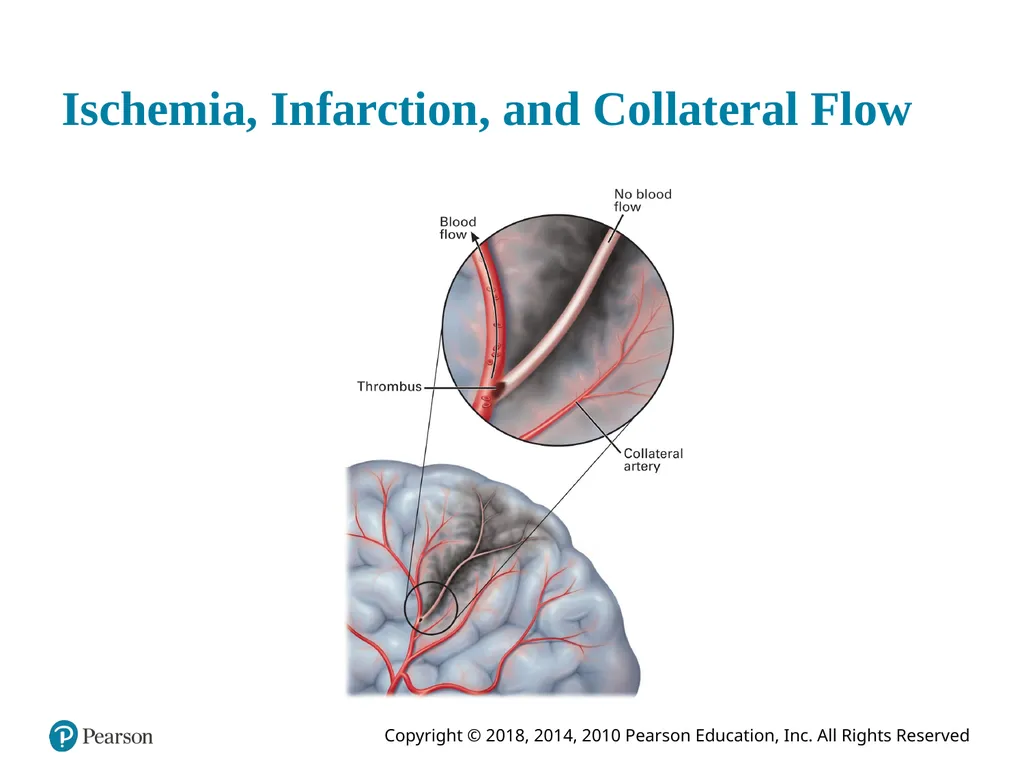
Cerebral arteries can develop collateral circulation.
Collateral circulation is often inadequate.
Ischemic cells can become electrically silent until circulation is restored.
The area of silent cells is called the ischemic penumbra.<br>
Cerebral Circulation and the Ischemic Penumbra
Cerebral arteries can develop collateral circulation.
Collateral circulation is often inadequate.
Ischemic cells can become electrically silent until circulation is restored.
The area of silent cells is called the ischemic penumbra.<br>
20
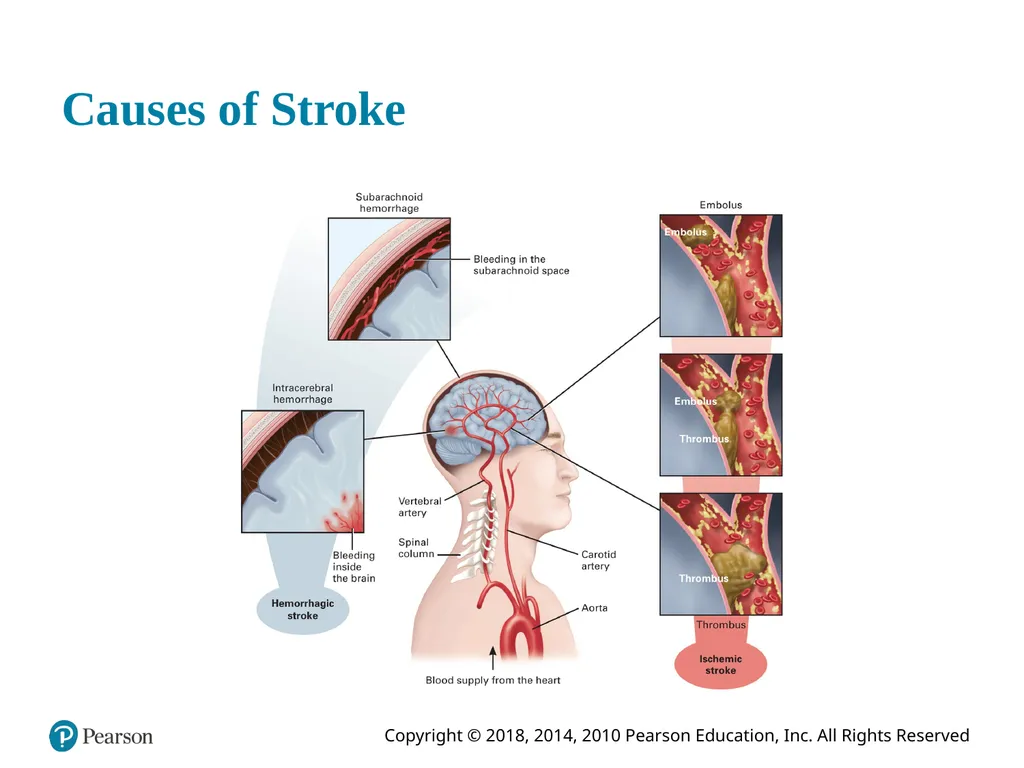
Causes of Stroke<br>
21
Ischemia, Infarction, and Collateral Flow<br>
22
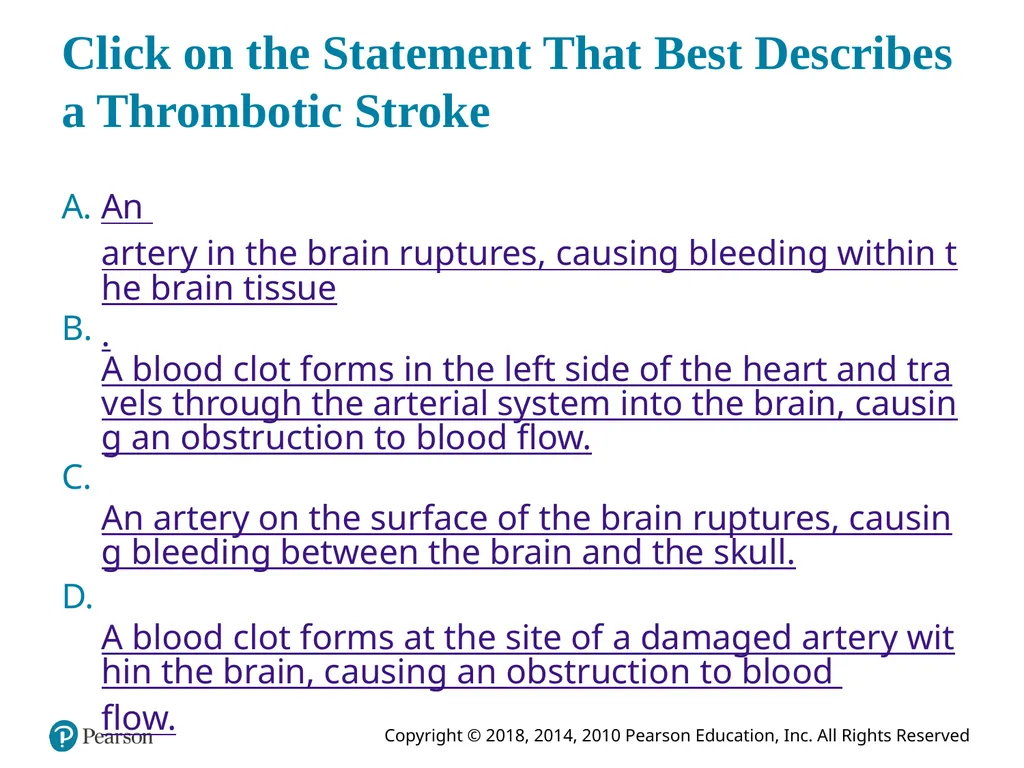
Click on the Statement That Best Describes a Thrombotic Stroke A. An artery in the brain ruptures, causing bleeding within the brain tissue. B. A blood clot forms in the left side of the heart and travels through the arterial system into the brain, causing an obstruction to blood flow. C. An artery on the surface of the brain ruptures, causing bleeding between the brain and the skull. D. A blood clot forms at the site of a damaged artery within the brain, causing an obstruction to blood flow.<br>
23
Stroke (5 of 20) Types of Stroke
Stroke caused by a blockage is referred to as an ischemic stroke and stroke caused by rupture and bleeding is referred to as a hemorrhagic stroke.
It is difficult to distinguish between types of stroke in the prehospital setting.<br>
Stroke caused by a blockage is referred to as an ischemic stroke and stroke caused by rupture and bleeding is referred to as a hemorrhagic stroke.
It is difficult to distinguish between types of stroke in the prehospital setting.<br>
24
Stroke (6 of 20) Types of Stroke
Ischemic Strokes
Occur when the cerebral artery is blocked by a clot or other foreign matter.
A clot that develops at the site of occlusion is called a thrombus.
Patients with an ischemic stroke may be eligible to receive fibrinolytic drugs.
Atrial Fibrillation can precipitate an ischemic stroke.<br>
Ischemic Strokes
Occur when the cerebral artery is blocked by a clot or other foreign matter.
A clot that develops at the site of occlusion is called a thrombus.
Patients with an ischemic stroke may be eligible to receive fibrinolytic drugs.
Atrial Fibrillation can precipitate an ischemic stroke.<br>
25
Stroke (7 of 20) Types of Stroke
Hemorrhagic Strokes
Results from the rupture of a weakened cerebral artery.
High blood pressure can precipitate a hemorrhagic stroke.
Hemorrhagic strokes are usually caused by an aneurism or an Arteriovenous Malformation (A V M).<br>
Hemorrhagic Strokes
Results from the rupture of a weakened cerebral artery.
High blood pressure can precipitate a hemorrhagic stroke.
Hemorrhagic strokes are usually caused by an aneurism or an Arteriovenous Malformation (A V M).<br>
26
Stroke (8 of 20) Types of Stroke
Hemorrhagic Strokes
Signs and symptoms of a hemorrhagic stroke depend on the area of the brain where the hemorrhage occurs.
Common signs include nausea & vomiting, headache and decreased level of consciousness.
It is difficult to distinguish between the two types of stroke in the field.<br>
Hemorrhagic Strokes
Signs and symptoms of a hemorrhagic stroke depend on the area of the brain where the hemorrhage occurs.
Common signs include nausea & vomiting, headache and decreased level of consciousness.
It is difficult to distinguish between the two types of stroke in the field.<br>
27
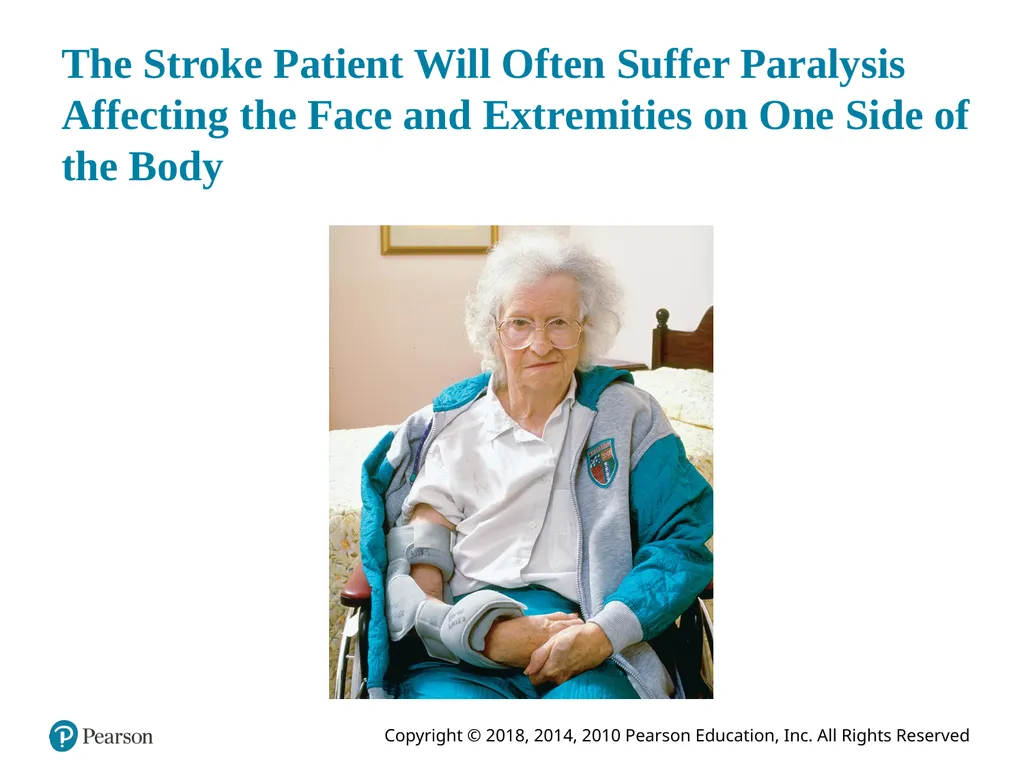
The Stroke Patient Will Often Suffer Paralysis Affecting the Face and Extremities on One Side of the Body<br>
28
Stroke (9 of 20) Stroke or Transient Ischemic Attack
Same signs and symptoms as stroke
Symptoms disappear, usually within one hour.
The emergency care for T I A is the same as for stroke.<br>
Same signs and symptoms as stroke
Symptoms disappear, usually within one hour.
The emergency care for T I A is the same as for stroke.<br>
29
Stroke (10 of 20) Stroke or Transient Ischemic Attack
Stroke
Signs and Symptoms
Sudden onset weakness or paralysis
Facial droop
Anterior and Posterior Circulation Strokes.
It is rare that paralysis from a stroke affects both extremities on both sides of the body<br>
Stroke
Signs and Symptoms
Sudden onset weakness or paralysis
Facial droop
Anterior and Posterior Circulation Strokes.
It is rare that paralysis from a stroke affects both extremities on both sides of the body<br>
30
Stroke (11 of 20) Stroke or Transient Ischemic Attack
Transient Ischemic Attack
Many of the same signs and symptoms as a stroke.
Most T I A s resolve in less than five minutes with the average being one minute.
10–20 percent risk of a stroke in the subsequent 90 days, half of these within 24-48 hours.<br>
Transient Ischemic Attack
Many of the same signs and symptoms as a stroke.
Most T I A s resolve in less than five minutes with the average being one minute.
10–20 percent risk of a stroke in the subsequent 90 days, half of these within 24-48 hours.<br>
31
Stroke (12 of 20) Stroke or Transient Ischemic Attack
Cryptogenic Stroke
can’t be attributed to a specific cause.
Thought to be secondary to atrial fibrillation.<br>
Cryptogenic Stroke
can’t be attributed to a specific cause.
Thought to be secondary to atrial fibrillation.<br>
32
Stroke (13 of 20) Assessment-Based Approach: Stroke and Transient Ischemic Attack
Scene size-up
Determine the nature of the problem.
Note where the patient is found.<br>
Scene size-up
Determine the nature of the problem.
Note where the patient is found.<br>
33
Stroke (14 of 20) Assessment-Based Approach: Stroke and Transient Ischemic Attack
Primary assessment
Assess the airway and suction as needed.
Position the patient.
Use an airway adjunct, as needed.
Assess for inadequate breathing and abnormal breathing patterns.
Apply oxygen if the S p O2 is <94%.<br>
Primary assessment
Assess the airway and suction as needed.
Position the patient.
Use an airway adjunct, as needed.
Assess for inadequate breathing and abnormal breathing patterns.
Apply oxygen if the S p O2 is <94%.<br>
34
Stroke (15 of 20) Assessment-Based Approach: Stroke and Transient Ischemic Attack
Secondary assessment
Findings suspicious for stroke include:
Sudden weakness of face or extremities
Trouble speaking and/or difficulty seeing
Problems walking or loss of balance or coordination
Sudden, severe headache<br>
Secondary assessment
Findings suspicious for stroke include:
Sudden weakness of face or extremities
Trouble speaking and/or difficulty seeing
Problems walking or loss of balance or coordination
Sudden, severe headache<br>
35
Stroke (16 of 20) Assessment-Based Approach: Stroke and Transient Ischemic Attack
Secondary assessment
Prehospital Stroke Screening Tools
Cincinnati Prehospital Stroke Scale (C P S S)
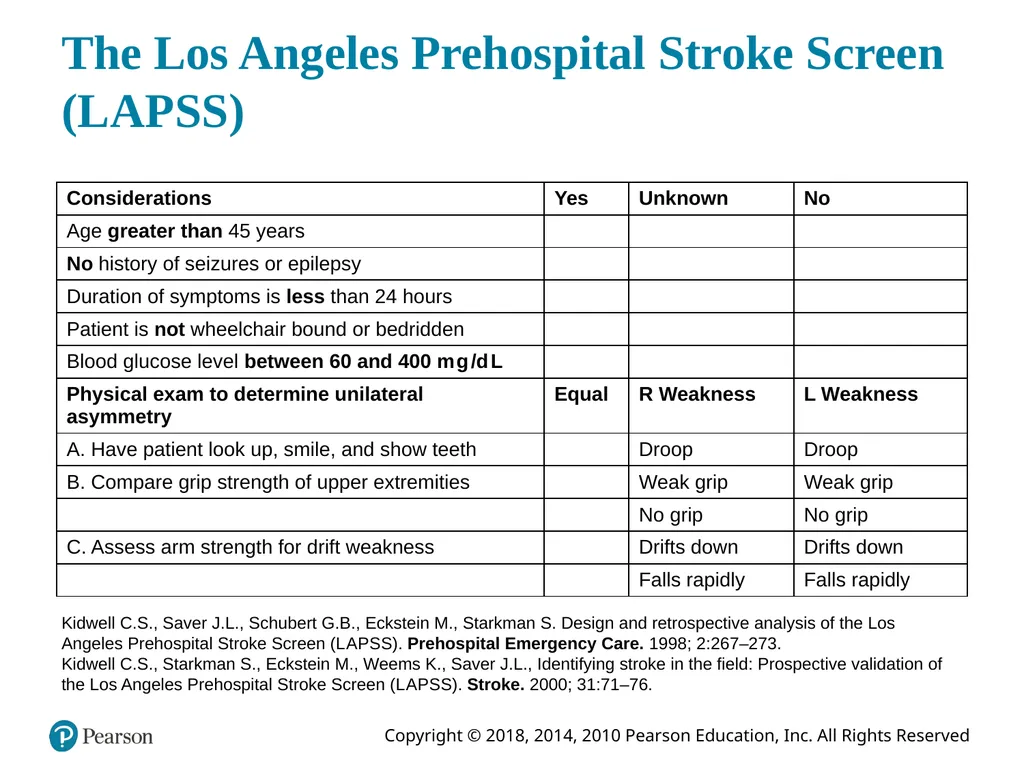
Los Angeles Prehospital Stroke Screen (L A P S S)
Miami Emergency Neurologic Deficit (M E N D)
Rapid Arterial Occlusion Evaluation (R A C E)
Scale and Large Vessel Occlusion (L V O)
Two types of stroke centers<br>
Secondary assessment
Prehospital Stroke Screening Tools
Cincinnati Prehospital Stroke Scale (C P S S)
Los Angeles Prehospital Stroke Screen (L A P S S)
Miami Emergency Neurologic Deficit (M E N D)
Rapid Arterial Occlusion Evaluation (R A C E)
Scale and Large Vessel Occlusion (L V O)
Two types of stroke centers<br>
36
Stroke (17 of 20) Assessment-Based Approach: Stroke and Transient Ischemic Attack
Secondary assessment
Obtain a history
Perform a physical exam
Obtain baseline vital signs<br>
Secondary assessment
Obtain a history
Perform a physical exam
Obtain baseline vital signs<br>
37
Stroke (18 of 20) Assessment-Based Approach: Stroke and Transient Ischemic Attack
Secondary assessment
Dangers of administering too much oxygen in a stroke
Free radicals cause tissue damage
Provide oxygen titrated to 94 percent<br>
Secondary assessment
Dangers of administering too much oxygen in a stroke
Free radicals cause tissue damage
Provide oxygen titrated to 94 percent<br>
38
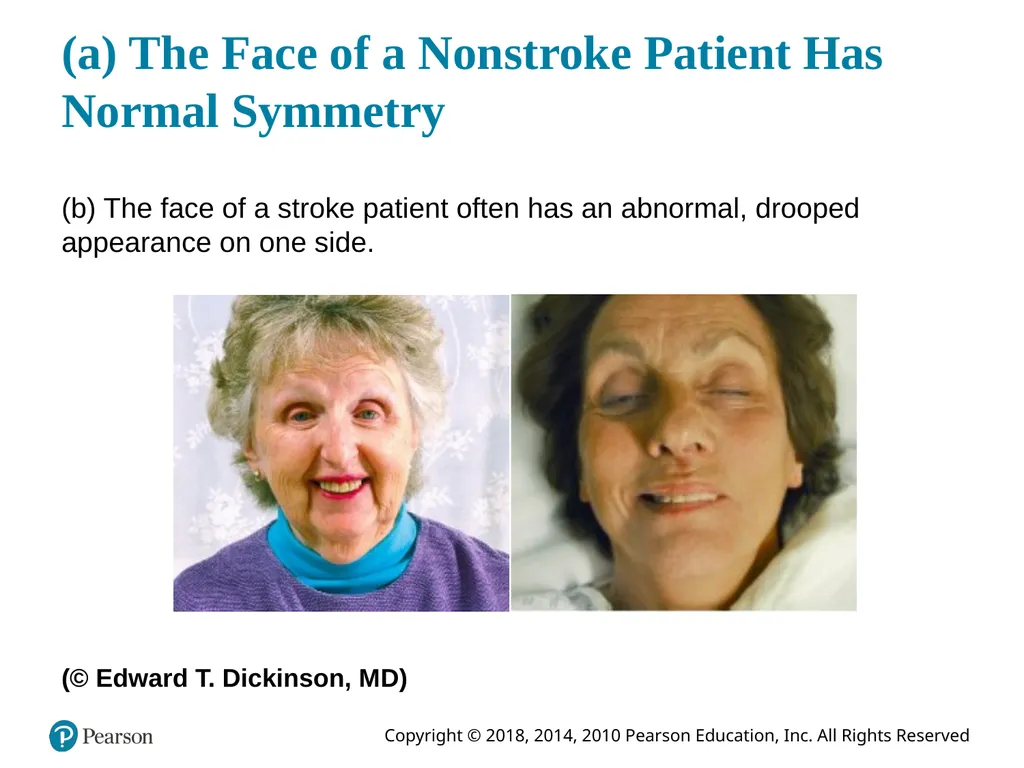
(a) The Face of a Nonstroke Patient Has Normal Symmetry (b) The face of a stroke patient often has an abnormal, drooped appearance on one side. (© Edward T. Dickinson, M D)<br>
39
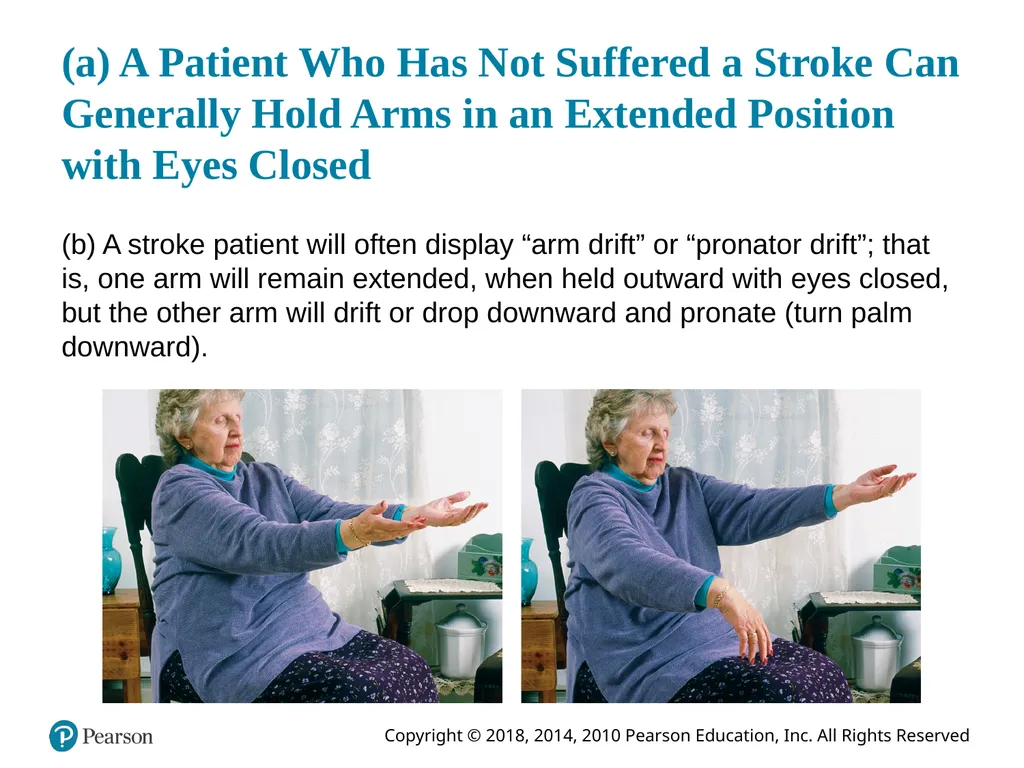
(a) A Patient Who Has Not Suffered a Stroke Can Generally Hold Arms in an Extended Position with Eyes Closed (b) A stroke patient will often display “arm drift” or “pronator drift”; that is, one arm will remain extended, when held outward with eyes closed, but the other arm will drift or drop downward and pronate (turn palm downward).<br>
40
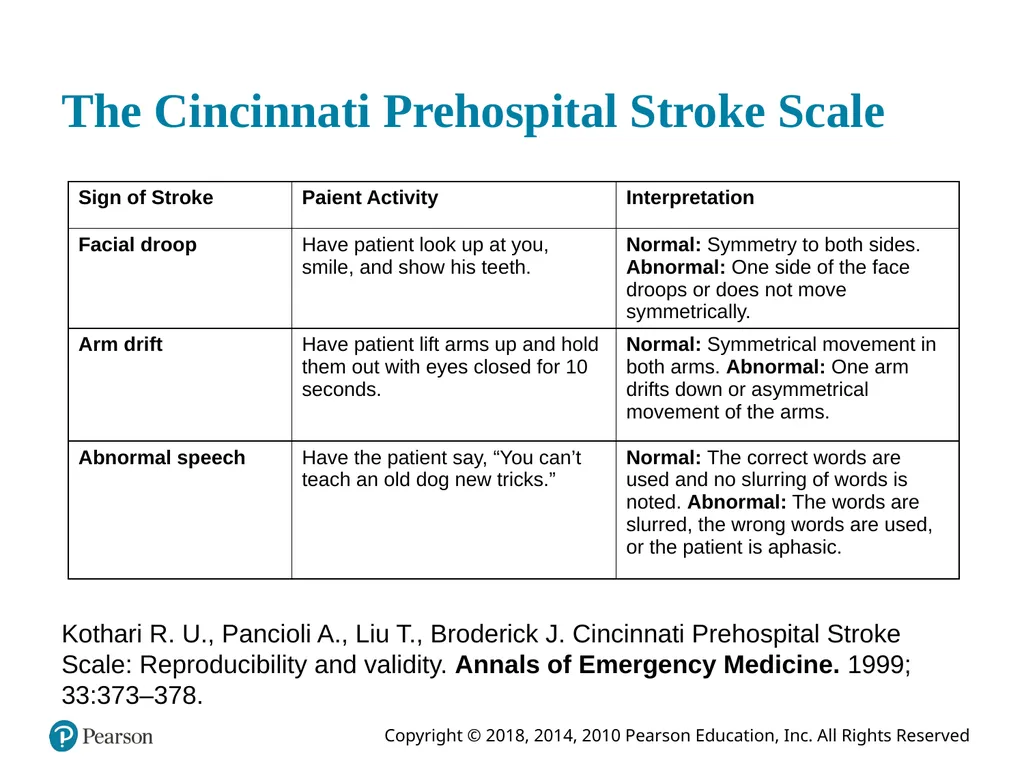
The Cincinnati Prehospital Stroke Scale Kothari R. U., Pancioli A., Liu T., Broderick J. Cincinnati Prehospital Stroke Scale: Reproducibility and validity. Annals of Emergency Medicine. 1999; 33:373–378.<br>
41
The Los Angeles Prehospital Stroke Screen (L A P S S) Kidwell C.S., Saver J.L., Schubert G.B., Eckstein M., Starkman S. Design and retrospective analysis of the Los Angeles Prehospital Stroke Screen (L A P S S). Prehospital Emergency Care. 1998; 2:267–273.
Kidwell C.S., Starkman S., Eckstein M., Weems K., Saver J.L., Identifying stroke in the field: Prospective validation of the Los Angeles Prehospital Stroke Screen (L A P S S). Stroke. 2000; 31:71–76.<br>
42
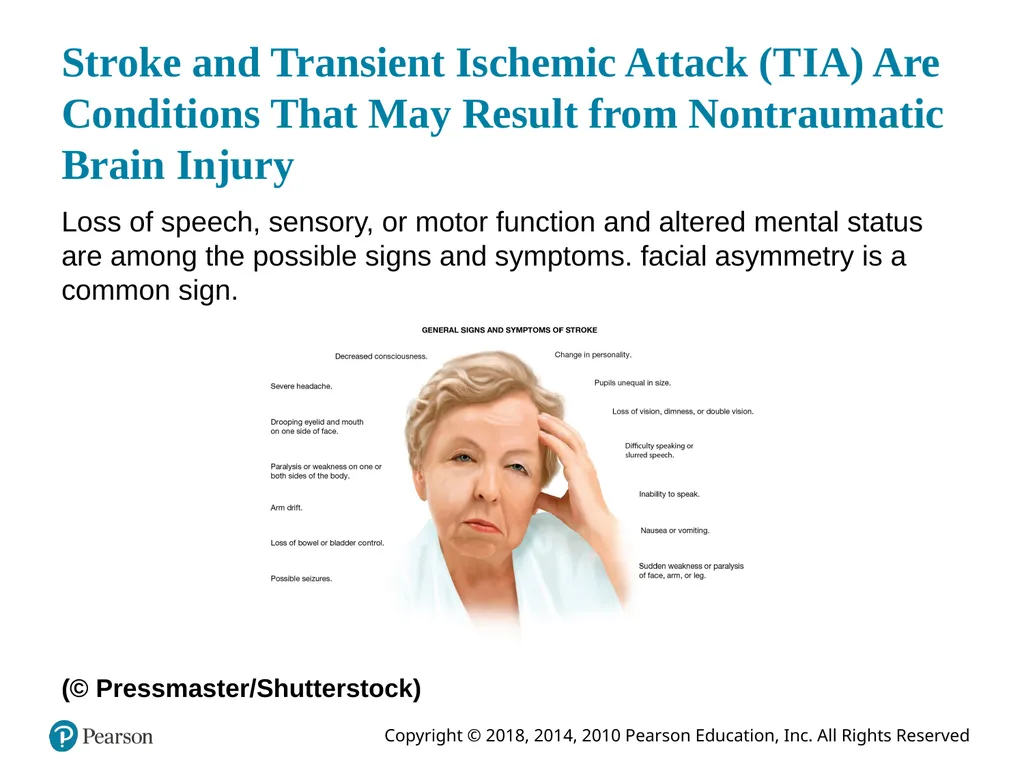
Stroke and Transient Ischemic Attack (T I A) Are Conditions That May Result from Nontraumatic Brain Injury Loss of speech, sensory, or motor function and altered mental status are among the possible signs and symptoms. facial asymmetry is a common sign. (© Pressmaster/Shutterstock)<br>
43
Stroke (19 of 20) Assessment-Based Approach: Stroke and Transient Ischemic Attack
Emergency medical care
Maintain the patient’s airway.
Suction as needed.
Assist ventilation as needed.
Maintain adequate oxygenation.
Position the patient.<br>
Emergency medical care
Maintain the patient’s airway.
Suction as needed.
Assist ventilation as needed.
Maintain adequate oxygenation.
Position the patient.<br>
44
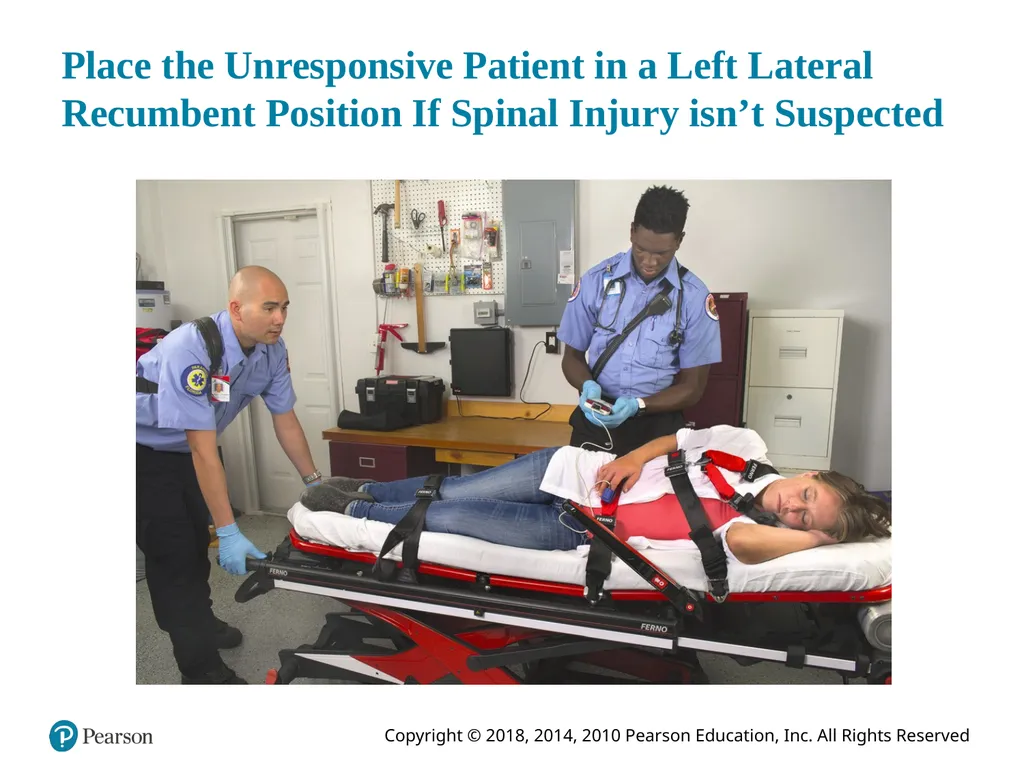
Place the Unresponsive Patient in a Left Lateral Recumbent Position If Spinal Injury isn’t Suspected<br>
45
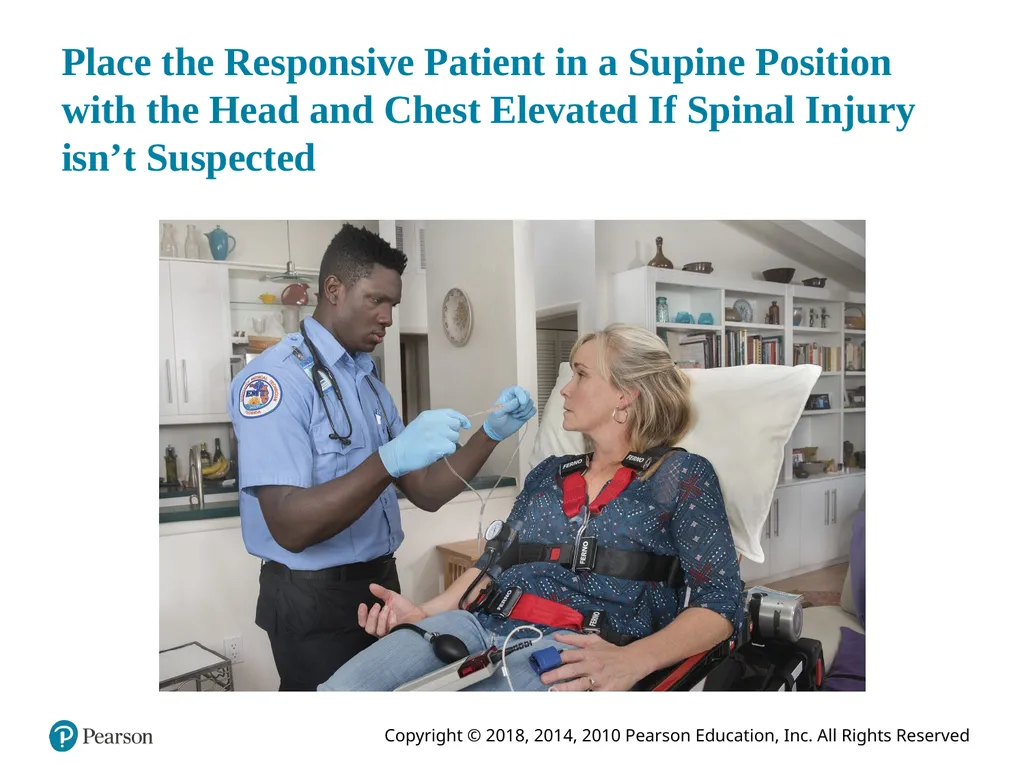
Place the Responsive Patient in a Supine Position with the Head and Chest Elevated If Spinal Injury isn’t Suspected<br>
46
Stroke (20 of 20) Assessment-Based Approach: Stroke and Transient Ischemic Attack
Emergency medical care
Check the blood glucose level.
Protect paralyzed extremities.
Rapid transport.
Reassessment
Reassess every five minutes.<br>
Emergency medical care
Check the blood glucose level.
Protect paralyzed extremities.
Rapid transport.
Reassessment
Reassess every five minutes.<br>
47
Headache (1 of 5) Headache may be a condition in itself, or can be a symptom of another condition.<br>
48
Headache (2 of 5) Types of Headache
Vascular headaches
Migraine
Hypertension
Cluster headaches
Tension headache
Organic, traction, or inflammatory headaches<br>
Vascular headaches
Migraine
Hypertension
Cluster headaches
Tension headache
Organic, traction, or inflammatory headaches<br>
49
Headache (3 of 5) Assessment
Suspect a serious underlying condition with any of the following findings:
Altered mental status
Motor or sensory deficit
Behavior change
Seizure<br>
Suspect a serious underlying condition with any of the following findings:
Altered mental status
Motor or sensory deficit
Behavior change
Seizure<br>
50
Headache (4 of 5) Assessment
Suspect a serious underlying condition with any of the following findings:
First experience of this type of headache with abrupt onset
Worsening of pain with coughing, sneezing, or bending over
Fever or stiff neck
Change in the quality of a chronic headache<br>
Suspect a serious underlying condition with any of the following findings:
First experience of this type of headache with abrupt onset
Worsening of pain with coughing, sneezing, or bending over
Fever or stiff neck
Change in the quality of a chronic headache<br>
51
Headache (5 of 5) Emergency Medical Care
Establish and maintain an airway.
Be prepared to suction.
Assess and maintain adequate ventilation.
Administer oxygen for an S p O2 >94%.
Position for comfort.
Be prepared for seizures.
Transport.<br>
Establish and maintain an airway.
Be prepared to suction.
Assess and maintain adequate ventilation.
Administer oxygen for an S p O2 >94%.
Position for comfort.
Be prepared for seizures.
Transport.<br>
52
Case Study Conclusion (1 of 3) Because of Mr. Hewlett’s slurred speech, both E M T s are immediately aware of the potential for airway compromise. Fred carefully assesses the airway and breathing as Reese asks Mrs. Hewlett what happened.
Mr. Hewlett is alert, and appears frustrated at his difficulty in making himself understood. Fred assures him that they will quickly do what they need to do and then will get him to the hospital for further assessment and care.<br>
Mr. Hewlett is alert, and appears frustrated at his difficulty in making himself understood. Fred assures him that they will quickly do what they need to do and then will get him to the hospital for further assessment and care.<br>
53
Case Study Conclusion (2 of 3) Fred’s stroke scale assessment confirms the facial droop and difficulty speaking, and reveals a slight weakness of Mr. Hewlett’s left hand. Mr. Hewlett is able to maintain a sitting position, so the E M T s position him in semi-Fowler’s position on the stretcher.<br>
54
Case Study Conclusion (3 of 3) Meanwhile, Reese was able to obtain information from Mrs. Hewlett, including the time of onset of signs and symptoms, which the E M T s know will be important in determining Mr. Hewlett's ongoing treatment in the hospital.<br>
55
Summary Causes of altered mental status include structural and metabolic-toxic causes.
Strokes may be ischemic or hemorrhagic.
Time is of the essence in the management of stroke.<br>
Strokes may be ischemic or hemorrhagic.
Time is of the essence in the management of stroke.<br>
56
Lesson Summary Use a validated stroke scale to assess patients with suspected stroke.
Headache may be a condition itself, or a symptom of an underlying condition.<br>
Headache may be a condition itself, or a symptom of an underlying condition.<br>
57
Correct! A thrombotic stroke is a type of ischemic stroke in which a blood clot forms at a site of atherosclerosis within an artery in the brain, obstructing the flow of blood.
Click here to return to the program.<br>
Click here to return to the program.<br>
58
Incorrect (1 of 3) When a blood vessel within the brain ruptures, thereby interrupting blood supply beyond that point and causing bleeding within the brain, it is an intracerebral hemorrhage, a type of hemorrhagic stroke.
Click here to return to the quiz.<br>
Click here to return to the quiz.<br>
59
Incorrect (2 of 3) When a blood vessel between the brain and the skull ruptures, causing bleeding between the brain and skull, within the subarachnoid space, it is a type of hemorrhagic stroke.
Click here to return to the quiz.<br>
Click here to return to the quiz.<br>
60
Incorrect (3 of 3) When a blood clot forms elsewhere and travels to the brain, interrupting the flow of blood, it is a type of ischemic stroke called an embolic stroke.
Click here to return to the quiz.<br>
Click here to return to the quiz.<br>
61
Copyright<br>