
Preliminary Design Review Bi-Functional On-Orbit

Description: Preliminary Design Review Bi-Functional On-Orbit Space Transfers (BOOST) By: Tycho Cinquini, Riana Gagnon, Avery Gillespie, Wesley Gilliam, Luca Herlein, Chieri Kamada, Colton Massic, Rishi Mayekar, Zach Rochman CustomerSponsor: Marcus
Related Topics
Download Presentation
"Preliminary Design Review Bi-Functional On-Orbit" is the property of its rightful owner. Permission is granted to download and print the materials on this website for personal, non-commercial use only, and to display it on your personal computer provided you do not modify the materials and that you retain all copyright notices contained in the materials. By downloading content from our website, you accept the terms of this agreement.
Presentation Transcript
slide1. Preliminary Design Review Bi-Functional On-Orbit Space Transfers (BOOST) By: Tycho Cinquini, Riana Gagnon, Avery Gillespie, Wesley Gilliam, Luca Herlein, Chieri Kamada, Colton Massic, Rishi Mayekar, Zach Rochman Customer/Sponsor: Marcus Holzinger | Mentor: Ball Aerospace<br>
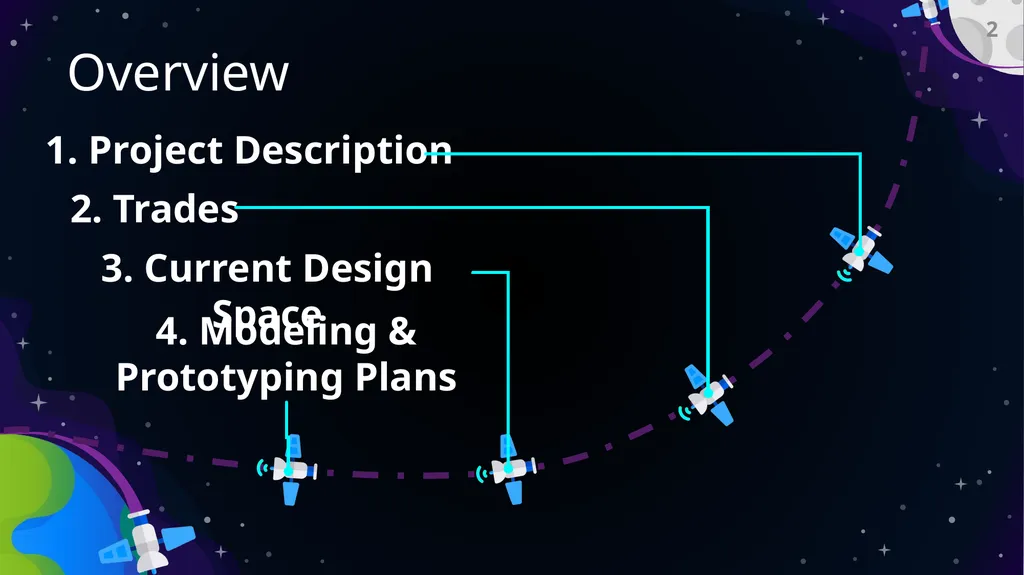
slide2. Overview 2 4. Modeling & Prototyping Plans 3. Current Design Space 2. Trades 1. Project Description<br>
slide3. Project Description 1<br>
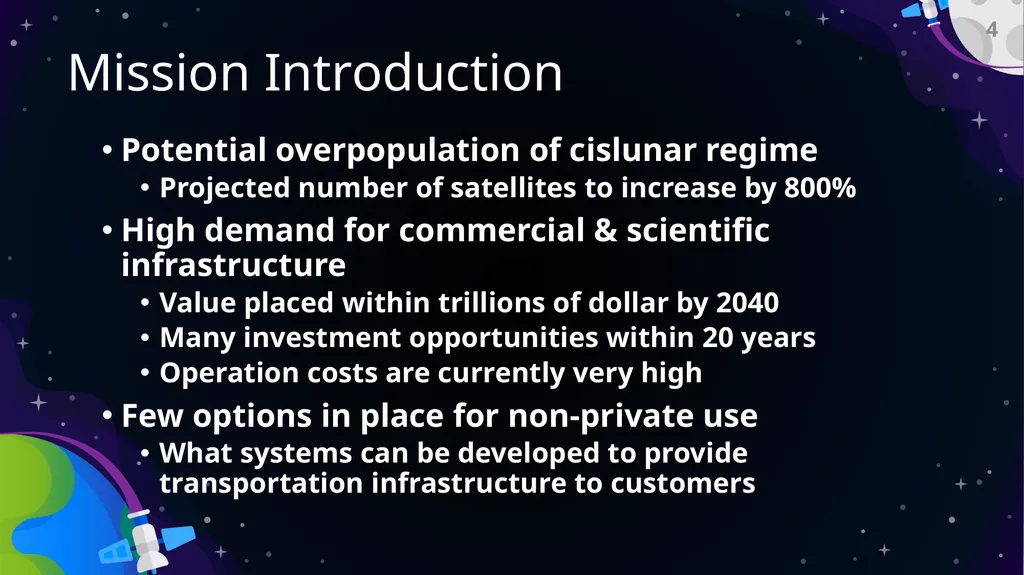
slide4. Mission Introduction 4 Potential overpopulation of cislunar regime
Projected number of satellites to increase by 800%
High demand for commercial & scientific infrastructure
Value placed within trillions of dollar by 2040
Many investment opportunities within 20 years
Operation costs are currently very high
Few options in place for non-private use
What systems can be developed to provide transportation infrastructure to customers<br>
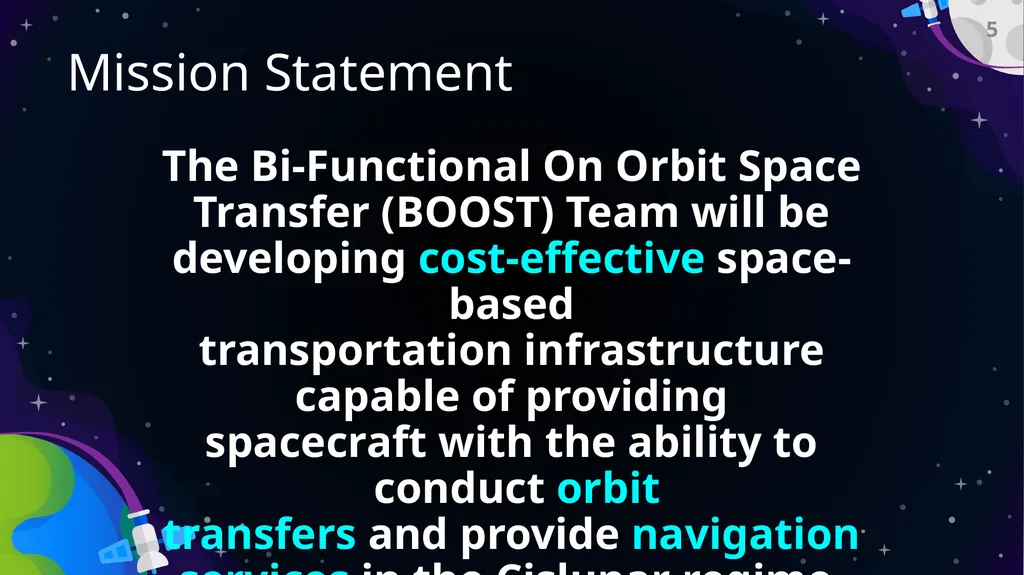
slide5. Mission Statement The Bi-Functional On Orbit Space Transfer (BOOST) Team will be developing cost-effective space-based transportation infrastructure capable of providing spacecraft with the ability to conduct orbit transfers and provide navigation services in the Cislunar regime. 5<br>
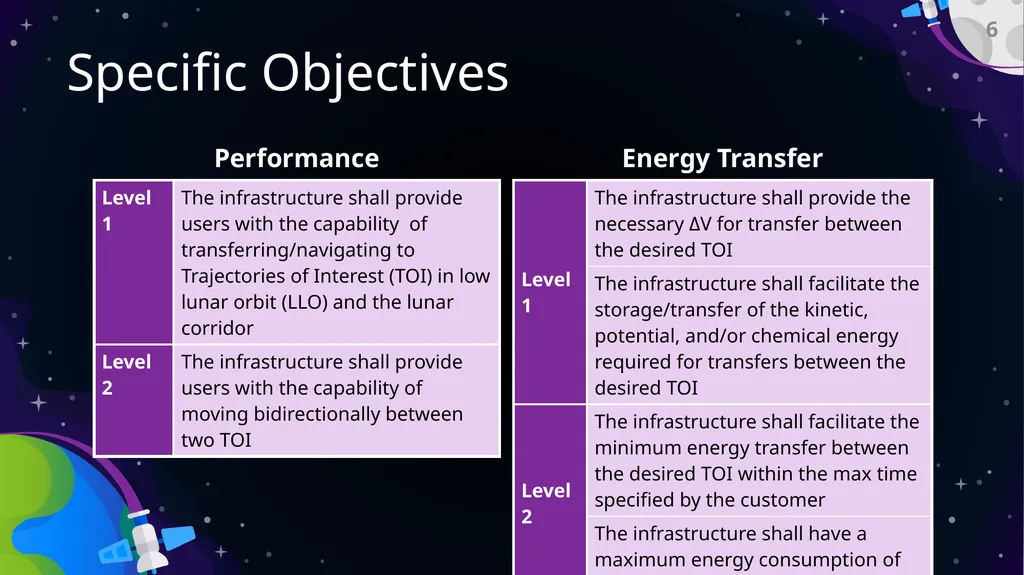
slide6. Specific Objectives 6 Performance Energy Transfer<br>
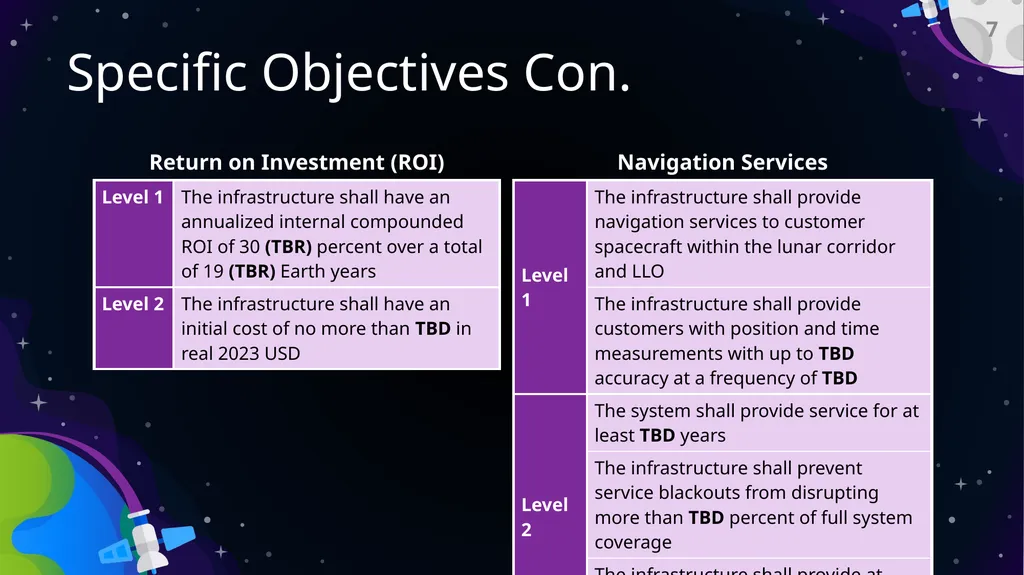
slide7. Specific Objectives Con. 7 Return on Investment (ROI) Navigation Services<br>
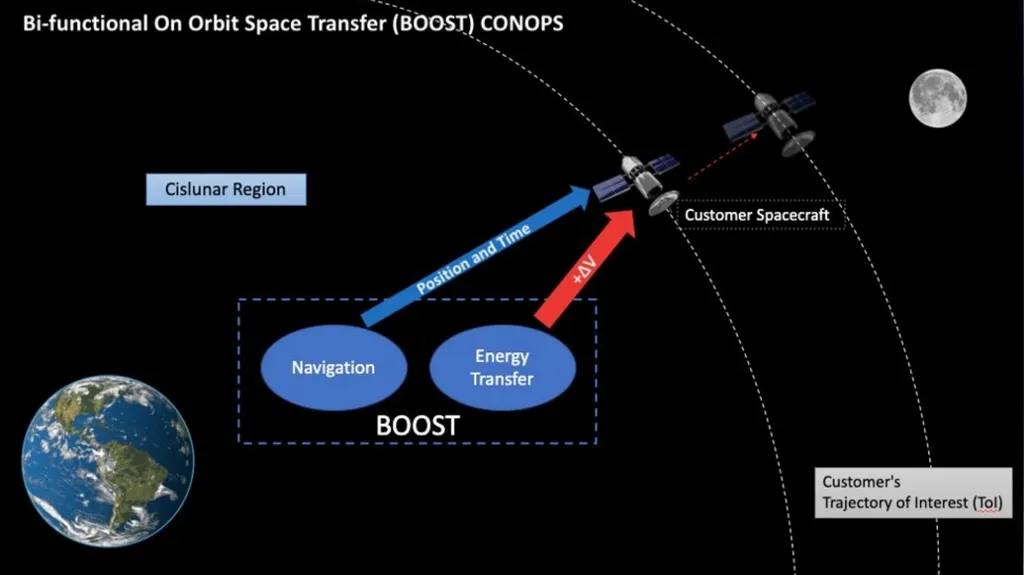
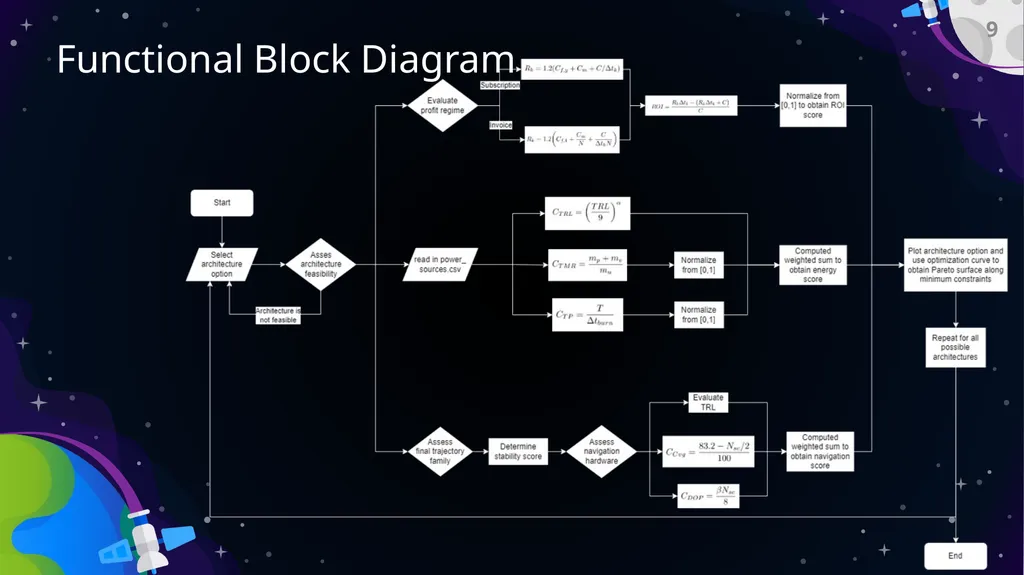
slide9. Functional Block Diagram 9<br>
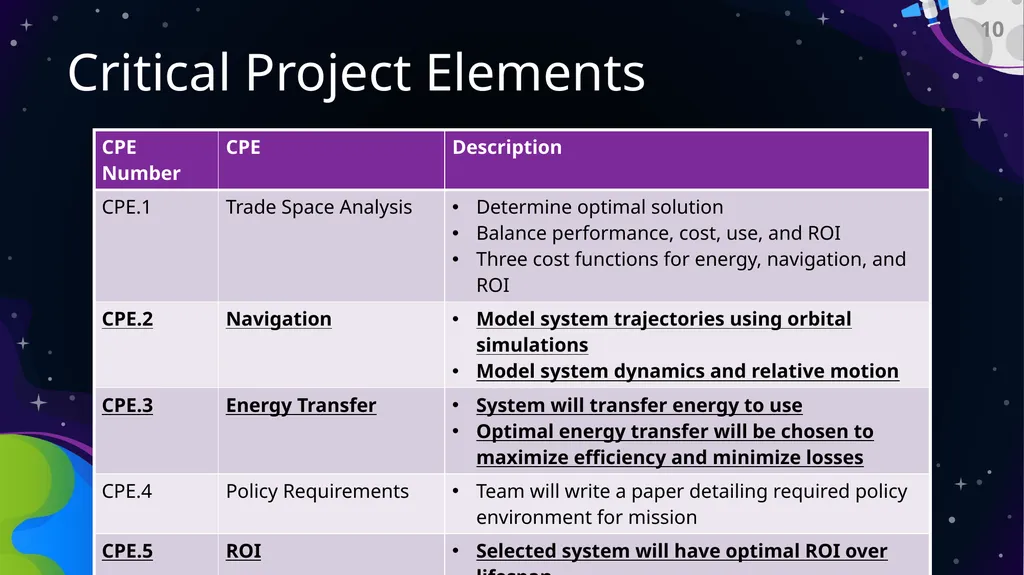
slide10. Critical Project Elements 10<br>
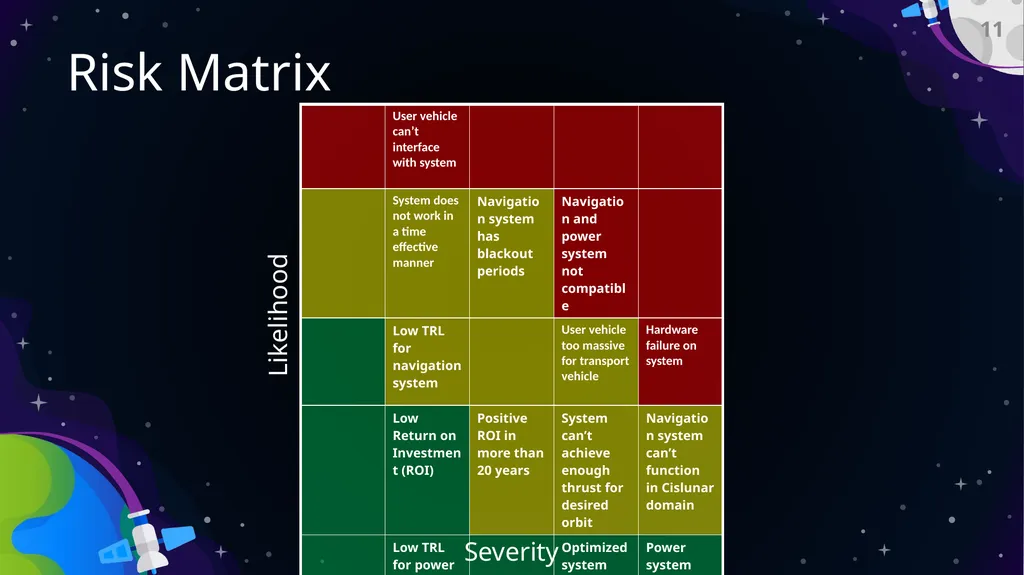
slide11. Risk Matrix 11 Severity Likelihood<br>
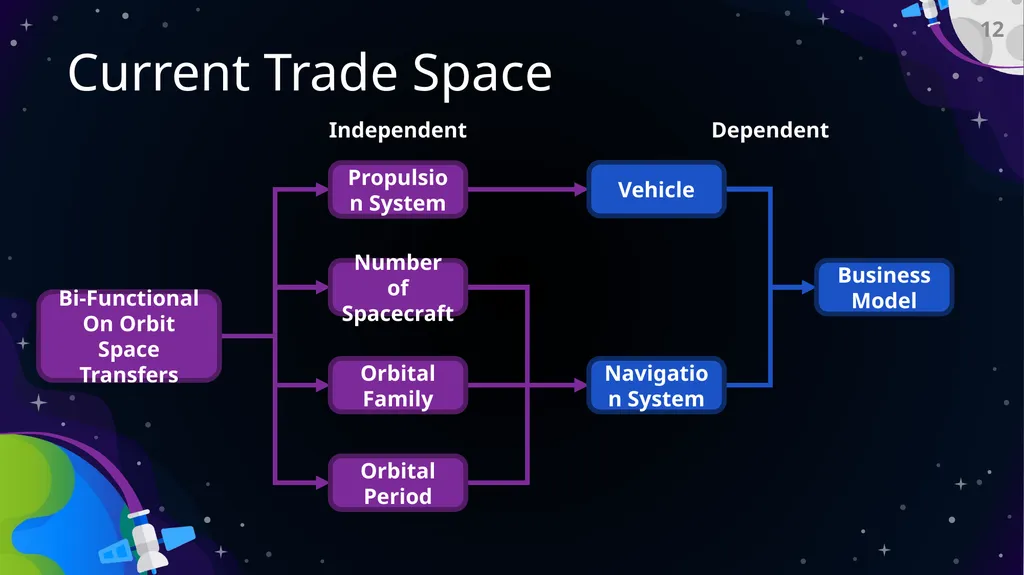
slide12. Current Trade Space 12<br>
slide13. Trades 2<br>
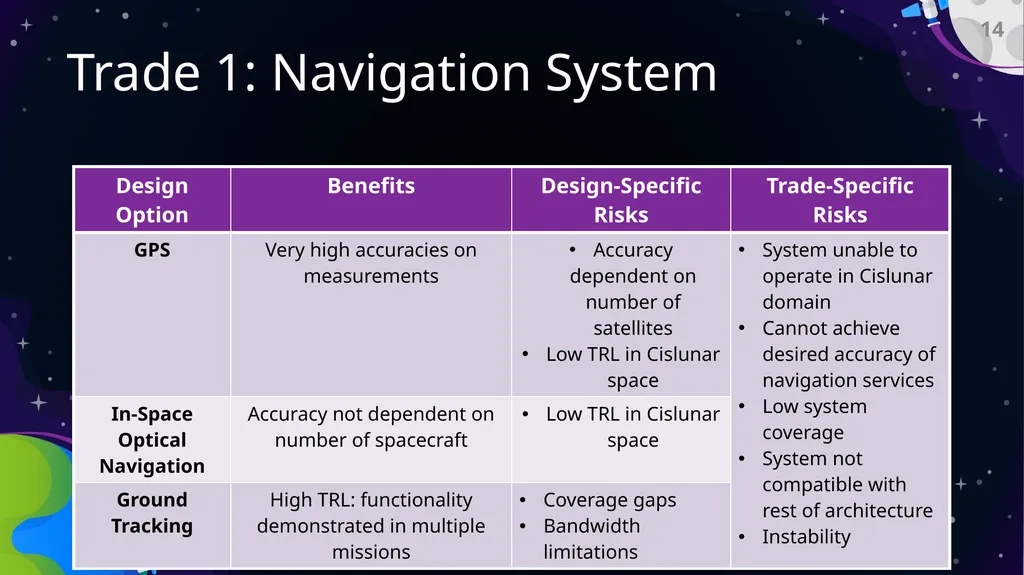
slide14. Trade 1: Navigation System 14<br>
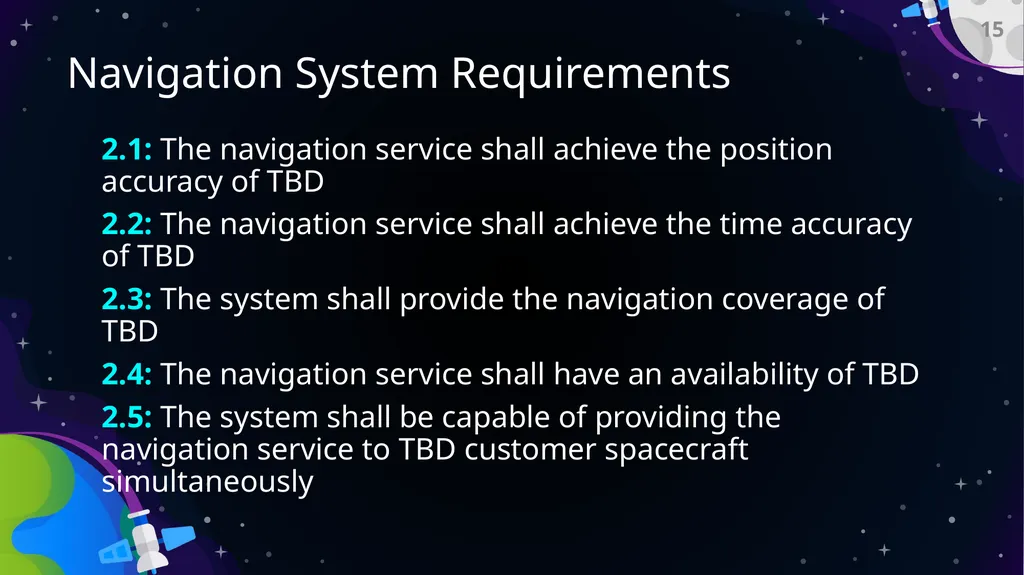
slide15. Navigation System Requirements 2.1: The navigation service shall achieve the position accuracy of TBD
2.2: The navigation service shall achieve the time accuracy of TBD
2.3: The system shall provide the navigation coverage of TBD
2.4: The navigation service shall have an availability of TBD
2.5: The system shall be capable of providing the navigation service to TBD customer spacecraft simultaneously 15<br>
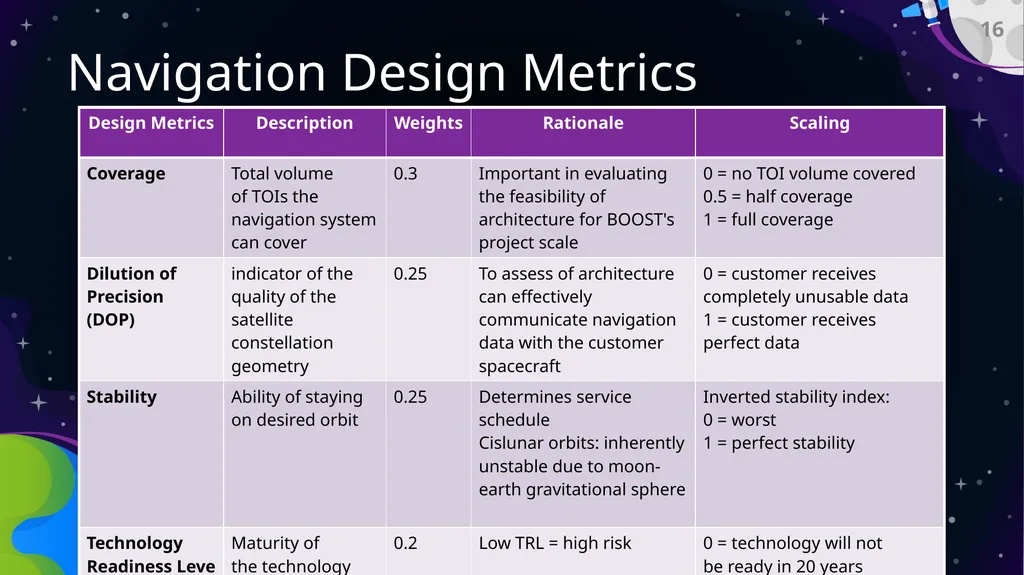
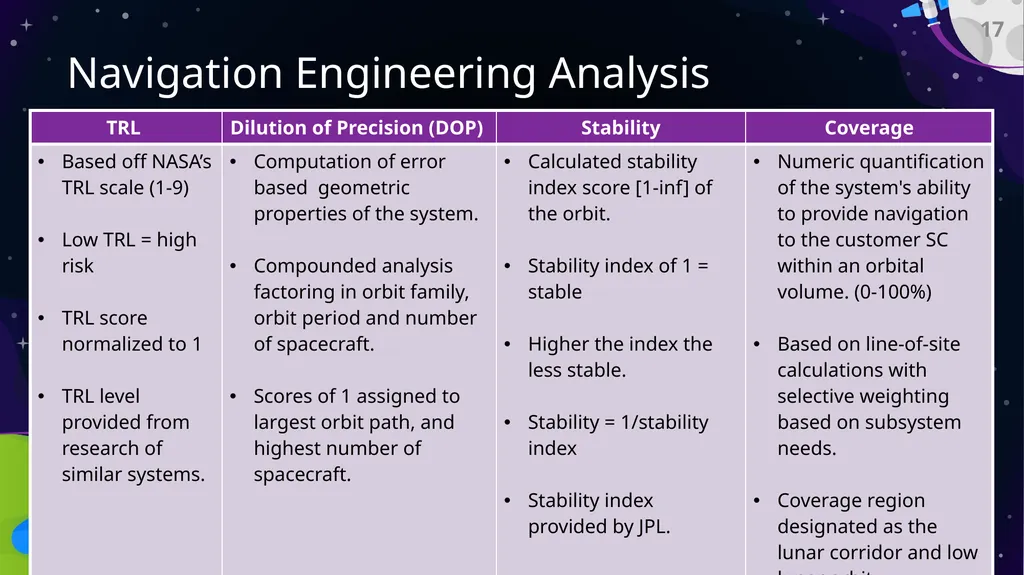
slide16. Navigation Design Metrics 16<br>
slide17. Navigation Engineering Analysis 17<br>
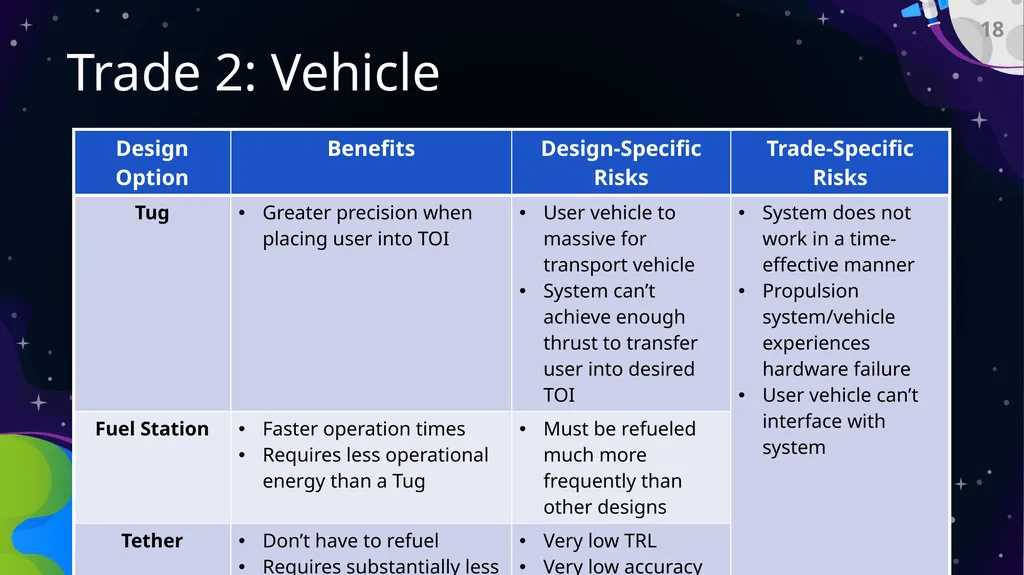
slide18. Trade 2: Vehicle 18<br>
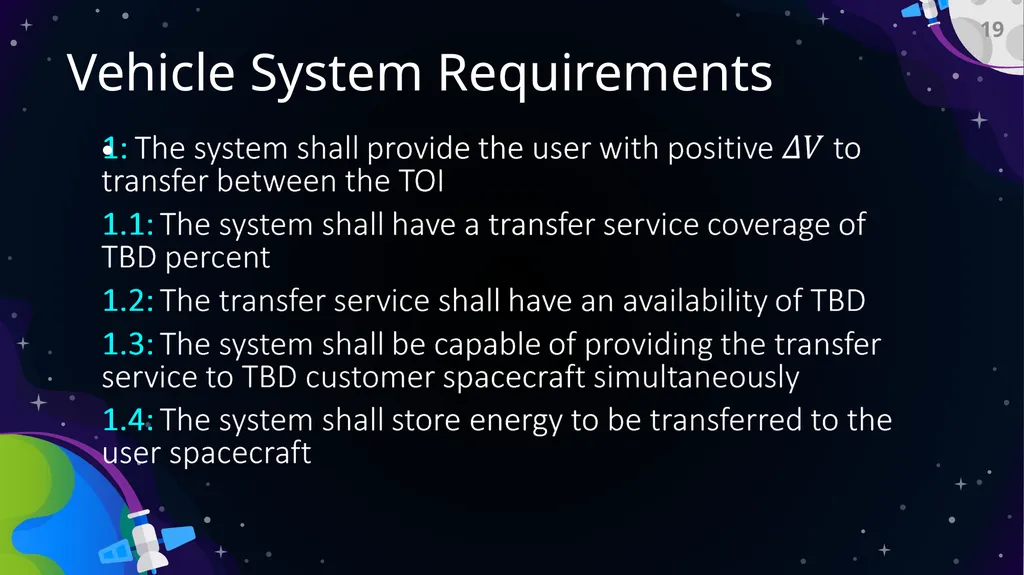
slide19. Vehicle System Requirements 19<br>
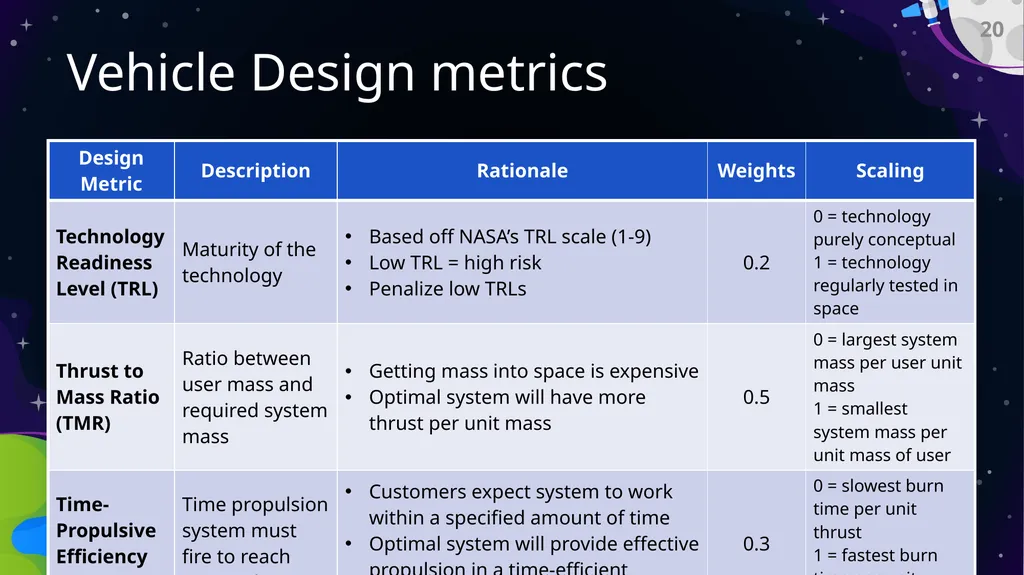
slide20. Vehicle Design metrics 20<br>
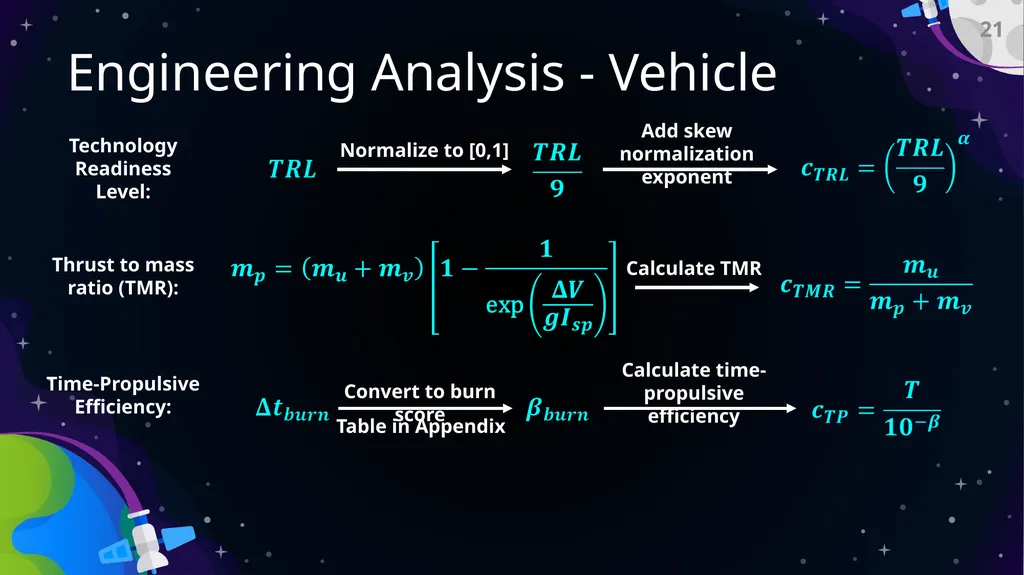
slide21. Engineering Analysis - Vehicle 21<br>
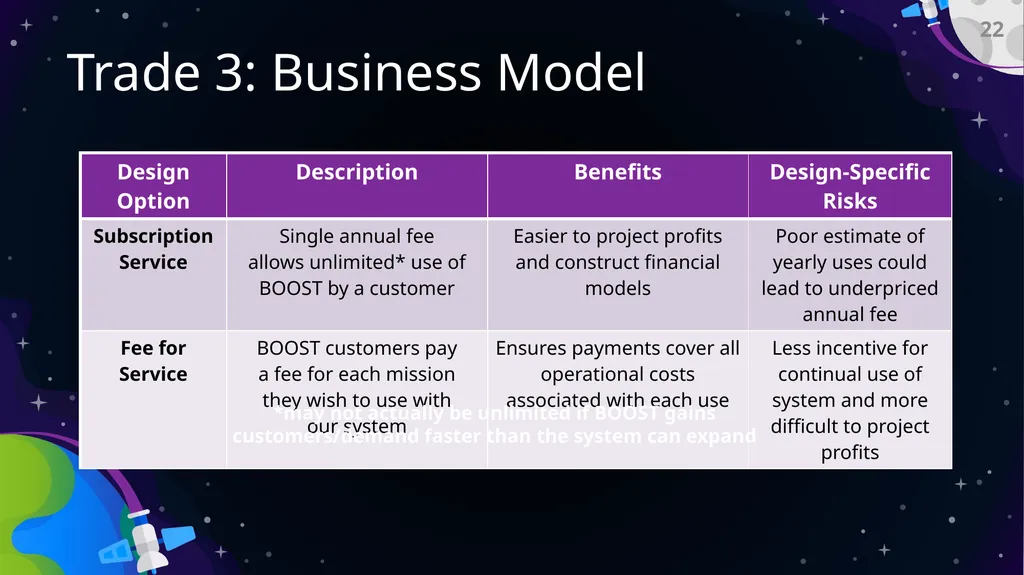
slide22. Trade 3: Business Model 22 *may not actually be unlimited if BOOST gains customers/demand faster than the system can expand<br>
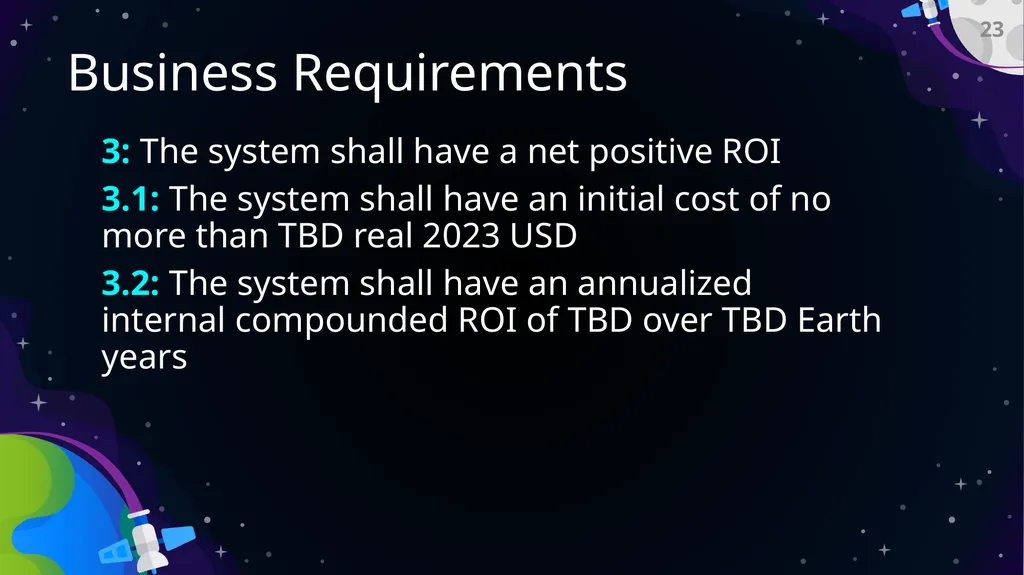
slide23. Business Requirements 3: The system shall have a net positive ROI
3.1: The system shall have an initial cost of no more than TBD real 2023 USD
3.2: The system shall have an annualized internal compounded ROI of TBD over TBD Earth years 23<br>
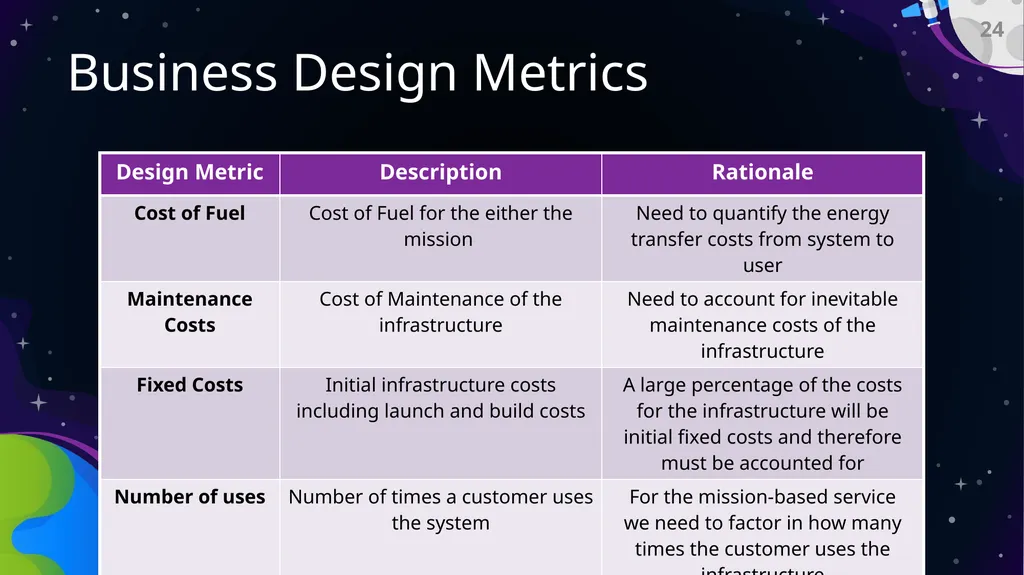
slide24. Business Design Metrics 24<br>
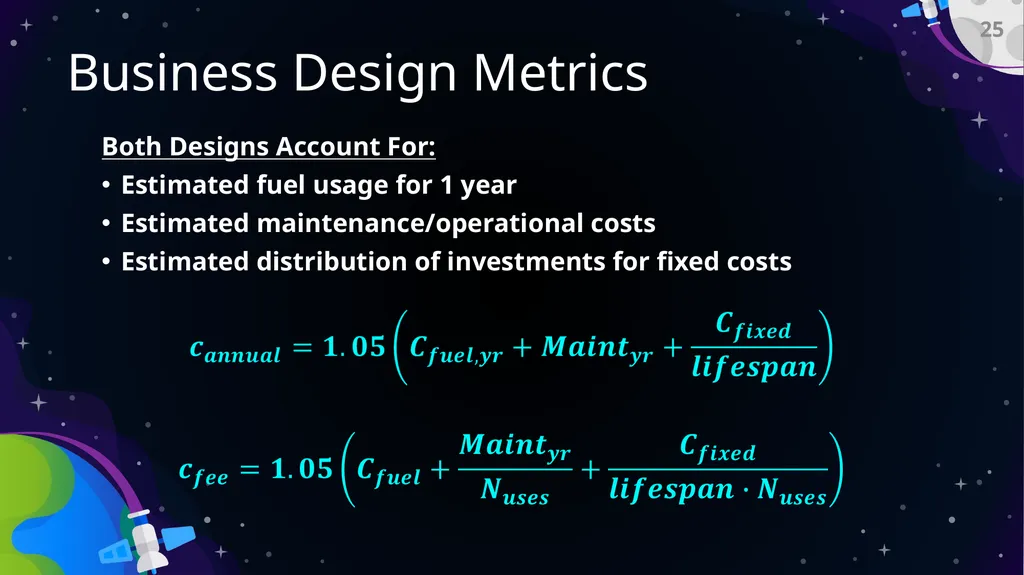
slide25. Business Design Metrics Both Designs Account For:
Estimated fuel usage for 1 year
Estimated maintenance/operational costs
Estimated distribution of investments for fixed costs 25<br>
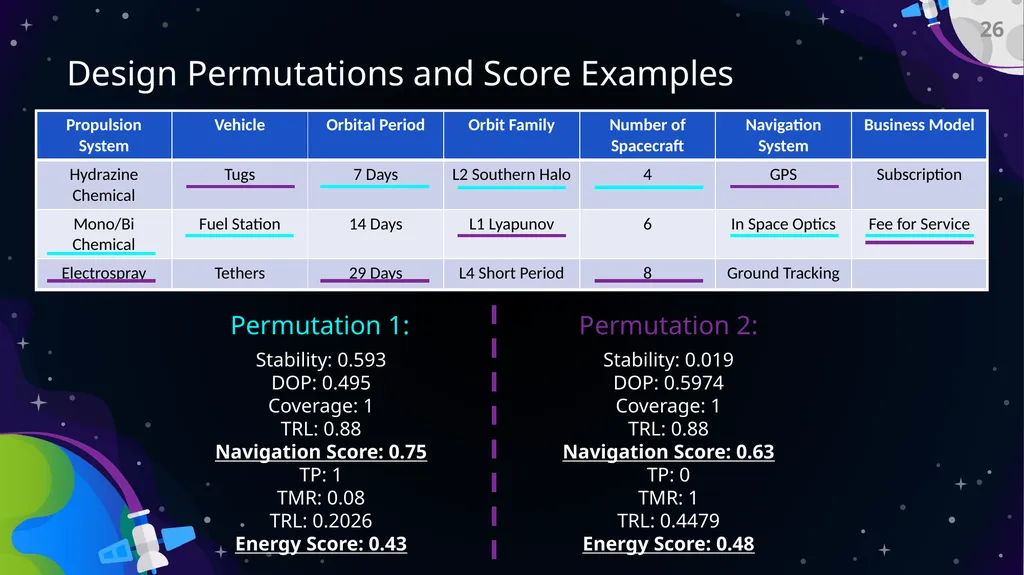
slide26. Design Permutations and Score Examples 26 Permutation 1: Permutation 2: Stability: 0.593
DOP: 0.495
Coverage: 1
TRL: 0.88
Navigation Score: 0.75
TP: 1
TMR: 0.08
TRL: 0.2026
Energy Score: 0.43 Stability: 0.019
DOP: 0.5974
Coverage: 1
TRL: 0.88
Navigation Score: 0.63
TP: 0
TMR: 1
TRL: 0.4479
Energy Score: 0.48<br>
slide27. Current Design Space 3<br>
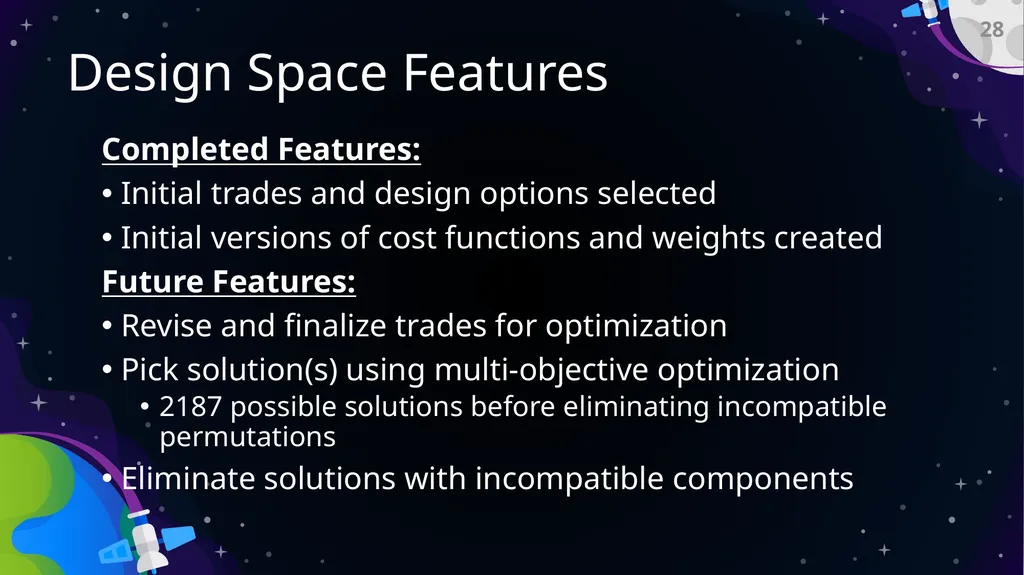
slide28. Design Space Features Completed Features:
Initial trades and design options selected
Initial versions of cost functions and weights created
Future Features:
Revise and finalize trades for optimization
Pick solution(s) using multi-objective optimization
2187 possible solutions before eliminating incompatible permutations
Eliminate solutions with incompatible components 28<br>
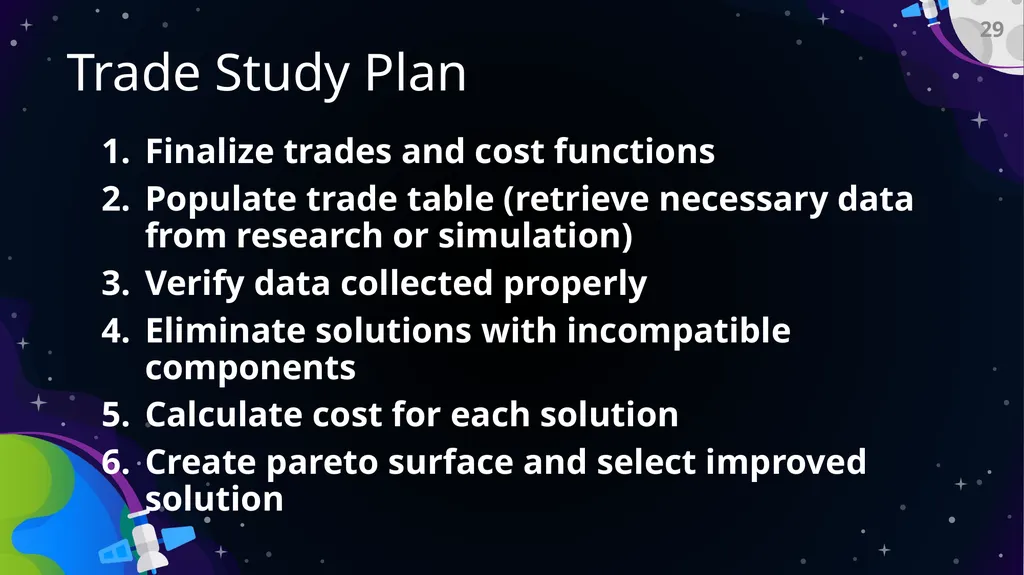
slide29. Trade Study Plan Finalize trades and cost functions
Populate trade table (retrieve necessary data from research or simulation)
Verify data collected properly
Eliminate solutions with incompatible components
Calculate cost for each solution
Create pareto surface and select improved solution 29<br>
slide30. Modeling & Prototyping plans 4<br>
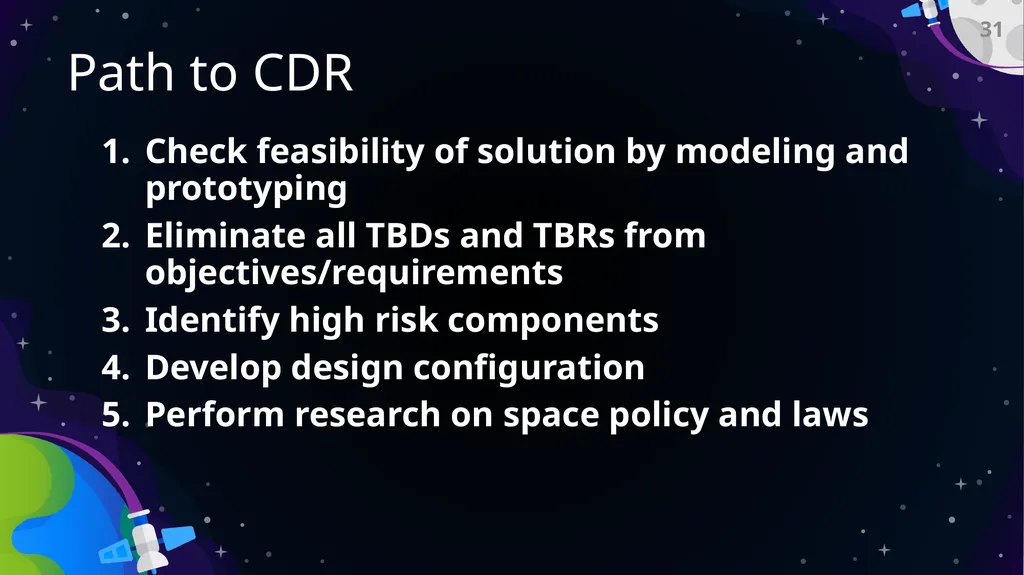
slide31. Path to CDR Check feasibility of solution by modeling and prototyping
Eliminate all TBDs and TBRs from objectives/requirements
Identify high risk components
Develop design configuration
Perform research on space policy and laws 31<br>
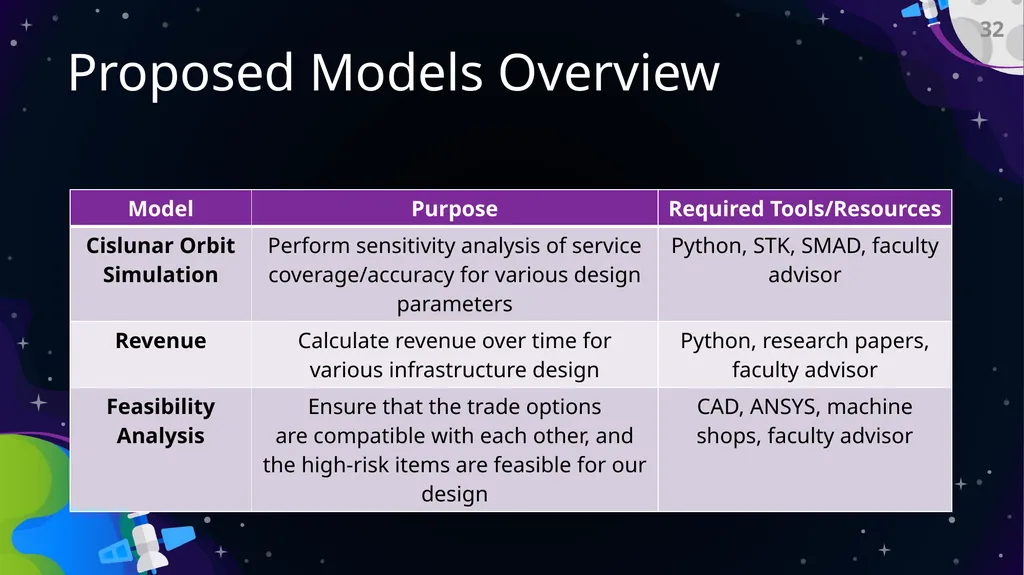
slide32. Proposed Models Overview 32<br>
slide33. References [1] Architecture development - DODAF - DOD architecture framework version 2.02 - DOD deputy chief information officer Available: https://dodcio.defense.gov/Library/DoD-Architecture-Framework/dodaf20_arch_development/.
[2] Dunbar, B., “Space tethers,” NASA Available: https://www.nasa.gov/centers/marshall/capabilities/space-tethers.html.
[3] “Exploring the design space of lunar GNSS in frozen orbit conditions” Available: https://www.researchgate.net/publication/344757079_Exploring_the_Design_Space_of_Lunar_GNSS_in_Frozen_Orbit_Conditions.
[4] “Global Navigation Satellite System (GNSS) - princeton university” Available: https://www.princeton.edu/~alaink/Orf467F07/GNSS.pdf.
[5] Hsu, J., “Kilometer-long space tether tests fuel-free propulsion,” Scientific American Available:https://www.scientificamerican.com/article/kilometer-long-space-tether-tests-fuel-free-propulsion/.
[6] “In-space propulsion gy s momentum-exchange electrodynamic ... - NASA” Available:https://www.nasa.gov/centers/marshall/pdf/115871main-MXER-TS.pdf.
[7] “Refueling Satellites in Space.” Lockheed Martin, Lockheed Martin, 13 Sept. 2021, https://www.lockheedmartin.com/en-us/news/features/2021/refueling-satellites-in-space.html.
[8] Macleod, Caitlin. “How the Explosive Growth in Satellites Could Impact Life on Earth.” The Hustle, Caitlin MacLeod, 7 Aug. 2021, https://thehustle.co/how-the-explosive-growth-in-satellites-could-impact-life-on-earth/.
[9] “Miniature Tether Electrodynamics Experiment (Mitee) proof-of-concept space mission design,” VIP Consortium Available: https://www.vip-consortium.org/teams/miniature-tether-electrodynamics-experiment-mitee-proof-concept-space-mission-design.
[10] Montenbruck, O., and Ramos-Bosch, P., “Precision real-time navigation of LEO SATELLITES USING Global Positioning System measurements - GPS solutions,” SpringerLink Available: https://link.springer.com/article/10.1007/s10291-007-0080-x.
[11] “NASA seeks wider use of GPS: Not from space, but in space - via satellite -,” Via Satellite Available: https://www.satellitetoday.com/government-military/2019/06/21/nasa-seeks-wider-use-of-gps-not-from-space-but-in-space/.
[12] “Orbit Fab: Gas Stations in SpaceTM.” Orbit Fab | Gas Stations in SpaceTM, Orbit Fab, https://www.orbitfab.com/.
[13] Vedda, James. “Cislunar Development: What to Build and Why.” Cislunar Development: What to Build and Why| Aerospace Center for Space Policy and Strategy, Aerospace Center for Space Policy and Strategy, 18 Apr. 2018,https://csps.aerospace.org/papers/cislunar-development-what-build-and-why.
[14] Yi Chen, Rui Huang, Xianlin Ren, Liping He, Ye He, "History of the Tether Concept and Tether Missions: A Review", International Scholarly Research Notices, vol. 2013, Article ID 502973, 7 pages, 2013.https://doi.org/10.1155/2013/502973
[15] Architecture Development – DODAF: https://dodcio.defense.gov/Library/DoD-Architecture-Framework/dodaf20_arch_development/#step1 33<br>
slide34. Appendices 5<br>
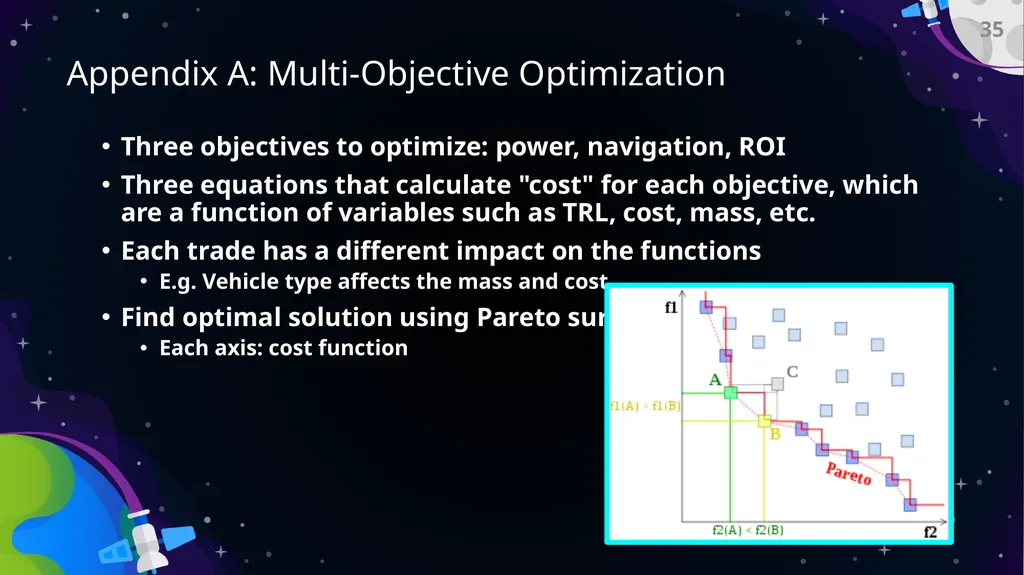
slide35. Appendix A: Multi-Objective Optimization Three objectives to optimize: power, navigation, ROI
Three equations that calculate "cost" for each objective, which are a function of variables such as TRL, cost, mass, etc.
Each trade has a different impact on the functions
E.g. Vehicle type affects the mass and cost
Find optimal solution using Pareto surface
Each axis: cost function 35<br>
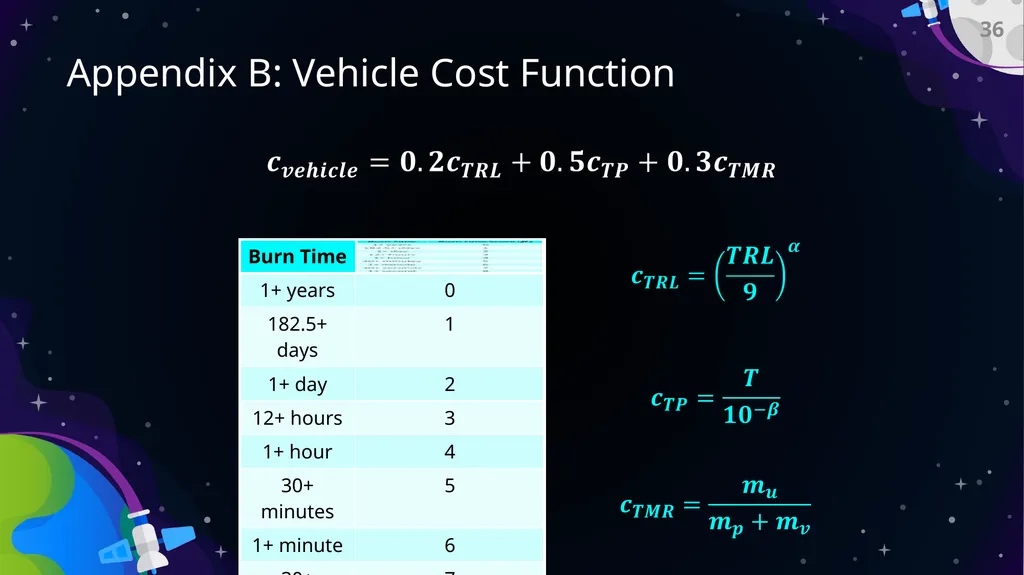
slide36. Appendix B: Vehicle Cost Function 36<br>
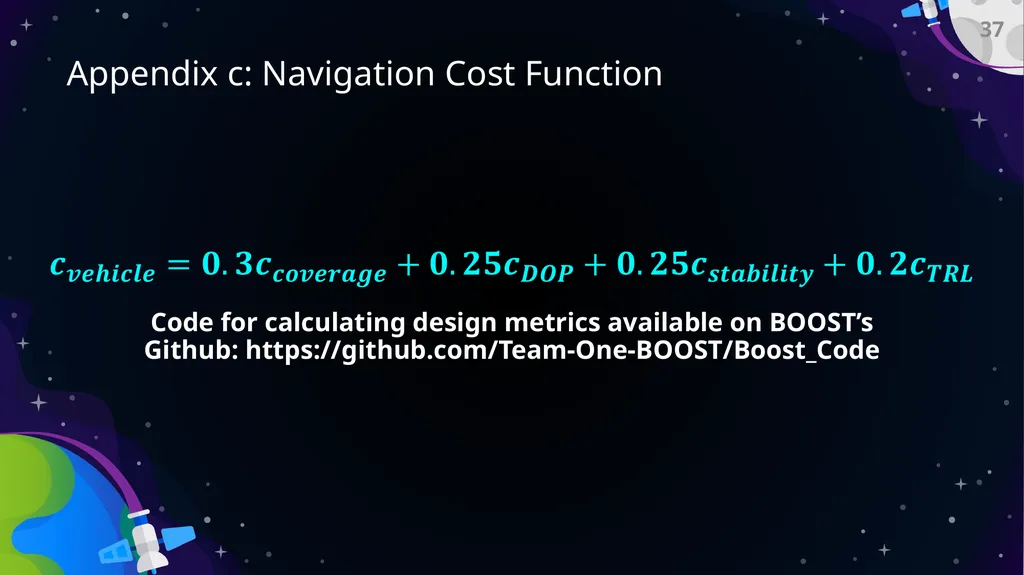
slide37. Appendix c: Navigation Cost Function Code for calculating design metrics available on BOOST’s Github: https://github.com/Team-One-BOOST/Boost_Code 37<br>
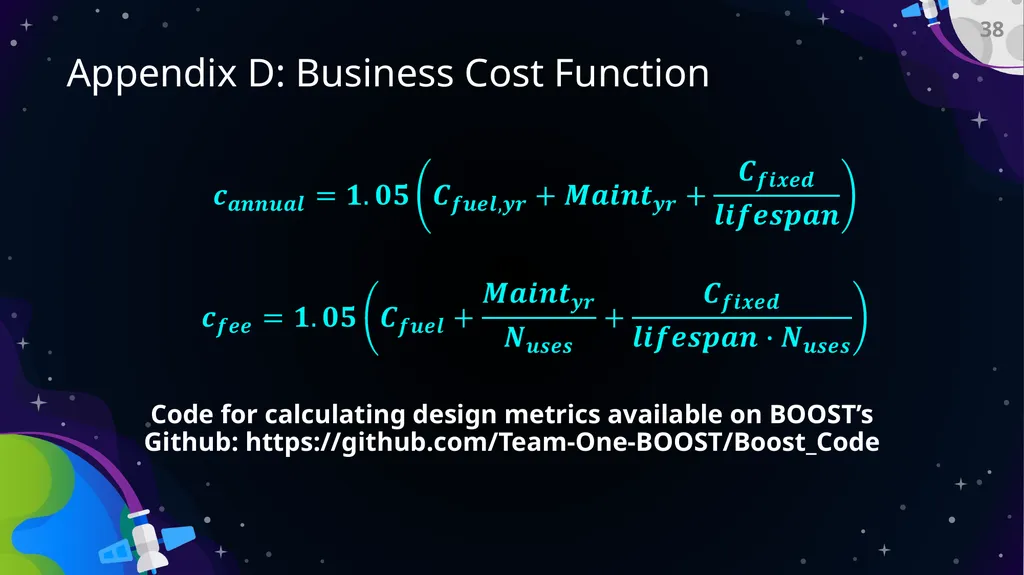
slide38. Appendix D: Business Cost Function 38 Code for calculating design metrics available on BOOST’s Github: https://github.com/Team-One-BOOST/Boost_Code<br>
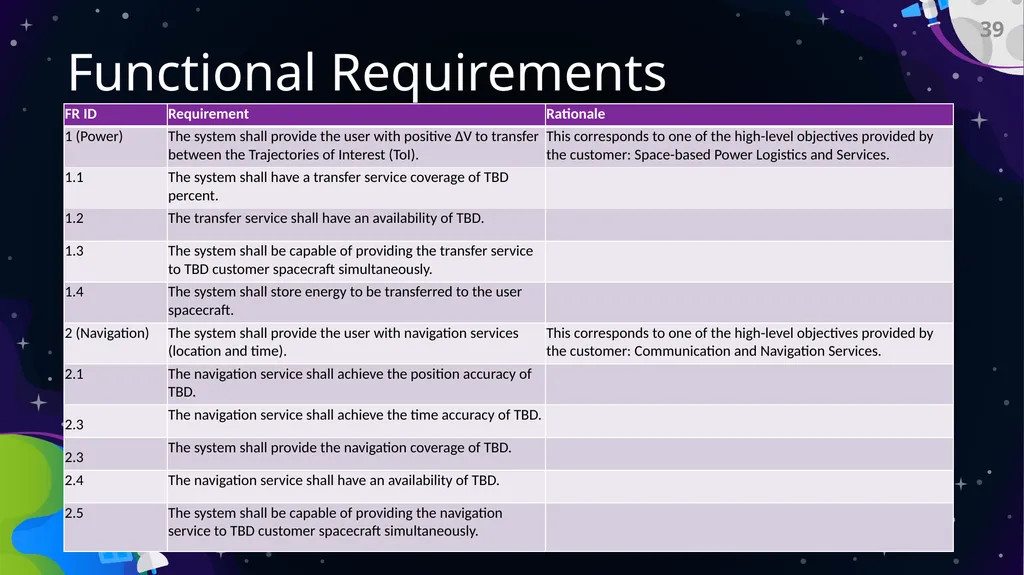
slide39. Functional Requirements 39<br>
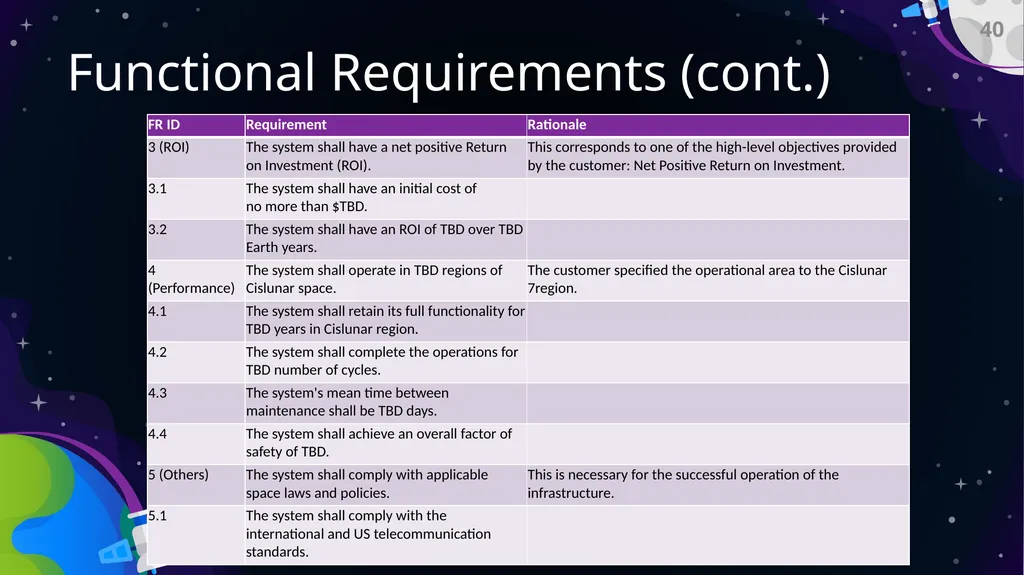
slide40. Functional Requirements (cont.) 40<br>
slide2. Overview 2 4. Modeling & Prototyping Plans 3. Current Design Space 2. Trades 1. Project Description<br>
slide3. Project Description 1<br>
slide4. Mission Introduction 4 Potential overpopulation of cislunar regime
Projected number of satellites to increase by 800%
High demand for commercial & scientific infrastructure
Value placed within trillions of dollar by 2040
Many investment opportunities within 20 years
Operation costs are currently very high
Few options in place for non-private use
What systems can be developed to provide transportation infrastructure to customers<br>
slide5. Mission Statement The Bi-Functional On Orbit Space Transfer (BOOST) Team will be developing cost-effective space-based transportation infrastructure capable of providing spacecraft with the ability to conduct orbit transfers and provide navigation services in the Cislunar regime. 5<br>
slide6. Specific Objectives 6 Performance Energy Transfer<br>
slide7. Specific Objectives Con. 7 Return on Investment (ROI) Navigation Services<br>
slide9. Functional Block Diagram 9<br>
slide10. Critical Project Elements 10<br>
slide11. Risk Matrix 11 Severity Likelihood<br>
slide12. Current Trade Space 12<br>
slide13. Trades 2<br>
slide14. Trade 1: Navigation System 14<br>
slide15. Navigation System Requirements 2.1: The navigation service shall achieve the position accuracy of TBD
2.2: The navigation service shall achieve the time accuracy of TBD
2.3: The system shall provide the navigation coverage of TBD
2.4: The navigation service shall have an availability of TBD
2.5: The system shall be capable of providing the navigation service to TBD customer spacecraft simultaneously 15<br>
slide16. Navigation Design Metrics 16<br>
slide17. Navigation Engineering Analysis 17<br>
slide18. Trade 2: Vehicle 18<br>
slide19. Vehicle System Requirements 19<br>
slide20. Vehicle Design metrics 20<br>
slide21. Engineering Analysis - Vehicle 21<br>
slide22. Trade 3: Business Model 22 *may not actually be unlimited if BOOST gains customers/demand faster than the system can expand<br>
slide23. Business Requirements 3: The system shall have a net positive ROI
3.1: The system shall have an initial cost of no more than TBD real 2023 USD
3.2: The system shall have an annualized internal compounded ROI of TBD over TBD Earth years 23<br>
slide24. Business Design Metrics 24<br>
slide25. Business Design Metrics Both Designs Account For:
Estimated fuel usage for 1 year
Estimated maintenance/operational costs
Estimated distribution of investments for fixed costs 25<br>
slide26. Design Permutations and Score Examples 26 Permutation 1: Permutation 2: Stability: 0.593
DOP: 0.495
Coverage: 1
TRL: 0.88
Navigation Score: 0.75
TP: 1
TMR: 0.08
TRL: 0.2026
Energy Score: 0.43 Stability: 0.019
DOP: 0.5974
Coverage: 1
TRL: 0.88
Navigation Score: 0.63
TP: 0
TMR: 1
TRL: 0.4479
Energy Score: 0.48<br>
slide27. Current Design Space 3<br>
slide28. Design Space Features Completed Features:
Initial trades and design options selected
Initial versions of cost functions and weights created
Future Features:
Revise and finalize trades for optimization
Pick solution(s) using multi-objective optimization
2187 possible solutions before eliminating incompatible permutations
Eliminate solutions with incompatible components 28<br>
slide29. Trade Study Plan Finalize trades and cost functions
Populate trade table (retrieve necessary data from research or simulation)
Verify data collected properly
Eliminate solutions with incompatible components
Calculate cost for each solution
Create pareto surface and select improved solution 29<br>
slide30. Modeling & Prototyping plans 4<br>
slide31. Path to CDR Check feasibility of solution by modeling and prototyping
Eliminate all TBDs and TBRs from objectives/requirements
Identify high risk components
Develop design configuration
Perform research on space policy and laws 31<br>
slide32. Proposed Models Overview 32<br>
slide33. References [1] Architecture development - DODAF - DOD architecture framework version 2.02 - DOD deputy chief information officer Available: https://dodcio.defense.gov/Library/DoD-Architecture-Framework/dodaf20_arch_development/.
[2] Dunbar, B., “Space tethers,” NASA Available: https://www.nasa.gov/centers/marshall/capabilities/space-tethers.html.
[3] “Exploring the design space of lunar GNSS in frozen orbit conditions” Available: https://www.researchgate.net/publication/344757079_Exploring_the_Design_Space_of_Lunar_GNSS_in_Frozen_Orbit_Conditions.
[4] “Global Navigation Satellite System (GNSS) - princeton university” Available: https://www.princeton.edu/~alaink/Orf467F07/GNSS.pdf.
[5] Hsu, J., “Kilometer-long space tether tests fuel-free propulsion,” Scientific American Available:https://www.scientificamerican.com/article/kilometer-long-space-tether-tests-fuel-free-propulsion/.
[6] “In-space propulsion gy s momentum-exchange electrodynamic ... - NASA” Available:https://www.nasa.gov/centers/marshall/pdf/115871main-MXER-TS.pdf.
[7] “Refueling Satellites in Space.” Lockheed Martin, Lockheed Martin, 13 Sept. 2021, https://www.lockheedmartin.com/en-us/news/features/2021/refueling-satellites-in-space.html.
[8] Macleod, Caitlin. “How the Explosive Growth in Satellites Could Impact Life on Earth.” The Hustle, Caitlin MacLeod, 7 Aug. 2021, https://thehustle.co/how-the-explosive-growth-in-satellites-could-impact-life-on-earth/.
[9] “Miniature Tether Electrodynamics Experiment (Mitee) proof-of-concept space mission design,” VIP Consortium Available: https://www.vip-consortium.org/teams/miniature-tether-electrodynamics-experiment-mitee-proof-concept-space-mission-design.
[10] Montenbruck, O., and Ramos-Bosch, P., “Precision real-time navigation of LEO SATELLITES USING Global Positioning System measurements - GPS solutions,” SpringerLink Available: https://link.springer.com/article/10.1007/s10291-007-0080-x.
[11] “NASA seeks wider use of GPS: Not from space, but in space - via satellite -,” Via Satellite Available: https://www.satellitetoday.com/government-military/2019/06/21/nasa-seeks-wider-use-of-gps-not-from-space-but-in-space/.
[12] “Orbit Fab: Gas Stations in SpaceTM.” Orbit Fab | Gas Stations in SpaceTM, Orbit Fab, https://www.orbitfab.com/.
[13] Vedda, James. “Cislunar Development: What to Build and Why.” Cislunar Development: What to Build and Why| Aerospace Center for Space Policy and Strategy, Aerospace Center for Space Policy and Strategy, 18 Apr. 2018,https://csps.aerospace.org/papers/cislunar-development-what-build-and-why.
[14] Yi Chen, Rui Huang, Xianlin Ren, Liping He, Ye He, "History of the Tether Concept and Tether Missions: A Review", International Scholarly Research Notices, vol. 2013, Article ID 502973, 7 pages, 2013.https://doi.org/10.1155/2013/502973
[15] Architecture Development – DODAF: https://dodcio.defense.gov/Library/DoD-Architecture-Framework/dodaf20_arch_development/#step1 33<br>
slide34. Appendices 5<br>
slide35. Appendix A: Multi-Objective Optimization Three objectives to optimize: power, navigation, ROI
Three equations that calculate "cost" for each objective, which are a function of variables such as TRL, cost, mass, etc.
Each trade has a different impact on the functions
E.g. Vehicle type affects the mass and cost
Find optimal solution using Pareto surface
Each axis: cost function 35<br>
slide36. Appendix B: Vehicle Cost Function 36<br>
slide37. Appendix c: Navigation Cost Function Code for calculating design metrics available on BOOST’s Github: https://github.com/Team-One-BOOST/Boost_Code 37<br>
slide38. Appendix D: Business Cost Function 38 Code for calculating design metrics available on BOOST’s Github: https://github.com/Team-One-BOOST/Boost_Code<br>
slide39. Functional Requirements 39<br>
slide40. Functional Requirements (cont.) 40<br>