
Prepared by- Dr. Dinesh Kumar Assistant Professor
T
Published · 22 slides · 0 views
1 / 1

Description
Prepared by- Dr. Dinesh Kumar Assistant Professor Department of Liberal Arts and Humanities Topic: Dharmshastra tradition in India Dharmashastra Thomas Pantham says that the crux of Indian Political Thought revolves around Dharma. Dharma
Related Topics
Share
Embed code
Download this presentation From Below
"Prepared by- Dr. Dinesh Kumar Assistant Professor" is the property of its rightful owner. Permission is granted to download and print the materials on this website for personal, non-commercial use only, and to display it on your personal computer provided you do not modify the materials and that you retain all copyright notices contained in the materials. By downloading content from our website, you accept the terms of this agreement.
Presentation Transcript
01
Prepared by-
Dr. Dinesh Kumar
Assistant Professor
Department of Liberal Arts and Humanities
Topic: Dharmshastra tradition in India<br>
Dr. Dinesh Kumar
Assistant Professor
Department of Liberal Arts and Humanities
Topic: Dharmshastra tradition in India<br>
02
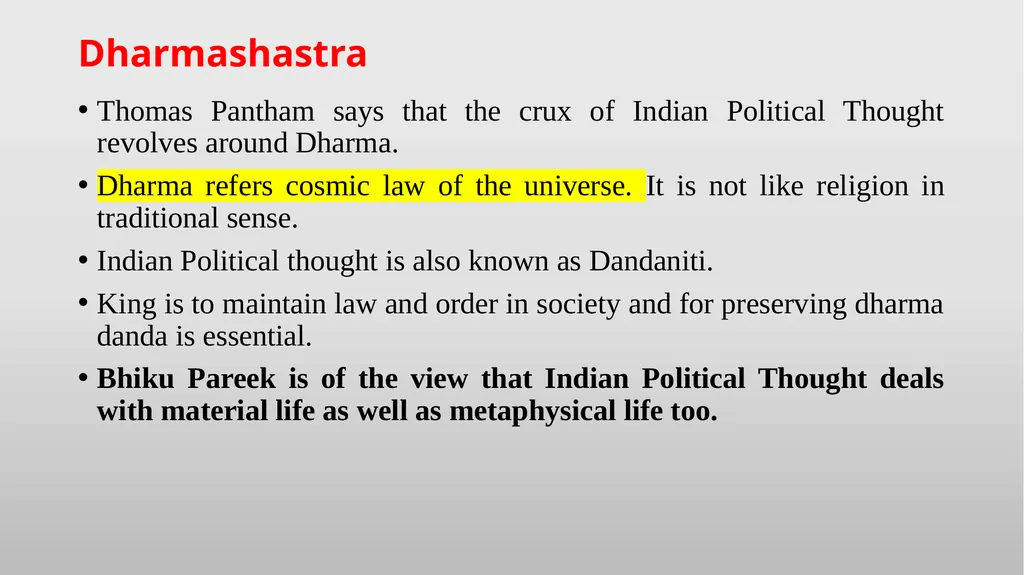
Dharmashastra Thomas Pantham says that the crux of Indian Political Thought revolves around Dharma.
Dharma refers cosmic law of the universe. It is not like religion in traditional sense.
Indian Political thought is also known as Dandaniti.
King is to maintain law and order in society and for preserving dharma danda is essential.
Bhiku Pareek is of the view that Indian Political Thought deals with material life as well as metaphysical life too.<br>
Dharma refers cosmic law of the universe. It is not like religion in traditional sense.
Indian Political thought is also known as Dandaniti.
King is to maintain law and order in society and for preserving dharma danda is essential.
Bhiku Pareek is of the view that Indian Political Thought deals with material life as well as metaphysical life too.<br>
03
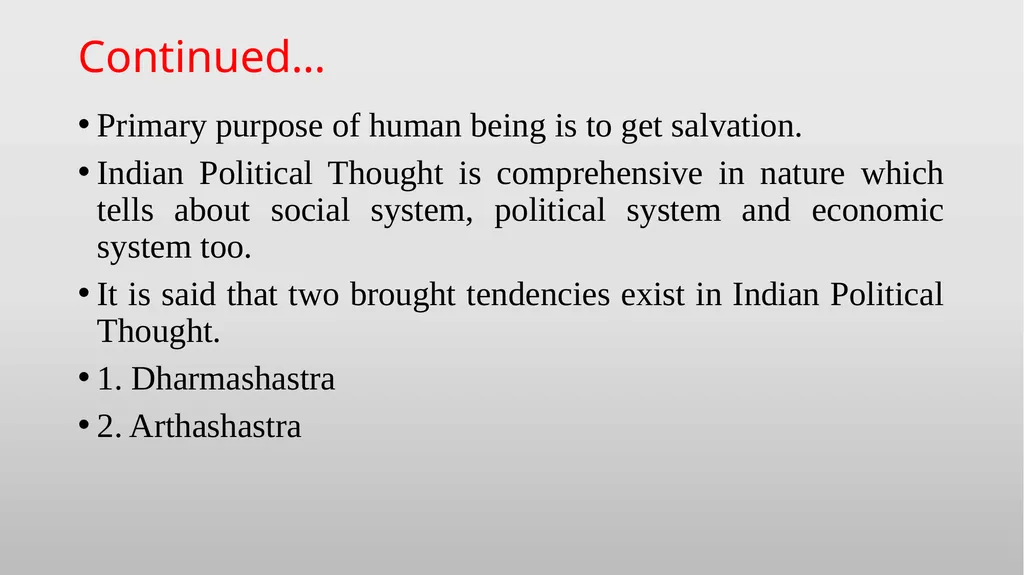
Continued… Primary purpose of human being is to get salvation.
Indian Political Thought is comprehensive in nature which tells about social system, political system and economic system too.
It is said that two brought tendencies exist in Indian Political Thought.
1. Dharmashastra
2. Arthashastra<br>
Indian Political Thought is comprehensive in nature which tells about social system, political system and economic system too.
It is said that two brought tendencies exist in Indian Political Thought.
1. Dharmashastra
2. Arthashastra<br>
04
Dharmashastra
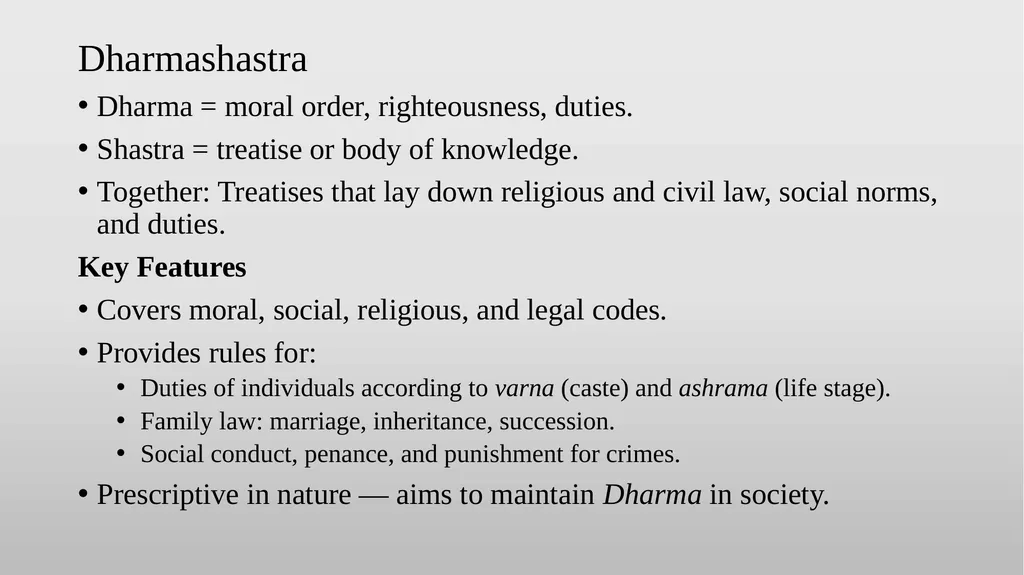
Dharma = moral order, righteousness, duties.
Shastra = treatise or body of knowledge.
Together: Treatises that lay down religious and civil law, social norms, and duties.
Key Features
Covers moral, social, religious, and legal codes.
Provides rules for:
Duties of individuals according to varna (caste) and ashrama (life stage).
Family law: marriage, inheritance, succession.
Social conduct, penance, and punishment for crimes.
Prescriptive in nature — aims to maintain Dharma in society.<br>
Dharma = moral order, righteousness, duties.
Shastra = treatise or body of knowledge.
Together: Treatises that lay down religious and civil law, social norms, and duties.
Key Features
Covers moral, social, religious, and legal codes.
Provides rules for:
Duties of individuals according to varna (caste) and ashrama (life stage).
Family law: marriage, inheritance, succession.
Social conduct, penance, and punishment for crimes.
Prescriptive in nature — aims to maintain Dharma in society.<br>
05
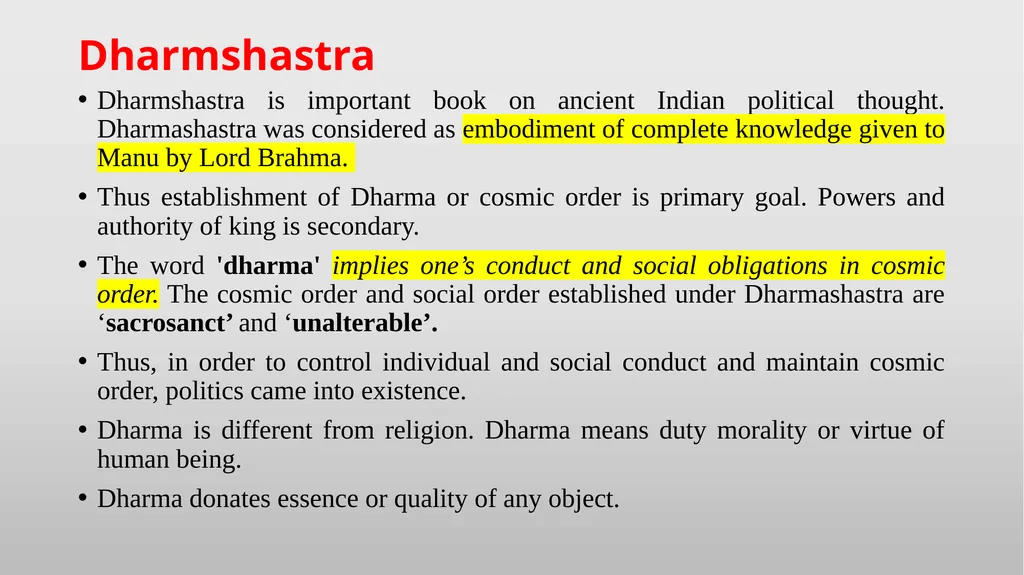
Dharmshastra Dharmshastra is important book on ancient Indian political thought. Dharmashastra was considered as embodiment of complete knowledge given to Manu by Lord Brahma.
Thus establishment of Dharma or cosmic order is primary goal. Powers and authority of king is secondary.
The word 'dharma' implies one’s conduct and social obligations in cosmic order. The cosmic order and social order established under Dharmashastra are ‘sacrosanct’ and ‘unalterable’.
Thus, in order to control individual and social conduct and maintain cosmic order, politics came into existence.
Dharma is different from religion. Dharma means duty morality or virtue of human being.
Dharma donates essence or quality of any object.<br>
Thus establishment of Dharma or cosmic order is primary goal. Powers and authority of king is secondary.
The word 'dharma' implies one’s conduct and social obligations in cosmic order. The cosmic order and social order established under Dharmashastra are ‘sacrosanct’ and ‘unalterable’.
Thus, in order to control individual and social conduct and maintain cosmic order, politics came into existence.
Dharma is different from religion. Dharma means duty morality or virtue of human being.
Dharma donates essence or quality of any object.<br>
06
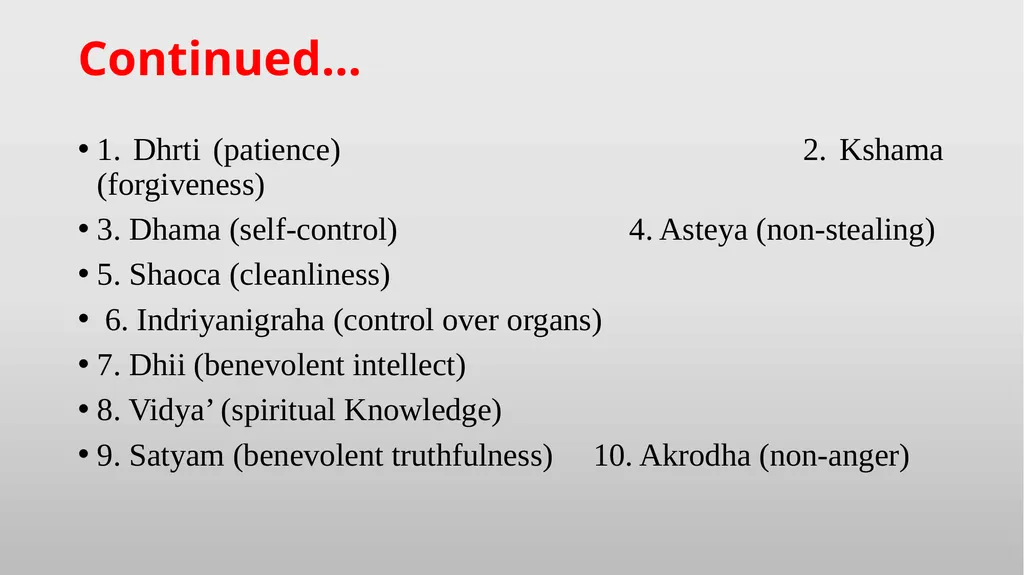
Continued… 1. Dhrti (patience) 2. Kshama (forgiveness)
3. Dhama (self-control) 4. Asteya (non-stealing)
5. Shaoca (cleanliness)
6. Indriyanigraha (control over organs)
7. Dhii (benevolent intellect)
8. Vidya’ (spiritual Knowledge)
9. Satyam (benevolent truthfulness) 10. Akrodha (non-anger)<br>
3. Dhama (self-control) 4. Asteya (non-stealing)
5. Shaoca (cleanliness)
6. Indriyanigraha (control over organs)
7. Dhii (benevolent intellect)
8. Vidya’ (spiritual Knowledge)
9. Satyam (benevolent truthfulness) 10. Akrodha (non-anger)<br>
07
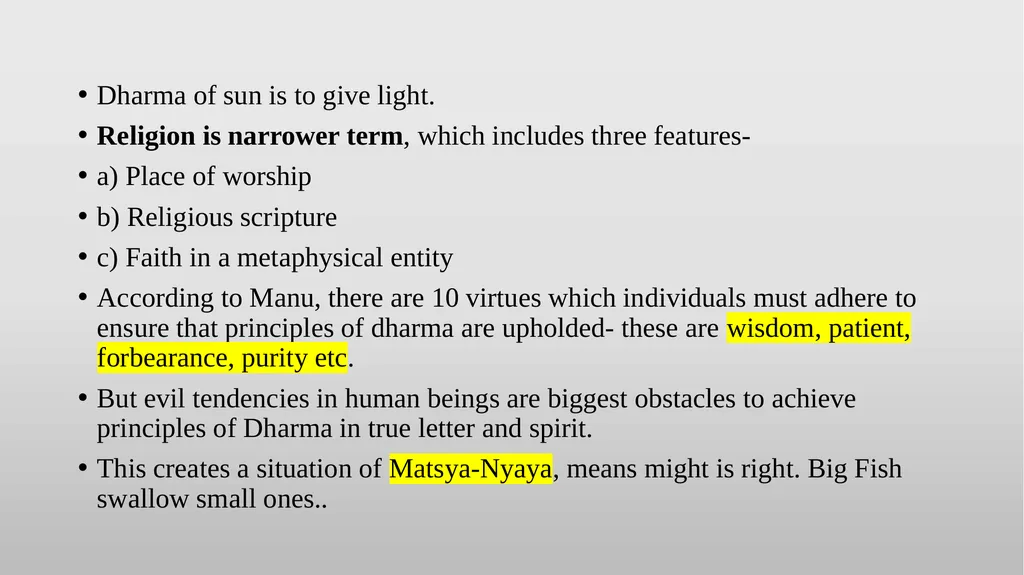
Dharma of sun is to give light.
Religion is narrower term, which includes three features-
a) Place of worship
b) Religious scripture
c) Faith in a metaphysical entity
According to Manu, there are 10 virtues which individuals must adhere to ensure that principles of dharma are upholded- these are wisdom, patient, forbearance, purity etc.
But evil tendencies in human beings are biggest obstacles to achieve principles of Dharma in true letter and spirit.
This creates a situation of Matsya-Nyaya, means might is right. Big Fish swallow small ones..<br>
Religion is narrower term, which includes three features-
a) Place of worship
b) Religious scripture
c) Faith in a metaphysical entity
According to Manu, there are 10 virtues which individuals must adhere to ensure that principles of dharma are upholded- these are wisdom, patient, forbearance, purity etc.
But evil tendencies in human beings are biggest obstacles to achieve principles of Dharma in true letter and spirit.
This creates a situation of Matsya-Nyaya, means might is right. Big Fish swallow small ones..<br>
08
Thus in order to control this tendency in human being, dand nitiis needed Dandaniti means punishment or use of force to control evil tendencies in human beings.
Persuade them to follow the dictates of ‘Dharma’.
Dandaniti is synonymous with politics in ancient political thought.
Modern political thought which seeks to provides materialistic and worldly pleasure.
The ancient political thought seeks of provide both worldly as well as spiritual pleasure.
Another important thing about ancient political thought is that, it lays down principles of Rajdharma which is set of rules concerning duties of ruler.
According to Rajdharma the king was expected to govern the state as per dictates of Vedas and Shastra.<br>
Persuade them to follow the dictates of ‘Dharma’.
Dandaniti is synonymous with politics in ancient political thought.
Modern political thought which seeks to provides materialistic and worldly pleasure.
The ancient political thought seeks of provide both worldly as well as spiritual pleasure.
Another important thing about ancient political thought is that, it lays down principles of Rajdharma which is set of rules concerning duties of ruler.
According to Rajdharma the king was expected to govern the state as per dictates of Vedas and Shastra.<br>
09
Divine Origin of State Manu believes in divine origin of state. Manu said that, human being possess mixture of both good and evil tendencies. When individuals are swayed by evil tendencies, they violates principles of Dharma. Dandaniti has emerged to control these evil tendencies.
According to Manu, King is symbol of Danda created by God in order to save the world from anarchy.
The king is said to have possess to unique qualities of all the major God- Indra, Vayu, Yama, Kuber, Agni, Varuna and Chandra.
Thus, king is considered as embodiment of God on earth. Any disobedience or betrayal to king’s order will be considered as betrayal of God.
If king refuses to obey dictates of Dharma. Then he shall be doomed along with his family and will be denied of Moksha.<br>
According to Manu, King is symbol of Danda created by God in order to save the world from anarchy.
The king is said to have possess to unique qualities of all the major God- Indra, Vayu, Yama, Kuber, Agni, Varuna and Chandra.
Thus, king is considered as embodiment of God on earth. Any disobedience or betrayal to king’s order will be considered as betrayal of God.
If king refuses to obey dictates of Dharma. Then he shall be doomed along with his family and will be denied of Moksha.<br>
10
Continued.. In order to ensure social harmony and promote people’s welfare, the state should be governed by selfless and enlightened Yogi King.
Who would uphold principles of Dharma.
The king is neither allowed to create new rule nor existing principles of Dharma.
He is only expected to uphold it and preserve it.
According to Manu, everyone doesn't possess the qualities of king.
Thus, here he has openly supported monarchical form kingship instead of democratic ruler.
Manu’s view of kingship departs from western view of kingship where monarchy is considered as ‘Agent of God’ and believes in principles of ‘king can do no wrong’.<br>
Who would uphold principles of Dharma.
The king is neither allowed to create new rule nor existing principles of Dharma.
He is only expected to uphold it and preserve it.
According to Manu, everyone doesn't possess the qualities of king.
Thus, here he has openly supported monarchical form kingship instead of democratic ruler.
Manu’s view of kingship departs from western view of kingship where monarchy is considered as ‘Agent of God’ and believes in principles of ‘king can do no wrong’.<br>
11
Nature of State Nature of state is organic.
State is compared with a human organ.
State is comprises of seven parts likewise seven organs of the human body.
For better human body all organs should be stronger.
Similarly powerful component of the organs of state makes strong state.
State is a natural like human body.<br>
State is compared with a human organ.
State is comprises of seven parts likewise seven organs of the human body.
For better human body all organs should be stronger.
Similarly powerful component of the organs of state makes strong state.
State is a natural like human body.<br>
12
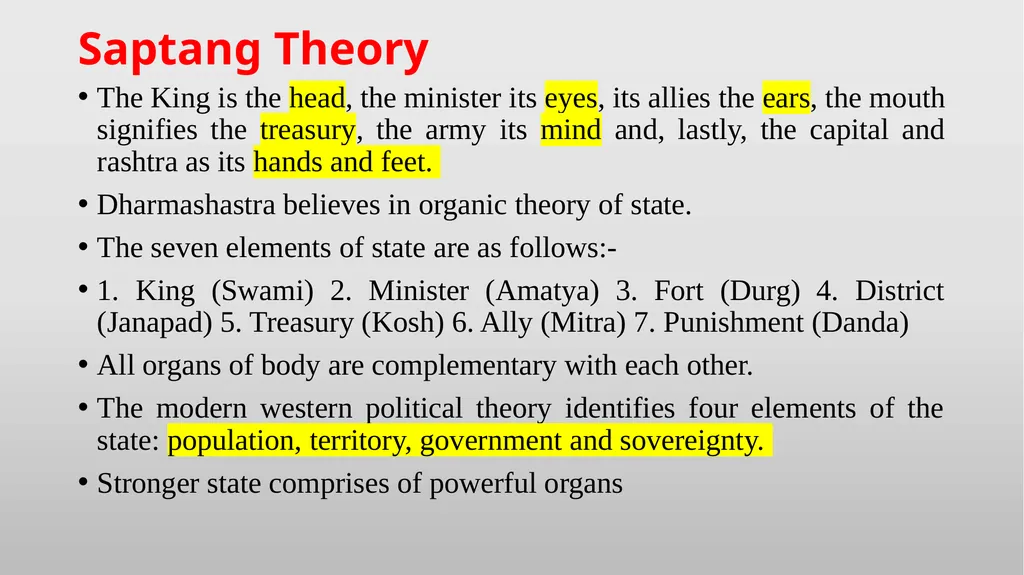
Saptang Theory The King is the head, the minister its eyes, its allies the ears, the mouth signifies the treasury, the army its mind and, lastly, the capital and rashtra as its hands and feet.
Dharmashastra believes in organic theory of state.
The seven elements of state are as follows:-
1. King (Swami) 2. Minister (Amatya) 3. Fort (Durg) 4. District (Janapad) 5. Treasury (Kosh) 6. Ally (Mitra) 7. Punishment (Danda)
All organs of body are complementary with each other.
The modern western political theory identifies four elements of the state: population, territory, government and sovereignty.
Stronger state comprises of powerful organs<br>
Dharmashastra believes in organic theory of state.
The seven elements of state are as follows:-
1. King (Swami) 2. Minister (Amatya) 3. Fort (Durg) 4. District (Janapad) 5. Treasury (Kosh) 6. Ally (Mitra) 7. Punishment (Danda)
All organs of body are complementary with each other.
The modern western political theory identifies four elements of the state: population, territory, government and sovereignty.
Stronger state comprises of powerful organs<br>
13
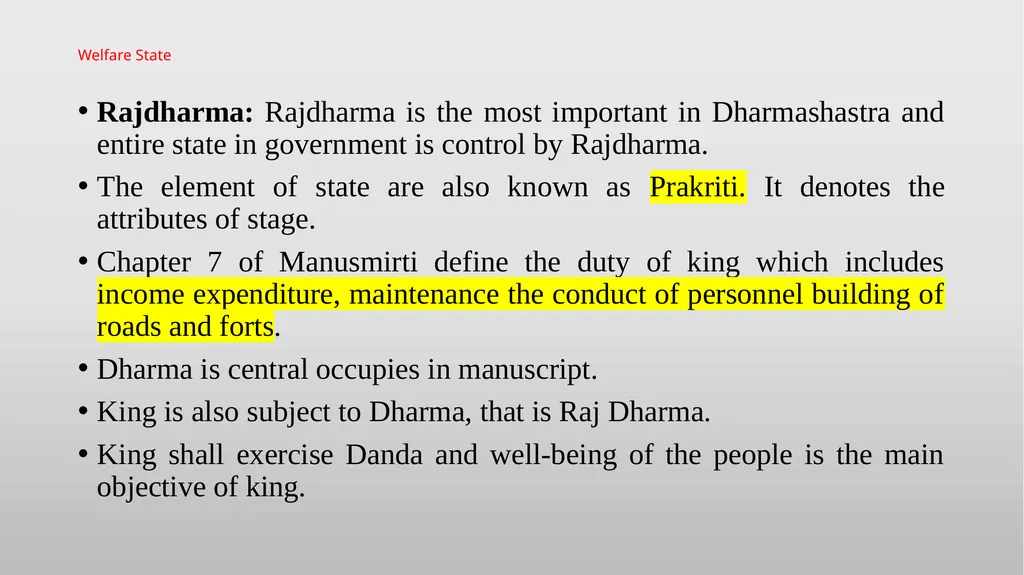
Welfare State Rajdharma: Rajdharma is the most important in Dharmashastra and entire state in government is control by Rajdharma.
The element of state are also known as Prakriti. It denotes the attributes of stage.
Chapter 7 of Manusmirti define the duty of king which includes income expenditure, maintenance the conduct of personnel building of roads and forts.
Dharma is central occupies in manuscript.
King is also subject to Dharma, that is Raj Dharma.
King shall exercise Danda and well-being of the people is the main objective of king.<br>
The element of state are also known as Prakriti. It denotes the attributes of stage.
Chapter 7 of Manusmirti define the duty of king which includes income expenditure, maintenance the conduct of personnel building of roads and forts.
Dharma is central occupies in manuscript.
King is also subject to Dharma, that is Raj Dharma.
King shall exercise Danda and well-being of the people is the main objective of king.<br>
14
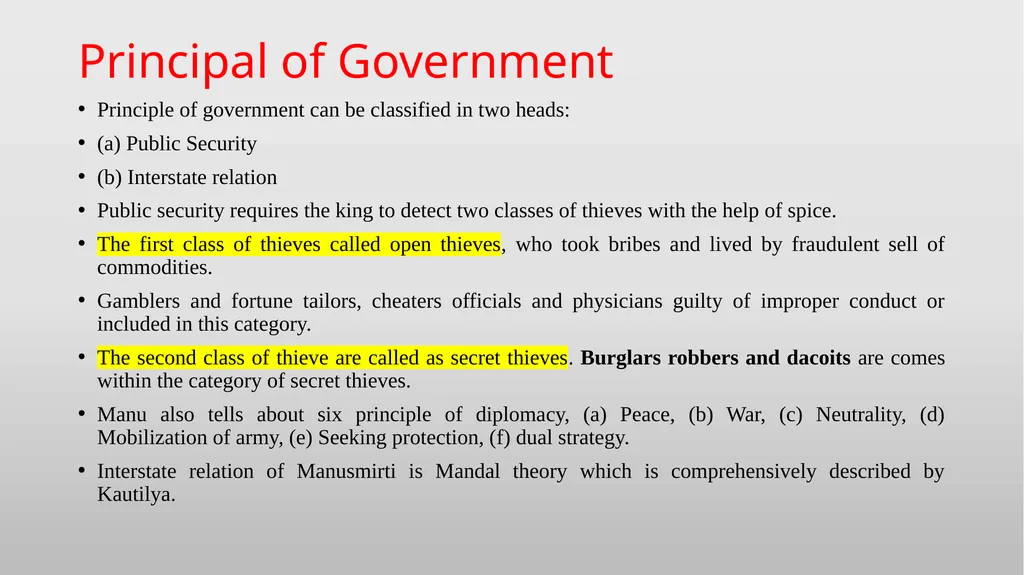
Principal of Government Principle of government can be classified in two heads:
(a) Public Security
(b) Interstate relation
Public security requires the king to detect two classes of thieves with the help of spice.
The first class of thieves called open thieves, who took bribes and lived by fraudulent sell of commodities.
Gamblers and fortune tailors, cheaters officials and physicians guilty of improper conduct or included in this category.
The second class of thieve are called as secret thieves. Burglars robbers and dacoits are comes within the category of secret thieves.
Manu also tells about six principle of diplomacy, (a) Peace, (b) War, (c) Neutrality, (d) Mobilization of army, (e) Seeking protection, (f) dual strategy.
Interstate relation of Manusmirti is Mandal theory which is comprehensively described by Kautilya.<br>
(a) Public Security
(b) Interstate relation
Public security requires the king to detect two classes of thieves with the help of spice.
The first class of thieves called open thieves, who took bribes and lived by fraudulent sell of commodities.
Gamblers and fortune tailors, cheaters officials and physicians guilty of improper conduct or included in this category.
The second class of thieve are called as secret thieves. Burglars robbers and dacoits are comes within the category of secret thieves.
Manu also tells about six principle of diplomacy, (a) Peace, (b) War, (c) Neutrality, (d) Mobilization of army, (e) Seeking protection, (f) dual strategy.
Interstate relation of Manusmirti is Mandal theory which is comprehensively described by Kautilya.<br>
15
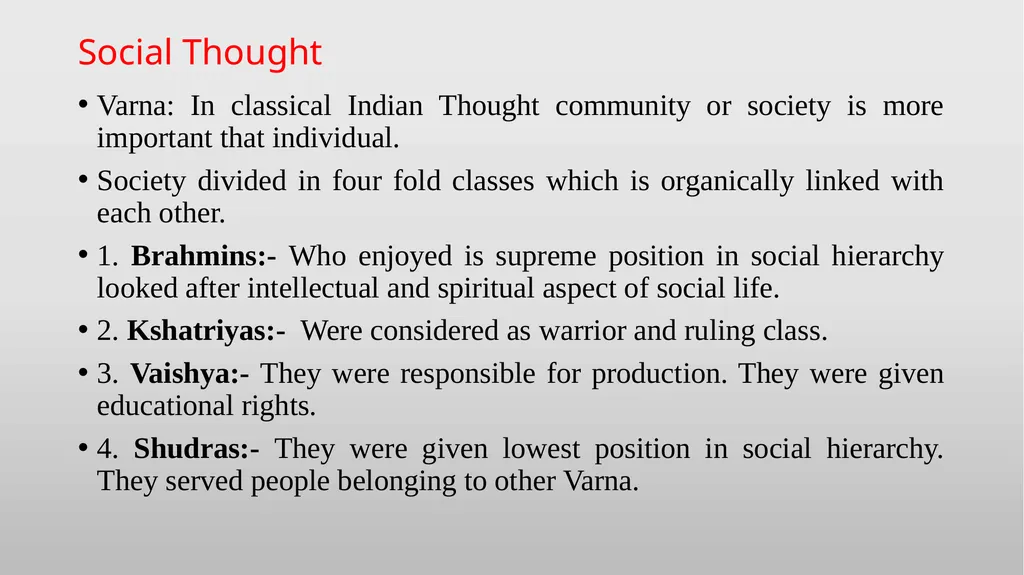
Social Thought Varna: In classical Indian Thought community or society is more important that individual.
Society divided in four fold classes which is organically linked with each other.
1. Brahmins:- Who enjoyed is supreme position in social hierarchy looked after intellectual and spiritual aspect of social life.
2. Kshatriyas:- Were considered as warrior and ruling class.
3. Vaishya:- They were responsible for production. They were given educational rights.
4. Shudras:- They were given lowest position in social hierarchy. They served people belonging to other Varna.<br>
Society divided in four fold classes which is organically linked with each other.
1. Brahmins:- Who enjoyed is supreme position in social hierarchy looked after intellectual and spiritual aspect of social life.
2. Kshatriyas:- Were considered as warrior and ruling class.
3. Vaishya:- They were responsible for production. They were given educational rights.
4. Shudras:- They were given lowest position in social hierarchy. They served people belonging to other Varna.<br>
16
K.P. Jayaswal holds the view that the theory of the divinity of the king was advanced by Manusmriti to support the Brahmin empire of Pusyamitra, and to counteract the Buddhist theory of the origin of the state by contract.
V.R. Mehta is of the view that Vaishaya Varna is least preferred for manuscript because Vaishaya always seeks their own profit rather than working for well-being of others.
V.R. Mehta also said that the two contradictory features available in manuscript.
On the one hand it appears that Varna is based on birth, but on the other hand it shows Varna is based on the Karma (Deeds).<br>
V.R. Mehta is of the view that Vaishaya Varna is least preferred for manuscript because Vaishaya always seeks their own profit rather than working for well-being of others.
V.R. Mehta also said that the two contradictory features available in manuscript.
On the one hand it appears that Varna is based on birth, but on the other hand it shows Varna is based on the Karma (Deeds).<br>
17
Continued.. According to Dharmashastra person performing Sradha without knowing the religious scripture will go in hell. Which prove that Varna is based on deeds.
Gender Justice: In Dharmashastra on the one hand it is written that God lived there wherever women are worshiped.
Although the public role of women is not permitted and society appears patriarchal.
Manu also says that women should be kept under the regulation of men.
In childhood is women should be under regulation of father. In adult a lady should be under control of husband and while in old age women should be kept under control of son.<br>
Gender Justice: In Dharmashastra on the one hand it is written that God lived there wherever women are worshiped.
Although the public role of women is not permitted and society appears patriarchal.
Manu also says that women should be kept under the regulation of men.
In childhood is women should be under regulation of father. In adult a lady should be under control of husband and while in old age women should be kept under control of son.<br>
18
Ashrams:- Brahmacharya:- This is a stage of acquiring education, training, and character building. First 25 years is devoted to education.
Grihastha:- It is next 25 years of life in which person fulfils his social and family obligations like marriages, raising children, etc. It runs from 25-50 years.
Vanapratha:- At this stage person detaches himself from worldly life. Vanapratha continues from 50 to 75 years.
Sanyasa:- This stage is considered as stage of renunciation and spiritual emancipation.
Sanyas means loving towards humanity them ones own family. Comprehensively Sanyasa stands for lifting attachment towards material world.
Broadly Sanyas refer to the attachment towards humanity.
Sanyas donates control over own passion desire, to attain Moksha (liberation).<br>
Grihastha:- It is next 25 years of life in which person fulfils his social and family obligations like marriages, raising children, etc. It runs from 25-50 years.
Vanapratha:- At this stage person detaches himself from worldly life. Vanapratha continues from 50 to 75 years.
Sanyasa:- This stage is considered as stage of renunciation and spiritual emancipation.
Sanyas means loving towards humanity them ones own family. Comprehensively Sanyasa stands for lifting attachment towards material world.
Broadly Sanyas refer to the attachment towards humanity.
Sanyas donates control over own passion desire, to attain Moksha (liberation).<br>
19
Continued… There are four highest aims of life too. It is known Purusartha.
Dharma, Kam, Artha and Moksha are four highest aims of life.
Dharma stands morality and duty. Kam indicates the fulfilment of physical need.
Broadly all worldly desires come within Kam.
Artha refers to means of livelihood.
Moksha is the highest aim stands for living according to truth bless and consciousness.
Sanyas is not renunciation of the world but it is failing that entire world is the family of ours.
In Sanyas person is supposed to follow Selfless Action.<br>
Dharma, Kam, Artha and Moksha are four highest aims of life.
Dharma stands morality and duty. Kam indicates the fulfilment of physical need.
Broadly all worldly desires come within Kam.
Artha refers to means of livelihood.
Moksha is the highest aim stands for living according to truth bless and consciousness.
Sanyas is not renunciation of the world but it is failing that entire world is the family of ours.
In Sanyas person is supposed to follow Selfless Action.<br>
20
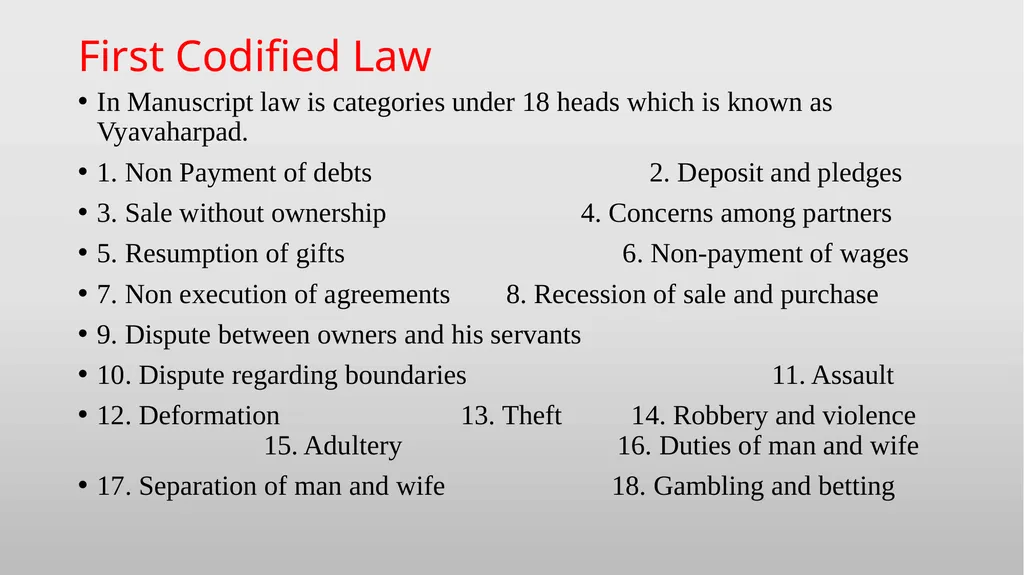
First Codified Law In Manuscript law is categories under 18 heads which is known as Vyavaharpad.
1. Non Payment of debts 2. Deposit and pledges
3. Sale without ownership 4. Concerns among partners
5. Resumption of gifts 6. Non-payment of wages
7. Non execution of agreements 8. Recession of sale and purchase
9. Dispute between owners and his servants
10. Dispute regarding boundaries 11. Assault
12. Deformation 13. Theft 14. Robbery and violence 15. Adultery 16. Duties of man and wife
17. Separation of man and wife 18. Gambling and betting<br>
1. Non Payment of debts 2. Deposit and pledges
3. Sale without ownership 4. Concerns among partners
5. Resumption of gifts 6. Non-payment of wages
7. Non execution of agreements 8. Recession of sale and purchase
9. Dispute between owners and his servants
10. Dispute regarding boundaries 11. Assault
12. Deformation 13. Theft 14. Robbery and violence 15. Adultery 16. Duties of man and wife
17. Separation of man and wife 18. Gambling and betting<br>
21
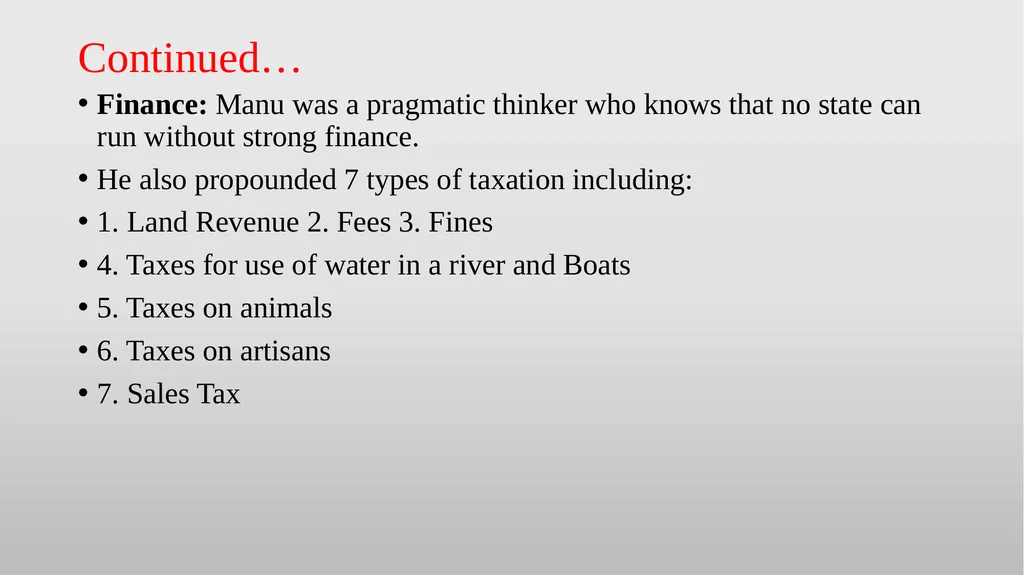
Continued… Finance: Manu was a pragmatic thinker who knows that no state can run without strong finance.
He also propounded 7 types of taxation including:
1. Land Revenue 2. Fees 3. Fines
4. Taxes for use of water in a river and Boats
5. Taxes on animals
6. Taxes on artisans
7. Sales Tax<br>
He also propounded 7 types of taxation including:
1. Land Revenue 2. Fees 3. Fines
4. Taxes for use of water in a river and Boats
5. Taxes on animals
6. Taxes on artisans
7. Sales Tax<br>
22
Thanks<br>