Prepared By: Vijay Jangra Presented By: Mahender Singh Poetry Poetic Devices Introduction to Poetry Poetry is a form of literature that uses rhythm, sound, and vivid language to convey emotions, thoughts, and ideas. Unlike prose, poetry
"Prepared By: Vijay Jangra Presented By: Mahender" is the property of its rightful owner. Permission is granted to
download and print the materials on this website for personal, non-commercial use only, and to display it
on your personal computer provided you do not modify the materials and that you retain all copyright
notices contained in the materials. By downloading content from our website, you accept the terms of this
agreement.
Introduction to Poetry Poetry is a form of literature that uses rhythm, sound, and vivid language to convey emotions, thoughts, and ideas.
Unlike prose, poetry often employs a structured format and relies on creative expressions to engage readers and listeners.
Poetry has been used across cultures for centuries to tell stories, celebrate events, and express personal feelings.
Today we will explore the fundamentals of poetry and various poetic devices that enhance the beauty and impact of poems.<br>
03
Elements of Poetry<br>
04
Form and Structure Poems can take many forms, including:
Free Verse: No set rhyme scheme or meter.
Sonnet: A 14-line poem with a specific rhyme scheme.
Haiku: A 3-line poem with a 5-7-5 syllable structure.
Limerick: A humorous 5-line poem with an AABBA rhyme scheme.<br>
05
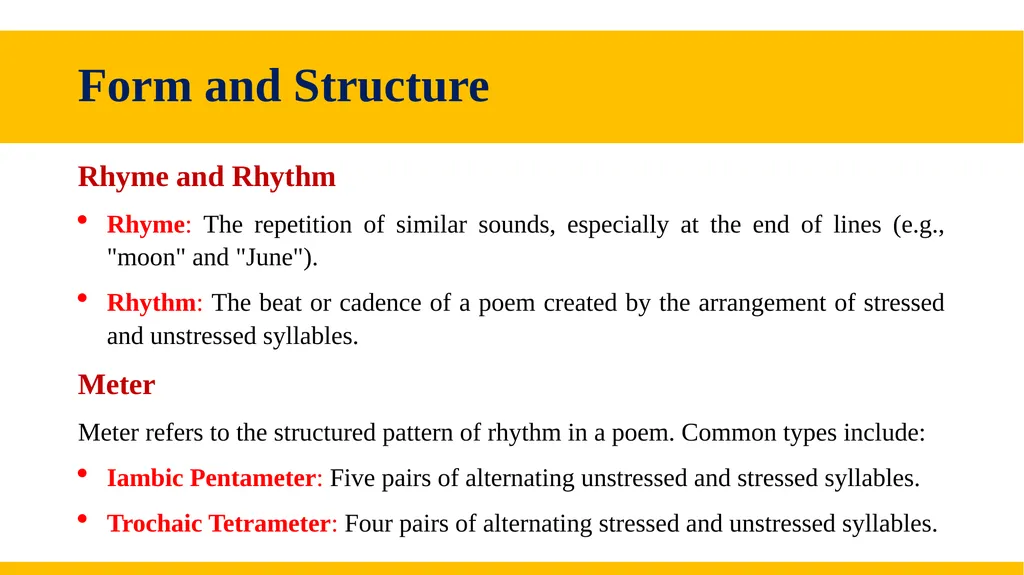
Form and Structure Rhyme and Rhythm
Rhyme: The repetition of similar sounds, especially at the end of lines (e.g., "moon" and "June").
Rhythm: The beat or cadence of a poem created by the arrangement of stressed and unstressed syllables.
Meter
Meter refers to the structured pattern of rhythm in a poem. Common types include:
Iambic Pentameter: Five pairs of alternating unstressed and stressed syllables.
Trochaic Tetrameter: Four pairs of alternating stressed and unstressed syllables.<br>
06
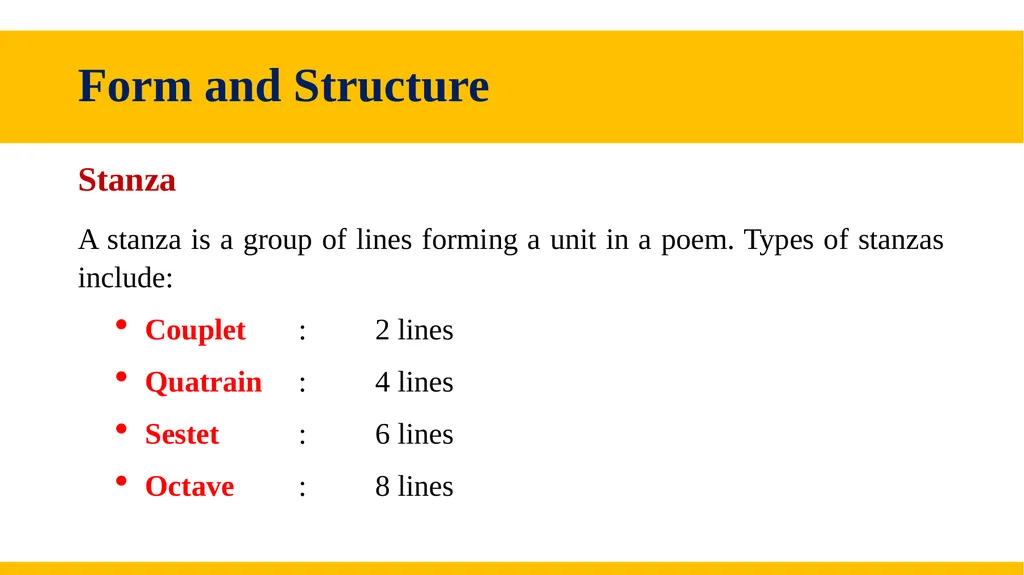
Form and Structure Stanza
A stanza is a group of lines forming a unit in a poem. Types of stanzas include:
Couplet : 2 lines
Quatrain : 4 lines
Sestet : 6 lines
Octave : 8 lines<br>
07
POETIC DEVICES Poetic devices are techniques used by poets to create more engaging and expressive poetry. These devices help enhance meaning, sound, and imagery.<br>
08
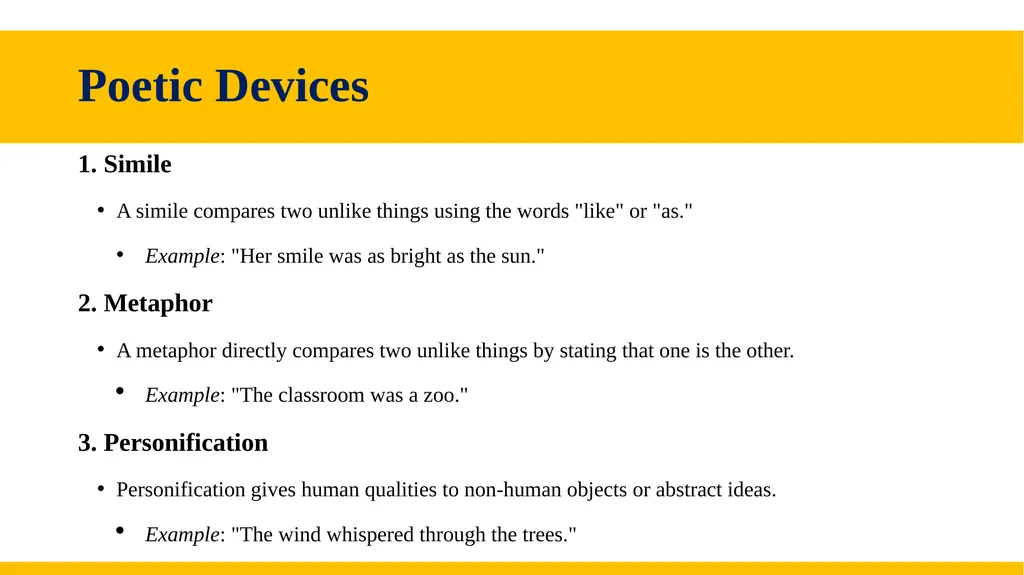
Poetic Devices 1. Simile
A simile compares two unlike things using the words "like" or "as."
Example: "Her smile was as bright as the sun."
2. Metaphor
A metaphor directly compares two unlike things by stating that one is the other.
Example: "The classroom was a zoo."
3. Personification
Personification gives human qualities to non-human objects or abstract ideas.
Example: "The wind whispered through the trees."<br>
09
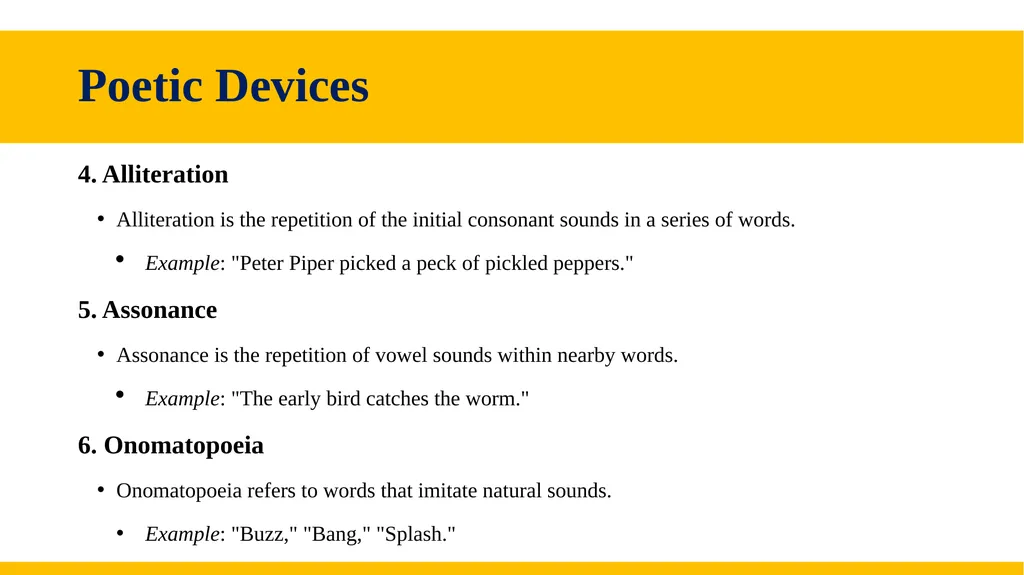
Poetic Devices 4. Alliteration
Alliteration is the repetition of the initial consonant sounds in a series of words.
Example: "Peter Piper picked a peck of pickled peppers."
5. Assonance
Assonance is the repetition of vowel sounds within nearby words.
Example: "The early bird catches the worm."
6. Onomatopoeia
Onomatopoeia refers to words that imitate natural sounds.
Example: "Buzz," "Bang," "Splash."<br>
10
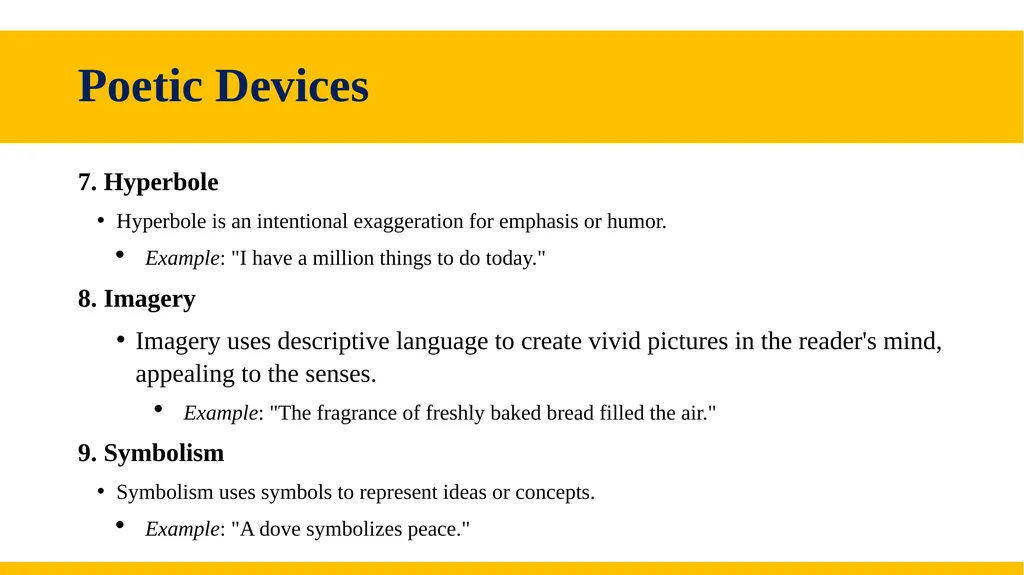
Poetic Devices 7. Hyperbole
Hyperbole is an intentional exaggeration for emphasis or humor.
Example: "I have a million things to do today."
8. Imagery
Imagery uses descriptive language to create vivid pictures in the reader's mind, appealing to the senses.
Example: "The fragrance of freshly baked bread filled the air."
9. Symbolism
Symbolism uses symbols to represent ideas or concepts.
Example: "A dove symbolizes peace."<br>
11
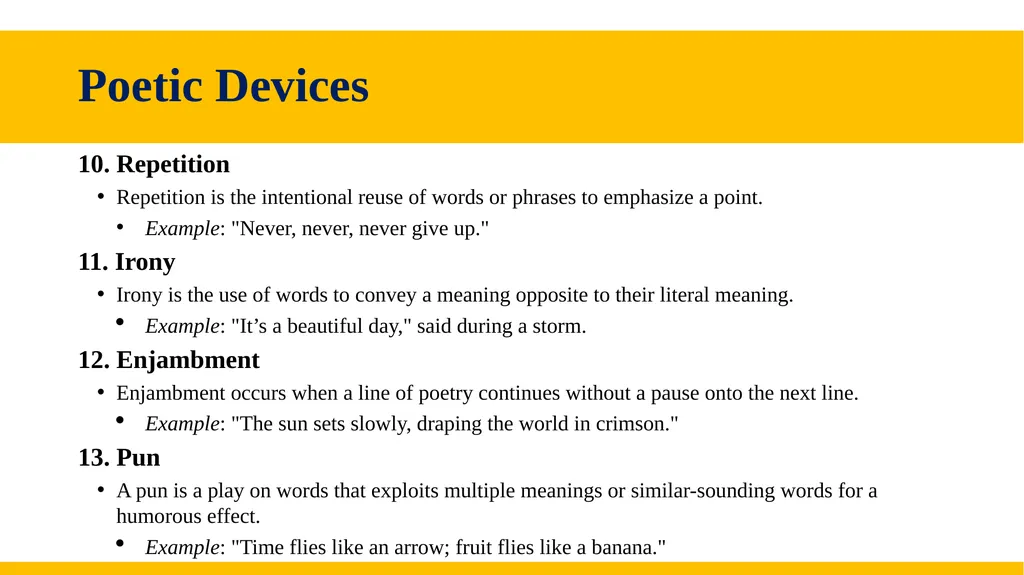
Poetic Devices 10. Repetition
Repetition is the intentional reuse of words or phrases to emphasize a point.
Example: "Never, never, never give up."
11. Irony
Irony is the use of words to convey a meaning opposite to their literal meaning.
Example: "It’s a beautiful day," said during a storm.
12. Enjambment
Enjambment occurs when a line of poetry continues without a pause onto the next line.
Example: "The sun sets slowly, draping the world in crimson."
13. Pun
A pun is a play on words that exploits multiple meanings or similar-sounding words for a humorous effect.
Example: "Time flies like an arrow; fruit flies like a banana."<br>
12
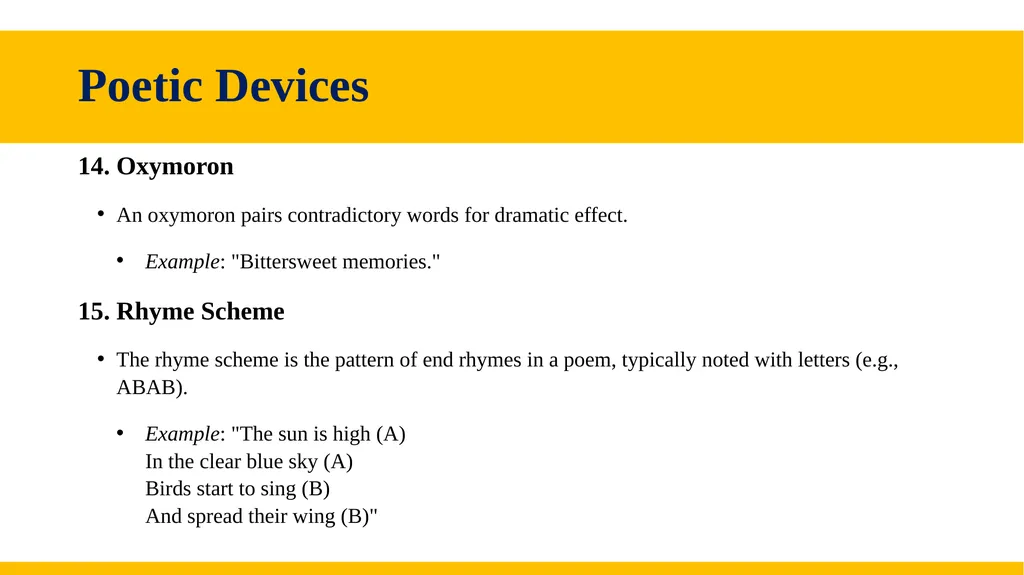
Poetic Devices 14. Oxymoron
An oxymoron pairs contradictory words for dramatic effect.
Example: "Bittersweet memories."
15. Rhyme Scheme
The rhyme scheme is the pattern of end rhymes in a poem, typically noted with letters (e.g., ABAB).
Example: "The sun is high (A) In the clear blue sky (A) Birds start to sing (B) And spread their wing (B)"<br>
13
Examples of Poems and Their Devices<br>
14
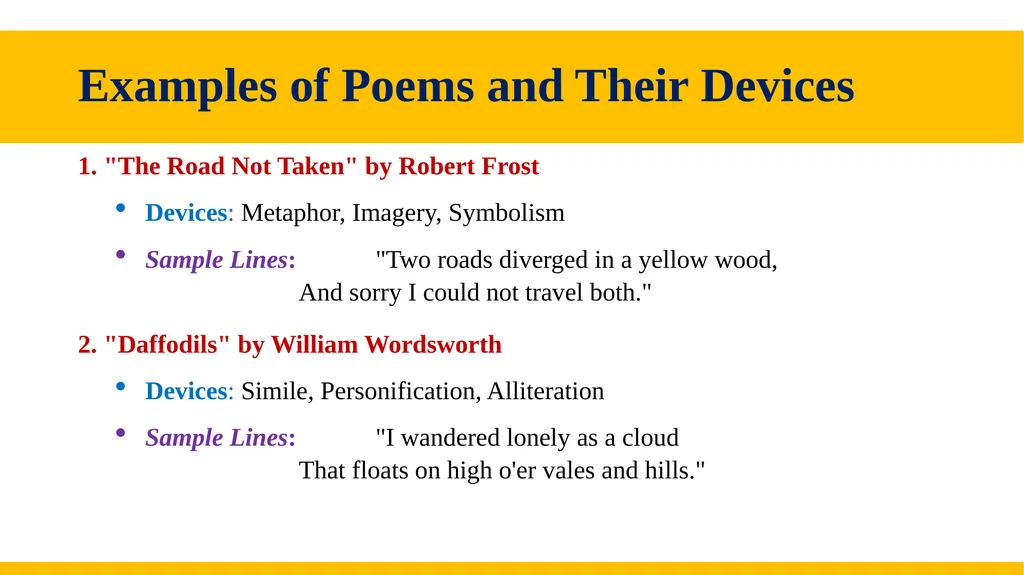
Examples of Poems and Their Devices 1. "The Road Not Taken" by Robert Frost
Devices: Metaphor, Imagery, Symbolism
Sample Lines: "Two roads diverged in a yellow wood, And sorry I could not travel both."
2. "Daffodils" by William Wordsworth
Devices: Simile, Personification, Alliteration
Sample Lines: "I wandered lonely as a cloud That floats on high o'er vales and hills."<br>
15
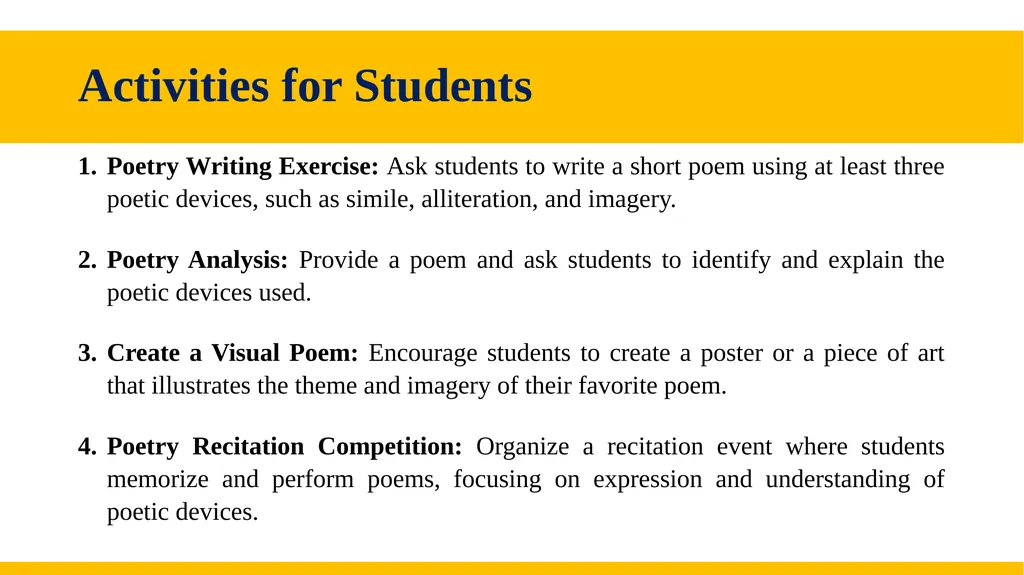
Activities for Students Poetry Writing Exercise: Ask students to write a short poem using at least three poetic devices, such as simile, alliteration, and imagery.
Poetry Analysis: Provide a poem and ask students to identify and explain the poetic devices used.
Create a Visual Poem: Encourage students to create a poster or a piece of art that illustrates the theme and imagery of their favorite poem.
Poetry Recitation Competition: Organize a recitation event where students memorize and perform poems, focusing on expression and understanding of poetic devices.<br>
16
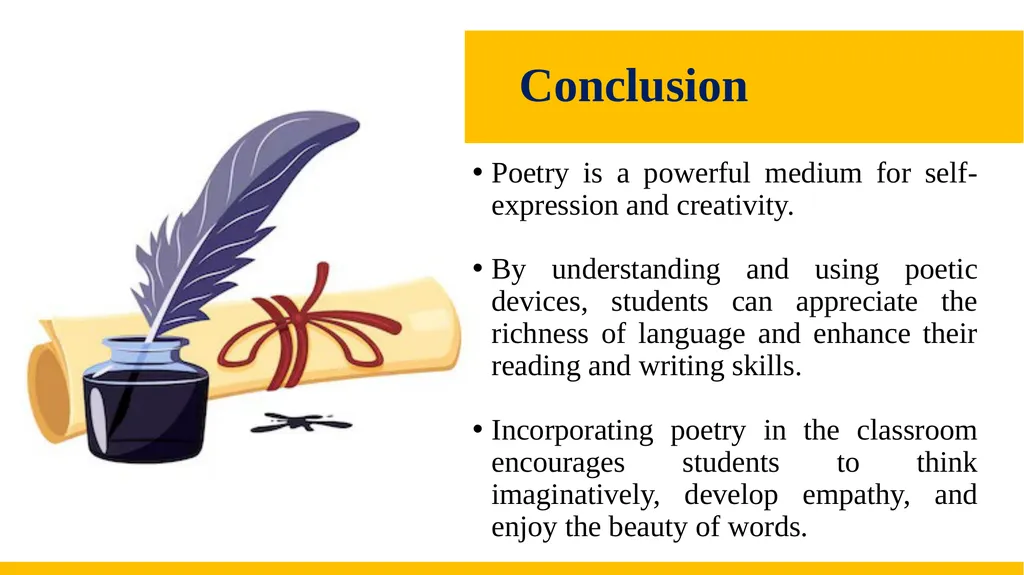
Poetry is a powerful medium for self-expression and creativity.
By understanding and using poetic devices, students can appreciate the richness of language and enhance their reading and writing skills.
Incorporating poetry in the classroom encourages students to think imaginatively, develop empathy, and enjoy the beauty of words. Conclusion<br>