
Preparing Research Proposals for NSF and NIH April
KB
Published · 14 slides · 0 views
1 / 1
Description
Preparing Research Proposals for NSF and NIH April 20, 2018 Presenter: Deborah Hernandez, Director, Research Development Workshop Objectives Understand Required Proposal Documents Review Research Focus and Programmatic Structure Explain
Related Topics
Share
Embed code
Download this presentation From Below
"Preparing Research Proposals for NSF and NIH April" is the property of its rightful owner. Permission is granted to download and print the materials on this website for personal, non-commercial use only, and to display it on your personal computer provided you do not modify the materials and that you retain all copyright notices contained in the materials. By downloading content from our website, you accept the terms of this agreement.
Presentation Transcript
01
Preparing Research Proposals
for NSF and NIH
April 20, 2018 Presenter: Deborah Hernandez, Director, Research Development<br>
for NSF and NIH
April 20, 2018 Presenter: Deborah Hernandez, Director, Research Development<br>
02
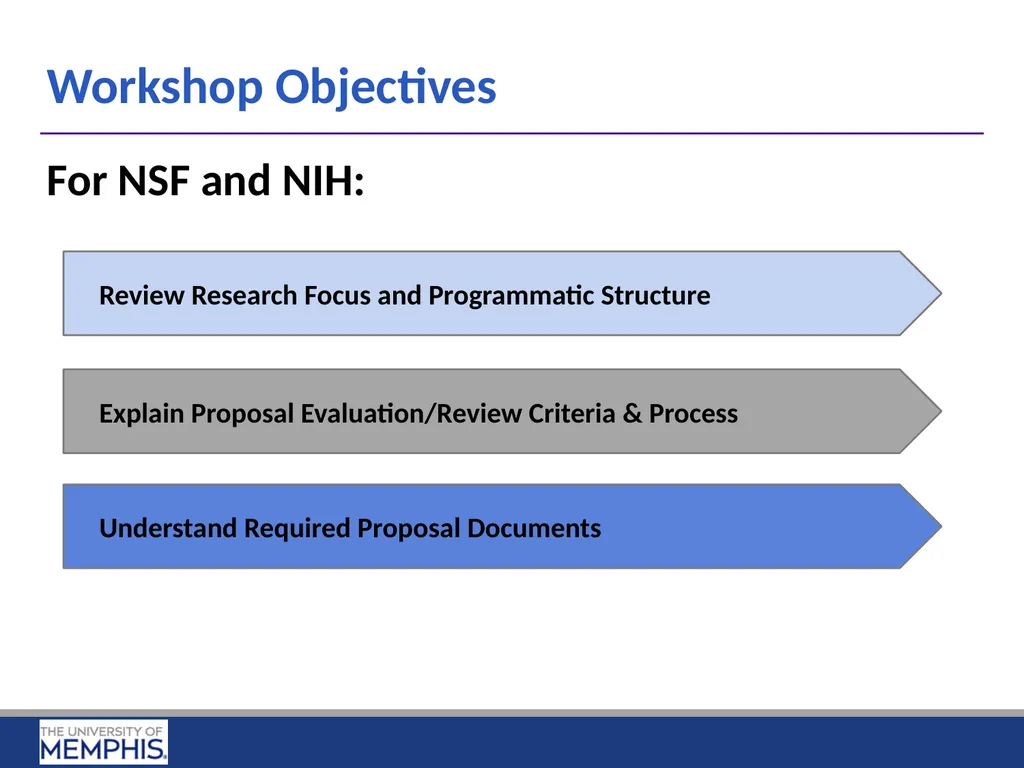
Workshop Objectives Understand Required Proposal Documents Review Research Focus and Programmatic Structure Explain Proposal Evaluation/Review Criteria & Process For NSF and NIH:<br>
03
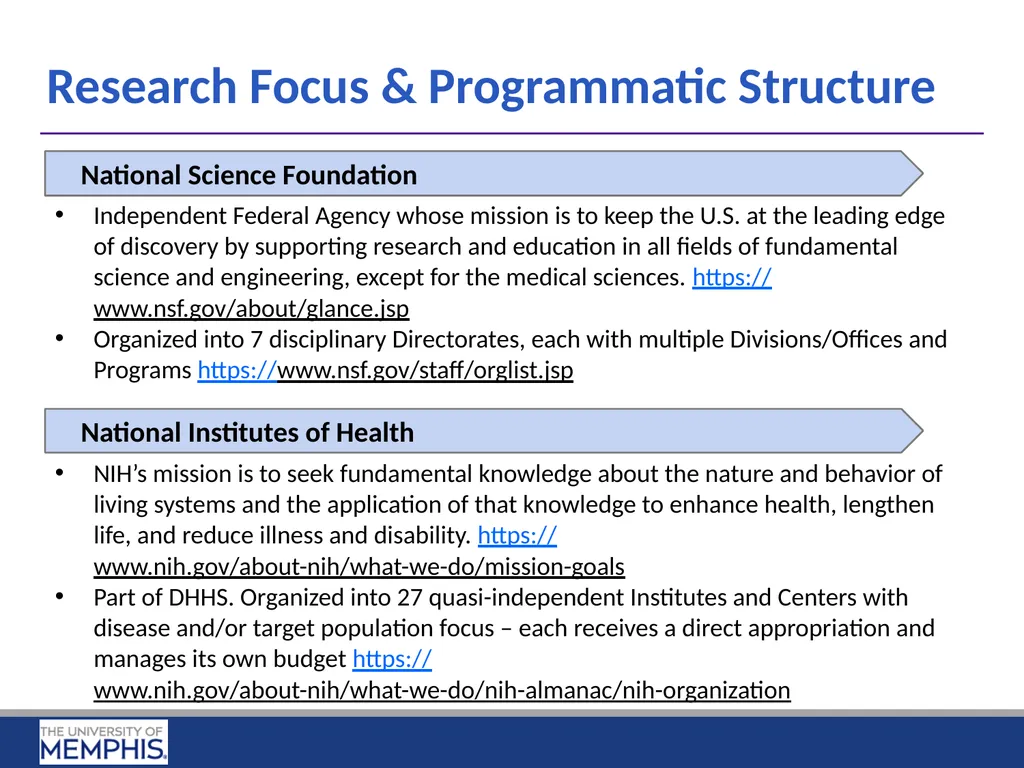
Research Focus & Programmatic Structure National Science Foundation National Institutes of Health Independent Federal Agency whose mission is to keep the U.S. at the leading edge of discovery by supporting research and education in all fields of fundamental science and engineering, except for the medical sciences. https://www.nsf.gov/about/glance.jsp
Organized into 7 disciplinary Directorates, each with multiple Divisions/Offices and Programs https://www.nsf.gov/staff/orglist.jsp NIH’s mission is to seek fundamental knowledge about the nature and behavior of living systems and the application of that knowledge to enhance health, lengthen life, and reduce illness and disability. https://www.nih.gov/about-nih/what-we-do/mission-goals
Part of DHHS. Organized into 27 quasi-independent Institutes and Centers with disease and/or target population focus – each receives a direct appropriation and manages its own budget https://www.nih.gov/about-nih/what-we-do/nih-almanac/nih-organization<br>
Organized into 7 disciplinary Directorates, each with multiple Divisions/Offices and Programs https://www.nsf.gov/staff/orglist.jsp NIH’s mission is to seek fundamental knowledge about the nature and behavior of living systems and the application of that knowledge to enhance health, lengthen life, and reduce illness and disability. https://www.nih.gov/about-nih/what-we-do/mission-goals
Part of DHHS. Organized into 27 quasi-independent Institutes and Centers with disease and/or target population focus – each receives a direct appropriation and manages its own budget https://www.nih.gov/about-nih/what-we-do/nih-almanac/nih-organization<br>
04
NSF Proposal Evaluation Criteria & Process Two Standard Merit Review Criteria
Intellectual Merit: The potential to advance knowledge and understanding within one’s own field or across different fields. Must convey merit of the potential contribution as well as merit of the proposed approach.
Broader Impacts: The potential to benefit society and contribute to the achievement of specific, desired societal outcomes. Impacts may be economic, environmental, or educational; may improve research and education infrastructure; or may provide opportunities for underrepresented groups. National Science Foundation Review Process
ad hoc panel of scientists in program field who provide individual reviews
Reviews given to the Program Officer who determines what to fund<br>
Intellectual Merit: The potential to advance knowledge and understanding within one’s own field or across different fields. Must convey merit of the potential contribution as well as merit of the proposed approach.
Broader Impacts: The potential to benefit society and contribute to the achievement of specific, desired societal outcomes. Impacts may be economic, environmental, or educational; may improve research and education infrastructure; or may provide opportunities for underrepresented groups. National Science Foundation Review Process
ad hoc panel of scientists in program field who provide individual reviews
Reviews given to the Program Officer who determines what to fund<br>
05
NSF Proposals – Primary Documents 1-Page Summary with 3 sections
Overview
Intellectual Merit
Broader Impacts
15 page Research Plan
References
Biosketch (2 pages in specified format)
Current and Pending Support document
Collaborators Spreadsheet
Data Management Plan
Budget and Narrative Budget Justification
Post Doctoral Mentoring Plan, if applicable
Letters of Commitment from Unfunded Collaborators
https://www.nsf.gov/pubs/policydocs/pappg18_1/index.jsp<br>
Overview
Intellectual Merit
Broader Impacts
15 page Research Plan
References
Biosketch (2 pages in specified format)
Current and Pending Support document
Collaborators Spreadsheet
Data Management Plan
Budget and Narrative Budget Justification
Post Doctoral Mentoring Plan, if applicable
Letters of Commitment from Unfunded Collaborators
https://www.nsf.gov/pubs/policydocs/pappg18_1/index.jsp<br>
06
NSF Proposals – 1-page summary Overview – A stand-alone summary of the planned work. It should:
Summarize the scientific or technological challenge you seek to address
Present your project goal and specific objectives
Identify key components of your proposed approach/methods
Intellectual Merit – This is your potential to advance knowledge and understanding in an impactful way. Address the merit or significance of the topic, and the merit of your proposed approach/methods. Consider:
What will my research add to what we already know?
How will my research enhance or enable new directions in my field or in other related fields
What is new or novel about my approach and why is it likely to work?
Broader Impacts – Summarize plans to extend the impact of your research in ways that will benefit larger societal goals related to such things as broadening participation in the sciences, enhancing public health or safety, advancing economic competitiveness, etc.<br>
Summarize the scientific or technological challenge you seek to address
Present your project goal and specific objectives
Identify key components of your proposed approach/methods
Intellectual Merit – This is your potential to advance knowledge and understanding in an impactful way. Address the merit or significance of the topic, and the merit of your proposed approach/methods. Consider:
What will my research add to what we already know?
How will my research enhance or enable new directions in my field or in other related fields
What is new or novel about my approach and why is it likely to work?
Broader Impacts – Summarize plans to extend the impact of your research in ways that will benefit larger societal goals related to such things as broadening participation in the sciences, enhancing public health or safety, advancing economic competitiveness, etc.<br>
07
NSF Proposals – Project Description 15 pages with no specified format beyond 3 required sections: intellectual merit, broader impacts, and results from prior NSF support
Suggested Format:
Introduction – ½ page that defines your topic by identifying the main scientific challenges you will address, specifically states your goals and objectives (or hypothesis and research questions), and highlights new ideas/novel approach and the expected impact of your work on the current state of science.
Background/Significance—1-3 pages that provides a synopsis of recent findings in the area and summarizes what we do and don’t know. If appropriate, identify existing barriers to advances in your area that you will address through this project.
This is your literature heavy section and should provide reviewers with a clear understanding of why your proposed work and approach will result in an important contribution to science.<br>
Suggested Format:
Introduction – ½ page that defines your topic by identifying the main scientific challenges you will address, specifically states your goals and objectives (or hypothesis and research questions), and highlights new ideas/novel approach and the expected impact of your work on the current state of science.
Background/Significance—1-3 pages that provides a synopsis of recent findings in the area and summarizes what we do and don’t know. If appropriate, identify existing barriers to advances in your area that you will address through this project.
This is your literature heavy section and should provide reviewers with a clear understanding of why your proposed work and approach will result in an important contribution to science.<br>
08
NSF Proposals – Project Description Research Plan (8+ pages) is your forward-looking, technical description of planned activities and timeline.
Identify WHAT will you do, HOW will you do it, and WHEN you will do it. You may choose to set this up with objectives and tasks, clearly identifying tasks that are sequential versus concurrent and identifying key decision points based on expected task outcomes.
Explain WHY your proposed strategy/method is appropriate. This section should logically flow from your background/significance section.
Use appropriate graphics. Consider providing a summary timetable to provide a graphic snapshot of the entire project. Results from Prior NSF Support, Broader Impacts, and Intellectual Merit<br>
Identify WHAT will you do, HOW will you do it, and WHEN you will do it. You may choose to set this up with objectives and tasks, clearly identifying tasks that are sequential versus concurrent and identifying key decision points based on expected task outcomes.
Explain WHY your proposed strategy/method is appropriate. This section should logically flow from your background/significance section.
Use appropriate graphics. Consider providing a summary timetable to provide a graphic snapshot of the entire project. Results from Prior NSF Support, Broader Impacts, and Intellectual Merit<br>
09
Proposal Evaluation Criteria & Process Significance – Are you addressing an important problem or a critical barrier to progress in the field? How will the result improve knowledge, technical capability, or clinical practice and/or change the concepts, methods, technologies, treatments, services, or preventative interventions that drive the field?
Investigator(s) – Does the research team have appropriate experience and training and demonstrated record of accomplishments that have advanced their field(s)?
Innovation - How will the work shift current research via novel theoretical concepts, approaches or methodologies, instrumentation, or interventions or through refinement, improvement, or new application of existing knowledge?
Approach – Are strategy, methodology, and analyses well-reasoned and appropriate to accomplish the specific aims of the project? Are potential problems, alternative strategies, and benchmarks presented? If applicable, are plans in place for the protection of human subjects and justification of study design (method and criteria)?
Environment – Are necessary resources, support, and collaboration in place? National Institutes of Health - Five Criteria, plus Overall Impact Overall Impact: Likelihood the project will exert a sustained, powerful influence on the research field(s) involved<br>
Investigator(s) – Does the research team have appropriate experience and training and demonstrated record of accomplishments that have advanced their field(s)?
Innovation - How will the work shift current research via novel theoretical concepts, approaches or methodologies, instrumentation, or interventions or through refinement, improvement, or new application of existing knowledge?
Approach – Are strategy, methodology, and analyses well-reasoned and appropriate to accomplish the specific aims of the project? Are potential problems, alternative strategies, and benchmarks presented? If applicable, are plans in place for the protection of human subjects and justification of study design (method and criteria)?
Environment – Are necessary resources, support, and collaboration in place? National Institutes of Health - Five Criteria, plus Overall Impact Overall Impact: Likelihood the project will exert a sustained, powerful influence on the research field(s) involved<br>
10
Proposal Evaluation Criteria & Process National Institutes of Health Review Process – layered peer and staff review
Center for Scientific Review assigns proposals to the IC, Integrated Review Group, (25), and Study Section (173) for review https://public.csr.nih.gov/pages/default.aspx
Study Section evaluates for scientific merit; Score 1-9 for each criterion and overall impact https://grants.nih.gov/grants/policy/review/rev_prep/scoring.htm
Final impact score is based on each individual reviewer’s assessment of the scored criteria plus additional criteria regarding the protection and inclusion of human subjects; vertebrate animal care and welfare; biohazards, and criteria specific to the funding opportunity
Overall impact/priority score is calculated by averaging reviewer impact scores.
This score is converted to percentile ranking, which determines funding consideration
IC program officers then evaluate proposals for program relevance and recommends projects to National Advisory Council for consideration
National Advisory Council in each IC provides second level of review and makes funding recommendations to the IC Director<br>
Center for Scientific Review assigns proposals to the IC, Integrated Review Group, (25), and Study Section (173) for review https://public.csr.nih.gov/pages/default.aspx
Study Section evaluates for scientific merit; Score 1-9 for each criterion and overall impact https://grants.nih.gov/grants/policy/review/rev_prep/scoring.htm
Final impact score is based on each individual reviewer’s assessment of the scored criteria plus additional criteria regarding the protection and inclusion of human subjects; vertebrate animal care and welfare; biohazards, and criteria specific to the funding opportunity
Overall impact/priority score is calculated by averaging reviewer impact scores.
This score is converted to percentile ranking, which determines funding consideration
IC program officers then evaluate proposals for program relevance and recommends projects to National Advisory Council for consideration
National Advisory Council in each IC provides second level of review and makes funding recommendations to the IC Director<br>
11
NIH Proposals – Primary Documents Project Summary
Project Narrative
Introduction for resubmissions/revisions
Specific Aims
Research Strategy (6-12 pages)
Significance
Innovation
Approach
References
Budget and Budget Narrative
Biosketch (5 pages)
Facilities and Resources
Equipment
If applicable - Human Subjects, Animal Subjects, Letters of Support/Consortium Letters, Resource Sharing Plan, & Appendix<br>
Project Narrative
Introduction for resubmissions/revisions
Specific Aims
Research Strategy (6-12 pages)
Significance
Innovation
Approach
References
Budget and Budget Narrative
Biosketch (5 pages)
Facilities and Resources
Equipment
If applicable - Human Subjects, Animal Subjects, Letters of Support/Consortium Letters, Resource Sharing Plan, & Appendix<br>
12
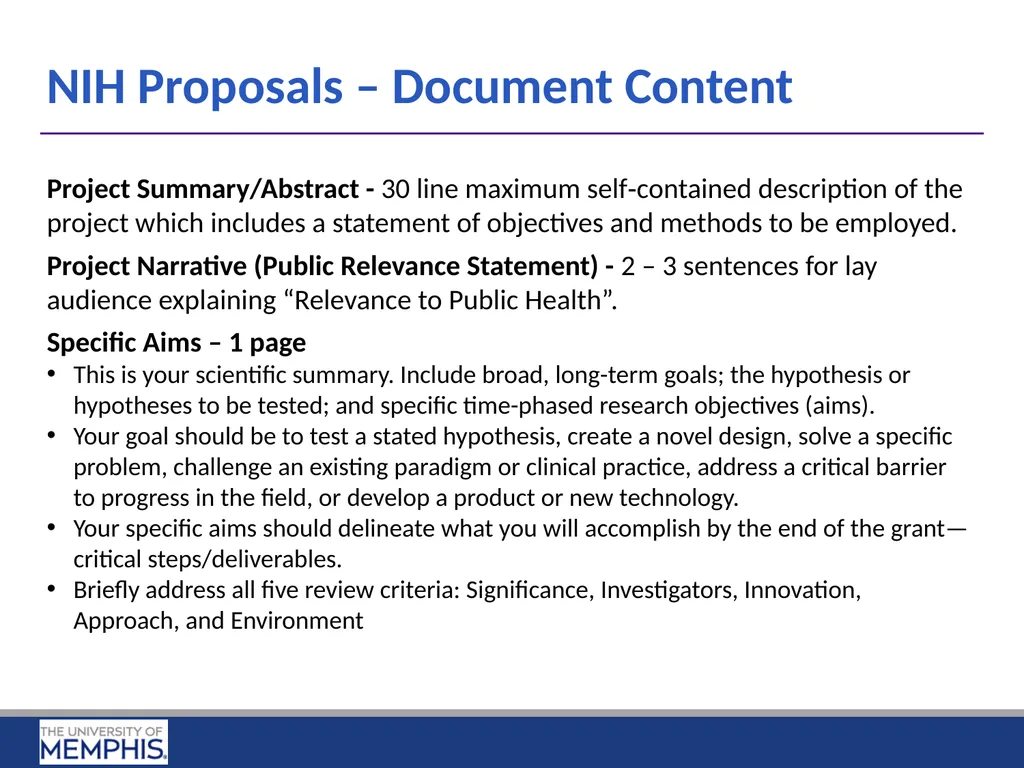
NIH Proposals – Document Content Project Summary/Abstract - 30 line maximum self‐contained description of the project which includes a statement of objectives and methods to be employed.
Project Narrative (Public Relevance Statement) - 2 – 3 sentences for lay audience explaining “Relevance to Public Health”.
Specific Aims – 1 page
This is your scientific summary. Include broad, long-term goals; the hypothesis or hypotheses to be tested; and specific time-phased research objectives (aims).
Your goal should be to test a stated hypothesis, create a novel design, solve a specific problem, challenge an existing paradigm or clinical practice, address a critical barrier to progress in the field, or develop a product or new technology.
Your specific aims should delineate what you will accomplish by the end of the grant—critical steps/deliverables.
Briefly address all five review criteria: Significance, Investigators, Innovation, Approach, and Environment<br>
Project Narrative (Public Relevance Statement) - 2 – 3 sentences for lay audience explaining “Relevance to Public Health”.
Specific Aims – 1 page
This is your scientific summary. Include broad, long-term goals; the hypothesis or hypotheses to be tested; and specific time-phased research objectives (aims).
Your goal should be to test a stated hypothesis, create a novel design, solve a specific problem, challenge an existing paradigm or clinical practice, address a critical barrier to progress in the field, or develop a product or new technology.
Your specific aims should delineate what you will accomplish by the end of the grant—critical steps/deliverables.
Briefly address all five review criteria: Significance, Investigators, Innovation, Approach, and Environment<br>
13
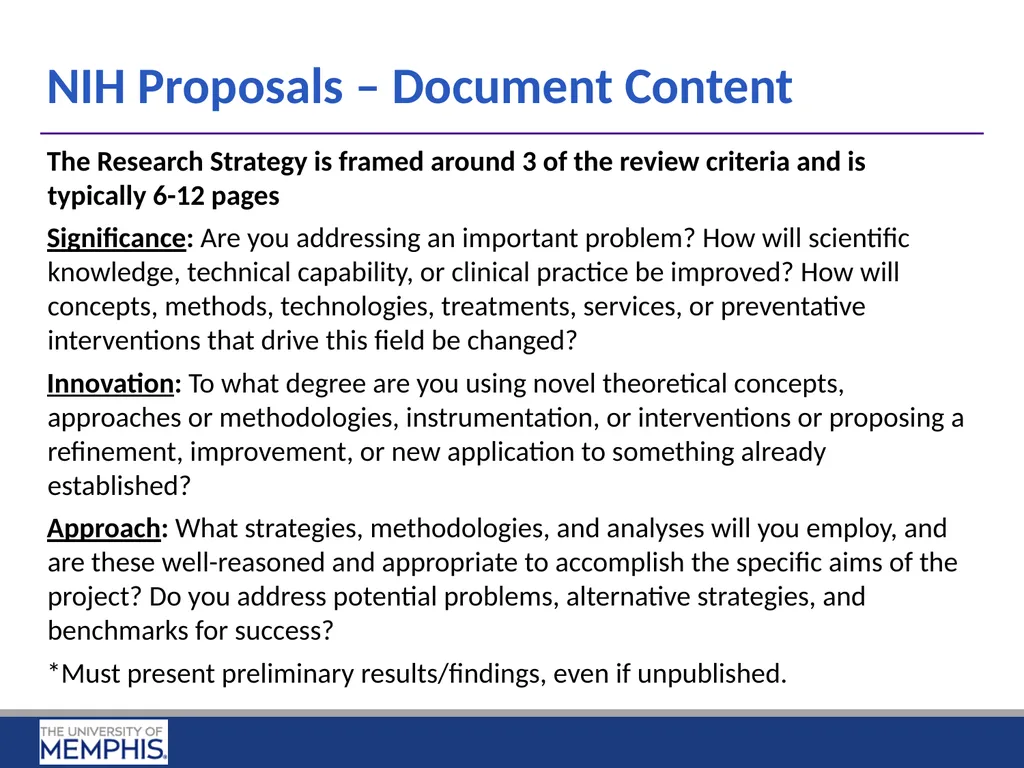
NIH Proposals – Document Content The Research Strategy is framed around 3 of the review criteria and is typically 6-12 pages
Significance: Are you addressing an important problem? How will scientific knowledge, technical capability, or clinical practice be improved? How will concepts, methods, technologies, treatments, services, or preventative interventions that drive this field be changed?
Innovation: To what degree are you using novel theoretical concepts, approaches or methodologies, instrumentation, or interventions or proposing a refinement, improvement, or new application to something already established?
Approach: What strategies, methodologies, and analyses will you employ, and are these well-reasoned and appropriate to accomplish the specific aims of the project? Do you address potential problems, alternative strategies, and benchmarks for success?
*Must present preliminary results/findings, even if unpublished.<br>
Significance: Are you addressing an important problem? How will scientific knowledge, technical capability, or clinical practice be improved? How will concepts, methods, technologies, treatments, services, or preventative interventions that drive this field be changed?
Innovation: To what degree are you using novel theoretical concepts, approaches or methodologies, instrumentation, or interventions or proposing a refinement, improvement, or new application to something already established?
Approach: What strategies, methodologies, and analyses will you employ, and are these well-reasoned and appropriate to accomplish the specific aims of the project? Do you address potential problems, alternative strategies, and benchmarks for success?
*Must present preliminary results/findings, even if unpublished.<br>
14
Questions?<br>