Preparing Statistics Majors for Graduate Study (Perhaps Your Own!) ASA Working Group to Revise the Undergraduate Statistics Curriculum Winter 2013 Outline Introduction of Invited Participants Sandy Weisberg, Univ of Minnesota Jane Monaco,
"Preparing Statistics Majors for Graduate Study" is the property of its rightful owner. Permission is granted to
download and print the materials on this website for personal, non-commercial use only, and to display it
on your personal computer provided you do not modify the materials and that you retain all copyright
notices contained in the materials. By downloading content from our website, you accept the terms of this
agreement.
Presentation Transcript
01
Preparing Statistics Majors for Graduate Study (Perhaps Your Own!) ASA Working Group to Revise the Undergraduate Statistics Curriculum
Winter 2013<br>
02
Outline Introduction of Invited Participants
Sandy Weisberg, Univ of Minnesota
Jane Monaco, UNC Biostatistics
Simon Sheather, Texas A&M
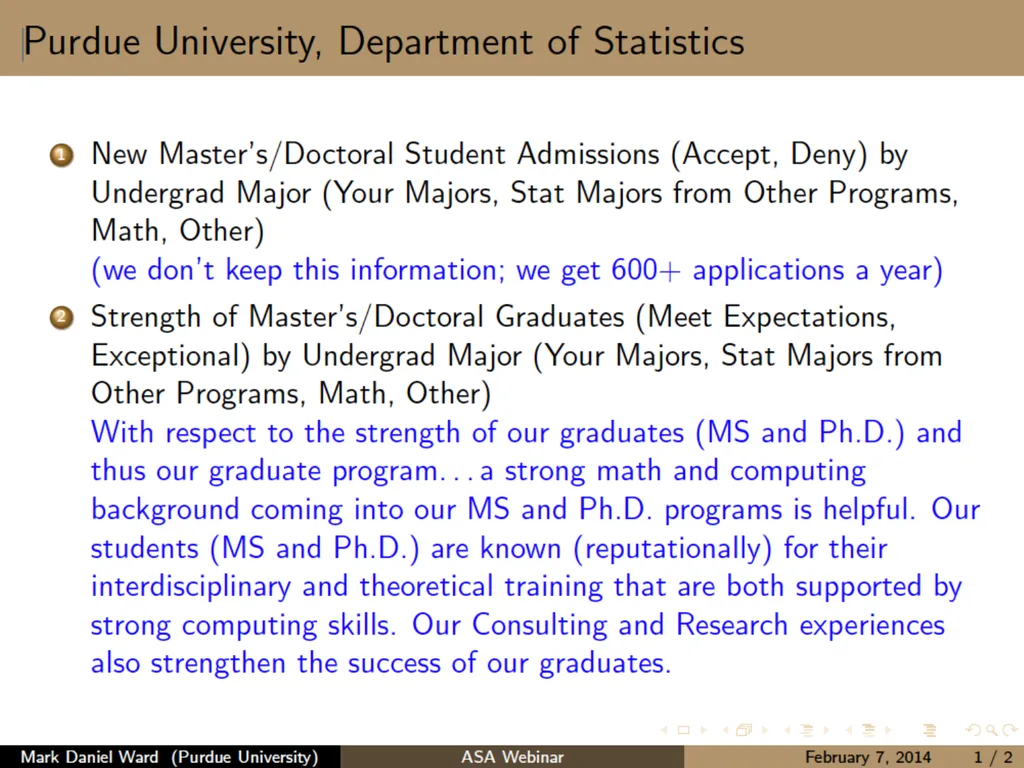
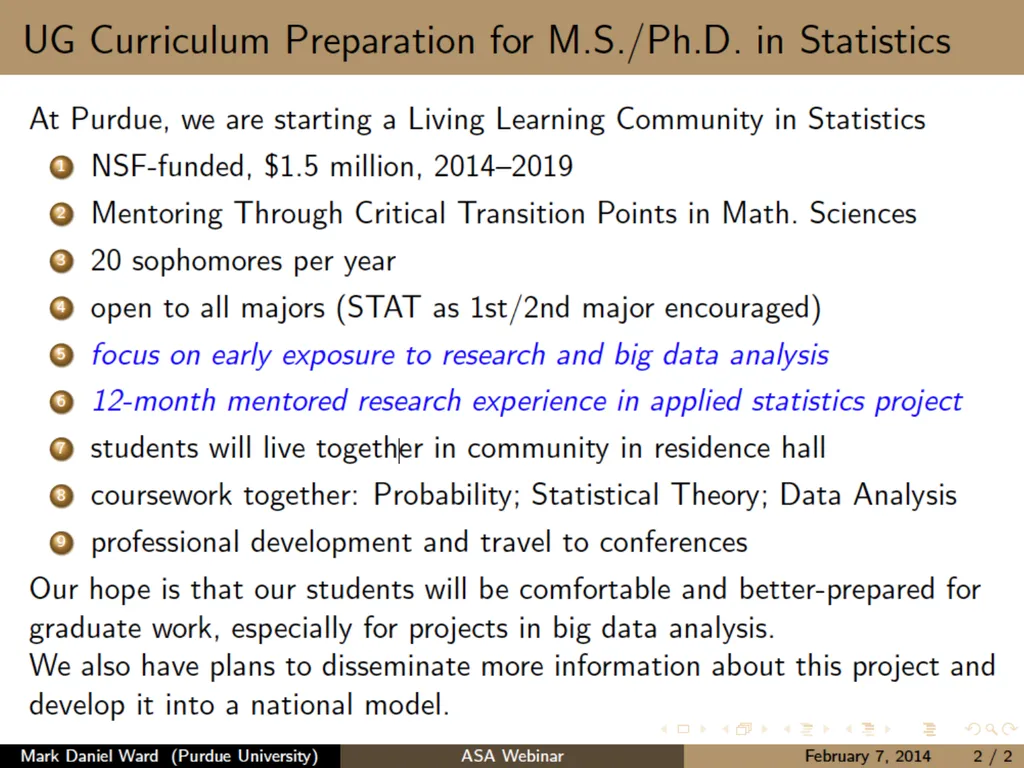
Mark Ward, Purdue
Questions for Panel
Open Discussion<br>
03
UNC-CH Dept Biostatistics Admissions by Major (2013)<br>
04
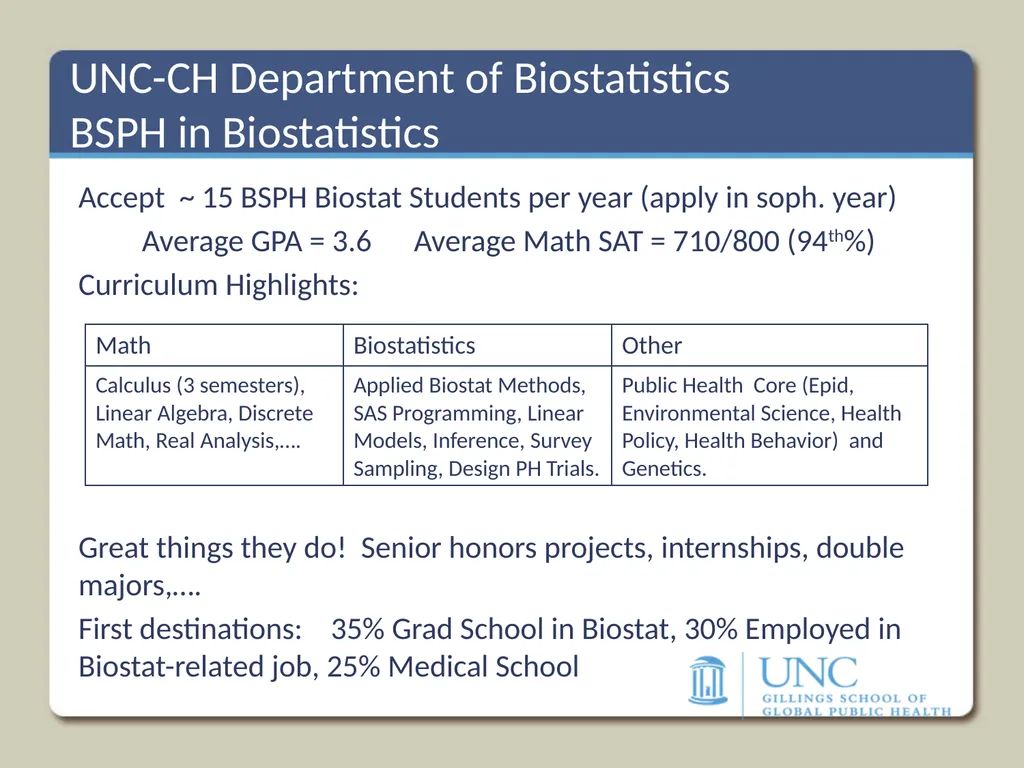
UNC-CH Department of Biostatistics BSPH in Biostatistics Accept ~ 15 BSPH Biostat Students per year (apply in soph. year)
Average GPA = 3.6 Average Math SAT = 710/800 (94th%)
Curriculum Highlights:
Great things they do! Senior honors projects, internships, double majors,….
First destinations: 35% Grad School in Biostat, 30% Employed in Biostat-related job, 25% Medical School<br>
05
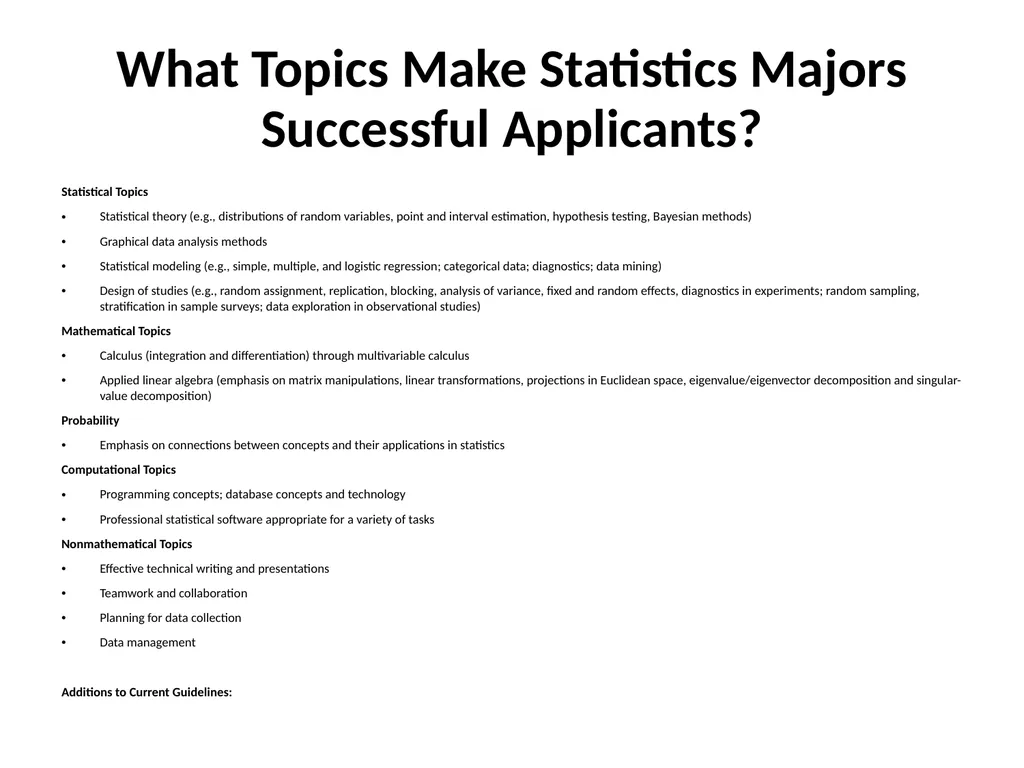
What Topics Make Statistics Majors Successful Applicants? Statistical Topics
Statistical theory (e.g., distributions of random variables, point and interval estimation, hypothesis testing, Bayesian methods)
Graphical data analysis methods
Statistical modeling (e.g., simple, multiple, and logistic regression; categorical data; diagnostics; data mining)
Design of studies (e.g., random assignment, replication, blocking, analysis of variance, fixed and random effects, diagnostics in experiments; random sampling, stratification in sample surveys; data exploration in observational studies)
Mathematical Topics
Calculus (integration and differentiation) through multivariable calculus
Applied linear algebra (emphasis on matrix manipulations, linear transformations, projections in Euclidean space, eigenvalue/eigenvector decomposition and singular-value decomposition)
Probability
Emphasis on connections between concepts and their applications in statistics
Computational Topics
Programming concepts; database concepts and technology
Professional statistical software appropriate for a variety of tasks
Nonmathematical Topics
Effective technical writing and presentations
Teamwork and collaboration
Planning for data collection
Data management
Additions to Current Guidelines:<br>
06
What Should be Added to Undergraduate Preparation? Additional Depth in Current Topics:
Additional Topics:<br>
07
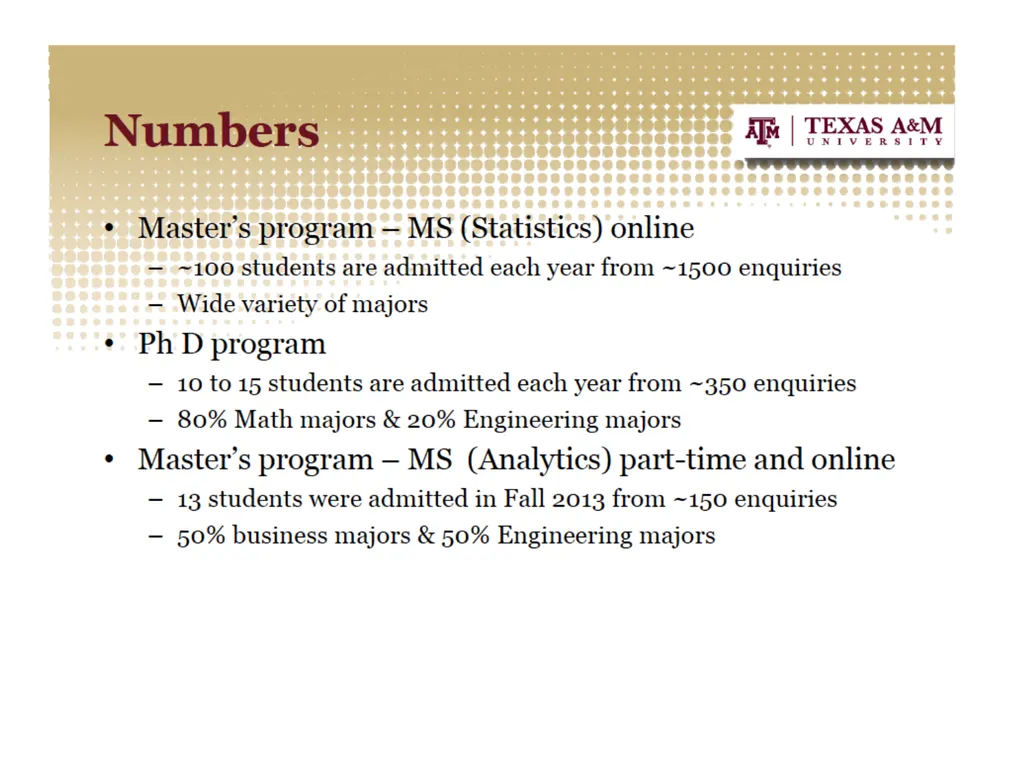
Responding to the Demand for Statisticians: Sheather:
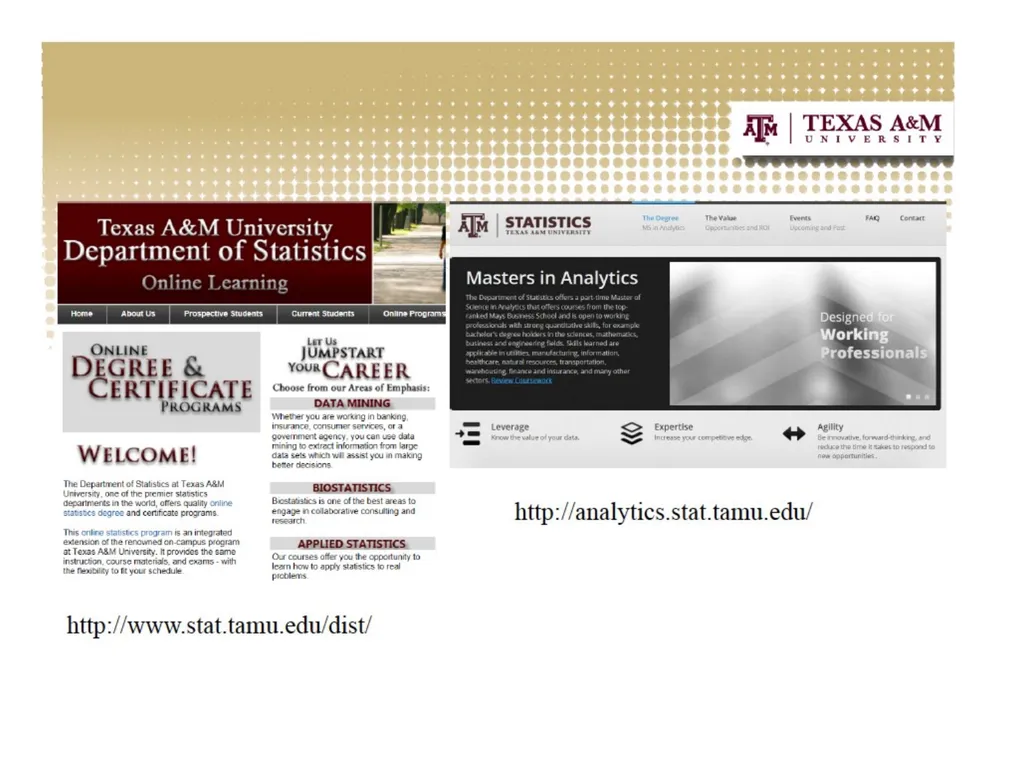
What are some of the programs (degrees and certificates) created by A&M to respond to the high demand for statisticians?
Are statistics majors better prepared for MS Statistics or MS Analytics program (or neither)?<br>
08
Focusing on Biostatistics: Monaco:
The typical recruit for a biostatistics program is not a statistics major.
Share how and when your BS/MS Integrated Biostatistics program covers topics in statistics, computing, and mathematics.<br>
09
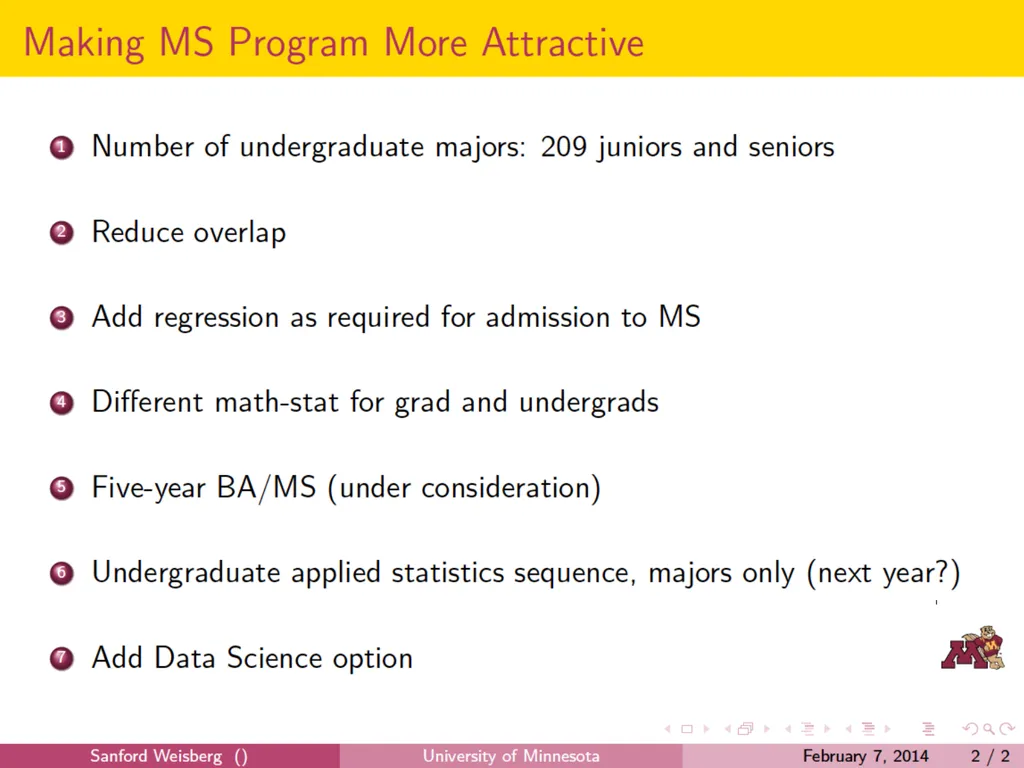
Difference Between Undergraduate and Graduate Expectations Weisberg & Sheather:
Examples of Undergraduate Regression Topics
Examples of Graduate Regression Topics<br>
10
Preparation and Performance of Your Majors Who Have Gone Elsewhere Ward
Monaco
Weisberg<br>
11
Looking Forward: Big Data and Computing Skills Needed:
Skills of Stronger Candidates:<br>
12
Discussion More information about the existing curriculum guidelines as well as a survey to share your thoughts:
http://www.amstat.org/education/curriculumguidelines.cfm<br>