
Present Perfect Simple With the present perfect
EM
Published · 29 slides · 0 views
1 / 1
Description
Present Perfect Simple With the present perfect tense, there is always a connection with the past and with the present. We use the present perfect to talk about: Experience Change Continuing situation The exact time of the event is
Related Topics
Share
Embed code
Download this presentation From Below
"Present Perfect Simple With the present perfect" is the property of its rightful owner. Permission is granted to download and print the materials on this website for personal, non-commercial use only, and to display it on your personal computer provided you do not modify the materials and that you retain all copyright notices contained in the materials. By downloading content from our website, you accept the terms of this agreement.
Presentation Transcript
01
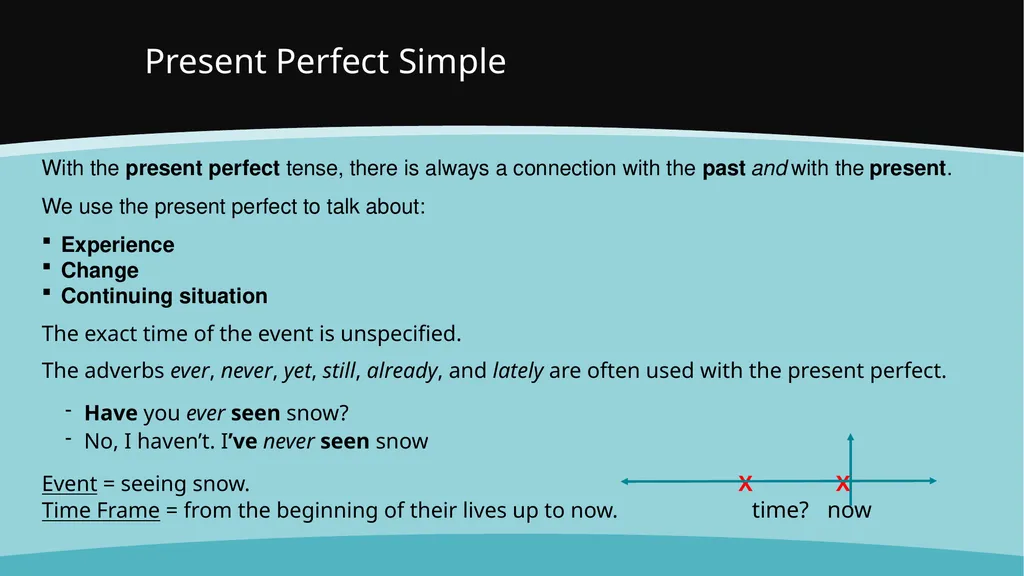
Present Perfect Simple With the present perfect tense, there is always a connection with the past and with the present.
We use the present perfect to talk about:
Experience
Change
Continuing situation
The exact time of the event is unspecified.
The adverbs ever, never, yet, still, already, and lately are often used with the present perfect.
Have you ever seen snow?
No, I haven’t. I’ve never seen snow
Event = seeing snow. X X
Time Frame = from the beginning of their lives up to now. time? now<br>
We use the present perfect to talk about:
Experience
Change
Continuing situation
The exact time of the event is unspecified.
The adverbs ever, never, yet, still, already, and lately are often used with the present perfect.
Have you ever seen snow?
No, I haven’t. I’ve never seen snow
Event = seeing snow. X X
Time Frame = from the beginning of their lives up to now. time? now<br>
02
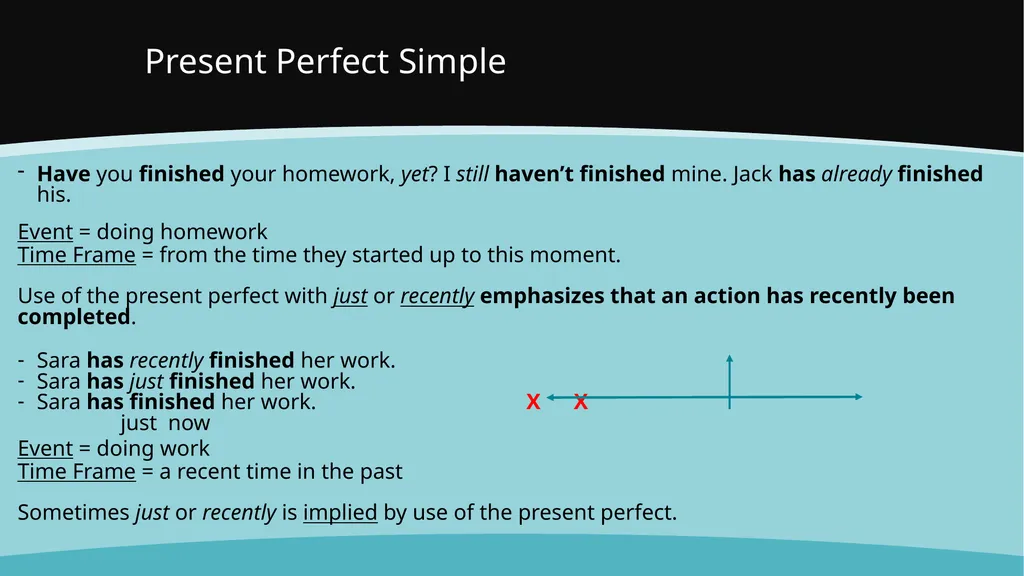
Present Perfect Simple Have you finished your homework, yet? I still haven’t finished mine. Jack has already finished his.
Event = doing homework
Time Frame = from the time they started up to this moment.
Use of the present perfect with just or recently emphasizes that an action has recently been completed.
Sara has recently finished her work.
Sara has just finished her work.
Sara has finished her work. X X
just now
Event = doing work
Time Frame = a recent time in the past
Sometimes just or recently is implied by use of the present perfect.<br>
Event = doing homework
Time Frame = from the time they started up to this moment.
Use of the present perfect with just or recently emphasizes that an action has recently been completed.
Sara has recently finished her work.
Sara has just finished her work.
Sara has finished her work. X X
just now
Event = doing work
Time Frame = a recent time in the past
Sometimes just or recently is implied by use of the present perfect.<br>
03
Present Perfect Simple Ever
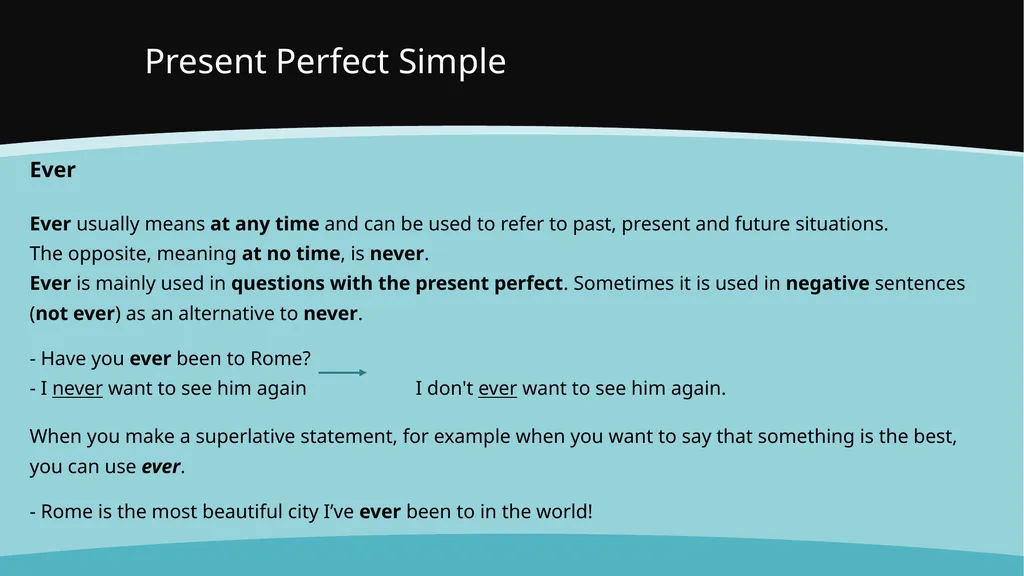
Ever usually means at any time and can be used to refer to past, present and future situations.
The opposite, meaning at no time, is never.
Ever is mainly used in questions with the present perfect. Sometimes it is used in negative sentences (not ever) as an alternative to never.
- Have you ever been to Rome?
- I never want to see him again I don't ever want to see him again.
When you make a superlative statement, for example when you want to say that something is the best, you can use ever.
- Rome is the most beautiful city I’ve ever been to in the world!<br>
Ever usually means at any time and can be used to refer to past, present and future situations.
The opposite, meaning at no time, is never.
Ever is mainly used in questions with the present perfect. Sometimes it is used in negative sentences (not ever) as an alternative to never.
- Have you ever been to Rome?
- I never want to see him again I don't ever want to see him again.
When you make a superlative statement, for example when you want to say that something is the best, you can use ever.
- Rome is the most beautiful city I’ve ever been to in the world!<br>
04
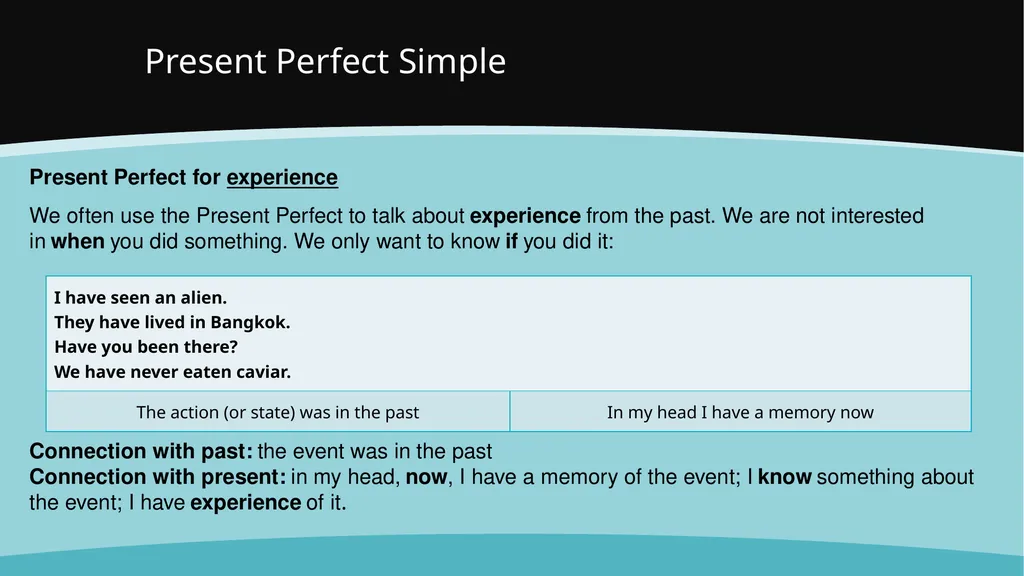
Present Perfect Simple Present Perfect for experience
We often use the Present Perfect to talk about experience from the past. We are not interested in when you did something. We only want to know if you did it:
Connection with past: the event was in the past Connection with present: in my head, now, I have a memory of the event; I know something about the event; I have experience of it.<br>
We often use the Present Perfect to talk about experience from the past. We are not interested in when you did something. We only want to know if you did it:
Connection with past: the event was in the past Connection with present: in my head, now, I have a memory of the event; I know something about the event; I have experience of it.<br>
05
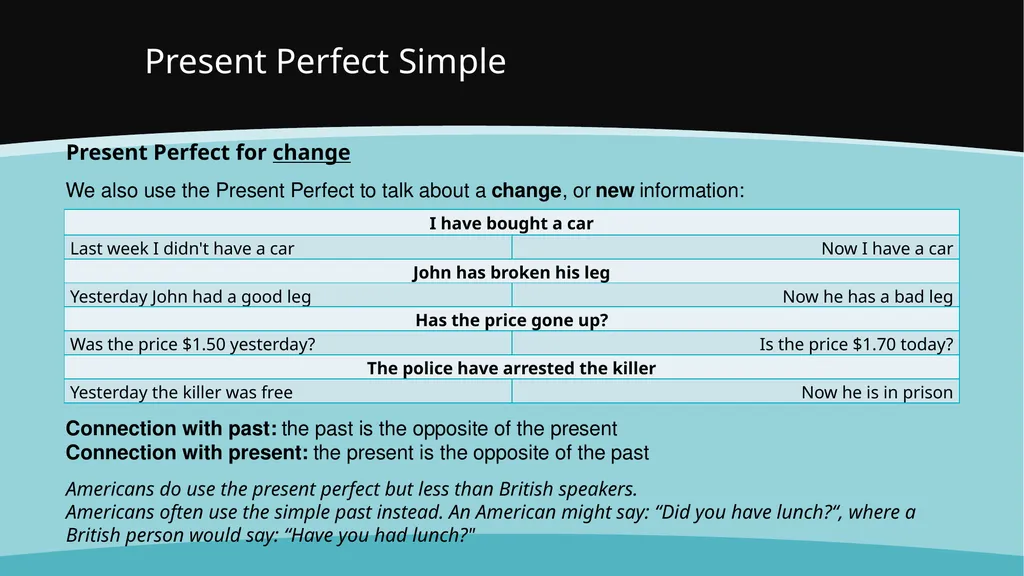
Present Perfect Simple Present Perfect for change
We also use the Present Perfect to talk about a change, or new information:
Connection with past: the past is the opposite of the present
Connection with present: the present is the opposite of the past
Americans do use the present perfect but less than British speakers.
Americans often use the simple past instead. An American might say: “Did you have lunch?“, where a British person would say: “Have you had lunch?"<br>
We also use the Present Perfect to talk about a change, or new information:
Connection with past: the past is the opposite of the present
Connection with present: the present is the opposite of the past
Americans do use the present perfect but less than British speakers.
Americans often use the simple past instead. An American might say: “Did you have lunch?“, where a British person would say: “Have you had lunch?"<br>
06
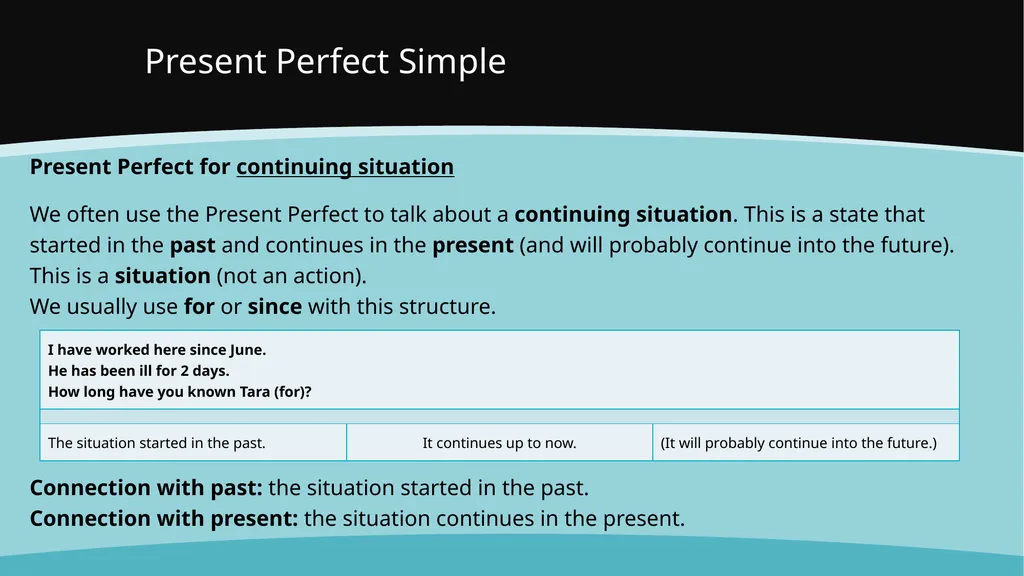
Present Perfect Simple Present Perfect for continuing situation
We often use the Present Perfect to talk about a continuing situation. This is a state that started in the past and continues in the present (and will probably continue into the future).
This is a situation (not an action).
We usually use for or since with this structure.
Connection with past: the situation started in the past. Connection with present: the situation continues in the present.<br>
We often use the Present Perfect to talk about a continuing situation. This is a state that started in the past and continues in the present (and will probably continue into the future).
This is a situation (not an action).
We usually use for or since with this structure.
Connection with past: the situation started in the past. Connection with present: the situation continues in the present.<br>
07
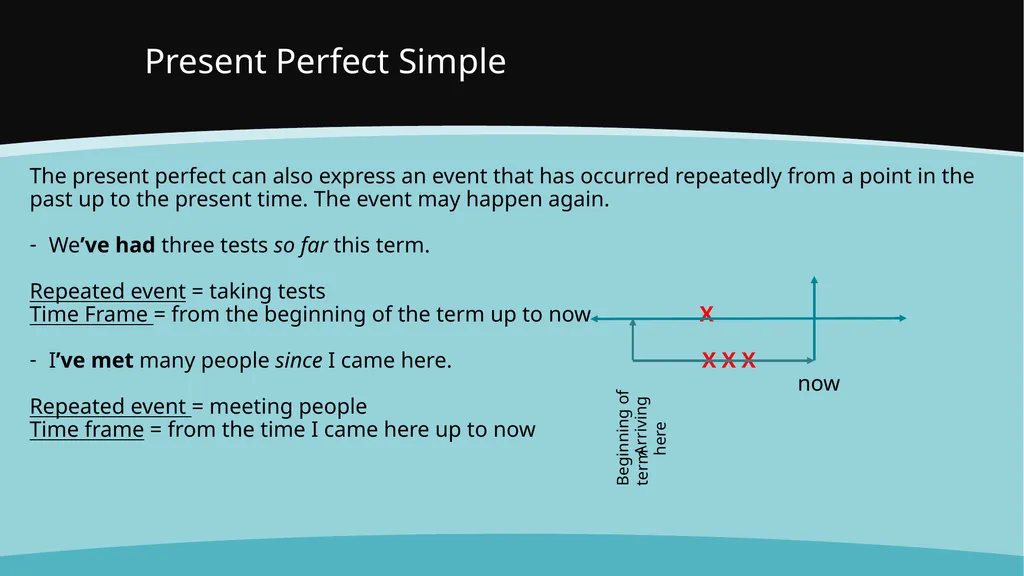
Present Perfect Simple The present perfect can also express an event that has occurred repeatedly from a point in the past up to the present time. The event may happen again.
We’ve had three tests so far this term.
Repeated event = taking tests
Time Frame = from the beginning of the term up to now X
I’ve met many people since I came here. X X X
now
Repeated event = meeting people
Time frame = from the time I came here up to now Beginning of term Arriving here<br>
We’ve had three tests so far this term.
Repeated event = taking tests
Time Frame = from the beginning of the term up to now X
I’ve met many people since I came here. X X X
now
Repeated event = meeting people
Time frame = from the time I came here up to now Beginning of term Arriving here<br>
08
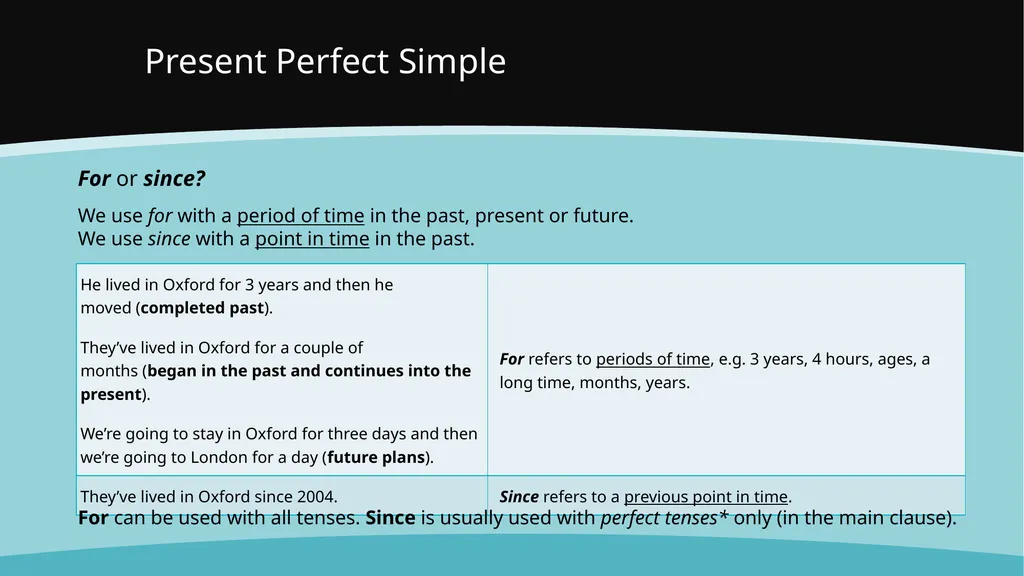
Present Perfect Simple For or since?
We use for with a period of time in the past, present or future.
We use since with a point in time in the past.
For can be used with all tenses. Since is usually used with perfect tenses* only (in the main clause).<br>
We use for with a period of time in the past, present or future.
We use since with a point in time in the past.
For can be used with all tenses. Since is usually used with perfect tenses* only (in the main clause).<br>
09
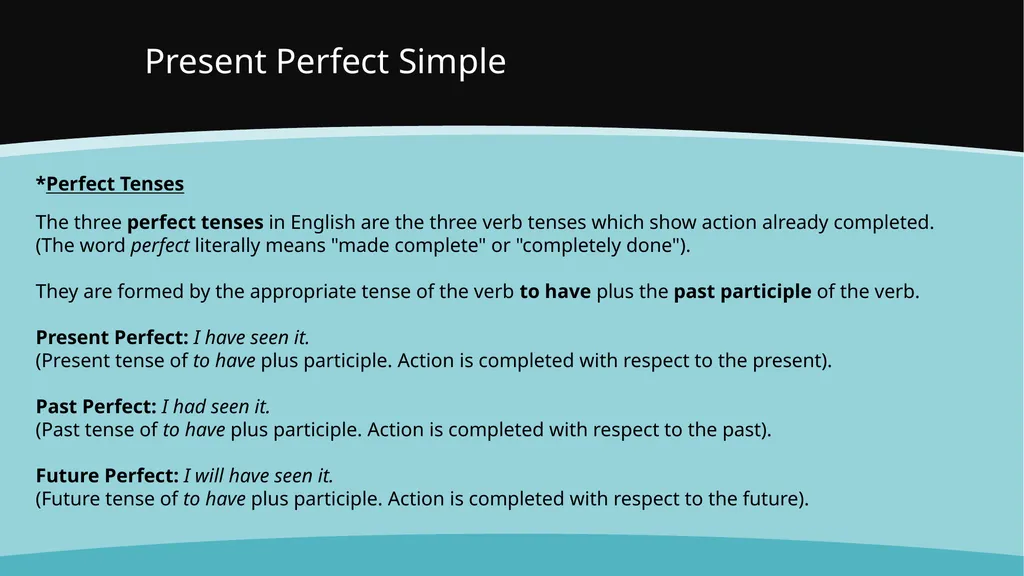
Present Perfect Simple *Perfect Tenses
The three perfect tenses in English are the three verb tenses which show action already completed. (The word perfect literally means "made complete" or "completely done").
They are formed by the appropriate tense of the verb to have plus the past participle of the verb.
Present Perfect: I have seen it. (Present tense of to have plus participle. Action is completed with respect to the present).
Past Perfect: I had seen it. (Past tense of to have plus participle. Action is completed with respect to the past).
Future Perfect: I will have seen it. (Future tense of to have plus participle. Action is completed with respect to the future).<br>
The three perfect tenses in English are the three verb tenses which show action already completed. (The word perfect literally means "made complete" or "completely done").
They are formed by the appropriate tense of the verb to have plus the past participle of the verb.
Present Perfect: I have seen it. (Present tense of to have plus participle. Action is completed with respect to the present).
Past Perfect: I had seen it. (Past tense of to have plus participle. Action is completed with respect to the past).
Future Perfect: I will have seen it. (Future tense of to have plus participle. Action is completed with respect to the future).<br>
10
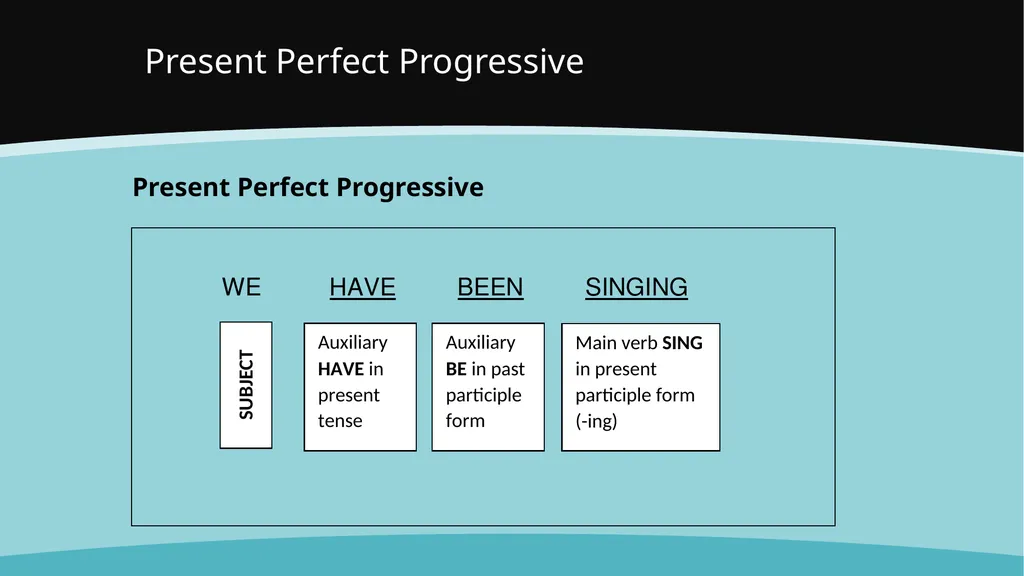
Present Perfect Progressive Present Perfect Progressive<br>
11
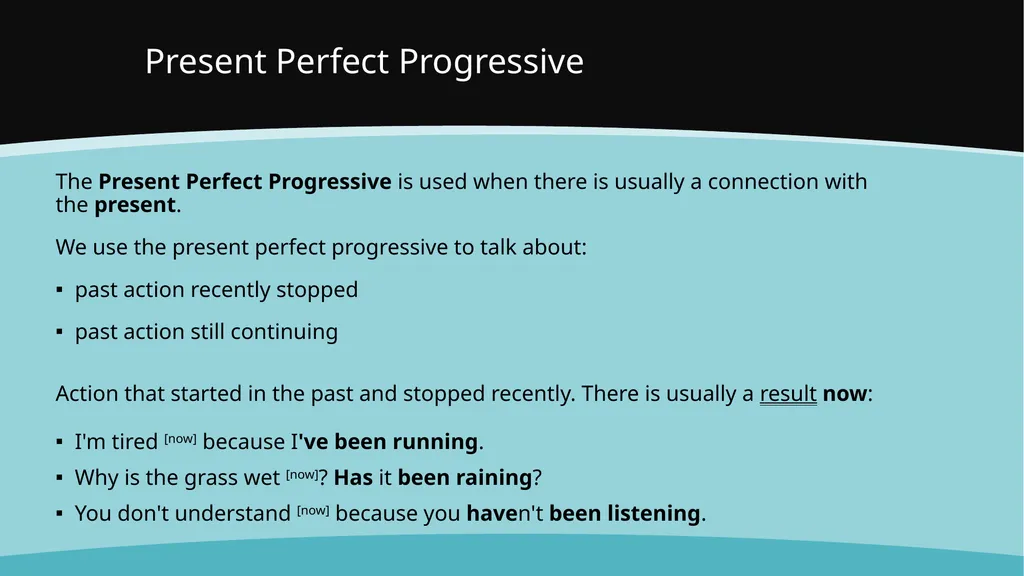
Present Perfect Progressive The Present Perfect Progressive is used when there is usually a connection with the present.
We use the present perfect progressive to talk about:
past action recently stopped
past action still continuing
Action that started in the past and stopped recently. There is usually a result now:
I'm tired [now] because I've been running.
Why is the grass wet [now]? Has it been raining?
You don't understand [now] because you haven't been listening.<br>
We use the present perfect progressive to talk about:
past action recently stopped
past action still continuing
Action that started in the past and stopped recently. There is usually a result now:
I'm tired [now] because I've been running.
Why is the grass wet [now]? Has it been raining?
You don't understand [now] because you haven't been listening.<br>
12
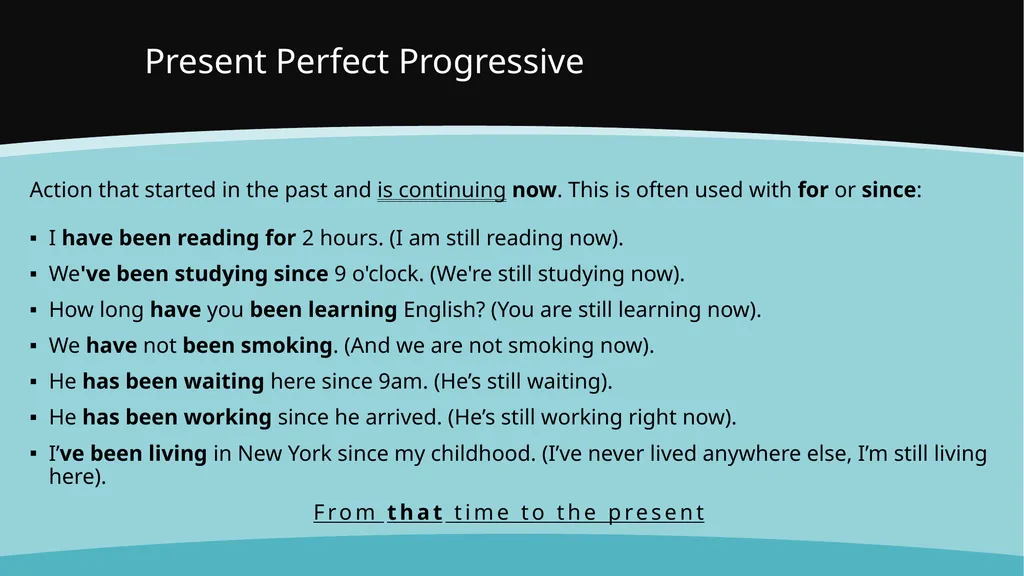
Present Perfect Progressive Action that started in the past and is continuing now. This is often used with for or since:
I have been reading for 2 hours. (I am still reading now).
We've been studying since 9 o'clock. (We're still studying now).
How long have you been learning English? (You are still learning now).
We have not been smoking. (And we are not smoking now).
He has been waiting here since 9am. (He’s still waiting).
He has been working since he arrived. (He’s still working right now).
I’ve been living in New York since my childhood. (I’ve never lived anywhere else, I’m still living here).
From that time to the present<br>
I have been reading for 2 hours. (I am still reading now).
We've been studying since 9 o'clock. (We're still studying now).
How long have you been learning English? (You are still learning now).
We have not been smoking. (And we are not smoking now).
He has been waiting here since 9am. (He’s still waiting).
He has been working since he arrived. (He’s still working right now).
I’ve been living in New York since my childhood. (I’ve never lived anywhere else, I’m still living here).
From that time to the present<br>
13
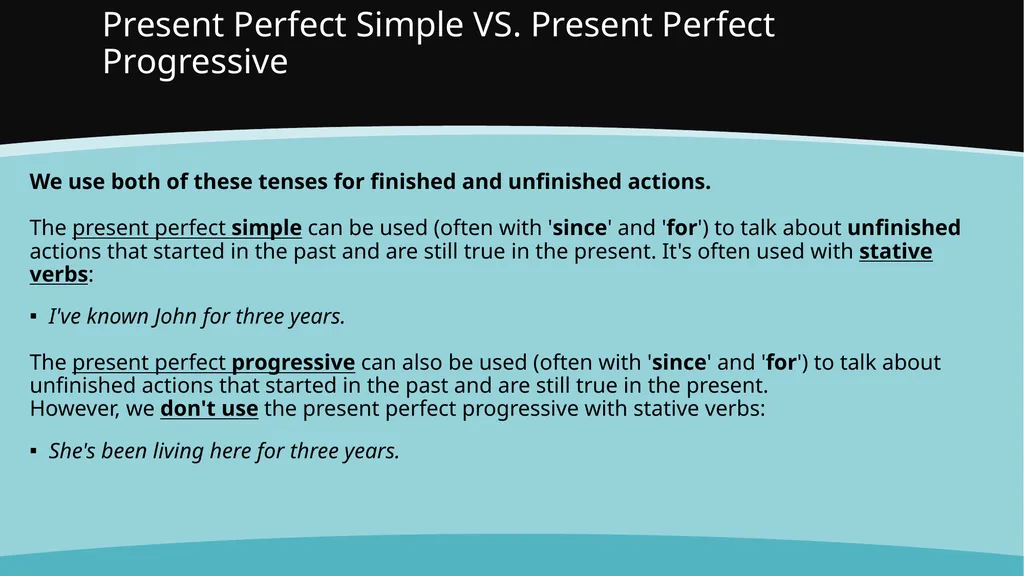
Present Perfect Simple VS. Present Perfect Progressive We use both of these tenses for finished and unfinished actions.
The present perfect simple can be used (often with 'since' and 'for') to talk about unfinished actions that started in the past and are still true in the present. It's often used with stative verbs:
I've known John for three years.
The present perfect progressive can also be used (often with 'since' and 'for') to talk about unfinished actions that started in the past and are still true in the present.
However, we don't use the present perfect progressive with stative verbs:
She's been living here for three years.<br>
I've known John for three years.
The present perfect progressive can also be used (often with 'since' and 'for') to talk about unfinished actions that started in the past and are still true in the present.
However, we don't use the present perfect progressive with stative verbs:
She's been living here for three years.<br>
14
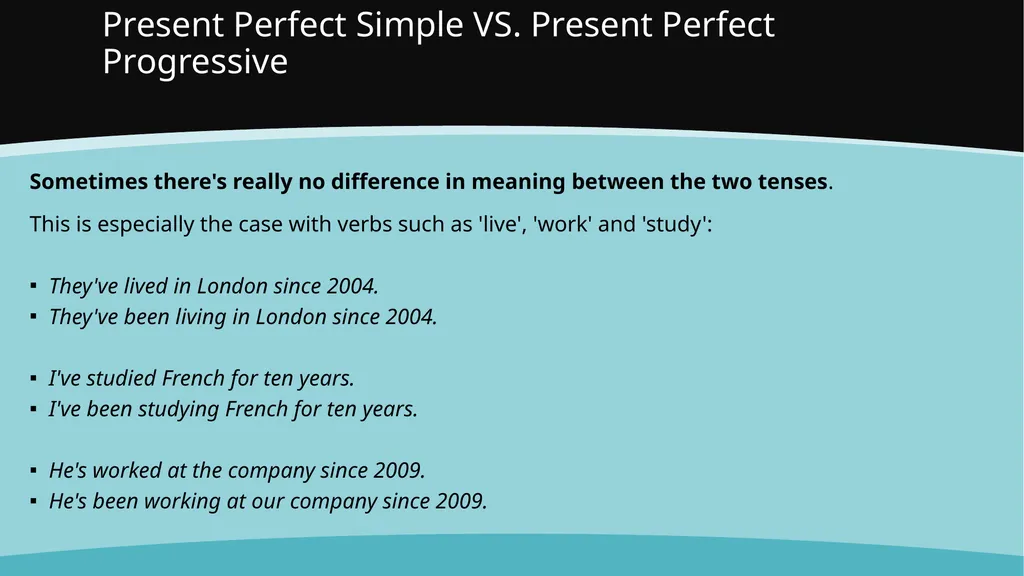
Present Perfect Simple VS. Present Perfect Progressive Sometimes there's really no difference in meaning between the two tenses.
This is especially the case with verbs such as 'live', 'work' and 'study':
They've lived in London since 2004.
They've been living in London since 2004.
I've studied French for ten years.
I've been studying French for ten years.
He's worked at the company since 2009.
He's been working at our company since 2009.<br>
This is especially the case with verbs such as 'live', 'work' and 'study':
They've lived in London since 2004.
They've been living in London since 2004.
I've studied French for ten years.
I've been studying French for ten years.
He's worked at the company since 2009.
He's been working at our company since 2009.<br>
15
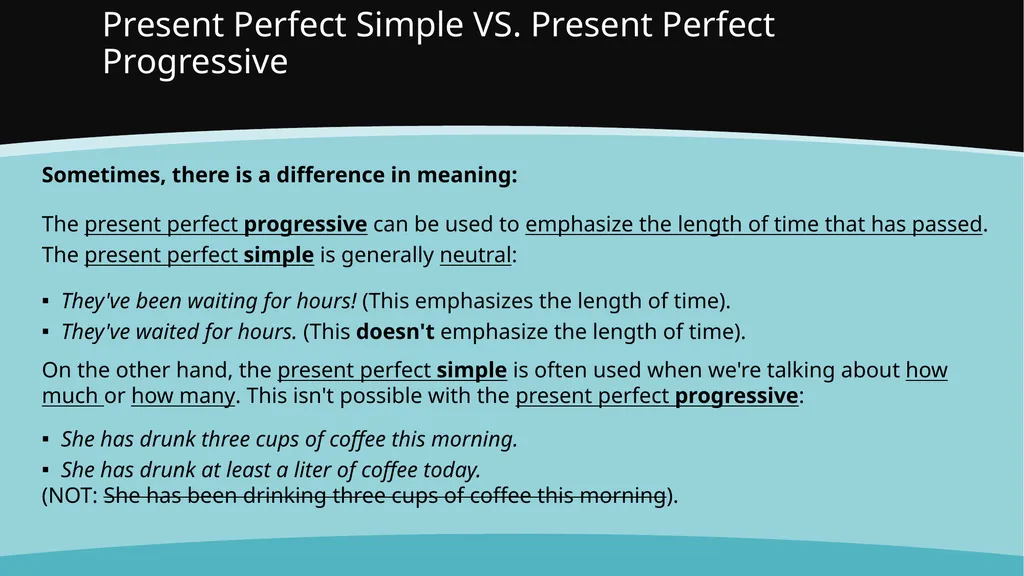
Present Perfect Simple VS. Present Perfect Progressive Sometimes, there is a difference in meaning:
The present perfect progressive can be used to emphasize the length of time that has passed.
The present perfect simple is generally neutral:
They've been waiting for hours! (This emphasizes the length of time).
They've waited for hours. (This doesn't emphasize the length of time).
On the other hand, the present perfect simple is often used when we're talking about how much or how many. This isn't possible with the present perfect progressive:
She has drunk three cups of coffee this morning.
She has drunk at least a liter of coffee today.
(NOT: She has been drinking three cups of coffee this morning).<br>
The present perfect progressive can be used to emphasize the length of time that has passed.
The present perfect simple is generally neutral:
They've been waiting for hours! (This emphasizes the length of time).
They've waited for hours. (This doesn't emphasize the length of time).
On the other hand, the present perfect simple is often used when we're talking about how much or how many. This isn't possible with the present perfect progressive:
She has drunk three cups of coffee this morning.
She has drunk at least a liter of coffee today.
(NOT: She has been drinking three cups of coffee this morning).<br>
16
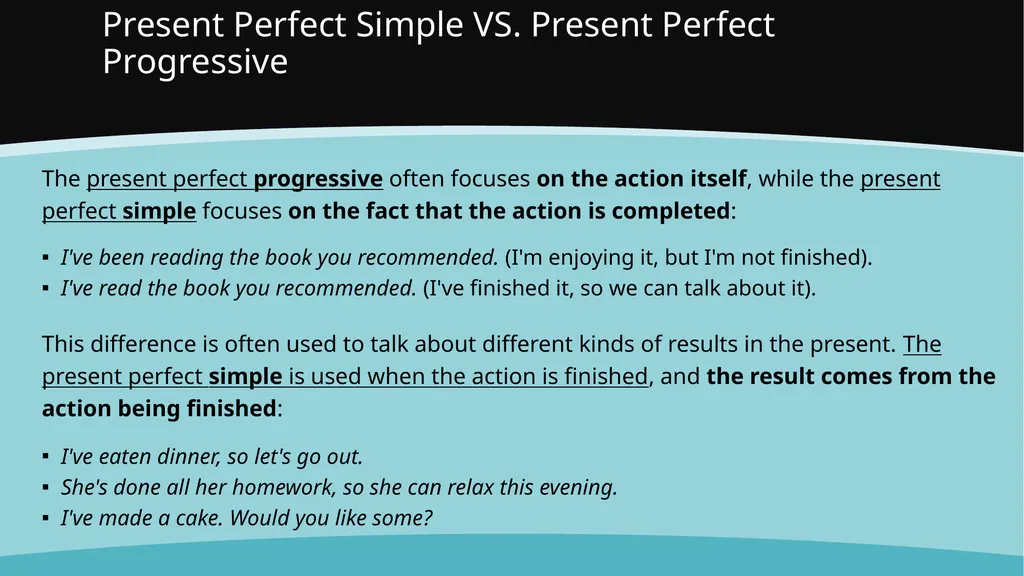
Present Perfect Simple VS. Present Perfect Progressive The present perfect progressive often focuses on the action itself, while the present perfect simple focuses on the fact that the action is completed:
I've been reading the book you recommended. (I'm enjoying it, but I'm not finished).
I've read the book you recommended. (I've finished it, so we can talk about it).
This difference is often used to talk about different kinds of results in the present. The present perfect simple is used when the action is finished, and the result comes from the action being finished:
I've eaten dinner, so let's go out.
She's done all her homework, so she can relax this evening.
I've made a cake. Would you like some?<br>
I've been reading the book you recommended. (I'm enjoying it, but I'm not finished).
I've read the book you recommended. (I've finished it, so we can talk about it).
This difference is often used to talk about different kinds of results in the present. The present perfect simple is used when the action is finished, and the result comes from the action being finished:
I've eaten dinner, so let's go out.
She's done all her homework, so she can relax this evening.
I've made a cake. Would you like some?<br>
17
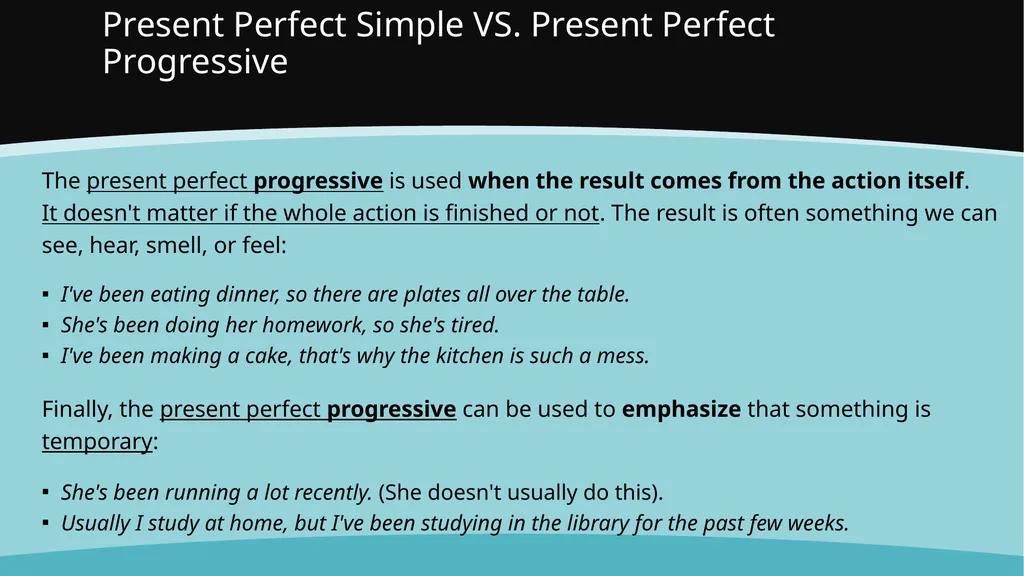
Present Perfect Simple VS. Present Perfect Progressive The present perfect progressive is used when the result comes from the action itself.
It doesn't matter if the whole action is finished or not. The result is often something we can see, hear, smell, or feel:
I've been eating dinner, so there are plates all over the table.
She's been doing her homework, so she's tired.
I've been making a cake, that's why the kitchen is such a mess.
Finally, the present perfect progressive can be used to emphasize that something is temporary:
She's been running a lot recently. (She doesn't usually do this).
Usually I study at home, but I've been studying in the library for the past few weeks.<br>
It doesn't matter if the whole action is finished or not. The result is often something we can see, hear, smell, or feel:
I've been eating dinner, so there are plates all over the table.
She's been doing her homework, so she's tired.
I've been making a cake, that's why the kitchen is such a mess.
Finally, the present perfect progressive can be used to emphasize that something is temporary:
She's been running a lot recently. (She doesn't usually do this).
Usually I study at home, but I've been studying in the library for the past few weeks.<br>
18
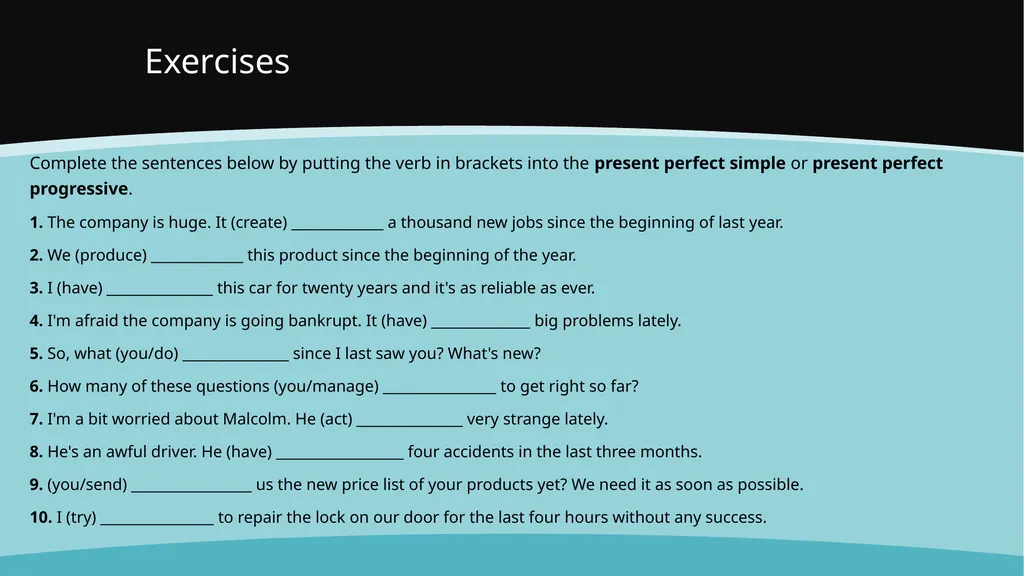
Exercises Complete the sentences below by putting the verb in brackets into the present perfect simple or present perfect progressive.
1. The company is huge. It (create) _____________ a thousand new jobs since the beginning of last year.
2. We (produce) _____________ this product since the beginning of the year.
3. I (have) _______________ this car for twenty years and it's as reliable as ever.
4. I'm afraid the company is going bankrupt. It (have) ______________ big problems lately.
5. So, what (you/do) _______________ since I last saw you? What's new?
6. How many of these questions (you/manage) ________________ to get right so far?
7. I'm a bit worried about Malcolm. He (act) _______________ very strange lately.
8. He's an awful driver. He (have) __________________ four accidents in the last three months.
9. (you/send) _________________ us the new price list of your products yet? We need it as soon as possible.
10. I (try) ________________ to repair the lock on our door for the last four hours without any success.<br>
1. The company is huge. It (create) _____________ a thousand new jobs since the beginning of last year.
2. We (produce) _____________ this product since the beginning of the year.
3. I (have) _______________ this car for twenty years and it's as reliable as ever.
4. I'm afraid the company is going bankrupt. It (have) ______________ big problems lately.
5. So, what (you/do) _______________ since I last saw you? What's new?
6. How many of these questions (you/manage) ________________ to get right so far?
7. I'm a bit worried about Malcolm. He (act) _______________ very strange lately.
8. He's an awful driver. He (have) __________________ four accidents in the last three months.
9. (you/send) _________________ us the new price list of your products yet? We need it as soon as possible.
10. I (try) ________________ to repair the lock on our door for the last four hours without any success.<br>
19
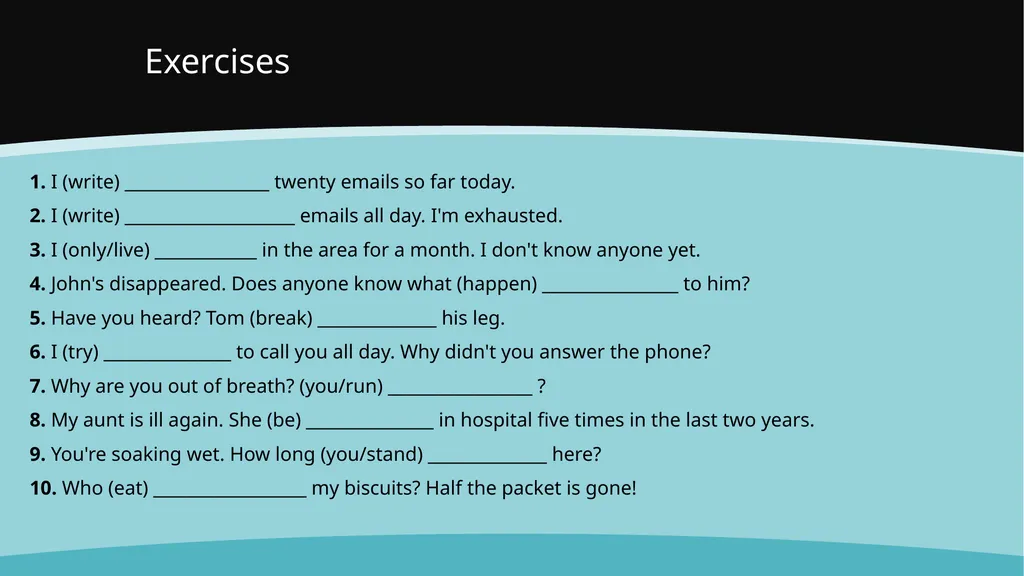
Exercises 1. I (write) _________________ twenty emails so far today.
2. I (write) ____________________ emails all day. I'm exhausted.
3. I (only/live) ____________ in the area for a month. I don't know anyone yet.
4. John's disappeared. Does anyone know what (happen) ________________ to him?
5. Have you heard? Tom (break) ______________ his leg.
6. I (try) _______________ to call you all day. Why didn't you answer the phone?
7. Why are you out of breath? (you/run) _________________ ?
8. My aunt is ill again. She (be) _______________ in hospital five times in the last two years.
9. You're soaking wet. How long (you/stand) ______________ here?
10. Who (eat) __________________ my biscuits? Half the packet is gone!<br>
2. I (write) ____________________ emails all day. I'm exhausted.
3. I (only/live) ____________ in the area for a month. I don't know anyone yet.
4. John's disappeared. Does anyone know what (happen) ________________ to him?
5. Have you heard? Tom (break) ______________ his leg.
6. I (try) _______________ to call you all day. Why didn't you answer the phone?
7. Why are you out of breath? (you/run) _________________ ?
8. My aunt is ill again. She (be) _______________ in hospital five times in the last two years.
9. You're soaking wet. How long (you/stand) ______________ here?
10. Who (eat) __________________ my biscuits? Half the packet is gone!<br>
20
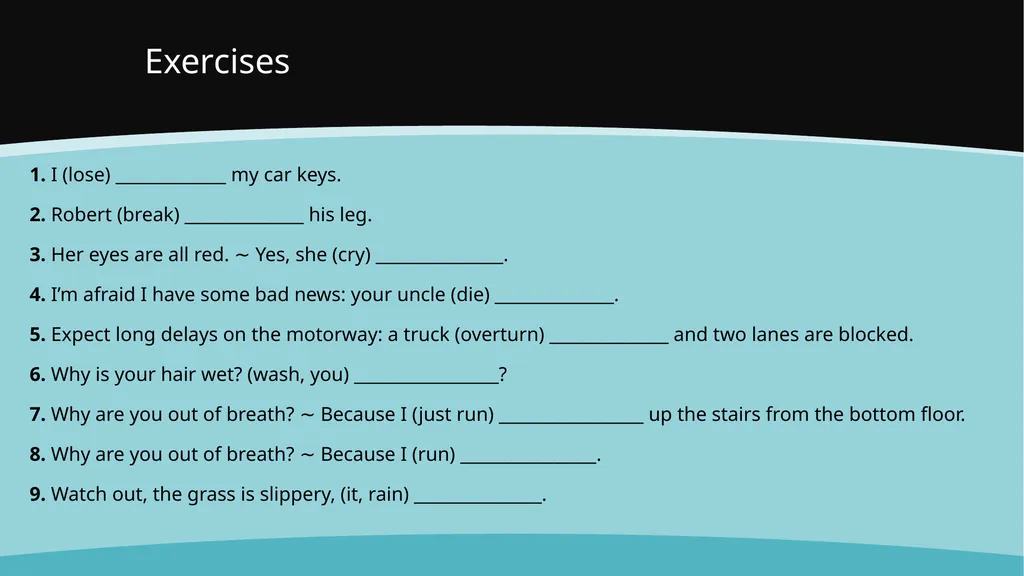
Exercises 1. I (lose) _____________ my car keys.
2. Robert (break) ______________ his leg.
3. Her eyes are all red. ∼ Yes, she (cry) _______________.
4. I’m afraid I have some bad news: your uncle (die) ______________.
5. Expect long delays on the motorway: a truck (overturn) ______________ and two lanes are blocked.
6. Why is your hair wet? (wash, you) _________________?
7. Why are you out of breath? ∼ Because I (just run) _________________ up the stairs from the bottom floor.
8. Why are you out of breath? ∼ Because I (run) ________________.
9. Watch out, the grass is slippery, (it, rain) _______________.<br>
2. Robert (break) ______________ his leg.
3. Her eyes are all red. ∼ Yes, she (cry) _______________.
4. I’m afraid I have some bad news: your uncle (die) ______________.
5. Expect long delays on the motorway: a truck (overturn) ______________ and two lanes are blocked.
6. Why is your hair wet? (wash, you) _________________?
7. Why are you out of breath? ∼ Because I (just run) _________________ up the stairs from the bottom floor.
8. Why are you out of breath? ∼ Because I (run) ________________.
9. Watch out, the grass is slippery, (it, rain) _______________.<br>
21
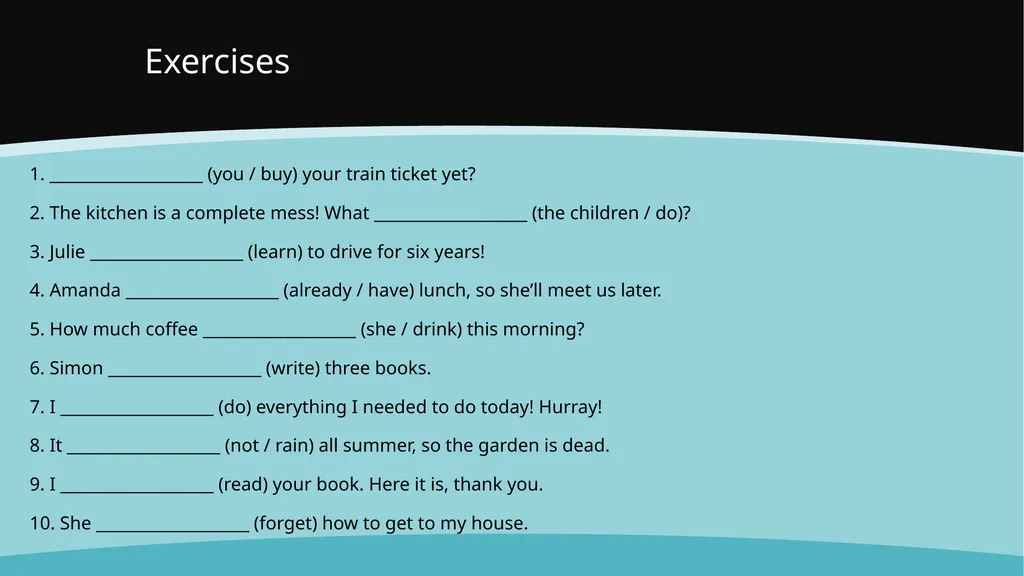
Exercises 1. ___________________ (you / buy) your train ticket yet?
2. The kitchen is a complete mess! What ___________________ (the children / do)?
3. Julie ___________________ (learn) to drive for six years!
4. Amanda ___________________ (already / have) lunch, so she’ll meet us later.
5. How much coffee ___________________ (she / drink) this morning?
6. Simon ___________________ (write) three books.
7. I ___________________ (do) everything I needed to do today! Hurray!
8. It ___________________ (not / rain) all summer, so the garden is dead.
9. I ___________________ (read) your book. Here it is, thank you.
10. She ___________________ (forget) how to get to my house.<br>
2. The kitchen is a complete mess! What ___________________ (the children / do)?
3. Julie ___________________ (learn) to drive for six years!
4. Amanda ___________________ (already / have) lunch, so she’ll meet us later.
5. How much coffee ___________________ (she / drink) this morning?
6. Simon ___________________ (write) three books.
7. I ___________________ (do) everything I needed to do today! Hurray!
8. It ___________________ (not / rain) all summer, so the garden is dead.
9. I ___________________ (read) your book. Here it is, thank you.
10. She ___________________ (forget) how to get to my house.<br>
22
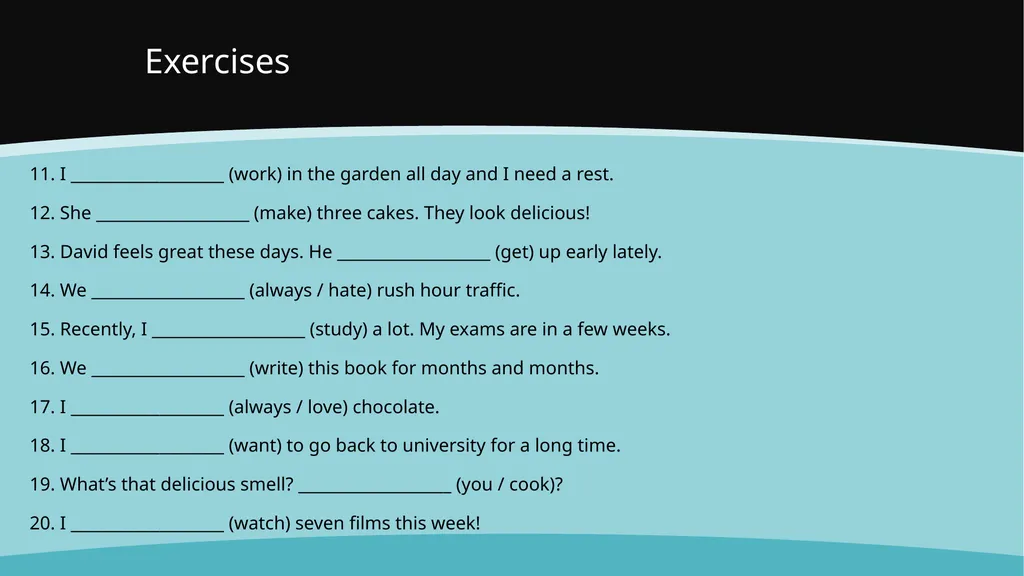
Exercises 11. I ___________________ (work) in the garden all day and I need a rest.
12. She ___________________ (make) three cakes. They look delicious!
13. David feels great these days. He ___________________ (get) up early lately.
14. We ___________________ (always / hate) rush hour traffic.
15. Recently, I ___________________ (study) a lot. My exams are in a few weeks.
16. We ___________________ (write) this book for months and months.
17. I ___________________ (always / love) chocolate.
18. I ___________________ (want) to go back to university for a long time.
19. What’s that delicious smell? ___________________ (you / cook)?
20. I ___________________ (watch) seven films this week!<br>
12. She ___________________ (make) three cakes. They look delicious!
13. David feels great these days. He ___________________ (get) up early lately.
14. We ___________________ (always / hate) rush hour traffic.
15. Recently, I ___________________ (study) a lot. My exams are in a few weeks.
16. We ___________________ (write) this book for months and months.
17. I ___________________ (always / love) chocolate.
18. I ___________________ (want) to go back to university for a long time.
19. What’s that delicious smell? ___________________ (you / cook)?
20. I ___________________ (watch) seven films this week!<br>
23
Exercises 1. I ___________________ (not / do) the housework yet.
2. They ___________________ (study) very hard recently.
3. She ___________________ (promise) to help many times.
4. He ___________________ (clean) the kitchen. Everything is sparkling clean.
5. She ___________________ (write) her essay and ___________________ (send) it to her professor.
6. He ___________________ (see) the film ‘The King’s Speech’ about six times.
7. We ___________________ (paint) our living room. I think it looks a lot better.
8. She ___________________ (take) French lessons lately.
9. It ___________________ (not / rain) for three hours! Only about one hour.
10. Lucy ___________________ (already / leave).<br>
2. They ___________________ (study) very hard recently.
3. She ___________________ (promise) to help many times.
4. He ___________________ (clean) the kitchen. Everything is sparkling clean.
5. She ___________________ (write) her essay and ___________________ (send) it to her professor.
6. He ___________________ (see) the film ‘The King’s Speech’ about six times.
7. We ___________________ (paint) our living room. I think it looks a lot better.
8. She ___________________ (take) French lessons lately.
9. It ___________________ (not / rain) for three hours! Only about one hour.
10. Lucy ___________________ (already / leave).<br>
24
Exercises 11. How many times ___________________ (you / visit) Scotland?
12. I ___________________ (call) John for hours and hours and he hasn’t answered. I’m really angry with him!
13. I ___________________ (be) in London for three years.
14. We ___________________ (know) James for ages.
15. It’s really smelly in here. ___________________ (somebody / smoke)?
16. How much bread ___________________ (she / buy)?
17. She ___________________ (eat) chocolate all morning, so she feels sick.
18. I ___________________ (paint) my house all day, but it’s not finished yet.
19. Julie ___________________ (be) at the office since 6 am.
20. The writer ___________________ (deserve) this award for a long time.<br>
12. I ___________________ (call) John for hours and hours and he hasn’t answered. I’m really angry with him!
13. I ___________________ (be) in London for three years.
14. We ___________________ (know) James for ages.
15. It’s really smelly in here. ___________________ (somebody / smoke)?
16. How much bread ___________________ (she / buy)?
17. She ___________________ (eat) chocolate all morning, so she feels sick.
18. I ___________________ (paint) my house all day, but it’s not finished yet.
19. Julie ___________________ (be) at the office since 6 am.
20. The writer ___________________ (deserve) this award for a long time.<br>
25
Reading A Risky Combination: the young person’s brain and the lure of viral challenges
Love them or hate them, viral challenges have been all over social media in recent years. These online dares are often harmless fun. Take the Ice Bucket challenge, which involved people throwing buckets of ice water over their heads in the name of charity.
Some viral challenges, however, are less innocuous. The Laundry Pod challenge encouraged participants to eat (yes, eat) a capsule of laundry detergent. This landed dozens of people in the emergency room.
In another challenge, people imitated events in the popular film Bird Box, by doing everyday activities blindfolded. Predictably, this resulted in injuries and at least one auto accident.
In the wake of these incidents, social media companies decided that they had a responsibility to keep users from harm and banned dangerous challenges. However, the popularity of these challenges begs the question: what made them so alluring in the first place? The answer could be human nature. Or, in particular, “young” human nature.
Viral challenge participants are usually between 13 and 25 years old. This is no surprise.
The key component of these videos is often risk, and some evidence suggests that young brains are predisposed to taking risks. Various neuroscientific studies have found that teens and young adults may be hardwired to make poor judgment calls. This trait simply reflects their stage of cognitive development.<br>
Love them or hate them, viral challenges have been all over social media in recent years. These online dares are often harmless fun. Take the Ice Bucket challenge, which involved people throwing buckets of ice water over their heads in the name of charity.
Some viral challenges, however, are less innocuous. The Laundry Pod challenge encouraged participants to eat (yes, eat) a capsule of laundry detergent. This landed dozens of people in the emergency room.
In another challenge, people imitated events in the popular film Bird Box, by doing everyday activities blindfolded. Predictably, this resulted in injuries and at least one auto accident.
In the wake of these incidents, social media companies decided that they had a responsibility to keep users from harm and banned dangerous challenges. However, the popularity of these challenges begs the question: what made them so alluring in the first place? The answer could be human nature. Or, in particular, “young” human nature.
Viral challenge participants are usually between 13 and 25 years old. This is no surprise.
The key component of these videos is often risk, and some evidence suggests that young brains are predisposed to taking risks. Various neuroscientific studies have found that teens and young adults may be hardwired to make poor judgment calls. This trait simply reflects their stage of cognitive development.<br>
26
Reading The pre-frontal cortex of the brain plays an important role in the inhibition of risk-taking behavior. This area analyzes potential risk and gives the all-clear to proceed with action.
However, the pre-frontal cortex does not fully develop until the age of 25, meaning that young people do not have the same capacity as adults when it comes to analyzing risk.
Furthermore, research suggests that most young people have a reward-seeking brain. That is, they are more sensitive to the rewards associated with a goal or challenge than adults are. The bragging rights, the kudos, and the “likes” that can be gained for completing such daredevil antics seem to outweigh the dangers for many young people. Of all the benefits of social media, the chance of social recognition is seen as particularly attractive.
Beyond the science, there may be other elements involved in making viral challenges popular. One is a fear of missing out on the latest trends. Many young people are constantly connected to social media.
Disconnecting can cause anxiety and a feeling that they might miss out something important. Some studies report that this social anxiety is one of the main causes of social media addiction among young people. Their constant online presence means more exposure to viral challenges and perhaps a stronger desire to participate. Whether the main factor compelling young people to take part in these challenges is social or cognitive, findings suggest that it is inherent. They have a built-in tendency towards risk-taking, and risky viral challenges merely add fuel to the fire.<br>
However, the pre-frontal cortex does not fully develop until the age of 25, meaning that young people do not have the same capacity as adults when it comes to analyzing risk.
Furthermore, research suggests that most young people have a reward-seeking brain. That is, they are more sensitive to the rewards associated with a goal or challenge than adults are. The bragging rights, the kudos, and the “likes” that can be gained for completing such daredevil antics seem to outweigh the dangers for many young people. Of all the benefits of social media, the chance of social recognition is seen as particularly attractive.
Beyond the science, there may be other elements involved in making viral challenges popular. One is a fear of missing out on the latest trends. Many young people are constantly connected to social media.
Disconnecting can cause anxiety and a feeling that they might miss out something important. Some studies report that this social anxiety is one of the main causes of social media addiction among young people. Their constant online presence means more exposure to viral challenges and perhaps a stronger desire to participate. Whether the main factor compelling young people to take part in these challenges is social or cognitive, findings suggest that it is inherent. They have a built-in tendency towards risk-taking, and risky viral challenges merely add fuel to the fire.<br>