
Presentation: Dimensional Modelling 3 Erik Perjons
CS
Published · 59 slides · 0 views

1 / 1





Description
Presentation: Dimensional Modelling 3 Erik Perjons DSV, Stockholm University More about facts and fact tables Type of Facts Additive Facts Semi-Additive Facts Non-Additive Facts Additive Facts Additive Facts are facts that are additive
Related Topics
Share
Embed code
Download this presentation From Below
"Presentation: Dimensional Modelling 3 Erik Perjons" is the property of its rightful owner. Permission is granted to download and print the materials on this website for personal, non-commercial use only, and to display it on your personal computer provided you do not modify the materials and that you retain all copyright notices contained in the materials. By downloading content from our website, you accept the terms of this agreement.
Presentation Transcript
01
Presentation:
Dimensional Modelling 3 Erik Perjons
DSV, Stockholm University<br>
DSV, Stockholm University<br>
02
More about facts and fact tables<br>
03
Type of Facts Additive Facts
Semi-Additive Facts
Non-Additive Facts<br>
Semi-Additive Facts
Non-Additive Facts<br>
04
Additive Facts Additive Facts – are facts that are additive across all dimensions
Example: Sales amount, Cost dollar amount, Sales quantity<br>
Example: Sales amount, Cost dollar amount, Sales quantity<br>
05
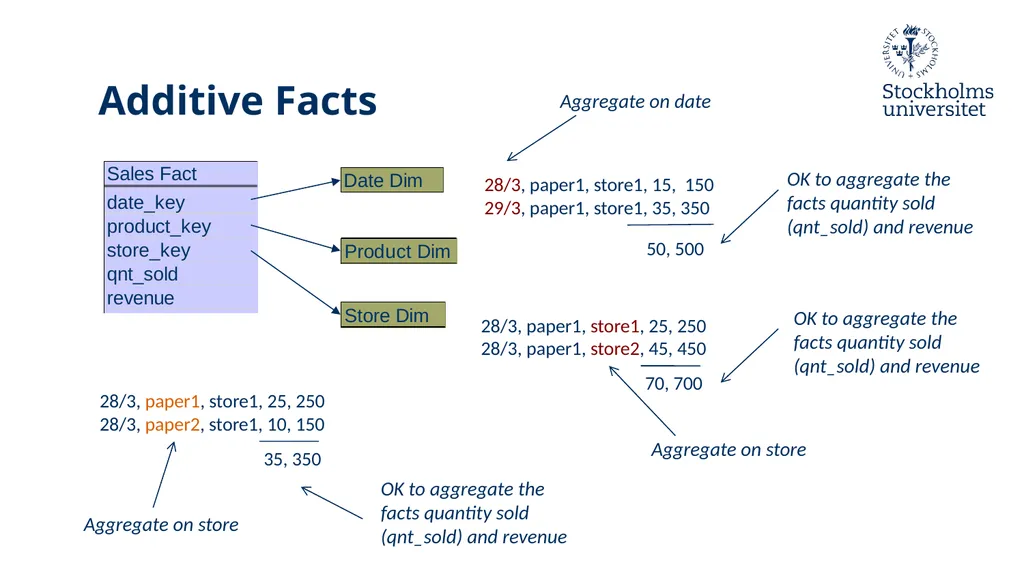
Additive Facts 28/3, paper1, store1, 25, 250
28/3, paper1, store2, 45, 450 70, 700 28/3, paper1, store1, 15, 150
29/3, paper1, store1, 35, 350 50, 500 Aggregate on date Aggregate on store OK to aggregate the facts quantity sold (qnt_sold) and revenue OK to aggregate the facts quantity sold (qnt_sold) and revenue 28/3, paper1, store1, 25, 250
28/3, paper2, store1, 10, 150 35, 350 Aggregate on store OK to aggregate the facts quantity sold (qnt_sold) and revenue<br>
28/3, paper1, store2, 45, 450 70, 700 28/3, paper1, store1, 15, 150
29/3, paper1, store1, 35, 350 50, 500 Aggregate on date Aggregate on store OK to aggregate the facts quantity sold (qnt_sold) and revenue OK to aggregate the facts quantity sold (qnt_sold) and revenue 28/3, paper1, store1, 25, 250
28/3, paper2, store1, 10, 150 35, 350 Aggregate on store OK to aggregate the facts quantity sold (qnt_sold) and revenue<br>
06
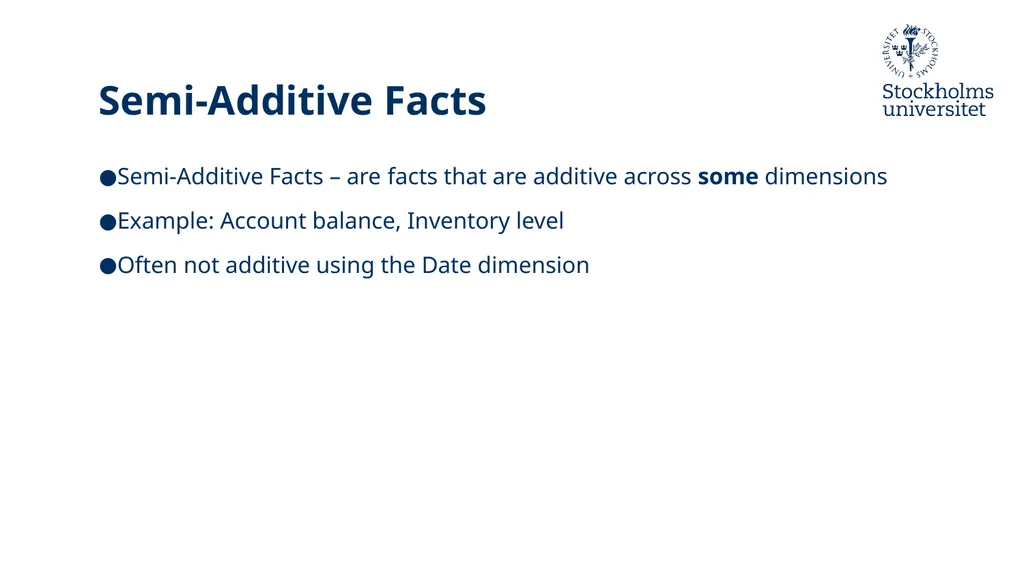
Semi-Additive Facts Semi-Additive Facts – are facts that are additive across some dimensions
Example: Account balance, Inventory level
Often not additive using the Date dimension<br>
Example: Account balance, Inventory level
Often not additive using the Date dimension<br>
07
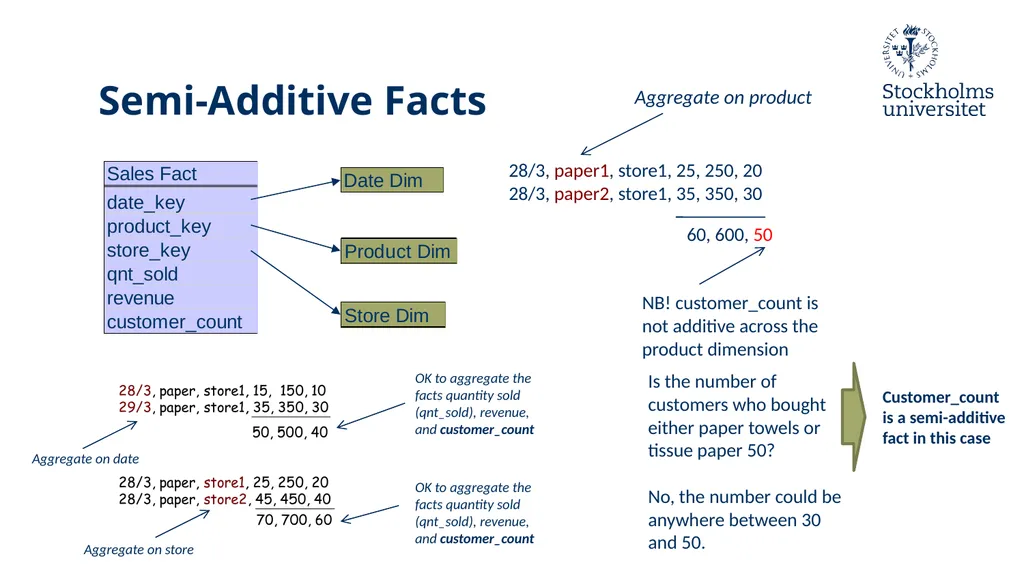
Semi-Additive Facts 28/3, paper1, store1, 25, 250, 20
28/3, paper2, store1, 35, 350, 30 60, 600, 50 NB! customer_count is not additive across the product dimension Is the number of customers who bought either paper towels or tissue paper 50?
No, the number could be anywhere between 30 and 50. Aggregate on product OK to aggregate the facts quantity sold (qnt_sold), revenue, and customer_count OK to aggregate the facts quantity sold (qnt_sold), revenue, and customer_count Aggregate on date Aggregate on store Customer_count is a semi-additive fact in this case<br>
28/3, paper2, store1, 35, 350, 30 60, 600, 50 NB! customer_count is not additive across the product dimension Is the number of customers who bought either paper towels or tissue paper 50?
No, the number could be anywhere between 30 and 50. Aggregate on product OK to aggregate the facts quantity sold (qnt_sold), revenue, and customer_count OK to aggregate the facts quantity sold (qnt_sold), revenue, and customer_count Aggregate on date Aggregate on store Customer_count is a semi-additive fact in this case<br>
08
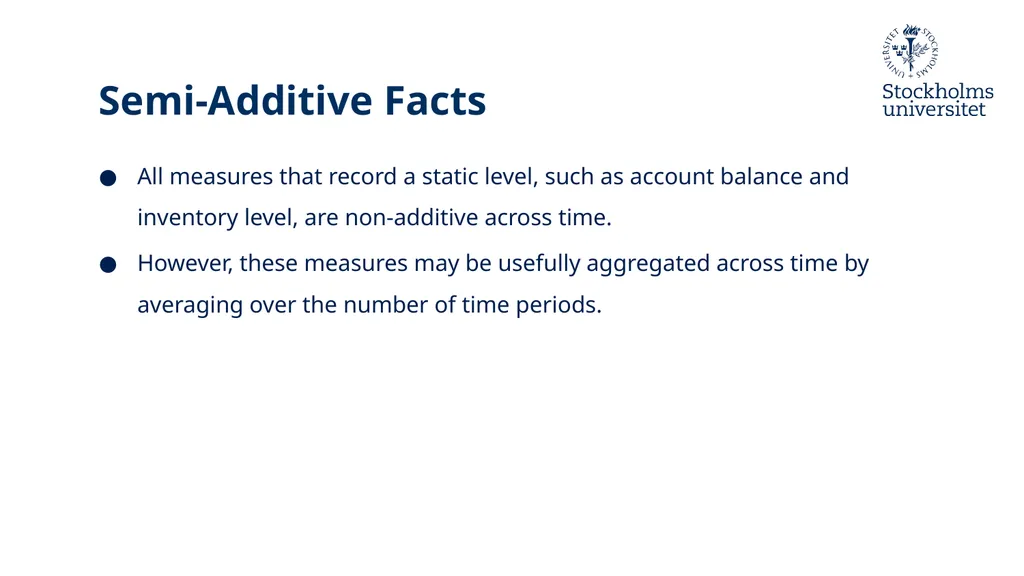
Semi-Additive Facts All measures that record a static level, such as account balance and inventory level, are non-additive across time.
However, these measures may be usefully aggregated across time by averaging over the number of time periods.<br>
However, these measures may be usefully aggregated across time by averaging over the number of time periods.<br>
09
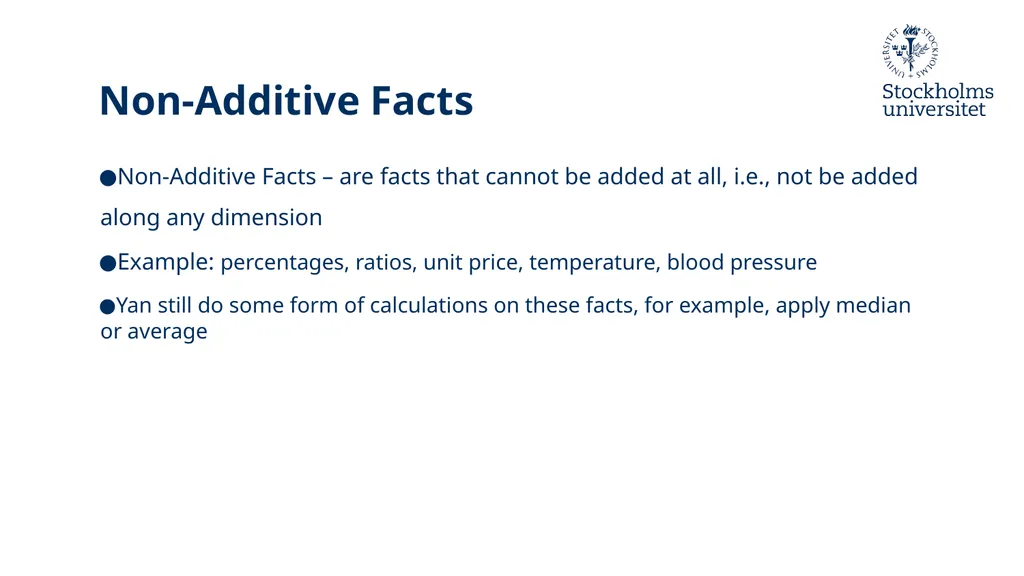
Non-Additive Facts Non-Additive Facts – are facts that cannot be added at all, i.e., not be added along any dimension
Example: percentages, ratios, unit price, temperature, blood pressure
Yan still do some form of calculations on these facts, for example, apply median or average<br>
Example: percentages, ratios, unit price, temperature, blood pressure
Yan still do some form of calculations on these facts, for example, apply median or average<br>
10
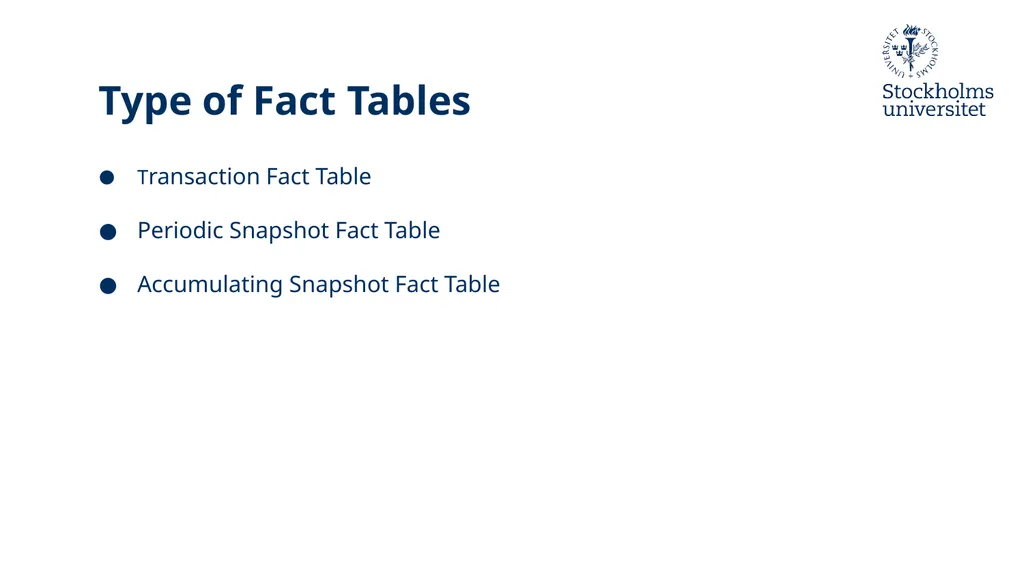
Type of Fact Tables Transaction Fact Table
Periodic Snapshot Fact Table
Accumulating Snapshot Fact Table<br>
Periodic Snapshot Fact Table
Accumulating Snapshot Fact Table<br>
11
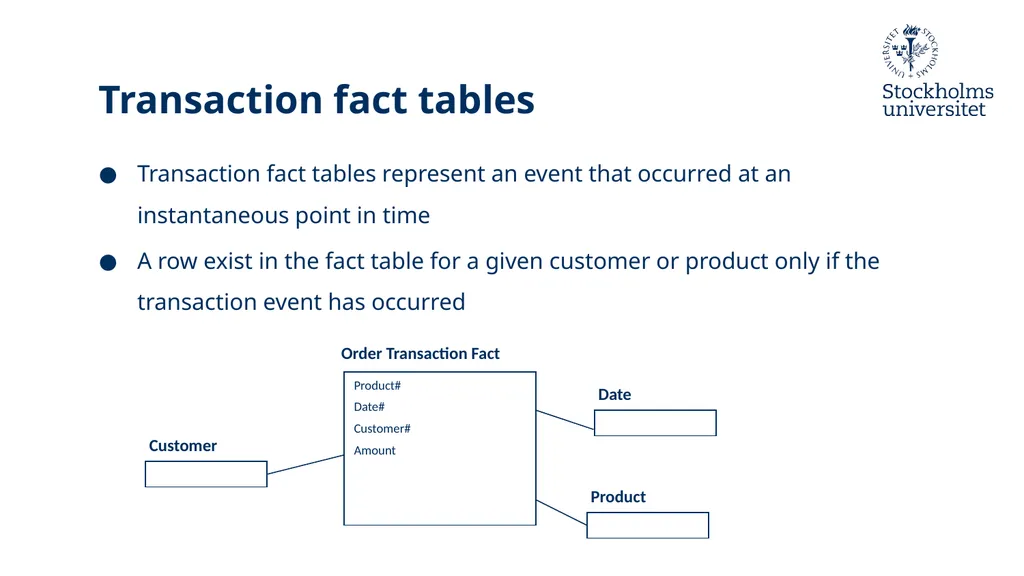
Transaction fact tables Transaction fact tables represent an event that occurred at an instantaneous point in time
A row exist in the fact table for a given customer or product only if the transaction event has occurred Order Transaction Fact Product#
Date#
Customer#
Amount Date Product Customer<br>
A row exist in the fact table for a given customer or product only if the transaction event has occurred Order Transaction Fact Product#
Date#
Customer#
Amount Date Product Customer<br>
12
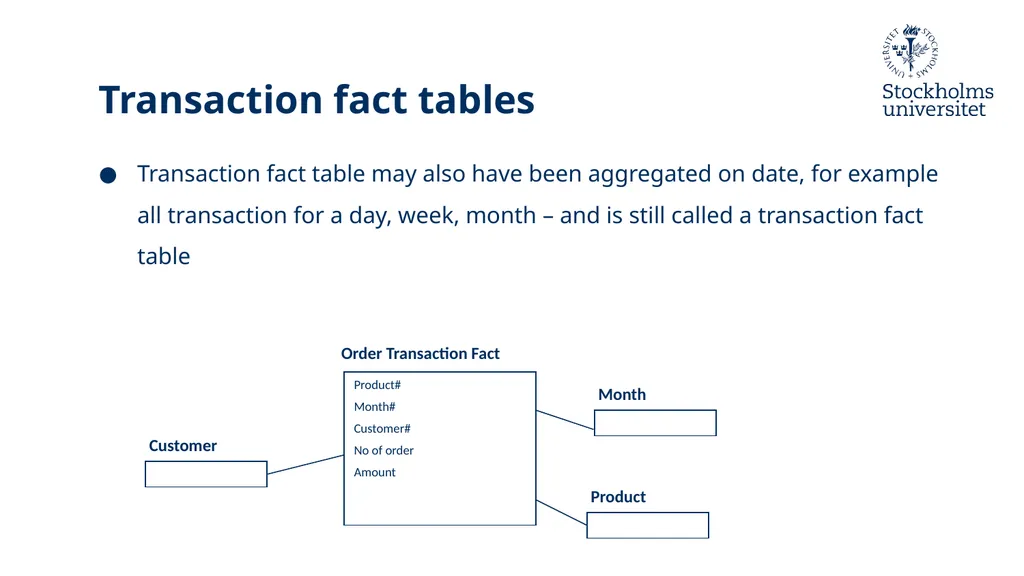
Transaction fact tables Transaction fact table may also have been aggregated on date, for example all transaction for a day, week, month – and is still called a transaction fact table Order Transaction Fact Product#
Month#
Customer#
No of order
Amount Month Product Customer<br>
Month#
Customer#
No of order
Amount Month Product Customer<br>
13
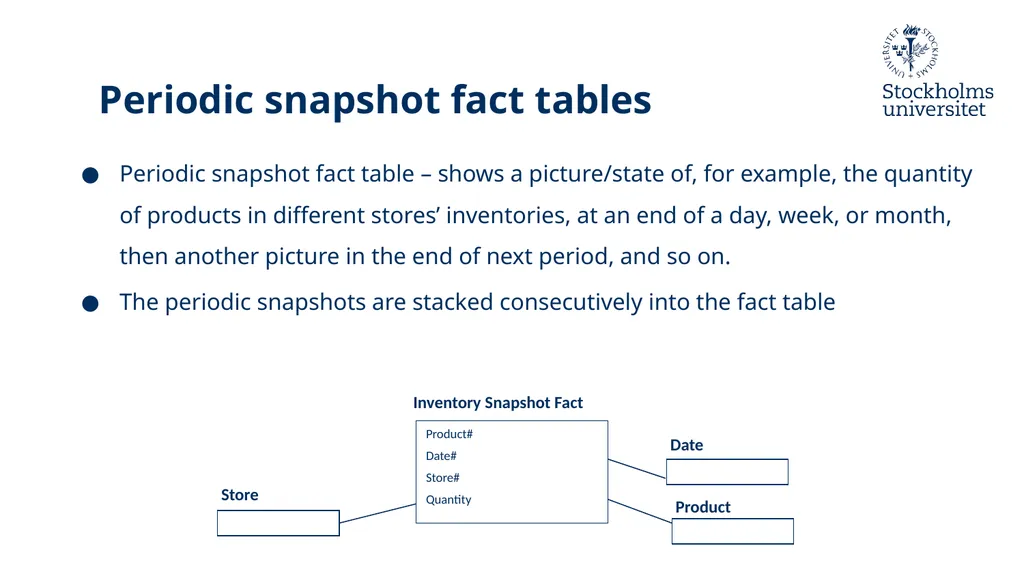
Periodic snapshot fact tables Periodic snapshot fact table – shows a picture/state of, for example, the quantity of products in different stores’ inventories, at an end of a day, week, or month, then another picture in the end of next period, and so on.
The periodic snapshots are stacked consecutively into the fact table Inventory Snapshot Fact Product#
Date#
Store#
Quantity Date Product Store<br>
The periodic snapshots are stacked consecutively into the fact table Inventory Snapshot Fact Product#
Date#
Store#
Quantity Date Product Store<br>
14
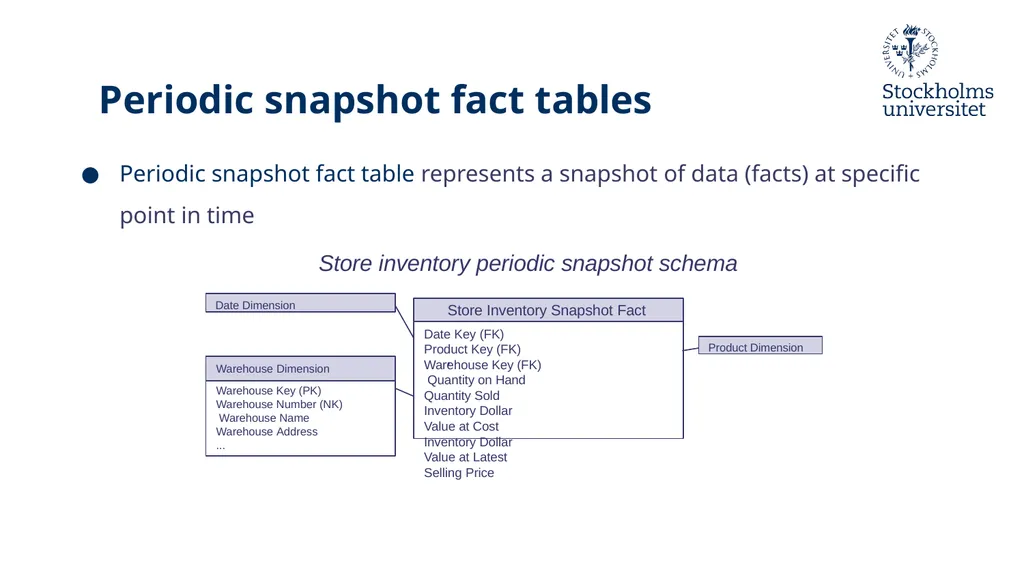
Periodic snapshot fact tables Periodic snapshot fact table represents a snapshot of data (facts) at specific point in time Warehouse Dimension Product Dimension Store Inventory Snapshot Fact Date Key (FK) Product Key (FK) Warehouse Key (FK) Quantity on Hand Quantity Sold
Inventory Dollar Value at Cost
Inventory Dollar Value at Latest Selling Price Date Dimension Warehouse Key (PK) Warehouse Number (NK) Warehouse Name Warehouse Address
... Store inventory periodic snapshot schema<br>
Inventory Dollar Value at Cost
Inventory Dollar Value at Latest Selling Price Date Dimension Warehouse Key (PK) Warehouse Number (NK) Warehouse Name Warehouse Address
... Store inventory periodic snapshot schema<br>
15
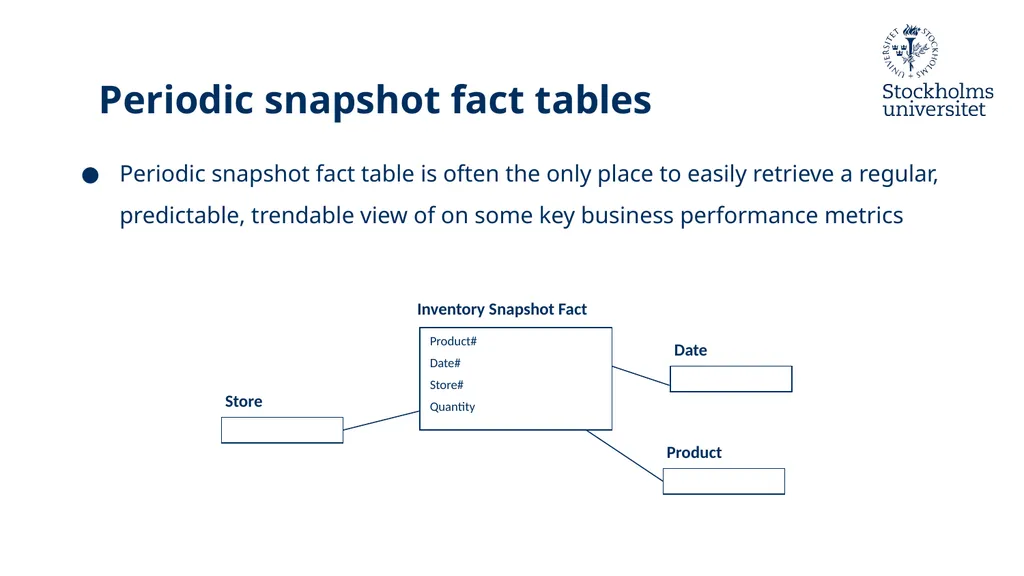
Periodic snapshot fact tables Periodic snapshot fact table is often the only place to easily retrieve a regular, predictable, trendable view of on some key business performance metrics Inventory Snapshot Fact Product#
Date#
Store#
Quantity Date Product Store<br>
Date#
Store#
Quantity Date Product Store<br>
16
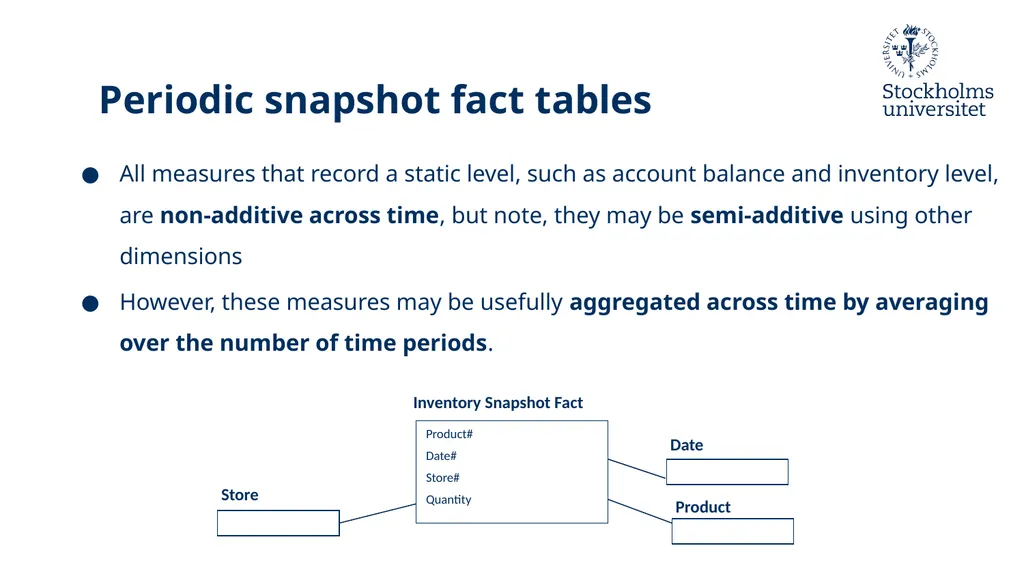
Periodic snapshot fact tables All measures that record a static level, such as account balance and inventory level, are non-additive across time, but note, they may be semi-additive using other dimensions
However, these measures may be usefully aggregated across time by averaging over the number of time periods. Inventory Snapshot Fact Product#
Date#
Store#
Quantity Date Product Store<br>
However, these measures may be usefully aggregated across time by averaging over the number of time periods. Inventory Snapshot Fact Product#
Date#
Store#
Quantity Date Product Store<br>
17
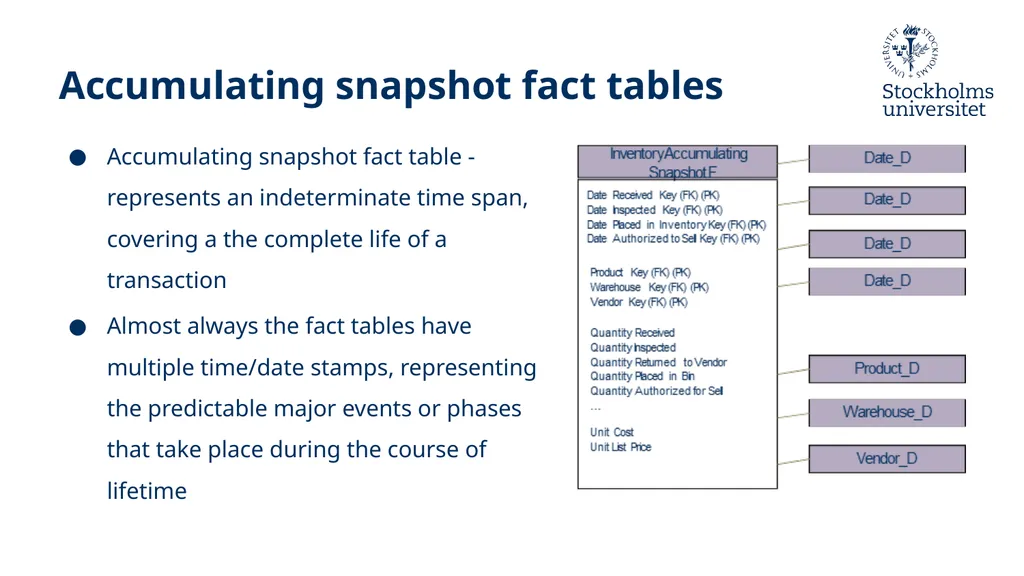
Accumulating snapshot fact tables Accumulating snapshot fact table - represents an indeterminate time span, covering a the complete life of a transaction
Almost always the fact tables have multiple time/date stamps, representing the predictable major events or phases that take place during the course of lifetime<br>
Almost always the fact tables have multiple time/date stamps, representing the predictable major events or phases that take place during the course of lifetime<br>
18
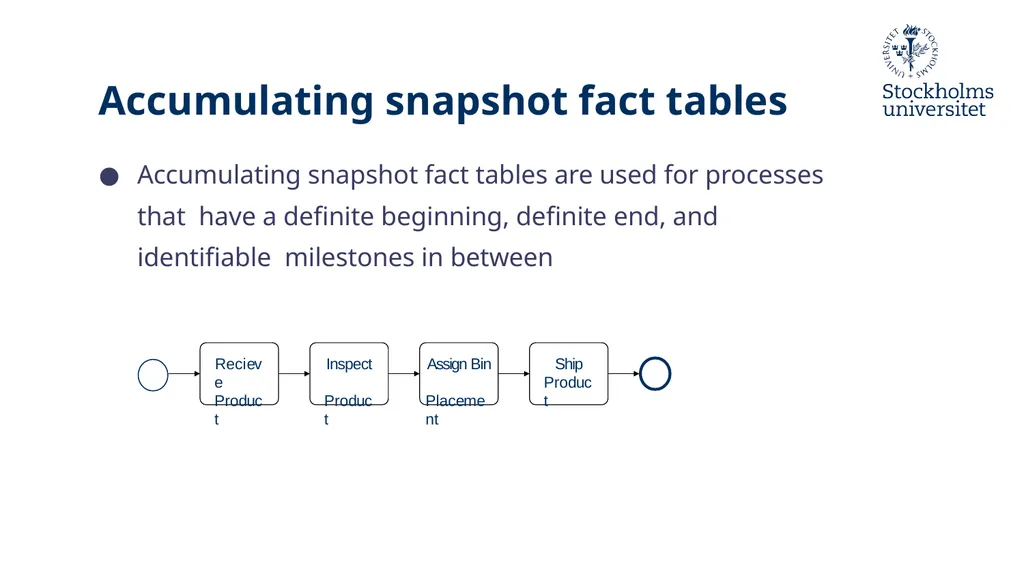
Accumulating snapshot fact tables Accumulating snapshot fact tables are used for processes that have a definite beginning, definite end, and identifiable milestones in between Recieve Product Inspect Product Assign Bin Placement Ship Product<br>
19
Accumulating snapshot fact tables In sharp contrast to the other fact table types, we purposely revisit accumulation snapshot fact table rows TO UPDATE (!!!) them. That is, we revisit them as more information becomes available
Since many of these dates are not known when the fact row is loaded, we must use surrogate date key to handle undefined dates
There need to be a row in the date dimension with the date=“unknown” or “to be determined”, when we first load the row in the fact table<br>
Since many of these dates are not known when the fact row is loaded, we must use surrogate date key to handle undefined dates
There need to be a row in the date dimension with the date=“unknown” or “to be determined”, when we first load the row in the fact table<br>
20
Factless fact tables Some fact tables quite simply have no measured facts
These fact tables are useful to describe events and coverage, i.e. the tables contain information that something has (event tracking) or has not (coverage table) happened
There are several types of factless fact tables, two of the most common are:
event tracking tables
coverage tables<br>
These fact tables are useful to describe events and coverage, i.e. the tables contain information that something has (event tracking) or has not (coverage table) happened
There are several types of factless fact tables, two of the most common are:
event tracking tables
coverage tables<br>
21
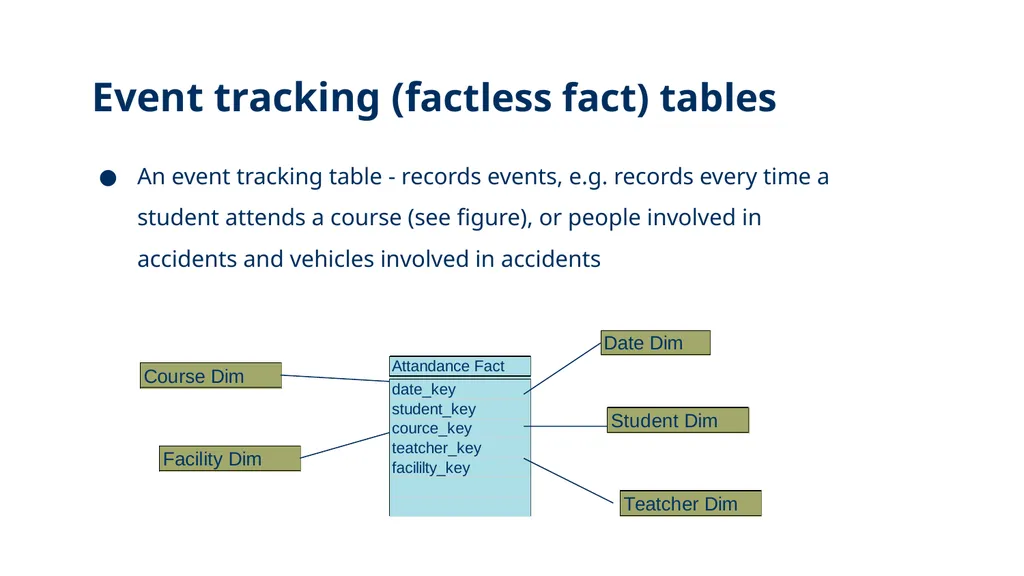
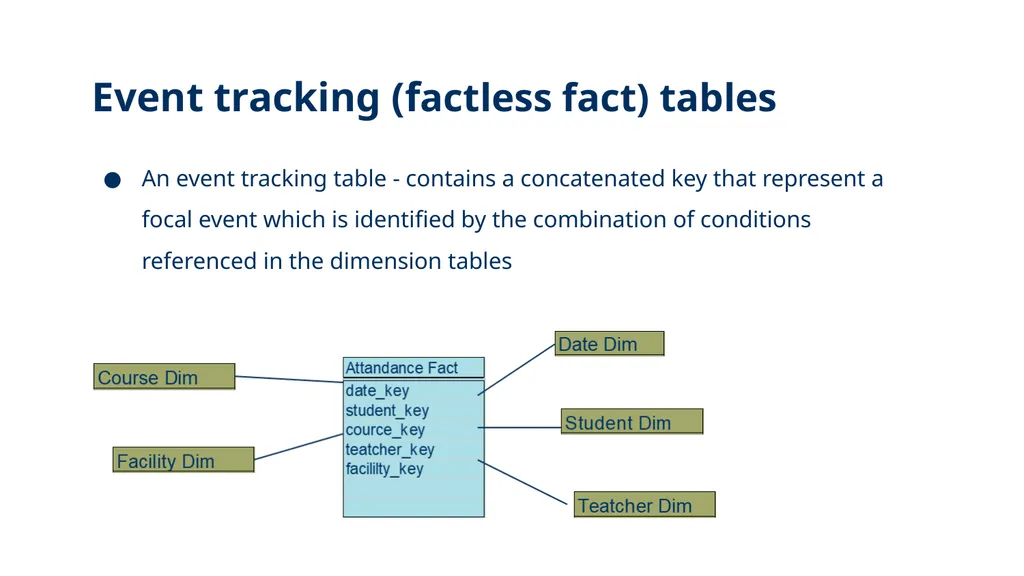
Event tracking (factless fact) tables An event tracking table - records events, e.g. records every time a student attends a course (see figure), or people involved in accidents and vehicles involved in accidents<br>
22
An event tracking table - contains a concatenated key that represent a focal event which is identified by the combination of conditions referenced in the dimension tables Event tracking (factless fact) tables<br>
23
Other types of factless fact tables Another problem that can be addressed by factless fact tables
Many to many relationships (M-to-M) between entities (tables) are difficult to deal with in any database design situation. For example, a customer can have many accounts and an account may belong to many customers
A factless fact table can be created to capture the relationship between the tables<br>
Many to many relationships (M-to-M) between entities (tables) are difficult to deal with in any database design situation. For example, a customer can have many accounts and an account may belong to many customers
A factless fact table can be created to capture the relationship between the tables<br>
24
Coverage (factless fact) tables How we can answer questions for which there is no event in the business process?
We can store all possibilities in a factless fact table in form of a coverage fact table<br>
We can store all possibilities in a factless fact table in form of a coverage fact table<br>
25
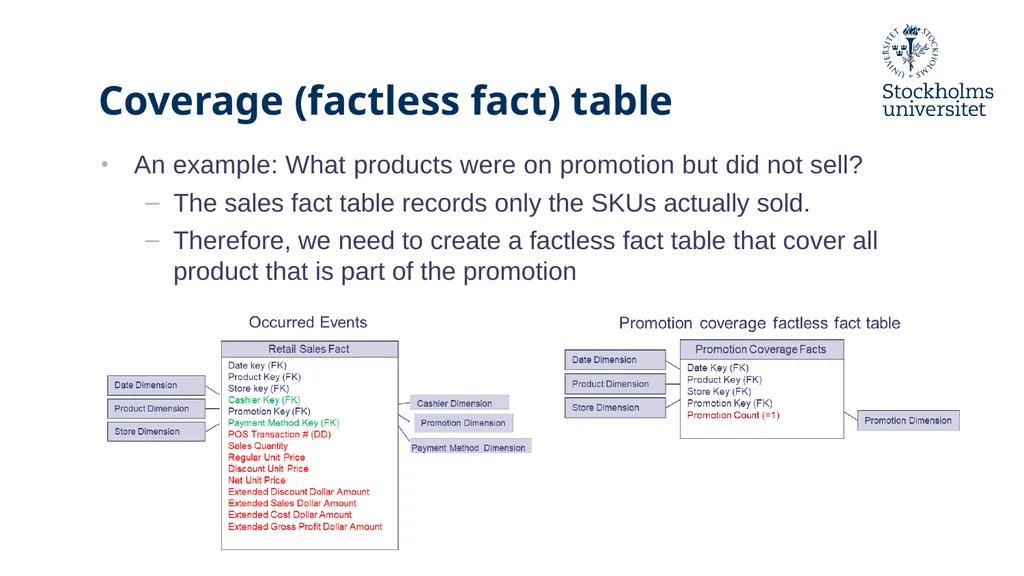
Coverage (factless fact) table An example: What products were on promotion but did not sell?
The sales fact table records only the SKUs actually sold.
Therefore, we need to create a factless fact table that cover all product that is part of the promotion<br>
The sales fact table records only the SKUs actually sold.
Therefore, we need to create a factless fact table that cover all product that is part of the promotion<br>
26
More about dimensions<br>
27
Slowly Changing Dimensions Problem to solve:
Dimension attribute values change over time, e.g., a product that belong to a department or product category, later belong to another department or category The assumption:
The key does not change, but some of the attribute values does.<br>
Dimension attribute values change over time, e.g., a product that belong to a department or product category, later belong to another department or category The assumption:
The key does not change, but some of the attribute values does.<br>
28
Slowly Changing Dimensions Type 1: Overwrite the dimension record (attribute value) with the new values, thereby losing history
Type 2: Create a new additional dimension record using a new value of the surrogate key
Type 3: Create a new field in the dimension record to store the new value of the attribute<br>
Type 2: Create a new additional dimension record using a new value of the surrogate key
Type 3: Create a new field in the dimension record to store the new value of the attribute<br>
29
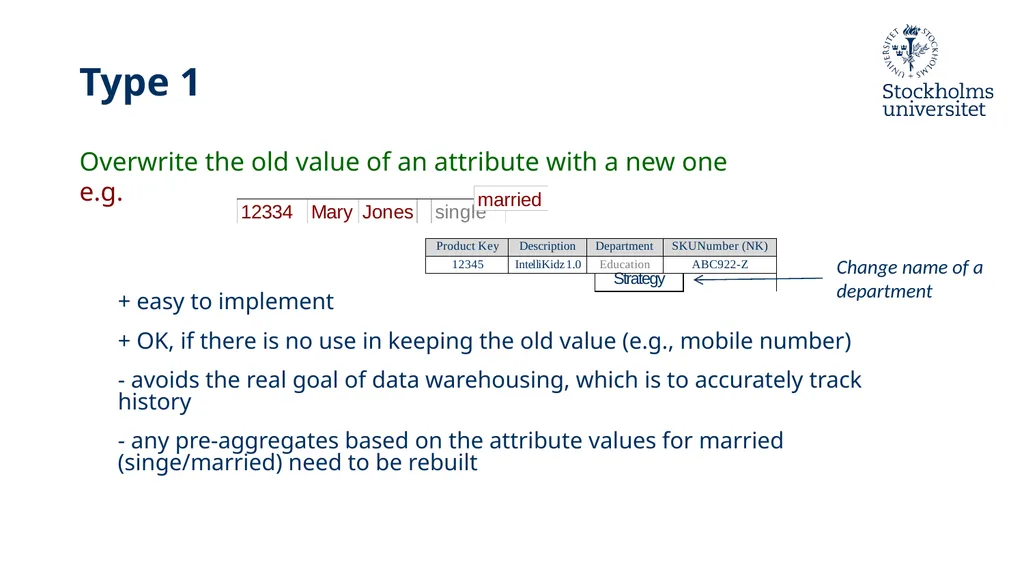
Overwrite the old value of an attribute with a new one
e.g.
+ easy to implement
+ OK, if there is no use in keeping the old value (e.g., mobile number)
- avoids the real goal of data warehousing, which is to accurately track history
- any pre-aggregates based on the attribute values for married (singe/married) need to be rebuilt Type 1 Change name of a department<br>
e.g.
+ easy to implement
+ OK, if there is no use in keeping the old value (e.g., mobile number)
- avoids the real goal of data warehousing, which is to accurately track history
- any pre-aggregates based on the attribute values for married (singe/married) need to be rebuilt Type 1 Change name of a department<br>
30
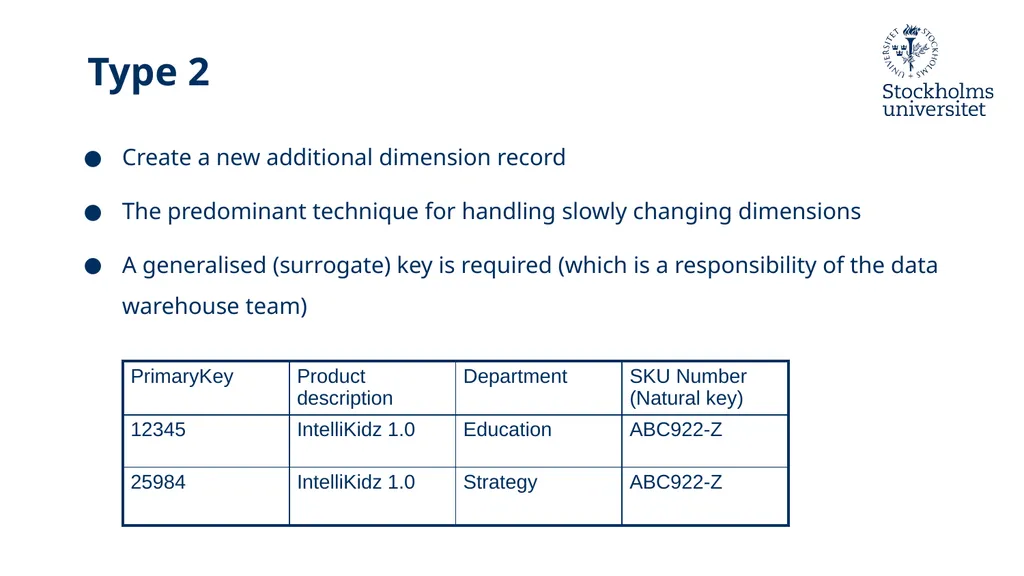
Type 2 Create a new additional dimension record
The predominant technique for handling slowly changing dimensions
A generalised (surrogate) key is required (which is a responsibility of the data warehouse team)<br>
The predominant technique for handling slowly changing dimensions
A generalised (surrogate) key is required (which is a responsibility of the data warehouse team)<br>
31
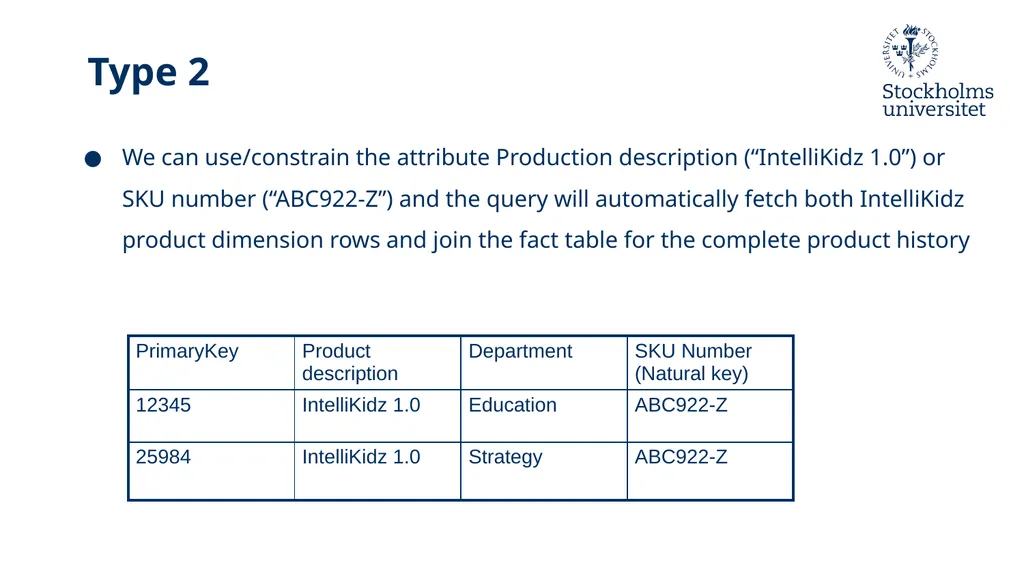
Type 2 We can use/constrain the attribute Production description (“IntelliKidz 1.0”) or SKU number (“ABC922-Z”) and the query will automatically fetch both IntelliKidz product dimension rows and join the fact table for the complete product history<br>
32
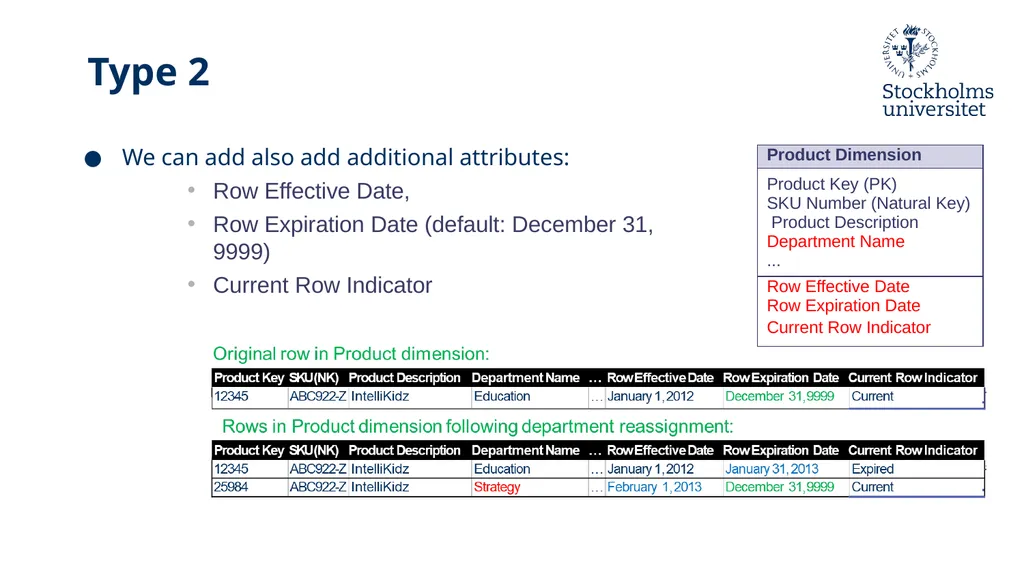
Type 2 We can add also add additional attributes:
Row Effective Date,
Row Expiration Date (default: December 31, 9999)
Current Row Indicator<br>
Row Effective Date,
Row Expiration Date (default: December 31, 9999)
Current Row Indicator<br>
33
Type 2 + history is stored
+ can track as many dimensional attribute value changes as required
+ no need to rebuilt pre-aggregations
- could lead to an accelerated dimensional table growth of rows.<br>
+ can track as many dimensional attribute value changes as required
+ no need to rebuilt pre-aggregations
- could lead to an accelerated dimensional table growth of rows.<br>
34
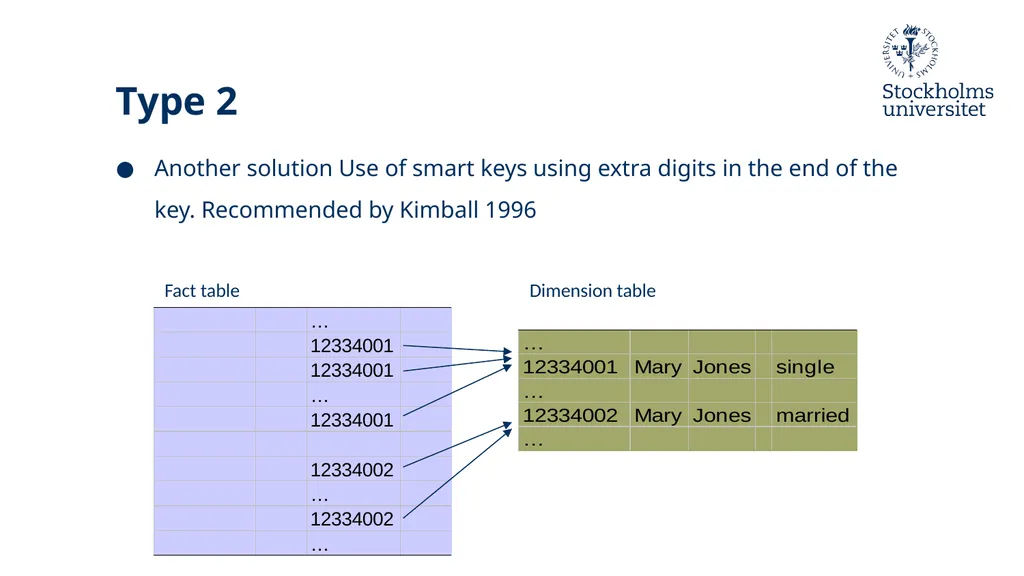
Type 2 Another solution Use of smart keys using extra digits in the end of the key. Recommended by Kimball 1996 Fact table Dimension table<br>
35
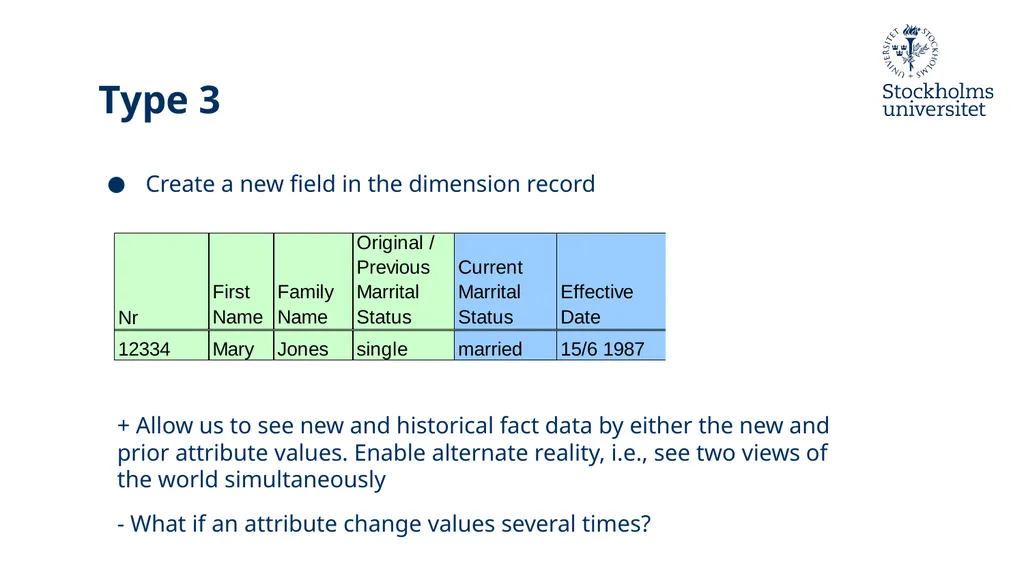
Type 3 Create a new field in the dimension record + Allow us to see new and historical fact data by either the new and prior attribute values. Enable alternate reality, i.e., see two views of the world simultaneously
- What if an attribute change values several times?<br>
- What if an attribute change values several times?<br>
36
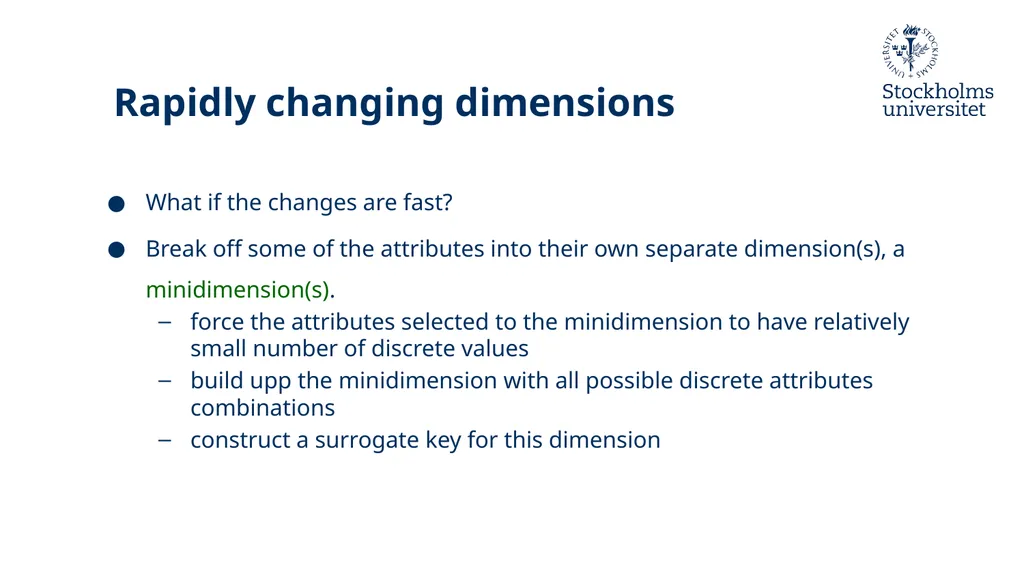
Rapidly changing dimensions What if the changes are fast?
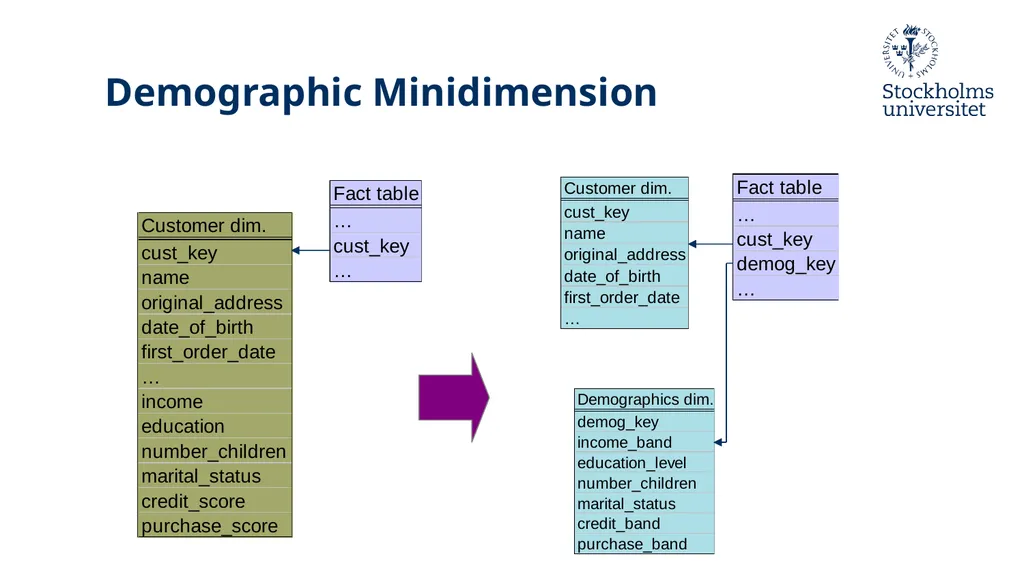
Break off some of the attributes into their own separate dimension(s), a minidimension(s).
force the attributes selected to the minidimension to have relatively small number of discrete values
build upp the minidimension with all possible discrete attributes combinations
construct a surrogate key for this dimension<br>
Break off some of the attributes into their own separate dimension(s), a minidimension(s).
force the attributes selected to the minidimension to have relatively small number of discrete values
build upp the minidimension with all possible discrete attributes combinations
construct a surrogate key for this dimension<br>
37
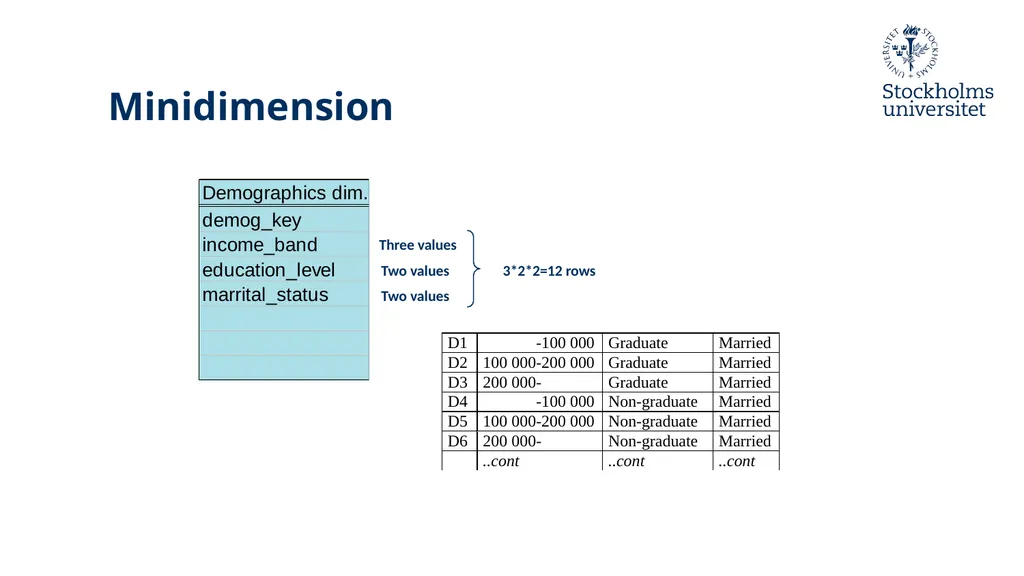
Minidimension Three values Two values Two values 3*2*2=12 rows<br>
38
Demographic Minidimension<br>
39
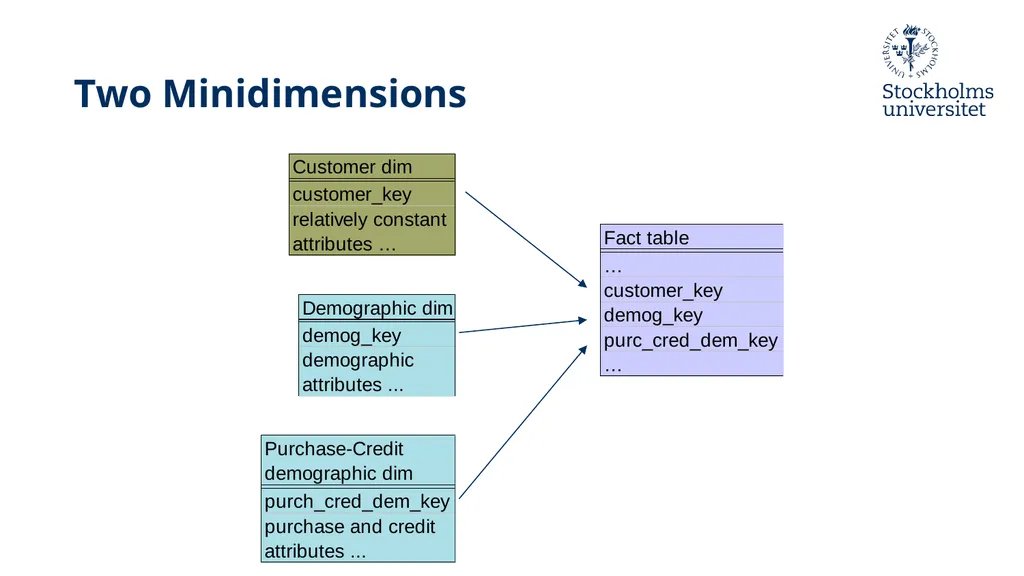
Two Minidimensions<br>
40
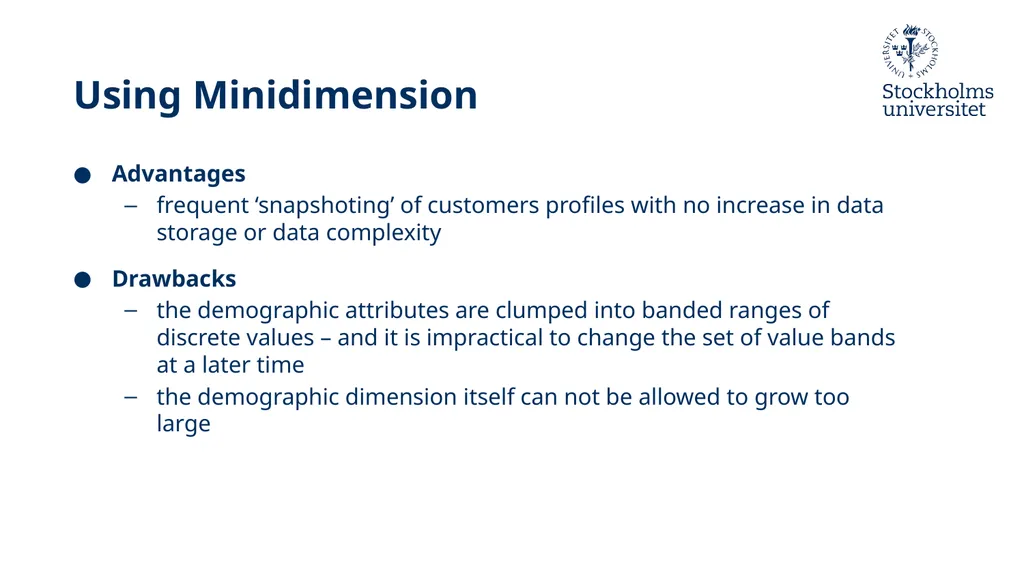
Using Minidimension Advantages
frequent ‘snapshoting’ of customers profiles with no increase in data storage or data complexity
Drawbacks
the demographic attributes are clumped into banded ranges of discrete values – and it is impractical to change the set of value bands at a later time
the demographic dimension itself can not be allowed to grow too large<br>
frequent ‘snapshoting’ of customers profiles with no increase in data storage or data complexity
Drawbacks
the demographic attributes are clumped into banded ranges of discrete values – and it is impractical to change the set of value bands at a later time
the demographic dimension itself can not be allowed to grow too large<br>
41
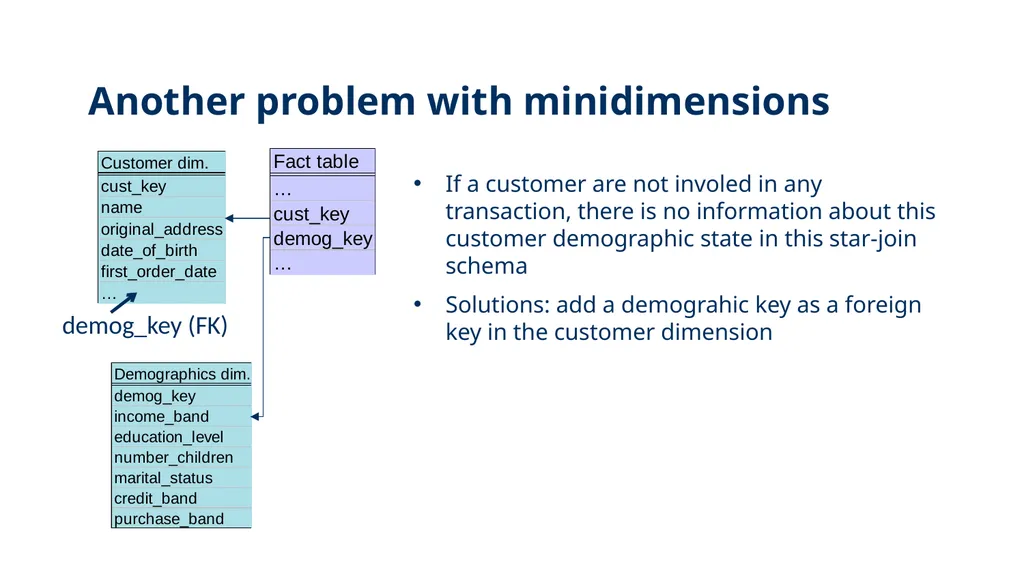
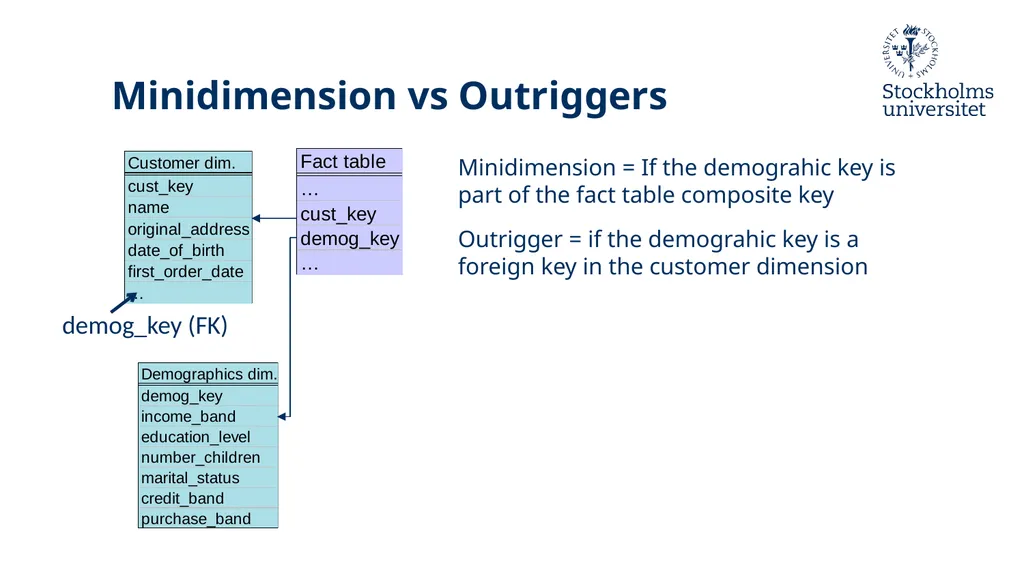
Another problem with minidimensions If a customer are not involed in any transaction, there is no information about this customer demographic state in this star-join schema
Solutions: add a demograhic key as a foreign key in the customer dimension demog_key (FK)<br>
Solutions: add a demograhic key as a foreign key in the customer dimension demog_key (FK)<br>
42
Minidimension vs Outriggers Minidimension = If the demograhic key is part of the fact table composite key
Outrigger = if the demograhic key is a foreign key in the customer dimension demog_key (FK)<br>
Outrigger = if the demograhic key is a foreign key in the customer dimension demog_key (FK)<br>
43
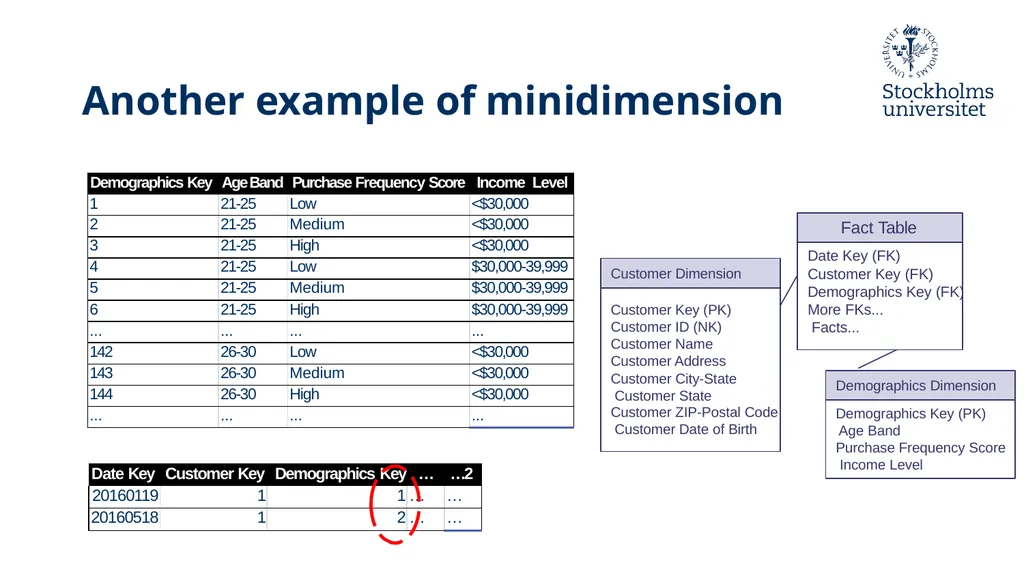
Another example of minidimension Customer Dimension Fact Table Date Key (FK) Customer Key (FK) Demographics Key (FK) More FKs... Facts... Customer Key (PK) Customer ID (NK) Customer Name Customer Address Customer City-State Customer State Customer ZIP-Postal Code Customer Date of Birth Demographics Dimension Demographics Key (PK) Age Band
Purchase Frequency Score Income Level<br>
Purchase Frequency Score Income Level<br>
44
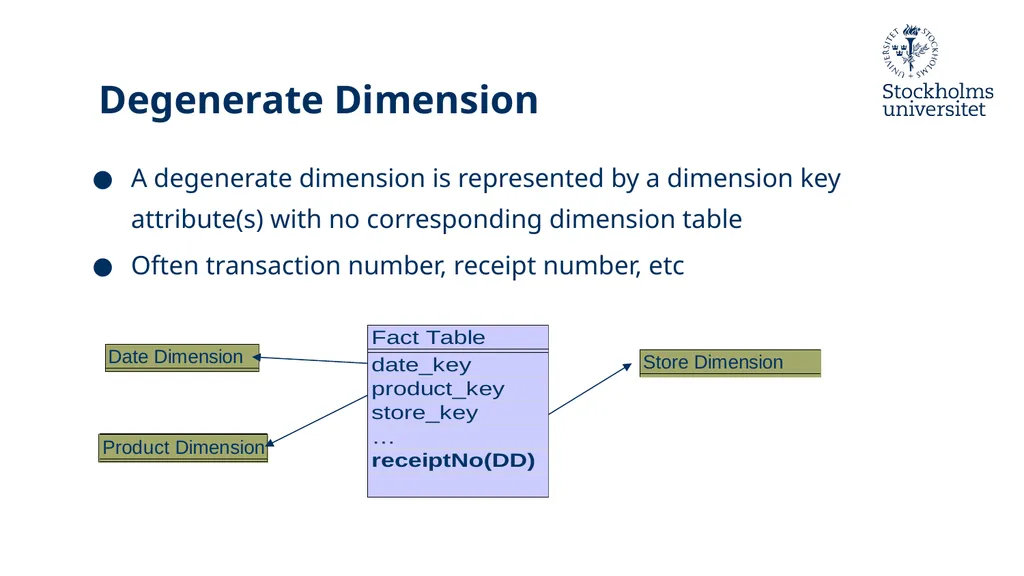
Degenerate Dimension A degenerate dimension is represented by a dimension key attribute(s) with no corresponding dimension table
Often transaction number, receipt number, etc<br>
Often transaction number, receipt number, etc<br>
45
Junk Dimension . A junk dimension - is a convenient grouping of attributes and flags into a useful dimensional framework to get them out of a fact table or to avoid adding a number of extra dimensions into a useful dimensional framework<br>
46
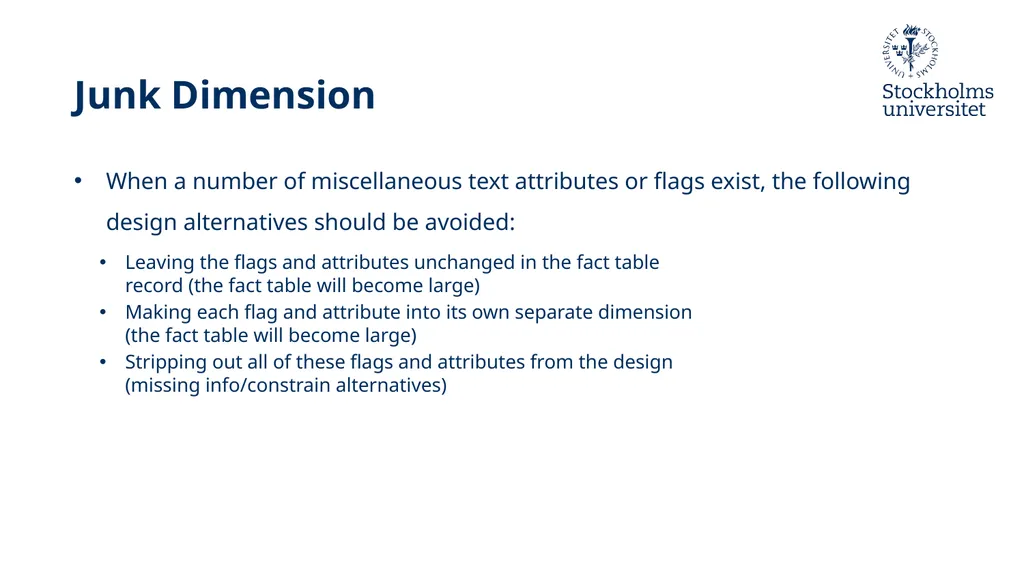
Junk Dimension Leaving the flags and attributes unchanged in the fact table record (the fact table will become large)
Making each flag and attribute into its own separate dimension (the fact table will become large)
Stripping out all of these flags and attributes from the design (missing info/constrain alternatives) When a number of miscellaneous text attributes or flags exist, the following design alternatives should be avoided:<br>
Making each flag and attribute into its own separate dimension (the fact table will become large)
Stripping out all of these flags and attributes from the design (missing info/constrain alternatives) When a number of miscellaneous text attributes or flags exist, the following design alternatives should be avoided:<br>
47
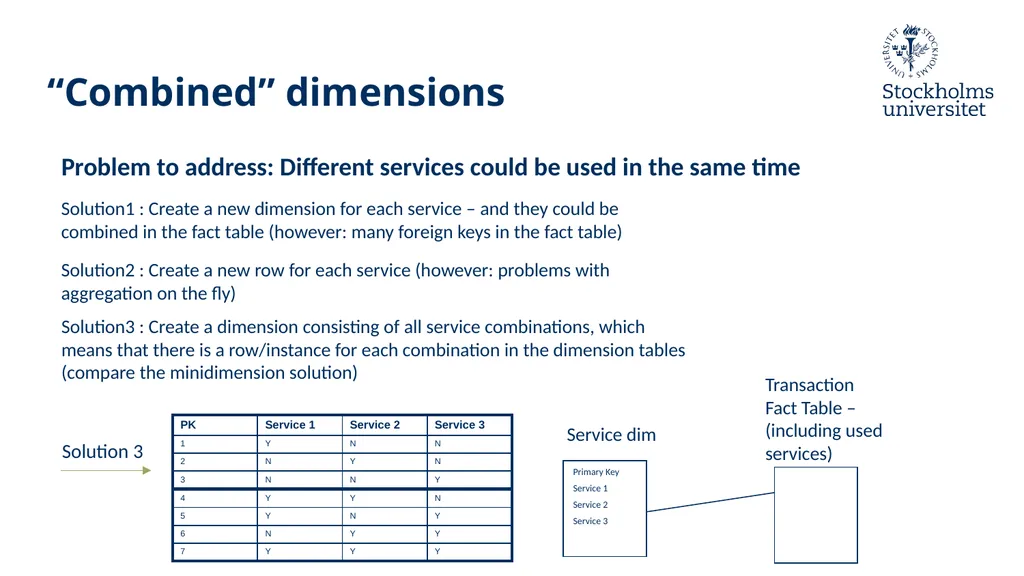
“Combined” dimensions Problem to address: Different services could be used in the same time Solution1 : Create a new dimension for each service – and they could be combined in the fact table (however: many foreign keys in the fact table) Solution2 : Create a new row for each service (however: problems with aggregation on the fly) Solution3 : Create a dimension consisting of all service combinations, which means that there is a row/instance for each combination in the dimension tables (compare the minidimension solution) Transaction Fact Table – (including used services) Service dim Primary Key
Service 1
Service 2
Service 3 Solution 3<br>
Service 1
Service 2
Service 3 Solution 3<br>
48
Heterogenous products<br>
49
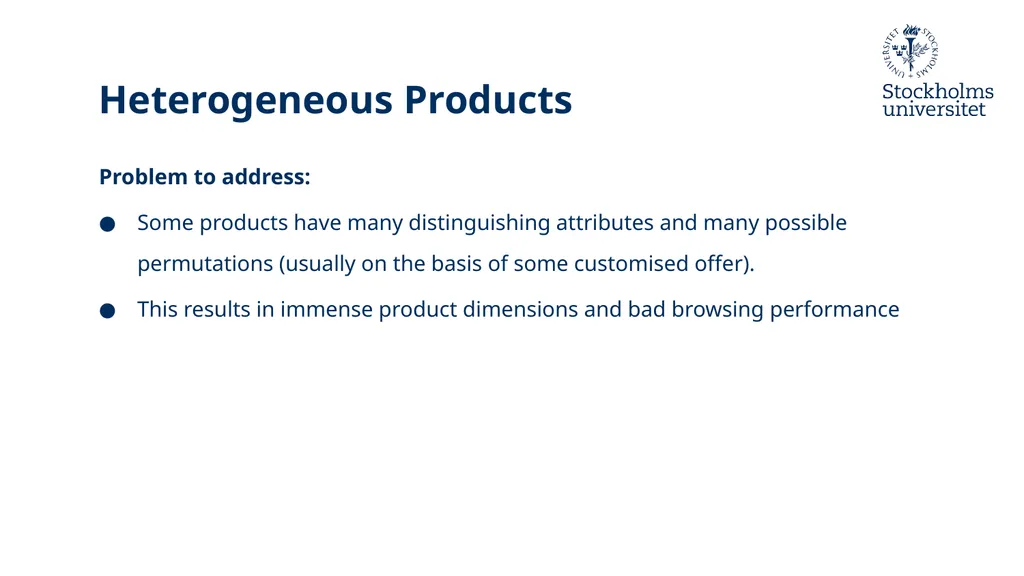
Heterogeneous Products Problem to address:
Some products have many distinguishing attributes and many possible permutations (usually on the basis of some customised offer).
This results in immense product dimensions and bad browsing performance<br>
Some products have many distinguishing attributes and many possible permutations (usually on the basis of some customised offer).
This results in immense product dimensions and bad browsing performance<br>
50
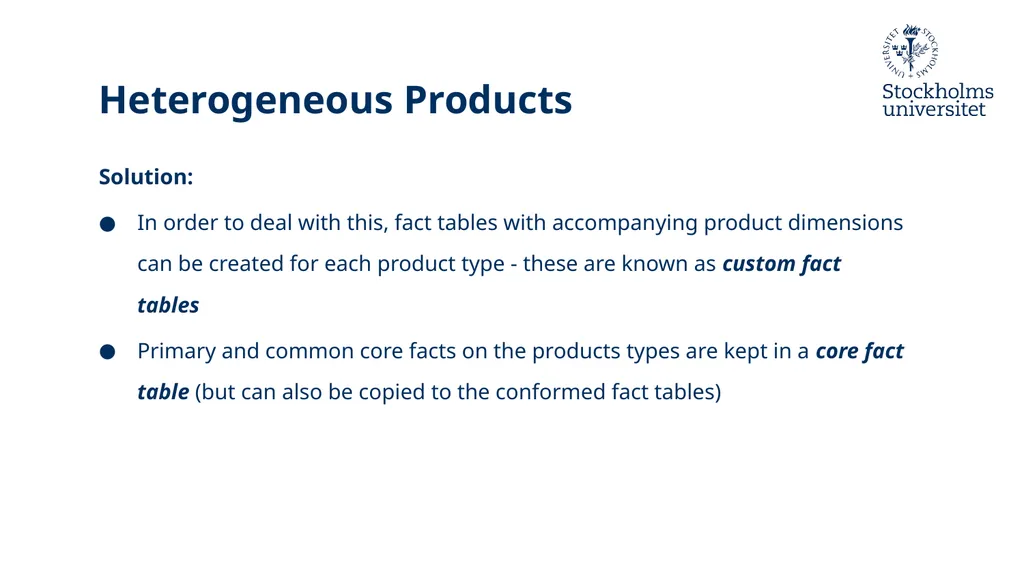
Heterogeneous Products Solution:
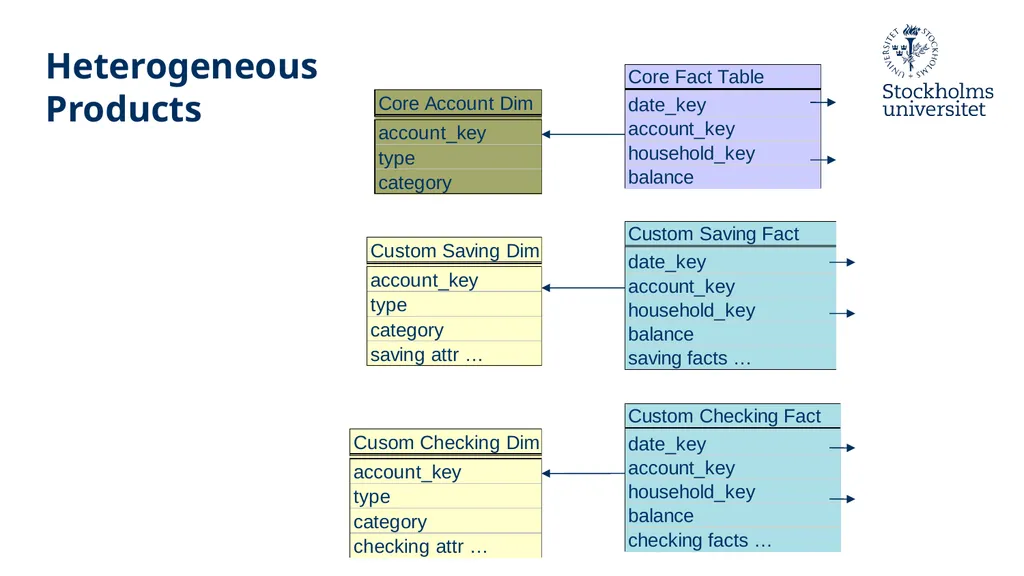
In order to deal with this, fact tables with accompanying product dimensions can be created for each product type - these are known as custom fact tables
Primary and common core facts on the products types are kept in a core fact table (but can also be copied to the conformed fact tables)<br>
In order to deal with this, fact tables with accompanying product dimensions can be created for each product type - these are known as custom fact tables
Primary and common core facts on the products types are kept in a core fact table (but can also be copied to the conformed fact tables)<br>
51
Heterogeneous Products<br>
52
Aggregrations<br>
53
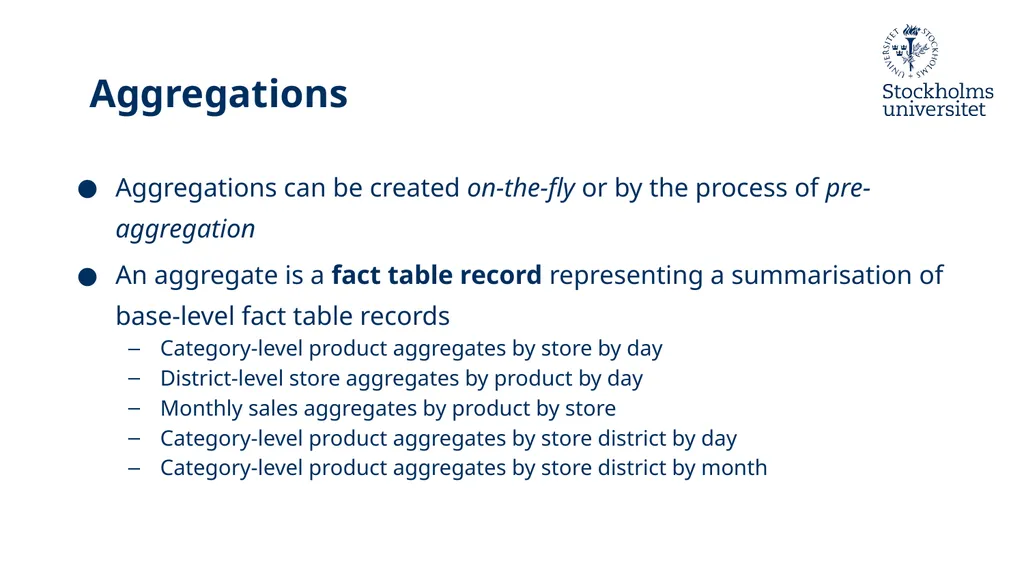
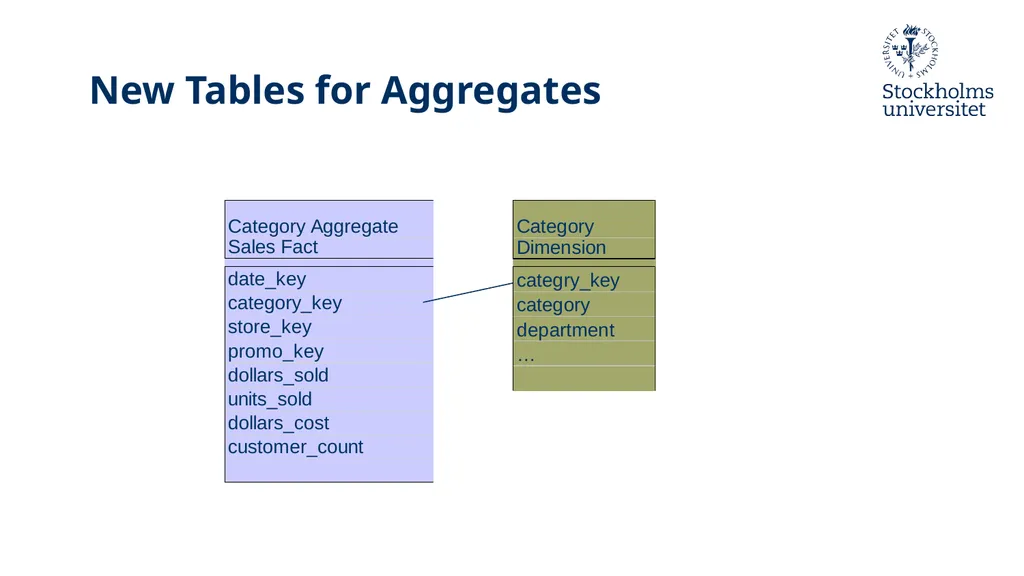
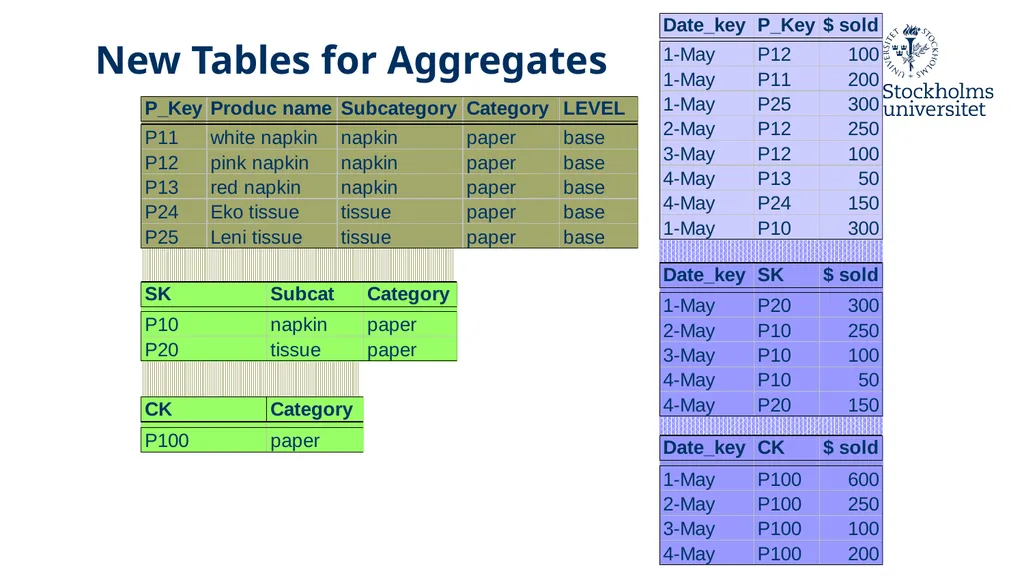
Aggregations Aggregations can be created on-the-fly or by the process of pre-aggregation
An aggregate is a fact table record representing a summarisation of base-level fact table records
Category-level product aggregates by store by day
District-level store aggregates by product by day
Monthly sales aggregates by product by store
Category-level product aggregates by store district by day
Category-level product aggregates by store district by month<br>
An aggregate is a fact table record representing a summarisation of base-level fact table records
Category-level product aggregates by store by day
District-level store aggregates by product by day
Monthly sales aggregates by product by store
Category-level product aggregates by store district by day
Category-level product aggregates by store district by month<br>
54
New Tables for Aggregates<br>
55
New Tables for Aggregates<br>
56
Family of stars again<br>
57
A family of stars<br>
58
A family of stars A dimensional model of a data warehouse for a large data warehouse consists of between 10 and 25 similar-looking star-join schemas. Each star join will have 5 to 15 dimensional tables
Conformed (shared) dimensions for drill-across<br>
Conformed (shared) dimensions for drill-across<br>
59
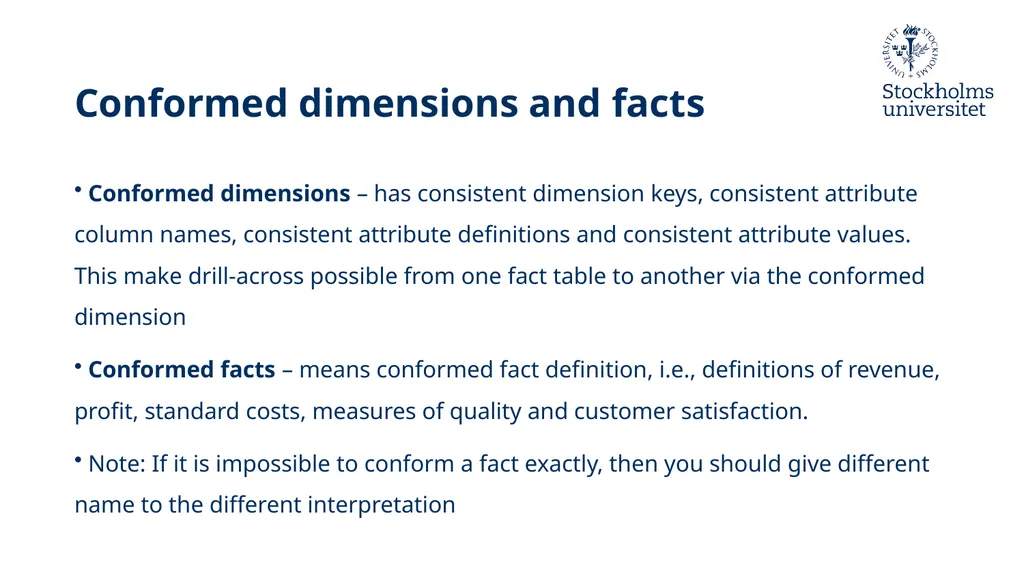
Conformed dimensions and facts Conformed dimensions – has consistent dimension keys, consistent attribute column names, consistent attribute definitions and consistent attribute values. This make drill-across possible from one fact table to another via the conformed dimension
Conformed facts – means conformed fact definition, i.e., definitions of revenue, profit, standard costs, measures of quality and customer satisfaction.
Note: If it is impossible to conform a fact exactly, then you should give different name to the different interpretation<br>
Conformed facts – means conformed fact definition, i.e., definitions of revenue, profit, standard costs, measures of quality and customer satisfaction.
Note: If it is impossible to conform a fact exactly, then you should give different name to the different interpretation<br>