
Presentation on the AART amendment Bill Preamble
MJ
Published · 16 slides · 0 views
1 / 1

Description
Presentation on the AART amendment Bill Preamble SANTACO was founded after a government intensive consultative process with taxi operators countrywide in a move to have an umbrella body governing the industry and to act as the principal
Related Topics
Share
Embed code
Download this presentation From Below
"Presentation on the AART amendment Bill Preamble" is the property of its rightful owner. Permission is granted to download and print the materials on this website for personal, non-commercial use only, and to display it on your personal computer provided you do not modify the materials and that you retain all copyright notices contained in the materials. By downloading content from our website, you accept the terms of this agreement.
Presentation Transcript
01
Presentation on the AART amendment Bill<br>
02
Preamble SANTACO was founded after a government intensive consultative process with taxi operators countrywide in a move to have an umbrella body governing the industry and to act as the principal mouthpiece for taxis.
This was guided by the National Taxi Task Team recommendations of 1996 which rested on three pillars of formalization, regulation and empowerment under the auspices of one taxi body as the taxi body then, SATACO was not seen as inclusively representative.
The National Conference Preparatory Committee (NCPC) was consequently formed to facilitate a national conference to initiate a new body with elections conducted at local, regional and provincial levels.
In September 2001 SANTACO was formally established and remains the principal representative body of the Taxi Industry in South Africa.
In line with its mandate and at its Elective Conference in May, SANTACO adopted the TR3 2020 strategy to transform and empower the Industry.<br>
This was guided by the National Taxi Task Team recommendations of 1996 which rested on three pillars of formalization, regulation and empowerment under the auspices of one taxi body as the taxi body then, SATACO was not seen as inclusively representative.
The National Conference Preparatory Committee (NCPC) was consequently formed to facilitate a national conference to initiate a new body with elections conducted at local, regional and provincial levels.
In September 2001 SANTACO was formally established and remains the principal representative body of the Taxi Industry in South Africa.
In line with its mandate and at its Elective Conference in May, SANTACO adopted the TR3 2020 strategy to transform and empower the Industry.<br>
03
Economic influence of taxis The taxi industry commands a turnover of R35 billion annually.
The DOT transport survey reported that the road sector contributes 3.4% towards the GDP. The taxi industry is a major contributor.
The taxi industry is the only transport business that employs an estimate 600 000 employees who are mainly lower and semi skilled workers, thus contributing hugely to government’s poverty alleviation programme.
Taxi environments serve as profitable locations for hawkers and other informal retails businesses who all depend on taxis for their livelihood.
SACP General Secretary, Blade Nzimande, debating the two economies (first and second) at the BMF national conference, argued; “In fact, without this taxi industry, our economy would grind to a halt.”<br>
The DOT transport survey reported that the road sector contributes 3.4% towards the GDP. The taxi industry is a major contributor.
The taxi industry is the only transport business that employs an estimate 600 000 employees who are mainly lower and semi skilled workers, thus contributing hugely to government’s poverty alleviation programme.
Taxi environments serve as profitable locations for hawkers and other informal retails businesses who all depend on taxis for their livelihood.
SACP General Secretary, Blade Nzimande, debating the two economies (first and second) at the BMF national conference, argued; “In fact, without this taxi industry, our economy would grind to a halt.”<br>
04
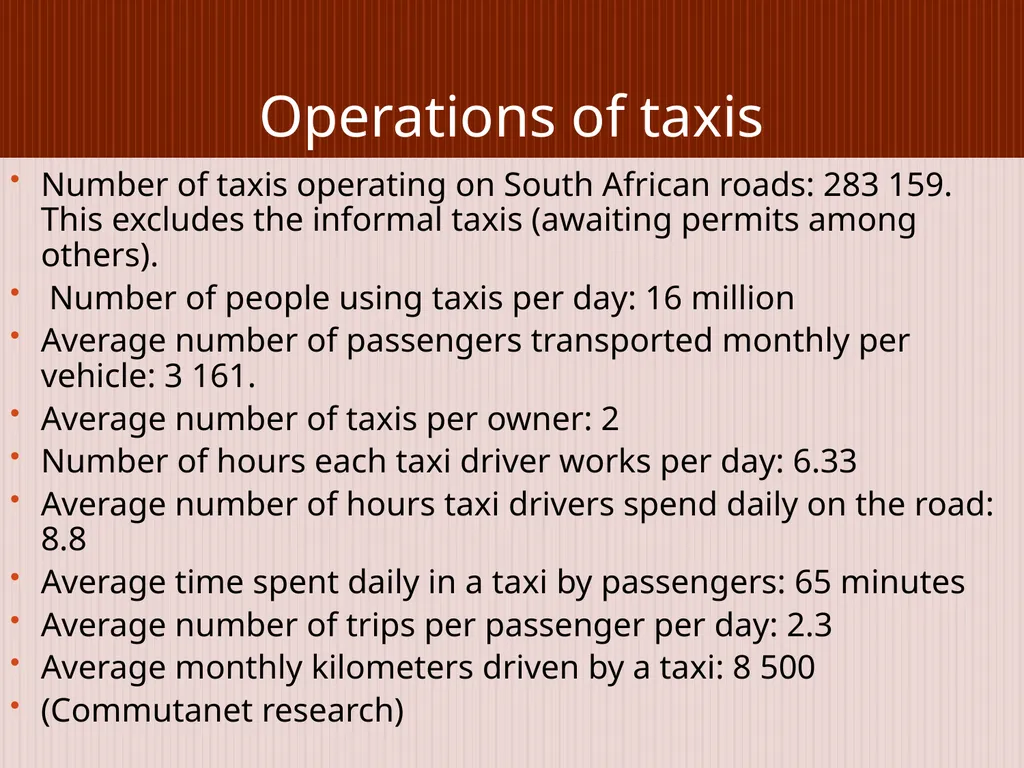
Operations of taxis Number of taxis operating on South African roads: 283 159. This excludes the informal taxis (awaiting permits among others).
Number of people using taxis per day: 16 million
Average number of passengers transported monthly per vehicle: 3 161.
Average number of taxis per owner: 2
Number of hours each taxi driver works per day: 6.33
Average number of hours taxi drivers spend daily on the road: 8.8
Average time spent daily in a taxi by passengers: 65 minutes
Average number of trips per passenger per day: 2.3
Average monthly kilometers driven by a taxi: 8 500
(Commutanet research)<br>
Number of people using taxis per day: 16 million
Average number of passengers transported monthly per vehicle: 3 161.
Average number of taxis per owner: 2
Number of hours each taxi driver works per day: 6.33
Average number of hours taxi drivers spend daily on the road: 8.8
Average time spent daily in a taxi by passengers: 65 minutes
Average number of trips per passenger per day: 2.3
Average monthly kilometers driven by a taxi: 8 500
(Commutanet research)<br>
05
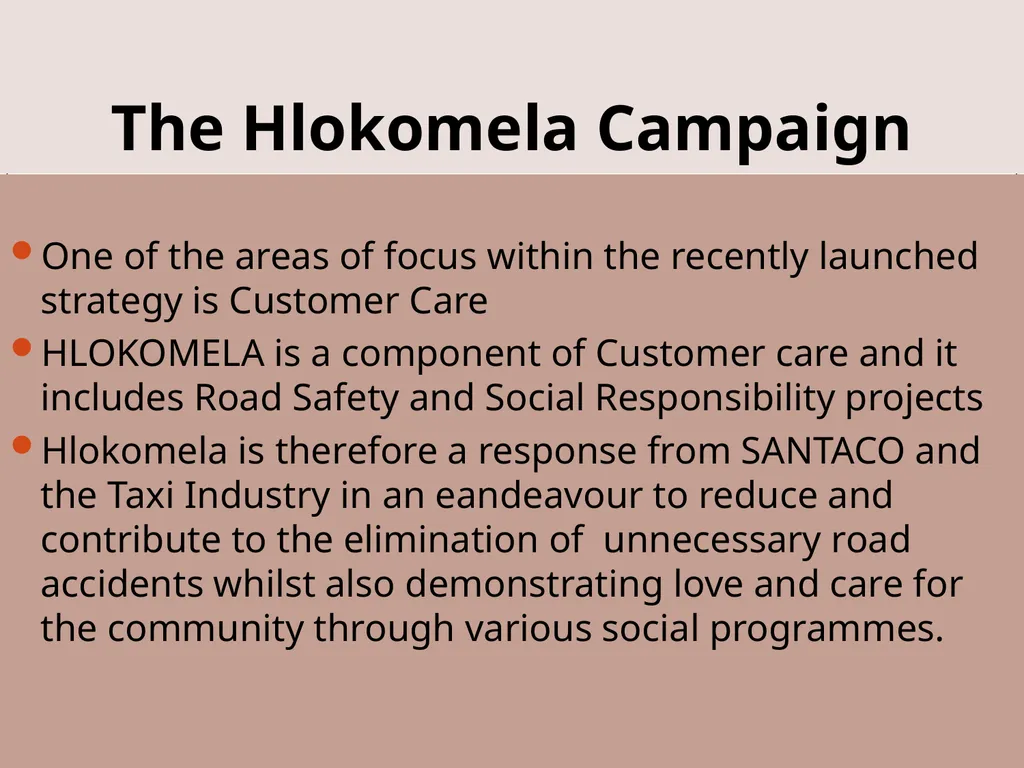
The Hlokomela Campaign One of the areas of focus within the recently launched strategy is Customer Care
HLOKOMELA is a component of Customer care and it includes Road Safety and Social Responsibility projects
Hlokomela is therefore a response from SANTACO and the Taxi Industry in an eandeavour to reduce and contribute to the elimination of unnecessary road accidents whilst also demonstrating love and care for the community through various social programmes.<br>
HLOKOMELA is a component of Customer care and it includes Road Safety and Social Responsibility projects
Hlokomela is therefore a response from SANTACO and the Taxi Industry in an eandeavour to reduce and contribute to the elimination of unnecessary road accidents whilst also demonstrating love and care for the community through various social programmes.<br>
06
HLOKOMELA : ROAD SAFETY<br>
07
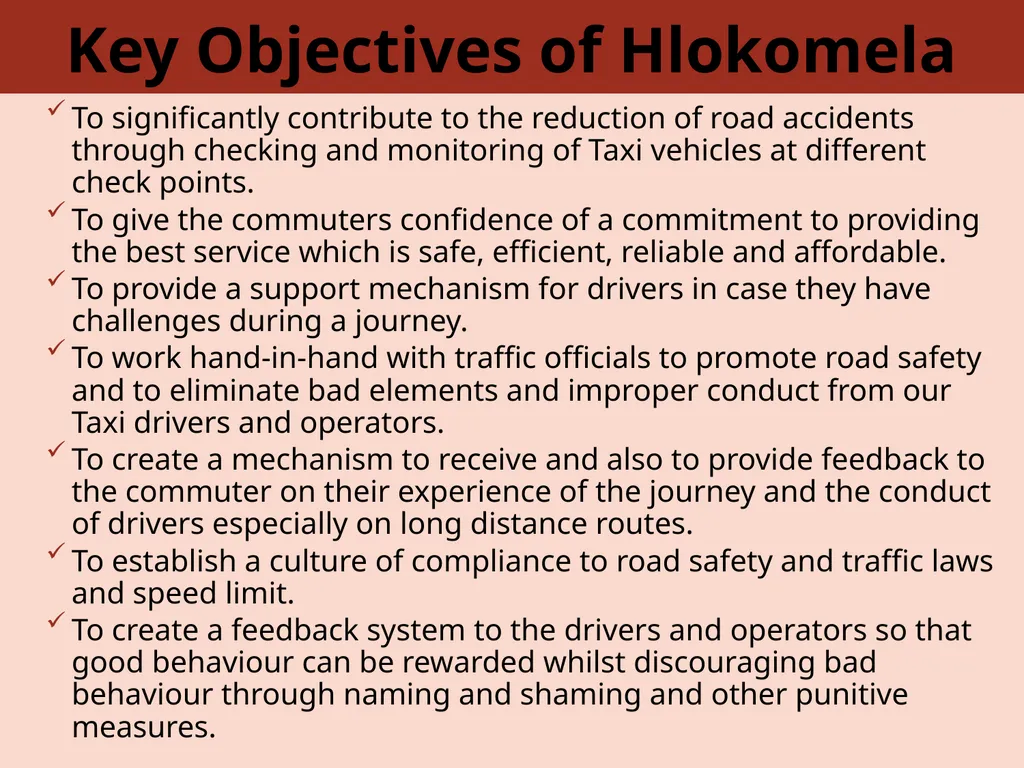
Key Objectives of Hlokomela To significantly contribute to the reduction of road accidents through checking and monitoring of Taxi vehicles at different check points.
To give the commuters confidence of a commitment to providing the best service which is safe, efficient, reliable and affordable.
To provide a support mechanism for drivers in case they have challenges during a journey.
To work hand-in-hand with traffic officials to promote road safety and to eliminate bad elements and improper conduct from our Taxi drivers and operators.
To create a mechanism to receive and also to provide feedback to the commuter on their experience of the journey and the conduct of drivers especially on long distance routes.
To establish a culture of compliance to road safety and traffic laws and speed limit.
To create a feedback system to the drivers and operators so that good behaviour can be rewarded whilst discouraging bad behaviour through naming and shaming and other punitive measures.<br>
To give the commuters confidence of a commitment to providing the best service which is safe, efficient, reliable and affordable.
To provide a support mechanism for drivers in case they have challenges during a journey.
To work hand-in-hand with traffic officials to promote road safety and to eliminate bad elements and improper conduct from our Taxi drivers and operators.
To create a mechanism to receive and also to provide feedback to the commuter on their experience of the journey and the conduct of drivers especially on long distance routes.
To establish a culture of compliance to road safety and traffic laws and speed limit.
To create a feedback system to the drivers and operators so that good behaviour can be rewarded whilst discouraging bad behaviour through naming and shaming and other punitive measures.<br>
08
Key Elements of Hlokomela Vehicle Inspection at the Ranks
Driver Condition monitoring
Registration of Driver and commuter details and cell phone numbers for monitoring, feedback and follow up
Check point action on major routes
Call Center and co-ordination information
Driver Support in the case of emergencies
Monitoring and feedback to passengers and other stakeholders
Engagement with Traffic Officials<br>
Driver Condition monitoring
Registration of Driver and commuter details and cell phone numbers for monitoring, feedback and follow up
Check point action on major routes
Call Center and co-ordination information
Driver Support in the case of emergencies
Monitoring and feedback to passengers and other stakeholders
Engagement with Traffic Officials<br>
09
SANTACO’s concerns As matter of principle, SANTACO will continue to record its grave concerns on how the development of laws and the implementation thereof has largely negatively affected the taxi industry.
This starts from the Public Transport Strategy which committed government to ensure taxis would become the “nucleus” of BRT projects in the country to the overarching National Land Transport Act which has taken from the taxi industry two critical business elements namely; the fundamental right which the permit lifespan and removal of the front seat which should have otherwise generated income for the taxi owner.
Absence of synergy between permit or operating licence related problems in various departments of transport and law enforcement agencies victimises operators who have applied and await necessary documents. Primarily, it is synergised communication between spheres of government on decisions taken. This has been recepe for flouting laws and making parties susceptible to bribery.
SANTACO also remains hugely concerned on the conflicted government officials who are charged with strategic positions relating to the taxi industry. These officials are often the very source of conflict which in the taxi more often result in violence. The recent Gauteng Transport Committee report is a point of reference.
A letter has been written to both the Police Minister and Acting National Commissioner to secure a meeting which seeks to find practical ways of resolving these problems and strengthening management systems that would prevent the culprits from this temptations of using their authority to influence bad decisions that affect loss of lives. We are still waiting.
Specifically to AARTO which cannot necessarily separate from the concerns above, we would be interested in communication of infringement (smses, emails, post, fax, etc), actual delivery time versus interruptions of business and the verification and possible deferral of offender.<br>
This starts from the Public Transport Strategy which committed government to ensure taxis would become the “nucleus” of BRT projects in the country to the overarching National Land Transport Act which has taken from the taxi industry two critical business elements namely; the fundamental right which the permit lifespan and removal of the front seat which should have otherwise generated income for the taxi owner.
Absence of synergy between permit or operating licence related problems in various departments of transport and law enforcement agencies victimises operators who have applied and await necessary documents. Primarily, it is synergised communication between spheres of government on decisions taken. This has been recepe for flouting laws and making parties susceptible to bribery.
SANTACO also remains hugely concerned on the conflicted government officials who are charged with strategic positions relating to the taxi industry. These officials are often the very source of conflict which in the taxi more often result in violence. The recent Gauteng Transport Committee report is a point of reference.
A letter has been written to both the Police Minister and Acting National Commissioner to secure a meeting which seeks to find practical ways of resolving these problems and strengthening management systems that would prevent the culprits from this temptations of using their authority to influence bad decisions that affect loss of lives. We are still waiting.
Specifically to AARTO which cannot necessarily separate from the concerns above, we would be interested in communication of infringement (smses, emails, post, fax, etc), actual delivery time versus interruptions of business and the verification and possible deferral of offender.<br>
10
SANTACO position South Africa has generally plunged into a society of civil disobedience and this is despite an untested popular belief that the taxi industry is leading this “breaking of the law”.
SANTACO adopted the Hlokomela campaign precisely to recommit the taxi industry to road safety and ensure that taxi operators and drivers assume equal responsibility on road safety for their part in the movement.
SANTACO President strengthened this view in December 2016 when he announced intentions to partner with the courts to ensure offenders who’ve contributed to loss of lives are given harsher punishments and this is except for the industry’s own internal processes.<br>
SANTACO adopted the Hlokomela campaign precisely to recommit the taxi industry to road safety and ensure that taxi operators and drivers assume equal responsibility on road safety for their part in the movement.
SANTACO President strengthened this view in December 2016 when he announced intentions to partner with the courts to ensure offenders who’ve contributed to loss of lives are given harsher punishments and this is except for the industry’s own internal processes.<br>
11
SANTACO position Though the initiatives of RTIA may be well intended, SANTACO believes for the taxi industry in particular, these can be achieved through a strong partnership.
This partnership would include rollout of an education campaign countrywide in the formal structures of the industry and at the ranks, through a collaborated effort of RTIA mobile offices and SANTACO Hlokomela mobile training facilities.
SANTACO also appreciates processes of the relationship that we are currently establishing with RTIA and all the envisaged fruitful outcomes that will emanate from it.
In principle, we accept the dire need for tougher action and mutually benefitial initiatives to achieve same and this must importantly achieve behavioural change programme than cracking the whip.
Within this context SANTACO supports the objectives of the AARTO amendment bill subject to conditions We list at least three fundamental points to logically reason with the process namely; taxi operations, demerit system and e-tolls.
SANTACO remains resolutely committed to initiatives that would promote and strengthen road safety objectives.<br>
This partnership would include rollout of an education campaign countrywide in the formal structures of the industry and at the ranks, through a collaborated effort of RTIA mobile offices and SANTACO Hlokomela mobile training facilities.
SANTACO also appreciates processes of the relationship that we are currently establishing with RTIA and all the envisaged fruitful outcomes that will emanate from it.
In principle, we accept the dire need for tougher action and mutually benefitial initiatives to achieve same and this must importantly achieve behavioural change programme than cracking the whip.
Within this context SANTACO supports the objectives of the AARTO amendment bill subject to conditions We list at least three fundamental points to logically reason with the process namely; taxi operations, demerit system and e-tolls.
SANTACO remains resolutely committed to initiatives that would promote and strengthen road safety objectives.<br>
12
Demerit system It is important to put into perspective the accurate reliability of the AARTO technology infrastructure and law enforcement systems that are beyond reproach.
While at face value the Demerit system seem an appealing solution to the effective response on dealing with offenders or even habitual offenders, the uniqueness of the taxi industry requires consideration of application
Based on the operations of the taxi industry as stated, it becomes necessary for the RTIA to reconsider how it applies principles of the demerit system in the taxi industry.<br>
While at face value the Demerit system seem an appealing solution to the effective response on dealing with offenders or even habitual offenders, the uniqueness of the taxi industry requires consideration of application
Based on the operations of the taxi industry as stated, it becomes necessary for the RTIA to reconsider how it applies principles of the demerit system in the taxi industry.<br>
13
Taxi operations and its effect Taxi operations and in particular drivers spend about 20 hours on the road on a daily basis, this makes the automatic targets to infringements.
Our road infrastructure and no taxi facilities to drop and collect commuters on the roads compel drivers to respond to commuter whose “waiting for taxis” and “alighting” is preferential and can often create tension between the two, is another cause for infringement.
These conditions under which taxi drivers find themselves makes them prone to be the first to face suspension of their licences and this could have serious socio-economic challenges. Case Study is the promotion of exiting taxi industry during the implementation of the TRP.
Taxis are on the roads for about 20 hours a day depending on jurisdiction, criminalisation of minor road traffic offences could exacerbate charges on the offender.<br>
Our road infrastructure and no taxi facilities to drop and collect commuters on the roads compel drivers to respond to commuter whose “waiting for taxis” and “alighting” is preferential and can often create tension between the two, is another cause for infringement.
These conditions under which taxi drivers find themselves makes them prone to be the first to face suspension of their licences and this could have serious socio-economic challenges. Case Study is the promotion of exiting taxi industry during the implementation of the TRP.
Taxis are on the roads for about 20 hours a day depending on jurisdiction, criminalisation of minor road traffic offences could exacerbate charges on the offender.<br>
14
E-tolling system vs exemption The taxi industry has been exempt from paying e-tolls in December 2013. However, implementation of this announcement has not been fully realised.
In its presentation for exemption, the taxi industry appealed for a blanket exemption purely because the industry is unsubsidized and services largely the poorest of the poor. If not exempted, it is the poor who are scholars, pensioners and the unemployed who will have to absorb the burden.<br>
In its presentation for exemption, the taxi industry appealed for a blanket exemption purely because the industry is unsubsidized and services largely the poorest of the poor. If not exempted, it is the poor who are scholars, pensioners and the unemployed who will have to absorb the burden.<br>
15
Why would SANTACO support AARTO Road carnage has become an economic threat that continues to spiral out of control. This cannot continue unchallenged using all means possible to seize it.
The safety of our commuters is a huge responsibility that has become even more necessary with socio-economic impact where families could be left without parents or breadwinners.
The investment of the taxi owner is another socio-economic factor which if not protected through good driving behaviour could affect both the jobs of drivers and entrepreneurial activity that could worsen the triple challenges of poverty, unemployment and inequality.
Based on the objectives of our own Hlokomela road safety campaign, SANTACO supports AARTO within the context of it being a response to seize the wider eruption of lack of road safety putting at heart, the creation of safer roads, safer vehicles and importantly encourage responsible driving and/or influencing behavioural change.<br>
The safety of our commuters is a huge responsibility that has become even more necessary with socio-economic impact where families could be left without parents or breadwinners.
The investment of the taxi owner is another socio-economic factor which if not protected through good driving behaviour could affect both the jobs of drivers and entrepreneurial activity that could worsen the triple challenges of poverty, unemployment and inequality.
Based on the objectives of our own Hlokomela road safety campaign, SANTACO supports AARTO within the context of it being a response to seize the wider eruption of lack of road safety putting at heart, the creation of safer roads, safer vehicles and importantly encourage responsible driving and/or influencing behavioural change.<br>