
PRESENTATION TITLE Presented by: Name Surname
KL
Published · 63 slides · 0 views
1 / 1

Description
PRESENTATION TITLE Presented by: Name Surname Directorate Date 201920 Annual Report of the Department of Water Sanitation Presented by: Ms D Mochotlhi Acting Director-General 30 March 2021 Contents
Related Topics
Share
Embed code
Download this presentation From Below
"PRESENTATION TITLE Presented by: Name Surname" is the property of its rightful owner. Permission is granted to download and print the materials on this website for personal, non-commercial use only, and to display it on your personal computer provided you do not modify the materials and that you retain all copyright notices contained in the materials. By downloading content from our website, you accept the terms of this agreement.
Presentation Transcript
01
PRESENTATION TITLE
Presented by:
Name Surname
Directorate
Date 2019/20 Annual Report of the Department of Water & Sanitation Presented by:
Ms D Mochotlhi
Acting Director-General 30 March 2021<br>
Presented by:
Name Surname
Directorate
Date 2019/20 Annual Report of the Department of Water & Sanitation Presented by:
Ms D Mochotlhi
Acting Director-General 30 March 2021<br>
02
Contents Purpose………...……………………………...………………...………..3
Introduction…….……………………………………………...………4-10
Part 1: Overview of non-financial performance………….…..…..11-36
Part 2: Overview of financial performance …..…………….…….37-46
Part 3: Overview of the Auditor-General’s report…..…………….47-52
Part 4: Feedback on the financial recovery plan ……….…..…...53-57
Part 5: Overview of the human resources …….………..………..58-62 2<br>
Introduction…….……………………………………………...………4-10
Part 1: Overview of non-financial performance………….…..…..11-36
Part 2: Overview of financial performance …..…………….…….37-46
Part 3: Overview of the Auditor-General’s report…..…………….47-52
Part 4: Feedback on the financial recovery plan ……….…..…...53-57
Part 5: Overview of the human resources …….………..………..58-62 2<br>
03
Purpose To brief the Committee on the Department of
Water and Sanitation’s 2019/20
Annual Report and Financial Statements 3<br>
Water and Sanitation’s 2019/20
Annual Report and Financial Statements 3<br>
04
introduction 4 Service delivery environment
Organisational environment
Policy and legislative changes
Finances of the department
Key highlights<br>
Organisational environment
Policy and legislative changes
Finances of the department
Key highlights<br>
05
Service delivery environment 2019/20 hydrological year:
Significant rainfall events between January and March 2020, resulted in localised flooding in KwaZulu-Natal and Gauteng. Poor drainage in urban areas destroyed some infrastructure such as roads.
Surface water info:
Although the significant rainfall resulted in most parts of the country recovering from previous drought conditions, the situation in some parts of the Eastern Cape were a cause for concern. For example, the Algoa System with 5 dams serving Nelson Mandela Bay Metro was 22.1% full which was a decrease of 23.7% compared to the previous year.
Ground water info:
The country’s groundwater depicted a steady declining trend nationally. Gauteng and KwaZulu-Natal however, showed a good recovery compared to other provinces owing to good rainfall received.
Operations of water resource systems:
restrictions implemented in six (6) water supply systems (i.e. Algoa, Greater Bloemfontein, Western Cape, Polokwane, Umgeni and Umhlathuze systems) 5<br>
Significant rainfall events between January and March 2020, resulted in localised flooding in KwaZulu-Natal and Gauteng. Poor drainage in urban areas destroyed some infrastructure such as roads.
Surface water info:
Although the significant rainfall resulted in most parts of the country recovering from previous drought conditions, the situation in some parts of the Eastern Cape were a cause for concern. For example, the Algoa System with 5 dams serving Nelson Mandela Bay Metro was 22.1% full which was a decrease of 23.7% compared to the previous year.
Ground water info:
The country’s groundwater depicted a steady declining trend nationally. Gauteng and KwaZulu-Natal however, showed a good recovery compared to other provinces owing to good rainfall received.
Operations of water resource systems:
restrictions implemented in six (6) water supply systems (i.e. Algoa, Greater Bloemfontein, Western Cape, Polokwane, Umgeni and Umhlathuze systems) 5<br>
06
Organisational environment Human resource management
A structure review process that entails among other things abolishing unfunded vacant posts is underway.
Information and Communication Technology:
The ICT strategic plan of the Department was developed. However the funding constraints contributes to the poor implementation thereof. Also, the lack of internal capacity on critical ICT posts resulted in the overreliance on consultants.
Finances of the Department:
The Department’s 2019/20 financial year allocation was R16.46 billion and R15.21 billion was spent. The under expenditure is R1.24 billion.
The Water Trading Entity’s operating surplus for 2019/20 increased to R5.47 billion. Revenue from water sales had a 10% increase compared to 2018/19 financial year 6<br>
A structure review process that entails among other things abolishing unfunded vacant posts is underway.
Information and Communication Technology:
The ICT strategic plan of the Department was developed. However the funding constraints contributes to the poor implementation thereof. Also, the lack of internal capacity on critical ICT posts resulted in the overreliance on consultants.
Finances of the Department:
The Department’s 2019/20 financial year allocation was R16.46 billion and R15.21 billion was spent. The under expenditure is R1.24 billion.
The Water Trading Entity’s operating surplus for 2019/20 increased to R5.47 billion. Revenue from water sales had a 10% increase compared to 2018/19 financial year 6<br>
07
Policy and legislative changes Policies under development
Mine Water Management: the policy seeks to balance the mining sector’s economic development with the protection and ensuring sustainable use of water resources in a manner that is beneficial to all.
Sustainable Hydropower Generation: the policy aims to support the long term energy master plan that pursues hydropower as part of the energy mix.
Integrated Water Quality Management: the policy seeks to develop an intergovernmental water quality management approach which will facilitate an integrated response to address water quality management challenges in the country.
Development of the National Water and Sanitation Act: The Department conducted a legislative review which sought to consolidate the National Water Act, 1998 (NWA) and the Water Services Act, 1997 (WSA) 7<br>
Mine Water Management: the policy seeks to balance the mining sector’s economic development with the protection and ensuring sustainable use of water resources in a manner that is beneficial to all.
Sustainable Hydropower Generation: the policy aims to support the long term energy master plan that pursues hydropower as part of the energy mix.
Integrated Water Quality Management: the policy seeks to develop an intergovernmental water quality management approach which will facilitate an integrated response to address water quality management challenges in the country.
Development of the National Water and Sanitation Act: The Department conducted a legislative review which sought to consolidate the National Water Act, 1998 (NWA) and the Water Services Act, 1997 (WSA) 7<br>
08
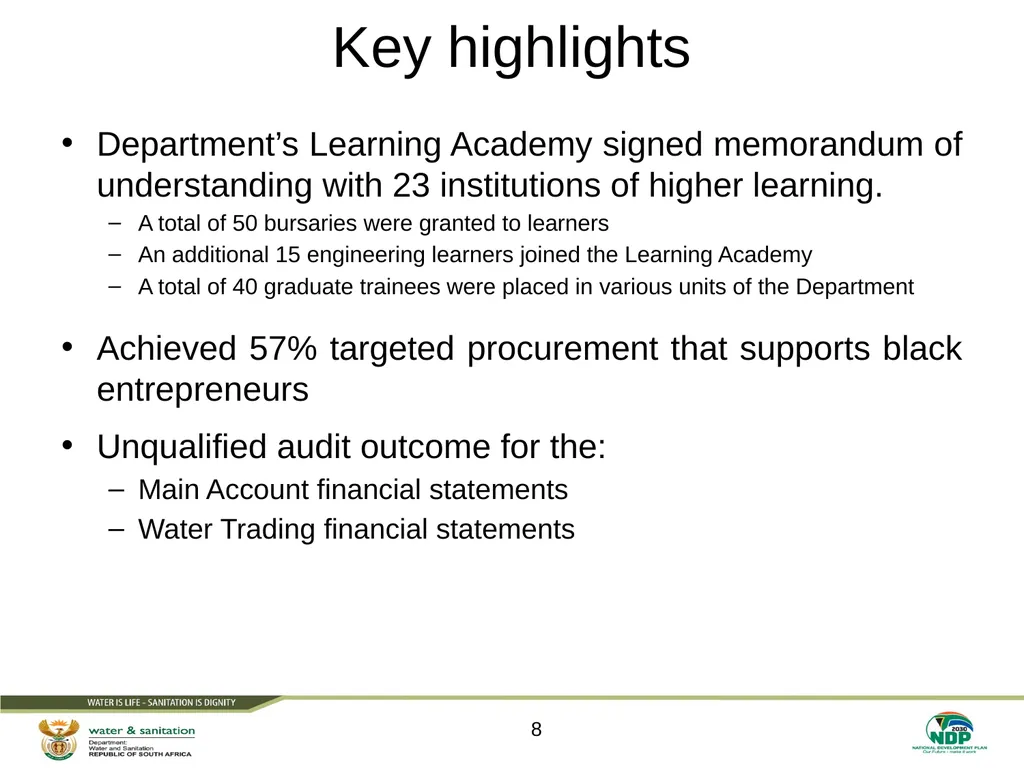
Key highlights Department’s Learning Academy signed memorandum of understanding with 23 institutions of higher learning.
A total of 50 bursaries were granted to learners
An additional 15 engineering learners joined the Learning Academy
A total of 40 graduate trainees were placed in various units of the Department
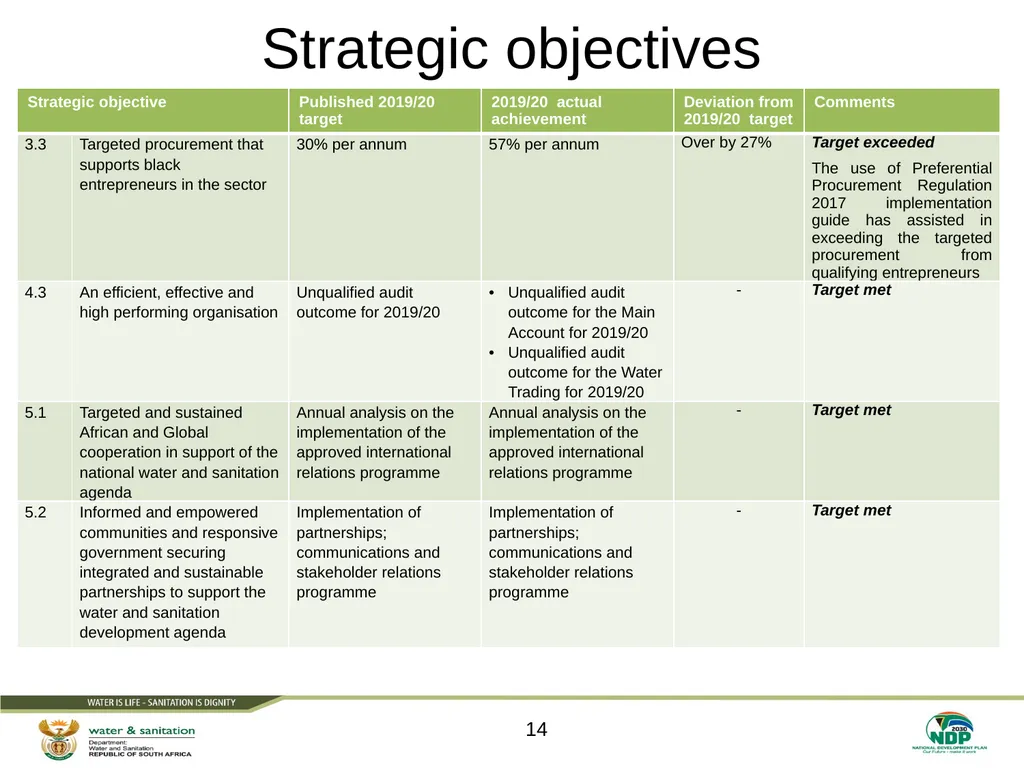
Achieved 57% targeted procurement that supports black entrepreneurs
Unqualified audit outcome for the:
Main Account financial statements
Water Trading financial statements 8<br>
A total of 50 bursaries were granted to learners
An additional 15 engineering learners joined the Learning Academy
A total of 40 graduate trainees were placed in various units of the Department
Achieved 57% targeted procurement that supports black entrepreneurs
Unqualified audit outcome for the:
Main Account financial statements
Water Trading financial statements 8<br>
09
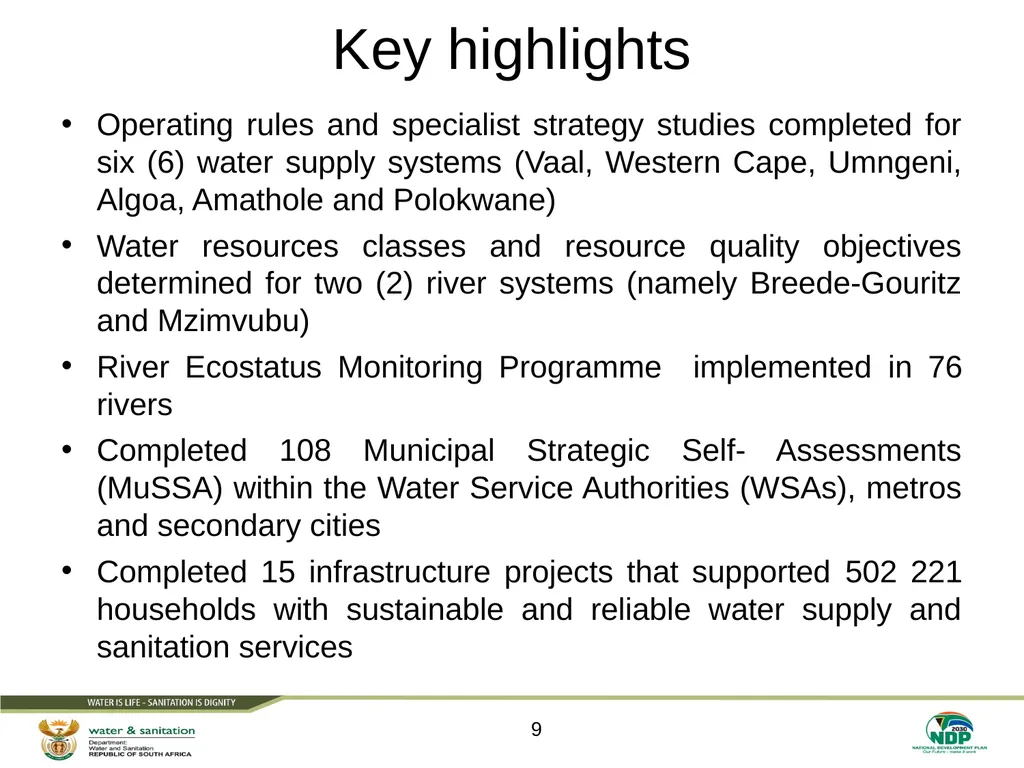
Key highlights Operating rules and specialist strategy studies completed for six (6) water supply systems (Vaal, Western Cape, Umngeni, Algoa, Amathole and Polokwane)
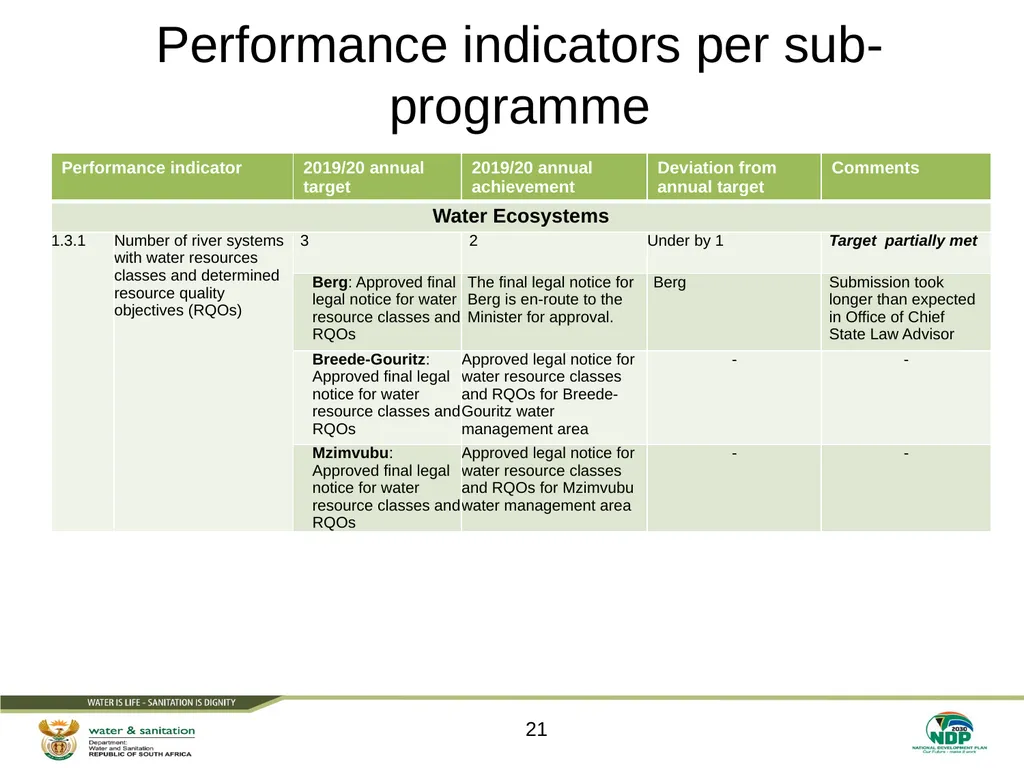
Water resources classes and resource quality objectives determined for two (2) river systems (namely Breede-Gouritz and Mzimvubu)
River Ecostatus Monitoring Programme implemented in 76 rivers
Completed 108 Municipal Strategic Self- Assessments (MuSSA) within the Water Service Authorities (WSAs), metros and secondary cities
Completed 15 infrastructure projects that supported 502 221 households with sustainable and reliable water supply and sanitation services 9<br>
Water resources classes and resource quality objectives determined for two (2) river systems (namely Breede-Gouritz and Mzimvubu)
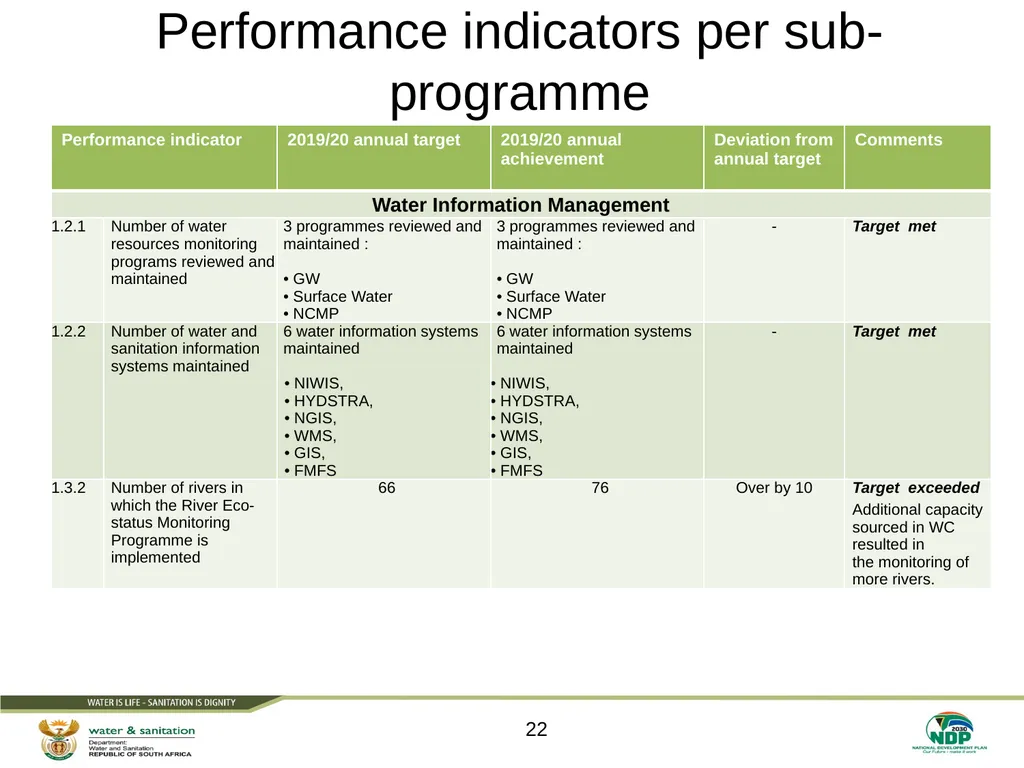
River Ecostatus Monitoring Programme implemented in 76 rivers
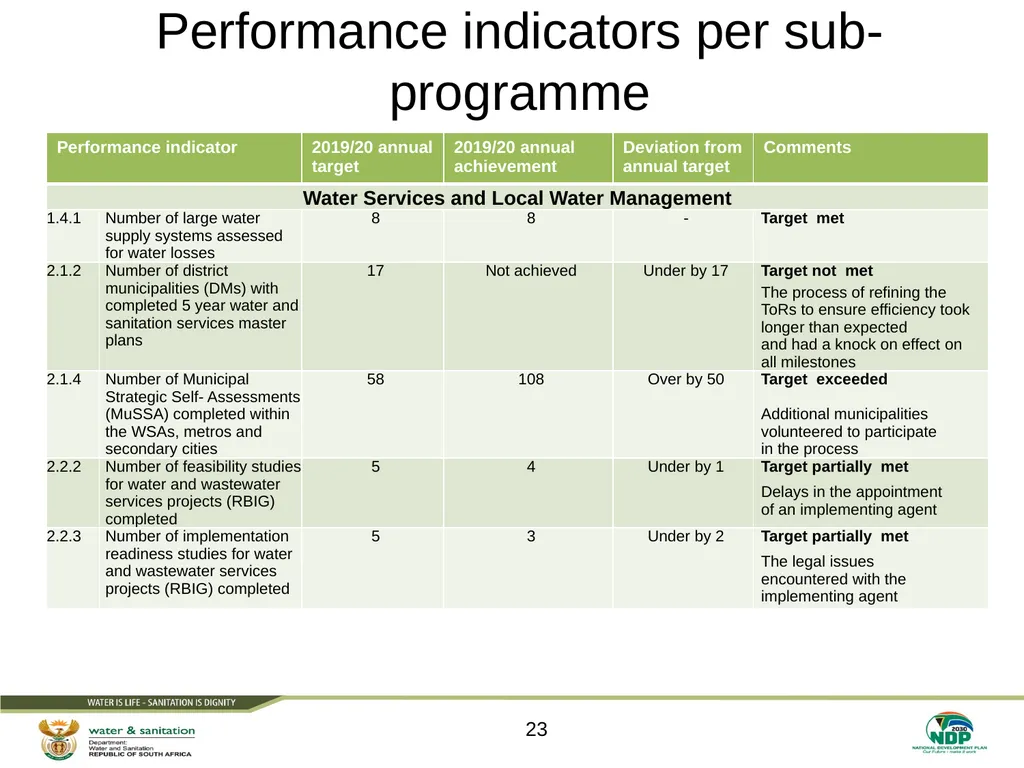
Completed 108 Municipal Strategic Self- Assessments (MuSSA) within the Water Service Authorities (WSAs), metros and secondary cities
Completed 15 infrastructure projects that supported 502 221 households with sustainable and reliable water supply and sanitation services 9<br>
10
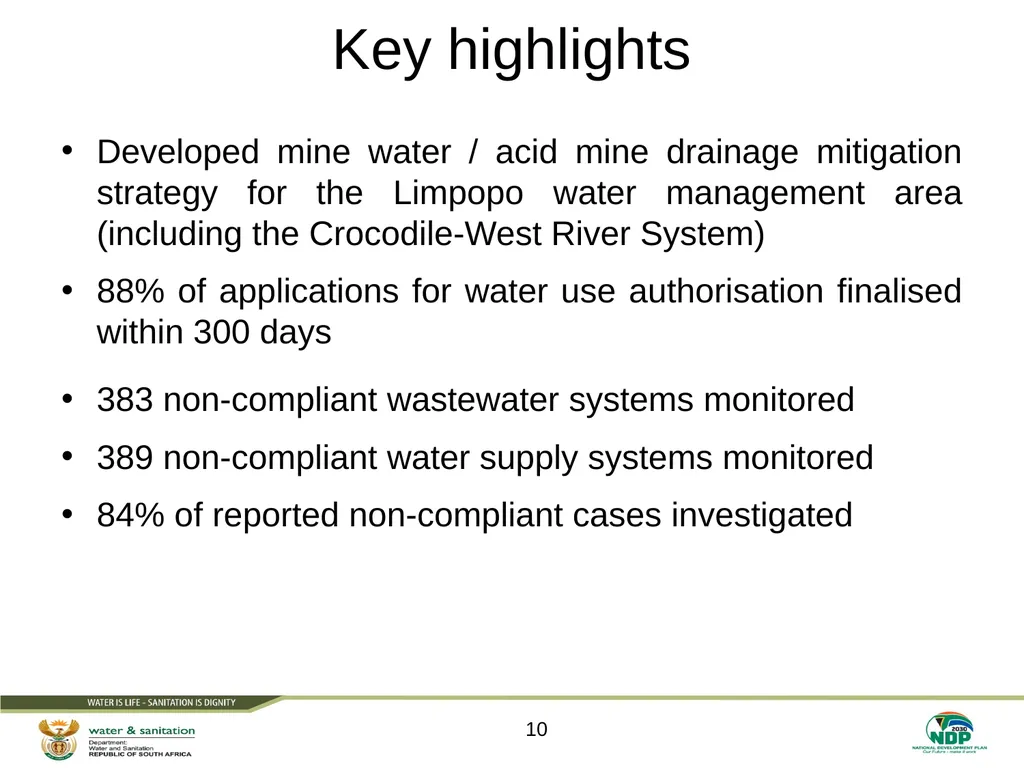
Key highlights Developed mine water / acid mine drainage mitigation strategy for the Limpopo water management area (including the Crocodile-West River System)
88% of applications for water use authorisation finalised within 300 days
383 non-compliant wastewater systems monitored
389 non-compliant water supply systems monitored
84% of reported non-compliant cases investigated 10<br>
88% of applications for water use authorisation finalised within 300 days
383 non-compliant wastewater systems monitored
389 non-compliant water supply systems monitored
84% of reported non-compliant cases investigated 10<br>
11
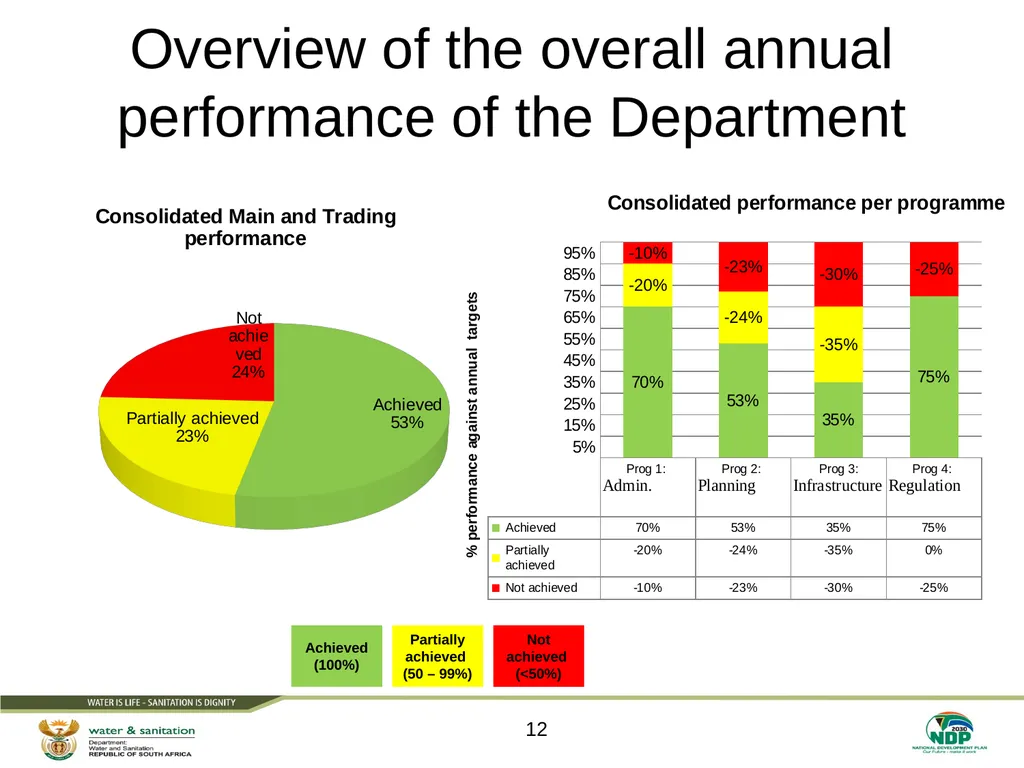
Part 1: overview of non-financial performance 11 Overview of the Overall annual performance of the Department
Detailed annual performance per programme<br>
Detailed annual performance per programme<br>
12
Overview of the overall annual performance of the Department 12<br>
13
Part 1.1: overview of programme 1 (administration) performance Detailed annual performance per programme 13<br>
14
Strategic objectives 14<br>
15
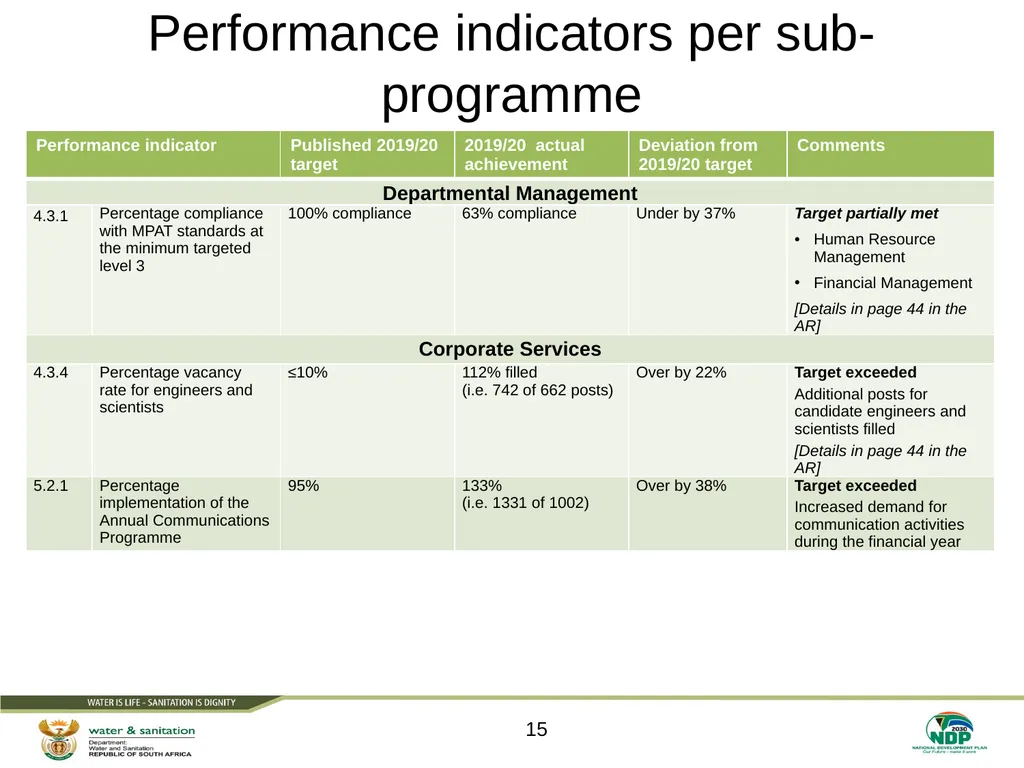
Performance indicators per sub-programme 15<br>
16
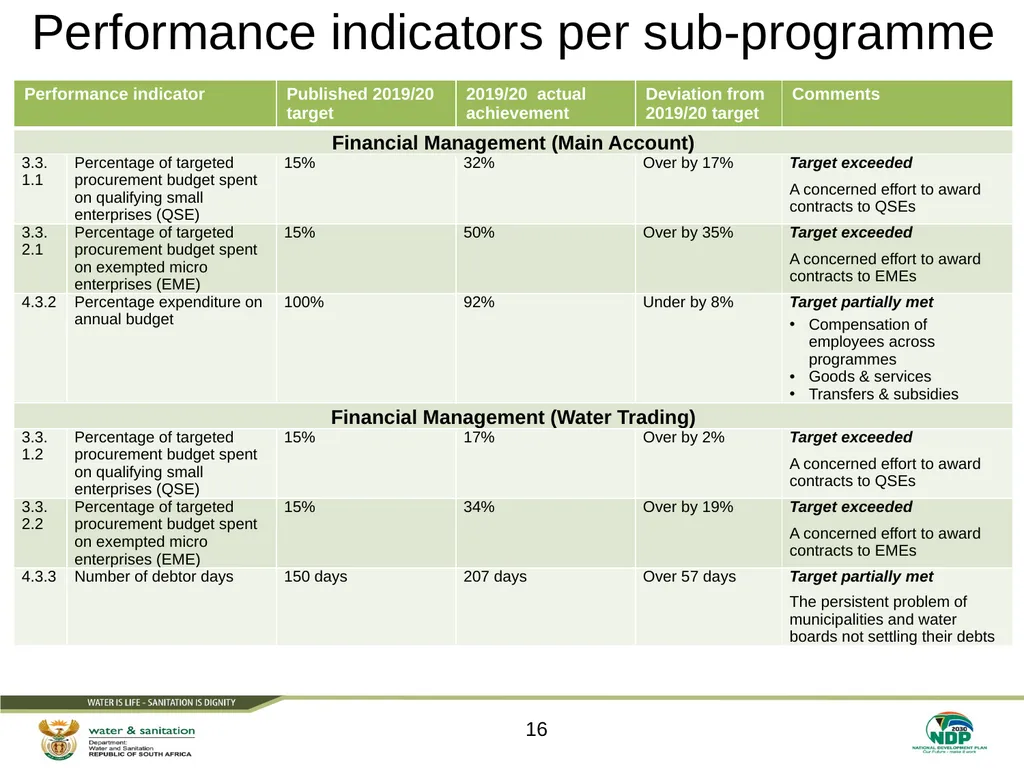
Performance indicators per sub-programme 16<br>
17
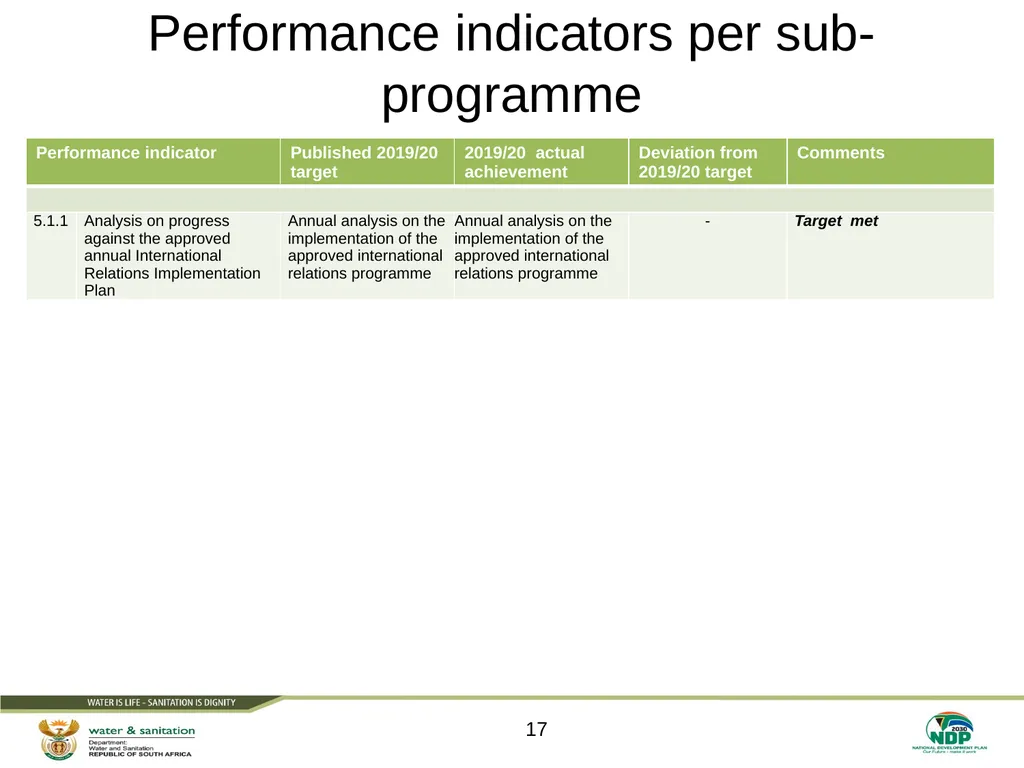
Performance indicators per sub-programme 17<br>
18
Part 1.2: overview of programme 2 (water planning & information management) performance Detailed annual performance per programme 18<br>
19
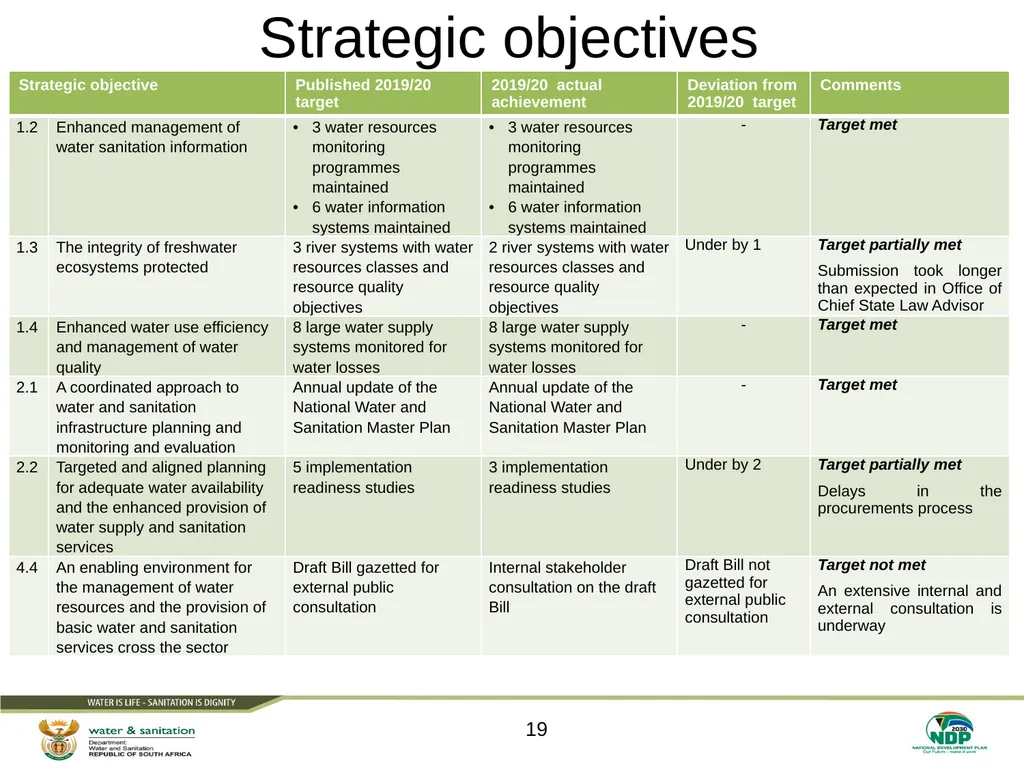
Strategic objectives 19<br>
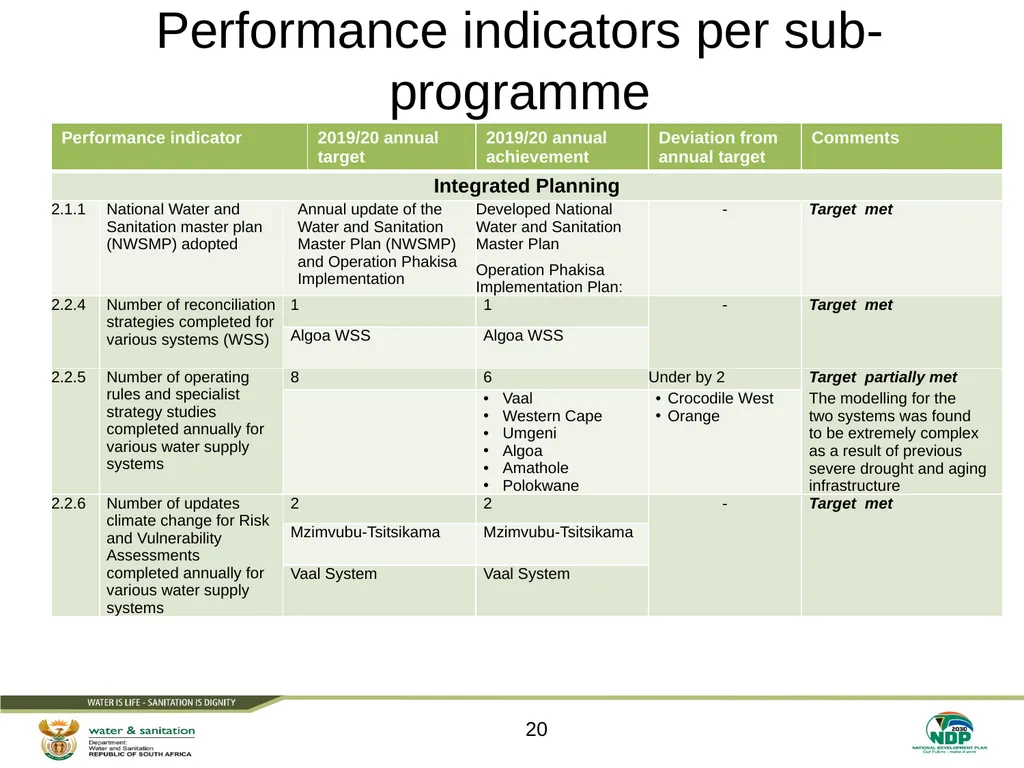
20
Performance indicators per sub-programme 20<br>
21
Performance indicators per sub-programme 21<br>
22
Performance indicators per sub-programme 22<br>
23
Performance indicators per sub-programme 23<br>
24
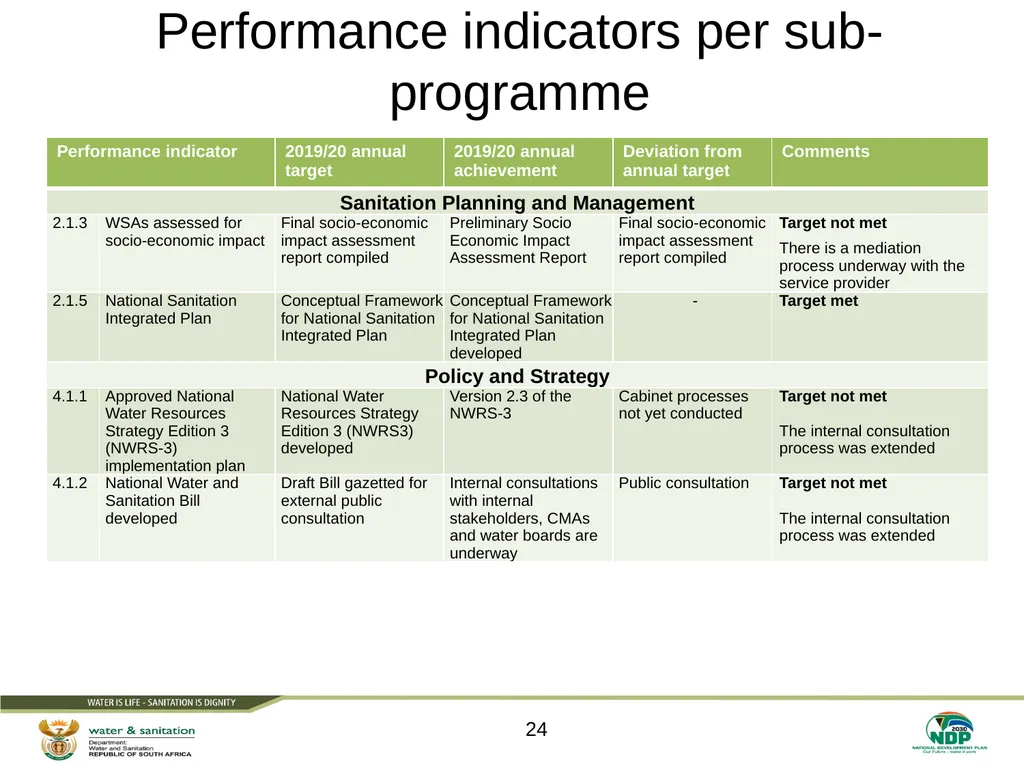
Performance indicators per sub-programme 24<br>
25
Part 1.3: overview of programme 3 (water infrastructure development) performance Detailed annual performance per programme 25<br>
26
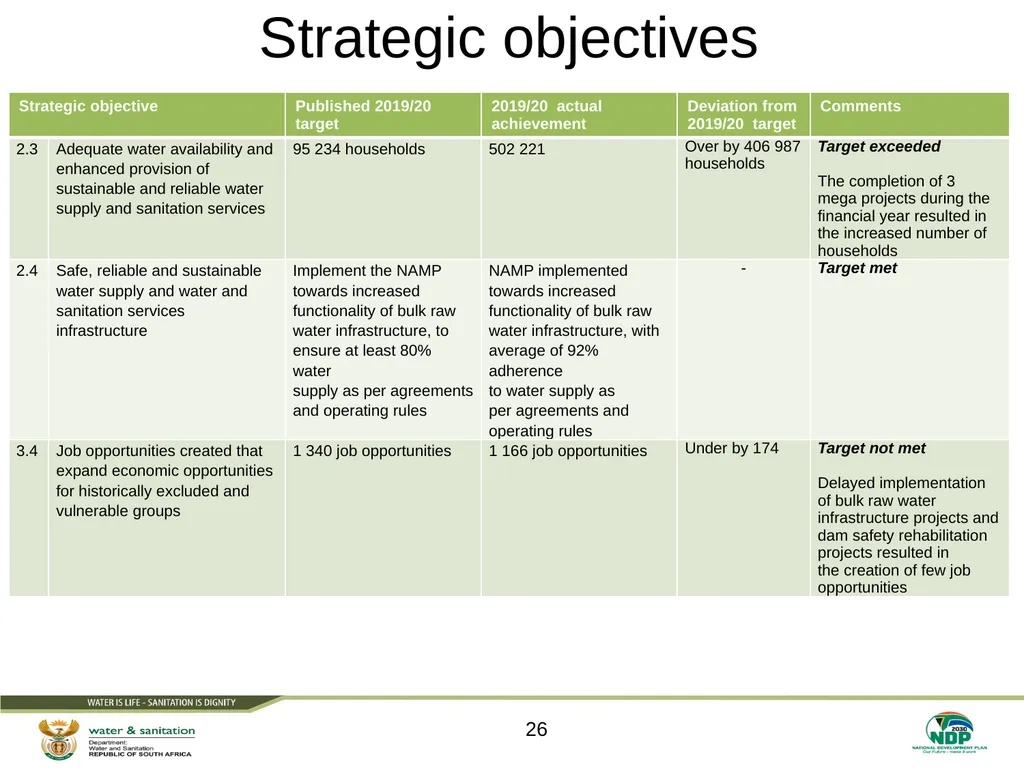
Strategic objectives 26<br>
27
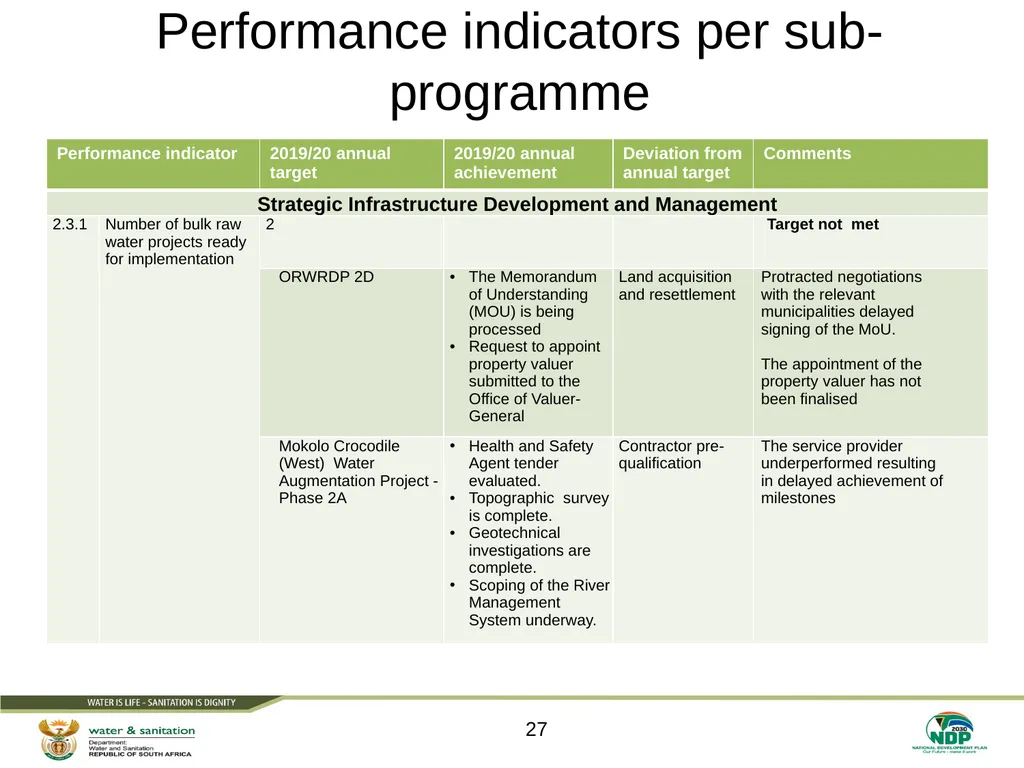
Performance indicators per sub-programme 27<br>
28
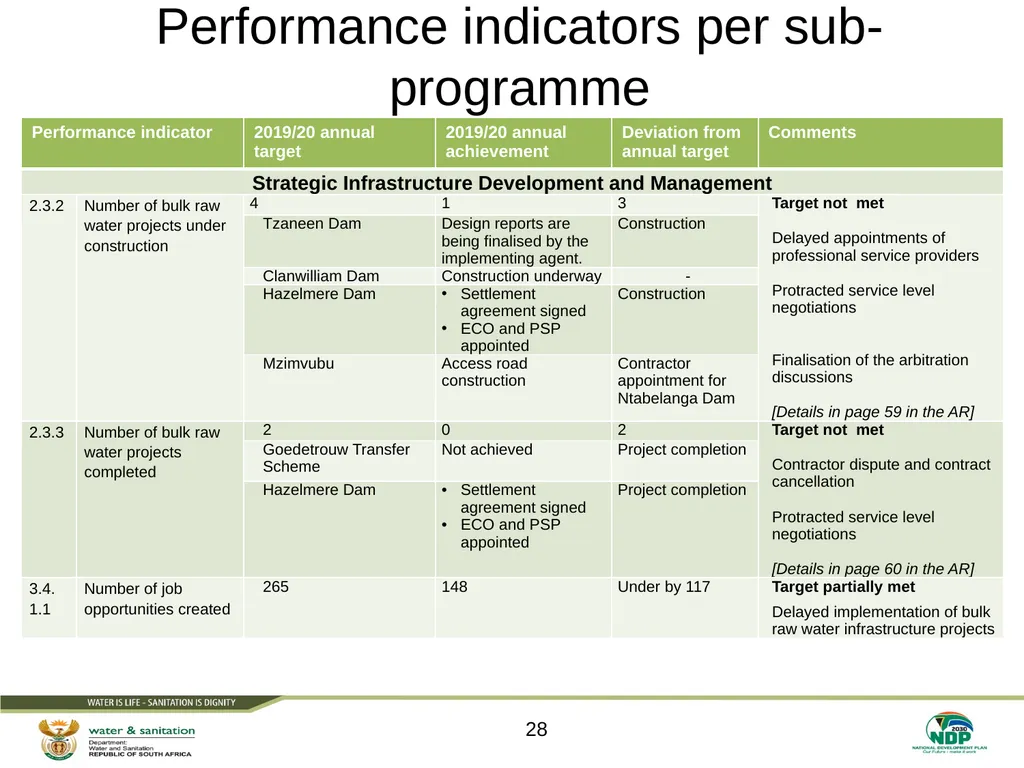
Performance indicators per sub-programme 28<br>
29
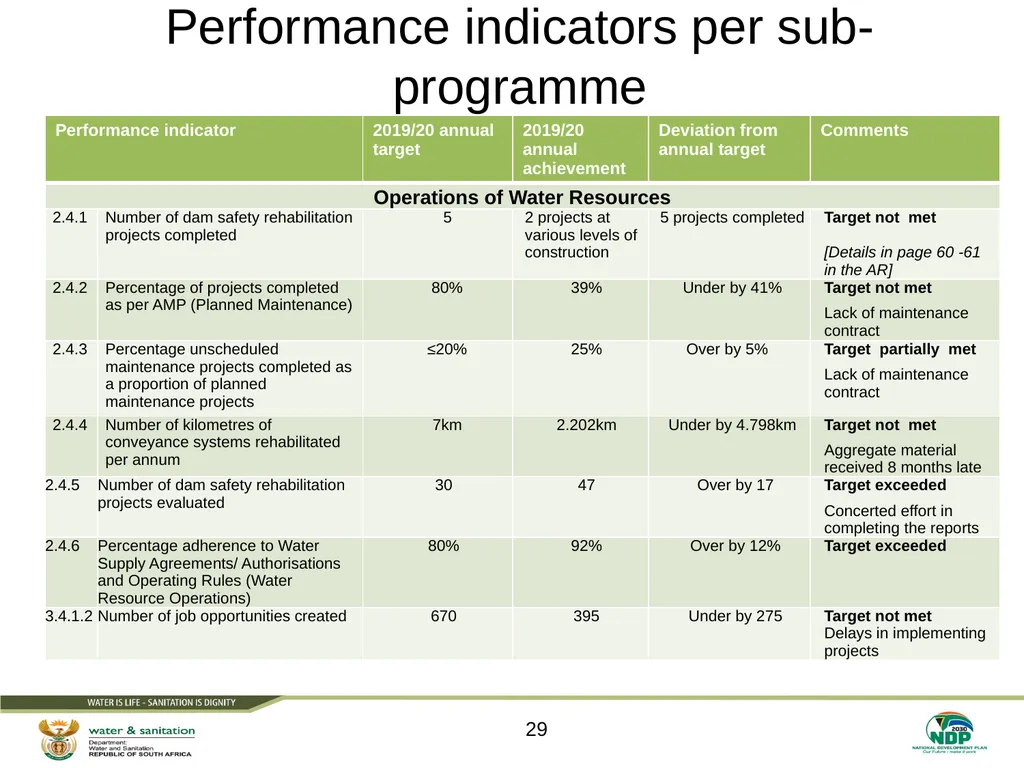
Performance indicators per sub-programme 29<br>
30
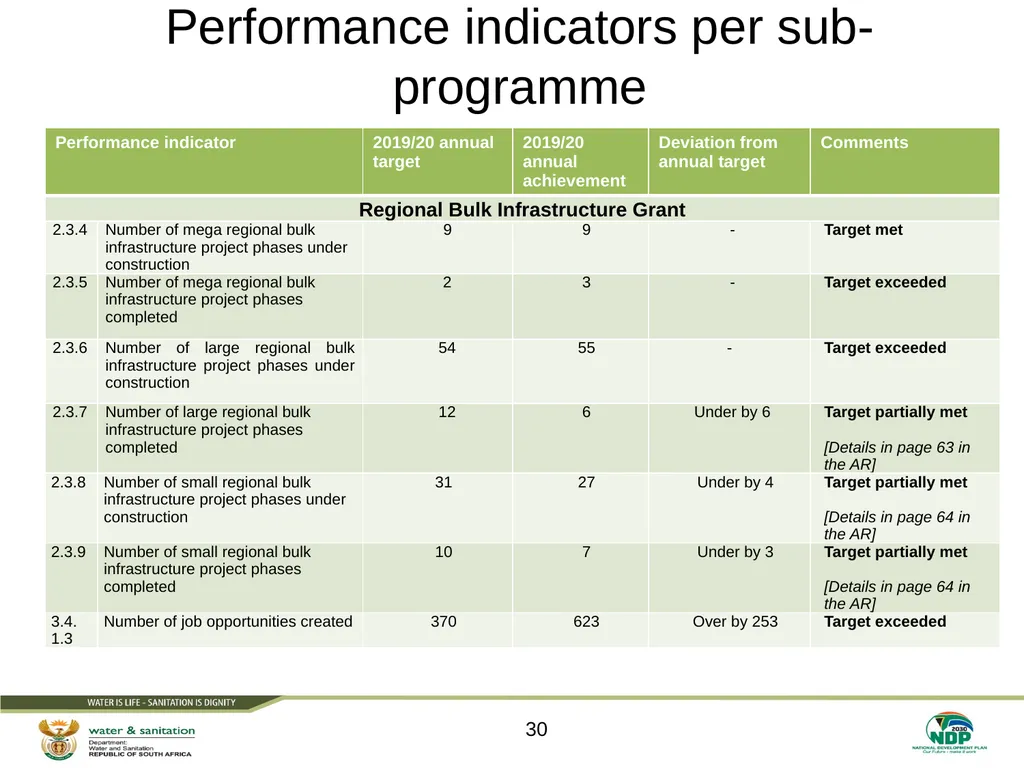
Performance indicators per sub-programme 30<br>
31
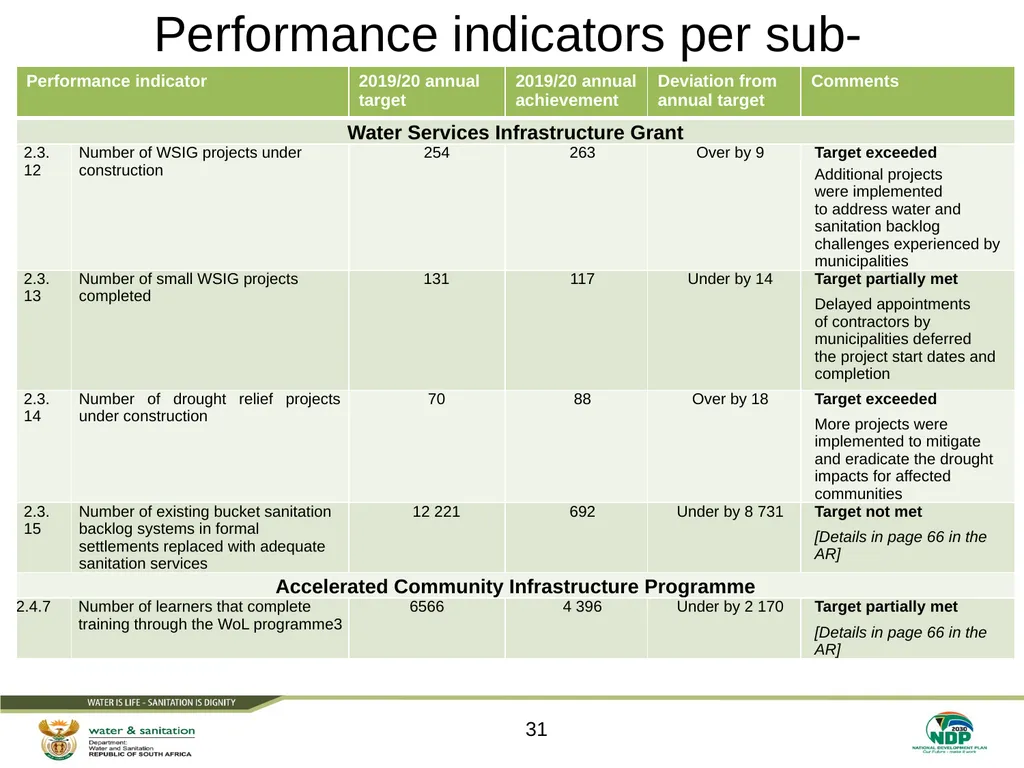
Performance indicators per sub-programme 31<br>
32
Part 1.4: overview of programme 4 (water sector regulation) performance Detailed annual performance per programme 32<br>
33
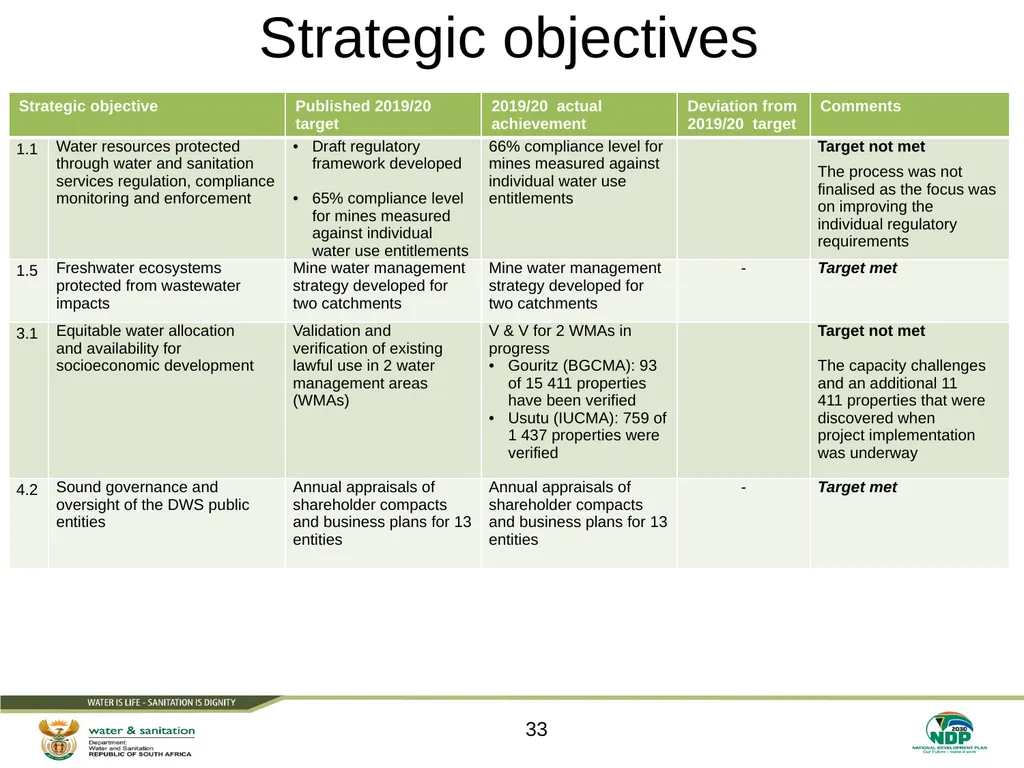
Strategic objectives 33<br>
34
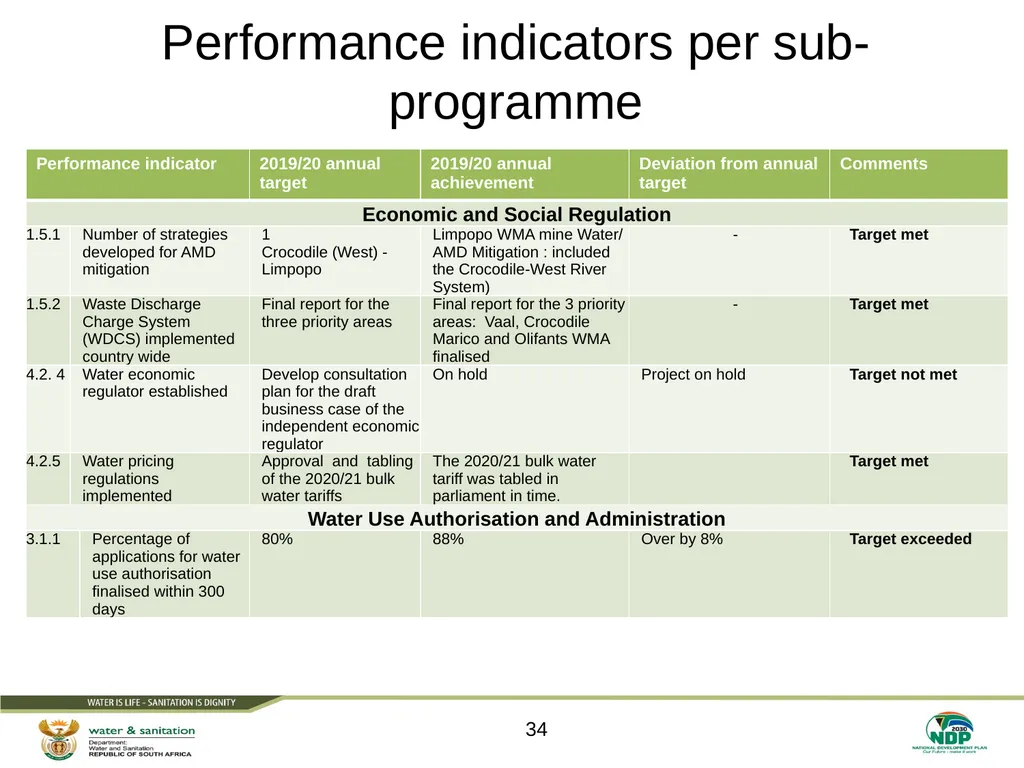
Performance indicators per sub-programme 34<br>
35
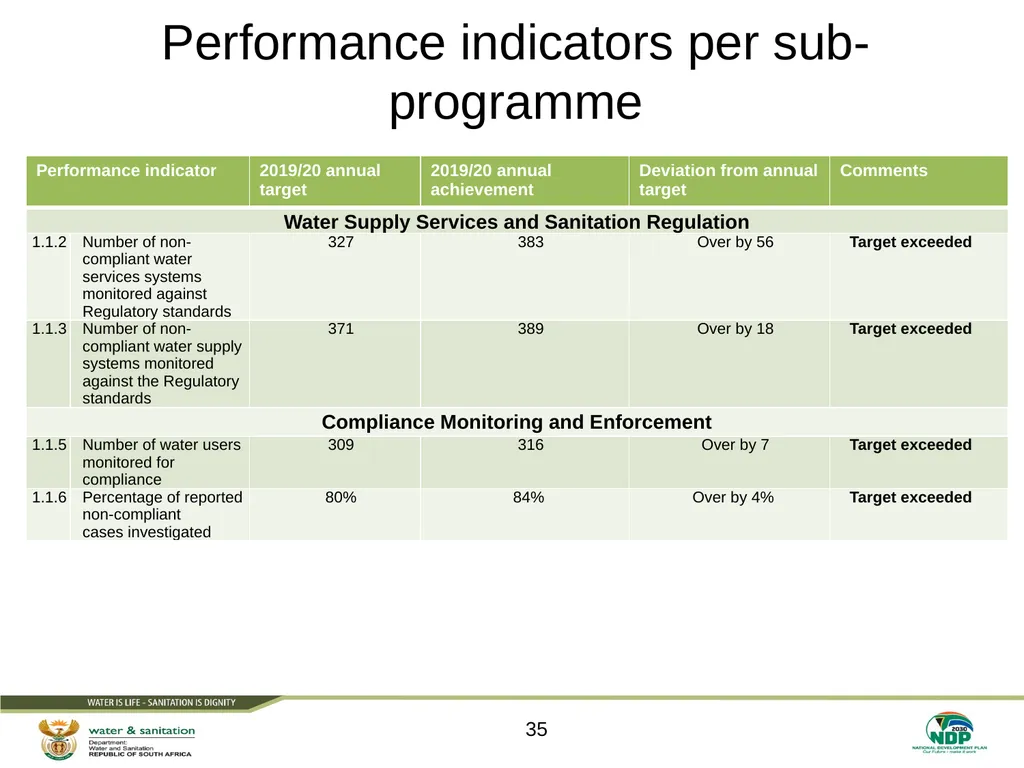
Performance indicators per sub-programme 35<br>
36
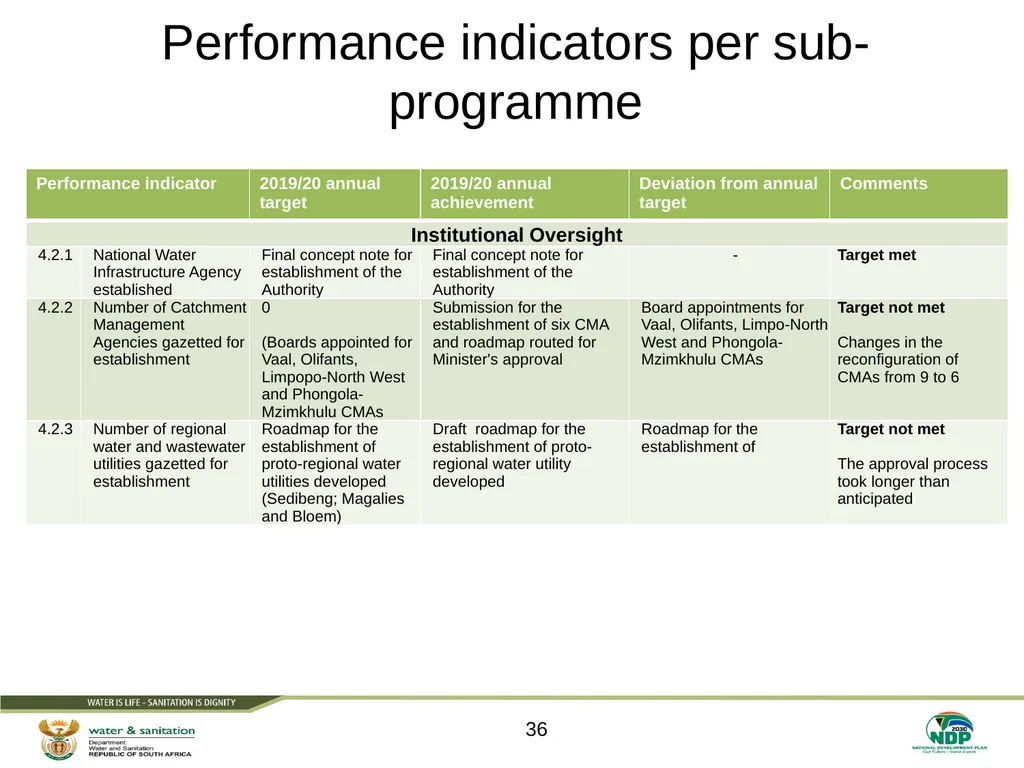
Performance indicators per sub-programme 36<br>
37
Part 2: overview of financial performance 37 FINANCIAL HIGHLIGHTS (MAIN ACCOUNT AND WATER TRADING)
UNAUTHORiSED EXPENDITURE (MAIN ACCOUNT)
IRREGULAR, FRUITLESS AND WASTEFUL EXPENDITURE (main account & water trading)
CONDONATION OF IRREGULAR EXPENDITURE (main account & water trading)<br>
UNAUTHORiSED EXPENDITURE (MAIN ACCOUNT)
IRREGULAR, FRUITLESS AND WASTEFUL EXPENDITURE (main account & water trading)
CONDONATION OF IRREGULAR EXPENDITURE (main account & water trading)<br>
38
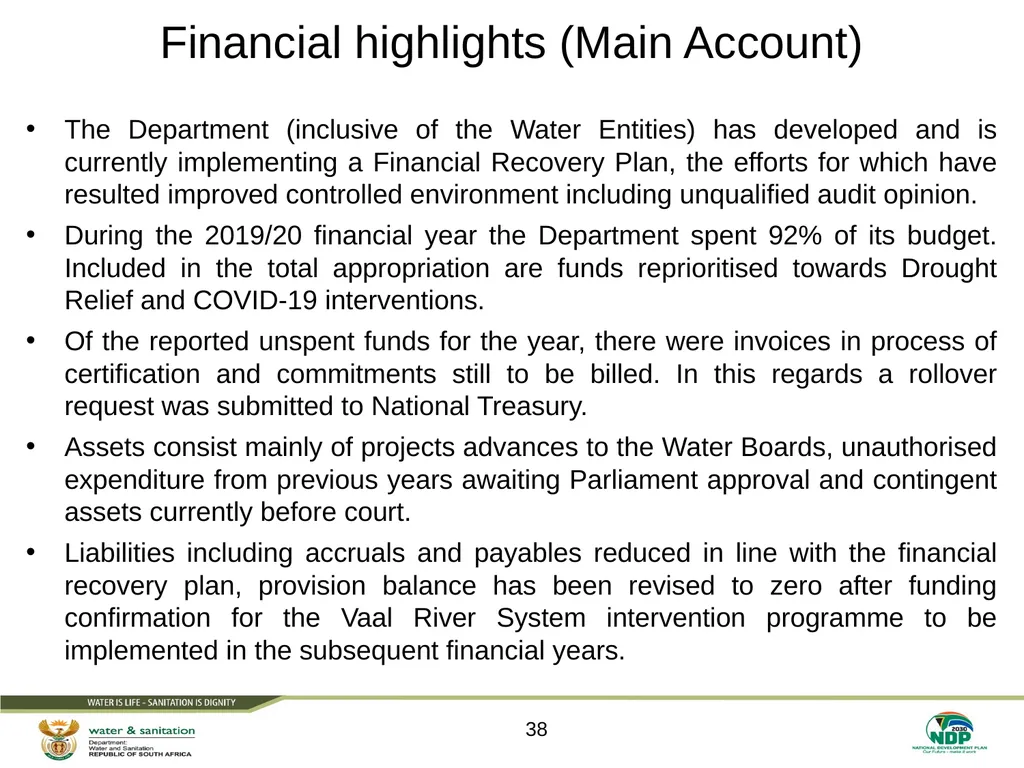
Financial highlights (Main Account) The Department (inclusive of the Water Entities) has developed and is currently implementing a Financial Recovery Plan, the efforts for which have resulted improved controlled environment including unqualified audit opinion.
During the 2019/20 financial year the Department spent 92% of its budget. Included in the total appropriation are funds reprioritised towards Drought Relief and COVID-19 interventions.
Of the reported unspent funds for the year, there were invoices in process of certification and commitments still to be billed. In this regards a rollover request was submitted to National Treasury.
Assets consist mainly of projects advances to the Water Boards, unauthorised expenditure from previous years awaiting Parliament approval and contingent assets currently before court.
Liabilities including accruals and payables reduced in line with the financial recovery plan, provision balance has been revised to zero after funding confirmation for the Vaal River System intervention programme to be implemented in the subsequent financial years. 38<br>
During the 2019/20 financial year the Department spent 92% of its budget. Included in the total appropriation are funds reprioritised towards Drought Relief and COVID-19 interventions.
Of the reported unspent funds for the year, there were invoices in process of certification and commitments still to be billed. In this regards a rollover request was submitted to National Treasury.
Assets consist mainly of projects advances to the Water Boards, unauthorised expenditure from previous years awaiting Parliament approval and contingent assets currently before court.
Liabilities including accruals and payables reduced in line with the financial recovery plan, provision balance has been revised to zero after funding confirmation for the Vaal River System intervention programme to be implemented in the subsequent financial years. 38<br>
39
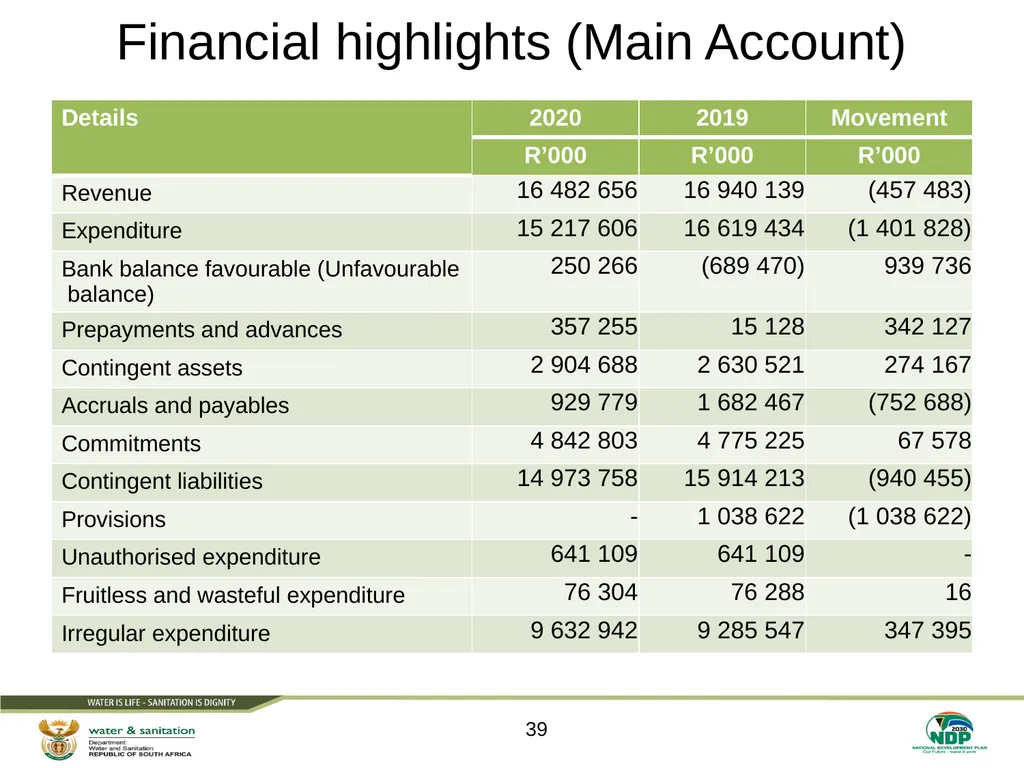
Financial highlights (Main Account) 39<br>
40
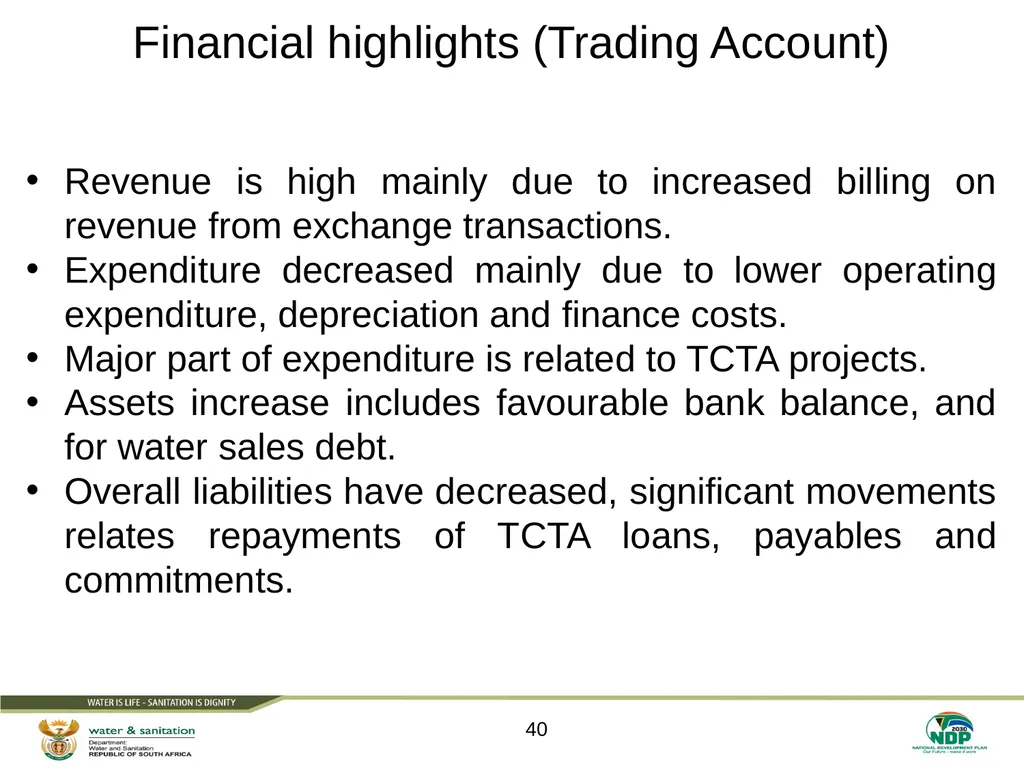
Financial highlights (Trading Account) Revenue is high mainly due to increased billing on revenue from exchange transactions.
Expenditure decreased mainly due to lower operating expenditure, depreciation and finance costs.
Major part of expenditure is related to TCTA projects.
Assets increase includes favourable bank balance, and for water sales debt.
Overall liabilities have decreased, significant movements relates repayments of TCTA loans, payables and commitments. 40<br>
Expenditure decreased mainly due to lower operating expenditure, depreciation and finance costs.
Major part of expenditure is related to TCTA projects.
Assets increase includes favourable bank balance, and for water sales debt.
Overall liabilities have decreased, significant movements relates repayments of TCTA loans, payables and commitments. 40<br>
41
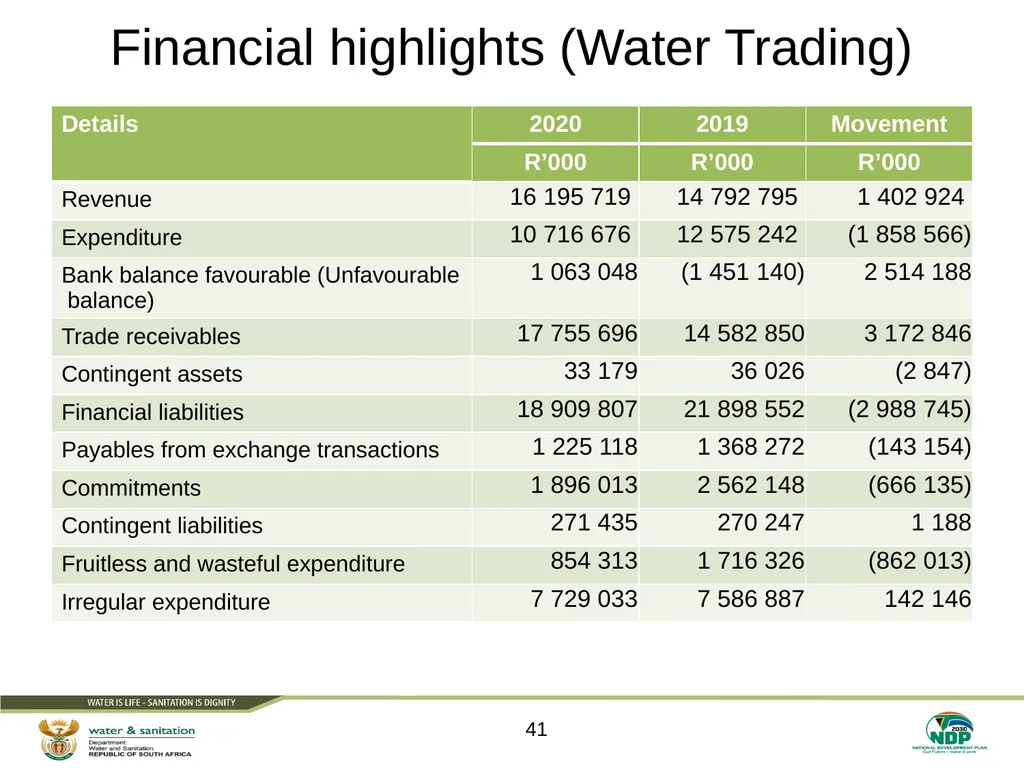
Financial highlights (Water Trading) 41<br>
42
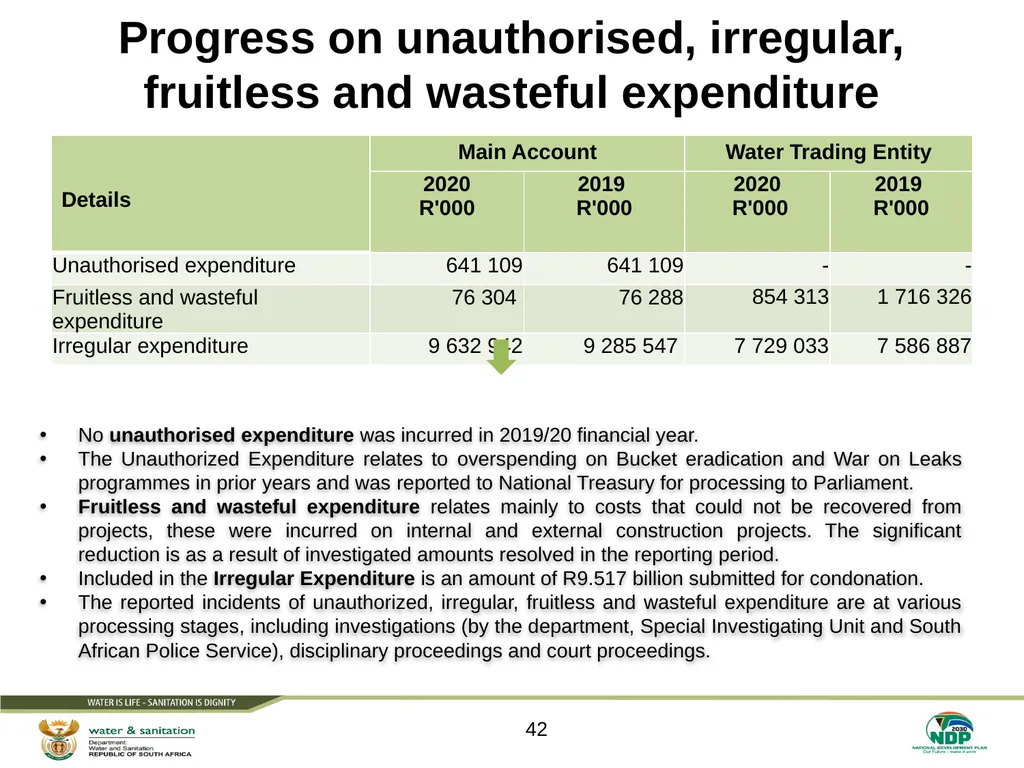
Progress on unauthorised, irregular, fruitless and wasteful expenditure 42 No unauthorised expenditure was incurred in 2019/20 financial year.
The Unauthorized Expenditure relates to overspending on Bucket eradication and War on Leaks programmes in prior years and was reported to National Treasury for processing to Parliament.
Fruitless and wasteful expenditure relates mainly to costs that could not be recovered from projects, these were incurred on internal and external construction projects. The significant reduction is as a result of investigated amounts resolved in the reporting period.
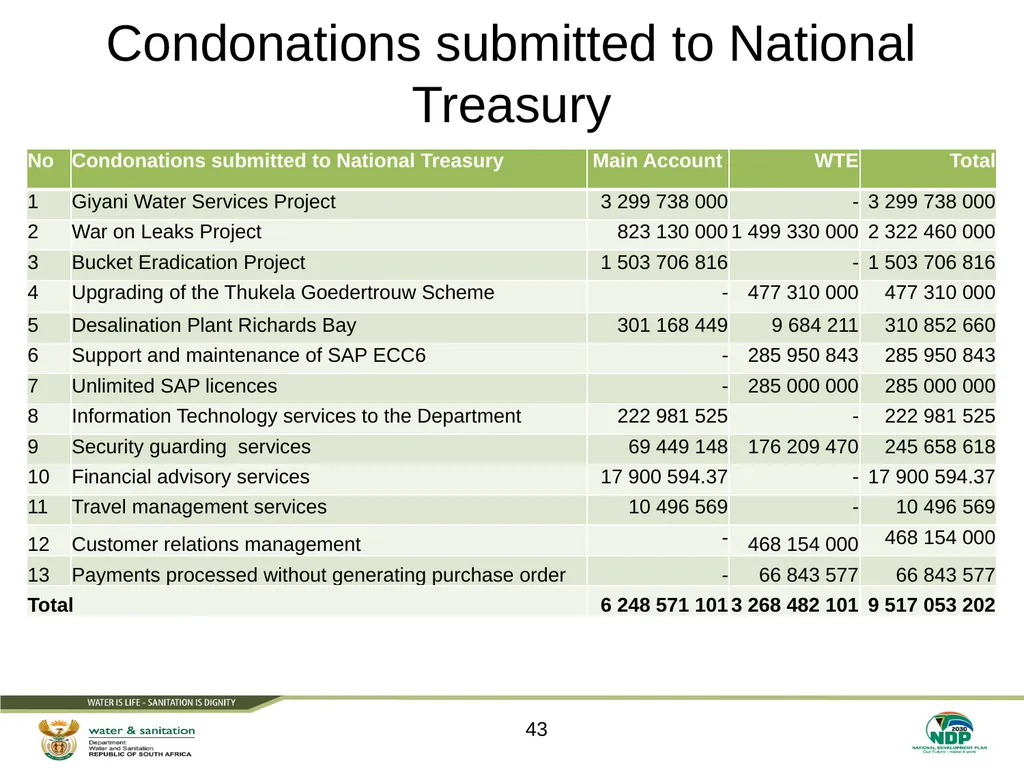
Included in the Irregular Expenditure is an amount of R9.517 billion submitted for condonation.
The reported incidents of unauthorized, irregular, fruitless and wasteful expenditure are at various processing stages, including investigations (by the department, Special Investigating Unit and South African Police Service), disciplinary proceedings and court proceedings.<br>
The Unauthorized Expenditure relates to overspending on Bucket eradication and War on Leaks programmes in prior years and was reported to National Treasury for processing to Parliament.
Fruitless and wasteful expenditure relates mainly to costs that could not be recovered from projects, these were incurred on internal and external construction projects. The significant reduction is as a result of investigated amounts resolved in the reporting period.
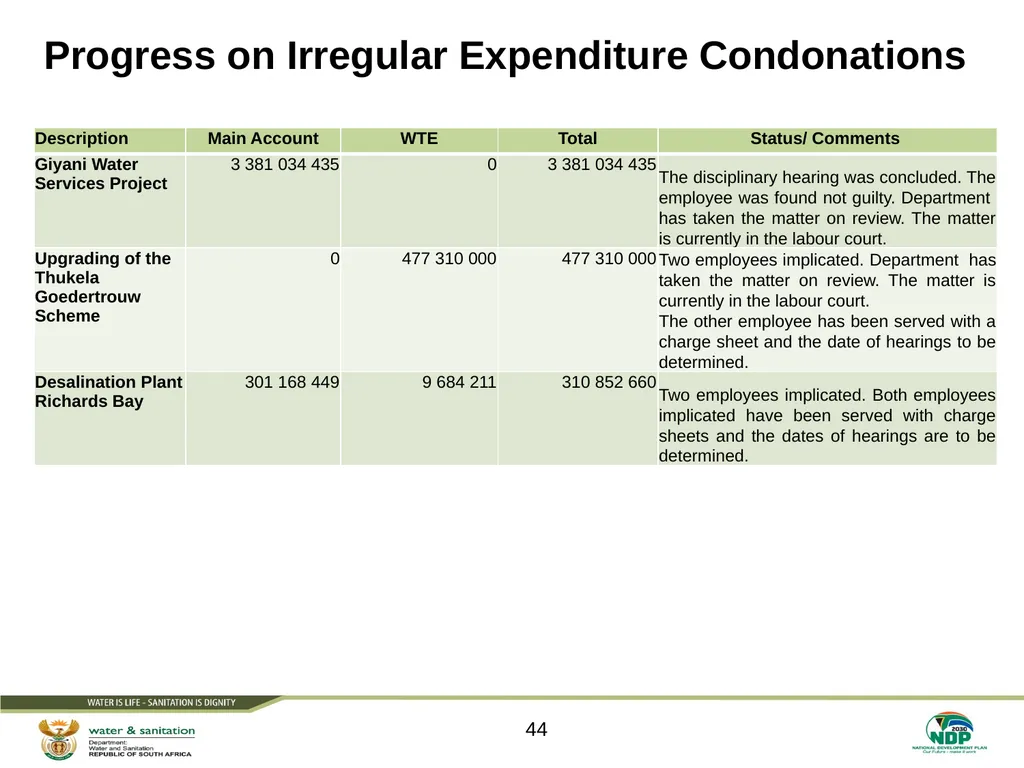
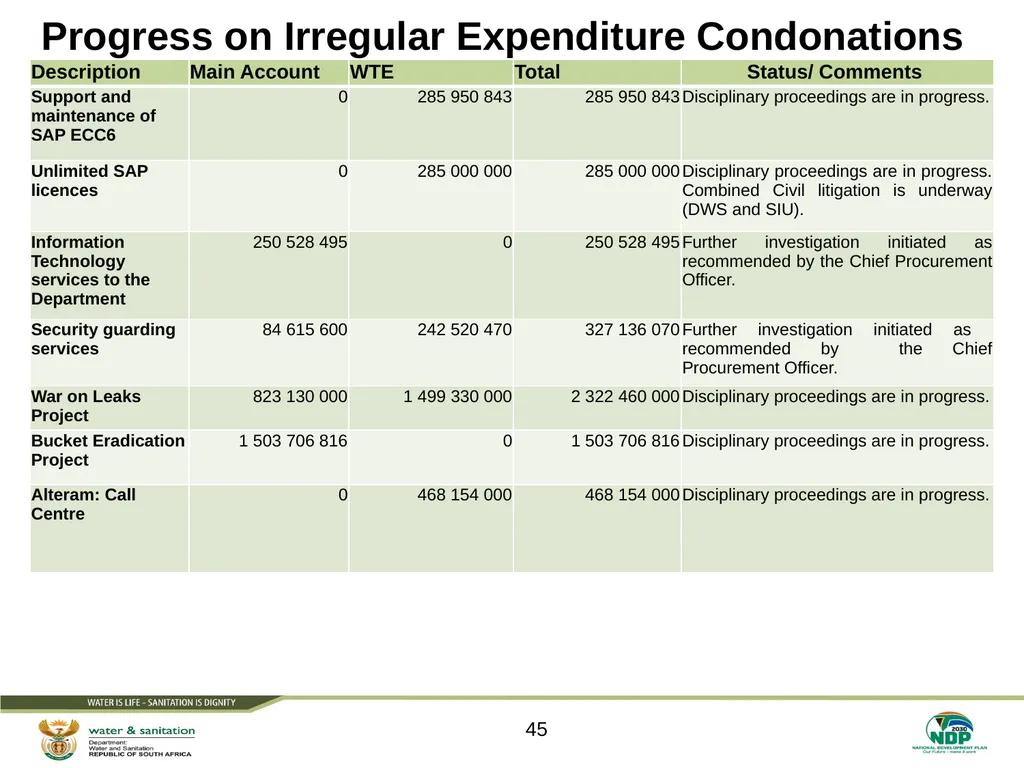
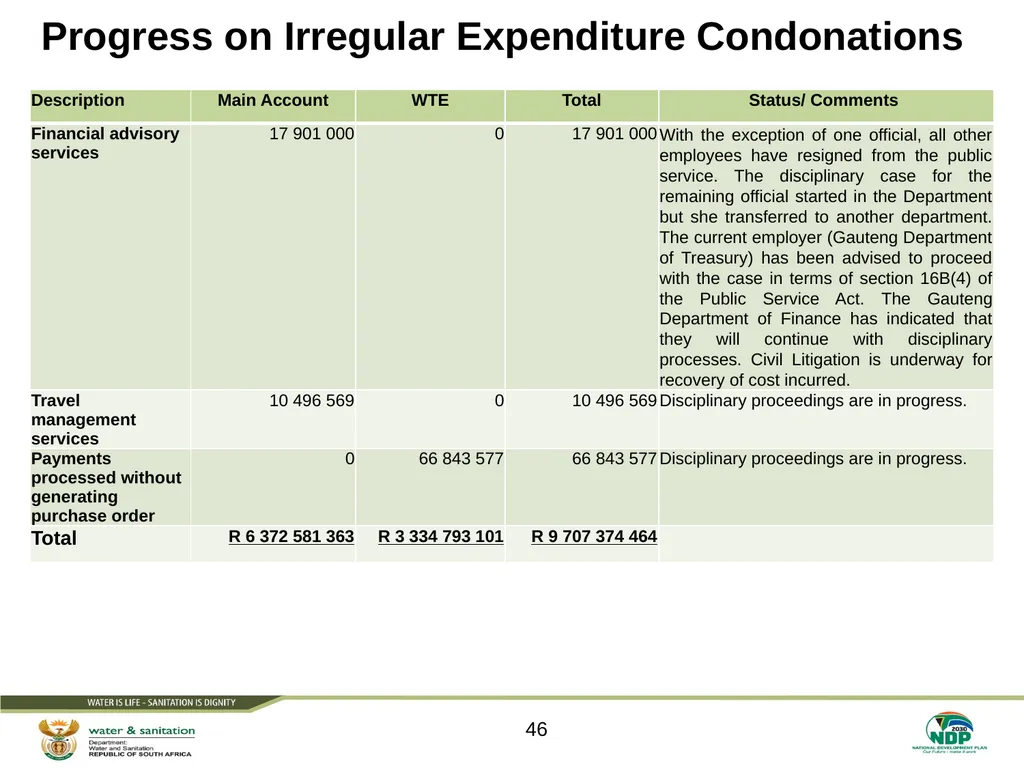
Included in the Irregular Expenditure is an amount of R9.517 billion submitted for condonation.
The reported incidents of unauthorized, irregular, fruitless and wasteful expenditure are at various processing stages, including investigations (by the department, Special Investigating Unit and South African Police Service), disciplinary proceedings and court proceedings.<br>
43
Condonations submitted to National Treasury 43<br>
44
Progress on Irregular Expenditure Condonations 44<br>
45
45 Progress on Irregular Expenditure Condonations<br>
46
46 Progress on Irregular Expenditure Condonations<br>
47
Part 3: overview of the auditor-general’s report 47 Outcome of the department’s (vote 36) financial audit report
Outcome of the water trading financial audit<br>
Outcome of the water trading financial audit<br>
48
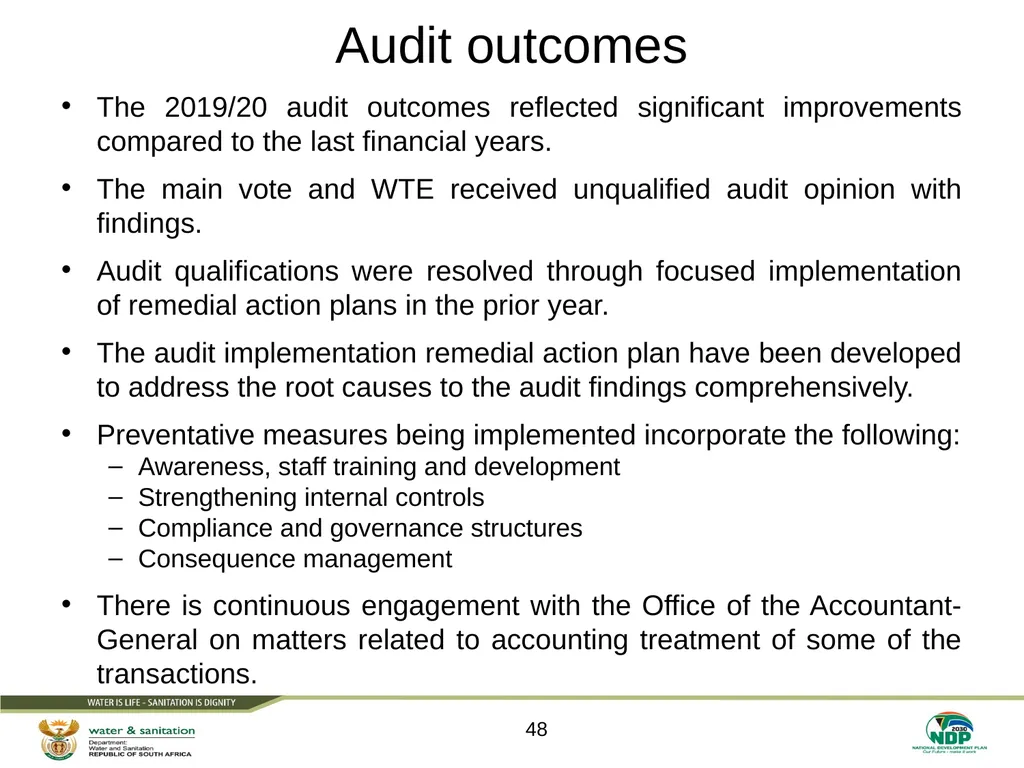
Audit outcomes The 2019/20 audit outcomes reflected significant improvements compared to the last financial years.
The main vote and WTE received unqualified audit opinion with findings.
Audit qualifications were resolved through focused implementation of remedial action plans in the prior year.
The audit implementation remedial action plan have been developed to address the root causes to the audit findings comprehensively.
Preventative measures being implemented incorporate the following:
Awareness, staff training and development
Strengthening internal controls
Compliance and governance structures
Consequence management
There is continuous engagement with the Office of the Accountant-General on matters related to accounting treatment of some of the transactions. 48<br>
The main vote and WTE received unqualified audit opinion with findings.
Audit qualifications were resolved through focused implementation of remedial action plans in the prior year.
The audit implementation remedial action plan have been developed to address the root causes to the audit findings comprehensively.
Preventative measures being implemented incorporate the following:
Awareness, staff training and development
Strengthening internal controls
Compliance and governance structures
Consequence management
There is continuous engagement with the Office of the Accountant-General on matters related to accounting treatment of some of the transactions. 48<br>
49
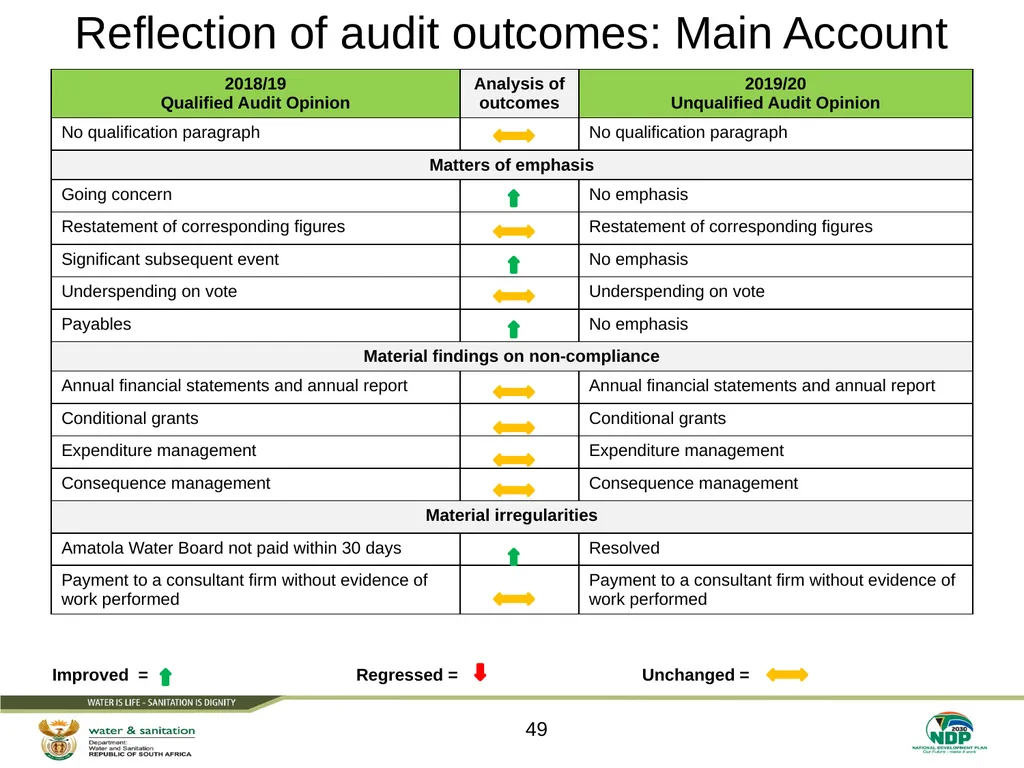
Reflection of audit outcomes: Main Account 49<br>
50
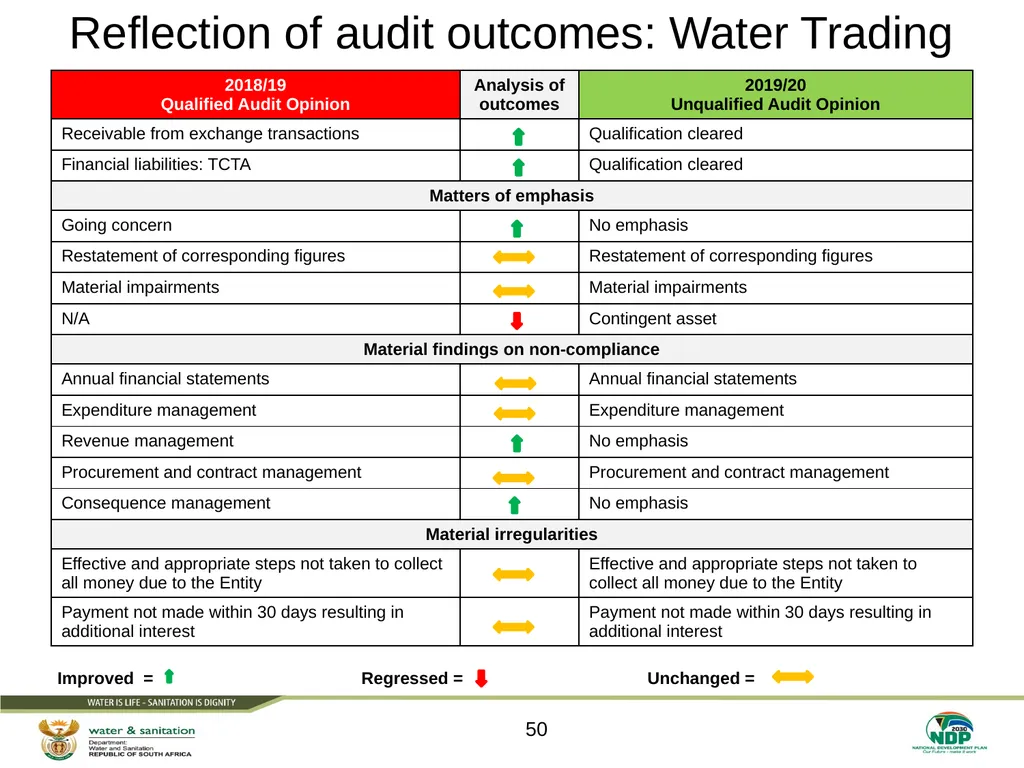
Reflection of audit outcomes: Water Trading 50<br>
51
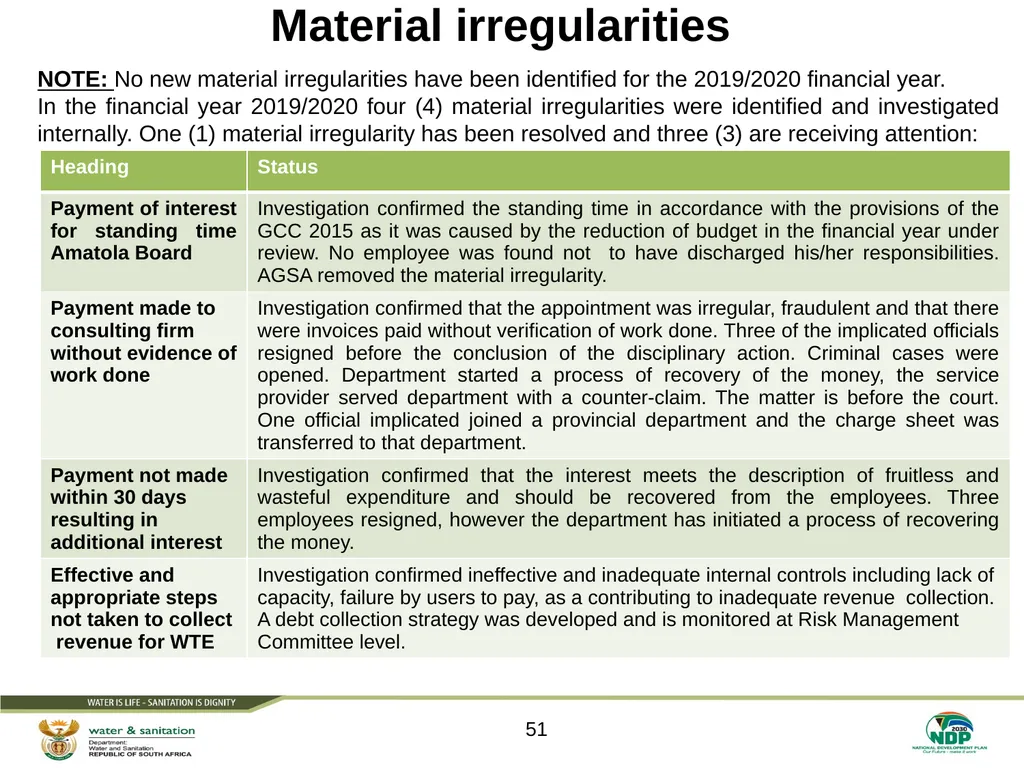
Material irregularities NOTE: No new material irregularities have been identified for the 2019/2020 financial year.
In the financial year 2019/2020 four (4) material irregularities were identified and investigated internally. One (1) material irregularity has been resolved and three (3) are receiving attention: 51<br>
In the financial year 2019/2020 four (4) material irregularities were identified and investigated internally. One (1) material irregularity has been resolved and three (3) are receiving attention: 51<br>
52
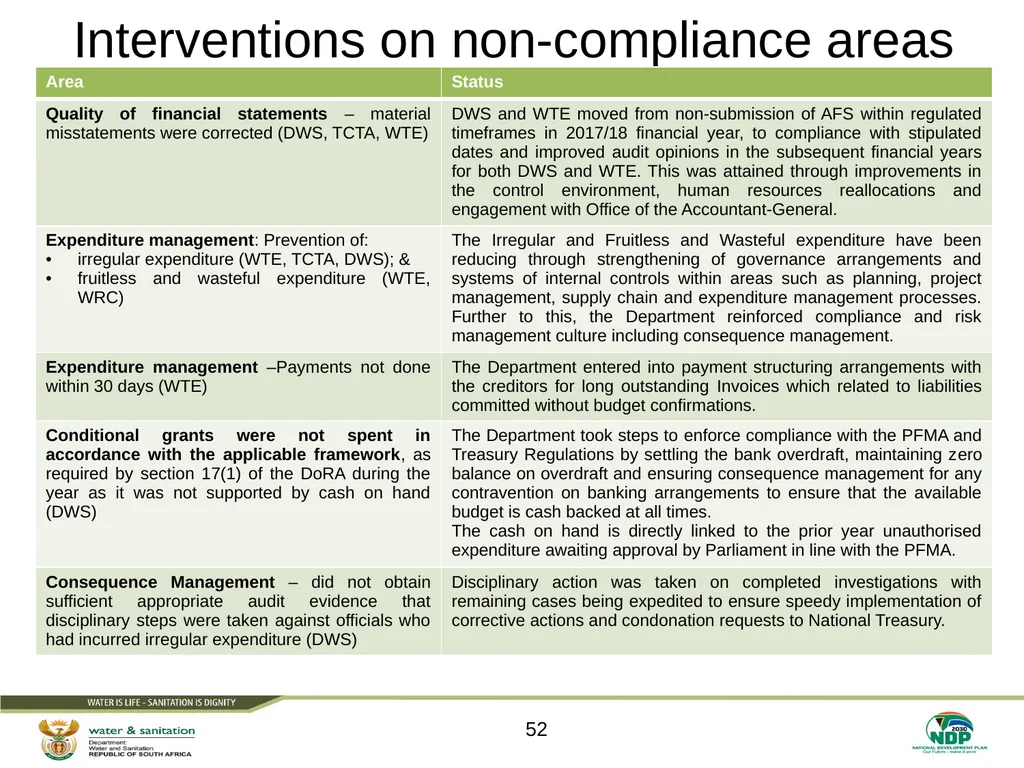
Interventions on non-compliance areas 52<br>
53
Part 4: feedback on the financial recovery plan 53<br>
54
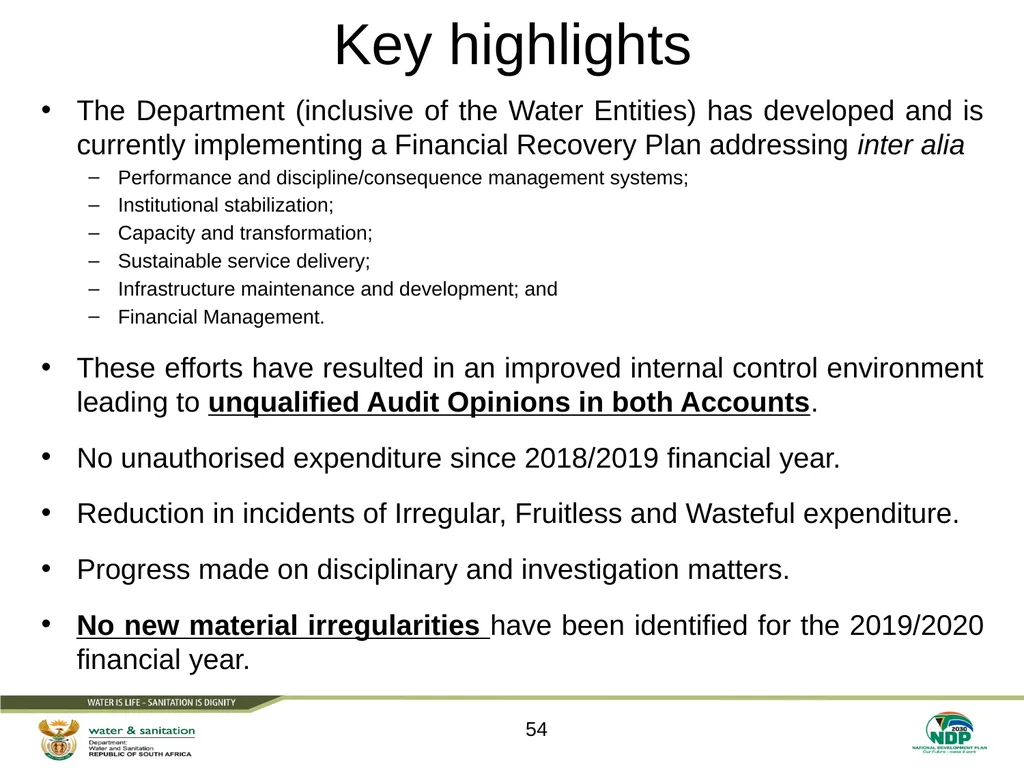
Key highlights The Department (inclusive of the Water Entities) has developed and is currently implementing a Financial Recovery Plan addressing inter alia
Performance and discipline/consequence management systems;
Institutional stabilization;
Capacity and transformation;
Sustainable service delivery;
Infrastructure maintenance and development; and
Financial Management.
These efforts have resulted in an improved internal control environment leading to unqualified Audit Opinions in both Accounts.
No unauthorised expenditure since 2018/2019 financial year.
Reduction in incidents of Irregular, Fruitless and Wasteful expenditure.
Progress made on disciplinary and investigation matters.
No new material irregularities have been identified for the 2019/2020 financial year. 54<br>
Performance and discipline/consequence management systems;
Institutional stabilization;
Capacity and transformation;
Sustainable service delivery;
Infrastructure maintenance and development; and
Financial Management.
These efforts have resulted in an improved internal control environment leading to unqualified Audit Opinions in both Accounts.
No unauthorised expenditure since 2018/2019 financial year.
Reduction in incidents of Irregular, Fruitless and Wasteful expenditure.
Progress made on disciplinary and investigation matters.
No new material irregularities have been identified for the 2019/2020 financial year. 54<br>
55
Summary of financial recovery 55<br>
56
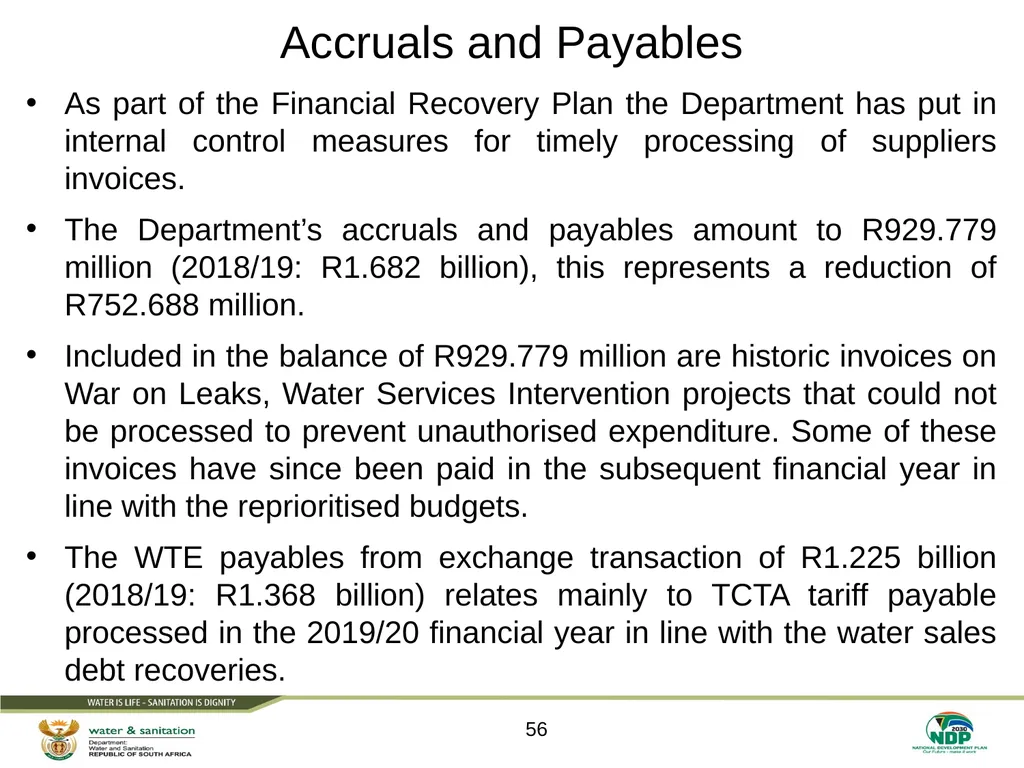
Accruals and Payables As part of the Financial Recovery Plan the Department has put in internal control measures for timely processing of suppliers invoices.
The Department’s accruals and payables amount to R929.779 million (2018/19: R1.682 billion), this represents a reduction of R752.688 million.
Included in the balance of R929.779 million are historic invoices on War on Leaks, Water Services Intervention projects that could not be processed to prevent unauthorised expenditure. Some of these invoices have since been paid in the subsequent financial year in line with the reprioritised budgets.
The WTE payables from exchange transaction of R1.225 billion (2018/19: R1.368 billion) relates mainly to TCTA tariff payable processed in the 2019/20 financial year in line with the water sales debt recoveries. 56<br>
The Department’s accruals and payables amount to R929.779 million (2018/19: R1.682 billion), this represents a reduction of R752.688 million.
Included in the balance of R929.779 million are historic invoices on War on Leaks, Water Services Intervention projects that could not be processed to prevent unauthorised expenditure. Some of these invoices have since been paid in the subsequent financial year in line with the reprioritised budgets.
The WTE payables from exchange transaction of R1.225 billion (2018/19: R1.368 billion) relates mainly to TCTA tariff payable processed in the 2019/20 financial year in line with the water sales debt recoveries. 56<br>
57
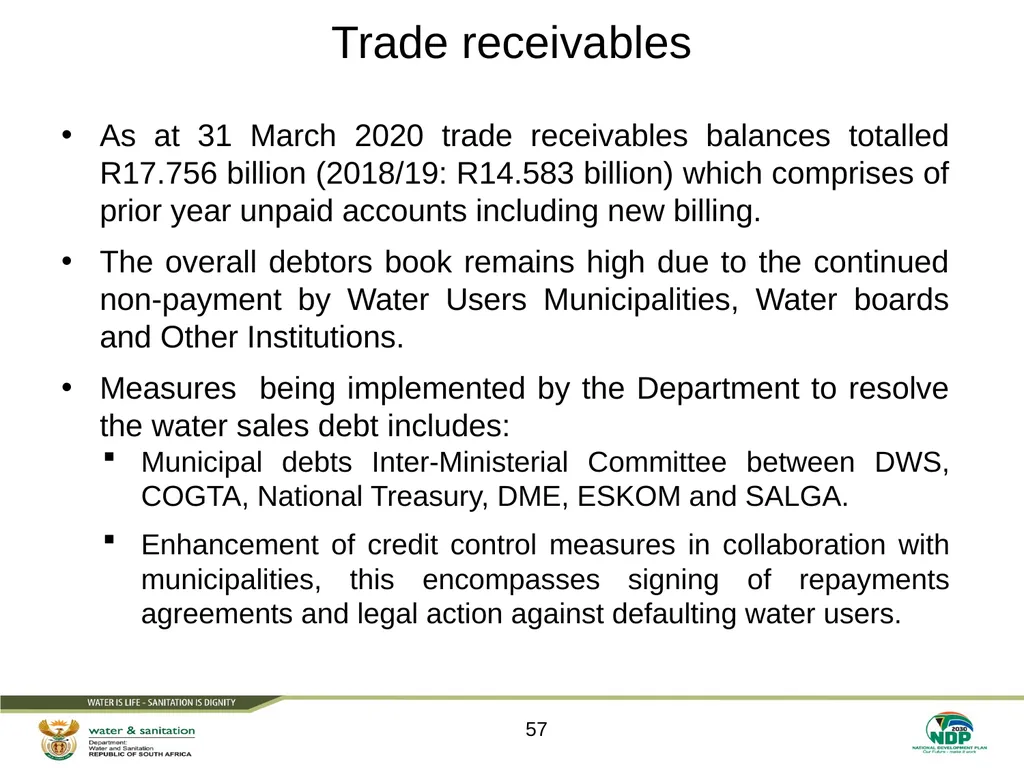
Trade receivables As at 31 March 2020 trade receivables balances totalled R17.756 billion (2018/19: R14.583 billion) which comprises of prior year unpaid accounts including new billing.
The overall debtors book remains high due to the continued non-payment by Water Users Municipalities, Water boards and Other Institutions.
Measures being implemented by the Department to resolve the water sales debt includes:
Municipal debts Inter-Ministerial Committee between DWS, COGTA, National Treasury, DME, ESKOM and SALGA.
Enhancement of credit control measures in collaboration with municipalities, this encompasses signing of repayments agreements and legal action against defaulting water users. 57<br>
The overall debtors book remains high due to the continued non-payment by Water Users Municipalities, Water boards and Other Institutions.
Measures being implemented by the Department to resolve the water sales debt includes:
Municipal debts Inter-Ministerial Committee between DWS, COGTA, National Treasury, DME, ESKOM and SALGA.
Enhancement of credit control measures in collaboration with municipalities, this encompasses signing of repayments agreements and legal action against defaulting water users. 57<br>
58
Part 5: overview of human resources management 58 Employment and vacancies
Employment equity
Employee attrition during 2018/19
Misconduct cases addressed at disciplinary hearings<br>
Employment equity
Employee attrition during 2018/19
Misconduct cases addressed at disciplinary hearings<br>
59
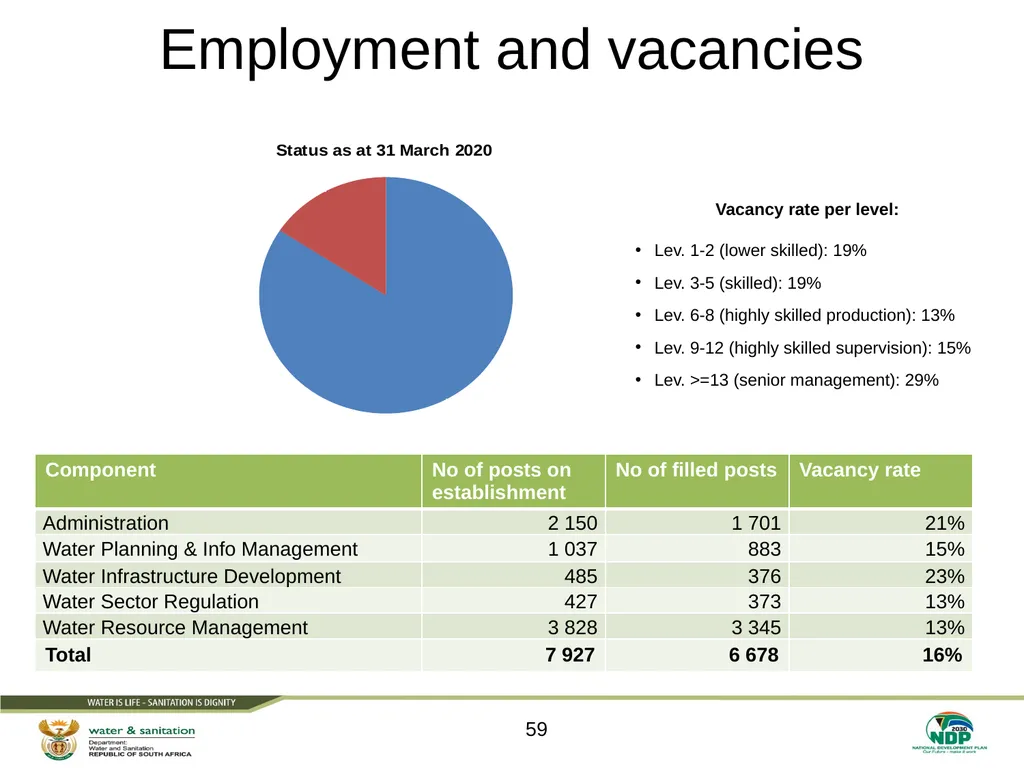
Employment and vacancies 59 Vacancy rate per level:
Lev. 1-2 (lower skilled): 19%
Lev. 3-5 (skilled): 19%
Lev. 6-8 (highly skilled production): 13%
Lev. 9-12 (highly skilled supervision): 15%
Lev. >=13 (senior management): 29%<br>
Lev. 1-2 (lower skilled): 19%
Lev. 3-5 (skilled): 19%
Lev. 6-8 (highly skilled production): 13%
Lev. 9-12 (highly skilled supervision): 15%
Lev. >=13 (senior management): 29%<br>
60
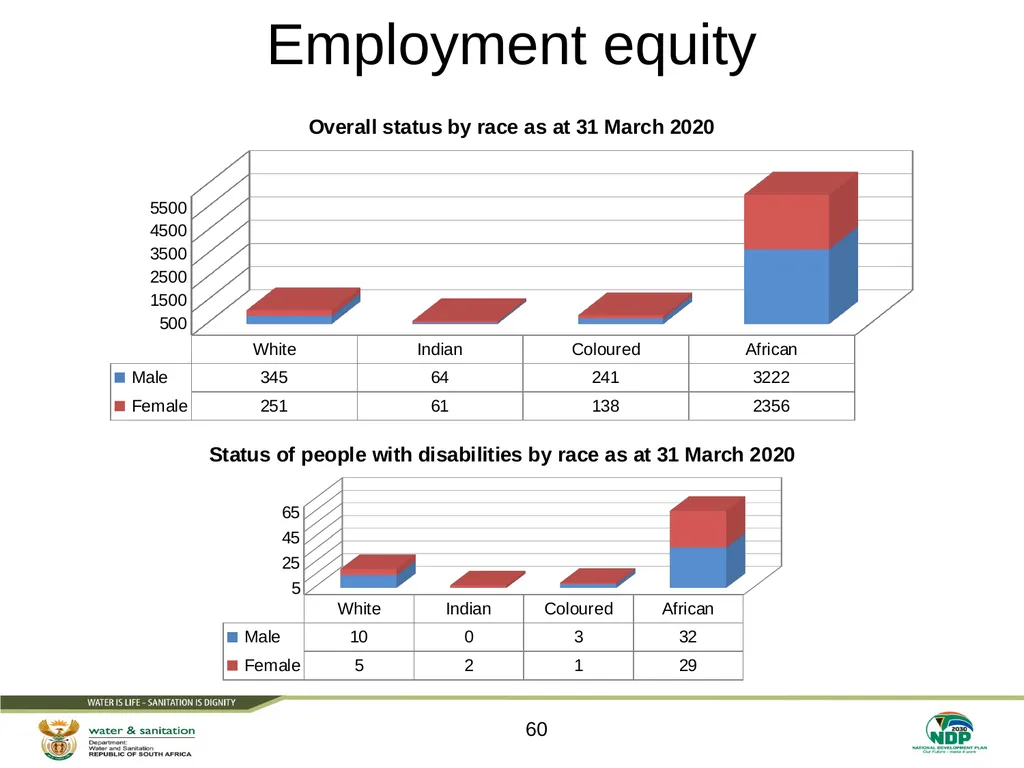
Employment equity 60<br>
61
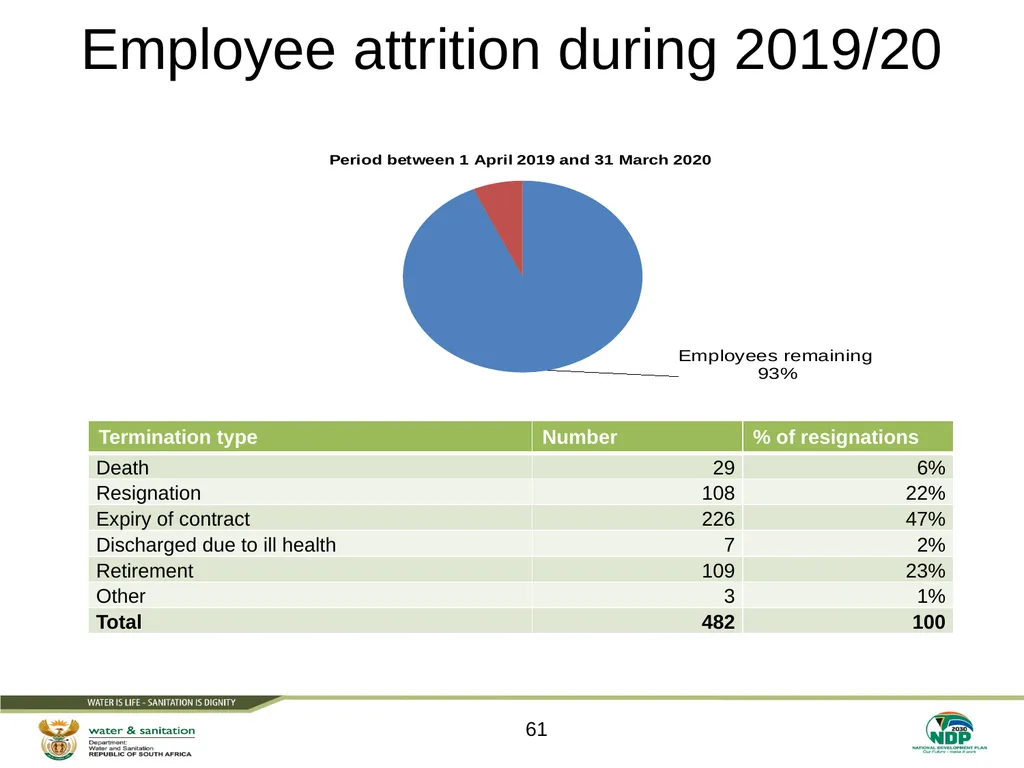
Employee attrition during 2019/20 61<br>
62
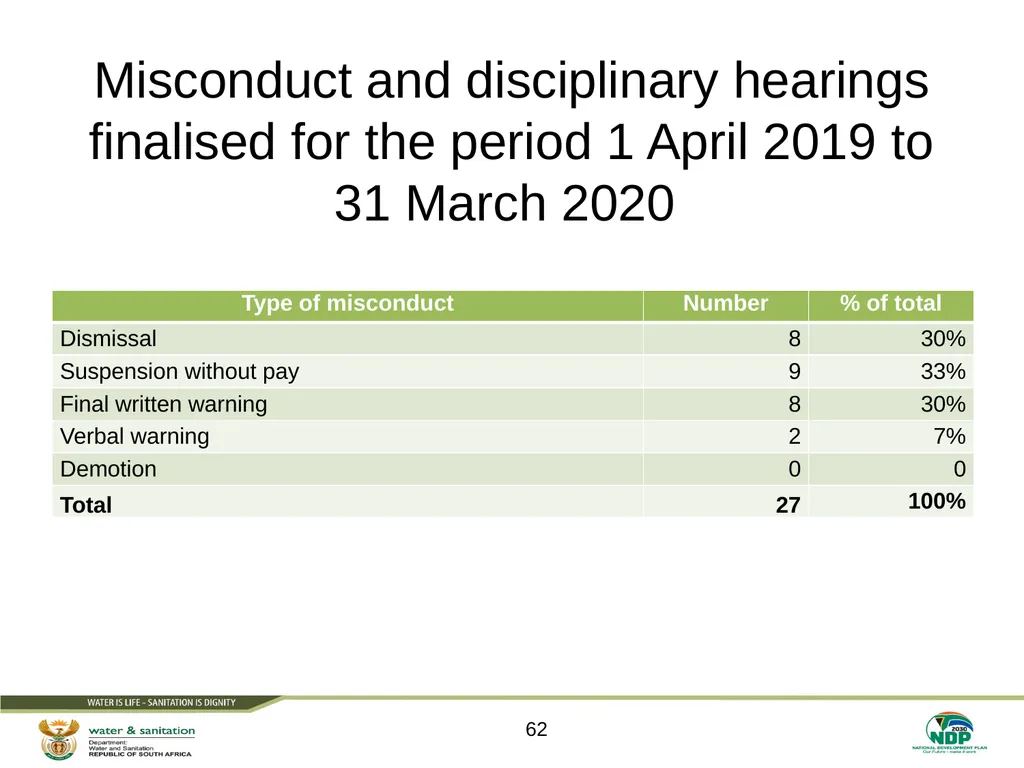
Misconduct and disciplinary hearings finalised for the period 1 April 2019 to 31 March 2020 62<br>
63
Thank you 63<br>