
PRESENTATION TITLE Presented by: Name Surname
DP
Published · 105 slides · 0 views

1 / 1


Description
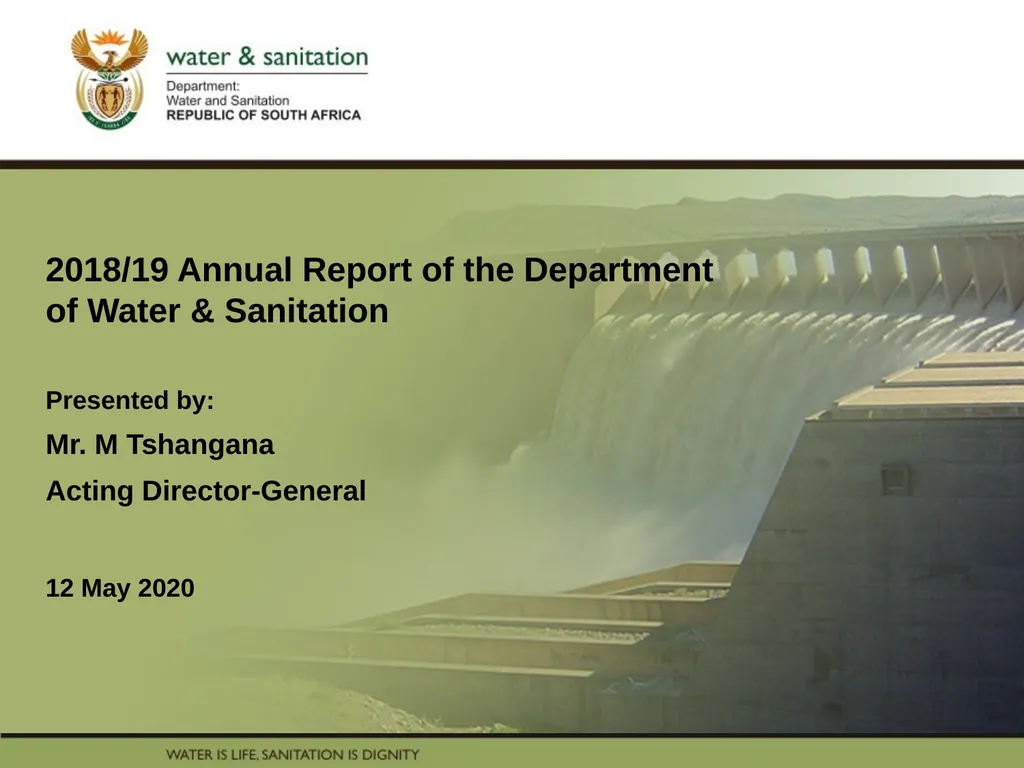
PRESENTATION TITLE Presented by: Name Surname Directorate Date 201819 Annual Report of the Department of Water Sanitation Presented by: Mr. M Tshangana Acting Director-General 12 May 2020 Contents
Related Topics
Share
Embed code
Download this presentation From Below
"PRESENTATION TITLE Presented by: Name Surname" is the property of its rightful owner. Permission is granted to download and print the materials on this website for personal, non-commercial use only, and to display it on your personal computer provided you do not modify the materials and that you retain all copyright notices contained in the materials. By downloading content from our website, you accept the terms of this agreement.
Presentation Transcript
01
PRESENTATION TITLE
Presented by:
Name Surname
Directorate
Date 2018/19 Annual Report of the Department of Water & Sanitation Presented by:
Mr. M Tshangana
Acting Director-General 12 May 2020<br>
Presented by:
Name Surname
Directorate
Date 2018/19 Annual Report of the Department of Water & Sanitation Presented by:
Mr. M Tshangana
Acting Director-General 12 May 2020<br>
02
Contents Purpose………...……………………………...………………...………..3
Introduction…….……………………………………………...………4-11
Part 1: Overview of non-financial performance………….…..…..12-53
Part 2: Overview of financial performance …..…………….…….54-73
Part 3: Overview of the Auditor-General’s report…..…………….74-85
Part 4: Overview of the human resources…………...…………...86-90
Part 5: Feedback on the financial recovery plan…….…………..91-99
Part 6: Consequence management……………………………100-104 2<br>
Introduction…….……………………………………………...………4-11
Part 1: Overview of non-financial performance………….…..…..12-53
Part 2: Overview of financial performance …..…………….…….54-73
Part 3: Overview of the Auditor-General’s report…..…………….74-85
Part 4: Overview of the human resources…………...…………...86-90
Part 5: Feedback on the financial recovery plan…….…………..91-99
Part 6: Consequence management……………………………100-104 2<br>
03
Purpose To brief the Committee on the Department of Water and Sanitation’s 2018/19 Annual Report and Financial Statements 3<br>
04
introduction 4 Service delivery environment
Organisational environment
Policy and legislative changes
Finances of the department
Key highlights<br>
Organisational environment
Policy and legislative changes
Finances of the department
Key highlights<br>
05
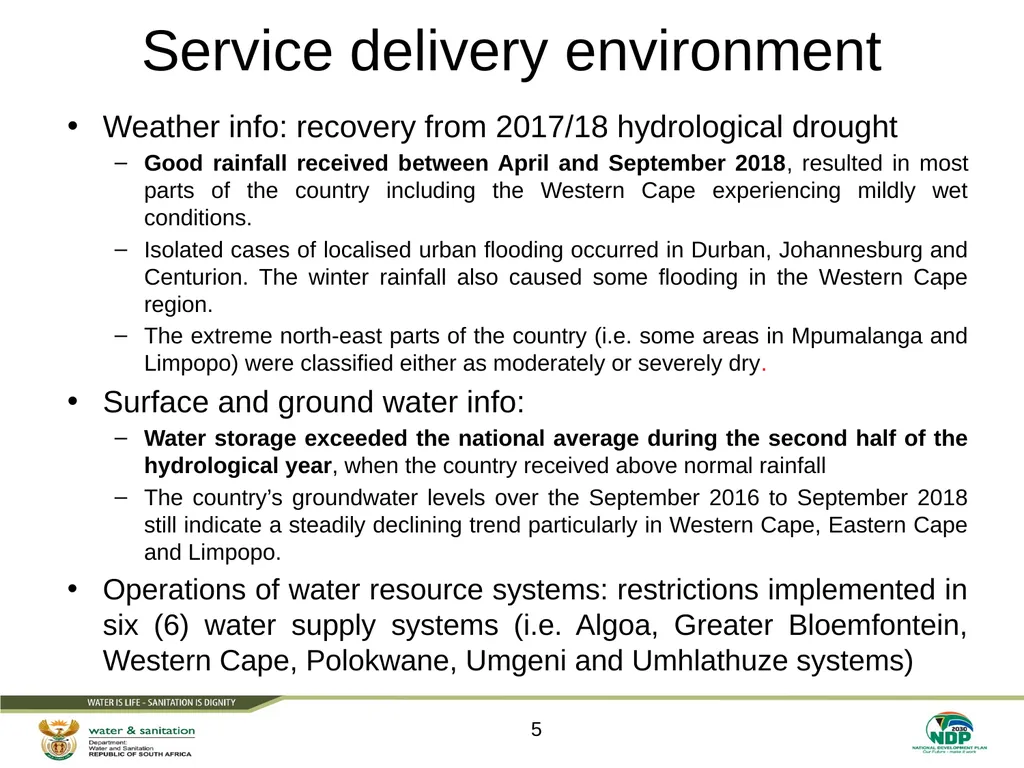
Service delivery environment Weather info: recovery from 2017/18 hydrological drought
Good rainfall received between April and September 2018, resulted in most parts of the country including the Western Cape experiencing mildly wet conditions.
Isolated cases of localised urban flooding occurred in Durban, Johannesburg and Centurion. The winter rainfall also caused some flooding in the Western Cape region.
The extreme north-east parts of the country (i.e. some areas in Mpumalanga and Limpopo) were classified either as moderately or severely dry.
Surface and ground water info:
Water storage exceeded the national average during the second half of the hydrological year, when the country received above normal rainfall
The country’s groundwater levels over the September 2016 to September 2018 still indicate a steadily declining trend particularly in Western Cape, Eastern Cape and Limpopo.
Operations of water resource systems: restrictions implemented in six (6) water supply systems (i.e. Algoa, Greater Bloemfontein, Western Cape, Polokwane, Umgeni and Umhlathuze systems) 5<br>
Good rainfall received between April and September 2018, resulted in most parts of the country including the Western Cape experiencing mildly wet conditions.
Isolated cases of localised urban flooding occurred in Durban, Johannesburg and Centurion. The winter rainfall also caused some flooding in the Western Cape region.
The extreme north-east parts of the country (i.e. some areas in Mpumalanga and Limpopo) were classified either as moderately or severely dry.
Surface and ground water info:
Water storage exceeded the national average during the second half of the hydrological year, when the country received above normal rainfall
The country’s groundwater levels over the September 2016 to September 2018 still indicate a steadily declining trend particularly in Western Cape, Eastern Cape and Limpopo.
Operations of water resource systems: restrictions implemented in six (6) water supply systems (i.e. Algoa, Greater Bloemfontein, Western Cape, Polokwane, Umgeni and Umhlathuze systems) 5<br>
06
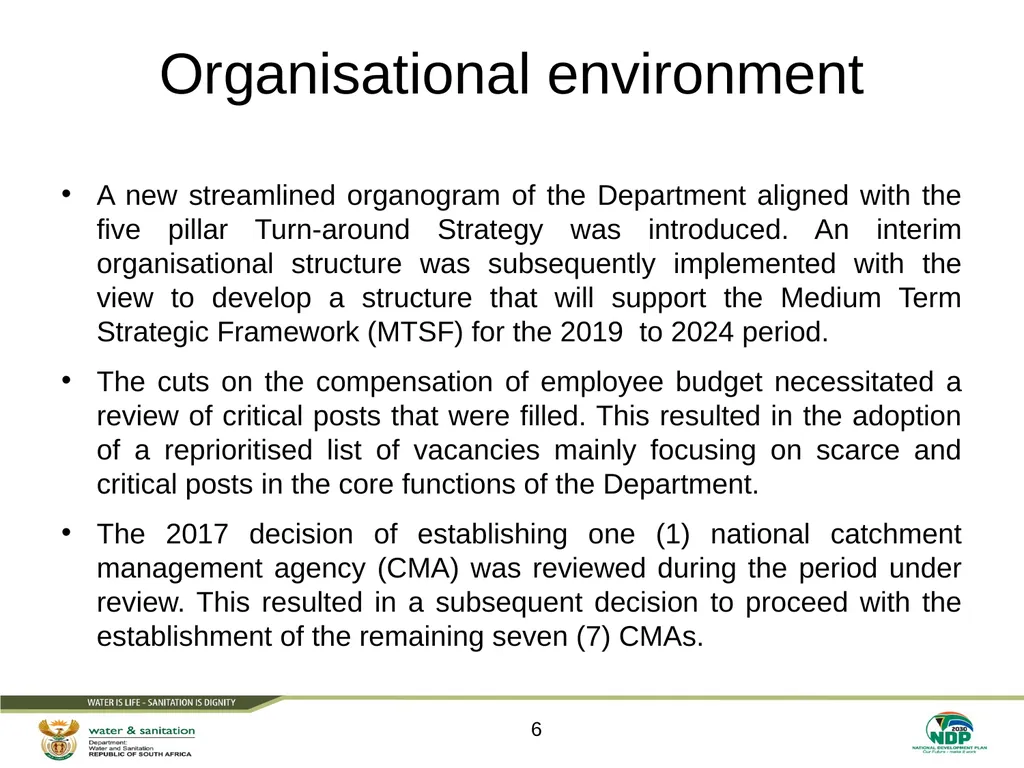
Organisational environment A new streamlined organogram of the Department aligned with the five pillar Turn-around Strategy was introduced. An interim organisational structure was subsequently implemented with the view to develop a structure that will support the Medium Term Strategic Framework (MTSF) for the 2019 to 2024 period.
The cuts on the compensation of employee budget necessitated a review of critical posts that were filled. This resulted in the adoption of a reprioritised list of vacancies mainly focusing on scarce and critical posts in the core functions of the Department.
The 2017 decision of establishing one (1) national catchment management agency (CMA) was reviewed during the period under review. This resulted in a subsequent decision to proceed with the establishment of the remaining seven (7) CMAs. 6<br>
The cuts on the compensation of employee budget necessitated a review of critical posts that were filled. This resulted in the adoption of a reprioritised list of vacancies mainly focusing on scarce and critical posts in the core functions of the Department.
The 2017 decision of establishing one (1) national catchment management agency (CMA) was reviewed during the period under review. This resulted in a subsequent decision to proceed with the establishment of the remaining seven (7) CMAs. 6<br>
07
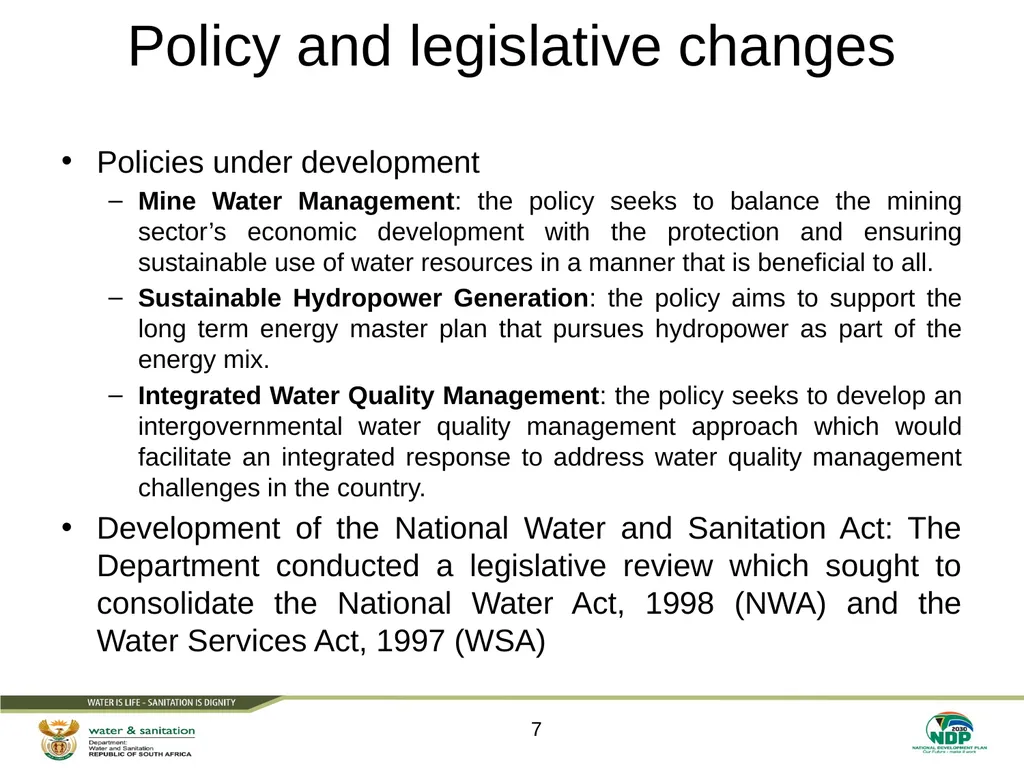
Policy and legislative changes Policies under development
Mine Water Management: the policy seeks to balance the mining sector’s economic development with the protection and ensuring sustainable use of water resources in a manner that is beneficial to all.
Sustainable Hydropower Generation: the policy aims to support the long term energy master plan that pursues hydropower as part of the energy mix.
Integrated Water Quality Management: the policy seeks to develop an intergovernmental water quality management approach which would facilitate an integrated response to address water quality management challenges in the country.
Development of the National Water and Sanitation Act: The Department conducted a legislative review which sought to consolidate the National Water Act, 1998 (NWA) and the Water Services Act, 1997 (WSA) 7<br>
Mine Water Management: the policy seeks to balance the mining sector’s economic development with the protection and ensuring sustainable use of water resources in a manner that is beneficial to all.
Sustainable Hydropower Generation: the policy aims to support the long term energy master plan that pursues hydropower as part of the energy mix.
Integrated Water Quality Management: the policy seeks to develop an intergovernmental water quality management approach which would facilitate an integrated response to address water quality management challenges in the country.
Development of the National Water and Sanitation Act: The Department conducted a legislative review which sought to consolidate the National Water Act, 1998 (NWA) and the Water Services Act, 1997 (WSA) 7<br>
08
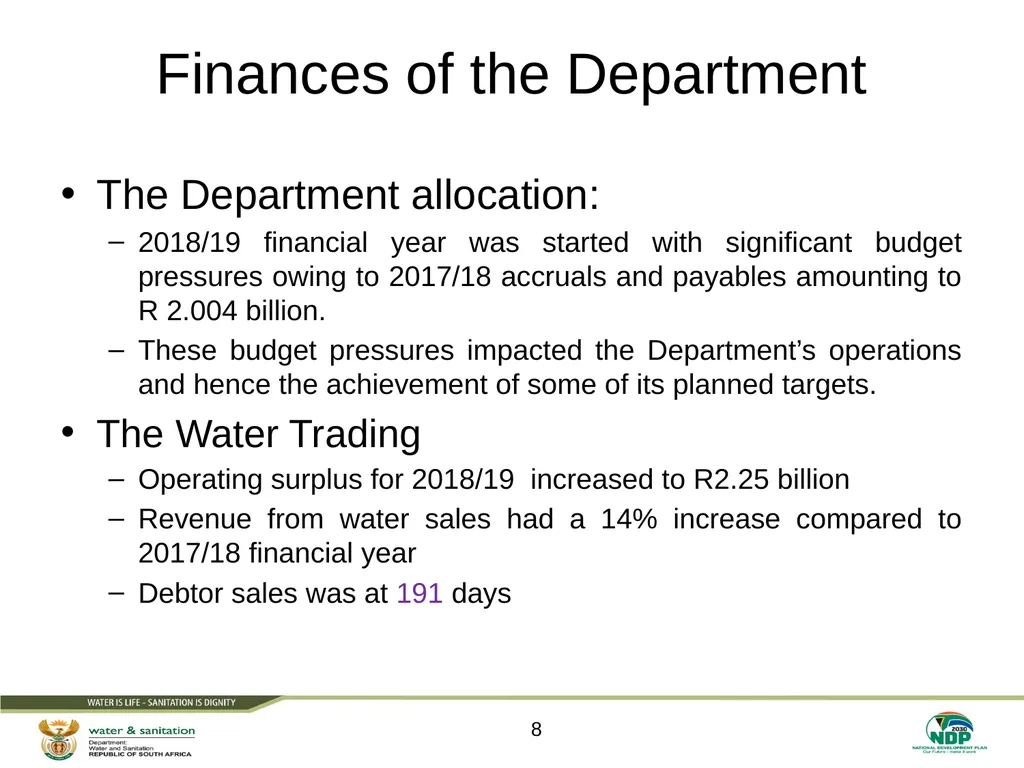
Finances of the Department The Department allocation:
2018/19 financial year was started with significant budget pressures owing to 2017/18 accruals and payables amounting to R 2.004 billion.
These budget pressures impacted the Department’s operations and hence the achievement of some of its planned targets.
The Water Trading
Operating surplus for 2018/19 increased to R2.25 billion
Revenue from water sales had a 14% increase compared to 2017/18 financial year
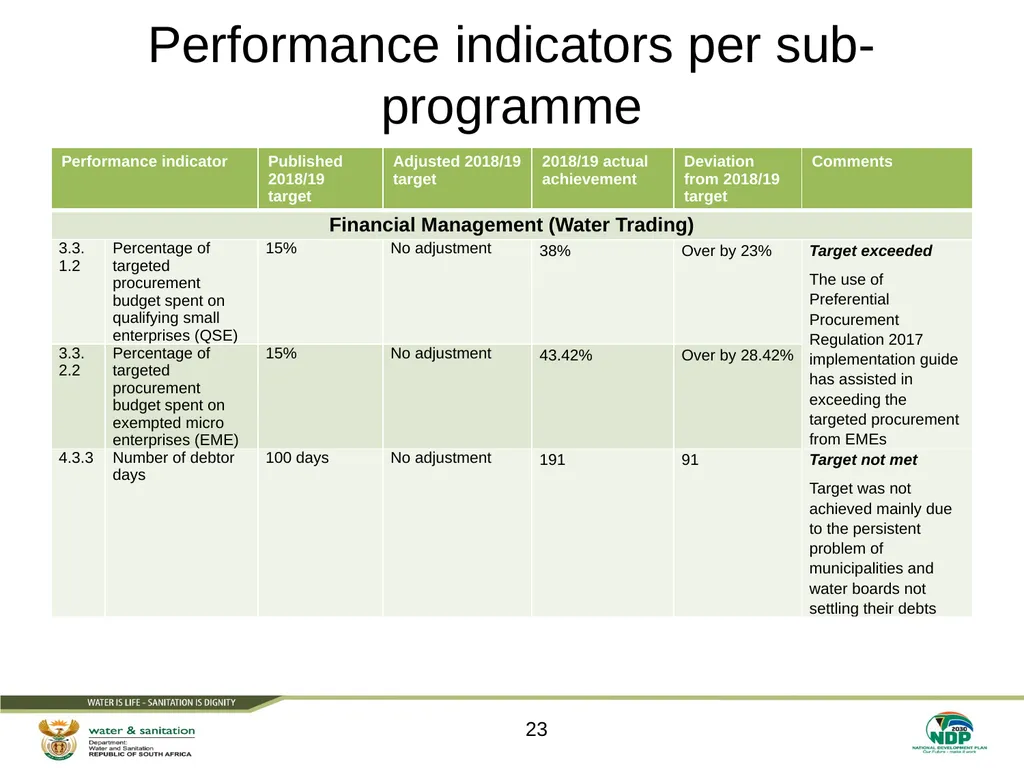
Debtor sales was at 191 days 8<br>
2018/19 financial year was started with significant budget pressures owing to 2017/18 accruals and payables amounting to R 2.004 billion.
These budget pressures impacted the Department’s operations and hence the achievement of some of its planned targets.
The Water Trading
Operating surplus for 2018/19 increased to R2.25 billion
Revenue from water sales had a 14% increase compared to 2017/18 financial year
Debtor sales was at 191 days 8<br>
09
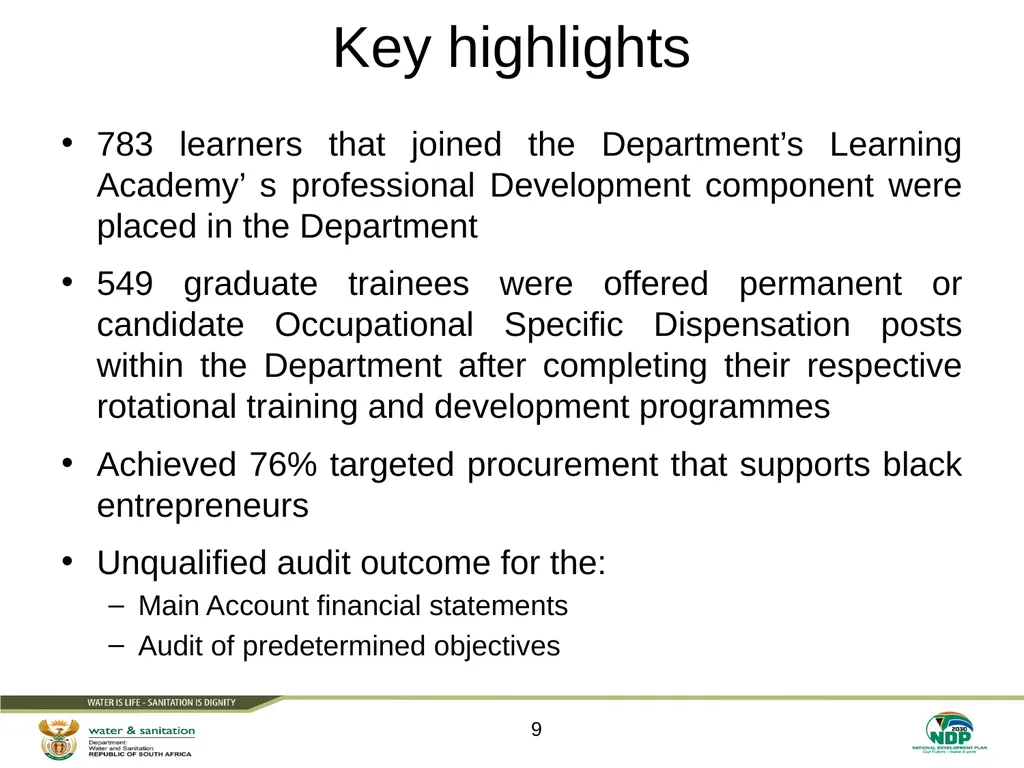
Key highlights 783 learners that joined the Department’s Learning Academy’ s professional Development component were placed in the Department
549 graduate trainees were offered permanent or candidate Occupational Specific Dispensation posts within the Department after completing their respective rotational training and development programmes
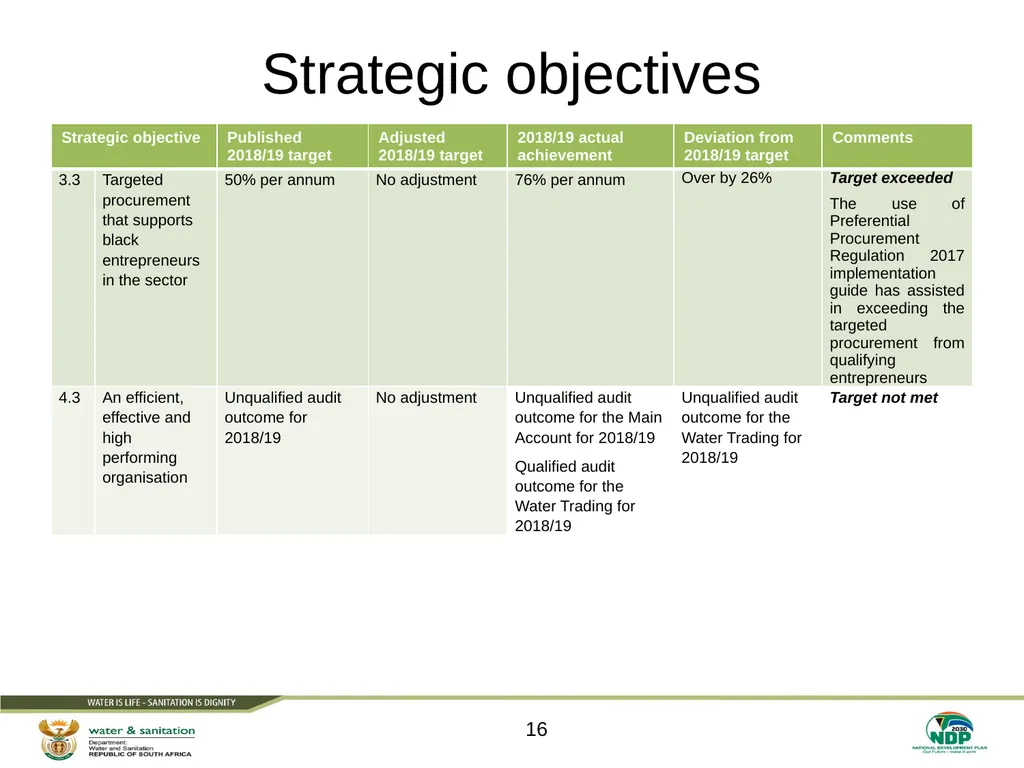
Achieved 76% targeted procurement that supports black entrepreneurs
Unqualified audit outcome for the:
Main Account financial statements
Audit of predetermined objectives 9<br>
549 graduate trainees were offered permanent or candidate Occupational Specific Dispensation posts within the Department after completing their respective rotational training and development programmes
Achieved 76% targeted procurement that supports black entrepreneurs
Unqualified audit outcome for the:
Main Account financial statements
Audit of predetermined objectives 9<br>
10
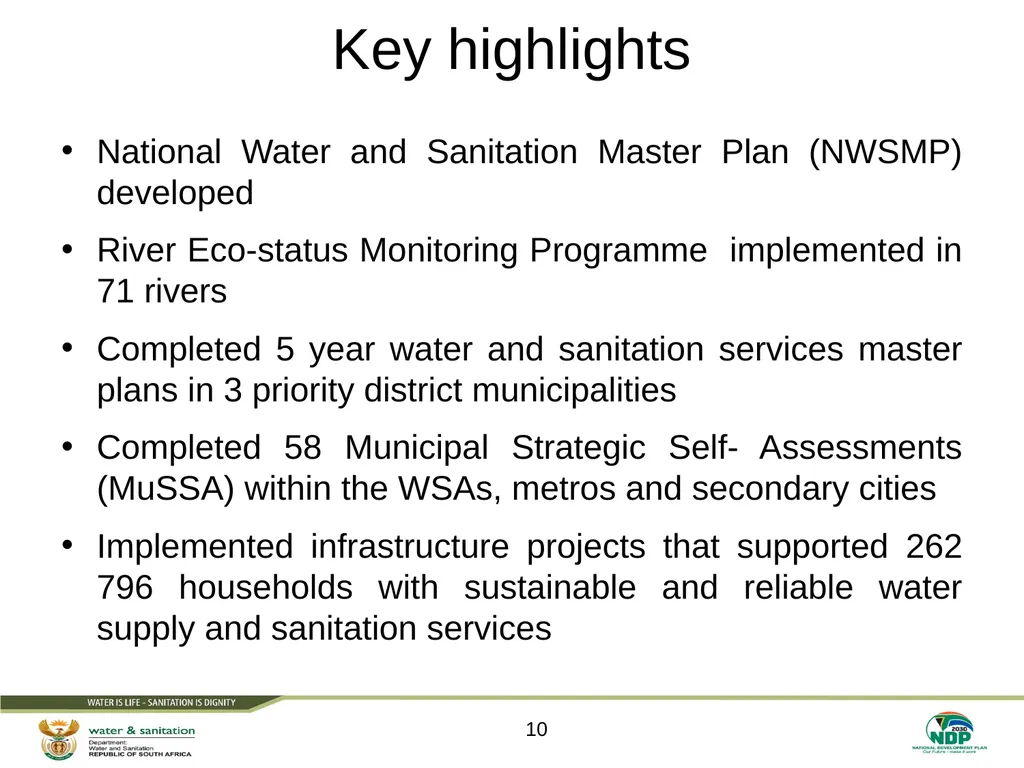
Key highlights National Water and Sanitation Master Plan (NWSMP) developed
River Eco-status Monitoring Programme implemented in 71 rivers
Completed 5 year water and sanitation services master plans in 3 priority district municipalities
Completed 58 Municipal Strategic Self- Assessments (MuSSA) within the WSAs, metros and secondary cities
Implemented infrastructure projects that supported 262 796 households with sustainable and reliable water supply and sanitation services 10<br>
River Eco-status Monitoring Programme implemented in 71 rivers
Completed 5 year water and sanitation services master plans in 3 priority district municipalities
Completed 58 Municipal Strategic Self- Assessments (MuSSA) within the WSAs, metros and secondary cities
Implemented infrastructure projects that supported 262 796 households with sustainable and reliable water supply and sanitation services 10<br>
11
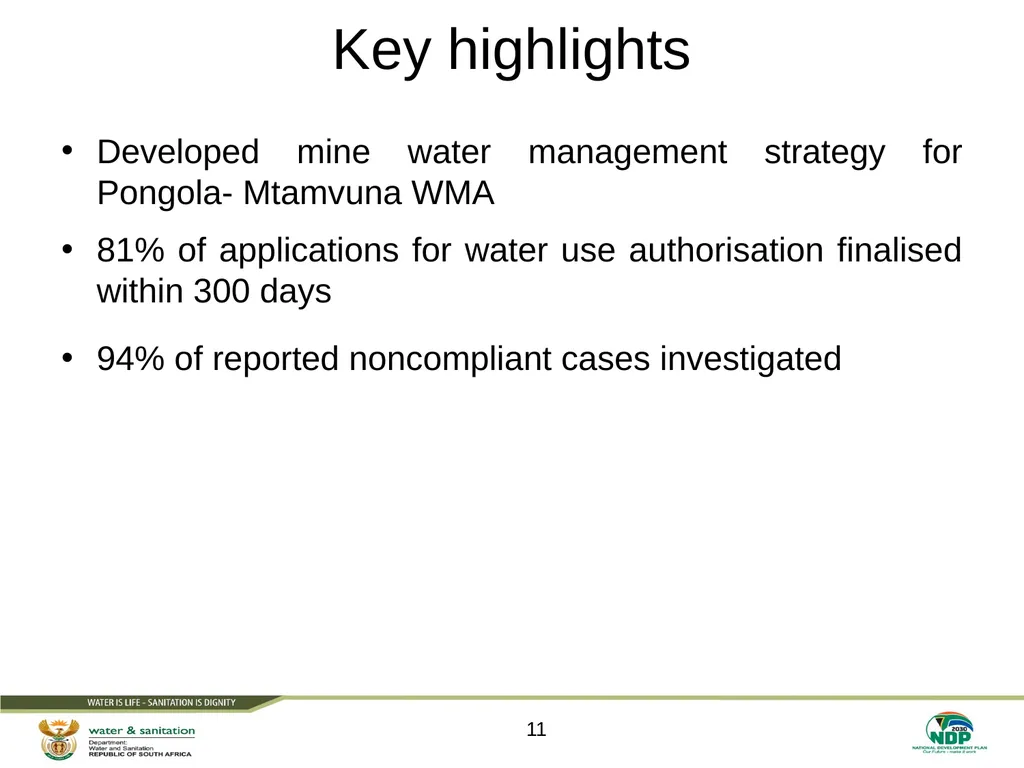
Key highlights Developed mine water management strategy for Pongola- Mtamvuna WMA
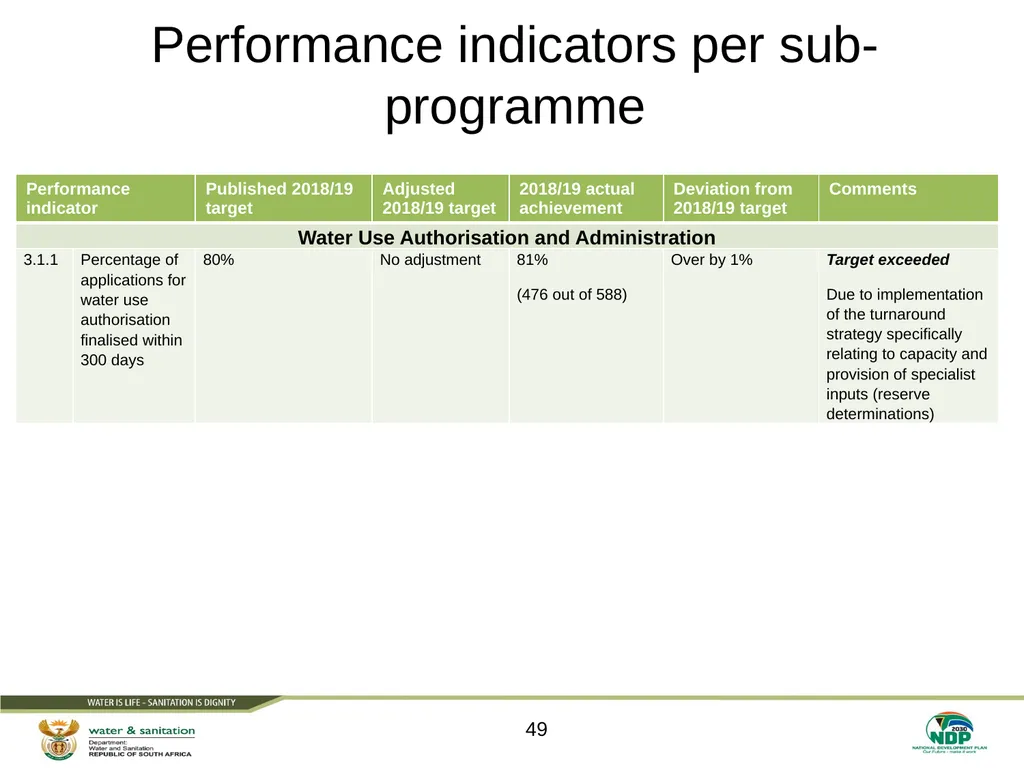
81% of applications for water use authorisation finalised within 300 days
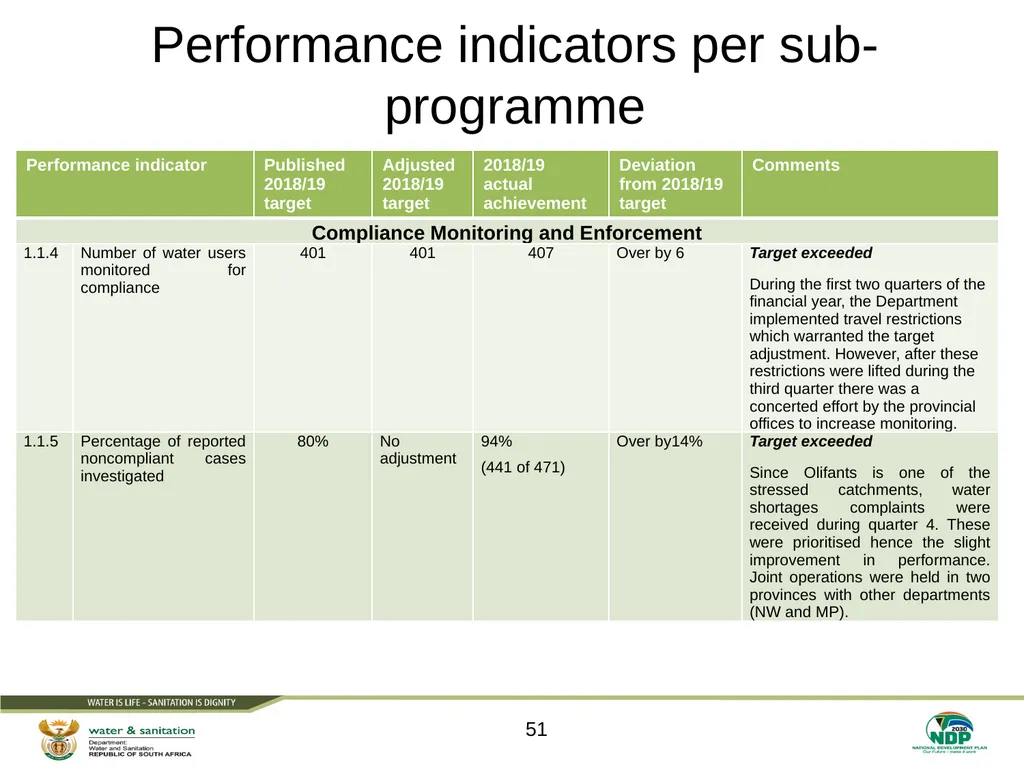
94% of reported noncompliant cases investigated 11<br>
81% of applications for water use authorisation finalised within 300 days
94% of reported noncompliant cases investigated 11<br>
12
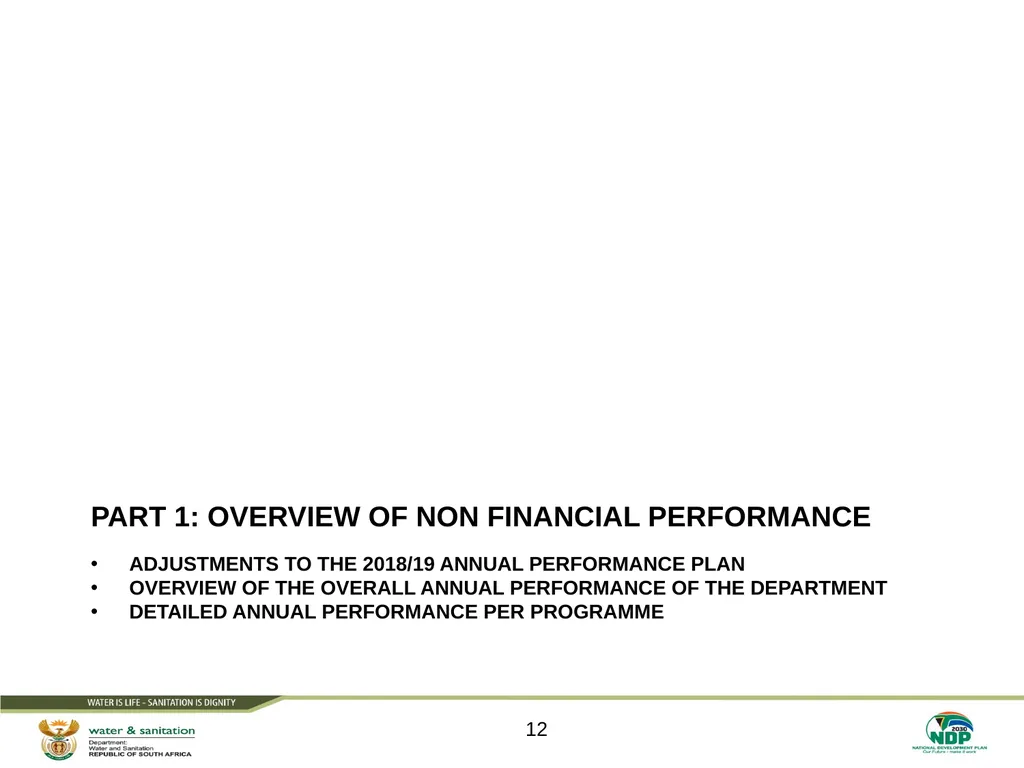
Part 1: overview of non financial performance 12 Adjustments to the 2018/19 annual performance plan
Overview of the Overall annual performance of the Department
Detailed annual performance per programme<br>
Overview of the Overall annual performance of the Department
Detailed annual performance per programme<br>
13
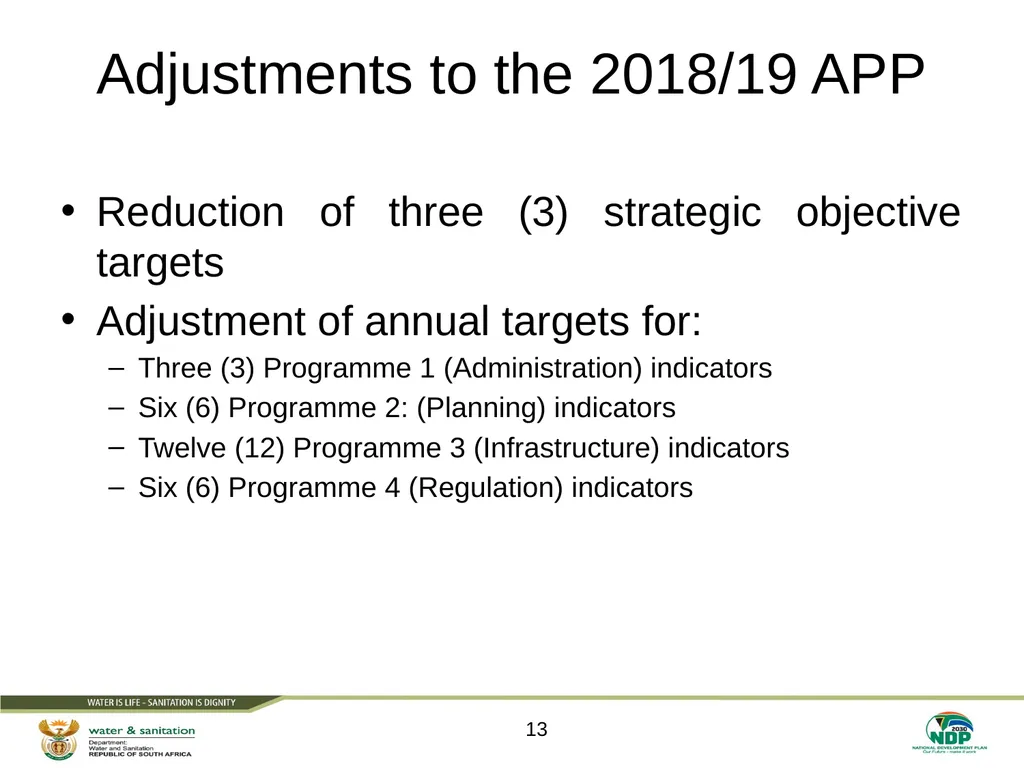
Adjustments to the 2018/19 APP Reduction of three (3) strategic objective targets
Adjustment of annual targets for:
Three (3) Programme 1 (Administration) indicators
Six (6) Programme 2: (Planning) indicators
Twelve (12) Programme 3 (Infrastructure) indicators
Six (6) Programme 4 (Regulation) indicators 13<br>
Adjustment of annual targets for:
Three (3) Programme 1 (Administration) indicators
Six (6) Programme 2: (Planning) indicators
Twelve (12) Programme 3 (Infrastructure) indicators
Six (6) Programme 4 (Regulation) indicators 13<br>
14
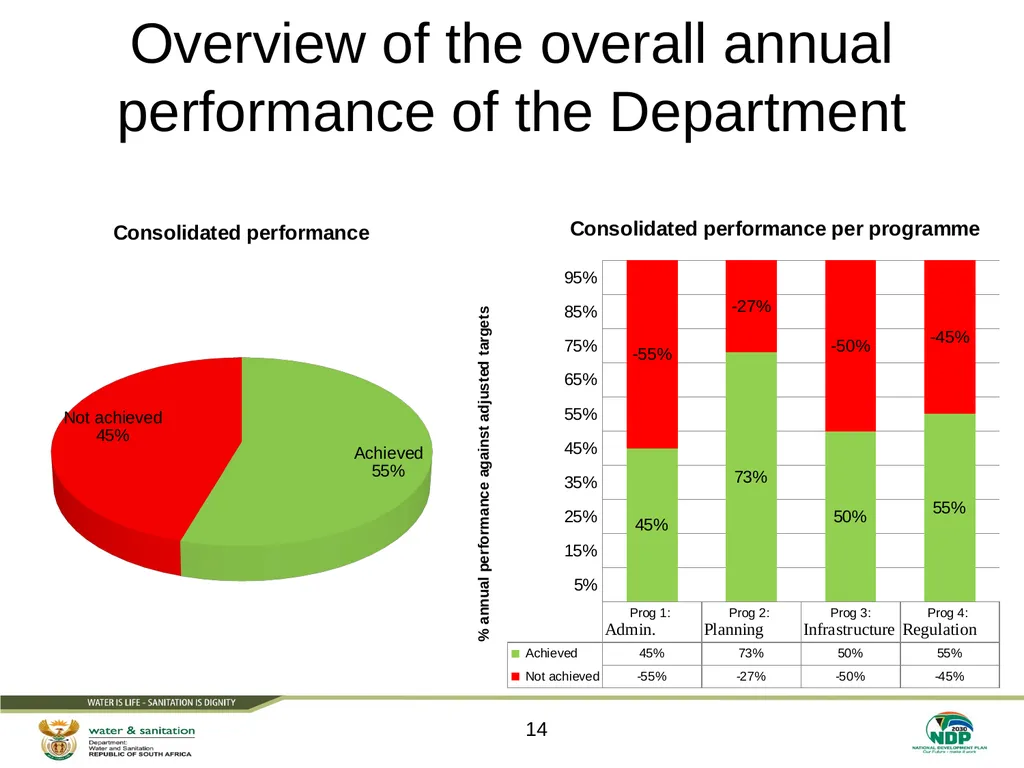
Overview of the overall annual performance of the Department 14<br>
15
Part 1.1: overview of programme 1 (administration) performance Detailed annual performance per programme 15<br>
16
Strategic objectives 16<br>
17
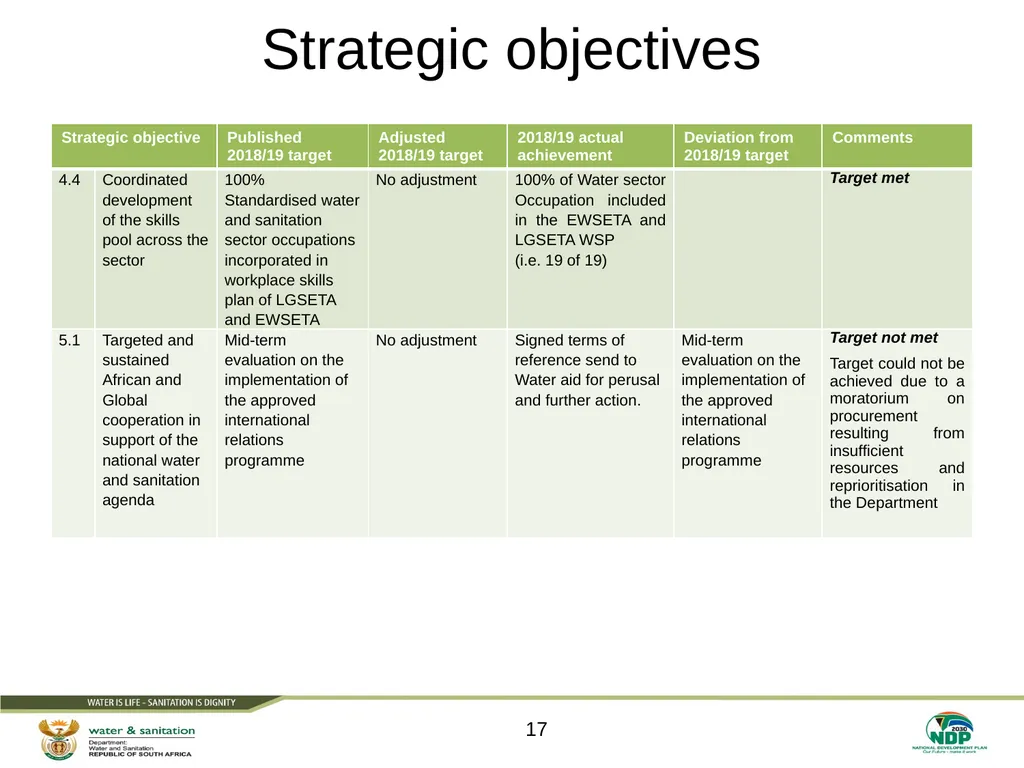
Strategic objectives 17<br>
18
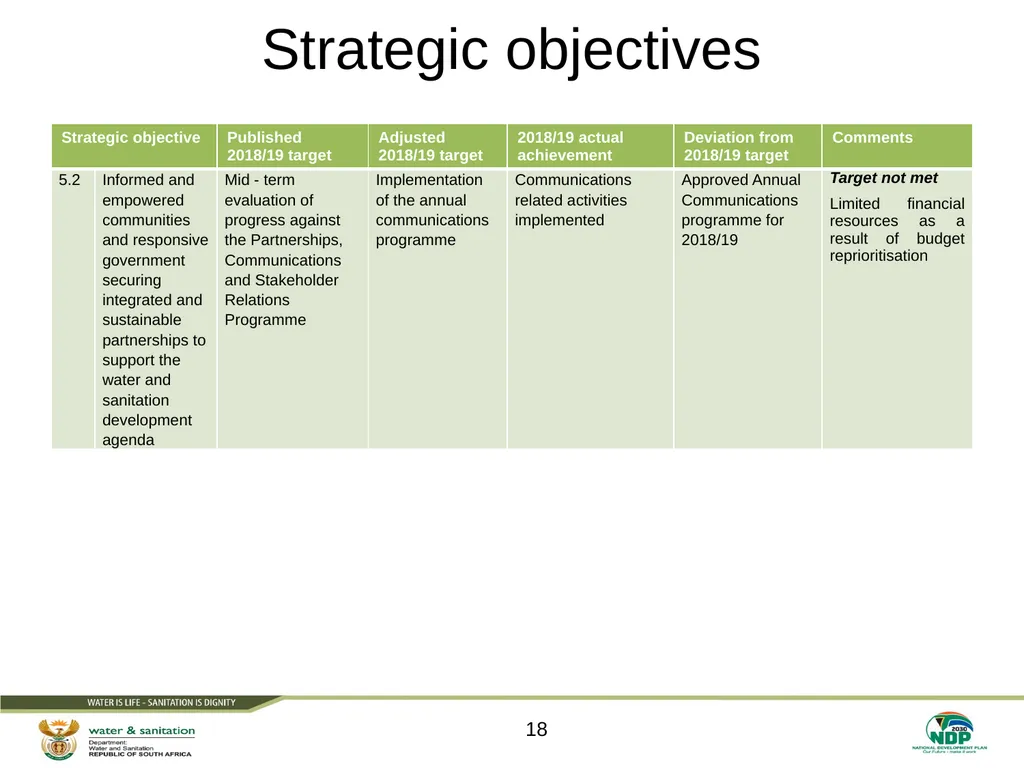
Strategic objectives 18<br>
19
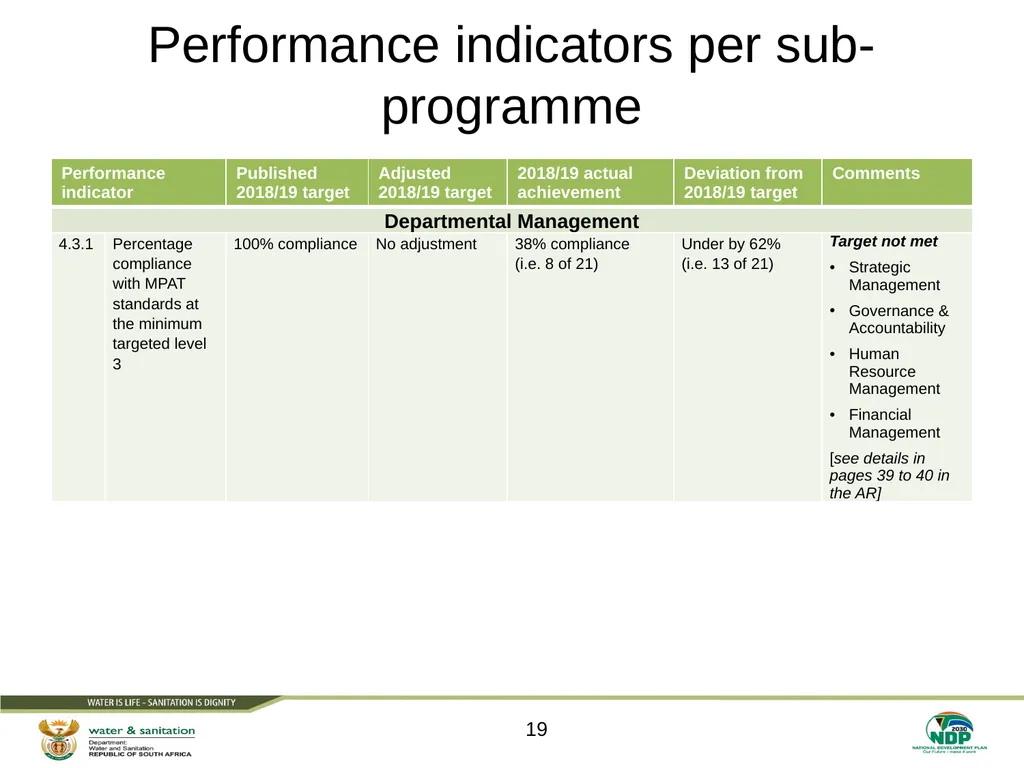
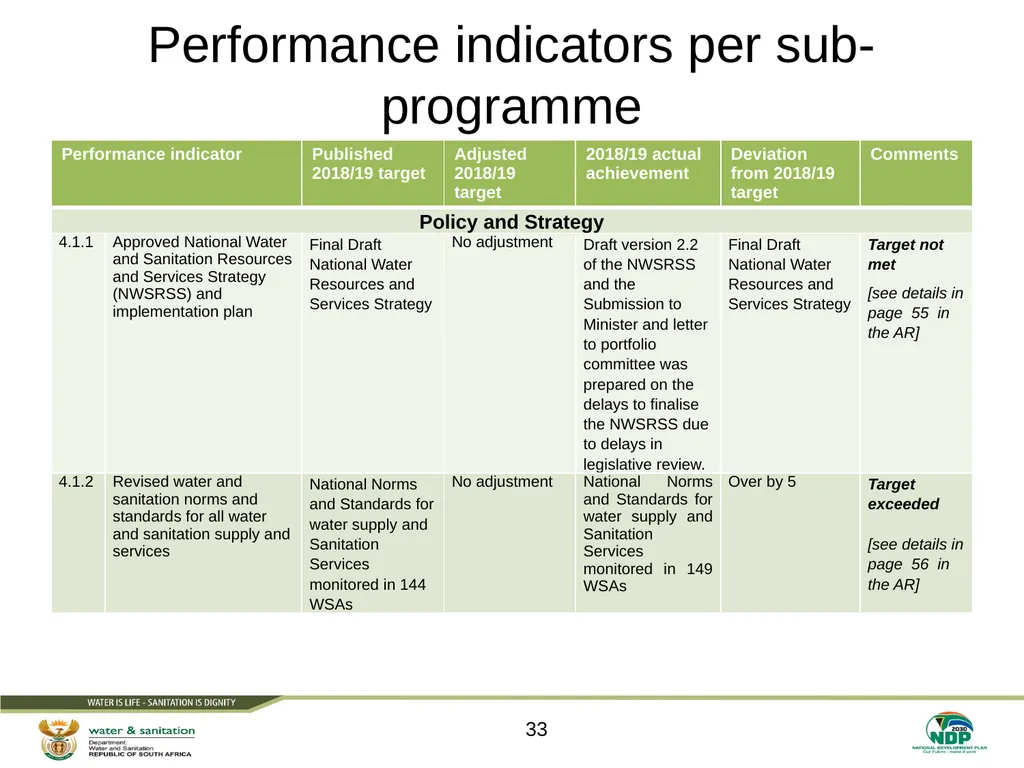
Performance indicators per sub-programme 19<br>
20
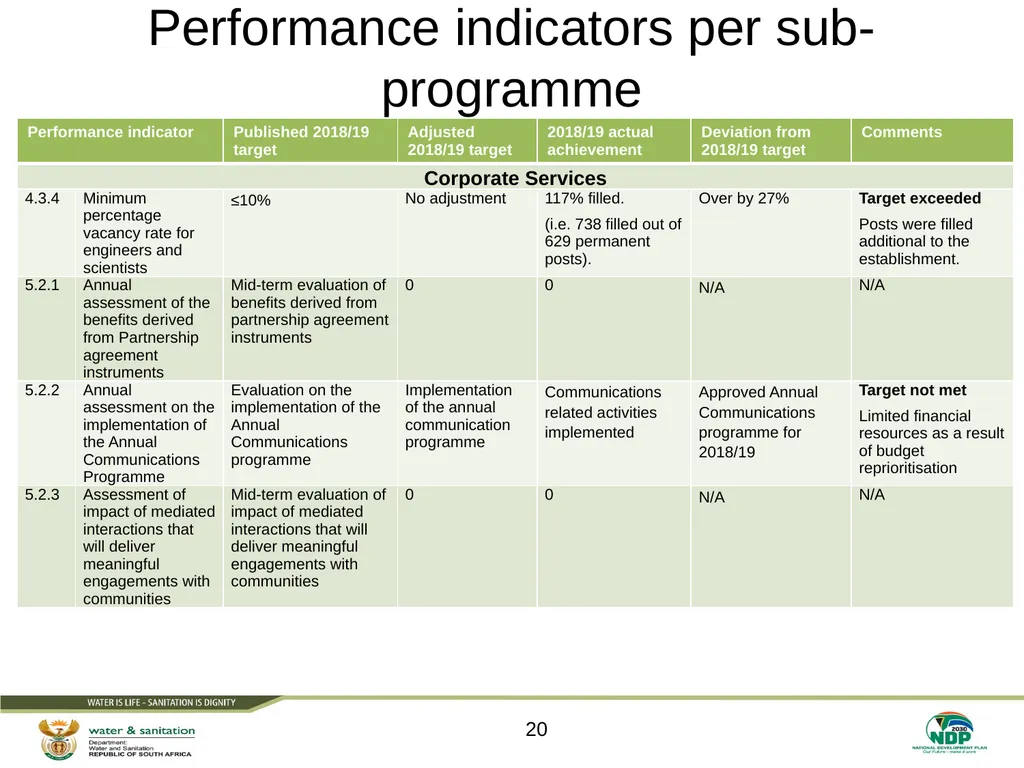
Performance indicators per sub-programme 20<br>
21
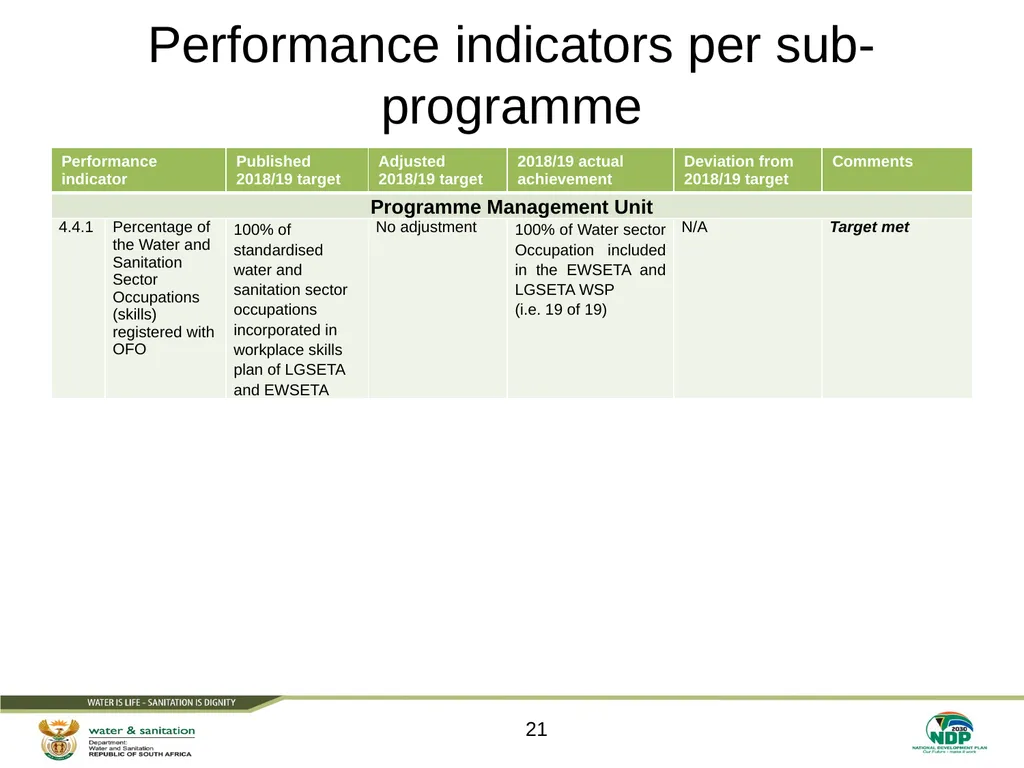
Performance indicators per sub-programme 21<br>
22
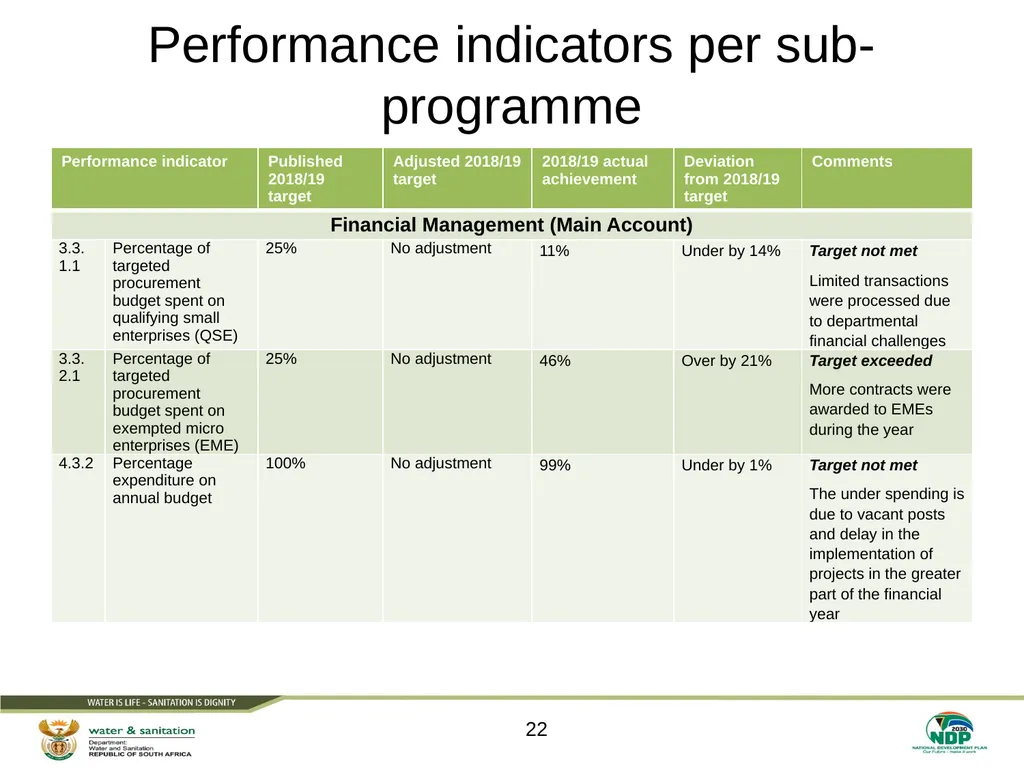
Performance indicators per sub-programme 22<br>
23
Performance indicators per sub-programme 23<br>
24
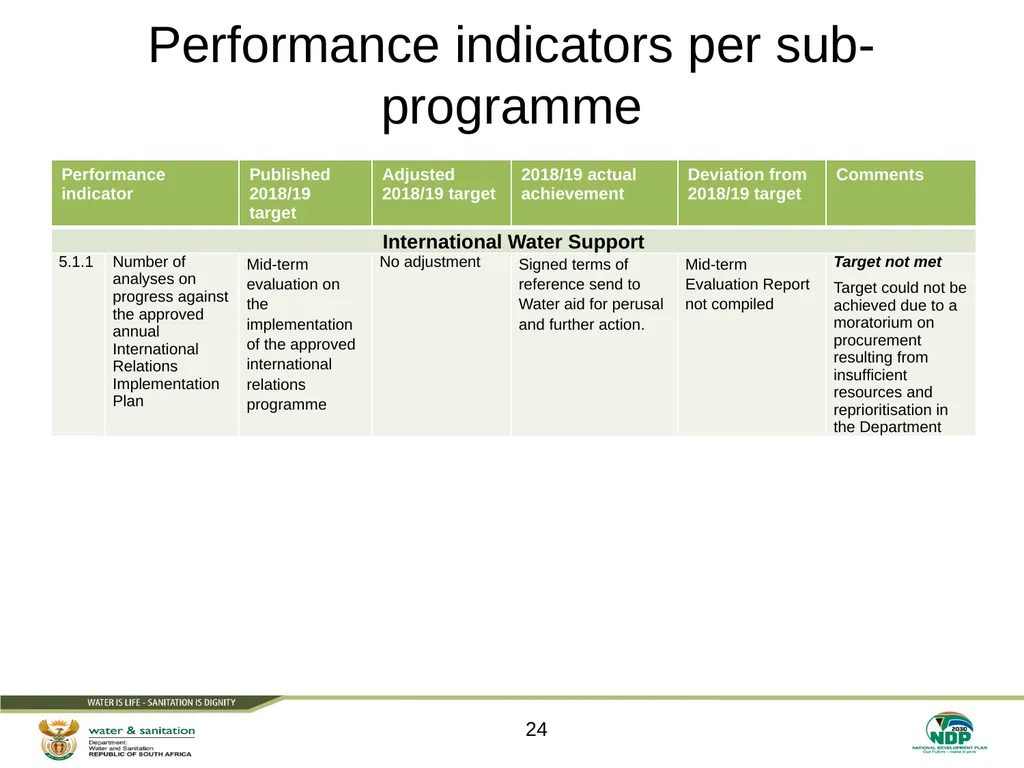
Performance indicators per sub-programme 24<br>
25
Part 1.2: overview of programme 2 (water planning & information management) performance Detailed annual performance per programme 25<br>
26
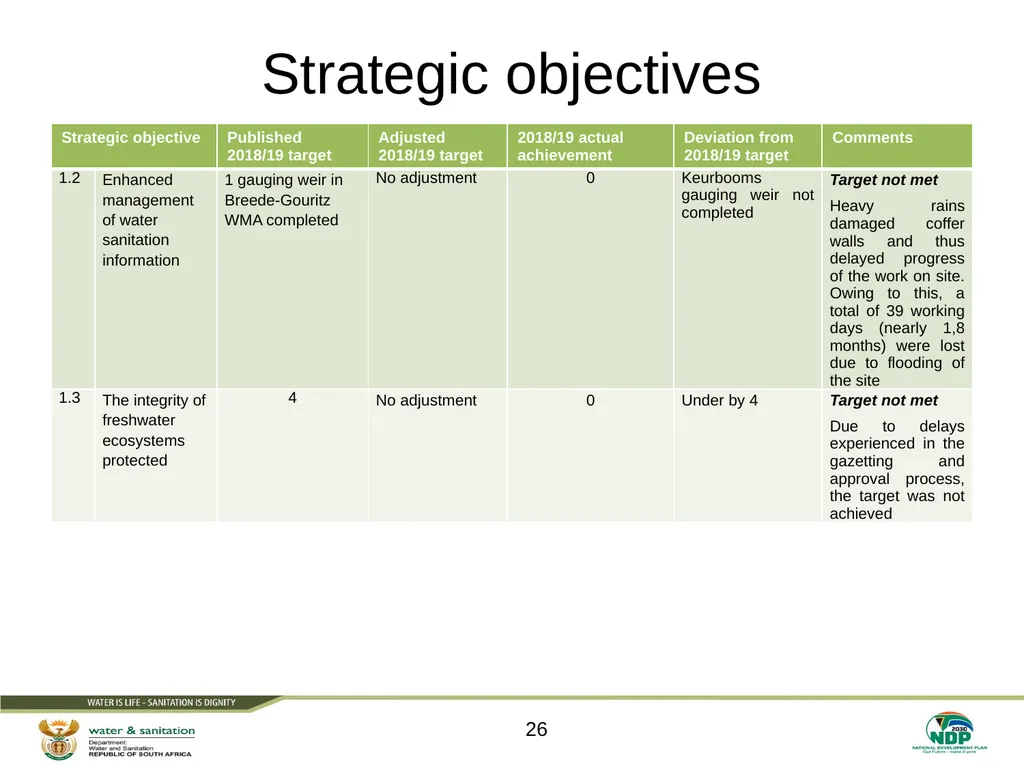
Strategic objectives 26<br>
27
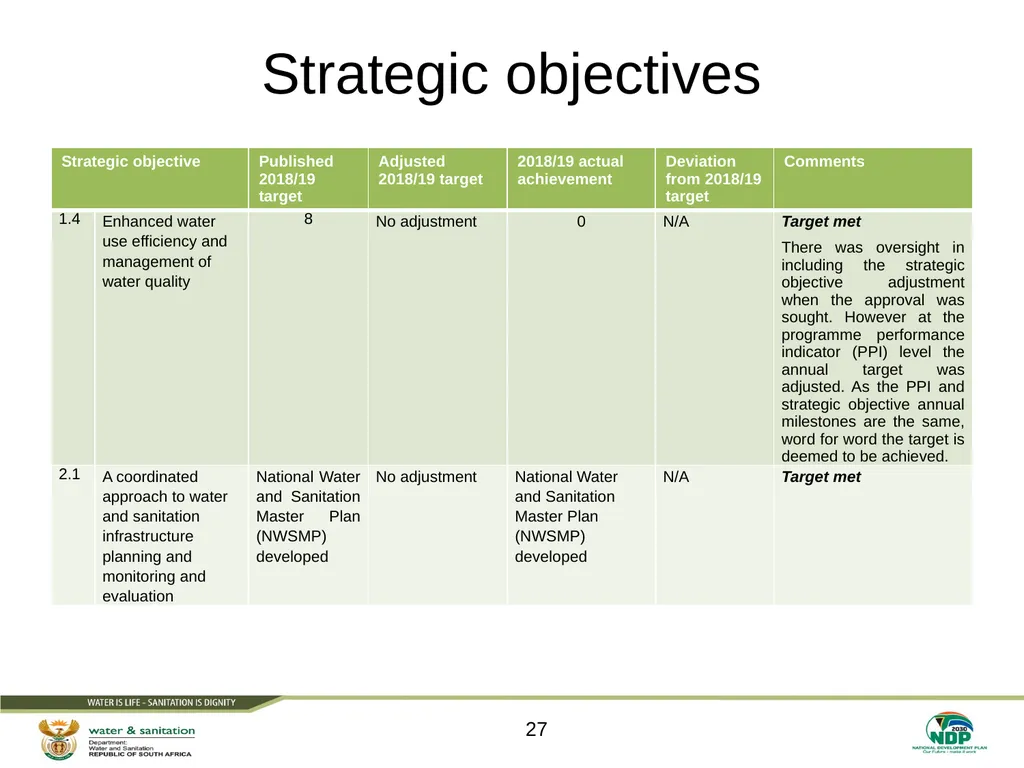
Strategic objectives 27<br>
28
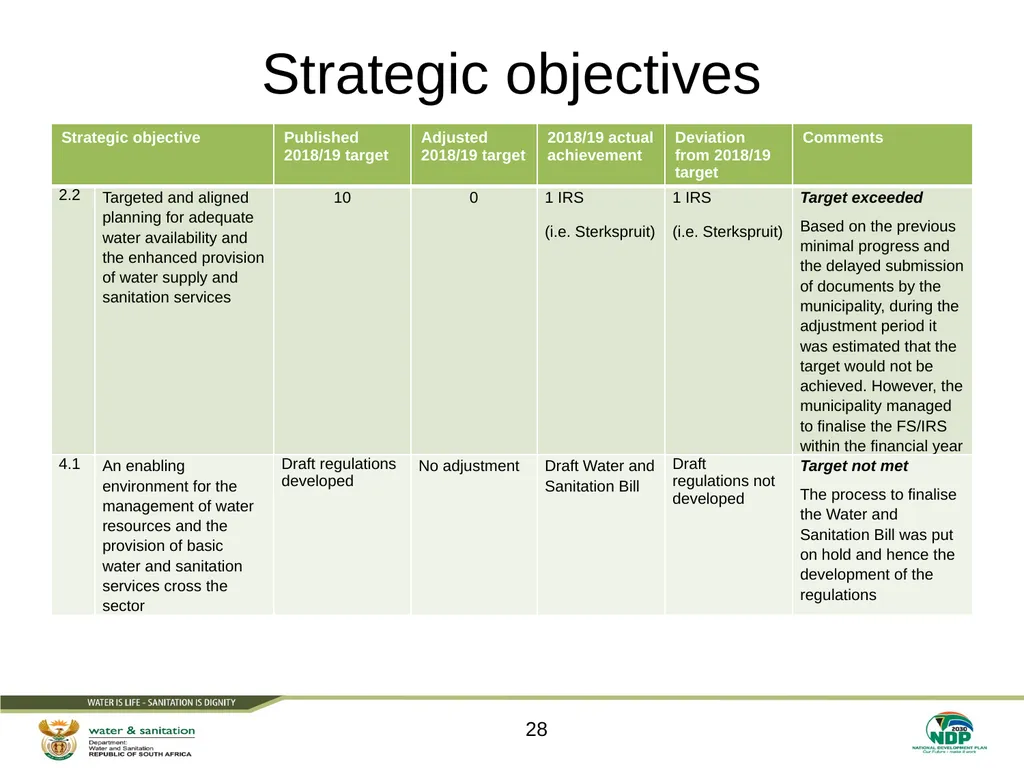
Strategic objectives 28<br>
29
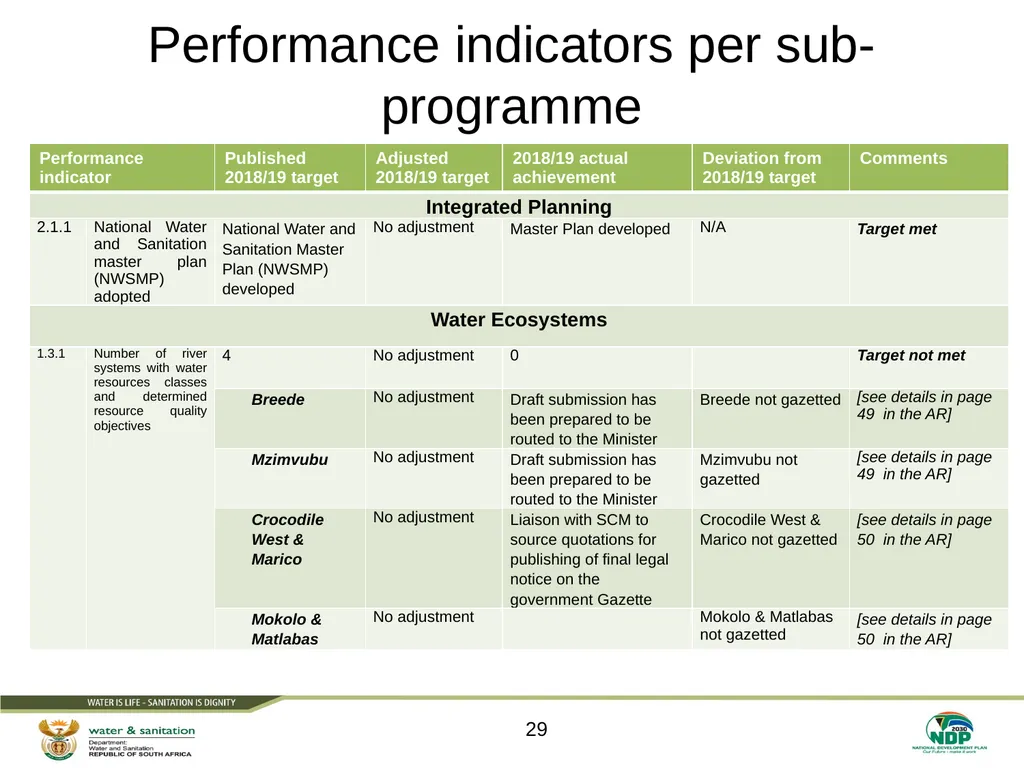
Performance indicators per sub-programme 29<br>
30
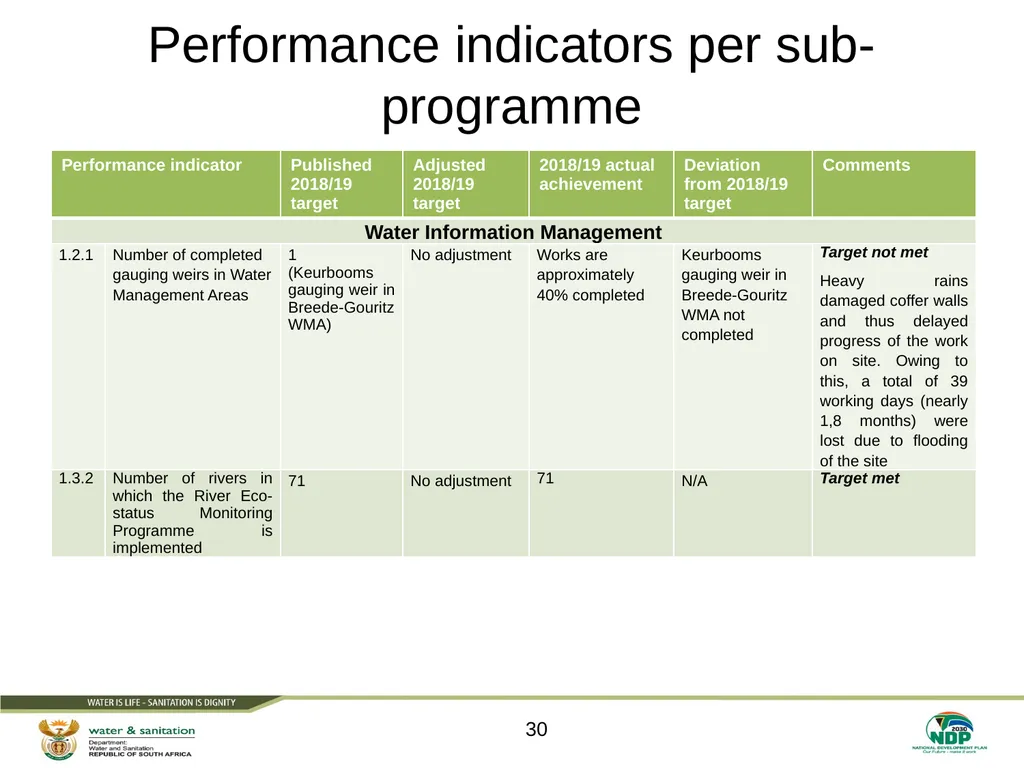
Performance indicators per sub-programme 30<br>
31
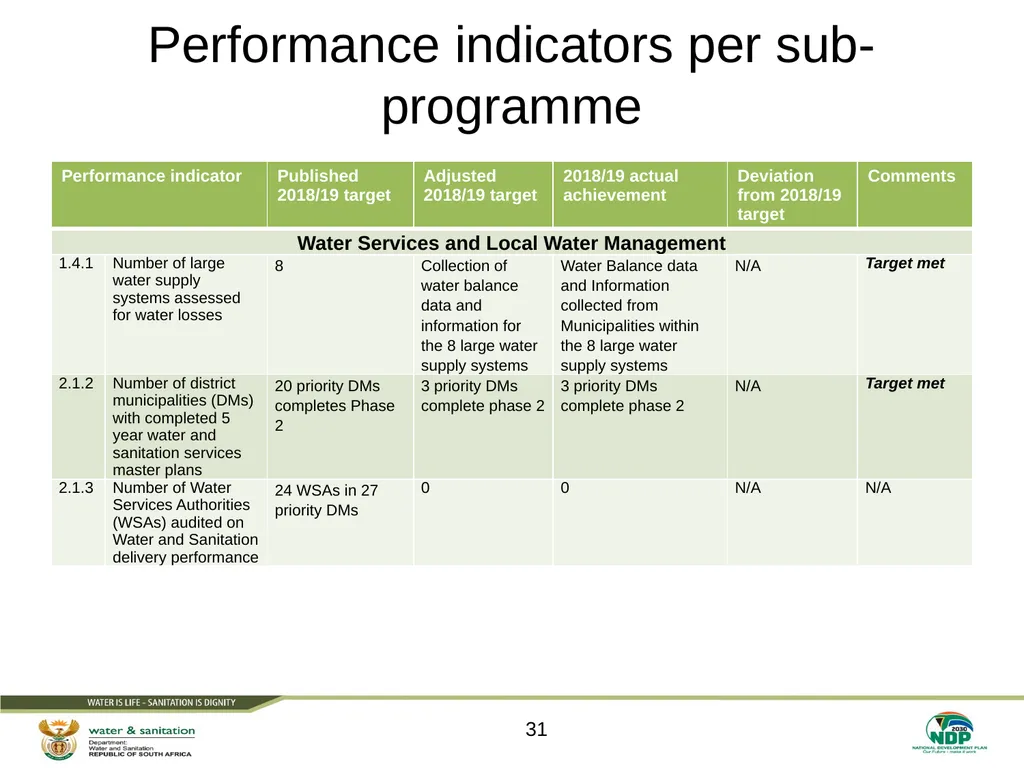
Performance indicators per sub-programme 31<br>
32
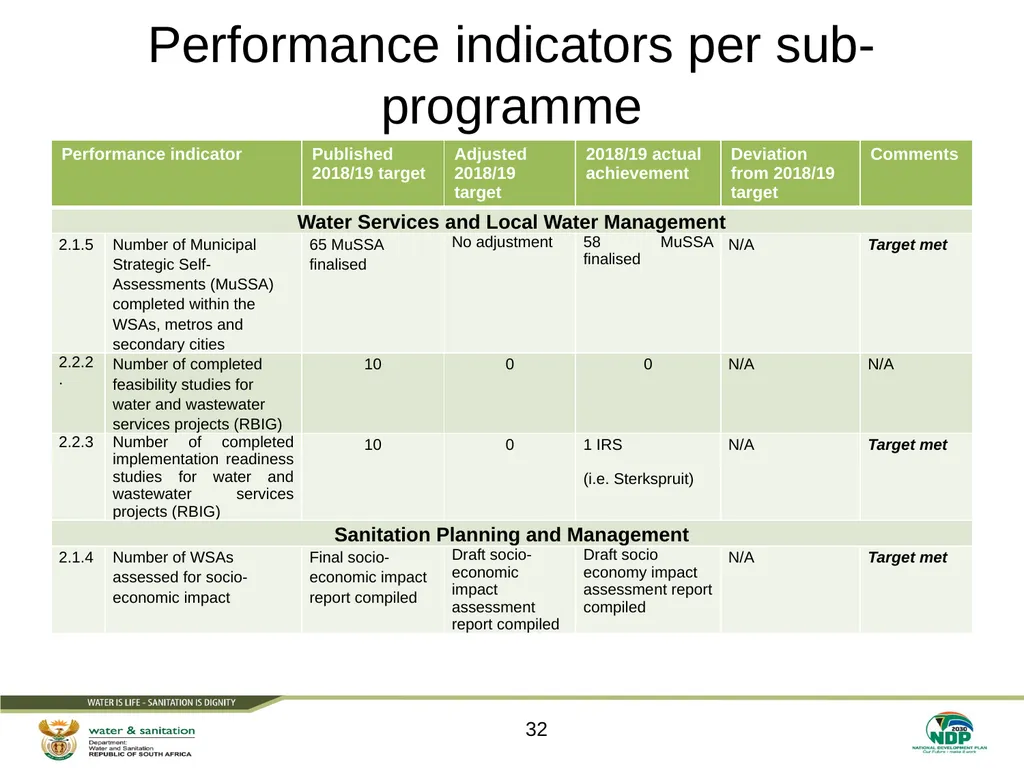
Performance indicators per sub-programme 32<br>
33
Performance indicators per sub-programme 33<br>
34
Part 1.3: overview of programme 3 (water infrastructure development) performance Detailed annual performance per programme 34<br>
35
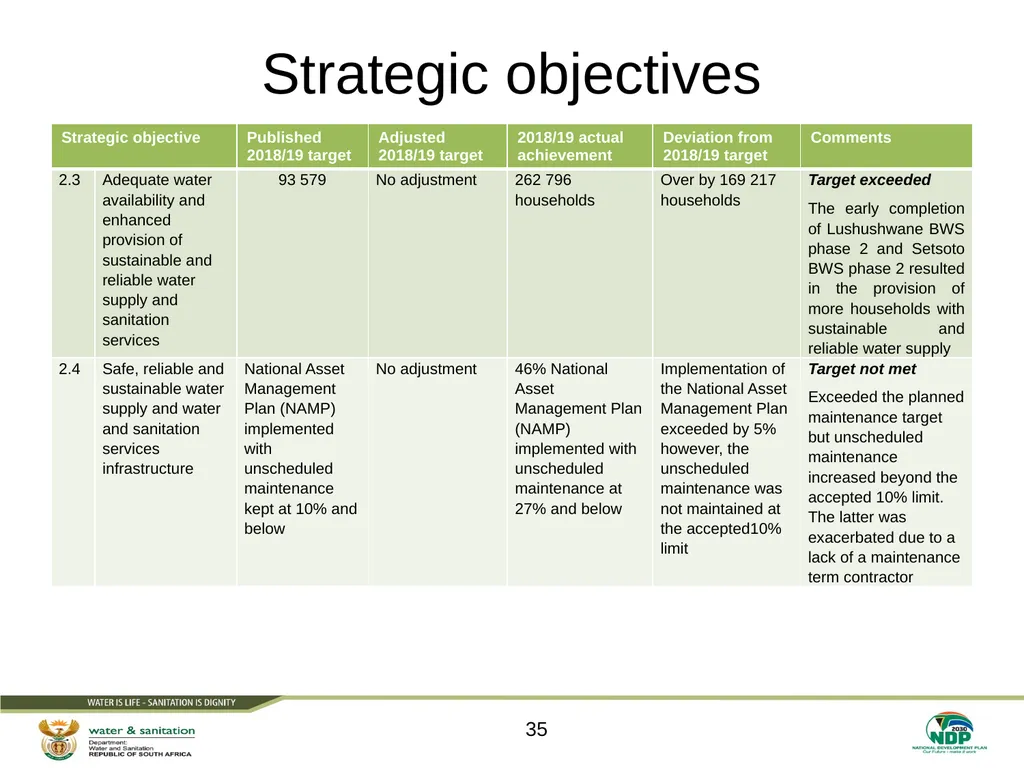
Strategic objectives 35<br>
36
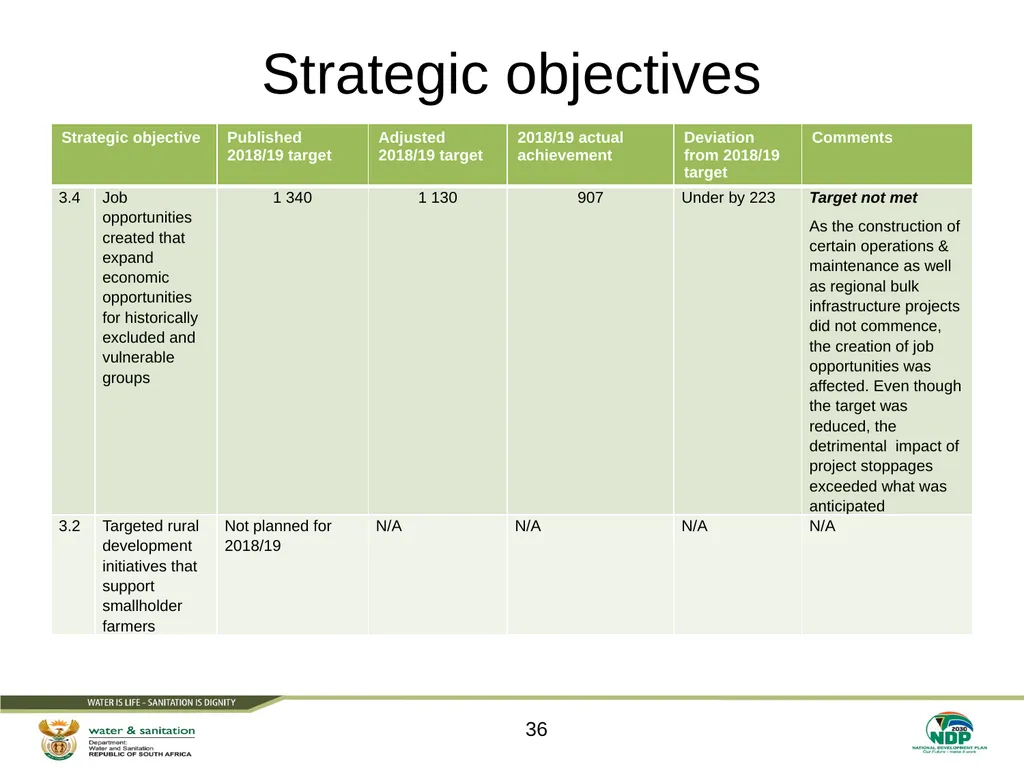
Strategic objectives 36<br>
37
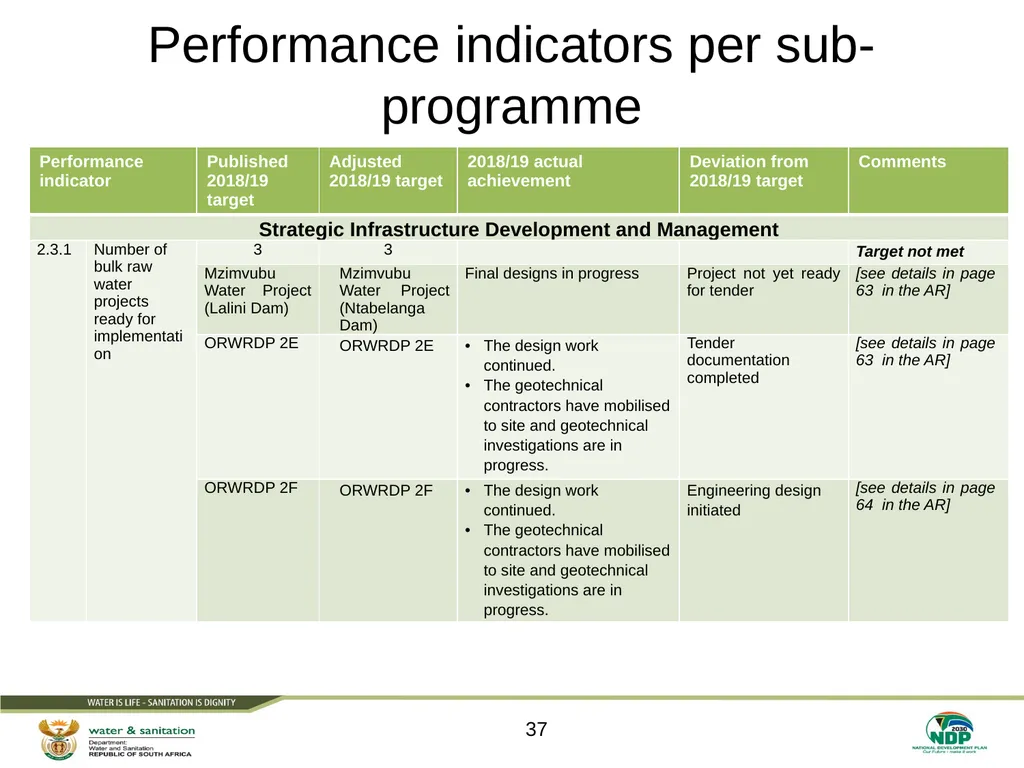
Performance indicators per sub-programme 37<br>
38
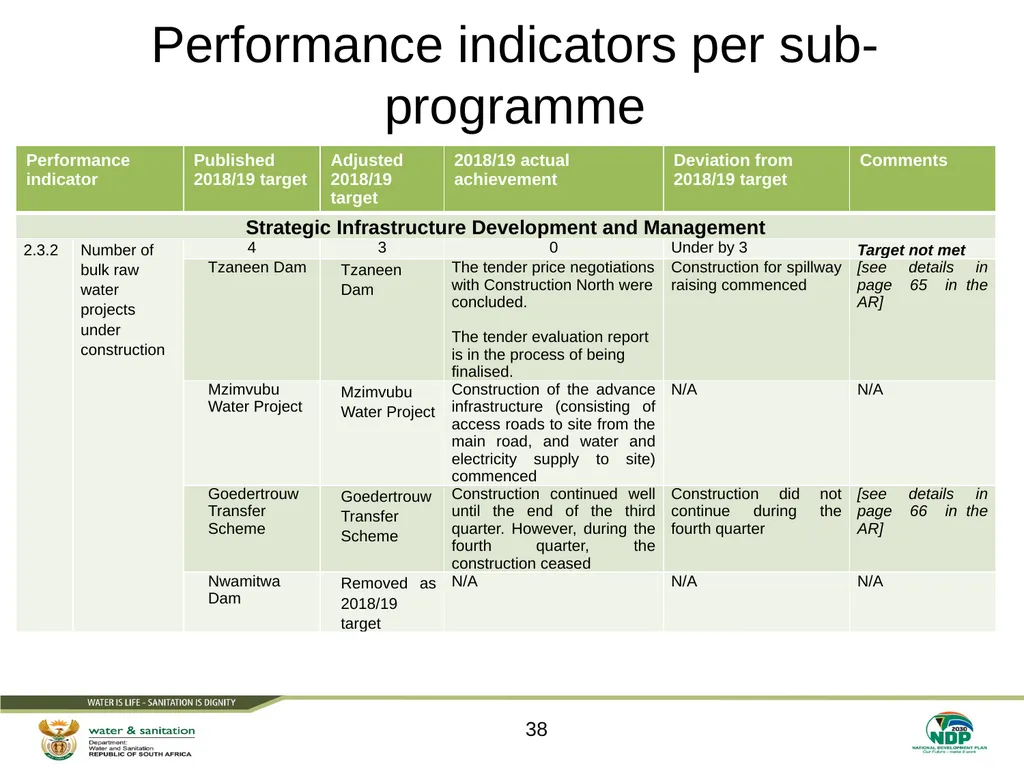
Performance indicators per sub-programme 38<br>
39
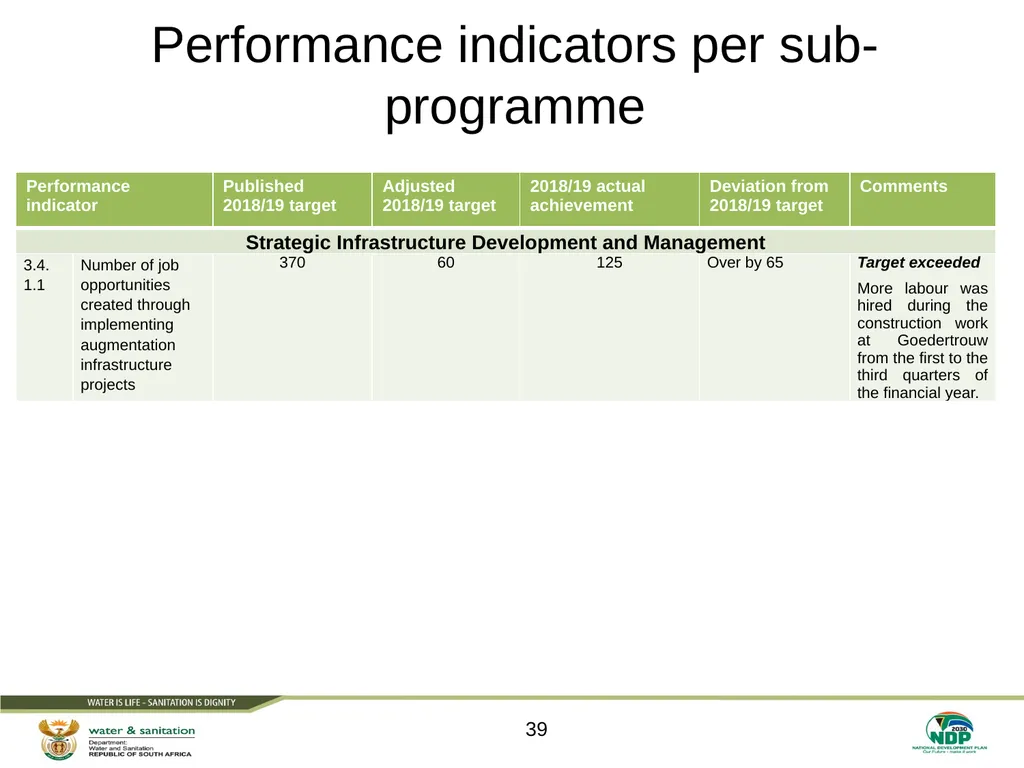
Performance indicators per sub-programme 39<br>
40
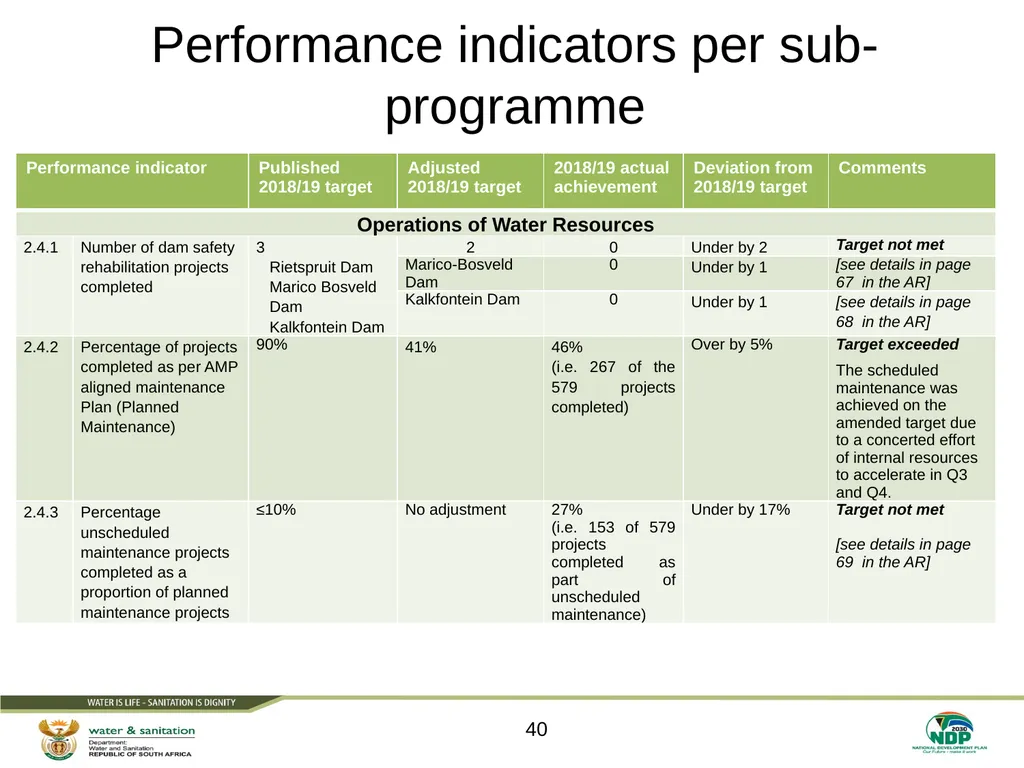
Performance indicators per sub-programme 40<br>
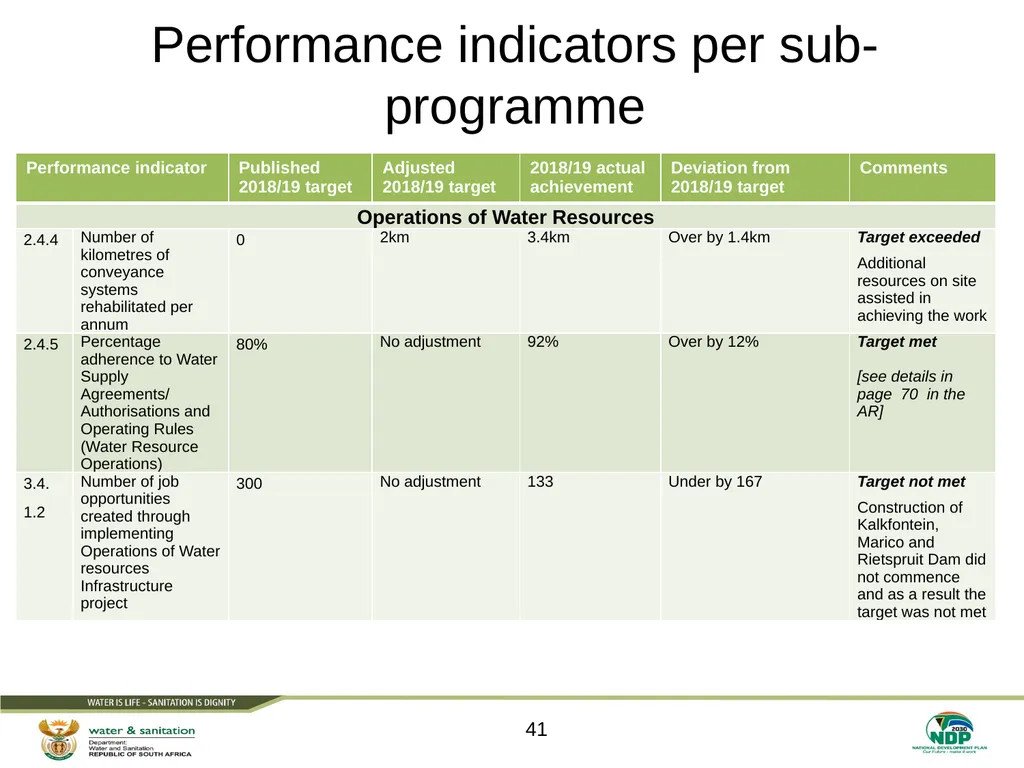
41
Performance indicators per sub-programme 41<br>
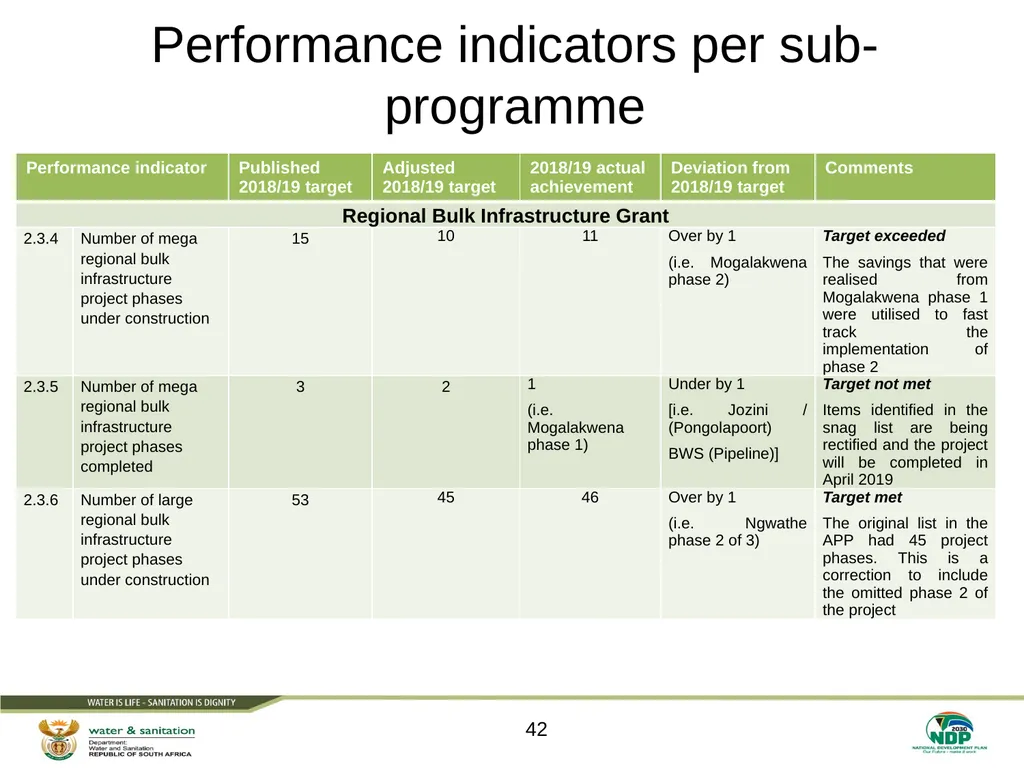
42
Performance indicators per sub-programme 42<br>
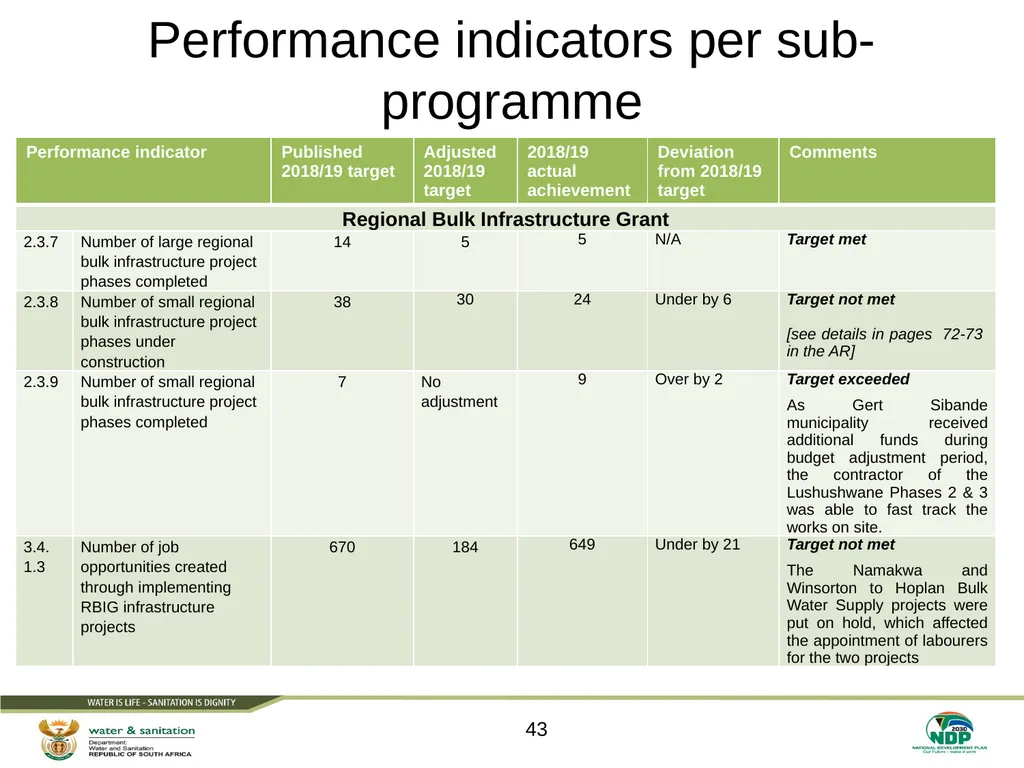
43
Performance indicators per sub-programme 43<br>
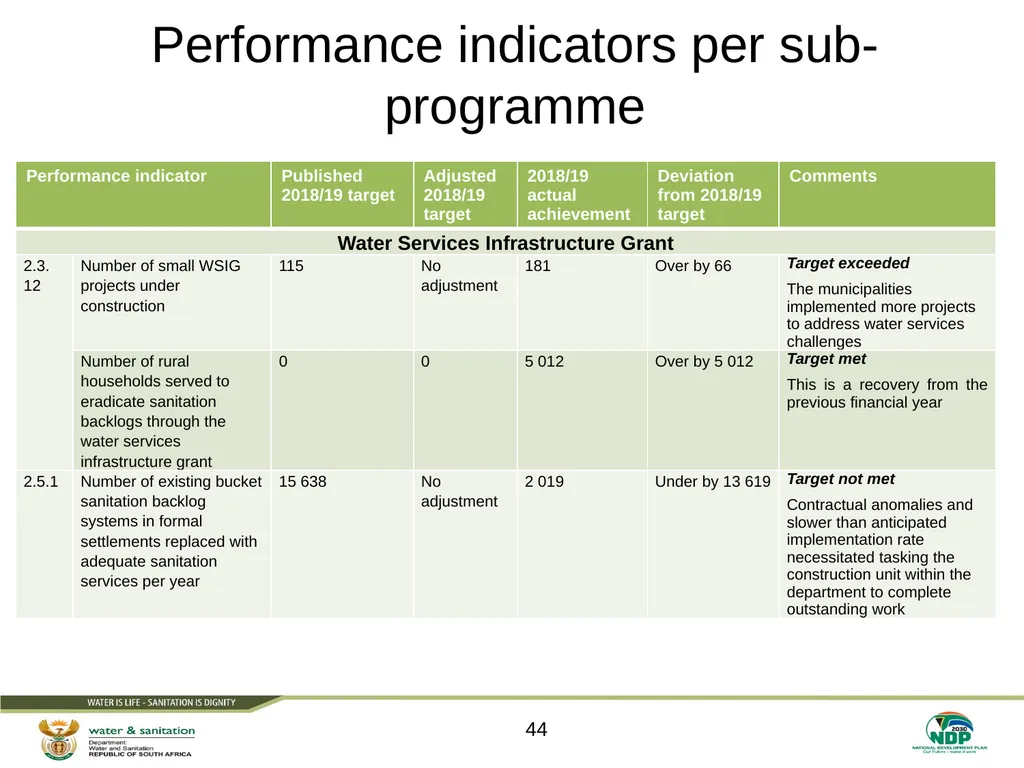
44
Performance indicators per sub-programme 44<br>
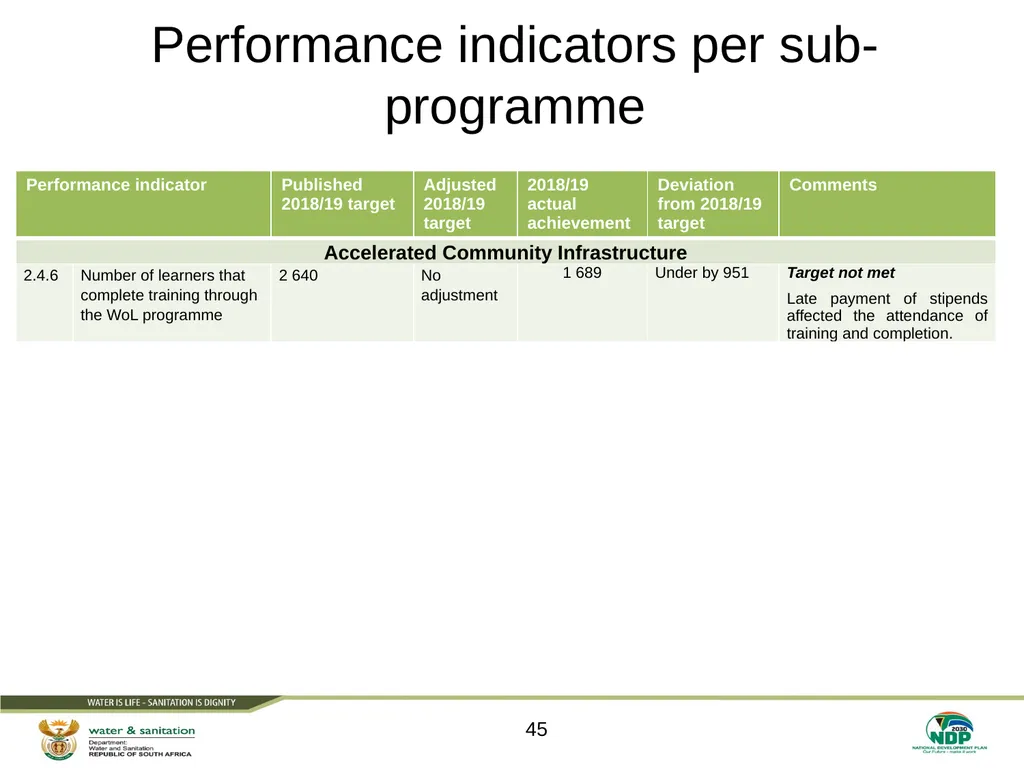
45
Performance indicators per sub-programme 45<br>
46
Part 1.4: overview of programme 4 (water sector regulation) performance Detailed annual performance per programme 46<br>
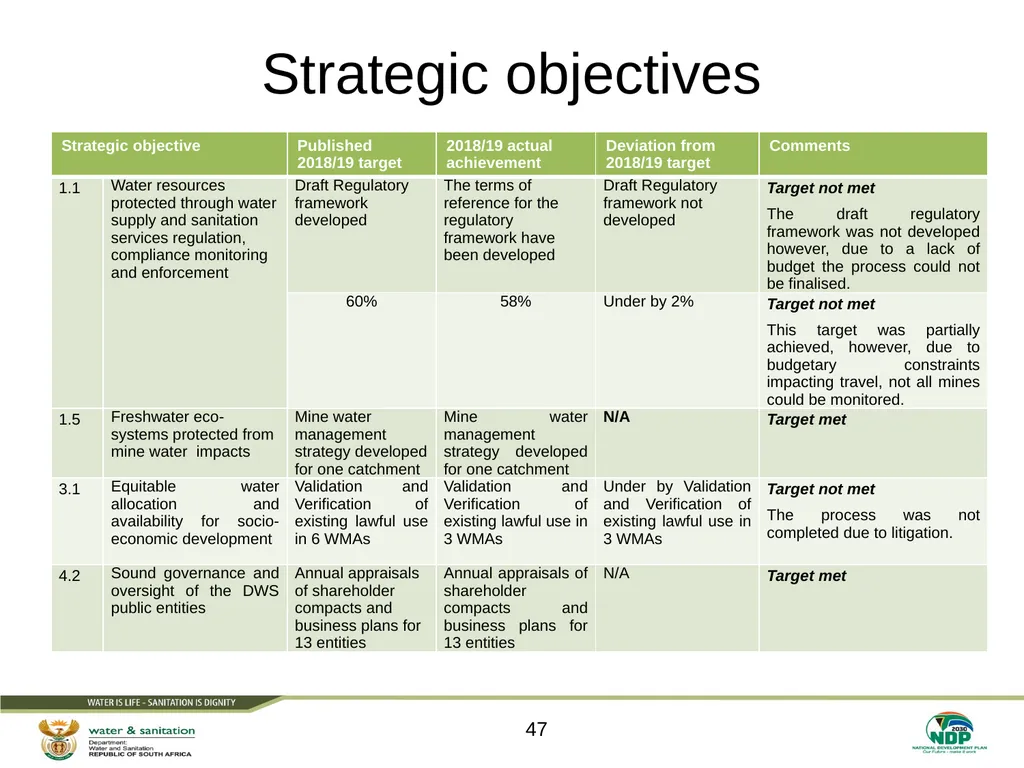
47
Strategic objectives 47<br>
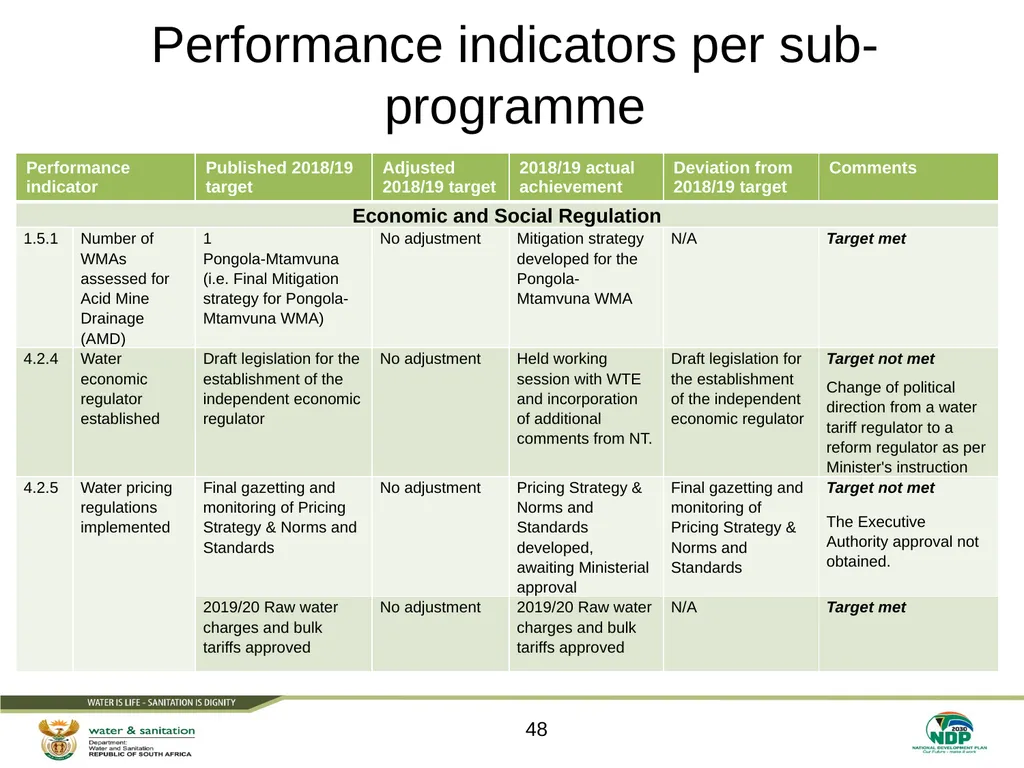
48
Performance indicators per sub-programme 48<br>
49
Performance indicators per sub-programme 49<br>
50
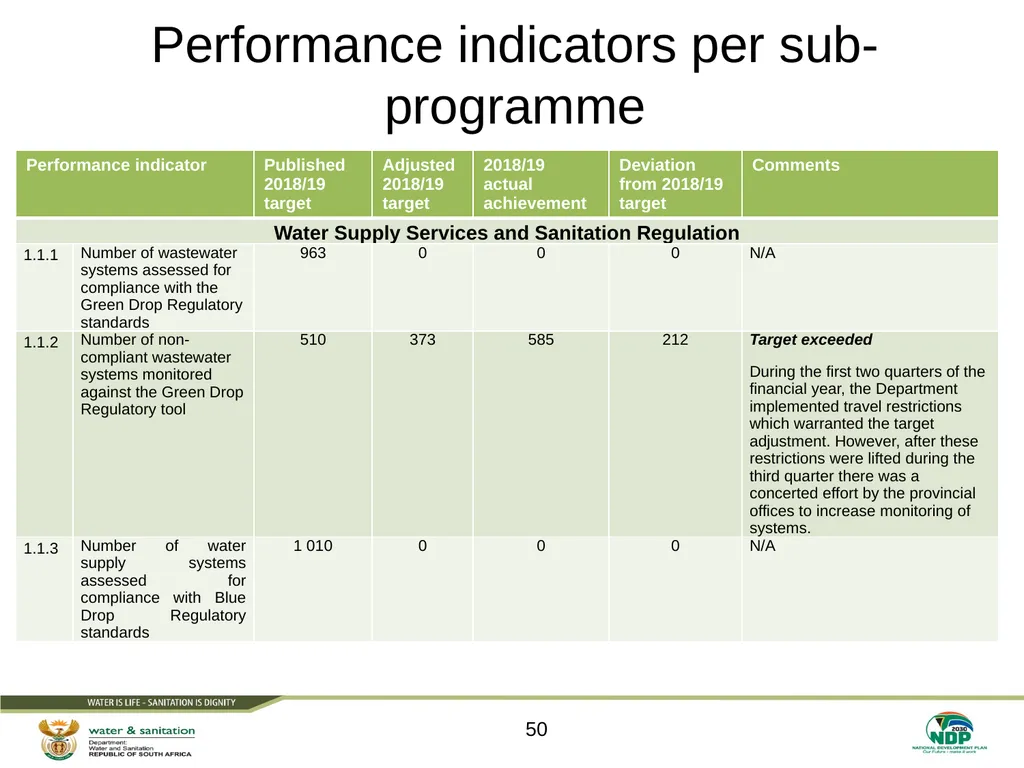
Performance indicators per sub-programme 50<br>
51
Performance indicators per sub-programme 51<br>
52
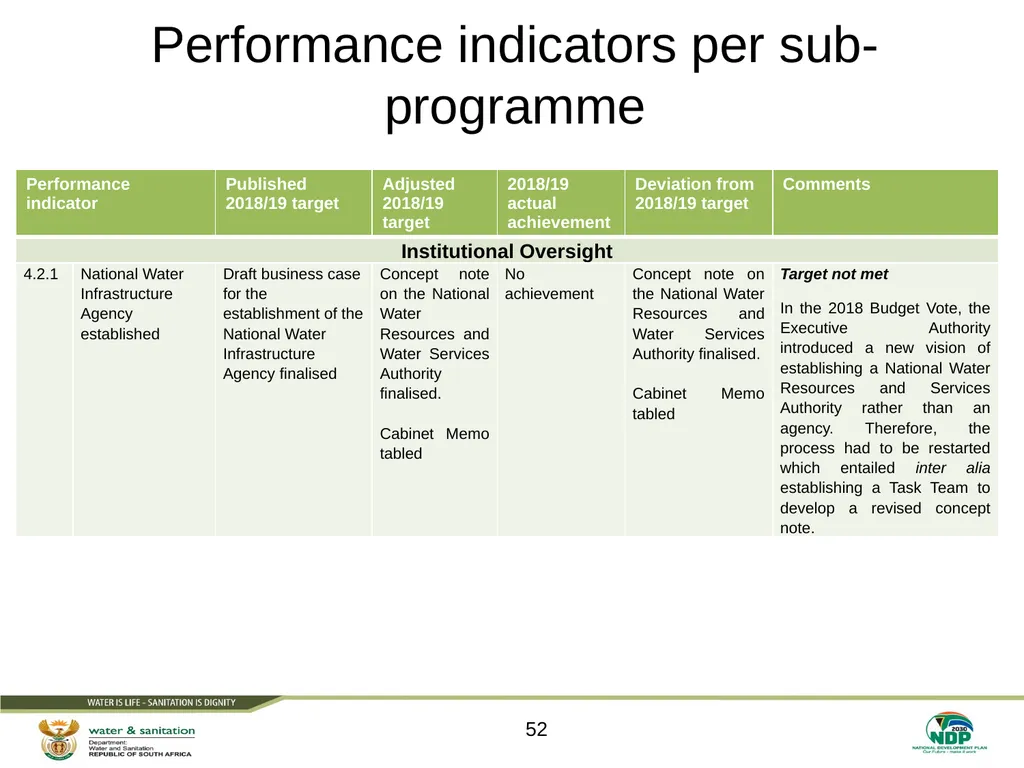
Performance indicators per sub-programme 52<br>
53
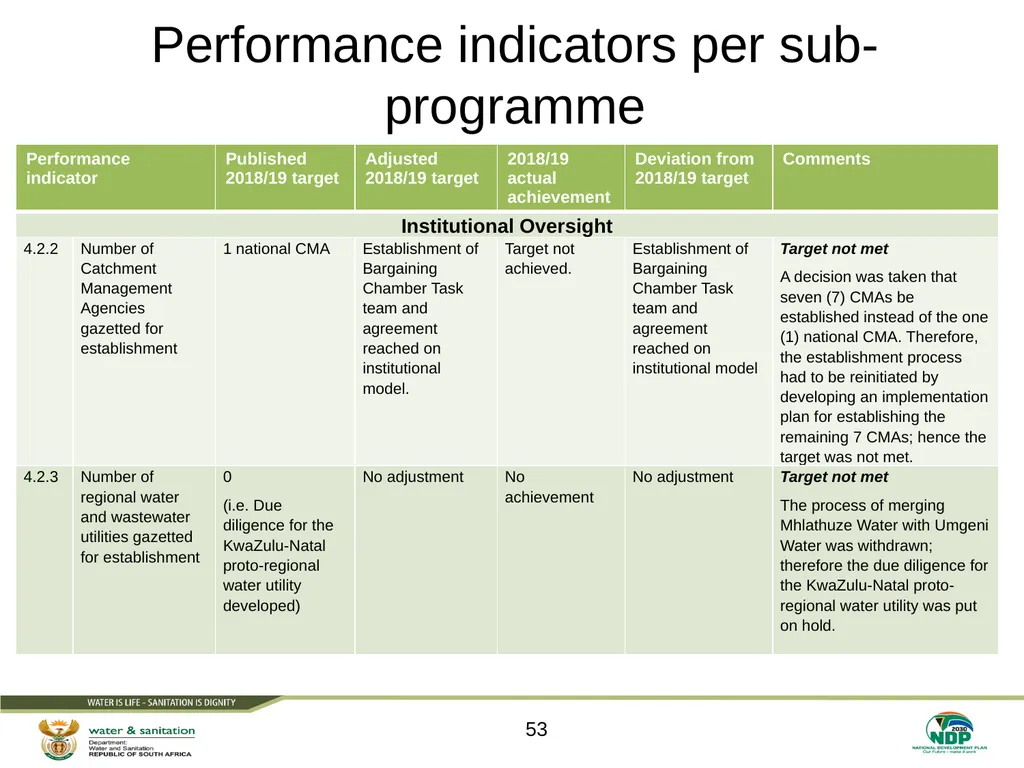
Performance indicators per sub-programme 53<br>
54
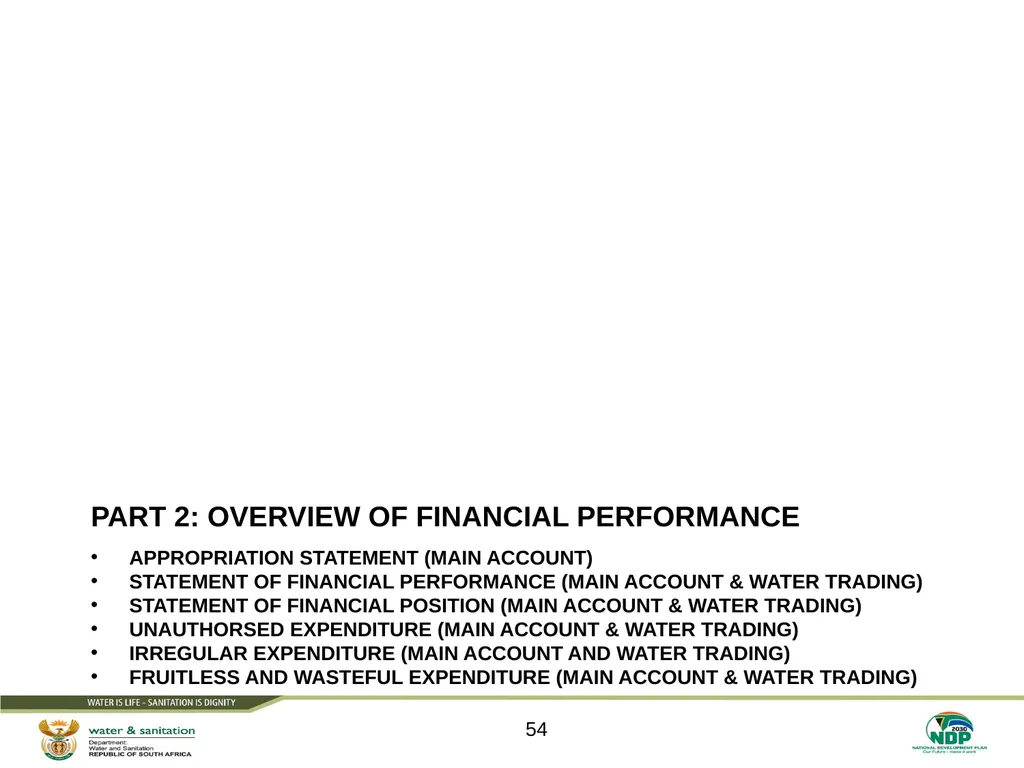
Part 2: overview of financial performance 54 APPROPRIATION STATEMENT (main account)
STATEMENT OF FINANCIAL PERFORMANCE (MAIN ACCOUNT & WATER TRADING)
STATEMENT OF FINANCIAL POSITION (MAIN ACCOUNT & WATER TRADING)
UNAUTHORSED EXPENDITURE (MAIN ACCOUNT & WATER TRADING)
IRREGULAR EXPENDITURE (MAIN ACCOUNT AND Water trading)
FRUITLESS AND WASTEFUL EXPENDITURE (main account & water trading)<br>
STATEMENT OF FINANCIAL PERFORMANCE (MAIN ACCOUNT & WATER TRADING)
STATEMENT OF FINANCIAL POSITION (MAIN ACCOUNT & WATER TRADING)
UNAUTHORSED EXPENDITURE (MAIN ACCOUNT & WATER TRADING)
IRREGULAR EXPENDITURE (MAIN ACCOUNT AND Water trading)
FRUITLESS AND WASTEFUL EXPENDITURE (main account & water trading)<br>
55
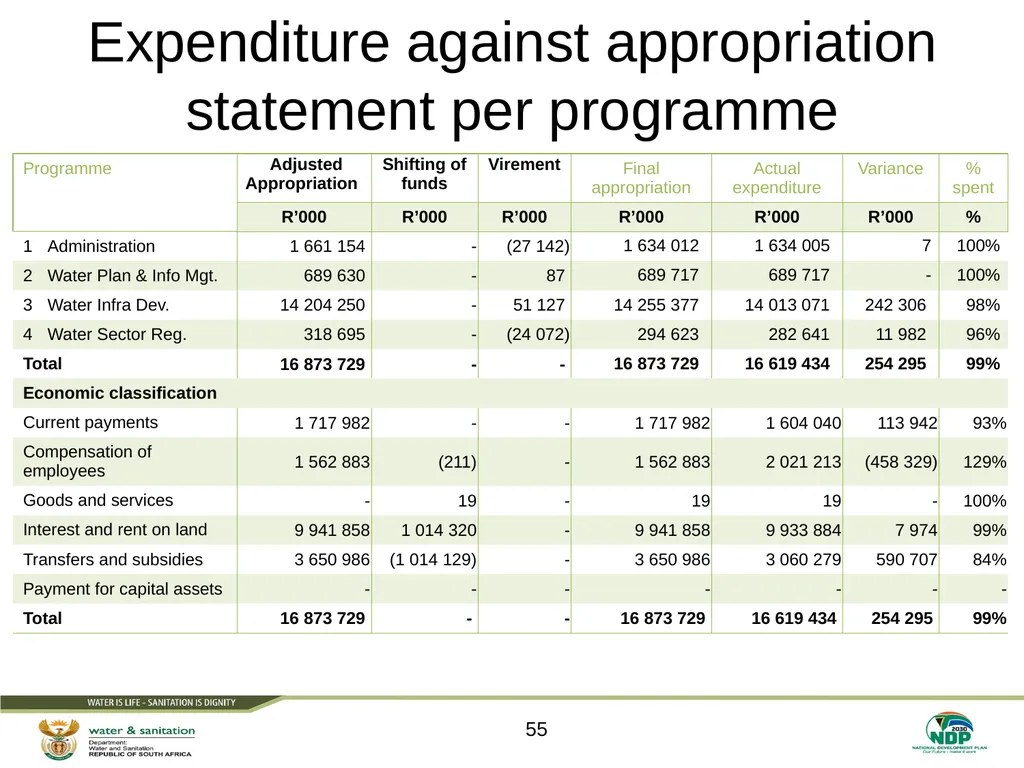
Expenditure against appropriation statement per programme 55<br>
56
Notes to the appropriation statement Programme financial performance
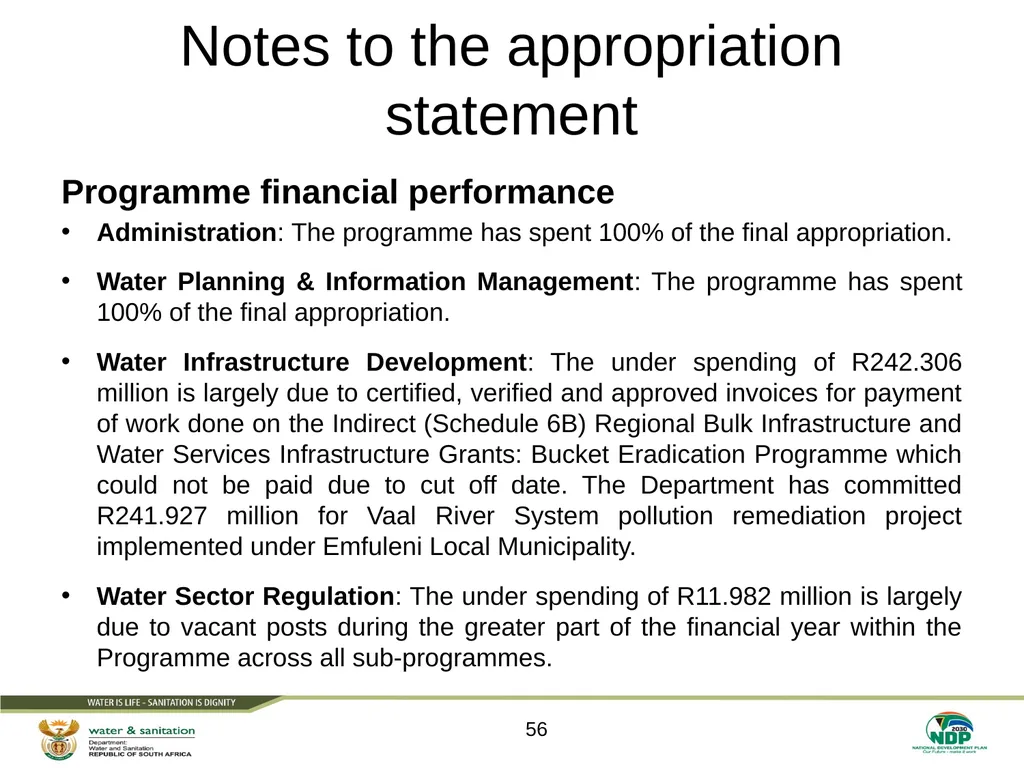
Administration: The programme has spent 100% of the final appropriation.
Water Planning & Information Management: The programme has spent 100% of the final appropriation.
Water Infrastructure Development: The under spending of R242.306 million is largely due to certified, verified and approved invoices for payment of work done on the Indirect (Schedule 6B) Regional Bulk Infrastructure and Water Services Infrastructure Grants: Bucket Eradication Programme which could not be paid due to cut off date. The Department has committed R241.927 million for Vaal River System pollution remediation project implemented under Emfuleni Local Municipality.
Water Sector Regulation: The under spending of R11.982 million is largely due to vacant posts during the greater part of the financial year within the Programme across all sub-programmes. 56<br>
Administration: The programme has spent 100% of the final appropriation.
Water Planning & Information Management: The programme has spent 100% of the final appropriation.
Water Infrastructure Development: The under spending of R242.306 million is largely due to certified, verified and approved invoices for payment of work done on the Indirect (Schedule 6B) Regional Bulk Infrastructure and Water Services Infrastructure Grants: Bucket Eradication Programme which could not be paid due to cut off date. The Department has committed R241.927 million for Vaal River System pollution remediation project implemented under Emfuleni Local Municipality.
Water Sector Regulation: The under spending of R11.982 million is largely due to vacant posts during the greater part of the financial year within the Programme across all sub-programmes. 56<br>
57
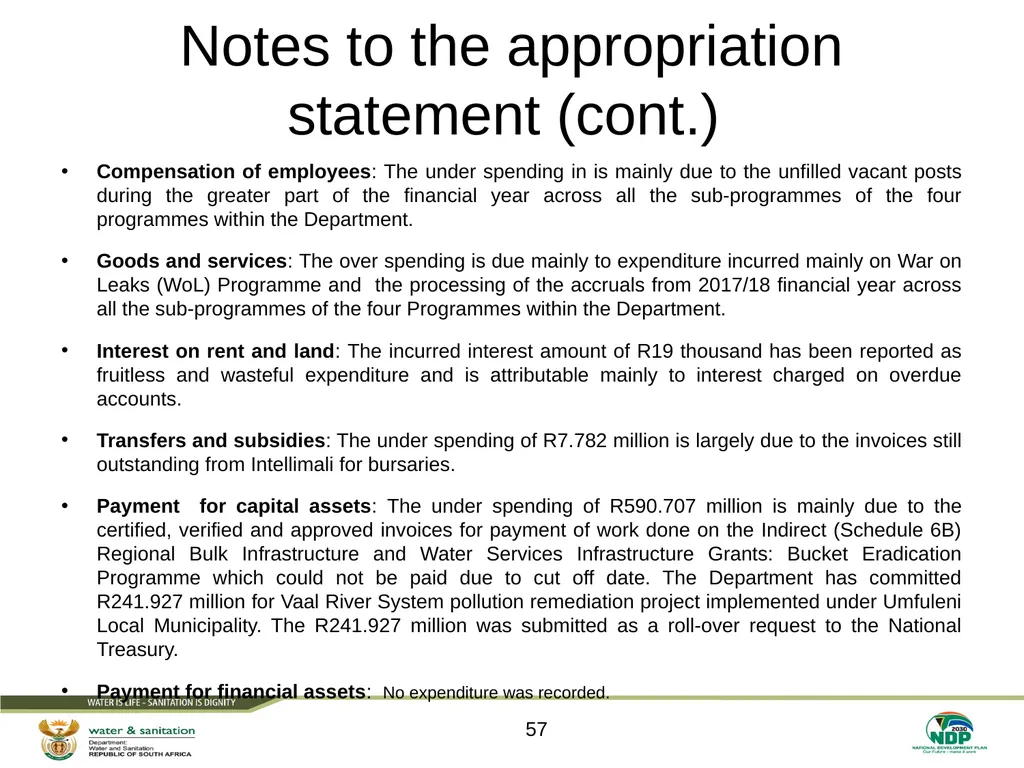
Notes to the appropriation statement (cont.) Compensation of employees: The under spending in is mainly due to the unfilled vacant posts during the greater part of the financial year across all the sub-programmes of the four programmes within the Department.
Goods and services: The over spending is due mainly to expenditure incurred mainly on War on Leaks (WoL) Programme and the processing of the accruals from 2017/18 financial year across all the sub-programmes of the four Programmes within the Department.
Interest on rent and land: The incurred interest amount of R19 thousand has been reported as fruitless and wasteful expenditure and is attributable mainly to interest charged on overdue accounts.
Transfers and subsidies: The under spending of R7.782 million is largely due to the invoices still outstanding from Intellimali for bursaries.
Payment for capital assets: The under spending of R590.707 million is mainly due to the certified, verified and approved invoices for payment of work done on the Indirect (Schedule 6B) Regional Bulk Infrastructure and Water Services Infrastructure Grants: Bucket Eradication Programme which could not be paid due to cut off date. The Department has committed R241.927 million for Vaal River System pollution remediation project implemented under Umfuleni Local Municipality. The R241.927 million was submitted as a roll-over request to the National Treasury.
Payment for financial assets: No expenditure was recorded. 57<br>
Goods and services: The over spending is due mainly to expenditure incurred mainly on War on Leaks (WoL) Programme and the processing of the accruals from 2017/18 financial year across all the sub-programmes of the four Programmes within the Department.
Interest on rent and land: The incurred interest amount of R19 thousand has been reported as fruitless and wasteful expenditure and is attributable mainly to interest charged on overdue accounts.
Transfers and subsidies: The under spending of R7.782 million is largely due to the invoices still outstanding from Intellimali for bursaries.
Payment for capital assets: The under spending of R590.707 million is mainly due to the certified, verified and approved invoices for payment of work done on the Indirect (Schedule 6B) Regional Bulk Infrastructure and Water Services Infrastructure Grants: Bucket Eradication Programme which could not be paid due to cut off date. The Department has committed R241.927 million for Vaal River System pollution remediation project implemented under Umfuleni Local Municipality. The R241.927 million was submitted as a roll-over request to the National Treasury.
Payment for financial assets: No expenditure was recorded. 57<br>
58
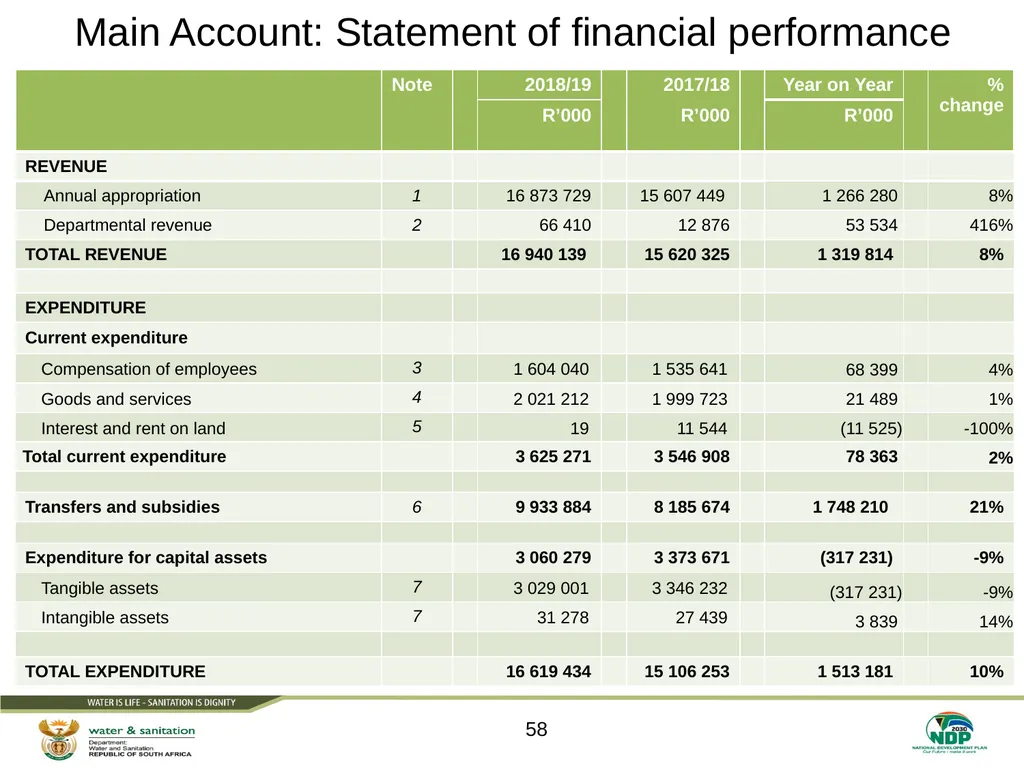
Main Account: Statement of financial performance 58<br>
59
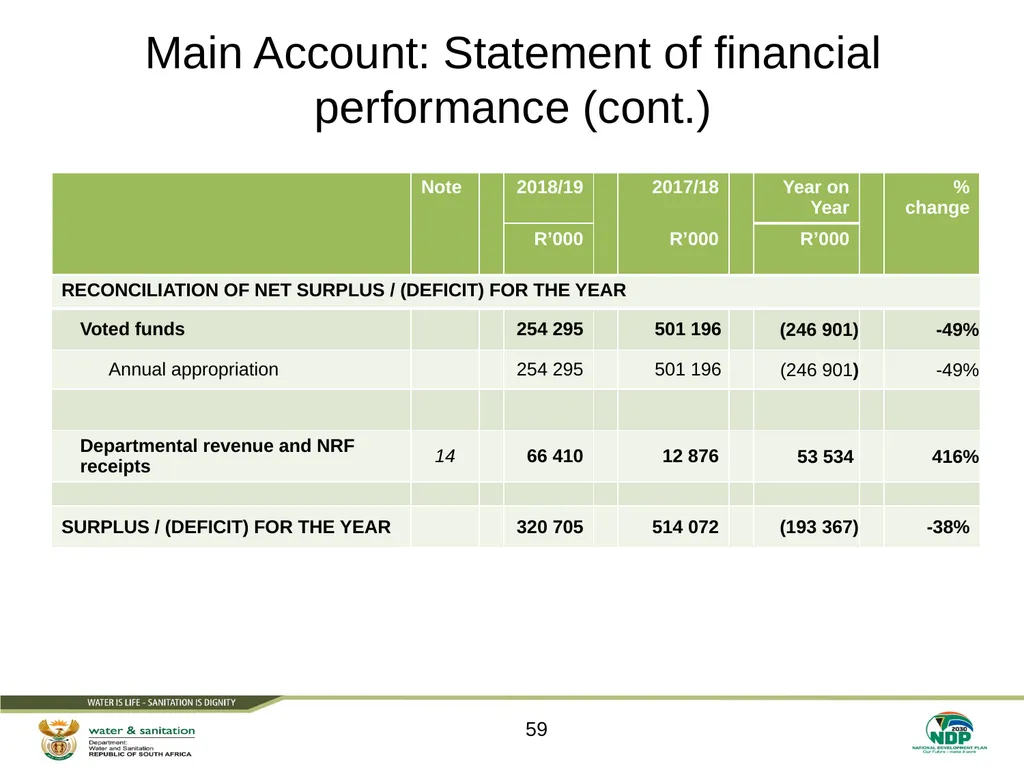
59 Main Account: Statement of financial performance (cont.)<br>
60
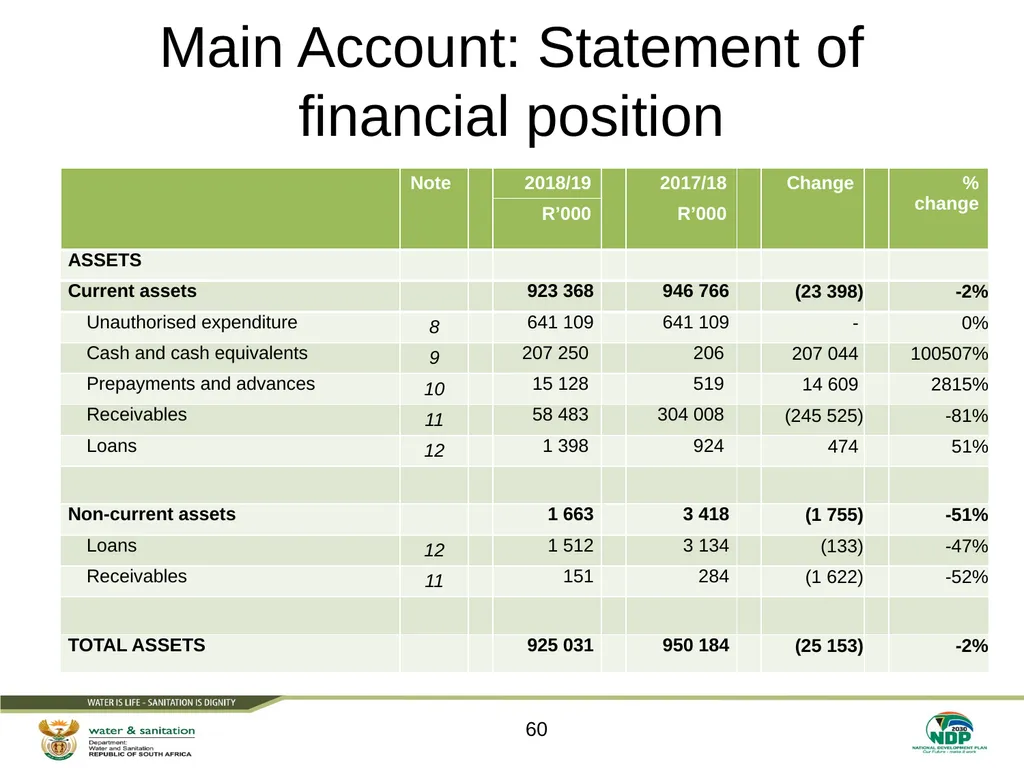
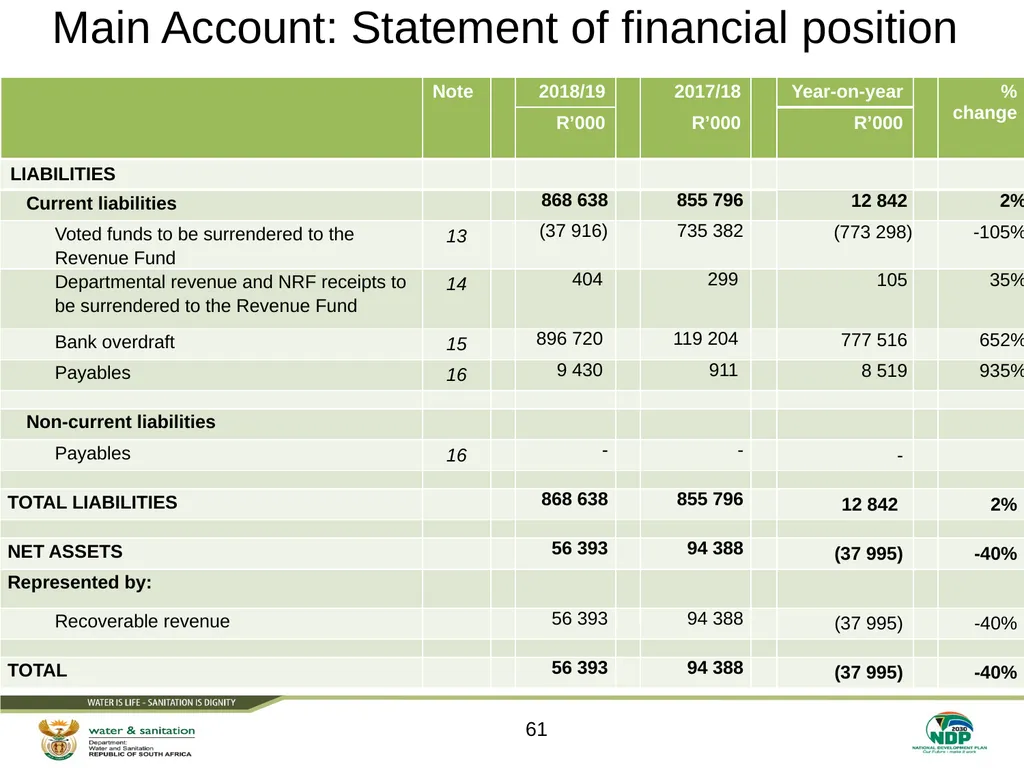
Main Account: Statement of financial position 60<br>
61
Main Account: Statement of financial position 61<br>
62
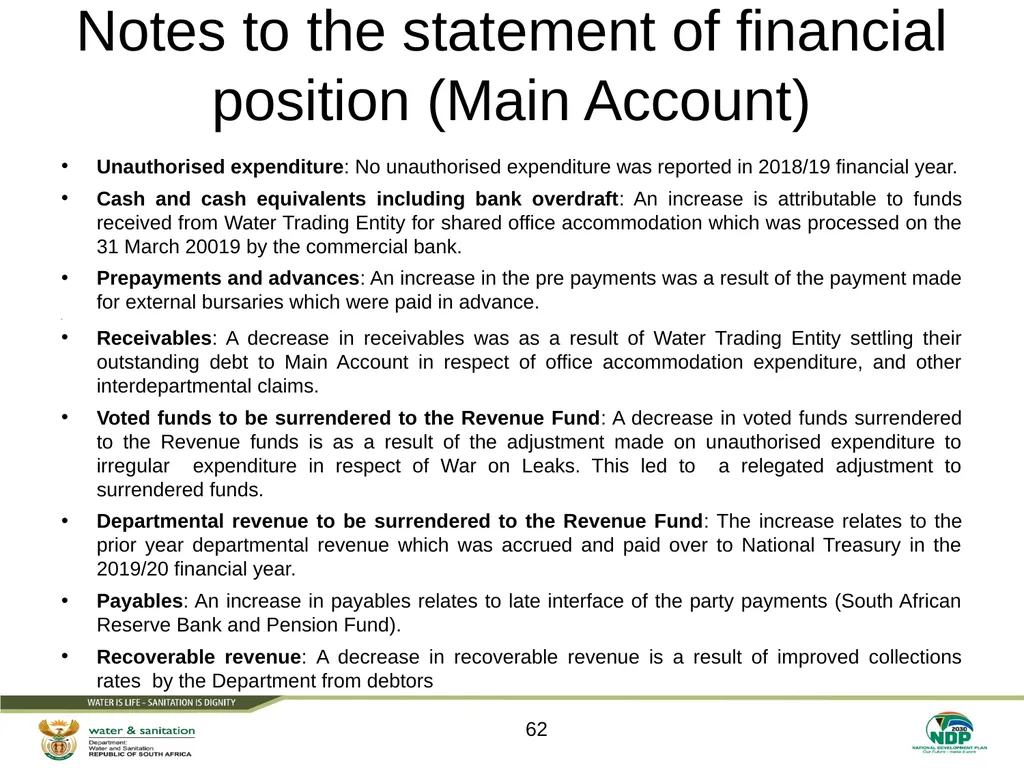
Notes to the statement of financial position (Main Account) Unauthorised expenditure: No unauthorised expenditure was reported in 2018/19 financial year.
Cash and cash equivalents including bank overdraft: An increase is attributable to funds received from Water Trading Entity for shared office accommodation which was processed on the 31 March 20019 by the commercial bank.
Prepayments and advances: An increase in the pre payments was a result of the payment made for external bursaries which were paid in advance.
Receivables: A decrease in receivables was as a result of Water Trading Entity settling their outstanding debt to Main Account in respect of office accommodation expenditure, and other interdepartmental claims.
Voted funds to be surrendered to the Revenue Fund: A decrease in voted funds surrendered to the Revenue funds is as a result of the adjustment made on unauthorised expenditure to irregular expenditure in respect of War on Leaks. This led to a relegated adjustment to surrendered funds.
Departmental revenue to be surrendered to the Revenue Fund: The increase relates to the prior year departmental revenue which was accrued and paid over to National Treasury in the 2019/20 financial year.
Payables: An increase in payables relates to late interface of the party payments (South African Reserve Bank and Pension Fund).
Recoverable revenue: A decrease in recoverable revenue is a result of improved collections rates by the Department from debtors 62<br>
Cash and cash equivalents including bank overdraft: An increase is attributable to funds received from Water Trading Entity for shared office accommodation which was processed on the 31 March 20019 by the commercial bank.
Prepayments and advances: An increase in the pre payments was a result of the payment made for external bursaries which were paid in advance.
Receivables: A decrease in receivables was as a result of Water Trading Entity settling their outstanding debt to Main Account in respect of office accommodation expenditure, and other interdepartmental claims.
Voted funds to be surrendered to the Revenue Fund: A decrease in voted funds surrendered to the Revenue funds is as a result of the adjustment made on unauthorised expenditure to irregular expenditure in respect of War on Leaks. This led to a relegated adjustment to surrendered funds.
Departmental revenue to be surrendered to the Revenue Fund: The increase relates to the prior year departmental revenue which was accrued and paid over to National Treasury in the 2019/20 financial year.
Payables: An increase in payables relates to late interface of the party payments (South African Reserve Bank and Pension Fund).
Recoverable revenue: A decrease in recoverable revenue is a result of improved collections rates by the Department from debtors 62<br>
63
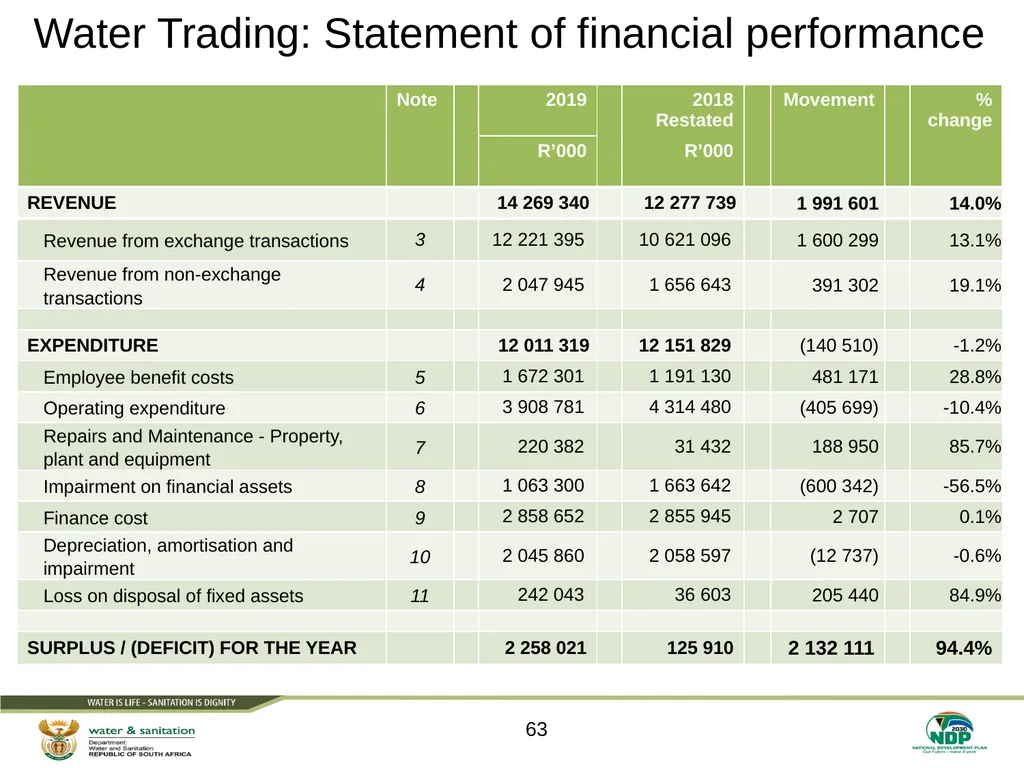
Water Trading: Statement of financial performance 63<br>
64
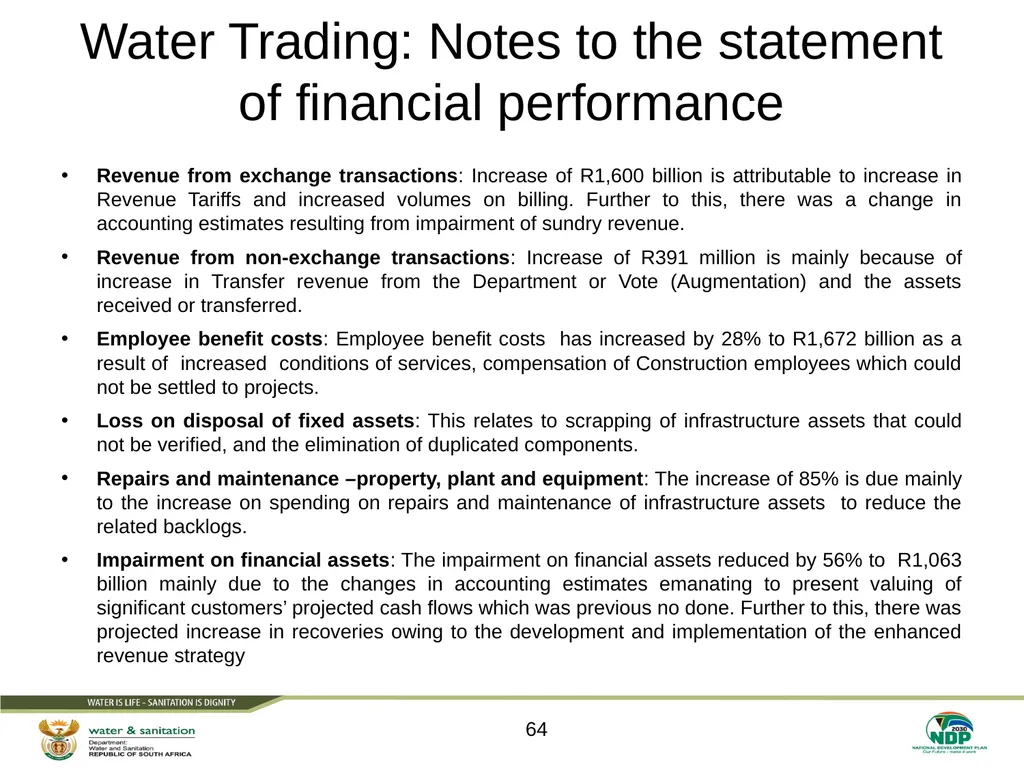
Water Trading: Notes to the statement of financial performance Revenue from exchange transactions: Increase of R1,600 billion is attributable to increase in Revenue Tariffs and increased volumes on billing. Further to this, there was a change in accounting estimates resulting from impairment of sundry revenue.
Revenue from non-exchange transactions: Increase of R391 million is mainly because of increase in Transfer revenue from the Department or Vote (Augmentation) and the assets received or transferred.
Employee benefit costs: Employee benefit costs has increased by 28% to R1,672 billion as a result of increased conditions of services, compensation of Construction employees which could not be settled to projects.
Loss on disposal of fixed assets: This relates to scrapping of infrastructure assets that could not be verified, and the elimination of duplicated components.
Repairs and maintenance –property, plant and equipment: The increase of 85% is due mainly to the increase on spending on repairs and maintenance of infrastructure assets to reduce the related backlogs.
Impairment on financial assets: The impairment on financial assets reduced by 56% to R1,063 billion mainly due to the changes in accounting estimates emanating to present valuing of significant customers’ projected cash flows which was previous no done. Further to this, there was projected increase in recoveries owing to the development and implementation of the enhanced revenue strategy 64<br>
Revenue from non-exchange transactions: Increase of R391 million is mainly because of increase in Transfer revenue from the Department or Vote (Augmentation) and the assets received or transferred.
Employee benefit costs: Employee benefit costs has increased by 28% to R1,672 billion as a result of increased conditions of services, compensation of Construction employees which could not be settled to projects.
Loss on disposal of fixed assets: This relates to scrapping of infrastructure assets that could not be verified, and the elimination of duplicated components.
Repairs and maintenance –property, plant and equipment: The increase of 85% is due mainly to the increase on spending on repairs and maintenance of infrastructure assets to reduce the related backlogs.
Impairment on financial assets: The impairment on financial assets reduced by 56% to R1,063 billion mainly due to the changes in accounting estimates emanating to present valuing of significant customers’ projected cash flows which was previous no done. Further to this, there was projected increase in recoveries owing to the development and implementation of the enhanced revenue strategy 64<br>
65
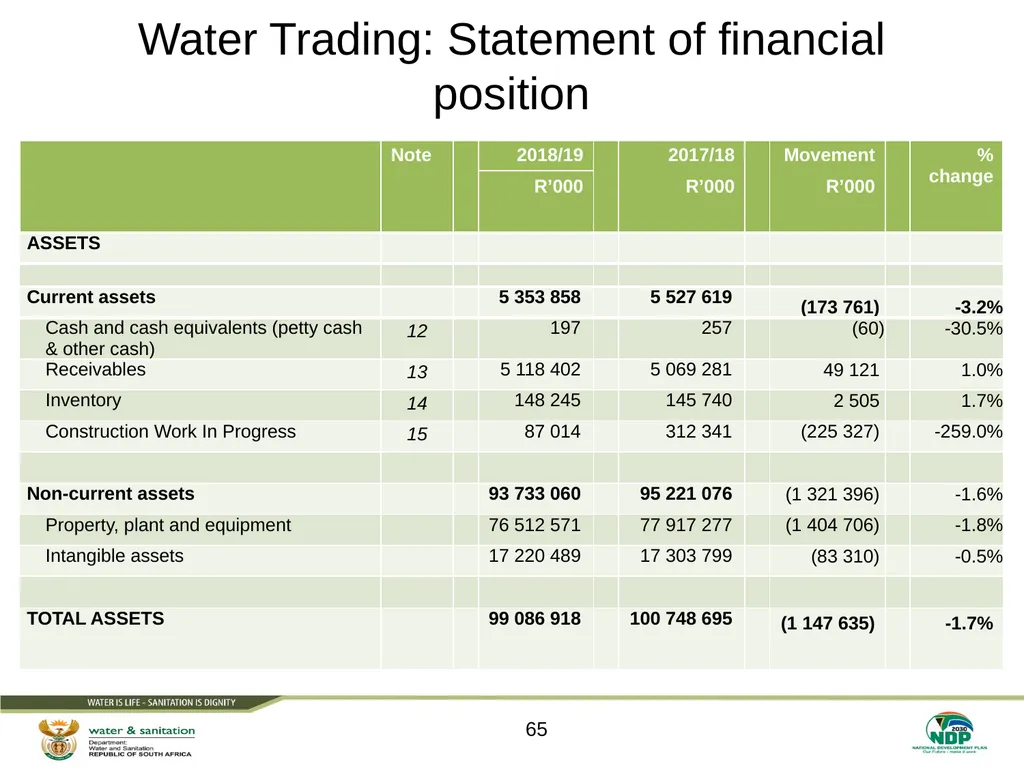
Water Trading: Statement of financial position 65<br>
66
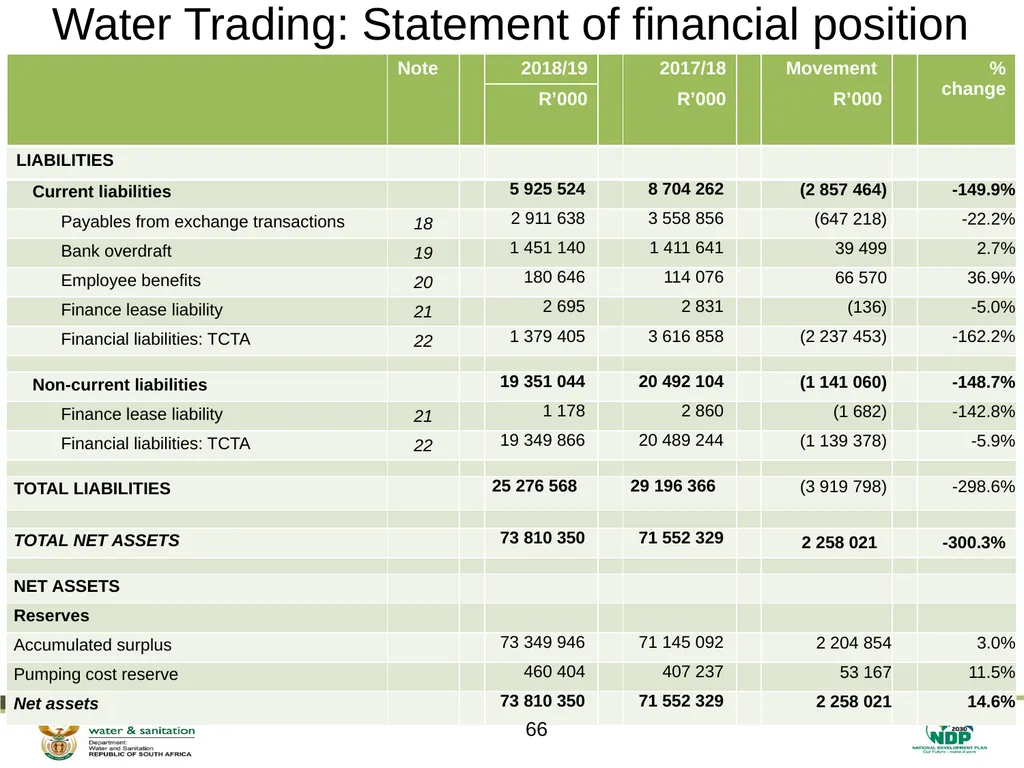
Water Trading: Statement of financial position 66<br>
67
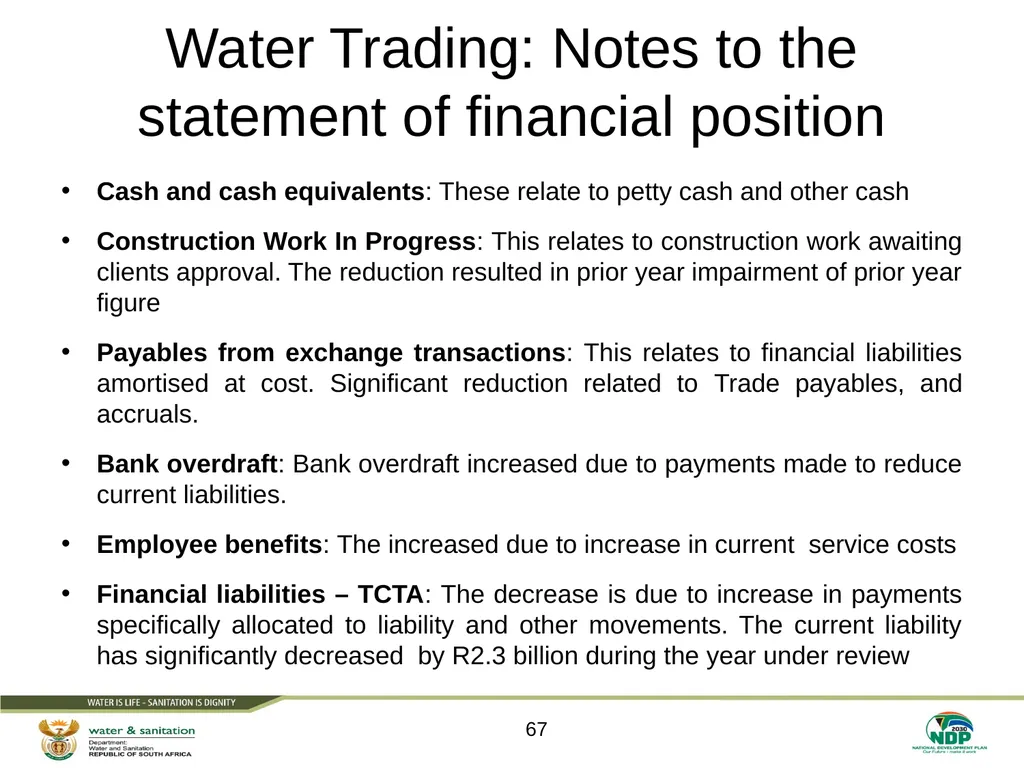
Water Trading: Notes to the statement of financial position Cash and cash equivalents: These relate to petty cash and other cash
Construction Work In Progress: This relates to construction work awaiting clients approval. The reduction resulted in prior year impairment of prior year figure
Payables from exchange transactions: This relates to financial liabilities amortised at cost. Significant reduction related to Trade payables, and accruals.
Bank overdraft: Bank overdraft increased due to payments made to reduce current liabilities.
Employee benefits: The increased due to increase in current service costs
Financial liabilities – TCTA: The decrease is due to increase in payments specifically allocated to liability and other movements. The current liability has significantly decreased by R2.3 billion during the year under review 67<br>
Construction Work In Progress: This relates to construction work awaiting clients approval. The reduction resulted in prior year impairment of prior year figure
Payables from exchange transactions: This relates to financial liabilities amortised at cost. Significant reduction related to Trade payables, and accruals.
Bank overdraft: Bank overdraft increased due to payments made to reduce current liabilities.
Employee benefits: The increased due to increase in current service costs
Financial liabilities – TCTA: The decrease is due to increase in payments specifically allocated to liability and other movements. The current liability has significantly decreased by R2.3 billion during the year under review 67<br>
68
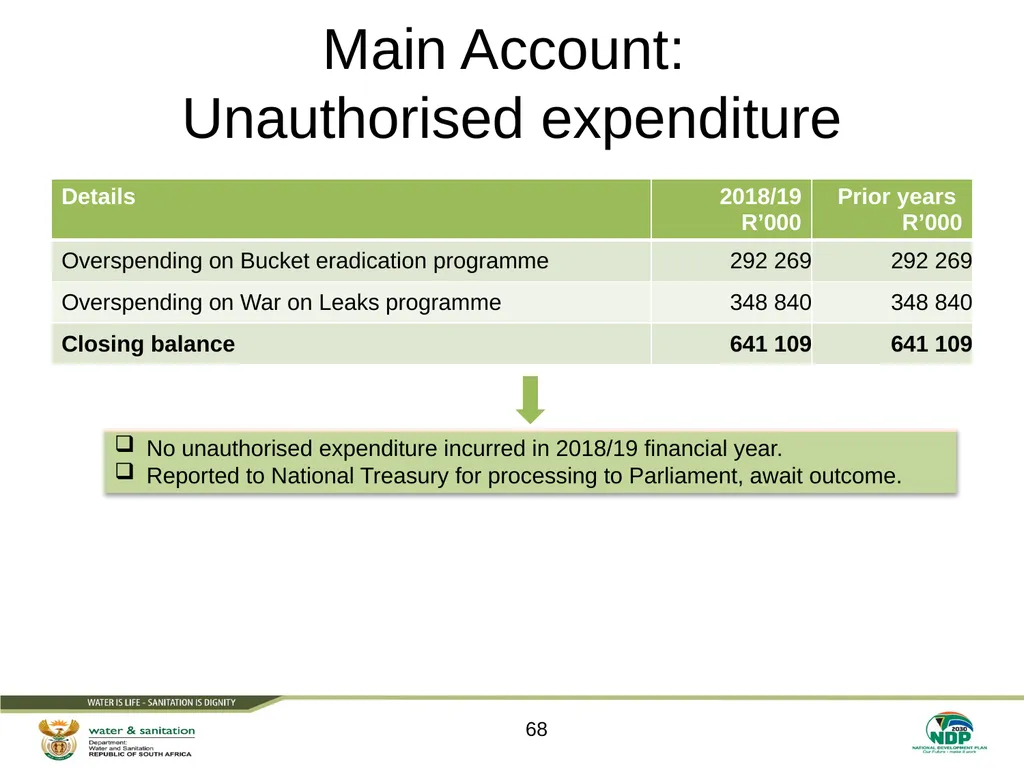
Main Account:
Unauthorised expenditure 68 No unauthorised expenditure incurred in 2018/19 financial year.
Reported to National Treasury for processing to Parliament, await outcome.<br>
Reported to National Treasury for processing to Parliament, await outcome.<br>
69
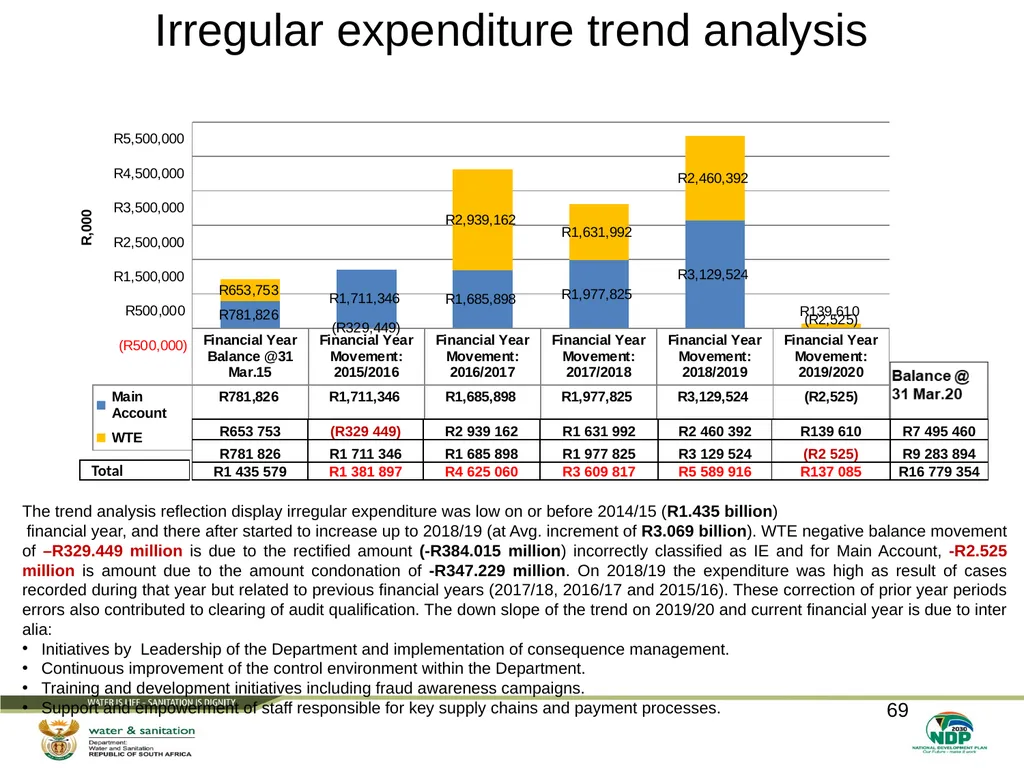
69 The trend analysis reflection display irregular expenditure was low on or before 2014/15 (R1.435 billion)
financial year, and there after started to increase up to 2018/19 (at Avg. increment of R3.069 billion). WTE negative balance movement of –R329.449 million is due to the rectified amount (-R384.015 million) incorrectly classified as IE and for Main Account, -R2.525 million is amount due to the amount condonation of -R347.229 million. On 2018/19 the expenditure was high as result of cases recorded during that year but related to previous financial years (2017/18, 2016/17 and 2015/16). These correction of prior year periods errors also contributed to clearing of audit qualification. The down slope of the trend on 2019/20 and current financial year is due to inter alia:
Initiatives by Leadership of the Department and implementation of consequence management.
Continuous improvement of the control environment within the Department.
Training and development initiatives including fraud awareness campaigns.
Support and empowerment of staff responsible for key supply chains and payment processes. Irregular expenditure trend analysis<br>
financial year, and there after started to increase up to 2018/19 (at Avg. increment of R3.069 billion). WTE negative balance movement of –R329.449 million is due to the rectified amount (-R384.015 million) incorrectly classified as IE and for Main Account, -R2.525 million is amount due to the amount condonation of -R347.229 million. On 2018/19 the expenditure was high as result of cases recorded during that year but related to previous financial years (2017/18, 2016/17 and 2015/16). These correction of prior year periods errors also contributed to clearing of audit qualification. The down slope of the trend on 2019/20 and current financial year is due to inter alia:
Initiatives by Leadership of the Department and implementation of consequence management.
Continuous improvement of the control environment within the Department.
Training and development initiatives including fraud awareness campaigns.
Support and empowerment of staff responsible for key supply chains and payment processes. Irregular expenditure trend analysis<br>
70
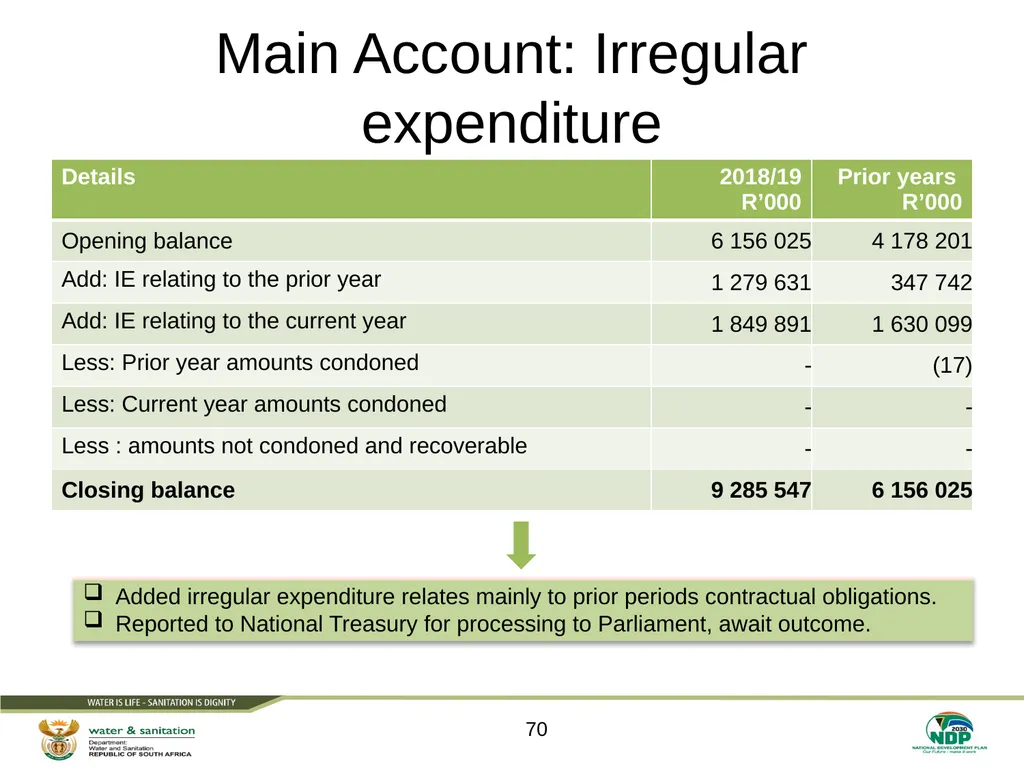
Main Account: Irregular expenditure 70 Added irregular expenditure relates mainly to prior periods contractual obligations.
Reported to National Treasury for processing to Parliament, await outcome.<br>
Reported to National Treasury for processing to Parliament, await outcome.<br>
71
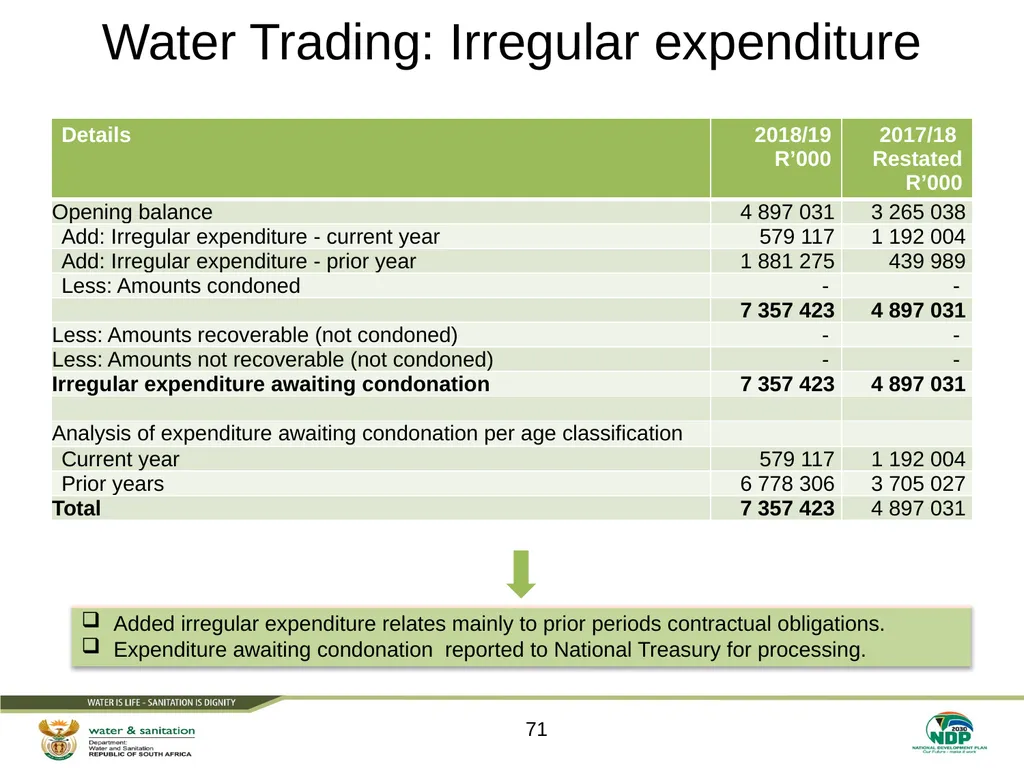
Water Trading: Irregular expenditure 71 Added irregular expenditure relates mainly to prior periods contractual obligations.
Expenditure awaiting condonation reported to National Treasury for processing.<br>
Expenditure awaiting condonation reported to National Treasury for processing.<br>
72
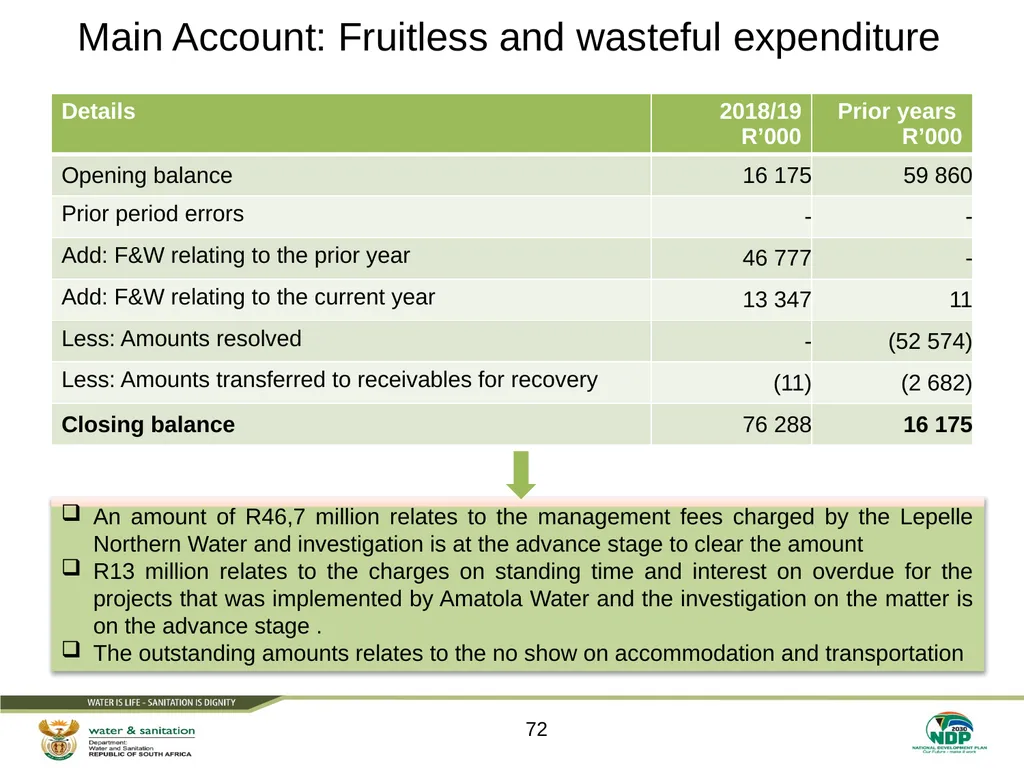
Main Account: Fruitless and wasteful expenditure 72 An amount of R46,7 million relates to the management fees charged by the Lepelle Northern Water and investigation is at the advance stage to clear the amount
R13 million relates to the charges on standing time and interest on overdue for the projects that was implemented by Amatola Water and the investigation on the matter is on the advance stage .
The outstanding amounts relates to the no show on accommodation and transportation<br>
R13 million relates to the charges on standing time and interest on overdue for the projects that was implemented by Amatola Water and the investigation on the matter is on the advance stage .
The outstanding amounts relates to the no show on accommodation and transportation<br>
73
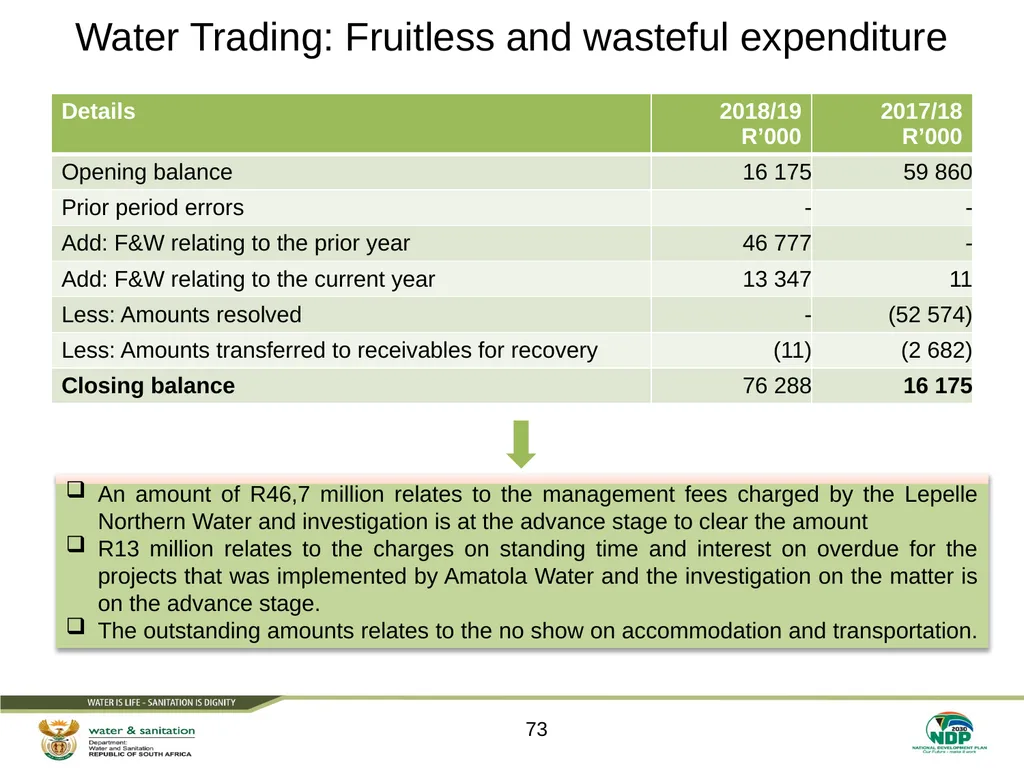
Water Trading: Fruitless and wasteful expenditure 73 An amount of R46,7 million relates to the management fees charged by the Lepelle Northern Water and investigation is at the advance stage to clear the amount
R13 million relates to the charges on standing time and interest on overdue for the projects that was implemented by Amatola Water and the investigation on the matter is on the advance stage.
The outstanding amounts relates to the no show on accommodation and transportation.<br>
R13 million relates to the charges on standing time and interest on overdue for the projects that was implemented by Amatola Water and the investigation on the matter is on the advance stage.
The outstanding amounts relates to the no show on accommodation and transportation.<br>
74
Part 3: overview of the auditor-general’s report 74 Audit of 2018/19 predetermined objectives
Outcome of the department’s (vote 36) financial audit report
Outcome of the water trading financial audit<br>
Outcome of the department’s (vote 36) financial audit report
Outcome of the water trading financial audit<br>
75
Audit of predetermined objectives 75<br>
76
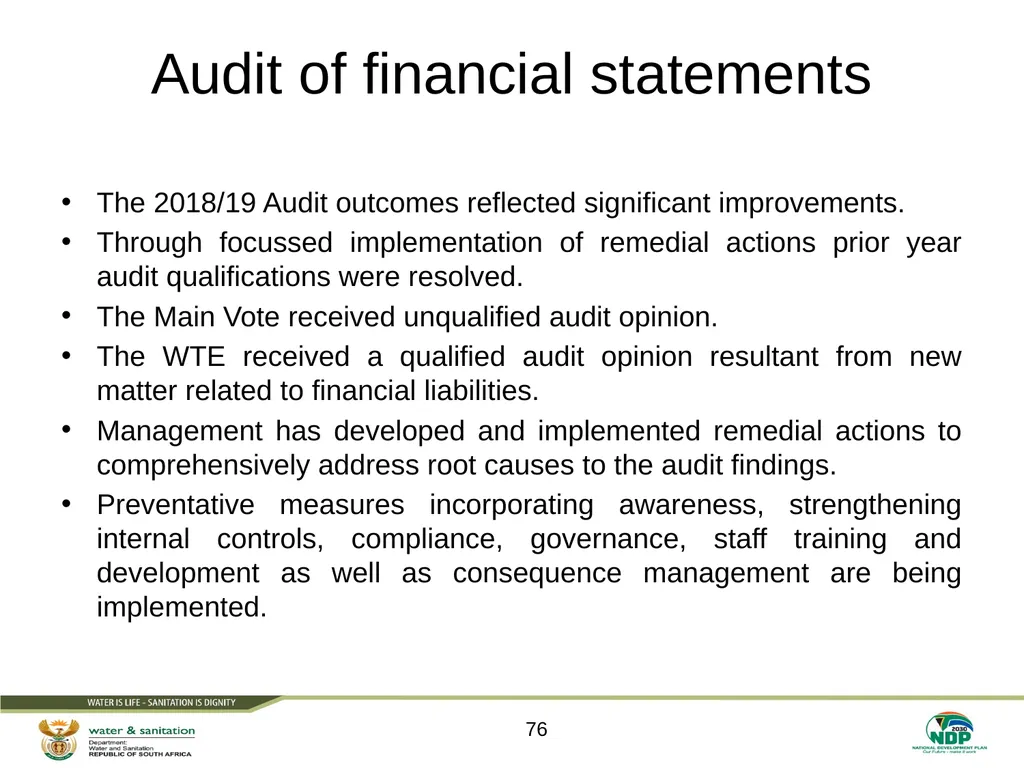
Audit of financial statements 76 The 2018/19 Audit outcomes reflected significant improvements.
Through focussed implementation of remedial actions prior year audit qualifications were resolved.
The Main Vote received unqualified audit opinion.
The WTE received a qualified audit opinion resultant from new matter related to financial liabilities.
Management has developed and implemented remedial actions to comprehensively address root causes to the audit findings.
Preventative measures incorporating awareness, strengthening internal controls, compliance, governance, staff training and development as well as consequence management are being implemented.<br>
Through focussed implementation of remedial actions prior year audit qualifications were resolved.
The Main Vote received unqualified audit opinion.
The WTE received a qualified audit opinion resultant from new matter related to financial liabilities.
Management has developed and implemented remedial actions to comprehensively address root causes to the audit findings.
Preventative measures incorporating awareness, strengthening internal controls, compliance, governance, staff training and development as well as consequence management are being implemented.<br>
77
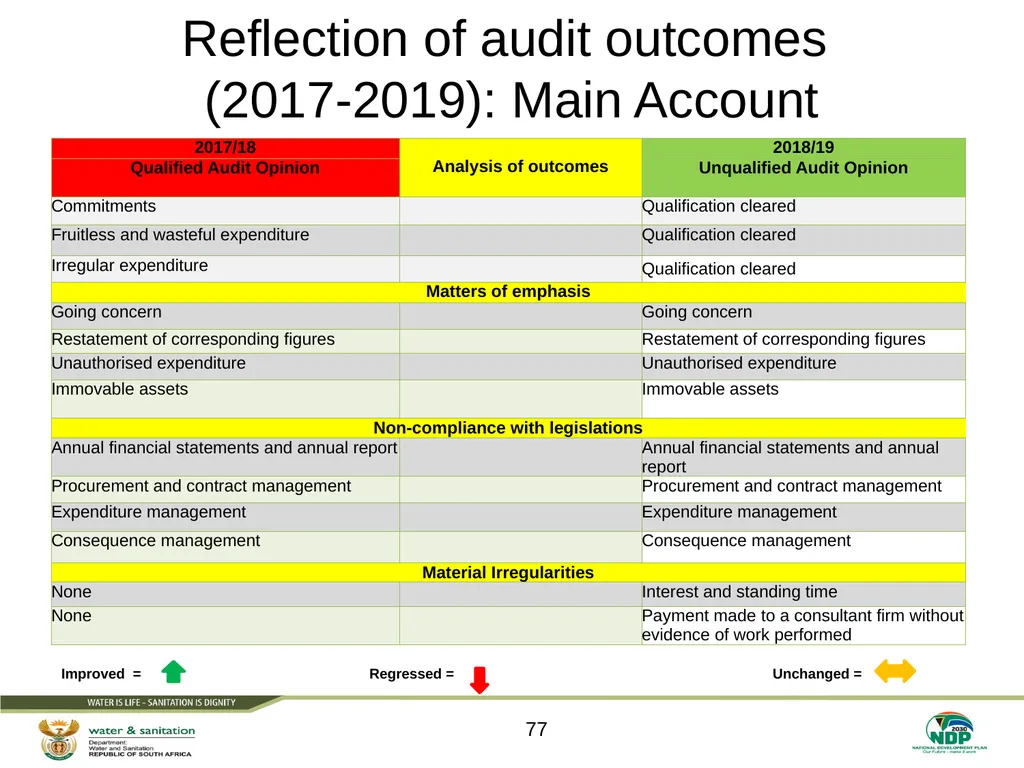
Reflection of audit outcomes
(2017-2019): Main Account 77<br>
78
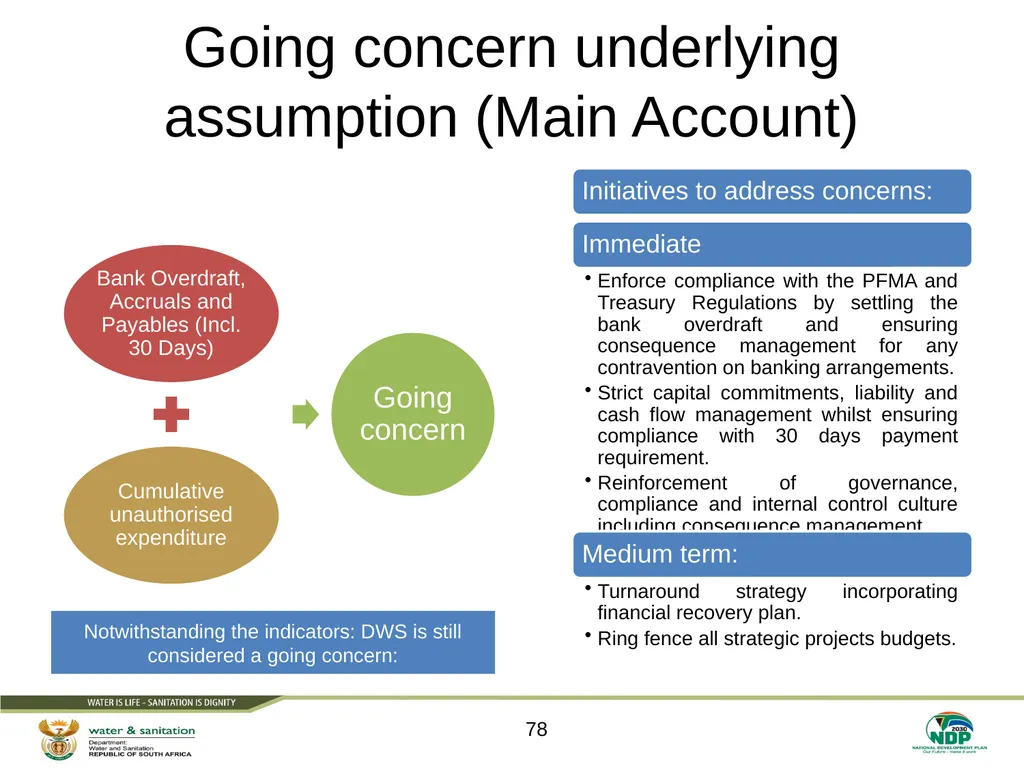
Going concern underlying assumption (Main Account) 78 Notwithstanding the indicators: DWS is still considered a going concern:<br>
79
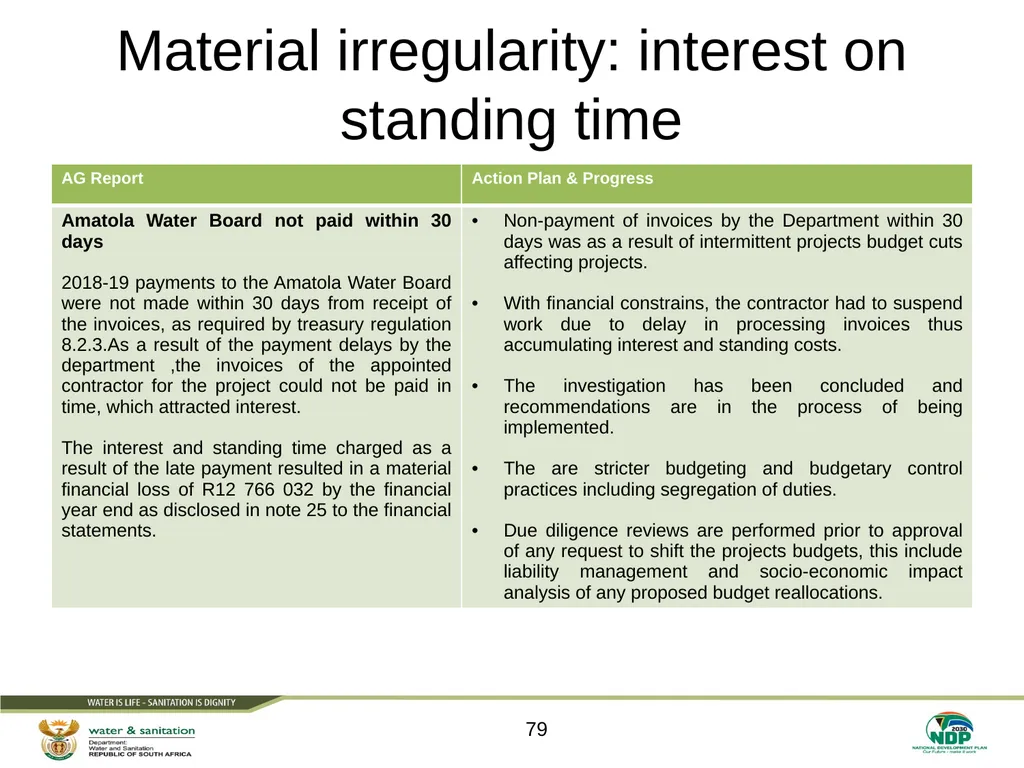
Material irregularity: interest on standing time 79<br>
80
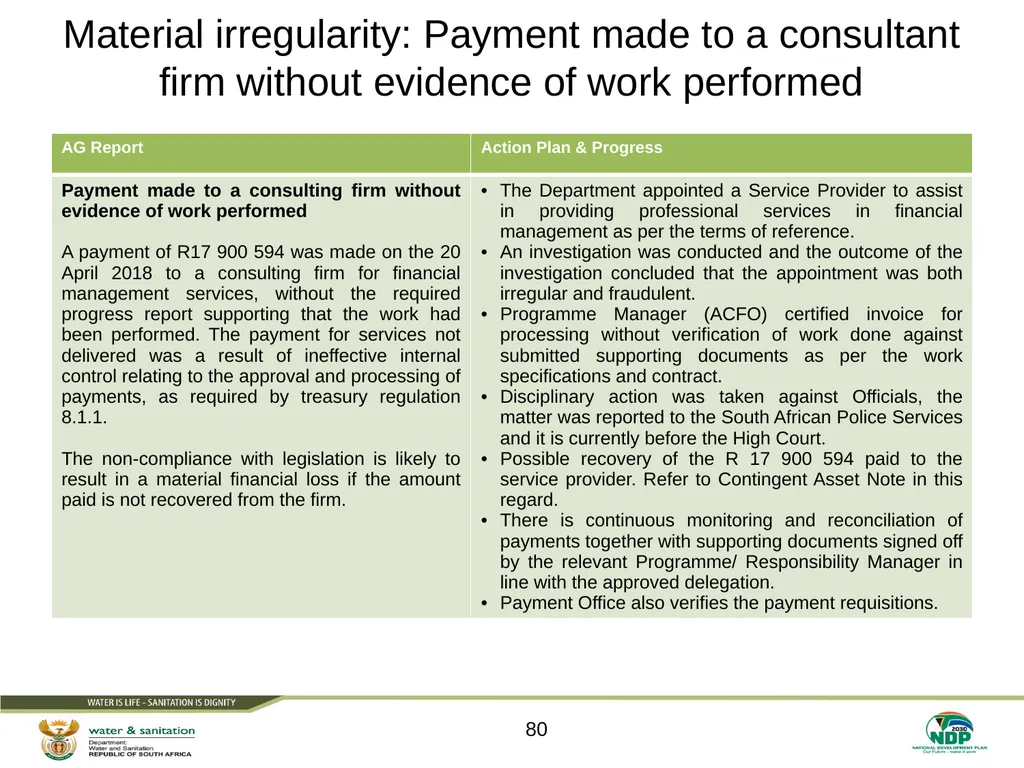
Material irregularity: Payment made to a consultant firm without evidence of work performed 80<br>
81
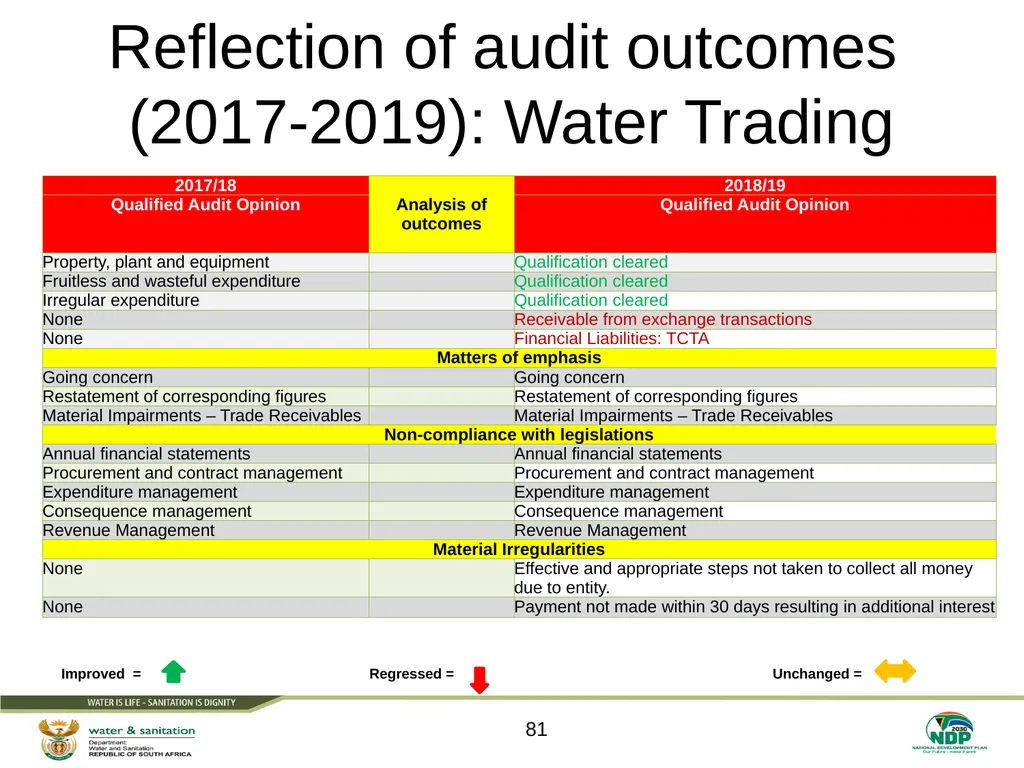
Reflection of audit outcomes
(2017-2019): Water Trading 81<br>
82
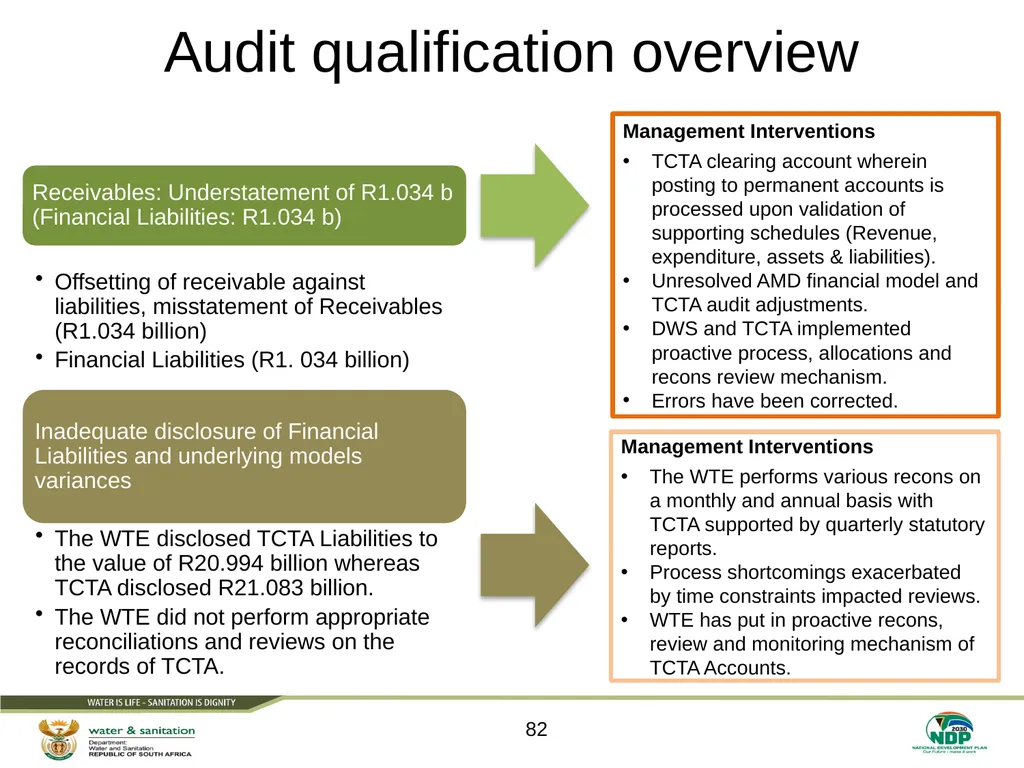
Audit qualification overview 82 Management Interventions
TCTA clearing account wherein posting to permanent accounts is processed upon validation of supporting schedules (Revenue, expenditure, assets & liabilities).
Unresolved AMD financial model and TCTA audit adjustments.
DWS and TCTA implemented proactive process, allocations and recons review mechanism.
Errors have been corrected. Management Interventions
The WTE performs various recons on a monthly and annual basis with TCTA supported by quarterly statutory reports.
Process shortcomings exacerbated by time constraints impacted reviews.
WTE has put in proactive recons, review and monitoring mechanism of TCTA Accounts.<br>
TCTA clearing account wherein posting to permanent accounts is processed upon validation of supporting schedules (Revenue, expenditure, assets & liabilities).
Unresolved AMD financial model and TCTA audit adjustments.
DWS and TCTA implemented proactive process, allocations and recons review mechanism.
Errors have been corrected. Management Interventions
The WTE performs various recons on a monthly and annual basis with TCTA supported by quarterly statutory reports.
Process shortcomings exacerbated by time constraints impacted reviews.
WTE has put in proactive recons, review and monitoring mechanism of TCTA Accounts.<br>
83
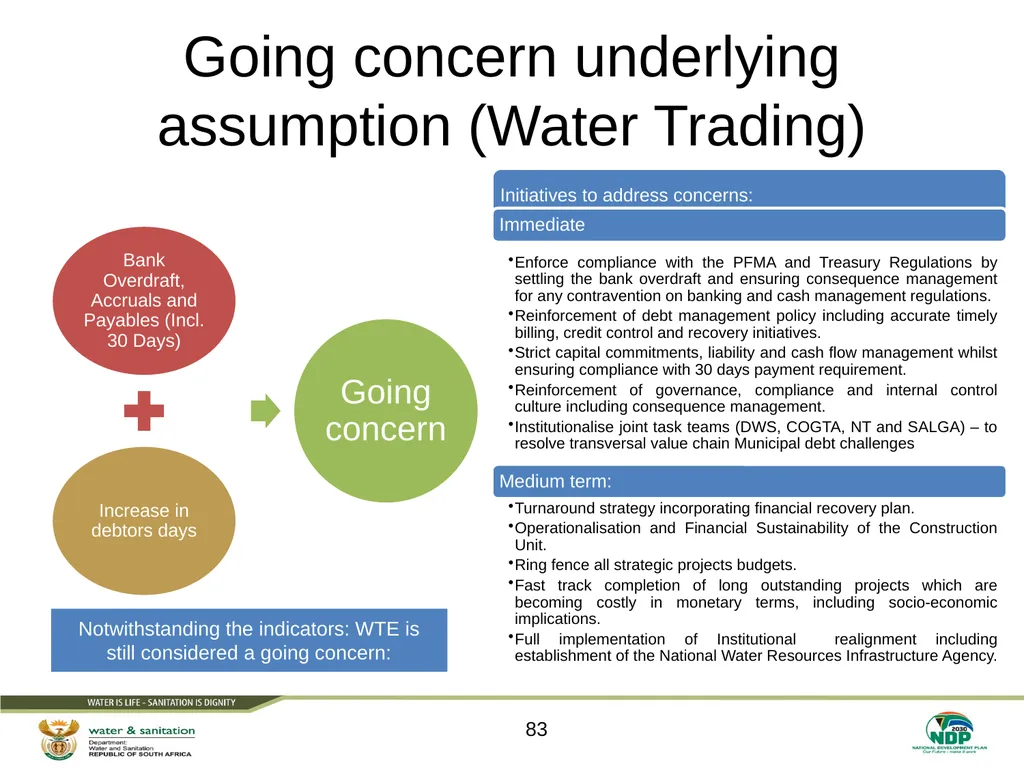
Going concern underlying assumption (Water Trading) 83 Notwithstanding the indicators: WTE is still considered a going concern:<br>
84
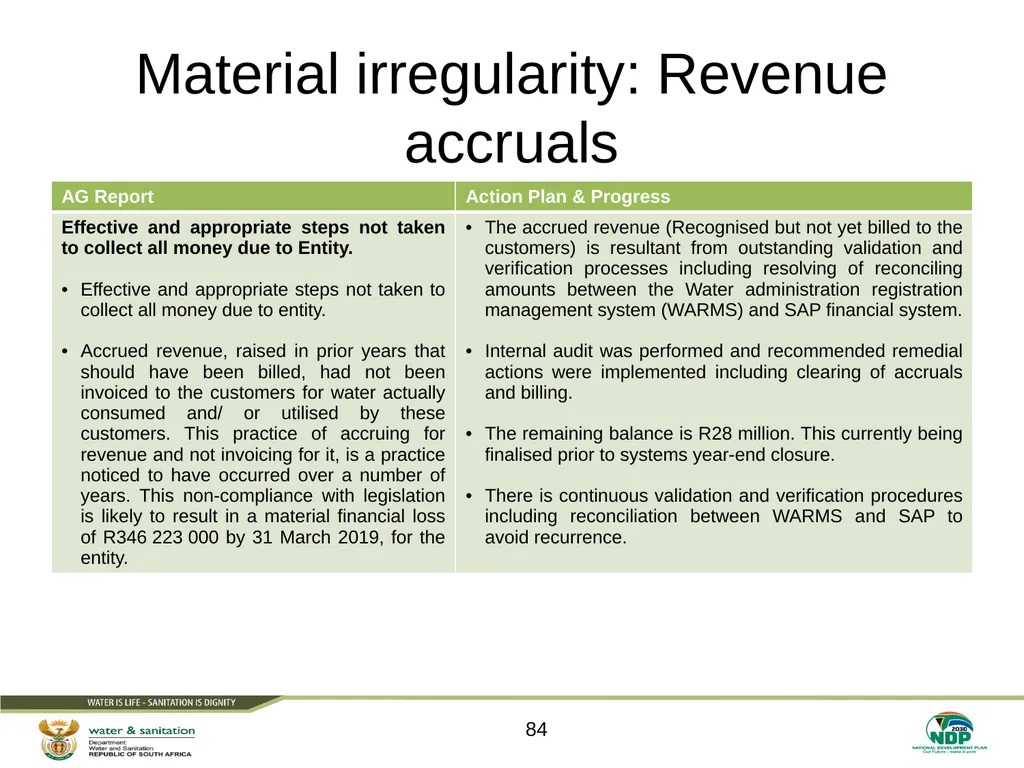
Material irregularity: Revenue accruals 84<br>
85
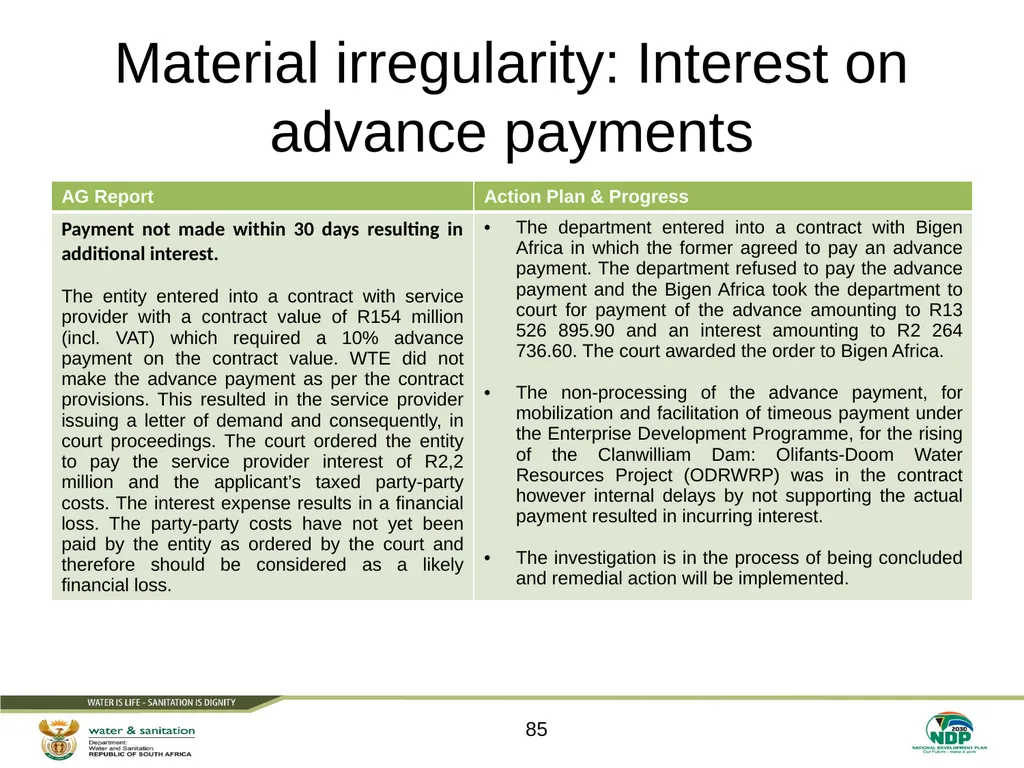
Material irregularity: Interest on advance payments 85<br>
86
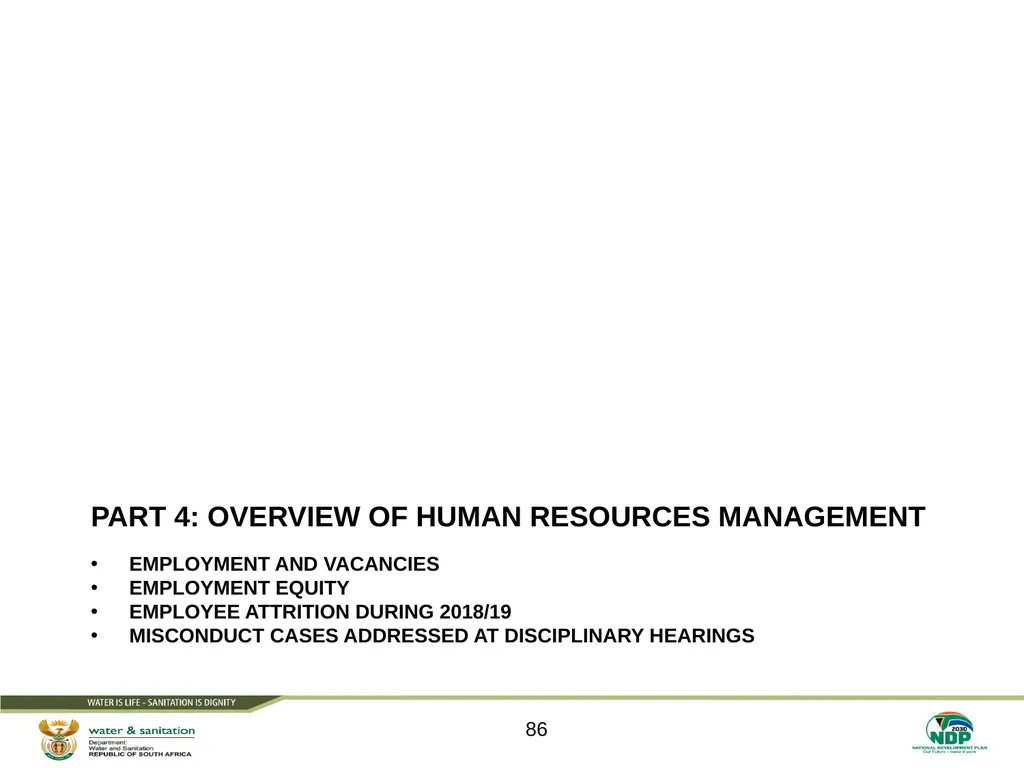
Part 4: overview of human resources management 86 Employment and vacancies
Employment equity
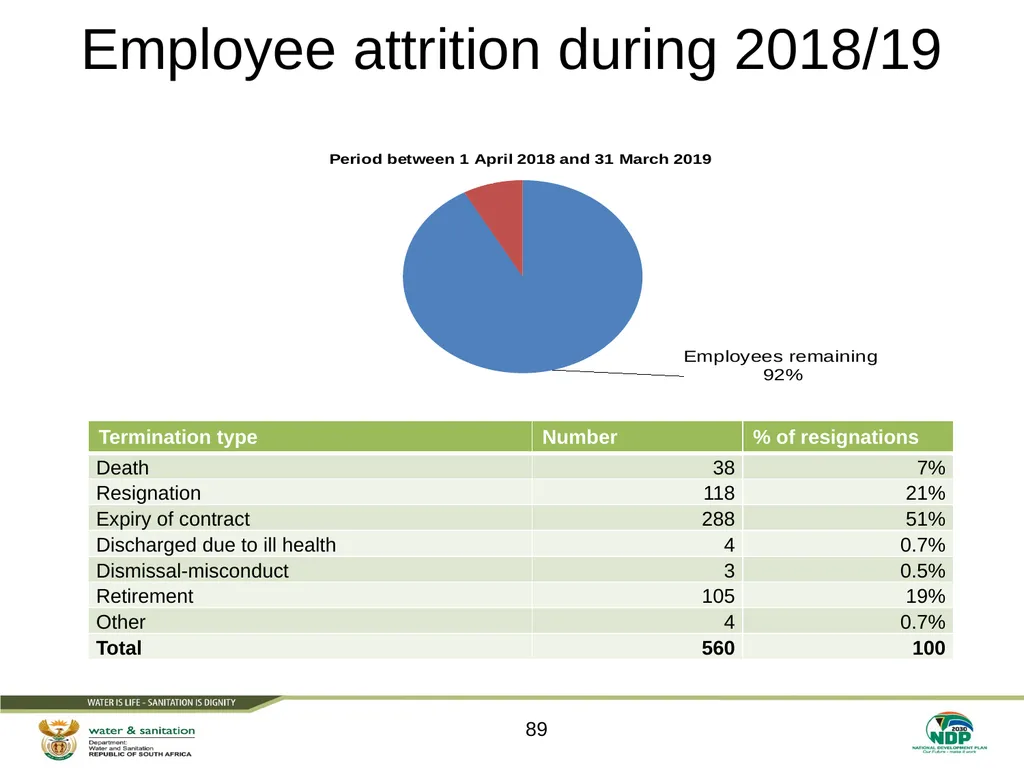
Employee attrition during 2018/19
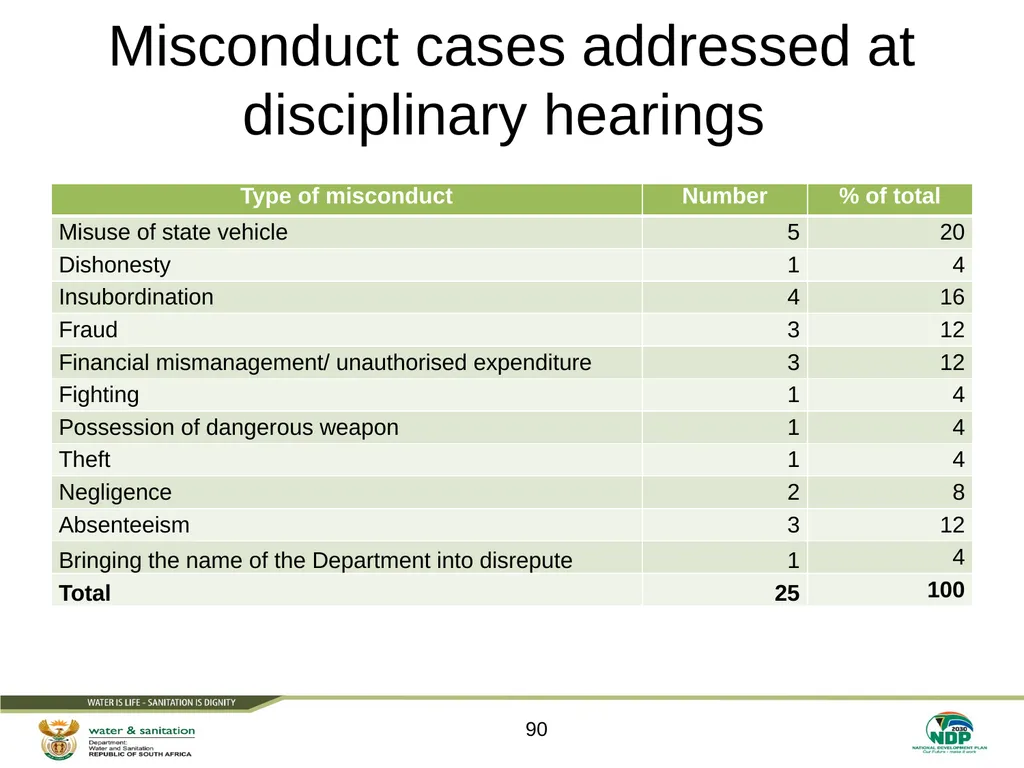
Misconduct cases addressed at disciplinary hearings<br>
Employment equity
Employee attrition during 2018/19
Misconduct cases addressed at disciplinary hearings<br>
87
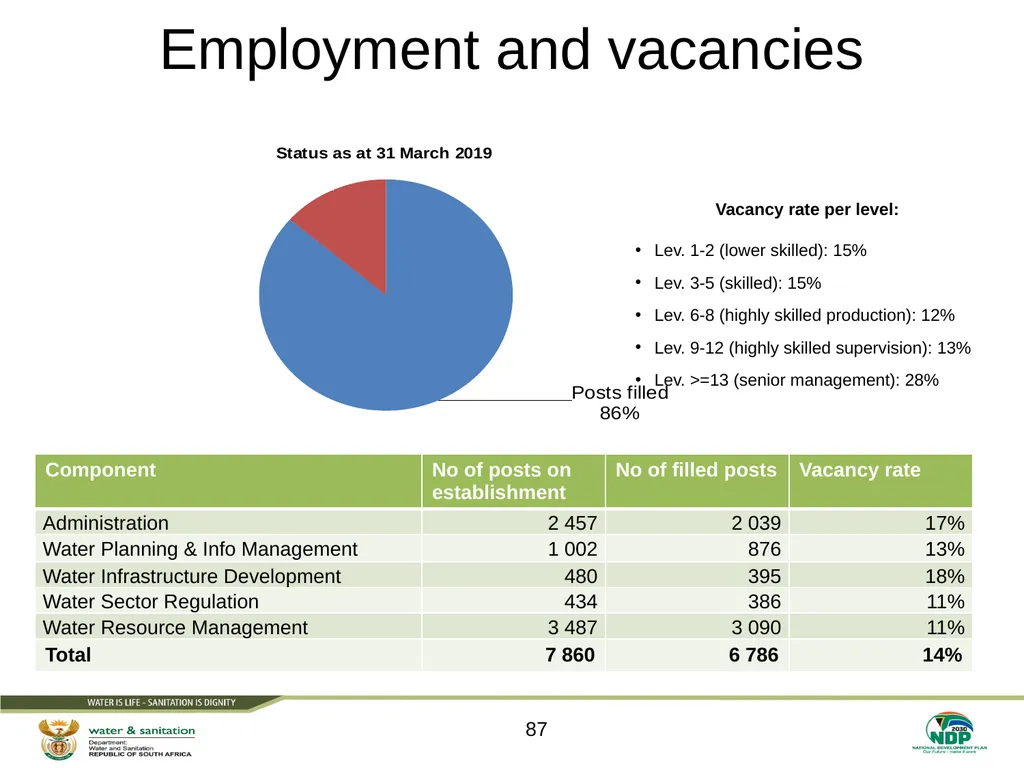
Employment and vacancies 87 Vacancy rate per level:
Lev. 1-2 (lower skilled): 15%
Lev. 3-5 (skilled): 15%
Lev. 6-8 (highly skilled production): 12%
Lev. 9-12 (highly skilled supervision): 13%
Lev. >=13 (senior management): 28%<br>
Lev. 1-2 (lower skilled): 15%
Lev. 3-5 (skilled): 15%
Lev. 6-8 (highly skilled production): 12%
Lev. 9-12 (highly skilled supervision): 13%
Lev. >=13 (senior management): 28%<br>
88
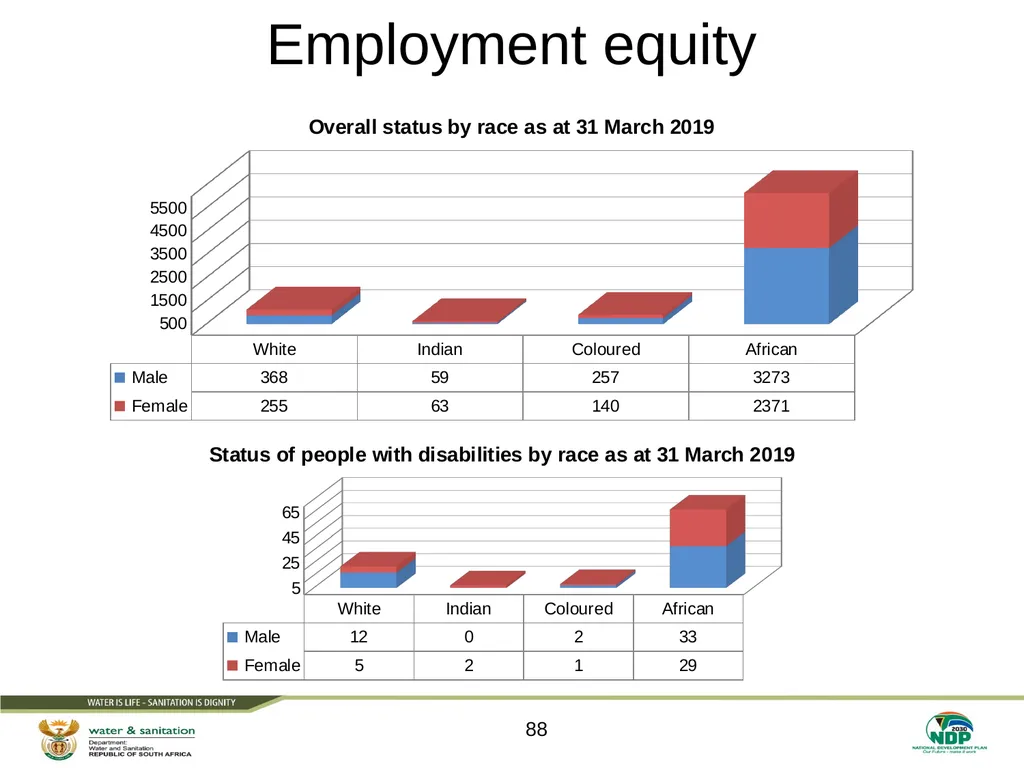
Employment equity 88<br>
89
Employee attrition during 2018/19 89<br>
90
Misconduct cases addressed at disciplinary hearings 90<br>
91
Part 5: feedback on the financial recovery plan 91<br>
92
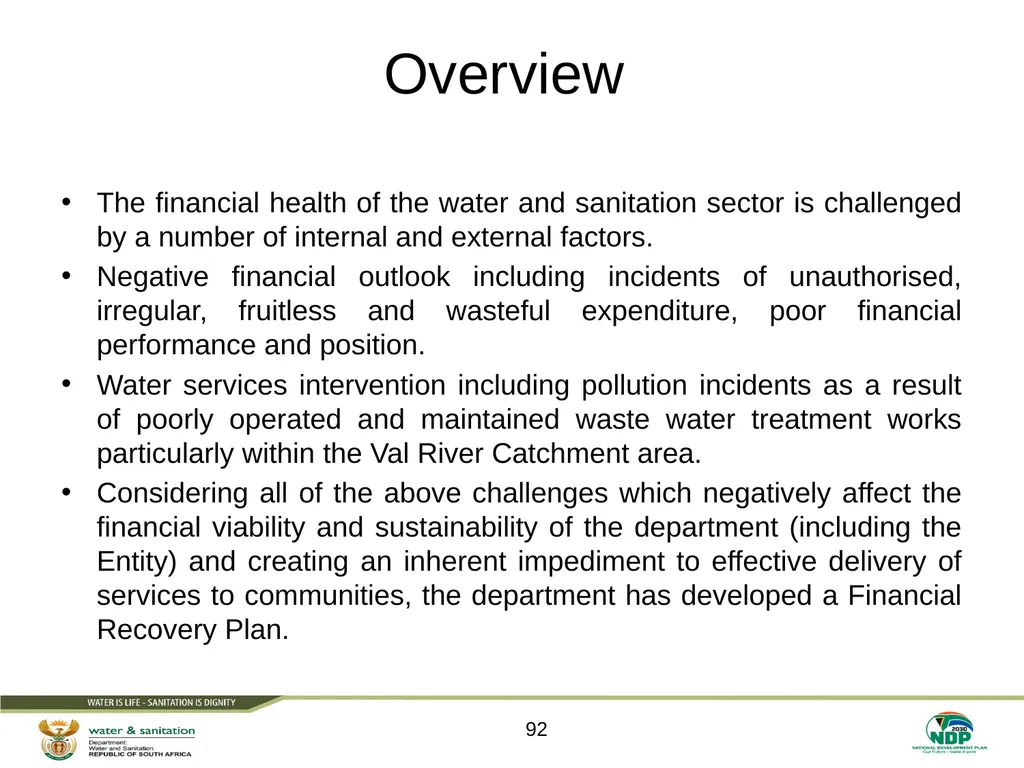
Overview The financial health of the water and sanitation sector is challenged by a number of internal and external factors.
Negative financial outlook including incidents of unauthorised, irregular, fruitless and wasteful expenditure, poor financial performance and position.
Water services intervention including pollution incidents as a result of poorly operated and maintained waste water treatment works particularly within the Val River Catchment area.
Considering all of the above challenges which negatively affect the financial viability and sustainability of the department (including the Entity) and creating an inherent impediment to effective delivery of services to communities, the department has developed a Financial Recovery Plan. 92<br>
Negative financial outlook including incidents of unauthorised, irregular, fruitless and wasteful expenditure, poor financial performance and position.
Water services intervention including pollution incidents as a result of poorly operated and maintained waste water treatment works particularly within the Val River Catchment area.
Considering all of the above challenges which negatively affect the financial viability and sustainability of the department (including the Entity) and creating an inherent impediment to effective delivery of services to communities, the department has developed a Financial Recovery Plan. 92<br>
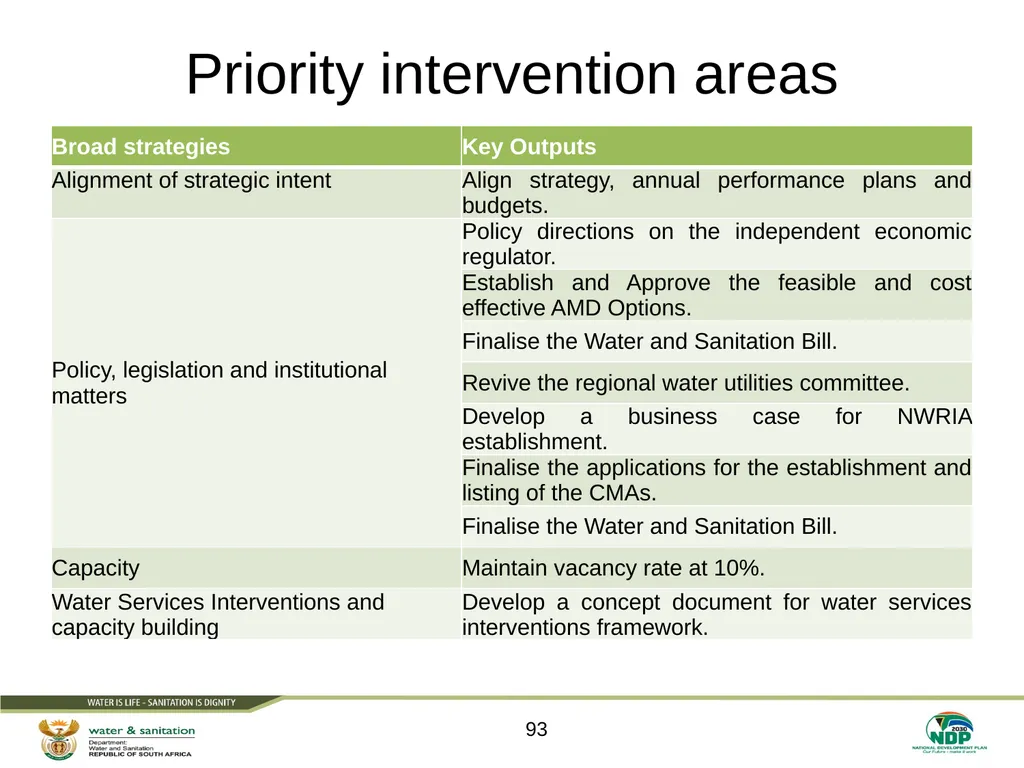
93
Priority intervention areas 93<br>
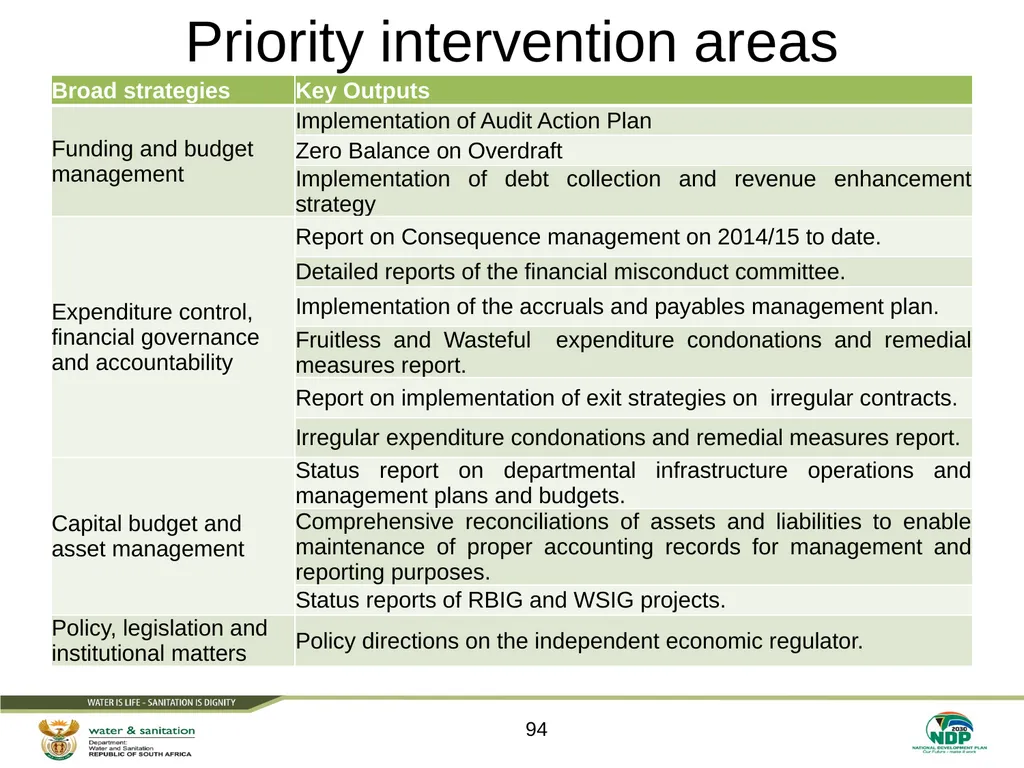
94
Priority intervention areas 94<br>
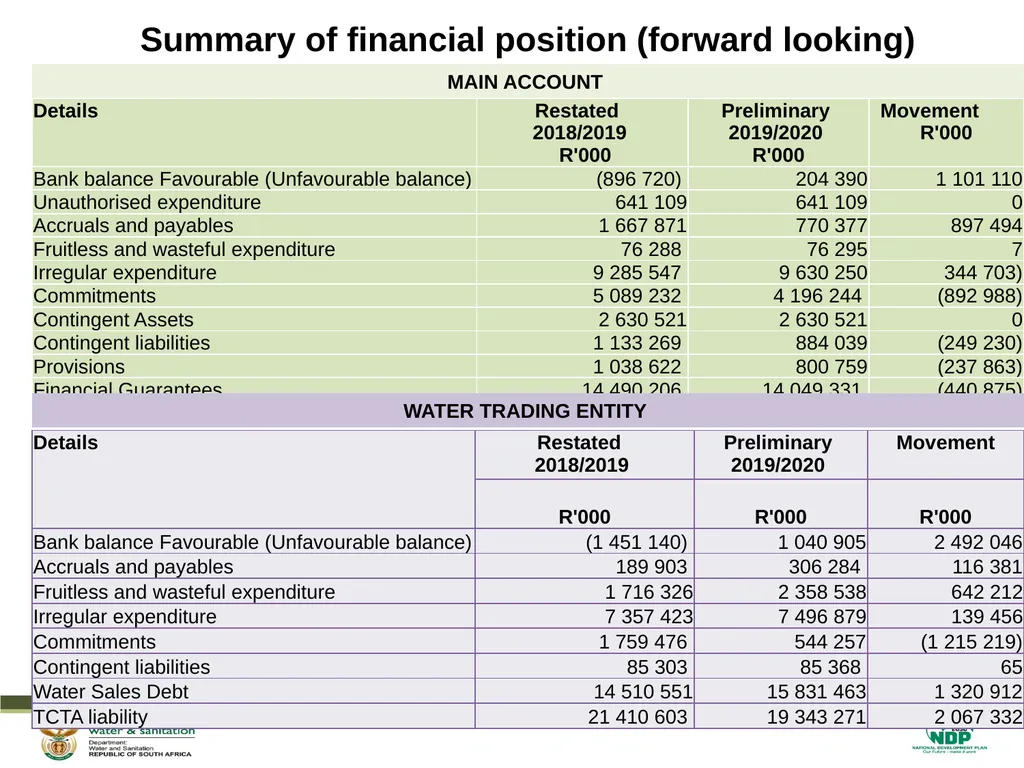
95
95 Summary of financial position (forward looking) MAIN ACCOUNT WATER TRADING ENTITY<br>
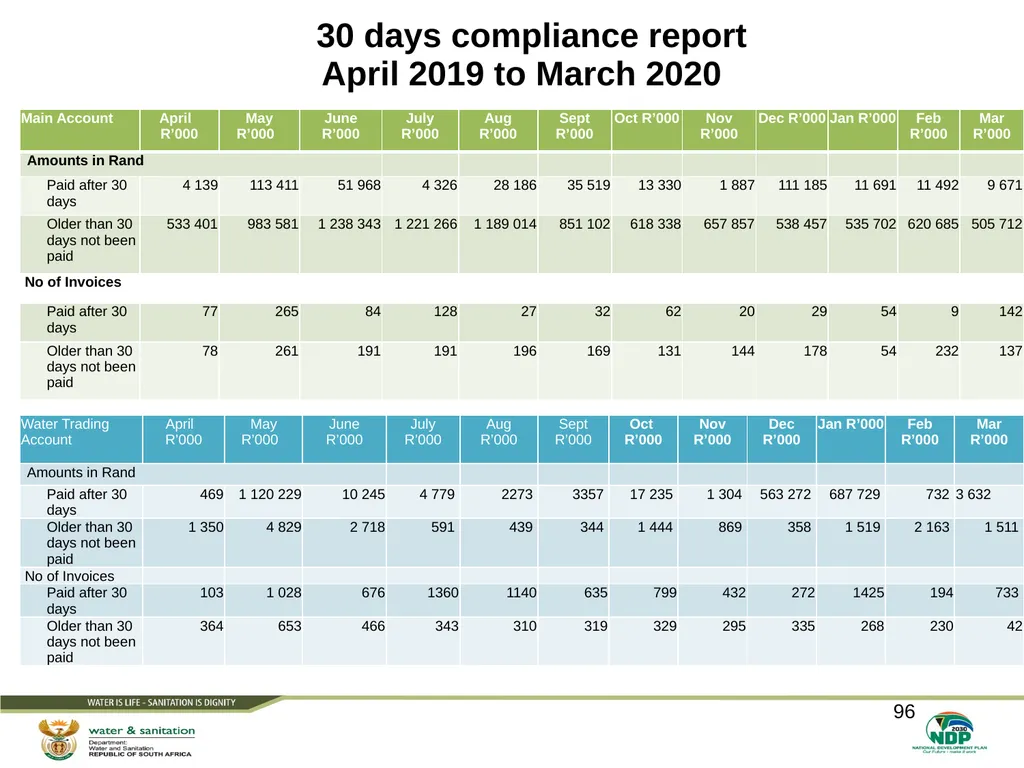
96
30 days compliance report
April 2019 to March 2020 96<br>
97
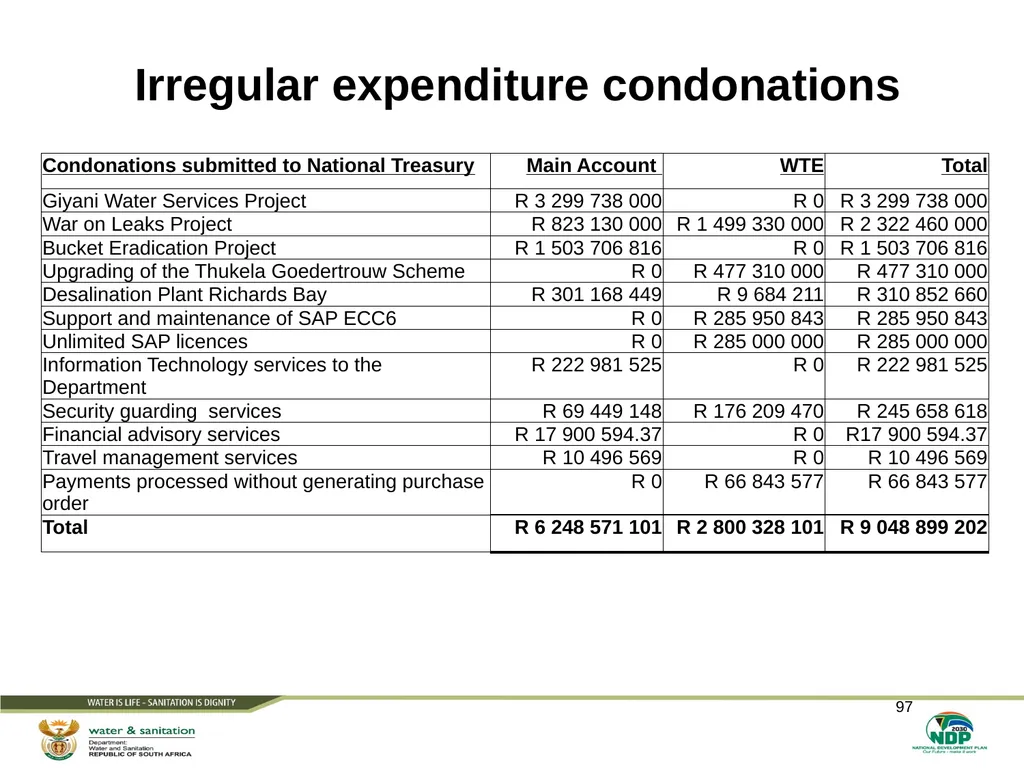
Irregular expenditure condonations 97<br>
98
Trade debtors, billings and recoveries 98<br>
99
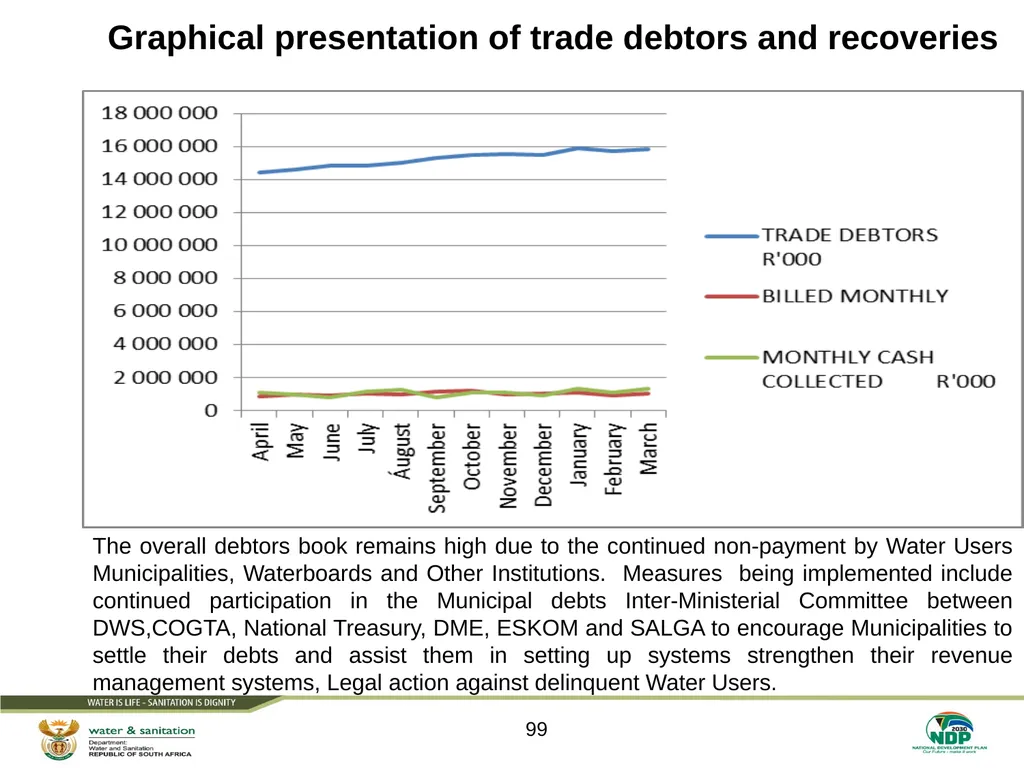
Graphical presentation of trade debtors and recoveries 99 The overall debtors book remains high due to the continued non-payment by Water Users Municipalities, Waterboards and Other Institutions. Measures being implemented include continued participation in the Municipal debts Inter-Ministerial Committee between DWS,COGTA, National Treasury, DME, ESKOM and SALGA to encourage Municipalities to settle their debts and assist them in setting up systems strengthen their revenue management systems, Legal action against delinquent Water Users.<br>
100
Part 6: consequence management 100<br>
101
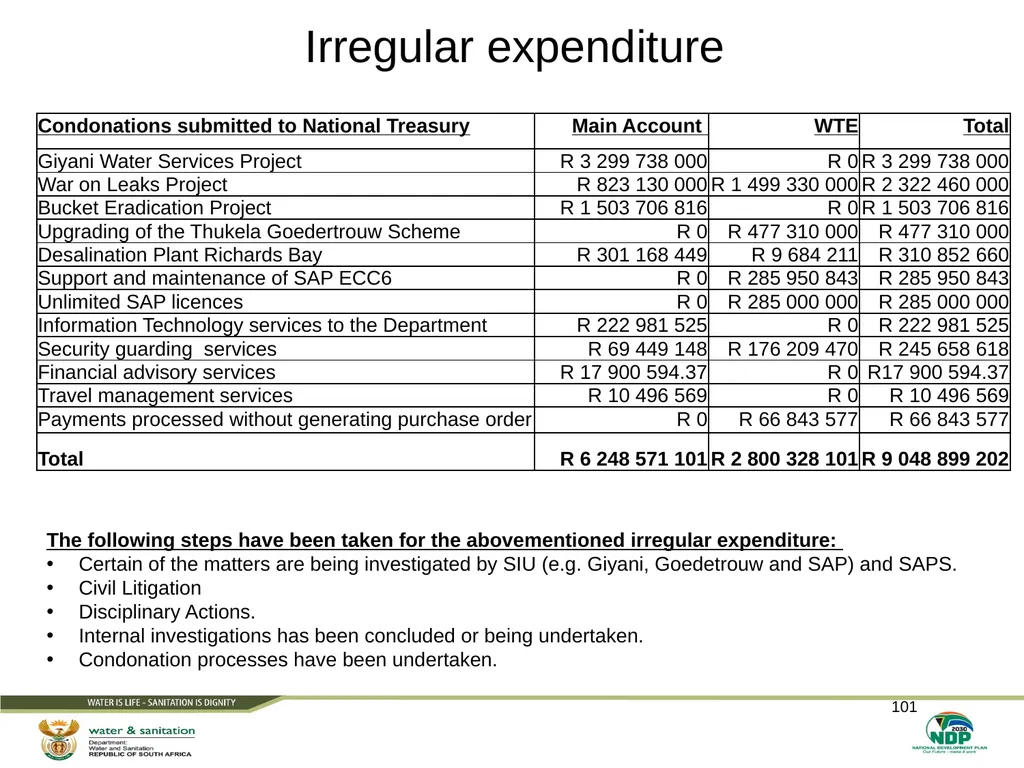
Irregular expenditure 101 The following steps have been taken for the abovementioned irregular expenditure:
Certain of the matters are being investigated by SIU (e.g. Giyani, Goedetrouw and SAP) and SAPS.
Civil Litigation
Disciplinary Actions.
Internal investigations has been concluded or being undertaken.
Condonation processes have been undertaken.<br>
Certain of the matters are being investigated by SIU (e.g. Giyani, Goedetrouw and SAP) and SAPS.
Civil Litigation
Disciplinary Actions.
Internal investigations has been concluded or being undertaken.
Condonation processes have been undertaken.<br>
102
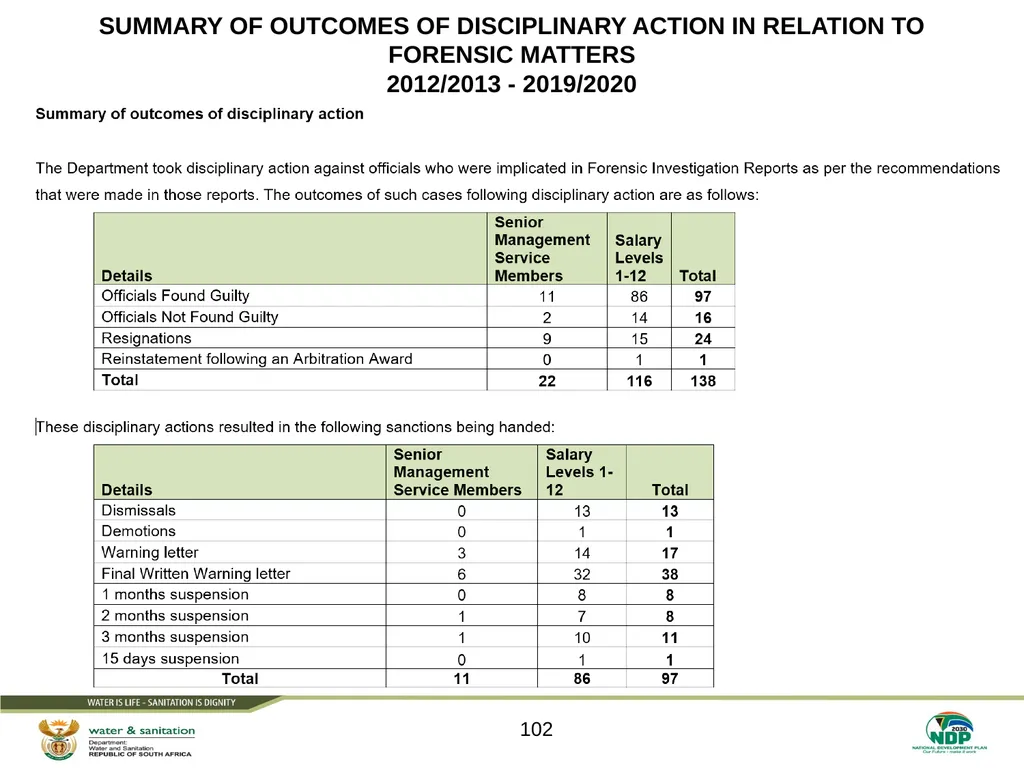
102 SUMMARY OF OUTCOMES OF DISCIPLINARY ACTION IN RELATION TO FORENSIC MATTERS
2012/2013 - 2019/2020<br>
103
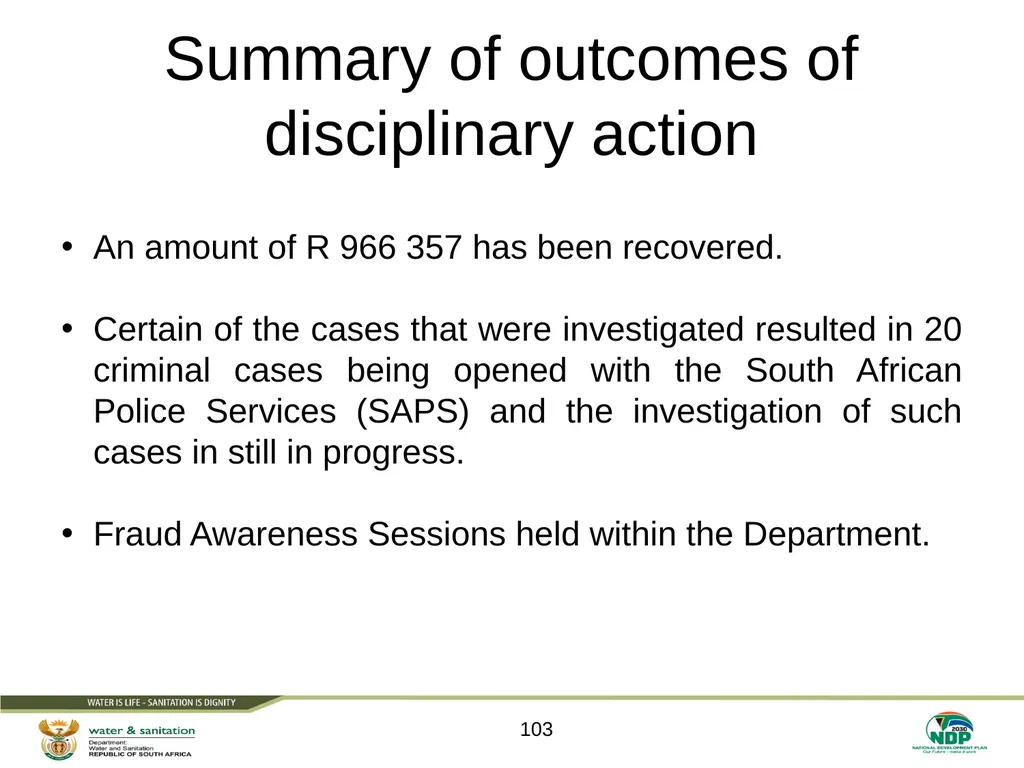
Summary of outcomes of disciplinary action An amount of R 966 357 has been recovered.
Certain of the cases that were investigated resulted in 20 criminal cases being opened with the South African Police Services (SAPS) and the investigation of such cases in still in progress.
Fraud Awareness Sessions held within the Department. 103<br>
Certain of the cases that were investigated resulted in 20 criminal cases being opened with the South African Police Services (SAPS) and the investigation of such cases in still in progress.
Fraud Awareness Sessions held within the Department. 103<br>
104
SIU investigations proclamations 104 The proclamations relating to SIU:
Proclamation No R35 of 2008: Allegations at the Mhlathuze Water Board
Proclamation No R54 of 2012: Various allegations at the Department of Water Affairs
Proclamation No R22 of 2016: The awarding of contracts to LTE Consulting by the Lepelle Northern Water and Gauteng Department of Human Settlements
Proclamation No R27 of 2018 and R44 of 2019: The awarding of a contract by the DWS to SAP (SA)<br>
Proclamation No R35 of 2008: Allegations at the Mhlathuze Water Board
Proclamation No R54 of 2012: Various allegations at the Department of Water Affairs
Proclamation No R22 of 2016: The awarding of contracts to LTE Consulting by the Lepelle Northern Water and Gauteng Department of Human Settlements
Proclamation No R27 of 2018 and R44 of 2019: The awarding of a contract by the DWS to SAP (SA)<br>
105
Thank you 105<br>