
PRESENTATION TITLE Presented by: Name Surname
Description: PRESENTATION TITLE Presented by: Name Surname Designation: Director Directorate: Communication Services Date: 15 April 2019 Water Services Drop Programmes 2023 Reports: Group 4 GoodExcellent Performing Municipalities Facilitated by:
Related Topics
Download Presentation
"PRESENTATION TITLE Presented by: Name Surname" is the property of its rightful owner. Permission is granted to download and print the materials on this website for personal, non-commercial use only, and to display it on your personal computer provided you do not modify the materials and that you retain all copyright notices contained in the materials. By downloading content from our website, you accept the terms of this agreement.
Presentation Transcript
slide1. PRESENTATION TITLE Presented by: Name Surname
Designation: Director
Directorate: Communication Services
Date: 15 April 2019 Water Services Drop Programmes
2023 Reports: Group 4 Good/Excellent Performing Municipalities Facilitated by: Mmakgang Enele
Presented by: Solomon Makate
Designation: Director:DWR
Department: DWS
18 January 2024 Drinking Water (Blue Drop)
Wastewater (Green Drop)
Water Conservation and Demand Management (No Drop) Action plan to address 2023 Blue, Green and No Drop results<br>
slide2. 2 PART A : Summary of key results (1) Introduction
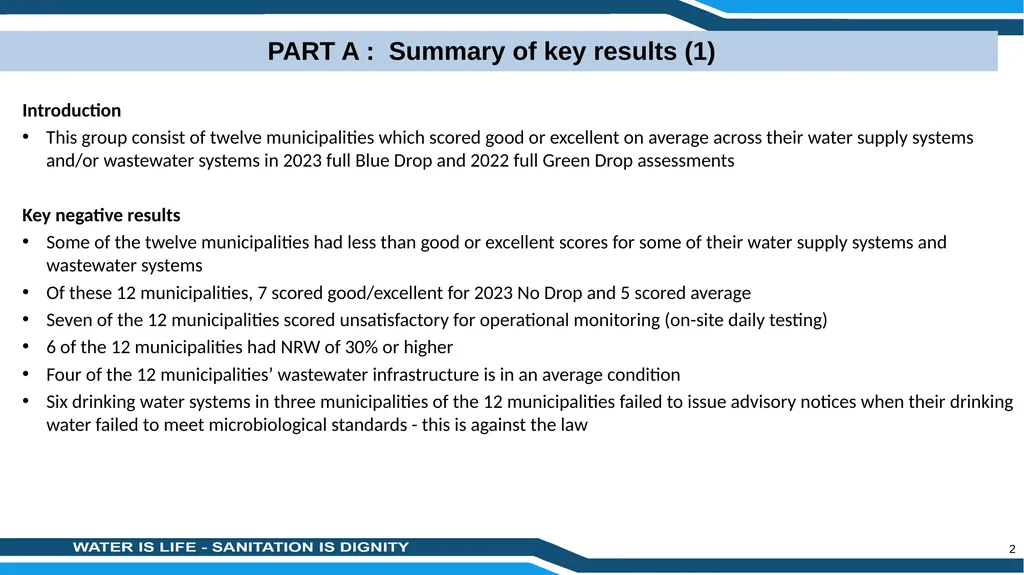
This group consist of twelve municipalities which scored good or excellent on average across their water supply systems and/or wastewater systems in 2023 full Blue Drop and 2022 full Green Drop assessments
Key negative results
Some of the twelve municipalities had less than good or excellent scores for some of their water supply systems and wastewater systems
Of these 12 municipalities, 7 scored good/excellent for 2023 No Drop and 5 scored average
Seven of the 12 municipalities scored unsatisfactory for operational monitoring (on-site daily testing)
6 of the 12 municipalities had NRW of 30% or higher
Four of the 12 municipalities’ wastewater infrastructure is in an average condition
Six drinking water systems in three municipalities of the 12 municipalities failed to issue advisory notices when their drinking water failed to meet microbiological standards - this is against the law<br>
slide3. 3 Summary of key results (2) Key positive results
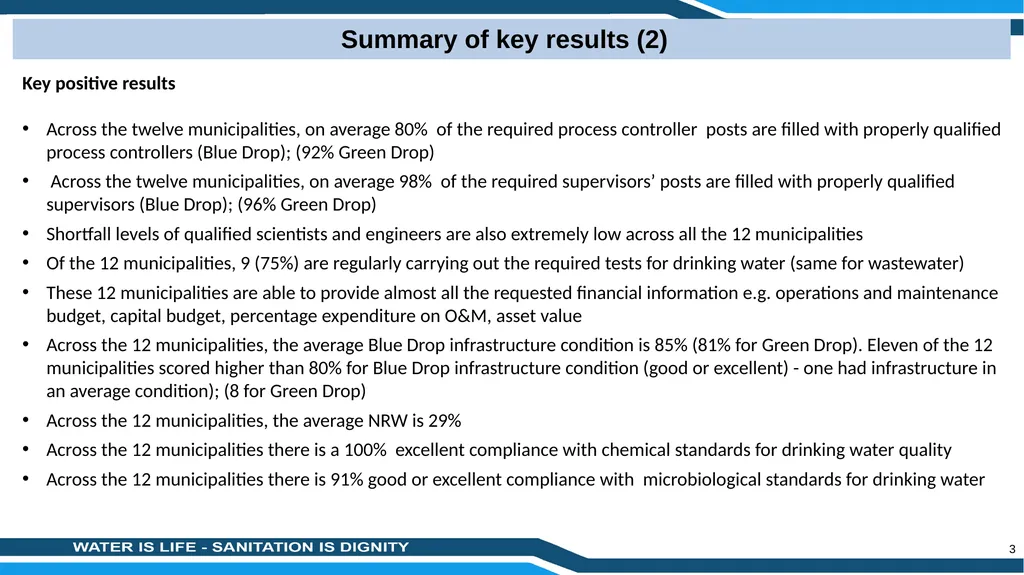
Across the twelve municipalities, on average 80% of the required process controller posts are filled with properly qualified process controllers (Blue Drop); (92% Green Drop)
Across the twelve municipalities, on average 98% of the required supervisors’ posts are filled with properly qualified supervisors (Blue Drop); (96% Green Drop)
Shortfall levels of qualified scientists and engineers are also extremely low across all the 12 municipalities
Of the 12 municipalities, 9 (75%) are regularly carrying out the required tests for drinking water (same for wastewater)
These 12 municipalities are able to provide almost all the requested financial information e.g. operations and maintenance budget, capital budget, percentage expenditure on O&M, asset value
Across the 12 municipalities, the average Blue Drop infrastructure condition is 85% (81% for Green Drop). Eleven of the 12 municipalities scored higher than 80% for Blue Drop infrastructure condition (good or excellent) - one had infrastructure in an average condition); (8 for Green Drop)
Across the 12 municipalities, the average NRW is 29%
Across the 12 municipalities there is a 100% excellent compliance with chemical standards for drinking water quality
Across the 12 municipalities there is 91% good or excellent compliance with microbiological standards for drinking water<br>
slide4. 4 PART B: Analysis of results The results indicate that the best performing municipalities generally:
Have adequate staff with the right qualifications
Keep their infrastructure in a well-maintained condition
Have relatively low NRW, which in turn indicates effective maintenance and management to minimise losses as well as effective billing and revenue collection systems
Have effective compliance and operational monitoring systems, i.e. they carry out required water quality tests and ensure that proper processes are followed
Have effective financial and asset management systems in place and are able to accurately report on their budgets and expenditure and assets
Employ private service providers to assist with Infrastructure Asset Management to align with Green and Blue Drop<br>
slide5. 5 PART B: Analysis of results The results also indicate that the best performing municipalities generally need to improve further in the following areas:
They need to make sure that all their individual systems obtain good or excellent scores
Many of them need to do more to reduce NRW and leaks
Many of the municipalities need to improve their operational monitoring (i.e. ensure that proper treatment process are followed, and necessary tests are done on-site)
Some of the municipalities need to improve condition of their infrastructure particularly wastewater infrastructure
All municipalities must issue advisory notices without fail when their drinking water fails to meet microbiological water standards
Microbiological failures is as a result of chlorine shortage in the country and the risk of having one supplier
Loadshedding contribution on wastewater management and water supply service delivery<br>
slide6. 6 PART C: What is to be done Maintaining good performance and further improvements within the 12 municipalities
Each municipality will develop an action plan for further improvement, addressing inter alia:
The action plans must include putting in place the required management tools to address poor performance in terms of BD, GD and ND (as described in the guidelines by DWS on the IRIS http://ws.dws.gov.za/iris.aspx ),with timeframes, such as Wastewater Risk Abatement Plans and Process Audits
making sure that all their individual systems obtain good or excellent scores
reducing NRW and leaks
improving their operational monitoring (i.e. ensure that proper treatment process are followed, and necessary tests are done on-site)
improving condition of their infrastructure particularly wastewater infrastructure
the action plans must be divided into actions with short, medium and long-term timeframes
the action plans without substantial financial implications must have short timeframes
These action plans must be submitted to the relevant DWS Provincial offices by end February 2024
The municipalities in this group should be embracing and developing new technologies supported by institutions of higher Learning
All municipalities must issue advisory notices without fail when their drinking water fails to meet microbiological water standards<br>
slide7. 7 PART C: What is to be done Support to other municipalities
The 12 municipalities will be open to reasonable requests from less well performing municipalities for knowledge sharing, advice and mentoring, within their available resource constraints
Where appropriate, the municipalities in this group will engage relevant neighboring municipalities and other water users regarding joint catchment-based risk abatement planning to collectively deal with pollution
Utilise IGR platforms to share lessons on best practices e.g Catchment Forums<br>
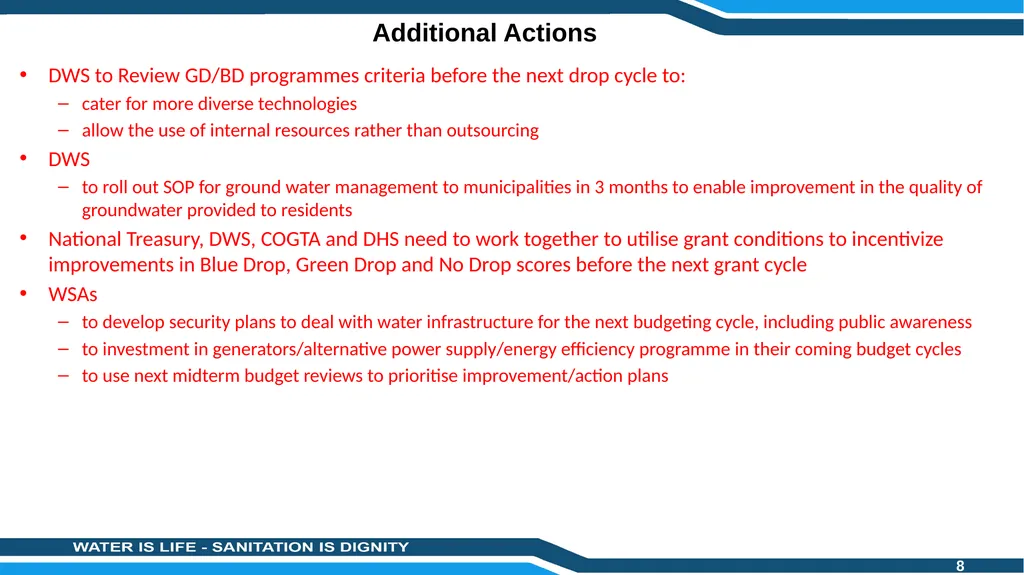
slide8. 8 Additional Actions DWS to Review GD/BD programmes criteria before the next drop cycle to:
cater for more diverse technologies
allow the use of internal resources rather than outsourcing
DWS
to roll out SOP for ground water management to municipalities in 3 months to enable improvement in the quality of groundwater provided to residents
National Treasury, DWS, COGTA and DHS need to work together to utilise grant conditions to incentivize improvements in Blue Drop, Green Drop and No Drop scores before the next grant cycle
WSAs
to develop security plans to deal with water infrastructure for the next budgeting cycle, including public awareness
to investment in generators/alternative power supply/energy efficiency programme in their coming budget cycles
to use next midterm budget reviews to prioritise improvement/action plans<br>
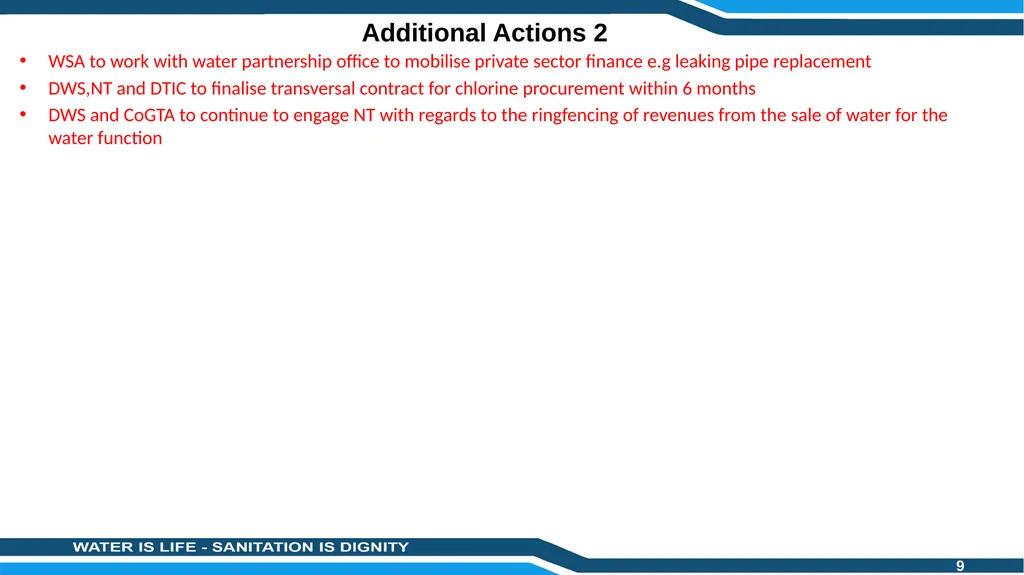
slide9. 9 Additional Actions 2 WSA to work with water partnership office to mobilise private sector finance e.g leaking pipe replacement
DWS,NT and DTIC to finalise transversal contract for chlorine procurement within 6 months
DWS and CoGTA to continue to engage NT with regards to the ringfencing of revenues from the sale of water for the water function<br>
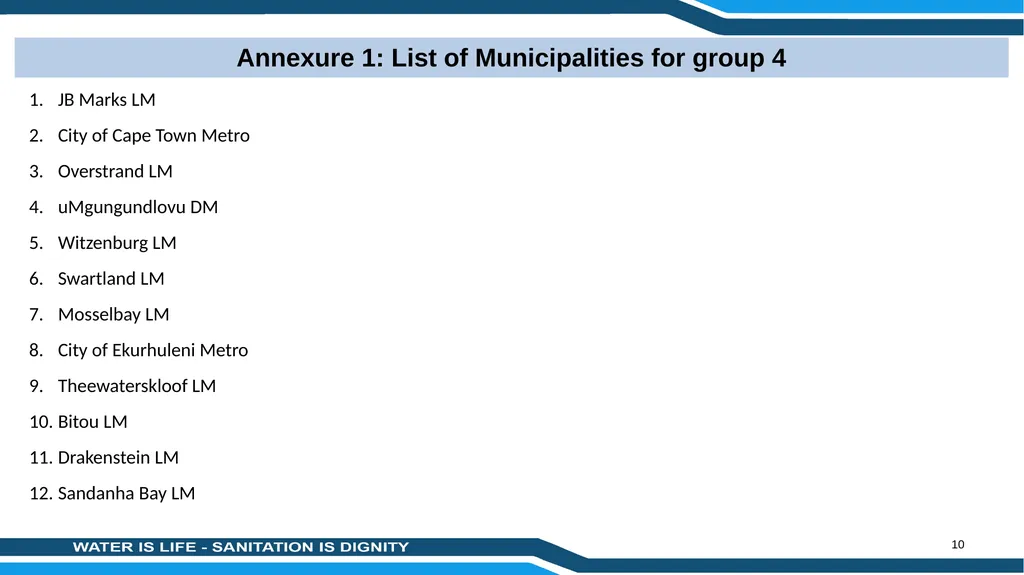
slide10. 10 JB Marks LM
City of Cape Town Metro
Overstrand LM
uMgungundlovu DM
Witzenburg LM
Swartland LM
Mosselbay LM
City of Ekurhuleni Metro
Theewaterskloof LM
Bitou LM
Drakenstein LM
Sandanha Bay LM Annexure 1: List of Municipalities for group 4<br>
Designation: Director
Directorate: Communication Services
Date: 15 April 2019 Water Services Drop Programmes
2023 Reports: Group 4 Good/Excellent Performing Municipalities Facilitated by: Mmakgang Enele
Presented by: Solomon Makate
Designation: Director:DWR
Department: DWS
18 January 2024 Drinking Water (Blue Drop)
Wastewater (Green Drop)
Water Conservation and Demand Management (No Drop) Action plan to address 2023 Blue, Green and No Drop results<br>
slide2. 2 PART A : Summary of key results (1) Introduction
This group consist of twelve municipalities which scored good or excellent on average across their water supply systems and/or wastewater systems in 2023 full Blue Drop and 2022 full Green Drop assessments
Key negative results
Some of the twelve municipalities had less than good or excellent scores for some of their water supply systems and wastewater systems
Of these 12 municipalities, 7 scored good/excellent for 2023 No Drop and 5 scored average
Seven of the 12 municipalities scored unsatisfactory for operational monitoring (on-site daily testing)
6 of the 12 municipalities had NRW of 30% or higher
Four of the 12 municipalities’ wastewater infrastructure is in an average condition
Six drinking water systems in three municipalities of the 12 municipalities failed to issue advisory notices when their drinking water failed to meet microbiological standards - this is against the law<br>
slide3. 3 Summary of key results (2) Key positive results
Across the twelve municipalities, on average 80% of the required process controller posts are filled with properly qualified process controllers (Blue Drop); (92% Green Drop)
Across the twelve municipalities, on average 98% of the required supervisors’ posts are filled with properly qualified supervisors (Blue Drop); (96% Green Drop)
Shortfall levels of qualified scientists and engineers are also extremely low across all the 12 municipalities
Of the 12 municipalities, 9 (75%) are regularly carrying out the required tests for drinking water (same for wastewater)
These 12 municipalities are able to provide almost all the requested financial information e.g. operations and maintenance budget, capital budget, percentage expenditure on O&M, asset value
Across the 12 municipalities, the average Blue Drop infrastructure condition is 85% (81% for Green Drop). Eleven of the 12 municipalities scored higher than 80% for Blue Drop infrastructure condition (good or excellent) - one had infrastructure in an average condition); (8 for Green Drop)
Across the 12 municipalities, the average NRW is 29%
Across the 12 municipalities there is a 100% excellent compliance with chemical standards for drinking water quality
Across the 12 municipalities there is 91% good or excellent compliance with microbiological standards for drinking water<br>
slide4. 4 PART B: Analysis of results The results indicate that the best performing municipalities generally:
Have adequate staff with the right qualifications
Keep their infrastructure in a well-maintained condition
Have relatively low NRW, which in turn indicates effective maintenance and management to minimise losses as well as effective billing and revenue collection systems
Have effective compliance and operational monitoring systems, i.e. they carry out required water quality tests and ensure that proper processes are followed
Have effective financial and asset management systems in place and are able to accurately report on their budgets and expenditure and assets
Employ private service providers to assist with Infrastructure Asset Management to align with Green and Blue Drop<br>
slide5. 5 PART B: Analysis of results The results also indicate that the best performing municipalities generally need to improve further in the following areas:
They need to make sure that all their individual systems obtain good or excellent scores
Many of them need to do more to reduce NRW and leaks
Many of the municipalities need to improve their operational monitoring (i.e. ensure that proper treatment process are followed, and necessary tests are done on-site)
Some of the municipalities need to improve condition of their infrastructure particularly wastewater infrastructure
All municipalities must issue advisory notices without fail when their drinking water fails to meet microbiological water standards
Microbiological failures is as a result of chlorine shortage in the country and the risk of having one supplier
Loadshedding contribution on wastewater management and water supply service delivery<br>
slide6. 6 PART C: What is to be done Maintaining good performance and further improvements within the 12 municipalities
Each municipality will develop an action plan for further improvement, addressing inter alia:
The action plans must include putting in place the required management tools to address poor performance in terms of BD, GD and ND (as described in the guidelines by DWS on the IRIS http://ws.dws.gov.za/iris.aspx ),with timeframes, such as Wastewater Risk Abatement Plans and Process Audits
making sure that all their individual systems obtain good or excellent scores
reducing NRW and leaks
improving their operational monitoring (i.e. ensure that proper treatment process are followed, and necessary tests are done on-site)
improving condition of their infrastructure particularly wastewater infrastructure
the action plans must be divided into actions with short, medium and long-term timeframes
the action plans without substantial financial implications must have short timeframes
These action plans must be submitted to the relevant DWS Provincial offices by end February 2024
The municipalities in this group should be embracing and developing new technologies supported by institutions of higher Learning
All municipalities must issue advisory notices without fail when their drinking water fails to meet microbiological water standards<br>
slide7. 7 PART C: What is to be done Support to other municipalities
The 12 municipalities will be open to reasonable requests from less well performing municipalities for knowledge sharing, advice and mentoring, within their available resource constraints
Where appropriate, the municipalities in this group will engage relevant neighboring municipalities and other water users regarding joint catchment-based risk abatement planning to collectively deal with pollution
Utilise IGR platforms to share lessons on best practices e.g Catchment Forums<br>
slide8. 8 Additional Actions DWS to Review GD/BD programmes criteria before the next drop cycle to:
cater for more diverse technologies
allow the use of internal resources rather than outsourcing
DWS
to roll out SOP for ground water management to municipalities in 3 months to enable improvement in the quality of groundwater provided to residents
National Treasury, DWS, COGTA and DHS need to work together to utilise grant conditions to incentivize improvements in Blue Drop, Green Drop and No Drop scores before the next grant cycle
WSAs
to develop security plans to deal with water infrastructure for the next budgeting cycle, including public awareness
to investment in generators/alternative power supply/energy efficiency programme in their coming budget cycles
to use next midterm budget reviews to prioritise improvement/action plans<br>
slide9. 9 Additional Actions 2 WSA to work with water partnership office to mobilise private sector finance e.g leaking pipe replacement
DWS,NT and DTIC to finalise transversal contract for chlorine procurement within 6 months
DWS and CoGTA to continue to engage NT with regards to the ringfencing of revenues from the sale of water for the water function<br>
slide10. 10 JB Marks LM
City of Cape Town Metro
Overstrand LM
uMgungundlovu DM
Witzenburg LM
Swartland LM
Mosselbay LM
City of Ekurhuleni Metro
Theewaterskloof LM
Bitou LM
Drakenstein LM
Sandanha Bay LM Annexure 1: List of Municipalities for group 4<br>