
Presentation to Expert Appraisal Committee (EAC)
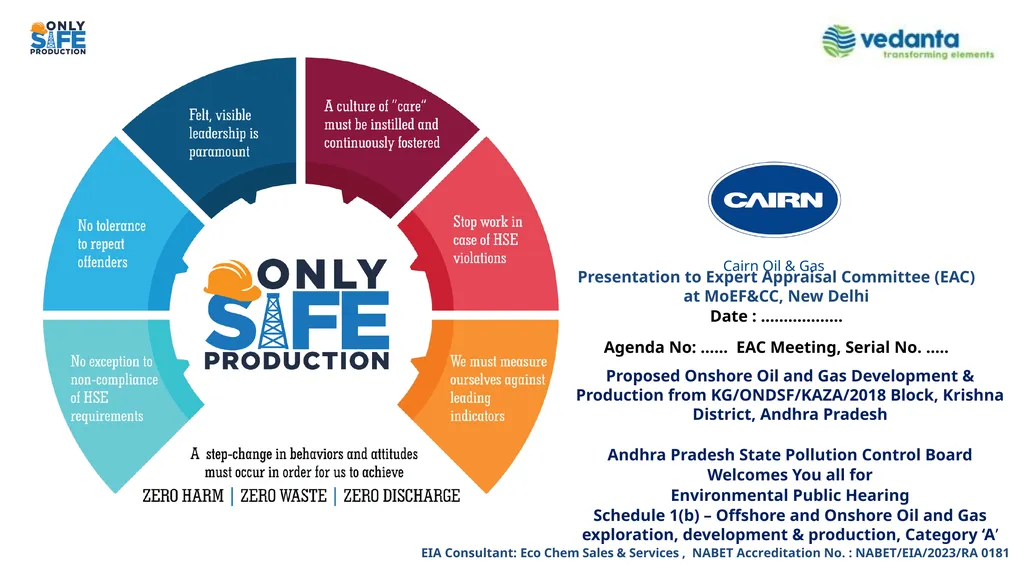
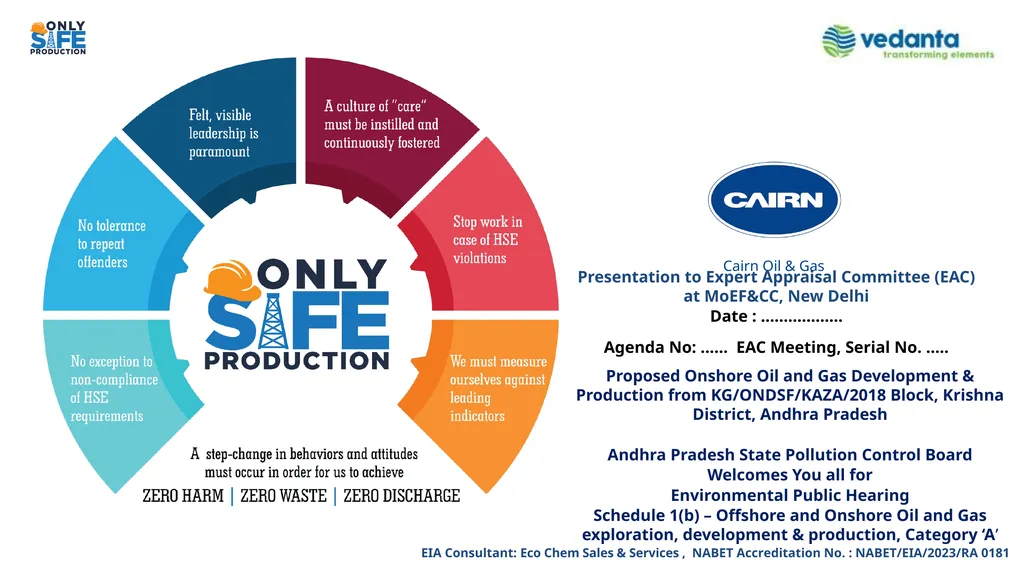

Description: Presentation to Expert Appraisal Committee (EAC) at MoEFCC, New Delhi Date : Agenda No: EAC Meeting, Serial No. .. EIA Consultant: Eco Chem Sales Services , NABET Accreditation No. : NABETEIA2023RA 0181 Proposed Onshore Oil
Related Topics
Download Presentation
"Presentation to Expert Appraisal Committee (EAC)" is the property of its rightful owner. Permission is granted to download and print the materials on this website for personal, non-commercial use only, and to display it on your personal computer provided you do not modify the materials and that you retain all copyright notices contained in the materials. By downloading content from our website, you accept the terms of this agreement.
Presentation Transcript
slide1. Presentation to Expert Appraisal Committee (EAC) at MoEF&CC, New Delhi
Date : ………………
Agenda No: …… EAC Meeting, Serial No. ….. EIA Consultant: Eco Chem Sales & Services , NABET Accreditation No. : NABET/EIA/2023/RA 0181 Proposed Onshore Oil and Gas Development & Production from KG/ONDSF/KAZA/2018 Block, Krishna District, Andhra Pradesh
Andhra Pradesh State Pollution Control Board
Welcomes You all for
Environmental Public Hearing
Schedule 1(b) – Offshore and Onshore Oil and Gas exploration, development & production, Category ‘A’<br>
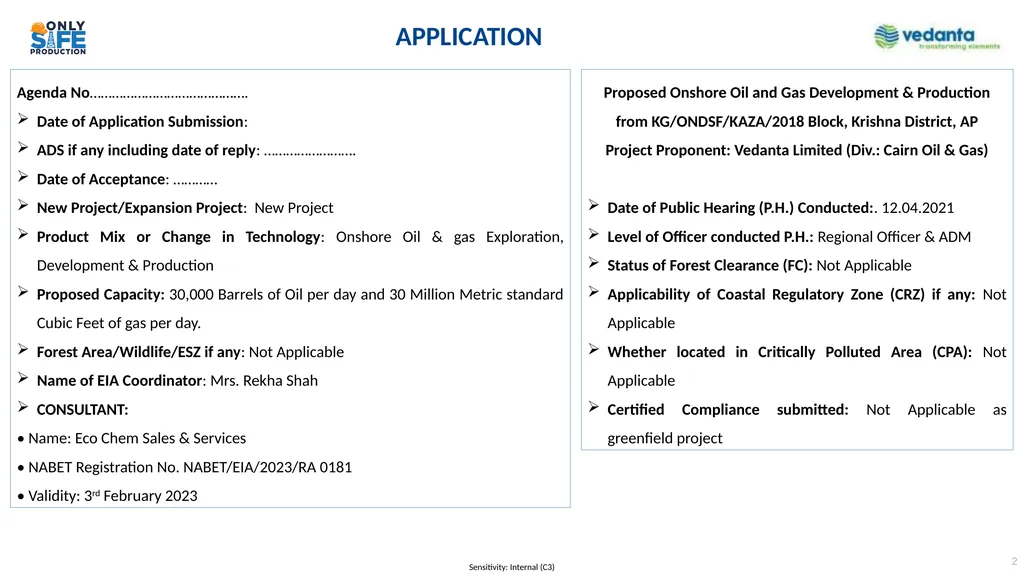
slide2. APPLICATION 2 Agenda No…………………………………….
Date of Application Submission:
ADS if any including date of reply: …………………….
Date of Acceptance: …………
New Project/Expansion Project: New Project
Product Mix or Change in Technology: Onshore Oil & gas Exploration, Development & Production
Proposed Capacity: 30,000 Barrels of Oil per day and 30 Million Metric standard Cubic Feet of gas per day.
Forest Area/Wildlife/ESZ if any: Not Applicable
Name of EIA Coordinator: Mrs. Rekha Shah
CONSULTANT:
• Name: Eco Chem Sales & Services
• NABET Registration No. NABET/EIA/2023/RA 0181
• Validity: 3rd February 2023 Proposed Onshore Oil and Gas Development & Production from KG/ONDSF/KAZA/2018 Block, Krishna District, AP
Project Proponent: Vedanta Limited (Div.: Cairn Oil & Gas)
Date of Public Hearing (P.H.) Conducted:. 12.04.2021
Level of Officer conducted P.H.: Regional Officer & ADM
Status of Forest Clearance (FC): Not Applicable
Applicability of Coastal Regulatory Zone (CRZ) if any: Not Applicable
Whether located in Critically Polluted Area (CPA): Not Applicable
Certified Compliance submitted: Not Applicable as greenfield project<br>
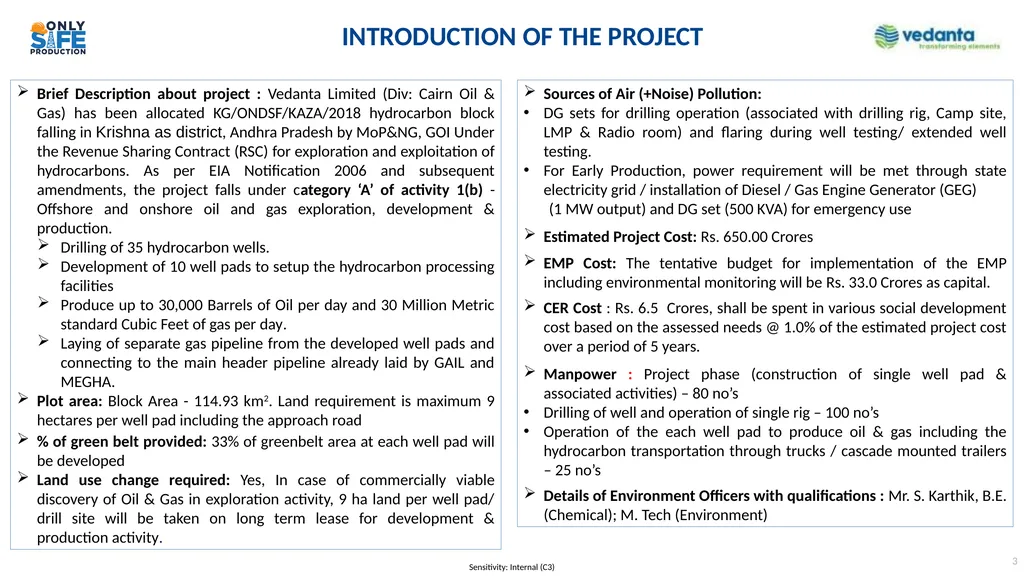
slide3. INTRODUCTION OF THE PROJECT 3 Brief Description about project : Vedanta Limited (Div: Cairn Oil & Gas) has been allocated KG/ONDSF/KAZA/2018 hydrocarbon block falling in Krishna as district, Andhra Pradesh by MoP&NG, GOI Under the Revenue Sharing Contract (RSC) for exploration and exploitation of hydrocarbons. As per EIA Notification 2006 and subsequent amendments, the project falls under category ‘A’ of activity 1(b) - Offshore and onshore oil and gas exploration, development & production.
Drilling of 35 hydrocarbon wells.
Development of 10 well pads to setup the hydrocarbon processing facilities
Produce up to 30,000 Barrels of Oil per day and 30 Million Metric standard Cubic Feet of gas per day.
Laying of separate gas pipeline from the developed well pads and connecting to the main header pipeline already laid by GAIL and MEGHA.
Plot area: Block Area - 114.93 km2. Land requirement is maximum 9 hectares per well pad including the approach road
% of green belt provided: 33% of greenbelt area at each well pad will be developed
Land use change required: Yes, In case of commercially viable discovery of Oil & Gas in exploration activity, 9 ha land per well pad/ drill site will be taken on long term lease for development & production activity. Sources of Air (+Noise) Pollution:
DG sets for drilling operation (associated with drilling rig, Camp site, LMP & Radio room) and flaring during well testing/ extended well testing.
For Early Production, power requirement will be met through state electricity grid / installation of Diesel / Gas Engine Generator (GEG)
(1 MW output) and DG set (500 KVA) for emergency use
Estimated Project Cost: Rs. 650.00 Crores
EMP Cost: The tentative budget for implementation of the EMP including environmental monitoring will be Rs. 33.0 Crores as capital.
CER Cost : Rs. 6.5 Crores, shall be spent in various social development cost based on the assessed needs @ 1.0% of the estimated project cost over a period of 5 years.
Manpower : Project phase (construction of single well pad & associated activities) – 80 no’s
Drilling of well and operation of single rig – 100 no’s
Operation of the each well pad to produce oil & gas including the hydrocarbon transportation through trucks / cascade mounted trailers – 25 no’s
Details of Environment Officers with qualifications : Mr. S. Karthik, B.E. (Chemical); M. Tech (Environment)<br>
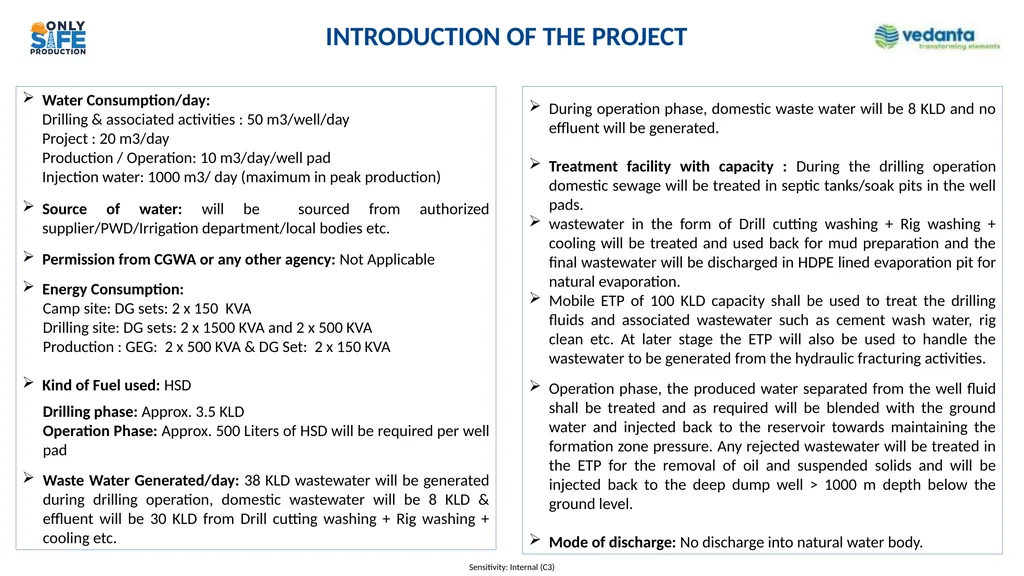
slide4. Water Consumption/day:
Drilling & associated activities : 50 m3/well/day
Project : 20 m3/day
Production / Operation: 10 m3/day/well pad
Injection water: 1000 m3/ day (maximum in peak production)
Source of water: will be sourced from authorized supplier/PWD/Irrigation department/local bodies etc.
Permission from CGWA or any other agency: Not Applicable
Energy Consumption:
Camp site: DG sets: 2 x 150 KVA
Drilling site: DG sets: 2 x 1500 KVA and 2 x 500 KVA
Production : GEG: 2 x 500 KVA & DG Set: 2 x 150 KVA
Kind of Fuel used: HSD
Drilling phase: Approx. 3.5 KLD
Operation Phase: Approx. 500 Liters of HSD will be required per well pad
Waste Water Generated/day: 38 KLD wastewater will be generated during drilling operation, domestic wastewater will be 8 KLD & effluent will be 30 KLD from Drill cutting washing + Rig washing + cooling etc. During operation phase, domestic waste water will be 8 KLD and no effluent will be generated.
Treatment facility with capacity : During the drilling operation domestic sewage will be treated in septic tanks/soak pits in the well pads.
wastewater in the form of Drill cutting washing + Rig washing + cooling will be treated and used back for mud preparation and the final wastewater will be discharged in HDPE lined evaporation pit for natural evaporation.
Mobile ETP of 100 KLD capacity shall be used to treat the drilling fluids and associated wastewater such as cement wash water, rig clean etc. At later stage the ETP will also be used to handle the wastewater to be generated from the hydraulic fracturing activities.
Operation phase, the produced water separated from the well fluid shall be treated and as required will be blended with the ground water and injected back to the reservoir towards maintaining the formation zone pressure. Any rejected wastewater will be treated in the ETP for the removal of oil and suspended solids and will be injected back to the deep dump well > 1000 m depth below the ground level.
Mode of discharge: No discharge into natural water body. INTRODUCTION OF THE PROJECT<br>
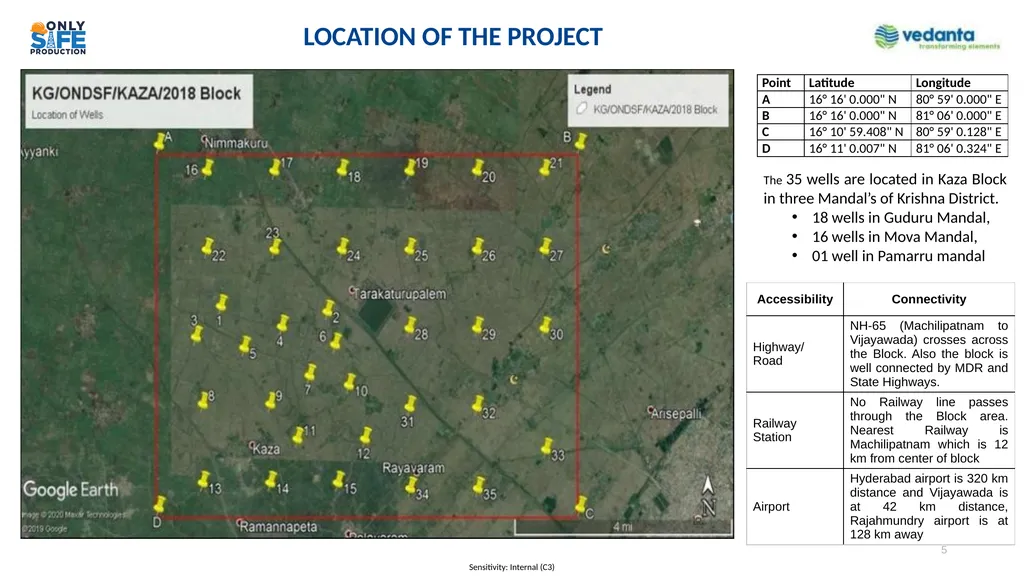
slide5. 5 LOCATION OF THE PROJECT The 35 wells are located in Kaza Block in three Mandal’s of Krishna District.
18 wells in Guduru Mandal,
16 wells in Mova Mandal,
01 well in Pamarru mandal<br>
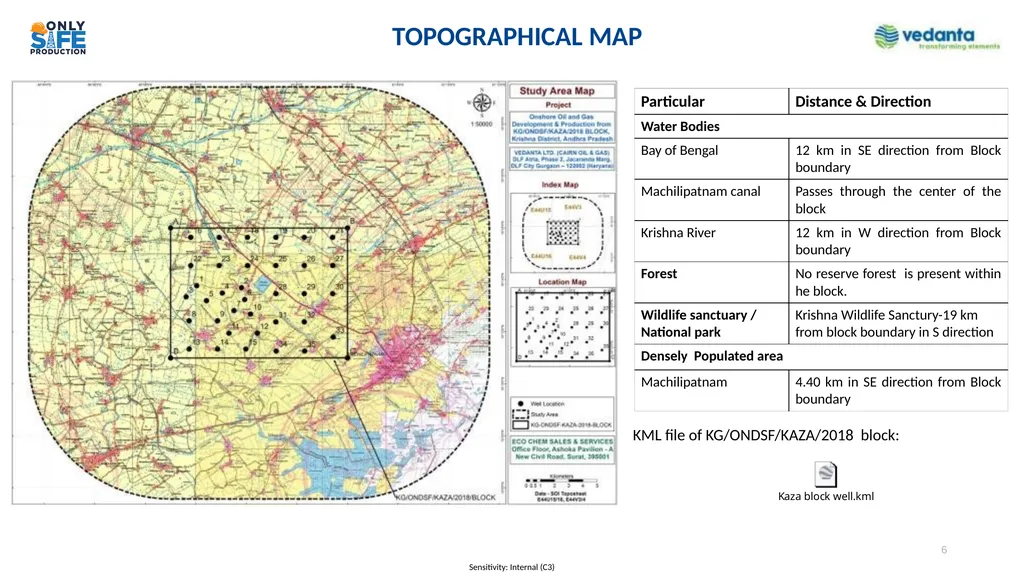
slide6. 6 TOPOGRAPHICAL MAP KML file of KG/ONDSF/KAZA/2018 block:<br>
slide7. 7 Product Details:
Drilling of 35 hydrocarbon wells.
Development of 10 well pads to setup the hydrocarbon processing facilities
Produce up to 30,000 Barrels of Oil per day and 30 Million Metric standard Cubic Feet of gas per day.
Laying of separate gas pipeline from the developed well pads and connecting to the main header pipeline already laid by GAIL and MEGHA.
Well Design:
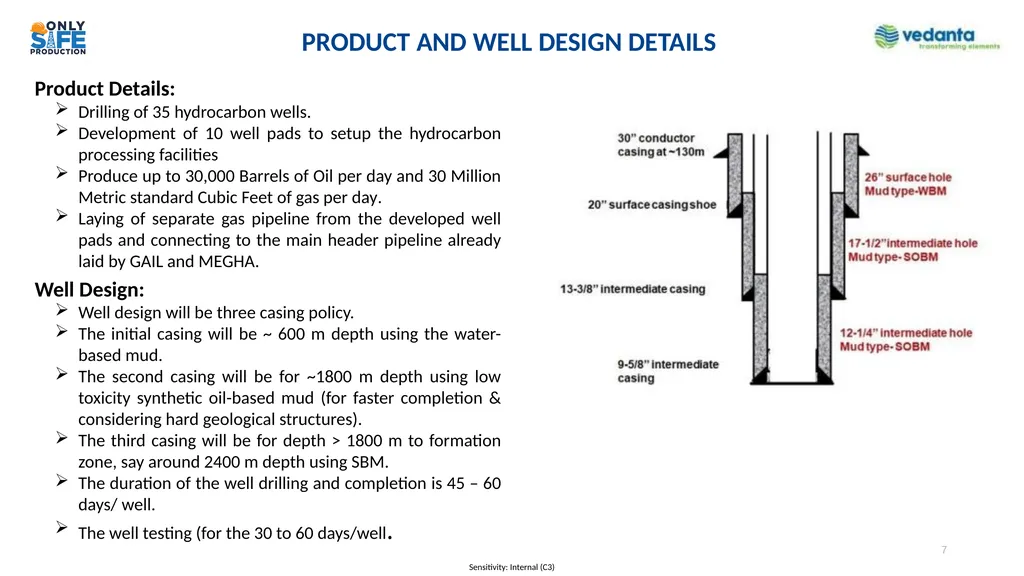
Well design will be three casing policy.
The initial casing will be ~ 600 m depth using the water-based mud.
The second casing will be for ~1800 m depth using low toxicity synthetic oil-based mud (for faster completion & considering hard geological structures).
The third casing will be for depth > 1800 m to formation zone, say around 2400 m depth using SBM.
The duration of the well drilling and completion is 45 – 60 days/ well.
The well testing (for the 30 to 60 days/well. PRODUCT AND WELL DESIGN DETAILS<br>
slide8. 8 SELECTION OF LAND FOR SETTING UP WELL PAD Initially 300 m X 300 m (9 hectares) would be taken on temporary lease basis for the construction of well pad (drill site) for drilling of the wells.
If any land site is sensitive/human settlement is there etc., those areas will be avoided and nearby lands suitable to the operation can be leased out
Based on successful oil & gas discovery, permanent land possession is required.
Maximum 10 well pads will be in operation at Kaza block i.e., 90 hectares land required in small parcels at various locations within Kaza block area.
The 30m width access roads will be required to connect the well pads, laying pipeline, overhead line and other utilities. This road will be acquired in the combination of permanent possession and RoU (Right of Usage).
The existing roads will be strengthened by Cairn, if used for heavy vehicular movements.
Land lease amount and related compensation will be paid based on Government approved rates, in consultation with both District Authorities and the Landowners.
The return of the land after the lease period will be handed over after proper restoration of the land.
The restoration will include complete cleanup of the land, restoring by improving the fertility of the soil, ensuring no contamination to the soil, ground water etc., and the hydrocarbon wells shall be plugged and abandon as per OISD standards.<br>
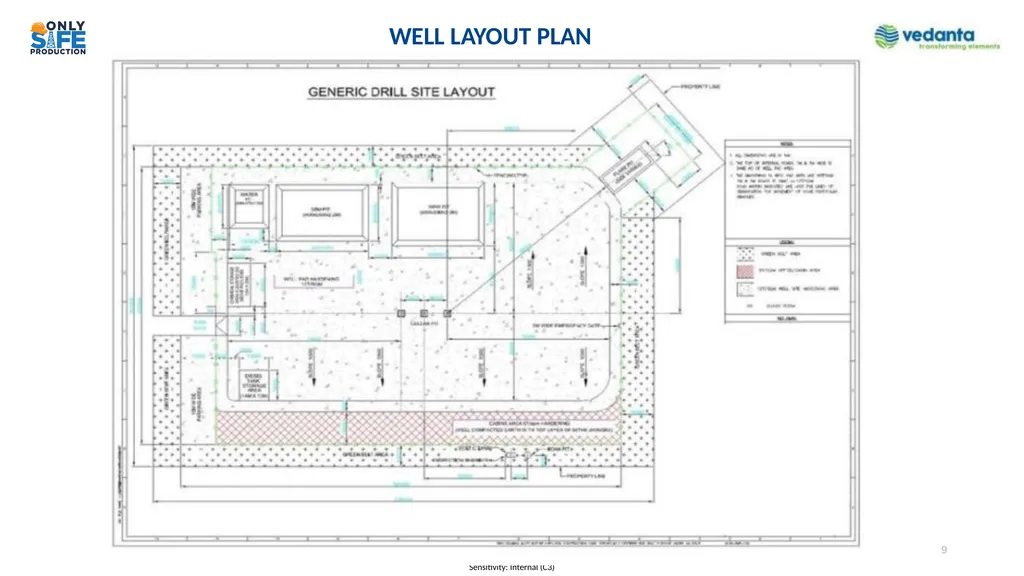
slide9. 9 WELL LAYOUT PLAN<br>
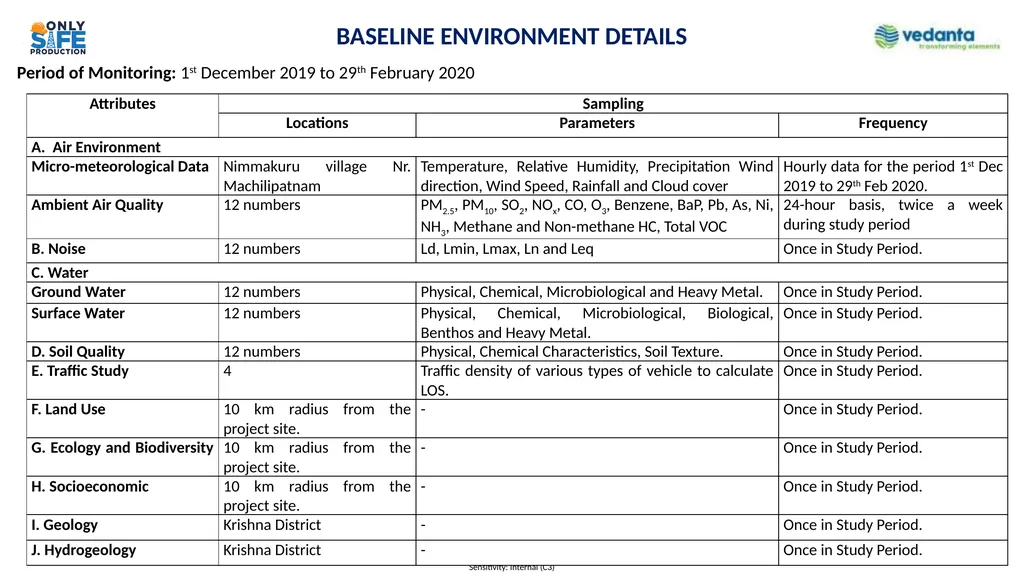
slide10. 10 BASELINE ENVIRONMENT DETAILS Period of Monitoring: 1st December 2019 to 29th February 2020<br>
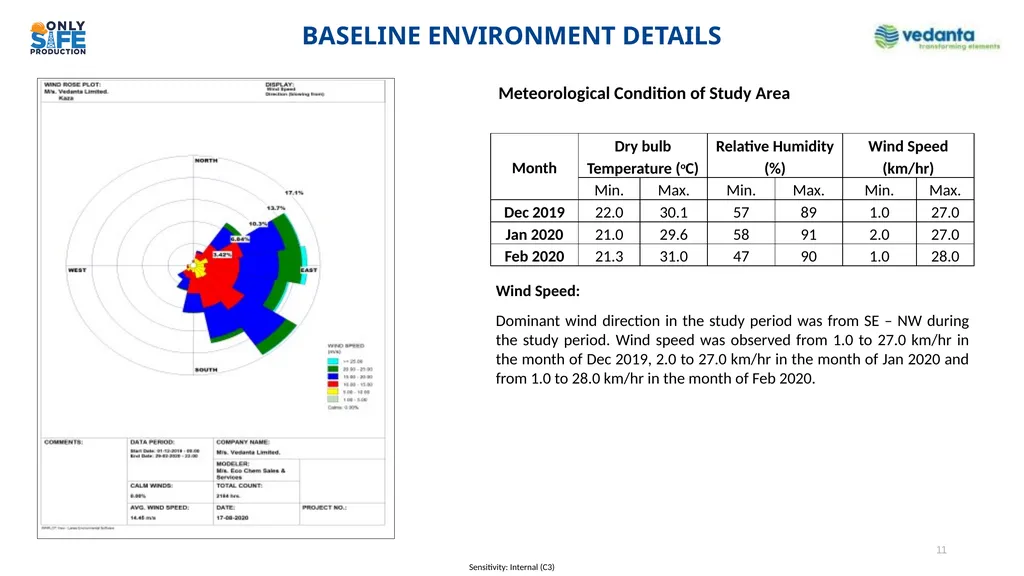
slide11. 11 BASELINE ENVIRONMENT DETAILS Meteorological Condition of Study Area Wind Speed:
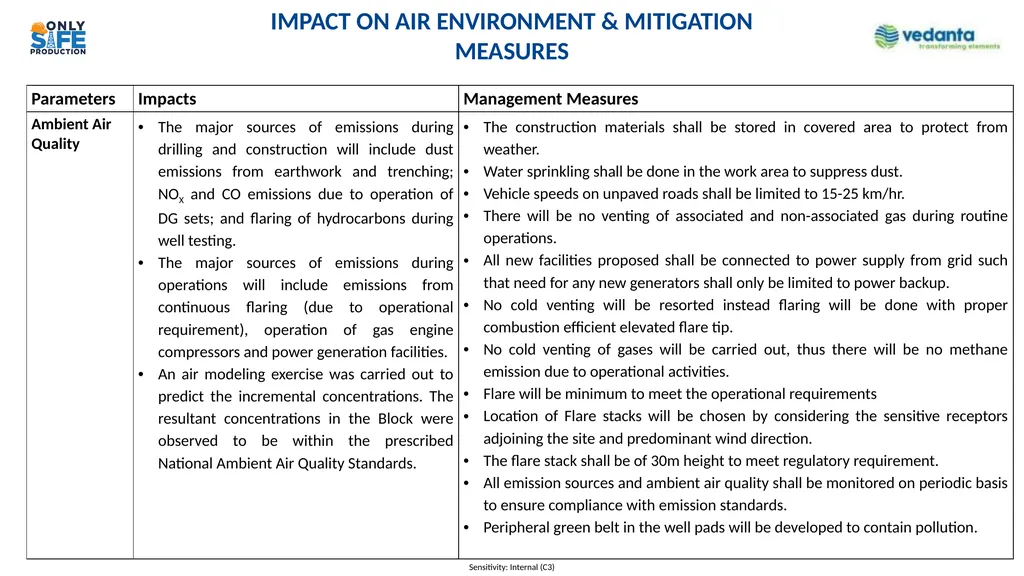
Dominant wind direction in the study period was from SE – NW during the study period. Wind speed was observed from 1.0 to 27.0 km/hr in the month of Dec 2019, 2.0 to 27.0 km/hr in the month of Jan 2020 and from 1.0 to 28.0 km/hr in the month of Feb 2020.<br>
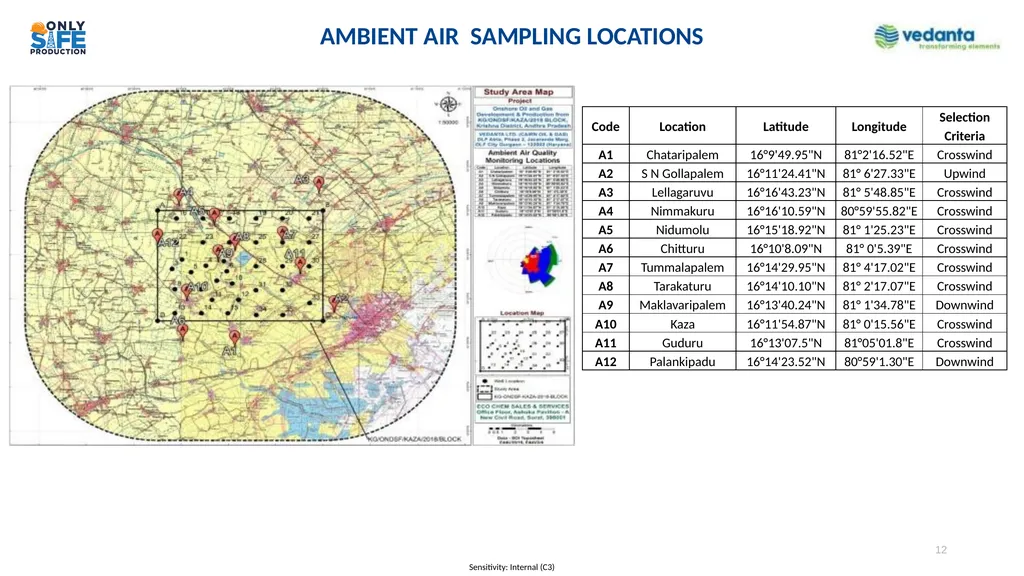
slide12. 12 AMBIENT AIR SAMPLING LOCATIONS<br>
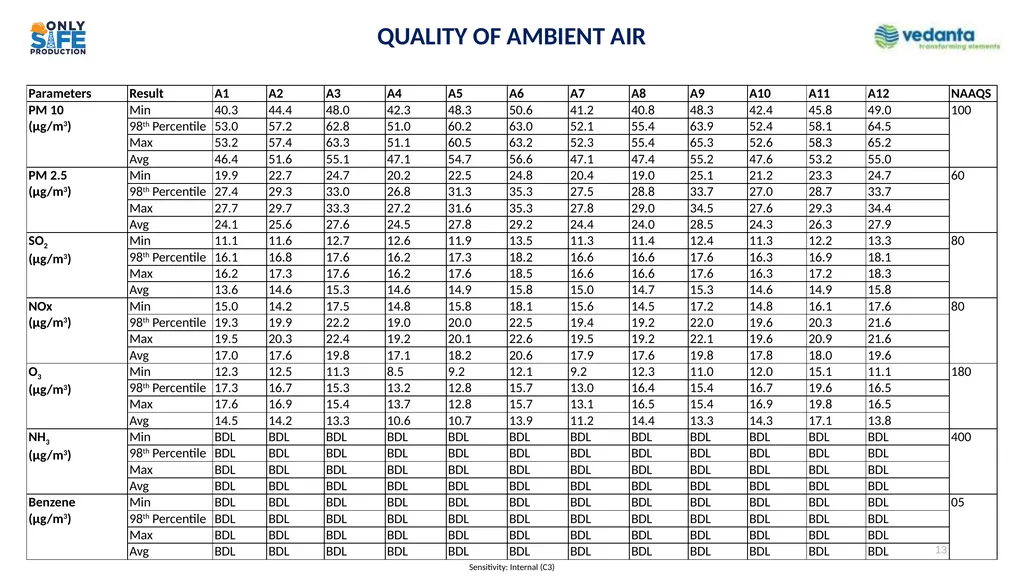
slide13. 13 QUALITY OF AMBIENT AIR<br>
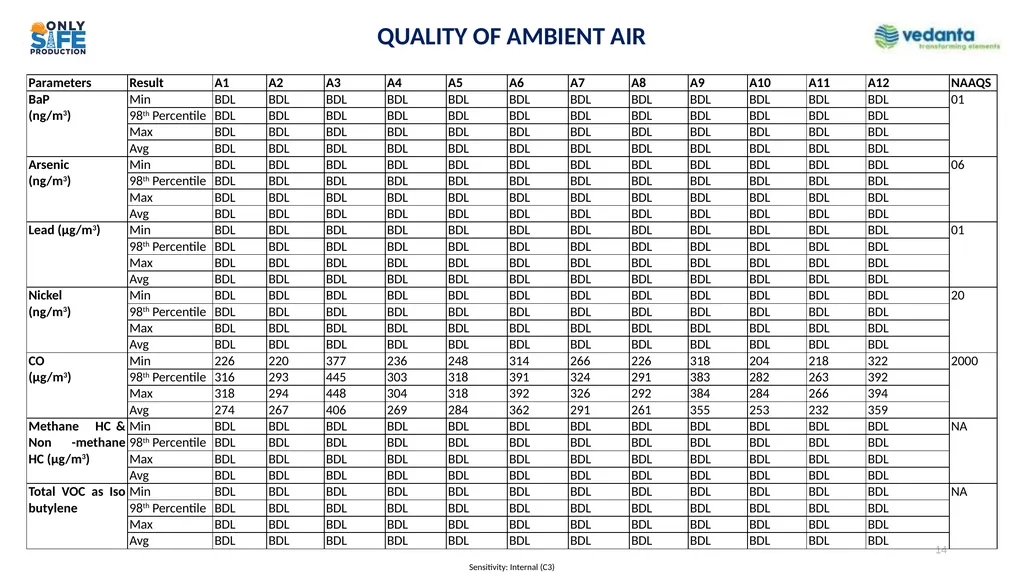
slide14. 14 QUALITY OF AMBIENT AIR<br>
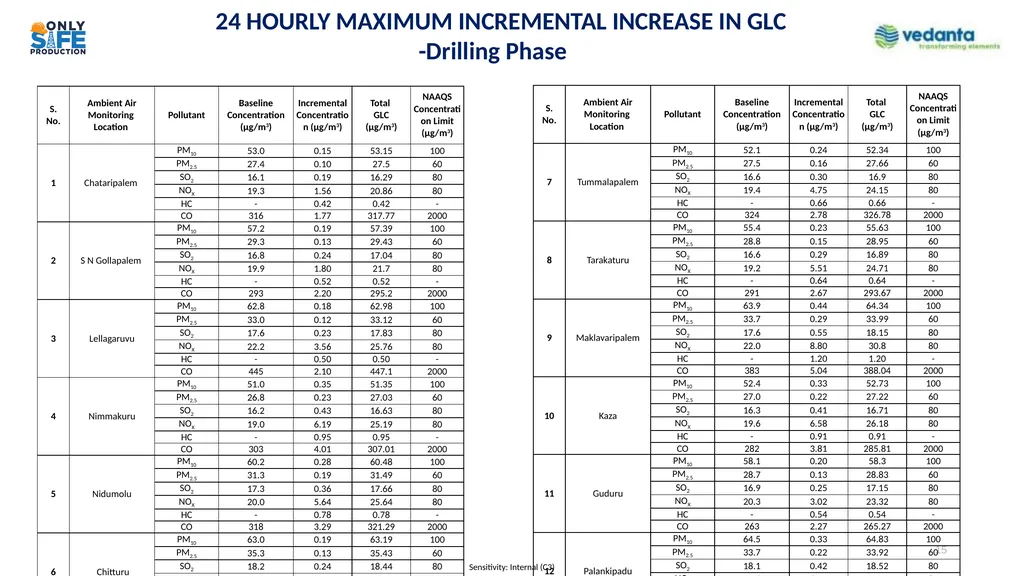
slide15. 15 BASELINE ENVIRONMENT DETAILS 24 HOURLY MAXIMUM INCREMENTAL INCREASE IN GLC
-Drilling Phase<br>
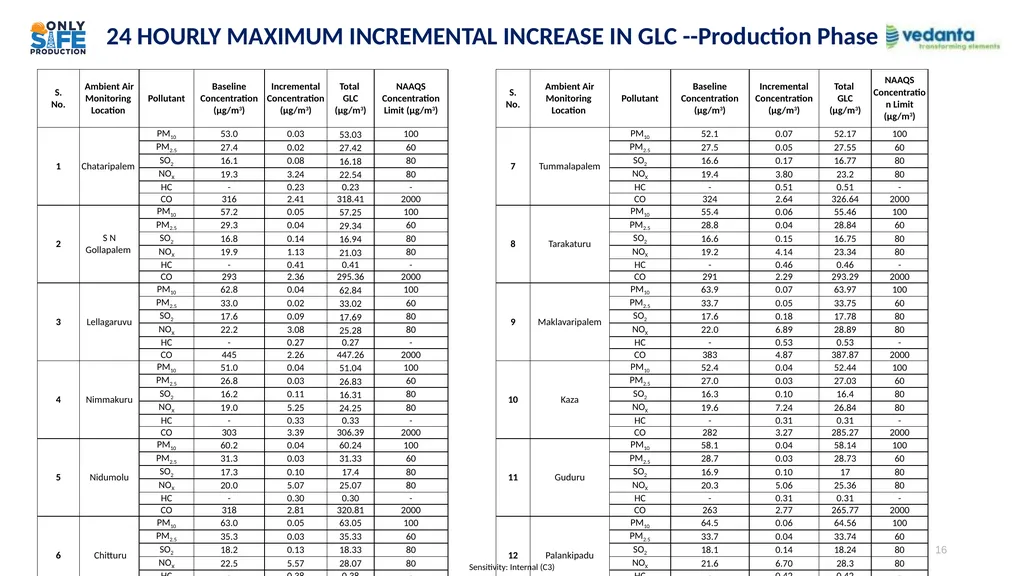
slide16. 16 BASELINE ENVIRONMENT DETAILS 24 HOURLY MAXIMUM INCREMENTAL INCREASE IN GLC --Production Phase<br>
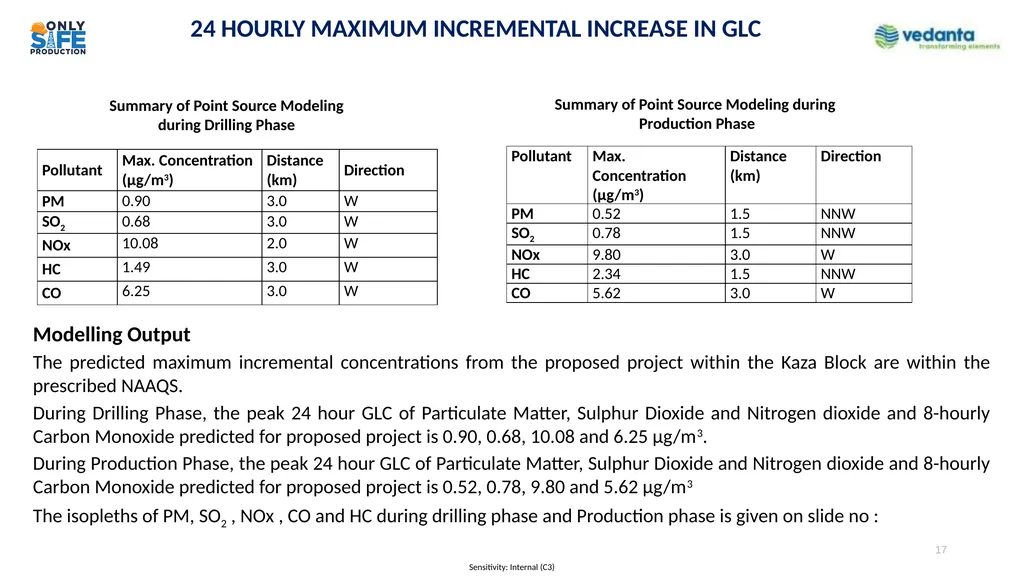
slide17. 17 24 HOURLY MAXIMUM INCREMENTAL INCREASE IN GLC Summary of Point Source Modeling during Drilling Phase Summary of Point Source Modeling during
Production Phase The isopleths of PM, SO2 , NOx , CO and HC during drilling phase and Production phase is given on slide no : Modelling Output
The predicted maximum incremental concentrations from the proposed project within the Kaza Block are within the prescribed NAAQS.
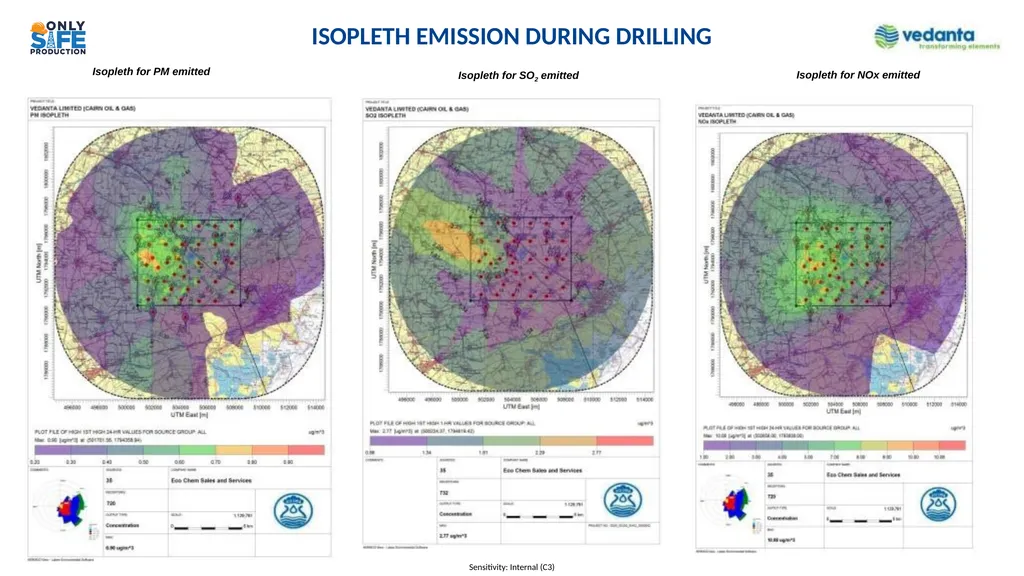
During Drilling Phase, the peak 24 hour GLC of Particulate Matter, Sulphur Dioxide and Nitrogen dioxide and 8-hourly Carbon Monoxide predicted for proposed project is 0.90, 0.68, 10.08 and 6.25 µg/m3.
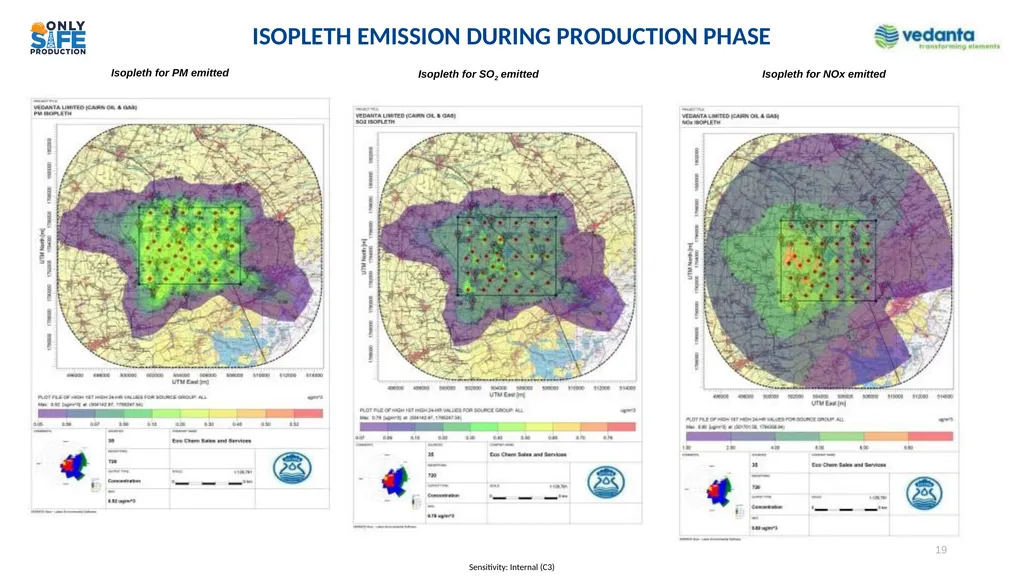
During Production Phase, the peak 24 hour GLC of Particulate Matter, Sulphur Dioxide and Nitrogen dioxide and 8-hourly Carbon Monoxide predicted for proposed project is 0.52, 0.78, 9.80 and 5.62 µg/m3<br>
slide18. 18 Isopleth for PM emitted Isopleth for SO2 emitted Isopleth for NOx emitted ISOPLETH EMISSION DURING DRILLING<br>
slide19. 19 Isopleth for PM emitted Isopleth for SO2 emitted Isopleth for NOx emitted ISOPLETH EMISSION DURING PRODUCTION PHASE<br>
slide20. 20 IMPACT ON AIR ENVIRONMENT & MITIGATION MEASURES<br>
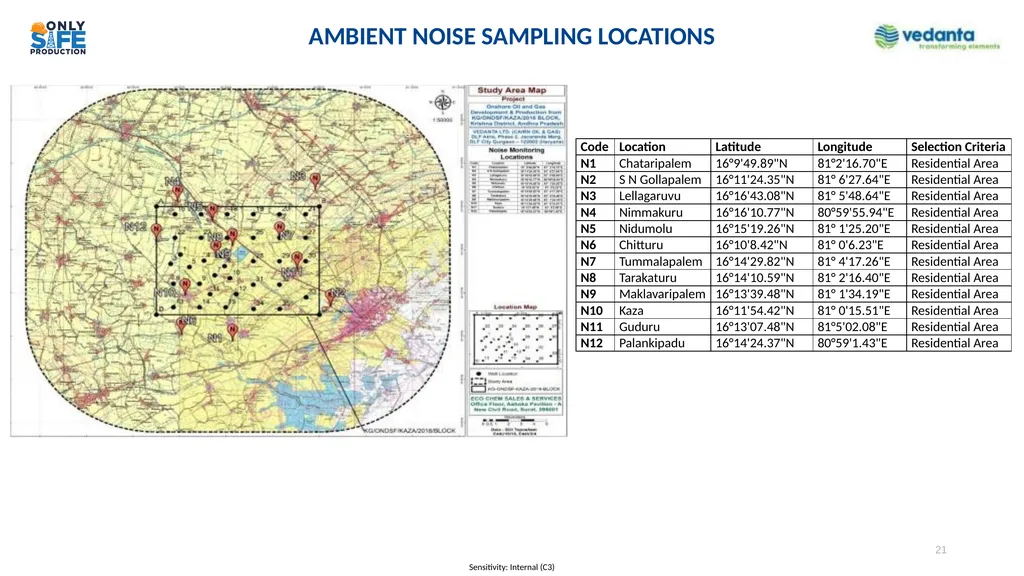
slide21. 21 AMBIENT NOISE SAMPLING LOCATIONS<br>
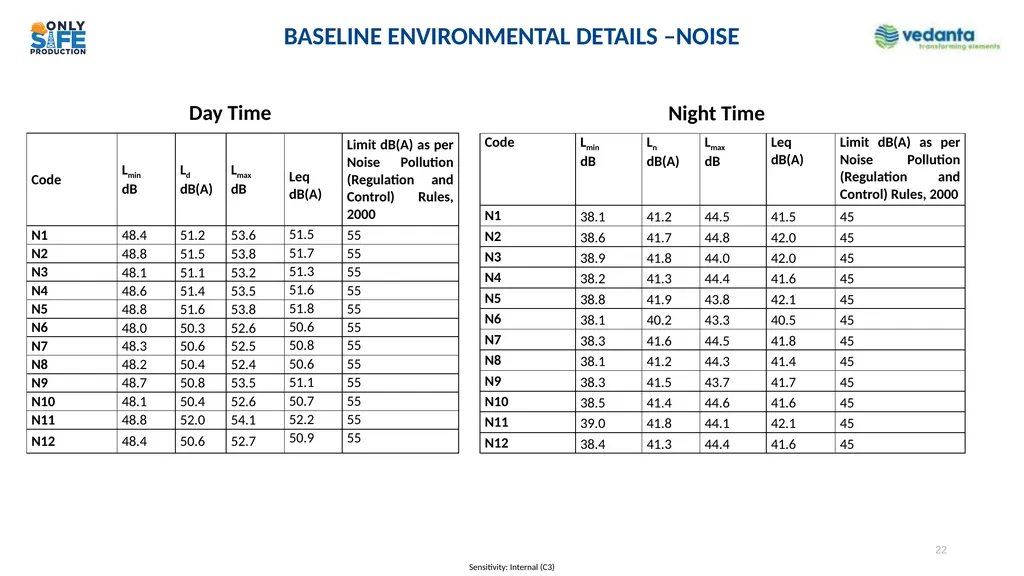
slide22. 22 BASELINE ENVIRONMENTAL DETAILS –NOISE Day Time Night Time<br>
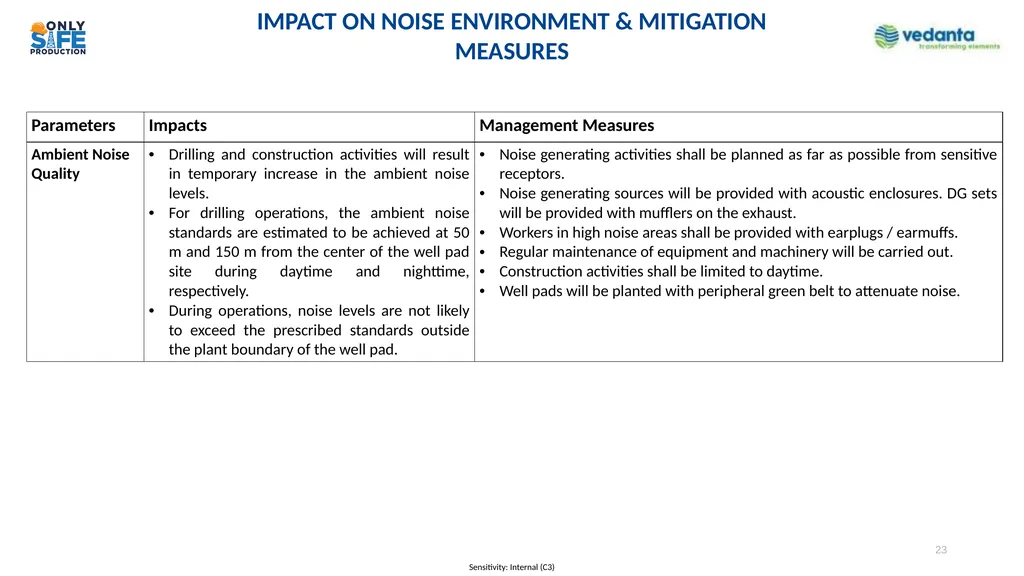
slide23. 23 IMPACT ON NOISE ENVIRONMENT & MITIGATION MEASURES<br>
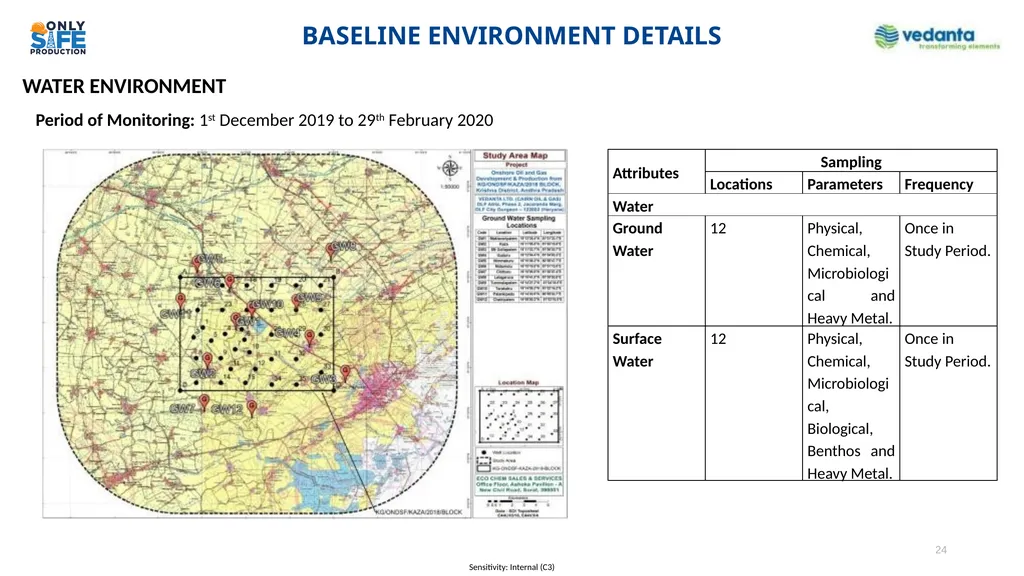
slide24. BASELINE ENVIRONMENT DETAILS 24 WATER ENVIRONMENT Period of Monitoring: 1st December 2019 to 29th February 2020<br>
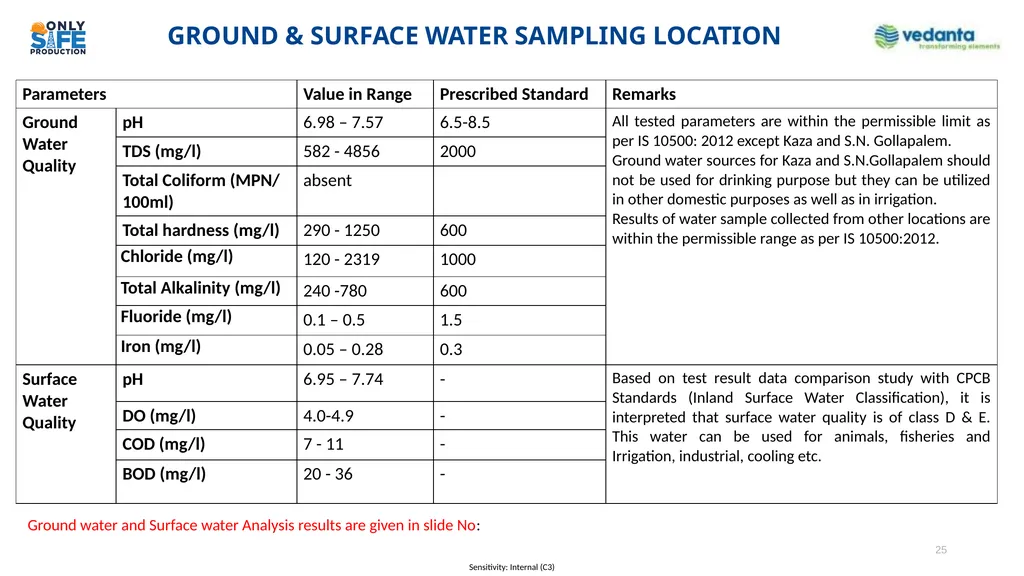
slide25. 25 GROUND & SURFACE WATER SAMPLING LOCATION Ground water and Surface water Analysis results are given in slide No:<br>
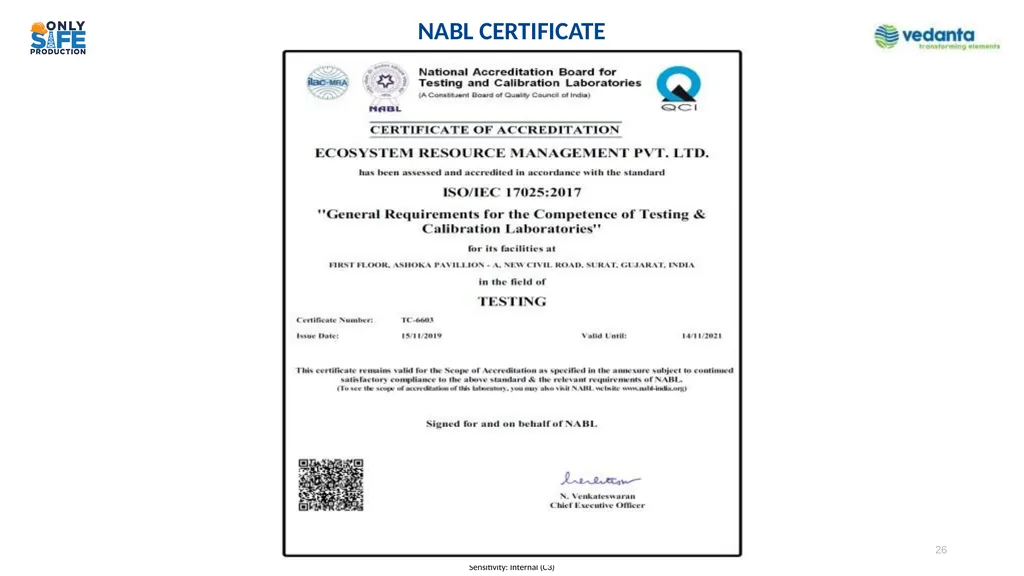
slide26. 26 NABL CERTIFICATE<br>
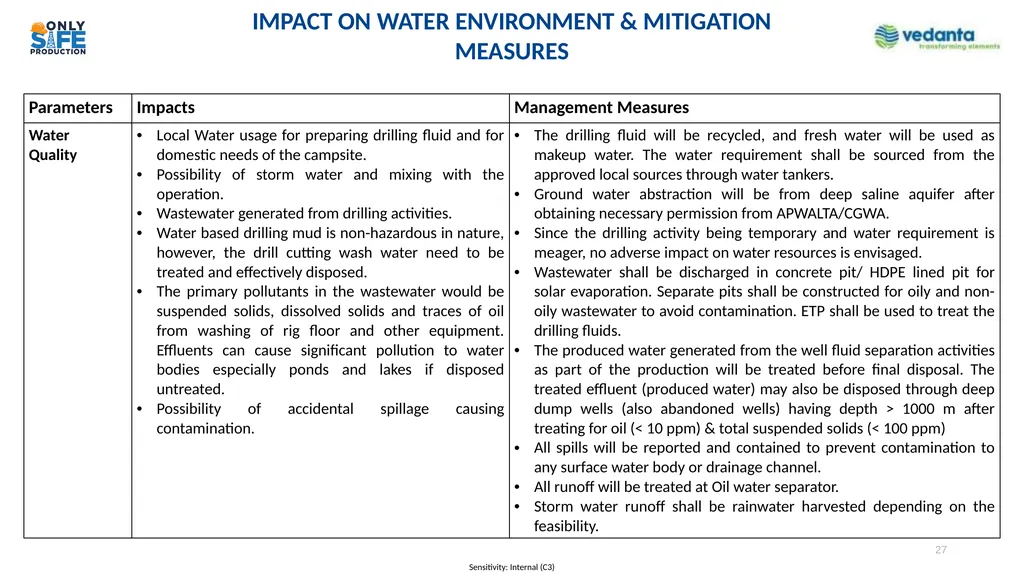
slide27. 27 IMPACT ON WATER ENVIRONMENT & MITIGATION MEASURES<br>
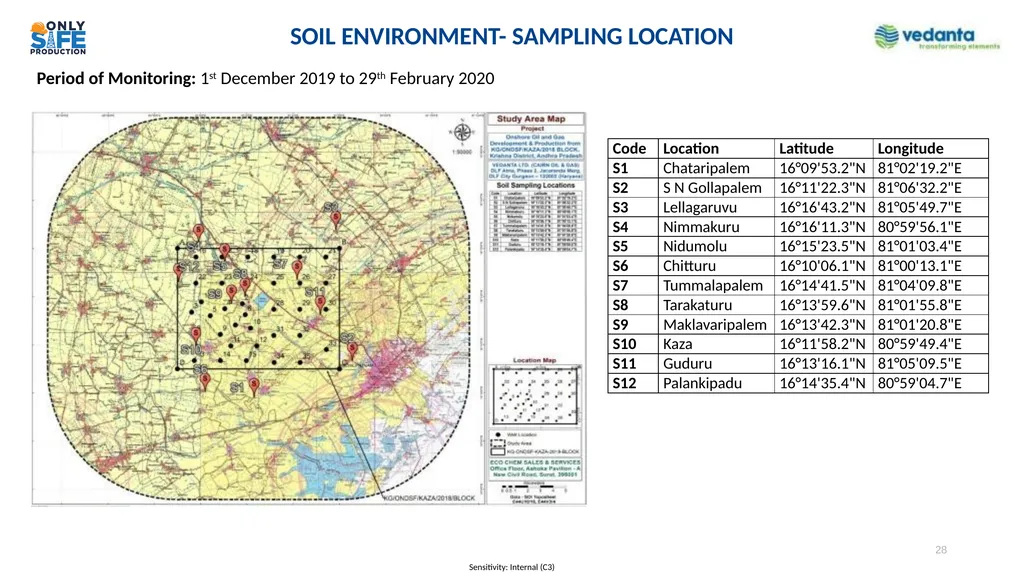
slide28. 28 SOIL ENVIRONMENT- SAMPLING LOCATION Period of Monitoring: 1st December 2019 to 29th February 2020<br>
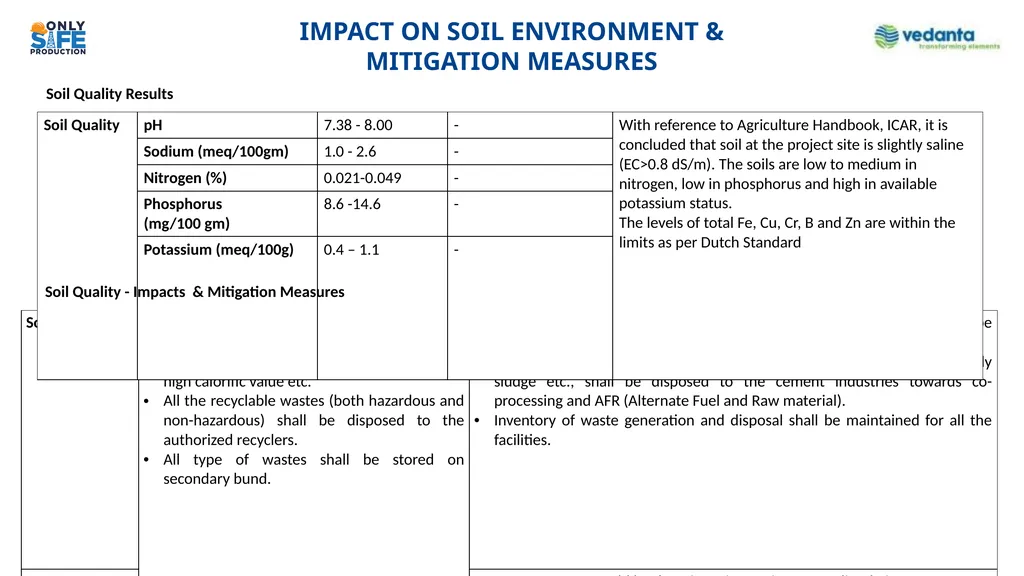
slide29. 29 IMPACT ON SOIL ENVIRONMENT & MITIGATION MEASURES Soil Quality - Impacts & Mitigation Measures Soil Quality Results<br>
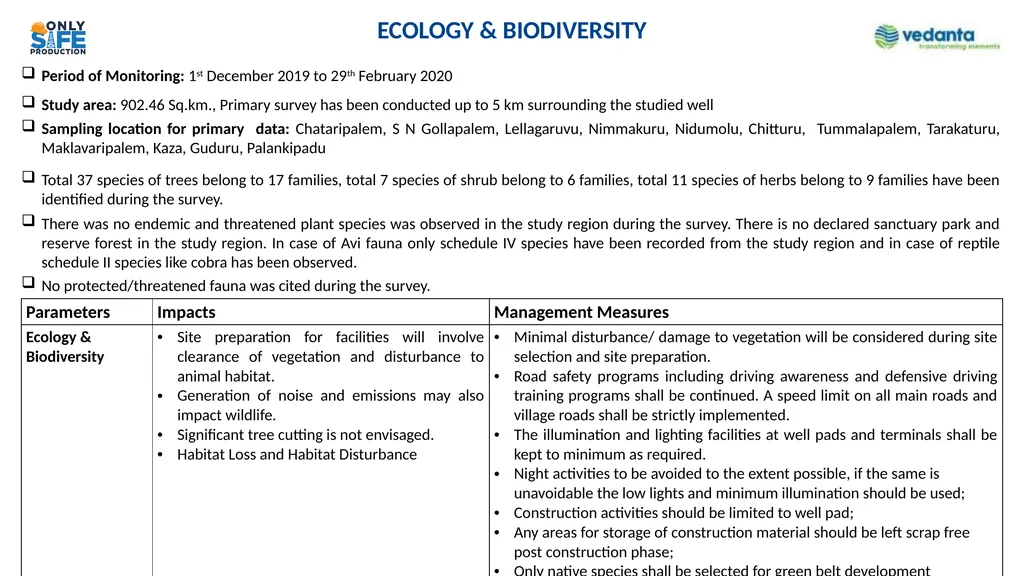
slide30. 30 ECOLOGY & BIODIVERSITY Period of Monitoring: 1st December 2019 to 29th February 2020
Study area: 902.46 Sq.km., Primary survey has been conducted up to 5 km surrounding the studied well
Sampling location for primary data: Chataripalem, S N Gollapalem, Lellagaruvu, Nimmakuru, Nidumolu, Chitturu, Tummalapalem, Tarakaturu, Maklavaripalem, Kaza, Guduru, Palankipadu
Total 37 species of trees belong to 17 families, total 7 species of shrub belong to 6 families, total 11 species of herbs belong to 9 families have been identified during the survey.
There was no endemic and threatened plant species was observed in the study region during the survey. There is no declared sanctuary park and reserve forest in the study region. In case of Avi fauna only schedule IV species have been recorded from the study region and in case of reptile schedule II species like cobra has been observed.
No protected/threatened fauna was cited during the survey.<br>
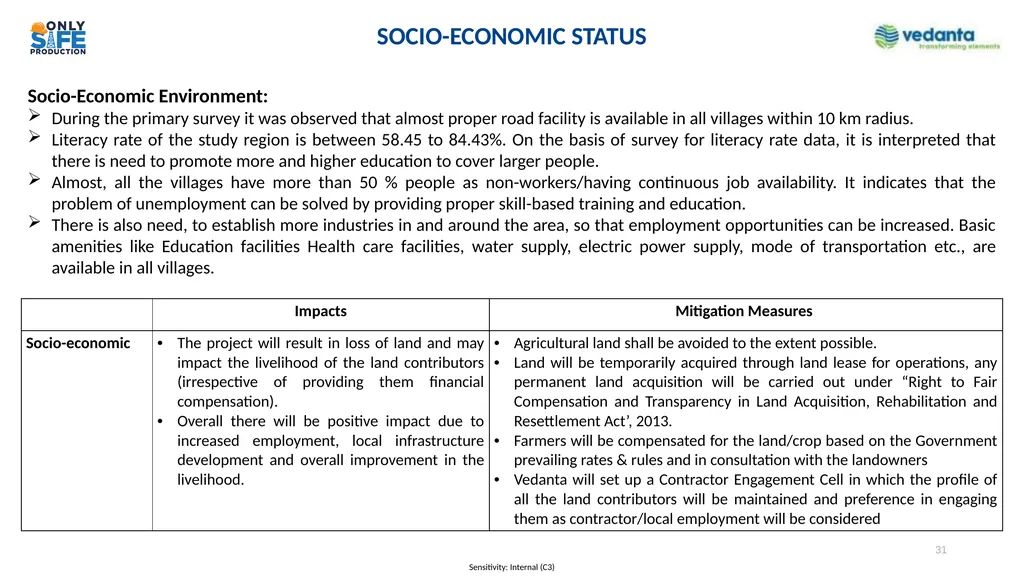
slide31. 31 SOCIO-ECONOMIC STATUS Socio-Economic Environment:
During the primary survey it was observed that almost proper road facility is available in all villages within 10 km radius.
Literacy rate of the study region is between 58.45 to 84.43%. On the basis of survey for literacy rate data, it is interpreted that there is need to promote more and higher education to cover larger people.
Almost, all the villages have more than 50 % people as non-workers/having continuous job availability. It indicates that the problem of unemployment can be solved by providing proper skill-based training and education.
There is also need, to establish more industries in and around the area, so that employment opportunities can be increased. Basic amenities like Education facilities Health care facilities, water supply, electric power supply, mode of transportation etc., are available in all villages.<br>
slide32. 32 BASELINE ENVIRONMENT DETAILS: RISK STUDIES & DISASTER MANAGEMENT Major incidents:
A fire, explosion due to release of a dangerous substance like flammable fluid or natural gas resulting from a work activity which could result in death or serious personal injury to people within the area of activity;
Hazards associated include uncontrolled release (liquid and gas) and subsequent fire due to accidental loss of containment.
Major Hazards:
Typically, the potential major hazardous incidents arising from the proposed project and its associated supporting facilities are mainly related to the leaks and rupture of hazardous liquids and gases processed in equipment, stored in tanks and transported through pipelines.
Mitigation Measures:
Drilling will be carried out using Blow Out Preventor (BOP) installation
Risk will be mitigated through having operational control system and procedures including the risk mitigation measures such as auto shutdown, fire & gas detector, fire control measures etc.
SCADA/DCS, will be provided across pipeline length for effective monitoring. Leak detection system (LDS)/ Pipeline Intrusion Detection (PIDS) will be installed in pipeline ROU.<br>
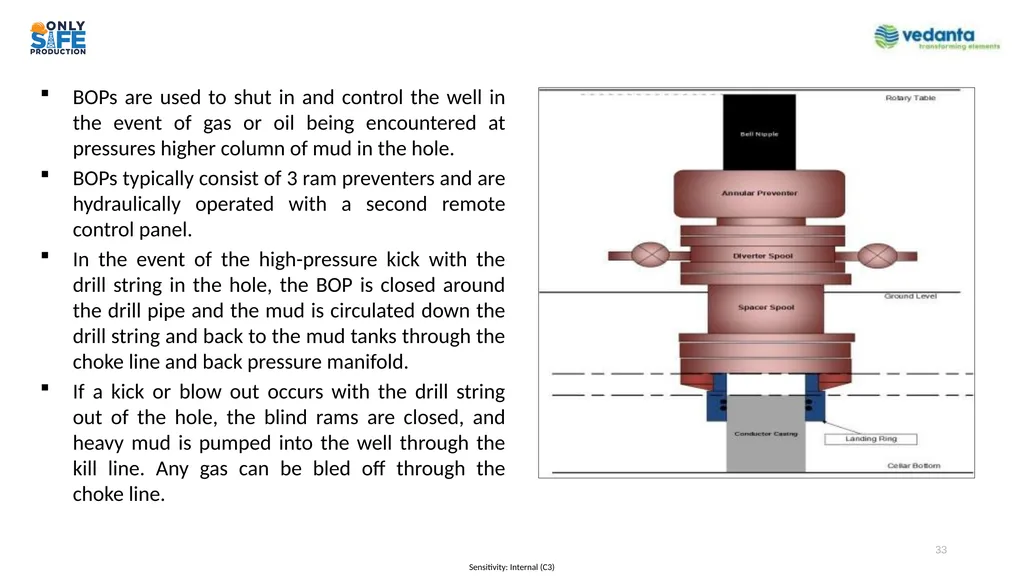
slide33. 33 BOPs are used to shut in and control the well in the event of gas or oil being encountered at pressures higher column of mud in the hole.
BOPs typically consist of 3 ram preventers and are hydraulically operated with a second remote control panel.
In the event of the high-pressure kick with the drill string in the hole, the BOP is closed around the drill pipe and the mud is circulated down the drill string and back to the mud tanks through the choke line and back pressure manifold.
If a kick or blow out occurs with the drill string out of the hole, the blind rams are closed, and heavy mud is pumped into the well through the kill line. Any gas can be bled off through the choke line.<br>
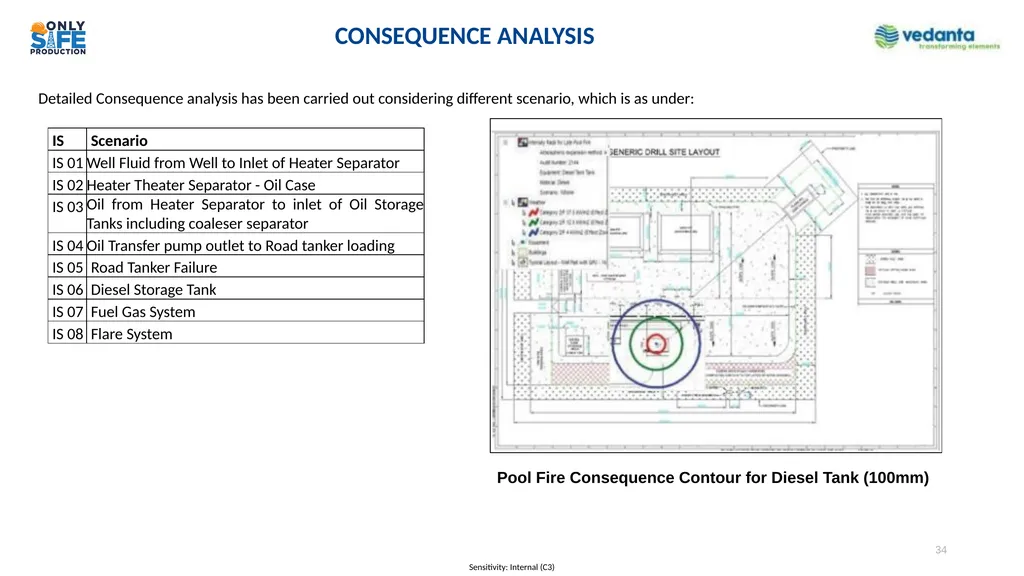
slide34. 34 CONSEQUENCE ANALYSIS Detailed Consequence analysis has been carried out considering different scenario, which is as under: Pool Fire Consequence Contour for Diesel Tank (100mm)<br>
slide35. 35 THANK YOU<br>
Date : ………………
Agenda No: …… EAC Meeting, Serial No. ….. EIA Consultant: Eco Chem Sales & Services , NABET Accreditation No. : NABET/EIA/2023/RA 0181 Proposed Onshore Oil and Gas Development & Production from KG/ONDSF/KAZA/2018 Block, Krishna District, Andhra Pradesh
Andhra Pradesh State Pollution Control Board
Welcomes You all for
Environmental Public Hearing
Schedule 1(b) – Offshore and Onshore Oil and Gas exploration, development & production, Category ‘A’<br>
slide2. APPLICATION 2 Agenda No…………………………………….
Date of Application Submission:
ADS if any including date of reply: …………………….
Date of Acceptance: …………
New Project/Expansion Project: New Project
Product Mix or Change in Technology: Onshore Oil & gas Exploration, Development & Production
Proposed Capacity: 30,000 Barrels of Oil per day and 30 Million Metric standard Cubic Feet of gas per day.
Forest Area/Wildlife/ESZ if any: Not Applicable
Name of EIA Coordinator: Mrs. Rekha Shah
CONSULTANT:
• Name: Eco Chem Sales & Services
• NABET Registration No. NABET/EIA/2023/RA 0181
• Validity: 3rd February 2023 Proposed Onshore Oil and Gas Development & Production from KG/ONDSF/KAZA/2018 Block, Krishna District, AP
Project Proponent: Vedanta Limited (Div.: Cairn Oil & Gas)
Date of Public Hearing (P.H.) Conducted:. 12.04.2021
Level of Officer conducted P.H.: Regional Officer & ADM
Status of Forest Clearance (FC): Not Applicable
Applicability of Coastal Regulatory Zone (CRZ) if any: Not Applicable
Whether located in Critically Polluted Area (CPA): Not Applicable
Certified Compliance submitted: Not Applicable as greenfield project<br>
slide3. INTRODUCTION OF THE PROJECT 3 Brief Description about project : Vedanta Limited (Div: Cairn Oil & Gas) has been allocated KG/ONDSF/KAZA/2018 hydrocarbon block falling in Krishna as district, Andhra Pradesh by MoP&NG, GOI Under the Revenue Sharing Contract (RSC) for exploration and exploitation of hydrocarbons. As per EIA Notification 2006 and subsequent amendments, the project falls under category ‘A’ of activity 1(b) - Offshore and onshore oil and gas exploration, development & production.
Drilling of 35 hydrocarbon wells.
Development of 10 well pads to setup the hydrocarbon processing facilities
Produce up to 30,000 Barrels of Oil per day and 30 Million Metric standard Cubic Feet of gas per day.
Laying of separate gas pipeline from the developed well pads and connecting to the main header pipeline already laid by GAIL and MEGHA.
Plot area: Block Area - 114.93 km2. Land requirement is maximum 9 hectares per well pad including the approach road
% of green belt provided: 33% of greenbelt area at each well pad will be developed
Land use change required: Yes, In case of commercially viable discovery of Oil & Gas in exploration activity, 9 ha land per well pad/ drill site will be taken on long term lease for development & production activity. Sources of Air (+Noise) Pollution:
DG sets for drilling operation (associated with drilling rig, Camp site, LMP & Radio room) and flaring during well testing/ extended well testing.
For Early Production, power requirement will be met through state electricity grid / installation of Diesel / Gas Engine Generator (GEG)
(1 MW output) and DG set (500 KVA) for emergency use
Estimated Project Cost: Rs. 650.00 Crores
EMP Cost: The tentative budget for implementation of the EMP including environmental monitoring will be Rs. 33.0 Crores as capital.
CER Cost : Rs. 6.5 Crores, shall be spent in various social development cost based on the assessed needs @ 1.0% of the estimated project cost over a period of 5 years.
Manpower : Project phase (construction of single well pad & associated activities) – 80 no’s
Drilling of well and operation of single rig – 100 no’s
Operation of the each well pad to produce oil & gas including the hydrocarbon transportation through trucks / cascade mounted trailers – 25 no’s
Details of Environment Officers with qualifications : Mr. S. Karthik, B.E. (Chemical); M. Tech (Environment)<br>
slide4. Water Consumption/day:
Drilling & associated activities : 50 m3/well/day
Project : 20 m3/day
Production / Operation: 10 m3/day/well pad
Injection water: 1000 m3/ day (maximum in peak production)
Source of water: will be sourced from authorized supplier/PWD/Irrigation department/local bodies etc.
Permission from CGWA or any other agency: Not Applicable
Energy Consumption:
Camp site: DG sets: 2 x 150 KVA
Drilling site: DG sets: 2 x 1500 KVA and 2 x 500 KVA
Production : GEG: 2 x 500 KVA & DG Set: 2 x 150 KVA
Kind of Fuel used: HSD
Drilling phase: Approx. 3.5 KLD
Operation Phase: Approx. 500 Liters of HSD will be required per well pad
Waste Water Generated/day: 38 KLD wastewater will be generated during drilling operation, domestic wastewater will be 8 KLD & effluent will be 30 KLD from Drill cutting washing + Rig washing + cooling etc. During operation phase, domestic waste water will be 8 KLD and no effluent will be generated.
Treatment facility with capacity : During the drilling operation domestic sewage will be treated in septic tanks/soak pits in the well pads.
wastewater in the form of Drill cutting washing + Rig washing + cooling will be treated and used back for mud preparation and the final wastewater will be discharged in HDPE lined evaporation pit for natural evaporation.
Mobile ETP of 100 KLD capacity shall be used to treat the drilling fluids and associated wastewater such as cement wash water, rig clean etc. At later stage the ETP will also be used to handle the wastewater to be generated from the hydraulic fracturing activities.
Operation phase, the produced water separated from the well fluid shall be treated and as required will be blended with the ground water and injected back to the reservoir towards maintaining the formation zone pressure. Any rejected wastewater will be treated in the ETP for the removal of oil and suspended solids and will be injected back to the deep dump well > 1000 m depth below the ground level.
Mode of discharge: No discharge into natural water body. INTRODUCTION OF THE PROJECT<br>
slide5. 5 LOCATION OF THE PROJECT The 35 wells are located in Kaza Block in three Mandal’s of Krishna District.
18 wells in Guduru Mandal,
16 wells in Mova Mandal,
01 well in Pamarru mandal<br>
slide6. 6 TOPOGRAPHICAL MAP KML file of KG/ONDSF/KAZA/2018 block:<br>
slide7. 7 Product Details:
Drilling of 35 hydrocarbon wells.
Development of 10 well pads to setup the hydrocarbon processing facilities
Produce up to 30,000 Barrels of Oil per day and 30 Million Metric standard Cubic Feet of gas per day.
Laying of separate gas pipeline from the developed well pads and connecting to the main header pipeline already laid by GAIL and MEGHA.
Well Design:
Well design will be three casing policy.
The initial casing will be ~ 600 m depth using the water-based mud.
The second casing will be for ~1800 m depth using low toxicity synthetic oil-based mud (for faster completion & considering hard geological structures).
The third casing will be for depth > 1800 m to formation zone, say around 2400 m depth using SBM.
The duration of the well drilling and completion is 45 – 60 days/ well.
The well testing (for the 30 to 60 days/well. PRODUCT AND WELL DESIGN DETAILS<br>
slide8. 8 SELECTION OF LAND FOR SETTING UP WELL PAD Initially 300 m X 300 m (9 hectares) would be taken on temporary lease basis for the construction of well pad (drill site) for drilling of the wells.
If any land site is sensitive/human settlement is there etc., those areas will be avoided and nearby lands suitable to the operation can be leased out
Based on successful oil & gas discovery, permanent land possession is required.
Maximum 10 well pads will be in operation at Kaza block i.e., 90 hectares land required in small parcels at various locations within Kaza block area.
The 30m width access roads will be required to connect the well pads, laying pipeline, overhead line and other utilities. This road will be acquired in the combination of permanent possession and RoU (Right of Usage).
The existing roads will be strengthened by Cairn, if used for heavy vehicular movements.
Land lease amount and related compensation will be paid based on Government approved rates, in consultation with both District Authorities and the Landowners.
The return of the land after the lease period will be handed over after proper restoration of the land.
The restoration will include complete cleanup of the land, restoring by improving the fertility of the soil, ensuring no contamination to the soil, ground water etc., and the hydrocarbon wells shall be plugged and abandon as per OISD standards.<br>
slide9. 9 WELL LAYOUT PLAN<br>
slide10. 10 BASELINE ENVIRONMENT DETAILS Period of Monitoring: 1st December 2019 to 29th February 2020<br>
slide11. 11 BASELINE ENVIRONMENT DETAILS Meteorological Condition of Study Area Wind Speed:
Dominant wind direction in the study period was from SE – NW during the study period. Wind speed was observed from 1.0 to 27.0 km/hr in the month of Dec 2019, 2.0 to 27.0 km/hr in the month of Jan 2020 and from 1.0 to 28.0 km/hr in the month of Feb 2020.<br>
slide12. 12 AMBIENT AIR SAMPLING LOCATIONS<br>
slide13. 13 QUALITY OF AMBIENT AIR<br>
slide14. 14 QUALITY OF AMBIENT AIR<br>
slide15. 15 BASELINE ENVIRONMENT DETAILS 24 HOURLY MAXIMUM INCREMENTAL INCREASE IN GLC
-Drilling Phase<br>
slide16. 16 BASELINE ENVIRONMENT DETAILS 24 HOURLY MAXIMUM INCREMENTAL INCREASE IN GLC --Production Phase<br>
slide17. 17 24 HOURLY MAXIMUM INCREMENTAL INCREASE IN GLC Summary of Point Source Modeling during Drilling Phase Summary of Point Source Modeling during
Production Phase The isopleths of PM, SO2 , NOx , CO and HC during drilling phase and Production phase is given on slide no : Modelling Output
The predicted maximum incremental concentrations from the proposed project within the Kaza Block are within the prescribed NAAQS.
During Drilling Phase, the peak 24 hour GLC of Particulate Matter, Sulphur Dioxide and Nitrogen dioxide and 8-hourly Carbon Monoxide predicted for proposed project is 0.90, 0.68, 10.08 and 6.25 µg/m3.
During Production Phase, the peak 24 hour GLC of Particulate Matter, Sulphur Dioxide and Nitrogen dioxide and 8-hourly Carbon Monoxide predicted for proposed project is 0.52, 0.78, 9.80 and 5.62 µg/m3<br>
slide18. 18 Isopleth for PM emitted Isopleth for SO2 emitted Isopleth for NOx emitted ISOPLETH EMISSION DURING DRILLING<br>
slide19. 19 Isopleth for PM emitted Isopleth for SO2 emitted Isopleth for NOx emitted ISOPLETH EMISSION DURING PRODUCTION PHASE<br>
slide20. 20 IMPACT ON AIR ENVIRONMENT & MITIGATION MEASURES<br>
slide21. 21 AMBIENT NOISE SAMPLING LOCATIONS<br>
slide22. 22 BASELINE ENVIRONMENTAL DETAILS –NOISE Day Time Night Time<br>
slide23. 23 IMPACT ON NOISE ENVIRONMENT & MITIGATION MEASURES<br>
slide24. BASELINE ENVIRONMENT DETAILS 24 WATER ENVIRONMENT Period of Monitoring: 1st December 2019 to 29th February 2020<br>
slide25. 25 GROUND & SURFACE WATER SAMPLING LOCATION Ground water and Surface water Analysis results are given in slide No:<br>
slide26. 26 NABL CERTIFICATE<br>
slide27. 27 IMPACT ON WATER ENVIRONMENT & MITIGATION MEASURES<br>
slide28. 28 SOIL ENVIRONMENT- SAMPLING LOCATION Period of Monitoring: 1st December 2019 to 29th February 2020<br>
slide29. 29 IMPACT ON SOIL ENVIRONMENT & MITIGATION MEASURES Soil Quality - Impacts & Mitigation Measures Soil Quality Results<br>
slide30. 30 ECOLOGY & BIODIVERSITY Period of Monitoring: 1st December 2019 to 29th February 2020
Study area: 902.46 Sq.km., Primary survey has been conducted up to 5 km surrounding the studied well
Sampling location for primary data: Chataripalem, S N Gollapalem, Lellagaruvu, Nimmakuru, Nidumolu, Chitturu, Tummalapalem, Tarakaturu, Maklavaripalem, Kaza, Guduru, Palankipadu
Total 37 species of trees belong to 17 families, total 7 species of shrub belong to 6 families, total 11 species of herbs belong to 9 families have been identified during the survey.
There was no endemic and threatened plant species was observed in the study region during the survey. There is no declared sanctuary park and reserve forest in the study region. In case of Avi fauna only schedule IV species have been recorded from the study region and in case of reptile schedule II species like cobra has been observed.
No protected/threatened fauna was cited during the survey.<br>
slide31. 31 SOCIO-ECONOMIC STATUS Socio-Economic Environment:
During the primary survey it was observed that almost proper road facility is available in all villages within 10 km radius.
Literacy rate of the study region is between 58.45 to 84.43%. On the basis of survey for literacy rate data, it is interpreted that there is need to promote more and higher education to cover larger people.
Almost, all the villages have more than 50 % people as non-workers/having continuous job availability. It indicates that the problem of unemployment can be solved by providing proper skill-based training and education.
There is also need, to establish more industries in and around the area, so that employment opportunities can be increased. Basic amenities like Education facilities Health care facilities, water supply, electric power supply, mode of transportation etc., are available in all villages.<br>
slide32. 32 BASELINE ENVIRONMENT DETAILS: RISK STUDIES & DISASTER MANAGEMENT Major incidents:
A fire, explosion due to release of a dangerous substance like flammable fluid or natural gas resulting from a work activity which could result in death or serious personal injury to people within the area of activity;
Hazards associated include uncontrolled release (liquid and gas) and subsequent fire due to accidental loss of containment.
Major Hazards:
Typically, the potential major hazardous incidents arising from the proposed project and its associated supporting facilities are mainly related to the leaks and rupture of hazardous liquids and gases processed in equipment, stored in tanks and transported through pipelines.
Mitigation Measures:
Drilling will be carried out using Blow Out Preventor (BOP) installation
Risk will be mitigated through having operational control system and procedures including the risk mitigation measures such as auto shutdown, fire & gas detector, fire control measures etc.
SCADA/DCS, will be provided across pipeline length for effective monitoring. Leak detection system (LDS)/ Pipeline Intrusion Detection (PIDS) will be installed in pipeline ROU.<br>
slide33. 33 BOPs are used to shut in and control the well in the event of gas or oil being encountered at pressures higher column of mud in the hole.
BOPs typically consist of 3 ram preventers and are hydraulically operated with a second remote control panel.
In the event of the high-pressure kick with the drill string in the hole, the BOP is closed around the drill pipe and the mud is circulated down the drill string and back to the mud tanks through the choke line and back pressure manifold.
If a kick or blow out occurs with the drill string out of the hole, the blind rams are closed, and heavy mud is pumped into the well through the kill line. Any gas can be bled off through the choke line.<br>
slide34. 34 CONSEQUENCE ANALYSIS Detailed Consequence analysis has been carried out considering different scenario, which is as under: Pool Fire Consequence Contour for Diesel Tank (100mm)<br>
slide35. 35 THANK YOU<br>