
Presentation to Portfolio Committee on
CP
Published · 19 slides · 0 views
1 / 1
Description
Presentation to Portfolio Committee on Environment, Forestry Fisheries 27 January 2023 Introduction PCC was mooted in the Presidential Job Summit Framework Agreement in October 2018. Commission appointed by President in December 2020
Related Topics
Share
Embed code
Download this presentation From Below
"Presentation to Portfolio Committee on" is the property of its rightful owner. Permission is granted to download and print the materials on this website for personal, non-commercial use only, and to display it on your personal computer provided you do not modify the materials and that you retain all copyright notices contained in the materials. By downloading content from our website, you accept the terms of this agreement.
Presentation Transcript
01
Presentation to Portfolio Committee on Environment, Forestry & Fisheries 27 January 2023<br>
02
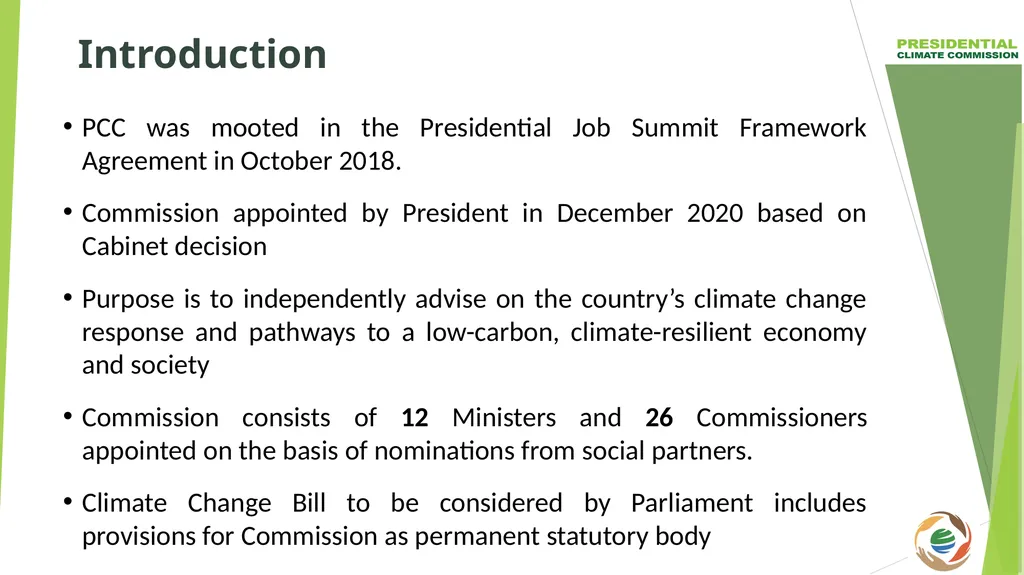
Introduction PCC was mooted in the Presidential Job Summit Framework Agreement in October 2018.
Commission appointed by President in December 2020 based on Cabinet decision
Purpose is to independently advise on the country’s climate change response and pathways to a low-carbon, climate-resilient economy and society
Commission consists of 12 Ministers and 26 Commissioners appointed on the basis of nominations from social partners.
Climate Change Bill to be considered by Parliament includes provisions for Commission as permanent statutory body<br>
Commission appointed by President in December 2020 based on Cabinet decision
Purpose is to independently advise on the country’s climate change response and pathways to a low-carbon, climate-resilient economy and society
Commission consists of 12 Ministers and 26 Commissioners appointed on the basis of nominations from social partners.
Climate Change Bill to be considered by Parliament includes provisions for Commission as permanent statutory body<br>
03
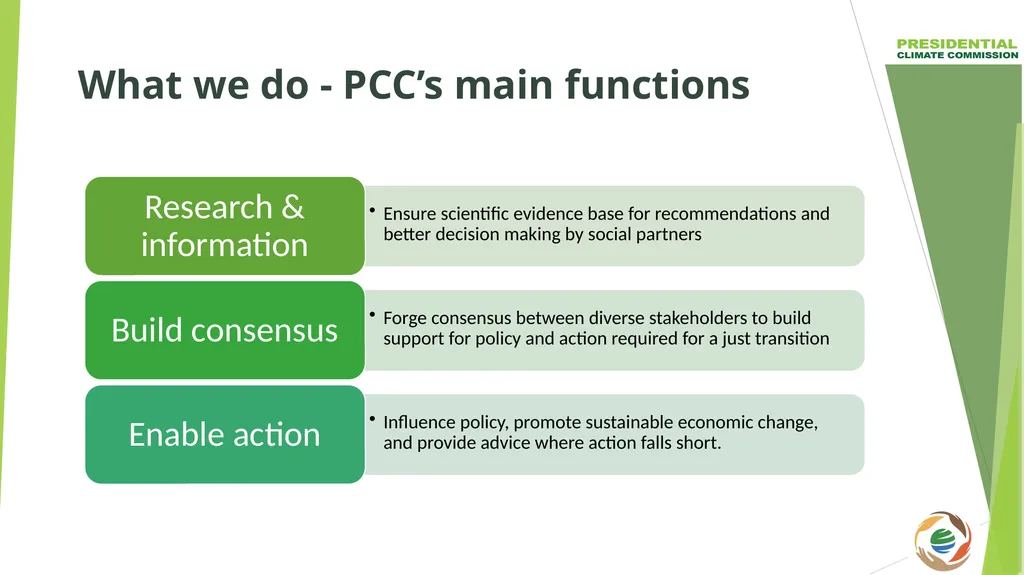
What we do - PCC’s main functions<br>
04
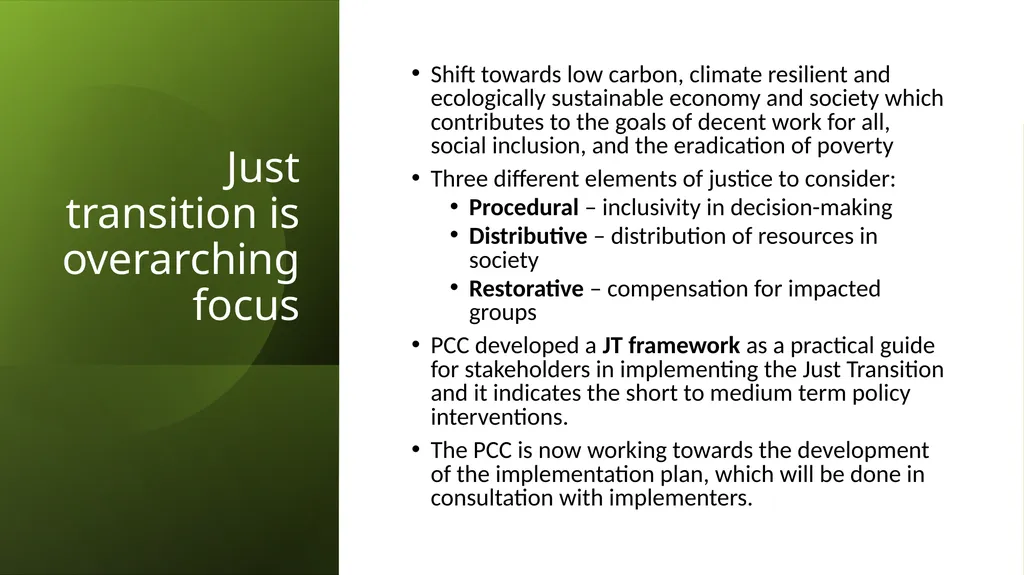
Just transition is overarching focus Shift towards low carbon, climate resilient and ecologically sustainable economy and society which contributes to the goals of decent work for all, social inclusion, and the eradication of poverty
Three different elements of justice to consider:
Procedural – inclusivity in decision-making
Distributive – distribution of resources in society
Restorative – compensation for impacted groups
PCC developed a JT framework as a practical guide for stakeholders in implementing the Just Transition and it indicates the short to medium term policy interventions.
The PCC is now working towards the development of the implementation plan, which will be done in consultation with implementers.<br>
Three different elements of justice to consider:
Procedural – inclusivity in decision-making
Distributive – distribution of resources in society
Restorative – compensation for impacted groups
PCC developed a JT framework as a practical guide for stakeholders in implementing the Just Transition and it indicates the short to medium term policy interventions.
The PCC is now working towards the development of the implementation plan, which will be done in consultation with implementers.<br>
05
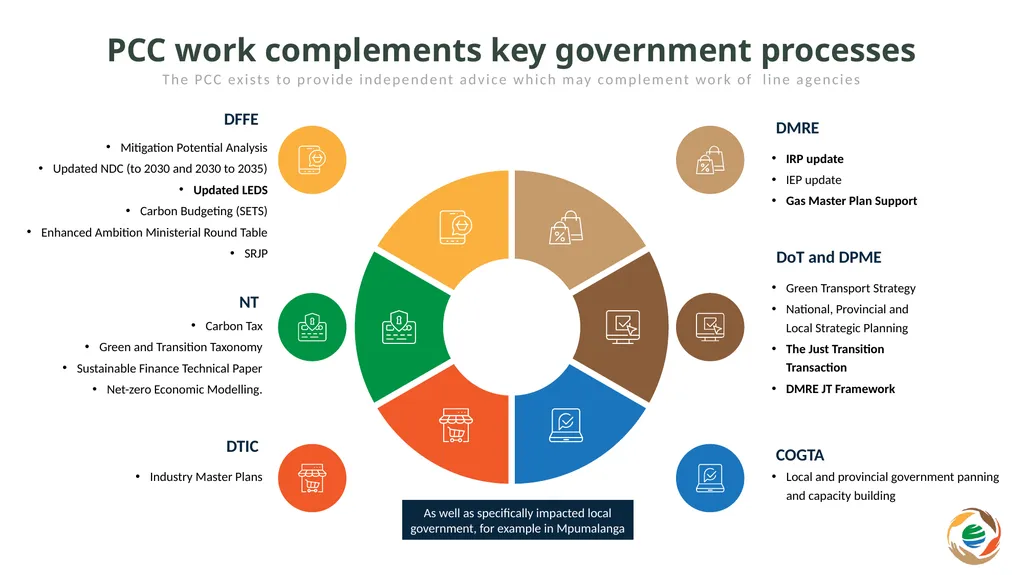
PCC work complements key government processes The PCC exists to provide independent advice which may complement work of line agencies DMRE IRP update
IEP update
Gas Master Plan Support COGTA Local and provincial government panning and capacity building DoT and DPME Green Transport Strategy
National, Provincial and Local Strategic Planning
The Just Transition Transaction
DMRE JT Framework DFFE Mitigation Potential Analysis
Updated NDC (to 2030 and 2030 to 2035)
Updated LEDS
Carbon Budgeting (SETS)
Enhanced Ambition Ministerial Round Table
SRJP DTIC Industry Master Plans NT Carbon Tax
Green and Transition Taxonomy
Sustainable Finance Technical Paper
Net-zero Economic Modelling. As well as specifically impacted local government, for example in Mpumalanga<br>
IEP update
Gas Master Plan Support COGTA Local and provincial government panning and capacity building DoT and DPME Green Transport Strategy
National, Provincial and Local Strategic Planning
The Just Transition Transaction
DMRE JT Framework DFFE Mitigation Potential Analysis
Updated NDC (to 2030 and 2030 to 2035)
Updated LEDS
Carbon Budgeting (SETS)
Enhanced Ambition Ministerial Round Table
SRJP DTIC Industry Master Plans NT Carbon Tax
Green and Transition Taxonomy
Sustainable Finance Technical Paper
Net-zero Economic Modelling. As well as specifically impacted local government, for example in Mpumalanga<br>
06
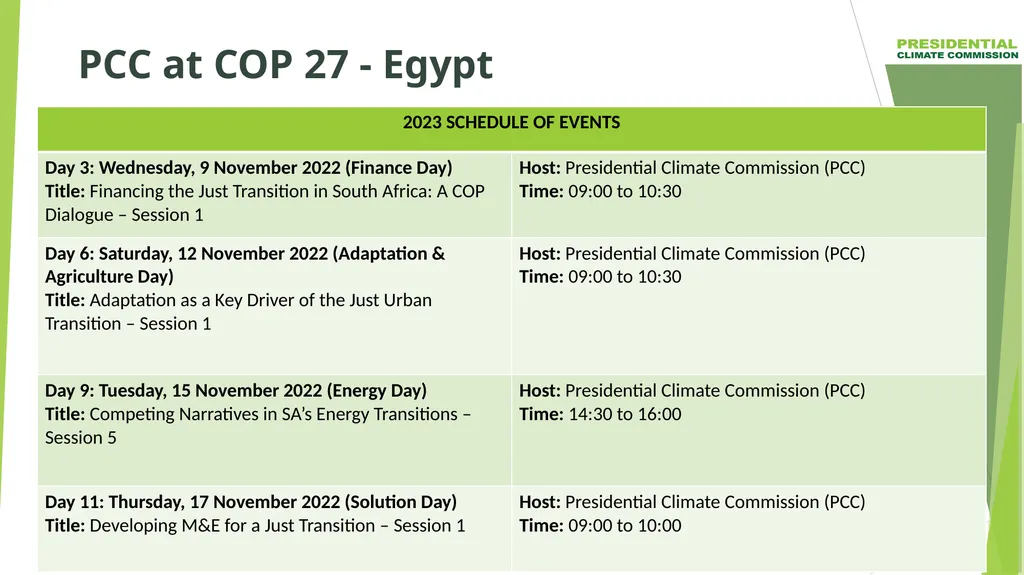
PCC at COP 27 - Egypt<br>
07
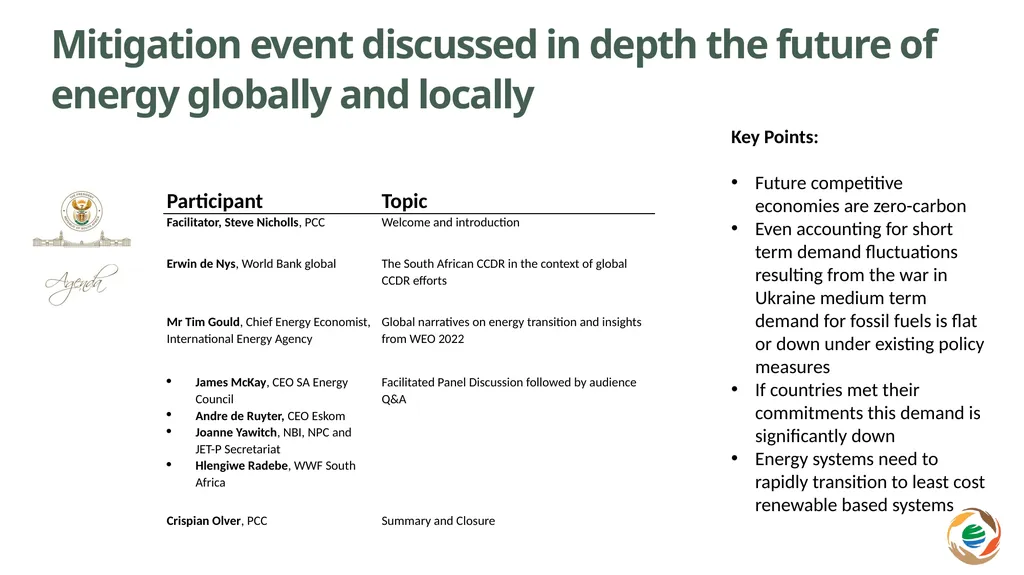
Mitigation event discussed in depth the future of energy globally and locally Key Points:
Future competitive economies are zero-carbon
Even accounting for short term demand fluctuations resulting from the war in Ukraine medium term demand for fossil fuels is flat or down under existing policy measures
If countries met their commitments this demand is significantly down
Energy systems need to rapidly transition to least cost renewable based systems<br>
Future competitive economies are zero-carbon
Even accounting for short term demand fluctuations resulting from the war in Ukraine medium term demand for fossil fuels is flat or down under existing policy measures
If countries met their commitments this demand is significantly down
Energy systems need to rapidly transition to least cost renewable based systems<br>
08
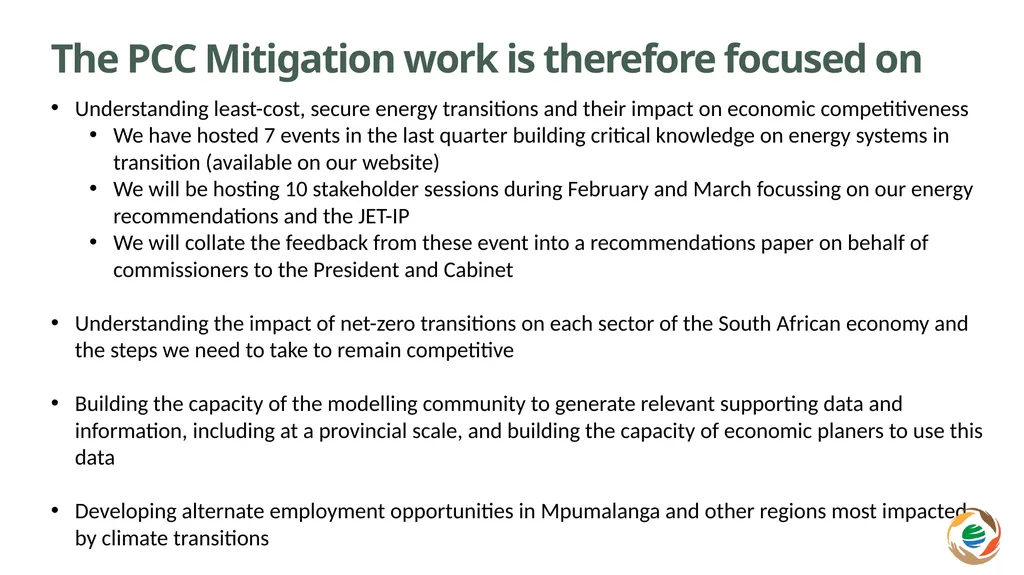
The PCC Mitigation work is therefore focused on Understanding least-cost, secure energy transitions and their impact on economic competitiveness
We have hosted 7 events in the last quarter building critical knowledge on energy systems in transition (available on our website)
We will be hosting 10 stakeholder sessions during February and March focussing on our energy recommendations and the JET-IP
We will collate the feedback from these event into a recommendations paper on behalf of commissioners to the President and Cabinet
Understanding the impact of net-zero transitions on each sector of the South African economy and the steps we need to take to remain competitive
Building the capacity of the modelling community to generate relevant supporting data and information, including at a provincial scale, and building the capacity of economic planers to use this data
Developing alternate employment opportunities in Mpumalanga and other regions most impacted by climate transitions<br>
We have hosted 7 events in the last quarter building critical knowledge on energy systems in transition (available on our website)
We will be hosting 10 stakeholder sessions during February and March focussing on our energy recommendations and the JET-IP
We will collate the feedback from these event into a recommendations paper on behalf of commissioners to the President and Cabinet
Understanding the impact of net-zero transitions on each sector of the South African economy and the steps we need to take to remain competitive
Building the capacity of the modelling community to generate relevant supporting data and information, including at a provincial scale, and building the capacity of economic planers to use this data
Developing alternate employment opportunities in Mpumalanga and other regions most impacted by climate transitions<br>
09
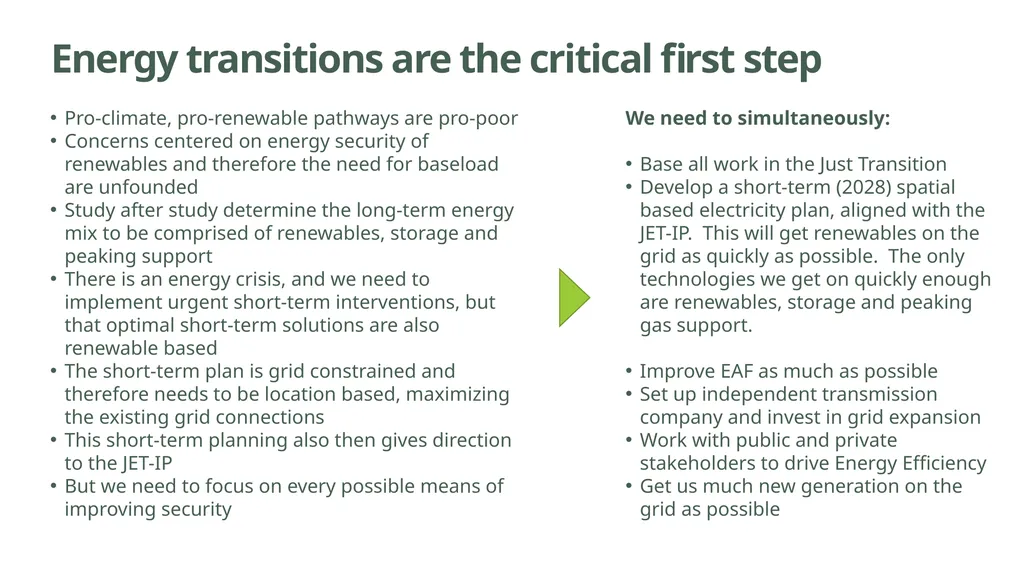
Energy transitions are the critical first step Pro-climate, pro-renewable pathways are pro-poor
Concerns centered on energy security of renewables and therefore the need for baseload are unfounded
Study after study determine the long-term energy mix to be comprised of renewables, storage and peaking support
There is an energy crisis, and we need to implement urgent short-term interventions, but that optimal short-term solutions are also renewable based
The short-term plan is grid constrained and therefore needs to be location based, maximizing the existing grid connections
This short-term planning also then gives direction to the JET-IP
But we need to focus on every possible means of improving security We need to simultaneously:
Base all work in the Just Transition
Develop a short-term (2028) spatial based electricity plan, aligned with the JET-IP. This will get renewables on the grid as quickly as possible. The only technologies we get on quickly enough are renewables, storage and peaking gas support.
Improve EAF as much as possible
Set up independent transmission company and invest in grid expansion
Work with public and private stakeholders to drive Energy Efficiency
Get us much new generation on the grid as possible<br>
Concerns centered on energy security of renewables and therefore the need for baseload are unfounded
Study after study determine the long-term energy mix to be comprised of renewables, storage and peaking support
There is an energy crisis, and we need to implement urgent short-term interventions, but that optimal short-term solutions are also renewable based
The short-term plan is grid constrained and therefore needs to be location based, maximizing the existing grid connections
This short-term planning also then gives direction to the JET-IP
But we need to focus on every possible means of improving security We need to simultaneously:
Base all work in the Just Transition
Develop a short-term (2028) spatial based electricity plan, aligned with the JET-IP. This will get renewables on the grid as quickly as possible. The only technologies we get on quickly enough are renewables, storage and peaking gas support.
Improve EAF as much as possible
Set up independent transmission company and invest in grid expansion
Work with public and private stakeholders to drive Energy Efficiency
Get us much new generation on the grid as possible<br>
10
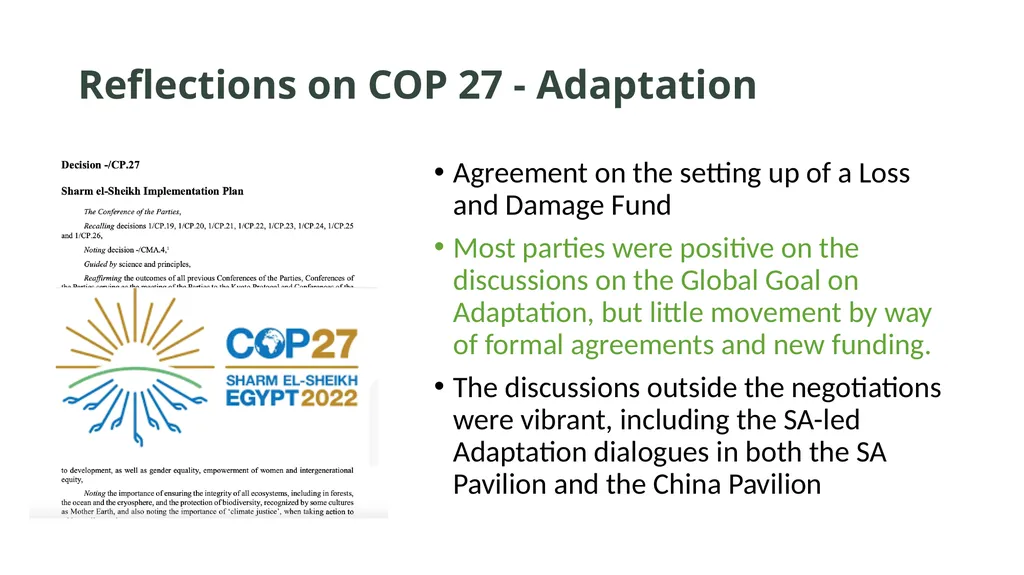
Reflections on COP 27 - Adaptation Agreement on the setting up of a Loss and Damage Fund
Most parties were positive on the discussions on the Global Goal on Adaptation, but little movement by way of formal agreements and new funding.
The discussions outside the negotiations were vibrant, including the SA-led Adaptation dialogues in both the SA Pavilion and the China Pavilion<br>
Most parties were positive on the discussions on the Global Goal on Adaptation, but little movement by way of formal agreements and new funding.
The discussions outside the negotiations were vibrant, including the SA-led Adaptation dialogues in both the SA Pavilion and the China Pavilion<br>
11
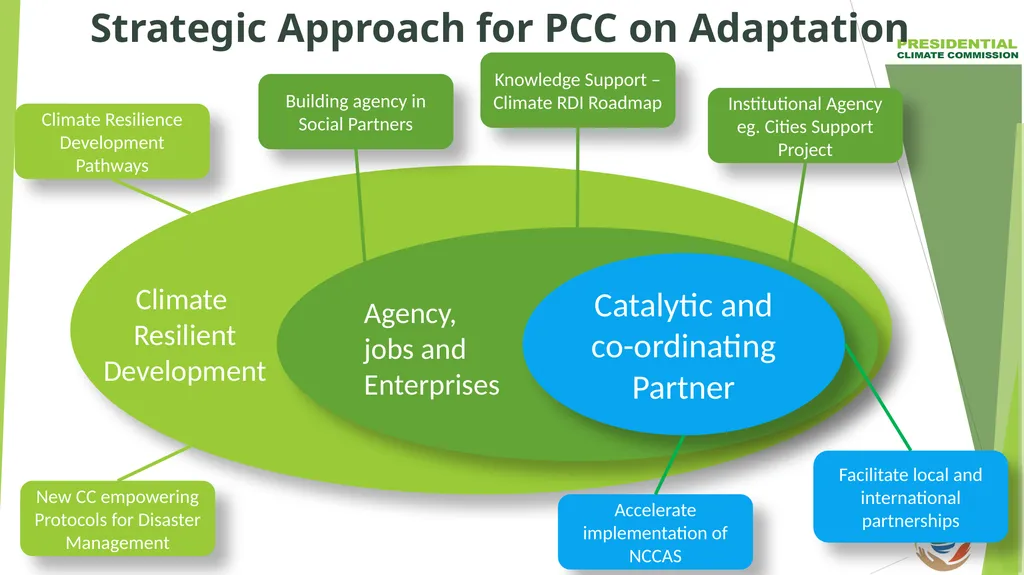
Strategic Approach for PCC on Adaptation Catalytic and co-ordinating Partner Agency,
jobs and
Enterprises Climate
Resilient
Development Knowledge Support – Climate RDI Roadmap Building agency in Social Partners Institutional Agency eg. Cities Support Project Accelerate implementation of NCCAS Facilitate local and international partnerships Climate Resilience Development Pathways New CC empowering Protocols for Disaster Management<br>
jobs and
Enterprises Climate
Resilient
Development Knowledge Support – Climate RDI Roadmap Building agency in Social Partners Institutional Agency eg. Cities Support Project Accelerate implementation of NCCAS Facilitate local and international partnerships Climate Resilience Development Pathways New CC empowering Protocols for Disaster Management<br>
12
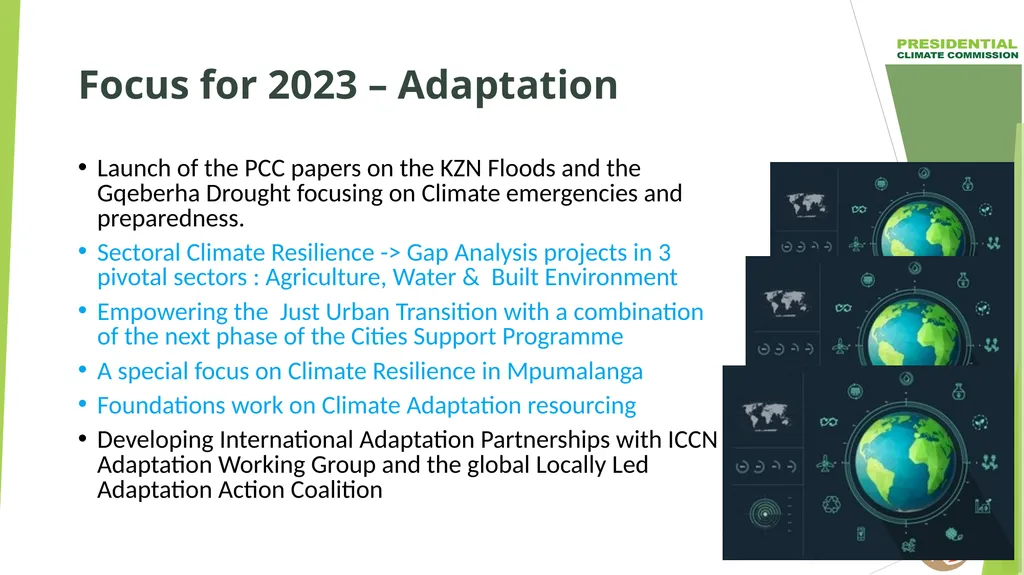
Focus for 2023 – Adaptation Launch of the PCC papers on the KZN Floods and the Gqeberha Drought focusing on Climate emergencies and preparedness.
Sectoral Climate Resilience -> Gap Analysis projects in 3 pivotal sectors : Agriculture, Water & Built Environment
Empowering the Just Urban Transition with a combination of the next phase of the Cities Support Programme
A special focus on Climate Resilience in Mpumalanga
Foundations work on Climate Adaptation resourcing
Developing International Adaptation Partnerships with ICCN Adaptation Working Group and the global Locally Led Adaptation Action Coalition<br>
Sectoral Climate Resilience -> Gap Analysis projects in 3 pivotal sectors : Agriculture, Water & Built Environment
Empowering the Just Urban Transition with a combination of the next phase of the Cities Support Programme
A special focus on Climate Resilience in Mpumalanga
Foundations work on Climate Adaptation resourcing
Developing International Adaptation Partnerships with ICCN Adaptation Working Group and the global Locally Led Adaptation Action Coalition<br>
13
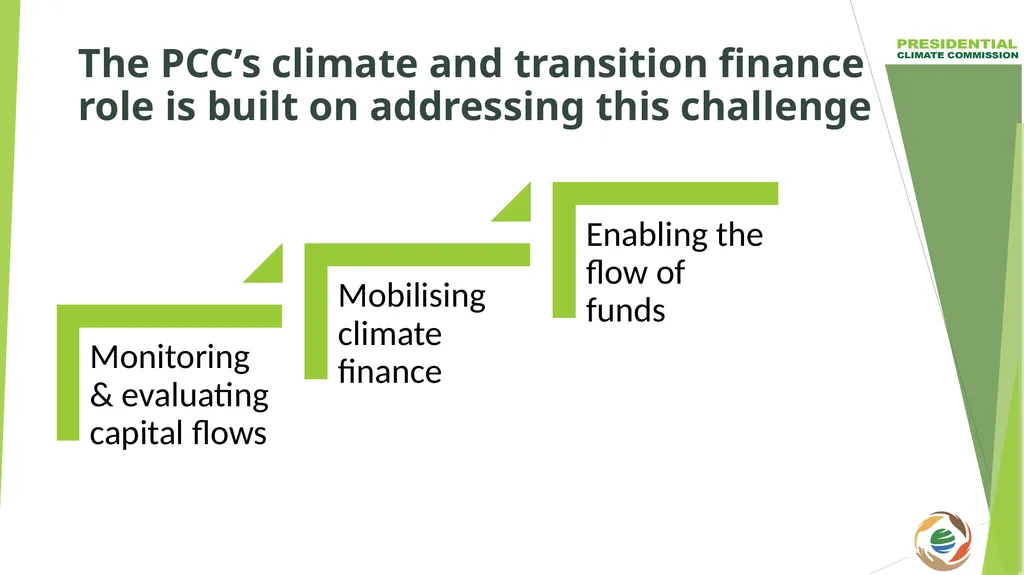
The PCC’s climate and transition finance role is built on addressing this challenge<br>
14
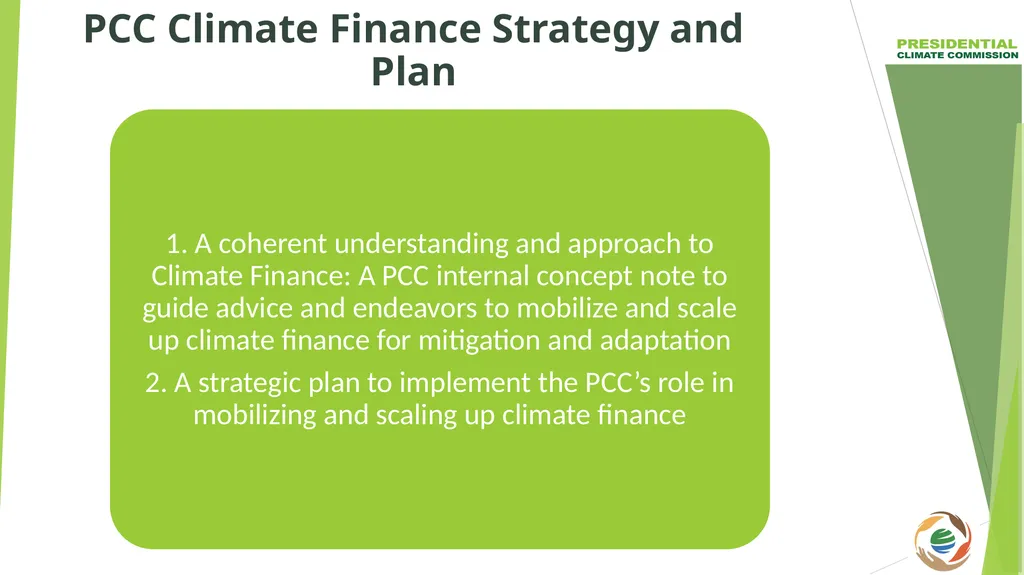
PCC Climate Finance Strategy and Plan<br>
15
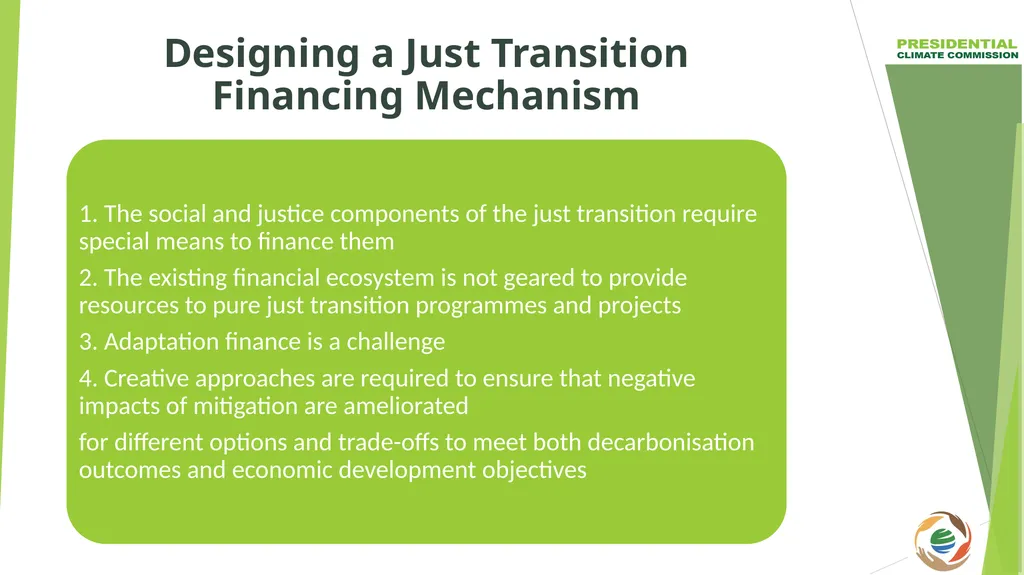
Designing a Just Transition Financing Mechanism<br>
16
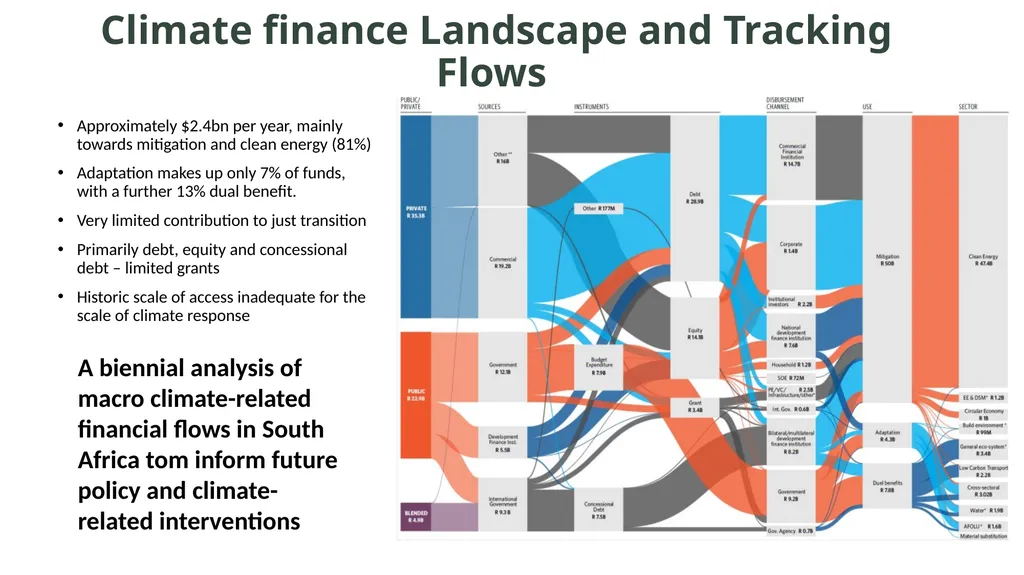
Climate finance Landscape and Tracking Flows Approximately $2.4bn per year, mainly towards mitigation and clean energy (81%)
Adaptation makes up only 7% of funds, with a further 13% dual benefit.
Very limited contribution to just transition
Primarily debt, equity and concessional debt – limited grants
Historic scale of access inadequate for the scale of climate response Chart source: CPI, Green Cape et al, Climate-Finance-Landscape-2020 A biennial analysis of macro climate-related financial flows in South Africa tom inform future policy and climate-related interventions<br>
Adaptation makes up only 7% of funds, with a further 13% dual benefit.
Very limited contribution to just transition
Primarily debt, equity and concessional debt – limited grants
Historic scale of access inadequate for the scale of climate response Chart source: CPI, Green Cape et al, Climate-Finance-Landscape-2020 A biennial analysis of macro climate-related financial flows in South Africa tom inform future policy and climate-related interventions<br>
17
Outreach and Communications SECTORAL CAMPAIGNS AND STAKEHOLDER RELATIONS
Development of Q1 Stakeholder Engagement Plan - Energy Plan, JET-IP and JTF Implementation
Mobilisation Campaign through Arts, Essays and Youth Engagement
Increased consultation of affected and impacted communities
WORKING WITH THE MEDIA
Media Engagement and Capacity Building Q1 of 2023
Capacity Building for Community Radio including targeted programmes co-funded with donors
DIGITAL MEDIA AND CONTENT DEVELOPMENT
Website and Digital Platforms Development ( FB, Twitter, Web, LinkIn .
Zero-Rating ( Data Free) content on platform to increase access to online engagements
Accessibility of PCC reports-local language translation Raise awareness on the science of climate change; its impacts and the opportunities of a just transition .
Educate, inform and mobilize through outreach campaigns to ignite collective action .
Seek platforms to strengthen collaboration, in pursuit of building a national brand for climate action .
Share climate stories, produce credible science-based reports and promote climate initiatives.<br>
Development of Q1 Stakeholder Engagement Plan - Energy Plan, JET-IP and JTF Implementation
Mobilisation Campaign through Arts, Essays and Youth Engagement
Increased consultation of affected and impacted communities
WORKING WITH THE MEDIA
Media Engagement and Capacity Building Q1 of 2023
Capacity Building for Community Radio including targeted programmes co-funded with donors
DIGITAL MEDIA AND CONTENT DEVELOPMENT
Website and Digital Platforms Development ( FB, Twitter, Web, LinkIn .
Zero-Rating ( Data Free) content on platform to increase access to online engagements
Accessibility of PCC reports-local language translation Raise awareness on the science of climate change; its impacts and the opportunities of a just transition .
Educate, inform and mobilize through outreach campaigns to ignite collective action .
Seek platforms to strengthen collaboration, in pursuit of building a national brand for climate action .
Share climate stories, produce credible science-based reports and promote climate initiatives.<br>
18
Monitoring, Reporting & Accountability Climate Change Bill will formalise legal status of PCC and institutionalise reporting and accountability
For time being, PCC reports to Presidency and Ministers for DFFE and DPME
PCC will report to Parliament on an annual basis via Minister DFFE, and PCC plans to be included in Minister’s budget speech
PCC annual report – April 2023
PCC is building systems to enable critical evaluation of progress with climate transition, and is collaborating with DFFE and DPME to avoid duplication of effort<br>
For time being, PCC reports to Presidency and Ministers for DFFE and DPME
PCC will report to Parliament on an annual basis via Minister DFFE, and PCC plans to be included in Minister’s budget speech
PCC annual report – April 2023
PCC is building systems to enable critical evaluation of progress with climate transition, and is collaborating with DFFE and DPME to avoid duplication of effort<br>
19
Thank you Email: thuli@climatecommission.org.za
For further information www.climatecommission.org.za<br>
For further information www.climatecommission.org.za<br>