
Presented By: Jean C. Zenklusen, PhD October 1,

Description: Presented By: Jean C. Zenklusen, PhD October 1, 2015 Center for Cancer Genomics Overview of Mission and Purpose Overview of Mission and Purpose The National Cancer Institutes (NCI) Center for Cancer Genomics (CCG) unifies NCIs activities
Related Topics
Download Presentation
"Presented By: Jean C. Zenklusen, PhD October 1," is the property of its rightful owner. Permission is granted to download and print the materials on this website for personal, non-commercial use only, and to display it on your personal computer provided you do not modify the materials and that you retain all copyright notices contained in the materials. By downloading content from our website, you accept the terms of this agreement.
Presentation Transcript
slide1. Presented By: Jean C. Zenklusen, PhD October 1, 2015 Center for Cancer Genomics<br>
slide2. Overview of Mission and Purpose<br>
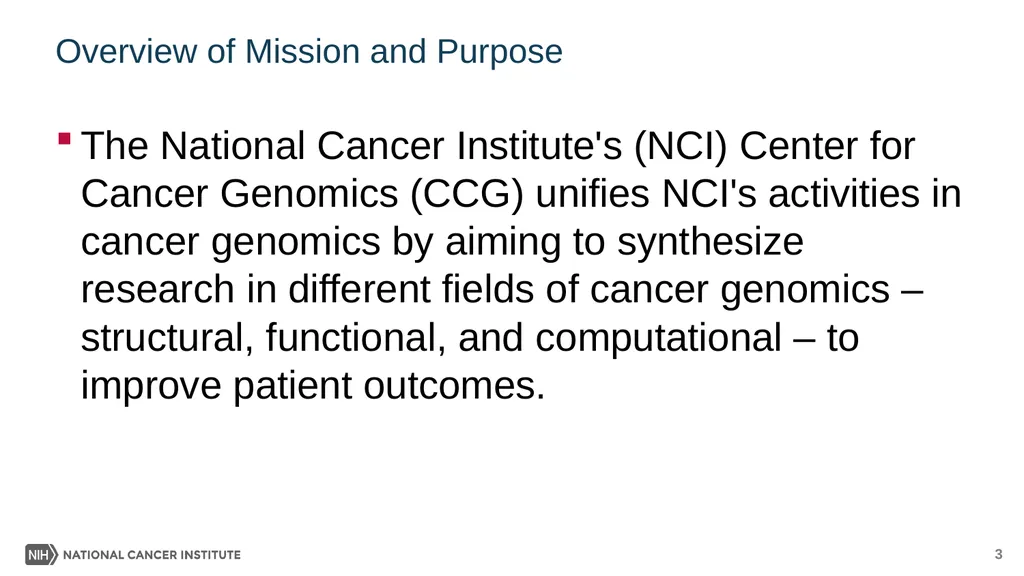
slide3. Overview of Mission and Purpose The National Cancer Institute's (NCI) Center for Cancer Genomics (CCG) unifies NCI's activities in cancer genomics by aiming to synthesize research in different fields of cancer genomics – structural, functional, and computational – to improve patient outcomes.<br>
slide4. Overview of Scientific Work<br>
slide5. Overview of Scientific Work Several Programs are run by CCG offices:
The Cancer Genome Atlas (TCGA)
Therapeutically Applicable Research to Generate Effective Treatments (TARGET)
Cancer Target Discovery and Development (CTD2)
Cancer Driver Discovery Program(CDDP)
Cancer Genome Characterization Initiative (CGCI)<br>
slide6. Overview of Scientific Work Several Programs are run by CCG offices in cooperation with other NCI divisions:
Adjuvant Lung Cancer Enrichment Marker Identification and Sequencing Trial (ALCHEMIST)
Exceptional Responders Initiative (ER)
Clinical Trial Sequencing Program (CTSP)<br>
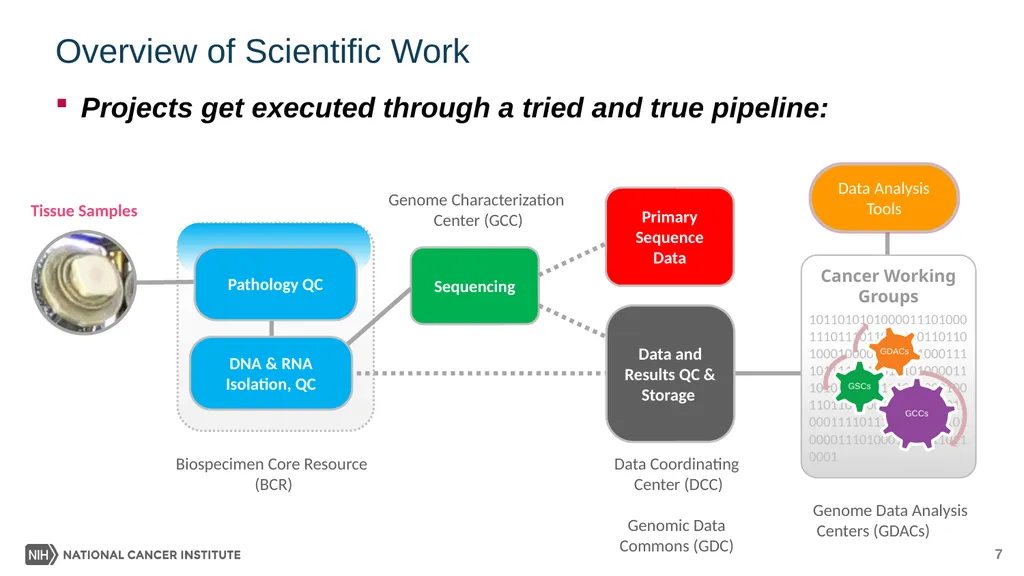
slide7. Projects get executed through a tried and true pipeline: Overview of Scientific Work Sequencing Data and Results QC & Storage Data Analysis Tools Pathology QC DNA & RNA Isolation, QC Primary Sequence Data Biospecimen Core Resource
(BCR) Genome Characterization
Center (GCC) Data Coordinating
Center (DCC)
Genomic Data
Commons (GDC) Genome Data Analysis
Centers (GDACs)<br>
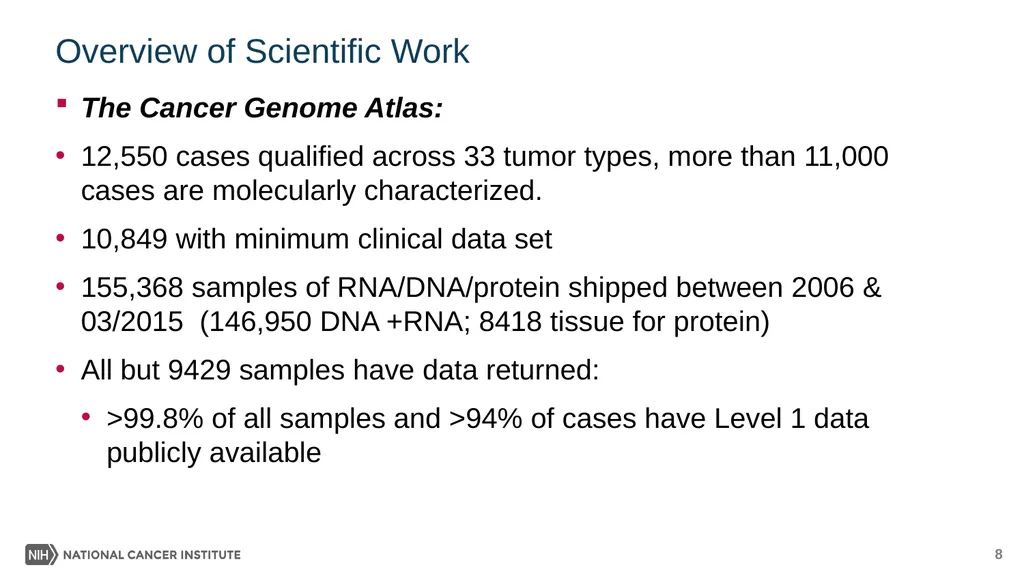
slide8. The Cancer Genome Atlas:
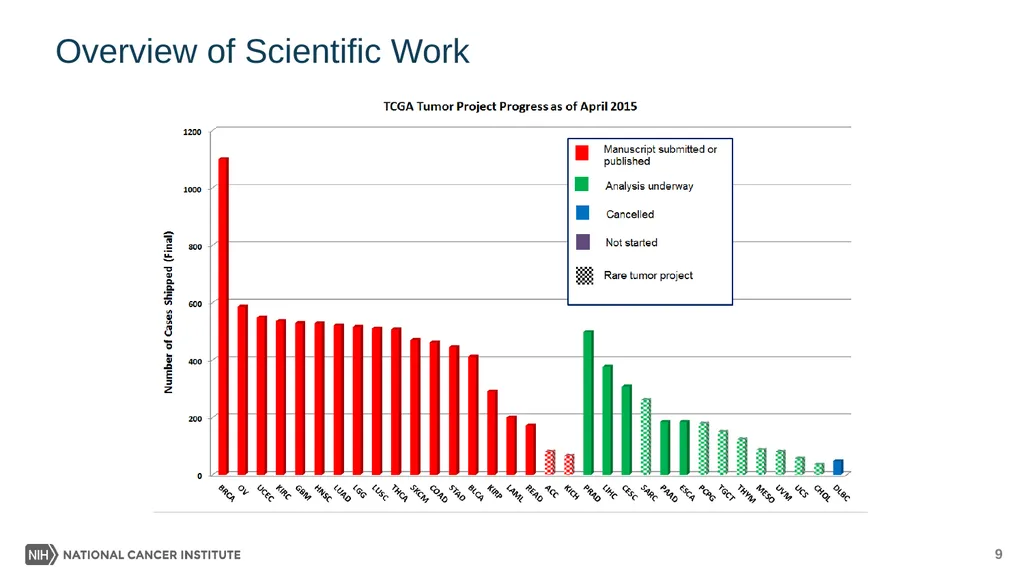
12,550 cases qualified across 33 tumor types, more than 11,000 cases are molecularly characterized.
10,849 with minimum clinical data set
155,368 samples of RNA/DNA/protein shipped between 2006 & 03/2015 (146,950 DNA +RNA; 8418 tissue for protein)
All but 9429 samples have data returned:
>99.8% of all samples and >94% of cases have Level 1 data publicly available Overview of Scientific Work<br>
slide9. Overview of Scientific Work<br>
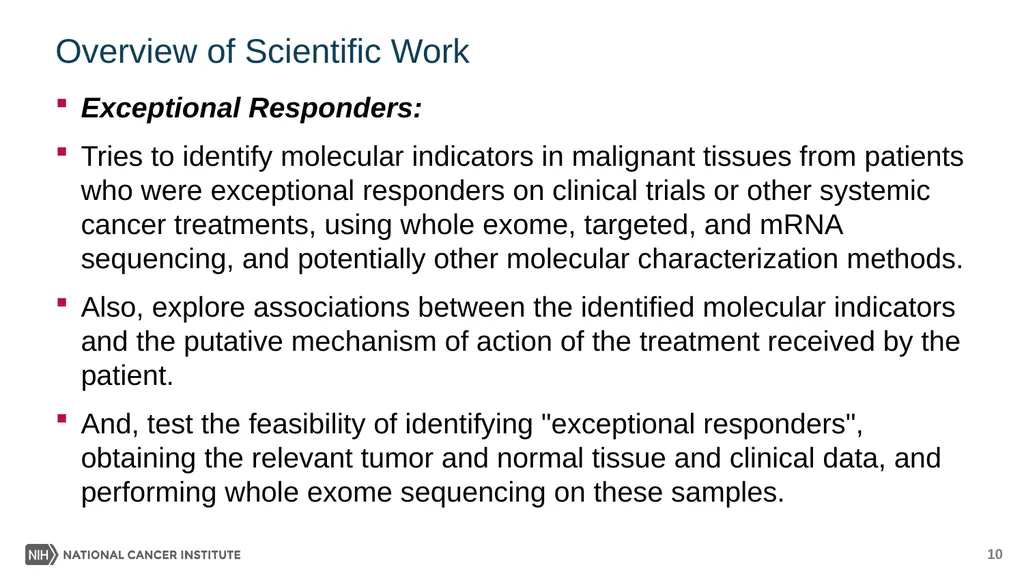
slide10. Exceptional Responders:
Tries to identify molecular indicators in malignant tissues from patients who were exceptional responders on clinical trials or other systemic cancer treatments, using whole exome, targeted, and mRNA sequencing, and potentially other molecular characterization methods.
Also, explore associations between the identified molecular indicators and the putative mechanism of action of the treatment received by the patient.
And, test the feasibility of identifying "exceptional responders", obtaining the relevant tumor and normal tissue and clinical data, and performing whole exome sequencing on these samples. Overview of Scientific Work<br>
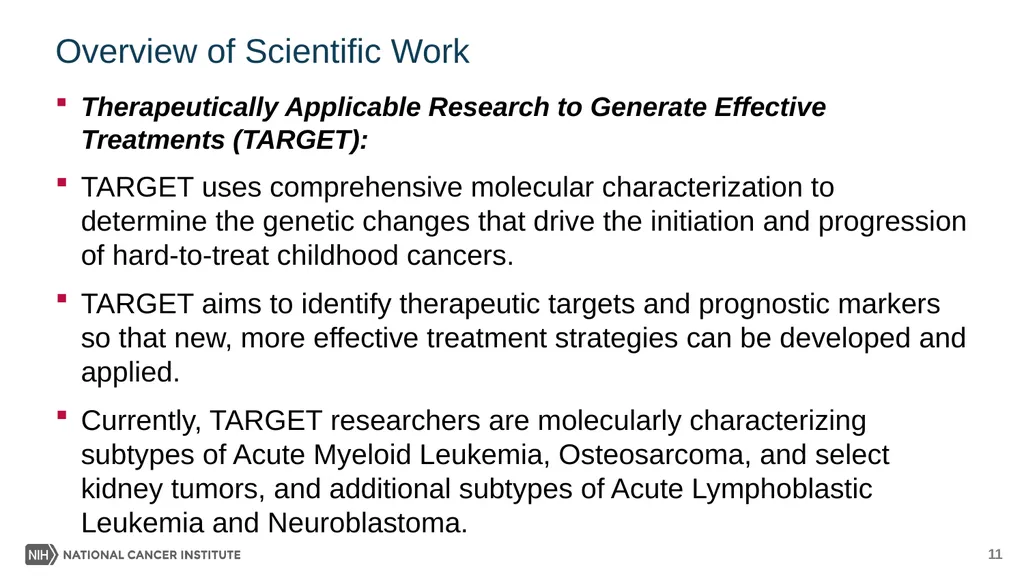
slide11. Therapeutically Applicable Research to Generate Effective Treatments (TARGET):
TARGET uses comprehensive molecular characterization to determine the genetic changes that drive the initiation and progression of hard-to-treat childhood cancers.
TARGET aims to identify therapeutic targets and prognostic markers so that new, more effective treatment strategies can be developed and applied.
Currently, TARGET researchers are molecularly characterizing subtypes of Acute Myeloid Leukemia, Osteosarcoma, and select kidney tumors, and additional subtypes of Acute Lymphoblastic Leukemia and Neuroblastoma. Overview of Scientific Work<br>
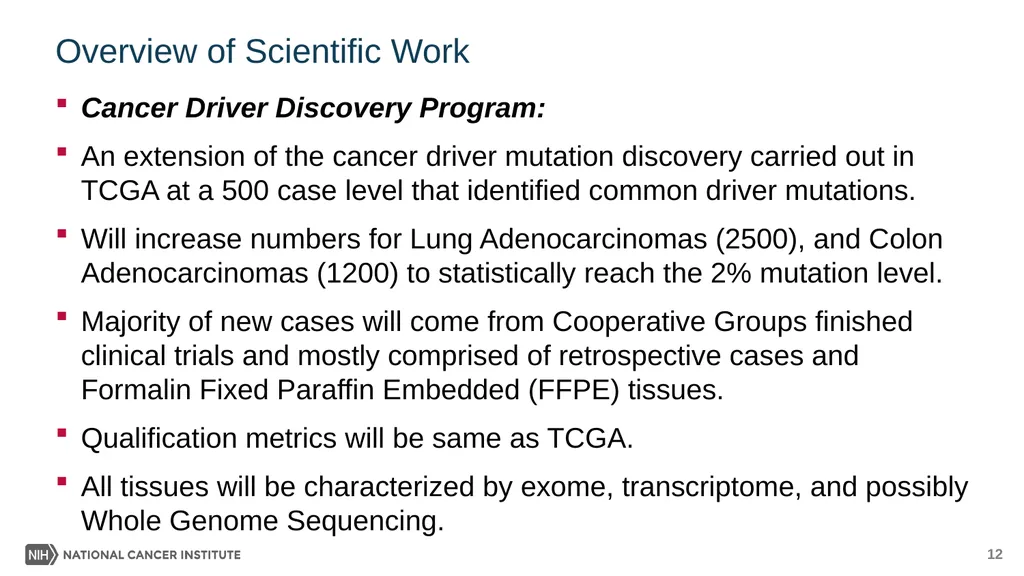
slide12. Cancer Driver Discovery Program:
An extension of the cancer driver mutation discovery carried out in TCGA at a 500 case level that identified common driver mutations.
Will increase numbers for Lung Adenocarcinomas (2500), and Colon Adenocarcinomas (1200) to statistically reach the 2% mutation level.
Majority of new cases will come from Cooperative Groups finished clinical trials and mostly comprised of retrospective cases and Formalin Fixed Paraffin Embedded (FFPE) tissues.
Qualification metrics will be same as TCGA.
All tissues will be characterized by exome, transcriptome, and possibly Whole Genome Sequencing. Overview of Scientific Work<br>
slide13. FNLCR Involvement:
The Frederick National Laboratory for Cancer Research provides support to these Center for Cancer Genomics activities through technical performance monitoring and the issuance and management of subcontracts for the Biospecimen Resource Core, Genomic Characterization Centers and Genomic Data Commons components of the pipeline. Overview of Scientific Work<br>
slide2. Overview of Mission and Purpose<br>
slide3. Overview of Mission and Purpose The National Cancer Institute's (NCI) Center for Cancer Genomics (CCG) unifies NCI's activities in cancer genomics by aiming to synthesize research in different fields of cancer genomics – structural, functional, and computational – to improve patient outcomes.<br>
slide4. Overview of Scientific Work<br>
slide5. Overview of Scientific Work Several Programs are run by CCG offices:
The Cancer Genome Atlas (TCGA)
Therapeutically Applicable Research to Generate Effective Treatments (TARGET)
Cancer Target Discovery and Development (CTD2)
Cancer Driver Discovery Program(CDDP)
Cancer Genome Characterization Initiative (CGCI)<br>
slide6. Overview of Scientific Work Several Programs are run by CCG offices in cooperation with other NCI divisions:
Adjuvant Lung Cancer Enrichment Marker Identification and Sequencing Trial (ALCHEMIST)
Exceptional Responders Initiative (ER)
Clinical Trial Sequencing Program (CTSP)<br>
slide7. Projects get executed through a tried and true pipeline: Overview of Scientific Work Sequencing Data and Results QC & Storage Data Analysis Tools Pathology QC DNA & RNA Isolation, QC Primary Sequence Data Biospecimen Core Resource
(BCR) Genome Characterization
Center (GCC) Data Coordinating
Center (DCC)
Genomic Data
Commons (GDC) Genome Data Analysis
Centers (GDACs)<br>
slide8. The Cancer Genome Atlas:
12,550 cases qualified across 33 tumor types, more than 11,000 cases are molecularly characterized.
10,849 with minimum clinical data set
155,368 samples of RNA/DNA/protein shipped between 2006 & 03/2015 (146,950 DNA +RNA; 8418 tissue for protein)
All but 9429 samples have data returned:
>99.8% of all samples and >94% of cases have Level 1 data publicly available Overview of Scientific Work<br>
slide9. Overview of Scientific Work<br>
slide10. Exceptional Responders:
Tries to identify molecular indicators in malignant tissues from patients who were exceptional responders on clinical trials or other systemic cancer treatments, using whole exome, targeted, and mRNA sequencing, and potentially other molecular characterization methods.
Also, explore associations between the identified molecular indicators and the putative mechanism of action of the treatment received by the patient.
And, test the feasibility of identifying "exceptional responders", obtaining the relevant tumor and normal tissue and clinical data, and performing whole exome sequencing on these samples. Overview of Scientific Work<br>
slide11. Therapeutically Applicable Research to Generate Effective Treatments (TARGET):
TARGET uses comprehensive molecular characterization to determine the genetic changes that drive the initiation and progression of hard-to-treat childhood cancers.
TARGET aims to identify therapeutic targets and prognostic markers so that new, more effective treatment strategies can be developed and applied.
Currently, TARGET researchers are molecularly characterizing subtypes of Acute Myeloid Leukemia, Osteosarcoma, and select kidney tumors, and additional subtypes of Acute Lymphoblastic Leukemia and Neuroblastoma. Overview of Scientific Work<br>
slide12. Cancer Driver Discovery Program:
An extension of the cancer driver mutation discovery carried out in TCGA at a 500 case level that identified common driver mutations.
Will increase numbers for Lung Adenocarcinomas (2500), and Colon Adenocarcinomas (1200) to statistically reach the 2% mutation level.
Majority of new cases will come from Cooperative Groups finished clinical trials and mostly comprised of retrospective cases and Formalin Fixed Paraffin Embedded (FFPE) tissues.
Qualification metrics will be same as TCGA.
All tissues will be characterized by exome, transcriptome, and possibly Whole Genome Sequencing. Overview of Scientific Work<br>
slide13. FNLCR Involvement:
The Frederick National Laboratory for Cancer Research provides support to these Center for Cancer Genomics activities through technical performance monitoring and the issuance and management of subcontracts for the Biospecimen Resource Core, Genomic Characterization Centers and Genomic Data Commons components of the pipeline. Overview of Scientific Work<br>