
Presenting Your Medicaid Fair Hearing Angela Gerig
PM
Published · 30 slides · 0 views

1 / 1



Description
Presenting Your Medicaid Fair Hearing Angela Gerig Caldwell, Senior Staff Attorney Community and Healthcare Services October 2024 1 Accessibility 2 Caption Options ASL Closed Captions: CC button at the bottom of the screen External
Related Topics
Share
Embed code
Download this presentation From Below
"Presenting Your Medicaid Fair Hearing Angela Gerig" is the property of its rightful owner. Permission is granted to download and print the materials on this website for personal, non-commercial use only, and to display it on your personal computer provided you do not modify the materials and that you retain all copyright notices contained in the materials. By downloading content from our website, you accept the terms of this agreement.
Presentation Transcript
01
Presenting Your Medicaid Fair Hearing Angela Gerig Caldwell,
Senior Staff Attorney
Community and Healthcare Services
October 2024 1<br>
Senior Staff Attorney
Community and Healthcare Services
October 2024 1<br>
02
Accessibility 2<br>
03
Caption Options & ASL Closed Captions: CC button at the bottom of the screen
External Caption Viewer: Link provided in the chat
ASL Interpreters: Spotlighted on your screen 3<br>
External Caption Viewer: Link provided in the chat
ASL Interpreters: Spotlighted on your screen 3<br>
04
Submitting Questions & Recording Q and A button: Located at the bottom of the screen
Email: Webinar@DisabilityRightsFlorida.org
You can submit questions at any time. We will answer them throughout the webinar.
This webinar will be recorded and posted on our website and YouTube channel. 4<br>
Email: Webinar@DisabilityRightsFlorida.org
You can submit questions at any time. We will answer them throughout the webinar.
This webinar will be recorded and posted on our website and YouTube channel. 4<br>
05
About DRF & Agenda 5<br>
06
Disability Rights Florida Funding, responsibility, and authority under nine federal programs to protect the rights of Floridians with disabilities.
A not-for-profit corporation since 1987.
Offices in Tallahassee, Tampa, Gainesville and Fort Lauderdale.
Many of our professionals work remotely throughout the state of Florida. 6<br>
A not-for-profit corporation since 1987.
Offices in Tallahassee, Tampa, Gainesville and Fort Lauderdale.
Many of our professionals work remotely throughout the state of Florida. 6<br>
07
Our Mission Disability Rights Florida advocates, educates, investigates, and litigates to protect and advance the rights, dignity, equal opportunities, self-determination, and choices for all people with disabilities. 7<br>
08
Agenda Preparing for a Fair Hearing
Documentation and Evidence Submission
Presenting your Case
Procedure of Fair Hearings and What to Expect
Questions 8<br>
Documentation and Evidence Submission
Presenting your Case
Procedure of Fair Hearings and What to Expect
Questions 8<br>
09
Preparing for a Fair Hearing Disability Rights Florida’s Advocacy 101 is a manual designed to assist individuals in preparing for a Medicaid case before:
Florida Division of Administrative Hearings (DOAH)
The Florida Office of Fair Hearings (OFH - Agency for Health Care Administration)
The Florida Office of Appeal Hearings (OAH - Department of Children and Families)
Available online: https://disabilityrightsflorida.org/disability-topics/disability_topic_info/advocacy_101_challenging_an_agencys_denial_or_reduction_of_your_medicaid_se 9<br>
10
The Office of Fair Hearings The Office of Fair Hearings (OFH) is part of the Agency for Health Care Administration.
OFH employs hearing officers who conduct hearings in cases affecting Medicaid fee-for-service and managed care recipients.
OFH Website: https://flmedicaidmanagedcare.com/home/medicaidfairhearing 10<br>
OFH employs hearing officers who conduct hearings in cases affecting Medicaid fee-for-service and managed care recipients.
OFH Website: https://flmedicaidmanagedcare.com/home/medicaidfairhearing 10<br>
11
The Office of Appeal Hearings The Office of Appeal Hearings (OAH) is part of the Florida Department of Children and Families’ Office of Inspector General.
OAH employs full-time hearing officers who conduct hearings in cases where a state agency, such as the Agency for Persons with Disabilities (APD) or the Department of Children and Families (DCF), makes a decision which unfavorably affects a person’s rights or benefits.
OAH website: https://www.myflfamilies.com/about-us/office-inspector-general/appeal-hearings/ 11<br>
12
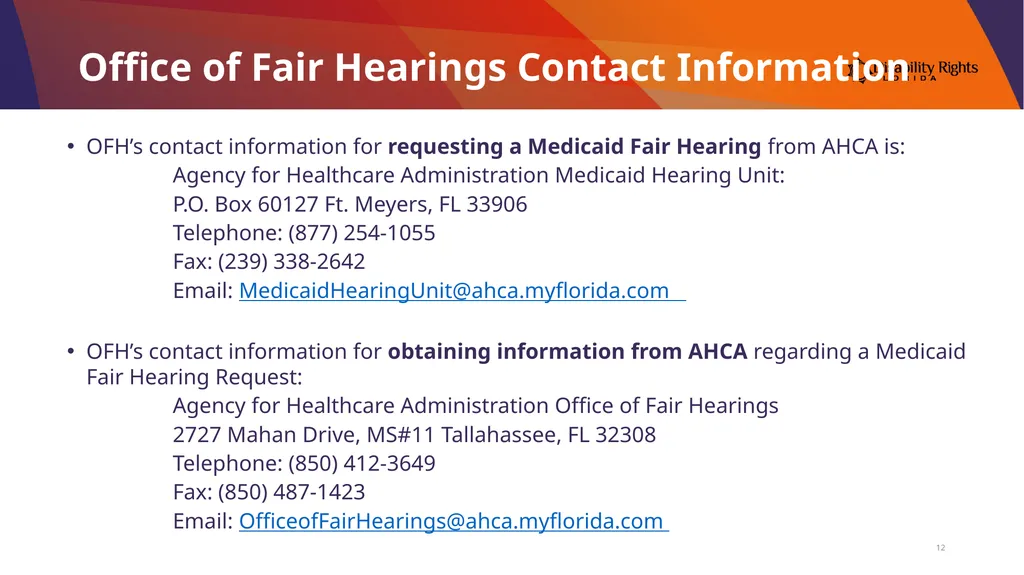
Office of Fair Hearings Contact Information OFH’s contact information for requesting a Medicaid Fair Hearing from AHCA is:
Agency for Healthcare Administration Medicaid Hearing Unit:
P.O. Box 60127 Ft. Meyers, FL 33906
Telephone: (877) 254-1055
Fax: (239) 338-2642
Email: MedicaidHearingUnit@ahca.myflorida.com
OFH’s contact information for obtaining information from AHCA regarding a Medicaid Fair Hearing Request:
Agency for Healthcare Administration Office of Fair Hearings
2727 Mahan Drive, MS#11 Tallahassee, FL 32308
Telephone: (850) 412-3649
Fax: (850) 487-1423
Email: OfficeofFairHearings@ahca.myflorida.com 12<br>
13
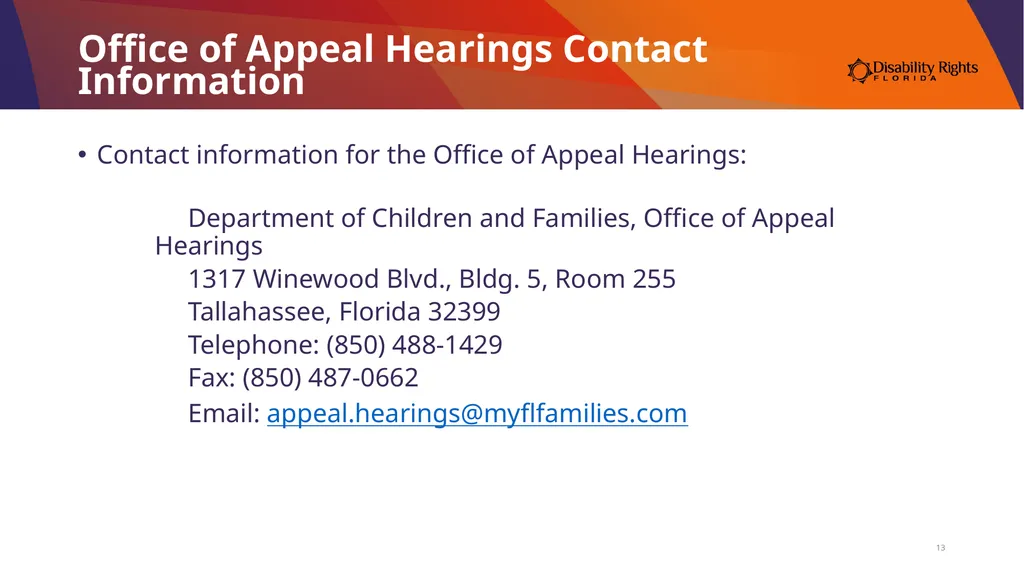
Office of Appeal Hearings Contact Information Contact information for the Office of Appeal Hearings:
Department of Children and Families, Office of Appeal Hearings
1317 Winewood Blvd., Bldg. 5, Room 255
Tallahassee, Florida 32399
Telephone: (850) 488-1429
Fax: (850) 487-0662
Email: appeal.hearings@myflfamilies.com 13<br>
Department of Children and Families, Office of Appeal Hearings
1317 Winewood Blvd., Bldg. 5, Room 255
Tallahassee, Florida 32399
Telephone: (850) 488-1429
Fax: (850) 487-0662
Email: appeal.hearings@myflfamilies.com 13<br>
14
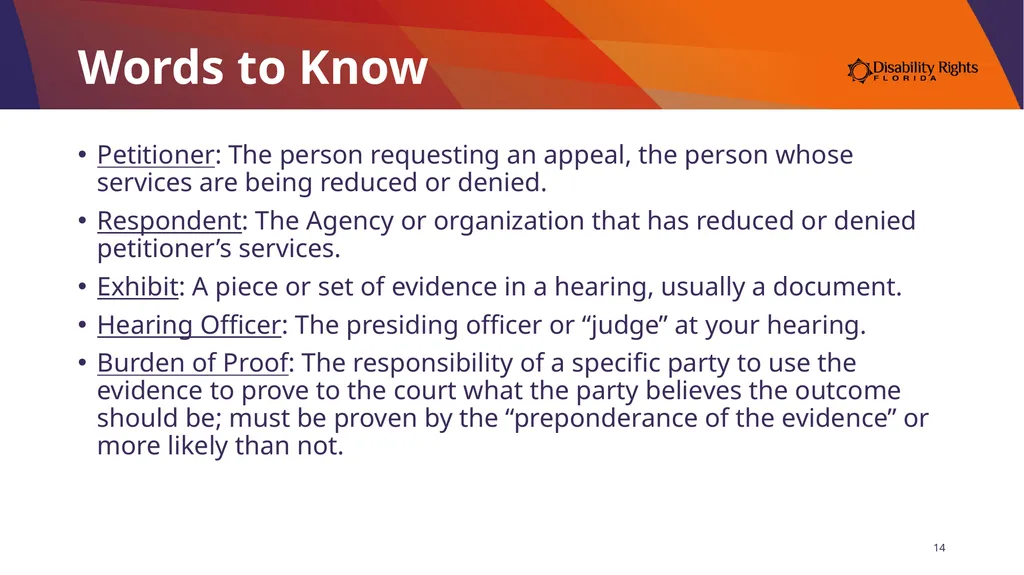
Words to Know Petitioner: The person requesting an appeal, the person whose services are being reduced or denied.
Respondent: The Agency or organization that has reduced or denied petitioner’s services.
Exhibit: A piece or set of evidence in a hearing, usually a document.
Hearing Officer: The presiding officer or “judge” at your hearing.
Burden of Proof: The responsibility of a specific party to use the evidence to prove to the court what the party believes the outcome should be; must be proven by the “preponderance of the evidence” or more likely than not. 14<br>
15
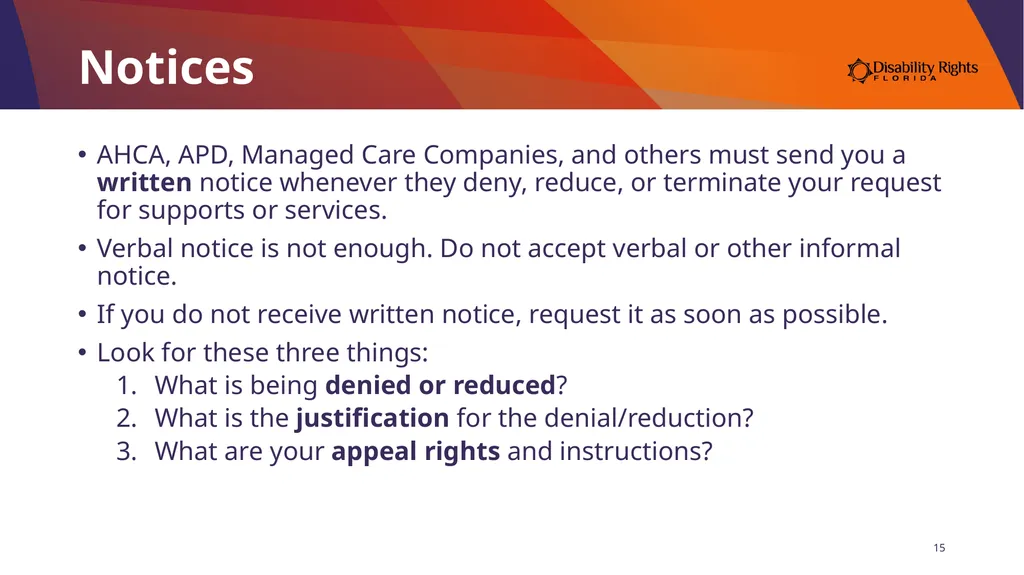
Notices AHCA, APD, Managed Care Companies, and others must send you a written notice whenever they deny, reduce, or terminate your request for supports or services.
Verbal notice is not enough. Do not accept verbal or other informal notice.
If you do not receive written notice, request it as soon as possible.
Look for these three things:
What is being denied or reduced?
What is the justification for the denial/reduction?
What are your appeal rights and instructions? 15<br>
16
Requesting an Appeal (1 of 2) Follow instructions in the Notice.
The deadline for requesting an appeal varies depending on the Agency, but it should be clearly stated on the Notice you receive. 16<br>
The deadline for requesting an appeal varies depending on the Agency, but it should be clearly stated on the Notice you receive. 16<br>
17
Requesting an Appeal (2 of 2) Be sure to make it clear if you wish to continue to receive services pending the outcome of your appeal. The deadline for requesting to continue to receive services may be different than the deadline to request an appeal and will be clearly stated on the Notice you receive. Sometimes you must request continued services immediately following the adverse decision.
Make a written request by email, fax, or mail for the appeal if possible, and save a dated copy of this request.
Medicaid Managed Care plans and the Office of Fair Hearings utilize verbal requests for fair hearings. Write down the date, time, and name of the staff you speak with when making a verbal request. 17<br>
18
Key Differences When
Requesting an Appeal (1 of 2) There are key differences in the appeals process for each Agency and Managed Care Company
When appealing a “Notice of Adverse Benefit Determination” from a Medicaid Managed Care Company (Managed Medicaid Assistance (MMA) or Long-Term Care (LTC) Waiver), you must submit a “Plan Appeal” and receive a “Notice of Plan Appeal Resolution” before you can request a Fair Hearing which is conducted by the Office of Fair Hearings. 18<br>
When appealing a “Notice of Adverse Benefit Determination” from a Medicaid Managed Care Company (Managed Medicaid Assistance (MMA) or Long-Term Care (LTC) Waiver), you must submit a “Plan Appeal” and receive a “Notice of Plan Appeal Resolution” before you can request a Fair Hearing which is conducted by the Office of Fair Hearings. 18<br>
19
Key Differences When
Requesting an Appeal (2 of 2) When appealing a “Notice of Outcome” from eQHealth Solutions, you can request a reconsideration, but this is not mandatory. You can request a Fair Hearing without requesting a reconsideration. The Fair Hearing is conducted by the Office of Fair Hearings.
When appealing a Notice from the Agency for Persons with Disabilities (APD), there is no reconsideration or secondary review. The request for Fair Hearing will be submitted to APD directly. The Fair Hearing is conducted by the Office of Appeal Hearings. 19<br>
When appealing a Notice from the Agency for Persons with Disabilities (APD), there is no reconsideration or secondary review. The request for Fair Hearing will be submitted to APD directly. The Fair Hearing is conducted by the Office of Appeal Hearings. 19<br>
20
Documentation and Evidence Submission You should get a scheduling order from OFH or OAH stating when and where the hearing will be held, along with directions for submitting evidence prior to the fair hearing.
In order to determine what documentation and evidence you may want to submit to the hearing office to support your case, you’ll need to research the laws and rules that affect your case.
Speak with witnesses and gather additional evidence to support your position/arguments at fair hearing. 20<br>
In order to determine what documentation and evidence you may want to submit to the hearing office to support your case, you’ll need to research the laws and rules that affect your case.
Speak with witnesses and gather additional evidence to support your position/arguments at fair hearing. 20<br>
21
Evidence and Witnesses Evidence can include medical records, school records, letters of medical necessity, letters of support from family, friends, or professionals, provider notes, etc.
Witnesses can be anyone with specific knowledge about the subject of the hearing and may include your physician, a provider, a case manager, family members, etc.
Prepare your testimony and talk to your witness(es) about their testimony.
You may request additional information or documentation from the Agency through the “discovery” process.
If you need more time to prepare for your fair hearing, you can request a “continuance” from the Hearing Officer via email but be sure to copy opposing counsel. 21<br>
22
Motion for Continuance A “Continuance” is what a hearing office may grant to delay proceedings until a later date.
You must communicate with the Respondent’s representative prior to requesting the Continuance from the Hearing Officer to ask if they agree or disagree with your request
Your Request for Continuance to the Hearing Officer must include a “Conferral Statement”
A “Conferral Statement” is your statement to the Hearing Officer that you contacted Respondent’s representative to get their input on your request for continuance.
Exp. I emailed Respondent’s representative, and they do not object to the Continuance. 22<br>
23
Presenting your Case (1 of 2) All witnesses will be sworn in prior to the fair hearing commencing.
Both parties will then give opening statements, summarizing their view of the case facts and issues before the hearing officer.
Whichever party is assigned the burden of proof for the fair hearing will present their case first.
Each side will be able to call witnesses, elicit testimony, offer documents into evidence, and cross examine the other party’s witnesses.
The hearing officer will also get a chance to ask any additional questions of witnesses that they may feel are needed for clarification of the issues. 23<br>
24
Presenting your Case (2 of 2) You should plan your arguments prior to fair hearing and start by calling witnesses that will bolster your strongest arguments.
Make sure all the evidence you want the hearing officer to consider is properly offered and accepted into evidence at the fair hearing.
It’s okay to ask for a break to collect your thoughts or slow down if you elicit testimony you weren’t prepared for.
When Respondent is presenting their case, you may use objections and state them clearly on the record.
This preserves certain issues for appeal
Do not let objections stress you out, but research the most used ones prior to fair hearing so that you are able to use them, if needed 24<br>
25
Procedure of Fair Hearings
and What to Expect The hearing will be telephonic for OFH.
The hearing can be telephonic or in-person (at your request) for OAH.
The Hearing Officer, Petitioner or their representative, Agency area staff and potentially an Agency attorney will be present.
Approach the hearing and your arguments from a logical and rational, not emotional, standpoint.
Let the Hearing Officer guide the proceedings, but do not be afraid to speak up. 25<br>
26
Requesting Accommodations Contact OAH or OFH by phone or email to request an accommodation for your hearing.
You should make this request as early as possible and at least 7 days prior to your hearing date. 26<br>
You should make this request as early as possible and at least 7 days prior to your hearing date. 26<br>
27
What Happens Next? Both sides will give closing statements once all testimony has been taken
The hearing officer may allow for proposed final orders to be submitted in writing prior to their final determination
After a few weeks, you will receive a written decision from the hearing officer, called a Final Order.
Read the Final Order carefully to determine what has been affirmed and/or what has been denied. 27<br>
28
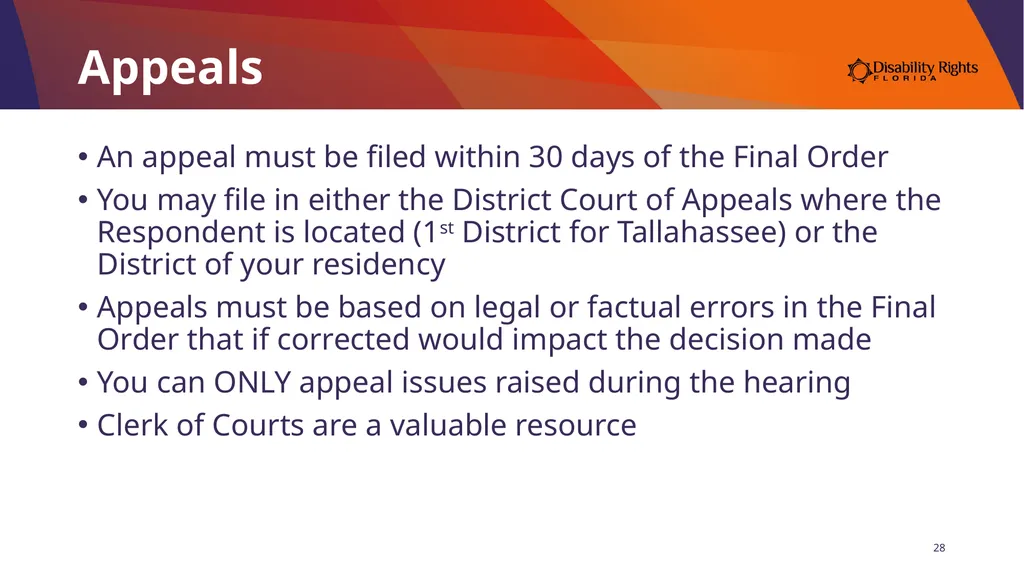
Appeals An appeal must be filed within 30 days of the Final Order
You may file in either the District Court of Appeals where the Respondent is located (1st District for Tallahassee) or the District of your residency
Appeals must be based on legal or factual errors in the Final Order that if corrected would impact the decision made
You can ONLY appeal issues raised during the hearing
Clerk of Courts are a valuable resource 28<br>
29
Questions?
Please contact Disability Rights Florida at: 2473 Care Drive, Suite 200
Tallahassee, Florida 32308
800.342.0823 • TDD 800.346.4127
www.DisabilityRightsFlorida.org 29<br>
30
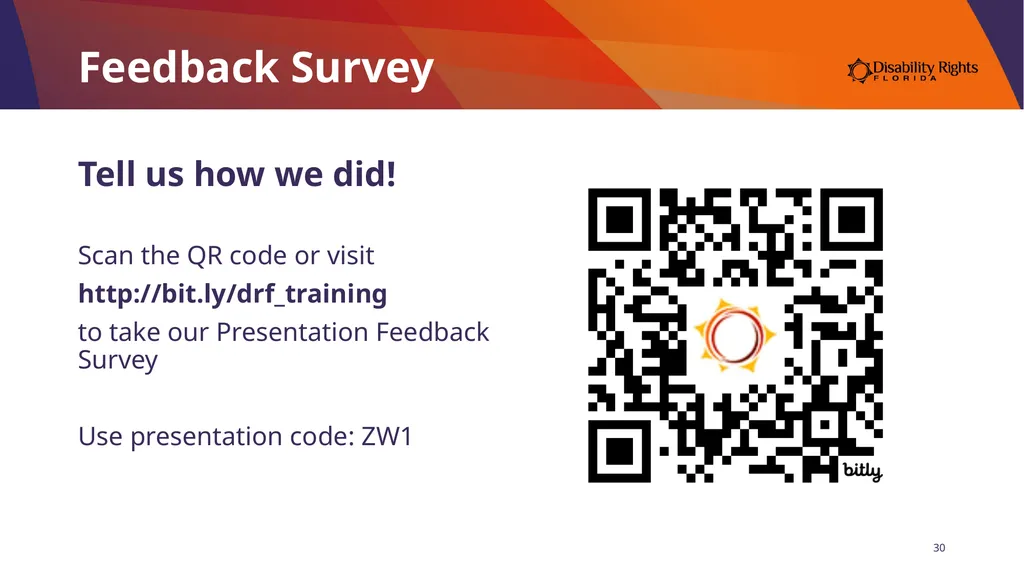
Feedback Survey Tell us how we did!
Scan the QR code or visit
http://bit.ly/drf_training
to take our Presentation Feedback Survey
Use presentation code: ZW1 30<br>
Scan the QR code or visit
http://bit.ly/drf_training
to take our Presentation Feedback Survey
Use presentation code: ZW1 30<br>