
Pressure Injuries using SSKIN Care Worker Training
JO
Published · 24 slides · 0 views
1 / 1

Description
Pressure Injuries using SSKIN Care Worker Training Module Created by the Te Waipounamu South Island Aged Residential Care Pressure Injury Prevention Working Group 2025 Presenter: Mandy Pagan CNS Wound Health NZ Southern Learning
Related Topics
Share
Embed code
Download this presentation From Below
"Pressure Injuries using SSKIN Care Worker Training" is the property of its rightful owner. Permission is granted to download and print the materials on this website for personal, non-commercial use only, and to display it on your personal computer provided you do not modify the materials and that you retain all copyright notices contained in the materials. By downloading content from our website, you accept the terms of this agreement.
Presentation Transcript
01
Pressure Injuries
using SSKIN Care Worker Training Module
Created by the Te Waipounamu | South Island Aged Residential Care Pressure Injury Prevention Working Group 2025
Presenter: Mandy Pagan CNS Wound Health NZ Southern<br>
using SSKIN Care Worker Training Module
Created by the Te Waipounamu | South Island Aged Residential Care Pressure Injury Prevention Working Group 2025
Presenter: Mandy Pagan CNS Wound Health NZ Southern<br>
02
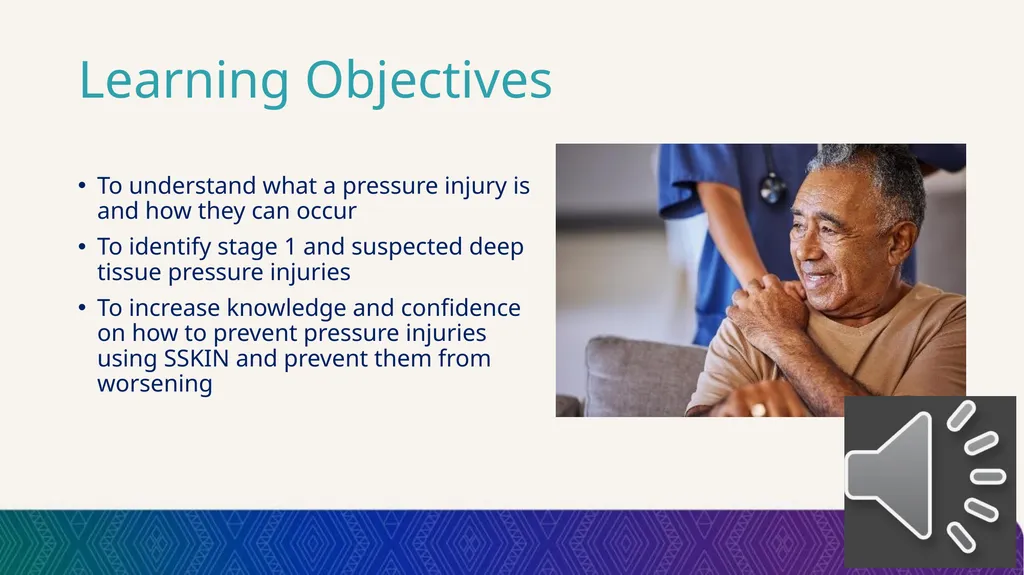
Learning Objectives To understand what a pressure injury is and how they can occur
To identify stage 1 and suspected deep tissue pressure injuries
To increase knowledge and confidence on how to prevent pressure injuries using SSKIN and prevent them from worsening<br>
To identify stage 1 and suspected deep tissue pressure injuries
To increase knowledge and confidence on how to prevent pressure injuries using SSKIN and prevent them from worsening<br>
03
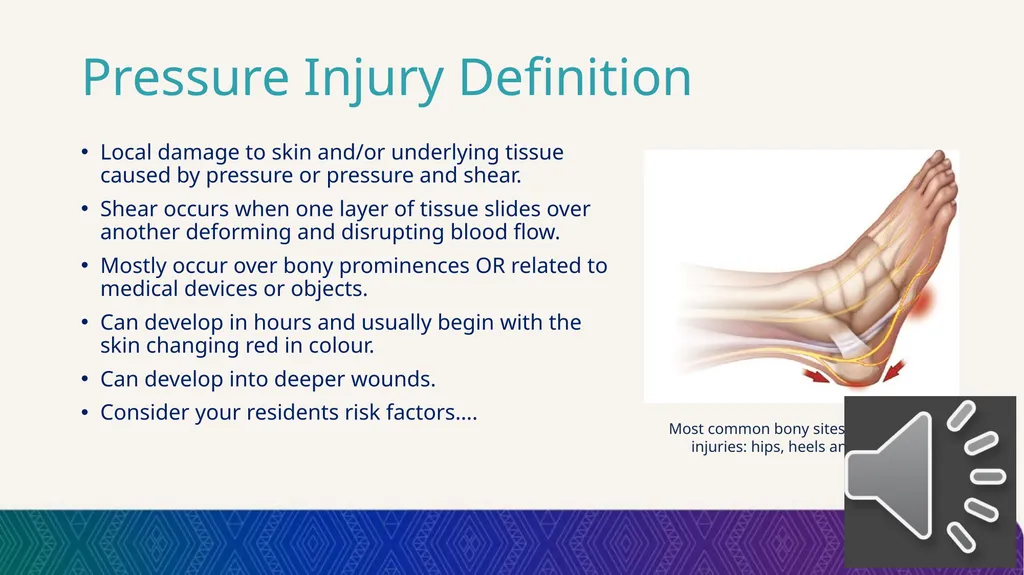
Pressure Injury Definition Local damage to skin and/or underlying tissue caused by pressure or pressure and shear.
Shear occurs when one layer of tissue slides over another deforming and disrupting blood flow.
Mostly occur over bony prominences OR related to medical devices or objects.
Can develop in hours and usually begin with the skin changing red in colour.
Can develop into deeper wounds.
Consider your residents risk factors…. Most common bony sites for pressure injuries: hips, heels and sacrum<br>
04
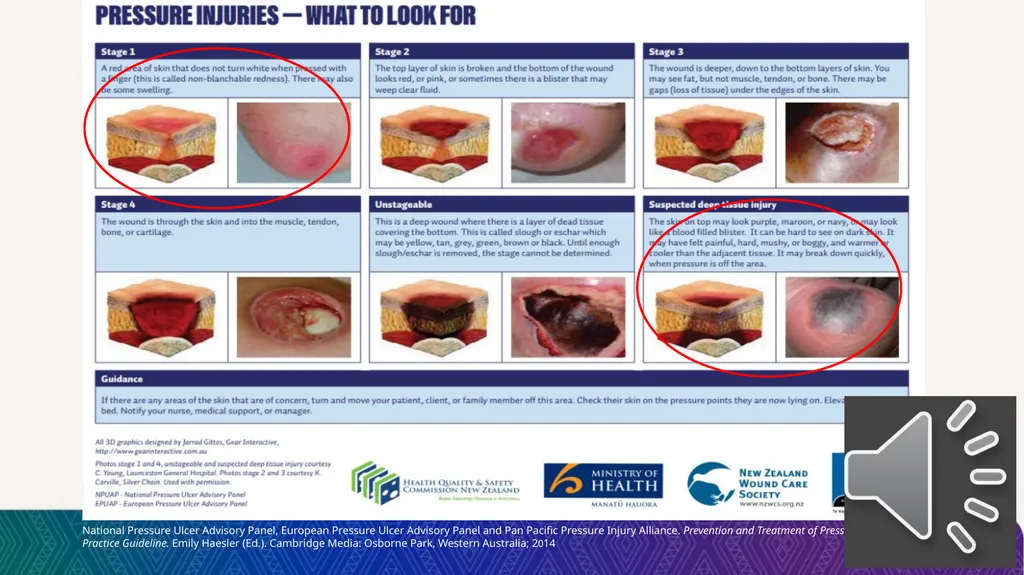
National Pressure Ulcer Advisory Panel, European Pressure Ulcer Advisory Panel and Pan Pacific Pressure Injury Alliance. Prevention and Treatment of Pressure Ulcers: Clinical Practice Guideline. Emily Haesler (Ed.). Cambridge Media: Osborne Park, Western Australia; 2014<br>
05
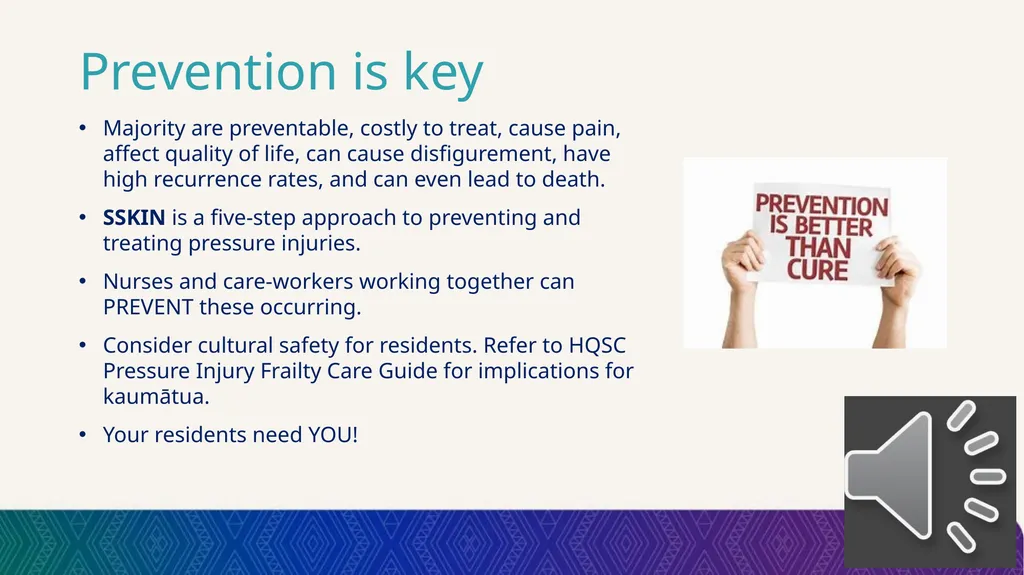
Prevention is key Majority are preventable, costly to treat, cause pain, affect quality of life, can cause disfigurement, have high recurrence rates, and can even lead to death.
SSKIN is a five-step approach to preventing and treating pressure injuries.
Nurses and care-workers working together can PREVENT these occurring.
Consider cultural safety for residents. Refer to HQSC Pressure Injury Frailty Care Guide for implications for kaumātua.
Your residents need YOU!<br>
SSKIN is a five-step approach to preventing and treating pressure injuries.
Nurses and care-workers working together can PREVENT these occurring.
Consider cultural safety for residents. Refer to HQSC Pressure Injury Frailty Care Guide for implications for kaumātua.
Your residents need YOU!<br>
06
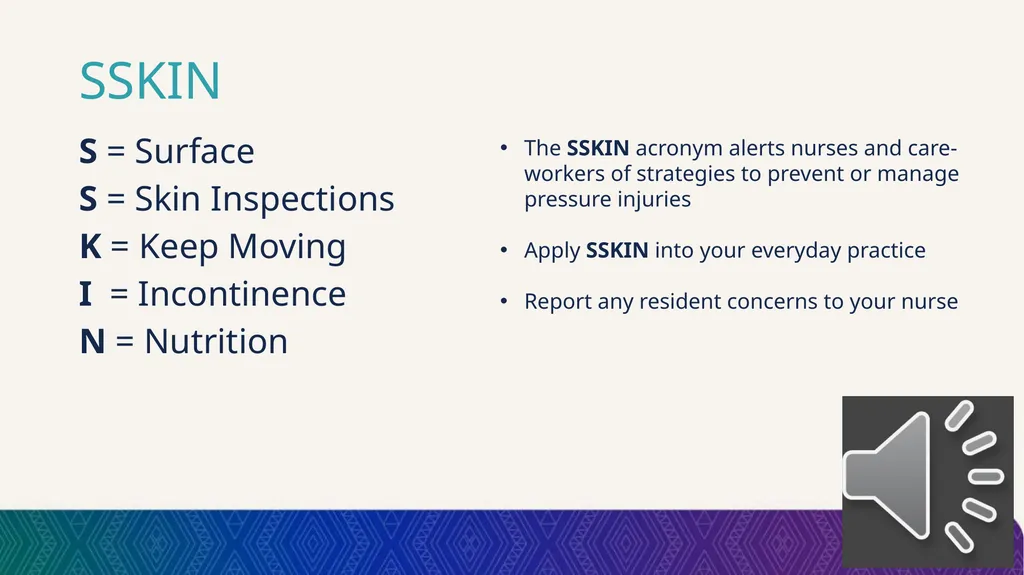
SSKIN S = Surface
S = Skin Inspections
K = Keep Moving
I = Incontinence
N = Nutrition The SSKIN acronym alerts nurses and care-workers of strategies to prevent or manage pressure injuries
Apply SSKIN into your everyday practice
Report any resident concerns to your nurse<br>
S = Skin Inspections
K = Keep Moving
I = Incontinence
N = Nutrition The SSKIN acronym alerts nurses and care-workers of strategies to prevent or manage pressure injuries
Apply SSKIN into your everyday practice
Report any resident concerns to your nurse<br>
07
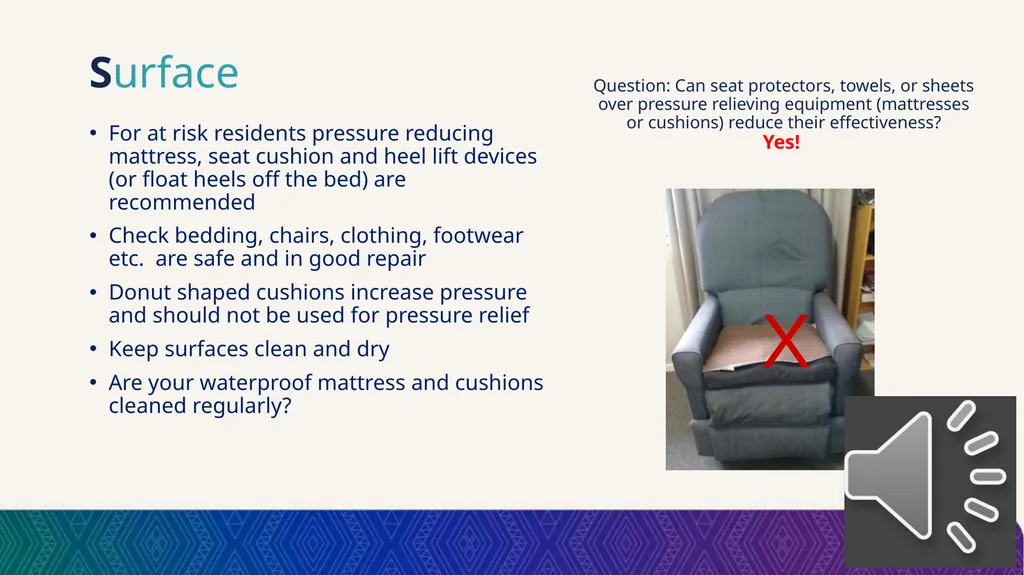
Surface For at risk residents pressure reducing mattress, seat cushion and heel lift devices (or float heels off the bed) are recommended
Check bedding, chairs, clothing, footwear etc. are safe and in good repair
Donut shaped cushions increase pressure and should not be used for pressure relief
Keep surfaces clean and dry
Are your waterproof mattress and cushions cleaned regularly? Question: Can seat protectors, towels, or sheets over pressure relieving equipment (mattresses or cushions) reduce their effectiveness?
Yes! X<br>
08
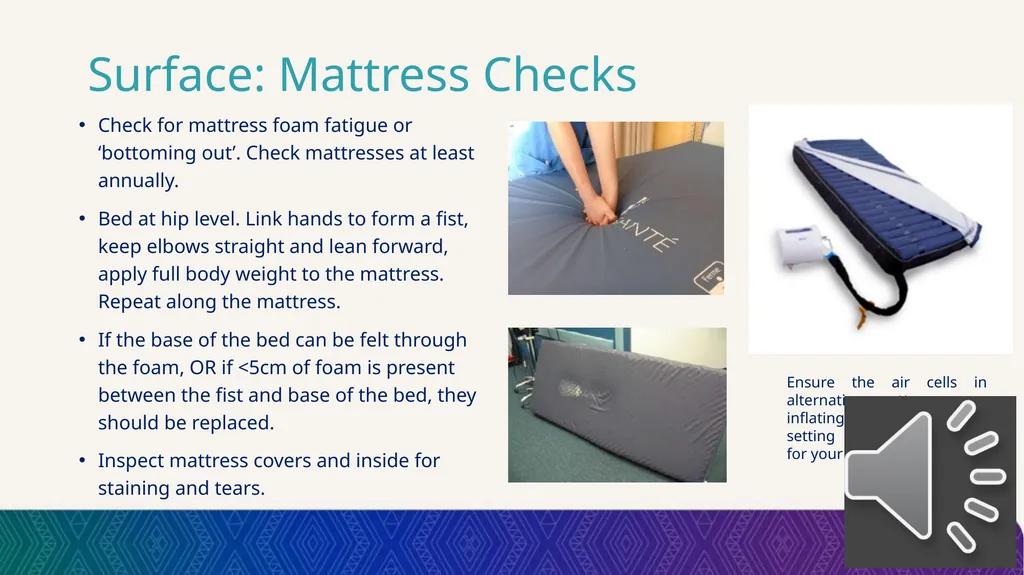
Surface: Mattress Checks Check for mattress foam fatigue or ‘bottoming out’. Check mattresses at least annually.
Bed at hip level. Link hands to form a fist, keep elbows straight and lean forward, apply full body weight to the mattress. Repeat along the mattress.
If the base of the bed can be felt through the foam, OR if <5cm of foam is present between the fist and base of the bed, they should be replaced.
Inspect mattress covers and inside for staining and tears. Ensure the air cells in alternating mattresses are inflating, on the correct setting and is comfortable for your resident.<br>
09
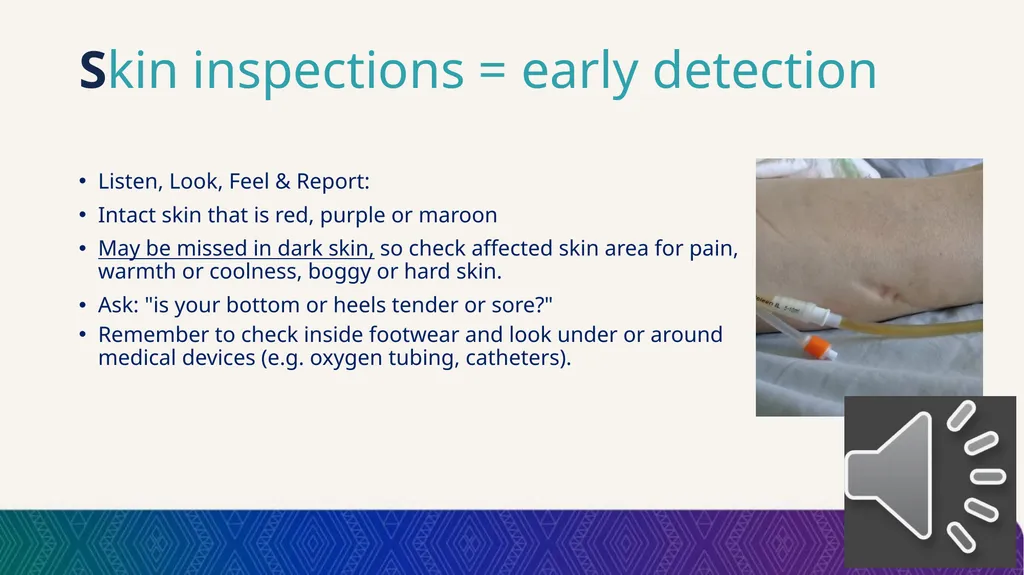
Skin inspections = early detection Listen, Look, Feel & Report:
Intact skin that is red, purple or maroon
May be missed in dark skin, so check affected skin area for pain, warmth or coolness, boggy or hard skin.
Ask: "is your bottom or heels tender or sore?"
Remember to check inside footwear and look under or around medical devices (e.g. oxygen tubing, catheters).<br>
10
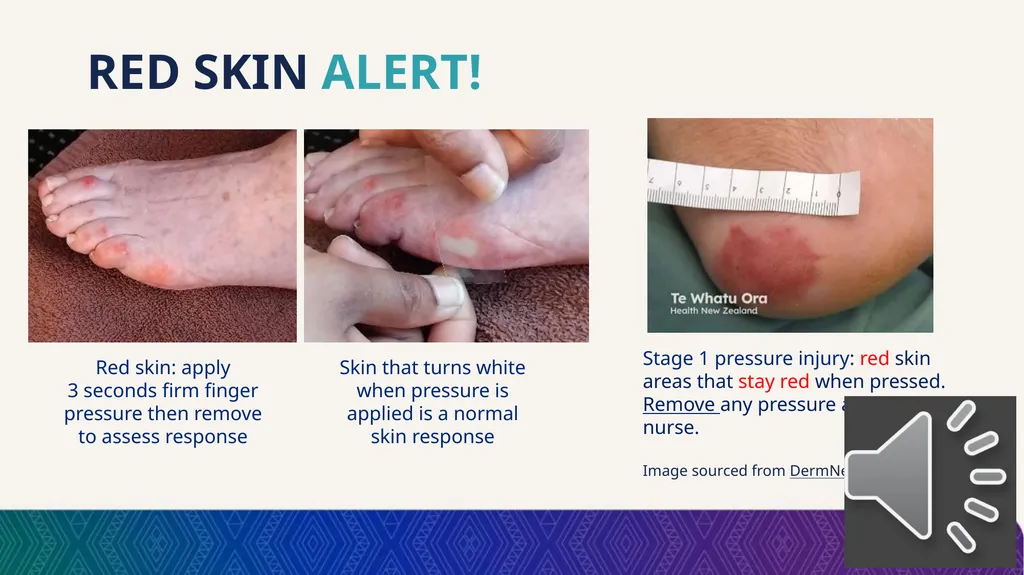
RED SKIN ALERT! Stage 1 pressure injury: red skin areas that stay red when pressed. Remove any pressure and inform the nurse.
Image sourced from DermNet Red skin: apply 3 seconds firm finger pressure then remove to assess response Skin that turns white when pressure is applied is a normal skin response<br>
Image sourced from DermNet Red skin: apply 3 seconds firm finger pressure then remove to assess response Skin that turns white when pressure is applied is a normal skin response<br>
11
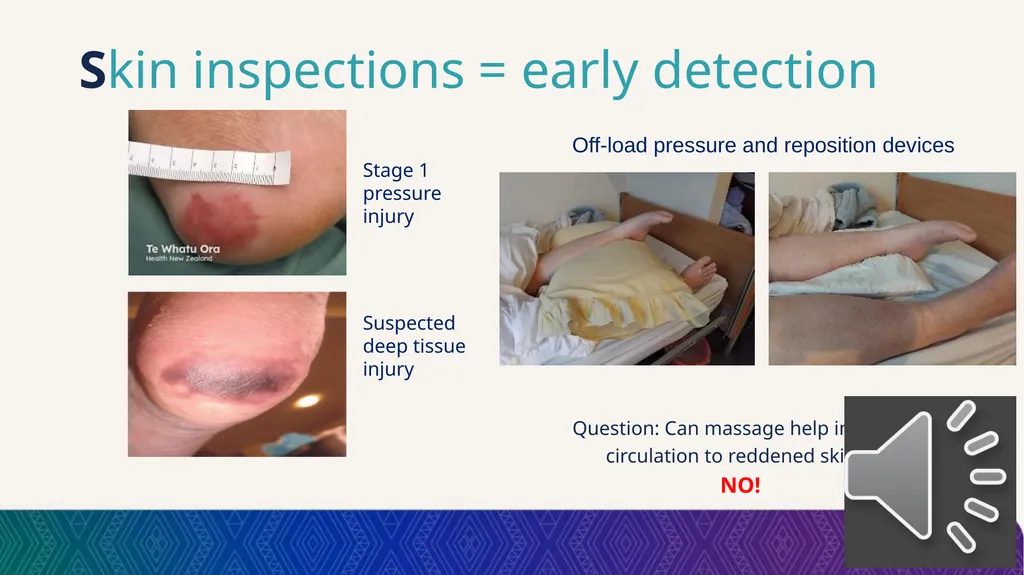
Skin inspections = early detection Suspected deep tissue injury Stage 1 pressure injury Question: Can massage help improve circulation to reddened skin?
NO! Off-load pressure and reposition devices<br>
NO! Off-load pressure and reposition devices<br>
12
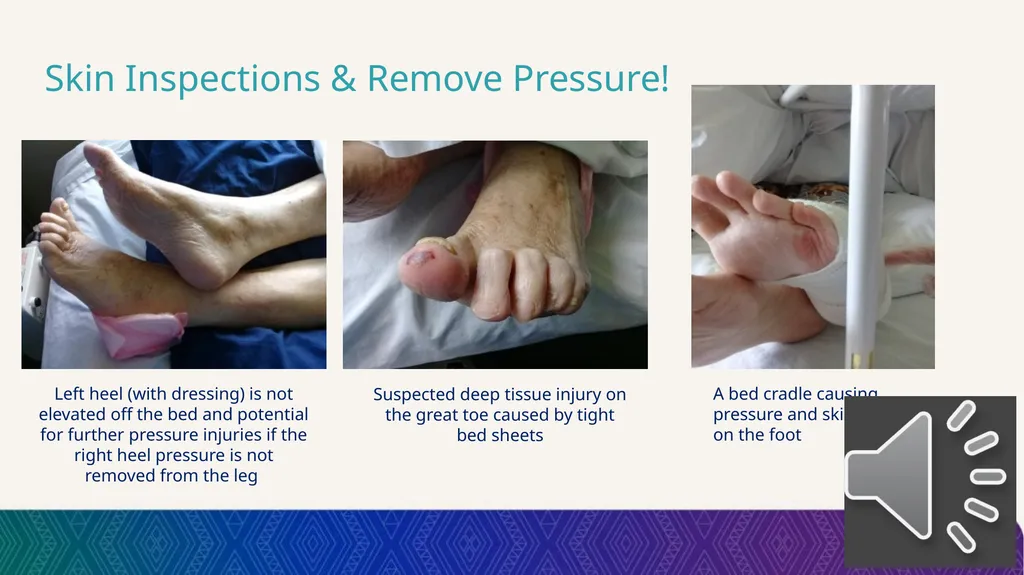
Skin Inspections & Remove Pressure! A bed cradle causing pressure and skin redness on the foot Left heel (with dressing) is not elevated off the bed and potential for further pressure injuries if the right heel pressure is not removed from the leg Suspected deep tissue injury on the great toe caused by tight bed sheets<br>
13
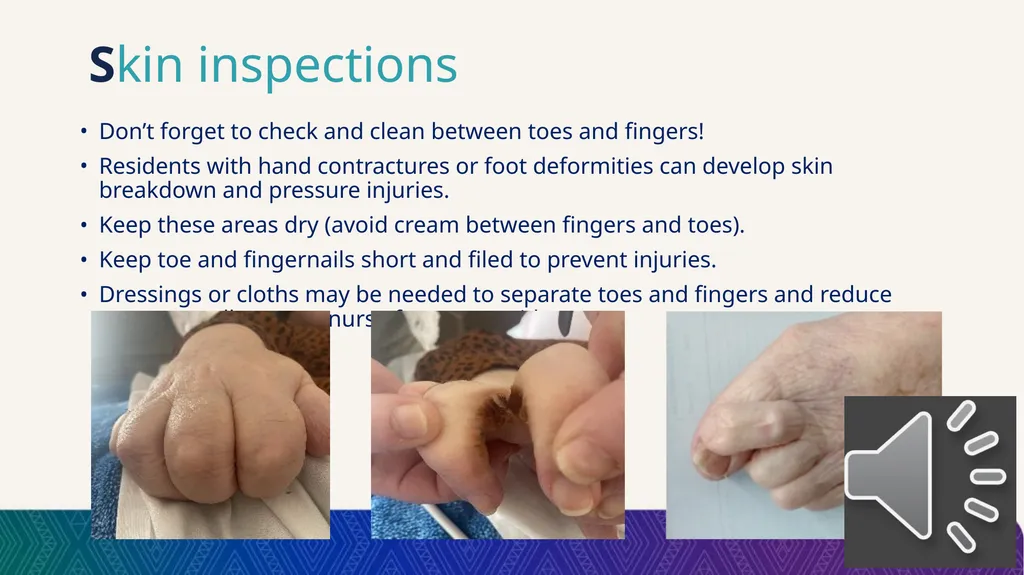
Skin inspections Don’t forget to check and clean between toes and fingers!
Residents with hand contractures or foot deformities can develop skin breakdown and pressure injuries.
Keep these areas dry (avoid cream between fingers and toes).
Keep toe and fingernails short and filed to prevent injuries.
Dressings or cloths may be needed to separate toes and fingers and reduce pressure, talk to your nurse for more guidance.<br>
14
Keep Moving Residents unable to reposition themselves or are immobile are most at risk for pressure injuries.
Regular movement or turning redistributes pressure, improves blood flow to the affected area and helps prevent skin damage.
Safe Handling: Use x2 ‘slide-sheets’ to reduce friction & shear.
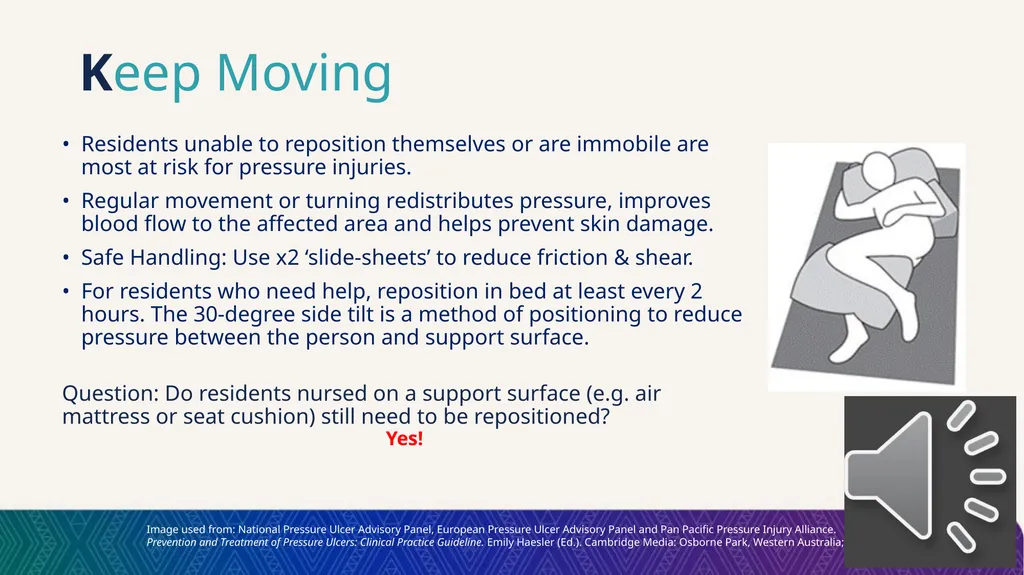
For residents who need help, reposition in bed at least every 2 hours. The 30-degree side tilt is a method of positioning to reduce pressure between the person and support surface.
Question: Do residents nursed on a support surface (e.g. air mattress or seat cushion) still need to be repositioned?
Yes! Image used from: National Pressure Ulcer Advisory Panel, European Pressure Ulcer Advisory Panel and Pan Pacific Pressure Injury Alliance. Prevention and Treatment of Pressure Ulcers: Clinical Practice Guideline. Emily Haesler (Ed.). Cambridge Media: Osborne Park, Western Australia; 2014<br>
15
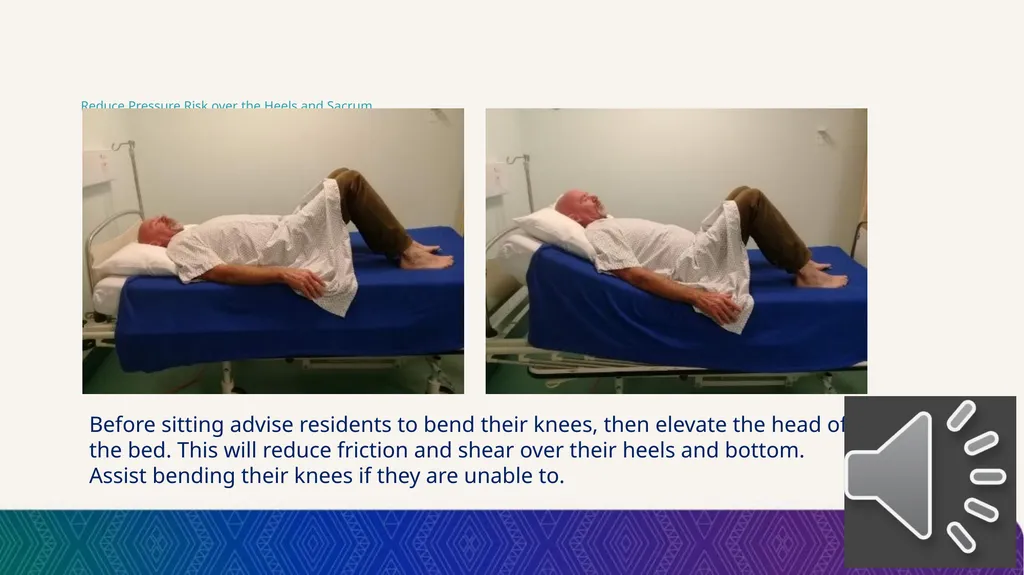
Reduce Pressure Risk over the Heels and Sacrum Before sitting advise residents to bend their knees, then elevate the head of the bed. This will reduce friction and shear over their heels and bottom. Assist bending their knees if they are unable to.<br>
16
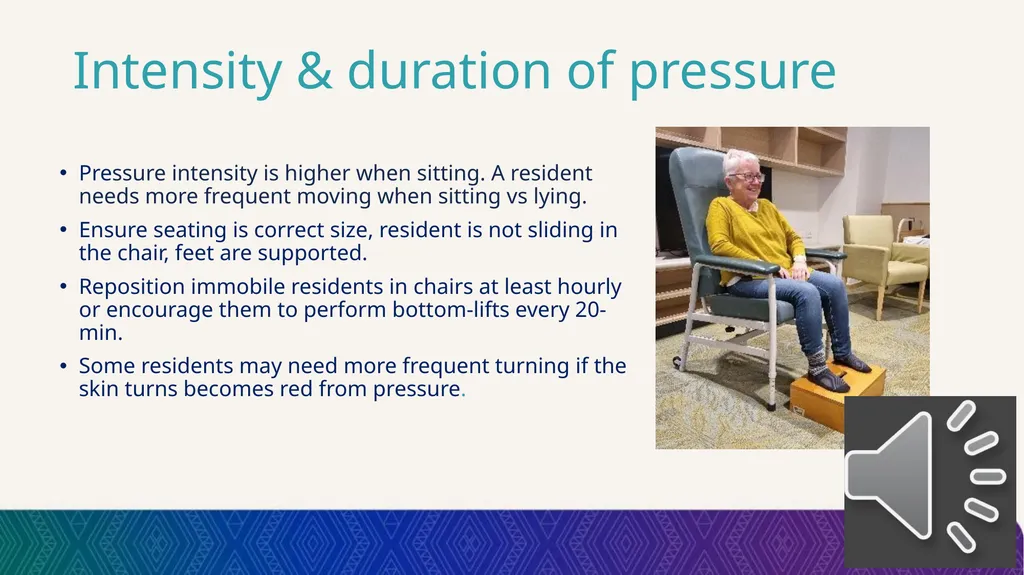
Intensity & duration of pressure Pressure intensity is higher when sitting. A resident needs more frequent moving when sitting vs lying.
Ensure seating is correct size, resident is not sliding in the chair, feet are supported.
Reposition immobile residents in chairs at least hourly or encourage them to perform bottom-lifts every 20-min.
Some residents may need more frequent turning if the skin turns becomes red from pressure.<br>
Ensure seating is correct size, resident is not sliding in the chair, feet are supported.
Reposition immobile residents in chairs at least hourly or encourage them to perform bottom-lifts every 20-min.
Some residents may need more frequent turning if the skin turns becomes red from pressure.<br>
17
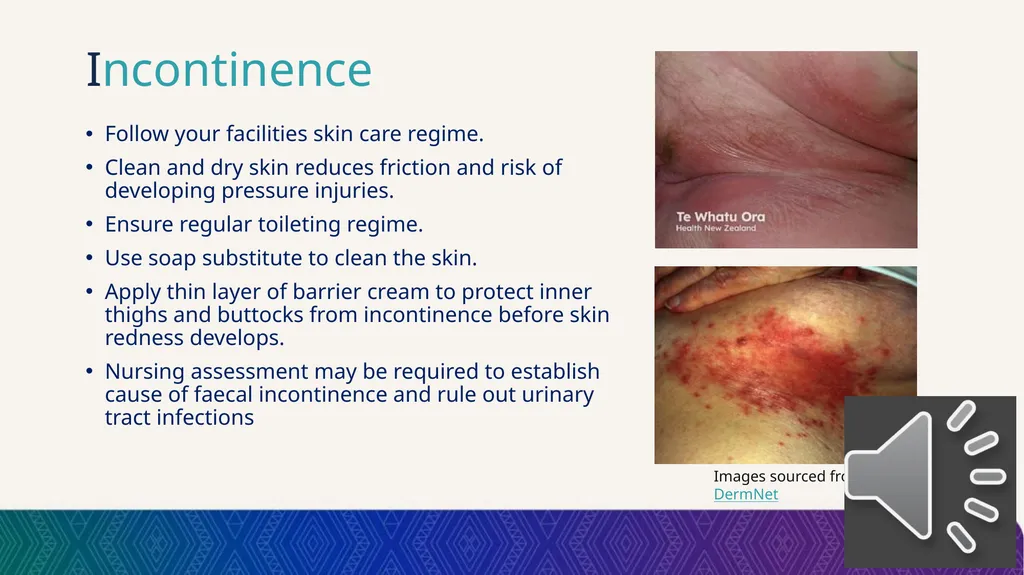
Incontinence Follow your facilities skin care regime.
Clean and dry skin reduces friction and risk of developing pressure injuries.
Ensure regular toileting regime.
Use soap substitute to clean the skin.
Apply thin layer of barrier cream to protect inner thighs and buttocks from incontinence before skin redness develops.
Nursing assessment may be required to establish cause of faecal incontinence and rule out urinary tract infections Images sourced from DermNet<br>
18
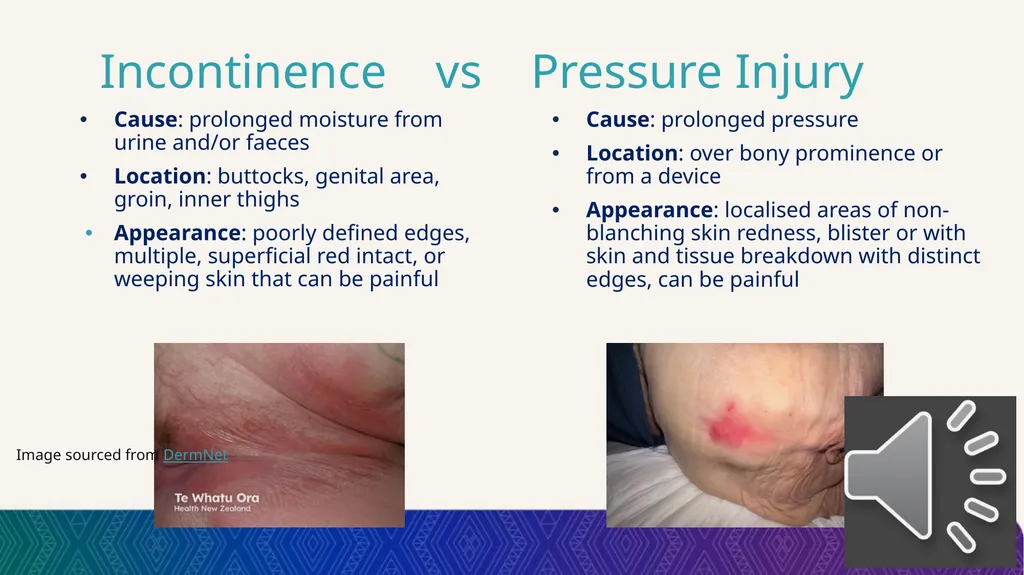
Incontinence vs Pressure Injury Cause: prolonged pressure
Location: over bony prominence or from a device
Appearance: localised areas of non-blanching skin redness, blister or with skin and tissue breakdown with distinct edges, can be painful Cause: prolonged moisture from urine and/or faeces
Location: buttocks, genital area, groin, inner thighs
Appearance: poorly defined edges, multiple, superficial red intact, or weeping skin that can be painful Image sourced from DermNet<br>
19
Incontinence pads Pads are used to keep the resident socially continent and do not replace toileting.
Evening pads should be applied 8.30pm onwards to reduce sleep disturbance.
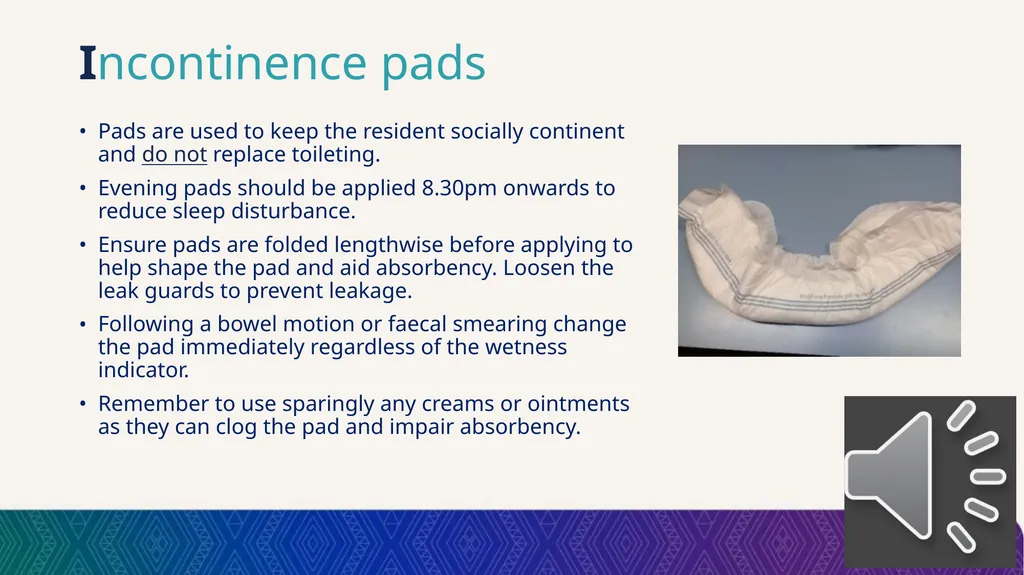
Ensure pads are folded lengthwise before applying to help shape the pad and aid absorbency. Loosen the leak guards to prevent leakage.
Following a bowel motion or faecal smearing change the pad immediately regardless of the wetness indicator.
Remember to use sparingly any creams or ointments as they can clog the pad and impair absorbency.<br>
20
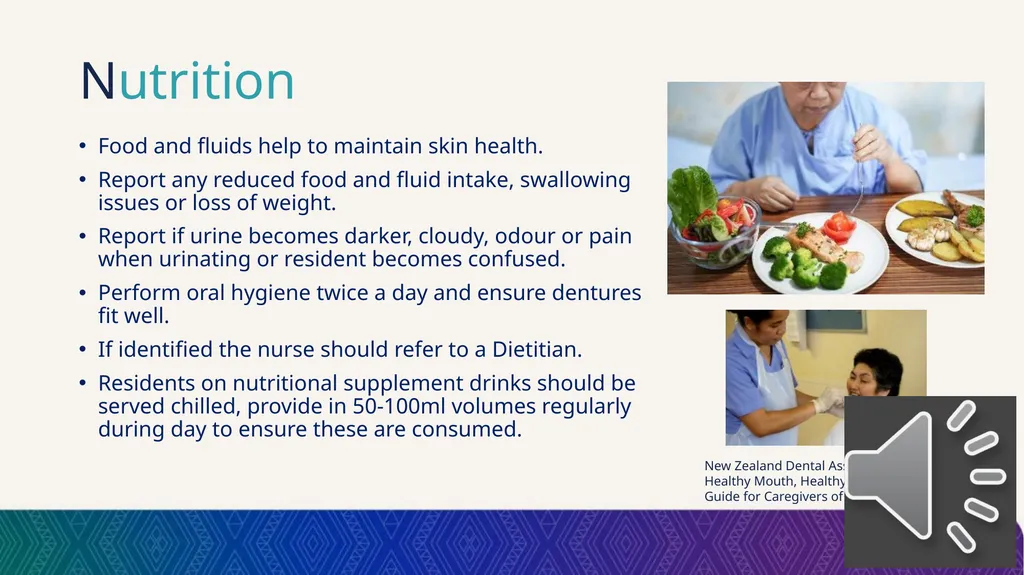
Nutrition Food and fluids help to maintain skin health.
Report any reduced food and fluid intake, swallowing issues or loss of weight.
Report if urine becomes darker, cloudy, odour or pain when urinating or resident becomes confused.
Perform oral hygiene twice a day and ensure dentures fit well.
If identified the nurse should refer to a Dietitian.
Residents on nutritional supplement drinks should be served chilled, provide in 50-100ml volumes regularly during day to ensure these are consumed. New Zealand Dental Association. 2010. Healthy Mouth, Healthy Ageing: Oral Health Guide for Caregivers of Older People<br>
21
SSKIN Recap The SSKIN acronym alerts nurses and care-workers of strategies to prevent or manage pressure injuries
Apply SSKIN into your everyday practice
Report any resident concerns to your nurse
Can you remember what SSKIN stands for?
S = Surface
S= Skin Inspections
K = Keep Moving
I = Incontinence
N = Nutrition<br>
Apply SSKIN into your everyday practice
Report any resident concerns to your nurse
Can you remember what SSKIN stands for?
S = Surface
S= Skin Inspections
K = Keep Moving
I = Incontinence
N = Nutrition<br>
22
Further Resources Ask your Clinical Lead/Manager to access wider resources from the Pressure Injury Prevention Toolkit, including:
SSKIN poster
Mind Your Tone presentation
Moving, handling and equipment presentation
Skin care guide
Foot and hand care guide
Wound healing and nutrition handout
Terminology and definitions for care workers
Patient leaflets (several languages)
Teaching cards
HealthLearn resources overview<br>
SSKIN poster
Mind Your Tone presentation
Moving, handling and equipment presentation
Skin care guide
Foot and hand care guide
Wound healing and nutrition handout
Terminology and definitions for care workers
Patient leaflets (several languages)
Teaching cards
HealthLearn resources overview<br>
23
References Beeckman et al. The Ghent Global IAD Categorisation Tool (GLOBIAD). Skin Integrity Research Group - Ghent University 2017. Available to download from www.UCVVGent.be
Fletcher J, Beeckman D, Boyles A et al (2020) International Best Practice Recommendations: Prevention and management of moisture-associated skin damage (MASD). Wounds International. Available online at www.woundsinternational.com
Health Quality & Safety Commission New Zealand. (2023). Pressure injury | Whara pēhanga (Frailty care guides 2023). Retrieved August 21, 2025, from https://www.hqsc.govt.nz/resources/resource-library/pressure-injury-whara-pehanga-frailty-care-guides-2023/
New Zealand Dental Association. 2010. Healthy Mouth, Healthy Ageing: Oral Health Guide for Caregivers of Older People. Auckland: New Zealand Dental Association. https://www.nzda.org.nz/assets/resources/Order_Resources/Healthy_Mouth_Healthy_Ageing.pdf
National Pressure Injury Advisory Panel, European Pressure Ulcer Advisory Panel and Pan Pacific Pressure Injury Alliance. Prevention and Treatment of Pressure Ulcers/Injuries: Quick Reference Guide. The International Guideline: Fourth Edition. Emily Haesler (Ed.). 2025. [cited: 13 Aug 2025]. Available from: https://internationalguideline.com.
New Zealand Spinal Trust. Pressure areas and their management. Retrieved August 21, 2025, from https://nzspinaltrust.org.nz/new-to-sci/skin-care/pressure-areas/
New Zealand Wound Care Society: https://nzwcs.org.nz/
O'Brien N, Moore Z, Avsar P, Patton D, Nugent L, O'Connor T. The impact of healthcare assistant education on pressure ulcer prevention: a systematic review. J Wound Care. 2023 Jul 1;32(Sup7a):cxv-cxxvii. doi: 10.12968/jowc.2023.32.Sup7a.cxv. PMID: 37405970.
Prevention and Treatment of Pressure Ulcers/Injuries: Clinical Practice Guideline. The International Guideline. Emily Haesler (Ed.). EPUAP/NPIAP/PPPIA: 2019.
New Zealand Spinal Trust. Pressure areas and their management. Retrieved August 21, 2025, from https://nzspinaltrust.org.nz/new-to-sci/skin-care/pressure-areas/<br>