Pressure UlcersInjuries Changes in Terminology And Progression of Tissue Injuries Maureen Lira RN BSN CWON CHI What is a Pressure UlcerInjury? A pressure injury is localized damage to the skin and underlying soft tissue usually over a
"Pressure Ulcers/Injuries Changes in Terminology" is the property of its rightful owner. Permission is granted to
download and print the materials on this website for personal, non-commercial use only, and to display it
on your personal computer provided you do not modify the materials and that you retain all copyright
notices contained in the materials. By downloading content from our website, you accept the terms of this
agreement.
Presentation Transcript
01
Pressure Ulcers/Injuries Changes in Terminology
And
Progression of Tissue Injuries
Maureen Lira RN BSN CWON CHI<br>
02
What is a Pressure Ulcer/Injury? “A pressure injury is localized damage to the skin and underlying soft tissue usually over a bony prominence or related to a medical or other device. The injury can present as intact skin or an open ulcer and may be painful. The injury occurs as a result of intense and/or prolonged pressure or pressure in combination with shear. The tolerance of soft tissue for pressure and shear may also be affected by microclimate, nutrition, perfusion, co-morbidities and condition of the soft tissue.”
Staging describes depth of damage<br>
03
National Pressure Ulcer Advisory Panel NPUAP has been the authority in writing definitions of pressure ulcer stages
Added Unstageable and Deep Tissue stages in 2007
Most recently in April 2016, terminology was changed to indicate all stages are INJURIES, but not are ULCERS
Concerns changing over to new terminology : pre printed forms, pull down menus in software, coding with old terminology<br>
04
Stage 1 Pressure Injury Non Blanchable Erythema to INTACT skin
“Color changes do not include purple or maroon discoloration; these may indicate deep tissue pressure injury. “
Localized, not a generalized area – measurements verify this
Not a real ulcer since skin is still intact<br>
05
Pressure Injury Stage 2 New definition includes what a stage 2 is NOT – medical adhesive tissue damage, incontinence dermatitis, or traumatic wounds
Also includes what the wound bed does not have ( devital tissue ) slough, eschar
Lastly, what is not SEEN in wound bed – adipose, granulation tissue<br>
06
Stage 3 Pressure Injury Full thickness loss – dermis is no longer present
Many Characteristics MAY be found though do not have to be
Adipose, granulation tissue, slough ( not obscuring depth ) tunneling, undermining, epibole
Differ from stage 4 and unstageable – non obscuring slough/eschar ( unstageable ) muscle, tendon, bone, ligament, fascia ( stage 4 )<br>
07
Stage 4 Pressure Injury Exposed or directly palpable structures – bone, muscle, fascia, tendon, ligament
Takes over where stage 3 left off
Definition still warns of describing eschar obscuring depth as unstageable rather than 3 or 4<br>
08
Unstageable Pressure Injury Taking from definitions in Stage 3 and 4
Cannot see depth of wound due to eschar or slough
If removed, would be stage 3 or 4
Here is the trick – if an unstageable is documented as a stage 3 and when eschar is removed, bone is exposed, it APPEARS to have deteriorated to a stage 4 when the damage was already done
Same idea with an unstageable which is revealed to be stage 3 – if documented as 4 , there are no structures to verify this ( excisional debridement as example )<br>
09
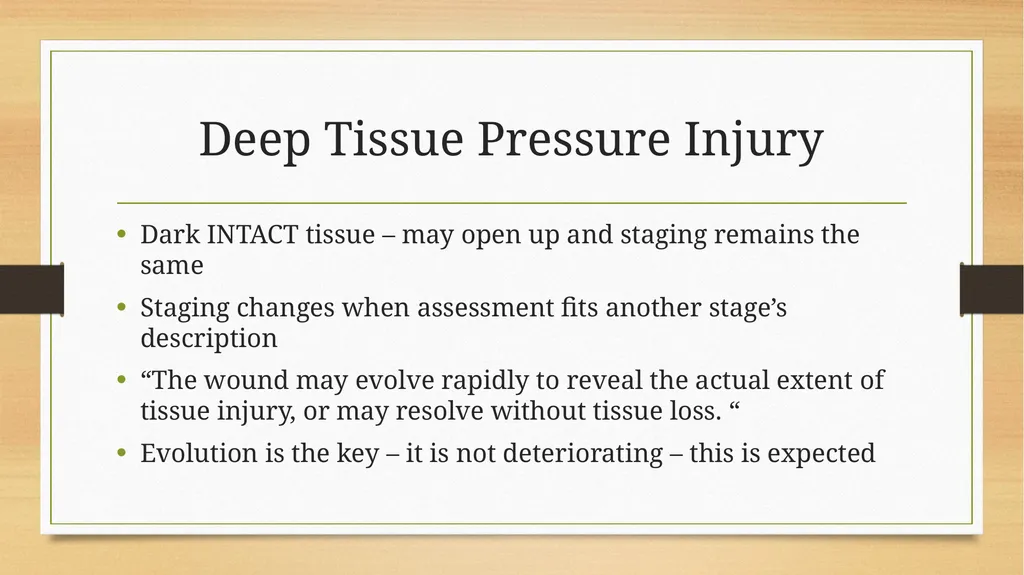
Deep Tissue Pressure Injury Dark INTACT tissue – may open up and staging remains the same
Staging changes when assessment fits another stage’s description
“The wound may evolve rapidly to reveal the actual extent of tissue injury, or may resolve without tissue loss. “
Evolution is the key – it is not deteriorating – this is expected<br>
10
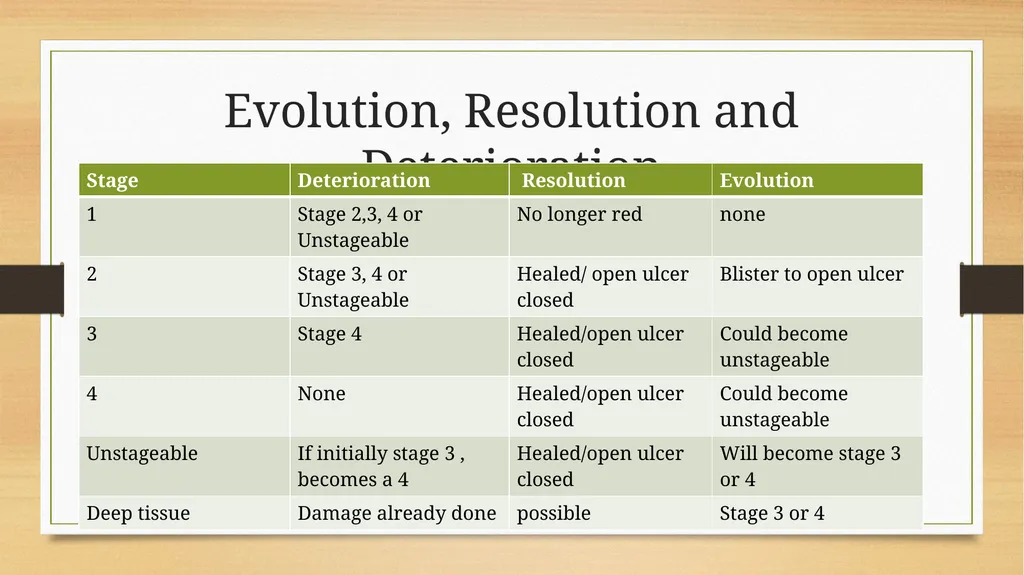
Evolution, Resolution and Deterioration Stage 1 or 2 may heal rapidly or linger even with interventions if the patient has no ability to heal ( RESOLVE )
Stage 1, 2 or 3 4 - indicates DETERIORATION
Stage 1 or 2 unstageable – partial thickness to full thickness DETERIORATION
Stage 3 can become unstageable and may or may not indicate deterioration
Unstageable and deep tissue pressure injury stage 3 or 4 – NOT deterioration<br>
11
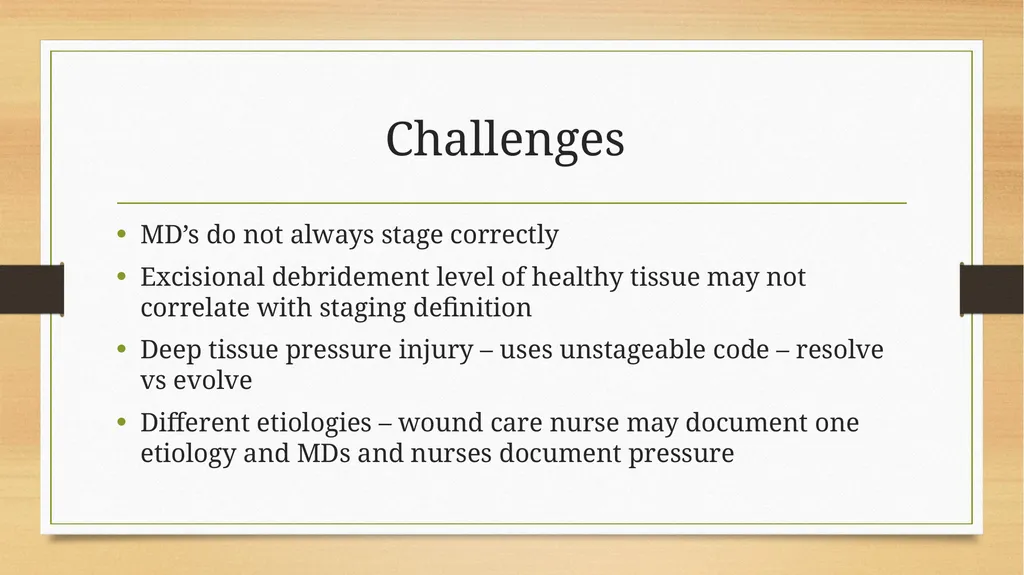
Challenges MD’s do not always stage correctly
Excisional debridement level of healthy tissue may not correlate with staging definition
Deep tissue pressure injury – uses unstageable code – resolve vs evolve
Different etiologies – wound care nurse may document one etiology and MDs and nurses document pressure<br>
12
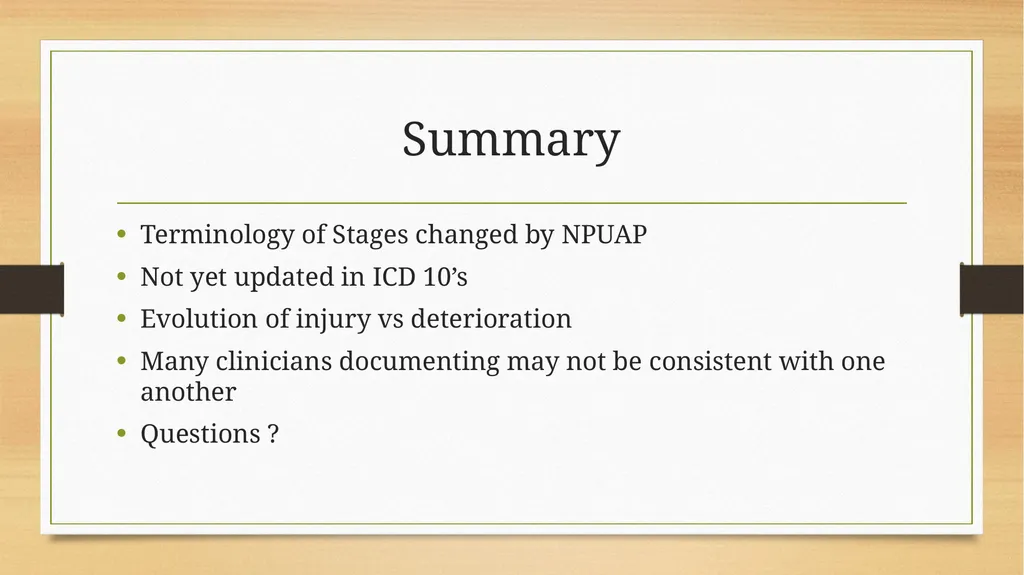
Summary Terminology of Stages changed by NPUAP
Not yet updated in ICD 10’s
Evolution of injury vs deterioration
Many clinicians documenting may not be consistent with one another
Questions ?<br>
13
References NPUAP website, http://www.npuap.org/resources/educational-and-clinical-resources/npuap-pressure-injury-stages/. Obtained January 18th, 2017<br>