
PRESSURE VESSEL DESIGN, CONSTRUCTION AND TESTING

Description: PRESSURE VESSEL DESIGN, CONSTRUCTION AND TESTING Dr Hassan Hassoon ALDelfi Lecture 7 This Photo by Unknown Author is licensed under CC BY-SA What Pressure Vessel A more common pressure vessel design consists of a cylinder closed with end
Related Topics
Download Presentation
"PRESSURE VESSEL DESIGN, CONSTRUCTION AND TESTING" is the property of its rightful owner. Permission is granted to download and print the materials on this website for personal, non-commercial use only, and to display it on your personal computer provided you do not modify the materials and that you retain all copyright notices contained in the materials. By downloading content from our website, you accept the terms of this agreement.
Presentation Transcript
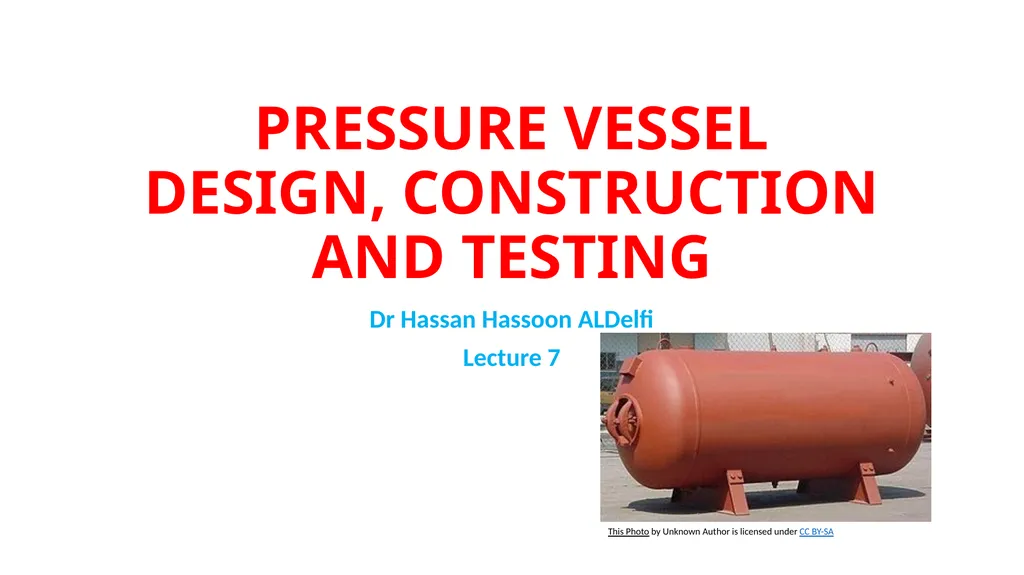
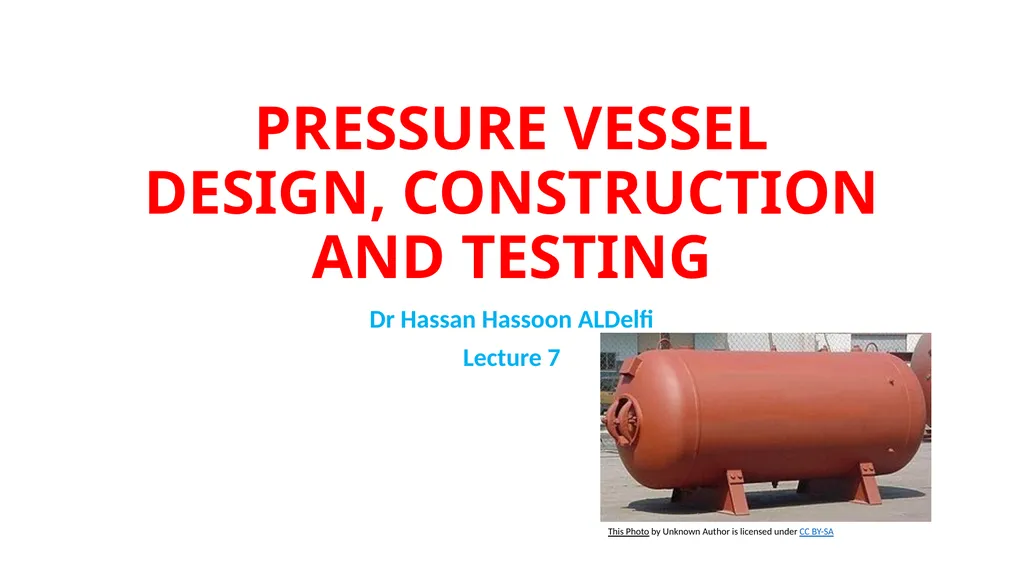
slide1. PRESSURE VESSEL DESIGN, CONSTRUCTION AND TESTING Dr Hassan Hassoon ALDelfi
Lecture 7 This Photo by Unknown Author is licensed under CC BY-SA<br>
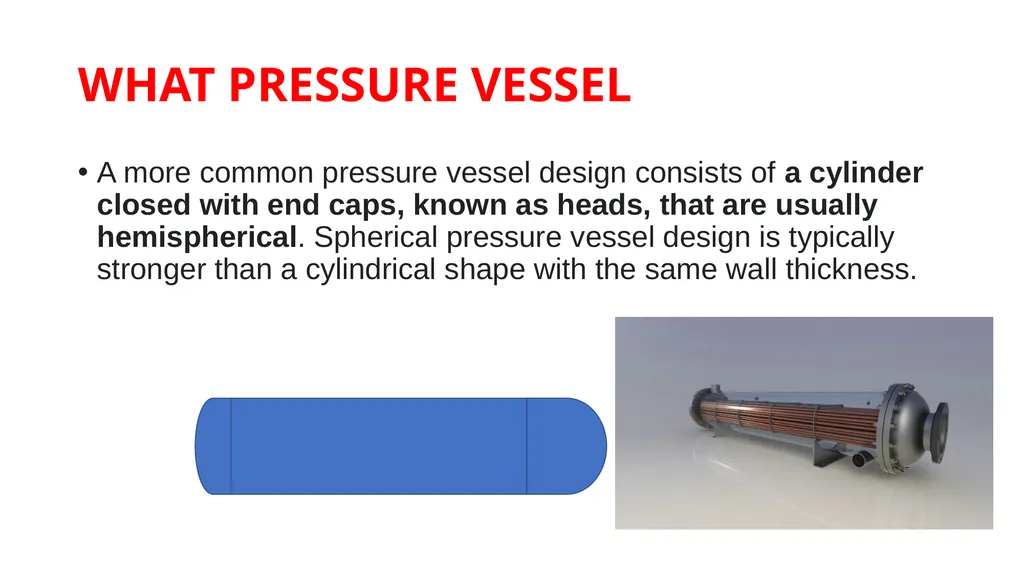
slide2. What Pressure Vessel A more common pressure vessel design consists of a cylinder closed with end caps, known as heads, that are usually hemispherical. Spherical pressure vessel design is typically stronger than a cylindrical shape with the same wall thickness.<br>
slide3. Pressure vessel construction Although it is possible to construct a pressure vessel of any shape and size, sections of cylinder, sphere and cone are usually preferred. A more common pressure vessel design consists of a cylinder closed with end caps, known as heads, that are usually hemispherical.
Spherical pressure vessel design is typically stronger than a cylindrical shape with the same wall thickness. However, spherical pressure vessels are difficult and costly to manufacture, which makes cylindrical shape pressure vessels with semi-elliptical heads preferred in many cases.
Typically, pressure vessels are made of steel, but there are some that employ composite materials, such as carbon fiber, ceramics and polymers like PET (polyethylene terephthalate).<br>
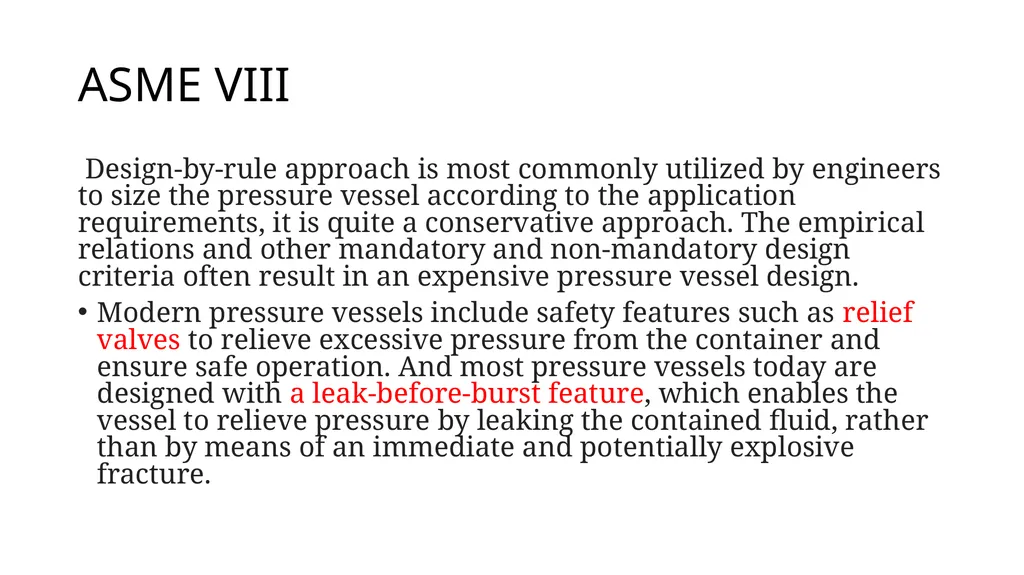
slide4. ASME VIII Design-by-rule approach is most commonly utilized by engineers to size the pressure vessel according to the application requirements, it is quite a conservative approach. The empirical relations and other mandatory and non-mandatory design criteria often result in an expensive pressure vessel design.
Modern pressure vessels include safety features such as relief valves to relieve excessive pressure from the container and ensure safe operation. And most pressure vessels today are designed with a leak-before-burst feature, which enables the vessel to relieve pressure by leaking the contained fluid, rather than by means of an immediate and potentially explosive fracture.<br>
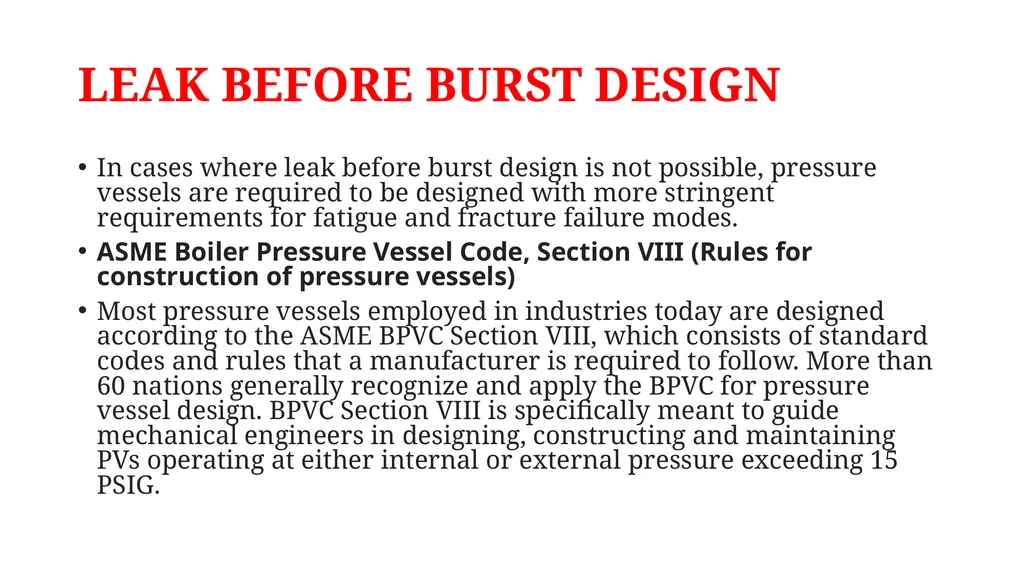
slide5. leak before burst design In cases where leak before burst design is not possible, pressure vessels are required to be designed with more stringent requirements for fatigue and fracture failure modes.
ASME Boiler Pressure Vessel Code, Section VIII (Rules for construction of pressure vessels)
Most pressure vessels employed in industries today are designed according to the ASME BPVC Section VIII, which consists of standard codes and rules that a manufacturer is required to follow. More than 60 nations generally recognize and apply the BPVC for pressure vessel design. BPVC Section VIII is specifically meant to guide mechanical engineers in designing, constructing and maintaining PVs operating at either internal or external pressure exceeding 15 PSIG.<br>
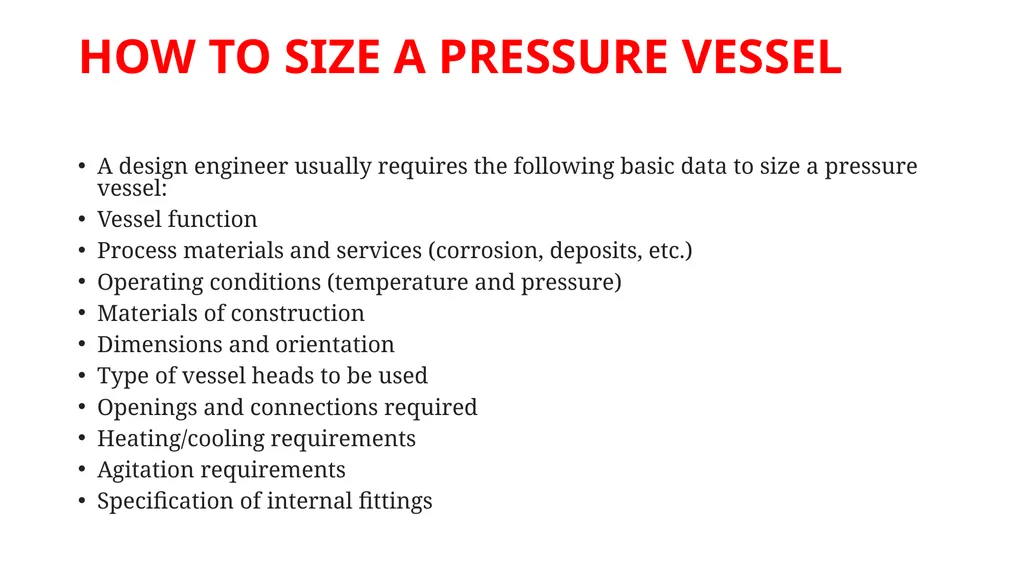
slide6. How to size a pressure vessel A design engineer usually requires the following basic data to size a pressure vessel:
Vessel function
Process materials and services (corrosion, deposits, etc.)
Operating conditions (temperature and pressure)
Materials of construction
Dimensions and orientation
Type of vessel heads to be used
Openings and connections required
Heating/cooling requirements
Agitation requirements
Specification of internal fittings<br>
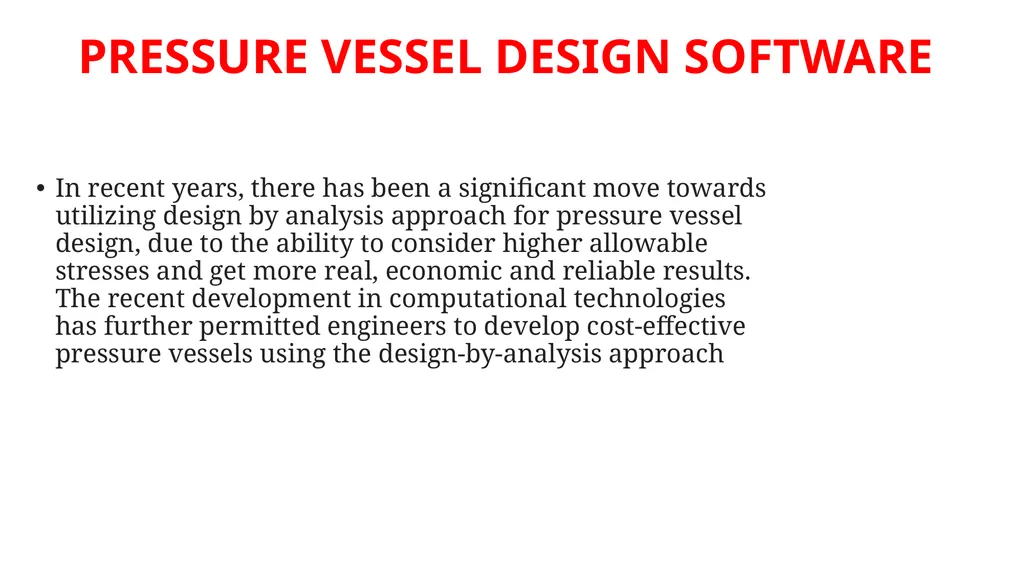
slide7. Pressure vessel design software In recent years, there has been a significant move towards utilizing design by analysis approach for pressure vessel design, due to the ability to consider higher allowable stresses and get more real, economic and reliable results. The recent development in computational technologies has further permitted engineers to develop cost-effective pressure vessels using the design-by-analysis approach<br>
slide8. For design and construction purposes, the pressure vessel is generally defined as the pressure vessel proper including welded attachments up to, and including, the nozzle flanges, screwed or welded connectors, or the edge to be welded at the first circumferential weld to connecting piping.<br>
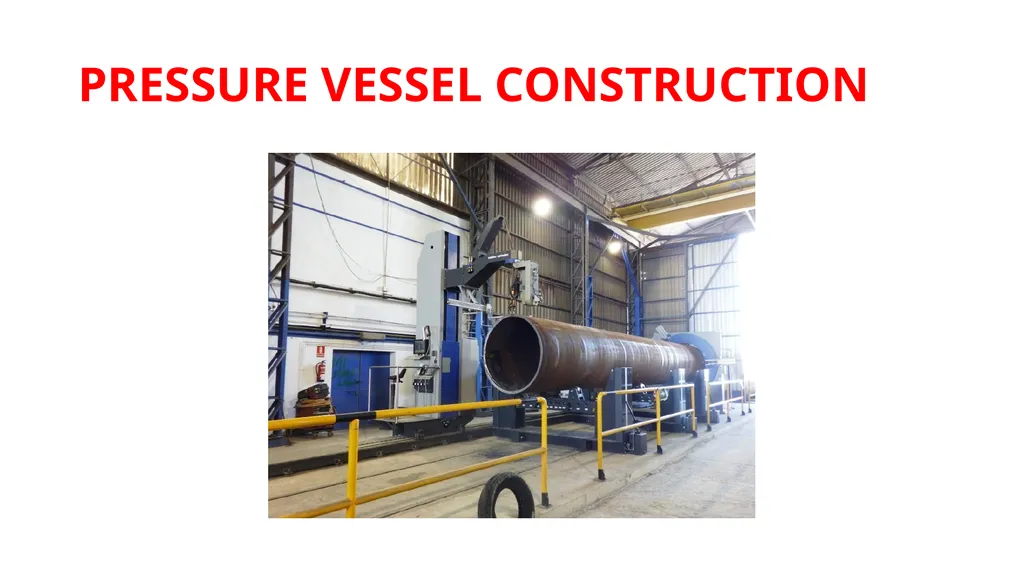
slide11. Pressure vessel construction<br>
slide12. CAD CAM https://youtu.be/lpkNtqlh74c
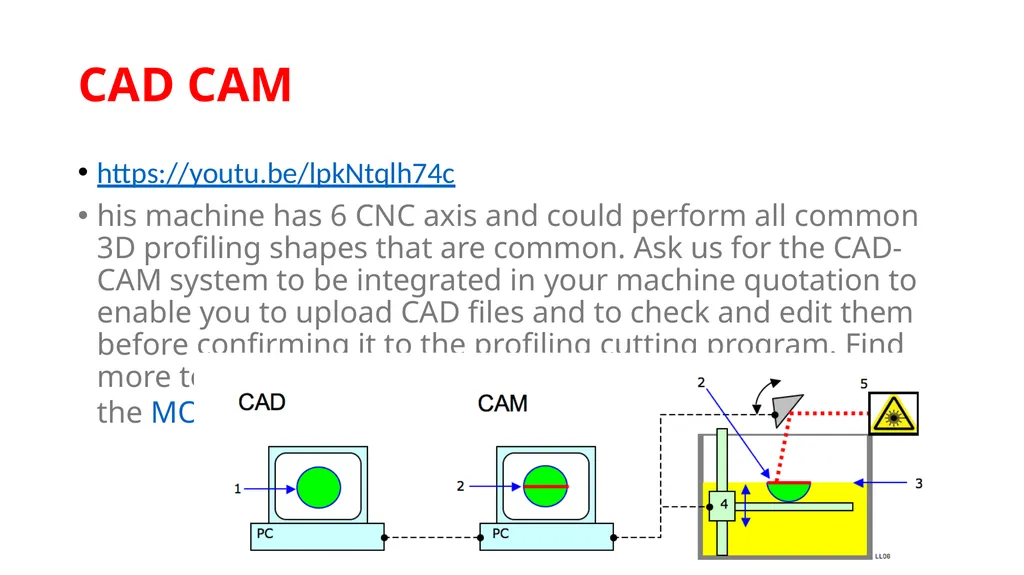
his machine has 6 CNC axis and could perform all common 3D profiling shapes that are common. Ask us for the CAD-CAM system to be integrated in your machine quotation to enable you to upload CAD files and to check and edit them before confirming it to the profiling cutting program. Find more technical information and pictures on the website of the MO Heavy Duty This Photo by Unknown Author is licensed under CC BY-SA<br>
slide13. MO-Heavy Duty machines for 3D cutting large diameter pipes, boilers, pressure vessels, heat exchangers and tanks.
For round pipes and dished ends up to 4,064 mm(160") in diameter and 30 metric tons in workpiece weight This Photo by Unknown Author is licensed under CC BY<br>
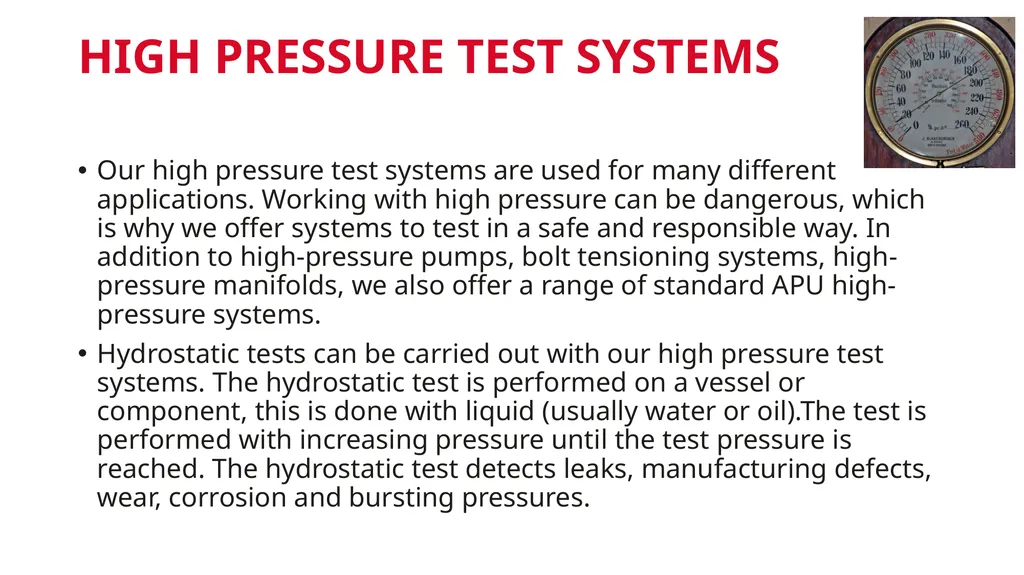
slide14. High Pressure Test Systems Our high pressure test systems are used for many different applications. Working with high pressure can be dangerous, which is why we offer systems to test in a safe and responsible way. In addition to high-pressure pumps, bolt tensioning systems, high-pressure manifolds, we also offer a range of standard APU high-pressure systems.
Hydrostatic tests can be carried out with our high pressure test systems. The hydrostatic test is performed on a vessel or component, this is done with liquid (usually water or oil).The test is performed with increasing pressure until the test pressure is reached. The hydrostatic test detects leaks, manufacturing defects, wear, corrosion and bursting pressures.<br>
slide15. Our benefits = Pneumatically and Electrically Driven
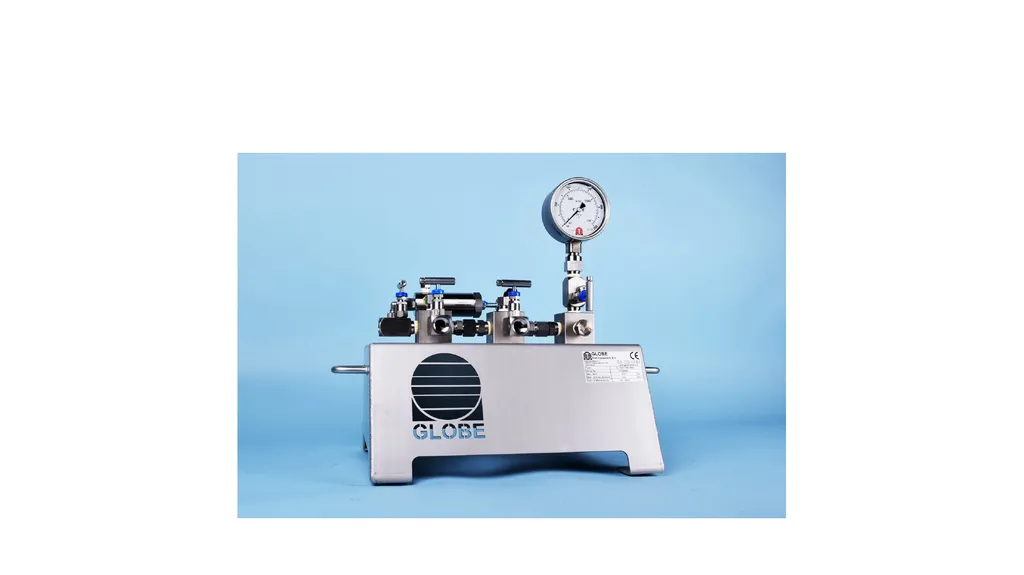
GLOBE Test Equipment has a very wide range of high pressure systems and components. We offer high pressure systems for pressures up to 4500 bar (65,000 psi). Besides our standard systems GLOBE offers complete customized solutions for high pressure. Our specialists are happy to advise you.
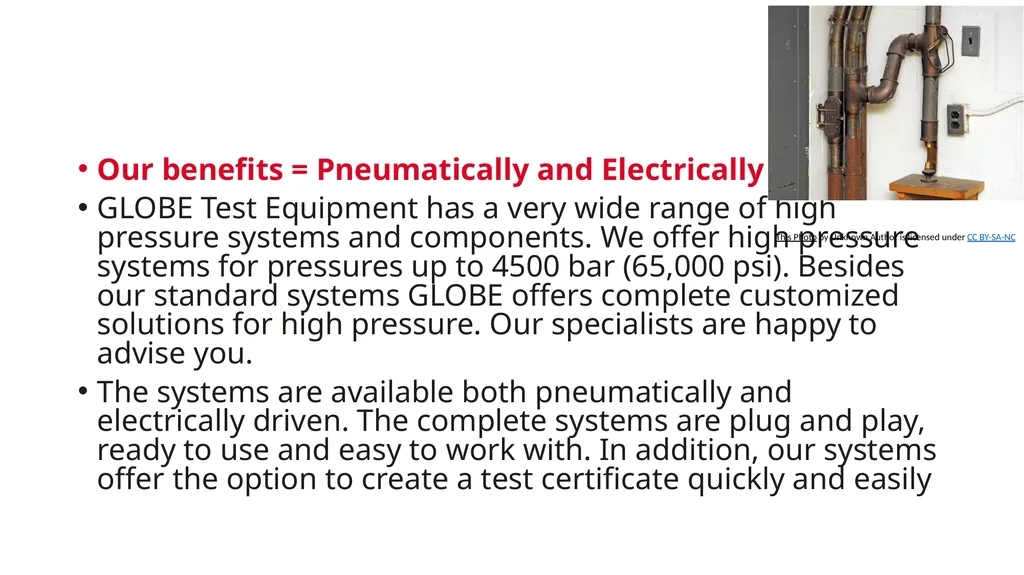
The systems are available both pneumatically and electrically driven. The complete systems are plug and play, ready to use and easy to work with. In addition, our systems offer the option to create a test certificate quickly and easily This Photo by Unknown Author is licensed under CC BY-SA-NC<br>
slide17. Certifications and Inspection GLOBE values quality and is therefor ISO 9000:2015 certified. As a high pressure specialist we are constantly working on the safety of our systems and the safety of the people who work with our systems. Meeting the right standards as well as timely inspecting and maintaining our systems are therefor very important to us. This Photo by Unknown Author is licensed under CC BY-SA<br>
Lecture 7 This Photo by Unknown Author is licensed under CC BY-SA<br>
slide2. What Pressure Vessel A more common pressure vessel design consists of a cylinder closed with end caps, known as heads, that are usually hemispherical. Spherical pressure vessel design is typically stronger than a cylindrical shape with the same wall thickness.<br>
slide3. Pressure vessel construction Although it is possible to construct a pressure vessel of any shape and size, sections of cylinder, sphere and cone are usually preferred. A more common pressure vessel design consists of a cylinder closed with end caps, known as heads, that are usually hemispherical.
Spherical pressure vessel design is typically stronger than a cylindrical shape with the same wall thickness. However, spherical pressure vessels are difficult and costly to manufacture, which makes cylindrical shape pressure vessels with semi-elliptical heads preferred in many cases.
Typically, pressure vessels are made of steel, but there are some that employ composite materials, such as carbon fiber, ceramics and polymers like PET (polyethylene terephthalate).<br>
slide4. ASME VIII Design-by-rule approach is most commonly utilized by engineers to size the pressure vessel according to the application requirements, it is quite a conservative approach. The empirical relations and other mandatory and non-mandatory design criteria often result in an expensive pressure vessel design.
Modern pressure vessels include safety features such as relief valves to relieve excessive pressure from the container and ensure safe operation. And most pressure vessels today are designed with a leak-before-burst feature, which enables the vessel to relieve pressure by leaking the contained fluid, rather than by means of an immediate and potentially explosive fracture.<br>
slide5. leak before burst design In cases where leak before burst design is not possible, pressure vessels are required to be designed with more stringent requirements for fatigue and fracture failure modes.
ASME Boiler Pressure Vessel Code, Section VIII (Rules for construction of pressure vessels)
Most pressure vessels employed in industries today are designed according to the ASME BPVC Section VIII, which consists of standard codes and rules that a manufacturer is required to follow. More than 60 nations generally recognize and apply the BPVC for pressure vessel design. BPVC Section VIII is specifically meant to guide mechanical engineers in designing, constructing and maintaining PVs operating at either internal or external pressure exceeding 15 PSIG.<br>
slide6. How to size a pressure vessel A design engineer usually requires the following basic data to size a pressure vessel:
Vessel function
Process materials and services (corrosion, deposits, etc.)
Operating conditions (temperature and pressure)
Materials of construction
Dimensions and orientation
Type of vessel heads to be used
Openings and connections required
Heating/cooling requirements
Agitation requirements
Specification of internal fittings<br>
slide7. Pressure vessel design software In recent years, there has been a significant move towards utilizing design by analysis approach for pressure vessel design, due to the ability to consider higher allowable stresses and get more real, economic and reliable results. The recent development in computational technologies has further permitted engineers to develop cost-effective pressure vessels using the design-by-analysis approach<br>
slide8. For design and construction purposes, the pressure vessel is generally defined as the pressure vessel proper including welded attachments up to, and including, the nozzle flanges, screwed or welded connectors, or the edge to be welded at the first circumferential weld to connecting piping.<br>
slide11. Pressure vessel construction<br>
slide12. CAD CAM https://youtu.be/lpkNtqlh74c
his machine has 6 CNC axis and could perform all common 3D profiling shapes that are common. Ask us for the CAD-CAM system to be integrated in your machine quotation to enable you to upload CAD files and to check and edit them before confirming it to the profiling cutting program. Find more technical information and pictures on the website of the MO Heavy Duty This Photo by Unknown Author is licensed under CC BY-SA<br>
slide13. MO-Heavy Duty machines for 3D cutting large diameter pipes, boilers, pressure vessels, heat exchangers and tanks.
For round pipes and dished ends up to 4,064 mm(160") in diameter and 30 metric tons in workpiece weight This Photo by Unknown Author is licensed under CC BY<br>
slide14. High Pressure Test Systems Our high pressure test systems are used for many different applications. Working with high pressure can be dangerous, which is why we offer systems to test in a safe and responsible way. In addition to high-pressure pumps, bolt tensioning systems, high-pressure manifolds, we also offer a range of standard APU high-pressure systems.
Hydrostatic tests can be carried out with our high pressure test systems. The hydrostatic test is performed on a vessel or component, this is done with liquid (usually water or oil).The test is performed with increasing pressure until the test pressure is reached. The hydrostatic test detects leaks, manufacturing defects, wear, corrosion and bursting pressures.<br>
slide15. Our benefits = Pneumatically and Electrically Driven
GLOBE Test Equipment has a very wide range of high pressure systems and components. We offer high pressure systems for pressures up to 4500 bar (65,000 psi). Besides our standard systems GLOBE offers complete customized solutions for high pressure. Our specialists are happy to advise you.
The systems are available both pneumatically and electrically driven. The complete systems are plug and play, ready to use and easy to work with. In addition, our systems offer the option to create a test certificate quickly and easily This Photo by Unknown Author is licensed under CC BY-SA-NC<br>
slide17. Certifications and Inspection GLOBE values quality and is therefor ISO 9000:2015 certified. As a high pressure specialist we are constantly working on the safety of our systems and the safety of the people who work with our systems. Meeting the right standards as well as timely inspecting and maintaining our systems are therefor very important to us. This Photo by Unknown Author is licensed under CC BY-SA<br>