
Pricing for Microinsurance Location Date Trainer 1





































Description: Pricing for Microinsurance Location Date Trainer 1 email Trainer 2 email Opening session Session 1 Background This 3-day training workshop has been developed by the ILOs Microinsurance Innovation Facility Based on a training needs
Related Topics
Download Presentation
"Pricing for Microinsurance Location Date Trainer 1" is the property of its rightful owner. Permission is granted to download and print the materials on this website for personal, non-commercial use only, and to display it on your personal computer provided you do not modify the materials and that you retain all copyright notices contained in the materials. By downloading content from our website, you accept the terms of this agreement.
Presentation Transcript
slide1. Pricing for Microinsurance Location
Date
Trainer 1 email
Trainer 2 email<br>
slide2. Opening session Session 1<br>
slide3. Background This 3-day training workshop has been developed by the ILO’s Microinsurance Innovation Facility
Based on a training needs assessment conducted in January 2012
Initial pilot in Accra in June 2012, in collaboration with the Actuarial Society of Ghana
The training development was sponsored by AusAid
The Facility is currently developing a corresponding technical guide<br>
slide4. Workshop Objective To provide participants with greater understanding of the pricing process
To provide tools to improve the pricing of microinsurance products
In this context, “better pricing” means:
More accurate estimation of expected claims costs, even with limited data
Better collection of experience data
Better monitoring and evaluation systems to review and adjust pricing
More suitable pricing for the low income market<br>
slide5. Specific Training Objectives By the end of the course, participants will be able to:
Identify key context elements to be considered in pricing microinsurance
Describe the pricing process and premium components
Set and validate pricing assumptions based on relevant data
Understand the calculations required for determining risk premiums, expense loadings and gross premiums
Set appropriate monitoring processes for better pricing review<br>
slide6. Agenda Day 1 Opening Session
Introduction to Pricing for Microinsurance
Basic Concepts of Pricing
Pricing Cycle/Process
Context
Understanding the Market / Initial Product Design
Calculating the Risk Premium
Methods and Formulas
Collecting Data
Setting Assumptions and Validating Results
Application / Case Study
Recap<br>
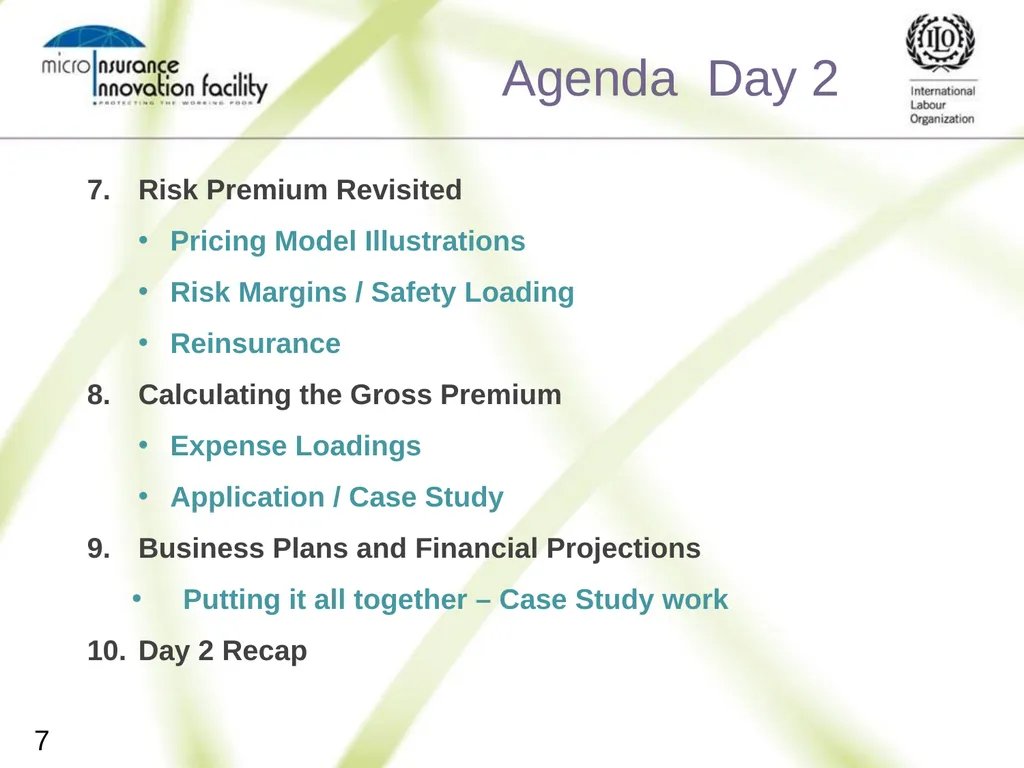
slide7. Agenda Day 2 Risk Premium Revisited
Pricing Model Illustrations
Risk Margins / Safety Loading
Reinsurance
Calculating the Gross Premium
Expense Loadings
Application / Case Study
Business Plans and Financial Projections
Putting it all together – Case Study work
Day 2 Recap<br>
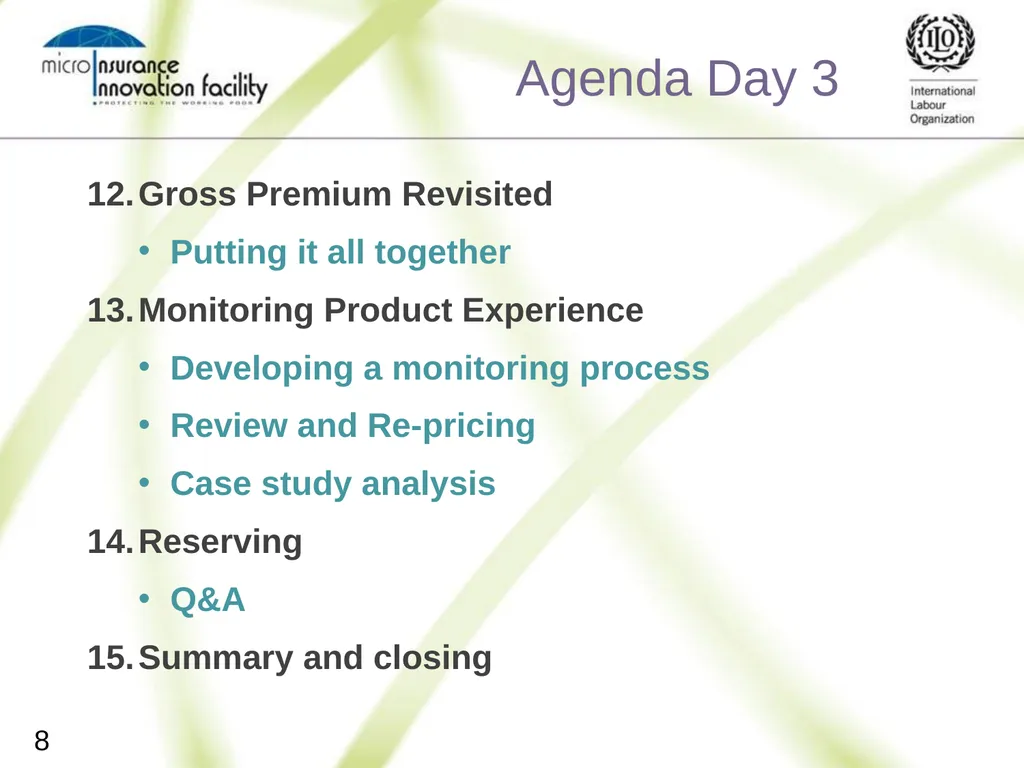
slide8. Agenda Day 3 Gross Premium Revisited
Putting it all together
Monitoring Product Experience
Developing a monitoring process
Review and Re-pricing
Case study analysis
Reserving
Q&A
Summary and closing<br>
slide9. Introduction to Pricing for Microinsurance Session 2<br>
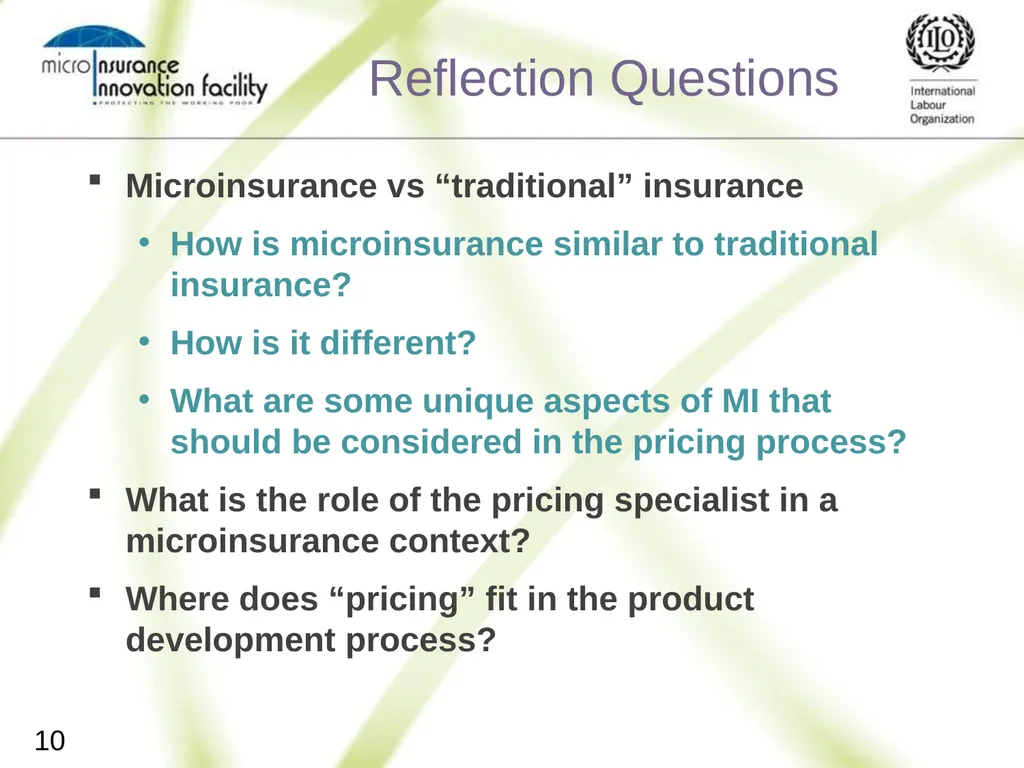
slide10. Reflection Questions Microinsurance vs “traditional” insurance
How is microinsurance similar to traditional insurance?
How is it different?
What are some unique aspects of MI that should be considered in the pricing process?
What is the role of the pricing specialist in a microinsurance context?
Where does “pricing” fit in the product development process?<br>
slide11. Event resulting in loss must be random
Loss must be definite and measurable, in terms of amount and time
Economic loss should be significant for the insured
Must be able to calculate the probability of loss
Should insure a “large” number of similar exposures
Premiums must be affordable relative to expected loss
There should be minimal risk of catastrophic events that cause multiple claims simultaneously Insurance Principles<br>
slide12. MI vs “traditional” insurance Similarities:
Basic insurance principles still apply
Purpose of pricing is the same
To determine a premium that is a fair price for the insurance coverage promised<br>
slide13. MI vs “traditional” insurance Differences:
Target market
Needs and priorities
Capacity and willingness to pay
Lack of insurance and financial literacy
Accessibility of services
Higher distribution and service costs relative to premium size<br>
slide14. Considerations for Pricing MI Client Focus
Products need to be designed to match client needs and low purchasing power
Limited experience data available
Challenges in setting assumptions
Need for capacity and systems to collect quality data
Lack of comparable products in market to use as benchmarks<br>
slide15. Considerations for Pricing MI Long term approach needed for sustainability
Takes time to reach scale
Consumer education and trust is key
Start up and operational costs often relatively higher (as % of premium)
Alternative distribution methods
Different sales model affects take-up rates and distribution expenses
Lack of experience creates challenges<br>
slide16. Considerations for Pricing MI Processes
Accessibility of financial transactions - much of target market may be “unbanked”
Marketing and distribution
Enrolment and claims processing
Mainly short term products
Challenges in marketing long term products to the low income market
Need for insurer to control risks and allow for re-pricing<br>
slide17. Role of Pricing Specialist Pricing role:
Develop model and assumptions to calculate accurate premiums
Develop financial projections for pricing and business plans
Set claims control mechanisms
Collect and monitor experience data
Analyse experience and develop recommendations for product redesign or re-pricing<br>
slide18. Role of Pricing Specialist For MI programs, the pricing role may also include:
Significant interaction with product design team
Improving understanding of insurance principles among other stakeholders
Especially with sales force and claims areas
Contributing to organisation’s MI strategy
Calculating or verifying reserves/technical provisions
Investment management activities<br>
slide19. Product Development Process<br>
slide20. Basic Concepts of pricing Session 3<br>
slide21. Pricing Cycle – Exercise 1 As a group, design a diagram that represents how you think of the pricing process
What are the basic steps or components?
How are they related to each other?
What is the flow of activities?
What are some of the “sub-steps”?
Use a flipchart page and coloured markers to draw a final version of your diagram to post on the wall<br>
slide22. Pricing Cycle – Exercise 2 Each team has an index card with a word or phrase on it that represents a component of the “pricing cycle”
Brainstorm as a team using the following questions and write the results on the blank sheet provided
What do we already know about this component?
What might be important to think about when performing this step in pricing for MI?
Rules:
Only 1 sheet per team
Only 5 minutes
Prize for the team with the most items listed<br>
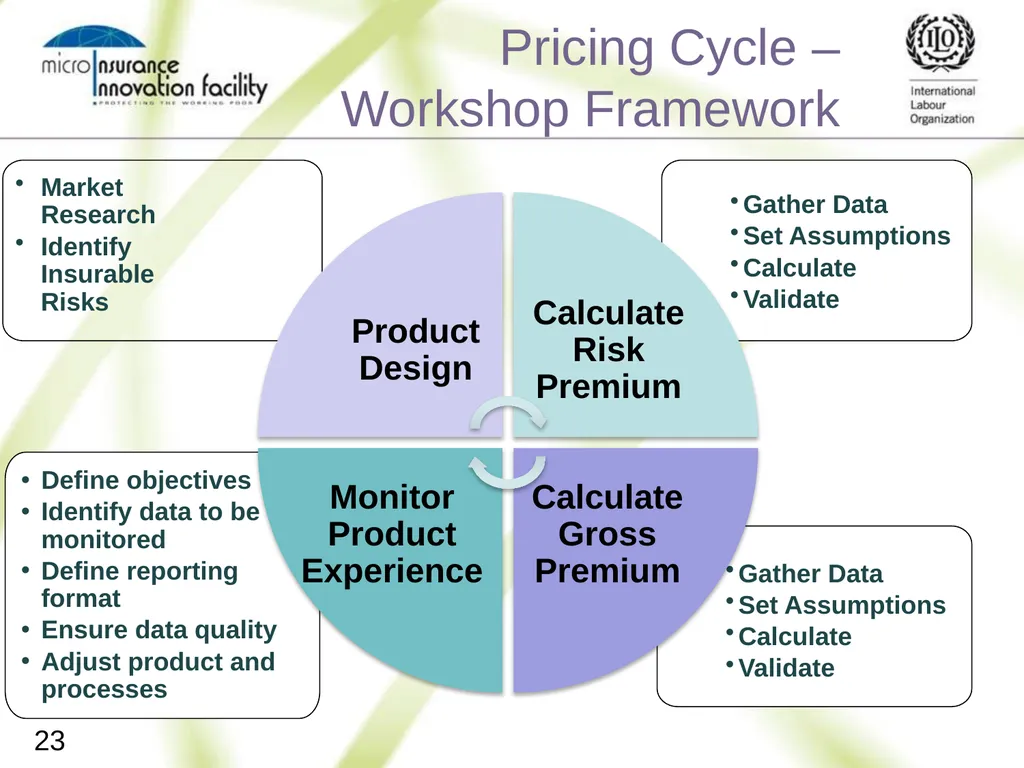
slide23. Pricing Cycle – Workshop Framework<br>
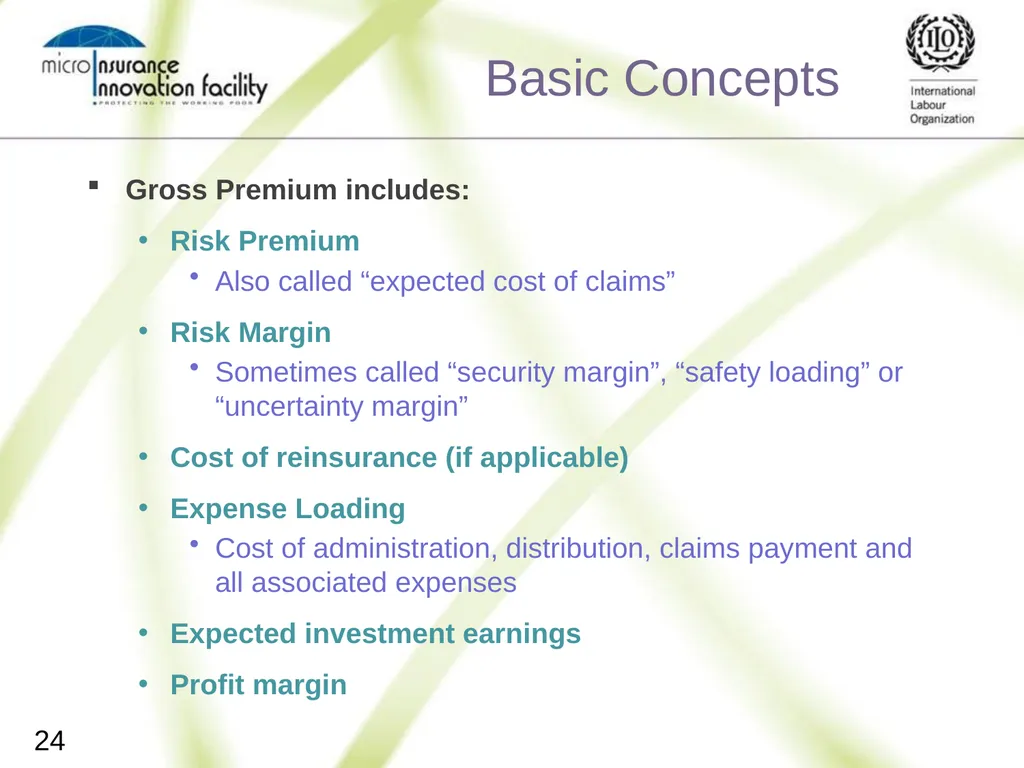
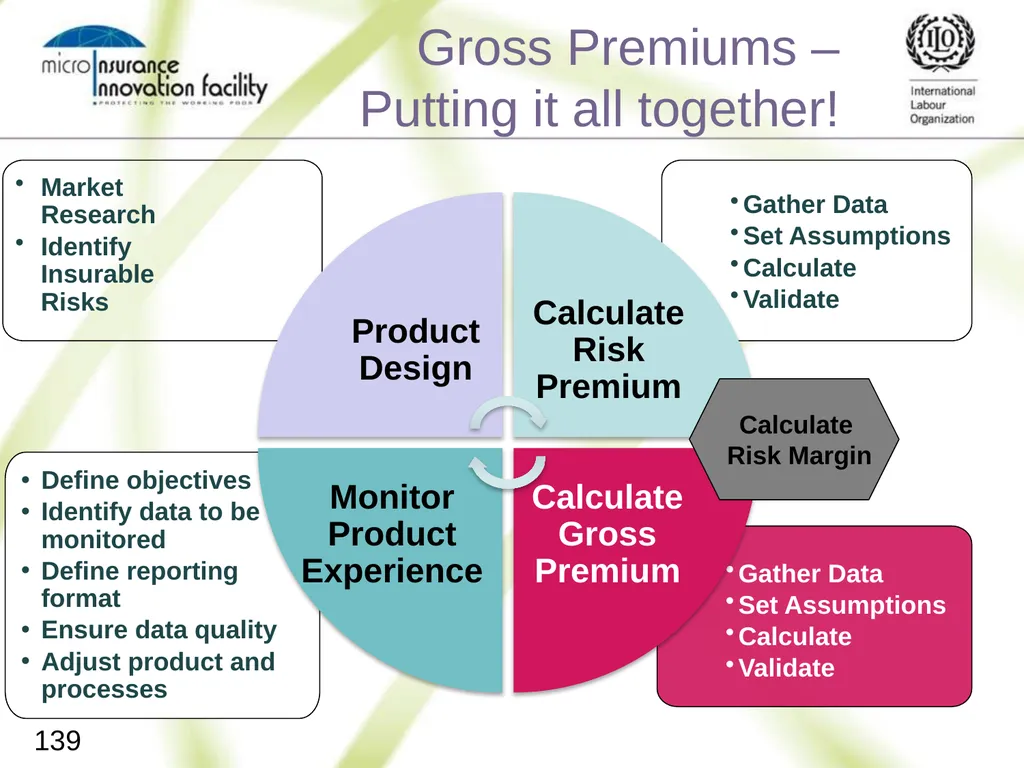
slide24. Basic Concepts Gross Premium includes:
Risk Premium
Also called “expected cost of claims”
Risk Margin
Sometimes called “security margin”, “safety loading” or “uncertainty margin”
Cost of reinsurance (if applicable)
Expense Loading
Cost of administration, distribution, claims payment and all associated expenses
Expected investment earnings
Profit margin<br>
slide25. Short-term vs Long-term Products What might be different?
Inability to change or revise premiums after policy issue (“guaranteed” premiums or benefits)
Much bigger effect on long-term products
Investment Income
Important for long-term products, usually not significant for short-term products
Inflation assumptions
Frequency of claims affects claims processing requirements
20 year life policy => 1 claim
Customer satisfaction/understanding of benefit<br>
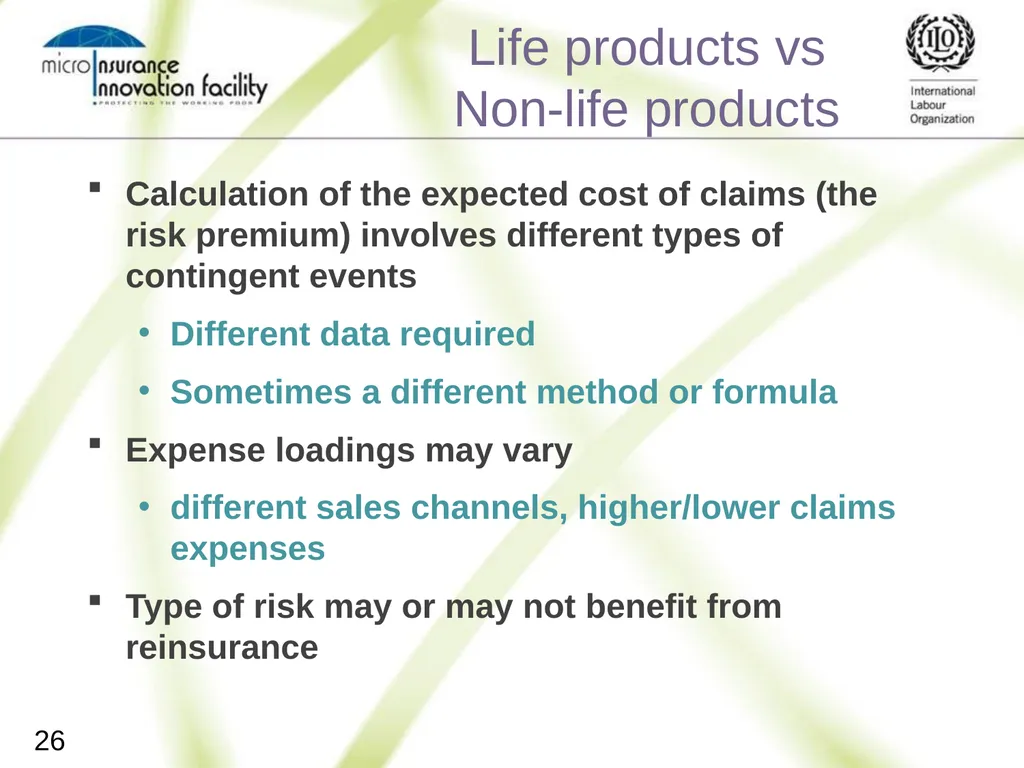
slide26. Life products vs Non-life products Calculation of the expected cost of claims (the risk premium) involves different types of contingent events
Different data required
Sometimes a different method or formula
Expense loadings may vary
different sales channels, higher/lower claims expenses
Type of risk may or may not benefit from reinsurance<br>
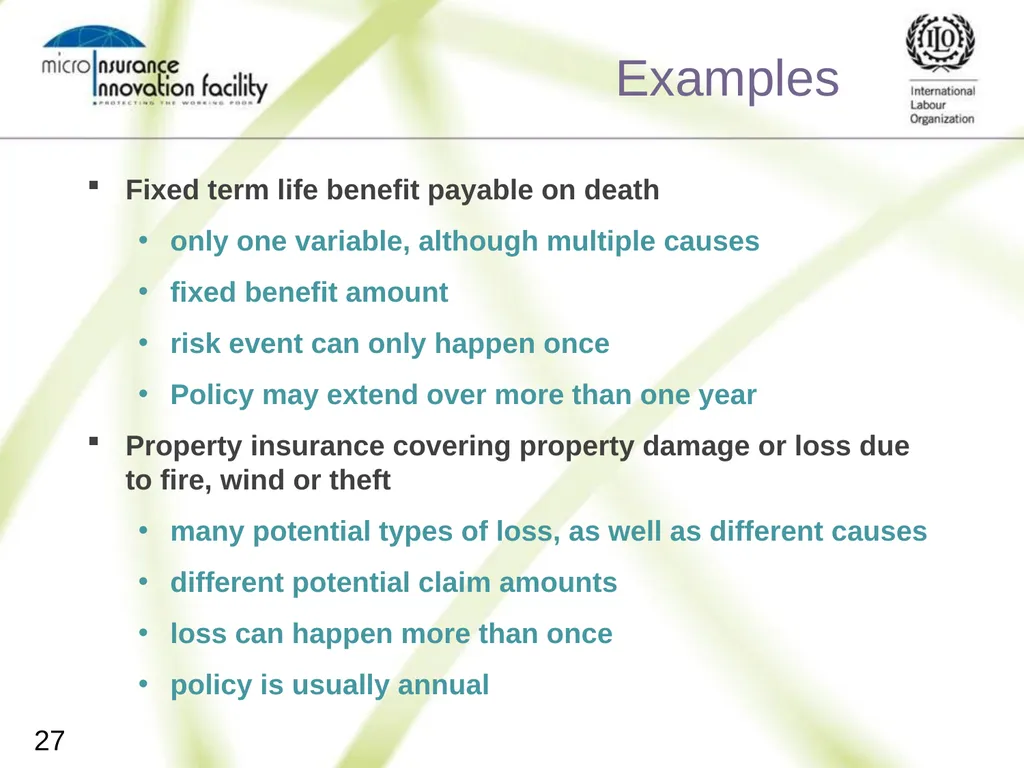
slide27. Examples Fixed term life benefit payable on death
only one variable, although multiple causes
fixed benefit amount
risk event can only happen once
Policy may extend over more than one year
Property insurance covering property damage or loss due to fire, wind or theft
many potential types of loss, as well as different causes
different potential claim amounts
loss can happen more than once
policy is usually annual<br>
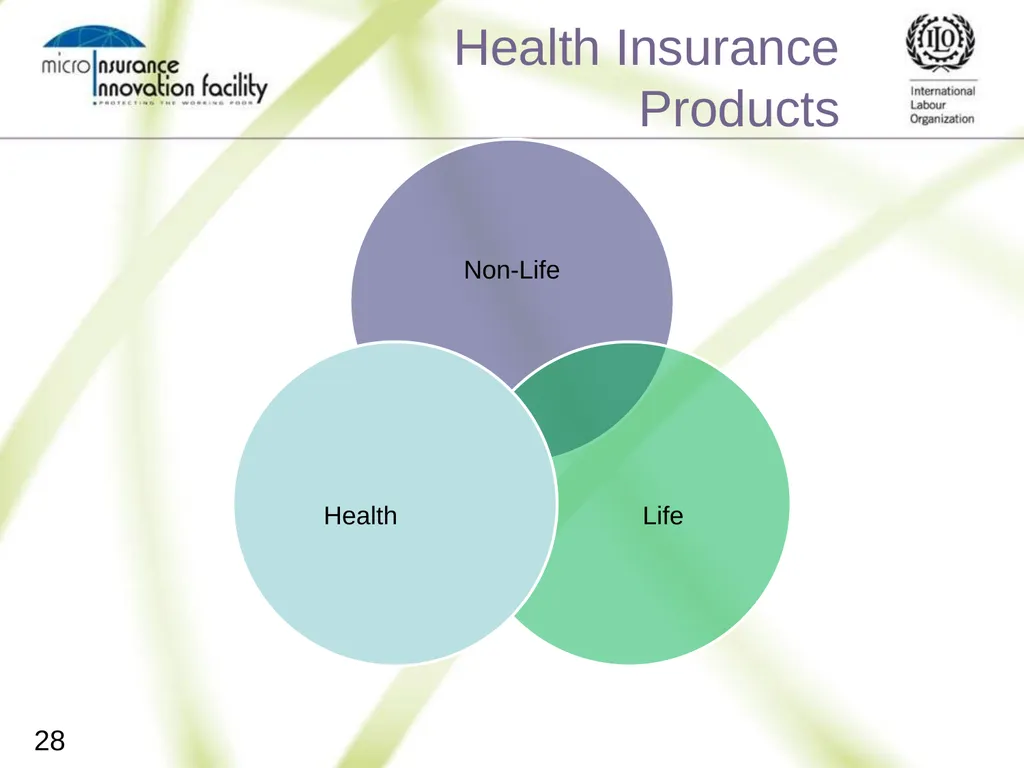
slide28. Health Insurance Products<br>
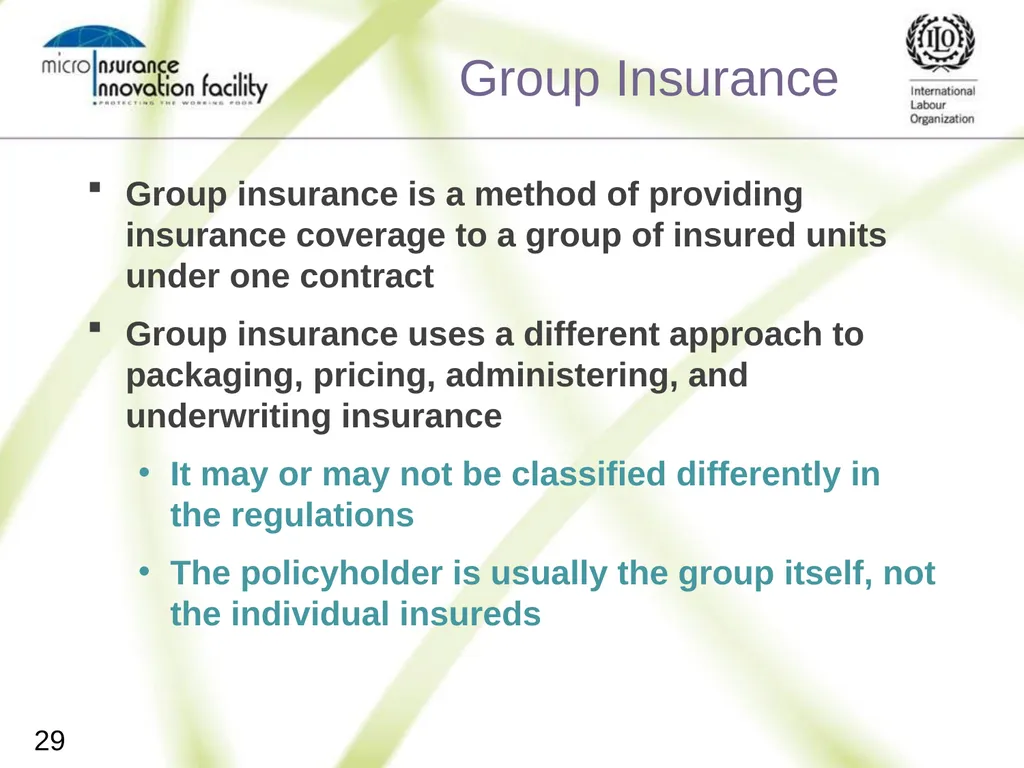
slide29. Group Insurance Group insurance is a method of providing insurance coverage to a group of insured units under one contract
Group insurance uses a different approach to packaging, pricing, administering, and underwriting insurance
It may or may not be classified differently in the regulations
The policyholder is usually the group itself, not the individual insureds<br>
slide30. Group Insurance Group Life insurance has many similarities to non-life insurance
It is usually short term, and may be administered by the General Accident Department or by a non-life insurer
Group insurance is favoured in microinsurance because it:
May have lower admin costs if group can provide cheaper admin services than insurer
May have lower distribution costs if the group acts as an effective risk aggregator
May have lower claims costs if the group mechanism serves to reduce anti-selection
If these conditions are not in place, then group MI may not meet expectations<br>
slide31. Differences by Product<br>
slide32. Differences by Product<br>
slide33. Basic Concepts Pricing for different products may involve:
Different data
Different models or formulas
Different margins
BUT
The PROCESS is the same!<br>
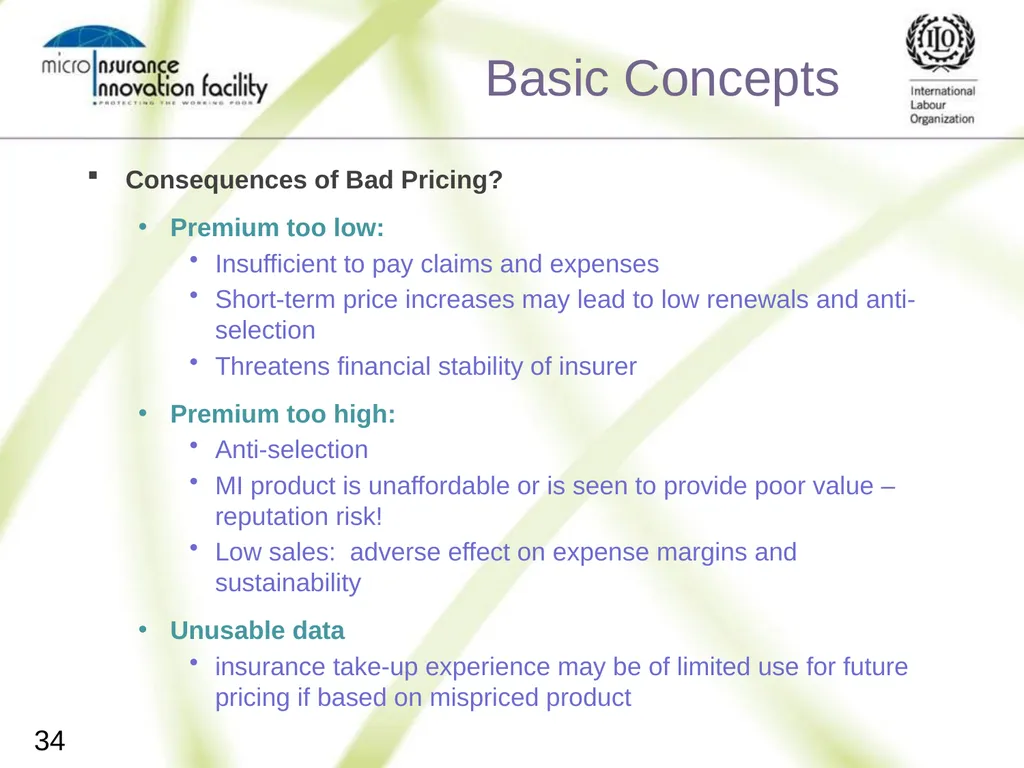
slide34. Basic Concepts Consequences of Bad Pricing?
Premium too low:
Insufficient to pay claims and expenses
Short-term price increases may lead to low renewals and anti-selection
Threatens financial stability of insurer
Premium too high:
Anti-selection
MI product is unaffordable or is seen to provide poor value – reputation risk!
Low sales: adverse effect on expense margins and sustainability
Unusable data
insurance take-up experience may be of limited use for future pricing if based on mispriced product<br>
slide35. Context – Understanding the Market; Product Design Session 4<br>
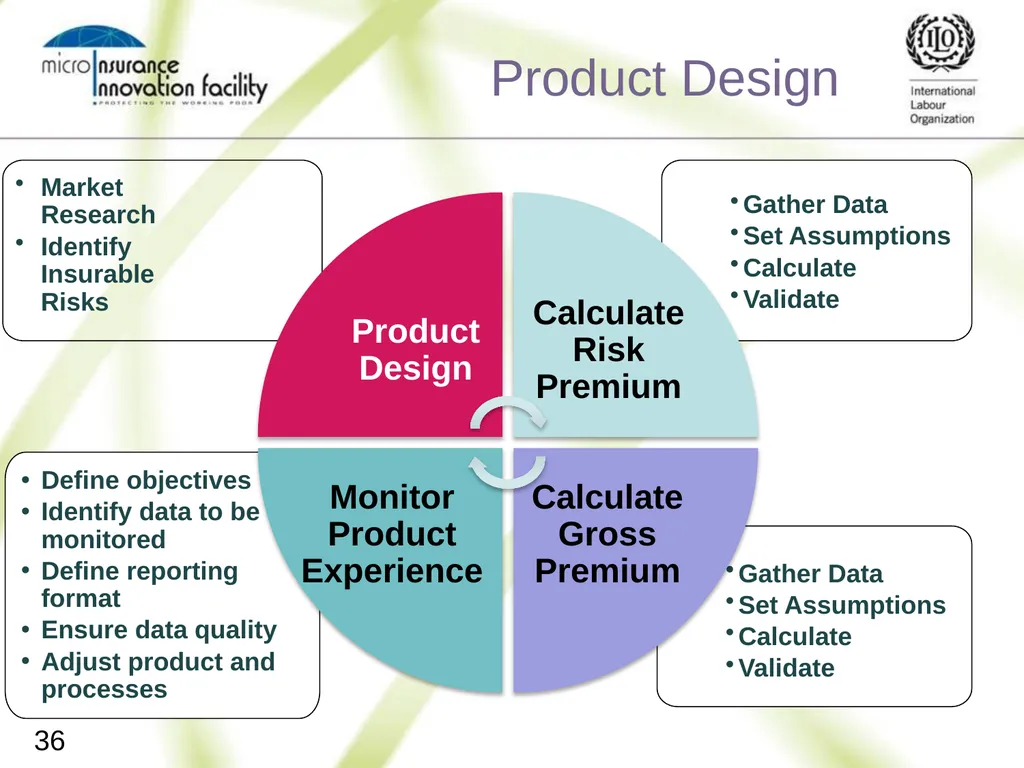
slide36. Product Design<br>
slide37. Market Context Pricing can only begin when an initial product has been designed by the product development team, based on market research.
It is indispensable for at least some of the project team to spend time in the community to understand the daily life of the target population:
living conditions and economic constraints
difficulties in accessing public services
level of understanding of financial products
local and community cultural context.<br>
slide38. Market Context The available quantitative data should be supplemented with qualitative data collected through focus group discussions
Qualitative and context data is used to make adjustments to the quantitative data gathered in order to apply it to the insured population.
Context data might include:
macro-economic data
existence and reliability of infrastructure
financial and insurance regulation<br>
slide39. Market Context Definition of the target market should include economic, cultural, professional, geographical and sociological aspects
This information is used:
to evaluate the risks (i.e. the frequency and the average claim amount)
for secondary calculations, such as the potential volume of premiums when elaborating financial projections
To measure the willingness and capacity to pay of the population<br>
slide40. Willingness to Pay Willingness to pay may relate to the amount people “mentally dedicate” to all risk coping mechanisms
Different survey approaches have different pros and cons (Dror and Koren, MI Compendium Vol 2)
Research suggests WTP ranges from 1% to 4% of individual income for microinsurance products
Willingness to pay is often over-stated and survey results may not be reliable<br>
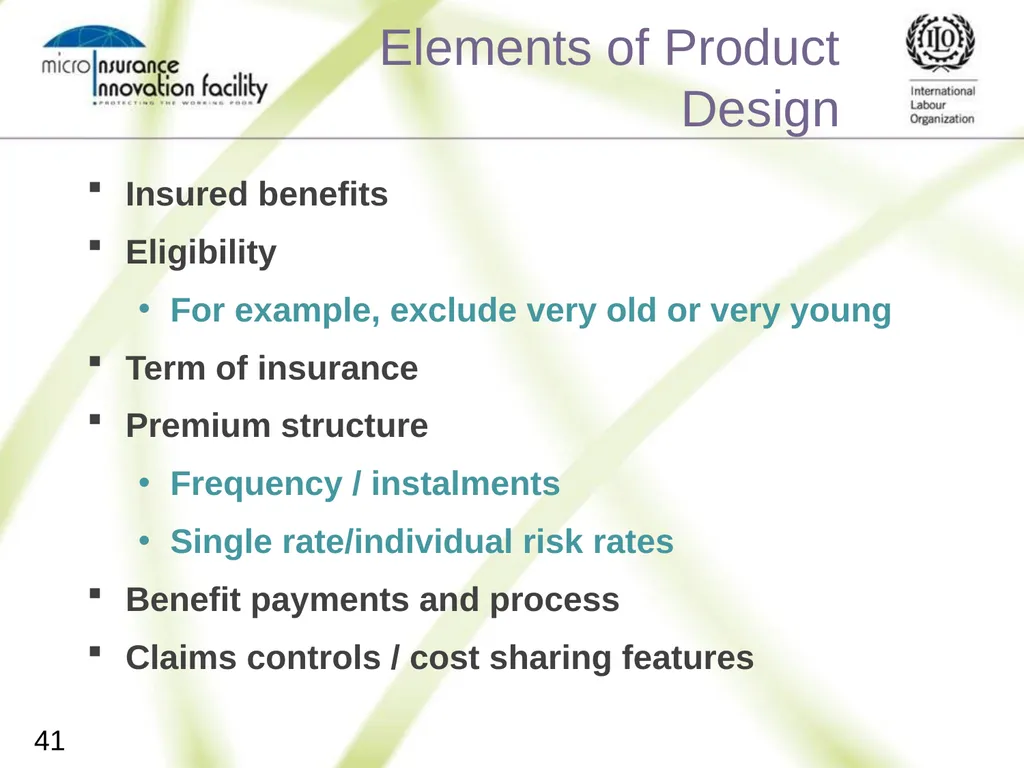
slide41. Elements of Product Design Insured benefits
Eligibility
For example, exclude very old or very young
Term of insurance
Premium structure
Frequency / instalments
Single rate/individual risk rates
Benefit payments and process
Claims controls / cost sharing features<br>
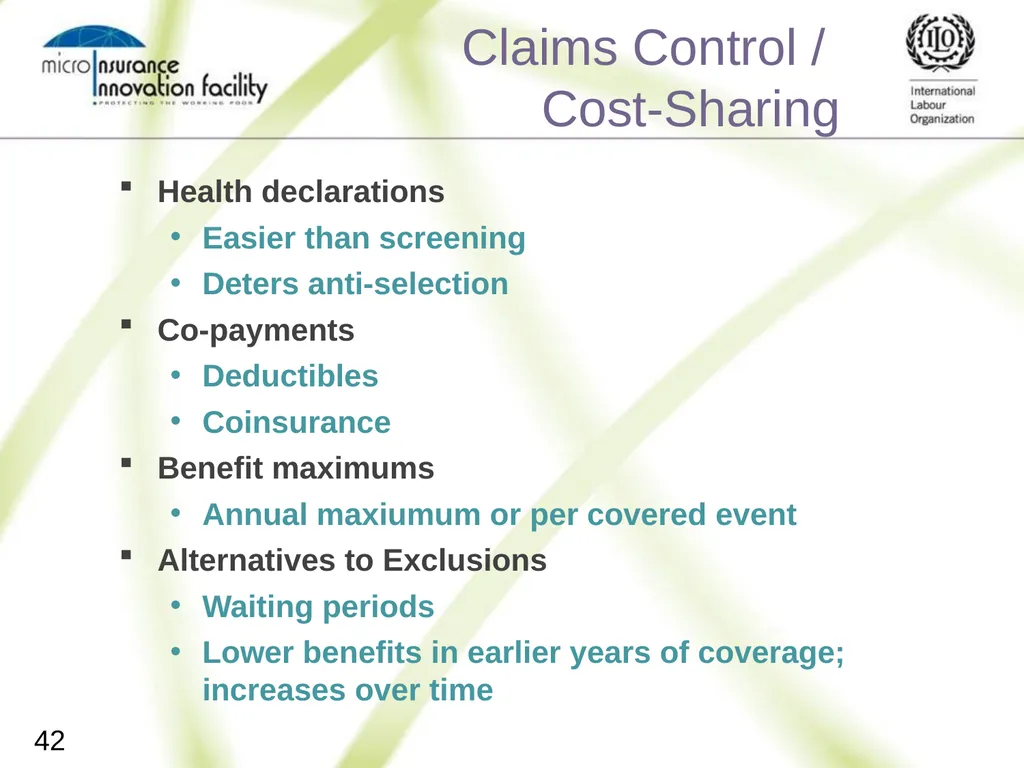
slide42. Claims Control / Cost-Sharing Health declarations
Easier than screening
Deters anti-selection
Co-payments
Deductibles
Coinsurance
Benefit maximums
Annual maxiumum or per covered event
Alternatives to Exclusions
Waiting periods
Lower benefits in earlier years of coverage; increases over time<br>
slide43. Individual Reflection Consider a project from your past experience where you were involved in pricing or product design:
What were the challenges with obtaining market research data?
How important was the context?
How did you evaluate willingness to pay?
What would you do differently now?
Share briefly with your neighbour(s)<br>
slide44. Calculating the risk premium Session 5<br>
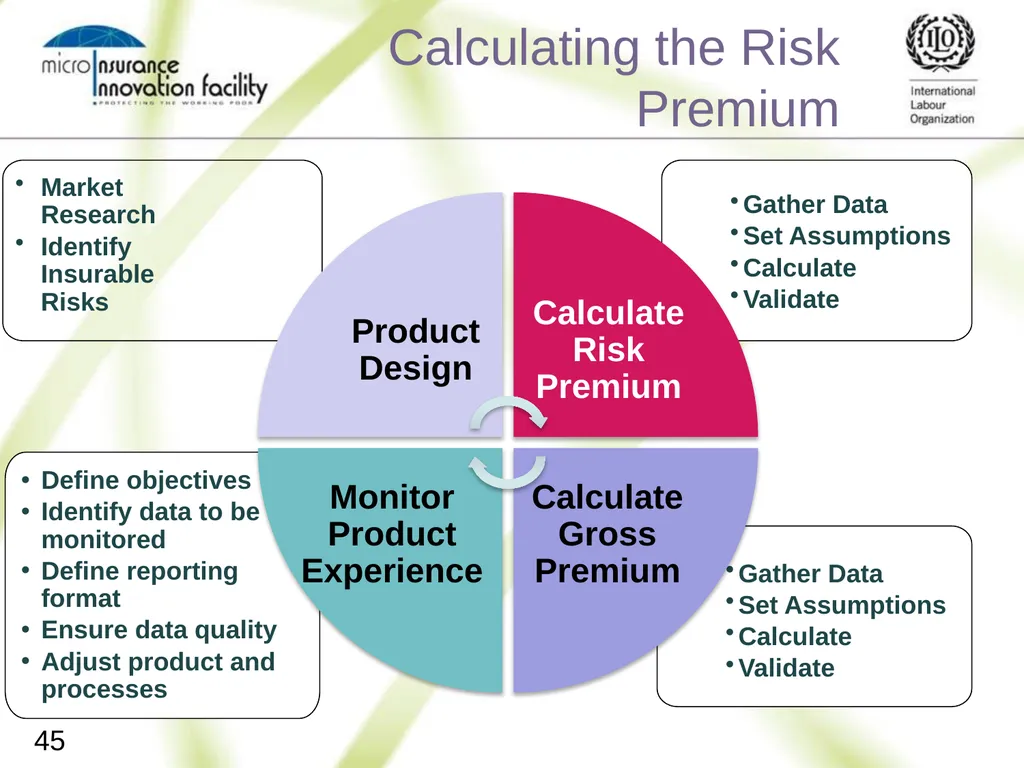
slide45. Calculating the Risk Premium<br>
slide46. Calculating Risk Premium Methods
Experience pricing
Exposure pricing
Credibility pricing
Basic formulas
Risk Premium
Claim Frequency
Expected Claim Amount
Community rating versus individual risk rating<br>
slide47. Risk Premium - Methods Experience pricing
Based on past claims experience
Assumes past provides “good enough” estimation for future claims
Requires sufficient claims data to make estimates
Requires assumptions for possible trends to extrapolate appropriately
Assumes no changes to product or insured population<br>
slide48. Risk Premium - Methods Exposure pricing
Based on assumptions regarding claims frequency and claims severity for target clients
Assumptions derived from sources other than past claims experience
Assumptions attempt to reflect “true” underlying claims distribution
No suitable past claims experience is available
Most common approach used in microinsurance, particularly for new products<br>
slide49. Risk Premium - Methods Credibility pricing
A combination of experience pricing and exposure pricing
Past claims experience only partly reflects true drivers of underlying claims
Assign relative weights to each component (experience and exposure)
May be applied to insured individuals or groups which have some accumulated claims experience<br>
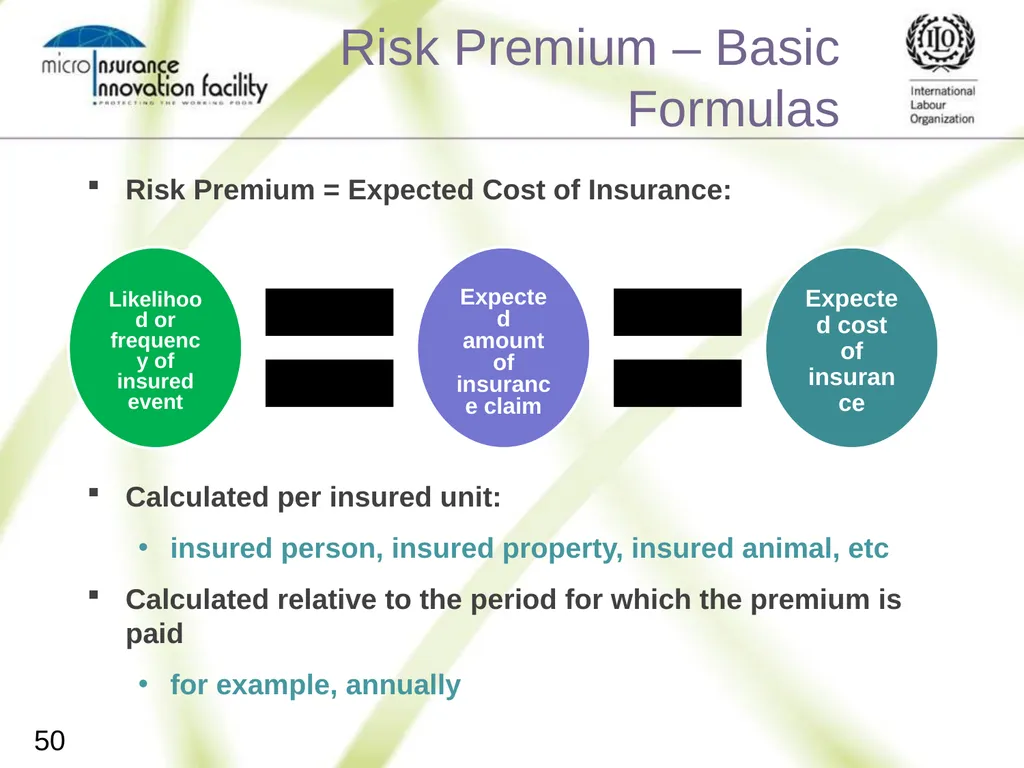
slide50. Risk Premium – Basic Formulas Risk Premium = Expected Cost of Insurance:
Calculated per insured unit:
insured person, insured property, insured animal, etc
Calculated relative to the period for which the premium is paid
for example, annually<br>
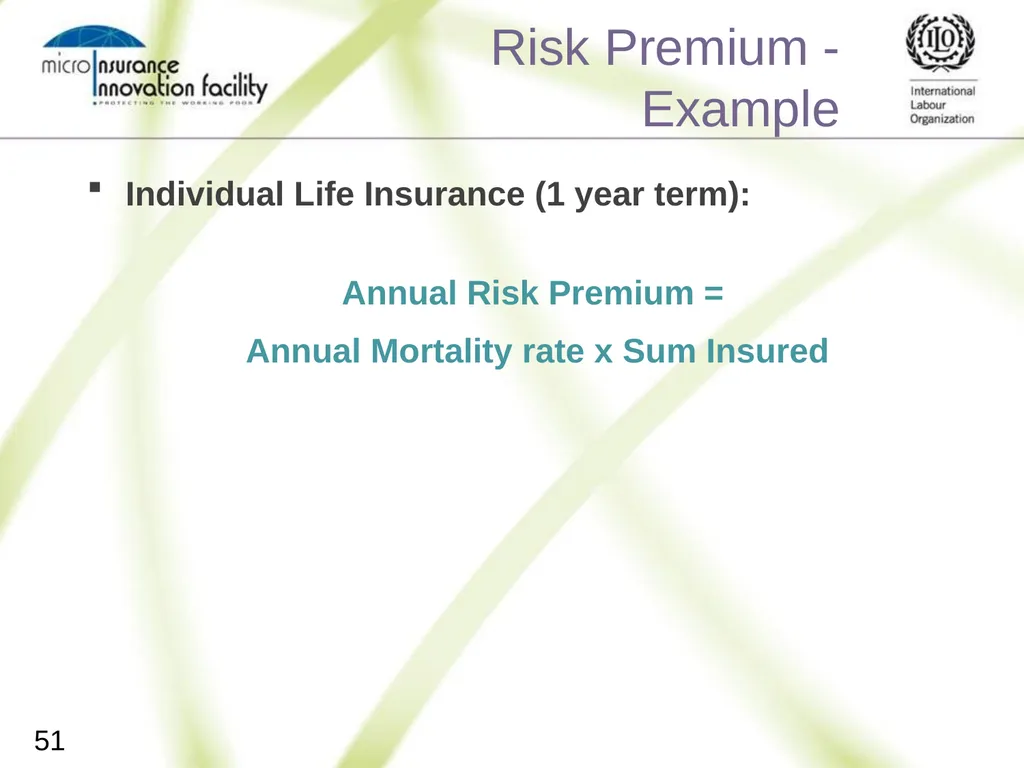
slide51. Risk Premium -Example Individual Life Insurance (1 year term):
Annual Risk Premium =
Annual Mortality rate x Sum Insured<br>
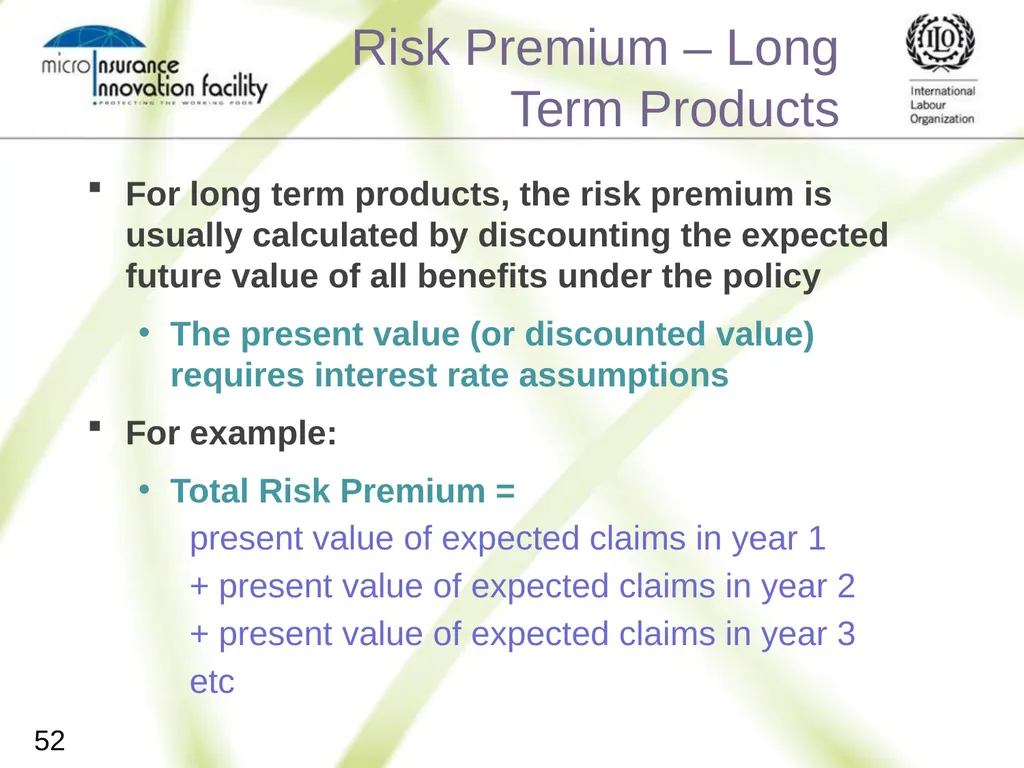
slide52. Risk Premium – Long Term Products For long term products, the risk premium is usually calculated by discounting the expected future value of all benefits under the policy
The present value (or discounted value) requires interest rate assumptions
For example:
Total Risk Premium =
present value of expected claims in year 1
+ present value of expected claims in year 2
+ present value of expected claims in year 3
etc<br>
slide53. Risk Premium – Long Term Products If premiums are paid periodically for long term products, then:
PV of periodic risk premiums = Total Risk Premium
Usually the final periodic premiums are determined at the gross premium level, after the present value of expenses and other loadings is also included<br>
slide54. Risk Premium – Asset Accumulation Products For asset accumulation products, such as endowment policies
“Net Premium” =
Risk Premium (to cover insured contingencies)
+ Savings Premium (to build up the maturity value)
There are various ways to structure savings-type elements within long-term products
MI products tend to be fairly simple so far<br>
slide55. Setting Risk Premium Assumptions Claim frequency
Expected incidence of claims in the insured population
Expected claim amount
Simple or complex depending on insured benefits
Approximations are sometimes used
Different methods
average claim vs probability distribution
May include inflation
such as for medical expenses<br>
slide56. Claim Frequency Assumptions Define “Exposure” basis – the reference population for which the claims experience applies to
For example, the number of lives that were insured during the period = “lives exposed to risk”
Use actuarial methods to determine this
Define claims occurrence
May need to omit or modify certain types of claims or events<br>
slide57. Expected Claim Amount Assumptions For products with a fixed sum insured, the Expected Claim Amount = Sum Insured
For products with variable insurance benefits, the Expected Claim assumption can be based on:
The average claim estimated from past experience
The expected value (mean) or a percentile from an assumed probability distribution of claim amounts
An estimate of the outstanding value of a loan at time of claim (eg credit life)
Projected claim amounts produced by a pricing model that might include factors such as inflation or other adjustments<br>
slide58. Community Rating vs Individual Risk Rating Sometimes it is appropriate to calculate rates on the basis of the group that the insured risk belongs to, rather than on the basis of each individual insured unit, for example:
Setting the premium for the insurance for the whole group (e.g. all people who are members of the same cooperative)
Applying the group / class price to each individual risk (e.g. all women pay the same premium no matter their age or where they live)
Community rating is not the same as Group Insurance<br>
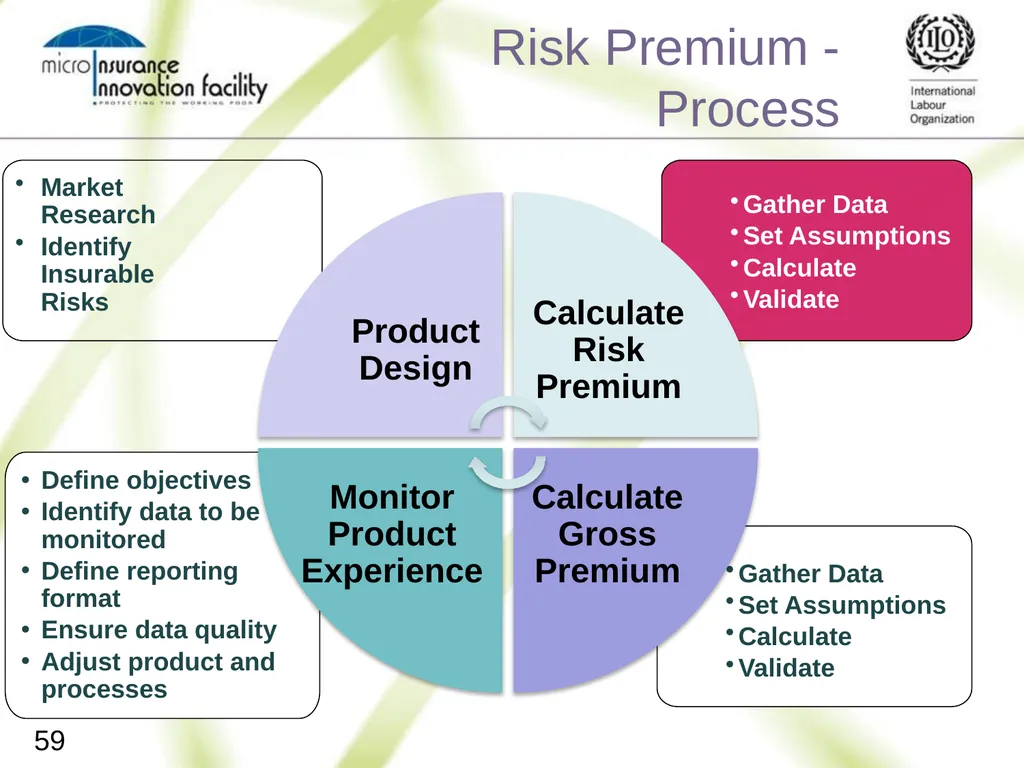
slide59. Risk Premium - Process<br>
slide60. Risk Premium – Data Collection “What type of data or information do you need to develop and price a microinsurance product?”
Write a different answer to this question on each of the blank cards you have been given.
Keep your answers short.<br>
slide61. Data Collection – Team Work Compare your cards with each other and form teams with people holding similar responses
A team can have any number of members
A team must keep only FOUR cards
Everyone in the team must agree on the 4 cards
Prepare a poster to reflect your team’s final 4 cards
No text is allowed
Use appropriate illustrations to create a clear message<br>
slide62. Risk Premium – Setting Assumptions and Validation Given the topic on your card, answer the following questions:
Define the component (word or phrase) on the card
Give at least 3 steps involved in performing this component (up to 5 max)
Provide 3 challenges that might be encountered in completing this component
Give an example of how this step would apply in practice (for a specific type of product)<br>
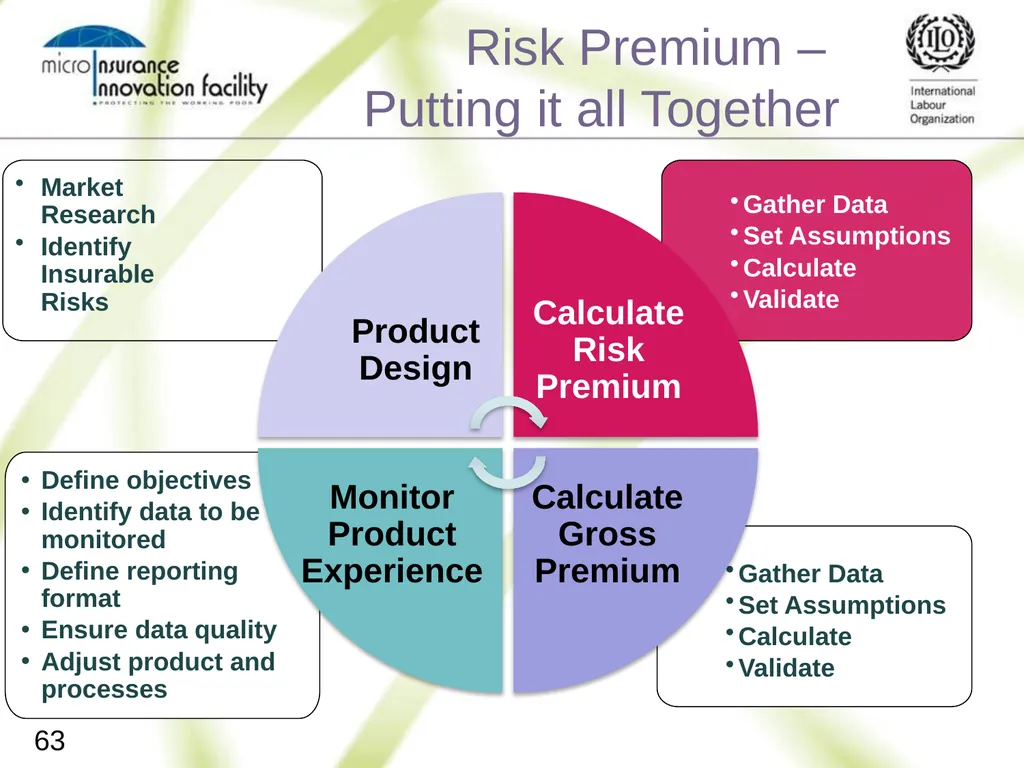
slide63. Risk Premium – Putting it all Together<br>
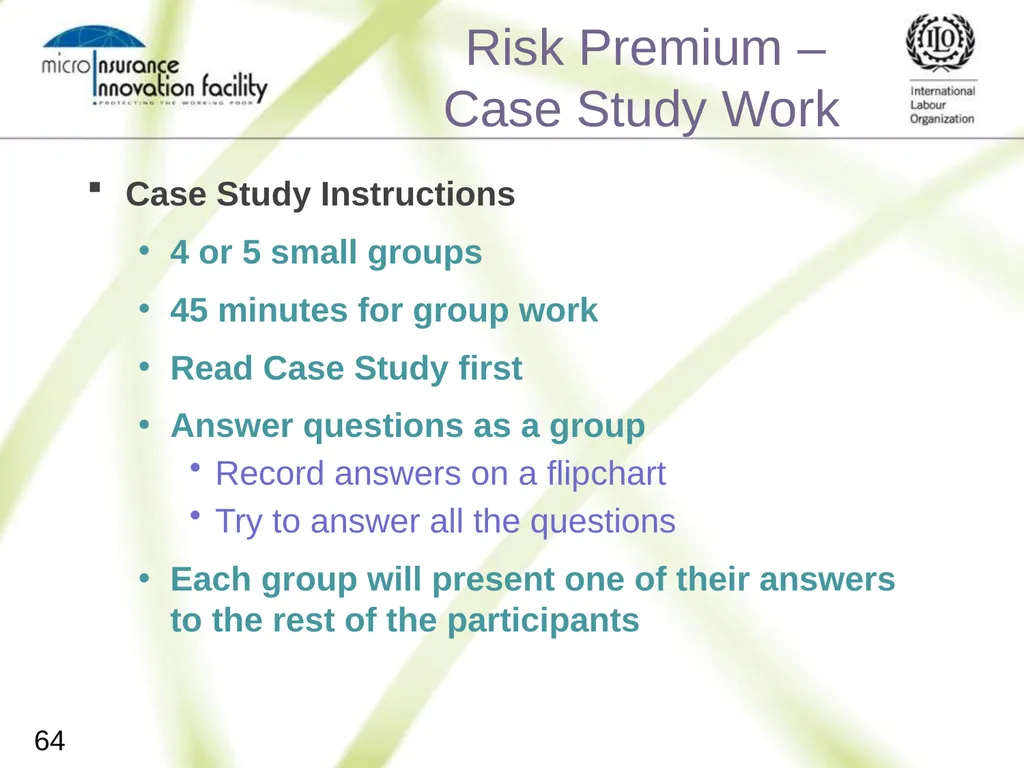
slide64. Risk Premium – Case Study Work Case Study Instructions
4 or 5 small groups
45 minutes for group work
Read Case Study first
Answer questions as a group
Record answers on a flipchart
Try to answer all the questions
Each group will present one of their answers to the rest of the participants<br>
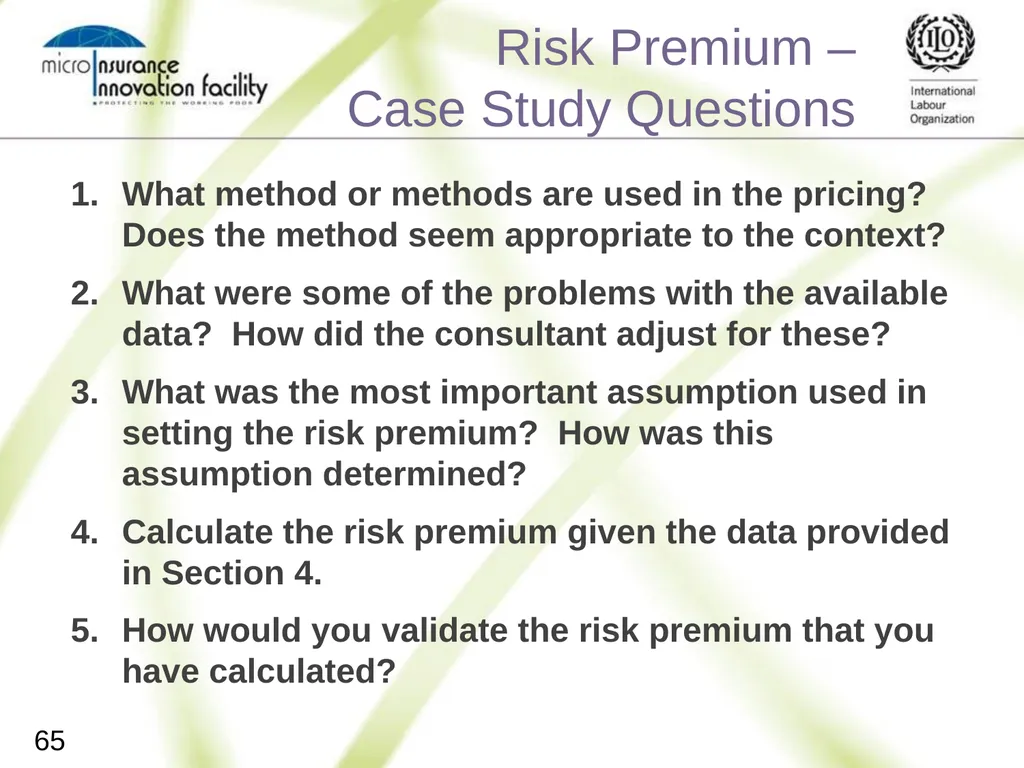
slide65. Risk Premium – Case Study Questions What method or methods are used in the pricing? Does the method seem appropriate to the context?
What were some of the problems with the available data? How did the consultant adjust for these?
What was the most important assumption used in setting the risk premium? How was this assumption determined?
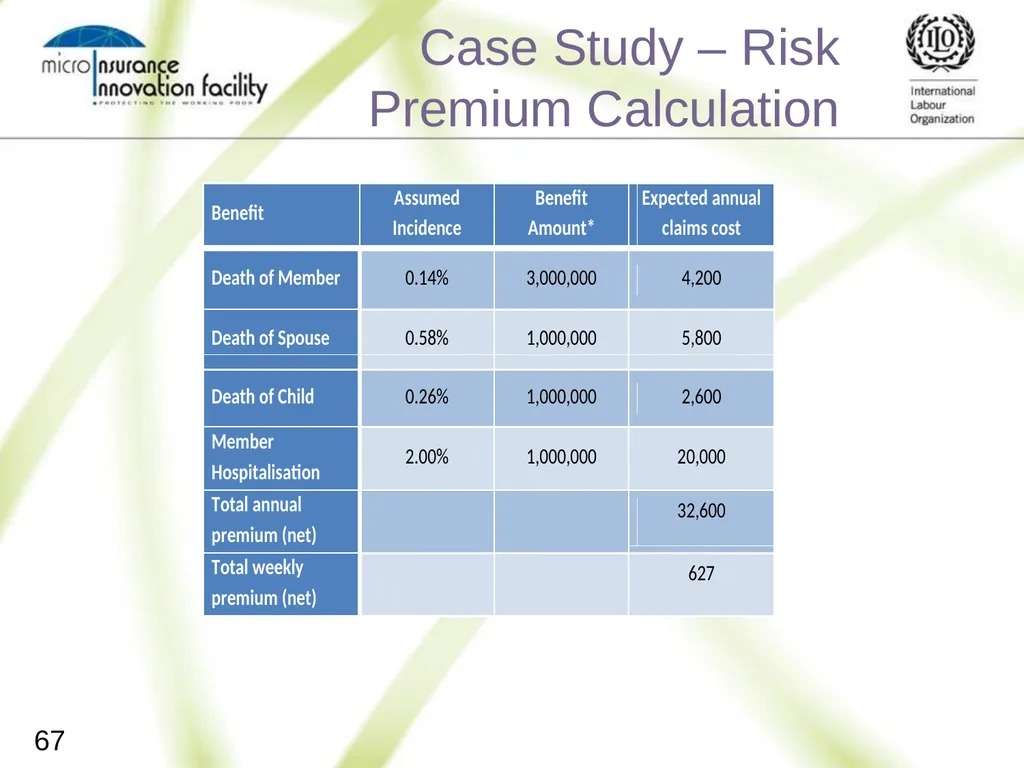
Calculate the risk premium given the data provided in Section 4.
How would you validate the risk premium that you have calculated?<br>
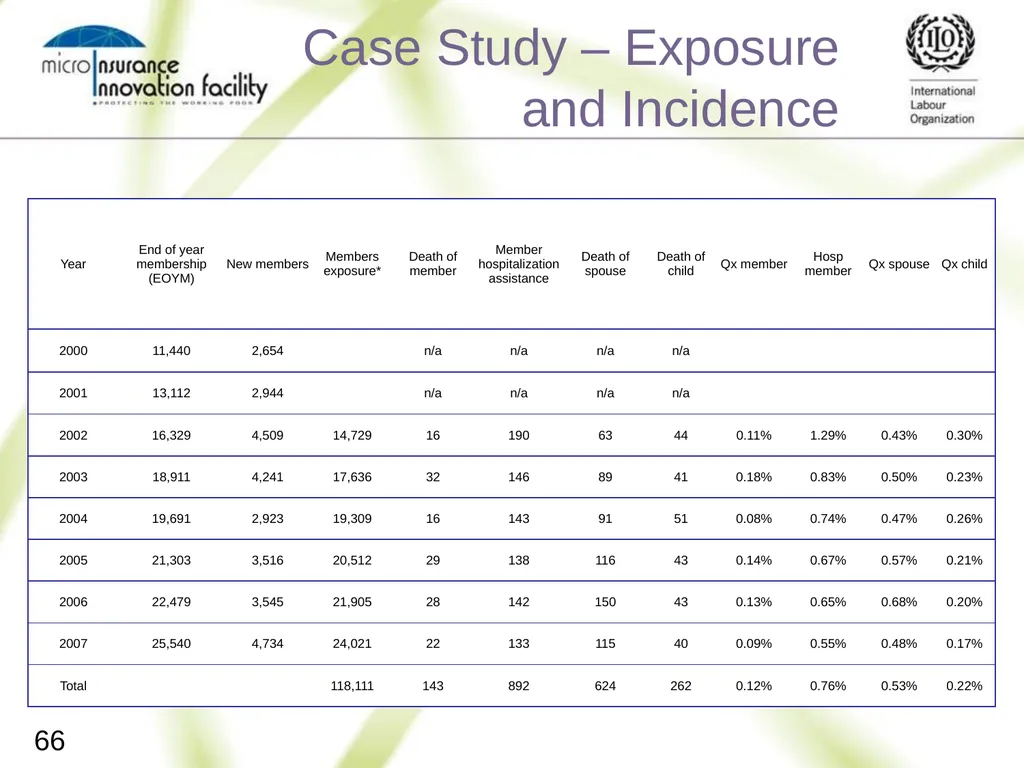
slide66. Case Study – Exposure and Incidence<br>
slide67. Case Study – Risk Premium Calculation<br>
slide68. Day 1 Recap Session 6<br>
slide69. Reflection and Sharing Reflect by yourself on the material we have covered throughout the day
Pick out 3 key concepts you have learned
Write them down (in your notebook, in your profile card, on an index card)<br>
slide70. Outstanding Questions If you have any questions or issues from the day, such as:
Areas that weren’t clear
Areas where you would like more detail
Please write these on an index card or sticky note and post them on the PARKING LOT
The trainers will review and try to answer in the morning
Remember to post questions relating to reserving for the Q&A on Day 3<br>
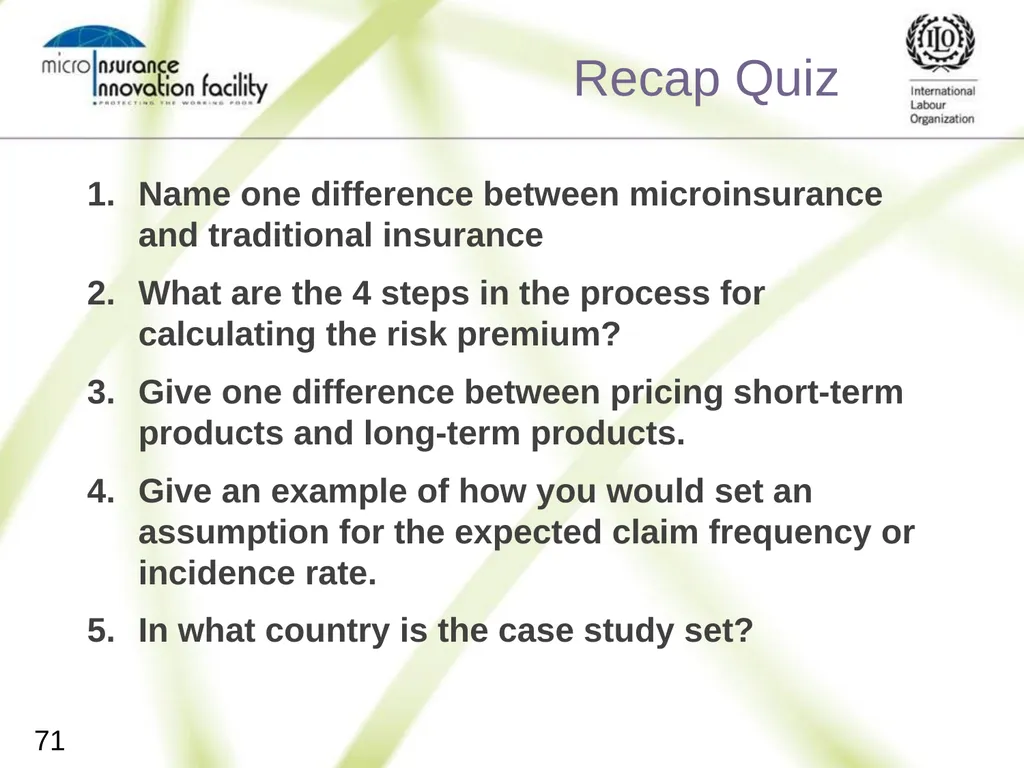
slide71. Recap Quiz Name one difference between microinsurance and traditional insurance
What are the 4 steps in the process for calculating the risk premium?
Give one difference between pricing short-term products and long-term products.
Give an example of how you would set an assumption for the expected claim frequency or incidence rate.
In what country is the case study set?<br>
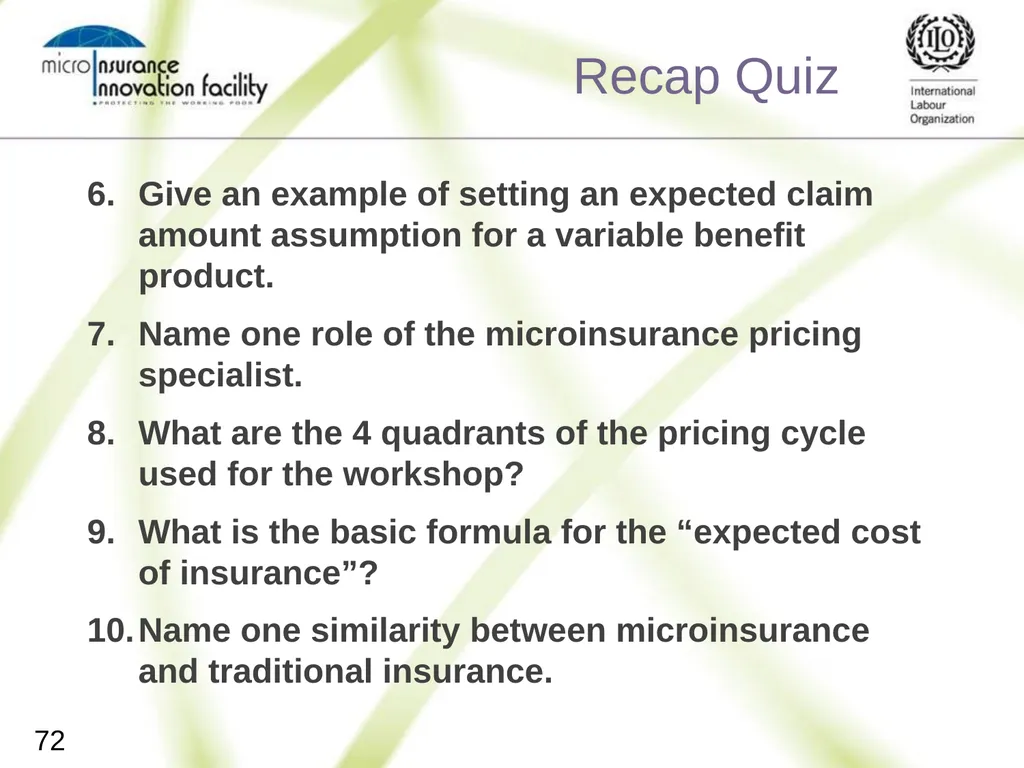
slide72. Recap Quiz Give an example of setting an expected claim amount assumption for a variable benefit product.
Name one role of the microinsurance pricing specialist.
What are the 4 quadrants of the pricing cycle used for the workshop?
What is the basic formula for the “expected cost of insurance”?
Name one similarity between microinsurance and traditional insurance.<br>
slide73. Recap Quiz List 4 components included in Gross Premium
What are the 3 methods used in calculating the risk premium?
List 2 consequences of bad pricing
What are 3 elements of insurance product design?
Name 2 insurance principles
BONUS Question!<br>
slide74. See you tomorrow!<br>
slide75. Risk Premium Revisited Session 7<br>
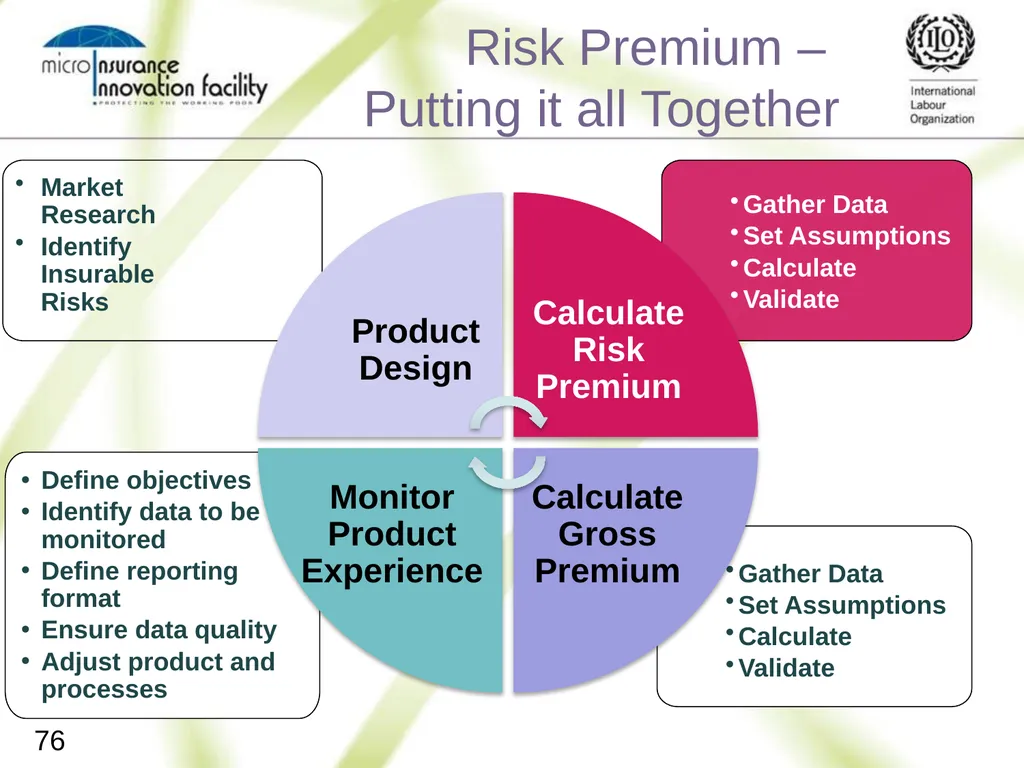
slide76. Risk Premium – Putting it all Together<br>
slide77. Risk Premium – General Discussion Which is better: a single premium or different premiums by risk class? Why?
What type of claim trends might need to be considered?
What type of trends might be specific to MI programs?
What does “best estimate” mean?<br>
slide78. Risk Premium – Using a Model Calculating the risk premium (quantifying the insured risk) often involves building a mathematical model to illustrate possible outcomes, their likelihood and their potential cost
What is a model?
What are the steps in the process?
Deterministic or stochastic?<br>
slide79. What is a Model? A mathematical model:
Is a simplified version of a real world system or process, represented through formulas or equations
Enables the pricing specialist or actuary to investigate possible outcomes without having to carry out actions in the real world<br>
slide80. Steps in Modeling 1. Develop a well-defined set of objectives for the model
2. Collect and analyse data
Requires judgment as to relevance of observed data to future environment
Quality of data is key – poor data quality may result in flawed output from model<br>
slide81. Steps in Modeling 3. Develop a set of mathematical assumptions about how the process works
Consider complexity of relationships between various parts of the model
Decide whether to use a deterministic or stochastic model
Consider timeframes
Length of projection period
Interdependence of results from one period to the next
Make assumptions for parameters that cannot be derived from data<br>
slide82. Steps in Modeling Program model
Create the “calculation engine”
Can be simple or complex depending on the process to be modeled
5. Validate model
Diagnostic and statistical tests to ensure model meets objectives and is consistent with past experience
6. Analyse outputs of model
Test reasonableness of output against real world if possible<br>
slide83. Deterministic or Stochastic? Deterministic = assumptions are set as fixed point estimates, such as the mean of a set of data based on experience
Result is a single number
Calculations from only one “scenario”
Stochastic = assumptions are set as random variables that are modeled using an appropriate probability distribution
Result is a probability distribution, from which the final premium number is selected
Calculations from multiple random scenarios, from which a “best estimate” can be selected<br>
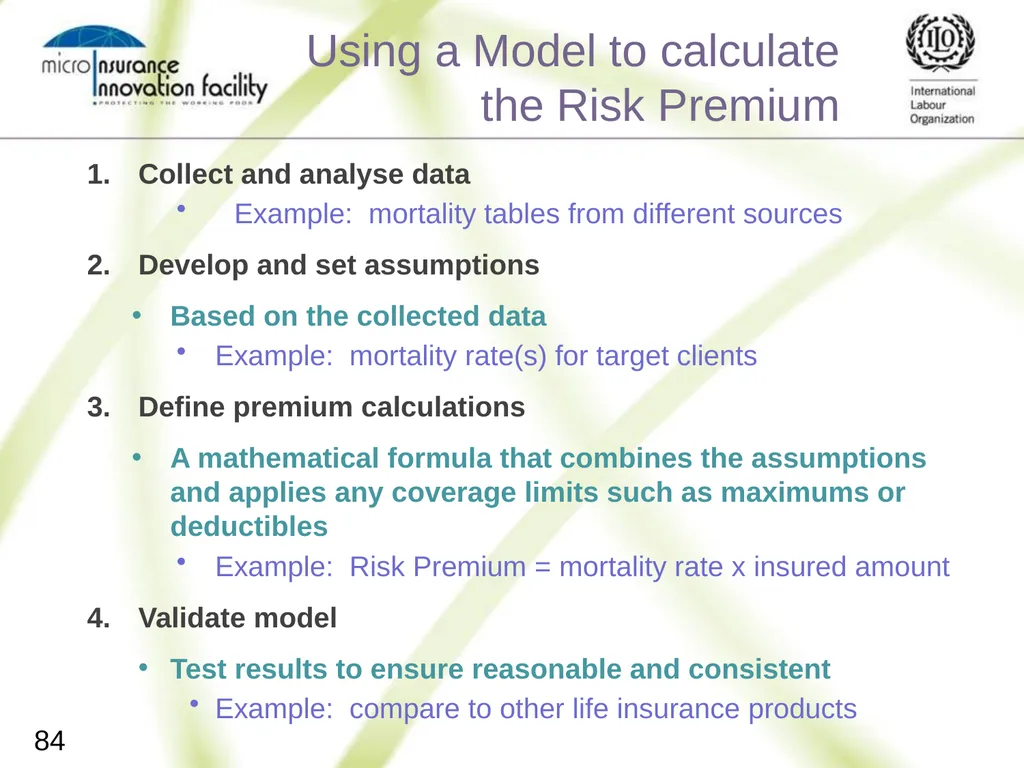
slide84. Using a Model to calculate the Risk Premium Collect and analyse data
Example: mortality tables from different sources
Develop and set assumptions
Based on the collected data
Example: mortality rate(s) for target clients
Define premium calculations
A mathematical formula that combines the assumptions and applies any coverage limits such as maximums or deductibles
Example: Risk Premium = mortality rate x insured amount
Validate model
Test results to ensure reasonable and consistent
Example: compare to other life insurance products<br>
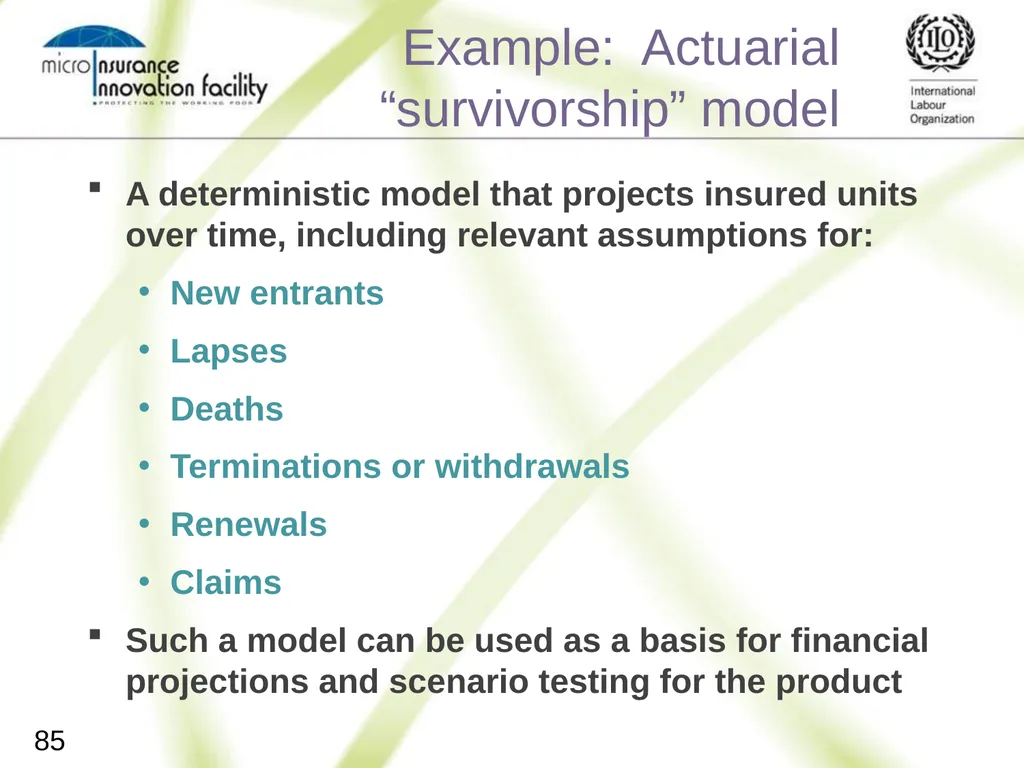
slide85. Example: Actuarial “survivorship” model A deterministic model that projects insured units over time, including relevant assumptions for:
New entrants
Lapses
Deaths
Terminations or withdrawals
Renewals
Claims
Such a model can be used as a basis for financial projections and scenario testing for the product<br>
slide86. Pricing Model Illustration<br>
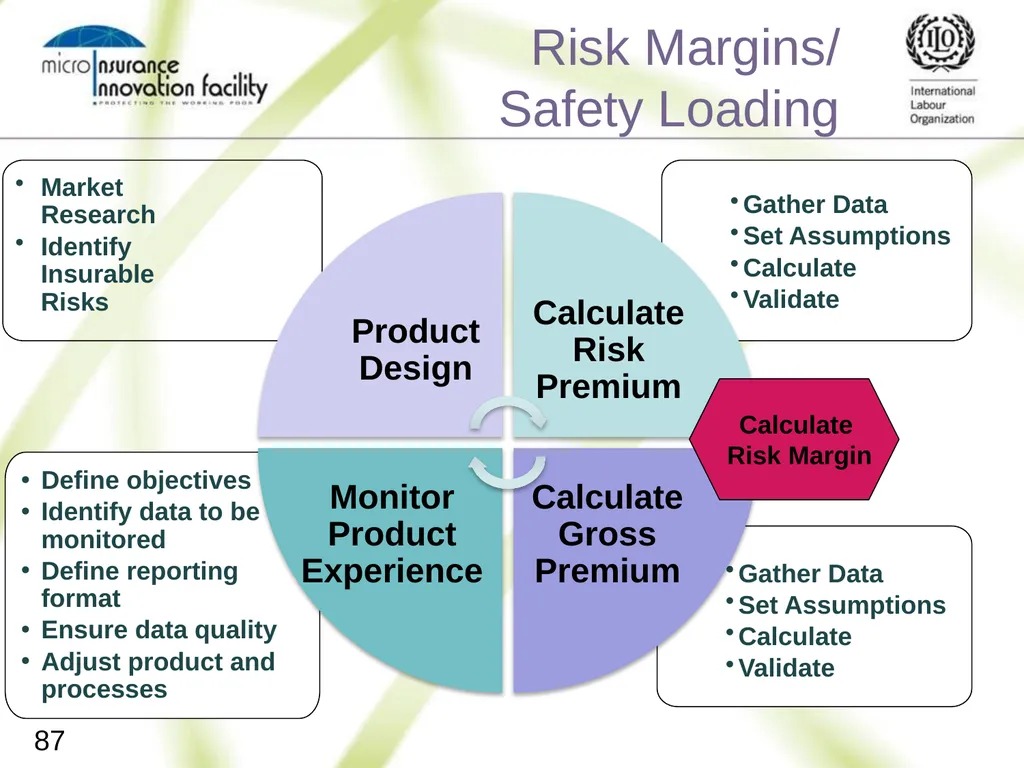
slide87. Risk Margins/ Safety Loading Calculate
Risk Margin<br>
slide88. Risk Margins/ Safety Loading Quiz Show - Test your Knowledge!
On a blank paper/card, write the numbers 1-10 and put your name at the top
Each question will show on the screen, and the presenter will read it out
On your answer sheet, write down the correct answer for the question
At the end of the quiz, hand in your answer sheet.
During the break we will score your answers and award prizes to those with the most correct answers.
(and we will go over the answers too!)<br>
slide89. Quiz Question 1 A Risk Margin can also be called an Uncertainty Margin or a Safety Loading.
True or false?<br>
slide90. Quiz Question 2 An Uncertainty Margin is:
Equal to the Risk premium
10% of the Risk premium
A loading to account for adverse deviations in expected experience
A probability distribution<br>
slide91. Quiz Question 3 An Uncertainty Margin may cover:
Errors in estimating the assumptions
Variability in expected claims
Unforeseen changes in the underlying insured population
All of the above<br>
slide92. Quiz Question 4 An Uncertainty Margin should always be explicitly calculated as a % of the Risk Premium.
True or false?<br>
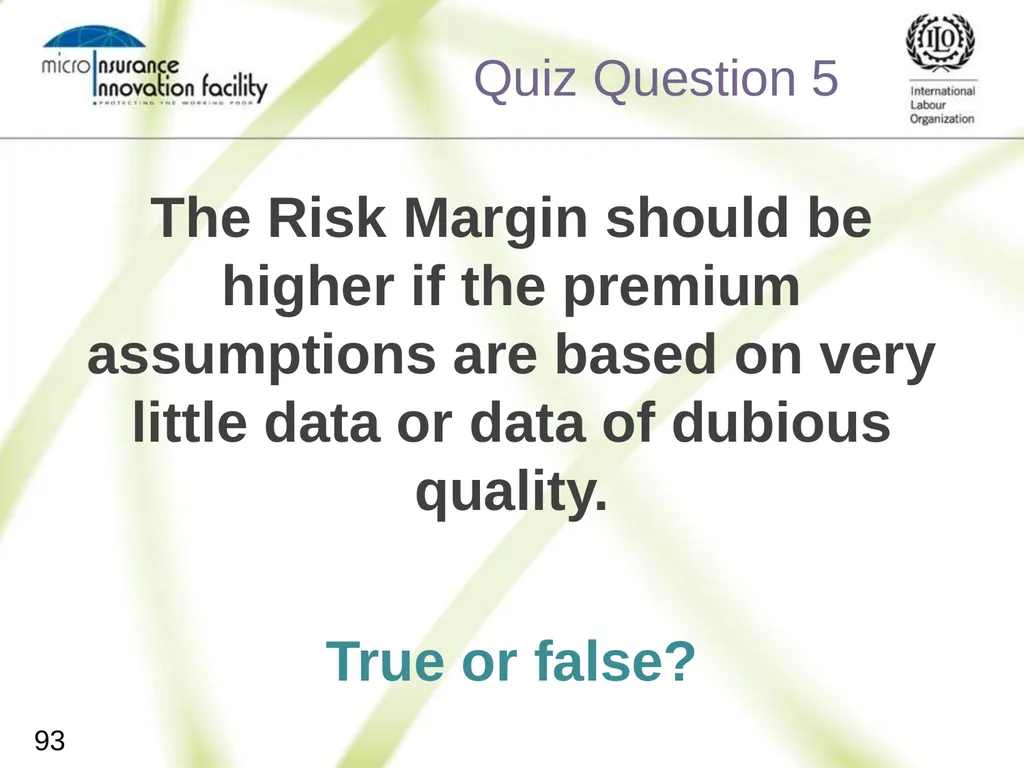
slide93. Quiz Question 5 The Risk Margin should be higher if the premium assumptions are based on very little data or data of dubious quality.
True or false?<br>
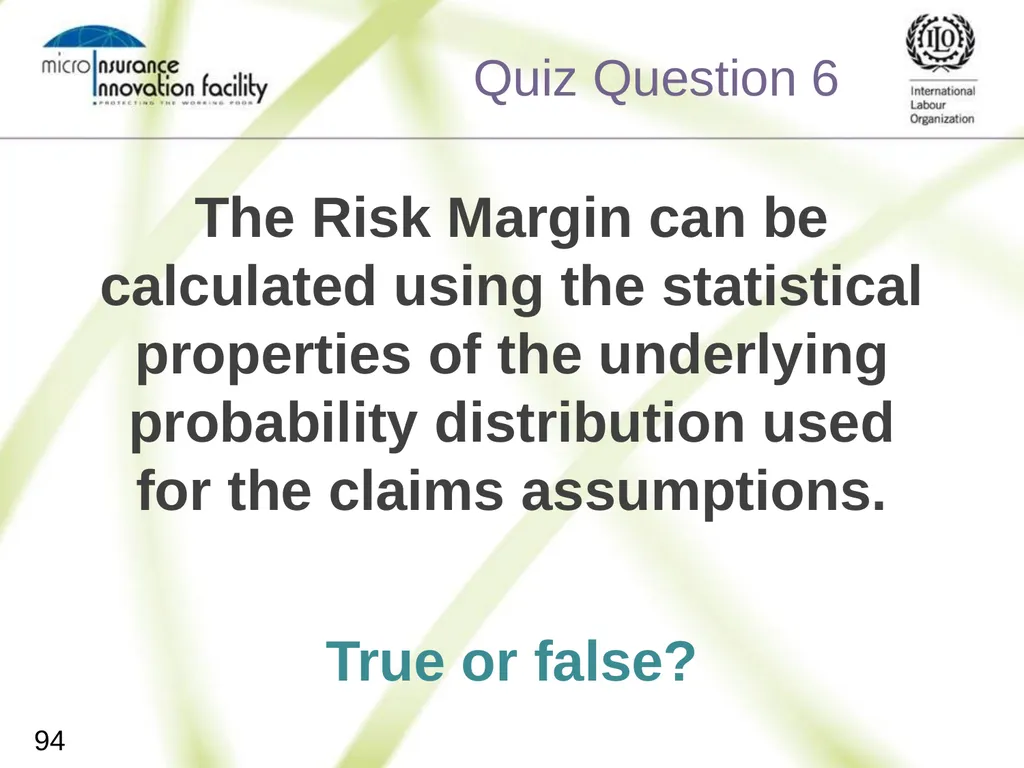
slide94. Quiz Question 6 The Risk Margin can be calculated using the statistical properties of the underlying probability distribution used for the claims assumptions.
True or false?<br>
slide95. Quiz Question 7 A Safety Margin provides adequate protection for the risk of catastrophic claims experience.
True or false?<br>
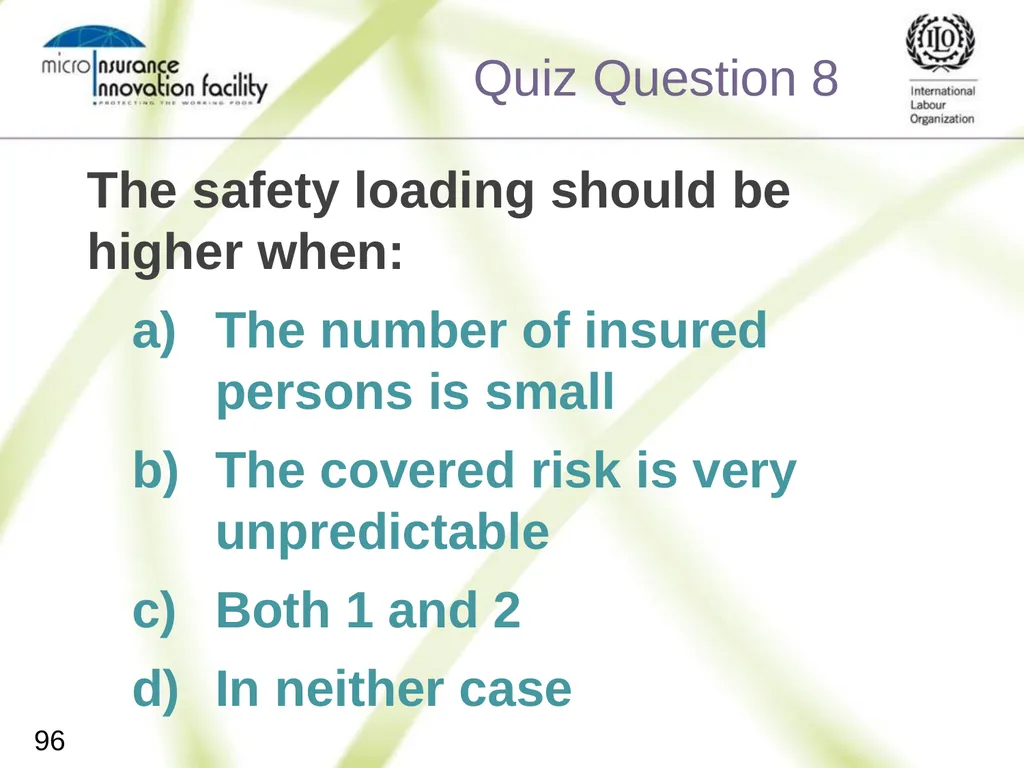
slide96. Quiz Question 8 The safety loading should be higher when:
The number of insured persons is small
The covered risk is very unpredictable
Both 1 and 2
In neither case<br>
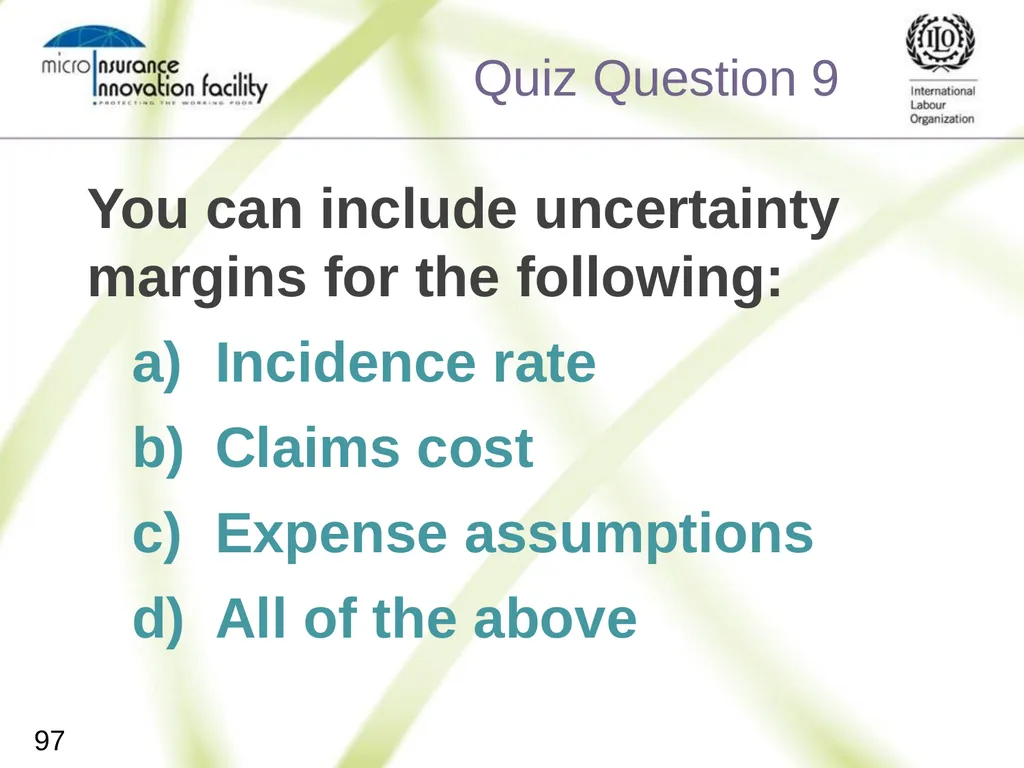
slide97. Quiz Question 9 You can include uncertainty margins for the following:
Incidence rate
Claims cost
Expense assumptions
All of the above<br>
slide98. Quiz Question 10 The Risk Margin should reflect the underlying uncertainty in the expected claims, so it will vary by product type.
True or false?<br>
slide99. Quiz Show How did we score?<br>
slide100. Reinsurance Reinsurance can be an important risk management tool:
Minimising risk concentration
Stabilising aggregate claims experience
Reduce surplus strain from new business
Reducing risk of insolvency
Minimise potential for catastrophic losses
Transfer of investment risk or lapse risk
Avail of technical and underwriting expertise
May reduce tax liabilities or solvency requirements<br>
slide101. Reinsurance How does reinsurance fit in to the risk premium calculations?
The cost of reinsurance is a separate component of the total premium, but
The need for reinsurance should be identified during the analysis of the expected claims costs
Variability of expected claims
Potential for high cost single claims
Potential for large numbers of simultaneous claims (covariance risk)<br>
slide102. Reinsurance Four main risks that reinsurance may help to address:
the risk of random fluctuations in claims experience
the risk of error in the pricing assumptions
the risk of change in the underlying conditions that affect claims
the risk of catastrophic accumulations of claims<br>
slide103. Reinsurance Common forms of reinsurance treaties:
Quota share
x% of premium ceded; x% of claims recovered
Individual Excess of Loss (XL)
If a single claim exceeds a fixed retention amount, the reinsurer pays excess
Aggregate Stop Loss (ASL)
If total claims exceed a fixed retention (usually a % of premium), reinsurer pays excess
Variations and combinations are often used to address specific risks<br>
slide104. Reinsurance For microinsurance, reinsurance is frequently not available
Catastrophe coverage for life MI is the most common
May be easier to implement benefit maximums or other limits to control risk
Determining an appropriate retention level is not an easy task
Reinsurers will frequently use a stochastic model in order to quantify and price the risk in the reinsured layers<br>
slide105. Reinsurance Reinsurance is NOT a magic wand!
Cannot transform an unviable program into a feasible one
Reinsurance comes at a cost
Reinsurance premium paid less reinsurance recoveries on claims
Should only cede risks that cannot be prudentially managed by the program itself<br>
slide106. Gross Premium Session 8<br>
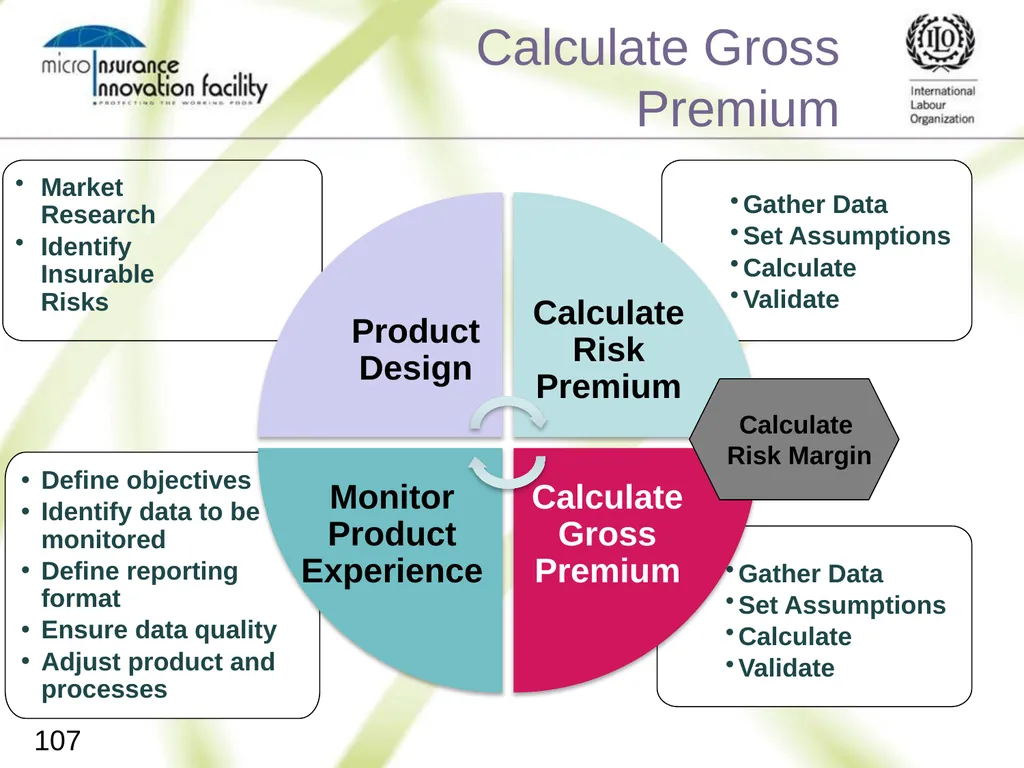
slide107. Calculate Gross Premium Calculate
Risk Margin<br>
slide108. Gross Premium Components Recall from Day 1
Gross Premium includes:
Risk Premium
Risk Margin
Cost of reinsurance (if applicable)
Expense Loading
Expected investment earnings (if applicable)
Profit Margin<br>
slide109. Gross Premium - Components Anything that is expected to be paid out of the insurance premium has to be priced into the gross premium
Some expense items are obvious, for example:
Commissions
Cost of back office (staff salaries etc) to administer the insurance<br>
slide110. Gross Premium –Components Other expense items are not as obvious, for example:
Printing and shipping education or marketing materials
Transportation in remote rural areas
Hiring and training qualified staff
Depreciation/maintenance of equipment
Software licenses
Bank fees
etc….<br>
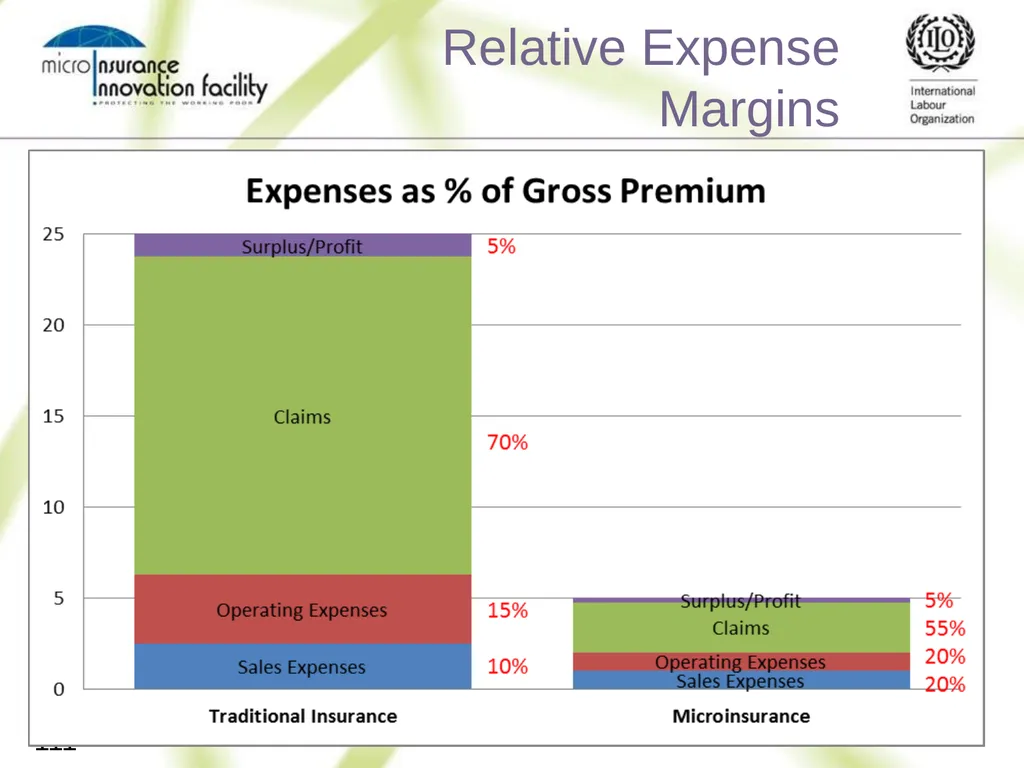
slide111. Relative Expense Margins<br>
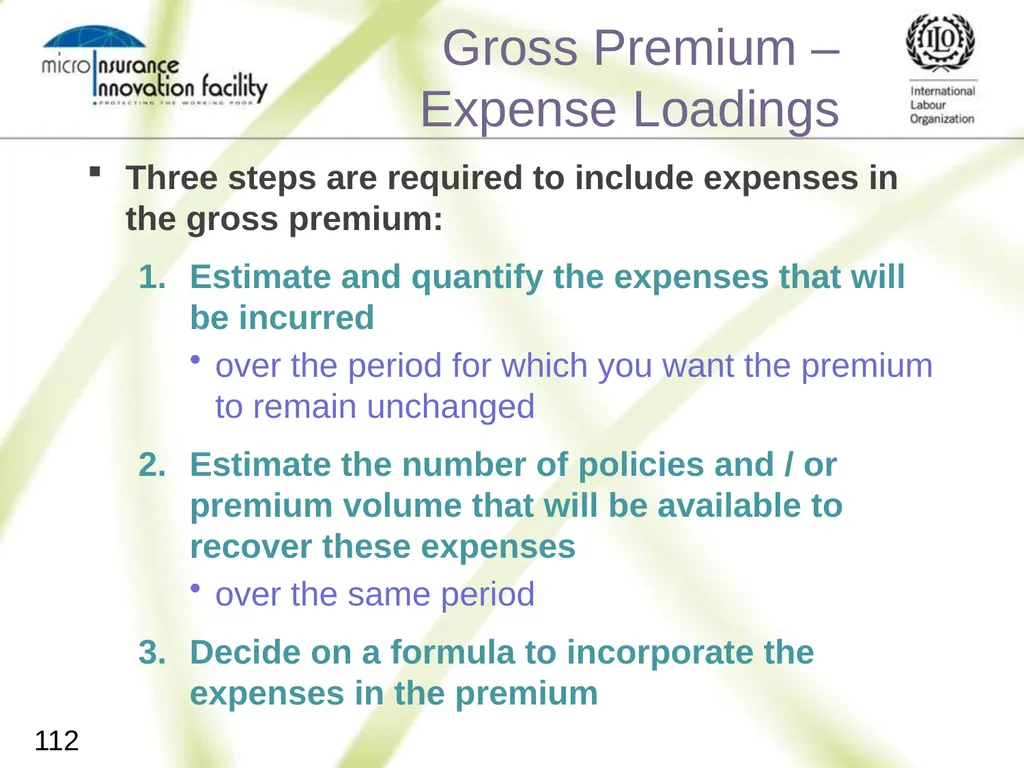
slide112. Gross Premium – Expense Loadings Three steps are required to include expenses in the gross premium:
Estimate and quantify the expenses that will be incurred
over the period for which you want the premium to remain unchanged
Estimate the number of policies and / or premium volume that will be available to recover these expenses
over the same period
Decide on a formula to incorporate the expenses in the premium<br>
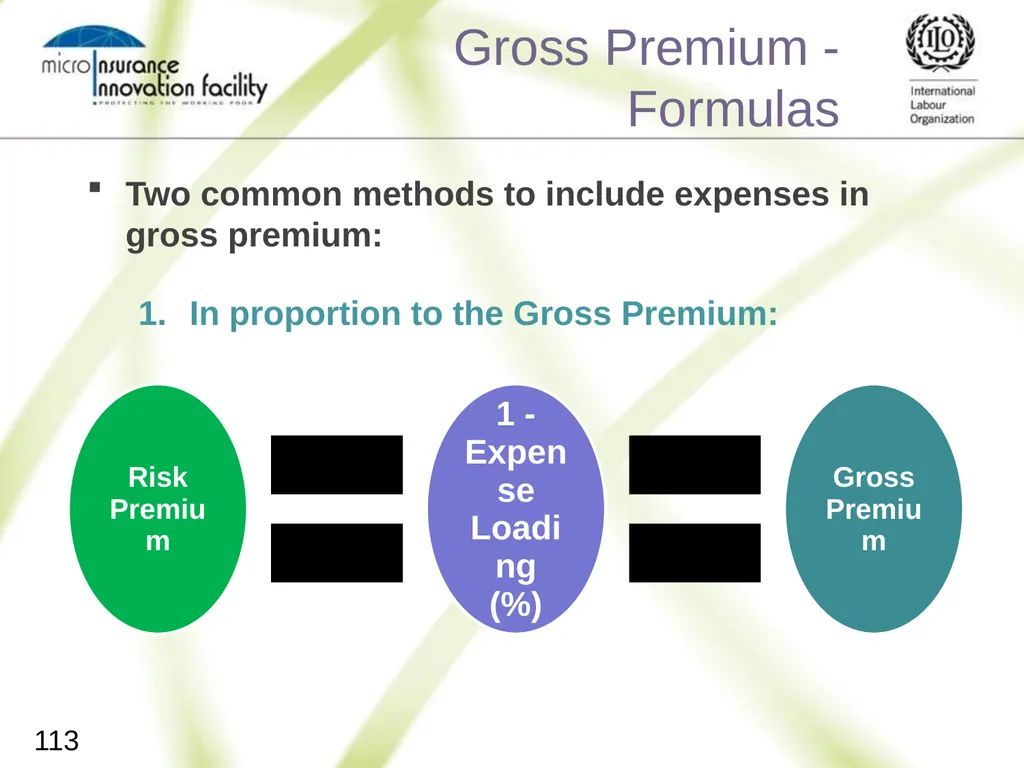
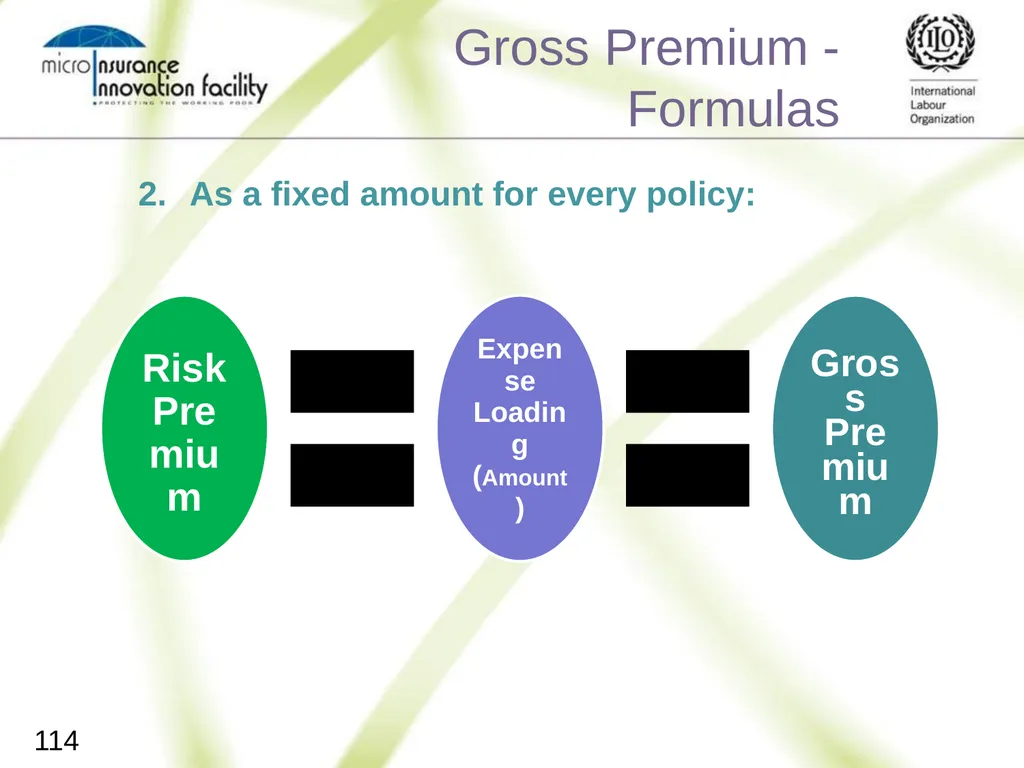
slide113. Gross Premium - Formulas Two common methods to include expenses in gross premium:
In proportion to the Gross Premium:<br>
slide114. Gross Premium - Formulas As a fixed amount for every policy:<br>
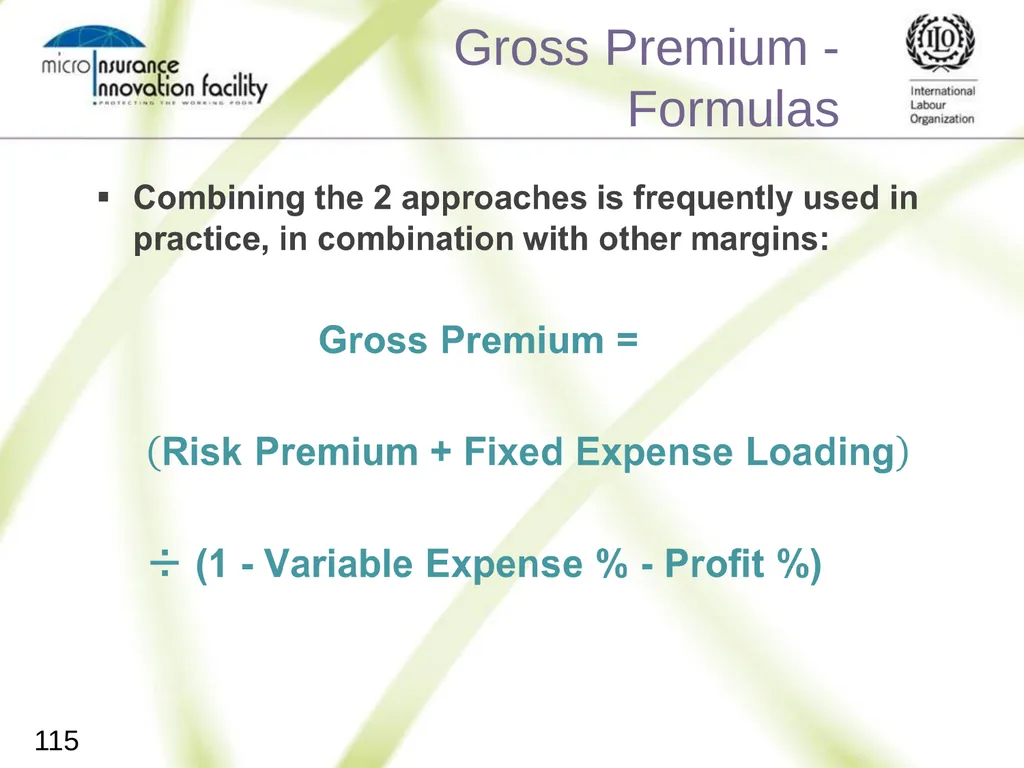
slide115. Gross Premium - Formulas<br>
slide116. Effective Distribution - Discussion How might the distribution channel affect the gross premium calculation?
What are key areas to consider for MI?<br>
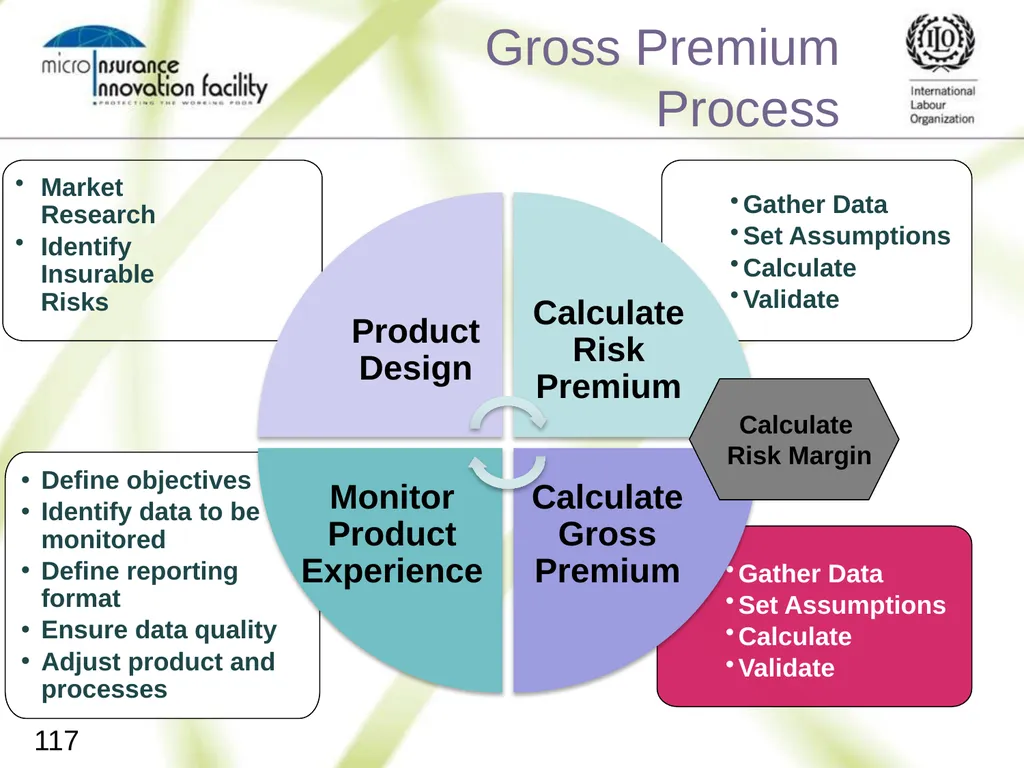
slide117. Gross Premium Process Calculate
Risk Margin<br>
slide118. Expense Loadings - Exercise Using the cards provided, write down as many expense components as you can think of
At least 3 items
Only one item per card
For each item indicate:
Is it a FIXED cost or a VARIABLE cost?
If variable, what is the underlying driver?
Post each of your cards up on the wall under the category you think it belongs to<br>
slide119. Expense Loadings – Case Study Work Case Study Instructions
4 small groups
Re-read Part 2 of each case study first
30 minutes to discuss and record on a flipchart
Each group will present one of their answers<br>
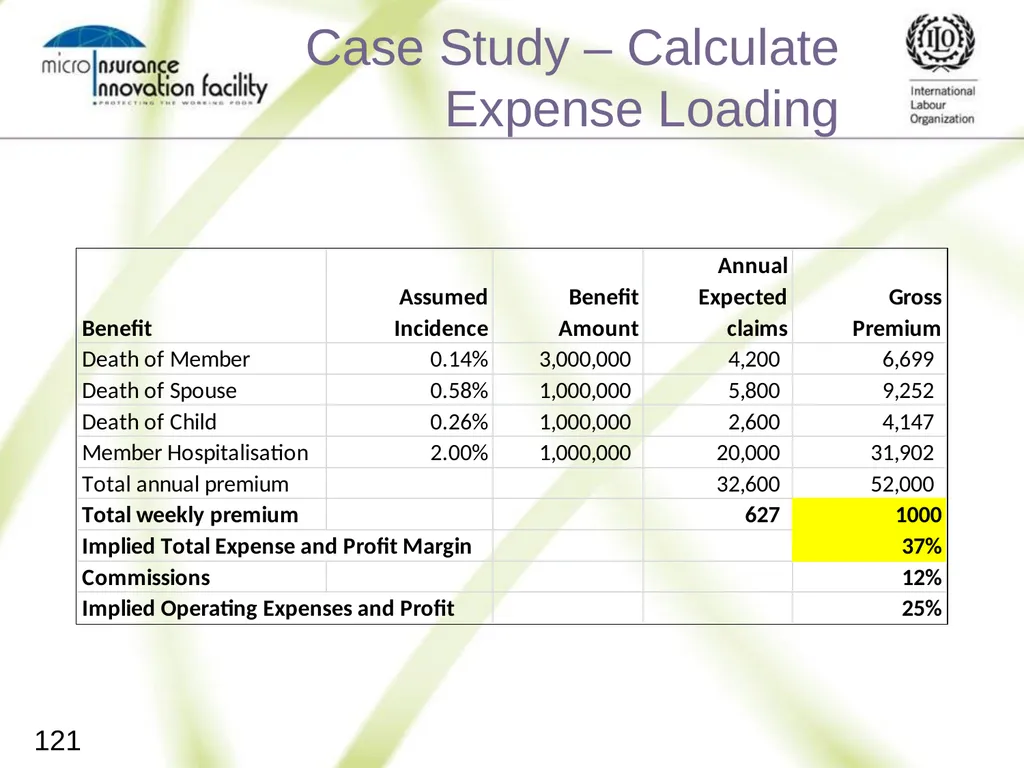
slide120. Expense Loadings – Case Study Questions Using the data from Tables 6 and 10, calculate the expense loading used in the final gross premiums.
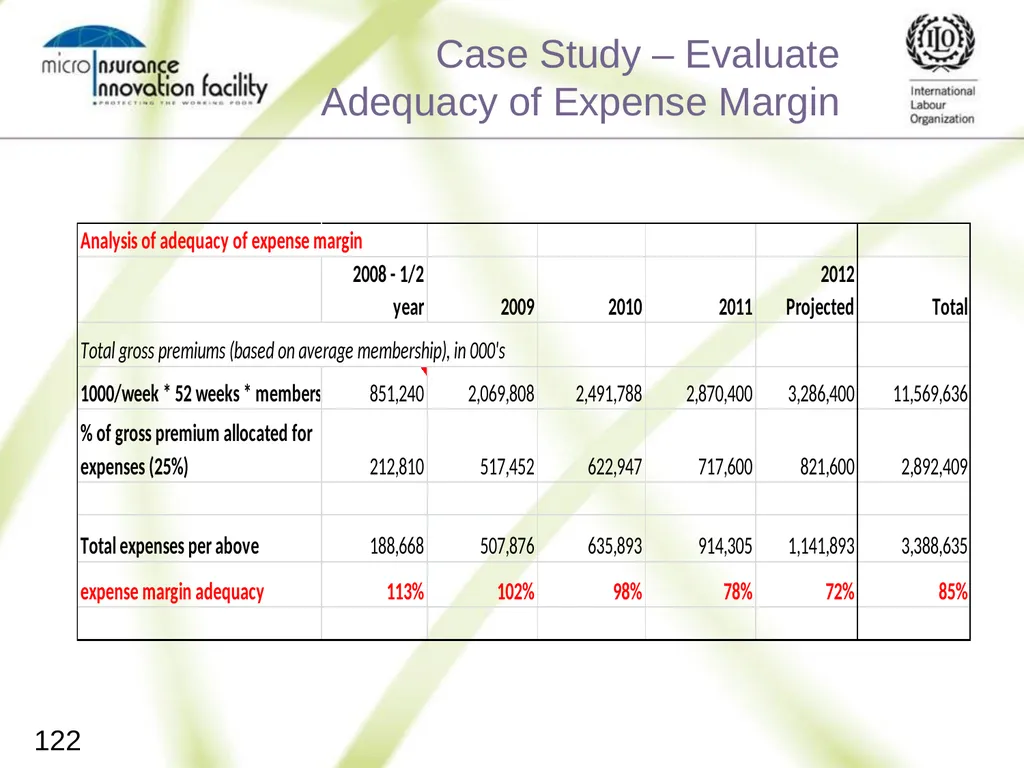
Using the expense data in Table 7 and the projected membership in Table 8, evaluate the adequacy of the expense loading over the period from 2008-2012.
Do you agree with the expense loading used in this case?
What would you do differently?
What were the biggest challenges in the case study exercise?
How could you overcome them?<br>
slide121. Case Study – Calculate Expense Loading<br>
slide122. Case Study – Evaluate Adequacy of Expense Margin<br>
slide123. Group Discussion Questions How do you set assumptions if you don’t have detailed data to work with?
How can you balance a reasonable expense margin with the often higher costs of reaching the target market?<br>
slide124. Business plans and financial projections Session 9.1<br>
slide125. Business Plans and Financial Projections Financial projections can be used as a method to determine gross premiums
Pricing projections should be consistent with business plan assumptions
If programmed on a computer, financial projections allow for scenario testing and answering “what-if” questions<br>
slide126. Developing Financial Projections Developing projections involves modeling all of the various elements, including how they relate to each other, and how they vary over the projection period:
Insured volume
Expected claims
Based on the insured volume
Expected expenses
Can be modeled in aggregate or relative to insured volume (or often both)
Other economic and business assumptions<br>
slide127. Insured Volume Assumptions Insured Volume can be defined in several ways:
By number of policies
By insured units (persons, cars, cows, etc)
By sum insured (benefit amount)
By gross premiums written/sold
Choose a volume definition that is appropriate to the product and distribution channel
Sometimes you need to use more than one to model the business effectively over time<br>
slide128. Insured Volume Assumptions Estimate the insured volume over time
Initial take-up rate
Relative to the size of the target market
Growth in take-up rate
May change based on pilot expansion or marketing campaigns
Lapse rates (drop outs)
Renewals
Deaths/Terminations due to claims made
Coverage may end if an insured person or animal dies or an asset is lost or destroyed<br>
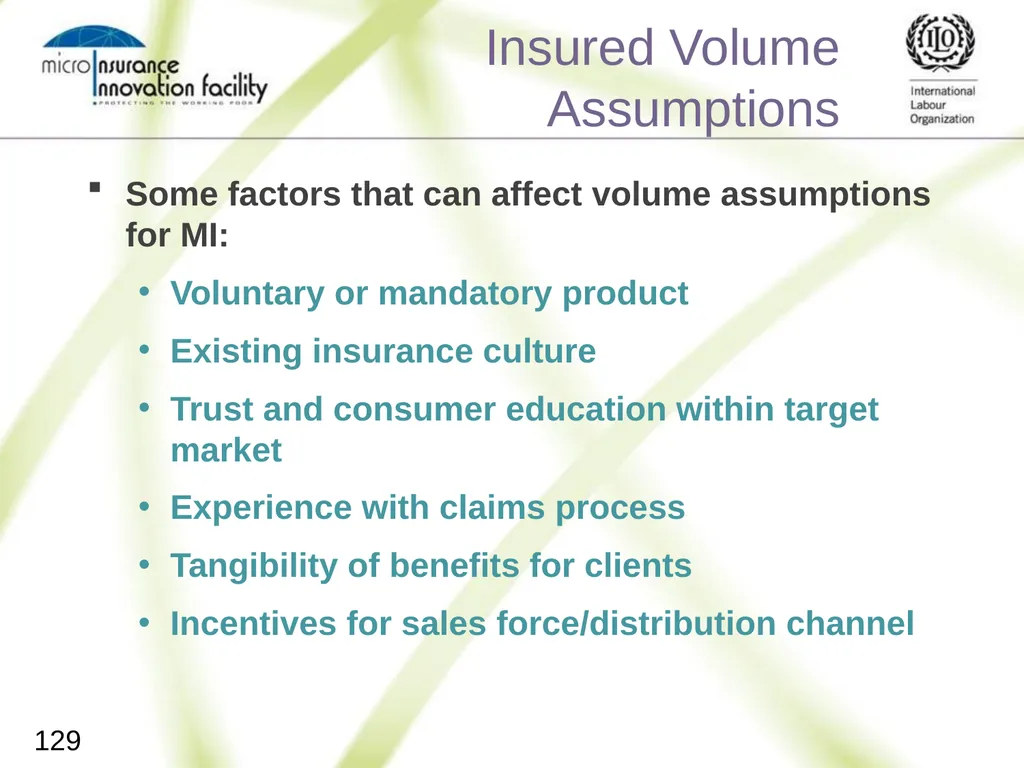
slide129. Insured Volume Assumptions Some factors that can affect volume assumptions for MI:
Voluntary or mandatory product
Existing insurance culture
Trust and consumer education within target market
Experience with claims process
Tangibility of benefits for clients
Incentives for sales force/distribution channel<br>
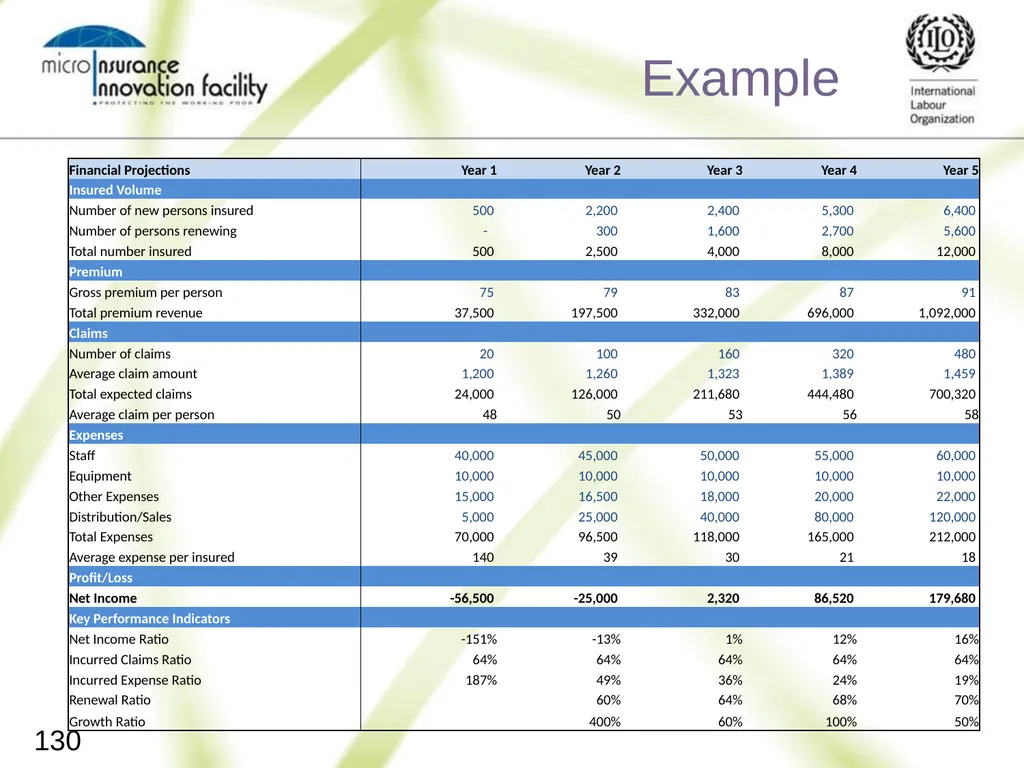
slide130. Example<br>
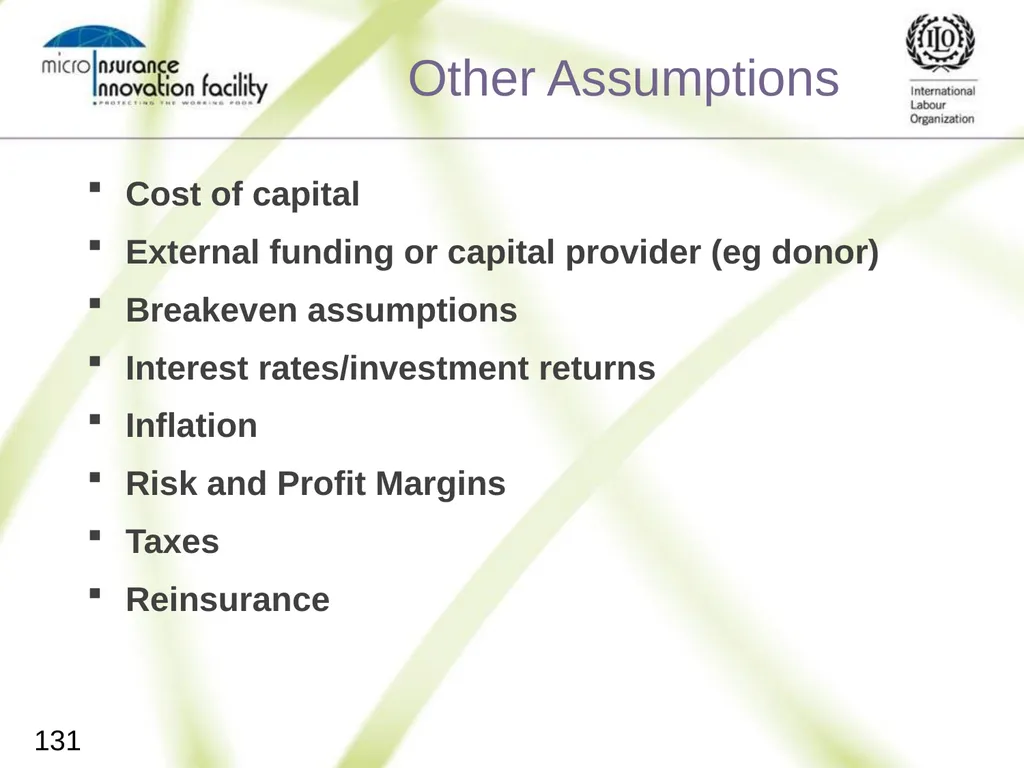
slide131. Other Assumptions Cost of capital
External funding or capital provider (eg donor)
Breakeven assumptions
Interest rates/investment returns
Inflation
Risk and Profit Margins
Taxes
Reinsurance<br>
slide132. Business Planning for Microinsurance Developed by John Wipf and Denis Garand
Funded by GIZ Sector Initiative – Systems of Social Protection, in collaboration with the Capacity Building Working Group (CBWG) of the Microinsurance Network (MiN)
Available online at http://www.microinsurancenetwork.org/networkpublication54.php<br>
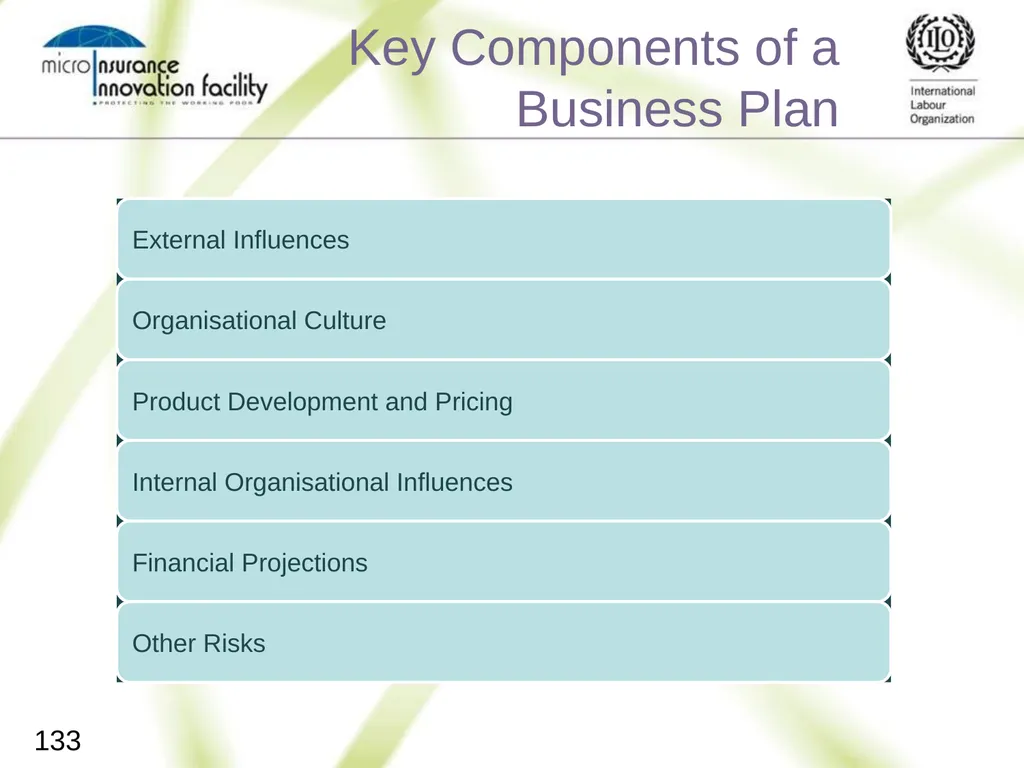
slide133. Key Components of a Business Plan<br>
slide134. Scenario Testing Scenario testing can help you determine if your gross premiums will be adequate, given the business plan assumptions
Decide which scenarios are relevant for your situation (product/organisation/etc), for example:
Sales/take-up much lower than expected
Claims much higher than expected
Expenses much higher than expected
Low renewal rates
Scenario testing can be deterministic or stochastic<br>
slide135. Scenario Testing Scenarios can reflect several factors:
“Reasonable” variations in experience
These should be captured by gross premiums (through the risk margin)
“High or unusual” variations in experience
These should be covered by capital/surplus or other external funding
Perhaps a donor guarantee or contingency fund
Can also be covered by reinsurance, if available
Specific risks that are unique to the project
Political or regulatory issues
Distribution partnership challenges<br>
slide136. Some Considerations for Financial Projections How long after the launch date should a profit be realised?
What long-term rates of return should be aimed for?
To what degree should products be cross-subsidized?
How much capital will be needed?
How much margin for error should be included in the pricing?
If subsidies are available, how should these be incorporated into the financial projections?
What should happen to surplus in member-owned programs?<br>
slide137. Individual Reflection Consider a current or recent MI project:
Did you prepare a business plan for it?
What information would you have needed to create good financial projections?
What types of scenario testing would be relevant for your organisation/product?
If you wanted to use this approach in practice, what would you need to do first?
Record notes for yourself to follow up on later<br>
slide138. Gross Premium – Putting it all together! Session 9.2<br>
slide139. Gross Premiums – Putting it all together! Calculate
Risk Margin<br>
slide140. Gross Premium – Applying the Concepts Case Study Work:
Divide into 4 groups
Each group will get one question to answer
Discuss and answer the question on your card, and record your answers on a flipchart
15 minutes
Will conclude with group presentations of each question and their response<br>
slide141. Case Study Discussion Questions Compare the final gross premiums to the benefits provided by the product. Do the premiums seem “reasonable”? How would you check?
What changes could you make to the benefits or product features to make the premiums more affordable?
What type of claims control features would you consider adding to this product? How would you adjust the premium?
Describe 3 “scenarios” that you might consider in your projections to test the premium calculations.<br>
slide142. Day 2 RECAP Session 10:<br>
slide143. See you tomorrow!<br>
slide144. Day 3 – morning recap Session 11<br>
slide145. GROSS Premium Revisited Session 12<br>
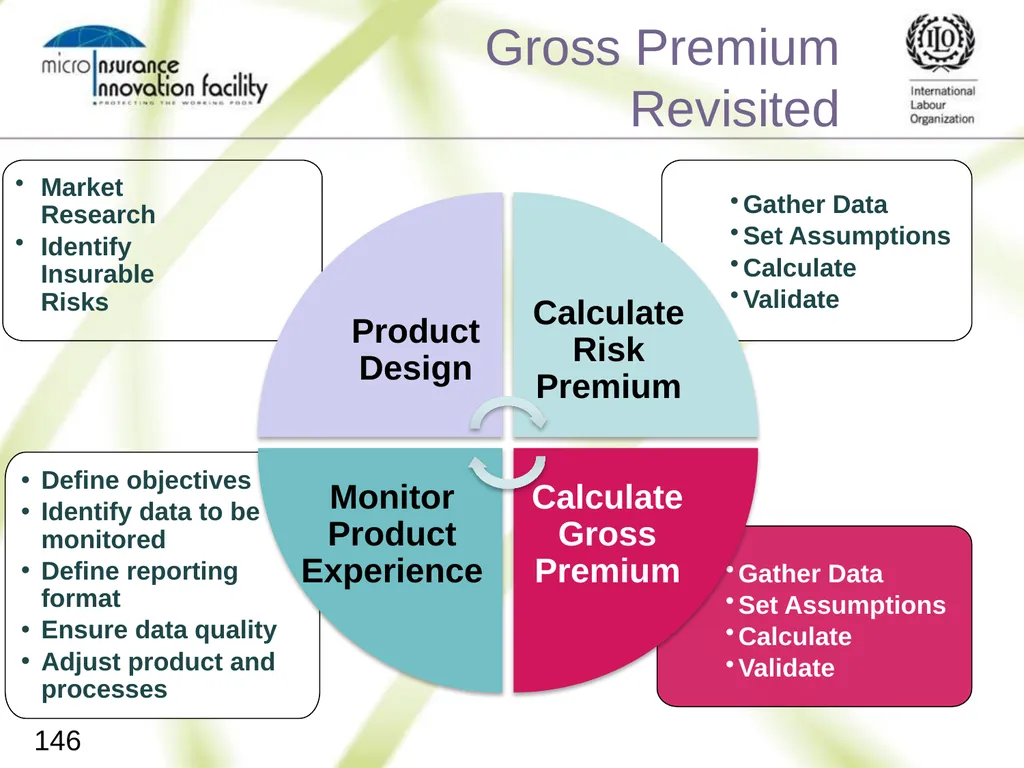
slide146. Gross Premium Revisited<br>
slide147. Gross Premium – Expected Investment Earnings May be included directly in the Risk Premium calculation, especially for long-term products
Usually very significant component for long-term products
Less important for short-term products
For short-term products, investment earnings are sometimes included implicitly in the profit margin rather than separately<br>
slide148. Gross Premium – Net Cost of Reinsurance The cost of reinsurance, if applicable, should be included in the gross premium as an expense
Often calculated separately after other expenses have been added
The reinsurance expense component is the expected reinsurance premium less expected reinsurance recoveries for claims
Also less any reinsurance expense allowance
Frequently reinsurance premium is calculated as a % of gross premium (formula 2), but not always<br>
slide149. Gross Premium - Discussion Product development and redesign
How do the various elements of product design affect the gross premium calculation?
Who are the various stakeholders that might want to have a say regarding the product and price?<br>
slide150. Review Willingness to Pay The initial gross premium calculation should be compared to an estimate of the willingness to pay (WTP) of the target clients
May result in product re-design or pricing if calculated gross premium is too high
Pilot testing to validate WTP assumptions, prior to product roll-out, is highly recommended
Pilot testing allows for refinement of product and pricing<br>
slide151. Gross Premium Discussion What is a “fair” price?
Write a short definition on the index card provided
Based on your own experience<br>
slide152. Profit Margins What is a “reasonable” profit margin for a MI product? (as a % of gross premium)
Write down your personal opinion, using the card provided
Bring your card up to the front to post when you are done<br>
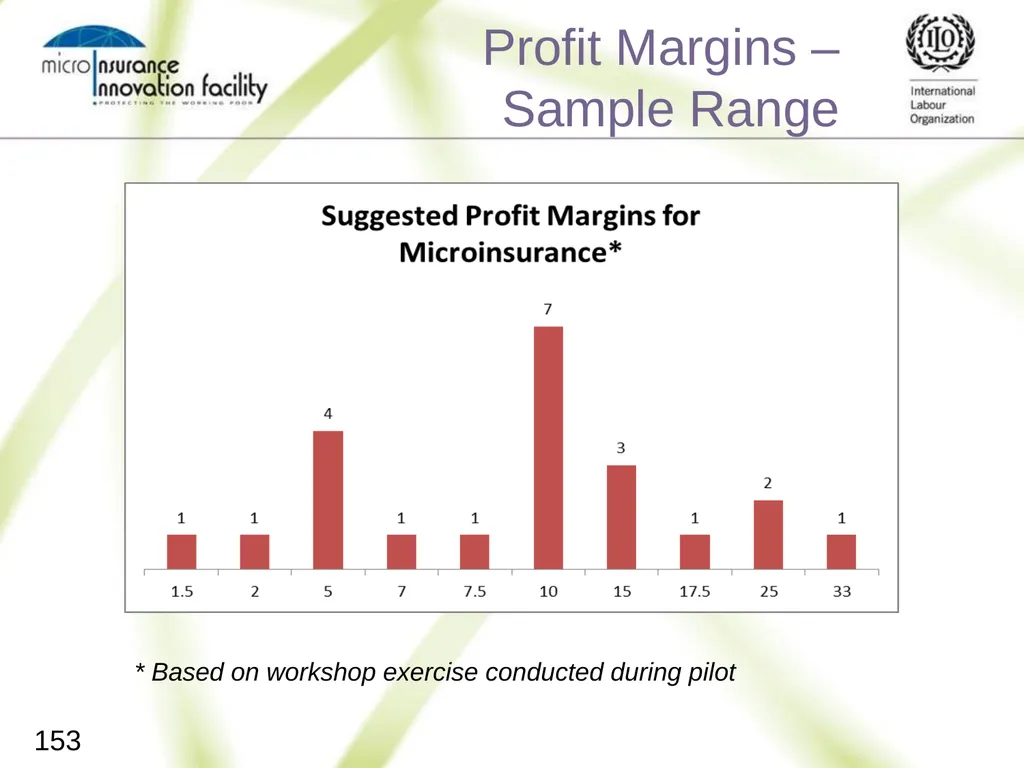
slide153. Profit Margins – Sample Range * Based on workshop exercise conducted during pilot<br>
slide154. Gross Premium Discussion What could be some obstacles to “good” pricing?
What types of challenges have you experienced?
What approaches could you take to mitigate these obstacles?<br>
slide155. Monitoring Product Experience / pricing review Session 13<br>
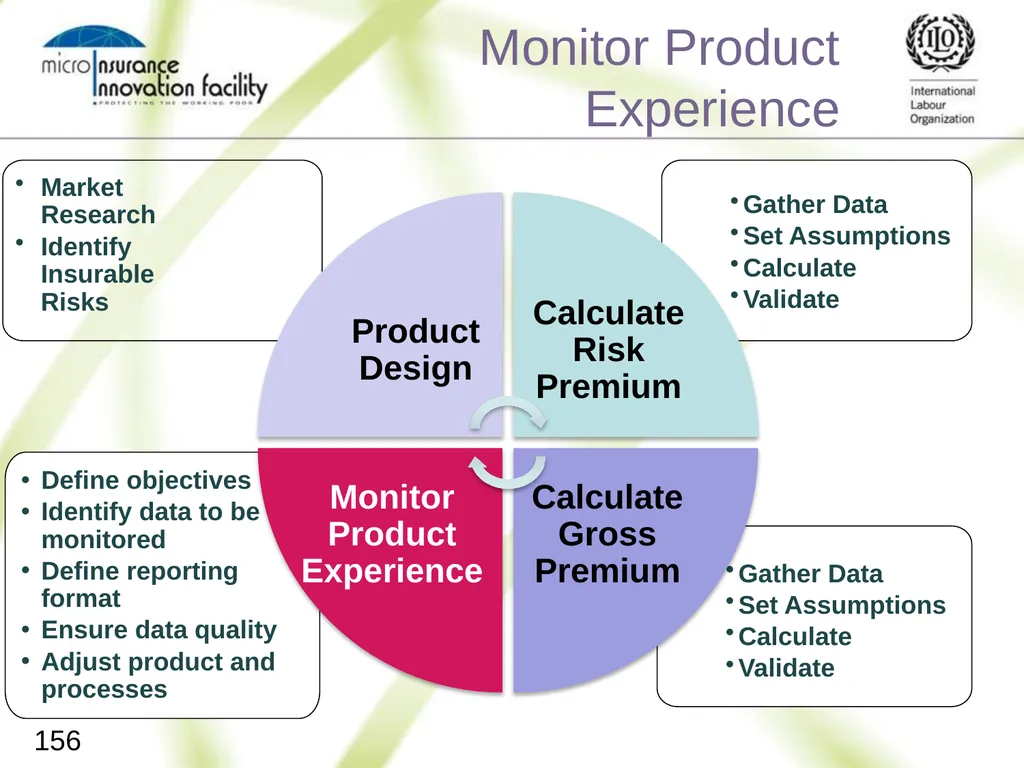
slide156. Monitor Product Experience<br>
slide157. Pilot Testing - Benefits Validate if product is attractive and affordable
Validate assumptions for pricing/projections
Validate processes
Distribution
Claims control
Training
Systems
Less expensive to make changes on small scale<br>
slide158. Pilot Testing - Cons Can increase initial expenses
Sample size too small for valid analysis of claims experience
Regulatory approval may be required for every product change
Stakeholder management:
May take less seriously in pilot mode
May get trapped in “pilot” mentality
May get discouraged if initial difficulties
Pilot seen as obstacle to growth/achieving scale<br>
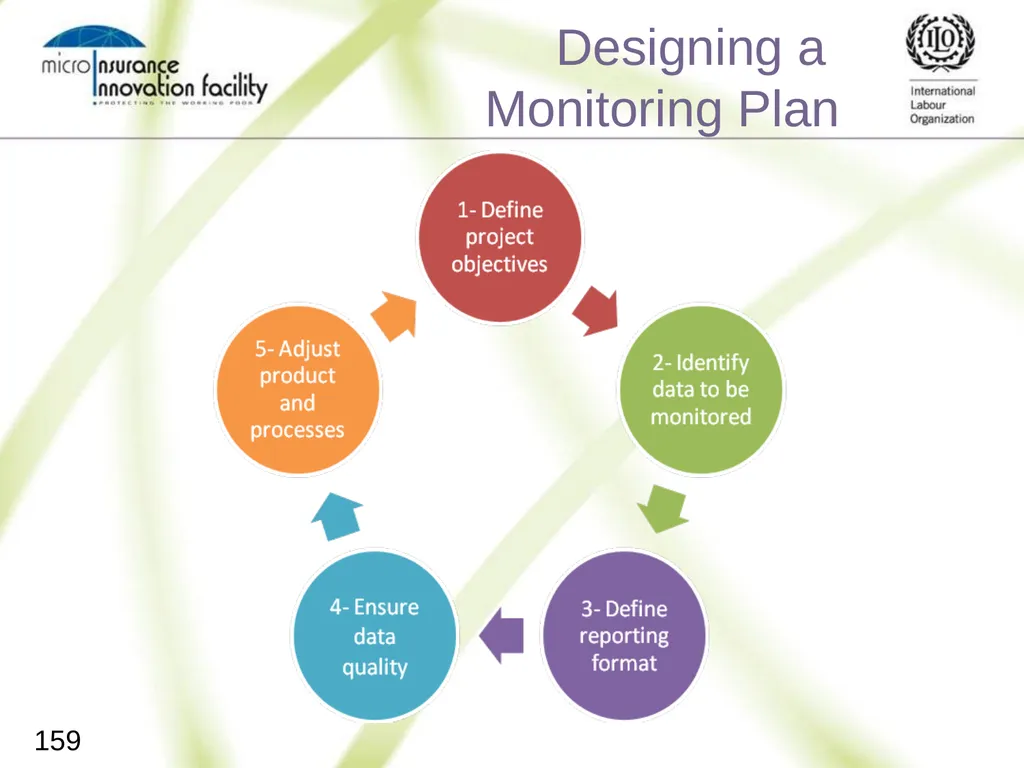
slide159. Designing a Monitoring Plan<br>
slide160. Individual Reflection Consider your current MI project:
What data should you collect to evaluate the pricing of your product?
How often should you collect experience data?
What are some ways to collect experience data?
What benchmark or indicators could you use to measure or evaluate the results?<br>
slide161. Review and re-pricing Session 13.2<br>
slide162. Re-Pricing: Case Study Analysis Divide into 4 groups
Can be the same groups or new ones
Read Case Study 2
Sections 1-3 are background information only, so you can skim these quickly
Discussion will focus on Sections 4 and 5
After the break, come back into your groups
Finish reading the case study
Wait for instructions<br>
slide163. Re-Pricing: Case Study Analysis List 2-3 challenges related to data collection and analysis for this microinsurance program.
Compare the actual incidence rates to the incidence rates assumed in the pricing.
Review the average claim amounts and compare them with the original pricing estimates.
What factors seemed to drive the claims experience?
Why do you think the average claim size and incidence increased in Year 2?
What changes would you recommend to the product design or the premiums?<br>
slide164. Case Study Summary Do you agree with the changes or recommendations that were made after Year 1?
Why or why not?
What other options can you think of?
What additional monitoring or control processes would you put in place?
What do you think will happen next?<br>
slide165. Reserving Session 14<br>
slide166. Bingo Rules Information will be presented as a lecture using the PowerPoint slides, but…
….at certain points the trainer will stop and ask a question (which will be shown on a slide).
If you know the answer AND if the answer is on your Bingo card, you get to mark that square on your card.
Do NOT shout out the answers!
If you get a Bingo – ie, all answers in a row, column or diagonal, then shout out BINGO!
Note – bingo cards are NOT the same! Everyone has a unique card.<br>
slide167. Reserves Accrual accounting for insurance requires that income and expenses be accounted for on an incurred basis, rather than a cash basis
For an insurance program, this means that an estimate of all future net liabilities must be made at the end of every accounting period
These accounting entries are called Reserves, or Technical Provisions
Reserves are entered as liabilities on the balance sheet
Changes in reserves over the period are recorded as expenses in the net income statement<br>
slide168. Bingo Question How often should you estimate net future liabilities?<br>
slide169. Reserves The most general definition of a reserve is
The actuarial present value of future liabilities less actuarial present value of future premiums.
Calculating exact reserves using this formula is often difficult since complex actuarial calculus and statistics must be employed
For microinsurance, simplified methods and tools that follow accepted standards and practices are often used instead<br>
slide170. Bingo Question What is another term for Reserve?<br>
slide171. Actuarial Present Value “Actuarial present value” = the current value of an expected amount which may be payable or receivable in the future
The future expected amount is discounted to the present day by incorporating the time value of money
The calculation also incorporates the probabilities and timing of all events that determine whether or not the amount will actually be paid or received<br>
slide172. Bingo Question Insurance uses what kind of accounting?<br>
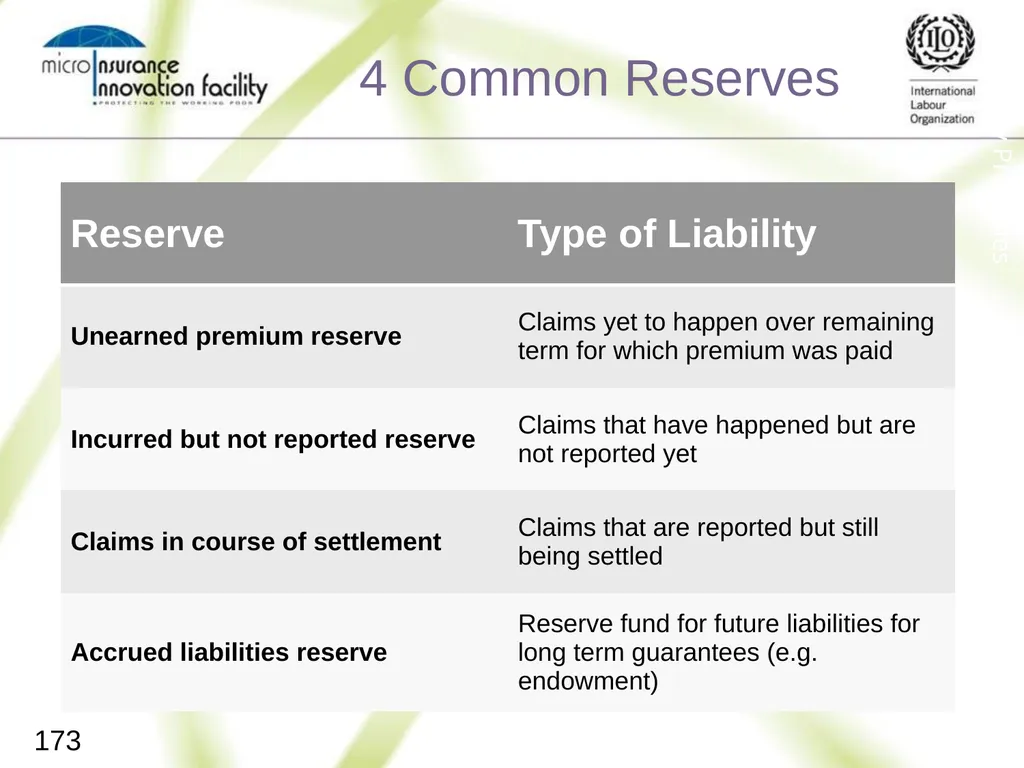
slide173. The 9 Key Principles 4 Common Reserves<br>
slide174. Bingo Question The current value of an expected amount which may be payable or receivable in the future is called what?<br>
slide175. Unearned Premium Reserve (UPR) An unearned premium reserve is required for all products with periodic premium payments
Premium is earned over the term for which it was paid
Reflects how expenses and claims are incurred
Does not depend on how premium is actually paid or received
Most insurers apply the simplest approach and earn premium on a pro-rata basis
May not always be the most conservative approach but it is generally acceptable for most products
UPR calculations may be specified by the local insurance regulator<br>
slide176. Incurred But Not Reported reserve (IBNR) At any point in time, there may be insured events that have happened which resulted in a loss, but which the insurer is not yet aware of
It may take a few hours, days, weeks, or even months before claims are reported to the insurer
Insurers set up a fund which will provide for all payable but still unreported claims at the end of the accounting period (IBNR)
Enables timely financial statements without waiting for all claims to be reported<br>
slide177. IBNR calculation There are many different methods to estimate the level of IBNR
Most of these methods are based on past claims reporting experience
the claims database must capture both the incurred date and reporting date of each claim
Observing the historical patterns of payment lags and applying these to the current block of business is one common approach
IBNR calculations are usually specified either by regulation or actuarial standards of practice<br>
slide178. Bingo Question What is one common method of calculating the UPR?<br>
slide179. Claims in course of settlement reserve (CICS) At any point in time, an insurer may have claims which are still being processed
Even when a claim has been reported, it may take some time to pay it
The insurer must recognize the unpaid liability of these claims
Some of these claims may end up being rejected, but as of the accounting date it may not be clear what will happen
The most conservative approach is to assume that all outstanding claims will be paid<br>
slide180. Bingo Question Is a reserve a liability or an asset?<br>
slide181. Accrued Liabilities Reserve (ALR) The ALR is a reserve or provision for the net future liabilities for products with long term guarantees
Since these are usually long-term products, the ALR should be calculated by a qualified actuary
Even if software tools are in place to make the calculations, the results should still be checked and certified by an actuary. 181 The 9 Key Principles<br>
slide182. Accrued Liability Reserve Examples of accrued liabilities:
Interest earnings
Savings, such as for endowment products
Premium paid up for future mortality cost and expenses
Example: for whole life insurance, level premiums are set for life at the time of purchase
The premiums paid in the younger years must be invested to fund the higher mortality cost in later years
The future expected liabilities must be recognised by holding an ALR<br>
slide183. Bingo Question What reserve is used to fund claims that have been reported but are not yet paid?<br>
slide184. Reserves vary…. The level of reserves varies depending on the type of microinsurance product, on its design and features, and on how the microinsurer is implementing the programme.
Reserves for a life microinsurance product will not be the same as the reserves needed for a health microinsurance product
Identical products carried by two different microinsurers may require different reserve levels because of their differences in management or distribution.<br>
slide185. Bingo Question To effectively set IBNR assumptions, what TWO elements should be included in the claims database?<br>
slide186. Bingo Question What reserve is used to estimate liabilities for claims which have happened but are not yet reported to the insurer?<br>
slide187. Reserves for Partner-Agent Schemes The insurer/risk carrier must set up the appropriate reserves
The Agent (distribution channel) should monitor the financial condition of the partner insurer:
On behalf of its clients or members
To manage its reputational risk
Especially if:
Products are long-term
Products have savings features or other equity build-up 187 The 9 Key Principles<br>
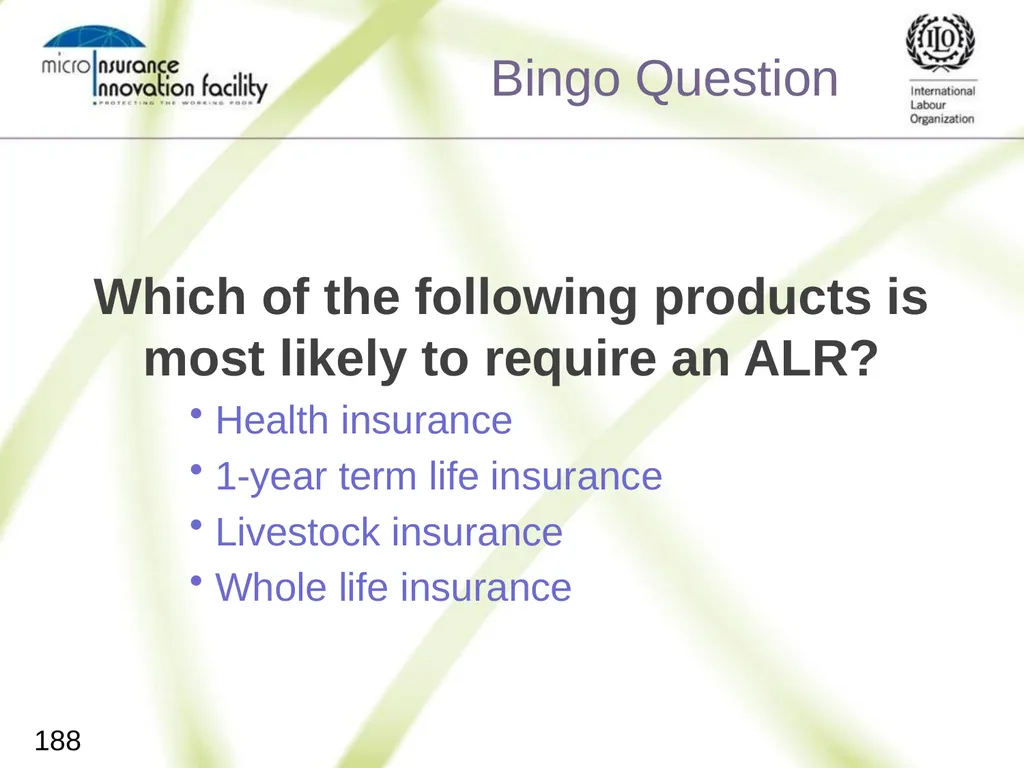
slide188. Bingo Question Which of the following products is most likely to require an ALR?
Health insurance
1-year term life insurance
Livestock insurance
Whole life insurance<br>
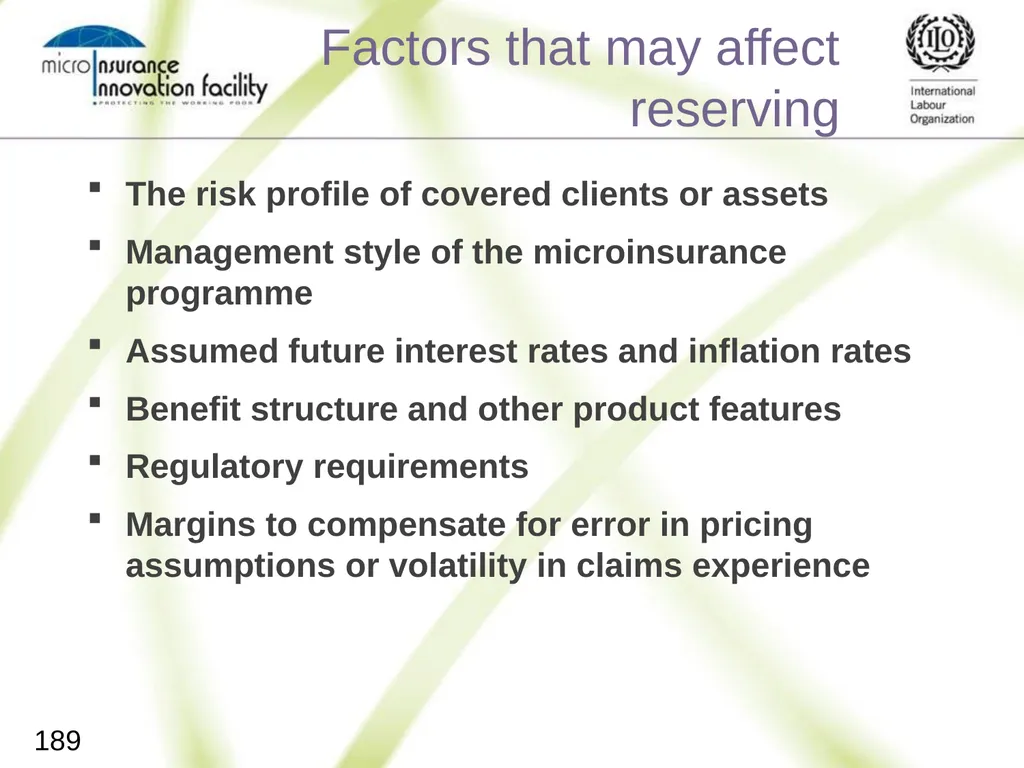
slide189. Factors that may affect reserving The risk profile of covered clients or assets
Management style of the microinsurance programme
Assumed future interest rates and inflation rates
Benefit structure and other product features
Regulatory requirements
Margins to compensate for error in pricing assumptions or volatility in claims experience<br>
slide190. Bingo Question Which of these two components is included in the calculation of actuarial present value:
Time value of money
Required capital<br>
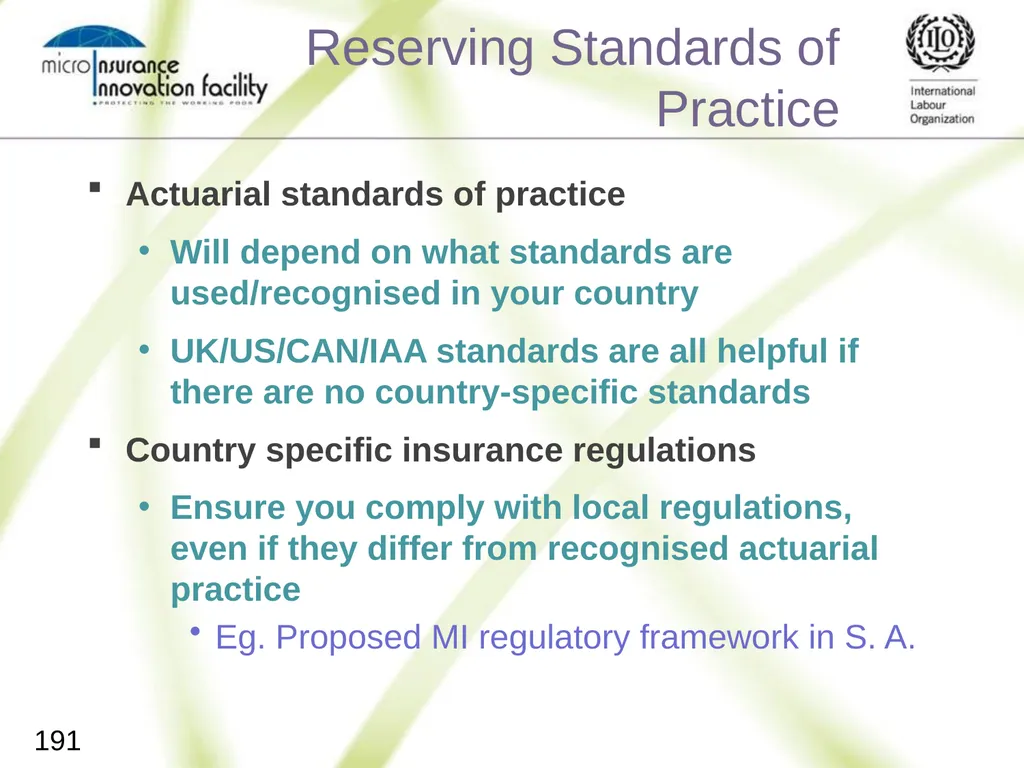
slide191. Reserving Standards of Practice Actuarial standards of practice
Will depend on what standards are used/recognised in your country
UK/US/CAN/IAA standards are all helpful if there are no country-specific standards
Country specific insurance regulations
Ensure you comply with local regulations, even if they differ from recognised actuarial practice
Eg. Proposed MI regulatory framework in S. A.<br>
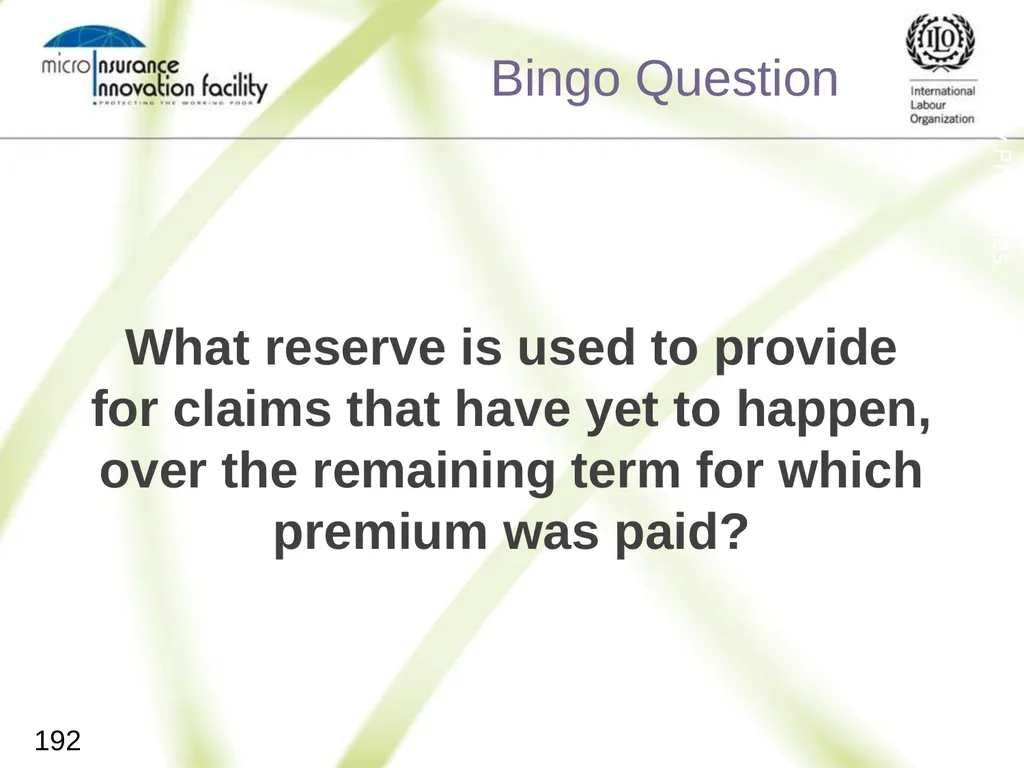
slide192. The 9 Key Principles Bingo Question What reserve is used to provide for claims that have yet to happen, over the remaining term for which premium was paid?<br>
slide193. Reserving Standards of Practice International Financial Reporting Standards (IFRS)
IFRS4 has impacted how reserves are calculated in countries that have adopted IFRS
The IAA is working to develop international actuarial standards consistent with IFRS<br>
slide194. Bingo Question What reserve is used to fund future liabilities for long term guarantees?<br>
slide195. Bingo Question Find 2 elements that might affect reserve calculations:<br>
slide196. Bingo Question What international accounting standards have changed how reserves are calculated?<br>
slide197. References and Resources Bellis, C., Klugman, S., Shepherd, J., and Lyon, R., 2010 (Second Edition). Understanding Actuarial Management: The Actuarial Control Cycle. Institute of Actuaries of Australia
Brown, R. L. and Gottlieb, L. R., 2007. Introduction to Ratemaking and Loss Reserving for Property and Casualty Insurance (Third Edition)
Easton, A. E. and Harris, T. F., 2007. Actuarial Aspects of Individual Life Insurance and Annuity Contracts (Second Edition)
Friedland, J., 2010. Estimating Unpaid Claims Using Basic Techniques. Casualty Actuarial Society<br>
slide198. Actuarial Standards of Practice Faculty and Institute of Actuaries (UK) - Actuarial standards of practice:
http://www.actuaries.org.uk/regulation/pages/professional-standards-directory
Canadian Institute of Actuaries – Standards of Practice
http://www.actuaries.ca/SOP_Doc/Complete/SOP_e_Complete_January_1_2012.pdf
Actuarial Standards Board (US):
http://www.actuarialstandardsboard.org/<br>
slide199. International Standards International Actuarial Association (IAA) – International Actuarial Notes (IAN), and International Standards of Actuarial Practice (ISAP)
Exposure Draft of ISAP1: http://www.actuaries.org/index.cfm?lang=EN&DSP=PUBLICATIONS&ACT=STANDARDS
IFRS Foundation and IASB – International Accounting Standards and related materials
http://www.ifrs.org<br>
slide200. Reserving Q&A<br>
slide201. Summary and closing Session 15<br>
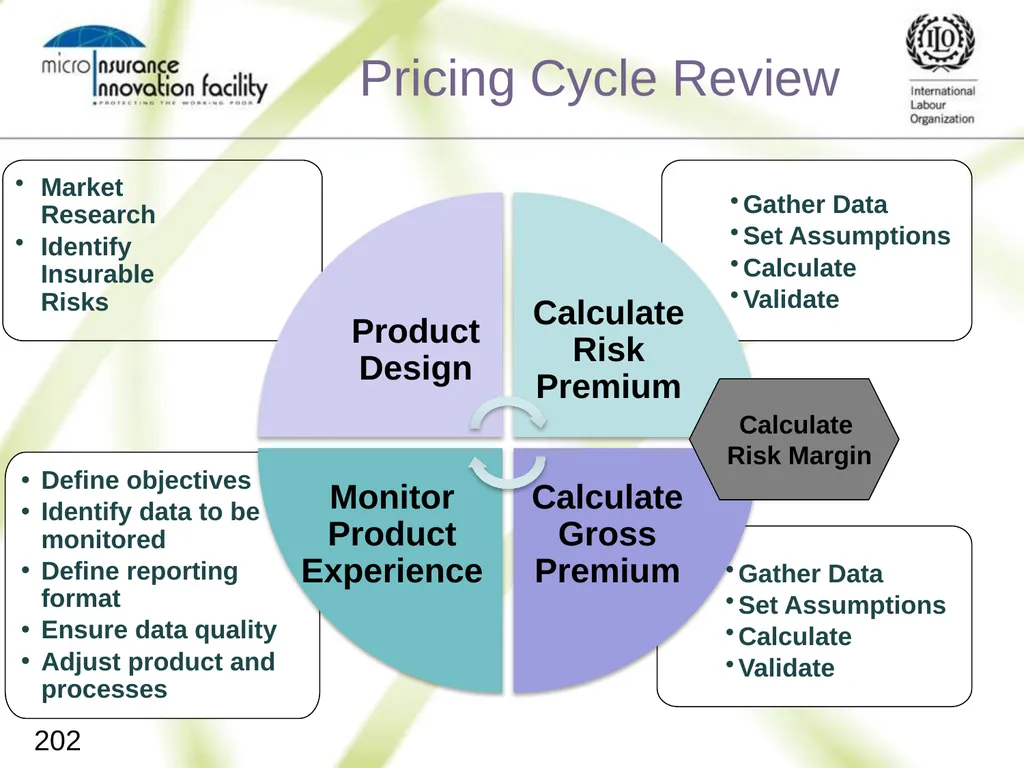
slide202. Pricing Cycle Review Calculate
Risk Margin<br>
slide203. Summary Insurance principles apply to MI, but additional considerations are needed
Pricing for MI requires the pricing specialist to consider all of the relevant context in order to make appropriate assumptions
What are some of the key elements?
Can you identify some “Key Principles” for MI pricing?
The pricing process is the same, even though the data requirements, assumptions and modeling approach may be different<br>
slide204. “Take-Away” What are the most important things you have learned during the workshop?
How will you apply them in practice?
Write down 3 specific goals for yourself:
One for tomorrow
One for next week
One for next month<br>
slide205. Evaluations Please add your comments to the flipcharts placed about the room
The trainers will step out of the room so it can be anonymous!<br>
slide206. THANK YOU!<br>
Date
Trainer 1 email
Trainer 2 email<br>
slide2. Opening session Session 1<br>
slide3. Background This 3-day training workshop has been developed by the ILO’s Microinsurance Innovation Facility
Based on a training needs assessment conducted in January 2012
Initial pilot in Accra in June 2012, in collaboration with the Actuarial Society of Ghana
The training development was sponsored by AusAid
The Facility is currently developing a corresponding technical guide<br>
slide4. Workshop Objective To provide participants with greater understanding of the pricing process
To provide tools to improve the pricing of microinsurance products
In this context, “better pricing” means:
More accurate estimation of expected claims costs, even with limited data
Better collection of experience data
Better monitoring and evaluation systems to review and adjust pricing
More suitable pricing for the low income market<br>
slide5. Specific Training Objectives By the end of the course, participants will be able to:
Identify key context elements to be considered in pricing microinsurance
Describe the pricing process and premium components
Set and validate pricing assumptions based on relevant data
Understand the calculations required for determining risk premiums, expense loadings and gross premiums
Set appropriate monitoring processes for better pricing review<br>
slide6. Agenda Day 1 Opening Session
Introduction to Pricing for Microinsurance
Basic Concepts of Pricing
Pricing Cycle/Process
Context
Understanding the Market / Initial Product Design
Calculating the Risk Premium
Methods and Formulas
Collecting Data
Setting Assumptions and Validating Results
Application / Case Study
Recap<br>
slide7. Agenda Day 2 Risk Premium Revisited
Pricing Model Illustrations
Risk Margins / Safety Loading
Reinsurance
Calculating the Gross Premium
Expense Loadings
Application / Case Study
Business Plans and Financial Projections
Putting it all together – Case Study work
Day 2 Recap<br>
slide8. Agenda Day 3 Gross Premium Revisited
Putting it all together
Monitoring Product Experience
Developing a monitoring process
Review and Re-pricing
Case study analysis
Reserving
Q&A
Summary and closing<br>
slide9. Introduction to Pricing for Microinsurance Session 2<br>
slide10. Reflection Questions Microinsurance vs “traditional” insurance
How is microinsurance similar to traditional insurance?
How is it different?
What are some unique aspects of MI that should be considered in the pricing process?
What is the role of the pricing specialist in a microinsurance context?
Where does “pricing” fit in the product development process?<br>
slide11. Event resulting in loss must be random
Loss must be definite and measurable, in terms of amount and time
Economic loss should be significant for the insured
Must be able to calculate the probability of loss
Should insure a “large” number of similar exposures
Premiums must be affordable relative to expected loss
There should be minimal risk of catastrophic events that cause multiple claims simultaneously Insurance Principles<br>
slide12. MI vs “traditional” insurance Similarities:
Basic insurance principles still apply
Purpose of pricing is the same
To determine a premium that is a fair price for the insurance coverage promised<br>
slide13. MI vs “traditional” insurance Differences:
Target market
Needs and priorities
Capacity and willingness to pay
Lack of insurance and financial literacy
Accessibility of services
Higher distribution and service costs relative to premium size<br>
slide14. Considerations for Pricing MI Client Focus
Products need to be designed to match client needs and low purchasing power
Limited experience data available
Challenges in setting assumptions
Need for capacity and systems to collect quality data
Lack of comparable products in market to use as benchmarks<br>
slide15. Considerations for Pricing MI Long term approach needed for sustainability
Takes time to reach scale
Consumer education and trust is key
Start up and operational costs often relatively higher (as % of premium)
Alternative distribution methods
Different sales model affects take-up rates and distribution expenses
Lack of experience creates challenges<br>
slide16. Considerations for Pricing MI Processes
Accessibility of financial transactions - much of target market may be “unbanked”
Marketing and distribution
Enrolment and claims processing
Mainly short term products
Challenges in marketing long term products to the low income market
Need for insurer to control risks and allow for re-pricing<br>
slide17. Role of Pricing Specialist Pricing role:
Develop model and assumptions to calculate accurate premiums
Develop financial projections for pricing and business plans
Set claims control mechanisms
Collect and monitor experience data
Analyse experience and develop recommendations for product redesign or re-pricing<br>
slide18. Role of Pricing Specialist For MI programs, the pricing role may also include:
Significant interaction with product design team
Improving understanding of insurance principles among other stakeholders
Especially with sales force and claims areas
Contributing to organisation’s MI strategy
Calculating or verifying reserves/technical provisions
Investment management activities<br>
slide19. Product Development Process<br>
slide20. Basic Concepts of pricing Session 3<br>
slide21. Pricing Cycle – Exercise 1 As a group, design a diagram that represents how you think of the pricing process
What are the basic steps or components?
How are they related to each other?
What is the flow of activities?
What are some of the “sub-steps”?
Use a flipchart page and coloured markers to draw a final version of your diagram to post on the wall<br>
slide22. Pricing Cycle – Exercise 2 Each team has an index card with a word or phrase on it that represents a component of the “pricing cycle”
Brainstorm as a team using the following questions and write the results on the blank sheet provided
What do we already know about this component?
What might be important to think about when performing this step in pricing for MI?
Rules:
Only 1 sheet per team
Only 5 minutes
Prize for the team with the most items listed<br>
slide23. Pricing Cycle – Workshop Framework<br>
slide24. Basic Concepts Gross Premium includes:
Risk Premium
Also called “expected cost of claims”
Risk Margin
Sometimes called “security margin”, “safety loading” or “uncertainty margin”
Cost of reinsurance (if applicable)
Expense Loading
Cost of administration, distribution, claims payment and all associated expenses
Expected investment earnings
Profit margin<br>
slide25. Short-term vs Long-term Products What might be different?
Inability to change or revise premiums after policy issue (“guaranteed” premiums or benefits)
Much bigger effect on long-term products
Investment Income
Important for long-term products, usually not significant for short-term products
Inflation assumptions
Frequency of claims affects claims processing requirements
20 year life policy => 1 claim
Customer satisfaction/understanding of benefit<br>
slide26. Life products vs Non-life products Calculation of the expected cost of claims (the risk premium) involves different types of contingent events
Different data required
Sometimes a different method or formula
Expense loadings may vary
different sales channels, higher/lower claims expenses
Type of risk may or may not benefit from reinsurance<br>
slide27. Examples Fixed term life benefit payable on death
only one variable, although multiple causes
fixed benefit amount
risk event can only happen once
Policy may extend over more than one year
Property insurance covering property damage or loss due to fire, wind or theft
many potential types of loss, as well as different causes
different potential claim amounts
loss can happen more than once
policy is usually annual<br>
slide28. Health Insurance Products<br>
slide29. Group Insurance Group insurance is a method of providing insurance coverage to a group of insured units under one contract
Group insurance uses a different approach to packaging, pricing, administering, and underwriting insurance
It may or may not be classified differently in the regulations
The policyholder is usually the group itself, not the individual insureds<br>
slide30. Group Insurance Group Life insurance has many similarities to non-life insurance
It is usually short term, and may be administered by the General Accident Department or by a non-life insurer
Group insurance is favoured in microinsurance because it:
May have lower admin costs if group can provide cheaper admin services than insurer
May have lower distribution costs if the group acts as an effective risk aggregator
May have lower claims costs if the group mechanism serves to reduce anti-selection
If these conditions are not in place, then group MI may not meet expectations<br>
slide31. Differences by Product<br>
slide32. Differences by Product<br>
slide33. Basic Concepts Pricing for different products may involve:
Different data
Different models or formulas
Different margins
BUT
The PROCESS is the same!<br>
slide34. Basic Concepts Consequences of Bad Pricing?
Premium too low:
Insufficient to pay claims and expenses
Short-term price increases may lead to low renewals and anti-selection
Threatens financial stability of insurer
Premium too high:
Anti-selection
MI product is unaffordable or is seen to provide poor value – reputation risk!
Low sales: adverse effect on expense margins and sustainability
Unusable data
insurance take-up experience may be of limited use for future pricing if based on mispriced product<br>
slide35. Context – Understanding the Market; Product Design Session 4<br>
slide36. Product Design<br>
slide37. Market Context Pricing can only begin when an initial product has been designed by the product development team, based on market research.
It is indispensable for at least some of the project team to spend time in the community to understand the daily life of the target population:
living conditions and economic constraints
difficulties in accessing public services
level of understanding of financial products
local and community cultural context.<br>
slide38. Market Context The available quantitative data should be supplemented with qualitative data collected through focus group discussions
Qualitative and context data is used to make adjustments to the quantitative data gathered in order to apply it to the insured population.
Context data might include:
macro-economic data
existence and reliability of infrastructure
financial and insurance regulation<br>
slide39. Market Context Definition of the target market should include economic, cultural, professional, geographical and sociological aspects
This information is used:
to evaluate the risks (i.e. the frequency and the average claim amount)
for secondary calculations, such as the potential volume of premiums when elaborating financial projections
To measure the willingness and capacity to pay of the population<br>
slide40. Willingness to Pay Willingness to pay may relate to the amount people “mentally dedicate” to all risk coping mechanisms
Different survey approaches have different pros and cons (Dror and Koren, MI Compendium Vol 2)
Research suggests WTP ranges from 1% to 4% of individual income for microinsurance products
Willingness to pay is often over-stated and survey results may not be reliable<br>
slide41. Elements of Product Design Insured benefits
Eligibility
For example, exclude very old or very young
Term of insurance
Premium structure
Frequency / instalments
Single rate/individual risk rates
Benefit payments and process
Claims controls / cost sharing features<br>
slide42. Claims Control / Cost-Sharing Health declarations
Easier than screening
Deters anti-selection
Co-payments
Deductibles
Coinsurance
Benefit maximums
Annual maxiumum or per covered event
Alternatives to Exclusions
Waiting periods
Lower benefits in earlier years of coverage; increases over time<br>
slide43. Individual Reflection Consider a project from your past experience where you were involved in pricing or product design:
What were the challenges with obtaining market research data?
How important was the context?
How did you evaluate willingness to pay?
What would you do differently now?
Share briefly with your neighbour(s)<br>
slide44. Calculating the risk premium Session 5<br>
slide45. Calculating the Risk Premium<br>
slide46. Calculating Risk Premium Methods
Experience pricing
Exposure pricing
Credibility pricing
Basic formulas
Risk Premium
Claim Frequency
Expected Claim Amount
Community rating versus individual risk rating<br>
slide47. Risk Premium - Methods Experience pricing
Based on past claims experience
Assumes past provides “good enough” estimation for future claims
Requires sufficient claims data to make estimates
Requires assumptions for possible trends to extrapolate appropriately
Assumes no changes to product or insured population<br>
slide48. Risk Premium - Methods Exposure pricing
Based on assumptions regarding claims frequency and claims severity for target clients
Assumptions derived from sources other than past claims experience
Assumptions attempt to reflect “true” underlying claims distribution
No suitable past claims experience is available
Most common approach used in microinsurance, particularly for new products<br>
slide49. Risk Premium - Methods Credibility pricing
A combination of experience pricing and exposure pricing
Past claims experience only partly reflects true drivers of underlying claims
Assign relative weights to each component (experience and exposure)
May be applied to insured individuals or groups which have some accumulated claims experience<br>
slide50. Risk Premium – Basic Formulas Risk Premium = Expected Cost of Insurance:
Calculated per insured unit:
insured person, insured property, insured animal, etc
Calculated relative to the period for which the premium is paid
for example, annually<br>
slide51. Risk Premium -Example Individual Life Insurance (1 year term):
Annual Risk Premium =
Annual Mortality rate x Sum Insured<br>
slide52. Risk Premium – Long Term Products For long term products, the risk premium is usually calculated by discounting the expected future value of all benefits under the policy
The present value (or discounted value) requires interest rate assumptions
For example:
Total Risk Premium =
present value of expected claims in year 1
+ present value of expected claims in year 2
+ present value of expected claims in year 3
etc<br>
slide53. Risk Premium – Long Term Products If premiums are paid periodically for long term products, then:
PV of periodic risk premiums = Total Risk Premium
Usually the final periodic premiums are determined at the gross premium level, after the present value of expenses and other loadings is also included<br>
slide54. Risk Premium – Asset Accumulation Products For asset accumulation products, such as endowment policies
“Net Premium” =
Risk Premium (to cover insured contingencies)
+ Savings Premium (to build up the maturity value)
There are various ways to structure savings-type elements within long-term products
MI products tend to be fairly simple so far<br>
slide55. Setting Risk Premium Assumptions Claim frequency
Expected incidence of claims in the insured population
Expected claim amount
Simple or complex depending on insured benefits
Approximations are sometimes used
Different methods
average claim vs probability distribution
May include inflation
such as for medical expenses<br>
slide56. Claim Frequency Assumptions Define “Exposure” basis – the reference population for which the claims experience applies to
For example, the number of lives that were insured during the period = “lives exposed to risk”
Use actuarial methods to determine this
Define claims occurrence
May need to omit or modify certain types of claims or events<br>
slide57. Expected Claim Amount Assumptions For products with a fixed sum insured, the Expected Claim Amount = Sum Insured
For products with variable insurance benefits, the Expected Claim assumption can be based on:
The average claim estimated from past experience
The expected value (mean) or a percentile from an assumed probability distribution of claim amounts
An estimate of the outstanding value of a loan at time of claim (eg credit life)
Projected claim amounts produced by a pricing model that might include factors such as inflation or other adjustments<br>
slide58. Community Rating vs Individual Risk Rating Sometimes it is appropriate to calculate rates on the basis of the group that the insured risk belongs to, rather than on the basis of each individual insured unit, for example:
Setting the premium for the insurance for the whole group (e.g. all people who are members of the same cooperative)
Applying the group / class price to each individual risk (e.g. all women pay the same premium no matter their age or where they live)
Community rating is not the same as Group Insurance<br>
slide59. Risk Premium - Process<br>
slide60. Risk Premium – Data Collection “What type of data or information do you need to develop and price a microinsurance product?”
Write a different answer to this question on each of the blank cards you have been given.
Keep your answers short.<br>
slide61. Data Collection – Team Work Compare your cards with each other and form teams with people holding similar responses
A team can have any number of members
A team must keep only FOUR cards
Everyone in the team must agree on the 4 cards
Prepare a poster to reflect your team’s final 4 cards
No text is allowed
Use appropriate illustrations to create a clear message<br>
slide62. Risk Premium – Setting Assumptions and Validation Given the topic on your card, answer the following questions:
Define the component (word or phrase) on the card
Give at least 3 steps involved in performing this component (up to 5 max)
Provide 3 challenges that might be encountered in completing this component
Give an example of how this step would apply in practice (for a specific type of product)<br>
slide63. Risk Premium – Putting it all Together<br>
slide64. Risk Premium – Case Study Work Case Study Instructions
4 or 5 small groups
45 minutes for group work
Read Case Study first
Answer questions as a group
Record answers on a flipchart
Try to answer all the questions
Each group will present one of their answers to the rest of the participants<br>
slide65. Risk Premium – Case Study Questions What method or methods are used in the pricing? Does the method seem appropriate to the context?
What were some of the problems with the available data? How did the consultant adjust for these?
What was the most important assumption used in setting the risk premium? How was this assumption determined?
Calculate the risk premium given the data provided in Section 4.
How would you validate the risk premium that you have calculated?<br>
slide66. Case Study – Exposure and Incidence<br>
slide67. Case Study – Risk Premium Calculation<br>
slide68. Day 1 Recap Session 6<br>
slide69. Reflection and Sharing Reflect by yourself on the material we have covered throughout the day
Pick out 3 key concepts you have learned
Write them down (in your notebook, in your profile card, on an index card)<br>
slide70. Outstanding Questions If you have any questions or issues from the day, such as:
Areas that weren’t clear
Areas where you would like more detail
Please write these on an index card or sticky note and post them on the PARKING LOT
The trainers will review and try to answer in the morning
Remember to post questions relating to reserving for the Q&A on Day 3<br>
slide71. Recap Quiz Name one difference between microinsurance and traditional insurance
What are the 4 steps in the process for calculating the risk premium?
Give one difference between pricing short-term products and long-term products.
Give an example of how you would set an assumption for the expected claim frequency or incidence rate.
In what country is the case study set?<br>
slide72. Recap Quiz Give an example of setting an expected claim amount assumption for a variable benefit product.
Name one role of the microinsurance pricing specialist.
What are the 4 quadrants of the pricing cycle used for the workshop?
What is the basic formula for the “expected cost of insurance”?
Name one similarity between microinsurance and traditional insurance.<br>
slide73. Recap Quiz List 4 components included in Gross Premium
What are the 3 methods used in calculating the risk premium?
List 2 consequences of bad pricing
What are 3 elements of insurance product design?
Name 2 insurance principles
BONUS Question!<br>
slide74. See you tomorrow!<br>
slide75. Risk Premium Revisited Session 7<br>
slide76. Risk Premium – Putting it all Together<br>
slide77. Risk Premium – General Discussion Which is better: a single premium or different premiums by risk class? Why?
What type of claim trends might need to be considered?
What type of trends might be specific to MI programs?
What does “best estimate” mean?<br>
slide78. Risk Premium – Using a Model Calculating the risk premium (quantifying the insured risk) often involves building a mathematical model to illustrate possible outcomes, their likelihood and their potential cost
What is a model?
What are the steps in the process?
Deterministic or stochastic?<br>
slide79. What is a Model? A mathematical model:
Is a simplified version of a real world system or process, represented through formulas or equations
Enables the pricing specialist or actuary to investigate possible outcomes without having to carry out actions in the real world<br>
slide80. Steps in Modeling 1. Develop a well-defined set of objectives for the model
2. Collect and analyse data
Requires judgment as to relevance of observed data to future environment
Quality of data is key – poor data quality may result in flawed output from model<br>
slide81. Steps in Modeling 3. Develop a set of mathematical assumptions about how the process works
Consider complexity of relationships between various parts of the model
Decide whether to use a deterministic or stochastic model
Consider timeframes
Length of projection period
Interdependence of results from one period to the next
Make assumptions for parameters that cannot be derived from data<br>
slide82. Steps in Modeling Program model
Create the “calculation engine”
Can be simple or complex depending on the process to be modeled
5. Validate model
Diagnostic and statistical tests to ensure model meets objectives and is consistent with past experience
6. Analyse outputs of model
Test reasonableness of output against real world if possible<br>
slide83. Deterministic or Stochastic? Deterministic = assumptions are set as fixed point estimates, such as the mean of a set of data based on experience
Result is a single number
Calculations from only one “scenario”
Stochastic = assumptions are set as random variables that are modeled using an appropriate probability distribution
Result is a probability distribution, from which the final premium number is selected
Calculations from multiple random scenarios, from which a “best estimate” can be selected<br>
slide84. Using a Model to calculate the Risk Premium Collect and analyse data
Example: mortality tables from different sources
Develop and set assumptions
Based on the collected data
Example: mortality rate(s) for target clients
Define premium calculations
A mathematical formula that combines the assumptions and applies any coverage limits such as maximums or deductibles
Example: Risk Premium = mortality rate x insured amount
Validate model
Test results to ensure reasonable and consistent
Example: compare to other life insurance products<br>
slide85. Example: Actuarial “survivorship” model A deterministic model that projects insured units over time, including relevant assumptions for:
New entrants
Lapses
Deaths
Terminations or withdrawals
Renewals
Claims
Such a model can be used as a basis for financial projections and scenario testing for the product<br>
slide86. Pricing Model Illustration<br>
slide87. Risk Margins/ Safety Loading Calculate
Risk Margin<br>
slide88. Risk Margins/ Safety Loading Quiz Show - Test your Knowledge!
On a blank paper/card, write the numbers 1-10 and put your name at the top
Each question will show on the screen, and the presenter will read it out
On your answer sheet, write down the correct answer for the question
At the end of the quiz, hand in your answer sheet.
During the break we will score your answers and award prizes to those with the most correct answers.
(and we will go over the answers too!)<br>
slide89. Quiz Question 1 A Risk Margin can also be called an Uncertainty Margin or a Safety Loading.
True or false?<br>
slide90. Quiz Question 2 An Uncertainty Margin is:
Equal to the Risk premium
10% of the Risk premium
A loading to account for adverse deviations in expected experience
A probability distribution<br>
slide91. Quiz Question 3 An Uncertainty Margin may cover:
Errors in estimating the assumptions
Variability in expected claims
Unforeseen changes in the underlying insured population
All of the above<br>
slide92. Quiz Question 4 An Uncertainty Margin should always be explicitly calculated as a % of the Risk Premium.
True or false?<br>
slide93. Quiz Question 5 The Risk Margin should be higher if the premium assumptions are based on very little data or data of dubious quality.
True or false?<br>
slide94. Quiz Question 6 The Risk Margin can be calculated using the statistical properties of the underlying probability distribution used for the claims assumptions.
True or false?<br>
slide95. Quiz Question 7 A Safety Margin provides adequate protection for the risk of catastrophic claims experience.
True or false?<br>
slide96. Quiz Question 8 The safety loading should be higher when:
The number of insured persons is small
The covered risk is very unpredictable
Both 1 and 2
In neither case<br>
slide97. Quiz Question 9 You can include uncertainty margins for the following:
Incidence rate
Claims cost
Expense assumptions
All of the above<br>
slide98. Quiz Question 10 The Risk Margin should reflect the underlying uncertainty in the expected claims, so it will vary by product type.
True or false?<br>
slide99. Quiz Show How did we score?<br>
slide100. Reinsurance Reinsurance can be an important risk management tool:
Minimising risk concentration
Stabilising aggregate claims experience
Reduce surplus strain from new business
Reducing risk of insolvency
Minimise potential for catastrophic losses
Transfer of investment risk or lapse risk
Avail of technical and underwriting expertise
May reduce tax liabilities or solvency requirements<br>
slide101. Reinsurance How does reinsurance fit in to the risk premium calculations?
The cost of reinsurance is a separate component of the total premium, but
The need for reinsurance should be identified during the analysis of the expected claims costs
Variability of expected claims
Potential for high cost single claims
Potential for large numbers of simultaneous claims (covariance risk)<br>
slide102. Reinsurance Four main risks that reinsurance may help to address:
the risk of random fluctuations in claims experience
the risk of error in the pricing assumptions
the risk of change in the underlying conditions that affect claims
the risk of catastrophic accumulations of claims<br>
slide103. Reinsurance Common forms of reinsurance treaties:
Quota share
x% of premium ceded; x% of claims recovered
Individual Excess of Loss (XL)
If a single claim exceeds a fixed retention amount, the reinsurer pays excess
Aggregate Stop Loss (ASL)
If total claims exceed a fixed retention (usually a % of premium), reinsurer pays excess
Variations and combinations are often used to address specific risks<br>
slide104. Reinsurance For microinsurance, reinsurance is frequently not available
Catastrophe coverage for life MI is the most common
May be easier to implement benefit maximums or other limits to control risk
Determining an appropriate retention level is not an easy task
Reinsurers will frequently use a stochastic model in order to quantify and price the risk in the reinsured layers<br>
slide105. Reinsurance Reinsurance is NOT a magic wand!
Cannot transform an unviable program into a feasible one
Reinsurance comes at a cost
Reinsurance premium paid less reinsurance recoveries on claims
Should only cede risks that cannot be prudentially managed by the program itself<br>
slide106. Gross Premium Session 8<br>
slide107. Calculate Gross Premium Calculate
Risk Margin<br>
slide108. Gross Premium Components Recall from Day 1
Gross Premium includes:
Risk Premium
Risk Margin
Cost of reinsurance (if applicable)
Expense Loading
Expected investment earnings (if applicable)
Profit Margin<br>
slide109. Gross Premium - Components Anything that is expected to be paid out of the insurance premium has to be priced into the gross premium
Some expense items are obvious, for example:
Commissions
Cost of back office (staff salaries etc) to administer the insurance<br>
slide110. Gross Premium –Components Other expense items are not as obvious, for example:
Printing and shipping education or marketing materials
Transportation in remote rural areas
Hiring and training qualified staff
Depreciation/maintenance of equipment
Software licenses
Bank fees
etc….<br>
slide111. Relative Expense Margins<br>
slide112. Gross Premium – Expense Loadings Three steps are required to include expenses in the gross premium:
Estimate and quantify the expenses that will be incurred
over the period for which you want the premium to remain unchanged
Estimate the number of policies and / or premium volume that will be available to recover these expenses
over the same period
Decide on a formula to incorporate the expenses in the premium<br>
slide113. Gross Premium - Formulas Two common methods to include expenses in gross premium:
In proportion to the Gross Premium:<br>
slide114. Gross Premium - Formulas As a fixed amount for every policy:<br>
slide115. Gross Premium - Formulas<br>
slide116. Effective Distribution - Discussion How might the distribution channel affect the gross premium calculation?
What are key areas to consider for MI?<br>
slide117. Gross Premium Process Calculate
Risk Margin<br>
slide118. Expense Loadings - Exercise Using the cards provided, write down as many expense components as you can think of
At least 3 items
Only one item per card
For each item indicate:
Is it a FIXED cost or a VARIABLE cost?
If variable, what is the underlying driver?
Post each of your cards up on the wall under the category you think it belongs to<br>
slide119. Expense Loadings – Case Study Work Case Study Instructions
4 small groups
Re-read Part 2 of each case study first
30 minutes to discuss and record on a flipchart
Each group will present one of their answers<br>
slide120. Expense Loadings – Case Study Questions Using the data from Tables 6 and 10, calculate the expense loading used in the final gross premiums.
Using the expense data in Table 7 and the projected membership in Table 8, evaluate the adequacy of the expense loading over the period from 2008-2012.
Do you agree with the expense loading used in this case?
What would you do differently?
What were the biggest challenges in the case study exercise?
How could you overcome them?<br>
slide121. Case Study – Calculate Expense Loading<br>
slide122. Case Study – Evaluate Adequacy of Expense Margin<br>
slide123. Group Discussion Questions How do you set assumptions if you don’t have detailed data to work with?
How can you balance a reasonable expense margin with the often higher costs of reaching the target market?<br>
slide124. Business plans and financial projections Session 9.1<br>
slide125. Business Plans and Financial Projections Financial projections can be used as a method to determine gross premiums
Pricing projections should be consistent with business plan assumptions
If programmed on a computer, financial projections allow for scenario testing and answering “what-if” questions<br>
slide126. Developing Financial Projections Developing projections involves modeling all of the various elements, including how they relate to each other, and how they vary over the projection period:
Insured volume
Expected claims
Based on the insured volume
Expected expenses
Can be modeled in aggregate or relative to insured volume (or often both)
Other economic and business assumptions<br>
slide127. Insured Volume Assumptions Insured Volume can be defined in several ways:
By number of policies
By insured units (persons, cars, cows, etc)
By sum insured (benefit amount)
By gross premiums written/sold
Choose a volume definition that is appropriate to the product and distribution channel
Sometimes you need to use more than one to model the business effectively over time<br>
slide128. Insured Volume Assumptions Estimate the insured volume over time
Initial take-up rate
Relative to the size of the target market
Growth in take-up rate
May change based on pilot expansion or marketing campaigns
Lapse rates (drop outs)
Renewals
Deaths/Terminations due to claims made
Coverage may end if an insured person or animal dies or an asset is lost or destroyed<br>
slide129. Insured Volume Assumptions Some factors that can affect volume assumptions for MI:
Voluntary or mandatory product
Existing insurance culture
Trust and consumer education within target market
Experience with claims process
Tangibility of benefits for clients
Incentives for sales force/distribution channel<br>
slide130. Example<br>
slide131. Other Assumptions Cost of capital
External funding or capital provider (eg donor)
Breakeven assumptions
Interest rates/investment returns
Inflation
Risk and Profit Margins
Taxes
Reinsurance<br>
slide132. Business Planning for Microinsurance Developed by John Wipf and Denis Garand
Funded by GIZ Sector Initiative – Systems of Social Protection, in collaboration with the Capacity Building Working Group (CBWG) of the Microinsurance Network (MiN)
Available online at http://www.microinsurancenetwork.org/networkpublication54.php<br>
slide133. Key Components of a Business Plan<br>
slide134. Scenario Testing Scenario testing can help you determine if your gross premiums will be adequate, given the business plan assumptions
Decide which scenarios are relevant for your situation (product/organisation/etc), for example:
Sales/take-up much lower than expected
Claims much higher than expected
Expenses much higher than expected
Low renewal rates
Scenario testing can be deterministic or stochastic<br>
slide135. Scenario Testing Scenarios can reflect several factors:
“Reasonable” variations in experience
These should be captured by gross premiums (through the risk margin)
“High or unusual” variations in experience
These should be covered by capital/surplus or other external funding
Perhaps a donor guarantee or contingency fund
Can also be covered by reinsurance, if available
Specific risks that are unique to the project
Political or regulatory issues
Distribution partnership challenges<br>
slide136. Some Considerations for Financial Projections How long after the launch date should a profit be realised?
What long-term rates of return should be aimed for?
To what degree should products be cross-subsidized?
How much capital will be needed?
How much margin for error should be included in the pricing?
If subsidies are available, how should these be incorporated into the financial projections?
What should happen to surplus in member-owned programs?<br>
slide137. Individual Reflection Consider a current or recent MI project:
Did you prepare a business plan for it?
What information would you have needed to create good financial projections?
What types of scenario testing would be relevant for your organisation/product?
If you wanted to use this approach in practice, what would you need to do first?
Record notes for yourself to follow up on later<br>
slide138. Gross Premium – Putting it all together! Session 9.2<br>
slide139. Gross Premiums – Putting it all together! Calculate
Risk Margin<br>
slide140. Gross Premium – Applying the Concepts Case Study Work:
Divide into 4 groups
Each group will get one question to answer
Discuss and answer the question on your card, and record your answers on a flipchart
15 minutes
Will conclude with group presentations of each question and their response<br>
slide141. Case Study Discussion Questions Compare the final gross premiums to the benefits provided by the product. Do the premiums seem “reasonable”? How would you check?
What changes could you make to the benefits or product features to make the premiums more affordable?
What type of claims control features would you consider adding to this product? How would you adjust the premium?
Describe 3 “scenarios” that you might consider in your projections to test the premium calculations.<br>
slide142. Day 2 RECAP Session 10:<br>
slide143. See you tomorrow!<br>
slide144. Day 3 – morning recap Session 11<br>
slide145. GROSS Premium Revisited Session 12<br>
slide146. Gross Premium Revisited<br>
slide147. Gross Premium – Expected Investment Earnings May be included directly in the Risk Premium calculation, especially for long-term products
Usually very significant component for long-term products
Less important for short-term products
For short-term products, investment earnings are sometimes included implicitly in the profit margin rather than separately<br>
slide148. Gross Premium – Net Cost of Reinsurance The cost of reinsurance, if applicable, should be included in the gross premium as an expense
Often calculated separately after other expenses have been added
The reinsurance expense component is the expected reinsurance premium less expected reinsurance recoveries for claims
Also less any reinsurance expense allowance
Frequently reinsurance premium is calculated as a % of gross premium (formula 2), but not always<br>
slide149. Gross Premium - Discussion Product development and redesign
How do the various elements of product design affect the gross premium calculation?
Who are the various stakeholders that might want to have a say regarding the product and price?<br>
slide150. Review Willingness to Pay The initial gross premium calculation should be compared to an estimate of the willingness to pay (WTP) of the target clients
May result in product re-design or pricing if calculated gross premium is too high
Pilot testing to validate WTP assumptions, prior to product roll-out, is highly recommended
Pilot testing allows for refinement of product and pricing<br>
slide151. Gross Premium Discussion What is a “fair” price?
Write a short definition on the index card provided
Based on your own experience<br>
slide152. Profit Margins What is a “reasonable” profit margin for a MI product? (as a % of gross premium)
Write down your personal opinion, using the card provided
Bring your card up to the front to post when you are done<br>
slide153. Profit Margins – Sample Range * Based on workshop exercise conducted during pilot<br>
slide154. Gross Premium Discussion What could be some obstacles to “good” pricing?
What types of challenges have you experienced?
What approaches could you take to mitigate these obstacles?<br>
slide155. Monitoring Product Experience / pricing review Session 13<br>
slide156. Monitor Product Experience<br>
slide157. Pilot Testing - Benefits Validate if product is attractive and affordable
Validate assumptions for pricing/projections
Validate processes
Distribution
Claims control
Training
Systems
Less expensive to make changes on small scale<br>
slide158. Pilot Testing - Cons Can increase initial expenses
Sample size too small for valid analysis of claims experience
Regulatory approval may be required for every product change
Stakeholder management:
May take less seriously in pilot mode
May get trapped in “pilot” mentality
May get discouraged if initial difficulties
Pilot seen as obstacle to growth/achieving scale<br>
slide159. Designing a Monitoring Plan<br>
slide160. Individual Reflection Consider your current MI project:
What data should you collect to evaluate the pricing of your product?
How often should you collect experience data?
What are some ways to collect experience data?
What benchmark or indicators could you use to measure or evaluate the results?<br>
slide161. Review and re-pricing Session 13.2<br>
slide162. Re-Pricing: Case Study Analysis Divide into 4 groups
Can be the same groups or new ones
Read Case Study 2
Sections 1-3 are background information only, so you can skim these quickly
Discussion will focus on Sections 4 and 5
After the break, come back into your groups
Finish reading the case study
Wait for instructions<br>
slide163. Re-Pricing: Case Study Analysis List 2-3 challenges related to data collection and analysis for this microinsurance program.
Compare the actual incidence rates to the incidence rates assumed in the pricing.
Review the average claim amounts and compare them with the original pricing estimates.
What factors seemed to drive the claims experience?
Why do you think the average claim size and incidence increased in Year 2?
What changes would you recommend to the product design or the premiums?<br>
slide164. Case Study Summary Do you agree with the changes or recommendations that were made after Year 1?
Why or why not?
What other options can you think of?
What additional monitoring or control processes would you put in place?
What do you think will happen next?<br>
slide165. Reserving Session 14<br>
slide166. Bingo Rules Information will be presented as a lecture using the PowerPoint slides, but…
….at certain points the trainer will stop and ask a question (which will be shown on a slide).
If you know the answer AND if the answer is on your Bingo card, you get to mark that square on your card.
Do NOT shout out the answers!
If you get a Bingo – ie, all answers in a row, column or diagonal, then shout out BINGO!
Note – bingo cards are NOT the same! Everyone has a unique card.<br>
slide167. Reserves Accrual accounting for insurance requires that income and expenses be accounted for on an incurred basis, rather than a cash basis
For an insurance program, this means that an estimate of all future net liabilities must be made at the end of every accounting period
These accounting entries are called Reserves, or Technical Provisions
Reserves are entered as liabilities on the balance sheet
Changes in reserves over the period are recorded as expenses in the net income statement<br>
slide168. Bingo Question How often should you estimate net future liabilities?<br>
slide169. Reserves The most general definition of a reserve is
The actuarial present value of future liabilities less actuarial present value of future premiums.
Calculating exact reserves using this formula is often difficult since complex actuarial calculus and statistics must be employed
For microinsurance, simplified methods and tools that follow accepted standards and practices are often used instead<br>
slide170. Bingo Question What is another term for Reserve?<br>
slide171. Actuarial Present Value “Actuarial present value” = the current value of an expected amount which may be payable or receivable in the future
The future expected amount is discounted to the present day by incorporating the time value of money
The calculation also incorporates the probabilities and timing of all events that determine whether or not the amount will actually be paid or received<br>
slide172. Bingo Question Insurance uses what kind of accounting?<br>
slide173. The 9 Key Principles 4 Common Reserves<br>
slide174. Bingo Question The current value of an expected amount which may be payable or receivable in the future is called what?<br>
slide175. Unearned Premium Reserve (UPR) An unearned premium reserve is required for all products with periodic premium payments
Premium is earned over the term for which it was paid
Reflects how expenses and claims are incurred
Does not depend on how premium is actually paid or received
Most insurers apply the simplest approach and earn premium on a pro-rata basis
May not always be the most conservative approach but it is generally acceptable for most products
UPR calculations may be specified by the local insurance regulator<br>
slide176. Incurred But Not Reported reserve (IBNR) At any point in time, there may be insured events that have happened which resulted in a loss, but which the insurer is not yet aware of
It may take a few hours, days, weeks, or even months before claims are reported to the insurer
Insurers set up a fund which will provide for all payable but still unreported claims at the end of the accounting period (IBNR)
Enables timely financial statements without waiting for all claims to be reported<br>
slide177. IBNR calculation There are many different methods to estimate the level of IBNR
Most of these methods are based on past claims reporting experience
the claims database must capture both the incurred date and reporting date of each claim
Observing the historical patterns of payment lags and applying these to the current block of business is one common approach
IBNR calculations are usually specified either by regulation or actuarial standards of practice<br>
slide178. Bingo Question What is one common method of calculating the UPR?<br>
slide179. Claims in course of settlement reserve (CICS) At any point in time, an insurer may have claims which are still being processed
Even when a claim has been reported, it may take some time to pay it
The insurer must recognize the unpaid liability of these claims
Some of these claims may end up being rejected, but as of the accounting date it may not be clear what will happen
The most conservative approach is to assume that all outstanding claims will be paid<br>
slide180. Bingo Question Is a reserve a liability or an asset?<br>
slide181. Accrued Liabilities Reserve (ALR) The ALR is a reserve or provision for the net future liabilities for products with long term guarantees
Since these are usually long-term products, the ALR should be calculated by a qualified actuary
Even if software tools are in place to make the calculations, the results should still be checked and certified by an actuary. 181 The 9 Key Principles<br>
slide182. Accrued Liability Reserve Examples of accrued liabilities:
Interest earnings
Savings, such as for endowment products
Premium paid up for future mortality cost and expenses
Example: for whole life insurance, level premiums are set for life at the time of purchase
The premiums paid in the younger years must be invested to fund the higher mortality cost in later years
The future expected liabilities must be recognised by holding an ALR<br>
slide183. Bingo Question What reserve is used to fund claims that have been reported but are not yet paid?<br>
slide184. Reserves vary…. The level of reserves varies depending on the type of microinsurance product, on its design and features, and on how the microinsurer is implementing the programme.
Reserves for a life microinsurance product will not be the same as the reserves needed for a health microinsurance product
Identical products carried by two different microinsurers may require different reserve levels because of their differences in management or distribution.<br>
slide185. Bingo Question To effectively set IBNR assumptions, what TWO elements should be included in the claims database?<br>
slide186. Bingo Question What reserve is used to estimate liabilities for claims which have happened but are not yet reported to the insurer?<br>
slide187. Reserves for Partner-Agent Schemes The insurer/risk carrier must set up the appropriate reserves
The Agent (distribution channel) should monitor the financial condition of the partner insurer:
On behalf of its clients or members
To manage its reputational risk
Especially if:
Products are long-term
Products have savings features or other equity build-up 187 The 9 Key Principles<br>
slide188. Bingo Question Which of the following products is most likely to require an ALR?
Health insurance
1-year term life insurance
Livestock insurance
Whole life insurance<br>
slide189. Factors that may affect reserving The risk profile of covered clients or assets
Management style of the microinsurance programme
Assumed future interest rates and inflation rates
Benefit structure and other product features
Regulatory requirements
Margins to compensate for error in pricing assumptions or volatility in claims experience<br>
slide190. Bingo Question Which of these two components is included in the calculation of actuarial present value:
Time value of money
Required capital<br>
slide191. Reserving Standards of Practice Actuarial standards of practice
Will depend on what standards are used/recognised in your country
UK/US/CAN/IAA standards are all helpful if there are no country-specific standards
Country specific insurance regulations
Ensure you comply with local regulations, even if they differ from recognised actuarial practice
Eg. Proposed MI regulatory framework in S. A.<br>
slide192. The 9 Key Principles Bingo Question What reserve is used to provide for claims that have yet to happen, over the remaining term for which premium was paid?<br>
slide193. Reserving Standards of Practice International Financial Reporting Standards (IFRS)
IFRS4 has impacted how reserves are calculated in countries that have adopted IFRS
The IAA is working to develop international actuarial standards consistent with IFRS<br>
slide194. Bingo Question What reserve is used to fund future liabilities for long term guarantees?<br>
slide195. Bingo Question Find 2 elements that might affect reserve calculations:<br>
slide196. Bingo Question What international accounting standards have changed how reserves are calculated?<br>
slide197. References and Resources Bellis, C., Klugman, S., Shepherd, J., and Lyon, R., 2010 (Second Edition). Understanding Actuarial Management: The Actuarial Control Cycle. Institute of Actuaries of Australia
Brown, R. L. and Gottlieb, L. R., 2007. Introduction to Ratemaking and Loss Reserving for Property and Casualty Insurance (Third Edition)
Easton, A. E. and Harris, T. F., 2007. Actuarial Aspects of Individual Life Insurance and Annuity Contracts (Second Edition)
Friedland, J., 2010. Estimating Unpaid Claims Using Basic Techniques. Casualty Actuarial Society<br>
slide198. Actuarial Standards of Practice Faculty and Institute of Actuaries (UK) - Actuarial standards of practice:
http://www.actuaries.org.uk/regulation/pages/professional-standards-directory
Canadian Institute of Actuaries – Standards of Practice
http://www.actuaries.ca/SOP_Doc/Complete/SOP_e_Complete_January_1_2012.pdf
Actuarial Standards Board (US):
http://www.actuarialstandardsboard.org/<br>
slide199. International Standards International Actuarial Association (IAA) – International Actuarial Notes (IAN), and International Standards of Actuarial Practice (ISAP)
Exposure Draft of ISAP1: http://www.actuaries.org/index.cfm?lang=EN&DSP=PUBLICATIONS&ACT=STANDARDS
IFRS Foundation and IASB – International Accounting Standards and related materials
http://www.ifrs.org<br>
slide200. Reserving Q&A<br>
slide201. Summary and closing Session 15<br>
slide202. Pricing Cycle Review Calculate
Risk Margin<br>
slide203. Summary Insurance principles apply to MI, but additional considerations are needed
Pricing for MI requires the pricing specialist to consider all of the relevant context in order to make appropriate assumptions
What are some of the key elements?
Can you identify some “Key Principles” for MI pricing?
The pricing process is the same, even though the data requirements, assumptions and modeling approach may be different<br>
slide204. “Take-Away” What are the most important things you have learned during the workshop?
How will you apply them in practice?
Write down 3 specific goals for yourself:
One for tomorrow
One for next week
One for next month<br>
slide205. Evaluations Please add your comments to the flipcharts placed about the room
The trainers will step out of the room so it can be anonymous!<br>
slide206. THANK YOU!<br>