
Prior beliefs Prior belief is knowledge that one
YM
Published · 22 slides · 0 views

1 / 1
Description
Prior beliefs Prior belief is knowledge that one has about a parameter of interest before any events have been observed For example, you may have an idea of what the prevalence of flu was last week. Not all events can be observed without
Related Topics
Share
Embed code
Download this presentation From Below
"Prior beliefs Prior belief is knowledge that one" is the property of its rightful owner. Permission is granted to download and print the materials on this website for personal, non-commercial use only, and to display it on your personal computer provided you do not modify the materials and that you retain all copyright notices contained in the materials. By downloading content from our website, you accept the terms of this agreement.
Presentation Transcript
01
Prior beliefs Prior belief is knowledge that one has about a parameter of interest before any events have been observed
For example, you may have an idea of what the prevalence of flu was last week.
Not all events can be observed without any bias
Prior belief comes into play to know what the biases may be and how to adjust them.
They are crucial to the estimation of sample sizes<br>
02
Prior beliefs The probability distribution functions learnt previously can be used to represent prior belief.
Prior beliefs can be elicited from 3 majors sources
Previous meta analyses which results can be directly transformed into pdf to represent belief
Previous literature but without meta analysis, which would require more work to put into pdf
Experts’ opinion, which can be challenging to assess and to put into a pdf.<br>
03
Eliciting prior beliefs from experts Experts’ belief are most often measured as
Beta(α,β) – for binomial outcomes
Normal(μ,σ) – for continuous outcomes
The elements of the belief to be measured are
Point estimates: means, medians and/or modes.
Quantiles or variances that give the expert’s confidence in their point estimates.
Co-variances that quantify relationships between the point estimates.
(Others. e.g. point estimates of correlations)<br>
04
Eliciting prior beliefs on proportions Includes 2 tasks
Eliciting the pdf (uncertainty, variance)
“Let µ be the date in which the first human settlers arrived in Europe. What probability distribution represents your uncertainty about µ?”
“Let µ be the proportion of adult males in the population who are involved in road accidents in the given year. What probability distribution represents your uncertainty about µ?”
Eliciting the actual proportion (point estimate)
“Estimate the probability of an adult male being involved in a road accident this year.” Taken from Oakley et al. 2010<br>
05
Eliciting prior beliefs on proportions The way the questions are asked can influence the answer
Recent experience with what is being measured
Presenting the problem using percentages vs asking about X out of 100 or X out of 1000
Anchoring (see later)
Listing of options Taken from J. Oakley (Ed.), Eliciting Univariate Probability Distributions, Risk Books, London (2010)<br>
06
The psychology of eliciting beliefs From Winkler, 1967:
“The [expert] has no built-in prior distribution that is there for the taking. That is, there is no `true' prior distribution. Rather, the [expert] has certain prior knowledge which is not easy to express quantitatively without careful thought. An elicitation technique used by the [facilitator] does not elicit a `true' prior distribution, but in a sense helps to draw out an assessment of a prior distribution from the prior knowledge. Different techniques may produce different distributions because the method of questioning may have some effect on the way the problem is viewed."<br>
07
Preparing the elicitation exercise Make sure the expert understands the difference between eliciting a pdf vs a probability per se (ie a prevalence)
Clearly explain that precision is not the goal, uncertainty is
Give an example of the difference between randomness and uncertainty Taken from J. Oakley (Ed.), Eliciting Univariate Probability Distributions, Risk Books, London (2010)<br>
08
Preparing the elicitation exercise Make sure the expert reflects his/her own uncertainty, not that of others
Explain why experts’ belief is important in contrast to collecting data.
In practice examples, get the expert to “react” to possible parameter values (should not be done in the actual elicitation) Taken from J. Oakley (Ed.), Eliciting Univariate Probability Distributions, Risk Books, London (2010)<br>
09
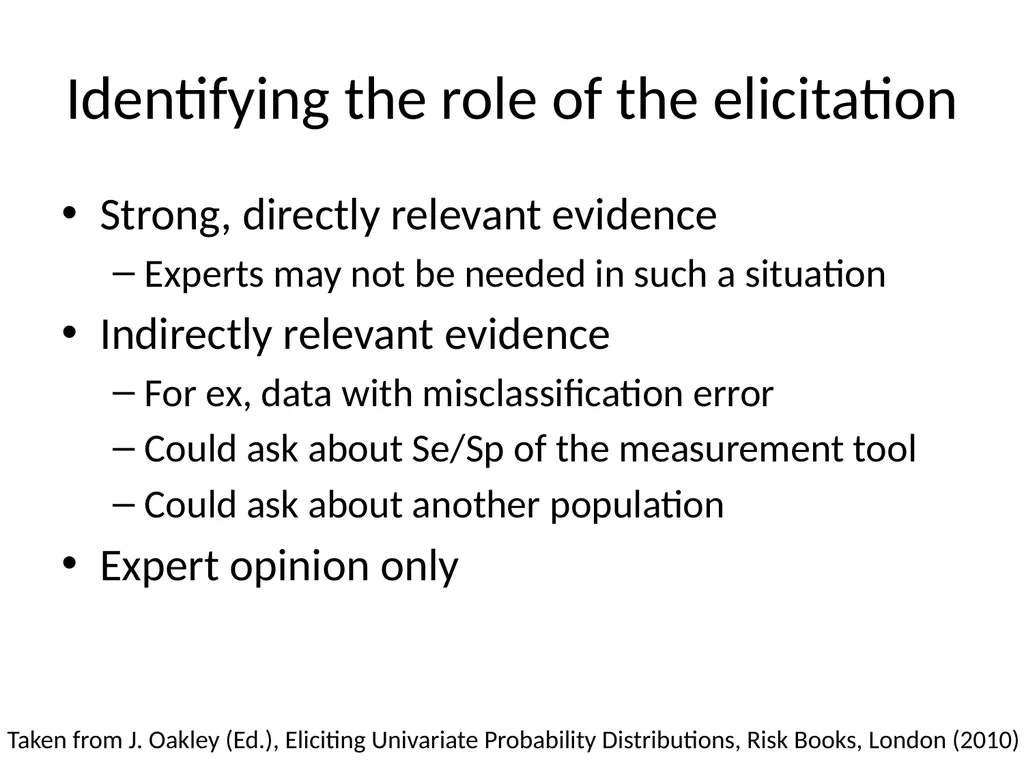
Identifying the role of the elicitation Strong, directly relevant evidence
Experts may not be needed in such a situation
Indirectly relevant evidence
For ex, data with misclassification error
Could ask about Se/Sp of the measurement tool
Could ask about another population
Expert opinion only Taken from J. Oakley (Ed.), Eliciting Univariate Probability Distributions, Risk Books, London (2010)<br>
10
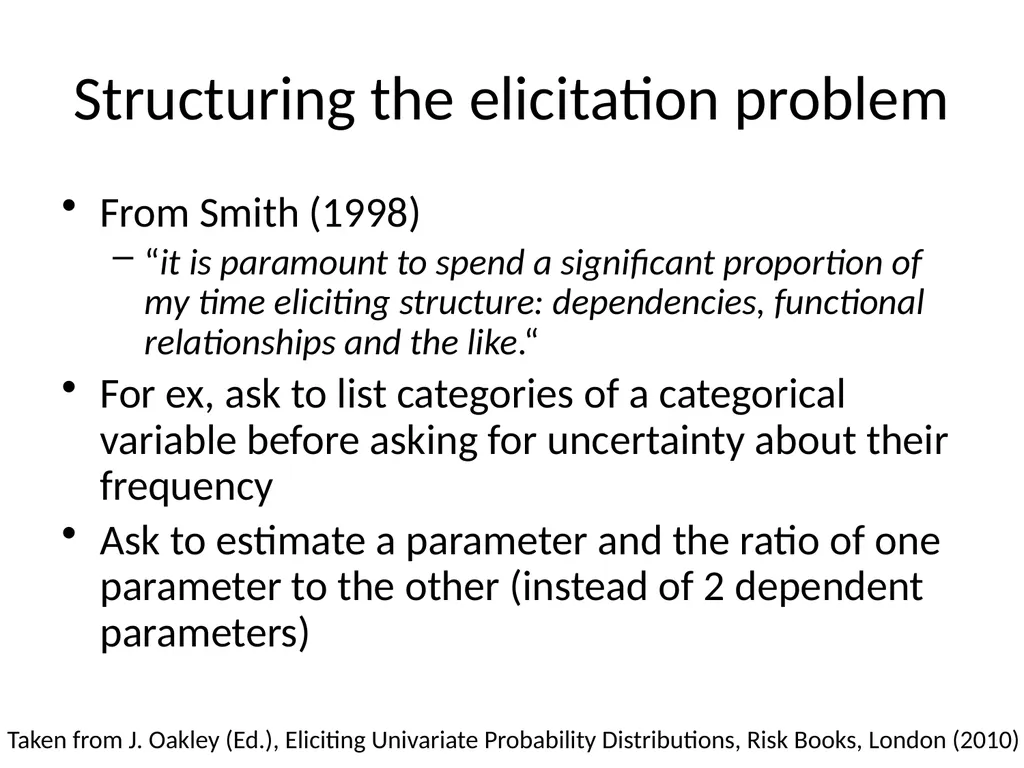
Structuring the elicitation problem From Smith (1998)
“it is paramount to spend a significant proportion of my time eliciting structure: dependencies, functional relationships and the like.“
For ex, ask to list categories of a categorical variable before asking for uncertainty about their frequency
Ask to estimate a parameter and the ratio of one parameter to the other (instead of 2 dependent parameters) Taken from J. Oakley (Ed.), Eliciting Univariate Probability Distributions, Risk Books, London (2010)<br>
11
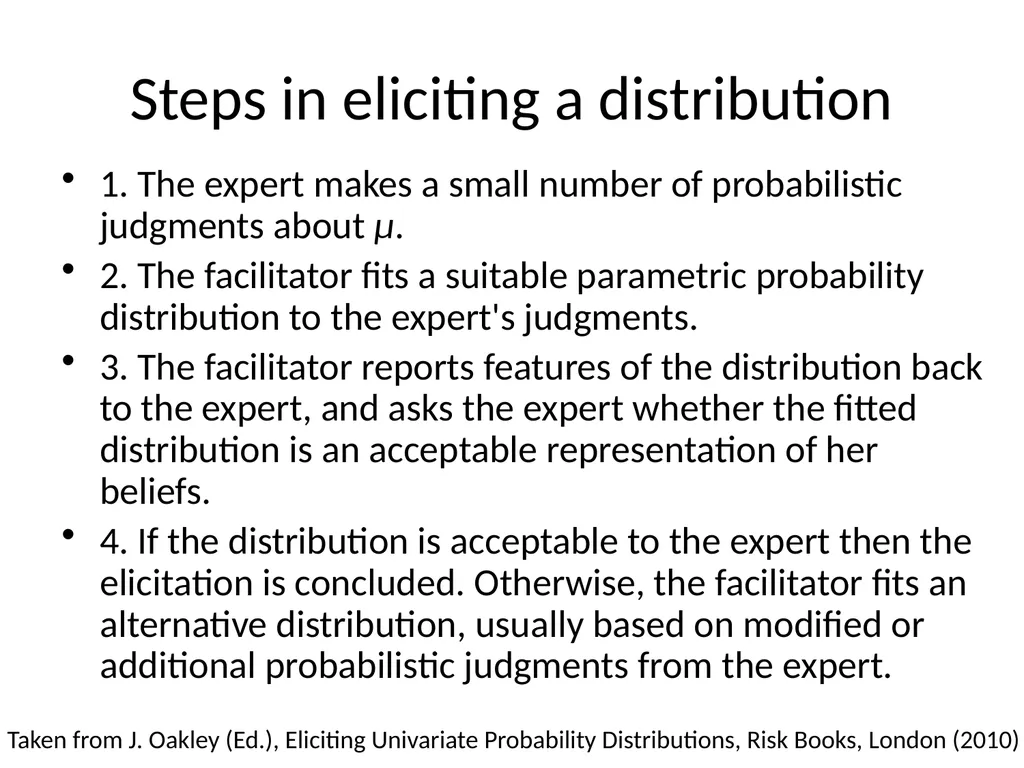
Steps in eliciting a distribution 1. The expert makes a small number of probabilistic judgments about µ.
2. The facilitator fits a suitable parametric probability distribution to the expert's judgments.
3. The facilitator reports features of the distribution back to the expert, and asks the expert whether the fitted distribution is an acceptable representation of her beliefs.
4. If the distribution is acceptable to the expert then the elicitation is concluded. Otherwise, the facilitator fits an alternative distribution, usually based on modified or additional probabilistic judgments from the expert. Taken from J. Oakley (Ed.), Eliciting Univariate Probability Distributions, Risk Books, London (2010)<br>
12
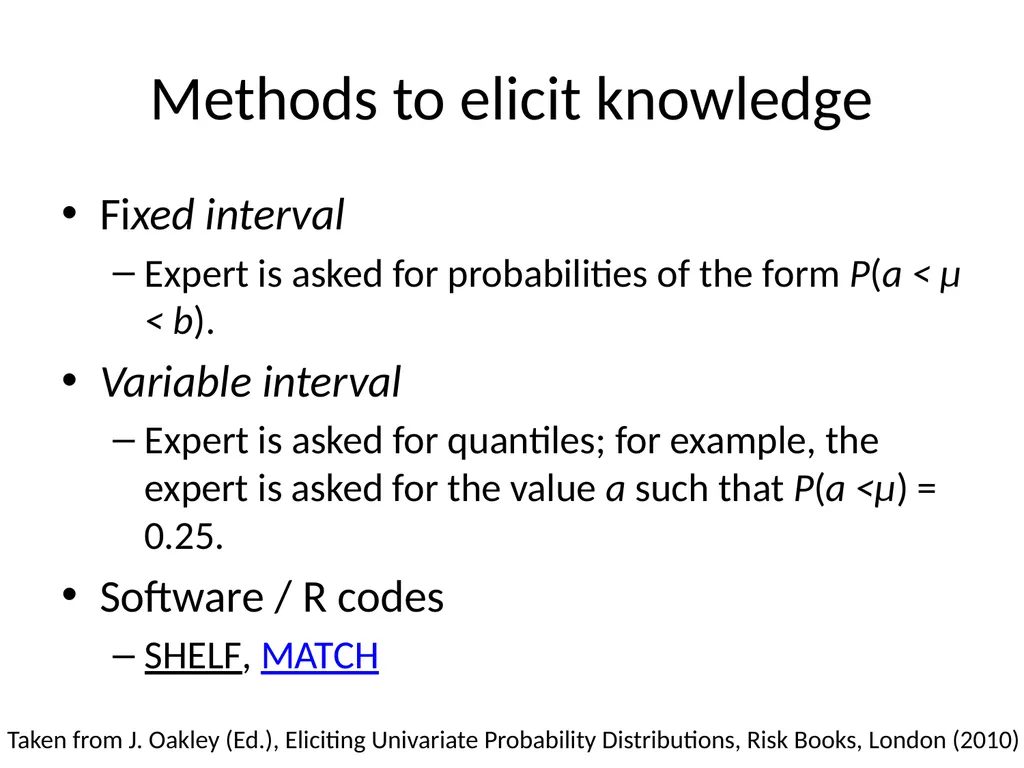
Methods to elicit knowledge Fixed interval
Expert is asked for probabilities of the form P(a < µ < b).
Variable interval
Expert is asked for quantiles; for example, the expert is asked for the value a such that P(a <µ) = 0.25.
Software / R codes
SHELF, MATCH Taken from J. Oakley (Ed.), Eliciting Univariate Probability Distributions, Risk Books, London (2010)<br>
13
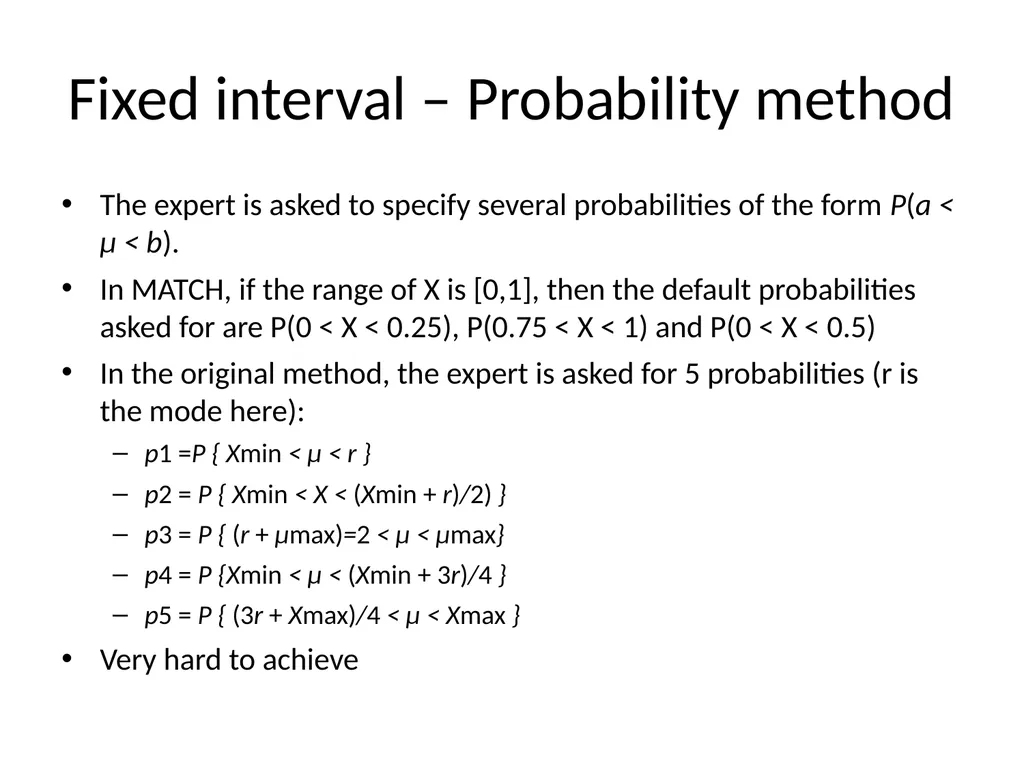
Fixed interval – Probability method The expert is asked to specify several probabilities of the form P(a < µ < b).
In MATCH, if the range of X is [0,1], then the default probabilities asked for are P(0 < X < 0.25), P(0.75 < X < 1) and P(0 < X < 0.5)
In the original method, the expert is asked for 5 probabilities (r is the mode here):
p1 =P { Xmin < µ < r }
p2 = P { Xmin < X < (Xmin + r)/2) }
p3 = P { (r + µmax)=2 < µ < µmax}
p4 = P {Xmin < µ < (Xmin + 3r)/4 }
p5 = P { (3r + Xmax)/4 < µ < Xmax }
Very hard to achieve<br>
14
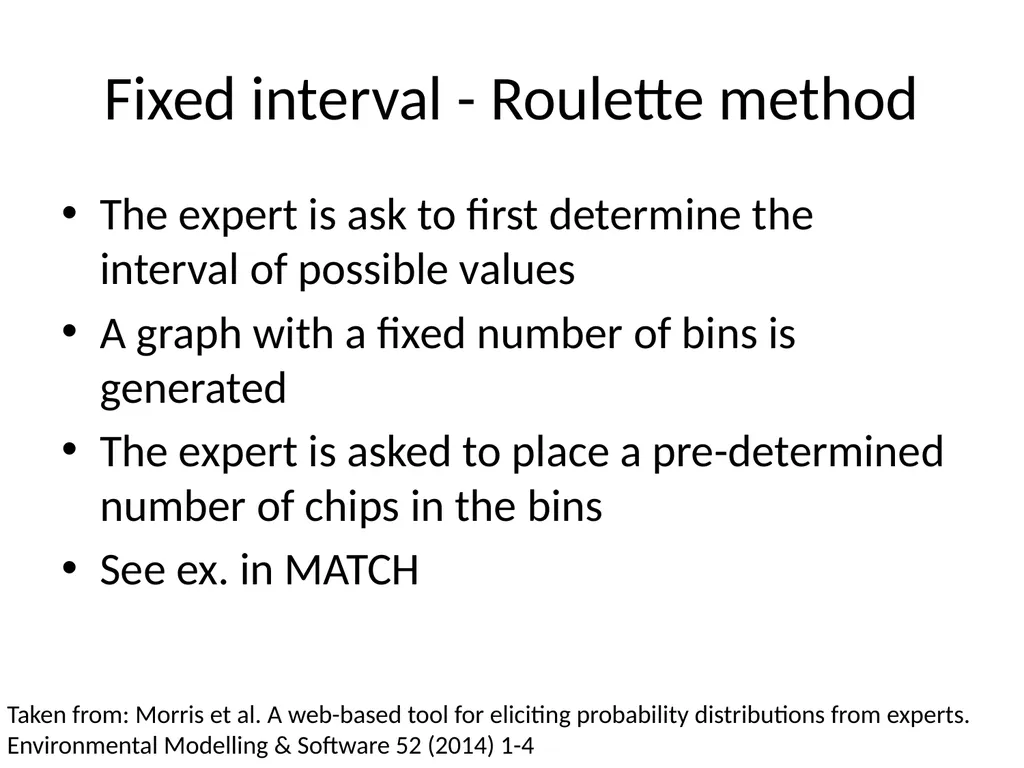
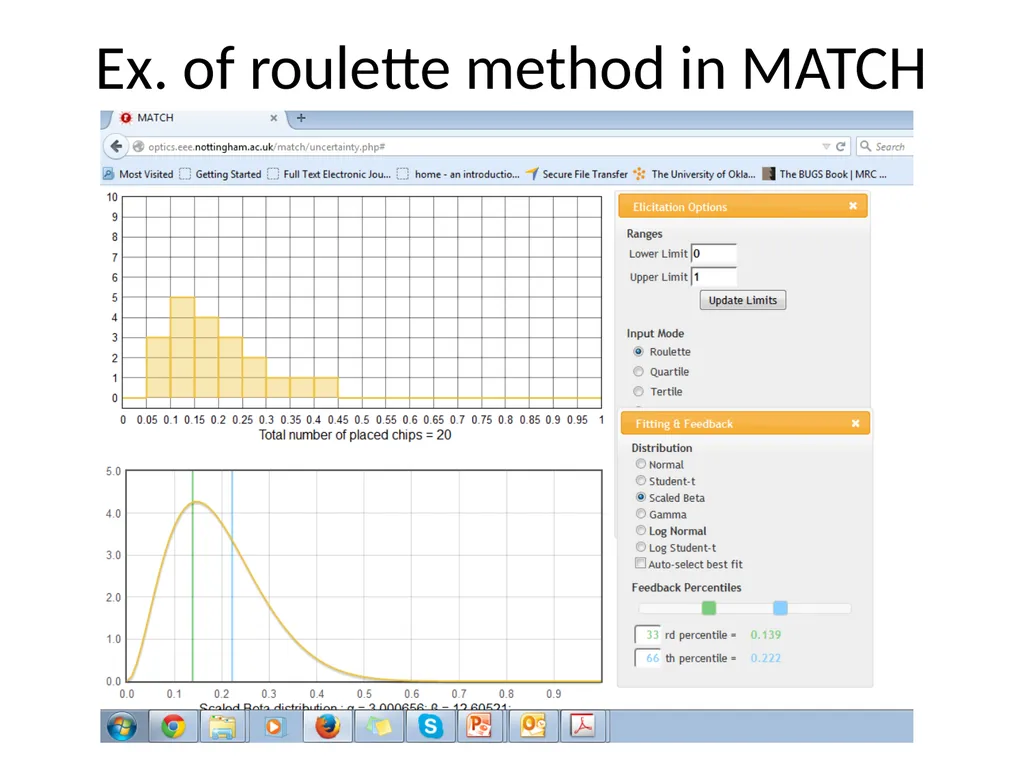
Fixed interval - Roulette method The expert is ask to first determine the interval of possible values
A graph with a fixed number of bins is generated
The expert is asked to place a pre-determined number of chips in the bins
See ex. in MATCH Taken from: Morris et al. A web-based tool for eliciting probability distributions from experts. Environmental Modelling & Software 52 (2014) 1-4<br>
15
Ex. of roulette method in MATCH<br>
16
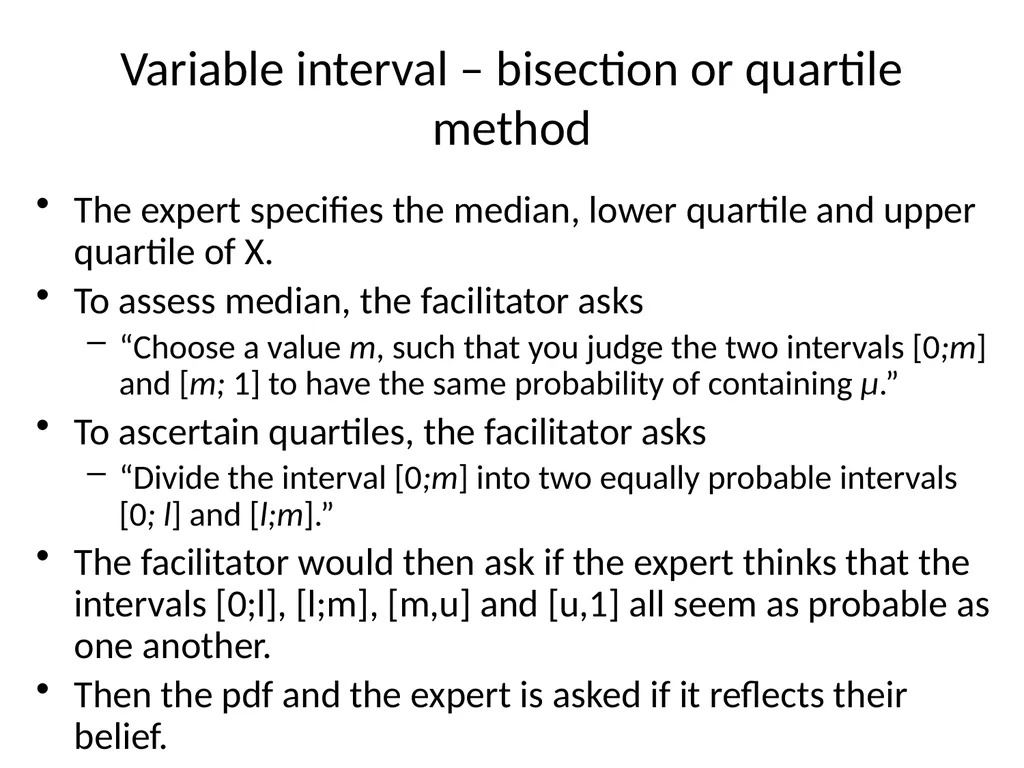
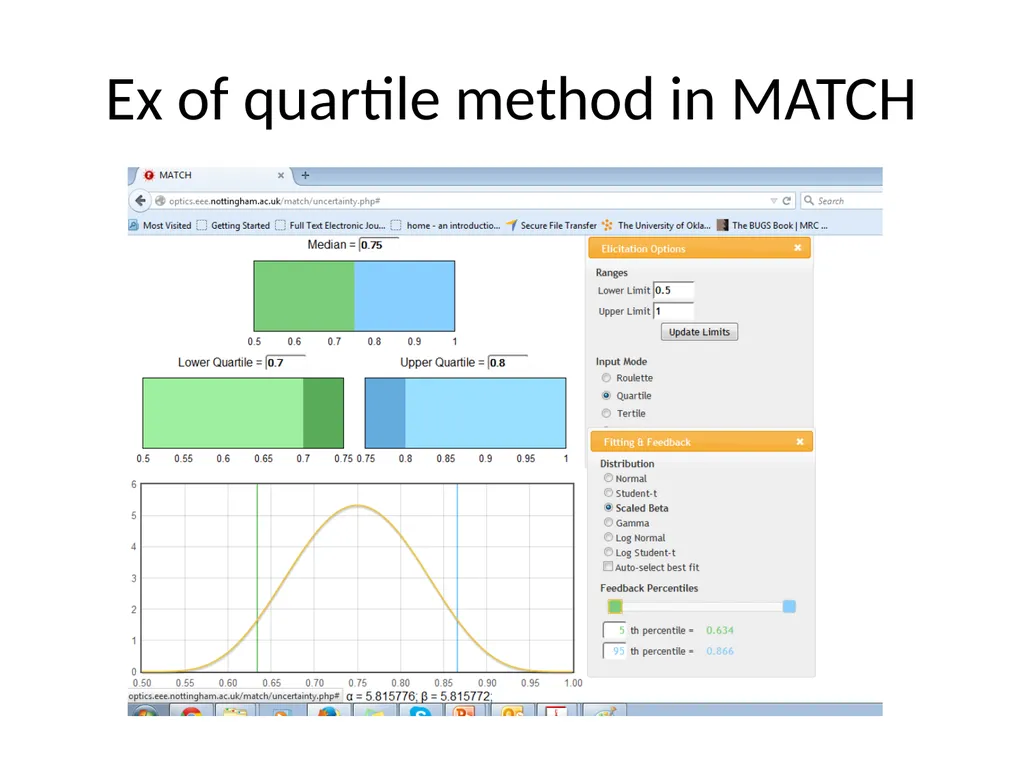
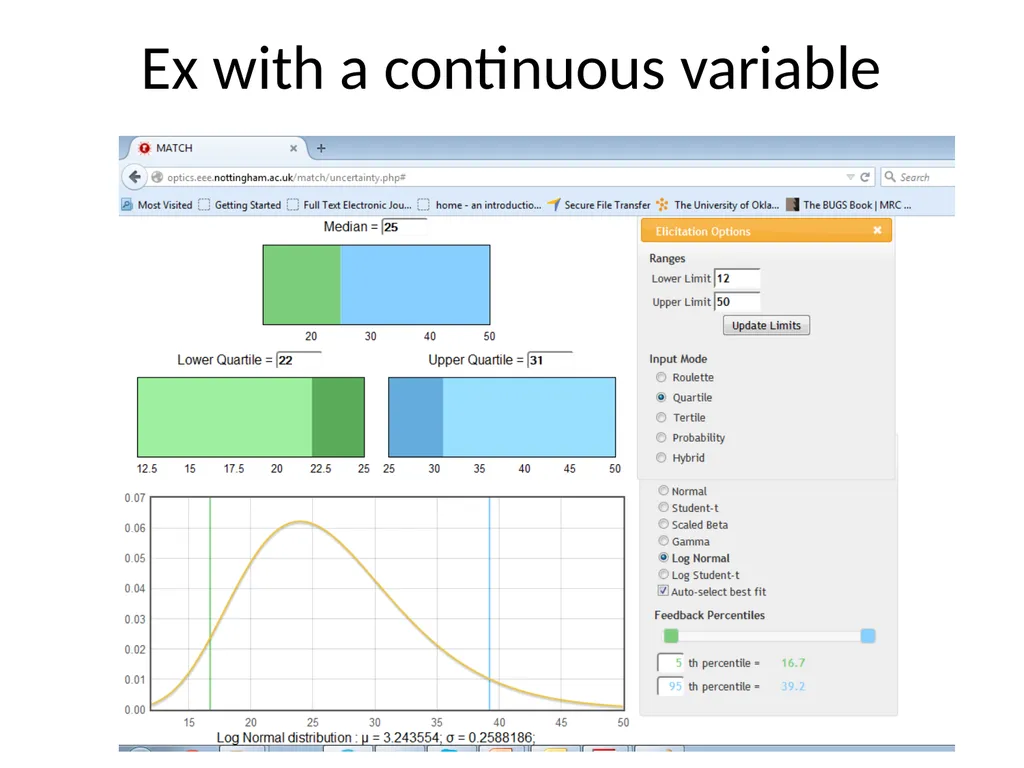
Variable interval – bisection or quartile method The expert specifies the median, lower quartile and upper quartile of X.
To assess median, the facilitator asks
“Choose a value m, such that you judge the two intervals [0;m] and [m; 1] to have the same probability of containing µ.”
To ascertain quartiles, the facilitator asks
“Divide the interval [0;m] into two equally probable intervals [0; l] and [l;m].”
The facilitator would then ask if the expert thinks that the intervals [0;l], [l;m], [m,u] and [u,1] all seem as probable as one another.
Then the pdf and the expert is asked if it reflects their belief.<br>
17
Ex of quartile method in MATCH<br>
18
Ex with a continuous variable<br>
19
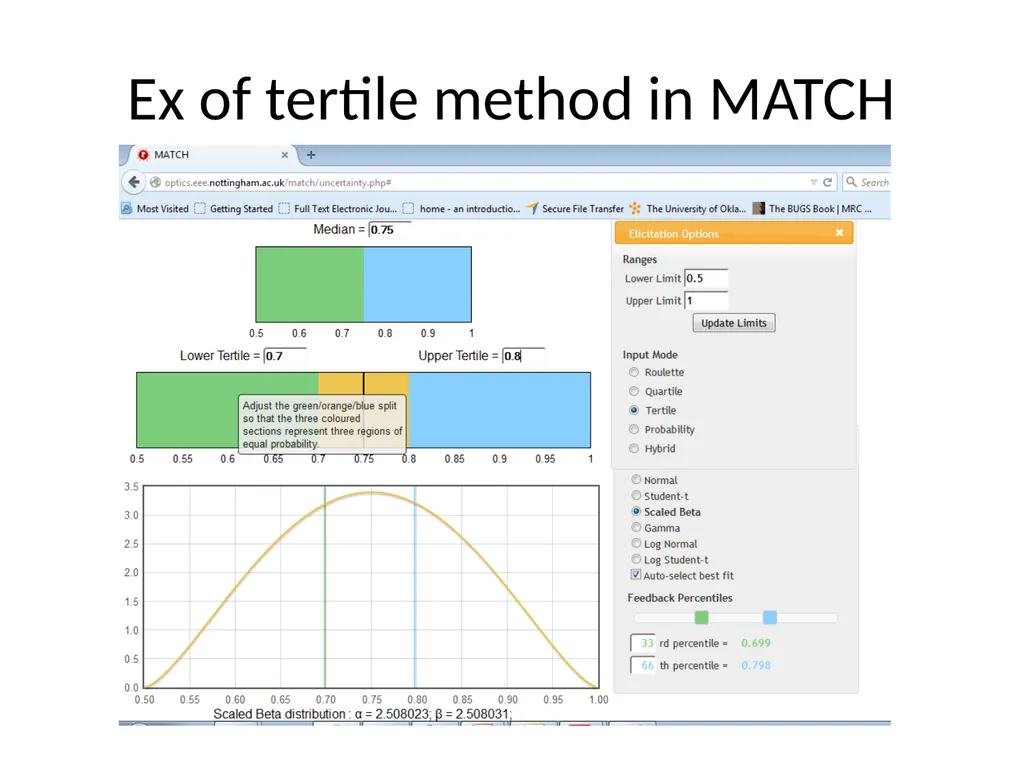
Variable interval – tertile method The expert specifies the median, the 33rd percentile and the 66th percentile.
The method is very similar to that of the quartile.
Experts may find it easier to divide their beliefs in thirds instead of quarters<br>
20
Ex of tertile method in MATCH<br>
21
Feedback After the pdf have been generated, then the facilitator will ask the expert questions about some values on the distribution. For example, how likely would a value corresponding to the 99th percentile be? Does it represent their beliefs etc. Values can be modified to best fit the belief of the expert.<br>
22
4 principles of eliciting prior knowledge Principle 1: It is desirable for elicitation methodologies to produce distributions which are flexible in form.
Principle 2: It is desirable to minimize the cognitive demands that an elicitation methodology places on the expert.
Principle 3: It is desirable to minimize the demands that an elicitation methodology places on the statistician.
Principle 4: All other things being equal, methodologies for prior elicitation which can be easily applied to a wide range of models or scenarios may have some added desirability. Taken from Hahn., Re-examining informative prior elicitation through the lens of MCMC. Journal of the Royal Statistical Society: Series A 2006; 169, 37–48.<br>