Private participation in infrastructure Bratislava, June 2016 Dejan Makovšek, EconomistOECD-ITF The main reasons come from the mitigation of the failures of traditional (public) model: prevention of time inconsistent behaviour of
"Private participation in infrastructure" is the property of its rightful owner. Permission is granted to
download and print the materials on this website for personal, non-commercial use only, and to display it
on your personal computer provided you do not modify the materials and that you retain all copyright
notices contained in the materials. By downloading content from our website, you accept the terms of this
agreement.
Presentation Transcript
01
Private participation in infrastructure Bratislava, June 2016
Dejan Makovšek, Economist/OECD-ITF<br>
02
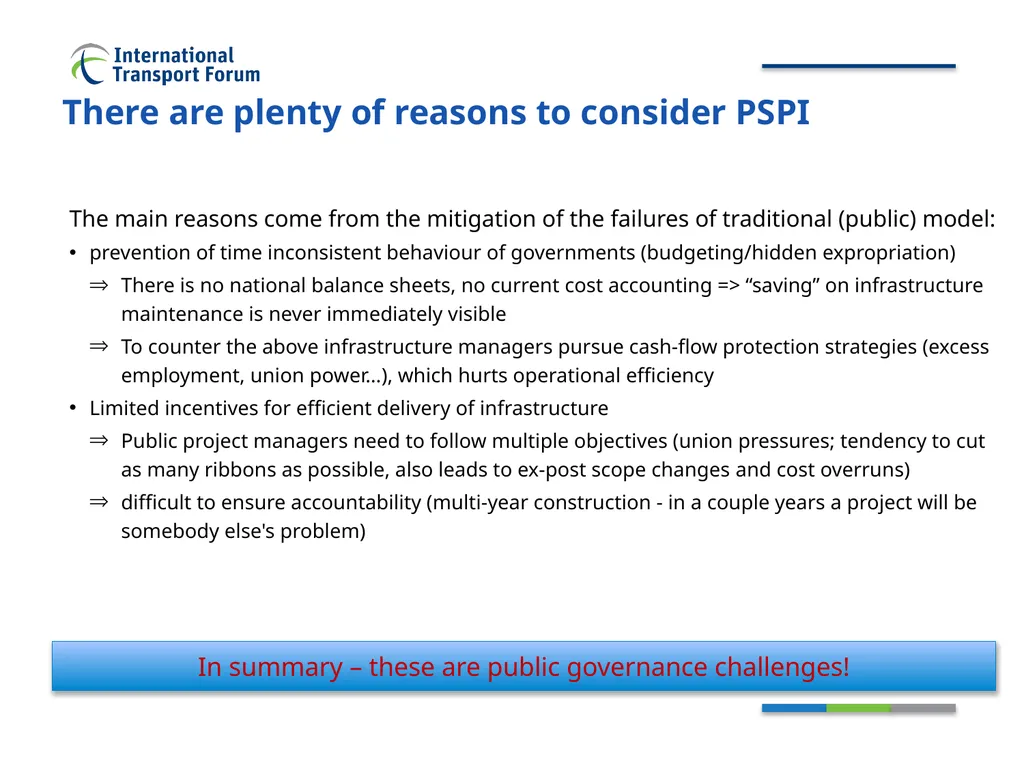
The main reasons come from the mitigation of the failures of traditional (public) model:
prevention of time inconsistent behaviour of governments (budgeting/hidden expropriation)
There is no national balance sheets, no current cost accounting => “saving” on infrastructure maintenance is never immediately visible
To counter the above infrastructure managers pursue cash-flow protection strategies (excess employment, union power…), which hurts operational efficiency
Limited incentives for efficient delivery of infrastructure
Public project managers need to follow multiple objectives (union pressures; tendency to cut as many ribbons as possible, also leads to ex-post scope changes and cost overruns)
difficult to ensure accountability (multi-year construction - in a couple years a project will be somebody else's problem) In summary – these are public governance challenges! There are plenty of reasons to consider PSPI<br>
03
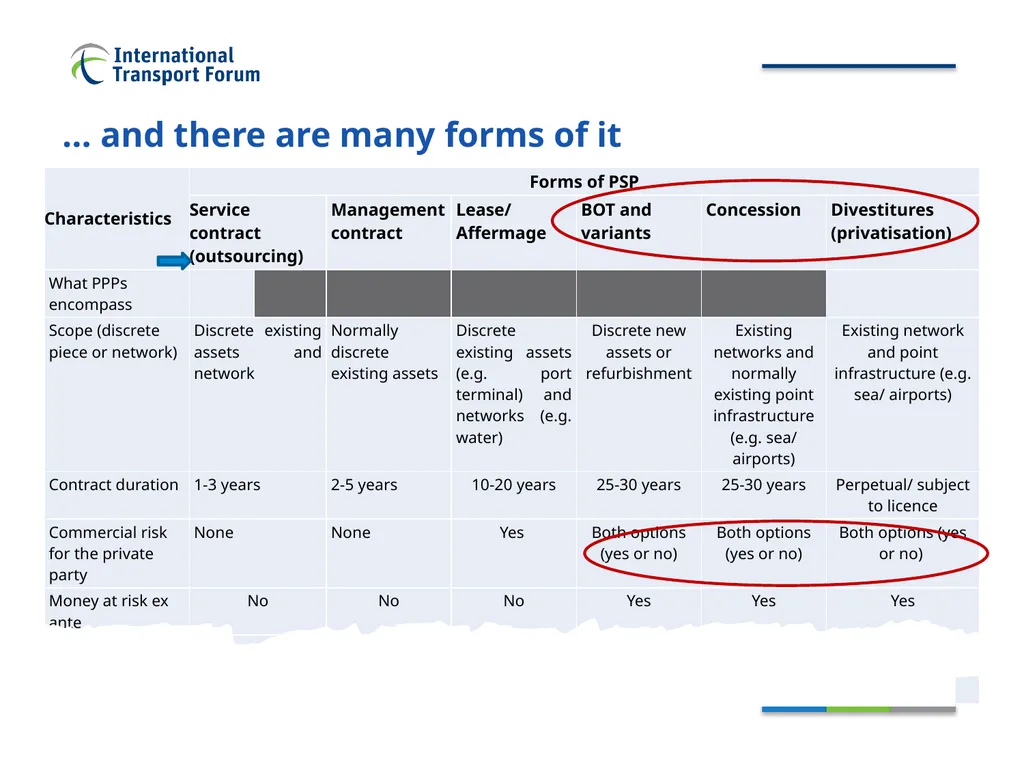
… and there are many forms of it<br>
04
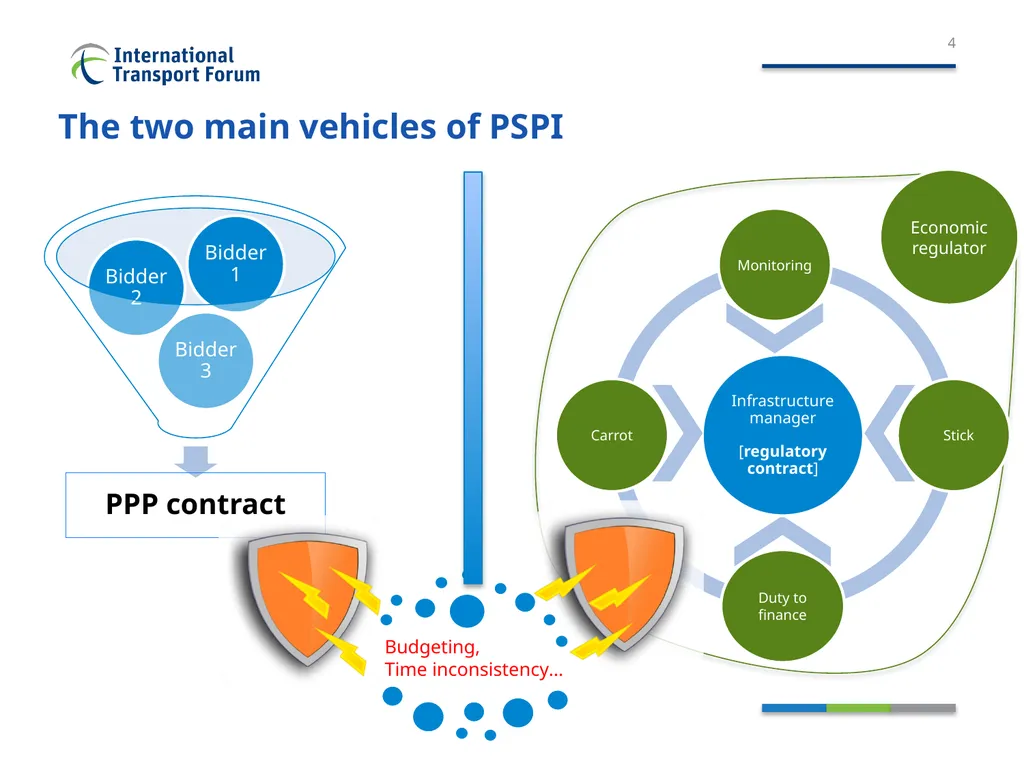
4 The two main vehicles of PSPI<br>
05
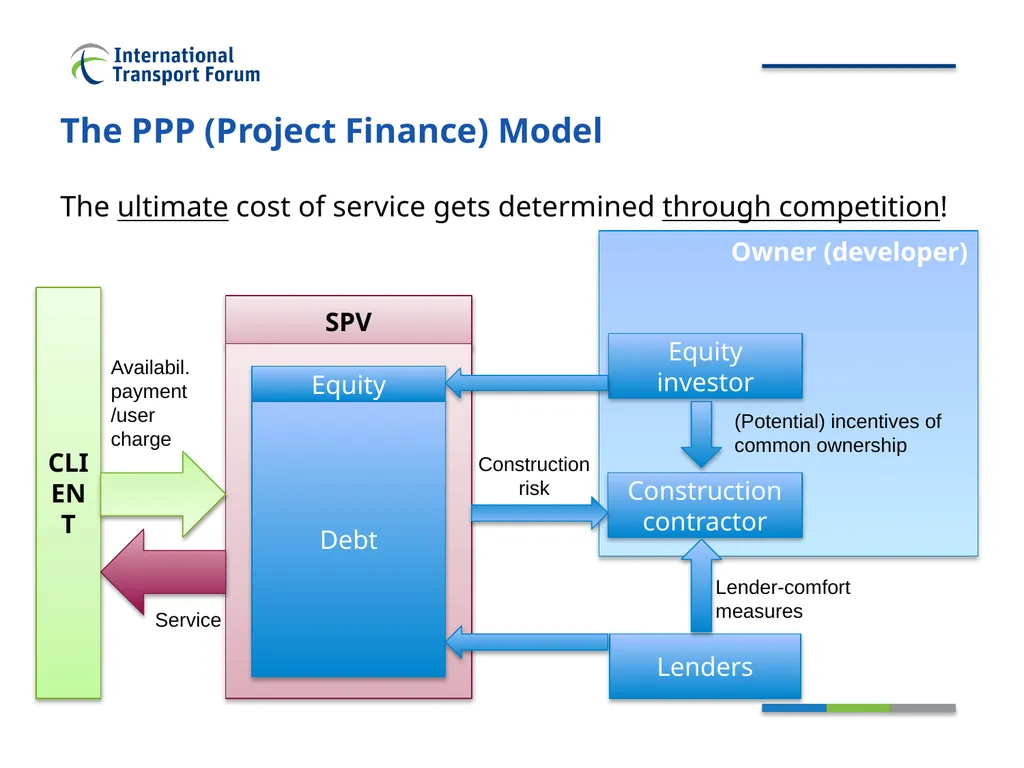
The PPP (Project Finance) Model The ultimate cost of service gets determined through competition!<br>
06
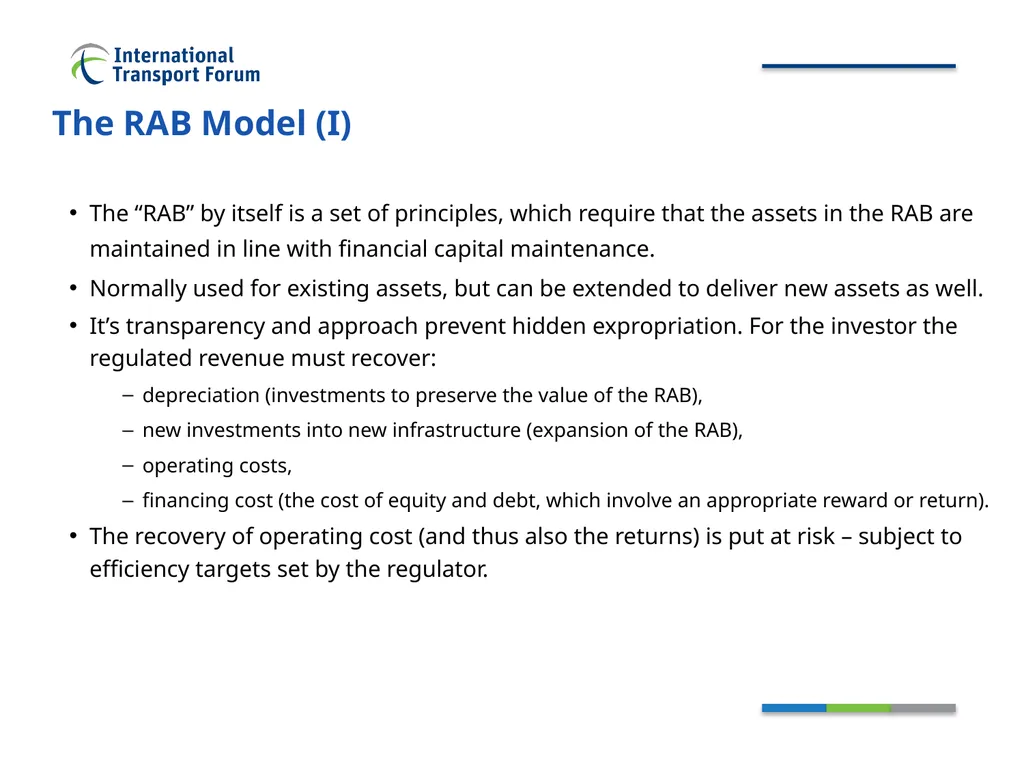
The RAB Model (I) The “RAB” by itself is a set of principles, which require that the assets in the RAB are maintained in line with financial capital maintenance.
Normally used for existing assets, but can be extended to deliver new assets as well.
It’s transparency and approach prevent hidden expropriation. For the investor the regulated revenue must recover:
depreciation (investments to preserve the value of the RAB),
new investments into new infrastructure (expansion of the RAB),
operating costs,
financing cost (the cost of equity and debt, which involve an appropriate reward or return).
The recovery of operating cost (and thus also the returns) is put at risk – subject to efficiency targets set by the regulator.<br>
07
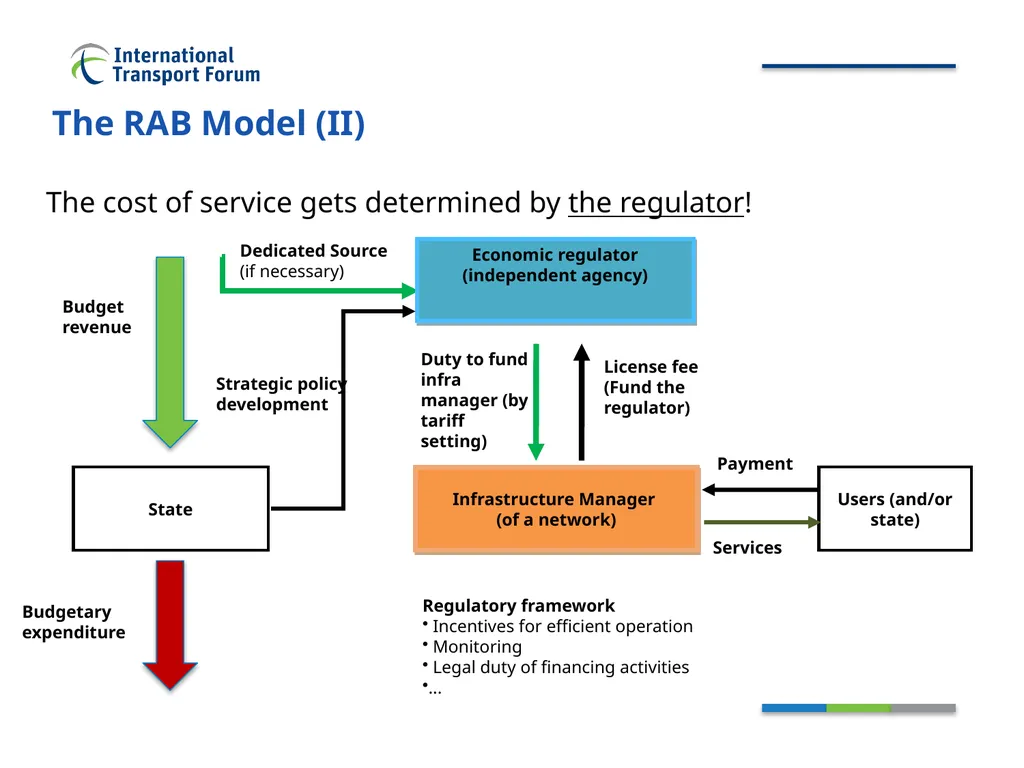
The RAB Model (II) The cost of service gets determined by the regulator!<br>
08
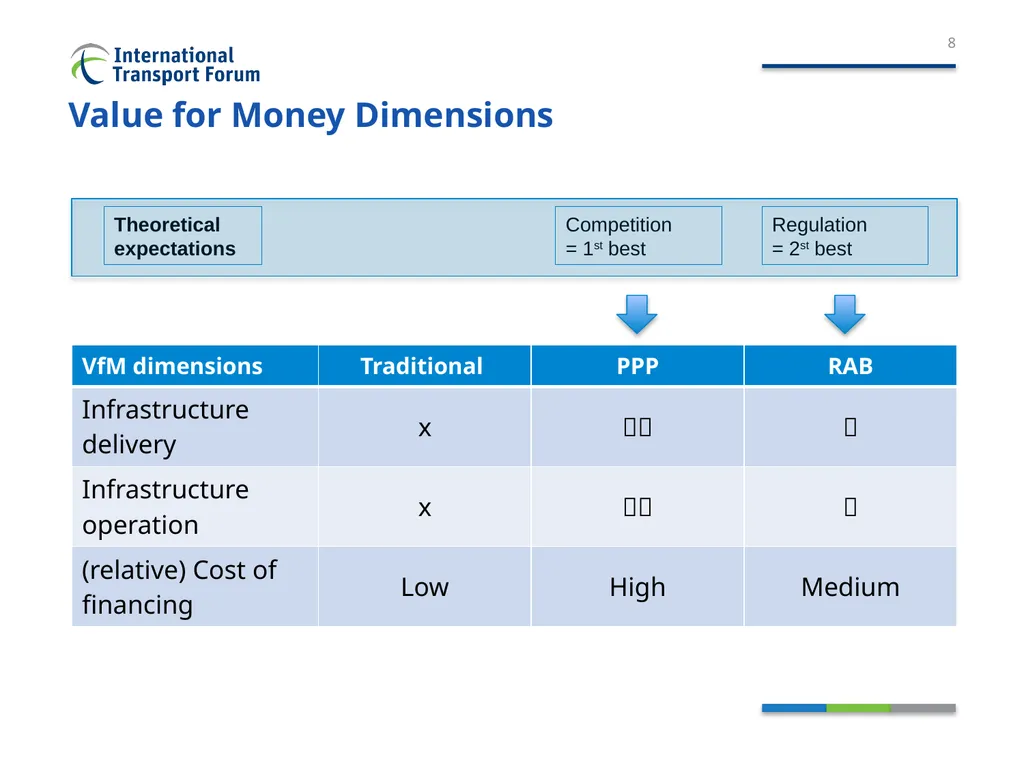
Value for Money Dimensions 8 Theoretical expectations Competition
= 1st best Regulation
= 2st best<br>
09
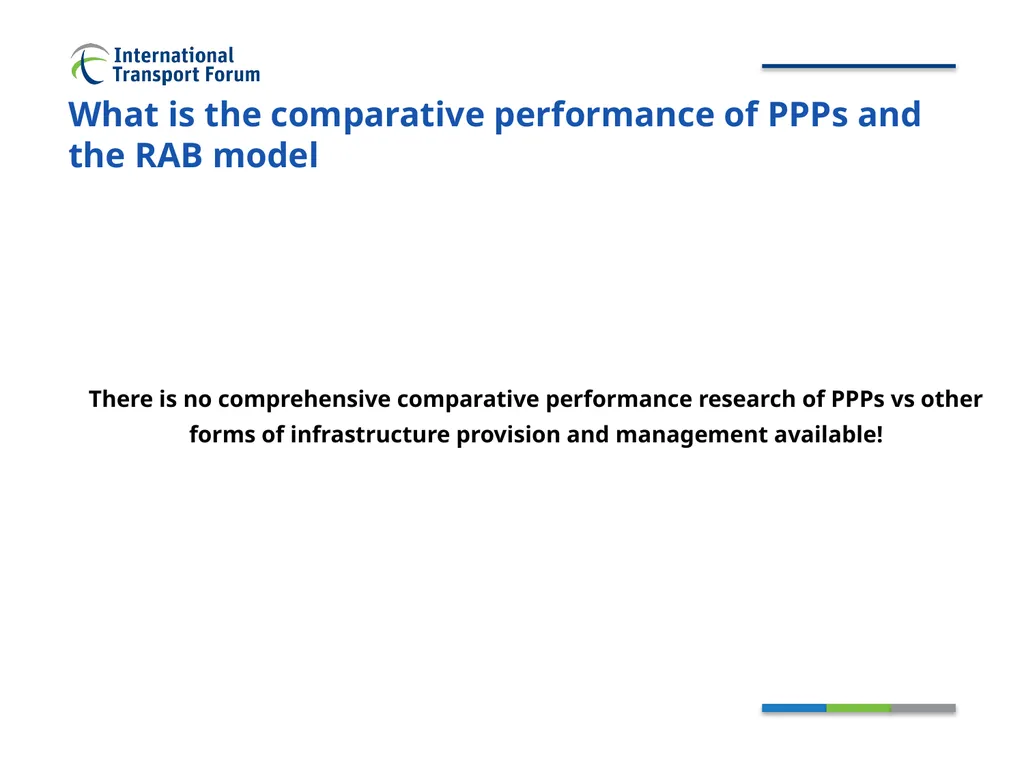
What is the comparative performance of PPPs and the RAB model There is no comprehensive comparative performance research of PPPs vs other forms of infrastructure provision and management available!<br>
10
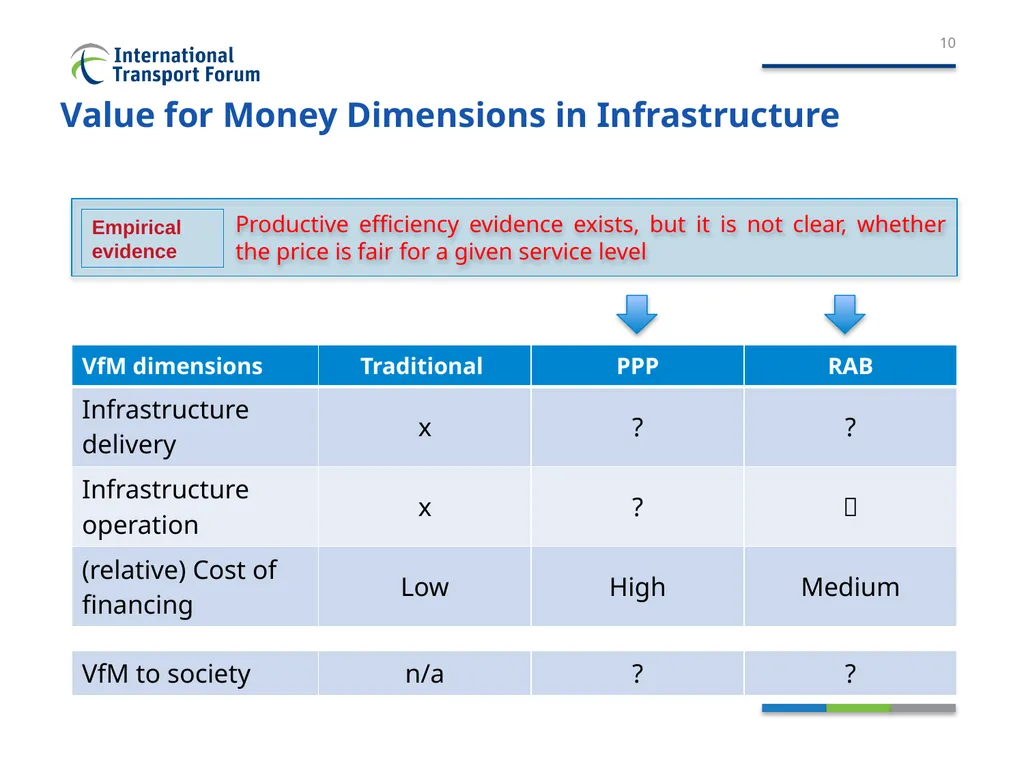
Value for Money Dimensions in Infrastructure 10 Empirical evidence Productive efficiency evidence exists, but it is not clear, whether the price is fair for a given service level<br>
11
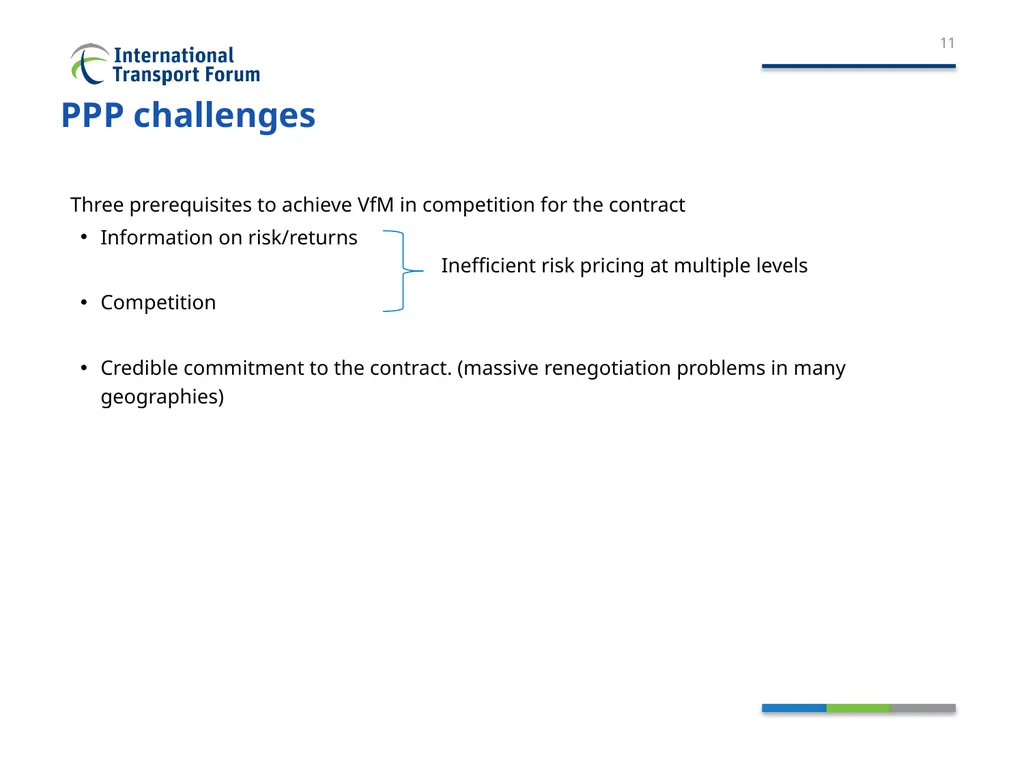
PPP challenges Three prerequisites to achieve VfM in competition for the contract
Information on risk/returns
Competition
Credible commitment to the contract. (massive renegotiation problems in many geographies) 11 Inefficient risk pricing at multiple levels<br>
12
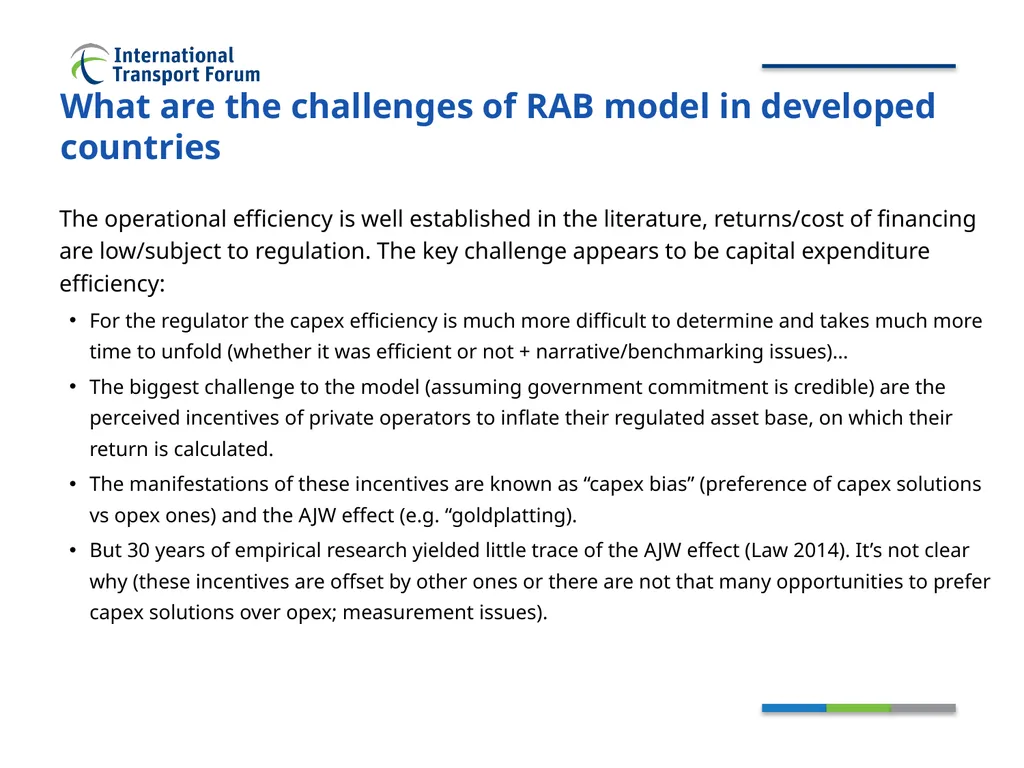
What are the challenges of RAB model in developed countries The operational efficiency is well established in the literature, returns/cost of financing are low/subject to regulation. The key challenge appears to be capital expenditure efficiency:
For the regulator the capex efficiency is much more difficult to determine and takes much more time to unfold (whether it was efficient or not + narrative/benchmarking issues)…
The biggest challenge to the model (assuming government commitment is credible) are the perceived incentives of private operators to inflate their regulated asset base, on which their return is calculated.
The manifestations of these incentives are known as “capex bias” (preference of capex solutions vs opex ones) and the AJW effect (e.g. “goldplatting).
But 30 years of empirical research yielded little trace of the AJW effect (Law 2014). It’s not clear why (these incentives are offset by other ones or there are not that many opportunities to prefer capex solutions over opex; measurement issues).<br>
13
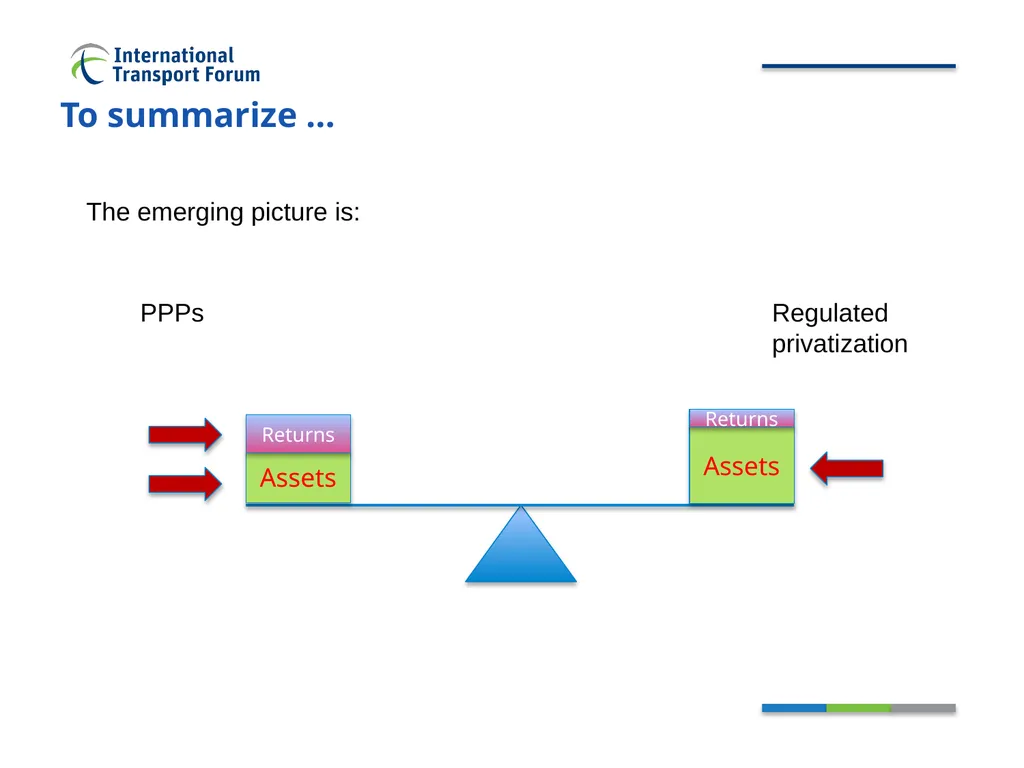
To summarize … PPPs Regulated privatization The emerging picture is:<br>
14
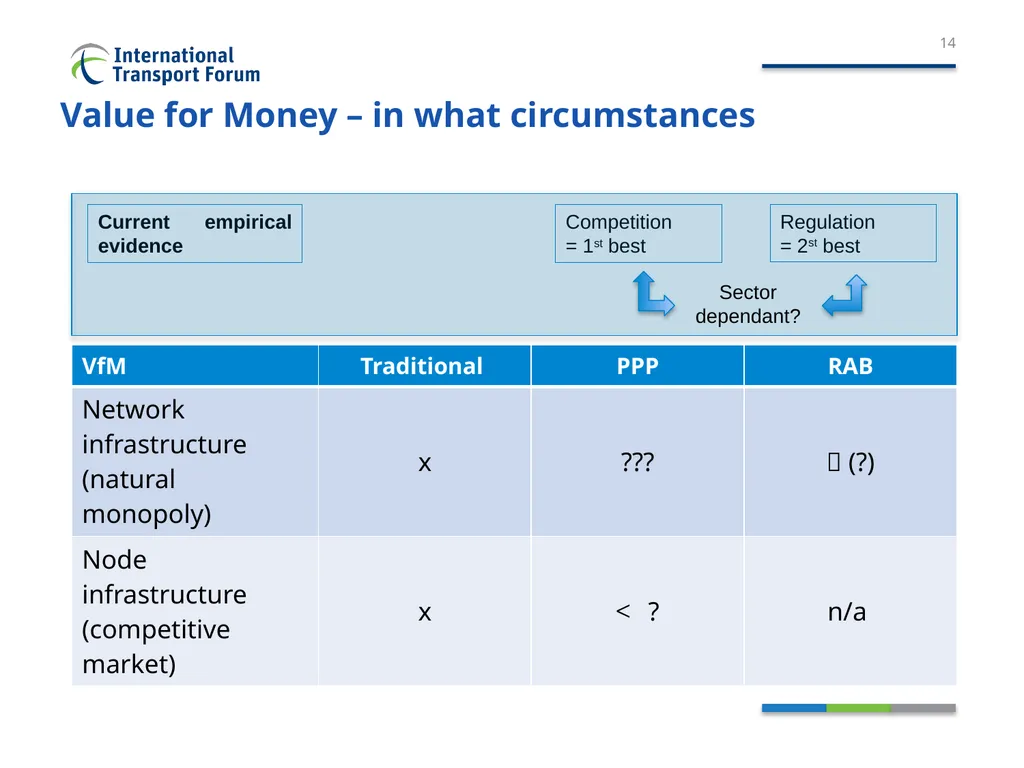
Value for Money – in what circumstances 14 Current empirical evidence Competition
= 1st best Regulation
= 2st best Sector dependant?<br>
15
The findings in this study are mainly based on research studies, conducted in developed economies. There are obvious complexities across sectors and countries at different stages of development that warrant care in their interpretation.
More empirical evidence is needed to help understand PPP outcomes better.
The capex bias does not appear to be a serious issue in the RAB model, but more research is needed, as it is not clear why.
In cases, where public governance is challenged, PPPs can bring an improvement to the traditional approach (e.g. breaking union capture, potentially reduce pillaging of tolls).
When public sentiment does not favour privatisation or a concession of the network, it may be politically more feasible to execute a project finance PPP.
A PPP can be deployed comparably fast, whereas the setup of an economic regulator and the build-up of its capacity takes more time. Indeed it is preferred that the RAB is first applied on a public entity and then later privatized/concessioned.
Both PPPs and RABs cannot in themselves resolve the issue of governments’ ability to commit or corruption issues – a regulator, that is not independent and well-resourced or a poorly executed PPP will both deliver poor Value for Money.
In networks a change in infrastructure policy will be easier accommodated by the RAB, whereas many affected PPPs will require a lot of renegotiations.
… Caveats<br>
16
Thank you! dejan.makovsek@itf-oecd.org<br>
17
Infrastructure is funded either by all the tax payers (direct government provision, shadow tolls) or by the users (which is a select group of taxpayers)
Both options theoretically exist in traditional public provision or a PPP (in a PPP the taxpayers pay, when an availability based model is in place)
So if there is somebody who is willing to pay for the infrastructure, why would it matter, where we borrow the money? Why would changing the source of financing solve a funding problem? Can private finance fill the gap? (I)<br>
18
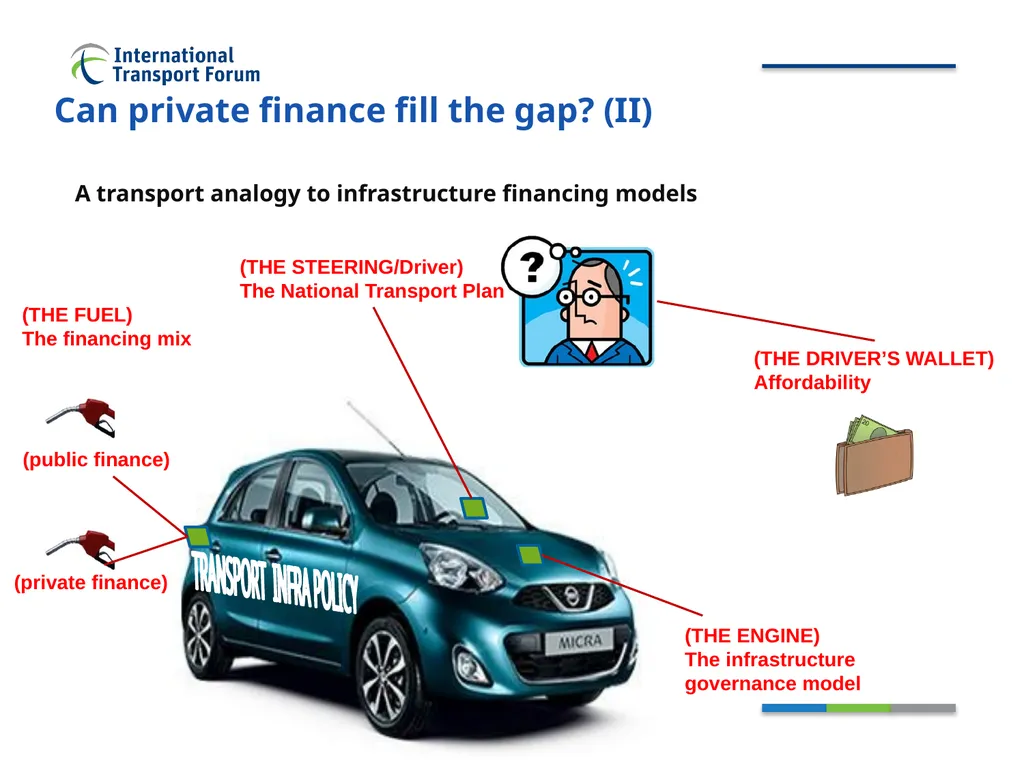
TRANSPORT INFRA POLICY A transport analogy to infrastructure financing models Can private finance fill the gap? (II)<br>