Private Sector Engagement Project on capacity building for inclusive and equitable African trade arrangements 4-5 February 2020 Brussels, Belgium KNOWLEDGE SHARING ON TRADE AND INVESTMENT GOOD PRACTICES 1 ATPC 2018 Financial Report
Related Topics
Download this presentation From Below
"Private Sector Engagement Project on capacity" is the property of its rightful owner. Permission is granted to
download and print the materials on this website for personal, non-commercial use only, and to display it
on your personal computer provided you do not modify the materials and that you retain all copyright
notices contained in the materials. By downloading content from our website, you accept the terms of this
agreement.
Share
Embed code
Presentation Transcript
01
Private Sector Engagement Project on capacity building for inclusive and equitable African trade arrangements 4-5 February 2020
Brussels, Belgium KNOWLEDGE SHARING ON TRADE AND INVESTMENT “GOOD PRACTICES” 1<br>
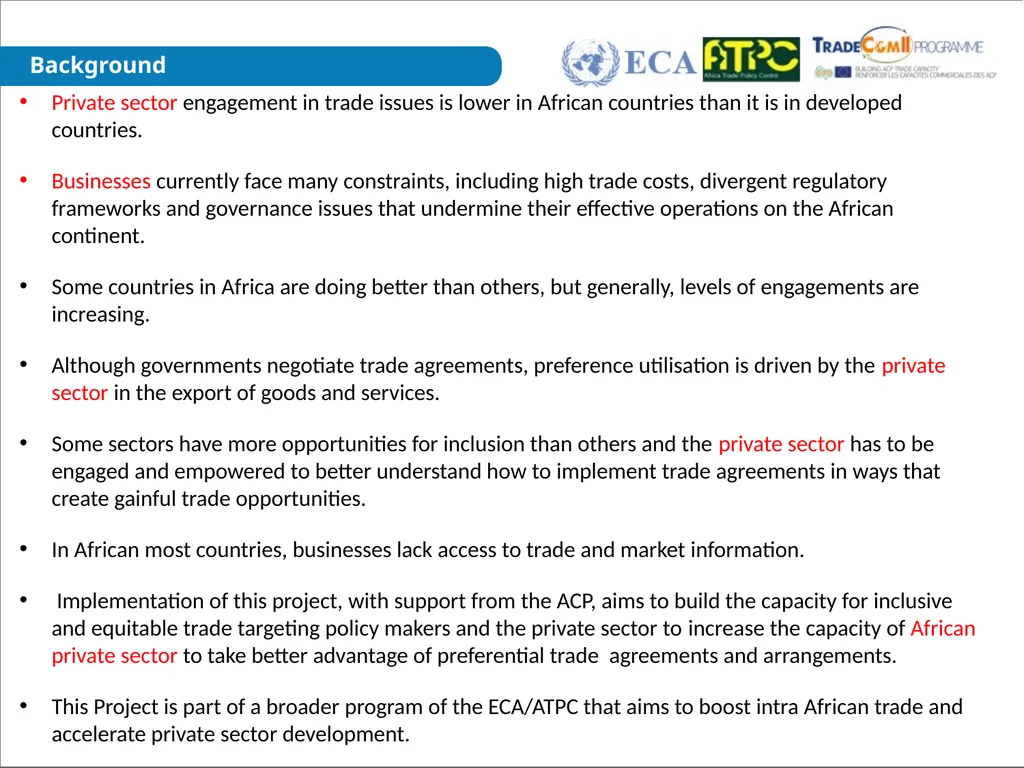
UNECA.ORG Background Private sector engagement in trade issues is lower in African countries than it is in developed countries.
Businesses currently face many constraints, including high trade costs, divergent regulatory frameworks and governance issues that undermine their effective operations on the African continent.
Some countries in Africa are doing better than others, but generally, levels of engagements are increasing.
Although governments negotiate trade agreements, preference utilisation is driven by the private sector in the export of goods and services.
Some sectors have more opportunities for inclusion than others and the private sector has to be engaged and empowered to better understand how to implement trade agreements in ways that create gainful trade opportunities.
In African most countries, businesses lack access to trade and market information.
Implementation of this project, with support from the ACP, aims to build the capacity for inclusive and equitable trade targeting policy makers and the private sector to increase the capacity of African private sector to take better advantage of preferential trade agreements and arrangements.
This Project is part of a broader program of the ECA/ATPC that aims to boost intra African trade and accelerate private sector development.<br>
04
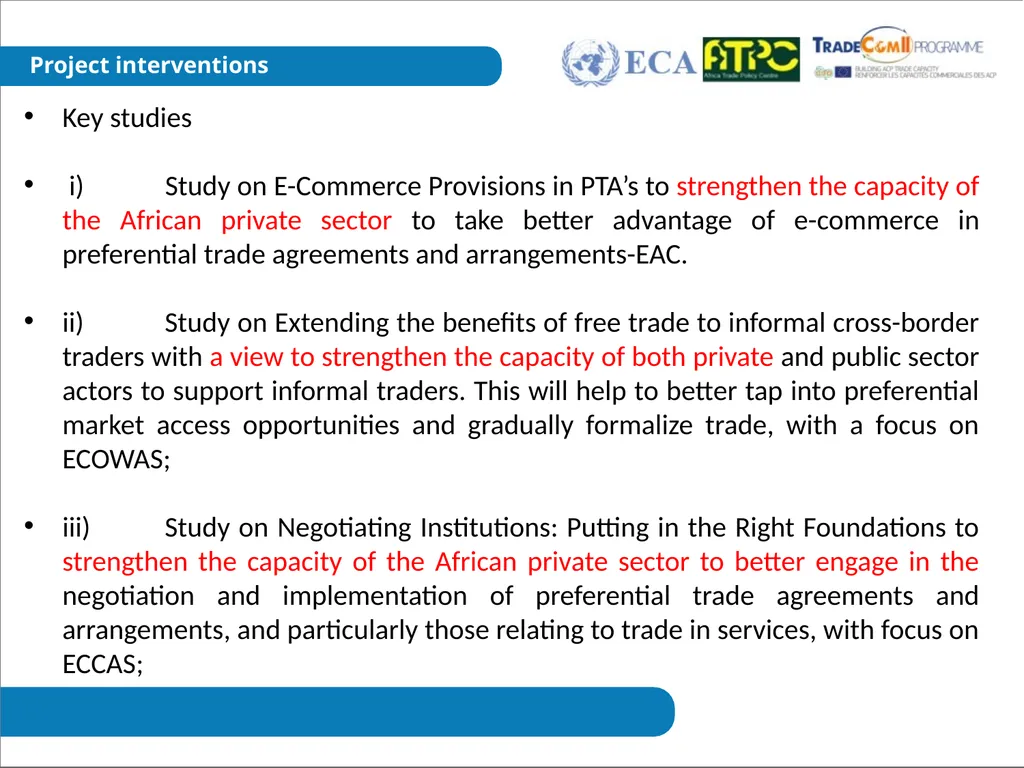
UNECA.ORG Project interventions Key studies
i) Study on E-Commerce Provisions in PTA’s to strengthen the capacity of the African private sector to take better advantage of e-commerce in preferential trade agreements and arrangements-EAC.
ii) Study on Extending the benefits of free trade to informal cross-border traders with a view to strengthen the capacity of both private and public sector actors to support informal traders. This will help to better tap into preferential market access opportunities and gradually formalize trade, with a focus on ECOWAS;
iii) Study on Negotiating Institutions: Putting in the Right Foundations to strengthen the capacity of the African private sector to better engage in the negotiation and implementation of preferential trade agreements and arrangements, and particularly those relating to trade in services, with focus on ECCAS;<br>
05
UNECA.ORG Project interventions Key studies
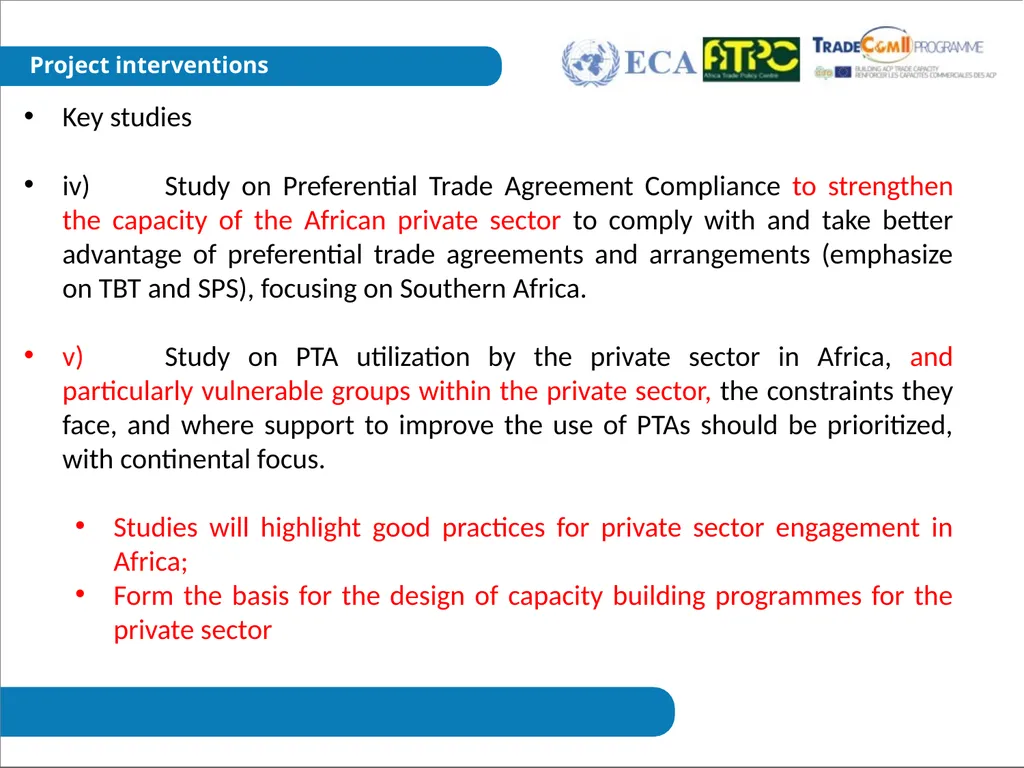
iv) Study on Preferential Trade Agreement Compliance to strengthen the capacity of the African private sector to comply with and take better advantage of preferential trade agreements and arrangements (emphasize on TBT and SPS), focusing on Southern Africa.
v) Study on PTA utilization by the private sector in Africa, and particularly vulnerable groups within the private sector, the constraints they face, and where support to improve the use of PTAs should be prioritized, with continental focus.
Studies will highlight good practices for private sector engagement in Africa;
Form the basis for the design of capacity building programmes for the private sector<br>
06
UNECA.ORG Private Sector Engagement Initiatives The Africa Business Forum (annual)
brings together heads of states, policymakers, industry leaders, and private businesses to discuss the role of private sector in Africa’s development;
focuses on the issues, challenges and opportunities that are most relevant for African economies and societies,
provides a unique networking environment for policymakers, private sector, financiers, academia and civil society.
Intra-African Trade Fair (IATF)
ECA partners with Afreximbank and African Union Commission
provides trade and market information
connect buyers and sellers from across the continent and
provide opportunities for matchmaking, business exchanges and conclusion of business and investment deals
Next IATF on 1-7 September 2020, in Kigali Rwanda<br>
07
UNECA.ORG Private Sector Engagement Initiatives The African Continental Free Trade Area (AfCFTA) Business Index
The index aggregates the opinions of businesses in Africa and articulates them in an index to ensure that the AfCFTA responds to their interests.
It identifies the actual effect that the AfCFTA has on business, and challenges countries to respond to improve the trading environment.
Star performing countries are recognized for their efforts, while those lagging behind are identified and flagged.<br>
08
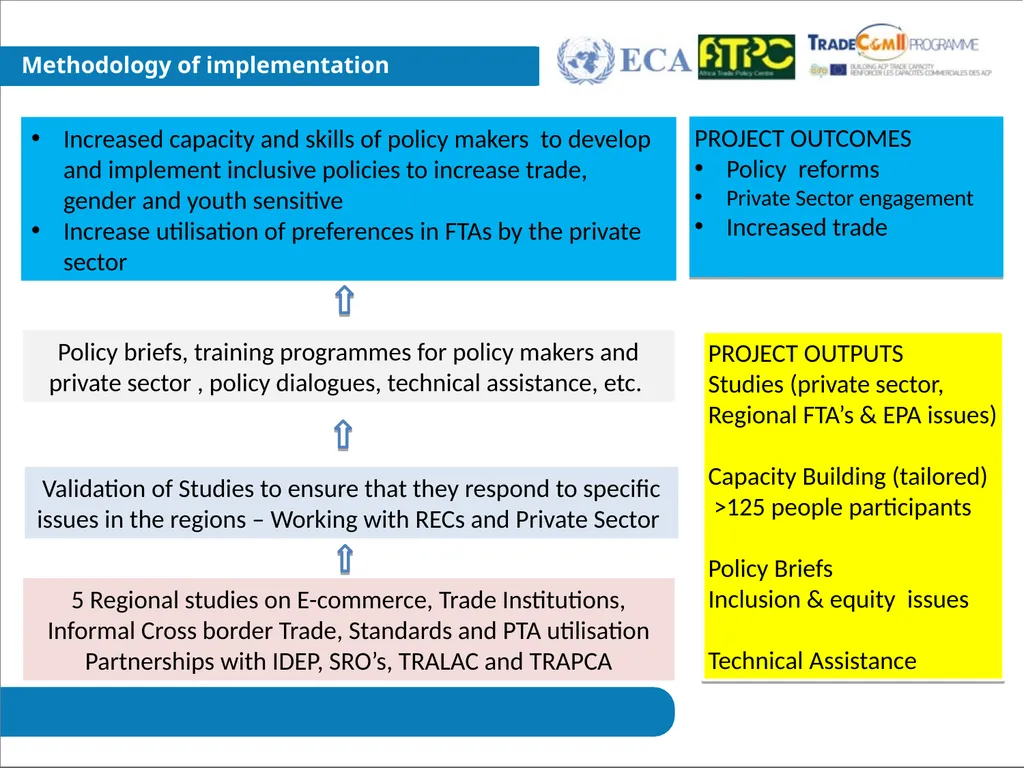
UNECA.ORG 8 Methodology of implementation 5 Regional studies on E-commerce, Trade Institutions, Informal Cross border Trade, Standards and PTA utilisation
Partnerships with IDEP, SRO’s, TRALAC and TRAPCA Validation of Studies to ensure that they respond to specific issues in the regions – Working with RECs and Private Sector Policy briefs, training programmes for policy makers and private sector , policy dialogues, technical assistance, etc. Increased capacity and skills of policy makers to develop and implement inclusive policies to increase trade, gender and youth sensitive
Increase utilisation of preferences in FTAs by the private sector PROJECT OUTPUTS
Studies (private sector,
Regional FTA’s & EPA issues)
Capacity Building (tailored)
>125 people participants
UNECA.ORG 9 Key considerations Studies will shape and inform the content of the trainings and capacity building programmes for policy makers and the private sector;
Focus is to ensure that our efforts results in policy reforms and increased trade flows;
ECA has other initiatives that are supporting African member States in developing national AfCFTA implementation Plans;
ECA is implementing other initiatives that are aimed at collecting gender disaggregated data- supporting and enabling evidence-based policy making;<br>
10
THANK YOU! ECA more info: bchikwene@un.org UN.ORG<br>