Privately Evaluating Region Overlaps with Applications to Collaborative Sensor Output Validation Anrin Chakraborti Duke University Euro SP 2023 Michael Reiter Duke University What is this paper about? I see an object at (x1 , y1, z1). Do
"Privately Evaluating Region Overlaps with" is the property of its rightful owner. Permission is granted to
download and print the materials on this website for personal, non-commercial use only, and to display it
on your personal computer provided you do not modify the materials and that you retain all copyright
notices contained in the materials. By downloading content from our website, you accept the terms of this
agreement.
Presentation Transcript
01
Privately Evaluating Region Overlaps with Applications to Collaborative Sensor Output Validation Anrin Chakraborti
Duke University @ Euro S&P 2023 Michael Reiter
Duke University<br>
02
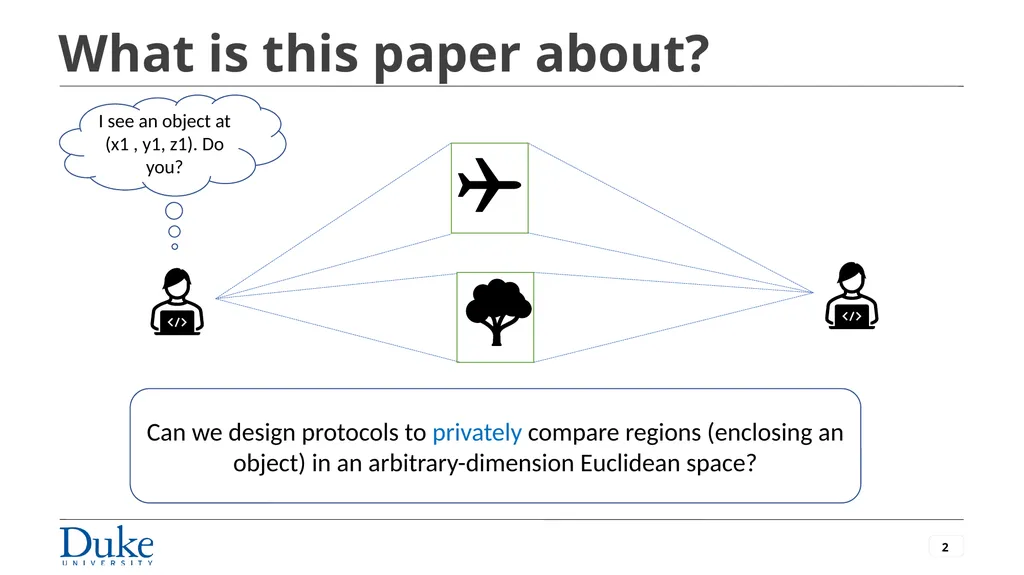
What is this paper about? I see an object at (x1 , y1, z1). Do you? Can we design protocols to privately compare regions (enclosing an object) in an arbitrary-dimension Euclidean space?<br>
03
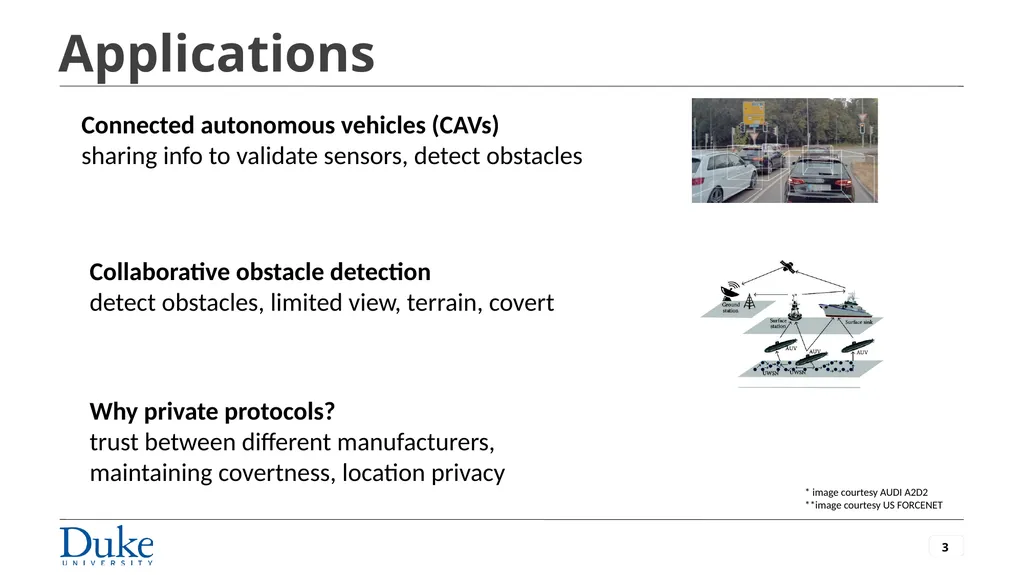
Applications Connected autonomous vehicles (CAVs)
sharing info to validate sensors, detect obstacles Collaborative obstacle detection
detect obstacles, limited view, terrain, covert * image courtesy AUDI A2D2
**image courtesy US FORCENET Why private protocols?
trust between different manufacturers,
maintaining covertness, location privacy<br>
04
Problem setting<br>
05
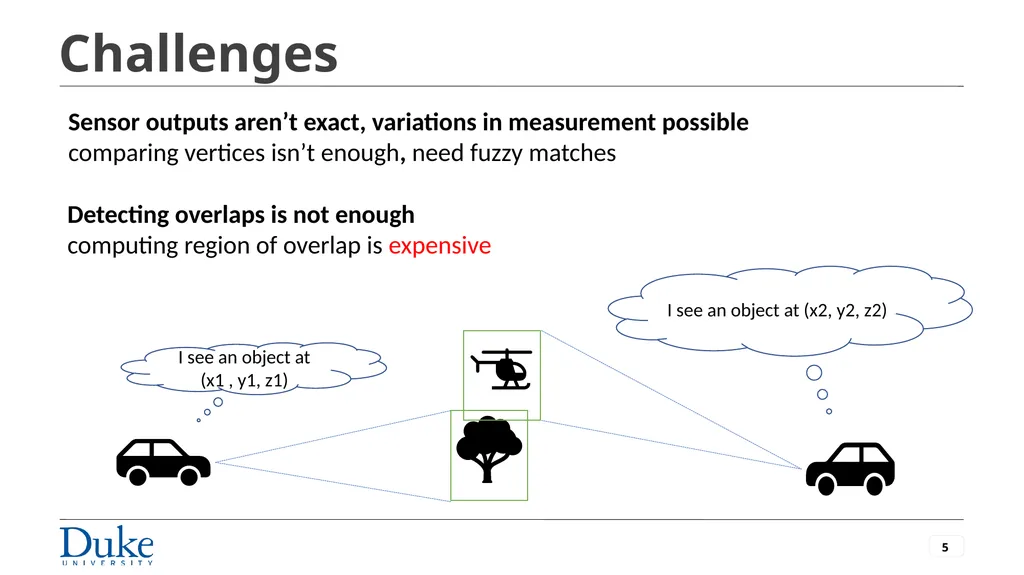
Challenges Sensor outputs aren’t exact, variations in measurement possible
comparing vertices isn’t enough, need fuzzy matches Detecting overlaps is not enough
computing region of overlap is expensive I see an object at (x1 , y1, z1) I see an object at (x2, y2, z2)<br>
06
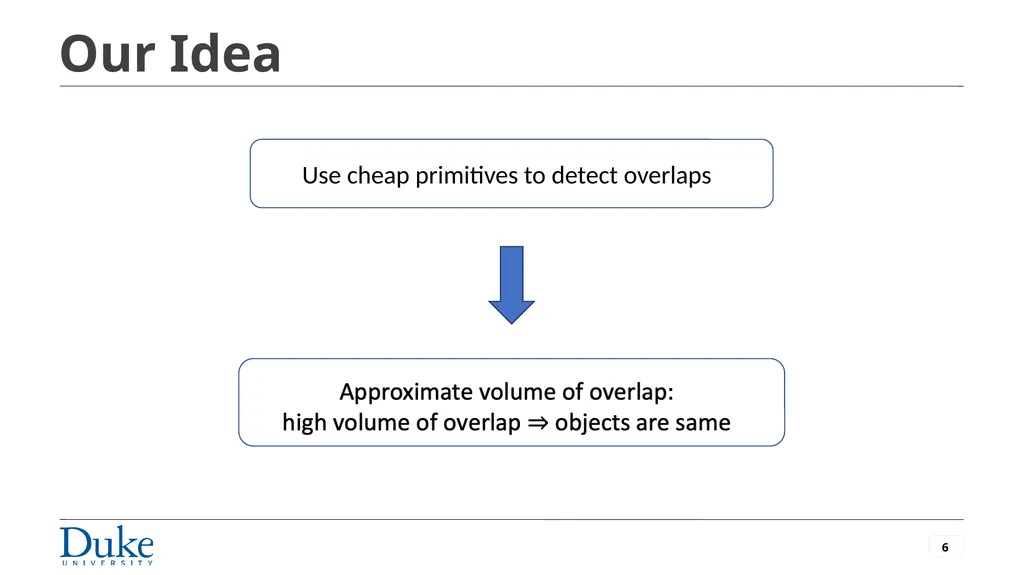
Our Idea Use cheap primitives to detect overlaps<br>
07
Existing works do not scale Cryptographic matching (exact/fuzzy)
designed for point comparisons: scale to large (infinite) sets of points?
Secure computation geometry [Atallah & Du, 2001]
limited research, expensive primitives, 2D applications common
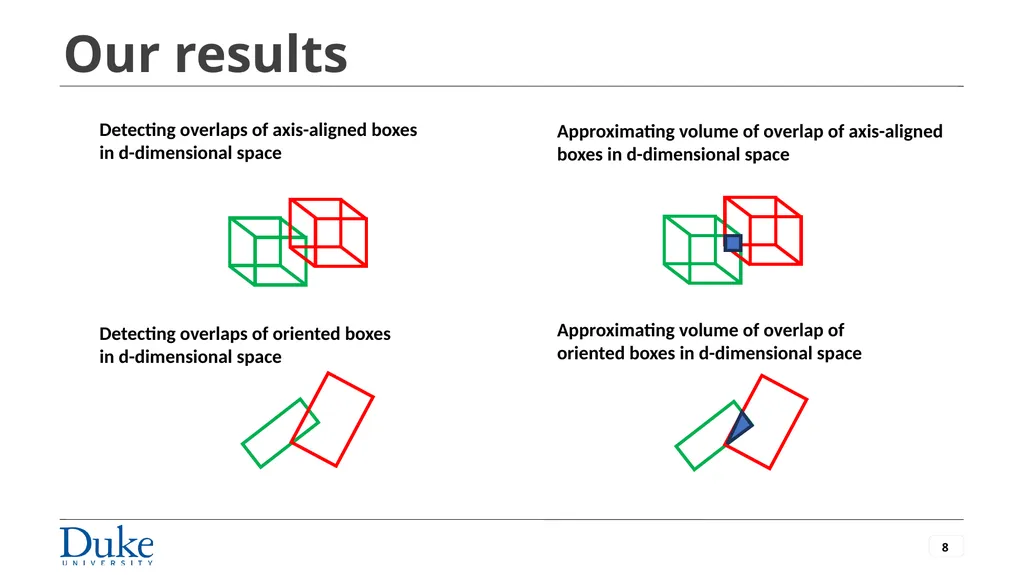
Approximating volume of overlap of axis-aligned boxes in d-dimensional space Approximating volume of overlap of
oriented boxes in d-dimensional space Detecting overlaps of oriented boxes
in d-dimensional space Detecting overlaps of axis-aligned boxes
in d-dimensional space Our results<br>
09
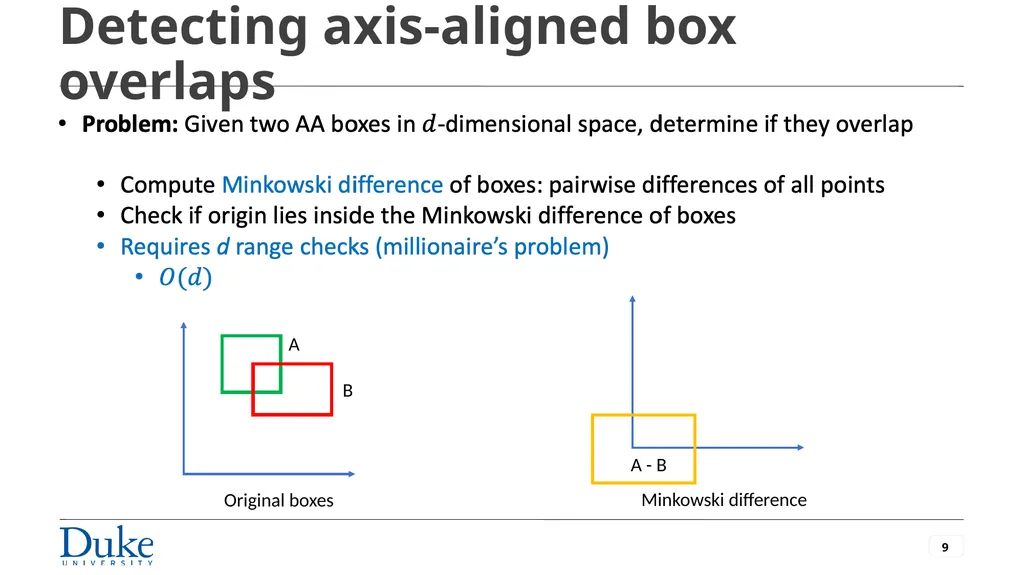
Detecting axis-aligned box overlaps Original boxes Minkowski difference A B A - B<br>
10
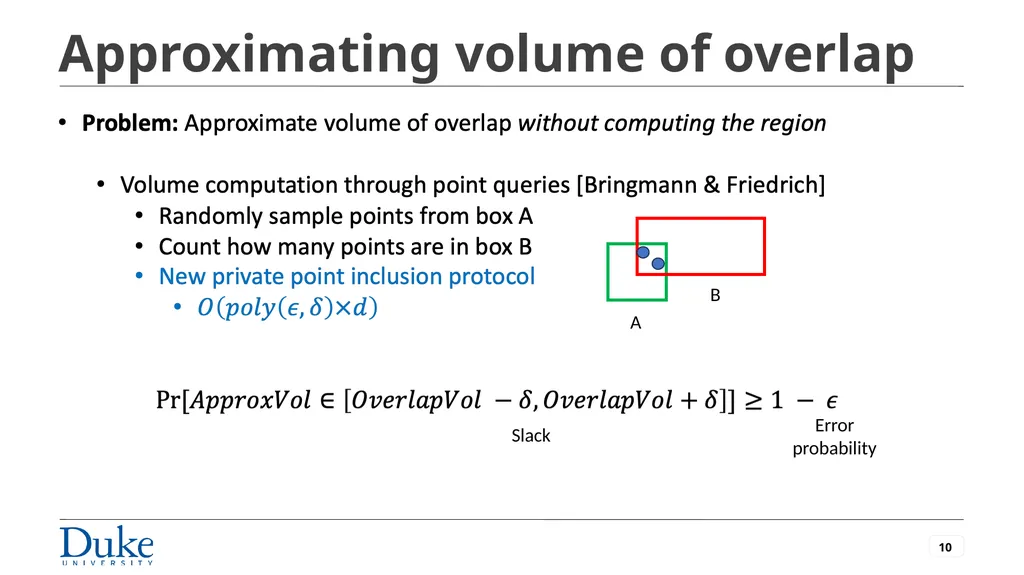
Approximating volume of overlap Slack Error probability A B<br>
11
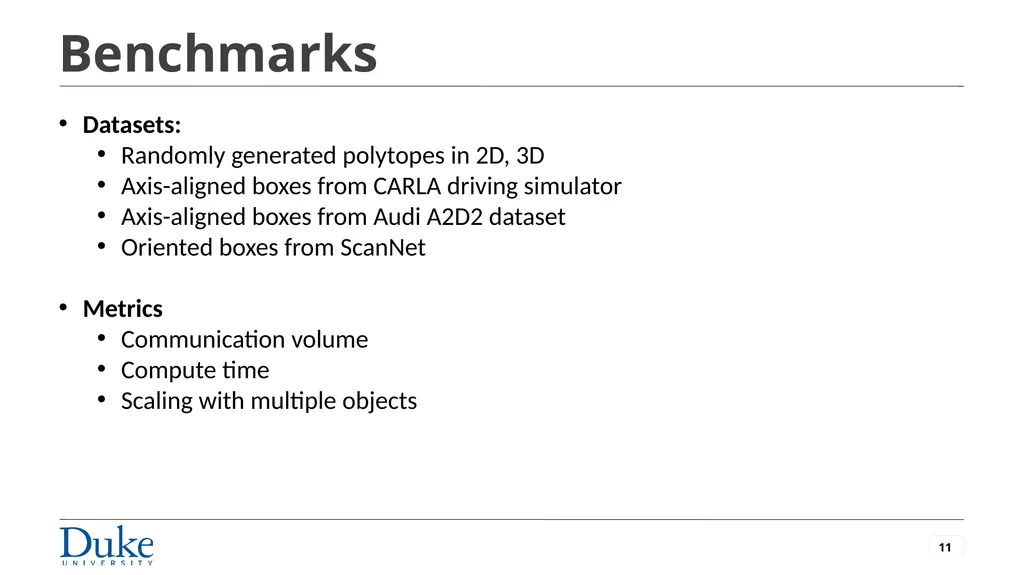
Benchmarks Datasets:
Randomly generated polytopes in 2D, 3D
Axis-aligned boxes from CARLA driving simulator
Axis-aligned boxes from Audi A2D2 dataset
Oriented boxes from ScanNet
Metrics
Communication volume
Compute time
Scaling with multiple objects<br>
12
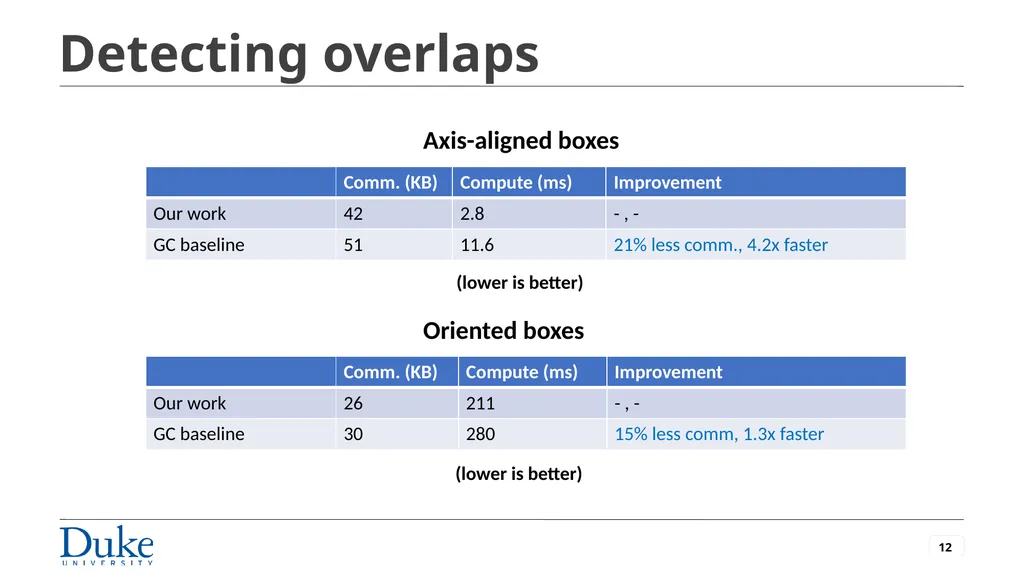
Detecting overlaps Axis-aligned boxes Oriented boxes (lower is better) (lower is better)<br>
13
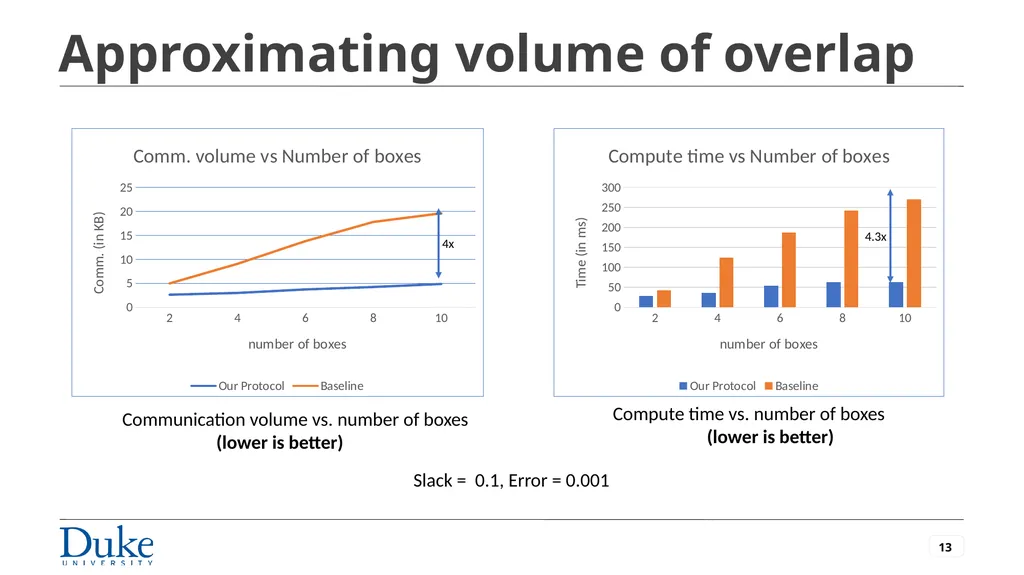
Approximating volume of overlap 4x 4.3x Slack = 0.1, Error = 0.001 Communication volume vs. number of boxes
(lower is better) Compute time vs. number of boxes
(lower is better)<br>
14
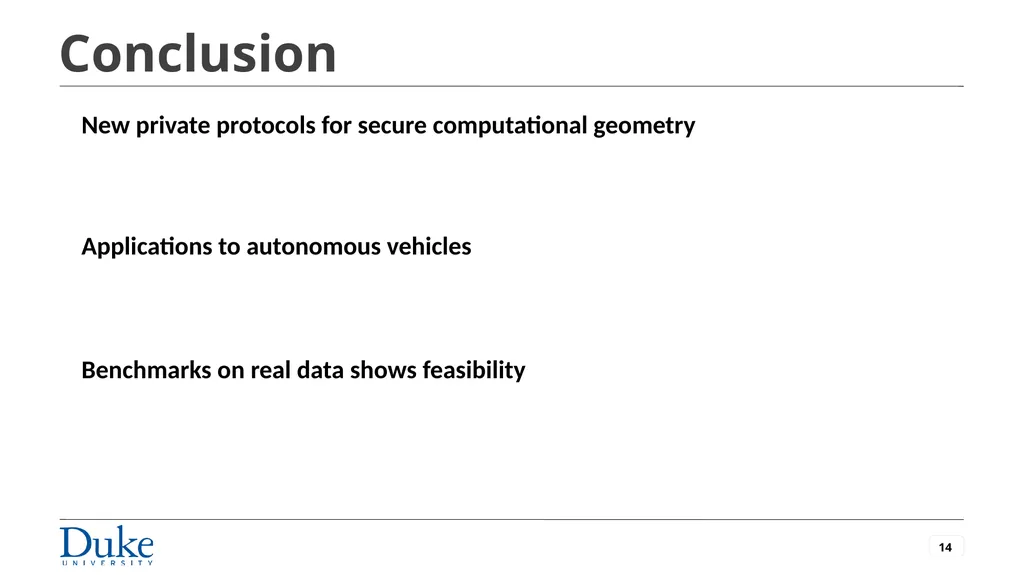
Conclusion New private protocols for secure computational geometry Applications to autonomous vehicles Benchmarks on real data shows feasibility<br>
15
Thank you<br>
16
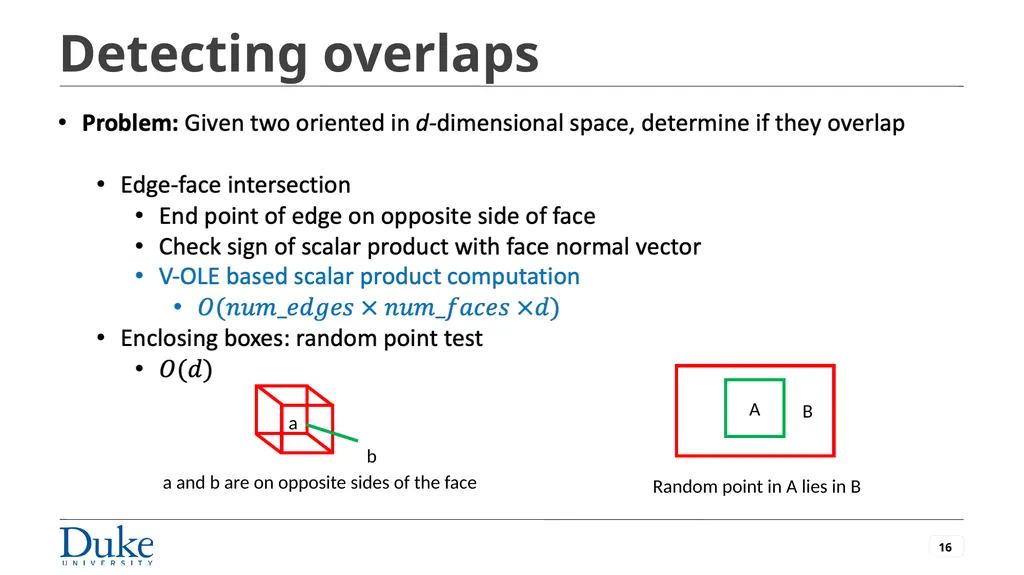
Detecting overlaps b a a and b are on opposite sides of the face A B Random point in A lies in B<br>
17
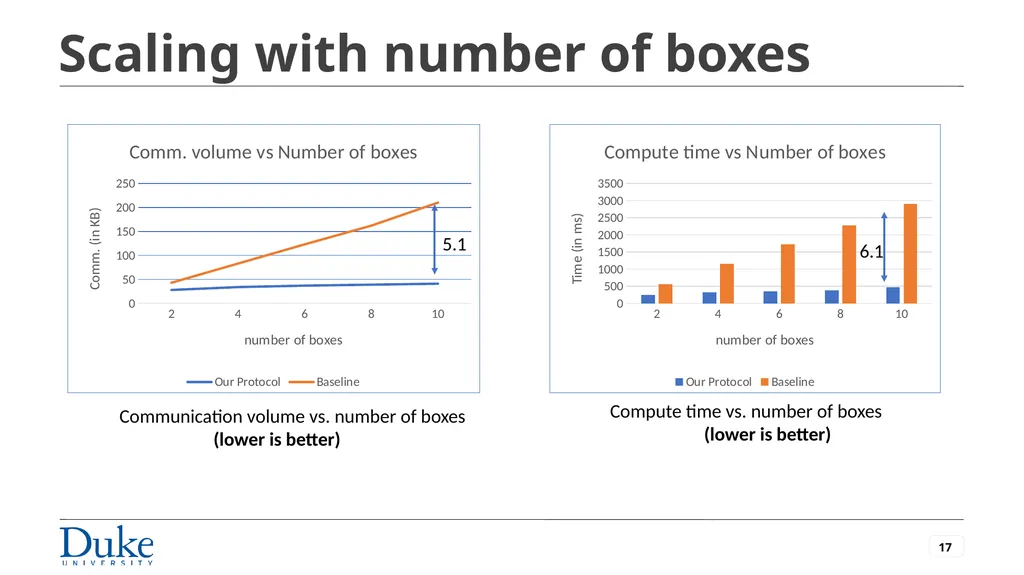
Scaling with number of boxes 5.1 6.1 Communication volume vs. number of boxes
(lower is better) Compute time vs. number of boxes
(lower is better)<br>