
Probability How likely something is to happen.


Description: Probability How likely something is to happen. Many events cant be predicted with total certainty. The best we can say is how likely they are to happen, using the idea of probability. Tossing a Coin When a coin is tossed, there are two
Related Topics
Download Presentation
"Probability How likely something is to happen." is the property of its rightful owner. Permission is granted to download and print the materials on this website for personal, non-commercial use only, and to display it on your personal computer provided you do not modify the materials and that you retain all copyright notices contained in the materials. By downloading content from our website, you accept the terms of this agreement.
Presentation Transcript
slide1. Probability
How likely something is to happen.
Many events can't be predicted with total certainty. The best we can say is how likely they are to happen, using the idea of probability.<br>
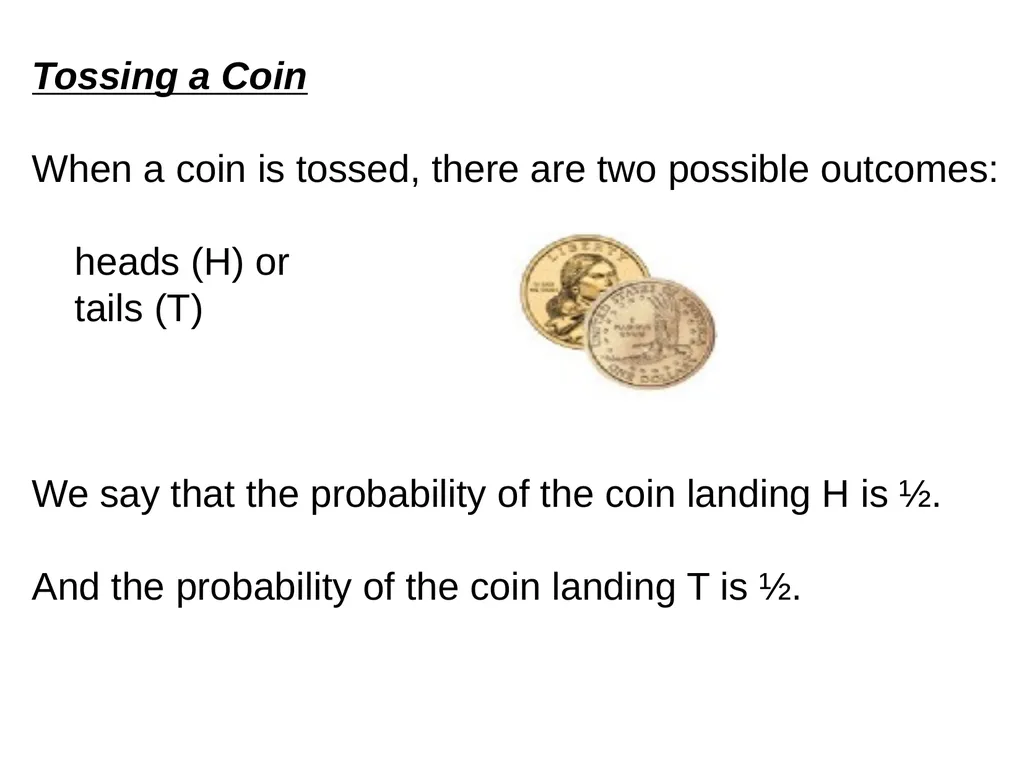
slide2. Tossing a Coin
When a coin is tossed, there are two possible outcomes:
heads (H) or
tails (T)
We say that the probability of the coin landing H is ½.
And the probability of the coin landing T is ½.<br>
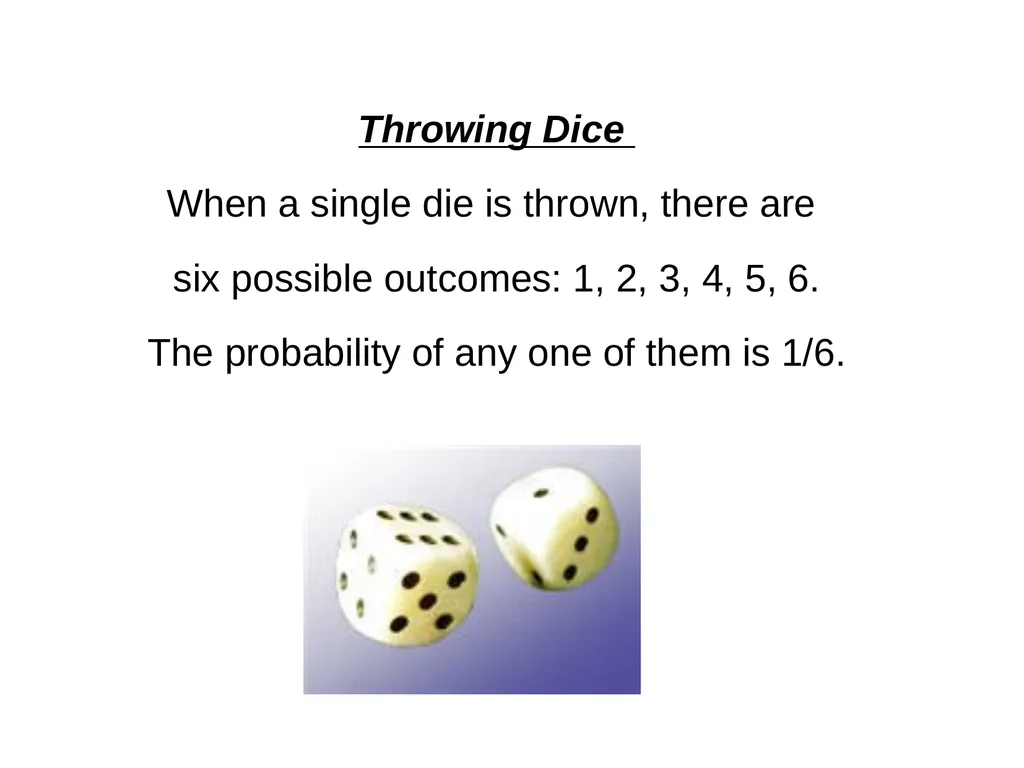
slide3. Throwing Dice
When a single die is thrown, there are
six possible outcomes: 1, 2, 3, 4, 5, 6.
The probability of any one of them is 1/6.<br>
slide4. Probability
In general:
Probability of an event happening = Number of ways it can happen
Total number of outcomes
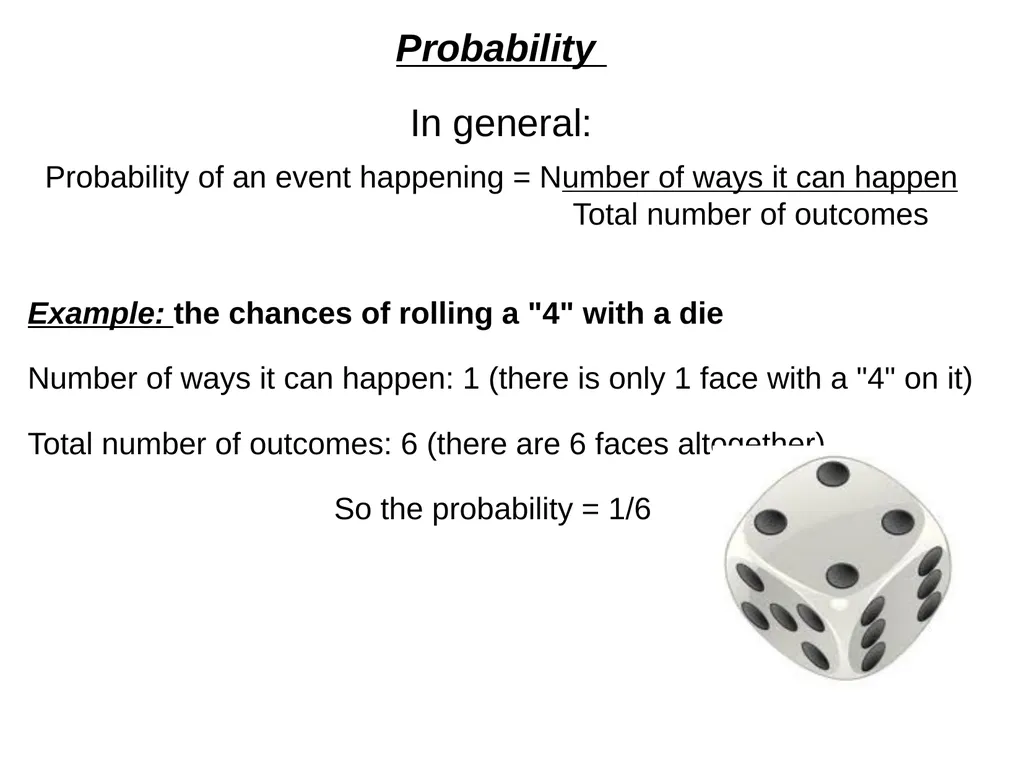
Example: the chances of rolling a "4" with a die
Number of ways it can happen: 1 (there is only 1 face with a "4" on it)
Total number of outcomes: 6 (there are 6 faces altogether)
So the probability = 1/6<br>
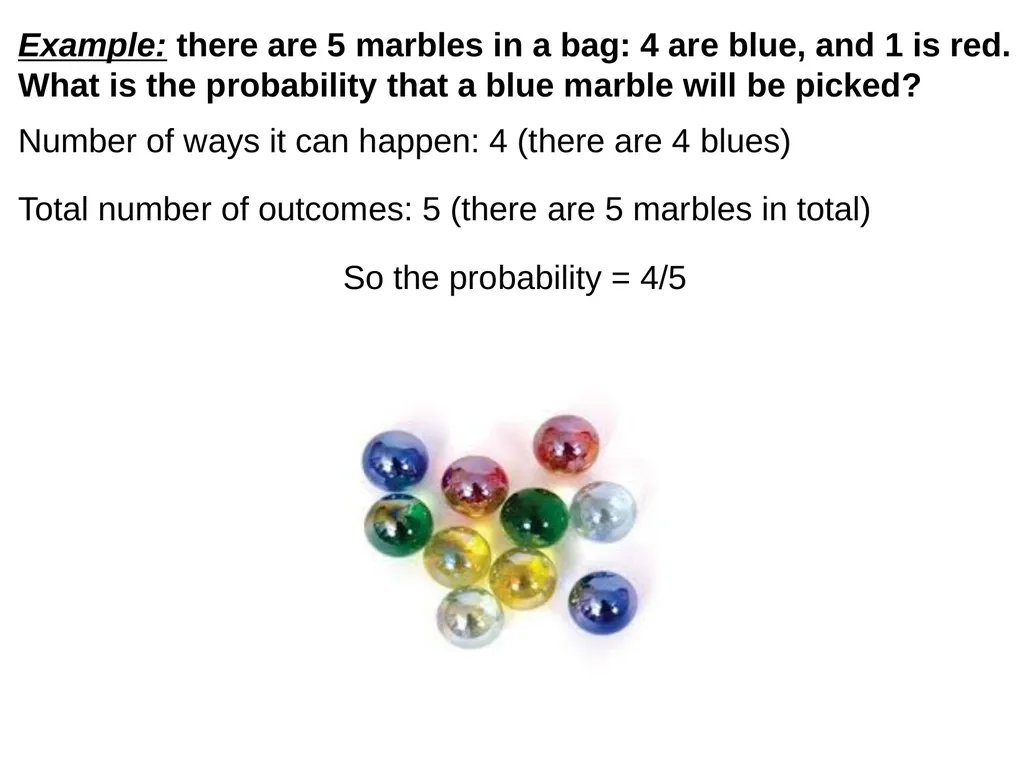
slide5. Example: there are 5 marbles in a bag: 4 are blue, and 1 is red.
What is the probability that a blue marble will be picked?
Number of ways it can happen: 4 (there are 4 blues)
Total number of outcomes: 5 (there are 5 marbles in total)
So the probability = 4/5<br>
slide6. Probability Line
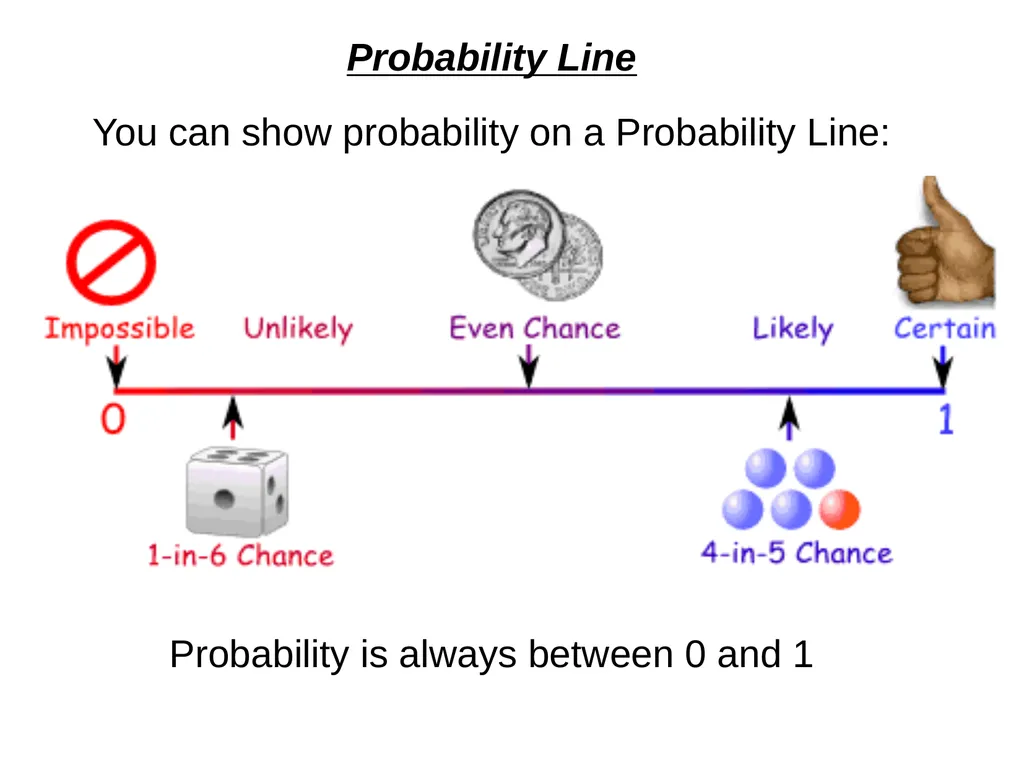
You can show probability on a Probability Line:
Probability is always between 0 and 1<br>
slide7. Probability is Just a Guide
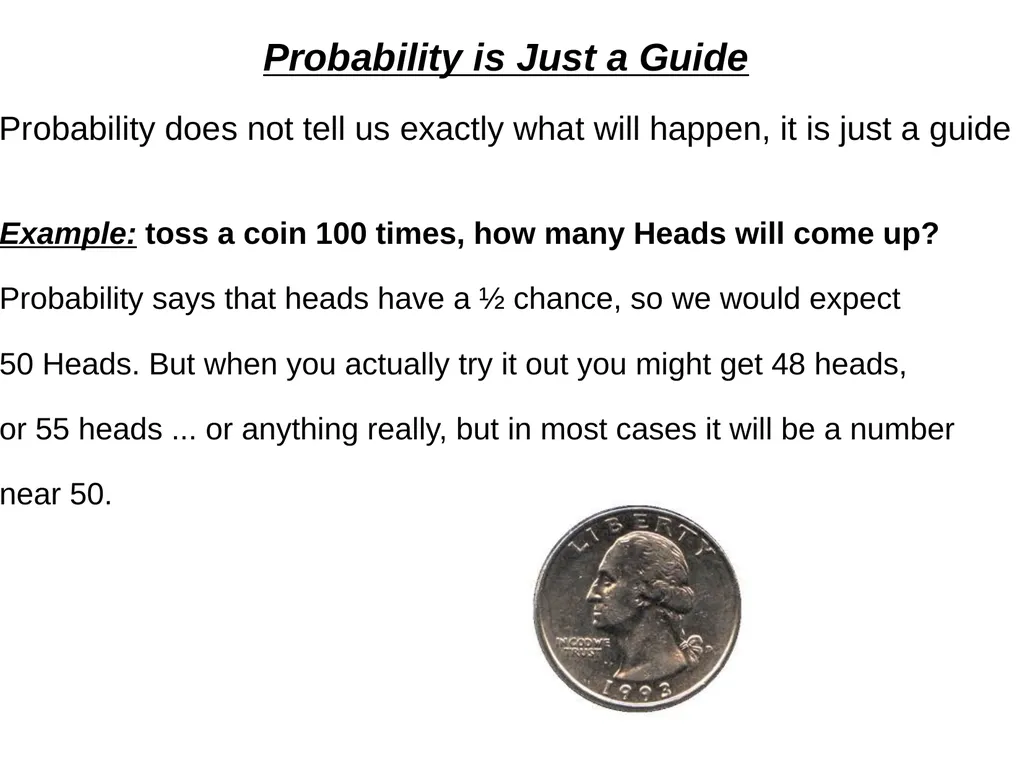
Probability does not tell us exactly what will happen, it is just a guide
Example: toss a coin 100 times, how many Heads will come up?
Probability says that heads have a ½ chance, so we would expect
50 Heads. But when you actually try it out you might get 48 heads,
or 55 heads ... or anything really, but in most cases it will be a number
near 50.<br>
slide8. Terminology
Some words have special meaning in Probability:
Experiment or Trial: an action where the result is uncertain.
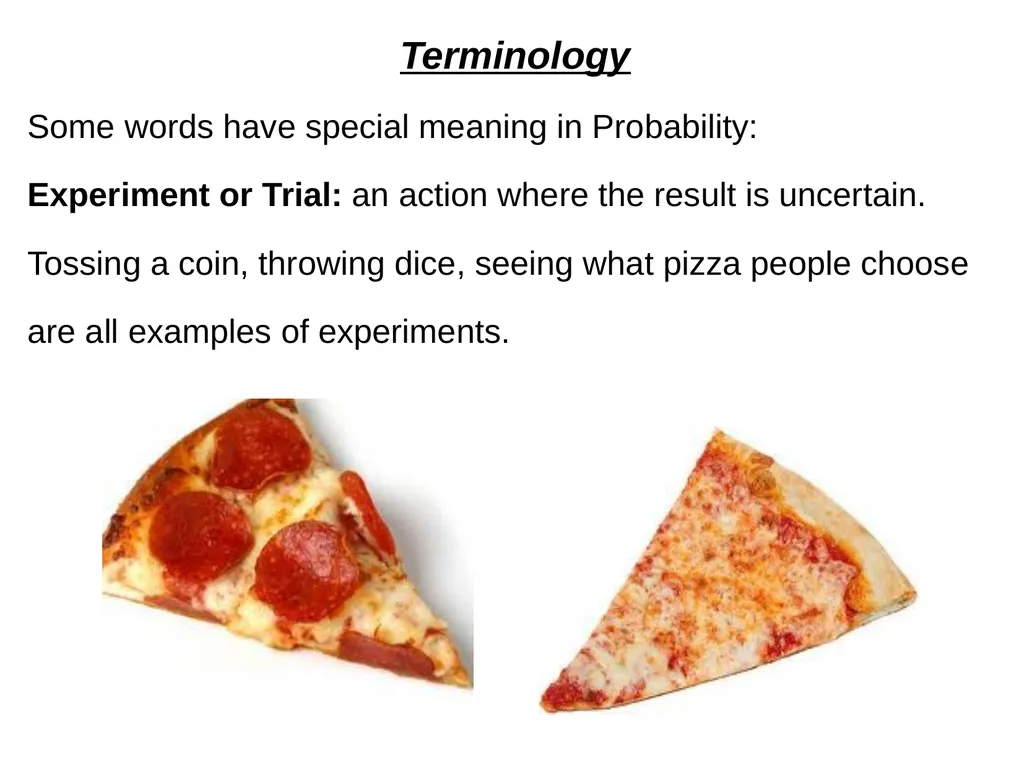
Tossing a coin, throwing dice, seeing what pizza people choose
are all examples of experiments.<br>
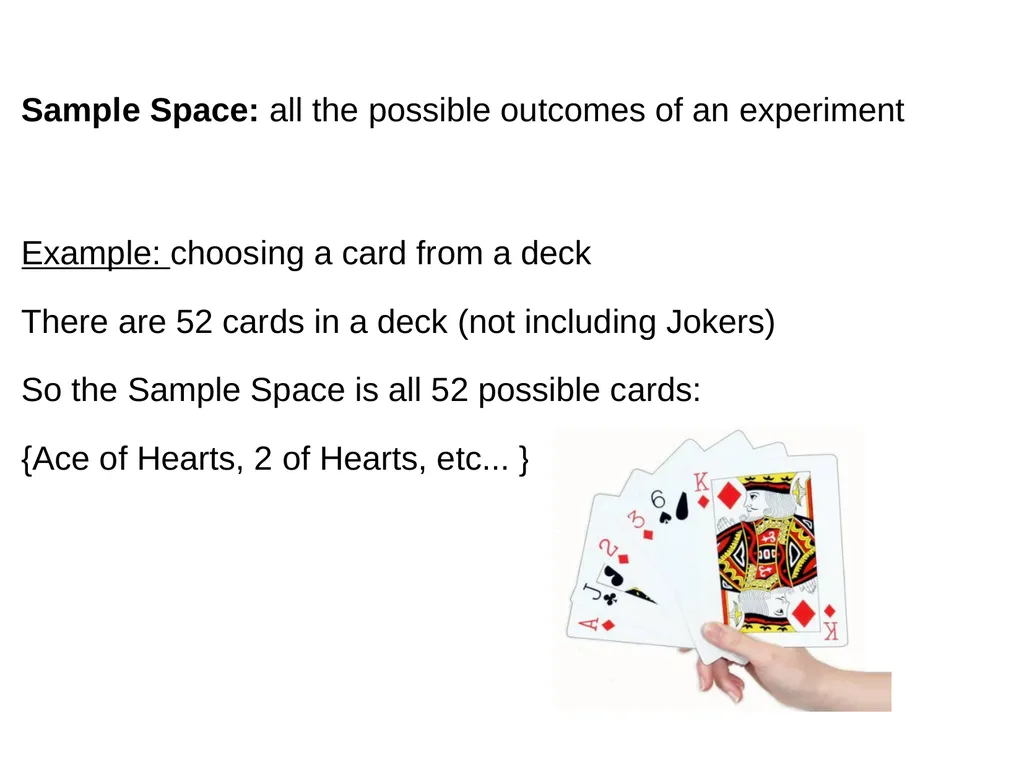
slide9. Sample Space: all the possible outcomes of an experiment
Example: choosing a card from a deck
There are 52 cards in a deck (not including Jokers)
So the Sample Space is all 52 possible cards:
{Ace of Hearts, 2 of Hearts, etc... }<br>
slide10. The Sample Space is made up of Sample Points:
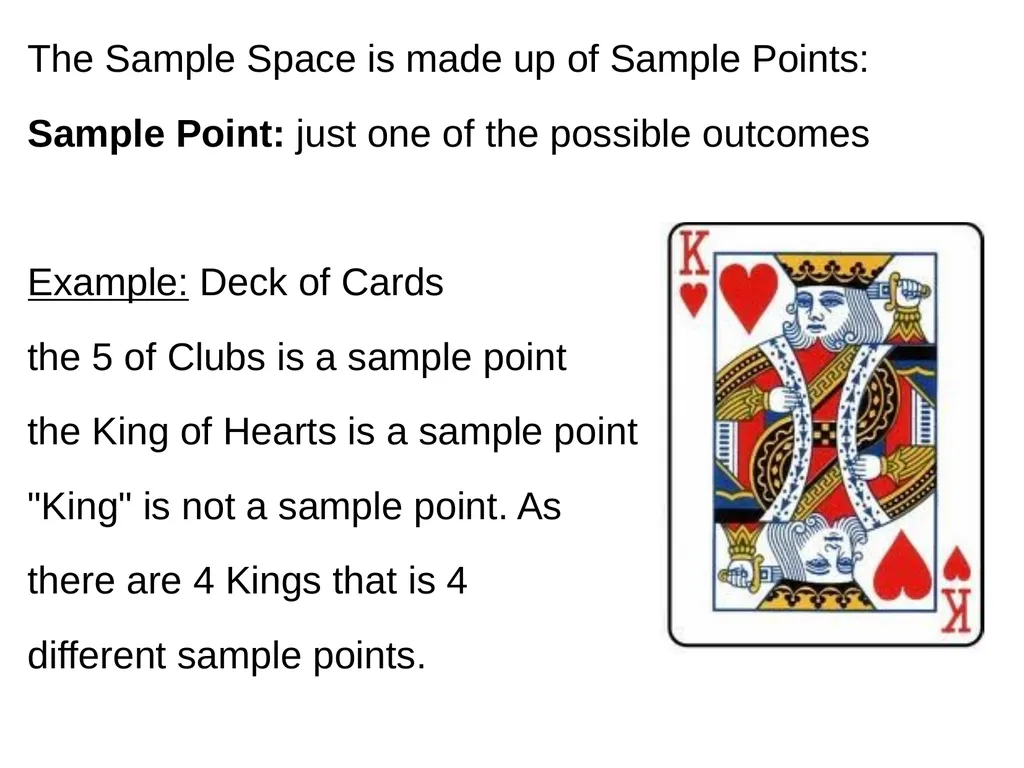
Sample Point: just one of the possible outcomes
Example: Deck of Cards
the 5 of Clubs is a sample point
the King of Hearts is a sample point
"King" is not a sample point. As
there are 4 Kings that is 4
different sample points.<br>
slide11. Event: a single result of an experiment
Example Events:
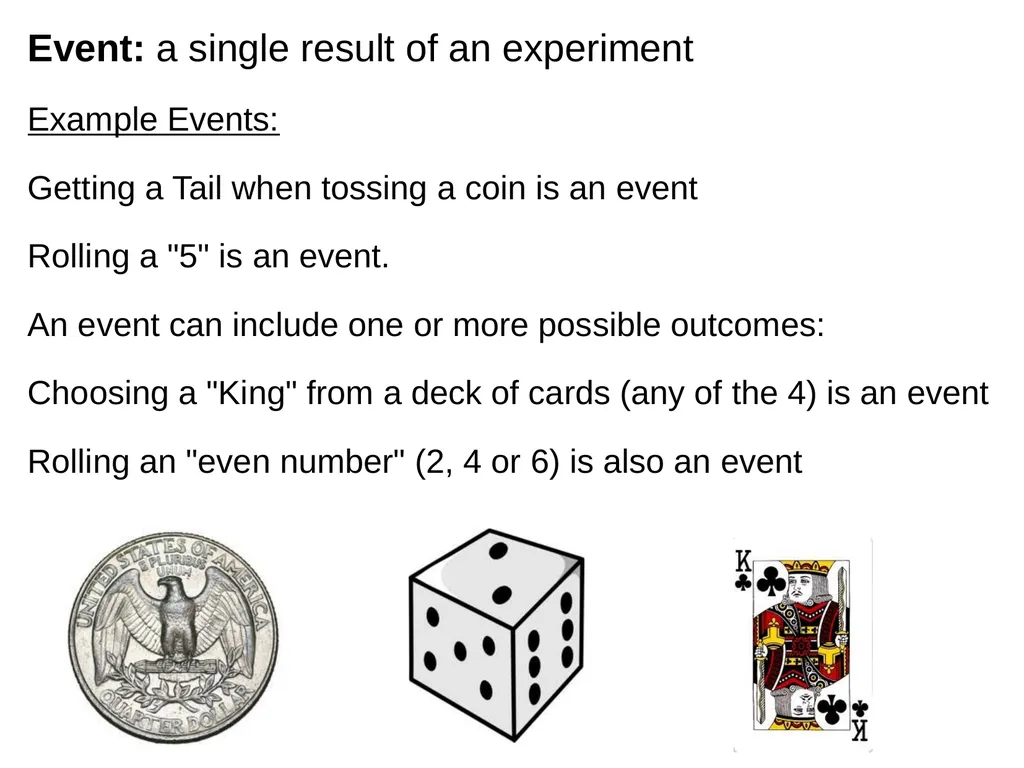
Getting a Tail when tossing a coin is an event
Rolling a "5" is an event.
An event can include one or more possible outcomes:
Choosing a "King" from a deck of cards (any of the 4) is an event
Rolling an "even number" (2, 4 or 6) is also an event<br>
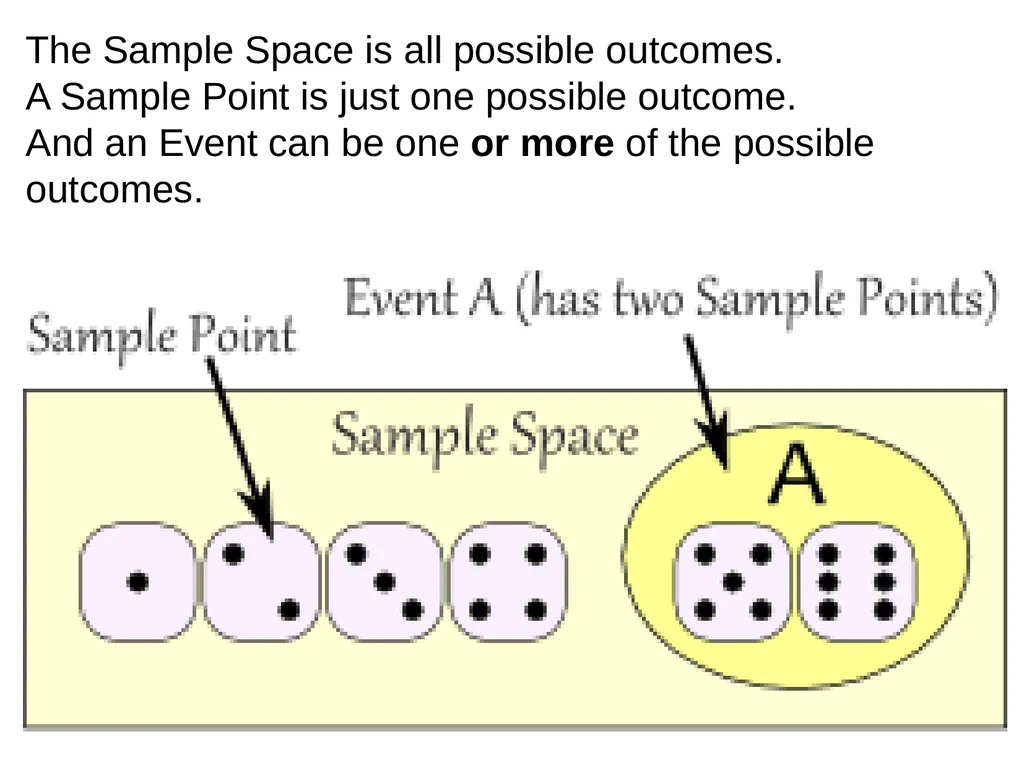
slide12. The Sample Space is all possible outcomes.
A Sample Point is just one possible outcome.
And an Event can be one or more of the possible outcomes.<br>
slide13. Mutually Exclusive
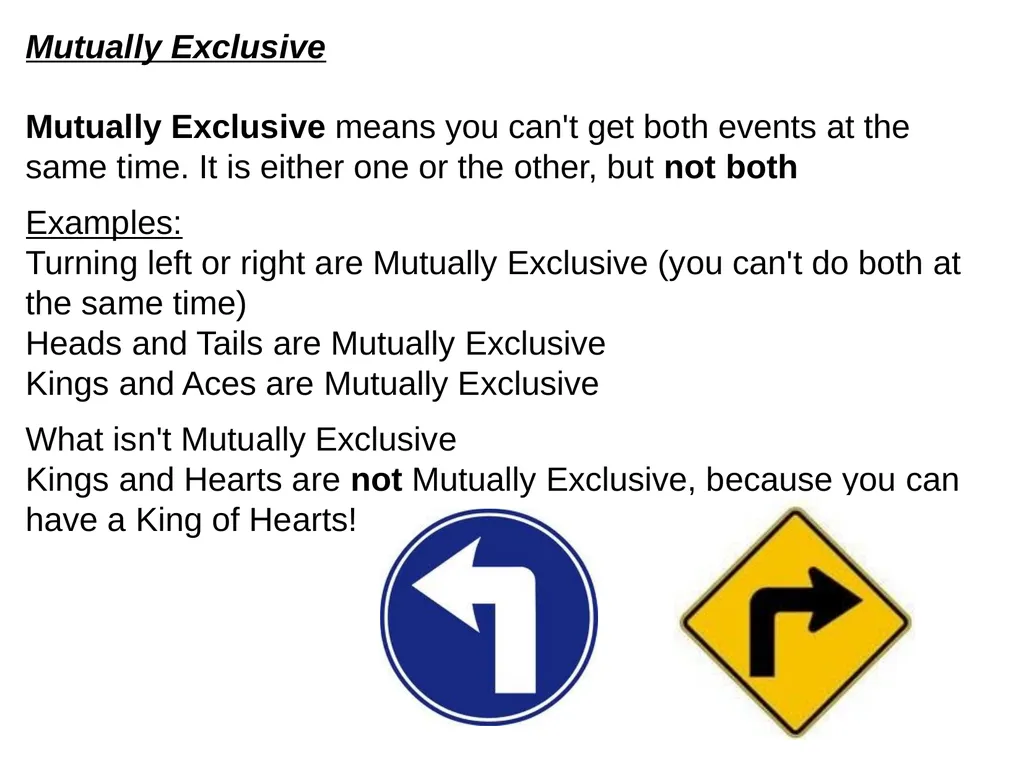
Mutually Exclusive means you can't get both events at the same time. It is either one or the other, but not both
Examples:
Turning left or right are Mutually Exclusive (you can't do both at the same time)
Heads and Tails are Mutually Exclusive
Kings and Aces are Mutually Exclusive
What isn't Mutually Exclusive
Kings and Hearts are not Mutually Exclusive, because you can have a King of Hearts!<br>
slide14. Probability: Complement
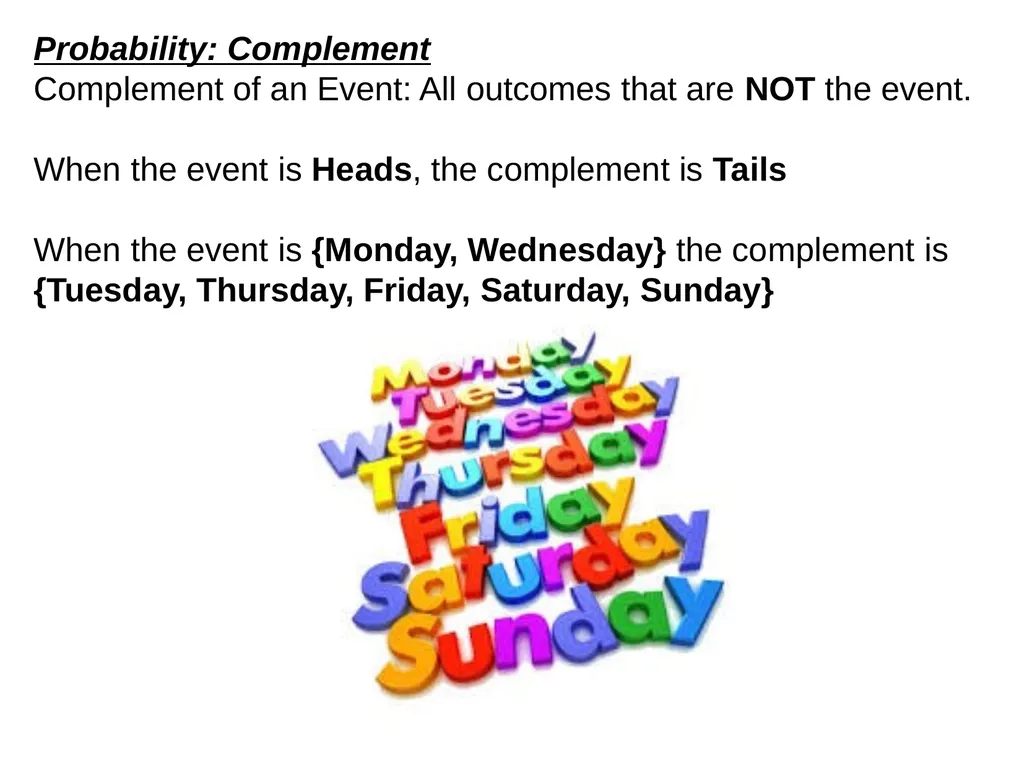
Complement of an Event: All outcomes that are NOT the event.
When the event is Heads, the complement is Tails
When the event is {Monday, Wednesday} the complement is {Tuesday, Thursday, Friday, Saturday, Sunday}<br>
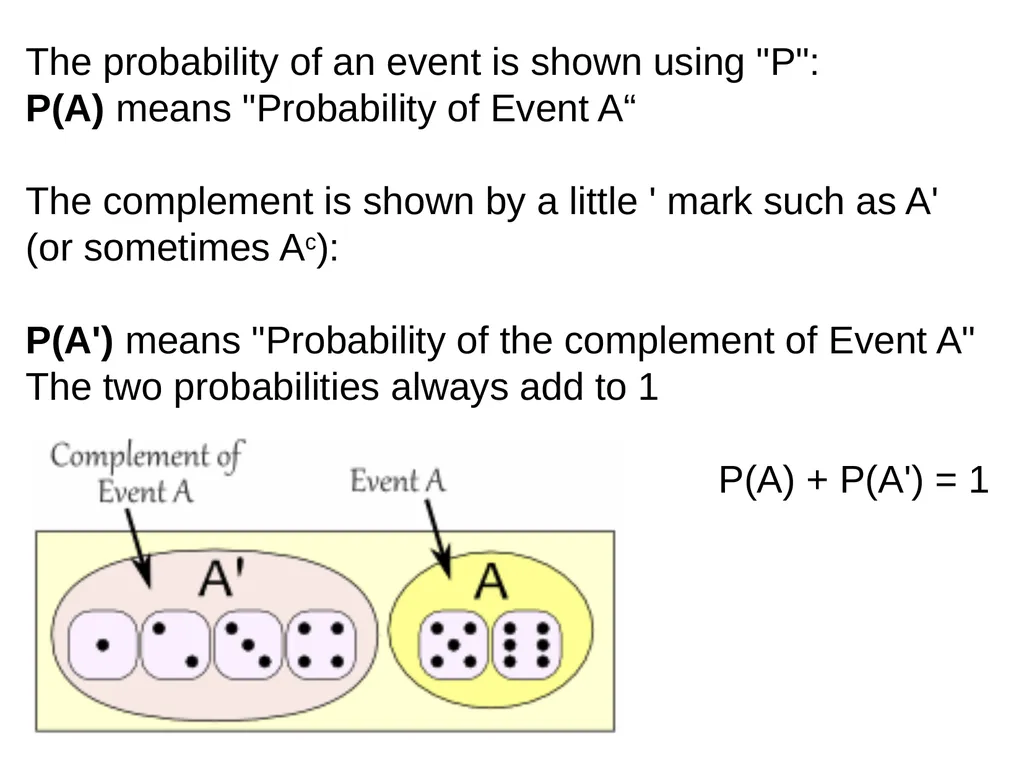
slide15. The probability of an event is shown using "P":
P(A) means "Probability of Event A“
The complement is shown by a little ' mark such as A' (or sometimes Ac):
P(A') means "Probability of the complement of Event A"
The two probabilities always add to 1
P(A) + P(A') = 1<br>
slide16. Independent Events
Events can be "Independent", meaning each event is not affected by any other events.
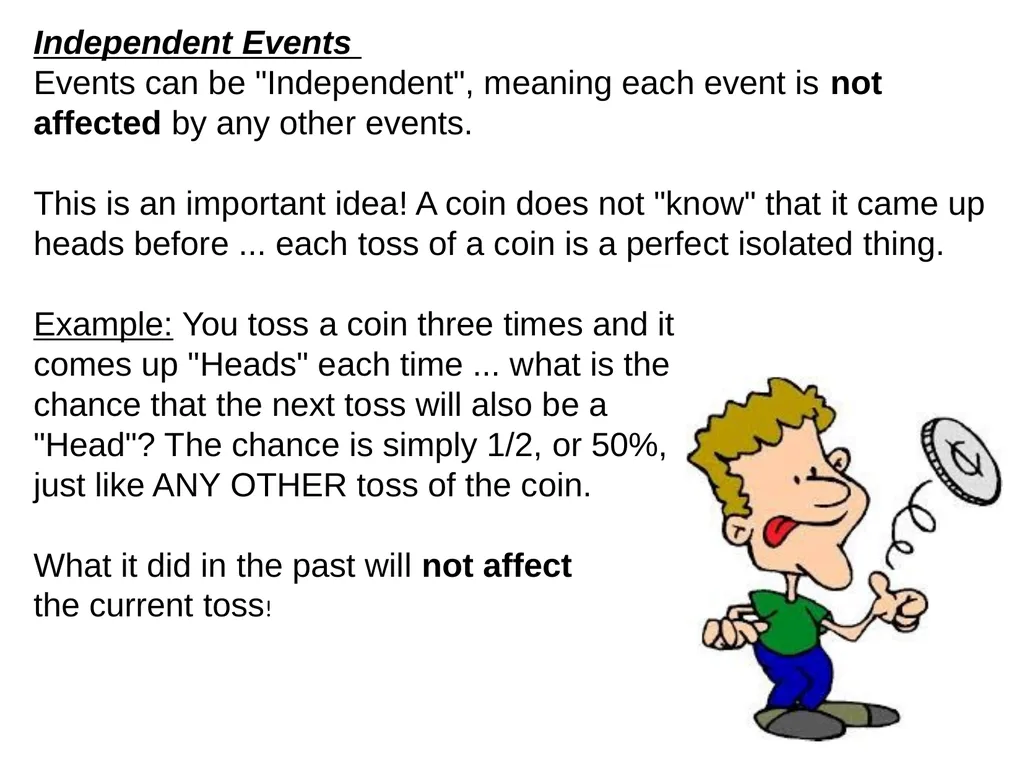
This is an important idea! A coin does not "know" that it came up heads before ... each toss of a coin is a perfect isolated thing.
Example: You toss a coin three times and it
comes up "Heads" each time ... what is the
chance that the next toss will also be a
"Head"? The chance is simply 1/2, or 50%,
just like ANY OTHER toss of the coin.
What it did in the past will not affect
the current toss!<br>
slide17. Dependent Events
But some events can be "dependent" ... which means they can be affected by previous events ...
Example: Drawing 2 Cards from a Deck
After taking one card from the deck there are less cards available, so the probabilities change!
Let's say you are interested in the chances of getting a King.
For the 1st card the chance of drawing a King is 4 out of 52
But for the 2nd card:
If the 1st card was a King, then the 2nd card is less likely to be a King, as only 3 of the 51 cards left are Kings.
If the 1st card was not a King, then the 2nd card is slightly more likely to be a King, as 4 of the 51 cards left are King.
This is because you are removing cards from the deck.<br>
slide18. Two or More Events
You can calculate the chances of two or more independent events by multiplying the chances.
So, for Independent Events:
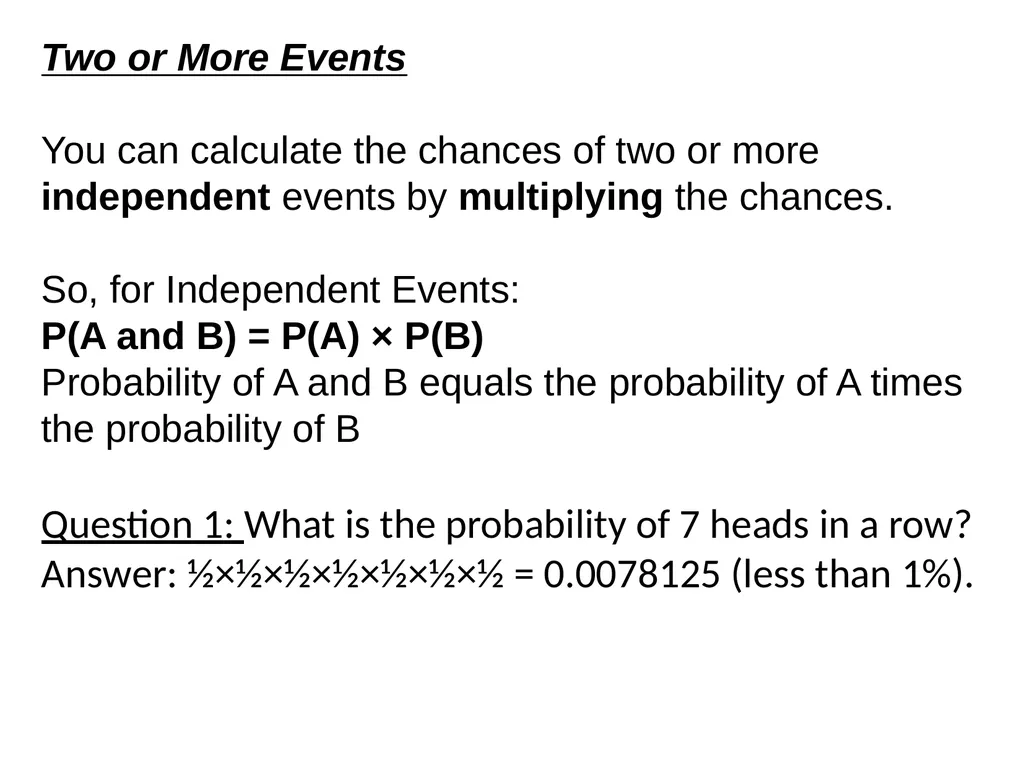
P(A and B) = P(A) × P(B)
Probability of A and B equals the probability of A times the probability of B
Question 1: What is the probability of 7 heads in a row?
Answer: ½×½×½×½×½×½×½ = 0.0078125 (less than 1%).<br>
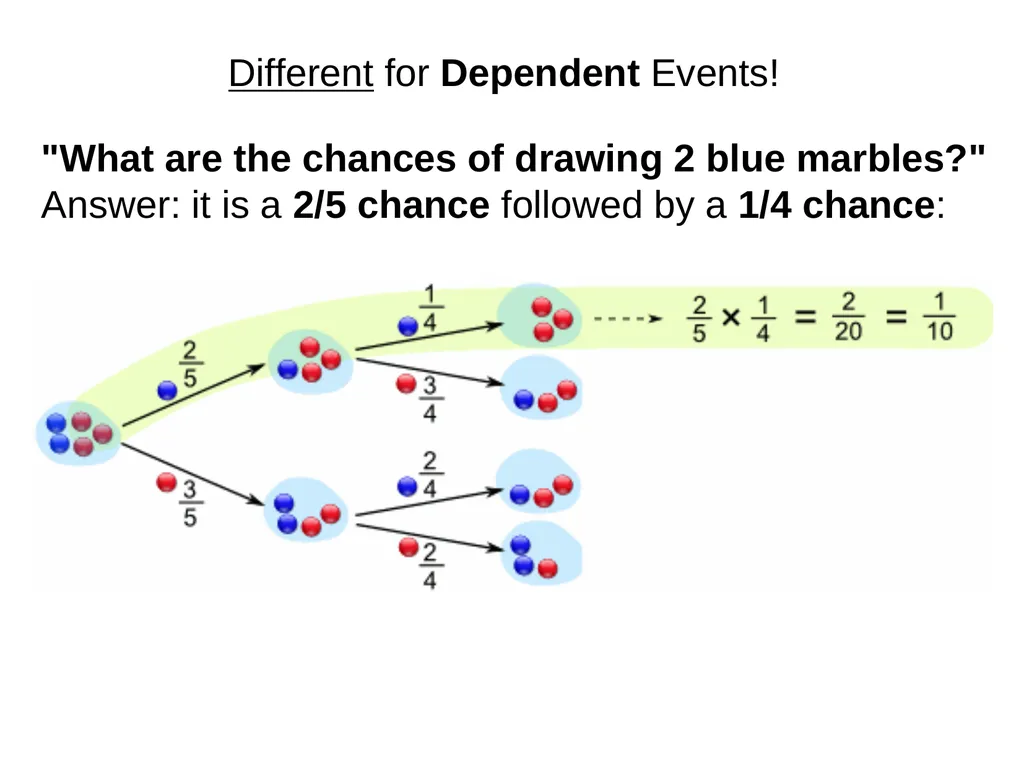
slide19. Different for Dependent Events! "What are the chances of drawing 2 blue marbles?"
Answer: it is a 2/5 chance followed by a 1/4 chance:<br>
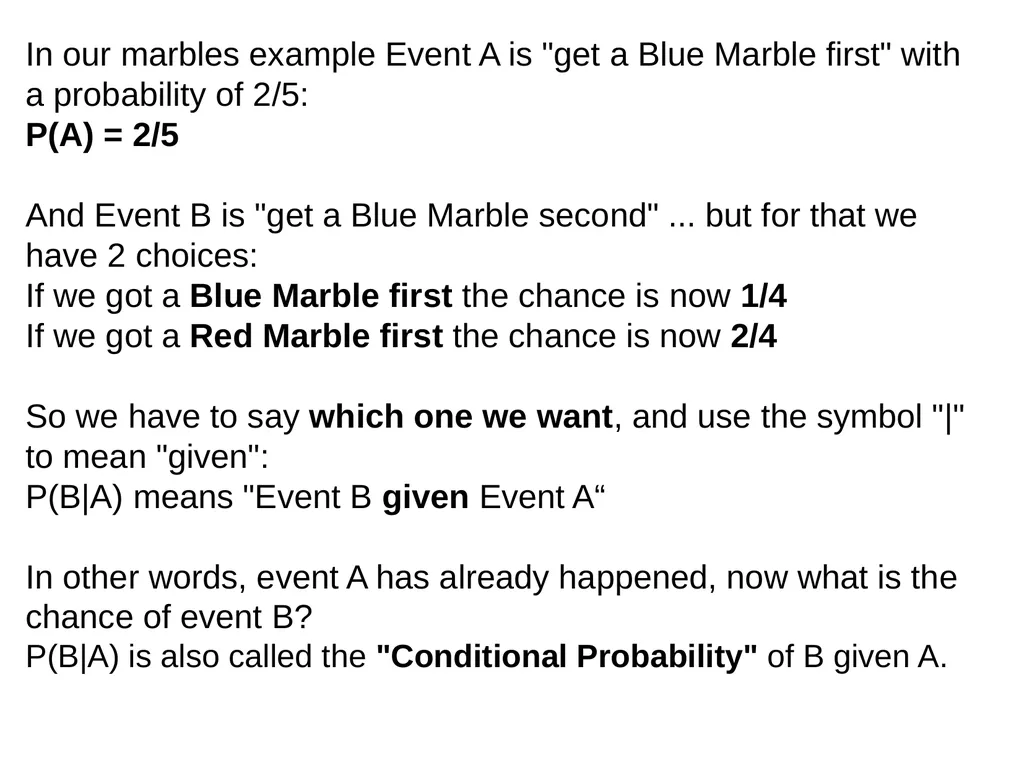
slide20. In our marbles example Event A is "get a Blue Marble first" with a probability of 2/5:
P(A) = 2/5
And Event B is "get a Blue Marble second" ... but for that we have 2 choices:
If we got a Blue Marble first the chance is now 1/4
If we got a Red Marble first the chance is now 2/4
So we have to say which one we want, and use the symbol "|" to mean "given":
P(B|A) means "Event B given Event A“
In other words, event A has already happened, now what is the chance of event B?
P(B|A) is also called the "Conditional Probability" of B given A.<br>
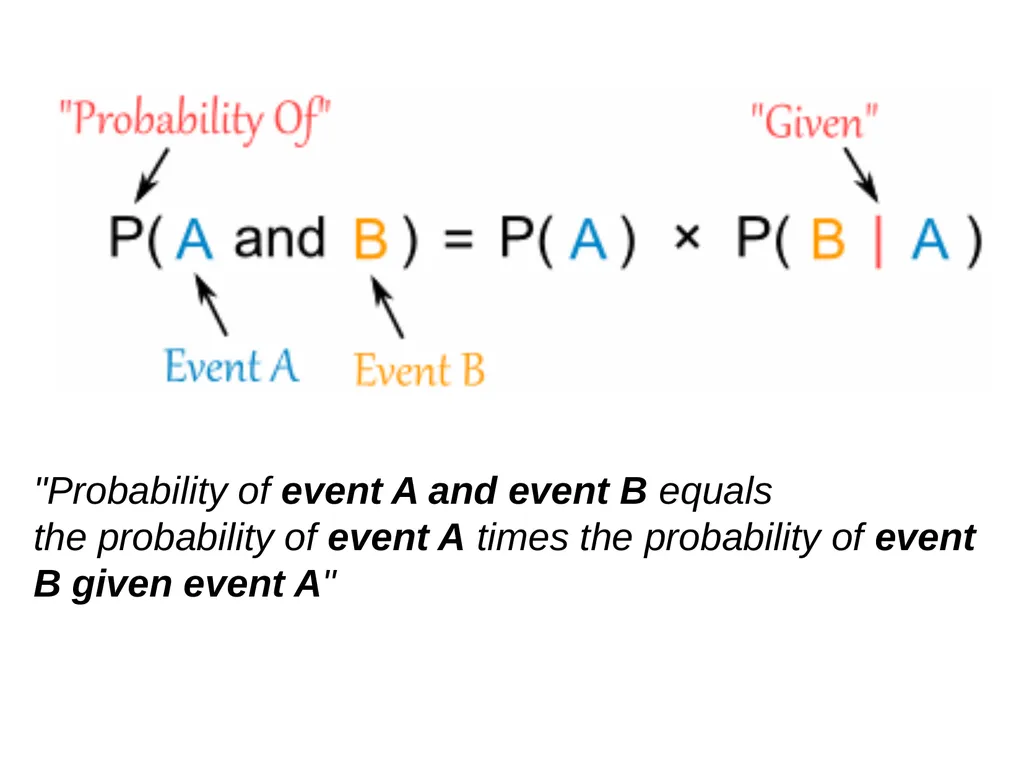
slide21. "Probability of event A and event B equals the probability of event A times the probability of event B given event A"<br>
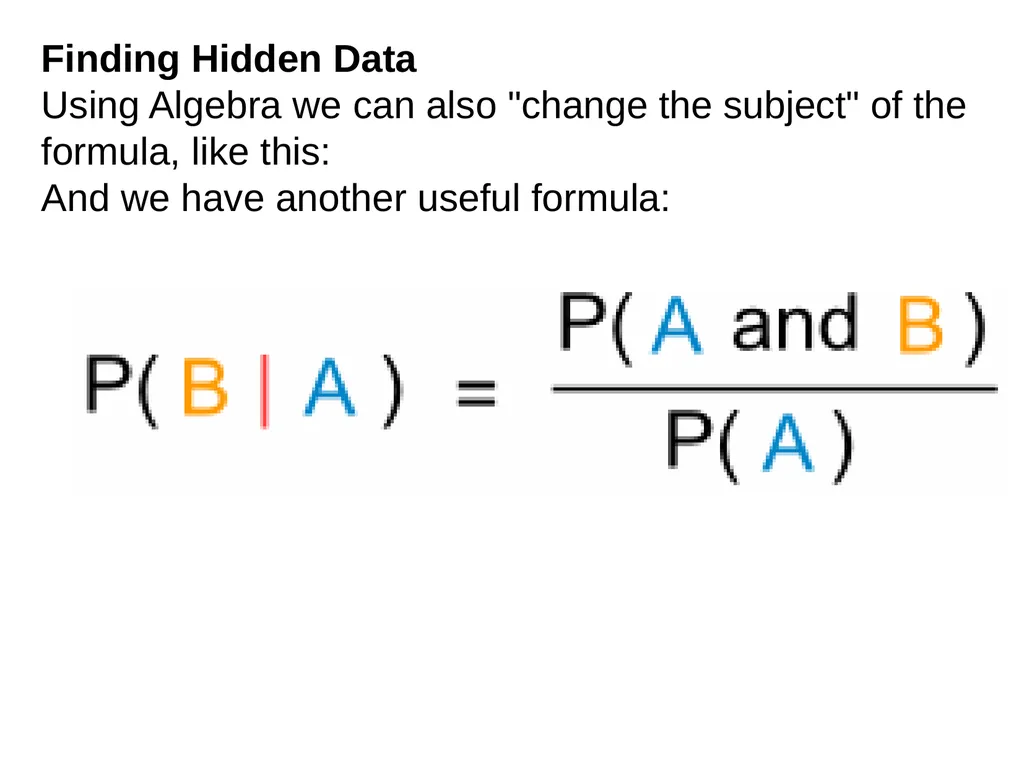
slide22. Finding Hidden Data
Using Algebra we can also "change the subject" of the formula, like this:
And we have another useful formula:<br>
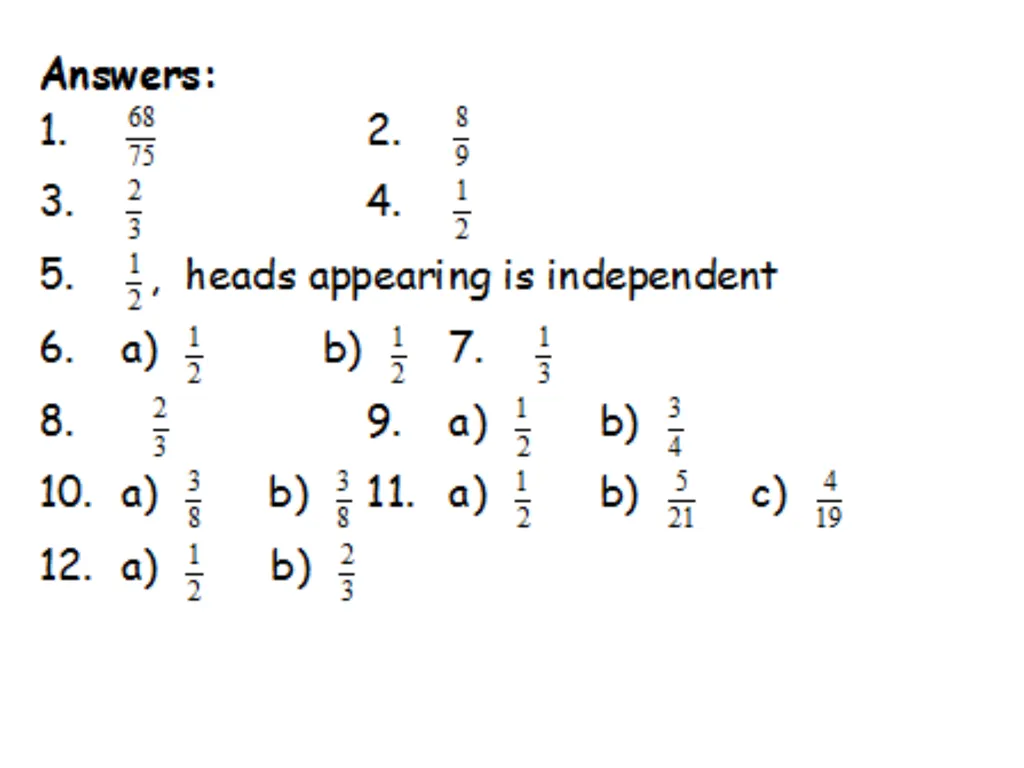
slide23. WORKSHEET
TIME!!!!<br>
slide25. http://www.youtube.com/watch?v=mhlc7peGlGg MONTY HALL!!<br>
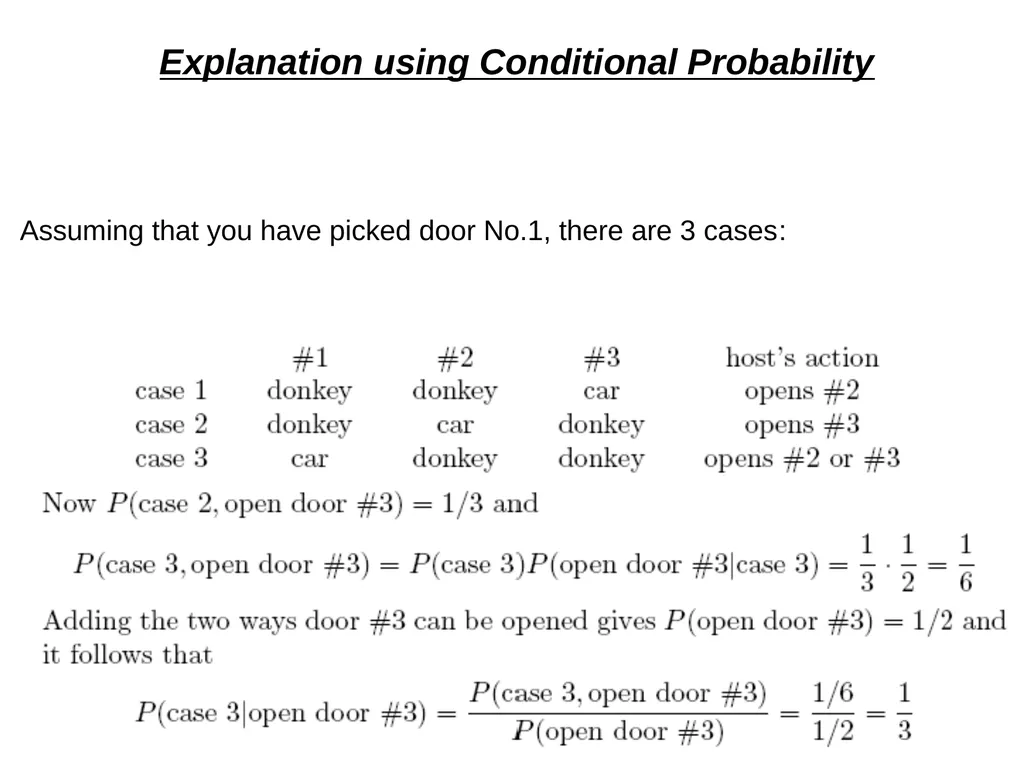
slide26. Explanation using Conditional Probability
Assuming that you have picked door No.1, there are 3 cases:<br>
slide27. Thanks for
Coming!!!<br>
How likely something is to happen.
Many events can't be predicted with total certainty. The best we can say is how likely they are to happen, using the idea of probability.<br>
slide2. Tossing a Coin
When a coin is tossed, there are two possible outcomes:
heads (H) or
tails (T)
We say that the probability of the coin landing H is ½.
And the probability of the coin landing T is ½.<br>
slide3. Throwing Dice
When a single die is thrown, there are
six possible outcomes: 1, 2, 3, 4, 5, 6.
The probability of any one of them is 1/6.<br>
slide4. Probability
In general:
Probability of an event happening = Number of ways it can happen
Total number of outcomes
Example: the chances of rolling a "4" with a die
Number of ways it can happen: 1 (there is only 1 face with a "4" on it)
Total number of outcomes: 6 (there are 6 faces altogether)
So the probability = 1/6<br>
slide5. Example: there are 5 marbles in a bag: 4 are blue, and 1 is red.
What is the probability that a blue marble will be picked?
Number of ways it can happen: 4 (there are 4 blues)
Total number of outcomes: 5 (there are 5 marbles in total)
So the probability = 4/5<br>
slide6. Probability Line
You can show probability on a Probability Line:
Probability is always between 0 and 1<br>
slide7. Probability is Just a Guide
Probability does not tell us exactly what will happen, it is just a guide
Example: toss a coin 100 times, how many Heads will come up?
Probability says that heads have a ½ chance, so we would expect
50 Heads. But when you actually try it out you might get 48 heads,
or 55 heads ... or anything really, but in most cases it will be a number
near 50.<br>
slide8. Terminology
Some words have special meaning in Probability:
Experiment or Trial: an action where the result is uncertain.
Tossing a coin, throwing dice, seeing what pizza people choose
are all examples of experiments.<br>
slide9. Sample Space: all the possible outcomes of an experiment
Example: choosing a card from a deck
There are 52 cards in a deck (not including Jokers)
So the Sample Space is all 52 possible cards:
{Ace of Hearts, 2 of Hearts, etc... }<br>
slide10. The Sample Space is made up of Sample Points:
Sample Point: just one of the possible outcomes
Example: Deck of Cards
the 5 of Clubs is a sample point
the King of Hearts is a sample point
"King" is not a sample point. As
there are 4 Kings that is 4
different sample points.<br>
slide11. Event: a single result of an experiment
Example Events:
Getting a Tail when tossing a coin is an event
Rolling a "5" is an event.
An event can include one or more possible outcomes:
Choosing a "King" from a deck of cards (any of the 4) is an event
Rolling an "even number" (2, 4 or 6) is also an event<br>
slide12. The Sample Space is all possible outcomes.
A Sample Point is just one possible outcome.
And an Event can be one or more of the possible outcomes.<br>
slide13. Mutually Exclusive
Mutually Exclusive means you can't get both events at the same time. It is either one or the other, but not both
Examples:
Turning left or right are Mutually Exclusive (you can't do both at the same time)
Heads and Tails are Mutually Exclusive
Kings and Aces are Mutually Exclusive
What isn't Mutually Exclusive
Kings and Hearts are not Mutually Exclusive, because you can have a King of Hearts!<br>
slide14. Probability: Complement
Complement of an Event: All outcomes that are NOT the event.
When the event is Heads, the complement is Tails
When the event is {Monday, Wednesday} the complement is {Tuesday, Thursday, Friday, Saturday, Sunday}<br>
slide15. The probability of an event is shown using "P":
P(A) means "Probability of Event A“
The complement is shown by a little ' mark such as A' (or sometimes Ac):
P(A') means "Probability of the complement of Event A"
The two probabilities always add to 1
P(A) + P(A') = 1<br>
slide16. Independent Events
Events can be "Independent", meaning each event is not affected by any other events.
This is an important idea! A coin does not "know" that it came up heads before ... each toss of a coin is a perfect isolated thing.
Example: You toss a coin three times and it
comes up "Heads" each time ... what is the
chance that the next toss will also be a
"Head"? The chance is simply 1/2, or 50%,
just like ANY OTHER toss of the coin.
What it did in the past will not affect
the current toss!<br>
slide17. Dependent Events
But some events can be "dependent" ... which means they can be affected by previous events ...
Example: Drawing 2 Cards from a Deck
After taking one card from the deck there are less cards available, so the probabilities change!
Let's say you are interested in the chances of getting a King.
For the 1st card the chance of drawing a King is 4 out of 52
But for the 2nd card:
If the 1st card was a King, then the 2nd card is less likely to be a King, as only 3 of the 51 cards left are Kings.
If the 1st card was not a King, then the 2nd card is slightly more likely to be a King, as 4 of the 51 cards left are King.
This is because you are removing cards from the deck.<br>
slide18. Two or More Events
You can calculate the chances of two or more independent events by multiplying the chances.
So, for Independent Events:
P(A and B) = P(A) × P(B)
Probability of A and B equals the probability of A times the probability of B
Question 1: What is the probability of 7 heads in a row?
Answer: ½×½×½×½×½×½×½ = 0.0078125 (less than 1%).<br>
slide19. Different for Dependent Events! "What are the chances of drawing 2 blue marbles?"
Answer: it is a 2/5 chance followed by a 1/4 chance:<br>
slide20. In our marbles example Event A is "get a Blue Marble first" with a probability of 2/5:
P(A) = 2/5
And Event B is "get a Blue Marble second" ... but for that we have 2 choices:
If we got a Blue Marble first the chance is now 1/4
If we got a Red Marble first the chance is now 2/4
So we have to say which one we want, and use the symbol "|" to mean "given":
P(B|A) means "Event B given Event A“
In other words, event A has already happened, now what is the chance of event B?
P(B|A) is also called the "Conditional Probability" of B given A.<br>
slide21. "Probability of event A and event B equals the probability of event A times the probability of event B given event A"<br>
slide22. Finding Hidden Data
Using Algebra we can also "change the subject" of the formula, like this:
And we have another useful formula:<br>
slide23. WORKSHEET
TIME!!!!<br>
slide25. http://www.youtube.com/watch?v=mhlc7peGlGg MONTY HALL!!<br>
slide26. Explanation using Conditional Probability
Assuming that you have picked door No.1, there are 3 cases:<br>
slide27. Thanks for
Coming!!!<br>