
Process Safety Management Valerie Orr Shazad
T
Published · 34 slides · 0 views

1 / 1


Description
Process Safety Management Valerie Orr Shazad Barghi Ralph Buchal Introduction Module Outline What is PSM? Importance of PSM PSM Systems Rules, Regulations, and Guideline for PSM in Canada References and further reading 2 3 MODULE outline:
Related Topics
Share
Embed code
Download this presentation From Below
"Process Safety Management Valerie Orr Shazad" is the property of its rightful owner. Permission is granted to download and print the materials on this website for personal, non-commercial use only, and to display it on your personal computer provided you do not modify the materials and that you retain all copyright notices contained in the materials. By downloading content from our website, you accept the terms of this agreement.
Presentation Transcript
01
Process Safety Management Valerie Orr
Shazad Barghi
Ralph Buchal<br>
Shazad Barghi
Ralph Buchal<br>
02
Introduction Module Outline
What is PSM?
Importance of PSM
PSM Systems
Rules, Regulations, and Guideline for PSM in Canada
References and further reading 2<br>
What is PSM?
Importance of PSM
PSM Systems
Rules, Regulations, and Guideline for PSM in Canada
References and further reading 2<br>
03
3 MODULE outline:
Process Safety Management
Description:
This module is meant to provide an introduction to process safety management (PSM). In a very simple sense, PSM is a framework for identifying and managing process risks. It is a type of safety management system that is specific for the process industries. Therefore, the principles are relevant to all disciplines of engineering involved in a process facility and are also broadly applicable to other manufacturing industries. The ultimate goal of PSM is to prevent the occurrence of major hazard incidents which are not appropriately addressed through traditional occupational health and safety procedures. This is due to the fact that many serious unplanned incidents are many times not simply attributable to any individual operator error. PSM strives to ensure all hazards of a process are identified and effectively managed for the lifetime of the process, regardless of changes in personnel, organization, or environment. The principles of PSM as taught in this module are based on a particular reference from the American Institute of Chemical Engineers Center for Chemical Process Safety (AIChE CCPS).<br>
Process Safety Management
Description:
This module is meant to provide an introduction to process safety management (PSM). In a very simple sense, PSM is a framework for identifying and managing process risks. It is a type of safety management system that is specific for the process industries. Therefore, the principles are relevant to all disciplines of engineering involved in a process facility and are also broadly applicable to other manufacturing industries. The ultimate goal of PSM is to prevent the occurrence of major hazard incidents which are not appropriately addressed through traditional occupational health and safety procedures. This is due to the fact that many serious unplanned incidents are many times not simply attributable to any individual operator error. PSM strives to ensure all hazards of a process are identified and effectively managed for the lifetime of the process, regardless of changes in personnel, organization, or environment. The principles of PSM as taught in this module are based on a particular reference from the American Institute of Chemical Engineers Center for Chemical Process Safety (AIChE CCPS).<br>
04
4 Primary Reading Materials:
Risk Based Process Safety Management (2007)
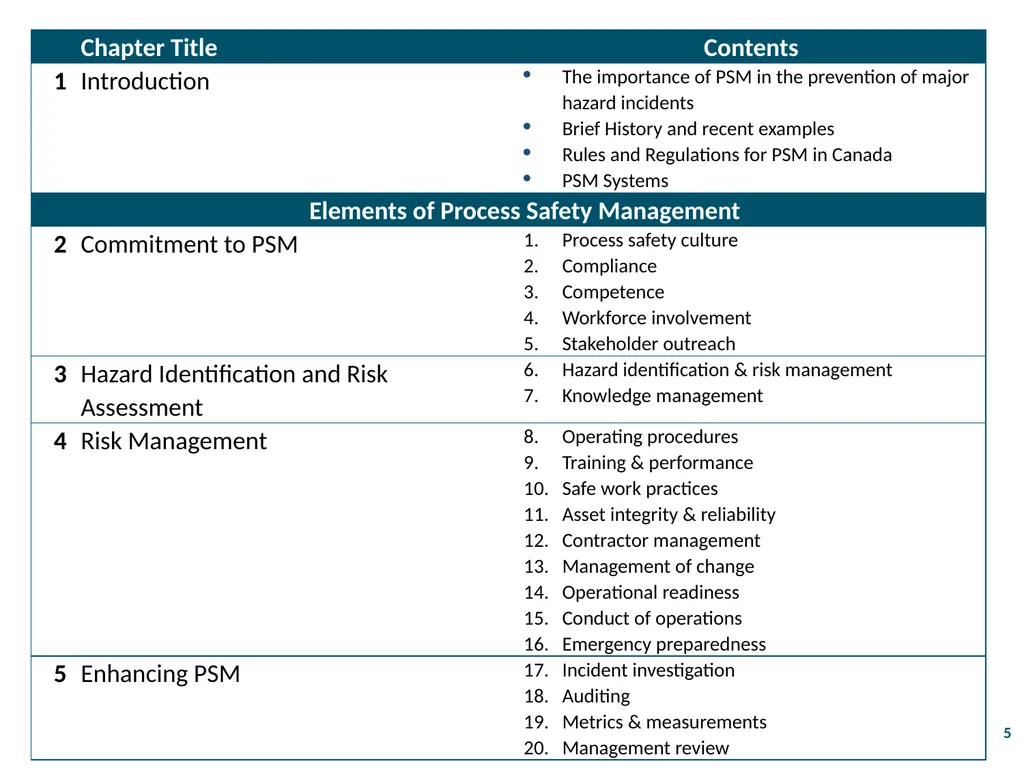
Introduction to the twenty elements of PSM developed by the American Institute of Chemical Engineers Center for Chemical Process Safety
Safety Management: A comprehensive approach to developing a sustainable system (2012)
A comprehensive look at the factors that affect safety improvements and the effectiveness of a process safety management system. Large focus on the human factors which affect the adoptions of safe work practices, such as leadership and behavior.<br>
Risk Based Process Safety Management (2007)
Introduction to the twenty elements of PSM developed by the American Institute of Chemical Engineers Center for Chemical Process Safety
Safety Management: A comprehensive approach to developing a sustainable system (2012)
A comprehensive look at the factors that affect safety improvements and the effectiveness of a process safety management system. Large focus on the human factors which affect the adoptions of safe work practices, such as leadership and behavior.<br>
05
5<br>
06
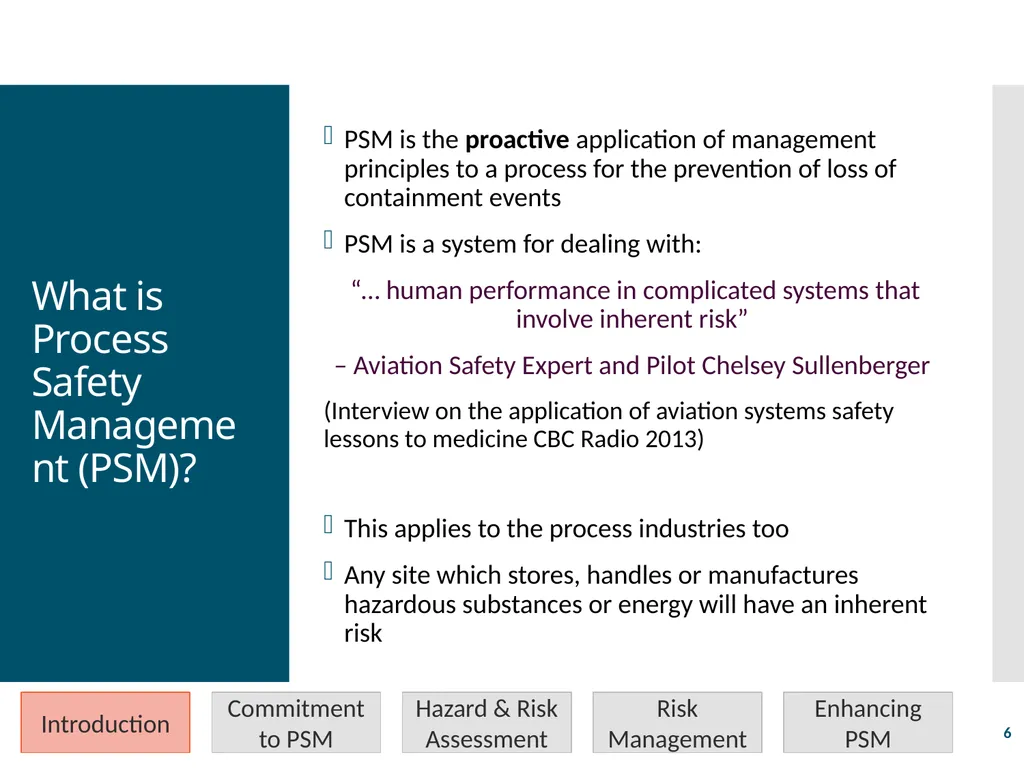
What is Process Safety Management (PSM)? PSM is the proactive application of management principles to a process for the prevention of loss of containment events
PSM is a system for dealing with:
“… human performance in complicated systems that involve inherent risk”
– Aviation Safety Expert and Pilot Chelsey Sullenberger
(Interview on the application of aviation systems safety lessons to medicine CBC Radio 2013)
This applies to the process industries too
Any site which stores, handles or manufactures hazardous substances or energy will have an inherent risk 6<br>
PSM is a system for dealing with:
“… human performance in complicated systems that involve inherent risk”
– Aviation Safety Expert and Pilot Chelsey Sullenberger
(Interview on the application of aviation systems safety lessons to medicine CBC Radio 2013)
This applies to the process industries too
Any site which stores, handles or manufactures hazardous substances or energy will have an inherent risk 6<br>
07
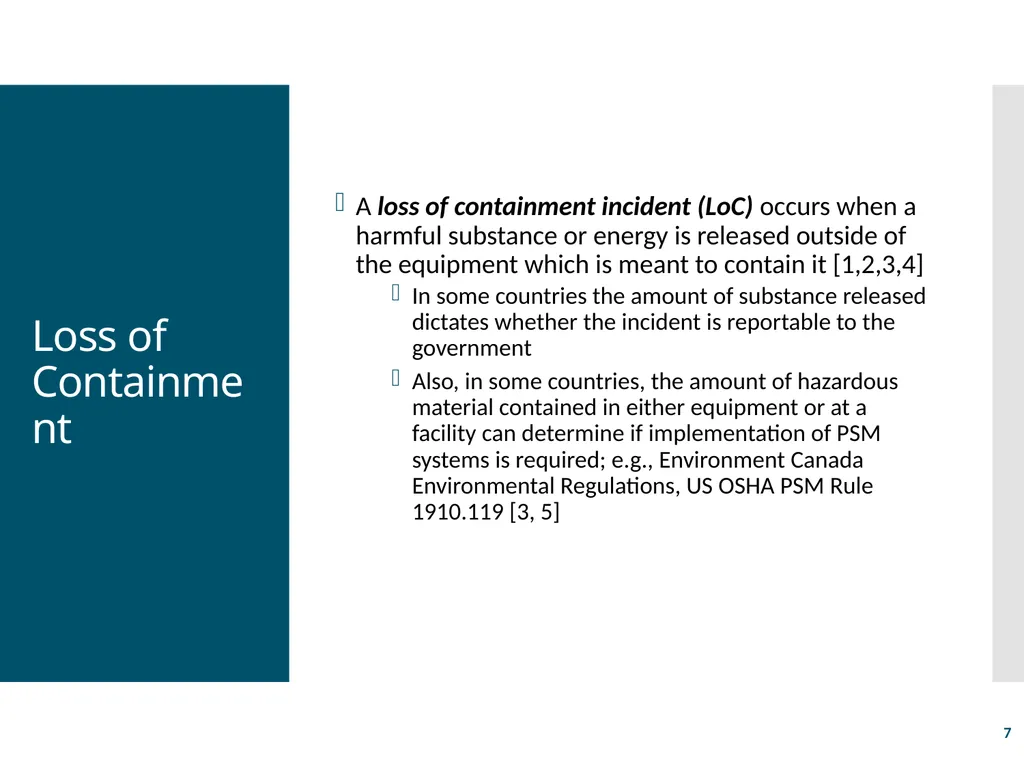
Loss of Containment A loss of containment incident (LoC) occurs when a harmful substance or energy is released outside of the equipment which is meant to contain it [1,2,3,4]
In some countries the amount of substance released dictates whether the incident is reportable to the government
Also, in some countries, the amount of hazardous material contained in either equipment or at a facility can determine if implementation of PSM systems is required; e.g., Environment Canada Environmental Regulations, US OSHA PSM Rule 1910.119 [3, 5] 7<br>
In some countries the amount of substance released dictates whether the incident is reportable to the government
Also, in some countries, the amount of hazardous material contained in either equipment or at a facility can determine if implementation of PSM systems is required; e.g., Environment Canada Environmental Regulations, US OSHA PSM Rule 1910.119 [3, 5] 7<br>
08
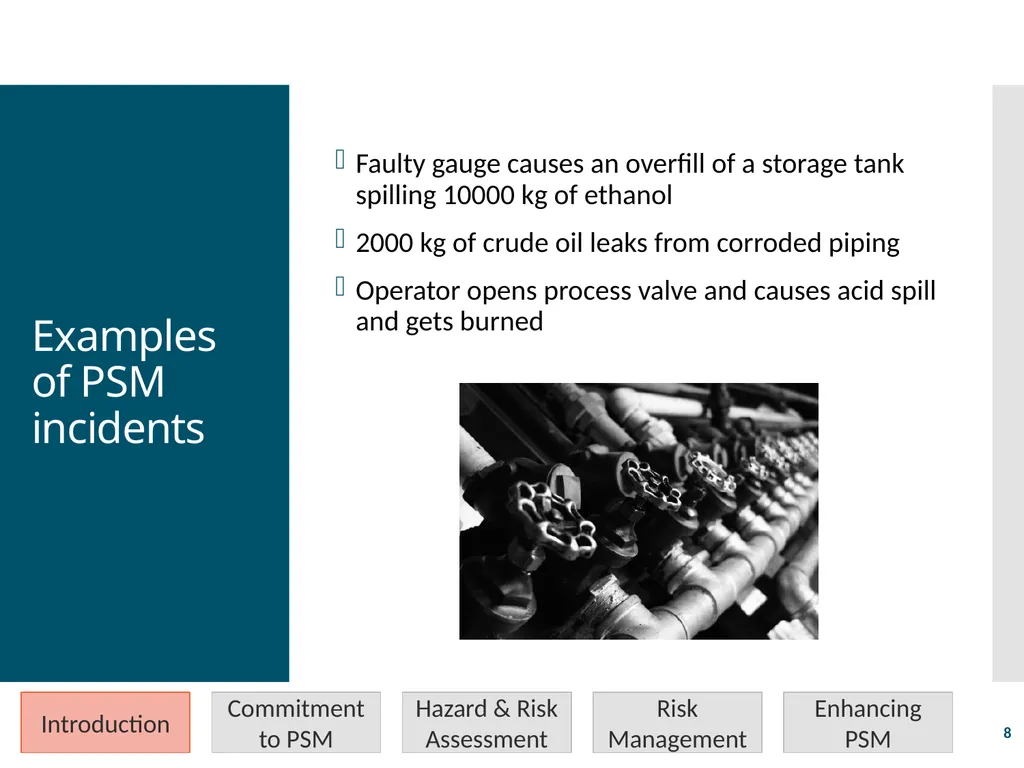
Examples of PSM incidents Faulty gauge causes an overfill of a storage tank spilling 10000 kg of ethanol
2000 kg of crude oil leaks from corroded piping
Operator opens process valve and causes acid spill and gets burned 8<br>
2000 kg of crude oil leaks from corroded piping
Operator opens process valve and causes acid spill and gets burned 8<br>
09
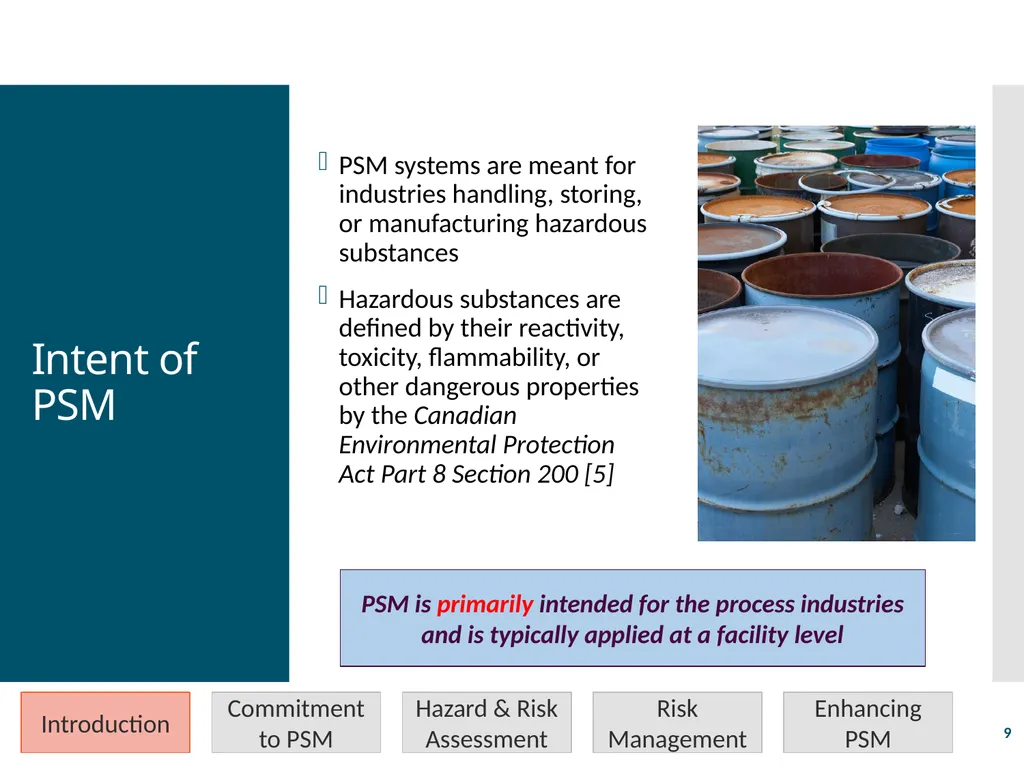
Intent of PSM PSM systems are meant for industries handling, storing, or manufacturing hazardous substances
Hazardous substances are defined by their reactivity, toxicity, flammability, or other dangerous properties by the Canadian Environmental Protection Act Part 8 Section 200 [5] 9 PSM is primarily intended for the process industries and is typically applied at a facility level<br>
Hazardous substances are defined by their reactivity, toxicity, flammability, or other dangerous properties by the Canadian Environmental Protection Act Part 8 Section 200 [5] 9 PSM is primarily intended for the process industries and is typically applied at a facility level<br>
10
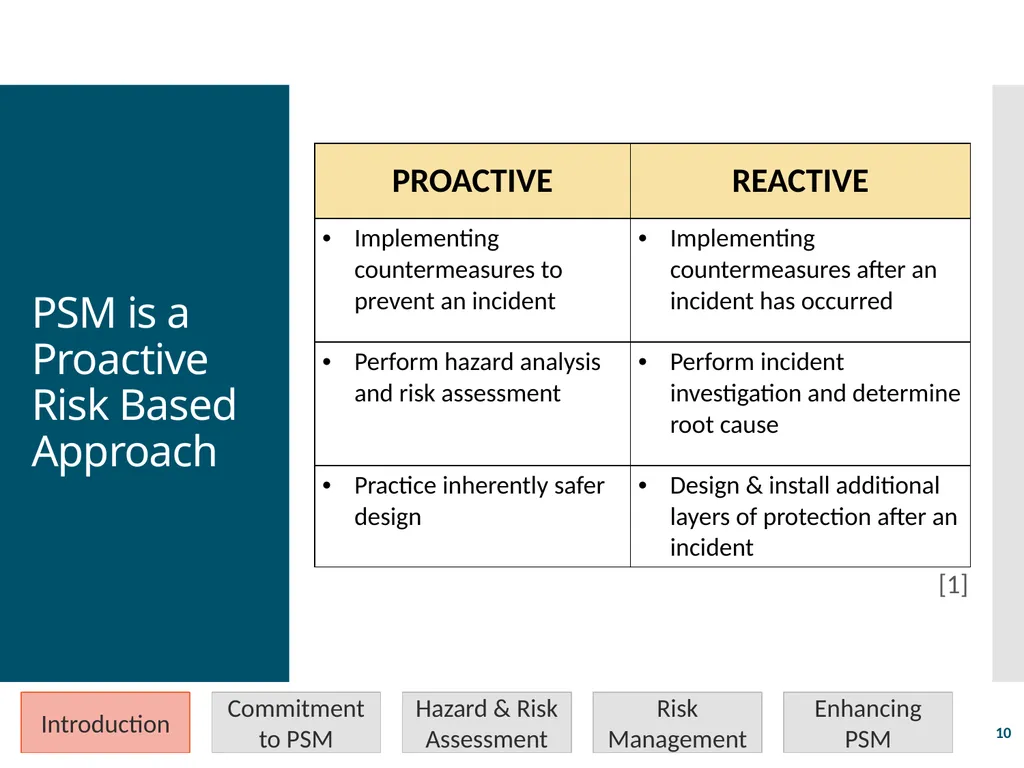
PSM is a Proactive Risk Based Approach 10 [1]<br>
11
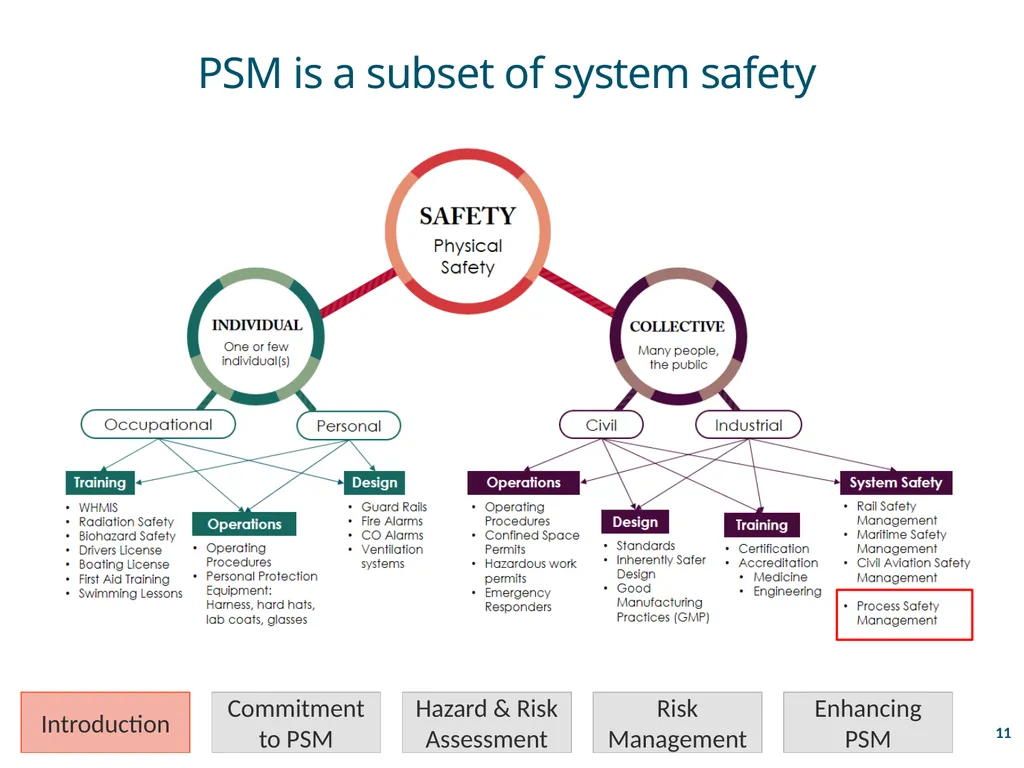
11 PSM is a subset of system safety<br>
12
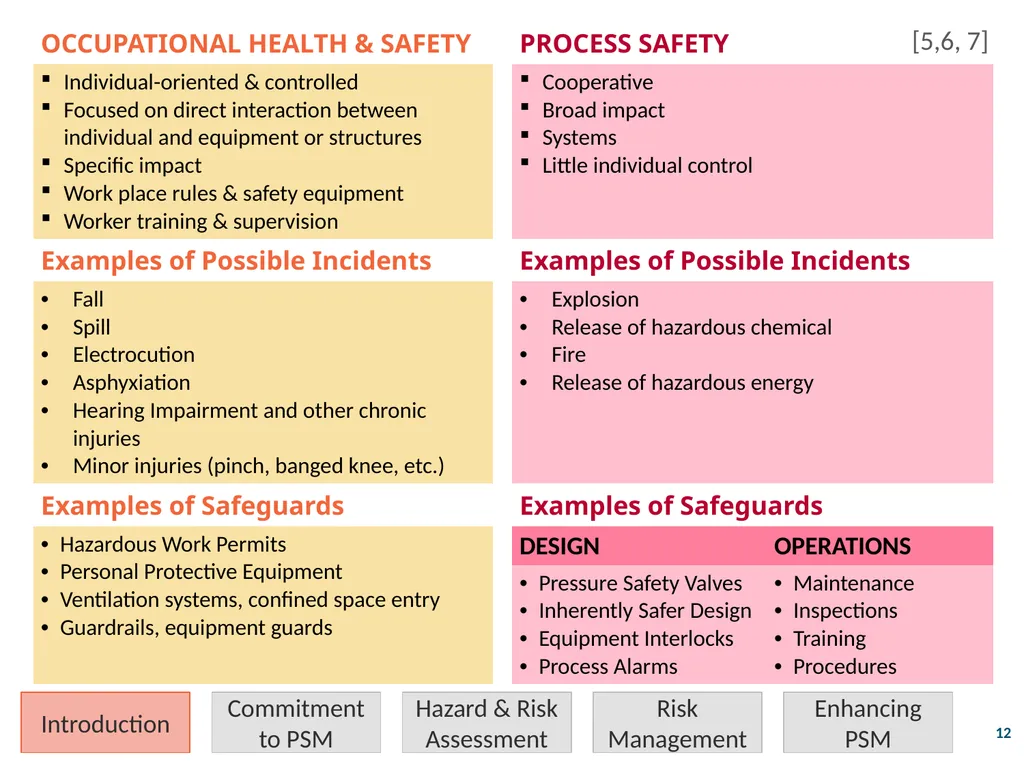
12 [5,6, 7]<br>
13
Why is PSM Important? PSM is important because loss of containment events in the process industries can have DIRE consequences for employees, the public, and the company.
Several major chemical catastrophes have demonstrated the need for effective PSM and the potential devastation of a dysfunctional system 13<br>
Several major chemical catastrophes have demonstrated the need for effective PSM and the potential devastation of a dysfunctional system 13<br>
14
A few major industrial accidents 14 [8, 9]<br>
15
Bhopal India, 1984 Union Carbide Corporation operating in Bhopal manufactured methyl isocyanate (MIC) as a precursor in Sevin (insecticide) production [8, 9].
Over >40 tons of MIC leaked into the air and caused over 3800 immediate fatalities and countless injuries and long term health affects.
Management had intentions to permanently shut down uneconomical operations and while many safety designs were not kept in operation even though a substantial MIC inventory was still in place 15 MIC tanks after Bhopal incident. (Wikipedia commons)<br>
Over >40 tons of MIC leaked into the air and caused over 3800 immediate fatalities and countless injuries and long term health affects.
Management had intentions to permanently shut down uneconomical operations and while many safety designs were not kept in operation even though a substantial MIC inventory was still in place 15 MIC tanks after Bhopal incident. (Wikipedia commons)<br>
16
How did this happen? On the night of the accident, approximately 2000 L of water was introduced into the MIC storage tanks causing an exothermic reaction to produce MIC vapours and increased pressure [8].
There is no consensuses on how the water was improperly introduced into the tanks. Some suggestions include valve malfunction or sabotage.
Regardless, safety considerations had been made in the design of the plant. The MIC storage tanks were equipped with a soda scrubber, a refrigeration system, and temperature and pressure alarms.
However, the scrubber was out of service. The flare, being the last defence, was also not in service. 16<br>
There is no consensuses on how the water was improperly introduced into the tanks. Some suggestions include valve malfunction or sabotage.
Regardless, safety considerations had been made in the design of the plant. The MIC storage tanks were equipped with a soda scrubber, a refrigeration system, and temperature and pressure alarms.
However, the scrubber was out of service. The flare, being the last defence, was also not in service. 16<br>
17
How did this happen? Production had been halted 6 months prior to the accident and the downstream Sevin plant continued to operate using the stored MIC. This indicated that considerable amounts of MIC a highly toxic chemical was being stored for extended period of time.
Inherently safer design (ISD) dictates that inventory of highly toxic materials should be maintained at the lowest possible level to minimize the possibility of large releases. Also, newer technology was later developed to produce the same pesticide product without using MIC intermediate, thus employing the ISD principle of substitution. 17<br>
Inherently safer design (ISD) dictates that inventory of highly toxic materials should be maintained at the lowest possible level to minimize the possibility of large releases. Also, newer technology was later developed to produce the same pesticide product without using MIC intermediate, thus employing the ISD principle of substitution. 17<br>
18
Why did this happen? (In terms of PSM) Accountability and corporate commitment to safety failed when supervisors failed to take immediate action when workers first reported a burning sensation in their eyes.
No management of change system was used to evaluate the effects of shutting down the safety equipment such as the refrigeration system, the soda scrubber and the flare system while continuing to store a significant amount of MIC on-site.
Equipment integrity and operating procedures were not maintained and as a consequence the pressure alarms had become so unreliable they were ignored by workers, the temperature alarms had failed to operate, and the tanks were filled beyond their recommended capacity 18<br>
No management of change system was used to evaluate the effects of shutting down the safety equipment such as the refrigeration system, the soda scrubber and the flare system while continuing to store a significant amount of MIC on-site.
Equipment integrity and operating procedures were not maintained and as a consequence the pressure alarms had become so unreliable they were ignored by workers, the temperature alarms had failed to operate, and the tanks were filled beyond their recommended capacity 18<br>
19
Flixborough, UK, 1974 Napro UK located in Flixborough manufactured caprolactam a precursor for nylon synthesis [4,8,9,10].
An improperly designed bypass line caused the leakage of a 50 ton cyclohexane vapour cloud in seconds
Upon contact with an ignition source, the resulting explosion killed 28 employees and damaged over 1800 buildings in the surrounding area. 19<br>
An improperly designed bypass line caused the leakage of a 50 ton cyclohexane vapour cloud in seconds
Upon contact with an ignition source, the resulting explosion killed 28 employees and damaged over 1800 buildings in the surrounding area. 19<br>
20
How did this happen? Prior to the accident, a crack in the reactor used for the oxidation of cyclohexane was discovered.
The maintenance engineer on-site decided to install a bypass line in order to maintain production and reduce down time.
However, the site experienced mechanical engineer had quit some time before, and those remaining decided to “fast track” a solution for the by-pass.
For design, they sketched a full-scale by-pass line in chalk on the maintenance shop floor.
However, no stress and thrust force analysis calculations were performed on the by-pass line.
The bypass later ruptured and leaked hot cyclohexane into the vicinity which ignited resulting in the explosion. 20<br>
The maintenance engineer on-site decided to install a bypass line in order to maintain production and reduce down time.
However, the site experienced mechanical engineer had quit some time before, and those remaining decided to “fast track” a solution for the by-pass.
For design, they sketched a full-scale by-pass line in chalk on the maintenance shop floor.
However, no stress and thrust force analysis calculations were performed on the by-pass line.
The bypass later ruptured and leaked hot cyclohexane into the vicinity which ignited resulting in the explosion. 20<br>
21
Why did this happen? (In terms of PSM) A functional PSM system would require a management of change system to deal with process design changes.
Every facility must ensure that competent personnel are hired and trained for the positions they fill.
Proper management of organizational change would have identified that the maintenance engineer, and the laboratory manager who also reviewed the shop floor sketch design, were unqualified 21<br>
Every facility must ensure that competent personnel are hired and trained for the positions they fill.
Proper management of organizational change would have identified that the maintenance engineer, and the laboratory manager who also reviewed the shop floor sketch design, were unqualified 21<br>
22
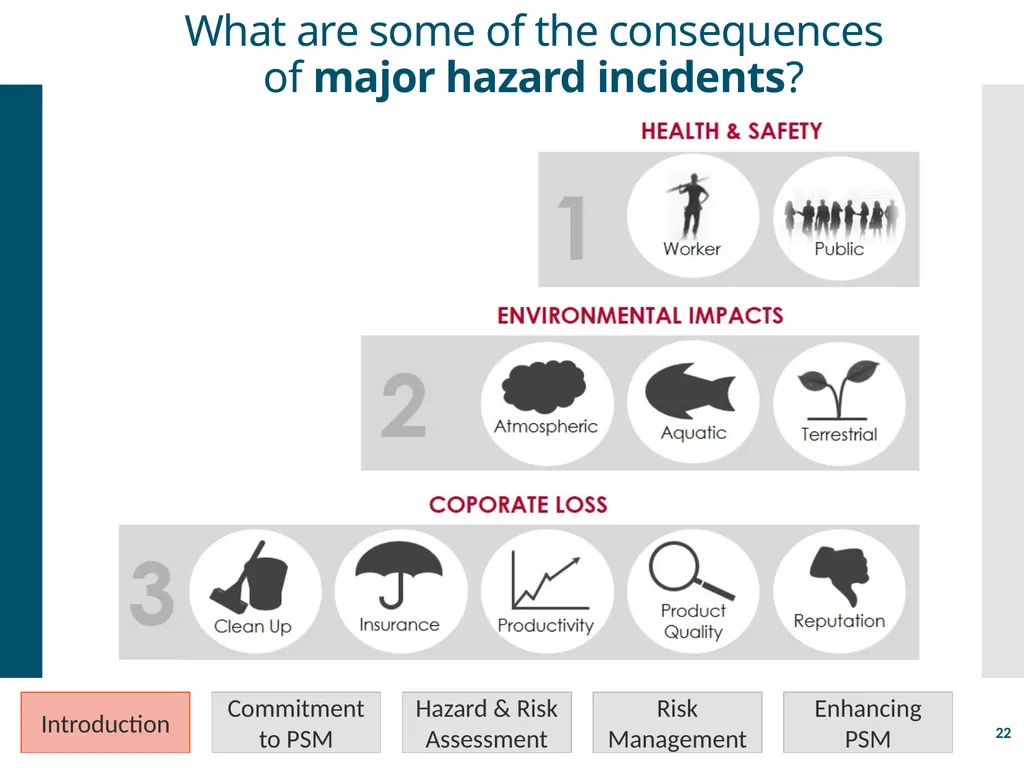
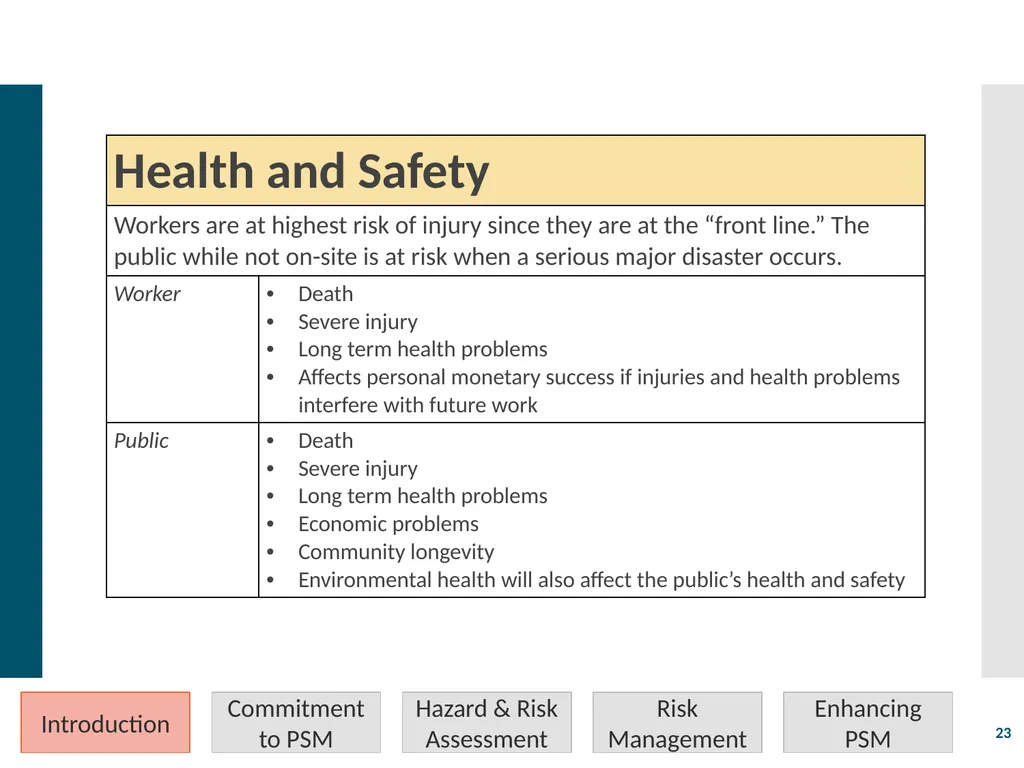
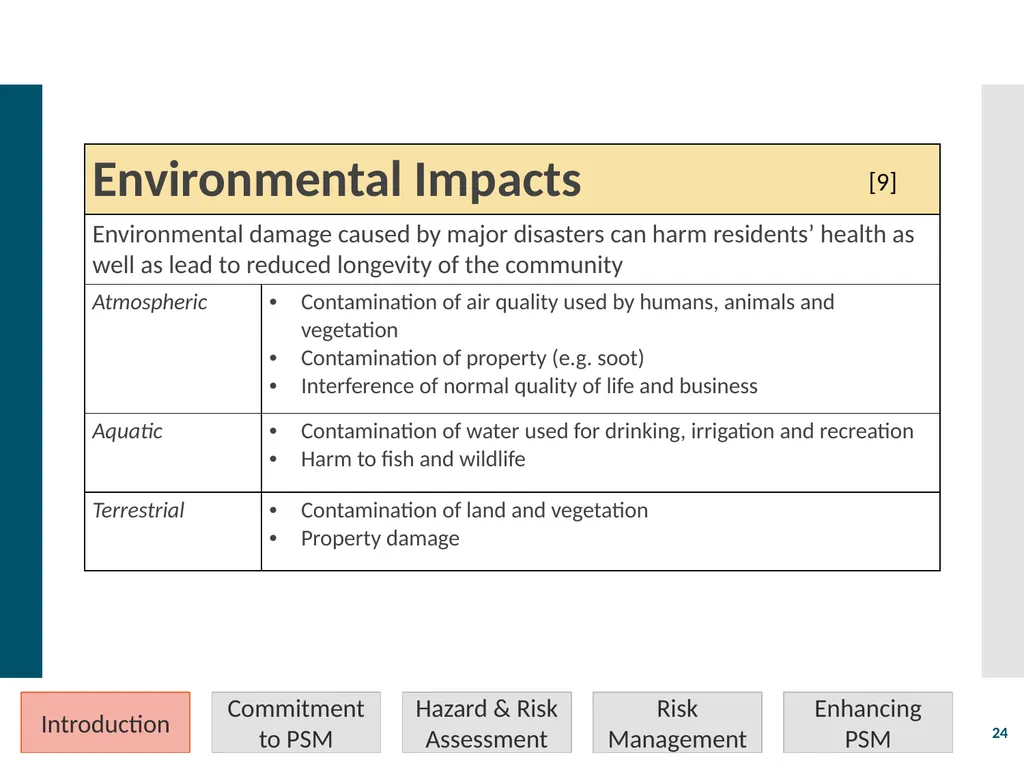
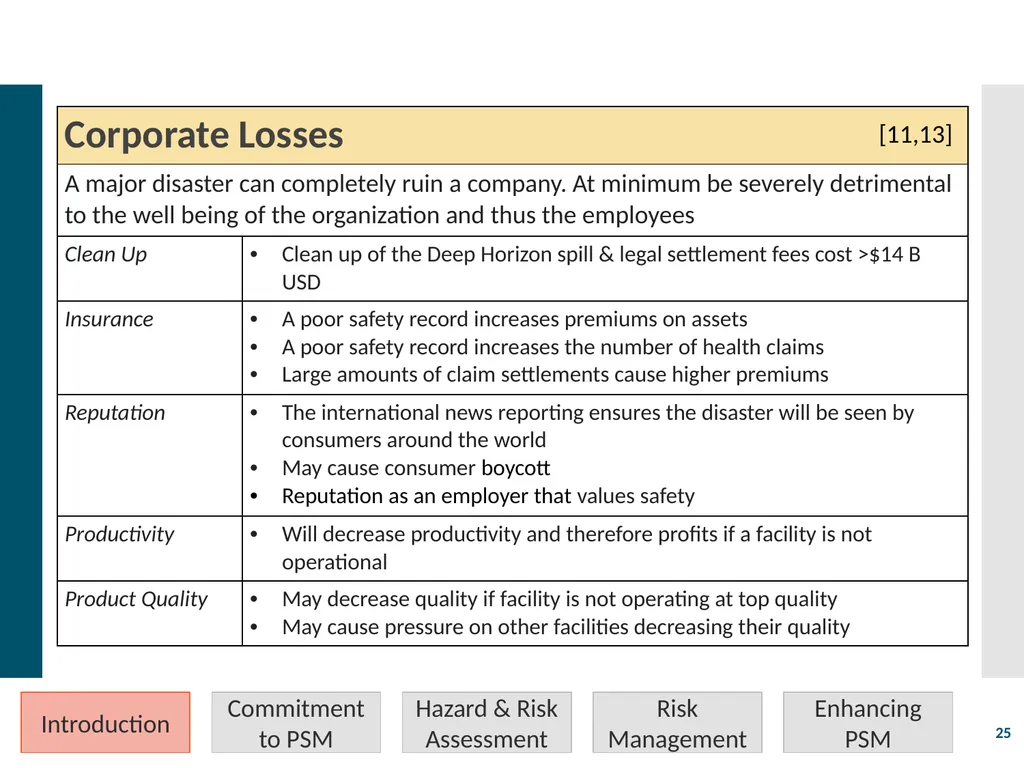
22 What are some of the consequences of major hazard incidents?<br>
23
23<br>
24
24 [9]<br>
25
25 [11,13]<br>
26
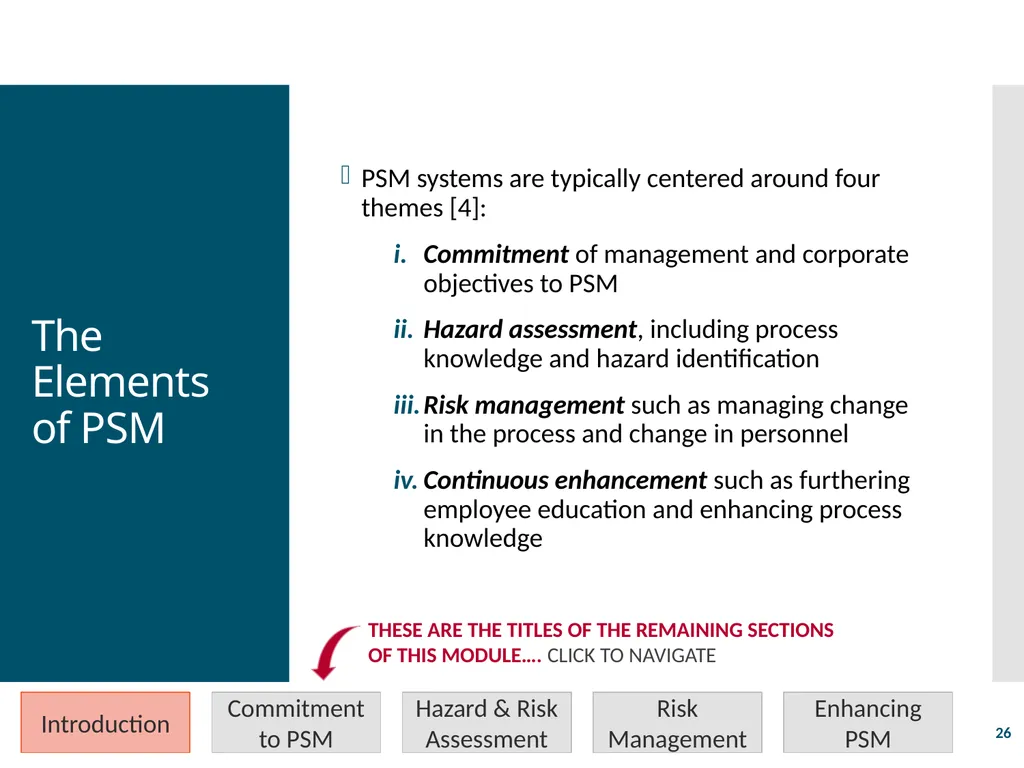
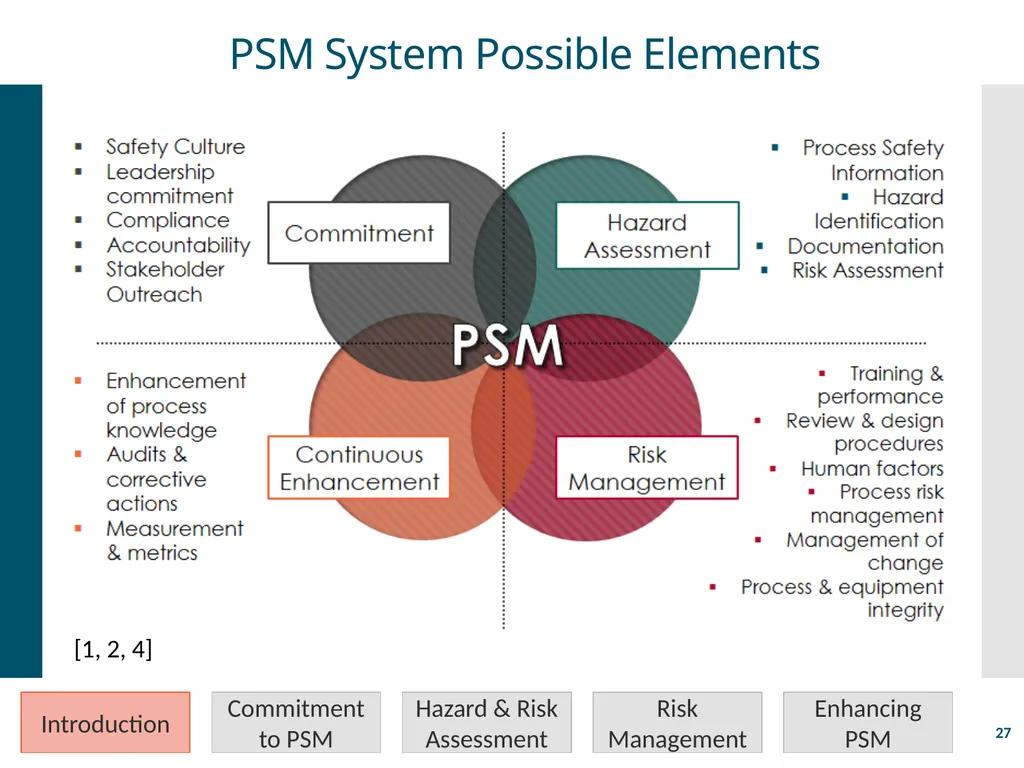
The Elements of PSM PSM systems are typically centered around four themes [4]:
Commitment of management and corporate objectives to PSM
Hazard assessment, including process knowledge and hazard identification
Risk management such as managing change in the process and change in personnel
Continuous enhancement such as furthering employee education and enhancing process knowledge 26 THESE ARE THE TITLES OF THE REMAINING SECTIONS OF THIS MODULE…. CLICK TO NAVIGATE<br>
Commitment of management and corporate objectives to PSM
Hazard assessment, including process knowledge and hazard identification
Risk management such as managing change in the process and change in personnel
Continuous enhancement such as furthering employee education and enhancing process knowledge 26 THESE ARE THE TITLES OF THE REMAINING SECTIONS OF THIS MODULE…. CLICK TO NAVIGATE<br>
27
27 PSM System Possible Elements [1, 2, 4]<br>
28
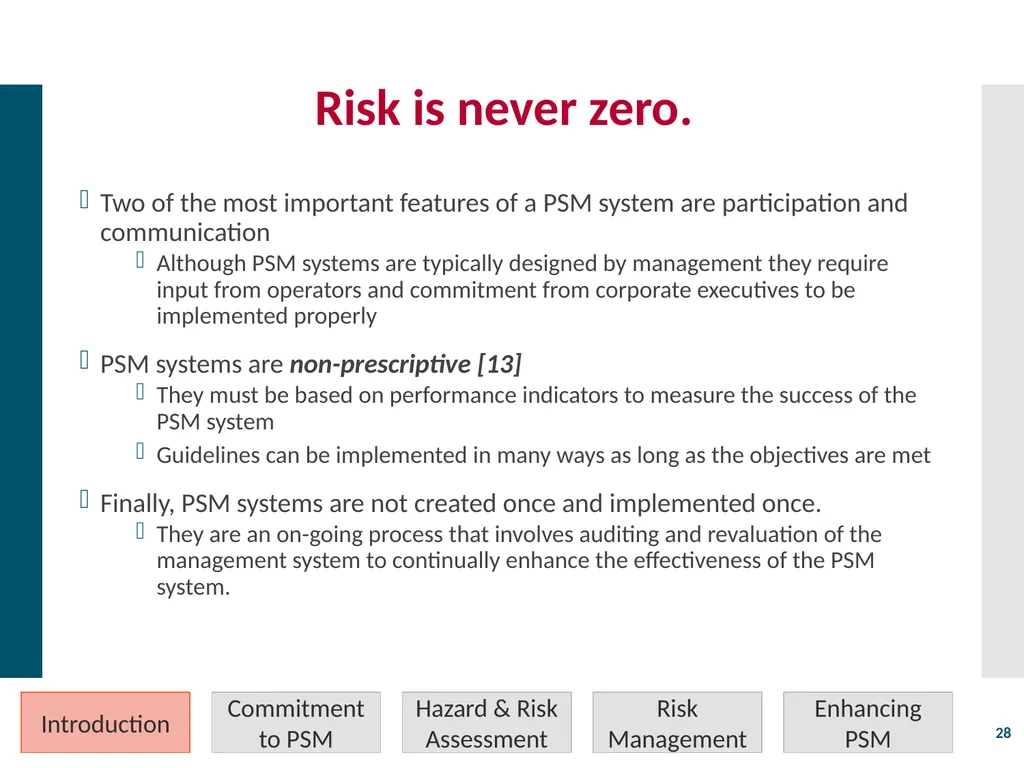
28 Two of the most important features of a PSM system are participation and communication
Although PSM systems are typically designed by management they require input from operators and commitment from corporate executives to be implemented properly
PSM systems are non-prescriptive [13]
They must be based on performance indicators to measure the success of the PSM system
Guidelines can be implemented in many ways as long as the objectives are met
Finally, PSM systems are not created once and implemented once.
They are an on-going process that involves auditing and revaluation of the management system to continually enhance the effectiveness of the PSM system. Risk is never zero.<br>
Although PSM systems are typically designed by management they require input from operators and commitment from corporate executives to be implemented properly
PSM systems are non-prescriptive [13]
They must be based on performance indicators to measure the success of the PSM system
Guidelines can be implemented in many ways as long as the objectives are met
Finally, PSM systems are not created once and implemented once.
They are an on-going process that involves auditing and revaluation of the management system to continually enhance the effectiveness of the PSM system. Risk is never zero.<br>
29
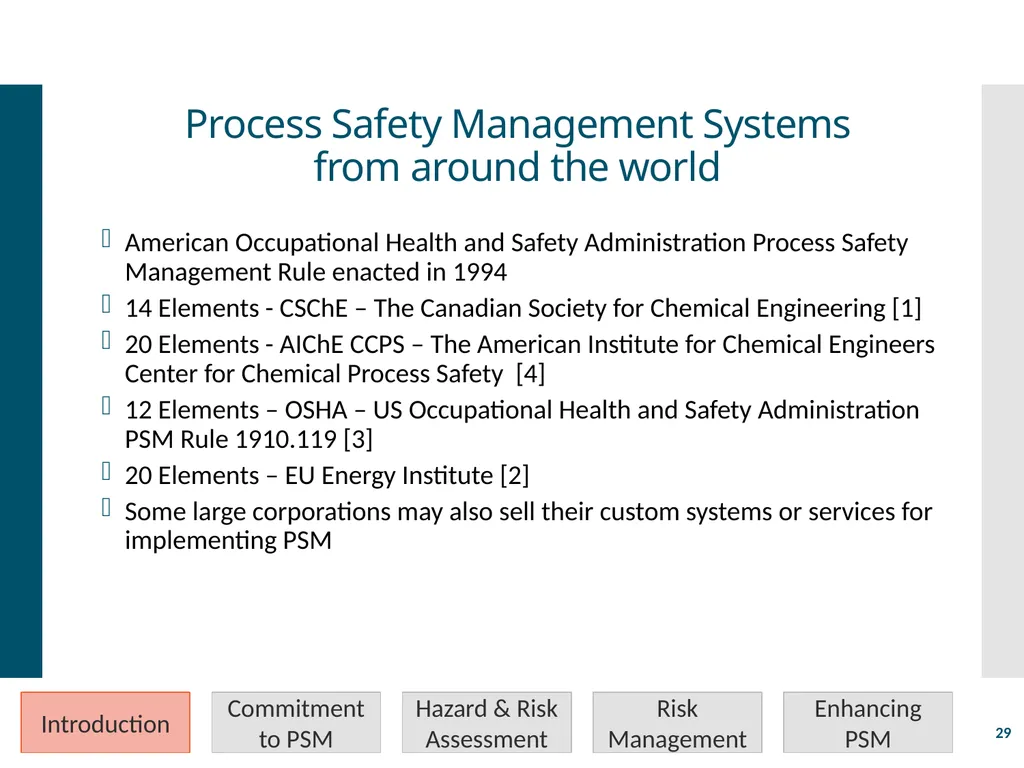
29 Process Safety Management Systems from around the world American Occupational Health and Safety Administration Process Safety Management Rule enacted in 1994
14 Elements - CSChE – The Canadian Society for Chemical Engineering [1]
20 Elements - AIChE CCPS – The American Institute for Chemical Engineers Center for Chemical Process Safety [4]
12 Elements – OSHA – US Occupational Health and Safety Administration PSM Rule 1910.119 [3]
20 Elements – EU Energy Institute [2]
Some large corporations may also sell their custom systems or services for implementing PSM<br>
14 Elements - CSChE – The Canadian Society for Chemical Engineering [1]
20 Elements - AIChE CCPS – The American Institute for Chemical Engineers Center for Chemical Process Safety [4]
12 Elements – OSHA – US Occupational Health and Safety Administration PSM Rule 1910.119 [3]
20 Elements – EU Energy Institute [2]
Some large corporations may also sell their custom systems or services for implementing PSM<br>
30
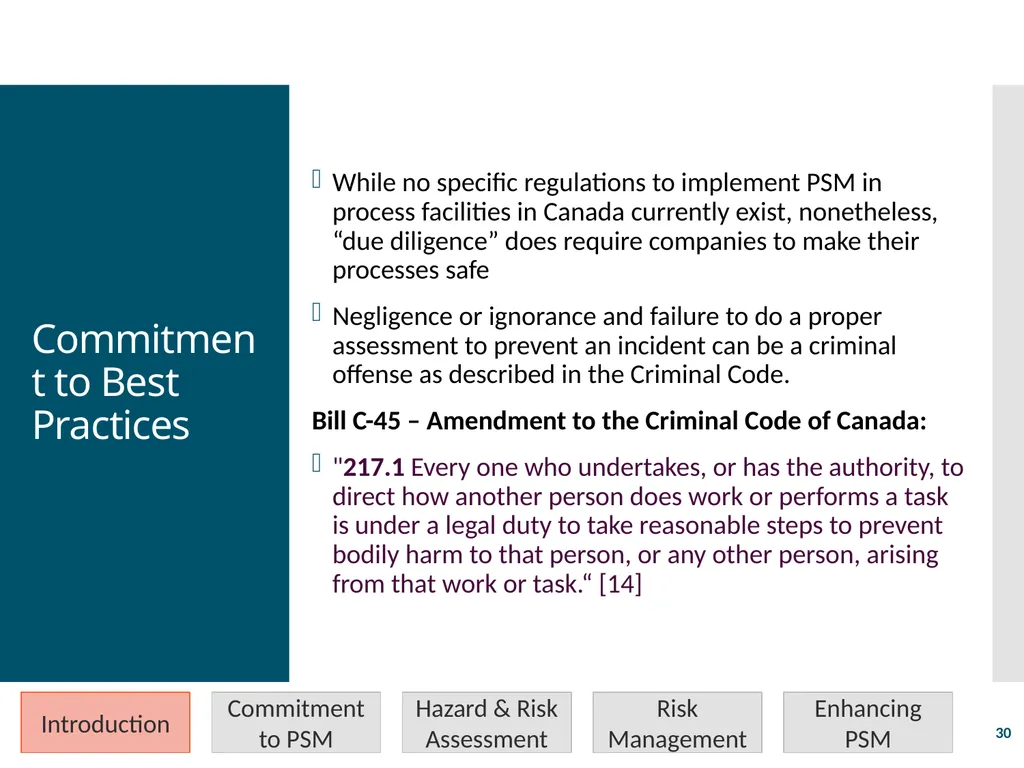
Commitment to Best Practices While no specific regulations to implement PSM in process facilities in Canada currently exist, nonetheless, “due diligence” does require companies to make their processes safe
Negligence or ignorance and failure to do a proper assessment to prevent an incident can be a criminal offense as described in the Criminal Code.
Bill C-45 – Amendment to the Criminal Code of Canada:
"217.1 Every one who undertakes, or has the authority, to direct how another person does work or performs a task is under a legal duty to take reasonable steps to prevent bodily harm to that person, or any other person, arising from that work or task.“ [14] 30<br>
Negligence or ignorance and failure to do a proper assessment to prevent an incident can be a criminal offense as described in the Criminal Code.
Bill C-45 – Amendment to the Criminal Code of Canada:
"217.1 Every one who undertakes, or has the authority, to direct how another person does work or performs a task is under a legal duty to take reasonable steps to prevent bodily harm to that person, or any other person, arising from that work or task.“ [14] 30<br>
31
Westray Bill Bill C-45 was passed as a result of the Westray Mine Explosion in Nova Scotia, 1992
About 8 months after the mine was opened, an underground methane explosion killed 26 workers who were underground at the time. There were no survivors underground [15].
A public inquiry found that the mine was poorly managed, worker safety was ignored, and poor oversight by the government regulators were the causes of the worse mining disaster in Canada
A criminal case was pursued against two managers but was dropped when it became unlikely they would be convicted. 31<br>
About 8 months after the mine was opened, an underground methane explosion killed 26 workers who were underground at the time. There were no survivors underground [15].
A public inquiry found that the mine was poorly managed, worker safety was ignored, and poor oversight by the government regulators were the causes of the worse mining disaster in Canada
A criminal case was pursued against two managers but was dropped when it became unlikely they would be convicted. 31<br>
32
Responsible Care The Chemistry Industry Association of Canada (CIAC) promotes PSM as part of their Responsible Care program for their members [6].
Many companies may possess facilities in the United States which are required by law since 1994 to have a functioning PSM system and are therefore experienced with the development and implementation of these systems. 32<br>
Many companies may possess facilities in the United States which are required by law since 1994 to have a functioning PSM system and are therefore experienced with the development and implementation of these systems. 32<br>
33
PSM around the world Two major international drivers of PSM:
US OSHA PSM Standard 1910.119 [16]
With the US OSHA levying hefty fines in the past few years, the need for functional PSM systems is increasing
While no fines will be levied for failure to possess a functional PSM system in Canada, there are still legal requirements for all people directing work to take reasonable steps to ensure worker and public safety
EU Seveso II Directive [17]
Directive II was a revision of the original directive which increased the requirement to include a safety management system, as well as emergency and land-use planning 33<br>
US OSHA PSM Standard 1910.119 [16]
With the US OSHA levying hefty fines in the past few years, the need for functional PSM systems is increasing
While no fines will be levied for failure to possess a functional PSM system in Canada, there are still legal requirements for all people directing work to take reasonable steps to ensure worker and public safety
EU Seveso II Directive [17]
Directive II was a revision of the original directive which increased the requirement to include a safety management system, as well as emergency and land-use planning 33<br>
34
PSM in Canada In the event of a loss of containment, the criminal code of Canada states that there will be severe penalties for failing to ensure the safe operation of facilities and ensure operational integrity [14].
Environment Canada’s Environmental Emergencies regulation requires hazard assessments to prevent spills, which is the focus of PSM.
Ontario Environment Regulation 224 requires risk assessment of potential spills and a contingency plan
Alberta Strathcona County has bylaws requiring risk-based land use planning adjacent to hazardous
Other bylaws and regulations may exist and should be evaluated for every facility 34<br>
Environment Canada’s Environmental Emergencies regulation requires hazard assessments to prevent spills, which is the focus of PSM.
Ontario Environment Regulation 224 requires risk assessment of potential spills and a contingency plan
Alberta Strathcona County has bylaws requiring risk-based land use planning adjacent to hazardous
Other bylaws and regulations may exist and should be evaluated for every facility 34<br>