Production Function Production Function The production function is a mathematical equation determining the relationship between the factors and quantity of input for production and the number of goods it produces most efficiently. It
"Production Function Production Function The" is the property of its rightful owner. Permission is granted to
download and print the materials on this website for personal, non-commercial use only, and to display it
on your personal computer provided you do not modify the materials and that you retain all copyright
notices contained in the materials. By downloading content from our website, you accept the terms of this
agreement.
Presentation Transcript
01
Production Function<br>
02
Production Function The production function is a mathematical equation determining the relationship between the factors and quantity of input for production and the number of goods it produces most efficiently. It answers the queries related to marginal productivity, level of production, and cheapest mode of production of goods.<br>
03
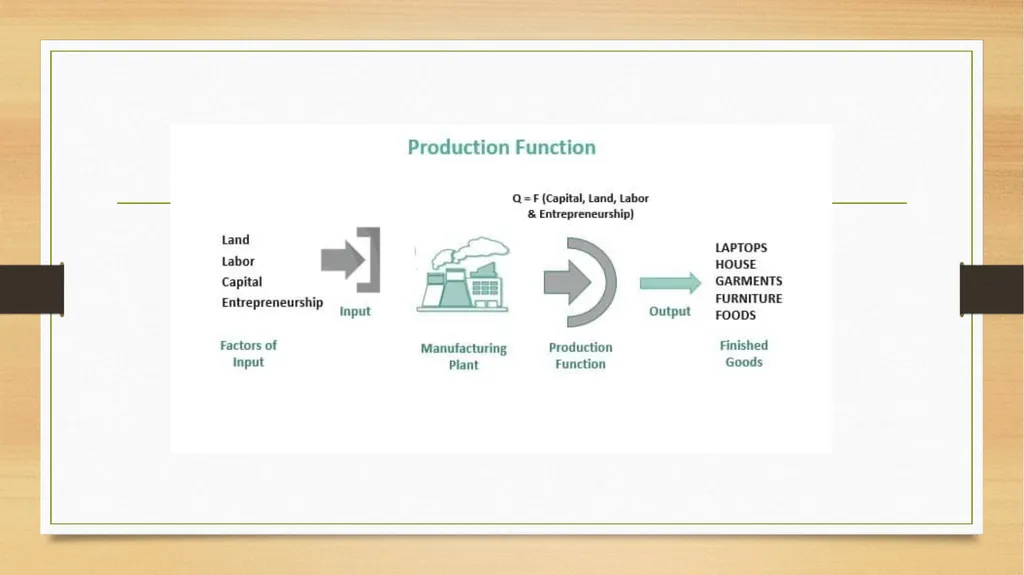
Four major factors of production are – entrepreneurship, labor, land, and capital. They form an integral part of inputs in this function. The production function helps the producers determine the maximum output that firms and businesses can achieve using the above four factors. In addition, it aids in selecting the minimum input combination for maximum output production at a certain price point.<br>
04
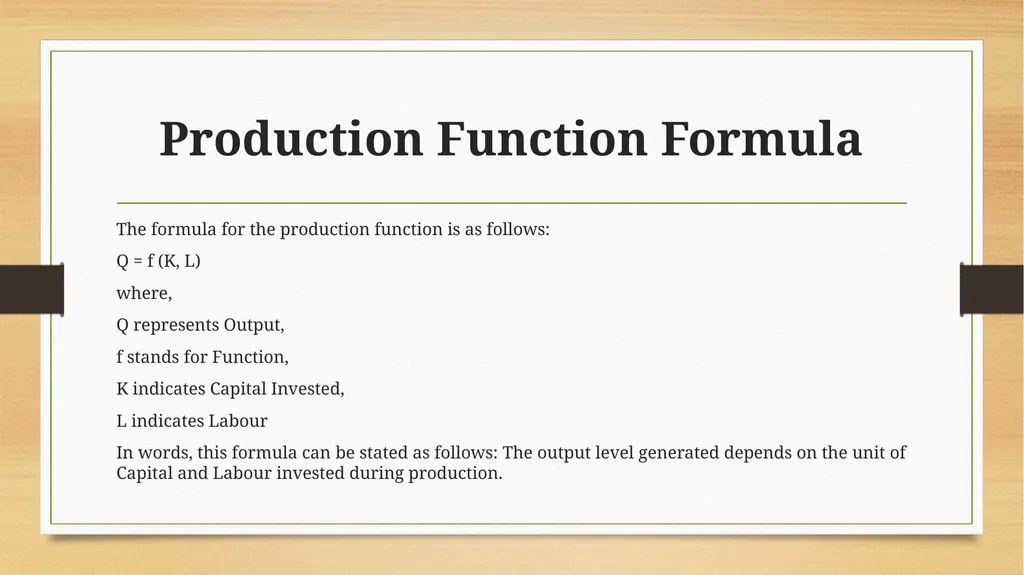
Production Function Formula The formula for the production function is as follows:
Q = f (K, L)
where,
Q represents Output,
f stands for Function,
K indicates Capital Invested,
L indicates Labour
In words, this formula can be stated as follows: The output level generated depends on the unit of Capital and Labour invested during production.<br>
05
Types of Production Functions Depending on the time period, two types of production functions can be seen:
Short-run Production Function
Long-run Production Function<br>
06
Types of Production Functions Short-run Production Function
It is the type of production function that shows changes in output with the change in one variable. Here, the other factors remain constant.
There are two theories based on short-run production function:
Law of Variable Proportion
Return to Factor
Long-run Production Function
All the variables are changed in this production function but in the same proportion. Here, all the factors are variable, and the size operation can be increased or decreased as required.
The theory based on the long-run production function is ‘Return to Scale’.<br>
07
Types Of Production Function Short Run
The firm cannot vary its input quantities in the short-run production function. The law of variable proportion gets applicable here. There is no change in the level of activity in the short-run function. The ratio of factors keeps changing because only one input changes concerning all the other variables, which remain fixed. The manufacturing firms face exit barriers. As a result, they can be shut down permanently but cannot exit from production.For any production company, only the nature of the input variable determines the type of productivity function one uses. If one uses variable input, it is a short-run productivity function; otherwise, it is a long-run function.<br>
08
Types Of Production Function Long Run
In the long-run production function, all the inputs are variable such as labor or raw materials during a certain period. Therefore, the operation is flexible as all the input variables can be changed per the firm’s requirements. Furthermore, in the production function in economics, the producers can use the law of equi-marginal returns to scale. It leads to a smaller rise in output if the producer increases the input even after the optimal production capacity. It means the manufacturer can secure the best combination of factors and change the production scale at any time. Therefore, the factor ratio remains the same here. Moreover, the firms are free to enter and exit in the long run due to low barriers.<br>